The September issue of 4X4 Australia is a big one, and the good news is it’s on sale right now.
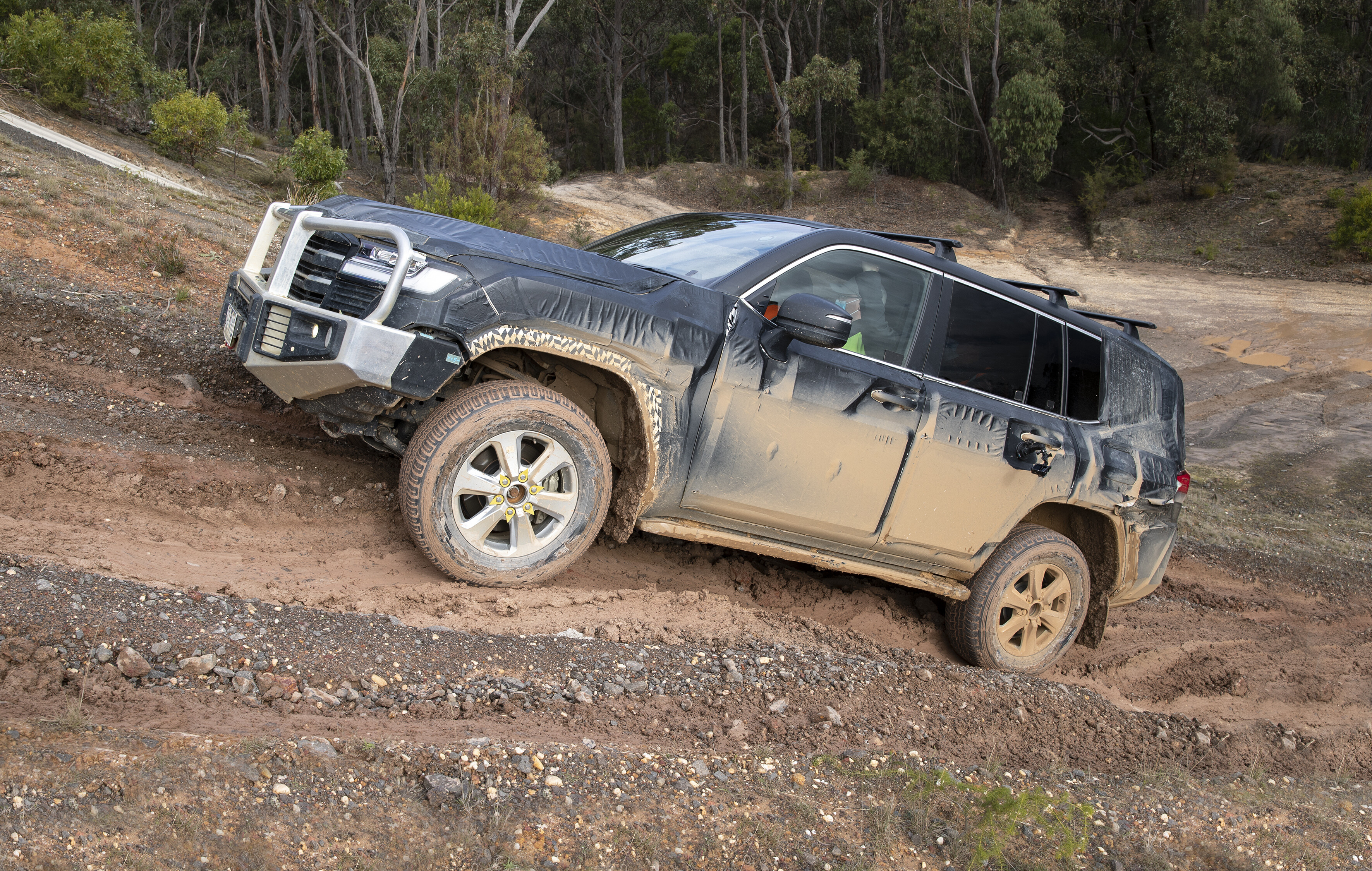
The 300 Series LandCruiser is one of the most hotly anticipated new 4x4s of recent times, and we were lucky enough to be involved in the very first drives. The big question though is, does it stack up against the previous 200 Series?
Speaking of new vehicles, we landed a set of keys to one of the first new Isuzu MU-Xs in the country, and spent a few weeks living with it on and off road. There’s loads more tech inside it, but is there enough to justify the price hike?
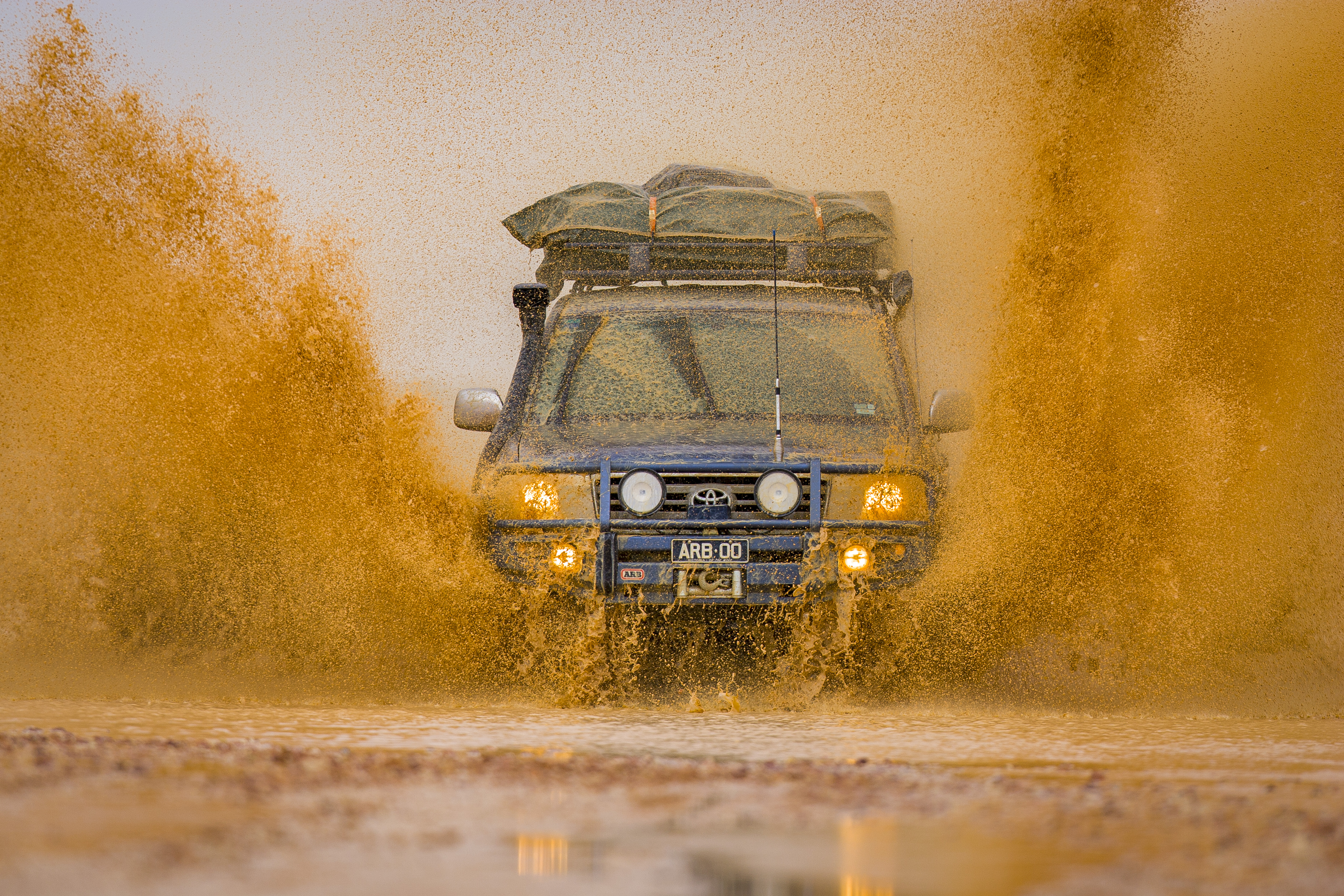
Mud driving is loads of fun, but there’s plenty that can go wrong when you drive through it. We share our expert 4×4 tips on how to drive in the sloppy stuff like a pro.
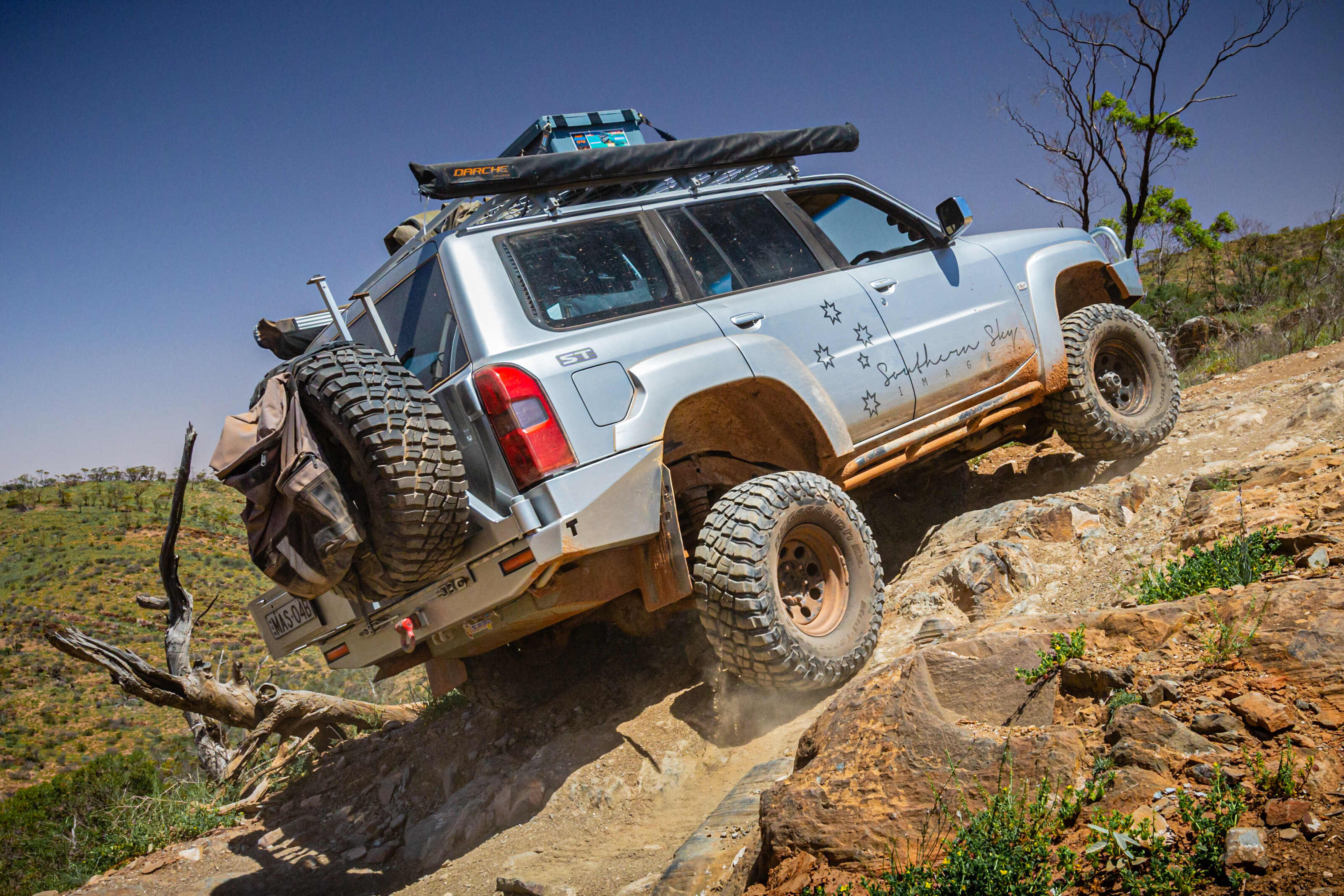
The Flinders Ranges is a bucket list destination for many four-wheel drivers, so we took one for the team and headed out to the beautiful Bendelby Ranges. If you are looking for challenging terrain, stunning views and some of the best sunsets in the country, this is one destination you need to explore.
WHAT ELSE IS THERE?
- Wild MWB LandCruiser custom
- Yakima roof platform install
- Hayman Reese X-Bar fitted to our D-MAX
- Monthly columns + New Gear + Readers’ 4x4s
The September 2021 issue of 4×4 Australia is on sale now.
UPDATE, August 25: Premcar has elaborated on the Navara Pro 4-X Warrior’s design process, revealing it conducted three months of testing in Victoria’s Big Desert Wilderness Park alongside work at the Australian Automotive Research Centre (AARC).
A team of six Premcar engineers and technicians spent up to three weeks at a time putting the pre-production vehicle through rigorous on and off-road work near the South Australian border.“Big Desert was perfect”, said Premcar engineering director Bernie Quinn. “It’s got a lot of different terrain, smooth gravel roads for high-speed testing, really rutted, muddy tracks, sand dunes and sand tracks, and deep corrugations.“Basically everything Australia can throw at you off-roading, it’s got. And then it’s a quick drive to get back onto bitumen roads to validate the changes we made.”
The story to here
August 5: Taking vehicles to their limits has always been a staple of Premcar’s operations – and its latest project, the Nissan Navara PRO-4X Warrior, is no different.
Set to be launched through Nissan dealers from September 1, the Navara PRO-4X Warrior by Premcar has been designed as the marque’s ultimate off-roader – creating a halo model to rival offerings such as the Toyota HiLux Rugged X and Ford Ranger Raptor.
The PRO-4X Warrior has been seriously fettled by the Epping-based team, with Premcar not willing to sacrifice comfort and capability given it is slated to be produced alongside the standard Navara’s lifecycle – not as a limited-run special as was the case with the N-TREK Warrior.
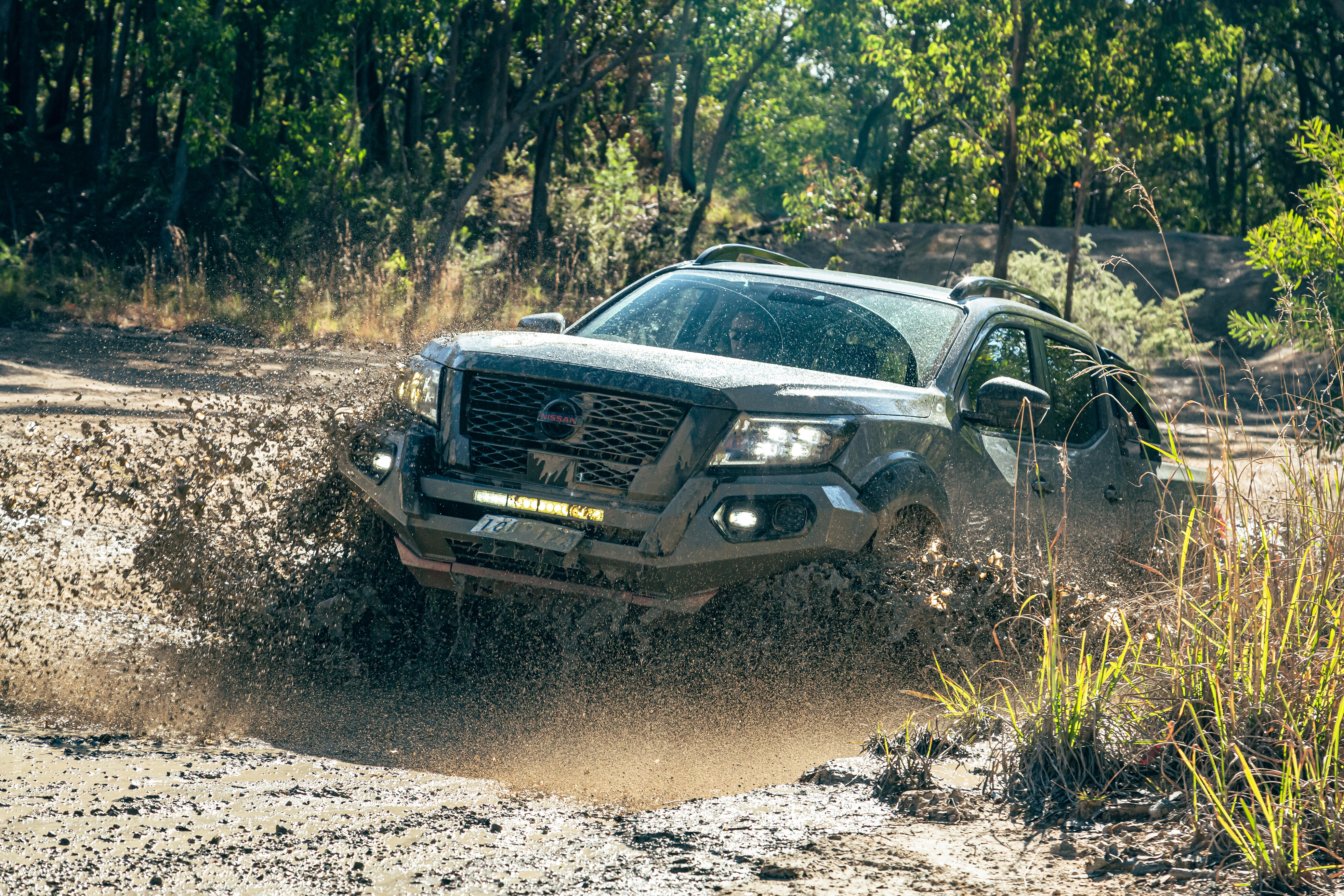
Billed as the world’s toughest Navara, Premcar’s head of programs, Tom Imbesi, said the PRO-4X Warrior’s strengths come from its local development.
“We’ve made it [the PRO-4X] even better,” said Imbesi.
“We undertook durability testing, thermal testing, NVH testing, as well as all the component testing. And we conducted a lot of it at the Australian Automotive Research Centre, and it has some of the toughest off-road tracks.”
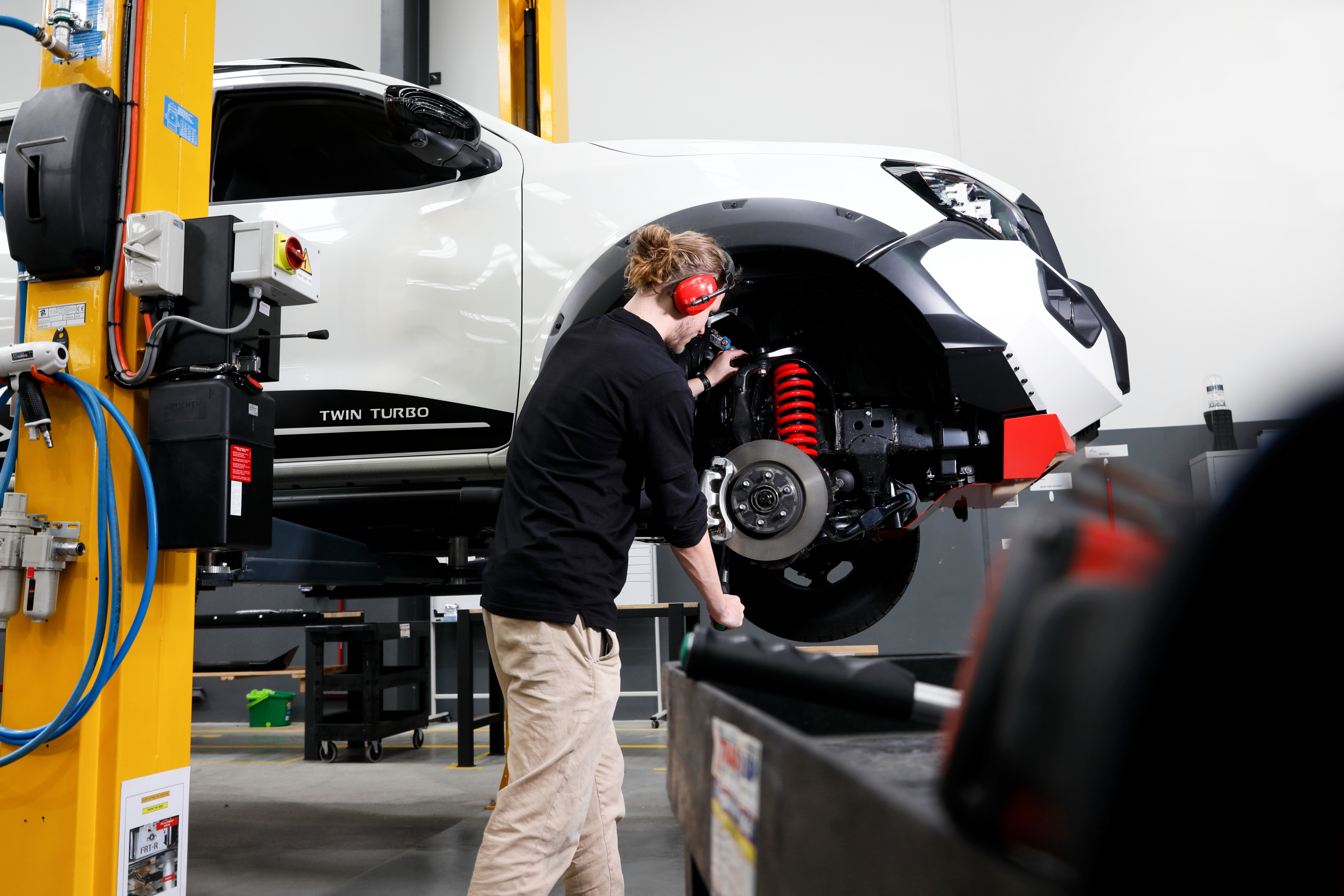
“Australians love utes, but more importantly they love to modify utes – Nissan didn’t have a product which fitted that niche,” added Matt Baily, Nissan’s senior manager of local product development and enhancement.
“From a customer’s perspective, to know it’s been locally developed, locally designed, locally tested and locally manufactured is extremely important.”
Set to arrive in showrooms next month, the PRO-4X Warrior arrives with a price tag of $67,490 in six-speed manual guise, while the seven-speed automatic incurs a $2500 premium – bumping its cost up to $69,990.
BEING located smack-bang between the capital city and the eastern border of Western Australia, the bustling mining town of Kalgoorlie-Boulder has many advantages, and one of them is not being close to a lot of the popular main places of attraction. It’s a four-hour drive for a dip in the ocean, and the state capital a leisurely seven or so hours away. Having a reliable rig capable of extended touring and the ability to do it comfortably, would arguably be high on the wish list of many an adventure seeker from the inland city.
Heading up his own building and construction business has seen Fraser owning a string of standard work utes, a 150 Series Prado and a 2018 Ford Raptor. The Raptor being fantastic for high-speed off-road driving and leaving terra firma on the regular.

“It was a lot of fun,” he says. “It liked hitting tabletops at 140km/h. They’re made for jumping, and the Fox suspension was pretty cool. You could sit sideways in it all day long.”
They say, once you get a taste for something good, it’s hard to look back, and in the end it was what was limiting the Raptor that had Fraser looking atbuilding something to fix those drawbacks. Not being able to tow a decent load being one of them.
Something with the GCM and GVM capabilities is what he needed, and the 79 Series stood out as his next ride, but with a twist. The new dual cab wasn’t going to be delivered to him in Kalgoorlie until after it had all the mods done to it.

“Creative Conversions took care of everything, managing the whole build from over there (in Queensland),” Fraser told us. This entailed fully revised front and rear suspensions, upgraded GVM and GCM, and a fully kitted out canopy ready for free-camping.
BRAND POWER
GETTING on the 79 Series train was a logical step, and the big dual cab ticks the reliability box straight out of the factory, with a rock-solid reputation built up over its long production run.
“You’re not restricted by many things, and they’re built to last,” said Fraser. “You’re able to get pretty much anywhere in it. Compared to the Raptor where you are really limited to what you can tow, it’s why I went with the LandCruiser.”
While being match-fit straight off the production line, LC79s aren’t known for offering plush levels of comfort and amenities. So even before laying eyes on his brand-spanking-new 79, Fraser had it on its way interstate to Creative Conversions for a rear coil set-up plus an extra 300mm of chassis length for good measure.
If only the freight industry were as reliable as a Toyota though, as Fraser’s unseen 79 then went missing.
“I ordered the vehicle and it was put on a train in Fremantle to go over east, and it disappeared for two months,” he says. “After it went to Victoria and up to Queensland, they couldn’t find it.”

After a couple of months, it turned up at the Creative Conversions workshop and after a few calls to verify it was the actual car Fraser had purchased, it was all systems go.
The guys separated the frame rails before adding the aforementioned extra length and removing the diff, leaf springs and all hangers. With the rear chassis laid bare, the plasma cutter was swapped for the welder and the boys set about fitting a chock-full pallet of Superior Engineering gear.
The Superior Engineering upgrade kit addresses every detail needed to upgrade the GVM-GCM, starting with a Superior Track Corrected Diamond chromoly sheet metal rear differential housing – this addressed an oddity of the 79 Series, bringing the rear wheel track outwards and in line with the front wheels. With the GXL 79 running diff locks from the factory, nothing needed adding before being slotted into the new housing, however a pair of longer RCV 300M axles were required for that extra width while also providing increased strength over the standard offerings.
Swinging the live axle through its arc of travel are heavy-duty four-link suspension arms, with adjustable upper links positioned in a triangulated set-up to keep sideways movement to a minimum but allow maximum articulation.

While a ton of work was carried out on the rear, the hits didn’t stop coming when it came to the front end. Superior supplied a pair of its Hyperflex radius arms along with heavy-duty Panhard rod, comp-spec drag link and tie rod. Taming down any unwanted feedback to the steering wheel is a Superior steering damper.
A fat pair of sway bars front and rear cope with the increased load carrying, also being fitted with billet spacers to help handle the displacement caused by the four-inch lifted Superior adjustable remote reservoir shocks and springs.
When it was time to choose a tyre size, Fraser was intent on going with 33 inches, but Jason from All 4 Adventure spied the newly modified 79 Series in the Creative Conversions’ workshop and gave Fraser a phone call.
“They saw my rig there and said ‘Nice rig mate’ and I had a bloody good yarn with them,” Fraser remembers. “I told them I was considering going with 33s and he (Jason) said ‘Nah mate, 35s all the way.’ So he convinced me to go the 35s route.”
Starting with 16×8-inch Speedy Territory rims, Fraser wrapped them in 315/75R16 Dick Cepek Fun Country all-terrains, ordering a full complement of six wheels and tyres.
BACK DECK

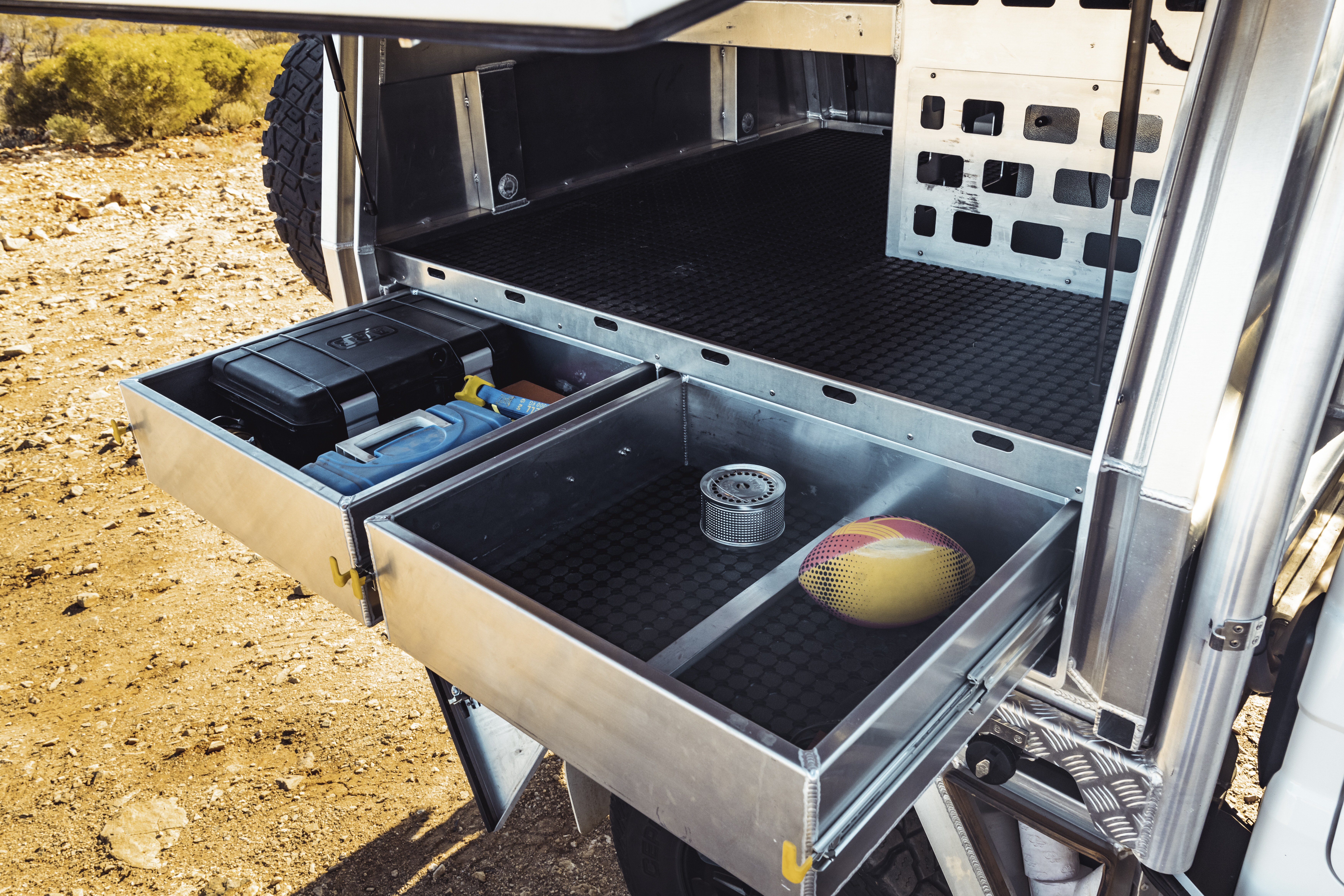
GOING full-spec on a canopy was next, with Norweld building a tray and removable canopy designed to utilise the extra 300mm of rear chassis length The guys there hopped to it, melding sheet after sheet of aluminium together to form the 1986mm long tray and 1740mm long canopy. This included internal drawers, toolboxes, trundle drawer, water tank, Maxilamps and internal locking. All doors in a two-pack finish to match the cab.

Norweld also handled the electrical fit-out of the canopy, calling in Rob’s Mobile Auto Electrics to fit a complete Enerdrive electrical system. The substantial fit-out includes a DC2DC+ charger with MPPT solar controller, ePower 3 Bank Charger capable of maintaining charge to three separate batteries at once, a 200amp/h lithium auxiliary battery, and ePower 2000W inverter. Giving a detailed readout of the state of play is an Enerdrive Pico+ Simarine screen, taking voltage and current draw readouts from a shunt, and also keeping an eye on water tank levels.

If you add all the extra equipment and upgrades regularly placed on 79 Series utes, it makes perfect sense why the 1VD-FTV engine is so sought after. With around 150hp but more importantly 430Nm available in stock form, it’s a proven performer off-road. Fraser pulled a few of the restrictions off, allowing the turbo to spool up faster with a Lundy Race Fab four-inch stainless-steel exhaust system from front to back. This woke the engine up, and after a tickle by the guys at Reaper Performance in Perth, an extra 65hp was achieved. Making short work of any fuel supply, the turbo-charged Toyota V8 likes to stay well-hydrated out on the open road, so 255 litres of diesel is on-tap from two steel Brown Davis tanks. “We originally wanted three tanks in there, but weren’t able to make them fit because of the coil conversion,” said Fraser.
Doing long trips can suck if the cabin is loud and chaotic, so Fraser kept the interior looking clean, starting with SupaFit seat covers. Giving a place for storage and the famously missing cupholders, is a full-length Cruiser Consoles unit. Also from the same company are speaker door pods containing Rockford Fosgate splits in the door panels. A Kenwood touchscreen stereo complete with Hema maps looks after entertainment, and when it’s time to party, the aftermarket speakers benefit from the extra panel damping of a full Dynamat installation, which do a stellar job keeping out road noise and increasing speaker response.
Audio signal is sent rearwards through a Rockford Fosgate amp and sub, mounted behind the rear seat. Alongside is a Cel-Fi mobile phone booster pulling signal through a GME Multi-band Cellular antenna on the ARB Summit bullbar. If antenna matching is your jam, then Fraser has it nailed with a GME 6.6dBi Gain Radome antenna mounted next to it for the Uniden RM980 UHF radio to use. Rounding out the front bar is a pair of Great Whites Attack 220 Series spotties, complementing the standard ARB fog lights.
After 18 months of build time incorporating such an extensive list of enhancements, it’s a gimme that Fraser has been enjoying the hell out of his new 79 since finally laying eyes on it in Kalgoorlie. More than 31,000km has passed under the treads within a few months, (not counting its trip accross the country and back) and with destinations calling all over the state, it’s a fair bet the big white ’Cruiser will be comfortably stacking on a whole lot more at, let’s just say, inspiring levels of velocity.
RED WHEEL WAITING
WHEN an increase in power has been achieved, it’s a sure bet the want for more is just around the corner, or in this case, back in Perth. The 79 will be heading back to Reaper Performance shortly, where it has a G-Turbo ‘Red Wheel’ G350 huffer waiting in the wings, plus a PDI front-mounted intercooler. Feeding the turbo the extra air required via the already fitted Safari snorkel will be a Fatz high-flow aluminium air-box, utilising a cone-style pod filter over the usual OEM panel filter. The extra torque won’t be a problem, however, as an NPC 1300Nm clutch and billet flywheel have already replaced the OEM unit.
CLOSER LOOK
1. Step on downClearview motorised side-steps ease access to the lifted cabin, dropping automatically whenever a door opens.
2. Clear view
Getting a clear look behind the new canopy are a pair of Clearview extendable towing mirrors.
3. Dash cam
Keeping an eye on the road is a Thinkware dash cam capable of 1440P front and 1080P rear resolutions.
4. Fuel watchSub-tank level monitoring is as simple as a dash-mounted LED display.
5. Ripper gripper
Front and rear differential locks are standard on the LC79 GXL model.

THE heavily laden work ute was bogged. Really bogged! And the young tradie who had been there for five hours already was really glad to see us.

We had been heading north from the small community of Apatula (Finke) and dodging around a wide, flooded area of track when we heard a bit of a distress call over the CB. Turns out it was another tradie who had spied our bogged mate and asked us to help.
In the end we had two vehicles, each with a double-line pull, hauling our stricken friend from the red mire. When I asked him if he was heading for Apatula, his reply was definite: “Not any bloody more I’m not. I’m going home, they can stick it. Thanks for the help!”
And with that he was gone!
Then, as we were trying to get out of the firmish area we had parked ourselves on, Trent’s 79 sunk in the red slush and we spent another half-hour extracting him and his trailer.
We were nearing the end of four weeks of wandering the outback with my son’s Moon Tours and while this recovery was one of the more intricate ones, it was by no means the only one.
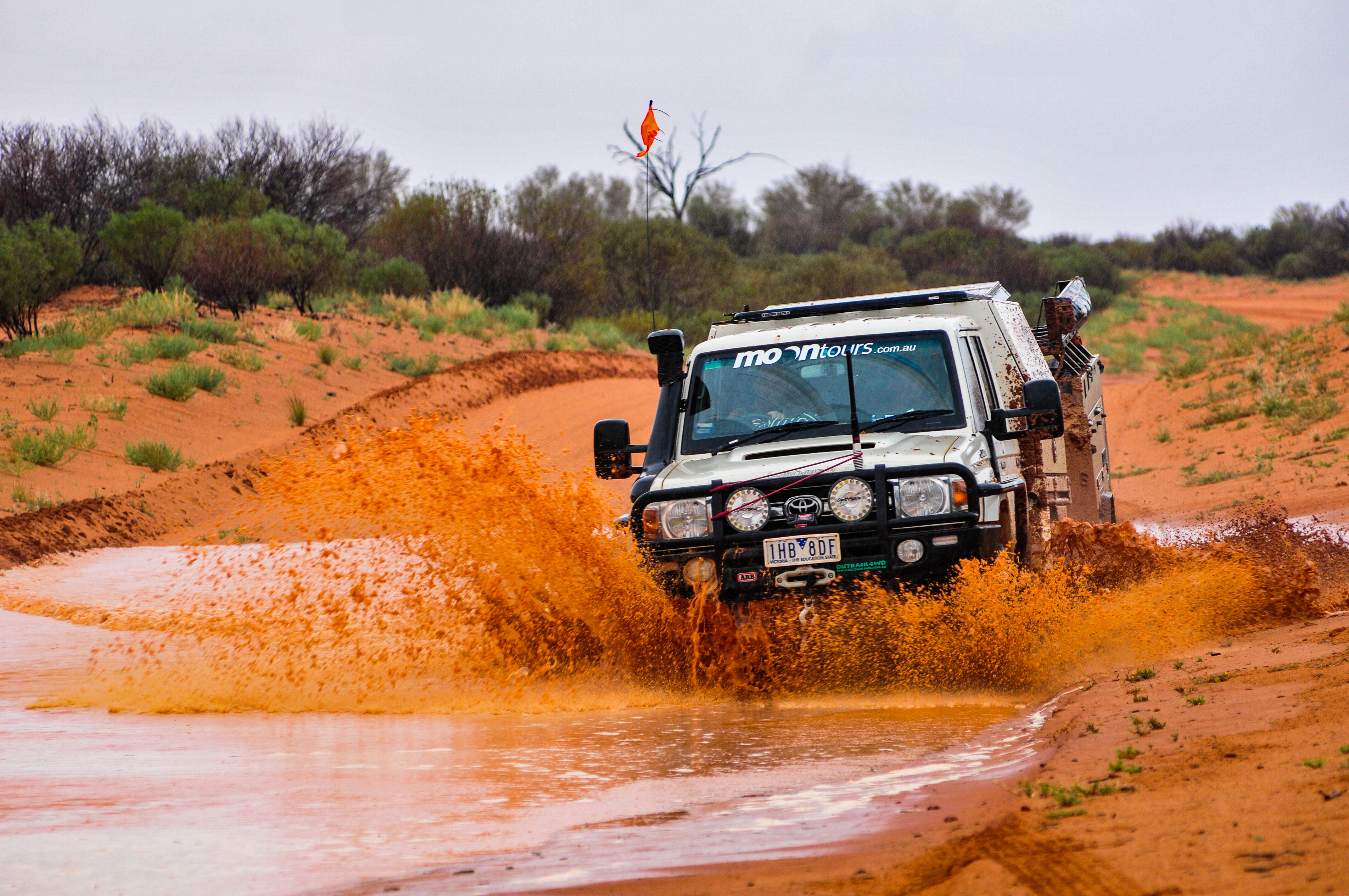
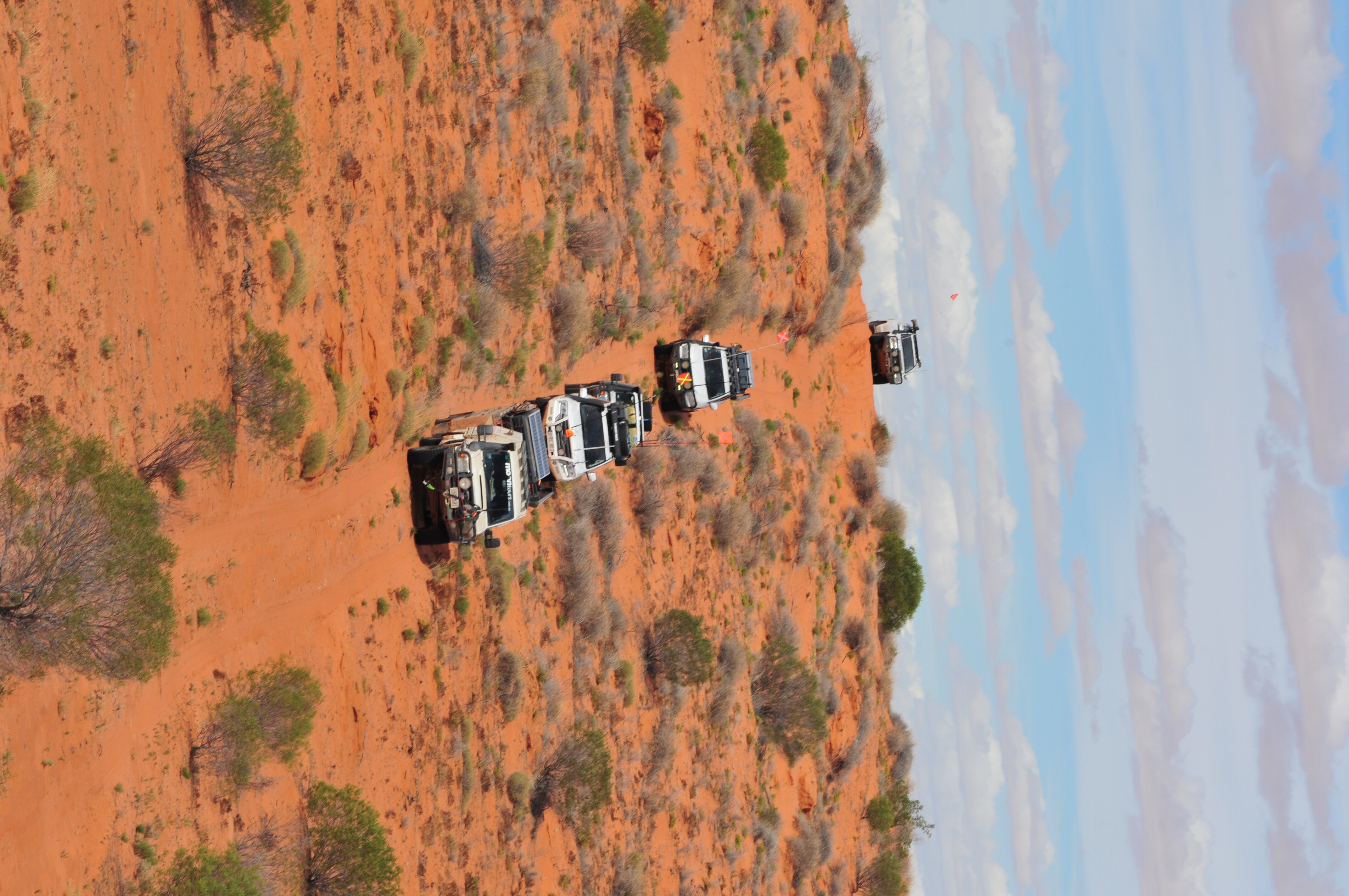
Initially, our little convoy had left Birdsville and, because of a flood warning on Eyre Creek, we were told the only way open into the desert was via the long, circuitous route of the Warburton Track. While it was a long detour we were just glad to be allowed to head into the desert, our group being one of the first, if not the first, to head west from Birdsville for the year.
We dodged around a little as we headed west, striking north to Poeppel Corner first where we came across a couple of vehicles bogged in the centre of the nearby salt lake. We took the diversion track around the north of the lake and wondered why these travellers hadn’t done the same. Their nonchalant replies and cocky attitude beggared belief really and, while we made sure they had water and didn’t need a sat phone to call for help, we left them to it.
Our route then took us down past the Approdinna Attora Knolls on to the WAA Line, a route less used than the French Line and one, I must say, I prefer. With a diversion to the Lone Gum we hit the western end of the French Line and, with the track improving greatly after Purni Bore, we made it to Mt Dare that evening, our fifth night since leaving Birdsville.
RAIN COMING
Greeted by Graham and Sandra, the current owners of this fine establishment, with dire warnings that heavy rain was on its way, we bailed out next morning before the roads closed and as the first spits of rain heralded more on the way.
At Kulgera and the safety of the bitumen the next day, we found dirt roads were closing all around us, with even the bitumen highway to Uluru and the road along the Western Macs from Alice Springs both closed due to flood waters rushing down the normally dry river beds. It seemed choices for a dirt-road adventure were dwindling fast!
A call to a friend who was running Kings Creek Station gave us some positive news with the proviso to watch the flooded creek crossings, but they were already receding when we arrived. That evening we opened the campers and I threw down my swag along the ridge-top camp they called the Drovers Rest, which has inspiring views north to the red raw ramparts of the George Gill Range. The property itself is pretty well set-up for campers and travellers, with a range of accommodation and facilities. With a new owner, expect even more and bigger changes in the future.
KINGS CANYON
As we waited for roads to dry and creeks to subside further, we took the opportunity to explore nearby spectacular Kings Canyon and later joined the manager at Kings Creek as he led us around the property which is basically being destocked. An ancient Aboriginal rock-art site was a highlight before we headed over the road to join an Aboriginal family and their Karrke Cultural Tour, run by Peter and Elma, traditional owners of the area. Over the years we’ve done a few of these tours in different areas of Australia, but this was one of the best and most informative.
Next day with news the Eastern Macs were open, we headed up the blacktop, crossing a strongly flowing Finke River which was worth a stop to view this rare happening. With news that the Hugh River Stock Route and the Old Ghan Line Road were both open, we headed that way and hardly saw any sign of water; although, the country was green from rain that had fallen through here a month or so previously. The only other travellers we saw were a couple of young Aboriginal men who had broken down, and we stopped and got them going again before continuing.
The sun was heading to the western horizon as we drove along the southern flank of the Eastern Macs, the evening light showering the mountains in the rich, reddish glow of the setting sun – it was magical!
We stopped that evening in the pleasant confines of the camping ground at the historic Ross River Homestead, one of the iconic properties of Central Australia and one of the first properties in the heart of the country to look at tourism as a way of surviving this often harsh land.
The nearby N’Dhala Gorge, reached next day at the end of a reasonable 4WD track, was so green it nearly obscured the red rocks the gorge is so well-known for, while flowing water and deep waterholes were another pleasant surprise.
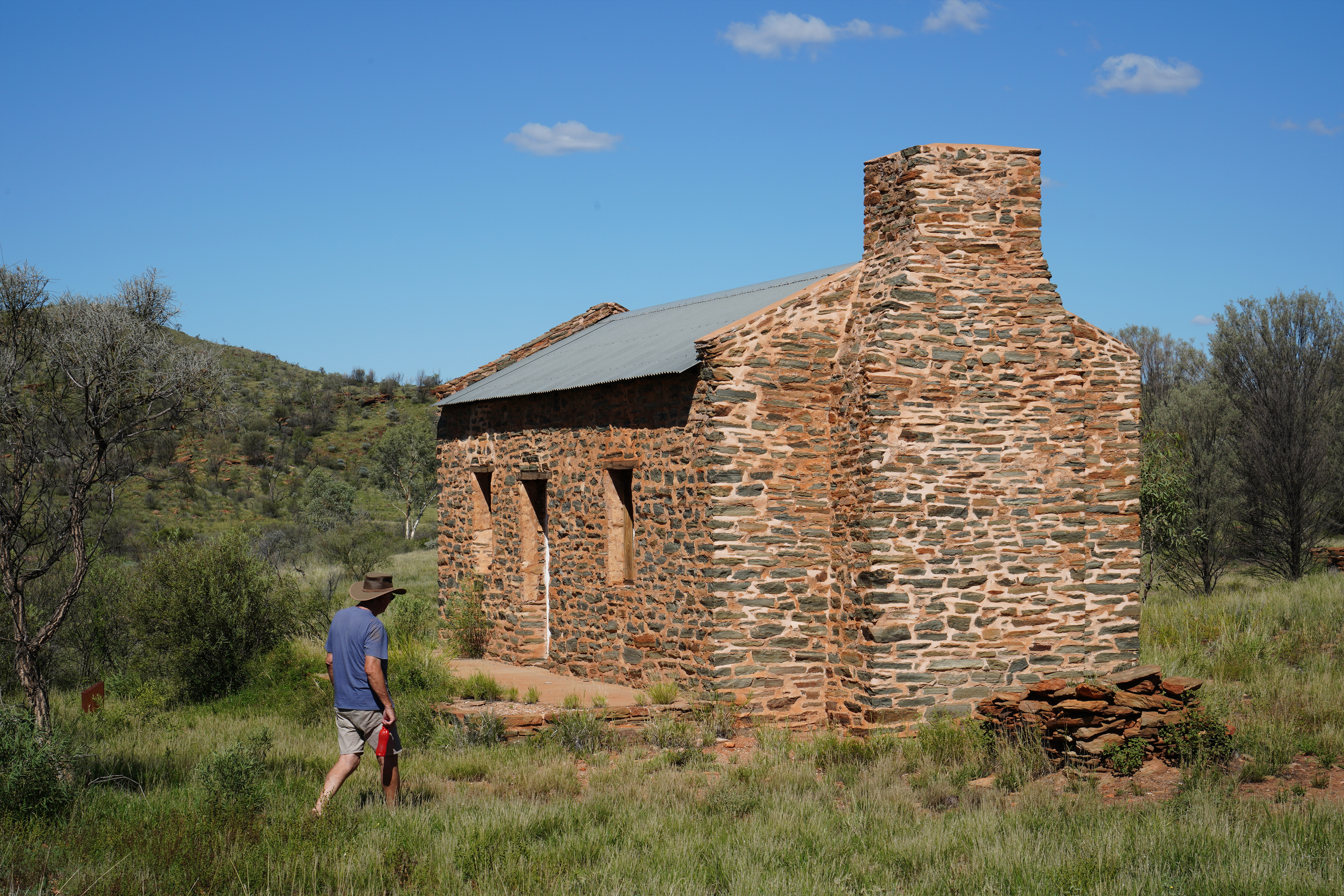
We headed east, stopping at a couple of historic sites in the Arltunga Historical Reserve and, while I’ve been here a few times, it is always an interesting place, depicting a time when pioneer prospectors helped open up the heart of the country with little more than their own feet, tough hands and a lot of manual labour.
That evening we pulled into the very pleasant and well set-up Hale River Homestead and the rich hospitality of the owners, Lynne and Sean and daughter Tracy, along with her two great kids. Set amongst the hills on the northern edge of the spectacular East MacDonnell Ranges and close to the ephemeral Hale River, it was so good our group elected to stay another day. We joined Sean on a trip around the property that the family is turning into a model of sustainable grazing for their small herd of prime cattle. As the heat of the afternoon descended, all of our party retired to the relief of the pool made from a large shipping container and decked out better than most suburban pools. Then it was time for a meal at the famous old workshed the family has converted into a fabulous rustic bar and lounge area.
FLOWER SHOW
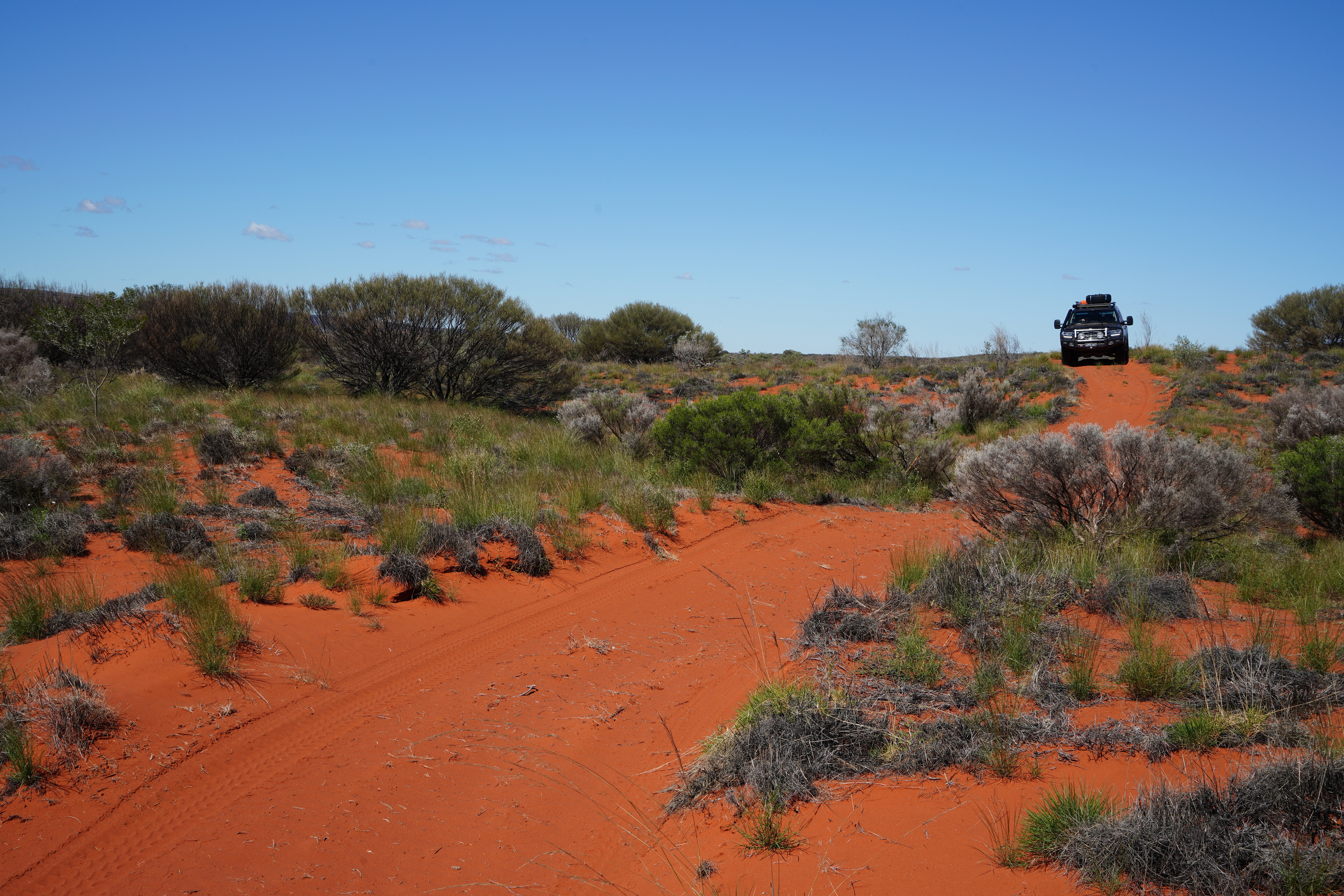
Next day, with word that the track south to Old Andado Station was open, we tore ourselves away and backtracked before taking the Santa Teresa Road through a country where the grass was seemingly growing as you looked at it. In places amongst the sandhill country farther south, daisies were starting to bloom, heralding a wildflower season in the centre of Australia that is bound to amaze travellers and locals alike in the coming months.
As we got closer to Old Andado, the country became less green as it had missed much of the rain of a month or so previously, but had received a drenching just days earlier. The track itself was relatively dry, our wheels throwing up a thin whisp of dust as we headed south, following one of the dunes that mark the western edge of the Simpson Desert. In between these widely spread dunes, the flat gibber stone country had any low-lying pan covered in a sheet of water.
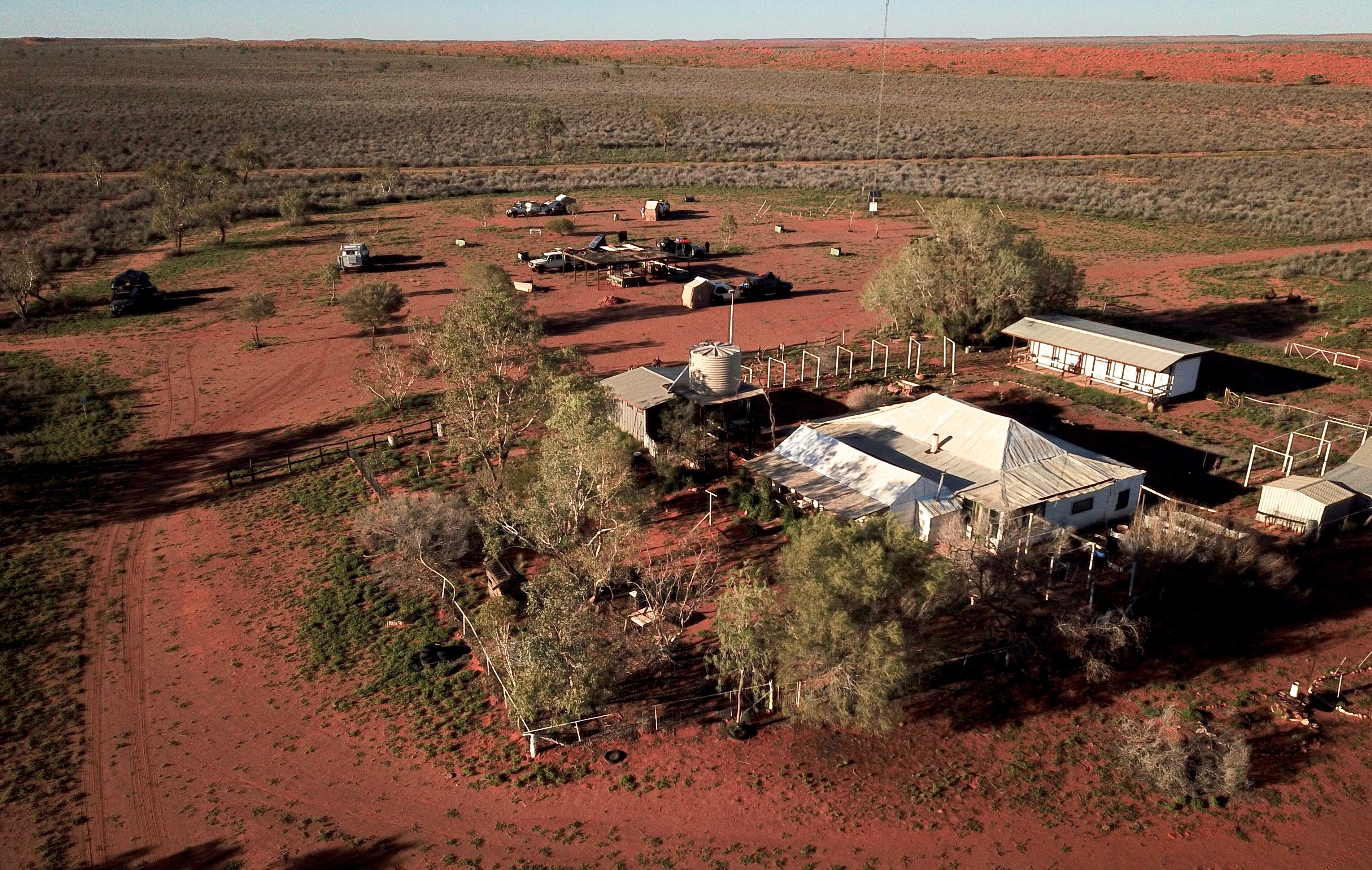

Old Andado Station’s historic homestead is much the same as when the legendary Molly Clark lived there. With COVID and no travellers though, there hasn’t been a caretaker in residence for more than a year, and the dust had blown in and cobwebs hung from the rafter and across the desk where the old RFDS radio still stands. It was a sad sight but everything is still in place, so hopefully another caretaker will be found that can have the water running, the showers and toilets working, and the dust and cobwebs relegated to their rightful place.
The following day we headed along better roads towards New Crown Station, the road showing more and more signs of the heavy rains of a week or so previously.
By the time we got to where the mighty Finke River breaks into a series of wide channels, as it occasionally oozes into the desert to expire amongst the Simpson’s sands, the road was rough and the approaches to the road crossing of the main channel washed away. In its place was a dry stretch of deep, soft sand with hardly a patch of water to be seen, but the first vehicle across got stopped in the sandy morass, which required a few Maxtrax before it was on the move again.
Then, with the Maxtrax still in place, the rest of our convoy slipped across without a worry.
At the Aboriginal community of Apatula we fuelled up and took a heavy toll on the steak sandwiches and sausage rolls of the general store while yarning to a few of the locals who were looking forward to the annual Finke Desert Race in June once more, after a break in 2020 due to bloody COVID.
Just north of the small community the main track to Alice Springs, part of the historic Old Ghan Railway Line route, we crossed a still flowing Finke River.
Talking to a young jackaroo who had pulled up to let us pass, he informed us that the river had been in flood for more than a week and the crossing had been closed up until that morning. While the crossing itself was a little soft, it wasn’t an issue, but it was so good to see water flowing into the desert and to experience what is, in fact, a very rare occurrence.

It was a few kilometres north of the Finke River when we came across our bogged tradie and spent more than an hour extracting him and then one of the recovery vehicles. With that adventure behind us we pushed north, the sun heading to the distant horizon and our group pulling up for the evening beside the old fettlers’ cottages at the now defunct railway siding at Rodinga.
It was our last night camped in the desert after what had been a momentous few weeks in the very heart of Australia. While the rain and water had closed roads and changed our plans considerably, the trip was made even more memorable by the verdancy of the landscape so different to the norm and the burgeoning explosion of life brought on by the rains. We’ll never forget it!
Don’t miss these spots in the red centre
1. Dalhousie Springs, SA 2. Kings Creek Station, NT 3. N’Dhala Gorge, NT 4. Arltunga Historical Reserve, NT 5. Hale River Homestead, NT
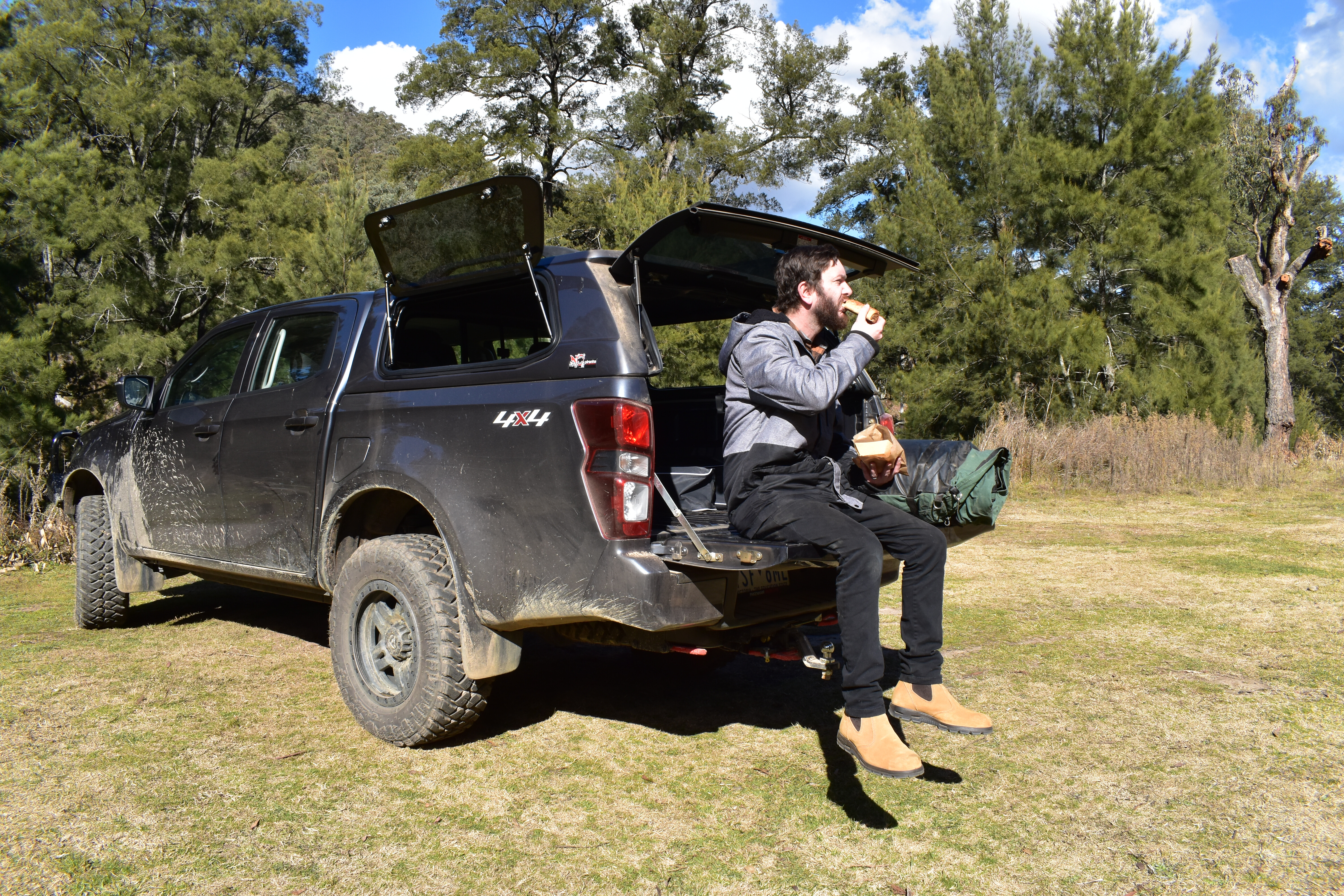
RUNNING our D-MAX without a tonneau cover or canopy over the tub has meant that I’ve had to store any valuables on the back seat of the ute for the last few months, making it difficult to cart passengers around. There are few things in this world more frustrating than having a ute without some form of cover over the tray. Sure, it’s fine if you are moving house and need maximum height, but we’re moving swags not domestic fridges or washing machines.
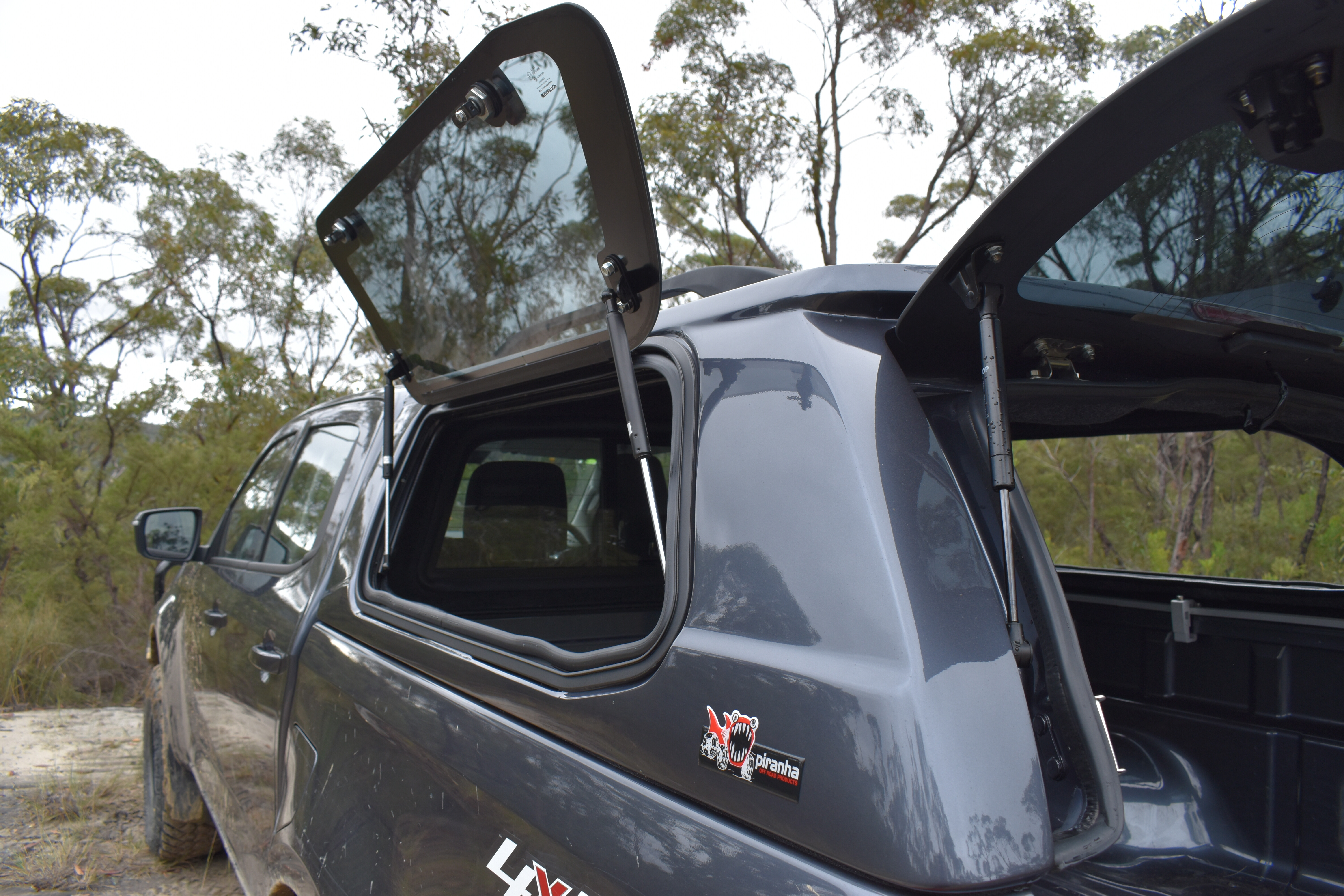
Piranha Off Road has been around for more than 30 years, specialising in 4WD electronic battery management systems and trays. Recently, it has expanded its product range into 4WD canopies and ute trays, and we saw this as a great opportunity to have one of its fibreglass canopies installed on to our 2020 D-MAX. We wanted to fit a fibreglass canopy, that had rated roof racks (100kg in this case), lift-up side windows and a nice colour-matched painted finish. We also wanted to have central locking and a rear window demister. The Piranha canopy ticked all those boxes, and really suits the look of the D-MAX.
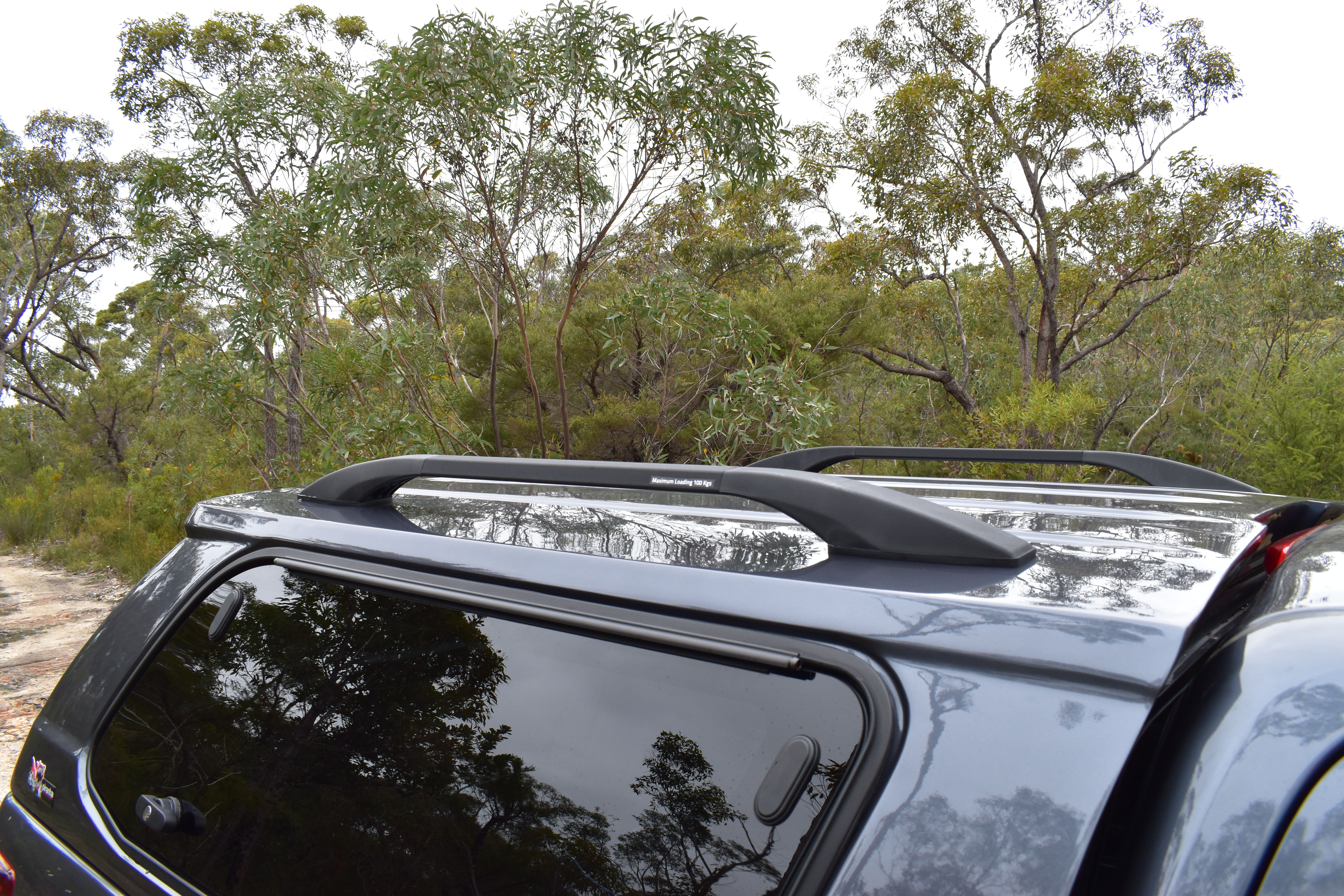
The canopy arrived unpainted and once we supplied the paint code, it was sent off to be sprayed. Once dry, the team at McNaughtans in Western Sydney handled the fitment, which was by all accounts a simple affair. Everything was supplied with the canopy, including a wiring loom to tap into the factory rear brake lights, central locking and window demister.
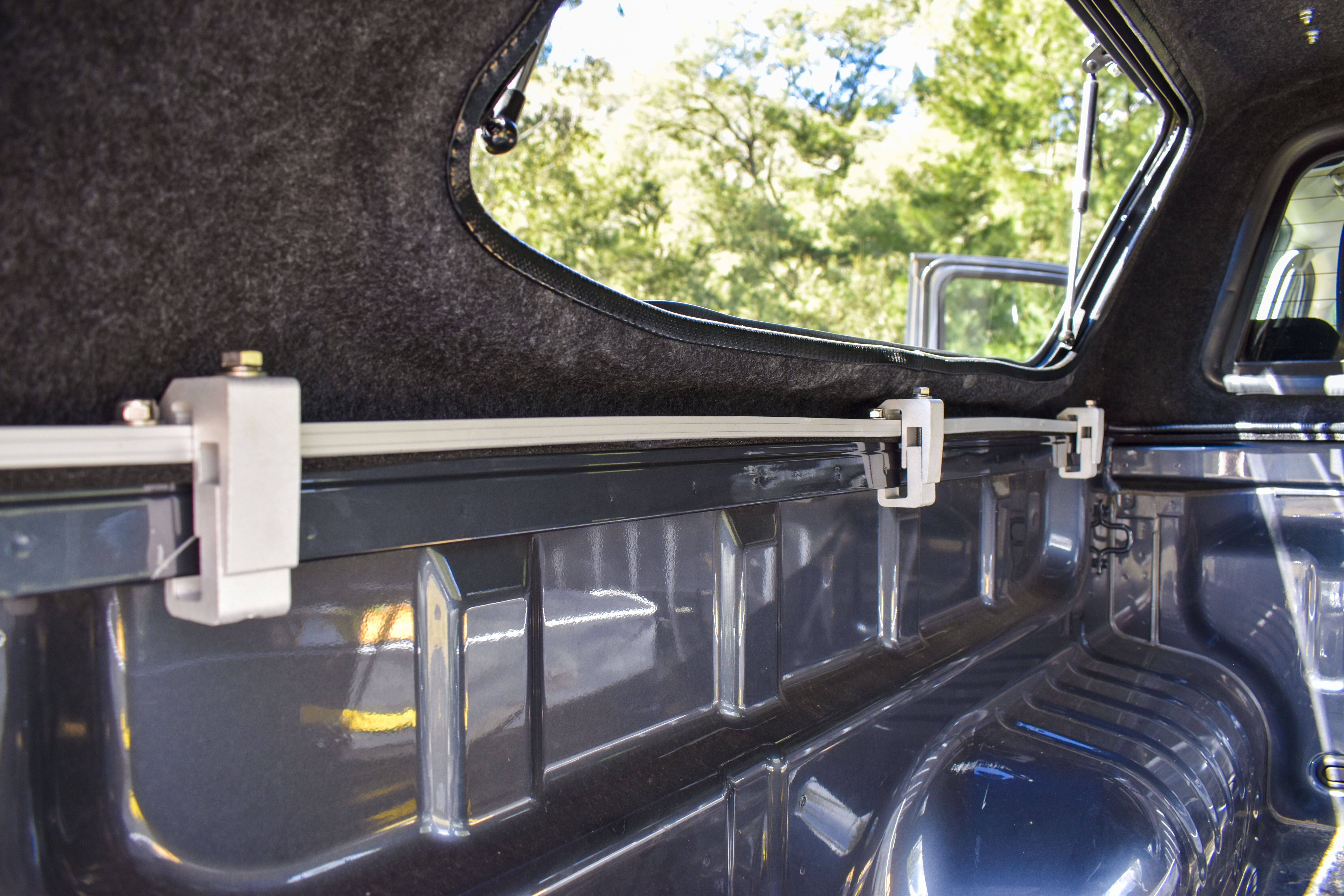
Sturdy (and simple) clamps mount the canopy to the tray for a quick install, and easy removal if ever required. No drilling is required, which I feel is a good thing for resale value or if you decide to go a different way down the line. Now that the canopy has been installed, Piranha Off Road are developing a battery tray specifically for this vehicle, so we can mount our 100amp/h Invicta lithium battery behind the back seat. Stay tuned for that update.
RATED
AVAILABLE FROM: piranhaoffroad.com.au
RRP: $3400 including paint, side lift-up windows and installation.
WE SAY: Piranha Off Road canopies are available to suit a range of 4×4 utes, including Hilux, Ranger, Navara, Triton, Amarok, Colorado and naturally the Isuzu D-MAX.
With ever-tightening travel restrictions, we’ve had to abandon our plans for gallivanting around the countryside with the Everest Sport and a camper trailer in tow. Apparently it’s not the done thing at the moment. So, what’s a fella to do with the keys to a new 4×4 and articles to write? If you’re thinking we should punt it around the local tracks to find its limits, then we’re definitely on the same page.
The Everest Sport was put in the 4×4 Australia fleet to see how they fare as a family camping machine, but like every 4×4 ever built, it’s going to get punted down some tracks it definitely shouldn’t at some point, so we figured we’d find out exactly how it’ll perform when you push it further than you should.
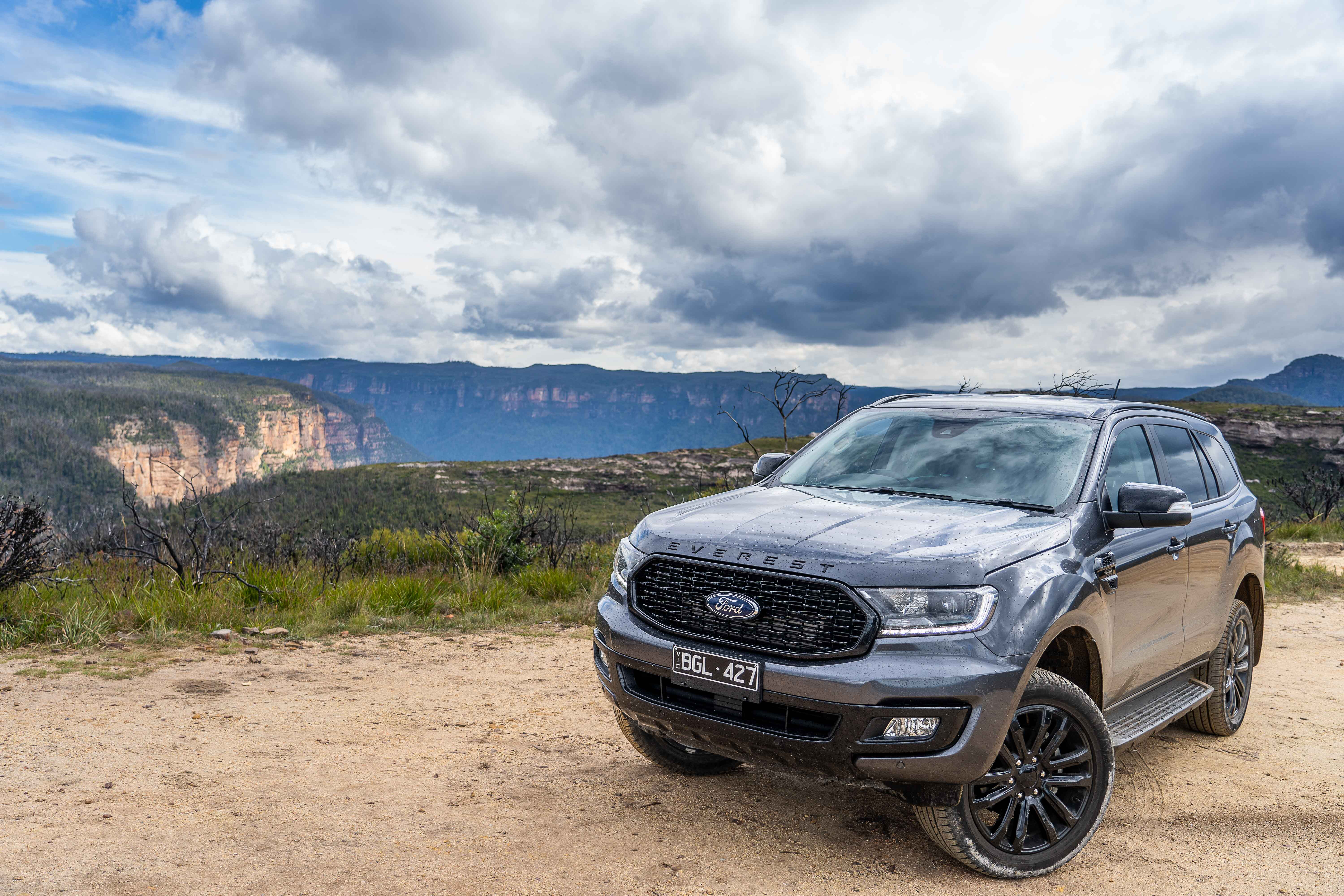
With any 4×4 sporting independent suspension, lack of wheel travel is always going to be a challenge you’ll need to overcome, and the Everest is no different. Pointing it at the local wombat holes, its rear suspension does a reasonable job soaking up the terrain, but the front end lifts almost immediately.
Despite the wheels in the air, the suspension is supple and the wheel track wide enough that it rarely felt unsettled – we had to jump out a few times to verify that the wheels were in fact in the air. Tapping the rear locker button was all it took for the Everest to keep working competently off-road, no matter how many wheels were in the air. The only two things stopping forward momentum were traction with the road-focused tyres, and mechanical sympathy by not wanting to punt sheet metal into rock.
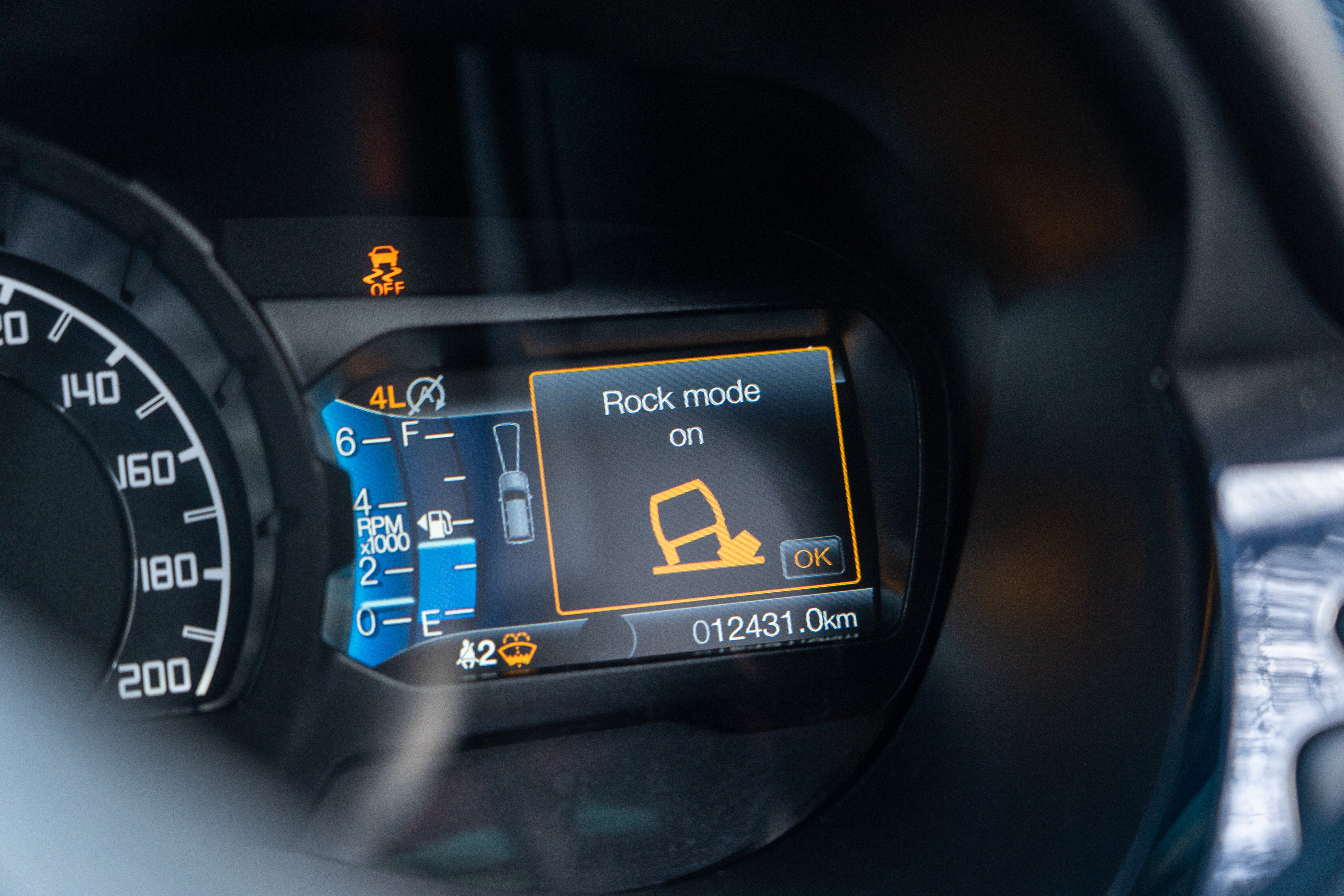
The Terrain Management System is something you don’t necessarily need to play with, but it did make things a little easier for the terrain. Engaging Rock mode softened the throttle response significantly, allowing for finer, more precise inputs. It also locked the transmission into first gear for maximum engine braking, and turned the traction-control sensitivity way up to keep us moving forward predictably without all the bucking and jerking of older systems.
Essentially it turns the front axle into a nearly locked state and slows everything down so you’re in full control. Even pointing downhill, the Everest never wanted to run away from us. Unfortunately, the nearest beach is three locked-down local areas away, so we’re unable to put the Sand mode through its paces.
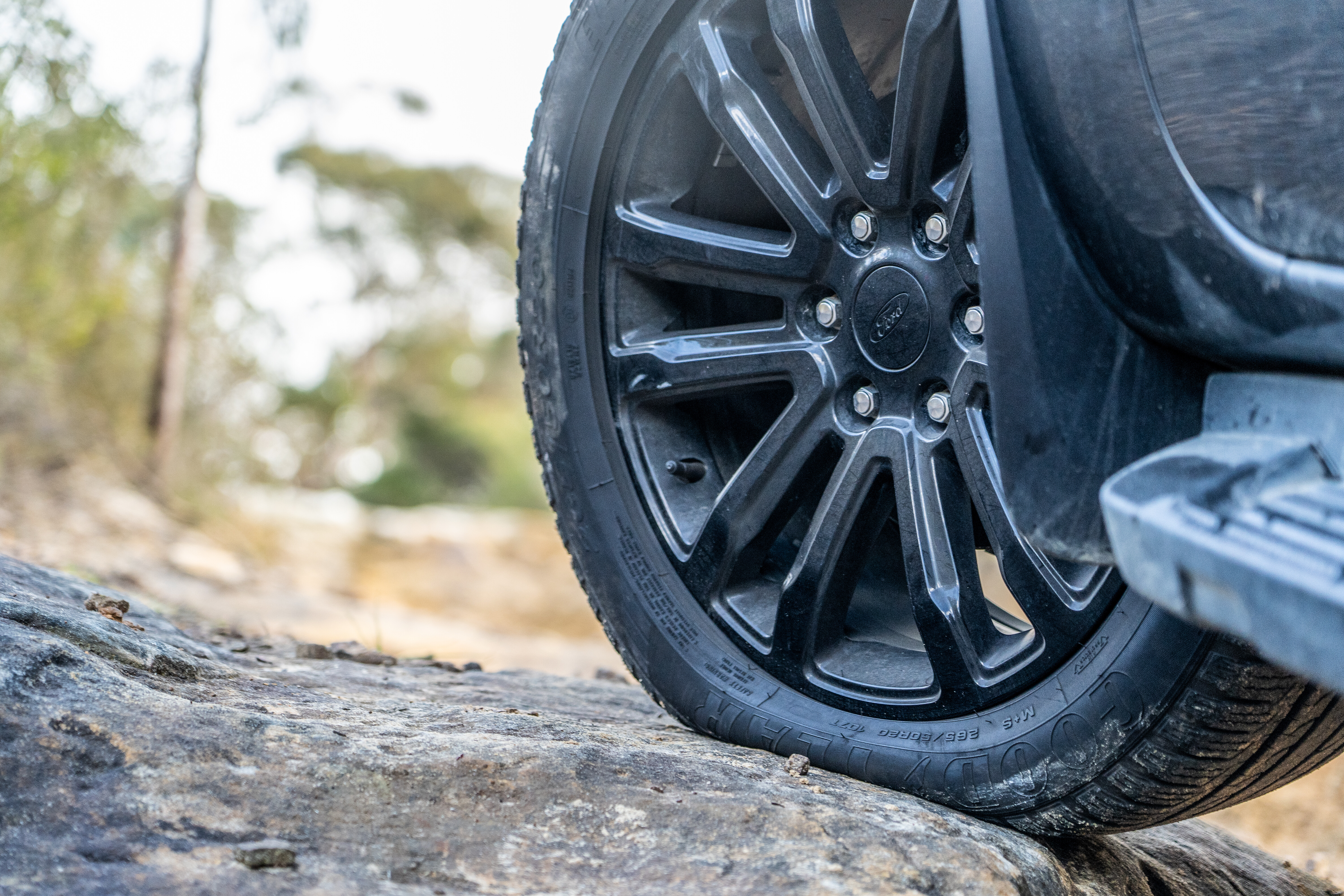
While the vehicle itself is fantastic off-road, it’s not without its drawbacks. Those 20-inch wheels on each corner look fantastic, but with next to no sidewall, airing down simply wasn’t an option. Even dropping 10psi out of the tyres would have had us hitting the rims on rocks and potentially rolling a tyre off the rim. The Everest itself is so insanely capable that fitting a set of larger mud tyres is all you’d need to drive most tracks you can point it at. A set of rock sliders and a front bar would also be highly recommended, as we’ve had a few moments where the Everest will keep climbing places it has no right to be.
THE DATA
| Km | 12870 |
| Date acquired | March 2021 |
| Price | $63,790 |
| Km since last update | 1420 |
| Av fuel | 9.3L/100km |
Following the news that a 60 series LandCruiser has sold at auction in the US for a record breaking $US134,400, we thought we’d take a look at what’s going under the hammer right now and what 4x4s will be going under the hammer in the coming weeks – both locally and overseas.
Starting off locally is Shannons’ spring timed online auction, which has three tasty lots up for grabs. Bidding starts online on Tuesday, August 31 and closes on September 7.
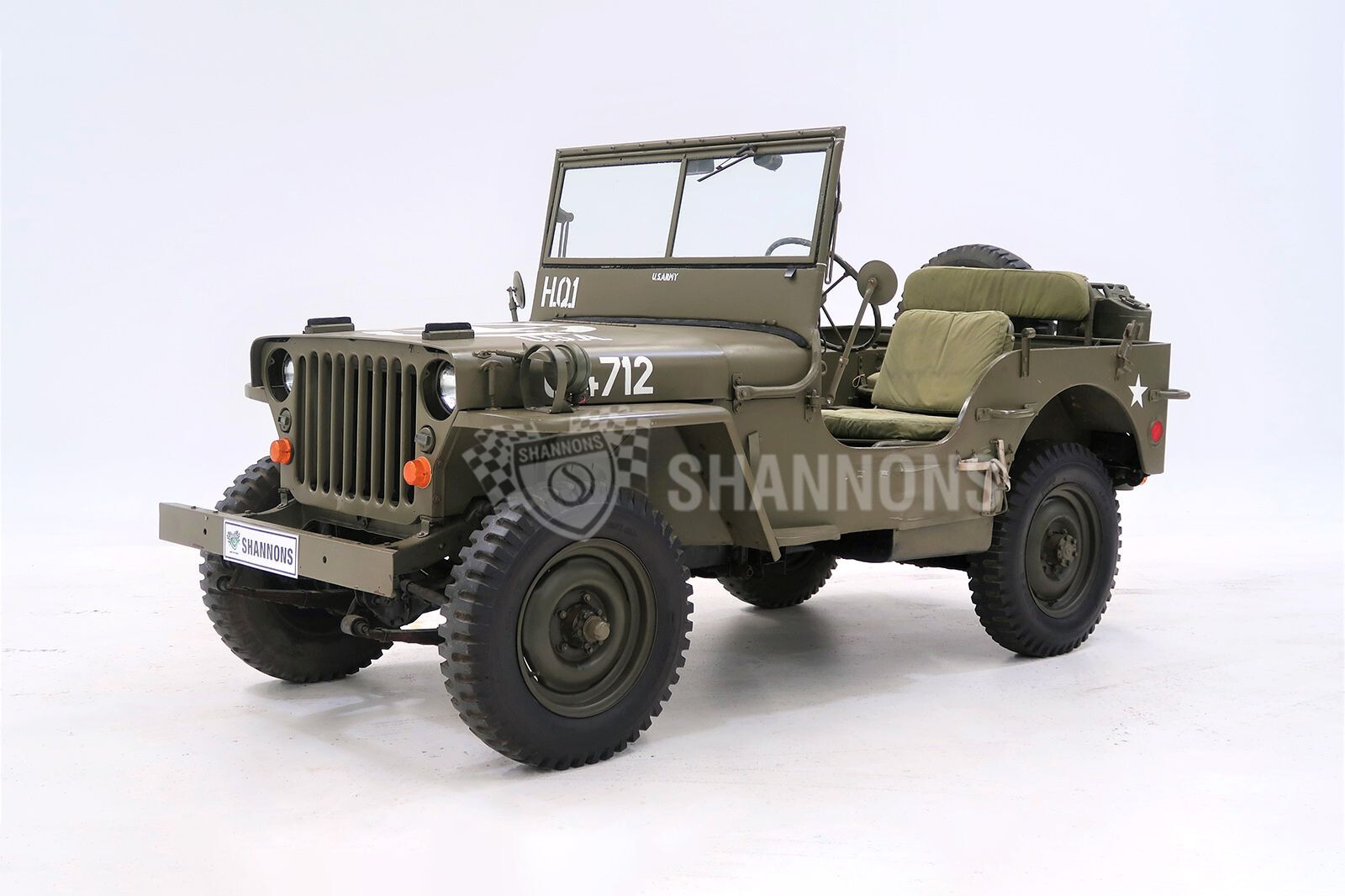
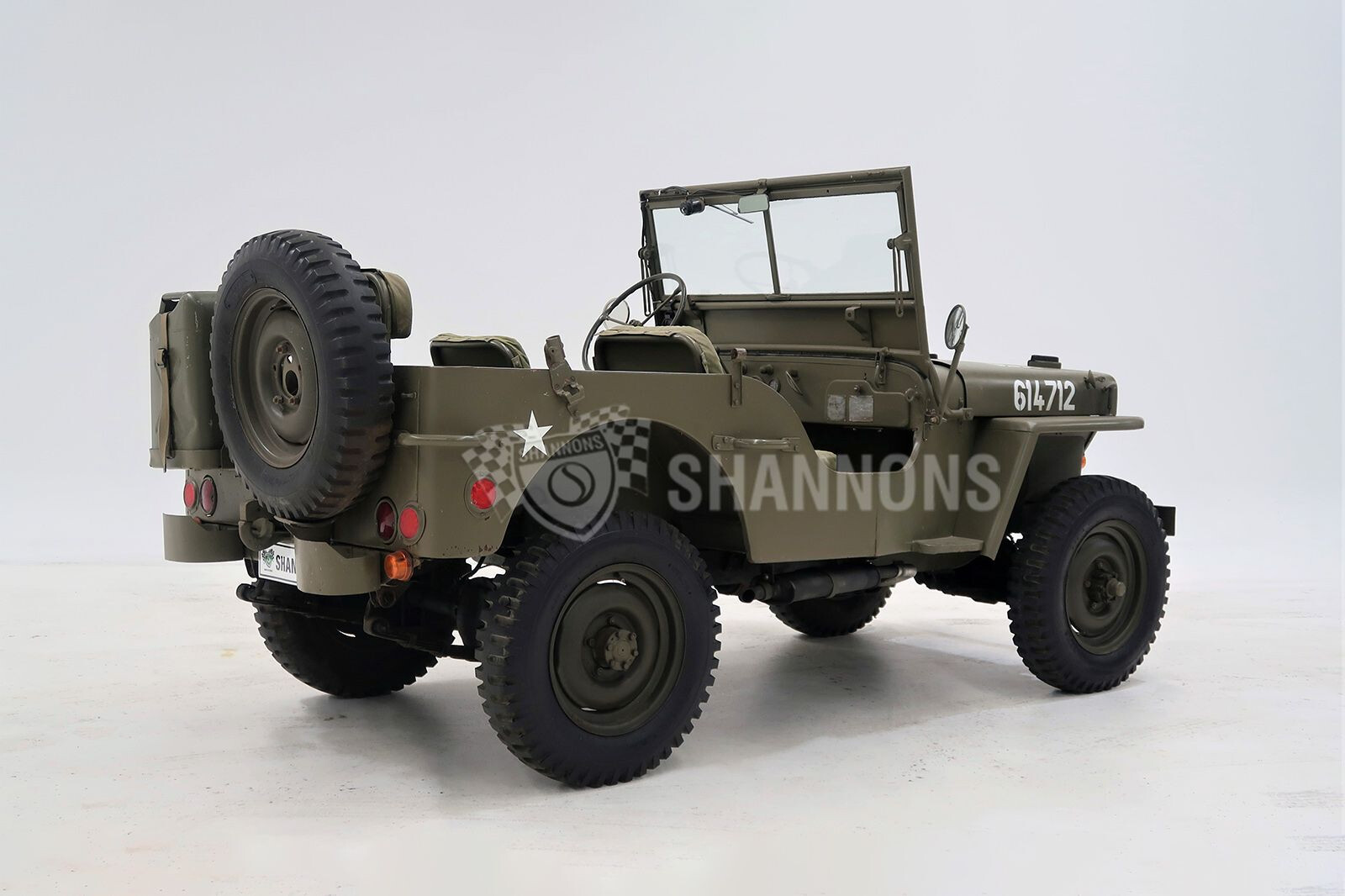
The first is this 1944 Ford-built GPW, one of the most iconic 4x4s of all time. It features a rebuilt version of the period-correct Willys’ four-banger engine – along with a new clutch in front of the three-cog manual, a new exhaust system, overhauled brakes and minor cosmetic improvements.
Shannons estimates a sale price of around $18,000 – $24,000.
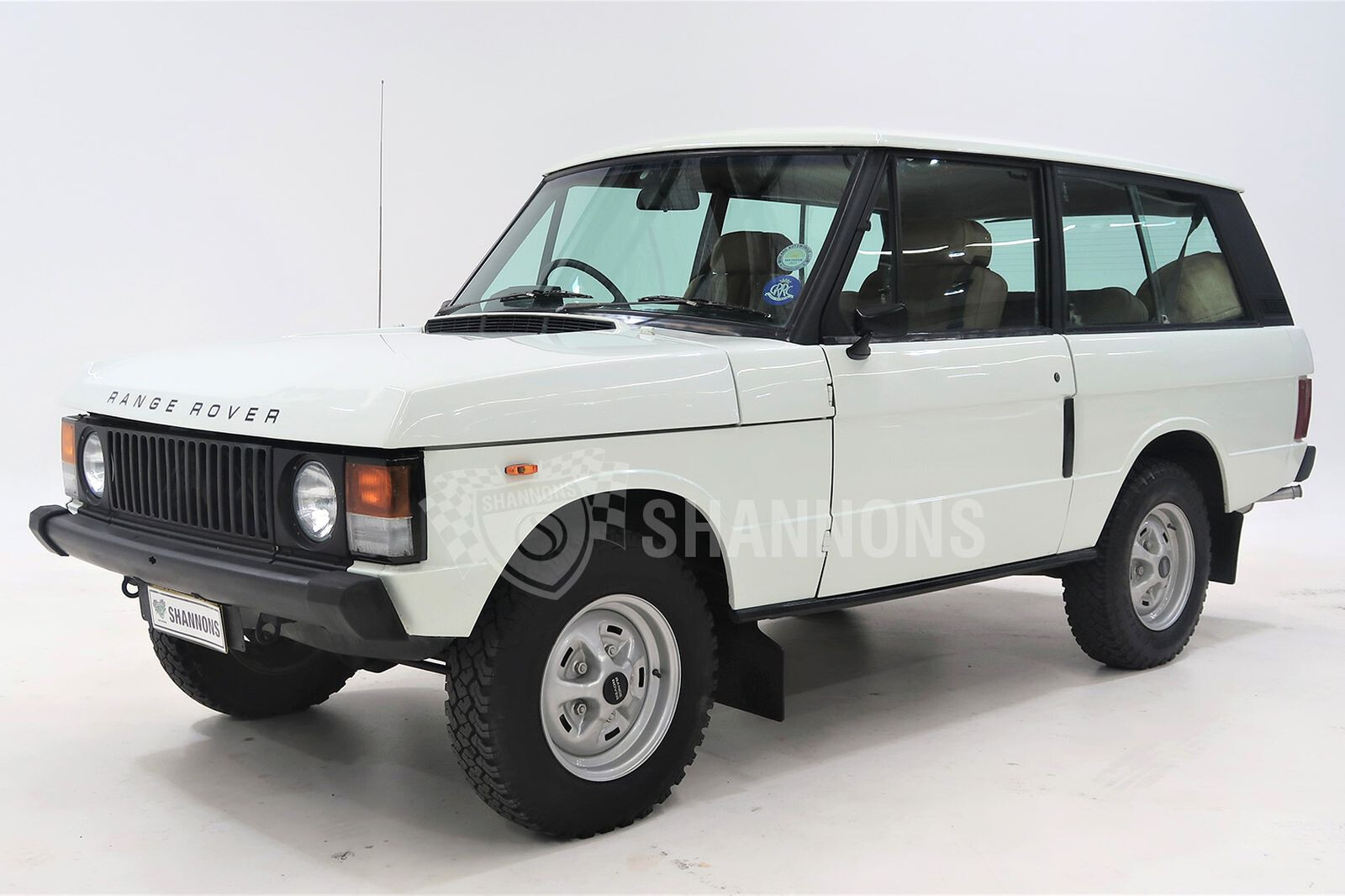
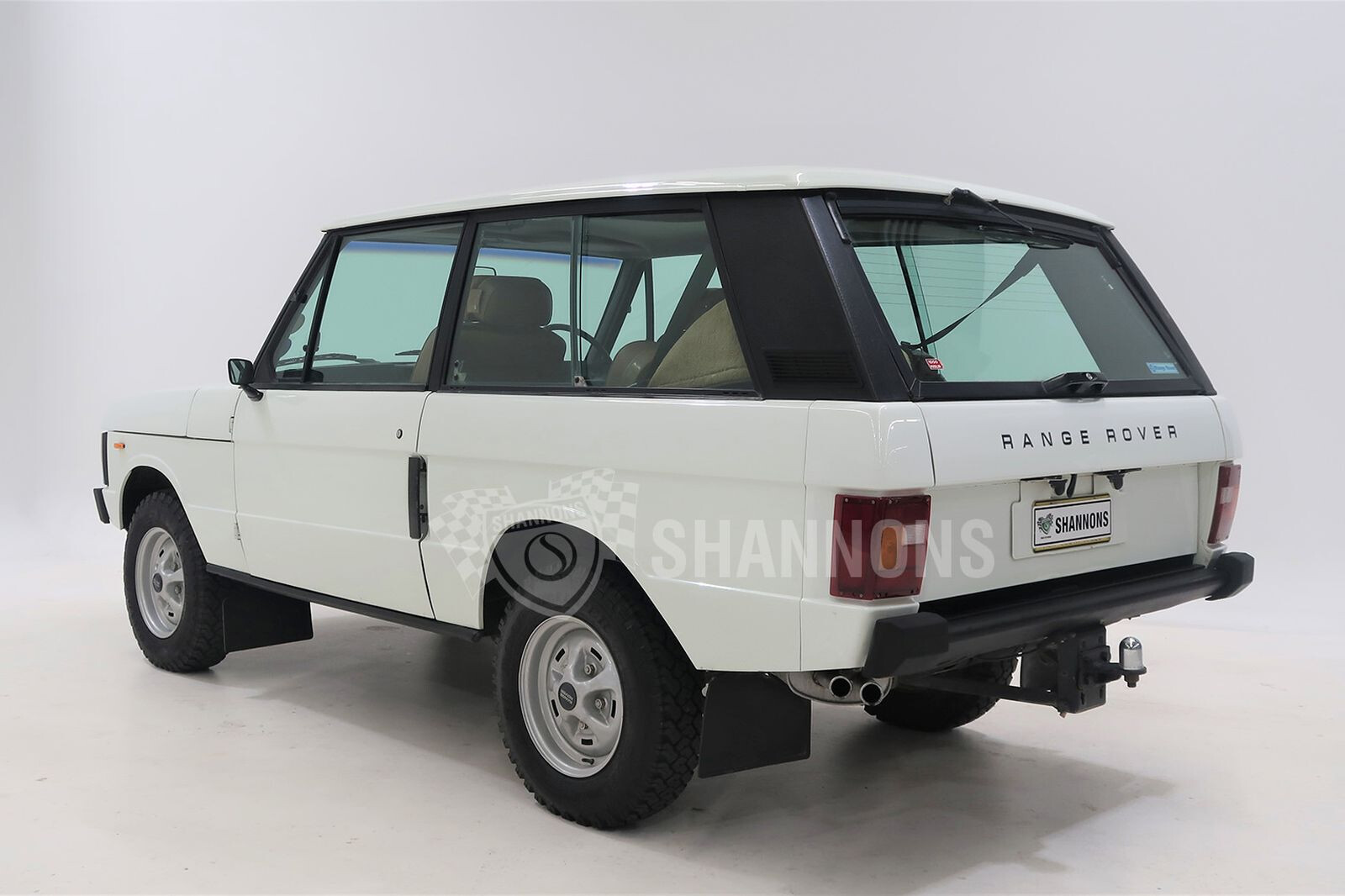
Fancy a shorty Range Rover? This 1984 two-door, V8 five-speed manual wagon looks like a super neat specimen, especially considering it has over 283,000km on the ticker.
Admittedly, it does have the smaller 3.5-litre carby-fed Rover V8 rather than the later 3.9-litre EFI version, and it appears there’s a few oil leaks that need attention. Despite this, prices for these older Range Rovers have been on the rise, Shannons estimating the hammer will fall around $40,000 – $50,000.
While not technically a 4×4, we couldn’t pass up this 1969 Volkswagen/Meyers Manx Beach Buggy, because we’re dreaming of some hitting the dunes in a few months’ time.
Under the genuine Australian Meyers Manx super lightweight body shell is a good-old dack dack four-banger with a four-speed manual, and it has just 7500km on the clock. Auctioneers estimate it’ll fetch between $28,000 – $32,000.


Grays mostly has ex-fleet 4x4s up for grabs, but we did spot this neat 2013 Jimny going under the hammer. It’s got a neat little snorkel, lightbar, roof racks and the four-pot is backed up by a slushbox.
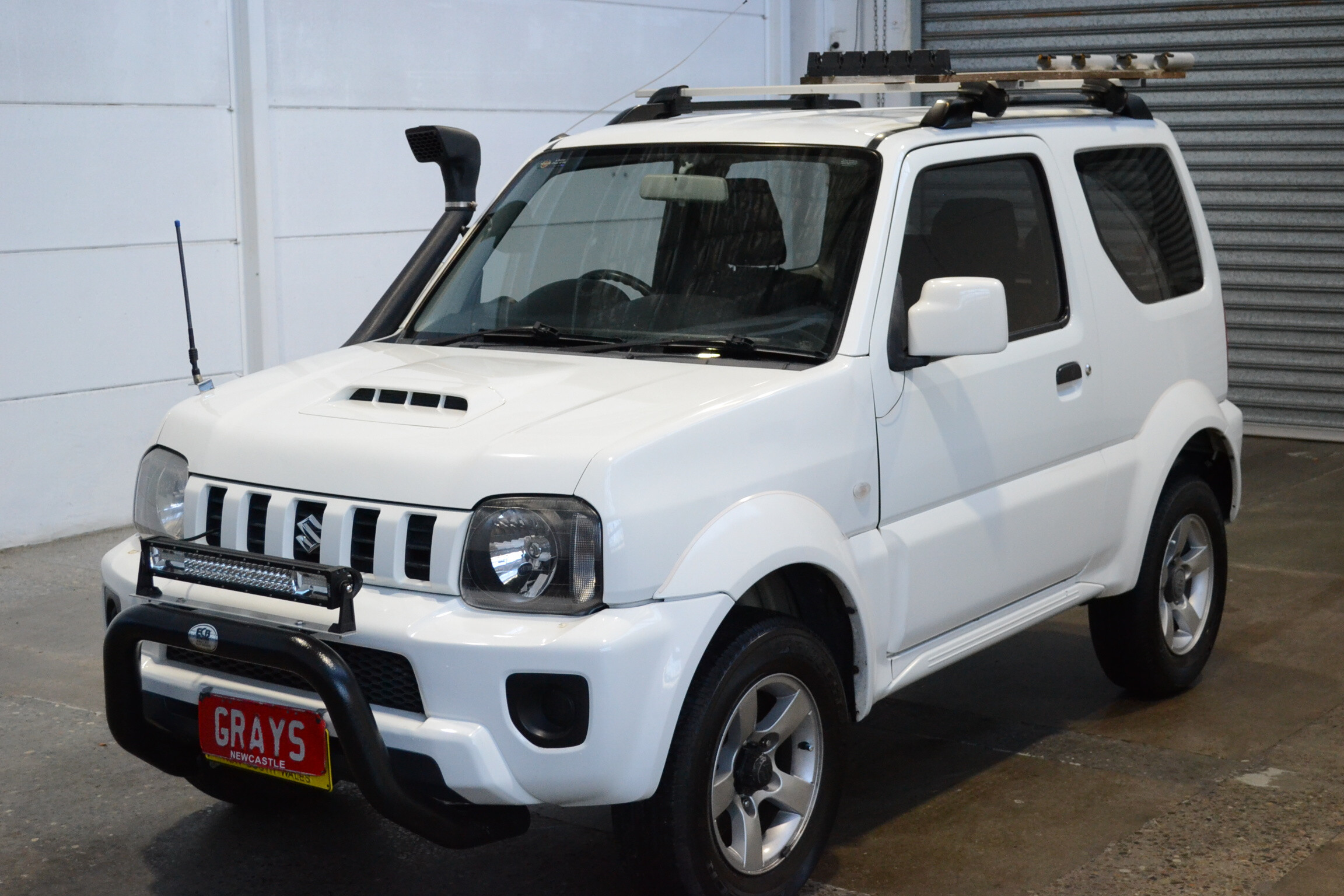
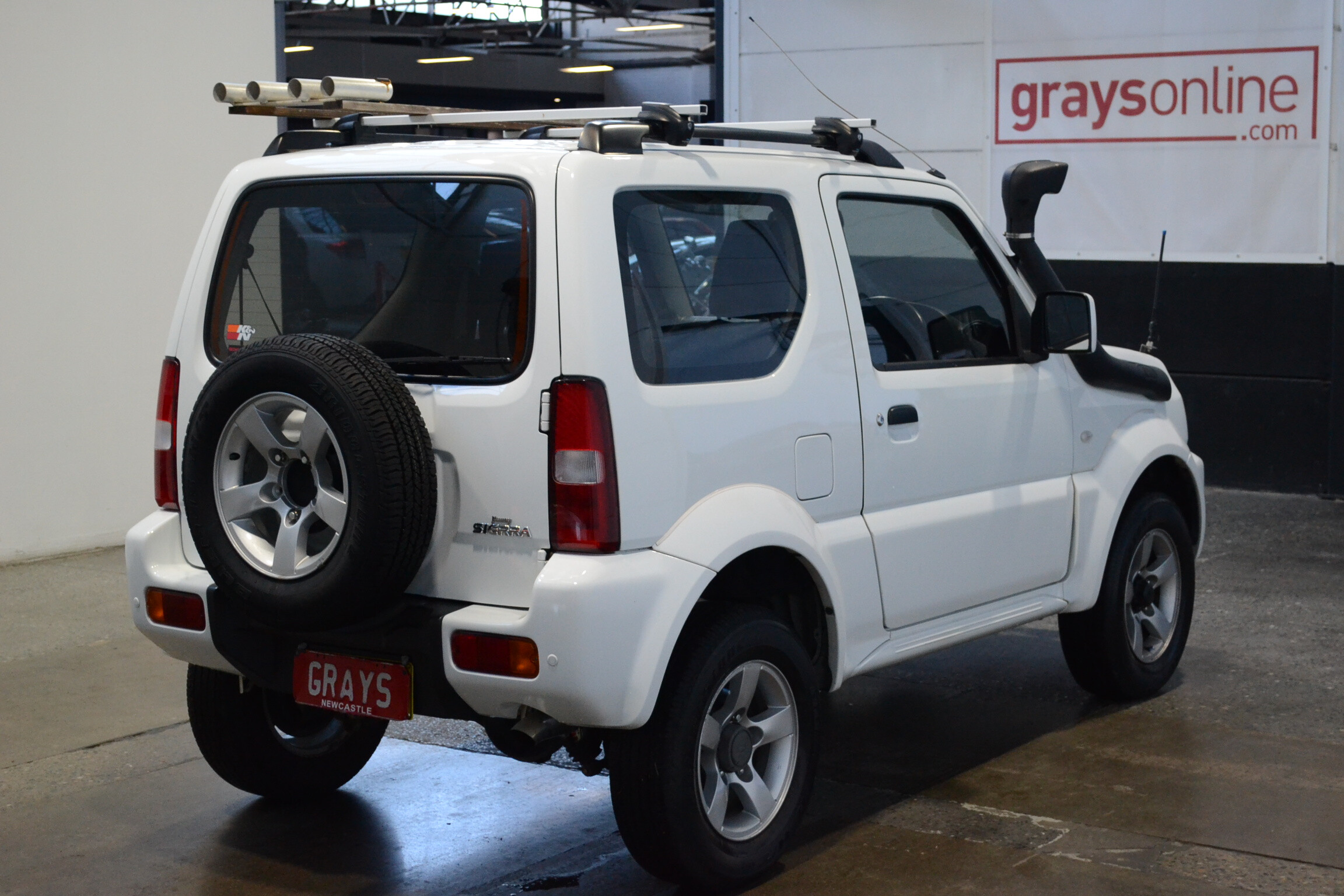
At the time of writing the listing has just over one day remaining, with bidding sitting at $15,000. With demand for the current model so high, it’s not so surprising Jimny buyers are offering decent money for the previous generation model.
Overseas, auction juggernaut Barrett-Jackson is gearing up for its Houston auction on September 16-18, and we’ve cherry-picked some cool 4x4s which will cross the stage.
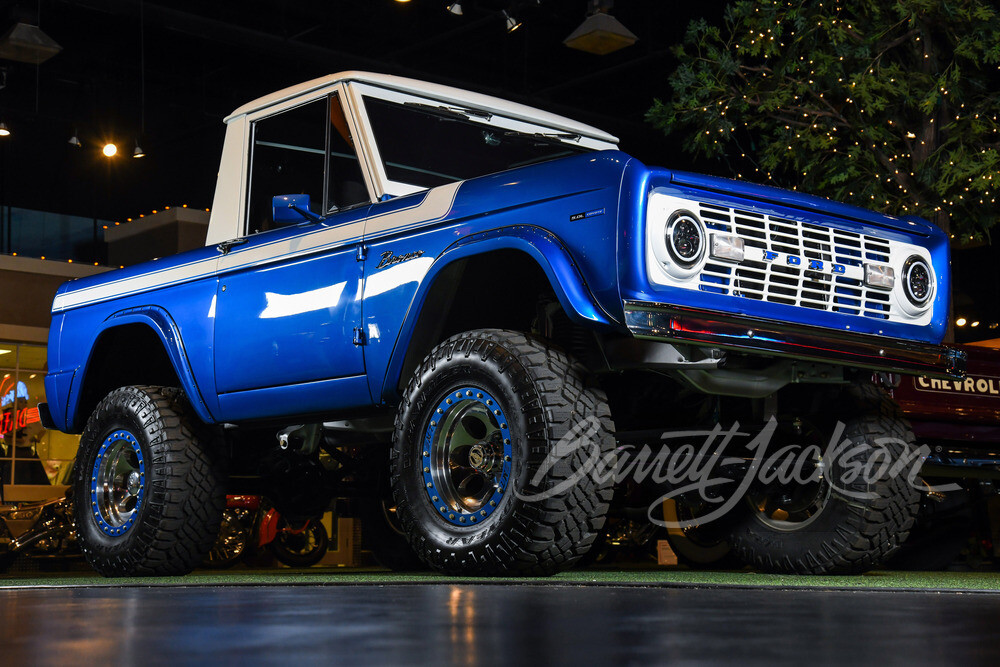
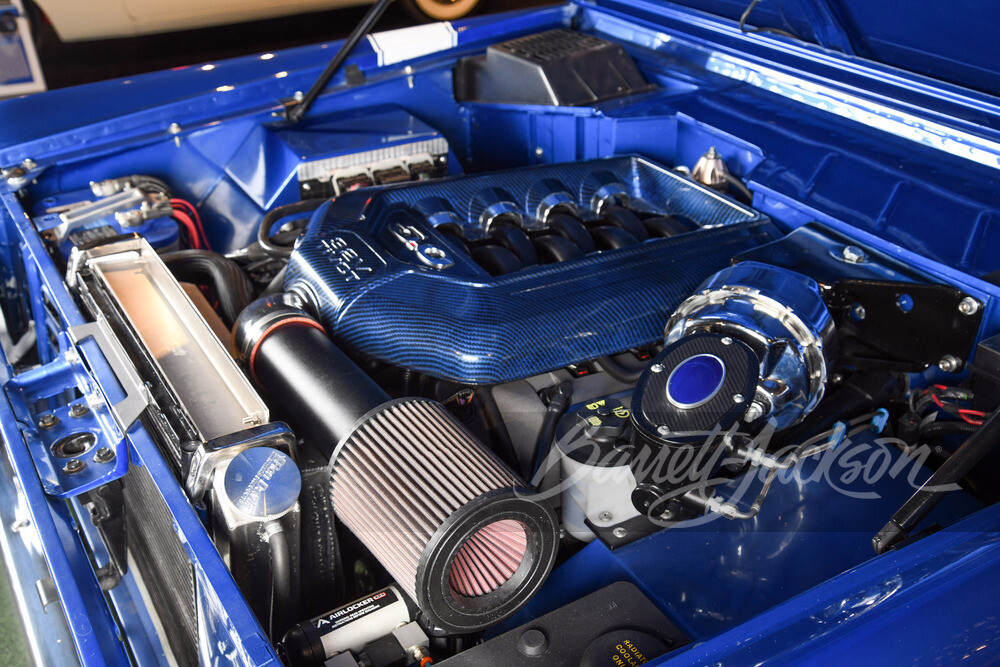
First up is a half-cab 1969 Ford Bronco, featuring a 5.0-litre Coyote V8 from the current S550 Mustang – that’s 330kW of power in a high-riding Bronco!
The rest of the car has undergone a frame-up resto – it uses a 6R80 ‘box and a neat part for us Aussies is the Dana 44 front diff and Ford 9-inch rear-end feature Australian-made ARB air lockers.
As previous mentioned, classic LandCruisers have been going bananas at auction lately, with both a 60 and an 80 series selling for north of US$130,000 (AU$181,915) each in recent months.
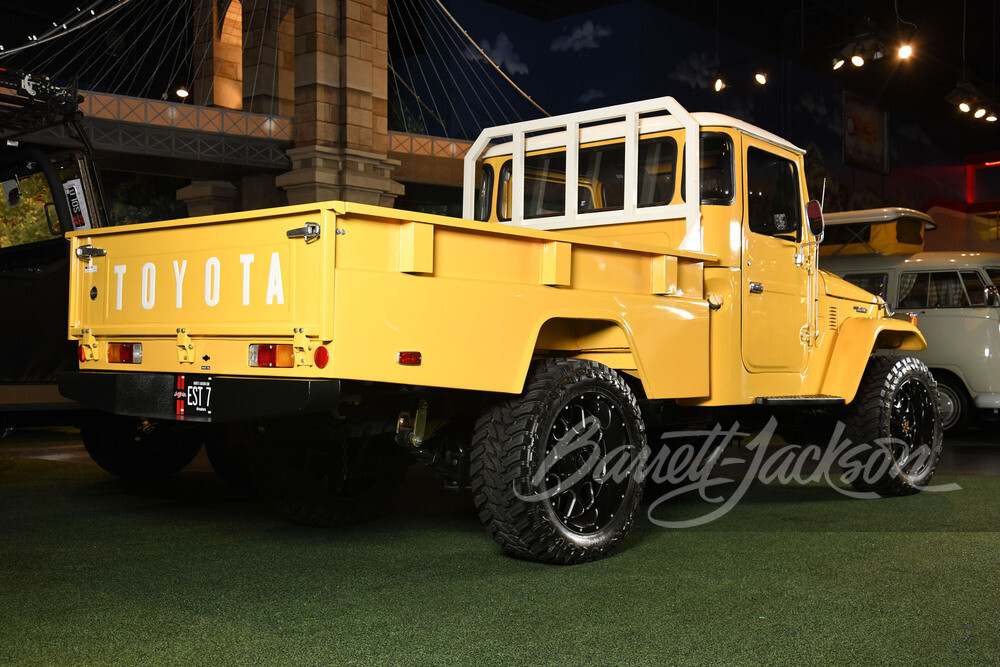
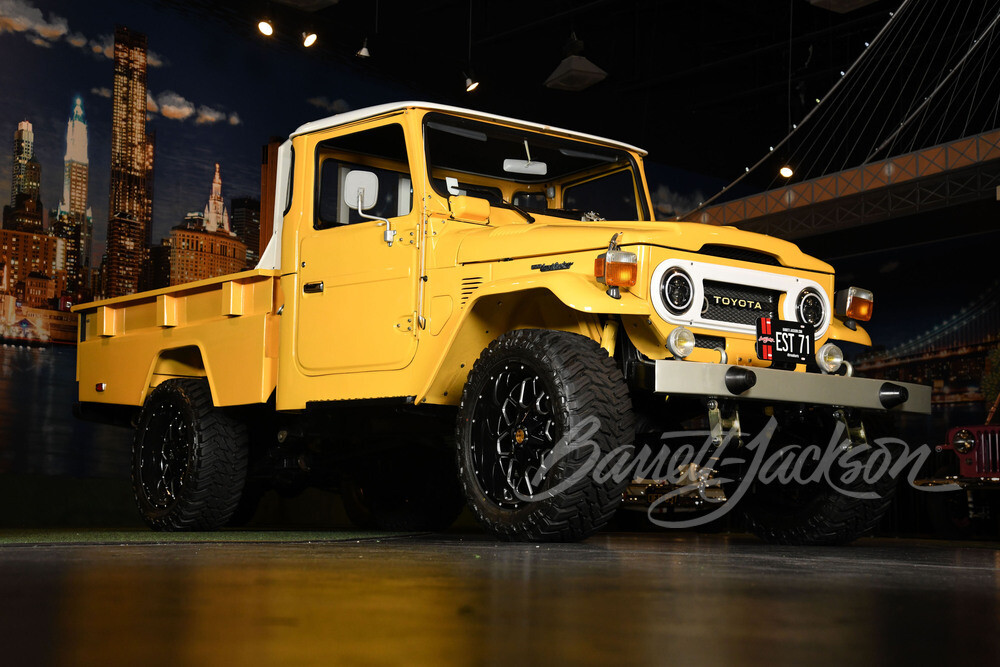
The FJ series started that trend, so we fully expect this completely restored FJ45 to score a seriously high number. It still uses the standard six-cylinder aspo driveline with the four-speed manual, as well as working A/C and custom stereo. Other modifications include two-inch lift and 20-inch Hardrock Gunner wheels wrapped in 33-inch tyres.
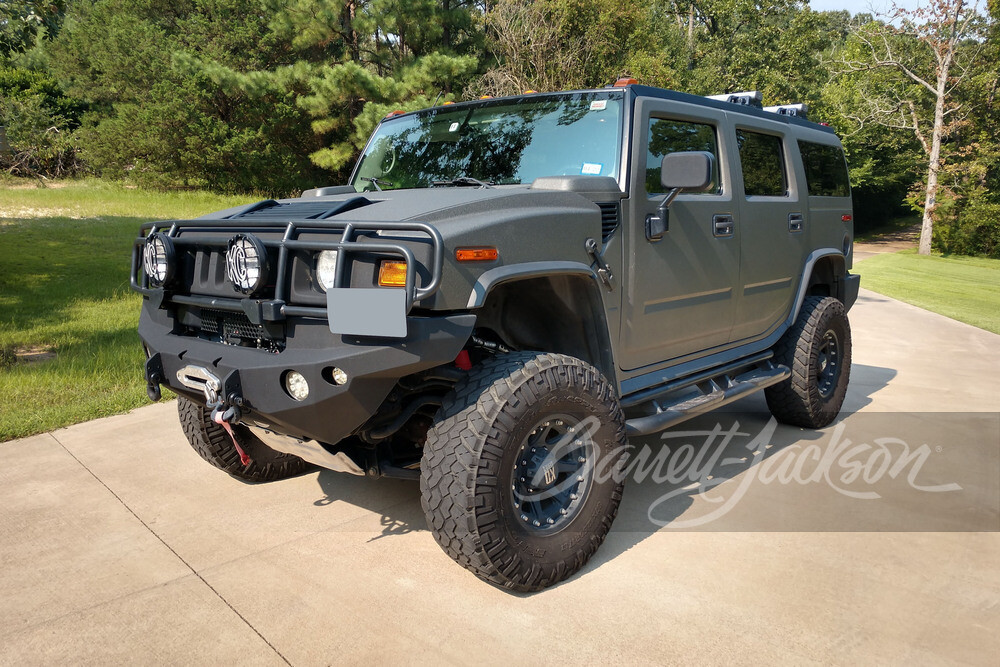
Bigger is better, right? This 2003 Hummer H2 has been shoved with a 6.6-litre LBZ V8 Duramax twin-turbo diesel, backed up by an Allison six-speed automatic. Other modifications include a 4-inch lift, 37-inch Nitto tyres and a heavy duty winch.
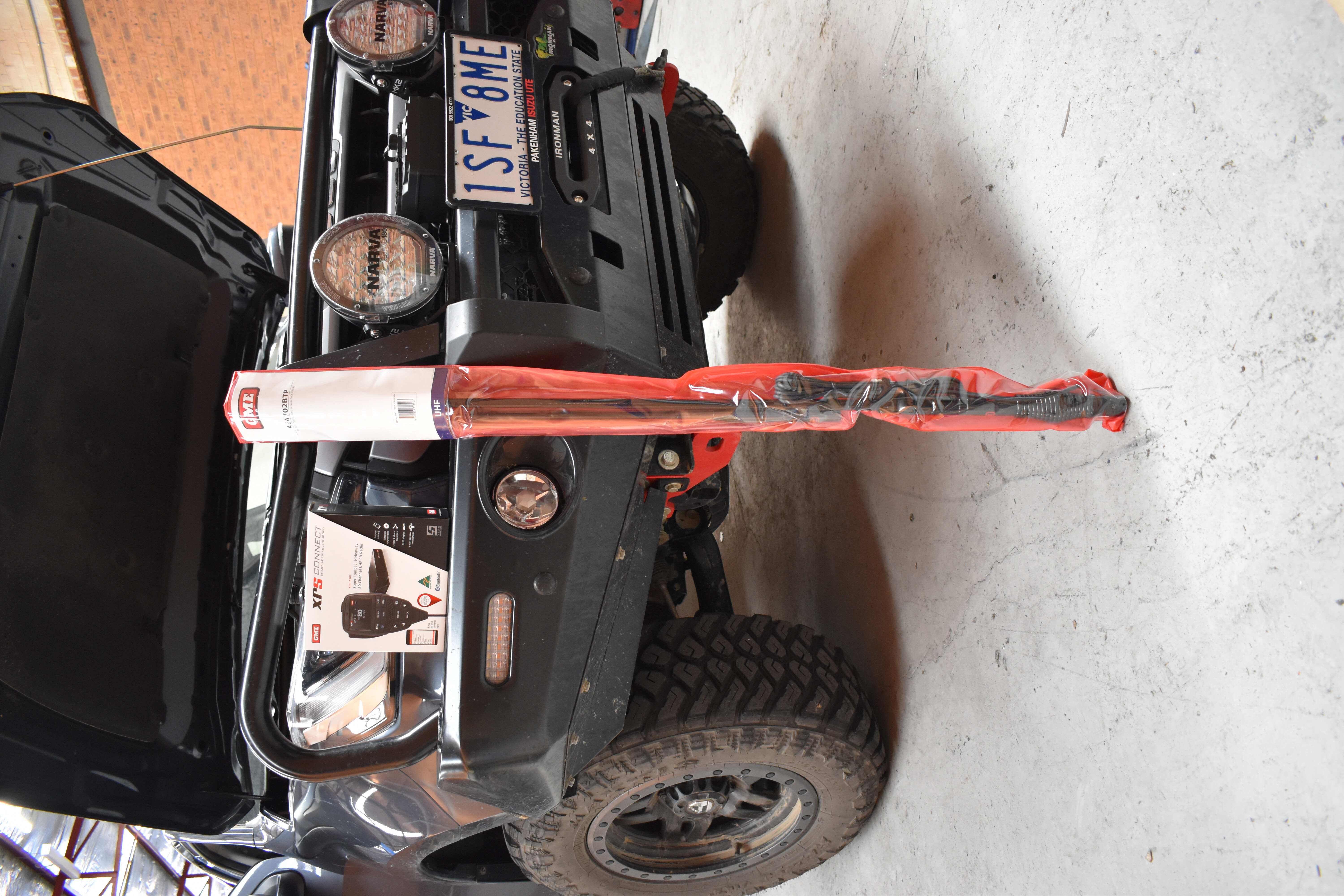
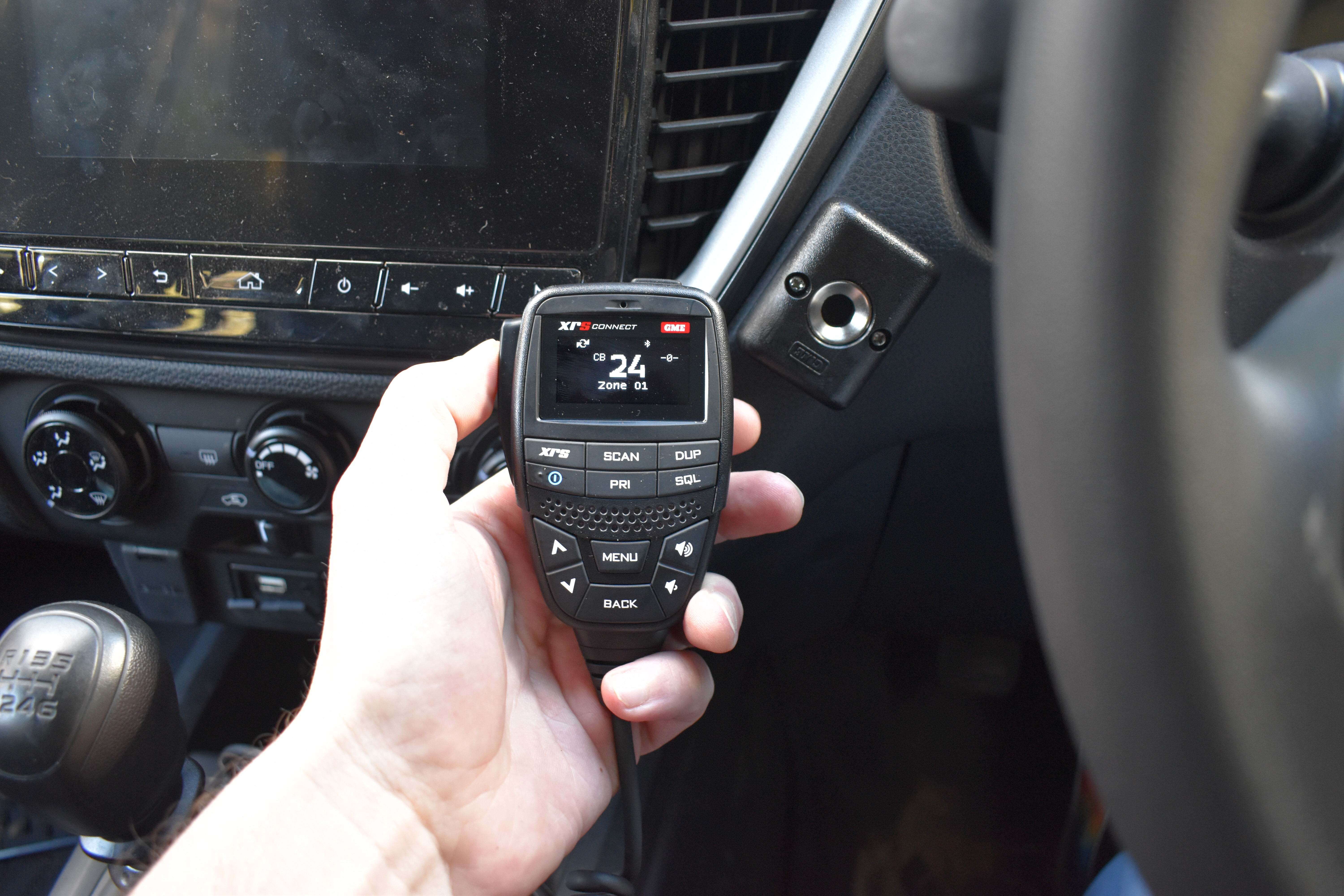
IF THERE were two basic ingredients every touring 4×4 needs, quality recovery gear and reliable communication equipment would be on top of the list. We’ve got the recovery side of things covered and we now have communications sorted after installing this GME XRS-330C UHF radio with the AE4702BTP antenna twin pack.
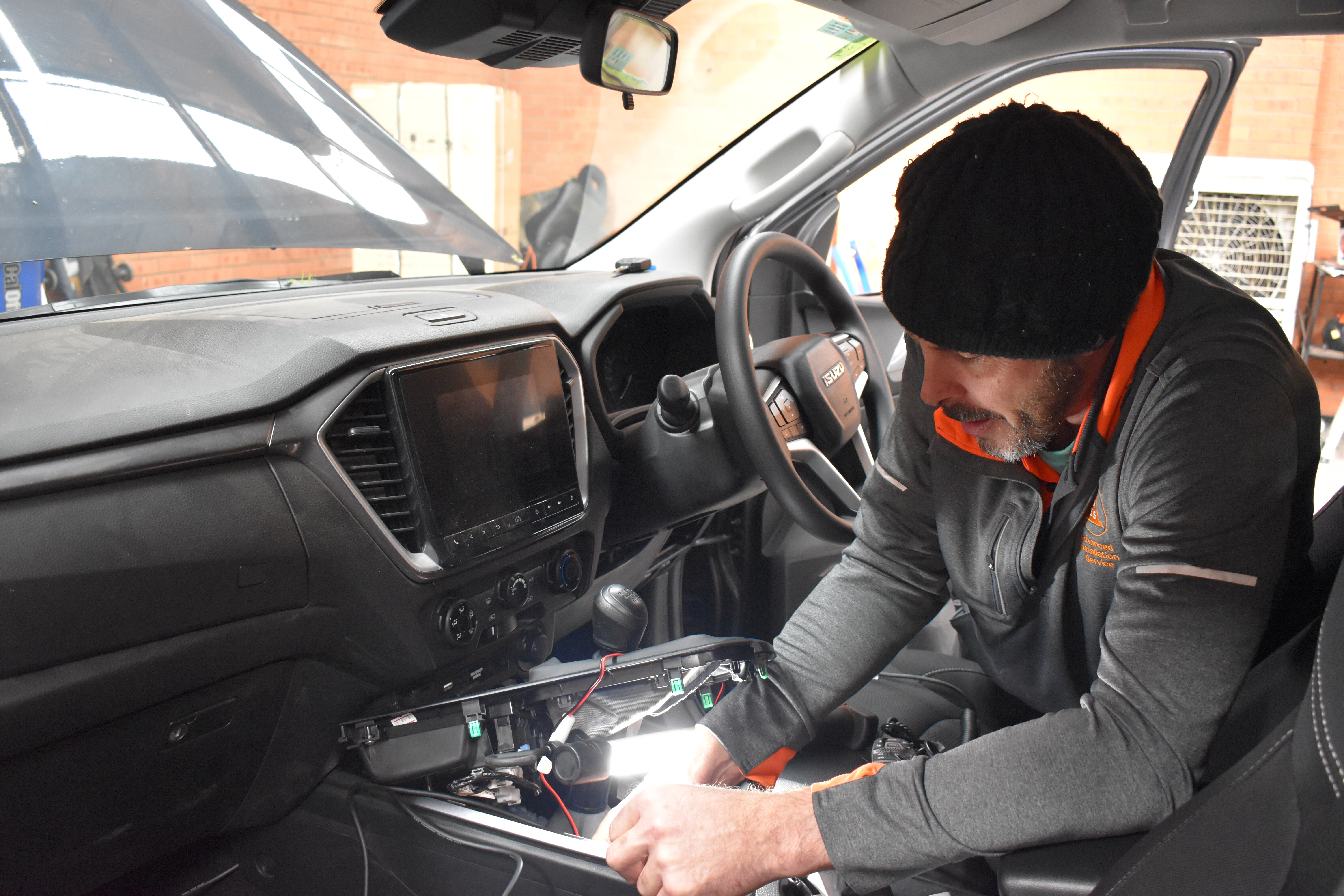
Jeremey (who’s Amarok custom featured in issue 449) from Advanced Installation Services (Emu Heights NSW) handled the install, and ran me through the process. For anyone with a 2020 Isuzu D-MAX, there is a grommet on the passenger side on the firewall to pass the antenna cable through. There are also spare fuse slots for 12V power, found in the driver’s side kick panel.
The XRS-330C from GME is compact, which allows the base unit to be mounted under the trim surrounding the transmission tunnel (or behind the dash). A small pass-through adaptor was secured into a blank switch slot, making for a very neat install. The business end of this GME UHF is all in the microphone handpiece, which is held in place with a neat optional magnetic mount (part number MB207) and strong double-sided tape.
Naturally, the XRS-330C is an 80-channel UHF so suits Australian requirements, but it’s also manufactured and designed in Australia. As mentioned, the handpiece is packed with tech making for an easy install. There’s an OLED display for easy visibility and front mounted speaker meaning you won’t need an external speaker to hear radio chatter. It also comes with an app called XRS Connect App which allows you to control and configure radio settings using Bluetooth. You can even use this app to share your location using your phones GPS location.
RATED
AVAILABLE FROM:
Snapshot
- Restored 60 series sells for record US$134,400
- The second classic LandCruiser to sell for over US$130,000 in successive months
- No sign of classic LandCruiser market slowing down
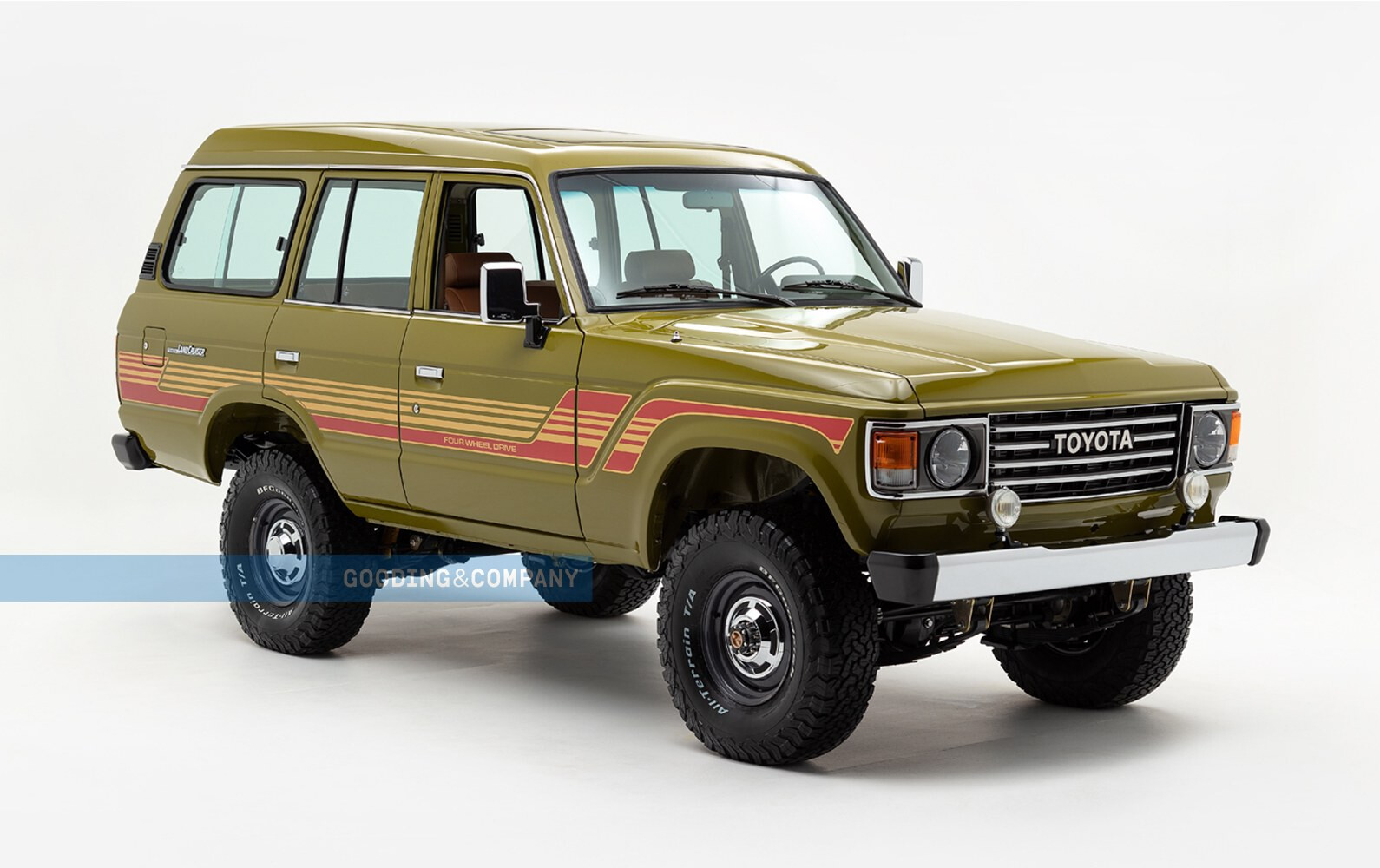
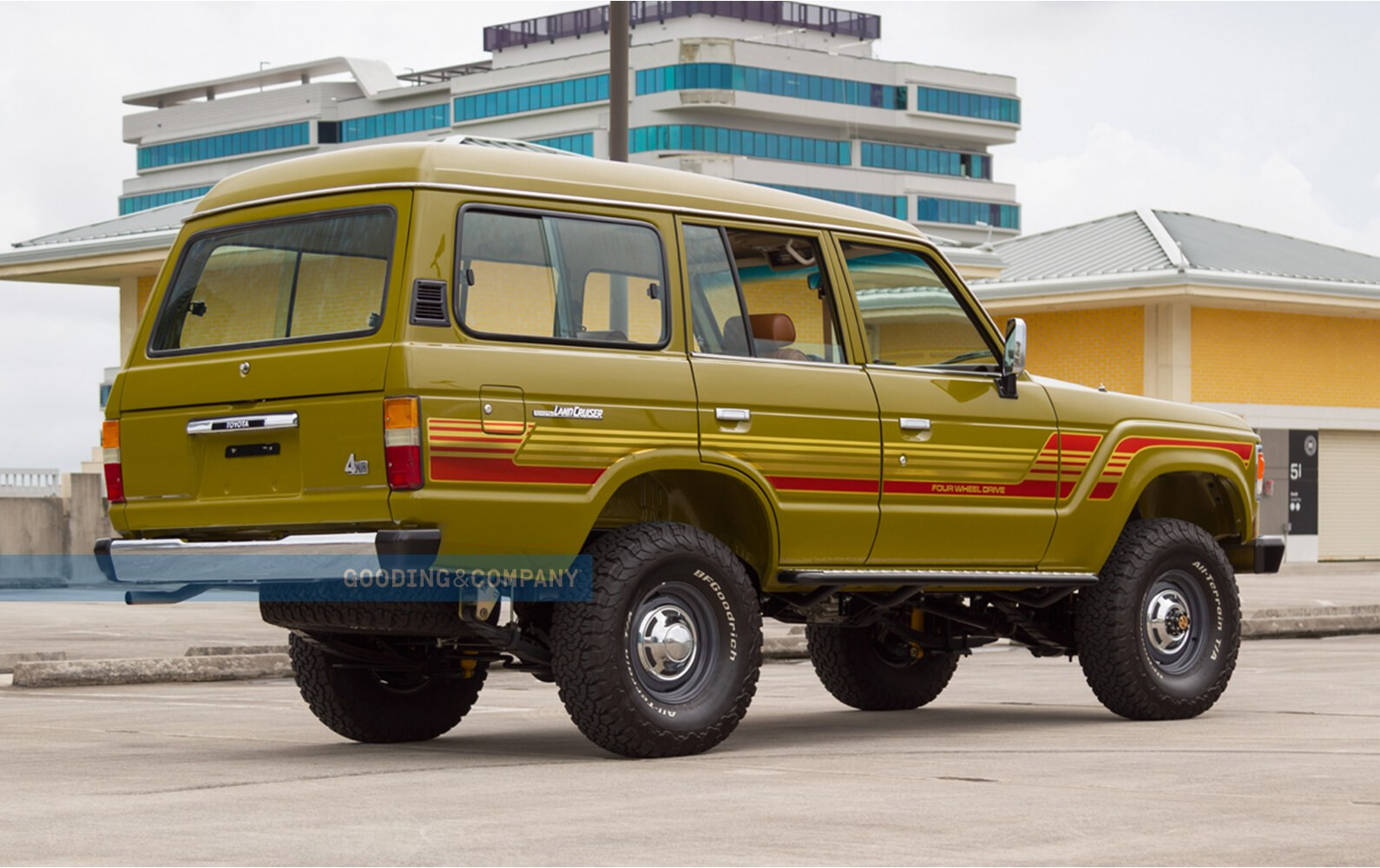
The market for classic LandCruisers is showing no signs of slowing down – with a mint condition 60 series 1986 LandCruiser selling at auction in America for US$134,400 (AU$187,873) before buyers fees.
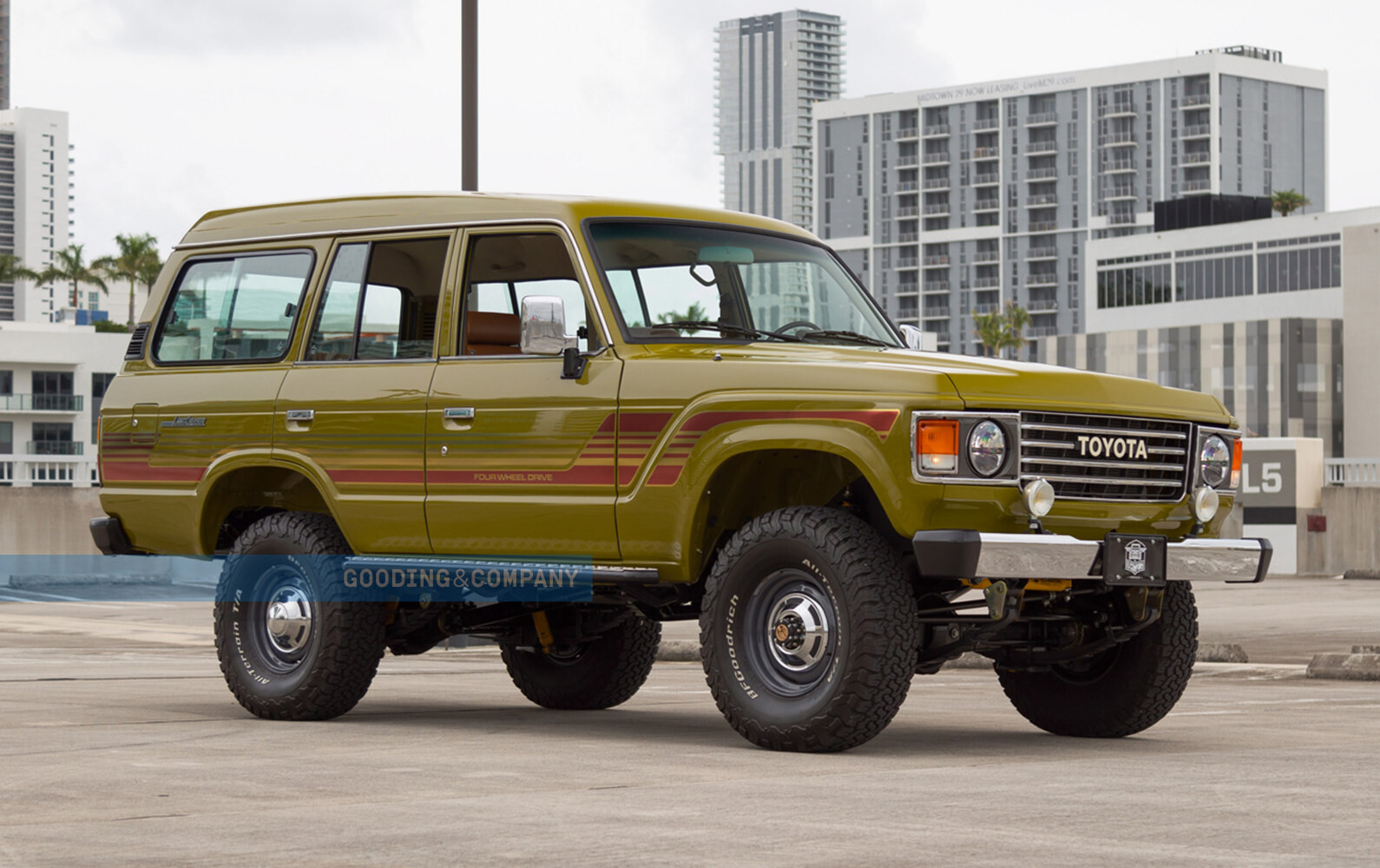
The FJ62 ‘Cruiser went under the hammer at Gooding & Company’s Pebble Beach auction, well and truly exceeding the estimate that was forecast between US$70,000 (AU$97,980) to US$90,000 (AU$125,976).
The news comes just a few months after an 80 series with just 1005 miles (1617 kilometres) on it sold on US buy-sell website Bring-a-Trailer for US$136,000 (AU $190,100).
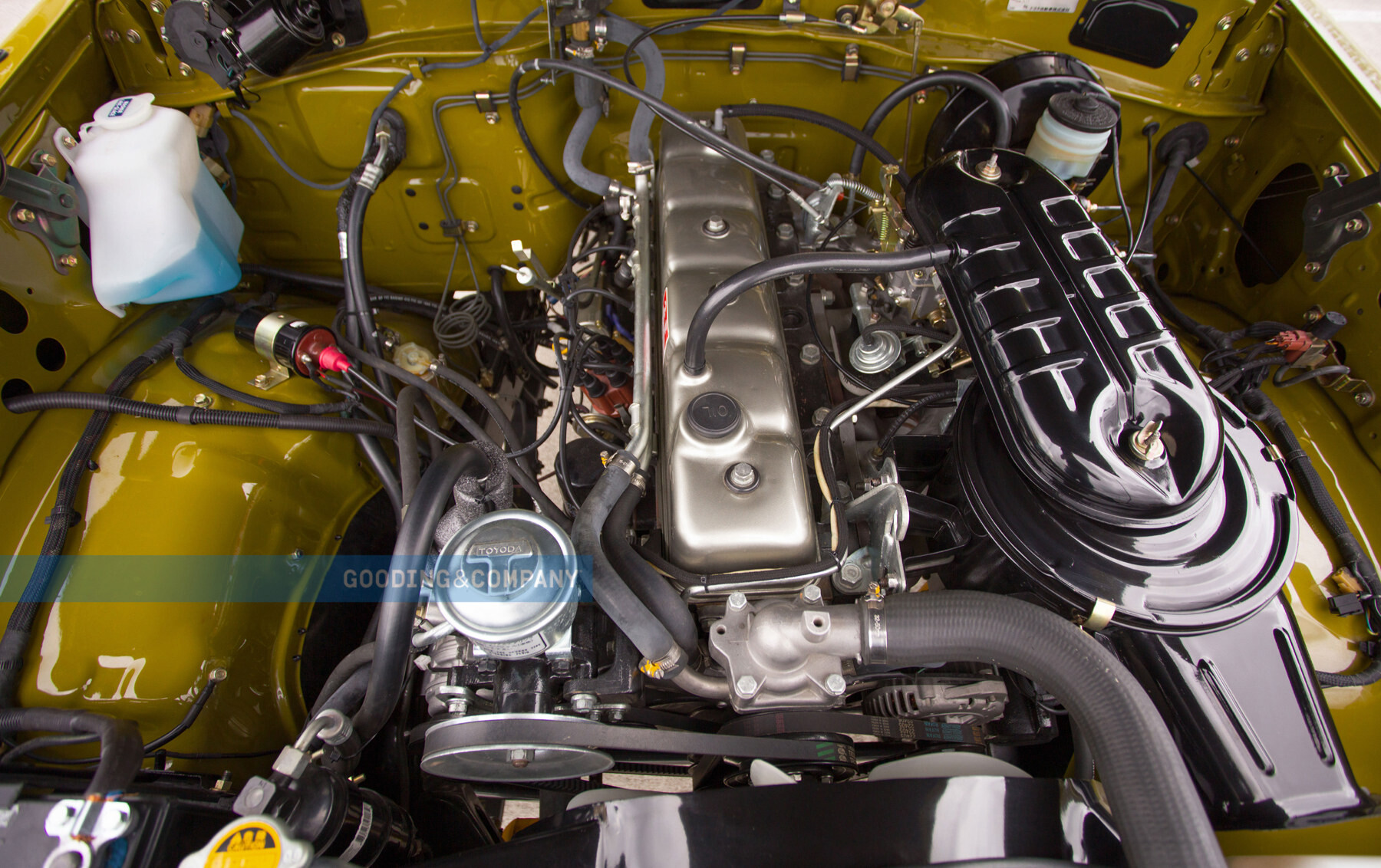
The 60 series is a high-roof model with rare luxuries like a powered sunroof, and was treated to a full frame-off, two-year restoration by LandCruiser specialists, The FJ Company.
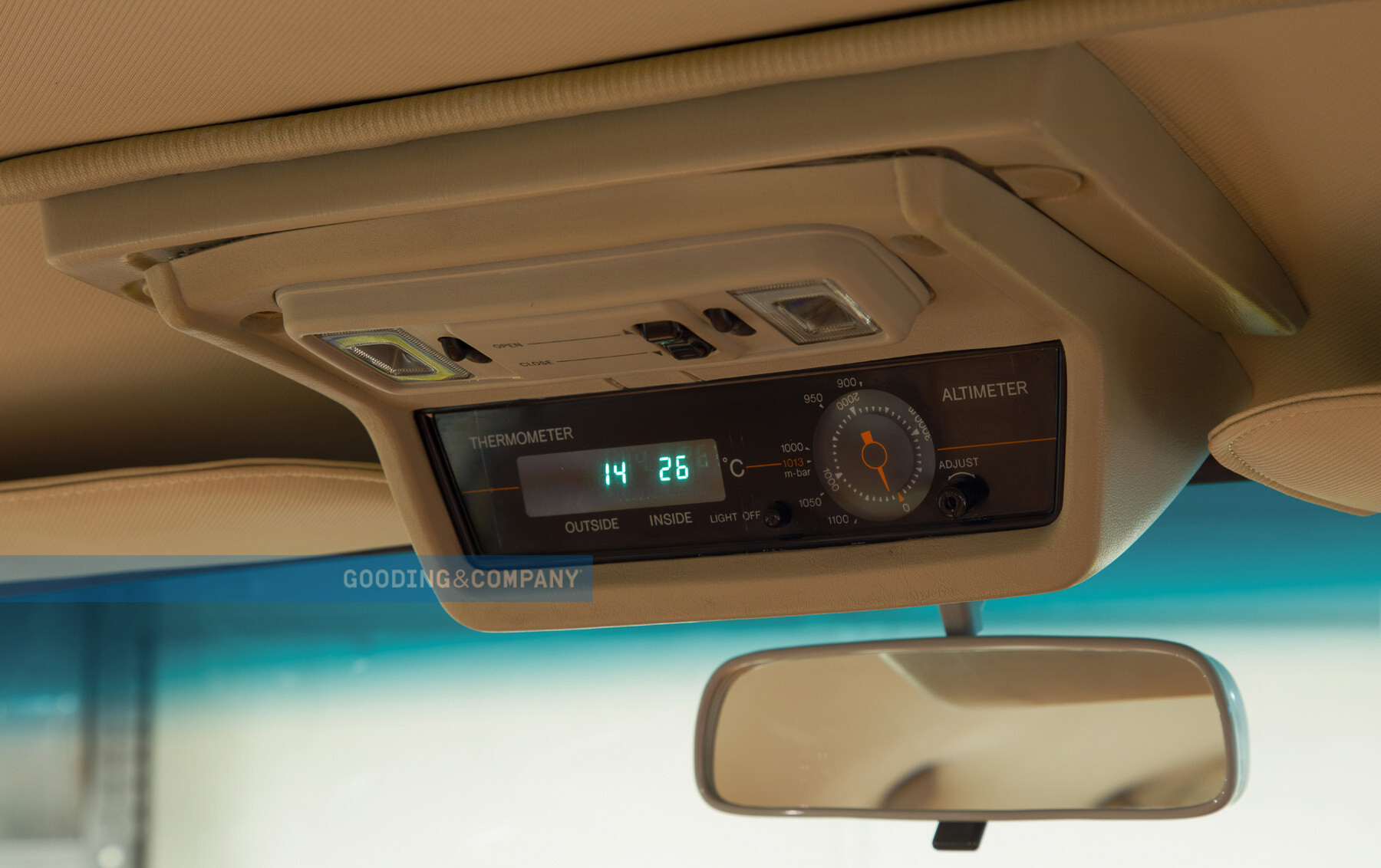
Included with the sale was the original tool kit, and the air conditioning even works along with the outside temperature monitor and altimeter.
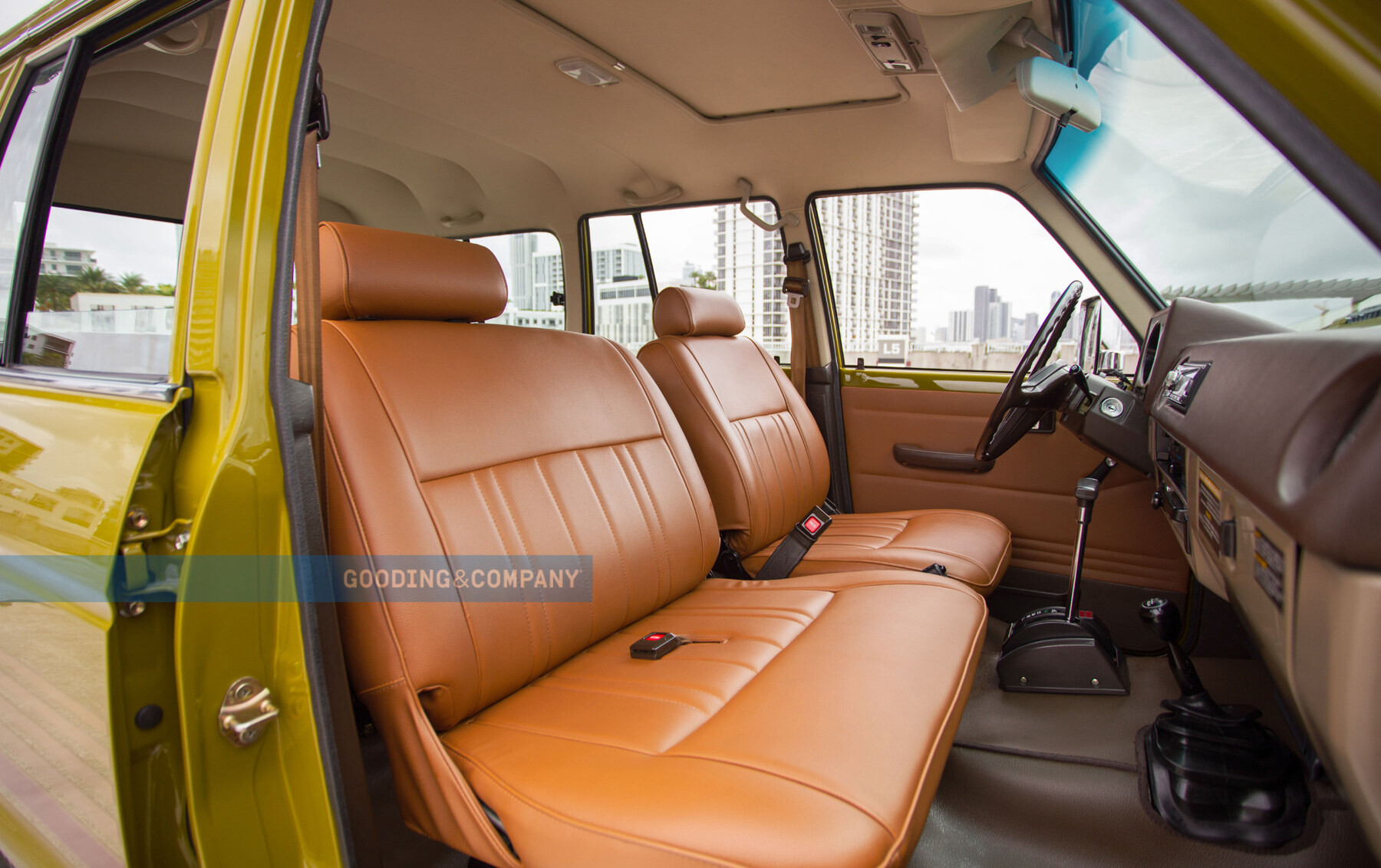
The car isn’t 100 per cent original though, upgrades include; Old Man Emu suspension, 33-inch BF Goodrich all-terrain tyres, LED headlights and an aftermarket head-unit with bluetooth and smartphone compatibility.
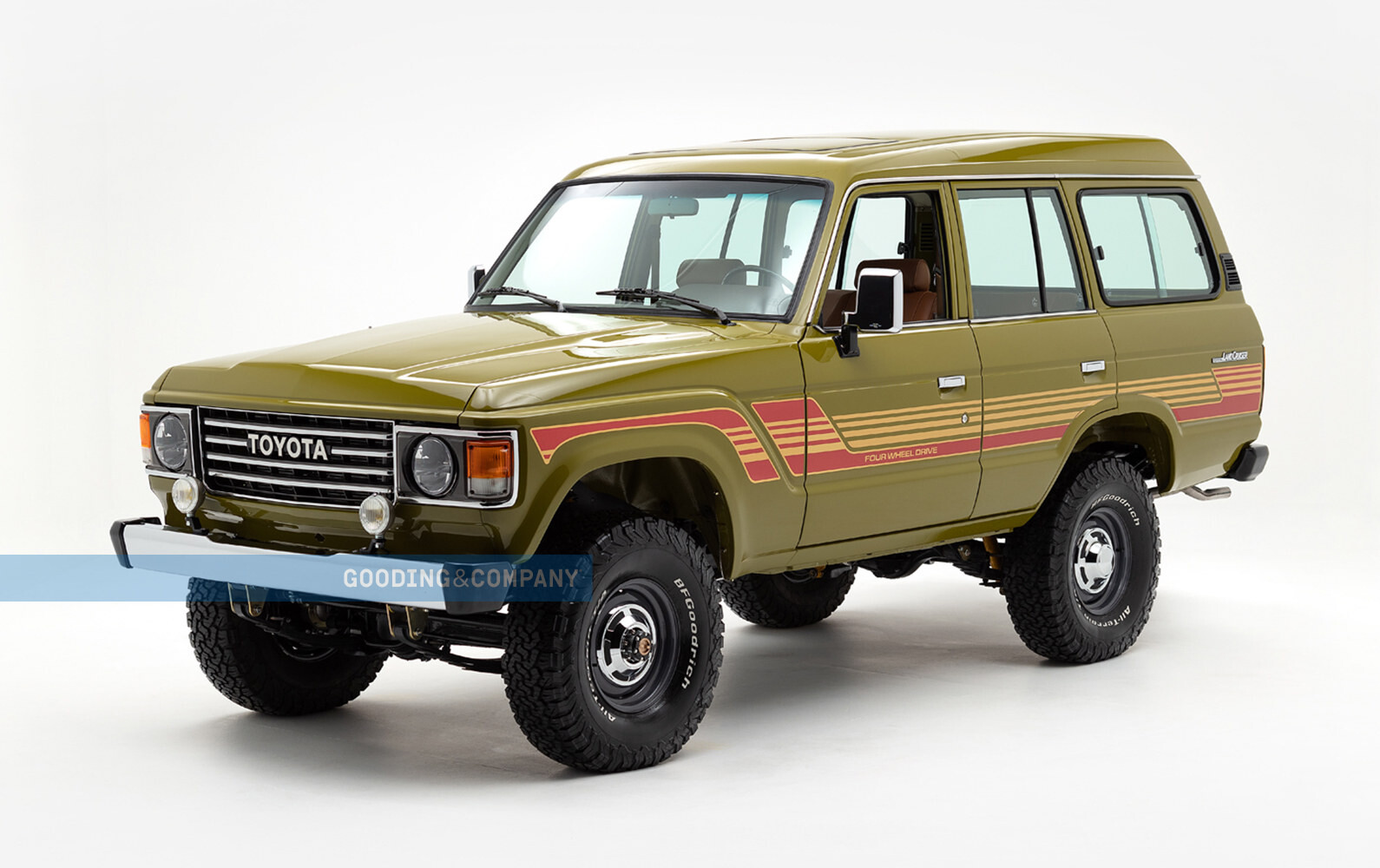
The record high prices follow on from the steady increase in value we’ve seen from earlier FJ-series ‘Cruisers, and earlier this month Toyota announced it would start making restoration parts for the 40 series LandCruiser early next year, with later series to follow after.
There’s a side of Australia most don’t ever see. Perched up in their high-rise apartments in the guts of cities all along the eastern seaboard, the average Joe has no understanding of what lies beyond the city lights. They’ve never seen the endless kilometres of corrugations. Couldn’t fathom the idea of hours between fuel stops, let alone days. The concept that a marked road may be nigh on impassable, requiring winching, sawing and technical driving ability to master it, is so foreign to them you may as well be describing a Mongolian odyssey. But for those with red dirt in their veins it’s a part of life; it defines not only their entire concept of adventure, but the very vehicles they build to tame the great outdoors.
With his sights set on serious remote touring, Luke knew he’d need a serious 4WD to get the job done, and with a Lifestyle Campers Reconn R2 ready to hook up to the back, a modern dual cab wasn’t going to cut the mustard; it’d need a bit of serious get up and go as well. Enter a stunning Merlot Red 2020 LC200 GXL, one of the toughest 4WDs on the market in factory form, and even tougher again after Luke had KDT Automotive Solutions spin its automotive wizardry on it.
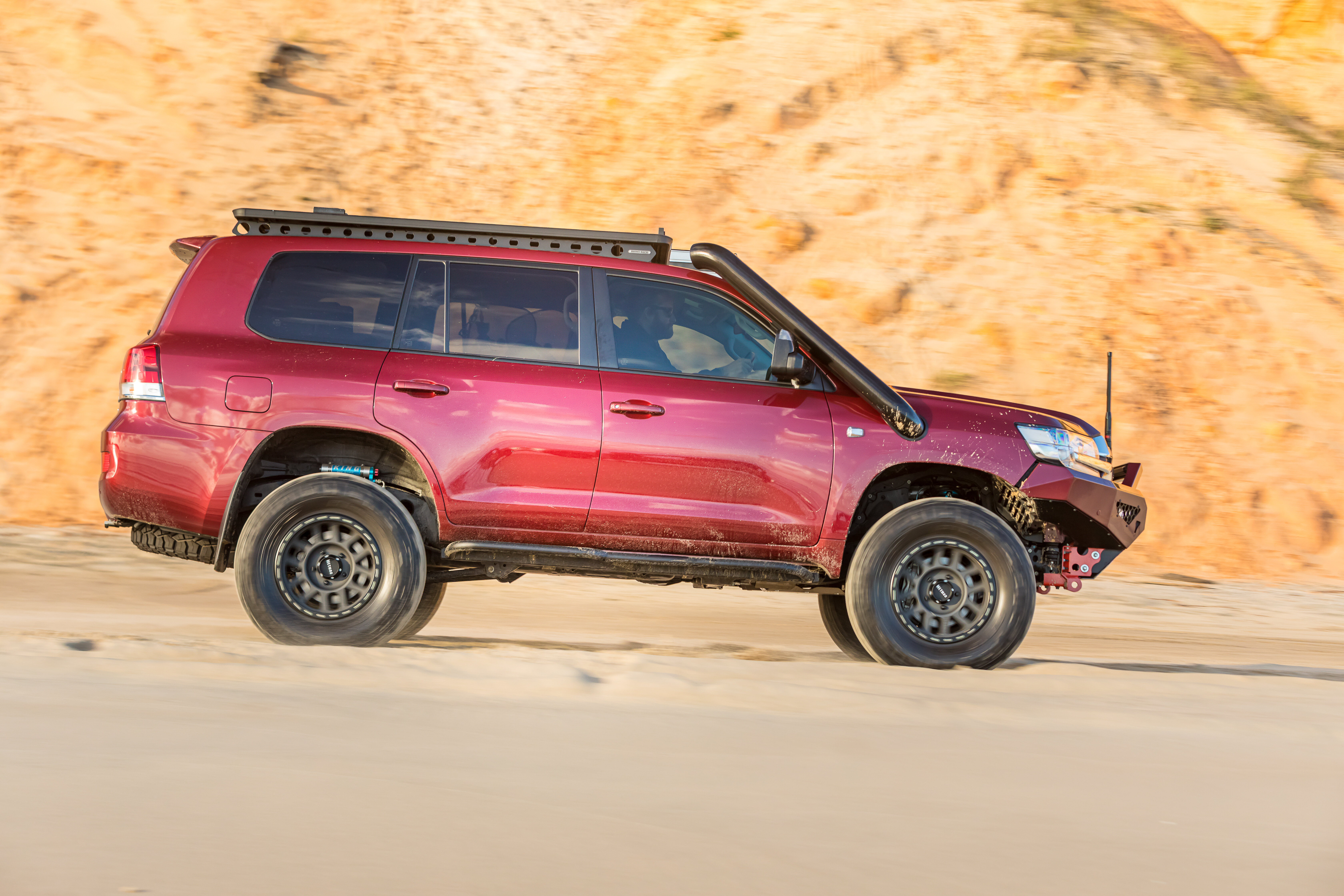
Like many tourers on the market, Luke knew the gear he’d be adding would start eating into the factory GVM, leaving him in a pinch of strife if he ever came face to face with a stern inspector holding a set of scales. With that in mind before he even picked up the keys, he had Darren from KDT lined up for a second-stage rego-certified GVM upgrade, bumping the Cruiser up to a massive 3800kg legal weight limit. With the LC200 so robust right out of the factory, extensive modifications weren’t required to boost the carrying capacity, but he did start with a solid foundation.
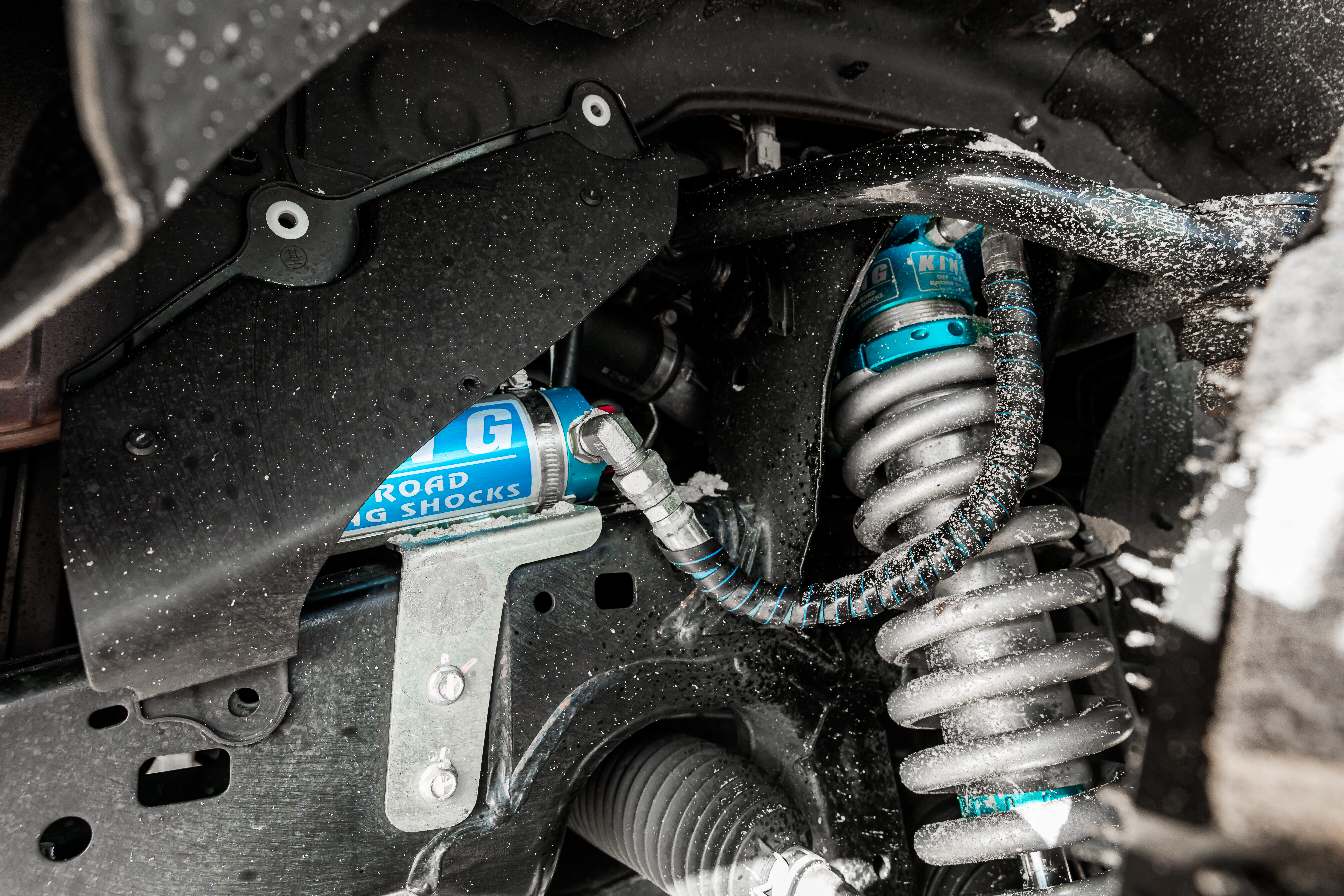
Hiding in each wheel of the Cruiser are huge 2.5-inch diameter King shocks with remote reservoirs and adjustable dampening, allowing Luke to dial-in his suspension set-up to suit exactly the loads he’s carrying and how he wants the rig to ride on the magic-carpet scale. Up front, the King shocks have bumped the ride height three inches closer to the clouds with Eibach springs, while the rear sits two inches higher on a set of Aussie-made King springs, a popular combination to level out the factory rake so many OEM 4x4s come with these days.
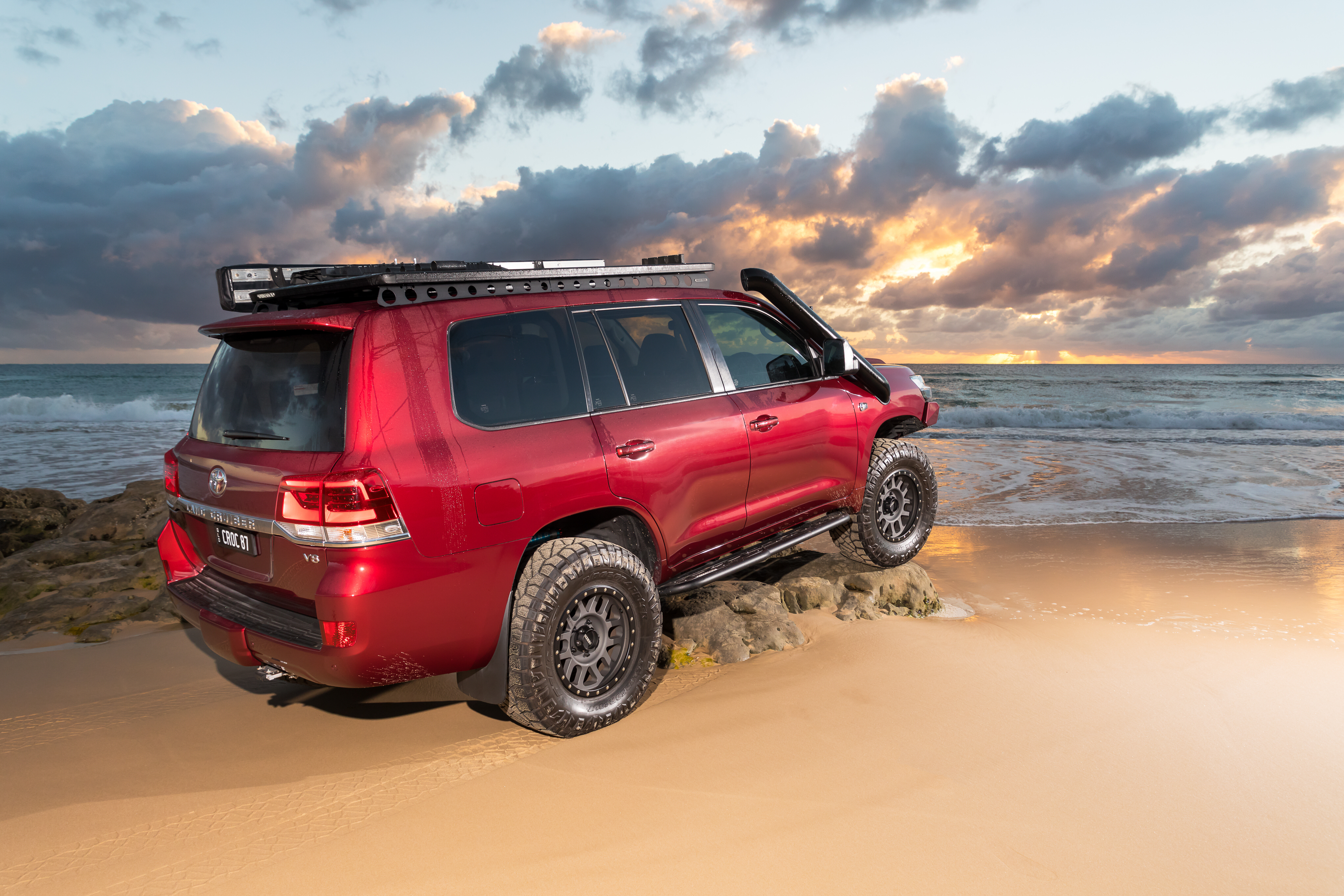
While it was on the hoist, a host of ancillary parts were fitted to ensure the Cruiser didn’t just sit better, but performed better too. Back to the front, and the restrictive OEM upper control arms have been binned and in their place now reside a pair of significantly beefier Blackhawk replacement arms, with the upper ball joint realigned to suit the new ride height; the suspension now far more comfortable at full travel. Moving backwards, the restrictive Panhard rod has swung the Cruiser’s diff to the side with the new lift, so an adjustable unit from Roadsafe was optioned up, providing a strength upgrade as well as adjustability to get the axle tracking straight again. Eagle-eyed readers will spot a set of Airbagman helper springs tucked inside the rear coils, allowing Luke to effectively increase his spring weight if the rear end is loaded up.
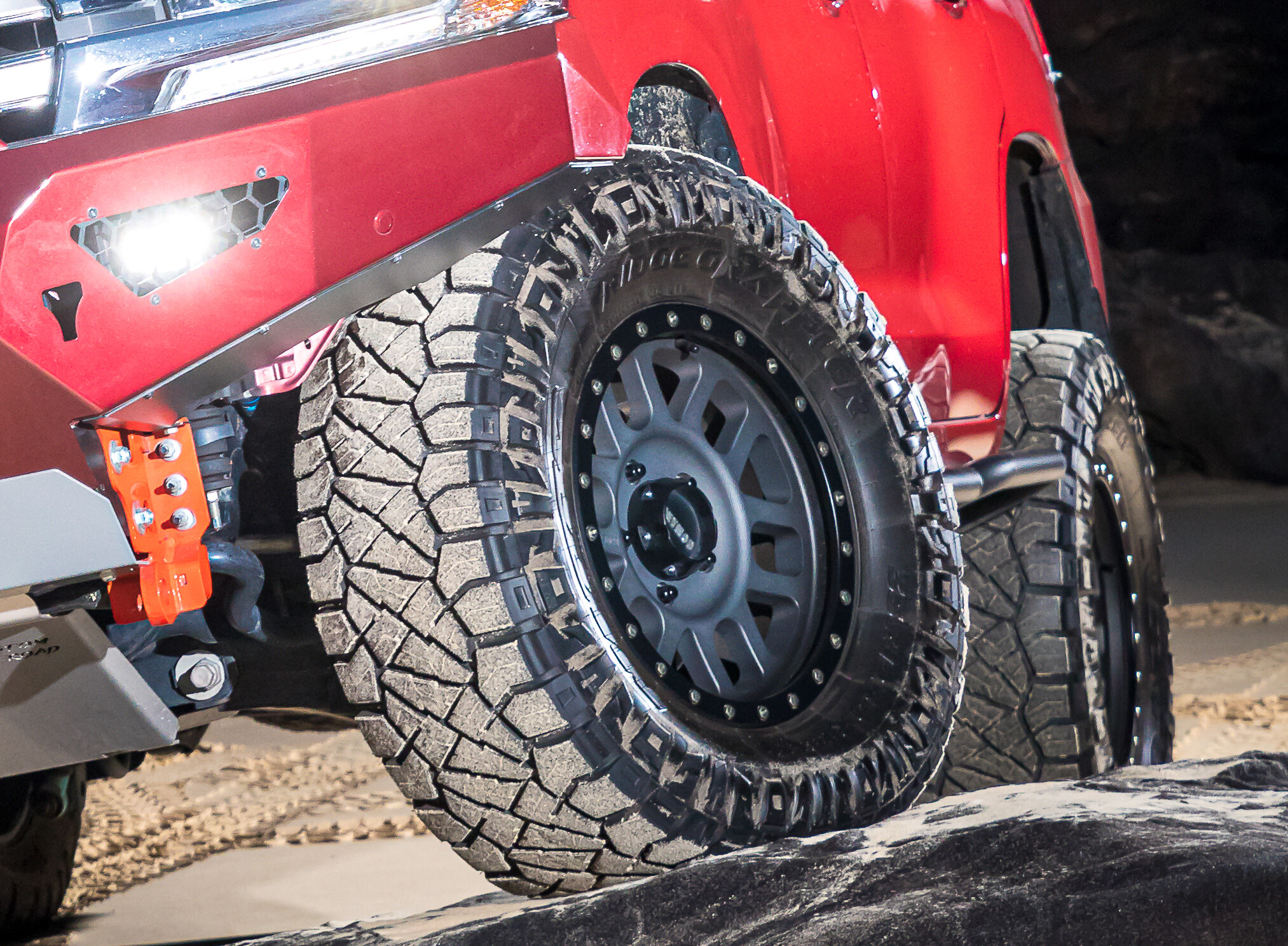
With so much space liberated in the wheel arches, Luke knew exactly what he’d need to do to fill it. “The overall goal of the build was long-range touring,” Luke told us. “But I didn’t want to compromise the look of the car.” Each corner now sports huge 18×9-inch 309 Grids from Method Race Wheels. Measuring in at +18 offset, they line up perfectly with the guards, giving the Cruiser an aggressive look without requiring huge flares to cover larger offsets. They’re wrapped front to back in 35×12.5-inch Nitto Ridge Grapplers, an aggressive all-terrain tyre perfect for a do-it-all tourer. “I didn’t want to go down the path of flares,” Luke says. “It meant with the offset I was running, a body mount chop and some minor guard trimming was required.”
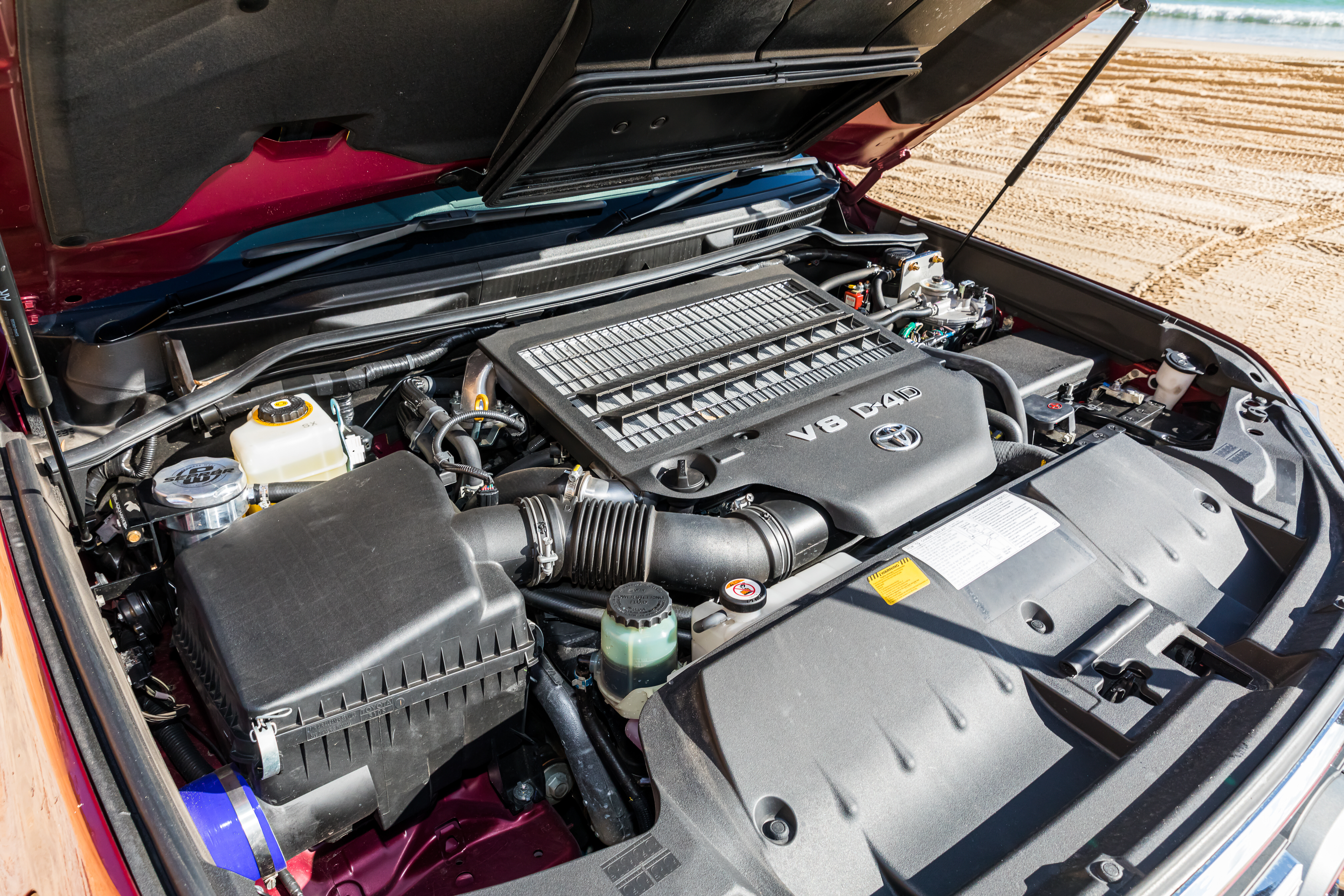
Keeping the whole show motoring down the road is the renowned twin-turbo bent-eight 1VD-FTV diesel. It’s breathing freely through a five-inch Vogue Industries stainless-steel snorkel and Unifilter combination. A Direction-Plus pre-filter helps ensure the injector pump and injectors live a long and healthy life, while a Process West catch can separates oil from the engine’s blow-by, helping keep the intake gunk free without blocking the EGR like so many people do these days.
Back on the outside and the Cruiser’s distinct look comes from the clean-as-a-whistle ‘Predator’ bar from Offroad Animal in Victoria. The colour-coded unit not only armours up the Cruiser’s soft bits, it also provides a home for a 22-inch slimline LED light bar from Stedi. Sliding back and the up-armouring continues with a set of Legendex rock sliders protecting the vulnerable sill panels.
Underneath, there’s more steel than a Sherman tank in the form of Custom Offroad bash plates front to back. MSA towing mirrors help bump out the view too, to let Luke keep a keen eye on the Lifestyle Campers set-up on the hitch.
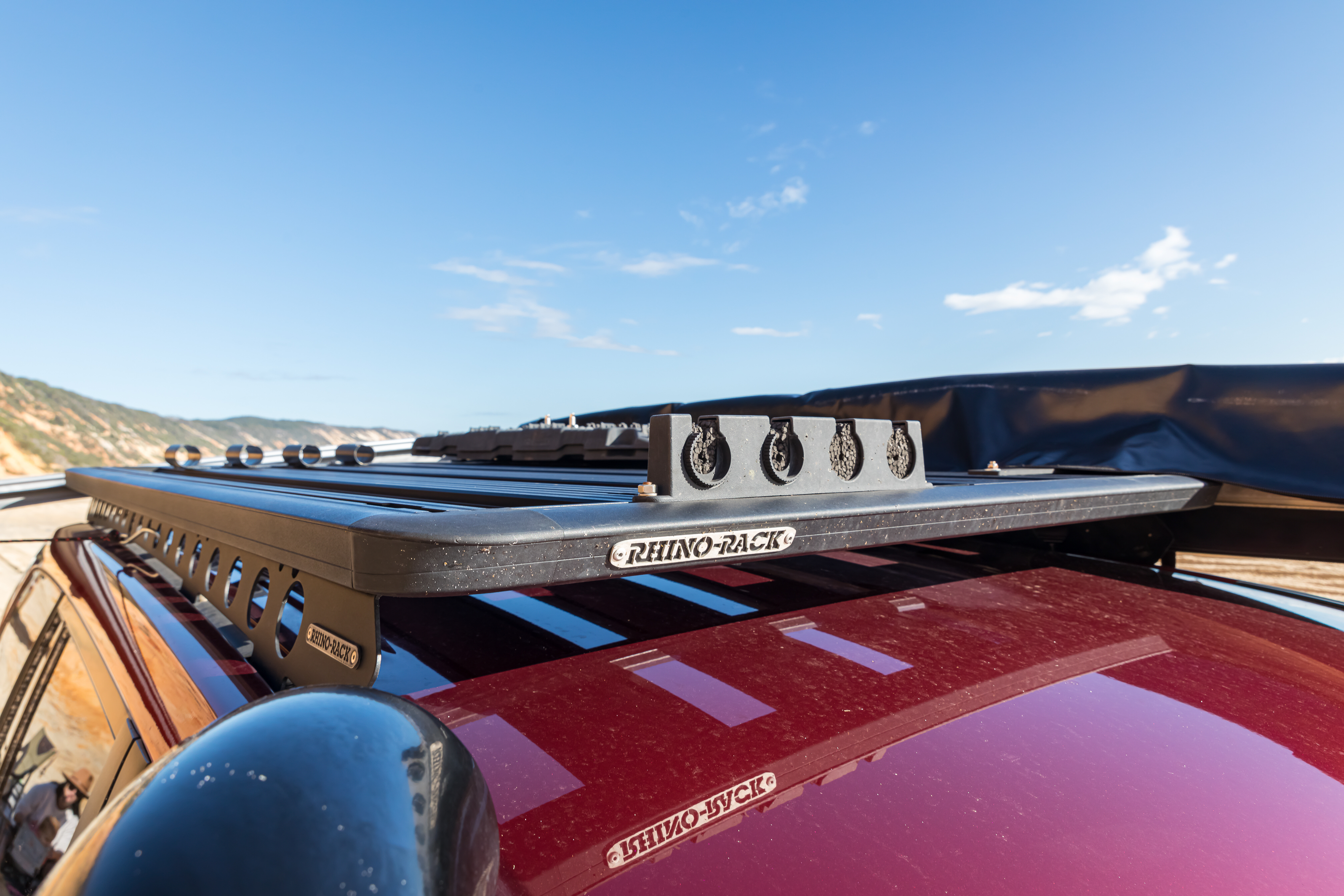
Up top there’s more than two square metres of touring storage thanks to a full Rhino-Rack set-up resting on a Backbone mounting system. It plays host to a 270-degree awning, a couple of additional light bars and a few recovery items if things turn pear-shaped on the tracks.
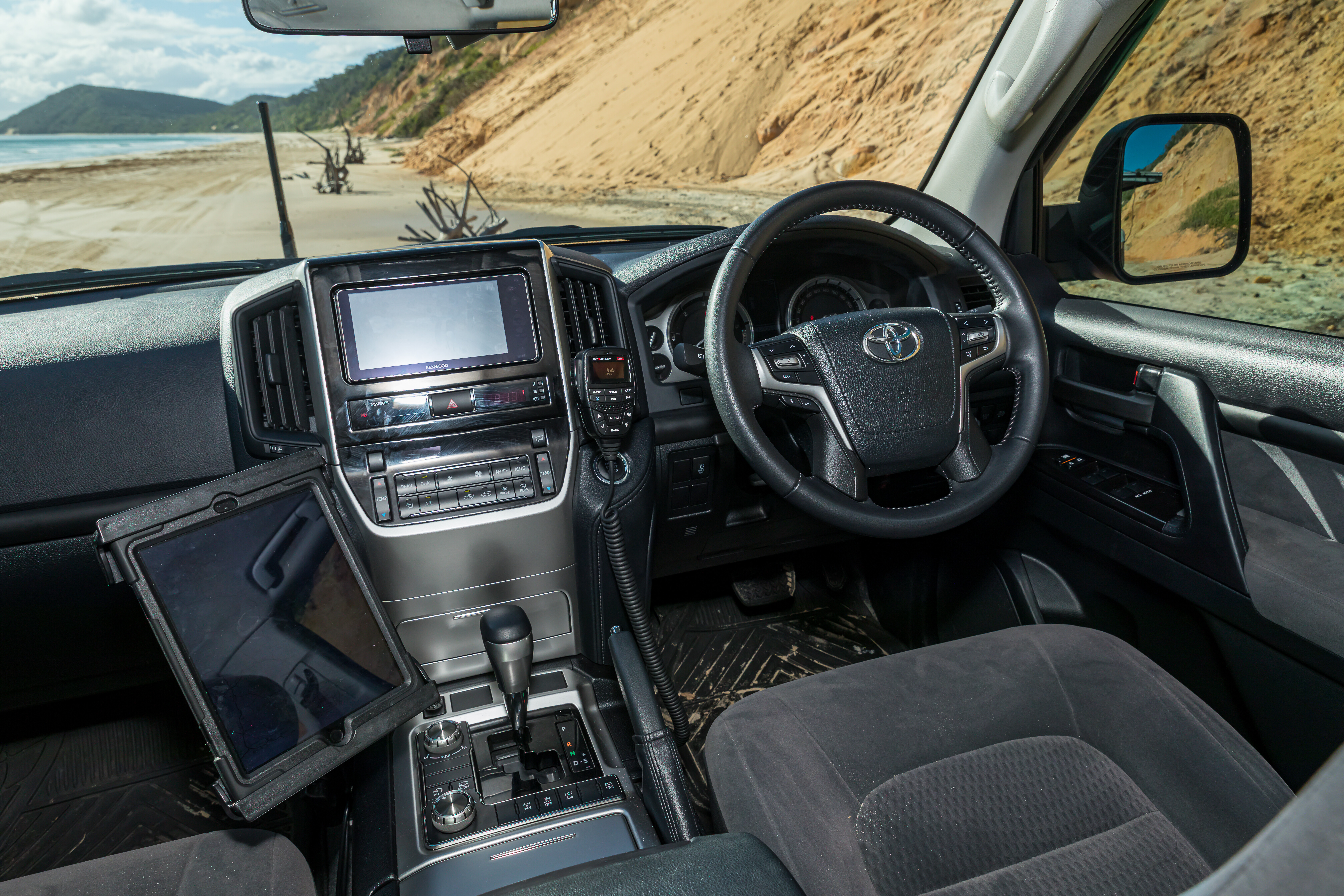
Sliding into the captain’s seat, Luke’s kept things simple but practical for his remote touring needs. A Throttle Monkey unit lets him dial in the throttle sensitivity, allowing him to dull it right down for precise rock-crawling work, or give him instant throttle response in soft sand or mud. A GME XRS 330C falls easily to hand, the high-tech unit not only giving clear communications but allowing Luke to replay previous messages and locate other members in his convoy thanks to the built-in location services. Hanging off the centre console is a full-sized iPad with off-road mapping, and a Redarc trailer-brake controller equipping Luke with all the tools he needs in his off-road arsenal.
While Luke’s Cruiser may not be one of the most modified we’ve ever seen, it’s easy to see it’s one of the most well thought out and intentionally modified. Everything he needs for remote touring, everything he’d want for hard weekend wheeling, and enough drool factor to ensure he’ll spend plenty of nights sitting in the shed looking at it with a smile on his face.
TRADING SPACERS
In days gone by, if you wanted your wheels to sit further out of the guards, you’d whack in a set of wheel spacers, convince yourself you’d recheck their tightness regularly, then never check them again until they came loose and left you stranded. With so many suitable aftermarket wheel options on the market, people are now putting the effort in to not only getting the right-looking wheel for their rig, but making sure it fits right too. Radius and width are easy enough to understand, but when it comes to offset a lot of people are left scratching their head wondering what the heck the +18 even means. We’re a bunch of nice fellas here at 4X4 Australia, so we figured we’d take the chance to shine a little light on the topic. Picture a typical wheel at 8-inch wide, but we’ll call it 160mm because mixing metric and imperial is an offence that should be cause for capital punishment. If your wheel is 0 offset, it means the wheel-mounting surface sits smack bang in the middle of the wheel, you’ll have 80mm of the wheel poking out from the rotor, 80mm poking in. If you’ve got a positive offset, your wheel-mounting surface moves to the outside by the same amount, a +20 offset means you’d have 100mm of wheel poking in, and 60mm poking out. Negative offset is just the opposite and would sit further out by 20mm.