A Simpson Desert-flavoured iPad app is available to download for free from the Apple App Store in celebration of the first motor vehicle crossing of the formidable red giant by a Nissan Patrol G60 in 1962.
Produced by ACP Trader – the people behind Camper Trailer Australia – Crossing the Simpson is a special electronic magazine that tells the story of Reg Sprigg, an explorer and geologist who made history when he and his young family conquered the mighty Simpson in their trusty Patrol. Nissan celebrated the 50th anniversary of the crossing with a re-enactment convoy of Patrols across the Simpson complete with journalists and a TV crew, followed by an outback bash in Birdsville.
The app details the long and colourful history of the Patrol and dusts off rare historical brochures from deep in the Nissan archive. It’s filled with great desert yarns, beautiful photography and loads of awesome video compliments ofPat Callinan’s 4X4 Adventures. Punch ‘Simpson Crossing’ into the App Store for your free download.
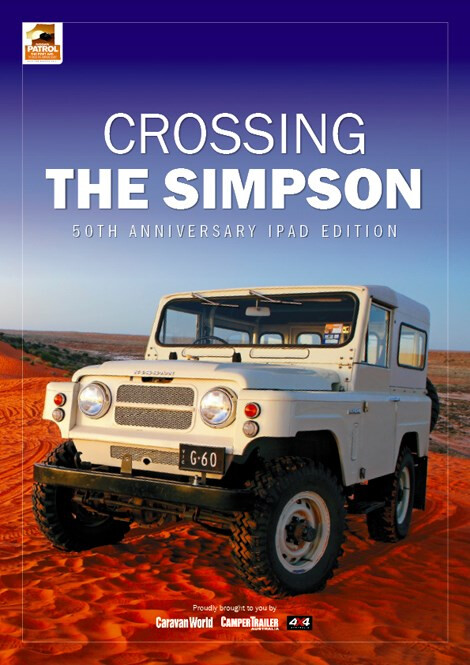
Click HERE to grab your free copy of the Crossing the Simpson: Nissan Patrol 50th Anniversary Edition iPad app.
Heard of Beyond Hotham? It’s a 4X4 event designed to show off the best the High Country has to offer.
Mount Hotham village, in the heart of the Victorian High Country, hosts the annual 10-day Nissan Beyond Hotham. The event attracts participants from throughout Australia, from retirees to dedicated four-wheel-drive club members. Their shared passion? An all-consuming love of the great outdoors.
For some, Beyond Hotham is their first off-road experience; for others, recently retired, they use the event as a way to find out more about travelling and camping with their four-wheel drive – perhaps for that once-in-a-lifetime trip they’ve been planning. Where better to do this than in the company of experienced off-roaders and under the expert tutelage of Beyond Hotham trip leaders? Even seasoned four-wheel-drive club members come away from Beyond Hotham with a smile on their faces.
We hope we can travel as well as this Toyota when we’re 76.
When it comes to being serious about four-wheel driving, you can’t go past Mark Haffenden. He lives and breathes it every day. Mark was so enthusiastic about combining his hobby with his day job that he bought well-established Perth training business, Eureka 4WD Training. He loves that he gets paid to pass on his passion to people just starting out on their own personal 4X4 adventure.
Mark has always owned a 4X4. He started out in the UK 25 years ago with the traditional, no-frills, working man’s chariot of choice, the Landie. In testament to their toughness, it was an original 1948 model that he picked up for the tidy sum of £500. That old Landie allowed Mark the enriching experience of spending all his free time scouring the British mainland in search of parts. While Mark’s mates were chatting to the girls, he was heading down to Shropshire for spares. After battling around the country to every dealer to get his brakes working he sold the Landie with relief to a collector, who kindly took it off his hands for £2000. After his initial glee at turning such a tidy profit, 21-year-old Mark found out he’d been driving a very rare vehicle and could have held out for £10,000.
Outback travellers may already know of Keep River National Park, but the park isn’t half the story. Ron and Viv Moon investigate.
The track had vanished for the second time in the past half hour, but this time it looked as if it was gone for good. I pushed the Nissan into the hunched fronds of the spear grass, the once-proud three-metre-high stalks now bent by time, the dry season and the wind into a metre-high mass of jumbled rotting vegetation.
Suddenly, a fence line presented and while the ‘moving map’ on the Hema Navigator had predicted such an object, its instantaneous appearance still startled us a little. I swung the wheel hard left and we then bumped our way along beside it. A gateway loomed, its entry and exit virtually hidden by the mass of grass and low scrub that had grown up since the last vehicle had passed through here.
We were heading for the NT/WA border near the northern coast of Australia and a long way from anywhere. When we got to a stream about a kilometre later, its waters tamed by the dry season into long shallow pools and trickles in between, we wandered the banks looking for any sign of the track. There wasn’t any, even though the GPS said we were close – and even right on it at times.
Conflicting thoughts battled in my head; should we go on or turn back? I really wanted to continue, but we were on our own and not really set up for such an undertaking. I had staked a tyre on a cattle grid the previous day, leaving us only one spare; food (and beer) were short, and the trip to the coast could take another day or more, even though it was so tantalisingly close. We chickened out and turned back. What do they say about saving the fight for another day?
Our travels north of Kununurra, in the far north of WA, had started a couple of days previously as we headed out of town and drove this way and back on the crisscross of roads that cut across the irrigation area north of the town. Phase Two of the Ord River Irrigation Area is now well under way with the land being prepared for irrigation and cutting up into farm blocks.
Crossing the border, we left all the development behind, although the irrigation system will reach out this far when it’s completed. Just before the Keep River crossing 9km further on and well north of the national park of the same name, we turned onto a little-used track and headed north.
A small creek which normally has water flowing in it well into the dry season is crossed shortly afterwards and then about 10km north a number of tracks lead off to the left a short distance to the high banks of the Keep River. A few spindly trees cast a minimal amount of shade while rough-hewn steps make access easier to the water. We set up camp for the night.
Here the river is generally fresh because rock bars a short distance downstream help keep the salt incursions to a minimum and it is still a long way to the mouth. Crocs though – freshies and estuarine – dot the exposed rocks in the middle of the river, making swimming an absolute no-no. Still, those with a small tinnie could launch it from around here, but you’d need to pay attention to the rock bars that stretch across the stream and are easily visible at low tide.
Shortly afterwards on the track north another deeper creek is crossed, but luckily it has a solid rock bottom and, unless the water is deep and fast-flowing, it shouldn’t be too much of an issue.
By following the large almost-right-angled bend of the Keep River, the track heads east passing several old station ruins before swinging north. Along here the river is mainly salt and greatly affected by the tide – but for those searching for barra and other big fish, the camps along here are some of the most popular. It’s still a fair haul from the river’s mouth, though.
The track network north from here becomes a lot less used as large areas of salt-wracked flood plain begin to dominate the landscape. These plains might only flood during spring tides or when the Keep is in full spat but, even so, narrow soft channels wend their way across the plains waiting to trap the unwary.
Well west of the river on a grassy plain we passed among magical boabs and the occasional kapok and kurrajong tree, the track narrow and little used, before we came to yet another boggy creek crossing. After that the track disappeared, for the first time, but we pushed on – the border looking ridiculously close and easy to get to. We were wrong.
Turning around we headed back to the river and a campsite, tried our luck at a bit of fishing but the tides were wrong, while “You should have been here last week” was the only really relevant advice we received.
No doubt we’ll return, possibly for the fishing, but certainly for the adventure of actually reaching the border.
Toyota’s take on its FJ40 swept all before it in 4X4 of the Year, but how does the FJ Cruiser rate against a couple of real icons?
“What were they thinking?” said one former editor, incredulous at the decision to name Toyota’s quirky FJ Cruiser 4X4 of the Year (4X4OTY). His wasn’t the only voice of dissent; the FJ became one of the most controversial winners in the history of our long-running award.
At a time when turbo-diesels seem to be making all the running, eyebrows were raised because the FJ Cruiser is a petrol-only model, and only an auto at that… and one with a relatively small fuel capacity. Some also questioned the FJ’s limited interior space, while others deemed the FJ too pug-ugly to be deserving of anything, let alone the 4X4OTY award.
Of course, this is all grist for the mill; another day in the life of the magazine and, as they say, the judges’ decision is final.
The 4X4OTY award typically throws together a disparate group of vehicles simply because eligibility is based on being new that year, and not on price or vehicle type, and the finalists are not compared to each other but judged against the award’s criteria. The field that the FJ beat home was as diverse as ever, but raises the obvious question: How would the FJ go against similar, price-comparable vehicles?
Isuzu’s intrepid off-road racing duo recounts more than two decades of tough love.
How and when did your respective careers in motorsports begin?
BRUCE: I got started as a novice rally driver in a Ford Escort back in 1975, competing in the Queensland state rally championship. I went on from there to work in the business with guys like Colin Bond and Ralliart boss Bob Riley, engineering and building rally cars and off-road cars, and eventually started off-road racing myself. My first off-road event was the Finke Desert Race in 1990.
HARRY: I started racing motorbikes when I was 15, when I was still living in Japan. I did motocross events for years.
When did the two of you first pair up; was it love at first sight?
HARRY: We met in 1989. I had actually been in Australia servicing for some friends who did the Safari. They had an Isuzu, but they didn’t finish the event. They left it here ready for the next year and I came back looking for someone to do the job, and found Bruce. I don’t think it was love, no, but he is very good at what he does!
BRUCE: I helped Harry rebuild the car, and then we stayed in touch after that. The first event we did together was the 1993 Safari and we had a bit of a setback. We ran over the gas pipeline that runs from Moomba to Port Augusta and I jumped it, but the car jumped out of four-wheel drive when it landed and damaged the selector. I couldn’t get it back in high range so we drove in low range for 650km; so that’s like driving all the way from Sydney to Coffs Harbour in second gear, which was… mentally challenging. We lost about an hour and 20 minutes to the leaders, but we caught up and I think ended up losing the race by five minutes — we came second and won our class.
Love? Well, I think we had a good working relationship right from when Harry first came to Australia and he was working for a mate of mine. He could hardly speak any English. Then we worked together building Metro Cabs for a few years and Harry was getting more involved with Isuzu in Japan, and it all went from there. It’s actually a long, complicated story as to how it all got started, but it obviously did — and it worked!
What’s the toughest off-road racing challenge you’ve ever faced?
BRUCE: Dakar 2009, because it was just relentlessly tough and we didn’t know what was coming. No one on that event knew what was coming, because it was all new for everyone, but it was our first time. [Dakar] is head and shoulders above the difficulty of any other event.
HARRY: Round Australia, 1998. So long — 21 days in the car. Dakar is tough too, but it’s different. It’s also hard, but not so long. Round Australia we did nearly 1000 kays every day, and the transports were boring. Dakar is hard, but you can enjoy it — except when you have to dig more!
You’ve got five outright Australian Safari wins under your belt, as well as the 1998 Round Australia. What would you put that success down to?
BRUCE: Obsessive compulsive disorder! Success is mostly all about what you do before the event, all the preparation, and then you have to have the mental stamina too, for the preparation and the racing. I think it probably is obsessive — you might have to talk to my therapist! Once I’ve decided to do an event, the focus is just on that. Anything that does not involve getting to the start of the race and winning it is just a distraction. I know it’s probably a bad thing to be like that, but it’s part of what gets you the result.
HARRY: It’s a combination, I think. The most important part is me, of course (laughs), but Isuzu, Bruce, the mechanics — and me. If one piece is missing, it doesn’t work
Partnerships are never perfect. Any particular traits that drive either one of you mad?
BRUCE: When Harry does something wrong, he doesn’t say anything — but that’s a typical Japanese response. He goes Japanese; he goes quiet, if something goes wrong or is difficult. That’s probably the only thing. Otherwise it’s a good relationship.
A lot of drivers think they’re perfect, so if the navigator makes a mistake, they just abuse them. But the navigator has to deal with the driver’s mistakes — he could get hurt, or if I get bogged again and again, he has to get out and help dig it out, so if he makes a mistake I can’t get angry. It’s just human, so you just think ‘well, how do we get over it and not make that mistake again’ because it’s gone, you know? It could have cost you the rally, but you’ve got to get over it, otherwise you’ll just distract yourself and you won’t get to the finish.
Sure, we do get mad at each other and we might have a spit, but you get it off your chest and get on with it.
HARRY: Pissing in the seat! But he says he is working on new technology so he doesn’t have to do that. No, nothing. You just don’t process it, because if you do, you get cranky. Just ignore him, don’t process it. You have to keep working together.
Harry, it must take a different type to sit by and navigate while someone else controls the vehicle. Ever wish you could take the wheel?
HARRY: If I drove, Bruce wouldn’t have a job! He’s not a better driver than me, but he’s much better in the dust. He’s got superman glasses!
Favourite 4X4 destination in Australia?
BRUCE: Aside from rallies, I don’t do much, but around Alice Springs, the MacDonnell Ranges. That’s pretty amazing country.
HARRY: Stockton Beach [NSW]. It’s fun when we test there.
BRUCE: But if he is in his car, he won’t let the tyres down, and it takes him forever to get up and down the dunes!
This article originally appeared in 4X4 Australia December 2010 issue.
Amarok gets the eight-speed auto we’ve been waiting for – and it has a more powerful engine.
Volkswagen’s decision to introduce the Amarok ute powered by a small (compared to segment rivals) 2.0-litre turbo-diesel with manual-only transmission drew criticism from amateur and professional commentators alike. Would the engine be up to the task of the regular demands placed upon a workhorse vehicle and would the lack of an auto put off buyers seeking the ease of indirect cog swapping?
So far sales have steadily increased but not in stratospheric numbers, despite the fact the Amarok has (as stated in our Ute of the Year award) set a benchmark in ute dynamics, performance and quality finish.
The three-engine spec range of Amaroks named in order of torque output (300Nm, 340Nm, 400Nm) will be, by July, augmented with a 132kW bi-turbo diesel that adds 20Nm to the torque store. Peak power remains at 4000rpm like the current 120kW model, whereas the extra torque peaks at 1750rpm.
Crucially, as a class-leading introduction, the Amarok has been given an eight-speed ZF auto transmission. The new ’box will only be available on the all-wheel drive models and only with the higher-power engine. Towing capacity in the 132kW model increases to 3200kg.
The decision to only use the new auto in AWD models and not low-range equipped variants may surprise, but the ratios are such that the eight cogs provide enough flexibility, with short ratios in first and second, so the Amarok takes off in second gear and allows enough range to retain off-road function. No exact ratio figures were available at the launch in Spain, so we can only speculate as to the spacing.
New to Australia will be the single-cab Amarok, but potential customers will have to wait to see exactly what will be on offer. Auto/manual, powertrain; we received no answers. Some good news on the tray in that variant is that it can hold two pallets with room to spare. Specified with the new higher-power engine and auto combination (and consistent in-cab quality) would take the single cab workhorse into a new realm of capability. However, at this stage the ZF auto is destined for dual-cab models only.
While displacement remains at 1968cc for diesel Amaroks, the increase in power has been achieved through engine software tuning and larger turbo vanes for more air intake. Claimed combined cycle fuel consumption in the 132kW auto is 8.5L/100km; 8.0 for the BlueMotion.
Nothing has changed in on-road operation. The Amarok has the dynamics of an SUV – amazing in this vehicle class – and, when pushed through twisting mountain passes, there’s none of the body-roll you’d expect of a ute. The cab is quiet, even though we were driving vehicles shod with Goodyear Wranglers, which are more aggressive than Australian-market Pirelli Scorpions. Despite the vehicles being left-hand drive, all interior appointments were the same as Oz-spec, bar the sat-nav system and fuel-efficient stop-start technology. The latter was much more noticeable than in comparable fuel-efficiency strategies, with an evident judder at stop/start points.
The eight-speed auto is a joy. Controlled with a throttle that is light in operation, there was no harshness and no unruly kick-down even with the Sport mode engaged, which sharpened throttle response and provided even livelier performance from the tweaked bi-turbo diesel. It’s a shame that, at this stage, only the top-spec Amarok will snare the new gearbox.
In most cases, vehicle manufacturers tailor a launch program especially for an off-road element, without being too extreme as not all journalists are experienced four-wheel drivers. This wasn’t the case in Spain. Far off the beaten track the course was a dedicated 4X4 driver-training facility that would have Land Rover Experience operatives interested, though it lacked mud. While there were VW staffers at the start of any severe obstacle, we were surprised that in-cab chaperones were not employed to make sure the right line was taken. Given that we first tackled the course in a high-riding VW Crafter, the off-camber slopes, ditches and climbs seemed even more extreme.
The Amarok is our 4X4 Ute of the Year, but it has to be re-stated how capable it is off-road. The track surface was dusty and loose soil and gravel coated all the climbs and descents. A series of high-crested undulations tested undercarriage protection and ramp-over angles and we gave up explaining our progress over the “wombat” holes to the German organisers. What’s the German word for wombat?
We were advised at each obstacle to engage the off-road mode that employs Hill Descent Control (HDC), which also works in reverse and tunes throttle and brake reactions according to input. There’s also traction control and a rear diff-lock can be employed if necessary. Ambling around the softer sections of the course, the Amaroks provided a smooth ride. The huge rubber bushings go a long way to help in the rear leaf-spring set-up, although no one could confirm whether we were riding on the comfort or optional heavy-duty suspension. Stopping the vehicle over the wombat hole with wheels in the air let us feel the traction control start to push us forward with slight throttle application and the suspension cycled through unfazed no matter the droop or compression at either end.
The most impressive feature of the off-road mode is the HDC. Its effectiveness is one thing, but it is the unfussed way it goes about its business that stands out. Nose over a steep incline and it will slow the Amarok to a crawl. But it’s not set to a limit; it reacts to throttle and brake application accordingly. We found no real need to use the manual mode of the auto to slow progress, in Drive it worked perfectly well no matter how steep the decline.
Locking the rear diff aided progress (traction control is not disabled), but we found the Amarok still made the worst climbs without it and with the off-road mode disabled, progress still wasn’t halted.
Amaroks have one of the best-protected underbodies of all the utes available here, and it was only on a few occasions that a lack of judgement called those plates to the fore, especially over the severe mogul tests.
The test vehicles had a great spray-on tub liner and a sporty hard tonneau cover on gas struts, but neither is confirmed for Australia. When questioned, PR confirmed VW’s stance on accessories such as bullbars are not on the agenda nor sanctioned, but the aftermarket is taking the issue in hand and producing what Aussie buyers require.
Prospective Amarok buyers hoping for Touareg’s V6 turbo-diesel in the auto will be disappointed, for now anyway…
Not that that matters. Amarok is a fantastic vehicle as it stands. And now that the niggle of low output/capacity engine and the lack an auto have been addressed, it’s appeal will only be broadened.
Does Range Rover’s luxury softroader stay true to the marque’s off-road heritage?
Pure. Prestige Dynamic. Adjectives? And all terms that could be applied to a Range Rover and they are, in the Evoque’s various specification levels. But this is no regular Range Rover; everything has changed. Evoque… evoke a spirit… so where is the Range Rover spirit in this new incarnation?
Stepping inside the test vehicle, a base-spec Pure, you’re confronted with Range Rover DNA everywhere. The appointments, the technology, the quality. And then you push the start button. (I hate keyless/start/stop ignition, especially at a heady $1350.) The engine is rather noisy. It’s not refined. Well, maybe refined in performance but not in isolation.
This five-door Pure is powered by the four-cylinder TD4 engine. Its 2179cc mill makes a claimed 110kW at 4000rpm and 400Nm at 1750rpm and was, in our tester, mated to the optional six-speed automatic. The other engine options for buyers are the SD4, which is a tweaked version of the TD4 (140kW at 3500rpm and 420Nm at 1750rpm), or the Si4 1999cc petrol with 177kW (5500rpm) and 340Nm (1750rpm) on tap.
In our first drive (Jan 2012 issue) we’d had a major taste of the Evoque’s on-road performance, and a little of its off-road manners – this is the first Range Rover without low-range gearing, though it does have Terrain Response.
All models have been driven hard by journos all over the world. Evoque’s driving dynamics are not in question; they are precise no matter how hard the vehicle is pushed. The Evoque has no air suspension but all-independent, all-corner coils. The set-up is tuned for spirited handling and while it can feel firm on occasion it’s a tune that keeps the car planted on all surfaces and is a joy when pushed through the twisties; bodyroll is minimal and grip is sensational. The electric steering is progressive, with a heavy over-centre feel at slower speeds that’s unusual but at all other times is light, direct and communicative.
The suspension tune can be tweaked with the option of MagneRide as part of the Adaptive Dynamic option pack, but with Evoque there is an option for everything (see Options Weighed, p55). Our test Pure has sensible Pirelli Scorpion all-season Verde rubber in 235/60R18P designation, though the fashion conscious can head up to 19- or 20-inch rims. The spare was a 155/85R18 115M space-saver limited to 80km/h use. And while fashion will play a huge hand in Evoque sales, this vehicle should not be dismissed as a mere accessory. We wanted to find out about substance over style.
The summer has been atrocious, weather-wise, in NSW and so it came as no surprise to photographer Phil and me as we laboured over the Blue Mountains in drizzle and fog and then pouring rain. Looking great for pics. But it would give us a chance to test the Evoque’s mettle in the mud around Lithgow.
As stated, the TD4 donk isn’t the quietest and, even with all windows up, we noticed a cabin boom (not noted in other models driven) as we climbed the mountains at around 30-40km/h. I like to drive with the window down, something that in the Evoque is harsh on the ears. The wind buffets the B-pillar to such an extent that causes a similar harmonic disturbance to a rear-seat passenger winding down their window when all others are closed.
And the B-pillar is a serious blind-spot annoyance. Unsurprisingly there is an option for Blind Spot Assist ($690) with a cool, orange ‘presence warning’ displayed in the side mirrors, but it should be standard. Due to the vehicle’s sloping roofline style, rear window vision is tiny; you’re assisted by a rear-view camera (all-round vision cameras are an option, if a distraction in traffic) for reversing, but get the Evoque dirty and the miniscule wiper action and clogged camera lens limit your rear-guard action. Still, I counted an abundant 14 airbags.
In-cabin ambience is excellent, pure Range Rover. Leather where you’d expect it; adjustable steering wheel with all controls falling neatly to hand. All media is accounted for including wireless streaming for your iPod/phone.
The seats fit me perfectly. While access to the three-door coupe version will be a serious issue for some, the five-door presents no such drama and, once inside, leg and headroom are totally acceptable. Three adults would be a squeeze, although provision is made for three child-seat anchor points. Nice adjustable cargo-restraint system back there, too. Just need your own straps – options? And on that subject, one option – the full glass roof, especially for rear-seat occupants – is a must tick. Glorious.
So, back to Lithgow.
The forest tracks are potholed at the best of times. This day just wasn’t one of them. Numerous, water-filled and of varying depth, it was hard to pick a route – so we just drove. Photographers aren’t often known for their useful input, but Phil and I were in concurrence with the Evoque’s suspension qualities, steering reaction and stable ride. Apart from the occasional big hit, masked by water, we were unfussed in our progress.
With no low-range gearing, Terrain Response (and traction control) was our main arsenal with which to tackle the off-road opposition. The fact that we were a solo vehicle and, up until that point, hadn’t managed to locate the recovery points (journo fail) meant we were not going to go crazy, but found the powerlines track enough to do what most Evoques never will.
Clearance is your biggest worry. Take a peek under the Evoque and it’s flat and there are plates in the right places, but with no air-sprung adjustability you’ve 215 and 240mm front and rear respectively.
With Mud and Ruts dialled in via Terrain Response we had a crack at some mud and ruts. The rear right spun uselessly; going nowhere. It smelled, too. The front left, according to Phil, was marginally off the deck also, but still I should have been granted forward progress, surely? Not so. Reversed. Switched to Grass, Gravel, Snow. Hey ho – let’s go.
A few stabs at the ABS reaction proved fruitful on less-than-stable surfaces, however, getting stopped was bearing ever heavier on my mind as I was having trouble recalling the latter stages of the Blackfellows Hand Trail we were on. Mining subsidence plays havoc in the area.
With careful wheel placement and judicious checking of boghole depths, we eventually landed back on the bitumen with satisfactory ease.
So, convinced? Yes and no. With the gamut of low-range and air suspension combined with jaw-dropping style, it would be a no-brainer. Don’t get me wrong, I love the Evoque; having stepped out of two back-to-back tests and into a mid-size 4X4 wagon I was reminded of the steering precision it possessed as I attempted to wrestle the wagon away from a metal-to-concrete interface in the car park.
It drives well, if a little noisily in the TD4 Pure. In contrast, the SD4 Prestige is quieter with a deeper exhaust note and no cabin intrusion. It’s a question of your options. Rangies are expensive and this one is too. The cynic in me questions whether it would have been better to price the vehicle higher in the first place and include the necessaries, rather than start low but add a mammoth list of add-ons to make it the complete package.
Jeep increases its stake in the softroader game with a return of the Compass.
Jeep has launched the MY2012 Compass onto the Australian market as the brand’s only vehicle available with 2WD, where it joins the Patriot in the fast-growing mid-size softroader segment.
Having undergone a redesign since its predecessor was withdrawn in 2009, the new Compass is certainly the better-looking sibling compared with the characteristically boxy Patriot, drawing heavily on the smoother, more up-market styling of its ‘real 4X4’ cousin, the Grand Cherokee.
The Compass comes in two guises: Sport and Limited, both offered with full-time AWD and lockable centre diff, while the Sport is also available in entry-level front-wheel drive.
With so much competition in this market, Jeep needed to ensure that where it compromised on off-roadability (i.e. with the absence of low-range gearing), it made up for it with on-road performance, decent specs, plenty of extras and attractive styling. First impressions, however, are of a sound but slightly underwhelming addition to the ranks of the likes of the Toyota Rav4 and Nissan X-Trail. However, with a highly competitive and affordable starting price of just $26,500 (for the 2WD manual Sport), it can be forgiven some comparative lack-lustre.
Two engines options are available in the new Compass: a 2.0-litre petrol that delivers 115kW of power at 6300rpm and 190Nm of torque at 5100rpm; and a 2.4-litre petrol with 125kW at 6000rpm and 220Nm at 4500rpm.
At Jeep’s compass launch, we drove the Sport model powered by the 2.4-litre petrol with constantly-variable transmission II (CVT2). While the Compass was quiet and handled comfortably on-road, the 2.4-litre engine felt spiritless and struggled to pull the vehicle’s modest 1480kg (Sport) weight off the line with any amount of gusto. While the Sport is available with five-speed manual as standard, the CVT2 auto (with manual shift mode) is a $2000 option. The Limited is available with CVT2 and full-time AWD only.
Features include electronic stability control, electronic roll mitigation, hill-start assist, front driver, passenger and curtain airbags (surprisingly, driver and front passenger side airbags are available as an option only; $800 on the Sport, $550 on Limited) and 17-inch aluminium wheels (on the Sport).
Additionally, the Limited model features leather-trimmed front and rear seats, six-way driver power seat adjustment and manual lumbar support adjustment, 40GB touchscreen CD/DVD/MP3/HDD radio with Uconnect phone, auto-dimming rear-view mirror and 18-inch aluminium wheels.
The Compass is a vehicle that would suit a young, middle-income family with a Jeep enthusiast in the ranks who’s had to compromise away from a $32k soft-top Wrangler – for practicality reasons – but can’t afford the $45k starting price of the Grand Cherokee – or doesn’t plan on heading far enough off the beaten track to justify it.
Of course, Jeep had no choice but to offer up a contribution to the fastest growing vehicle segment in Australia – and the Compass is without doubt a far more relevant and competitive entry than the increasingly outmoded Patriot. But is the price tag enough to put it in front of its increasingly slick, safe and well-equipped rivals? Only time will tell.
Twenty-five years after the ‘4X4 Olympics’ were held in Australia, seven Land Rover Defenders recreate the gruelling off-road event.
The first Camel Trophy was held in 1980, when three Jeeps were driven by German teams from Belem to Santarem in Brazil. It was planned as a one-off event by the manufacturer of Camel cigarettes, RJ Reynolds, but it was so successful that the tobacco company decided to sponsor a similar event every year.
From 1981 until its demise in 1998, Land Rover products were used. Like anything to do with Land Rover, a fanaticism has grown up around the event, with people re-living the ‘Camel Trophy Spirit’ all over the world. They were held in Sumatra, Papua New Guinea, Zaire, Brazil, Borneo, Madagascar, Sulawesi, Siberia, Tanzania, Belize. And, of course, Australia – in March 1986. The vehicles used were Land Rover Defender 90s, with 110s as support.
Each year, teams from all over the world were selected from up to 1.5 million applicants. They came from countries as disparate as the Canary Islands and Malaysia. It was all voluntary with the applicants having to give up their time to participate in the country eliminations – designed to test athletic, engineering and driving prowess – which reduced the competitors to four per country. The final eliminations were held to select teams of two per country. And that was even before the event itself started.
It has been called the 4X4 Olympics, with gruelling tests of human endurance in Special Stages involving winching, building bridges and timed driving, to reproduce what could occur on an expedition in a competitive environment. Later, sports such as kayaking and mountain bike riding were added. Teamwork was crucial – not just with your partner, but with other competitors. In fact, the Team Spirit Award was more highly regarded than the trophy itself. In 1986, the trophy was carried off by the French team, but the Australian team of Glenn Jones and Ron Begg won the Team Spirit Award.
25 YEARS ON
George Edwards and Glen Davoren, long-time members of the Land Rover Owners’ Club of Sydney, felt it would be appropriate in 2011 to celebrate the 25th anniversary of the Australian event, by following the original route taken in 1986.
Many people have discussed re-running the Camel Trophy, but the problem has always been that there are no accurate records. Even the memories of people involved differ, so getting an accurate route has always been difficult. But this did not deter George and Glen.
Part of the research involved George, Glen and me travelling to Melbourne for the day to talk to John Ayre, Principal of MLR and ULR Land Rover dealers. John worked on the pre-scout trips and the event itself for nine Camel Trophies.
Other people contacted included Geoff Stubbs from Land Rover Australia (LRA) who was a judge on the original event and still works at LRA, and Derek Stringfellow who was a mechanic and now works at Harley Davidson, in Sydney. Both were able to give valuable insights. Glen also received a lot of help from the Cooktown Historical Society and the Northern Territory State Library. Of course, we were not going to re-create the Special Stages – after all, these are our vehicles and we needed them to get us home!
Vehicle choice and preparation was important. All vehicles had to have winches and carry two spare wheels and plenty of other spares and recovery gear. There could be no trailers and, of course, they all had to be Land Rover Defenders.
THE RE-CREATION
So it was that seven Defenders (see Participants, below right) met in Cairns on a Tuesday in July, ready to tackle as much as possible of the original route. Glen and George had arranged for us all to have signs for the front of our vehicles similar to the original Camel Trophy signs, with the inscription ‘1986-2011 Cairns-Darwin’.
Bright and early the next morning, we all lined up outside Trinity Motors, the local Land Rover dealer, for photos. Twenty-five years previously, the full fleet of 24 vehicles and 73 people, consisting of 28 participants and a contingent of mechanics, judges, journos and cooks, were flagged off by the president of RJ Reynolds.
We set off north towards Cooktown across the Daintree River and along the Bloomfield Track. This had only been opened 25 years ago amid much controversy, which led to complications for the original participants. Today, it’s a relatively easy 4X4 track leading to the Aboriginal settlement of Wujal Wujal, with its beautiful waterfall. After stopping for a beer at the Lions Den pub, we arrived in Cooktown for a night at one of the caravan parks.
A quarter of a century earlier, the whole town had turned out and put on a huge feast with a pig spit-roast, jacket potatoes, carrots, onions, damper and apple pie with custard for everyone. Most of us settled for a simple meal in camp, although some went to the pub for dinner.
Next morning, there was time to refuel, stock up on supplies and visit the lookout overlooking Cooktown before setting off toward Darwin. It wasn’t long before we came to our first challenge. The original route had been along the old railway line through the hills between Cooktown and Laura, but this has long since become impassable. However, there was a track marked that followed the line quite closely and passed a homestead that was recorded as being visited on the original event.
We hadn’t gone far, though, before we came to a badly washed-out bridge, with a road-closed sign. However, there was a well-used river crossing alongside and after one of the team waded across, it was agreed all the vehicles would make it through.
On to Laura and a beer at the pub. It was here that we encountered our first problem. One of the older vehicles had undergone an almost complete re-build before the trip. Unfortunately, a bush on the Panhard rod had been fitted incorrectly and had worn badly, resulting in dangerous steering. There was no way he was going to be able to continue. Fortunately, the owner of the store is a Land Rover fan and was happy to help, so the Panhard rod was removed, the vehicle left behind in the store and Glen drove to Cairns with the offending piece, arriving late at night.
Next morning, although it was a public holiday in Cairns, Col Webb at Hypertune Land Rover, agreed to open up for them and they were soon back at Laura putting the vehicle back together again. Meanwhile, the rest of us had enjoyed a relaxing day camped at the Little Laura River or visiting the Aboriginal art at Quinkan. ‘Stumpy’ at the pub had also been on to his mates all over the place and established that the track out through Palmerville from Maytown was open, as was the crossing of the Mitchell River at Highbury. However, the crossing over the Mitchell River at Dunbar, where the original event had crossed, had been washed away.
Day four of the re-creation saw us setting off to Maytown one day later than the original event. We were never able to catch up. We followed the Old Coach Road, whereas in 1986, this had been closed with fallen trees by environmentalists protesting against the event. They had been incensed at the creating of the Bloomfield Track and were not going to let a large group of 4X4s through. Consequently, the convoy had to go north to Fairview before heading back south through Palmerville and into Maytown.
We had our own problems on the Old Coach Road. One stretch was rocky and washed out, requiring extreme articulation from the suspension. Two of our convoy had aftermarket shock absorbers fitted, but unfortunately they did not match the springs which came out of their rear holders. This involved a lengthy halt because the repairs had to be affected on a downhill slope, requiring them being anchored by the winch of the vehicle behind. It wasn’t long after setting off again that one of the vehicles sprung its springs again, so it was decided to replace the shock absorbers with the original ones, and there were no more problems.
We camped that night in a clearing off the track and set off next morning for Maytown. It was here that one of the Special Stages had been held in 1986, involving a deep river crossing. The Australian team was first and made it through with some difficulty. However, the next two vehicles couldn’t get through and it was decided to abandon the test and the points that the Australian team had won were not counted!
After a brief inspection of the ruins and lunch by the Palmer River, we set off west again crossing the Palmer River which is wide and deep at this point, and for a while we were on the original track. However, between Palmerville and Dunbar, the original event had driven through private property which we had been unable to obtain permission to access. So we had to settle for a long detour north, then west and then south into King Junction Station – an overnight stop on the original event.
King Junction Station still provides camping with a shower for travellers. We were lucky because the Palmer River, on which the property sits, had only been crossable for five days. If it hadn’t been, we’d have had an even bigger detour. Next day saw us heading south towards the Mitchell River, before following station tracks along its northern side towards Highbury where we crossed it on the causeway. The original event had travelled much further west, all the way to Dunbar, but the crossing was now too deep and we couldn’t cross. This was ironic, because in 1986, the river had been so low that one of the Special Stages involving building rafts and transporting the vehicles across turned out to be a virtual non-event as the contestants were able to walk the rafts across! Next stop was Normanton where, 25 years ago, the Camel Trophy contestants camped at the airfield.
In the morning, we all stopped for fuel at the BP Service Station where we met Wayne, the owner, who remembered the original event well. He hadn’t expected to see them as it was the height of the wet season, and was surprised when they turned up.
We were now well and truly on the original track as we headed towards Burketown and the NT border, albeit under very different conditions. In 1986 the road was just two tracks in the sand – now it’s graded (even sealed in places) and caters for caravans.
We stopped for fuel at Hells Gate. The owners also remembered the event well. They had just opened and were trying to establish a lawn, but it was ruined by the teams trampling all over it (“worse than a herd of cattle”) and they had to start again!
At the border, the original event had turned north onto station tracks that are now closed and then worked its way west through a number of properties before rejoining what is now the Savannah Way near Borroloola. We had obtained special permission to travel on these original tracks, although we were warned that some of them hadn’t been used in years. Looking at all the maps, this was going to be the most interesting part of the trip, as there were a lot of creek crossings indicated, as well as a couple of large rivers.
For the next five days we battled through the scrub. This was certainly no time to be squeamish about the duco. The track started off well graded, but we soon came to the turn-off that the original participants had taken. The track was barely discernible, but using the GPS co-ordinates that George had plotted using topographic maps and Google Earth, it was not too difficult to find.
The countryside was spectacular – magnificent billabongs, creeks and trees. The sun was shining and the temperature was perfect. What could possibly go wrong?
One of the creeks we crossed was Camel Creek – an appropriately named spot for a camp – but we moved on. We soon came to a very nasty creek, with soft sand on both entry and exit. Glen, in the lead, came to a halt and we all aired down. From then on we kept our tyres low and proceeded with caution. About mid-afternoon, our luck ran out. The track became indistinct. Scouts were sent out on foot and after a while, it was picked up again and two people walked ahead, one on each track, as we all followed slowly behind. But even that didn’t work for long. As evening drew in, it was obvious we had lost the track completely, so we set up camp.
Next day, using GPS coordinates, we found the track again and continued to push through the undergrowth. Soon we had our only casualty – one of the vehicles snagged a branch underneath and ripped the fuel line out, bringing it to a halt. After a couple of hours of bush mechanics, we were ready to go again, but in the meantime, a search ahead had established the track was too overgrown, so we reluctantly turned back.
The next day, we approached this track from the other end and realised we had only failed to make it through by about four kilometres!
We then had another two days of remote camping and following tracks that were sometimes obscure and other times graded as we followed the route of the original Camel Trophy, before arriving at Borroloola where we had ice creams and booked into the caravan park.
From then on, it was an easy run to Darwin via Roper Bar – certainly much easier than it would have been 25 years ago. Unfortunately, as we were still trying to make up the lost day, we were unable to visit the many tourist spots along the way, such as Butterfly Springs and the Lost City. Half of us had been before and the other half all said they’d be back with their significant others.
But it was no good. The sun caught up with us and we had to have an enforced camp before arriving in Darwin in the late afternoon, one day late, and booking into the Darwin Free Spirit Resort.
After nearly 3500km and 14 days of off-road travel (just one more than the original event), we’d made it.
That evening, a cheery dinner was held in a quiet corner of the restaurant. Reminiscences of incidents were accompanied by lots of laughter. In 1986, Greg had applied to be part of the Australian event as had Daniel in the mid-90s. Both had been rejected, but had now finally managed to live out their dream.
Awards were handed out. The most prestigious – the Team Spirit Award – was deservedly presented to Daniel and Simon (the ‘Swiss Team’).
Bright and early the next morning we set off for the final group photo in the car park of the Casino – just as the original participants had done.
In the early stages of planning, I had been concerned about some of the unknown elements of the trip. But even though we crossed a number of over-the-bonnet creeks and some long stretches of very soft sand that required full concentration to keep the vehicles on track, the 4X4s all behaved superbly. The trip had been hard on people and vehicles alike, with some very long days, but we’d had a ball.