
See the video interviews with the competitors of Team Jeep, in Leg 5 of the 2014 Australasian Safari Tour.
With the Jeep Safari Tour for 2014 heading into its final couple of legs, see how the 4×4 team are traveling through the rough terrain of outback WA.
With any large event, it takes many helping hands to get the show on the road and the Jeep Safari for 2014 is no exception – with over 550 crew members, all playing vital part in making the event and tour the great success it is.
Check out all the other legs of the tour.
See the video interviews with the competitors of Team Jeep, in Leg 4 of the 2014 Australasian Safari Tour.
Hitting the home straight, see all the action from leg 4 of the Australasian Safari tour.
This year was the first time the Safari Challenge has been included. And it is a new AUTO class accessible to everyday 4WD’s, with vehicles only requiring basic safety equipment and do not require a roll cage.Local towns along the route directly benefit from an economic boost as over 500 participants comprising of competitors, crews, officials and spectators come into town and stay overnight.
Ssme of the towns visited through out the Safari include Kalbarri, Gascoyne Junction and Carnarvon.
See videos of the other touring leg’s here
See the video interviews with the competitors of Team Jeep, in Leg 3 of the 2014 Australasian Safari Tour.
See all the action from the 4th leg of the Australasian Safari Tour, this year tour will see the Australasian Safari feature four of the five key destination regions of Western Australia.
After the rave reviews and success of the 2012 and 2013 course, it will again feature some spectacular coastal stages along WA’s Coral Coast, also venturing into the Golden Outback and Australia’s North West.
See the video interviews with the competitors of Team Jeep, in Leg 2 of the 2014 Australasian Safari Tour.
Continue to follow the Australasian Safari Tour, with 4×4 Australia’s Editor Matt Raudonikis a member of Team Jeep.
This extreme motorsport event attracts some of the best competitors from across the world, this year is no different, with entrants from Brazil, China, Japan, Malaysia, Thailand, France, Sweden, UK, South Africa, Botswana, USA, Italy, Germany, Venezuela and the Netherlands.
See all the Safari tour videos here
See the video interviews with the competitors of Team Jeep, in Leg 1 of the 2014 Australasian Safari Tour.
Jump on board the Jeep Australasian Safari Team for their first leg of racing.
The event covers more than 3400km of Western Australian coastline, scrub and mountain terrain. Competitors will be forced to race at a low average competition speed due to technically challenging and rough landscape making for impressive viewing for spectators.
See all the different stage videos here.
See the video interviews with the competitors of Team Jeep, in Leg 0 (Prologue) of the 2014 Australasian Safari Tour.
Join the 4×4 team, along with Jeep Australia on the Australasian Safari tour 2014.
The tour is an annual off-road rally for Four-Wheel Drives, Side-by-Sides (small buggies), Motorbikes and Quad bikes set in outback Western Australia.
Considered Australia’s answer to the Dakar, the event is renowned as one of the toughest and most challenging motorsport events in the world, attracting both the best local and international competitors.
See all the tour videos, with new uploads each day, on how the teams are travelling.
Range Rover Evoque Prestige TD4: 4×4 off-road review
- Price and specifications
- Price: $72,695 (manual), $75,175 (auto)
- Engine: 2.0-litre 4-cylinder turbo diesel, 110kW at 4000rpm, 400Nm at 1750rpm
- Transmission and 4WD system: High range 9-speed auto, on-demand four-wheel-drive
- Braked tow capacity: 1800kg
- Spare tyre: Space saver
- Fuel tank: 57 litres
- Fuel use (claimed): 5.7L/100km (manual), 6.0L/10km (auto)
- Fuel use on test: 8.3L/100km
- Approach/departure angles: 25 degrees/33 degrees
- Ground clearance: 215mm
WHAT’S THE DEAL?
The Evoque is available in four trim levels – Pure, Pure Tech, Prestige and Dynamic – each with the choice of three four-cylinder engines – two different tunes of a 2.2-litre diesel and a 2.0-litre four-cylinder petrol. There are also two body styles, the more popular five-door wagon or a three-door version that Land Rover likes to call a Coupe.
Prices kick off at $49,995 for the three-door with the entry-level diesel engine driving only the front wheels and rise to $81,470 for the Si4 Prestige with all the trimmings.
Speaking of which, no matter which Evoque you’re looking at it’s likely to be light-on for equipment. Even a reversing camera and satellite-navigation are optional across the premium-priced range.
Still, there are neat touches such as push button start and an electronic handbrake that combine with the fantastic attention to detail, right down to the small lights housed in the underside of the door mirrors that illuminate a silhouetted sketch of the car on the ground at night.
PRACTICALITY
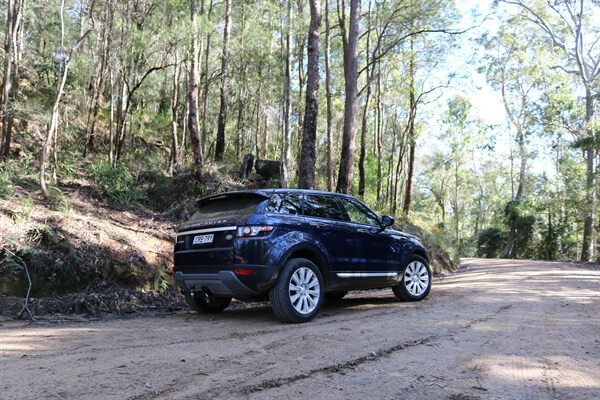
Underneath the Evoque uses the same underpinnings as the Land Rover Freelander, but it’s body has given up some of the boxiness in search of a stylish shape. So while it looks great it’s compromised inside. The sloping roofline will catch out taller adults sitting in the rear and the boot is compact but useful enough for around-town duties or a well-packed trip away.
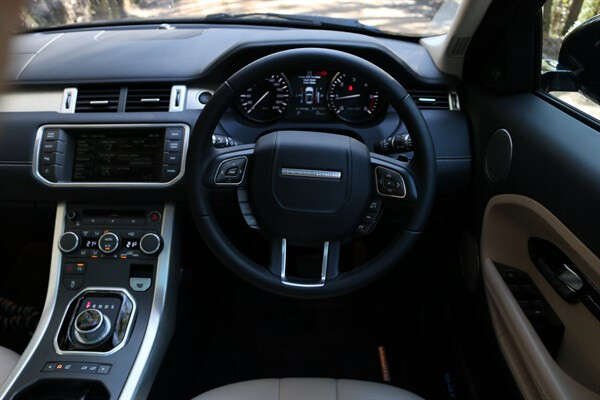
Up front it’s all good news, though, with ample head and leg room and excellent functionality to the main controls. The circular gear selector that rises when you start the car is a nice touch, too.
ON THE ROAD
It’s no secret that the Evoque’s natural environment is the city and suburbs, so no surprises that Land Rover has set it up accordingly. Independent suspension is relatively firm, but it feels confident when you point it and it sits nicely through the bends. Even on a country road at speed it’s a confident tourer. Ours was fitted with 19-inch Pirelli tyres that deliver impressive grip and help continue the theme of car-like dynamics.
B-grade roads can have it jiggling around a bit but it’s otherwise quiet and composed.
The 110kW 2.2-litre diesel engine (there’s also a 140kW version available) hesitates momentarily from a standstill before awakening to a stout delivery of torque in the middle revs. There’s some gruffness to the engine but it otherwise melds well with the nine-speed automatic; that auto is for the most part smooth and decisive in its shifts, but can occasionally trip over itself when reapplying the throttle.
OFF-ROAD
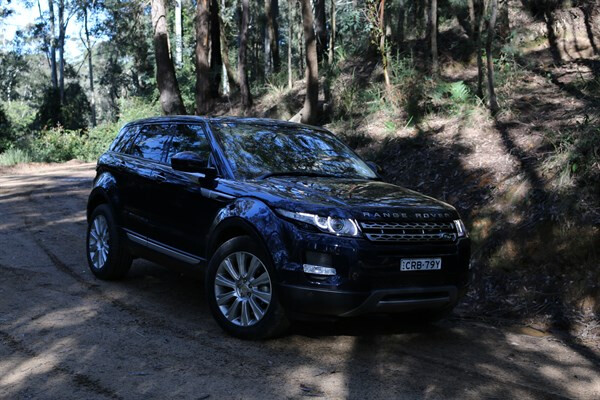
In focussing on off-road the compromises have come with the Evoque’s off-road prowess. Range Rover openly admits it won’t go near the abilities of the larger, more advanced Sport and full-sized Range Rover. But the sales pitch is that the Evoque is more capable than its rivals, which include the likes of the Audi Q5 and BMW X3.
It doesn’t take many rocks or gullies to establish that wheel articulation is its shortcoming. Rather than dip a wheel into a hole it would rather pop another wheel in the air. So even with a respectable 215mm of ground clearance you’ll come across other issues.
Thankfully there are some clever electronics in the Terrain Select system, allowing you to tailor the traction control system to grass/snow, mud or sand. They help it continue along your chosen path, but you’ll constantly have to be aware that the underbody protection is basic rather than bulletproof and that the suspension simply doesn’t have the travel to get too adventurous.
That said the extremes of the car are generally kept out of striking distance of mother nature, particularly at the rear where the stumpy tail contributes to a 33 degree departure angle.
But the biggest limitation with the Evoque off- road – particularly in Australia’s more remote regions – is likely to be the tyres. They’re predominantly designed for bitumen and are in big sizes (it’s all about the look); they’re available in 17 to 20-inch sizes, depending on what model and options you choose.
VERDICT
As a fashionable and competent luxury soft-roader the Evoque ticks plenty of boxes. It’s efficient and practical and can be fun to drive.
But it’s more on-roader than off-roader, with its tyres and suspension travel ultimately limiting how far it will go in the rough stuff. Some well-tuned traction management systems give it above average clawing ability in tricky terrain, though.
4×4 Australia’s road test video of the Conqueror 80 series, on Fraser Island, Queensland.
4×4 Australia Magazine heads to Iceland to drive the awesome Hilux from Arctic Trucks in the snow. Some one forgot to tell them it was summertime.
Read the report in the October 2014 edition of 4×4 Australia Magazine, available via iTunes.
The latest special edition Prado Altitude, from Toyota Australia, features a new look for its back-end. The style is achieved by moving the spare wheel off the back door and putting it under the rear floor (see video).
This may have tidied up the back of the Prado, but it has come at the expense of one of the model’s best features, the 150 litre fuel capacity.
Prados, and their Lexus derivatives, have been available in this configuration in European, Japanese and USA markets for some time, but never before in Australian markets. The larger 150 litres of fuel capacity in the 150 Series Prado – and the 180 litres in the previous 120 Series Prado – were key features very popular with long distance outback tourers.
But the weight of the spare wheel on the back door was a hindrance and even dangerous when the door slammed shut.
“By moving the spare wheel and tyre, we’ve made the tailgate lighter and therefore easier to open – especially when the vehicle is parked facing down a hill,” Tony Cramb, Toyota Australia’s executive director of sales and marketing said. “Owners can also open the tailgate wider in cramped situations such as when parked close to other vehicles or using a towing hitch, plus there’s the added convenience of the separate glass hatch.”
Deleting the extra fuel capacity leaves the Prado Altitude with just 87 litres of fuel, which is still good by OE 4×4 wagon standards, as it has close to a 1000km highway range. But it’s no match for the 150 litres which has always been a vital selling point for the car.
Thankfully this feature is only on the limited edition Altitude model (so far) and the regular Prado is still available with 150 litres.
Let’s just hope Toyota Australia doesn’t adapt this design for all Prado variants and hinder its unrivalled touring range.
The Prado Altitude is based on the GXL model but gains extras from the VX including leather-accented seats, a tilt-and-slide moonroof, Blu-ray rear entertainment system with three wireless headphones and a remote control, electro-chromatic rear-view mirror, power front seats and rain-sensing wipers. It also gains a 14-speaker JBL audio system, a seven-inch display screen, and satellite navigation.
Other notable features include chrome side mouldings, door handles and air-conditioning surrounds along with carbonfibre details on the dash panel and gearshift surround.
That’s around $10,000 worth of extras to total just $68,520, which is $4,800 more than the price of a regular Prado GXL diesel automatic. That should be enough to make this limited edition popular with the city folk. But we reckon the long haulers still want that extra fuel capacity!