
4×4 Australia is packing the rigs to head off on our 4×4 Of The Year road test next week…
Promising to be an intense six days of rigorous on and off road evaluation with the pick of the new 4-wheel drive crop of the past year.We’re welcoming along the support of Tough Dog Suspensions for this momentous occasion. Unfortunately none of the standard vehicles on test will benefit from Tough Dog Suspension, as it would give them an unfair advantage, but with 30 years in the suspension business, Tough Dog can improve the ride and performance of most 4x4s available today.“4×4 of the year recognises and rewards the growing sophistication of the vehicle manufacturers and the products they bring to the Australian marketplace and Tough Dog was afforded an opportunity to support and sponsor the recognition of this premier event,” said Tough Dog’s John Agostino in announcing his support.“As the Tough Dog brand is a premium brand and is synonymous with very good quality, it was appropriate that we lent our support. Top Car, Top Shock and Top Mag – who could ask anything more?”The full results of our road testing will be published in the February 2015 issue of 4×4 Australia, on sale January 8.
Take one 4×4 ute, remove the original body from the chassis, shorten the wheelbase, replace the rear leaf springs with coils and the rear drum brakes with discs, and then add a wagon body. Well Mitsubishi, Holden and Isuzu have done exactly that, turning their respective Triton, Colorado and D-Max utes into the Challenger, Colorado 7 and MU-X.
The Line Up
- Mitsubishi’s Challenger is the oldest vehicle here, released first in 2009. The Challenger was then updated in 2011 and then again in 2012.
- In mid-2013 the 2nd Generation Challenger received another facelift and gained its current look, the model range was simplified and the seven-seat option was also dropped.
- The Colorado 7 and the MU-X are much newer and share common chassis/body DNA although they employ completely different powertrains and differ also in many details like suspension specifics and ancillary equipment.
- Isuzu’s MU-X, which shares its basic chassis and body shell with the Colorado 7, arrived just after the revamped Colorado 7 and has been unchanged since.
- The relationship between the MU-X and Colorado 7 exactly mirrors the relationship between the D-Max ute and the Colorado ute.
Power
Mitsubishi Challenger LS
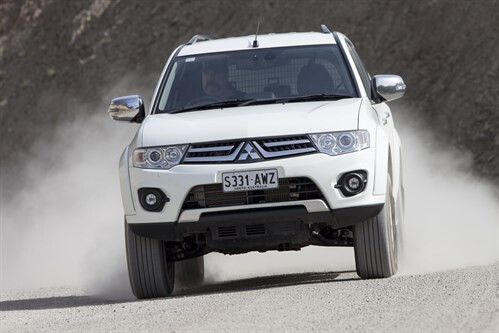
Powered by a 2.5-litre four-cylinder diesel that first appeared in the Triton ute in 2009, a few months before the Challenger was launched. In the Triton it replaced the long-serving 3.2-litre four-cylinder diesel and, despite the smaller capacity, it claimed more power and torque. Mated to the standard five-speed manual, this engine is rated at 131kW and 400Nm but with the five-speed automatic, as tested here, the maximum torque is reduced to 350Nm.
Specifications
- Engine – 4cyl turbo diesel
- Capacity – 2477cc
- Power – 131kW @ 4000rpm
- Torque – 350Nm @ 1800rpm
- Gearbox – five-speed automatic
- 4X4 System – dual-range full-time+2WD
- Crawl Ratio – 28.2:1
- Construction – separate chassis
- Front suspension – independent/coil springs
- Rear suspension – live axle/coil springs
- Tyre/wheel spec – 265/65R17 112S
- Kerb Weight – 2051kg
- GVM – 2710kg
- Payload – 659kg
- Towing capacity – 3000kg
- Seating capacity – Five
- Fuel tank capacity – 70 litres
- ADR fuel consumption* – 9.8 litres/100km
- On-test consumption – 12.7 litres/100km
- Touring range** – 501km
Holden Colorado 7 LTZ
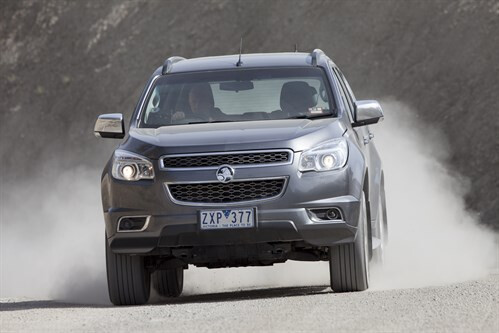
The Colorado 7 has a slightly bigger 2.8-litre four-cylinder diesel from Italian diesel specialist VM Motori. This is essentially the same engine as seen in the Jeep Wrangler. The Colorado 7 claims a substantial 147kW and 500Nm and is backed by a six-speed GM auto, the only gearbox option available with this vehicle.
Specifications
- Engine – 4cyl turbo diesel
- Capacity – 2776cc
- Power – 147kW @ 3600rpm
- Torque – 500Nm @ 2000rpm
- Gearbox – six-speed automatic
- 4X4 System – dual-range part-time
- Crawl Ratio – 36.4:1
- Construction – separate chassis
- Front suspension – independent/coil springs
- Rear suspension – live axle/coil springs
- Tyre/wheel spec – 265/60R18 110T
- Kerb Weight – 2205kg
- GVM – 2820kg
- Payload – 615kg
- Towing capacity – 3000kg
- Seating capacity – seven
- Fuel tank capacity – 76 litres
- ADR fuel consumption* – 9.2 litres/100km
- On-test consumption – 11.2 litres/100km
- Touring range** – 629km
Isuzu MU-X LS-U (auto)
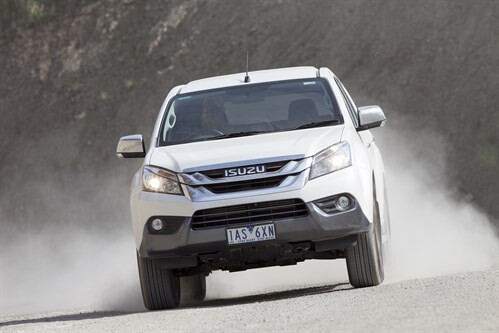
With a bigger engine again, a 3.0-litre four-cylinder diesel that claims 130kW and 380Nm. This Isuzu diesel is the latest iteration of the engine used in the previous generation D-Max and Colorado and in the last of the Holden Rodeos. The MU-X comes with either a five-speed manual or the five-speed automatic as tested here. The auto in question is made by Japanese automotive component supplier Aisin and comes from the same gearbox family.
Specifications
- Engine – 4cyl turbo diesel
- Capacity – 2999cc
- Power – 130kW @ 3600rpm
- Torque – 380Nm @ 1800-2800rpm
- Gearbox – five-speed automatic
- 4X4 System – dual-range part-time
- Crawl Ratio – 32.6:1
- Construction – separate chassis
- Front suspension – independent/coil springs
- Rear suspension – live axle/coil springs
- Tyre/wheel spec – 255/65R17 116S
- Kerb Weight – 2168kg
- GVM – 2750kg
- Payload – 582kg
- Towing capacity – 3000kg
- Seating capacity – seven
- Fuel tank capacity – 76 litres
- ADR fuel consumption* – 8.4 litres/100km
- On-test consumption – 10.5 litres/100km
- Touring range** – 674km
Performance
More significant than any performance difference here is the way the three engines mate to their respective gearboxes and their refinement and noise levels.
The Colorado 7’s diesel isn’t particularly quiet or refined but the gearbox does have the smartest shift protocols and does what you want most of the time.
Whereas the Isuzu’s engine is relatively refined and quiet and on this count is the best here. The gearbox is also smooth shifting but often seems too keen to select a taller ratio and in give-and-take driving in hilly terrain it can often be too indecisive.
And the Challenger’s engine is the smoothest of the three but still rather noisy, while the gearbox lacks the communication with the engine of the other two, particularly the Holden. Of the three it’s the one you are most tempted to drive in the gearbox’s manual mode something that’s encouraged as it’s the only vehicle here with steering wheel shift paddles.
On – Road
None of these wagons offer anything that’s special in terms of on road handling or ride quality, which is largely a reflection of the fact that they are all born out of commercial vehicles.
Of the three, the Challenger is slightly lighter and smaller, and feels sportier. But it also has the firmest ride and the least road-noise isolation. But it does benefit considerably from its ‘Super-Select’ 4×4 system, which effectively combines the attributes of full time and part time 4×4 systems. Like any conventional full time 4×4 (e.g. a Toyota Prado), the Challenger has a centre diff so it can be driven in 4WD on high traction (sealed road) surfaces, something you can’t do with a part time 4×4, as per the other two vehicles here. With the Challenger you can select 2WD, something you can’t do with a conventional full time 4×4.
All of these vehicles are much more stable and predictable in four-high on loose and corrugated gravel, but where the Colorado and MU-X demand that 2WD be selected every time you hit a sealed road, the Challenger is happy either way.
Off – Road
All three vehicles are genuinely capable of going well off road, even on the standard tyres, provided you don’t run into too much mud. Change the tyres to something more aggressive and perhaps fit a bar for some frontal protection and improved approach angle, and they are all good to go.
The Challenger is a little different from the other two in as much as it has a driver-switched rear locker as standard. But this is perhaps not the universal ‘fix it’ that you may think, as engaging the rear locker cancels the electronic traction control (ETC) on the front axle as well as the rear axle. That means you have the choice of ETC front and back, or a locked rear axle combined with an open front axle.
Interior and Safety
Once again the Challenger is the odd man out here. Where the other two seat seven, the Challenger seats five and has a smaller cabin overall. It also has a four-star ANCAP safety rating whereas the other two are five-star ANCAP – despite all three having six airbags and electronic stability and traction control.
The Verdict
In this company, the Challenger is very different from the other two but above all feels like an older design despite its technical features such as its Super Select 4×4 system, rear locker and paddle shifters. There’s also no doubt that it’s better as a manual than an auto and of all the variants of the three vehicles here, the base-spec manual Challenger is the cheapest, at least in terms of list price.
If the Colorado 7 appeals on paper due to its much stronger power and torque numbers, then you’ll probably be disappointed as it doesn’t live up to either, especially its 500Nm claim. However, it still has the best performance, the smartest gearbox and the backing of Holden’s extensive dealer network. But it’s not the winner here.
That honour goes to the sharply priced and well-equipped MU-X, which feels more refined and more comfortable, and does more with less. Unlike the Holden, it also comes with the option of a manual gearbox.
For the full review pick up a copy of 4×4 Australia’s #371 December Issue.
See other 4×4 Australia road tests and first drives
For all the latest 4WD and off-roading news and reviews subscribe to our monthly magazine today.
Here at 4X4 Australia, finding new off-road adventures and sharing the tale is kind of our thing. So we’re giving you the opportunity to share your favourite off-road adventure story with us for your chance to win a $5000 Ironman 4×4 voucher – Australia’s first choice for all your 4×4 accessories.
After 50 years of serving the 4×4 market, in more than 120 countries, Ironman 4×4 still designs its products right here in our country’s backyard. The winner will get to choose from a vast range of products to the value of $5000 (excludes fitting). So whether you want to fit out a family vehicle or an off-road explorer, this competition is the one for you. Don’t miss out!
COMPETITION NOW CLOSED
TERMS AND CONDITIONS: Promotion commences 1 November, 2014 and closes 7 January, 2015. Entrants must log on to www.4x4australia.com.au/win to enter the competition. Winner will be judged on 20 January, 2015.
The Dual GPS adds GPS capability to all Bluetooth enabled phones, tablets and laptops, as tested by Ron Moon.
- The Dual XGPS150 works with any device that supports Bluetooth SPP (serial Port Profile)
- Simple set-up: just pair the receiver with the device you want to use it with
- This small device weighs just a few grams, and is rechargeable
- Strong satellite connection, no matter the tree cover or other obstructions
WHAT IT WORKS WITH
The universal Bluetooth GPS receiver allows people to buy devices without cellular and mapping capability. The Dual XGPS150 works not only with iPads and their Apple products, but includes Bluetooth-enabled smartphones, tablets and laptops running Windows, OSX, Linux, Blackberry, or Android.
HOW IT WORKS
The receiver is less than six-centimetres square and one-centimetre thick and weighs just a few grams. It has four, simple controls that include the battery, Bluetooth, and GPS signal indicators, and a power off button. The Dual XGPS150 has a four-hour recharging time from flat, and lasts about 8 hours. A tiny switch hidden in a mini-USB connector compartment below the power button toggles the unit between Apple and non-Apple devices.
Pros:
- Set-up is simple
- Connects to satellites quickly and doesn’t lose connection
- Compact and reliable
- Must check the price to avoid a rip off
See more news, road test and reviews in the latest issue of 4×4 Australia, subscribe for a hard copy here.
*To get a digital copy – simply download a version here.
Joining a 4WD club was once a rite of passage. Today, the popularity of 4WD clubs has weakened, but by not signing up to a club, is the new generation of 4x4ers missing out?
According to Brian Tanner from the Toyota Land Cruiser Club Victoria (TLCCV), becoming involved in a 4WD club is the best way to tour this beautiful country. “It is no secret that many newcomers to the 4WD scene do not fully understand the concept of 4WDing, nor the why and wherefore of when to engage low or high range gears, how to prepare for a big trip, or even small mysteries such as what is a centre diff lock,” he said.
It’s important for drivers to learn the capabilities of their vehicles and the best techniques for various offroad scenarios. That’s where Brian said clubs can play a big part. “By joining a 4WD club, you have the opportunity to gain all the skills required for safe 4WD touring, as well as mixing with a like-minded group of people seeking the maximum enjoyment from their vehicle and recreation.”
Matt Foley, programme co-ordinator of Cross Country Jeep Club, agreed: “I had just bought a Land Rover and I had no idea how to use it, so I joined the Land Rover Club of Victoria because I didn’t know about any of the other independent clubs. “I’m not with them anymore but I’ve stayed in clubs because I’ve enjoyed the family-based environment that it brings.”
IN THE BEGINNING
4WD clubs took off in the late 1960s; about the same time 4WDing became a popular recreational activity, using what were basic 4WDs to access the bush and visit remote areas. The Land Rover Club of Victoria claims to be the longest established 4WD club in Australia, forming in 1963, with the Cross Country Jeep Club of Victoria establishing shortly after in 1967 and then the Toyota Land Cruiser Club in 1969.
Back then, there were limitations in 4WD choices, with the Land Rover, Toyota BJ/FJ and the Nissan G60 Patrol among the more popular vehicles, none of which focused on driver comfort. When clubs started to form, they were based on two sets of criteria – brand and locality.
Today, there are more than 90 clubs affiliated with 4WD New South Wales and ACT, about 80 with Four Wheel Drive Victoria, 50 under the Queensland Association’s banner, 40 clubs under Four Wheel Drive South Australia, 30 with WA 4WD Association and three with Northern Territory’s association. The choice is extensive and clubs continue to pop-up all over the country.
IT’S ALL ABOUT THE CHALLENGE
When the Green Movement came into the play, clubs started to work together to ensure the protection of their right to access parks and lands. The Australian National Four Wheel Drive Council (ANFWDC) was formed in 1984 to enable state 4WD bodies to work together in the fight against possible restrictions to parts of the country. Brian, who is also the founding chairman of ANFWDC, said, “The formation of the ANFWDC was a major step forward in promoting and legitimising the recreation of 4WD touring.
For the first time, we were able to put our message for fair access to a national audience resulting in successes that all 4WDers can enjoy today. “As a member of a 4WD club, you are part of the 4WD movement and are kept aware of issues and legislations affecting the recreation. Members are able to contribute to the future development of the 4WD movement through promoting and practicing responsible 4WD touring.”
While it seems there is a vast number of clubs out there for folk to join, the future of these clubs is questionable – thanks to the new gen of 4WDers. As the retiree generation begin to call curtains on their travels, clubs need this new generation to step up to the plate. Matt said this is a massive challenge. “You are getting a lot more people who want to do their own thing and they want to avoid the politics. There’s more politics involved now than there used to be, but it’s not at an unreasonable level.
At the end of the day, we’re all like-minded people who want to do the right thing by the bush. “About 50 per cent of the memberships at the Cross Country Jeep Club is made up of retirees, or close to it. We’re now trying to heavily rebuild and get a new generation of 4WDers to be part of the club, which is a challenge in itself. They don’t see why they should spend $150 a year to be part of the club when they can access the bush [by] themselves.”
LOOKING AHEAD
4WD clubs offer much more than regular meetings and group tours. They cover insurance, permits, and the opportunity to travel with experienced drivers. Clubs are even considering embracing soft-roaders, AWDs and the like. With all this in mind, it’s curious the newer generation hasn’t caught on to the benefits on offer.
Nevertheless, Brian believes that the future of 4WD clubs is strong and vibrant, as long as clubs adapt to the changing ways of vehicles and trends. “As electronics and traction control devices continue to evolve, there may come a time when mainstream vehicles may not feature a low range transmission, yet still retain offroad capability.
Clubs will need to adapt to changing trends of vehicle design and continue to evolve. “Through partnerships with government land managers and strong peak state 4WD organisations, clubs can, and will, continue to deliver effective driver training, group touring opportunities, equipment advice, social activities and the opportunity to make new friends through shared experiences,” he said.
Matt added, “For clubs to survive, they’ve got to be happy to adapt to new technology and the younger generations. We’re struggling to get involvement from younger members because it doesn’t interest them, but without them it will fold. The older members don’t want to change, and generally resist it. Clubs need to embrace change and welcome it; otherwise, ultimately, they will fail.”
WHY JOIN A CLUB
It’s not just about 4WDing, it’s about the community. “The principle activity of clubs is the organisation of 4WD trips of varying duration to interesting and challenging locations, driver education and social activities,” Brian said.
The advantages of joining a 4WD club are endless. With most clubs offering a family focus, it’s a good way to take the kids out to see our beautiful country with other families to keep them entertained and form life-long friendships. “I joined because I was looking for a family-based club that was focused on getting out there and having fun. Our club is also fortunate enough to have its own property, which is a big bonus,” Matt said.
“The membership cost also covers insurance so if someone gets injured, which has happened, it costs them next to nothing – if anything at all. It also covers permit costs and park fees.” With social events and functions, competitions, club equipment and libraries, knowledge from experienced drivers, discounts and more, the membership costs are minimal in comparison and well worth looking into if you’re serious about travelling off the beaten track.
SIGNS YOU SHOULD JOIN A CLUB
If you have just purchased a 4WD vehicle, consider these questions…
- Do you know how to drive it?
- Do you know how to make the best use of your gears?
- Do you know the different techniques needed to be able to drive competently in sand, mud, and other terrains while maintaining traction at all times?
- Do you know how to drive in the best interests of the environment and other bush users?
- Do you know basic recovery techniques?
- Are you thinking of putting some accessories on your vehicle? Items such as driving lights, tyres, bullbar, winch, UHF radio, HF radio or suspension?
- Will your choices be the best for your vehicle?
- Do you know how to read a map, or use a GPS device?
- Do you know what to do in an emergency when your mobile phone does not have a signal?
- Do you know how to prepare and plan for an extended 4WD trip?
If your answer is no to any of these points, then a 4WD club is your best answer to getting into the 4WD scene safely and responsibly.
HOW TO GET STARTED
Key websites around Australia to help get you started:
- 4WD – NSW & ACT
- 4WD – Northern Territory
- 4WD – Queensland
- 4WD – South Australia
- 4WD – Tasmania
- 4WD – Victoria
- 4WD – WA
The Pathfinder Hybrid sits alongside the regular V6 model in a multi-tiered range that covers a price spread of almost $30,000.
The Hybrid sells for $3000 more than the V6 Pathies and is only available in selected grades and configurations.
The entry-level ST Hybrid powers only the front wheels and sells for $42,990 while the flagship Ti four-wheel drive tested here is a $68,090 proposition. In between is an ST-L 4WD ($57,490).
For the money our Ti came impressively loaded, with leather, twin DVD screens in the rear, heated and cooled front seats, satellite-navigation, cruise control, smart key entry, Bluetooth, rear parking sensors, seven seats, electric driver’s seat, six airbags (including curtain airbags that cover all three rows) and three-zone air-conditioning with separate controls for those in the rear.
There’s also an around view monitor camera system that gives a virtual overhead view of the car as well as a tyre pressure monitoring system.
PRACTICALITY
It’s all about the size with the Pathfinder. Up front there’s a big two-stage centre console and sizeable glovebox as well as cupholders that could cope with an American-sized bucket of your favourite sugar drink.
The seats are cushy but comfy enough for longer journeys. Those in the middle row aren’t overlooked, either, with a higher seating position and those air vents with a separate controller.
The middle row splits and slides to allow for easy configuring of the rear for those looking to maximise cargo space. The rear-most pews in the third row also fold neatly into the floor to reveal a long, flat luggage space.
It’s not all great news, though; one of our biggest issues is the central colour touchscreen, which is used for various infotainment functions as well as the sat-nav system. It is dimmed separately to the main instrument cluster yet even in its lowest setting it’s too bright for country roads.
The Pathfinder Hybrid also takes a step backwards on its towing ability, with the claimed maximum at just 1650kg (V6 models are rated at 2700kg).
ON THE ROAD
In its latest guise the Pathfinder has focused more on on-road manners rather than off-road prowess. Gone is the ladder frame chassis and in its place a monocoque, in this case shared with the Altima sedan and Murano SUV (in a way it’s back to the future because the previous R50 Pathfinder sold between 1995 and 2005 sat on a monocoque too).
It’s also employed softer independent suspension and ditched the low-range transfer case.
The result is a car that feels more comfortable and composed in everyday driving. Big 20-inch wheels with Bridgestone Dueler rubber look the business and grip well through bends, although the steering isn’t as accurate as it could be.
Performax International’s Nissan Titan XD debuts
The Pathfinder also does a reasonable job of dealing with larger bumps, although smaller ones at lower speeds are more noticeable than they should be. It’s also relatively hushed at speed.
But it’s the Hybrid TI’s system that is more impressive. The four-cylinder engine uses its technology well – supercharger and a 15kW electric motor – to deliver V6 performance (there’s 188kW of power versus 190kW in the 3.5-litre V6-powered Pathfinder).
In fact it’s arguably better because the muscular 330Nm torque peak arrives at 3600rpm, ensuring energetic acceleration. That’s enough to overwhelm the grip at the front wheels if you’ve got the All Mode 4WD selector in 2WD, but the Auto mode solves the problem.
It’s only a mild hybrid system, though, so still relies on the petrol engine most of the time. Still, claimed fuel use of 8.8 litres per 100km is good for what is a big, heavy vehicle. We found it using about 11.5L/100km during a mix of driving that included a stretch off-road.
OFF-ROAD
The softening of the Pathfinder has done nothing for those wanting to get more adventurous. A glance down the specifications sheet reveals some less than impressive numbers, such as just 165mm of ground clearance and a marginal 14.3 degree approach angle. The space saver spare tyre is also a major limiting factor, although there’s a repair kit on board too (if you have to revert to that then your luck has really run out…).
And it doesn’t take long to show up its limitations. Wheel articulation is modest at best and once a wheel loses traction it can wheelspin and scrabble as the traction control tries to sort things out.
Those electronics don’t always get it right and even with the All Mode four-wheel-drive system in its Lock position it’ll still get stuck if one or two wheels aren’t firmly planted. The Lock mode is more about sending power front and rear all the time rather than locking differentials, all of which remain open all the time.
We also managed to temporarily overheat the hybrid system in some more challenging off-road conditions, something that flashes a warning to the driver. The owner’s manual warns that it can revert to two-wheel-drive if the All Mode system gets too hot, too.
Ground clearance, too, is nothing special so it pays to be conscious of the placement of wheels and so-on.
VERDICT
It’s more gentle tracks and some snow for the Pathfinder Hybrid, a car that works relatively well in the city. The Hybrid system is worth a look, though, bringing decent fuel saving advantages with no performance penalty..
Click here to read the full range review of the Nissan Pathfinder
SPECS Price: $68,090 Engine: 2.5-litre supercharged four-cylinder with 15kW electric motor; 188kW at 5600rpm, 330Nm at 3600rpm Transmission and 4WD system: CVT auto, on-demand high range 4WD with Lock mode Braked tow capacity: 1650kg Spare tyre: Space saver and with repair kit Fuel tank: 73 litres Fuel use (claimed): 8.8L/100km Fuel use on test: 11.5L/100km Approach/departure angles: 14.7 degrees, 22.3 degrees Ground clearance: 165mm
Ford has a lot riding on its all-new Everest wagon that was revealed in China.
Check out the launch video!
See a full review and information on the first Ford Everest test here
Subscribe to our 4×4 Australia Youtube Channel for all the latest video releases!
See more news, road test and reviews in the latest issue of 4×4 Australia, subscribe for a hard copy here.
*To get a digital copy – simply download a version here.
Earlier today, Ford pulled the wraps off the production version of its Everest 4×4 wagon at the Beijing Auto Show. The proddie version stays true to the concept of last year and promises to be one of the most exciting 4×4 releases of 2015 when it’s launched here in the first half of 2015. It certainly should give the Prado something to think about.
What we know
The images from China show the styling takes its cues from the T6 Ranger ute, on which it is based and we expect the ute to adopt the Everest front sheet metal and interior changes when it’s updated later in 2015. Like the Ranger, the Everest was designed and engineered right here in Australia although it has undergone R&D worldwide as a global product. It will be built in Thailand alongside the Ranger.
The undercarriage photo reveals the much speculated rear suspension which retains a live axle but is suspended on coil springs and located with trailing arms and a Watts linkage similar to that seen in previous model Ford Falcons. The Watts link set-up should provide superior on-road dynamics to other live axle arrangements while the live axle should allow good wheel articulation.
Ford says that the Everest will be available with a choice of three engines depending on the market including a 2.0-litre, turbocharged ‘EcoBoost’ four-cylinder petrol unit but it’s believed that Australian models will stick to just the five-cylinder diesel engine as currently offered in Ranger. This will be backed by a six-speed automatic transmission and an on-demand 4×4 system that offers two and four-wheel drive plus 4×4 low range.
New Ford features
Everest will debut a host of new technologies for Ford in Australia, one of which is a Land Rover Terrain Response-like Terrain Management System (TMS). TMS offers modes for normal, sand, snow, grass, gravel and rock modes, and optimises calibrations of the throttle, transmission and transfer case clutch to suit the conditions. It also controls the rear diff lock which can be manually overridden for the best control. The TMS settings are selected using a dial beside the gear shifter and are displayed in the all new electronic dash cluster.
Ford is touting best in class off road dimensions with 225mm of ground clearance; 800mm wading depth; an approach angle of 29-degrees, 21-degree ramp-over angle and a 25-degree departure angle. The capacities read well too with 3000kg towing, 750kg payload and 100kg roof loading.
The press images show the new dash with a large central touch screen replacing the fiddly buttons of the Ranger dash and the new gauge cluster. The interior looks spacious and given the size of the Ranger, we expect it will offer plenty of room for a family. The second and third row seats are shown to fold totally flat in a very Discovery 3/4 way giving a long load area and 2010-litres of space.
A neat feature of the interior will be the active noise cancelation system which generates sound waves through the vehicle’s sound system that cancels out ambient noise to quieten the inside of the car.
Market place
The Everest will eventually replace the Territory as Ford Australia’s seven-seat SUV and the locally made wagon should have around 18-months left in it to sell alongside the new Thai-built 4×4. Everest is tipped to be joined by a new light duty SUV, most likely to be the new generation Ford Edge, to fill the void left by Territory.
See more news, road test and reviews in the latest issue of 4×4 Australia, subscribe for a hard copy here.
*To get a digital copy – simply download a version here.
Mark Allen tests the Leveraxe wood splitter and makes light work of a big job.
Want more product reviews? click here.
Get the latest info on all things 4X4 Australia by signing up to our newsletter.
4×4 Australia join the biggest gathering of FJ Cruisers in the world at the FJ Summit in Colorado, USA.
FJ History
Think 4×4 gatherings in the USA and your first thought is likely to be Jeepers. Their Jeep Jamborees are legendary and have been going on across the USA for generations. But there’s another legendary 4×4 brand gathering momentum across the Pacific and there are numerous events attached to its growing popularity.
Toyota’s Land Cruiser doesn’t have the massive status in the States that it enjoys here because it was never sold there in huge numbers. This limited availability has created an underground following for Cruisers Stateside and early models are prized possessions, often being imported from all corners of the globe including Australia.
An FJ40 that has sat in a shed for the past 30 years and has just 2000 original miles on the odometer sold for more than $125,000 in August this year, which gives you an idea of the exclusivity of the marque. The FJ Cruiser, which launched in the States in 2005 went a long way to raising the profile of Cruisers over there. The FJ presented was a quirky looking, practical and capable 4×4 that could take enthusiasts out on the trails and tracks that are usually considered the domain of Jeepers. Like the Jeeps, the FJ Cruisers attracted a loyal following from buyers and the aftermarket followed suit with just about any accessory and modification an enthusiast could think of.
FJ Cruiser publications and events also popped up with the annual FJ Summit held in Ouray, Colorado dubbed the big gig not to miss. With its location one of the USA’s best off road tracks, Ouray is often called the ‘Jeep Capital of the World’ – but for just a few days a year it becomes the FJ Cruiser Capital. 2014 marked the eighth annual FJ Summit and ironically the last year the FJ Cruiser will be offered on sale in the USA (see below). With this in mind, we travelled across the pond in July to checked it out for ourselves.
With the imminent departure of the FJ Cruiser from US Toyota showrooms, the organisers of the Summit have opened up the event to any and all Toyota four-wheel drives which seems to have worked. There were more than 350 vehicles lining up for the tracks outside Ouray this year and while most of them were FJ Cruisers, there were a mix of Tacomas, and even a few regular Land Cruisers too.
FJ Cruiser finished in the US
Unlike Australia where the FJ Cruiser didn’t go on sale until 2011, the Americans have had it since 2005 and after more than 200,000 have been sold there, they feel that the model has run its race. As of June 2014, Toyota USA has stopped importing the Japanese built FJ and there is no new FJ Cruiser planned to replace it. The aggressive-looking 4Runner wagon seems to have stepped up to fill its place as the choice for American Toyota 4×4 enthusiasts looking for a new vehicle.
Australian FJ Cruiser fans need not panic, yet. Despite its late arrival here, or perhaps because of it, the FJ has been a success in Australia, doubling the sales originally predicted by Toyota Motor Corp Australia. As you would expect, TMCA is keen to keep the vehicle and have ensured that production of right hand drive FJs will continue for a few more years yet. Other RHD markets to take FJC include New Zealand, Japan and South Africa.
Arriving in Colorado
Ouray, Colorado sits higher than any point in Australia at 2375 meters above sea level yet the town is at the foot of the thrilling trails that rise spectacularly around it. The team behind FJ Summit select a dozen or so of the best tracks to send Summit participants on and, as many Summiteers are first time off roaders in stock vehicles, the tracks range from easy to difficult.
The great thing about this location is that even the easy tracks can be spectacular as they wind their way through the San Juan Mountains, which are part of the Colorado Rockies. Many of the tracks follow old mining trails which were pioneered through the area early last century. These include the infamous Black Bear Trail that links the highway high above Ouray to the high-end ski town of Telluride via Black Bear Pass at 3910 meters above sea level. It was on this trail that we joined some of the leading Summit vendors in their Cruisers for our first taste of Colorado High Country.
Tackling the 4WD tracks
The first part of the Black Bear Trail (they call them trails in the USA, not tracks) is a fairly sedate yet scenic drive on a formed gravel road. Even on this clear sunny day in the middle of summer, patches of snow and ice were scattered around the road as we climbed higher into the alps. It’s only when you reach the pass at the top and view the steep gulch leading down to Telluride that things get gnarlier. It’s still a road but adds some washed out rocky sections and tight switchbacks which, even in the compact FJ Cruisers, require multi-point turns that take you right to the edge under the guidance of a spotter. Get it wrong and not only will you take the spotter out, but it’s a long rocky roll down the mountain.
The trail passes the relics of the area’s mining past and travels directly under a waterfall. To say it’s spectacular is an understatement! The return run to Ouray is just as impressive on the Imogene Trail and pass of the same name at 3997 meters. Again it passes through snow and scree slopes, mining relics including a ghost town, before ducking back below the tree-line and following a fast flowing creek back to town.
Ouray itself is a piece of history and parts of it are protected under the National Historical Register. It’s real easy to imagine what life here would have been like back in the mining heyday as miners rode back to town to sell and spend their hard-earned silver and gold. The Beaumont Hotel where we enjoyed a dinner with the FJ Summit organisers, is a step back in time. It’s reminiscent of a true old-time western saloon, just minus the dancing girls. Throughout the FJ Summit, the event HQ plays host to the vendors’ area where you can see and get just about anything you want and need for your 4×4.
Custom Cruisers
If there was one FJ Cruiser that really stood in the vendors’ area at the Summit, it was the bright orange one from Metal Tech 4×4. MT 4×4 is an Oregon based Toyota 4×4 specialist shop run by Travis ‘LT’ Telleria, Mark Hawley and Wade Bradley – they can build almost anything you want for your Cruiser. LT’s FJ is a showcase of what they can do and when we heard they were joining us on the trail, we jumped on board for a ride.
The rig features the Metal Tech’s tube doors, rear bar with wheel carrier, front bar with Come Up winch and Rigid Industries LED lights, MT rock sliders, MT seat mounts and MT long arm rear suspension. The front suspension uses a Total Chaos arms with Icon Dynamics remote reservoir coil-overs and additional shocks. Mechanically the 4.0L V6 engine and auto transmission remain stock but behind them is an Atlas 4 transfer case offering four speeds to make the FJ suitable from everything from highway and trails, to dune driving to rock crawling. The lowest gear in the Atlas 4 is 10:1 giving massive overall reduction for complete low-speed control. The rear locker is the factory Toyota one with 4.8:1 gears fitted while an ARB Air Locker works up front. Tyres on the car at the Summit were 35-in BFG muddies on Walker Evans beadlocks.
The FJ made light work of the trails and more difficult rocky sections, and it was one of the few cars to drive up the rock steps on Poughkeepsie Gulch, one of the more difficult trails visited on the Summit. The tube doors give that true open air experience usually reserved for Jeep drivers which was sweet in the fresh mountain air, even if it did get dusty driving in convoy. In case you are thinking that orange colour looks different to the orange FJs here, you’re right. Persimmon Orange is an original FJ55 Toyota colour and is the hue adopted for all of Metal Tech’s rigs. In the spirit of the FJ Summit, Metal Tech teams up with some of their suppliers and each year puts on an open bar at the historic Western Saloon in Ouray. Free beer, sponsors t-shirts and merch, and good times are had by all at this not to be missed evening.
A hive of activity
We saw an FJ Cruiser with live front axle conversion, tube doors for FJs, lift kits, superchargers, roof tents, Aussie-made gear from Outback Proven, t-shirts, badges, restoration parts, protective barwork, big tyres, recovery kit – you name it, it was there. The vendors all put in product for a massive raffle that happens on the Saturday night and the prize pool had something like US$40,000 worth of kit in it with many winners taking home some pretty impressive swag.
The social activity that extends from the HQ to the bars and restaurants on Main Street, and then up on to the trails, is what keeps many visitors coming back to the FJ Summit. It’s a family friendly event suitable for anyone who wants to explore and certainly something that any Aussie 4×4 enthusiast should pencil in to their itinerary if they are planning an American adventure.
There was one FJ Cruiser fan from Sydney at Summit 8 who flew over specifically for the event and was taken out on the trails by the locals. It’s a great way to see a spectacular part of the country and what’s better than hanging out with friendly off road enthusiasts?
For more information on other FJ events around the globe, head to www.fjsummit.org
See 4×4 Australia road tests and first drives
For all the latest 4WD and off-roading news and reviews subscribe to our monthly magazine today.