
Price and specifications
Price: $39,990
Engine: 2.0-litre four-cylinder turbo diesel, 130kW at 4200rpm, 380Nm at 1750-2500rpm
Transmission and 4WD system: 7-speed dual clutch automatic, on-demand four-wheel-drive
Braked tow capacity: 2000kg
Spare tyre: Space saver spare
Fuel tank: 64 litres
Fuel use (claimed): 6.2L/100km
Fuel use on test: 7.5L/100km
Approach/departure angles: 18 degrees/25 degrees
Ground clearance: 193mm
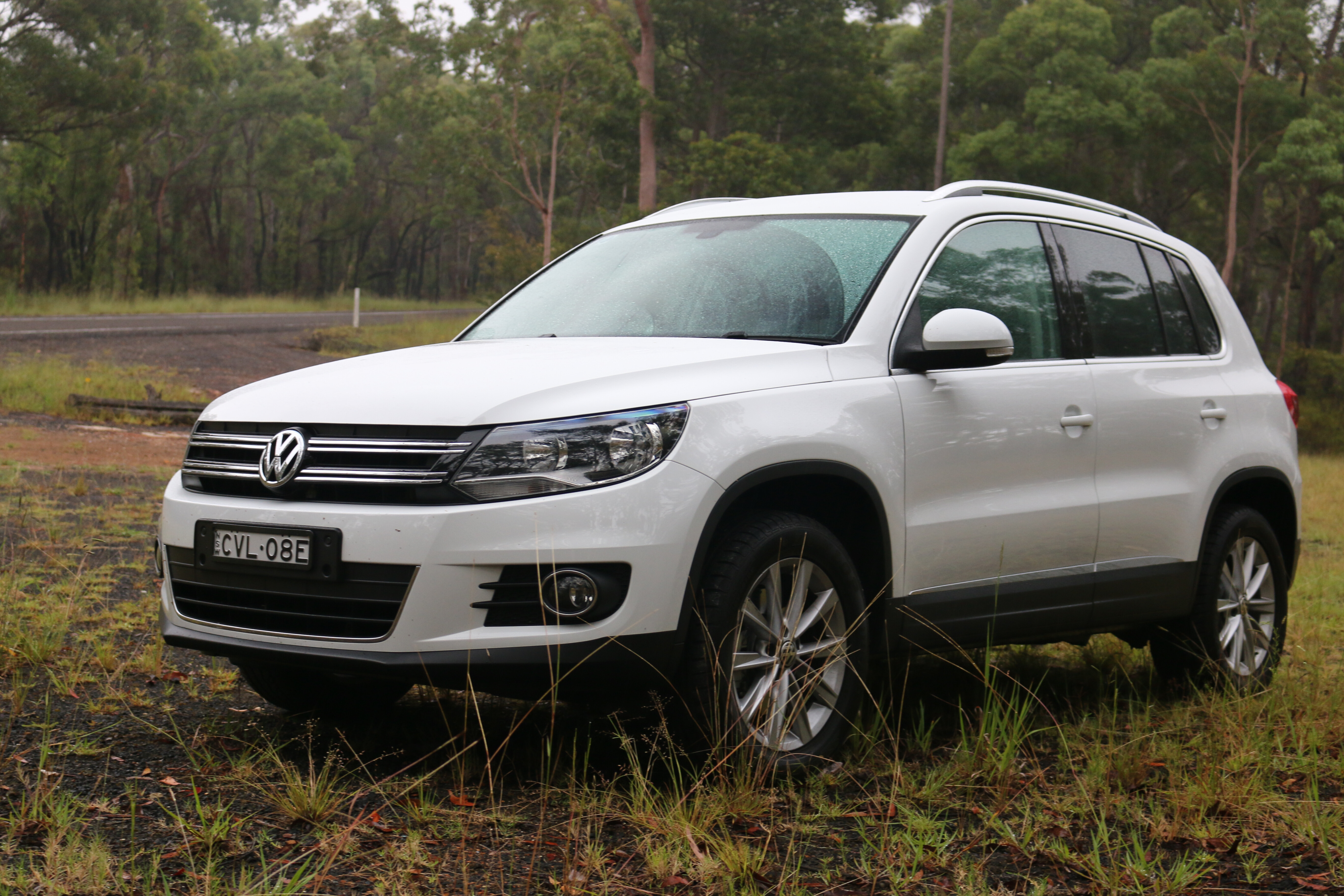
WHAT’S THE DEAL?
The Tiguan is a bit different to most SUV rivals in that it has four different engine combinations across four models (three petrol, one diesel) and as you step up in engine power you also get more equipment.
The flagship $44,990 155TSI (the number denoting the peak power output in kilowatts) comes loaded with adjustable shock absorbers, electric seats, sat-nav and leather trim.
But even the mid-level 130TDI tested here – a $39,990 proposition, fitted exclusively with an auto transmission – there’s a decent swag of gear, including rear parking sensors, Bluetooth, colour touchscreen, dual-zone air-conditioning, cruise control, rain-sensing wipers, electric park brake,
The 2015 update also brings more features, including a reversing camera and leather-bound steering wheel on all models. The fatigue detection system previously reserved for more expensive variants is also now part of the impressive standard package.
There’s also an entry-level two-wheel-drive model, the 118TSI ($28,990 for a manual and $31,490 for the auto), and a 132TSI ($36,990) driving all four wheels.
If you want any colour other than white it’s another $700.
PRACTICALITY
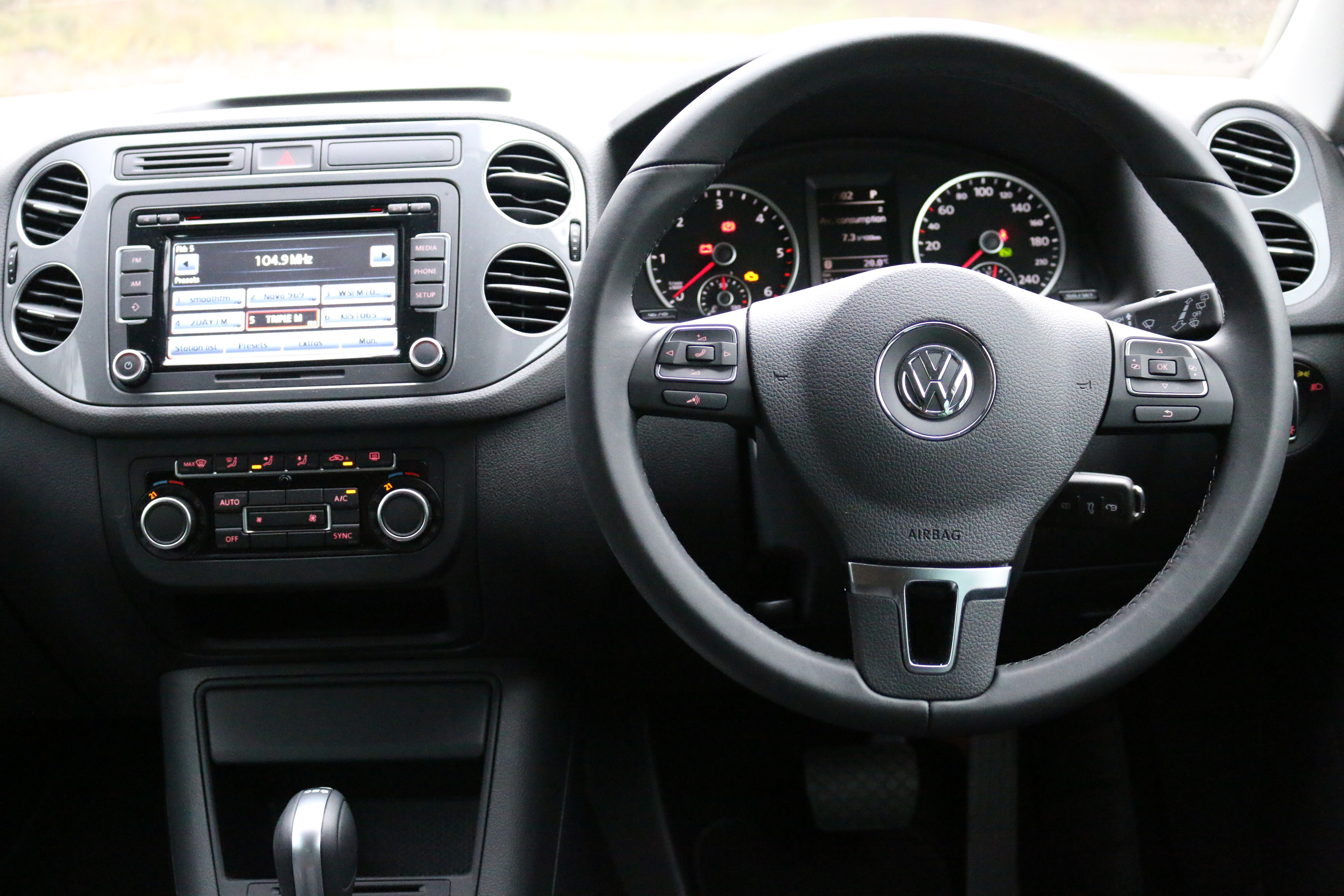
Up front there’s good adjustability to the seats and steering wheel, translating to a car-like feel. Cupholders, deep door pockets and other areas for odds and ends ensure most things are well catered for. But the centre console is close to useless, with half its compact interior taken up by a smartphone plug.
The basic dash design is also starting to date. Eight circular air vents keep the dash looking busy, although the touchscreen that’s sits up high is a win for being close to the driver’s line of sight.
Back seat occupants are surprisingly well catered for. Despite a compact boot, head a leg room are respectable, and rear air vents keep a steady flow of fresh air heading to the back. There are some clever additions, too, such as the shallow pockets on either side of the back seat.
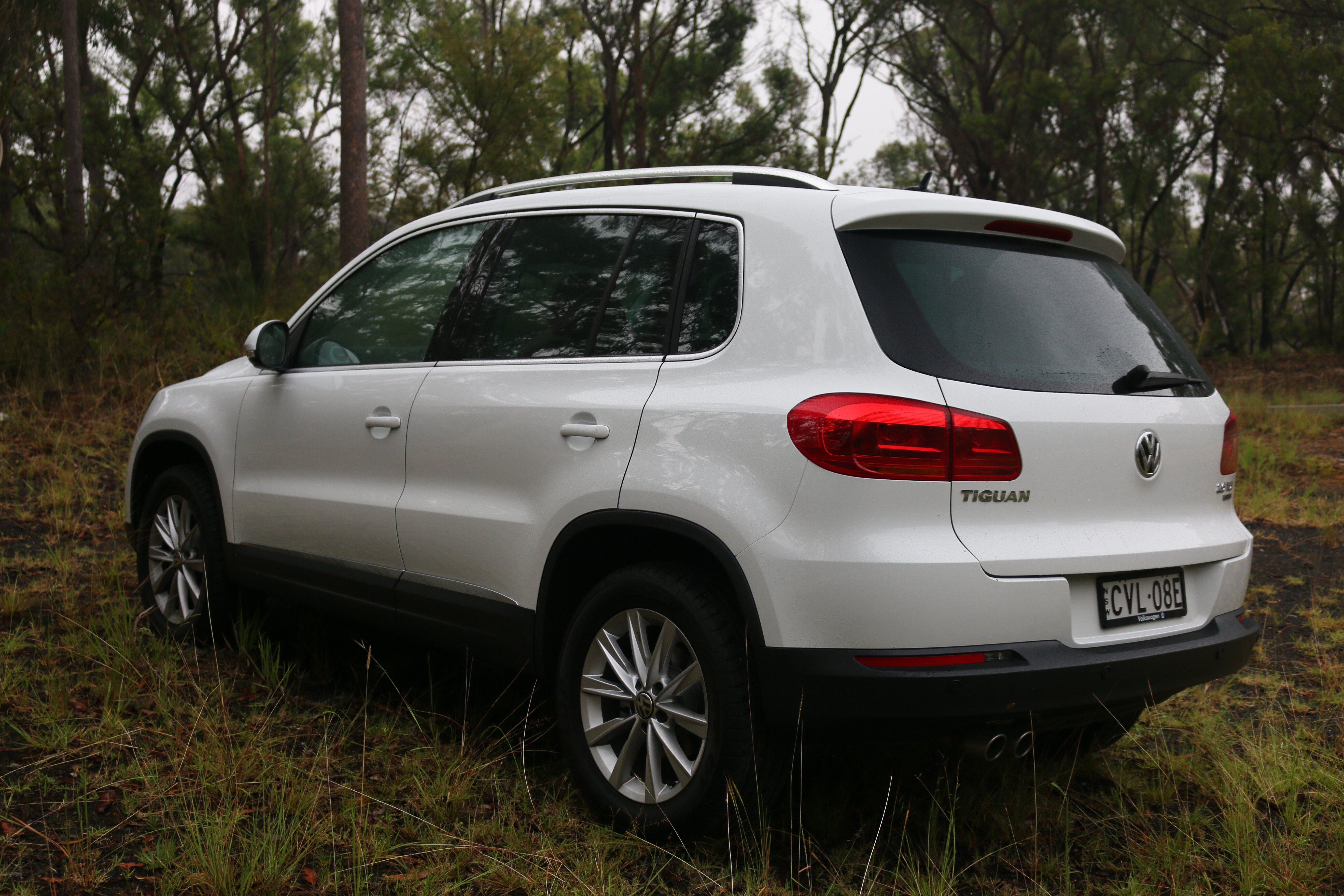
But the boot is small. At 4426mm long the Tiguan is shorter than most of its rivals and it’s the boot that’s been cut back. The floor is relatively shallow and it’s not particularly long; at least there’s a split-fold seat functionality for those wanting more space (albeit at the expense of passengers).
ON THE ROAD
The Tiguan has also been a sharp device on-road and it’s no different in 2015. Steering is faithful and direct, albeit with a hint of mild kickback over bumps on country roads. There’s some suspension noise but it’s otherwise relatively quiet. And the Tiguan feels reassuring when pushed, affirming it as a competent machine. The OE Dunlop tyres can let out a yelp when pushed but they’re otherwise good.
The diesel engine pulls well enough although it’s not as hushed as some. With 130kW and 380Nm it’s been boosted by 27kW and 60Nm over the model it replaces. More importantly, that torque is available lower in the rev range, now swelling to its peak by 1500rpm. Even below that it’s useful, although there’s some associated vibration as though it’s labouring slightly.
The transmission is partly to blame there as it’s been programmed to shift into higher gears early to help lower fuel use. It’s not unusual to be cruising at 70 or 80km/h in sixth or seventh gear, with engine speed as low as 1300rpm.
Fuel use is decent, though, with ours using about 7.5 litres per 100km on a mix of suburban, freeway and gravel-road running (the claimed consumption is 6.2L/100km).
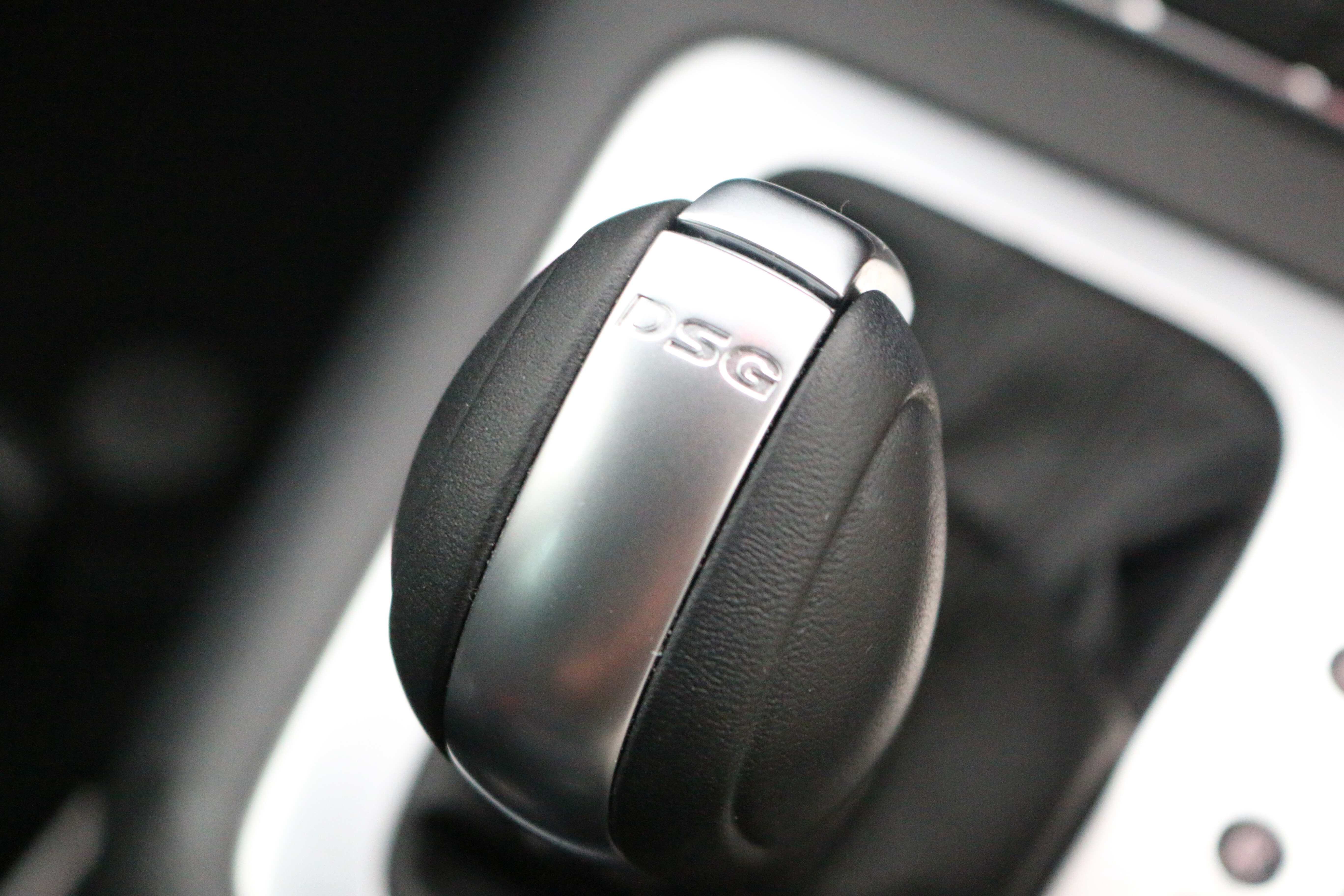
As with all Volkswagen DSG automatics (a twin-clutch setup with computer controlled clutches) there’s some hesitation and grabiness in stop-start situations. Under way it’s more convincing and can shift extremely smoothly. However, a couple of times we had it hanging between first and second gears under hard acceleration.
OFF-ROAD
Other than the 4Motion four-wheel-drive system the Tiguan doesn’t have much in the way of off-road credentials.
That said, tyre pressure sensors are included on the diesel model, making it easier to determine when you get a puncture. But once you get it, you then revert to a space saver spare tyre – a weak link in the Tiguan’s off-road armoury.
At 193mm ground clearance is OK and helps it clamber over patches of rock easily enough during our test course. Wheel articulation also wasn’t as limiting as it is on some soft-road SUV rivals. While it’ll still hang a wheel in the air over some obstacles there’s respectable droop (for a road-biased car with independent suspension front and rear), helping the wheels better stay connected to the track.
The traction control system is also smart enough to divert power to the wheels with grip. It can sometimes take a second or two to figure it out, but it’s intelligent enough to make the most of the available traction.
The Tiguan is more about on-road dynamics than helping through mud or sand. It’s electronic differential lock is an extension of the stability and traction control systems and can automatically brake an inside wheel as it begins to spin, thereby sending more power to the outside wheels that have more grip.
VERDICT
Age is the biggest factor working against the Tiguan. The latest refresh doesn’t change the look and it’s starting to feel tired, especially inside where it lacks the modernity of other Volkswagens. But it’s still a solid car to drive with respectable fuel economy and good on-road manners. That it is also semi-capable off-road speaks to the breadth of its modest but good ability, albeit with clear limitations.
Click here to read the full range review of the Volkswagen Tiguan
Get the latest info on all things 4X4 Australia by signing up to our newsletter.
Water was flowing vigorously across the track. As we got out of the Patrol to investigate the source of our unexpected road block a flock of ducks whirled into the air and circled us. You could tell they wanted to put some distance between us and them, but here in this dry desert country their choice of places to go was pretty limited. They needed to stay near the life-giving waters which had formed a small oasis amongst the low desert dunes.
Zebra finches flittered into the scrub nearby, even more reluctant than the ducks to leave the small narrow waterway. While a few hundred metres from us a lone dingo skulked away, looking furtively over its shoulder as it did so.
The bore head, the source of the water, was tucked in amongst scattered lumps of lush but spiky vegetation and piles of red sand that were way too small to be called a ‘dune’. The bore, shrouded in steam, was gushing near-boiling hot water at a powerful rate, albeit unable to free flow as it once did as it’s now capped and controlled.
We were on the southernmost edge of the Great Artesian Basin. Here, the deep and hot waters have been the lifeblood of sheep and cattle properties, and small outback communities, since the first well tapped the rich resource near Bourke in 1878. So quickly did other drills tap the basin that by the early 1900s many people realised that some form of control was needed to conserve the supply, but it really wasn’t until 1999 that governments enforced programmes to stem the flow.
The track we were following, which essentially goes from one remote bore to another, was once the main link between the goldfields around the tiny townships of Milparinka and Tibooburra in north-western NSW and the railhead in distant SA.
That railhead was Farina, known back then as Government Gums, in the very north-west of the Flinders Ranges. The Great Northern Railway (we call it the Old Ghan Railway) had reached here in 1882 having been pushed north from Port Augusta. Farina was to remain the railhead for a number of years before the line was forced through to Marree. But in the meantime the small town saw many hopeful prospectors set out in search of their own El Dorado.
Copper had been discovered in early 1863 just east of Farina in amongst the rugged hills of the northern Flinders at Yudnamutana. The Waukaringa Goldfield, out on the plains and south of the whiteness of Lake Frome, was discovered in 1871. A few years later gold was discovered over the NSW border at remote Mount Browne and at the nearby Granites and so the Albert Goldfields, as they were called, began attracting thousands of would-be hopefuls.
In late 1882 famine and a lack of water reached such dire circumstances on the Albert Goldfields that a relief supply was sent out by the NSW government. Surprisingly, the NSW relief party first went by ship to Port Augusta, then by train on the recently completed railway to Farina and then by camel across the northern Flinders (probably via Mount Freeling police station and Terrapinna Waterhole). From there the party followed the track we were now on, known today as Mount Browne Track, which parallels the Yandama Creek across the Strzelecki Desert to the NSW border and then east on to Milparinka.
The Mount Browne Track, that traverses the Strzelecki Desert, was first known as the ‘Old Hawker Road’. Hawker was an earlier railhead in the central Flinders Ranges and an important stopover point for places further north and east, including Waukaringa and the Albert Goldfields. That also explains how Hawker Gate, on the NSW and SA border section of the Dog Fence, got its name.
Even though the governments in both SA and NSW sunk a number of bores during the 1890s to help succour travellers and stock, the stretch across the desert in SA remained a 100km waterless wasteland for many years. When Fred Blakeley (famous for his involvement with the Lasseter 1930 expedition) and a couple of mates rode their bicycles across this same track, going from one hot flowing bore to another in 1908 (told in Fred’s book, Hard Liberty, published in 1938) he passed over 30 graves of earlier and luckless prospectors.
After discovering the existence of this little known historic route we wanted to travel it. So, after a lot of effort getting permission, we gathered with a couple of mates at Farina before setting off.
Today Farina is a top spot to camp along the gum-shaded creek (from whence it got its original name) and with all the recent restoration work that has been going on around the old townsite it’s worthy of at least a couple of nights.
Located just 24km north of Lyndhurst the town at its peak once boasted two hotels, a brewery, a police station, a school, an underground bakery (now reinvigorated and working for two months or so each year) and a population of over 500 people. There was also a busy railhead where camel trains and donkey teams headed out into the ranges and desert country carrying supplies to distant mines and pastoral runs, while rich copper ore and wool were brought in for shipping south. Until the 1960s this tiny outpost was also the southern terminus for the Strzelecki Track, now located at Lyndhurst.
We headed directly east from the one-time railway line, following the route of the early pioneers across station tracks we had received permission to use. With up-to-the-minute advice from the station owners we had little trouble finding our way across the desert landscape.
We passed the ruins of the Lorna Doone Mine and came to the main workings of the Lynda Mine, which we explored before pushing on to the homestead at Mount Lyndhurst. Here we got more advice for our travels further east towards the old mining settlement of Yudnamutana, which nestles up against some of the most rugged peaks and ridges of the northern Flinders Ranges.
From Mount Lyndhurst station we wound our way eastward through desolate range and hill country; the presence of water given away by mobs of kangaroos and flocks of birds, while the lack of water in other areas was brought to light by the complete absence of animals.
For a while the track stayed close to an (almost) dry Frome River, before crossing the streambed. The route’s importance in the old days was confirmed by the dry stone walling we found along the way where the road had been built up to ease the passage of heavy ore wagons and the like.
Near one old stone well, close to the track, was a conspicuous natural rock face. On closer investigation it revealed a number of engraved names and signatures in the most delicate flowing script – some inscriptions dated back as far as 1875. This told us we were on what was once a major thoroughfare.
We camped that night on the edge of the Frome and then pushed on to Yudnamutana where we camped the night in the protection offered by the rugged peaks around us. We’ve been here many times and yet we always seem to find something new in and around the site of the old smelter and its two remaining big boilers. Down the hill is a small cemetery which is well worth a visit, if only to learn the misery of a woman who was shot by her husband the day after Christmas in 1906.
The next day’s travel was on roads I’d travelled before, but this time heavy rain a month earlier had washed away sections of the route and now the sharp narrow creek crossings demanded a bit of road building to get the rigs through. That evening we soaked in the luxury of the Arkaroola Wilderness Resort, one of my favourite places in the Flinders Ranges.
Next morning saw us out on the eastern plains on a dusty track heading away from the ranges and passing through Dog Fence before coming to the flowing bore that had cut the track. Once we had dodged around the short creek, and the water disappeared into the thirsty sands, we again swung east as the track began to parallel Yandama Creek.
For the next two days we travelled easily and slowly from bore to bore, a few more of which were flowing boiling hot water to form an oasis that attracted not only cattle but lots of birds and the occasional dingo. In his book Fred Blakeley talks about these very same bores and, when he discovers natural flammable gas is also present, he postulates on the area being a great source of energy. Little did he know that he was very close to the truth; 60 years later, just a little north, the Moomba gas fields began pumping their liquid energy to Adelaide, Sydney and Brisbane.
Finally, but all too quickly, we passed through the Dingo Fence at Hawker Gate on the NSW border and drove onto a wide public road and continued east – running parallel to Yandama Creek, before passing Yandama homestead.
Further east again, on a good dirt road, we soon passed Depot Glen. Here, explorer Charles Sturt was trapped for over six months in 1844 as he tried to push north to the centre of Australia and the ‘Inland Sea’ that many people of his day thought existed. There are a number of monuments worth a visit here – as well as the historic cairn Sturt’s men built on nearby Mount Poole.
We pushed on a short distance to the small hamlet of Milparinka which, along with Tibooburra just 30km or so north, were the epicentres of the region in the boom days of the Albert Goldfields. Today the Albert Hotel has re-opened; a couple of people live just across the road and the local historical society has done a swag of work and rejuvenated a couple of the fine old stone buildings that once graced this town.
The camping area just down from the pub seemed a good bet for us. So, we set up camp then wandered up to the hotel to celebrate our little adventure with a cold beer and a good meal. We mightn’t be able to do the Old Hawker Road ever again, but there is no doubt we’ll be visiting both Farina and Milparinka once more – they are too good to bypass.
ACCESS
This route, when in South Australia, crosses a number of large, privately owned pastoral properties. Permission to travel across some of these cattle stations is very difficult to obtain. After numerous phone calls, emails and letters – and separate trips to all the properties to talk to the owners – we managed to obtain permission. The consent was given reluctantly with the premise that it would never be given again!
Passage through the locked Hawker Gate on the Dog Fence, that marks the NSW and SA border, must also be arranged. Once in NSW the roads east from Hawker Gate to Milparinka are all publicly accessible.
CAMPING
Farina has a fabulous small bush camping area. The Farina Restoration Group (www.farinarestoration.com) has done some fine work partly restoring the many buildings there. The old underground bakery runs for a couple of months each year during peak tourist season.
The Arkaroola Resort and Wilderness Sanctuary (www.arkaroola.com.au) in the rugged northern Flinders Ranges offers a range of camping and accommodation. Fuel, limited supplies, meals, tours and self-drive 4WD tracks are also available.
At Milparinka the old Albert Hotel is again open and offers cold beer, good meals and accommodation. Just 100 metres away a camping area has been established. The Milparinka Historical Group has renovated a couple of the notable buildings that once graced this town and a small museum is well worth visiting. Sadly the nearby old Mount Browne Goldfields are currently being worked on and access is closed to the public.
Get the latest info on all things 4X4 Australia by signing up to our newsletter.
With 15 years of experience producing Wrangler products, American Expedition Vehicles (AEV) has prided themselves on being a “Jeep” company, one that specialises in components that are engineered to work in concert with each other.
Their objective has been to provide the enthusiast with a one-stop source for the highest quality parts – rather than having to patch your rig together with products that may or may not be the best match. This year they’ve deviated from the Jeep-only mantra with the introduction of a new line of innovative products for Ram full-sized trucks. That line culminated in the development of this exquisite example of automotive art: The AEV Ram 2500 Ute.
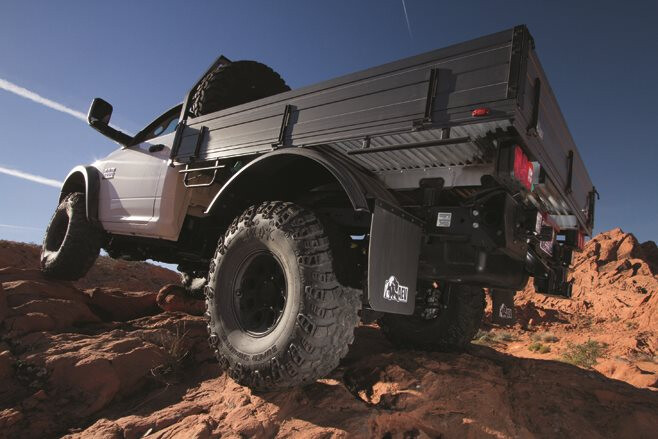
On initial glance, the Ram Ute appears like any other lifted truck with a cool bumper and big tyres. However, closer inspection reveals a plethora of nuances that separate it from the Bigfoot crowd. Firstly, though it rides on 41-inch Interco IROK Super Swamper tyres the Ram isn’t that high. In fact, the suspension system raises the vehicle a mere three inches.
Any shop can toss a few leaf and coil springs together, throw a drop Pitman arm and some shocks in a box, and call it a lift kit. It is true that this will raise the vehicle, allow for larger tyres, and provide a feeling of superiority as you look down at an intersection full of loathsome soccer-mum-mobiles. But buyers beware, soccer mums may have the last laugh on the highway when your patched-together lift won’t track straight and induces an SS Poseidon effect in turns. With thousands of street and off-pavement kilometres in various AEV-equipped vehicles, we assure you this is not the case with the suspensions hailing from this American-born company from Montana.
We crawled under the front end of the Ram with AEV owner Dave Harriton, and he explained that their goal was to break a decades-old methodology of lifting a vehicle: “The idea is to make the vehicle think it’s not lifted. Why mess with millions of dollars of proven engineering?”
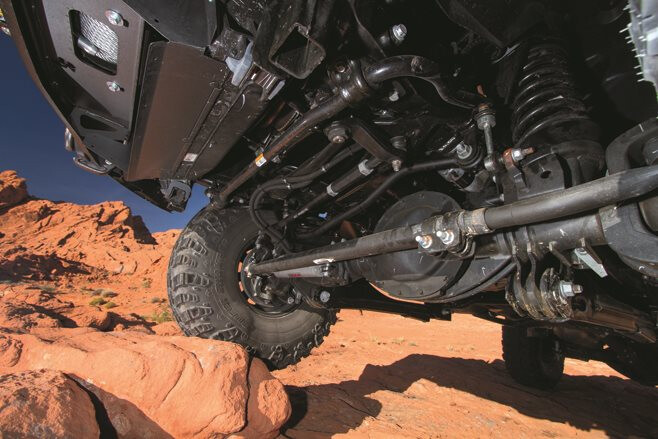
A proper suspension system is engineered to closely mirror the OE handling characteristics, and AEV accomplishes this through a number of innovative measures. While most lift kits incorporate a drop Pitman arm or steering link, the Ram DualSport system utilises a custom bracket on the axle that raises the panhard rod to maintain its original geometry. While the OE steering arm attaches to the bottom of the knuckle, the new AEV arm attaches to the top, again retaining the factory geometry. Rather than increasing the spring length, which can lead to unusual steering characteristics during full droop, a three-inch cast aluminum seat is placed under the OE coil springs. The aluminum aspect keeps unsprung weight to a minimum, and the stock spring length allows the steering to track properly under any axle configuration.
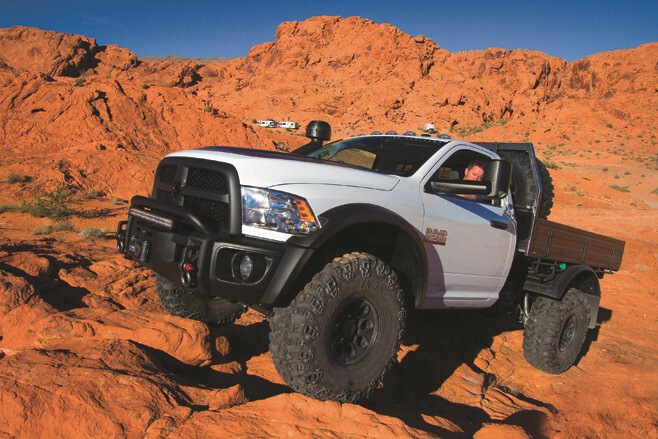
The system incorporates the OE trailing arms, but a custom rear bracket positions the rear of the arm three inches lower (again, proper geometry) and 1.5-inches forward to allow for tyre clearance. To assist with manoeuvring the 41-inch tyres, a PSC hydraulic ram was added. The rear suspension integrates a similar combination as the front; sway and panhard bar correction, stock length coil springs, and AEV-spec Bilstein shocks are found at each corner. The result is increased ground clearance, an additional inch of up travel, larger tyres that don’t rub and a vehicle that maintains stock handling properties.
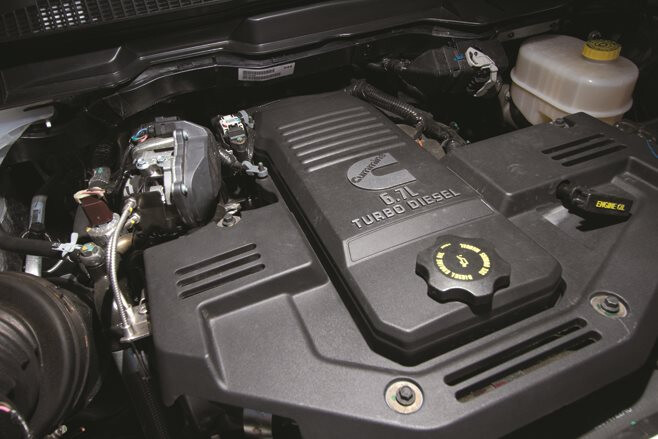
Keeping with the don’t-mess-with-a-good-thing mantra, AEV left the powertrain pretty much stock. The Cummins 6.7-litre turbodiesel generates 650hp (485kW) and 660 lb-ft torque (895Nm), more than enough to motivate the vehicle’s weight. The G-56 six-speed manual transmission (a wonderful thing) features an impressively low 6.29:1 first gear and 0.74:1 overdrive ratios. To ensure debris-free air to the engine, an AEV Raised Air Intake system was added. It functions as a pre-filter for the OE air filter, is self-cleaning, and utilises a cartridge similar to those found in heavy equipment and military applications. To compensate for the 41-inch tyres and provide four-wheel traction, the factory axle housings (AAM 9.5-inch front and AAM 11.5-inch rear) were fitted with 4.10:1 ring and pinion gears and ARB air lockers.
AEV made a splash at the 2013 SEMA show with a prototype Ram front bumper, and brand enthusiasts united in interest. We’re pretty sure they won’t be disappointed with the final version. As with many of the company’s bumpers, it is stamped from a solid sheet of 3/16-inch plate steel. Frame mounts are 1/4-inch plate and trace the frame rearward beyond the stock fittings on the end of the frame horns. Our experience has shown that this method addresses the torsional effect induced during heavy winching by distributing the load evenly to the meat of the frame. Though the winch cradle is designed for a Warn 1500-pound (7484kg) model, it will accommodate forward or bottom-mount units. Recovery points (or hoops) are cast steel, feature a nifty little skid pad, and sit outbound of the frame.
To properly distribute the load experienced during a recovery, AEV engineers developed a triangulated box-type system that creates a load path to the main mount and frame; all are 1/4-inch steel. The bumper is also of a modular design, which will allow end-users to choose from a variety of lighting and riser hoop options. Another feature, and one many bumper fabricators are overlooking on this vehicle, is the engine’s intercooler. It rides directly behind the OE bumper (which has a cutaway to allow airflow) and needs that cooling effect to function properly. The AEV unit addresses this with a cooler-width funnel underneath to allow for unrestricted airflow – though we might choose to add an expanded metal screen to protect it from rock damage.
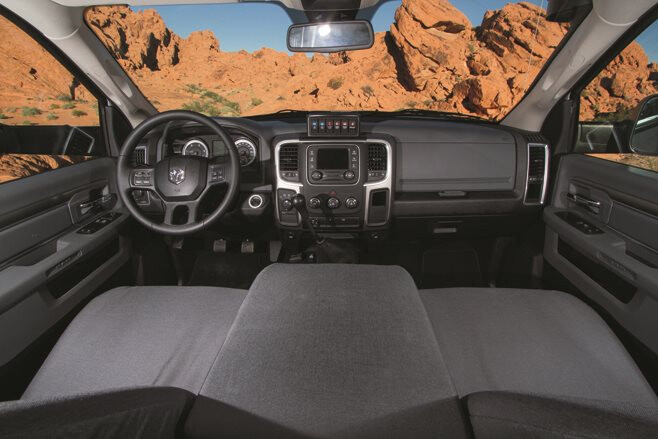
Down back, the Ram was treated to an aluminum tray bed from Ute Ltd. Though it is seven feet in width, a bit wider than the truck’s body, it provides ample room for gear and offers the ideal platform for a camper or other abode. The stock rear bumper was exchanged for a 1/4-inch plate steel unit with integrated LED lighting, trailer wiring, and a two-inch receiver. The filler for a Titan 30-gallon (113.5-litre) auxiliary fuel cell, which hangs in the spare tyre bay, sits between the bumper and bed. The spare was re-mounted against the front of the bed with an AEV tyre carrier kit.
We were jazzed when we hooked up with Dave at the 2014 SEMA show and he offered us first crack at reviewing the Ram Ute. Whether you’re a Jeep, Toyota, or Land Rover aficionado, you’ve got to admit, it’s downright cool.
2015 Ram single cab long bed SLT Specifications
| Engine | Cummins 6.7L turbodiesel |
| Output | 650hp (485kW), 660 lb-ft torque (895Nm) |
| Transmission | G56 six-speed manual w/ 6.29:1 first gear |
| Axles | AAM 9.5in front, AAM 11.5in rear |
| Differentials | ARB air locker, 4.10:1 gears |
| Tyres/wheels | 41/14.50R17 Interco IROK, AEV 17x10in Katla Wheels |
| Aspiration | AEV Raised Air Intake with pre-filter |
| Suspension | AEV DualSport |
| Steering | AEV Hi-Steer, PSC hydraulic assist |
| Bumpers | AEV modular front, AEV custom rear |
| Winch | Warn 16.5t, AEV/Factor 55 FlatLink thimble |
| Auxiliary fuel | Titan 30-gallon (113.5L) |
| Lighting | AEV/Vision X LED |
| Ute Ltd. aluminum bed w/AEV wheel skirt | u00a0 |
| AEV high-clearance fenders | u00a0 |
The new NP300 Nissan Navara, the first all new Navara in ten years, will go on sale in Australia in May 2015. Initially some 14 different dual-cab pick-up models will be available but only eight of them will be 4×4.
Single-cab/chassis, King-cab/chassis, King-Cab pick-ups and dual-cab/chassis models won’t arrive until the third-quarter 2015 to bring the total model range to 27 variants, including 4×2. The NP300 Navara will replace both the existing D40 and D22 ranges.
The new Navara 4x4s come with two different engines and in four model grades, RX, DX, ST and ST-X. The engine line up is led by an all-new 2.3-litre twin-turbo diesel that claims 140kW and 450Nm. This engine will be available in ST and ST-X models while further down the range a 120kW single turbo diesel is offered. The standard gearbox is a six-speed manual while an optional seven-speed automatic will be available on most models. Dual-cab pick-ups also get five-link coil suspension rather than leaf springs at the rear. All 4×4 variants will have a 3500kg maximum towing capacity.
All models get seven airbags (front, side, curtain and driver’s knee), daytime running lights, cruise control, Bluetooth phone connectivity, auto headlights and electronic stability and traction control.
The RX then adds remote keyless entry and swaps the DX’s 15-inch steel wheels for 16-inch steels.
The ST ups the ante with 16-inch alloys, an alloy sports bar, a rear diff lock, auto-levelling LED headlights, LED daytime running lamps, and a five-inch touchscreen for audio and Smartphone connectivity and the reversing-camera display.
The top-spec ST-X then adds leather seats, heated up front and with electric adjust for the driver, auto entry, push-button keyless start, dual-zone climate control, a seven-inch touchscreen display, sat-nav, 18-inch alloys, a tilt and slide sunroof, an adjustable load-restraint system for the tub and hill-start and hill-descent control.
Nissan NP300 4×4 Prices*
| RX Dual-Cab Pick-Up manual | $39,990 |
| RX Dual-Cab Pick-Up automatic | $42,490 |
| ST Dual-Cab Pick-Up manualu00a0 | $45,990 |
| ST Dual-Cab Pick-Up automatic | $48,490 |
| ST-X Dual-Cab Pick-Up manual | $51,990 |
| ST-X Dual-Cab Pick-Up automatic | $54,490 |
* Suggested retail price for initial roll-out in May 2015
Get the latest info on all things 4X4 Australia by signing up to our newsletter.
Most regular readers would be familiar with the photographs produced by Offroad Images. Over the years you’d have seen plenty of them gracing the pages of this magazine, and you’d also have seen them on brochures, banners, walls, windows and websites. The images range in size from tiny postage stamps to massive 10-metre signs adorning buildings.
The subject matter is usually 4WD related, whether it is an action shot of a competition vehicle scrambling up an impossibly steep rock, a convoy of tourers kicking up a cloud of red dust in the outback, or even a product shot of a new suspension component. There are also the shots made possible by simply being in remote locations: spectacular landscapes, amazing weather events, exotic wildlife or even detailed portraits of characters in the outback.
Get the latest info on all things 4X4 Australia by signing up to our newsletter.
Michael Ellem, the man behind Offroad Images, lives and breathes 4WDing – as do most of his clients. So when it comes to capturing the best off-road shots, he needs a vehicle that’s up to the task. He needs a rig capable of hauling all the tools of his trade (and there are a lot of them) and reliably getting him into and out of some extremely hard-to-access places.
Unlikely as it may seem, that vehicle is a Mazda BT-50 GT Dual Cab. “I liked the Ford Ranger,” Michael explains. “Originally I was seeking out the Ford Ranger XLT. I’d driven one for about 26,000km to remote locations around Australia, but I had trouble getting access to one from a dealer. One of the few dealers who showed any interest wanted to sell me a manual Ranger XLS, which I wasn’t interested in because I knew the auto gearbox was sublime.”
“I needed a vehicle for a particular trip with Creek to Coast, where we were heading through Broken Hill, Cameron Corner, Innamincka, the Simpson Desert and then right up into Winton in Central Queensland. But I was being messed around by three different Ford dealers; I wasn’t even given a price on a Ranger. On my way to one dealer to find out why he hadn’t he returned my calls, my wife asked me: ‘Why don’t you just drop into the Mazda dealer and talk to them?’ I said: ‘I don’t want a BT-50 because it’s got a big smile on its face!’”
“I had photographed a BT-50 up in the Flinders ranges and I just didn’t like it,” Michael continues. “Every angle that I picked up, it wasn’t the right look for me; it just kept smiling at me. So, when it came to a BT-50, why would I buy that? That’s going to be a car I’m not going to enjoy looking at.”
But Michael took his wife Gabrielle’s advice and dropped in to West End Mazda. “At the end of the day, the Mazda dealer offered me this really good price and a 200,000km warranty, and I thought: ‘Why would I buy the Ford?’ This is the GT model with full electric seats, leather and sat-nav – which you can’t get on the Ford XLT.”
And thankfully for Michael this BT-50 has had the smile well and truly wiped off its face thanks to the fitment of a colour-coded ARB Sahara Bar, Intensity LED driving lights and a strategically positioned control box for the Warn Magnum 10,000kg winch.
With its potent 3.2-litre five-cylinder turbodiesel engine, mated to the six-speed auto transmission, the BT-50 offers strong performance both on and off the road, despite the overall weight of the vehicle, when fully laden, which hits the scales at around 2900kg. Some of that weight comes from the accessories fitted to the vehicle, but a lot of it comes from all of the photography and computer gear Michael lugs around with him while on assignment.
“The right-hand drawer takes five light stands and three tripods,” Michael says. “Pelican cases hold all the various photography products including video and stills lighting kits, time-lapse rigs, panoramic heads, Go-Pro kits, remote camera modules, video rigs, chargers etc., to make sure they don’t get knocked around. The boxes all fit either full width or two to a width, and they sit in there like Lego.”
The 60-litre ARB fridge sits on an MSA drop slide, which is in turn mounted to an ARB Outback Solutions dual drawer system. The fridge is covered by an MSA fridge barrier, which allows gear to be packed up right against it, maximising load space yet ensuring there’s enough free space around the fridge for it to operate efficiently.
Before owning the BT-50, Michael had a number of Toyota wagons including a 100 Series Land Cruiser and a Prado, but it’s been many years since he ran a ute. The last being a HiLux Extra Cab many vehicles ago, so the purchase of a dual cab is a little surprising.
“Probably the number one reason for going with a dual cab with a canopy is the size of the enclosure for taking all the gear. I just can’t fit the tripods, stands, lighting gear, Pelican cases and so forth in a wagon. But normally when I work with a dual cab, I would never put camera gear in the back because every time you drive down a track, it sucks in dust, which ends up all over my gear, so I’d have space cases sitting on the back seat of the cab with all my gear in them.”
The solution to Michael’s dust woes came in the form of ARB’s canopy air vent. “I would never have gone for a ute until I had used a dual cab and canopy combination with air vents,” Michael says. “When ARB released the canopy vent, I gave it a go, thinking that it’s probably not going to work, but I ended up with no dust at all in the cargo area, on really dusty tracks that I was driving for about three days. I couldn’t believe it. That air vent is the single reason why I made a decision to buy a dual cab.”
Not content with one air vent, Michael asked the blokes at ARB to fit two of them up the front of the canopy where they work best to pressurise the cargo area. “It’s probably overkill, but why not?” he says.
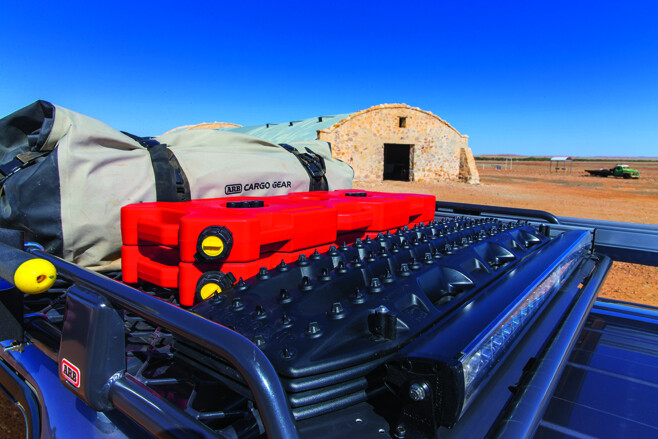
Sitting up on top of the canopy is an ARB trade roof rack which holds a number of items that don’t have to be accessed as often, such as four MAXTRAX recovery tracks, a Kaymar shovel and a Hi-Lift Jack roof rack holder customised to hold a long-handle shovel and camera tracking system, two 15-litre RotoPax diesel fuel cells and an ARB awning. There’s also a 40-inch Wurton spot/spread roof light mounted to the front of the rack and a couple of work lights at the rear.
When travelling in difficult off-road conditions in remote areas, having a reliable vehicle with good off-road capability is of paramount importance, especially when your business depends on it. “I’ve got to make sure that when I’m on a shoot if anything’s going to fail it’s going to be the client’s car, not mine,” Michael says. “I can’t be the reason for a delay in what we’re trying to achieve.
“Therefore, everything that I do, I’ve got redundancy involved. As in with all of my computer equipment, I’ll have two of everything: two chargers, two lots of cables, two lots of card readers, so everything’s backed-up. When it comes to a vehicle, you can’t have two of everything, so what you need to do is make sure that everything you’ve got on the truck is really well set up. For example there are no crimp connectors just whacked on to a cable, every bit of wire is soldered and every bit of wire is fused. There’s a fuse box in the front and one at the back. So if something does wear through, or something has a problem, I don’t want it to take out other areas.”
There’s a hell of a lot of wiring in this vehicle and, having recently travelled with Michael in the Northern Territory’s Red Centre, 4X4 Australia can attest that it’s all put to good use. Despite what you may think, being a photographer involves much more than simply taking shots; at the end of each day Michael needs a workstation where he can download and process images, and recharge the batteries for cameras, lights, computers and more. And that workstation is the BT-50’s tailgate, which is lit up by a custom LED lighting system.
“What the guys at ARB have done for me is place four USB ports at the back of the car,” Michael explains. “They figured that people, either me or those I’m working with, will need to charge things, and so much can be charged on USB rather than turning an inverter on. They’ve put four USB ports in the front, too.
“Forward of the set of drawers there’s a bit of vacant space, where the drawer stops and doesn’t continue through to the back wall of the ute area, so that space provides adequate room for jumper leads and various spares that you don’t need to see or get access to in a hurry. For example, there’s a 1000W inverter in there; it’s connected back through to the rear of the left-hand side of the drawers, so there’s a dual power point there. There’s also a remote switching arrangement which gives me full monitoring of the battery system; how much power’s being used, how much power’s needed by that inverter. At the back I’ve got two 240V plugs that I can turn on remotely, and it has another five points on the inside of the cabin, so if we’re doing a trip and I need to charge up things like my studio lighting or camera batteries while I’m driving, I can hook that in and keep that charging. That’s drawing the power from the battery in the rear, which is being charged by a 40amp Redarc charger.
“Everything that’s been put in the vehicle has been over-engineered,” Michael says. “Everything that has been added, I want to make sure that it’s the best performing platform for what it is that I do. Lockers, for example, I don’t really want to be stuck on a track somewhere if there’s an obstacle, I want to get through and then I can get the camera out and film my client doing whatever he wants to do to get through that obstacle. I don’t want to be the one having a drama.
“I’ve got a lot of 4WD experience but, at the end of the day, if you’ve got the right tools, it certainly allows you to get through obstacles a whole lot easier and, in doing it easier, there’s going to be less wear and tear on the original mechanicals.”
This is one of the reasons Michael opted for the auto transmission in his BT-50. “I definitely wanted the auto, for so many reasons. Say for crawling up a high country track there’s less wear and tear on the drivetrain and less energy expelled in trying to get up a heavily rutted track. So, I can go really slowly with lockers on, and just ease it up and it’ll have no dramas getting up an obstacle. Also, as you pull up at a set of lights it will gear down, so it manages the reduction of braking effort. It’s a bloody good ’box, so why wouldn’t you go with the auto?”
What goes up must come down, so how does the auto perform on steep descents or when dropping down rock shelves and the like? “Low-range is sensational,” Michael says. “You actually have to accelerate down very steep high-country tracks. If you just let it crawl down a hill in first gear, fully loaded with all of my camera gear, you’ll be going slower than the vehicles behind you.”
Ensuring the BT-50 has plenty of off-road grip is a set of Cooper Discovery ST Maxx 285/70R17 tyres mounted to some smart-looking American Racing Wheels ATX Series Dune rims. Of the tyres Michael says: “I love ’em. I’ve driven STs and STTs on lots of different vehicles. I originally wanted STTs for the vehicle as I figured they’d give me more effective grip in rough terrain. But I decided to go for the ST Maxx for the simple reason that, with the load I’m carrying, I thought it’d be a better tyre when driving on really hot roads, gibber plains and rocky roads where a lot of heat would be generated through the tyres. The ST Maxx has a bigger surface area, more rubber in contact with the surface, so I felt that would assist in dissipating some of the heat, because it is a heavy vehicle.
“I knew the majority of the kays that I do would be off-road kays. I’ve done 43,000km in that car, so the tyres have done about 40,000km. I’m rotating a set of six tyres, the newer tyres are always on the front. I don’t believe that I’ve ever seen a Cooper tyre with a puncture.”
We reminded Michael of one Cooper puncture he had definitely seen (he even photographed it) on a trip through the Simpson Desert we completed several years ago. But he was quick to point out that it was an STT, not an ST Maxx, and that was definitely the only one he could remember.
Helping the BT-50 carry all of this gear is an Old Man Emu suspension system with heavy duty 600kg rear springs. This also offers a moderate ride-height lift, which helps the long-wheelbase BT-50 in challenging off-road conditions.
No vehicle is invincible and Michael carries essentials such as a full recovery kit, although he insists that this and the winch are “hopefully” only used for rescuing other vehicles. There are also a couple of fire extinguishers (one in the cabin and one at the rear of the vehicle) and a first-aid kit. For airing up the tyres and operating the front air locker (the rear locker is a factory Mazda item), there’s an ARB dual air compressor and air tank under the deck in the rear.
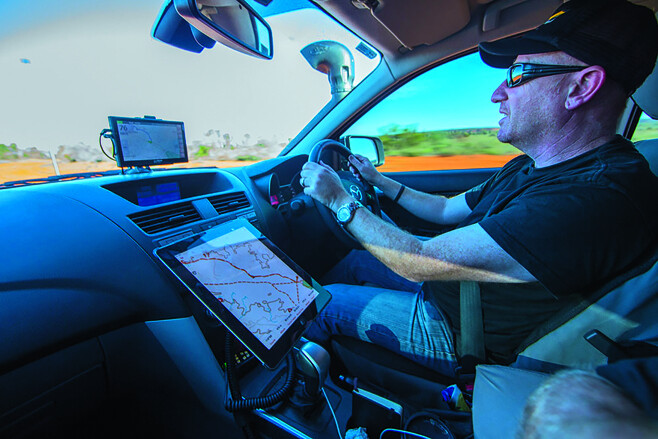
Communications are taken care of by a GME Headless 80 channel UHF connected to a 6.6dBi gain antenna. Boosting mobile phone reception is a GME dual band 6.1dBi gain phone antenna, which is connected to a Strike Smoothtalker phone cradle. Navigating is a cinch, thanks to a Hema HN7 Navigator mounted on the dash and a cradle-mounted iPad running Hema Explorer mapping software.
“I’ve had some really well set-up vehicles,” Michael says. “The 100 Series, it had 35s, a six-inch lift, lockers, front and rear bars, sidebar protection, roof rack, aerials – it had everything in it. But it couldn’t carry all the gear that I needed, so I’d always be loading the back seat up with all my cameras. As far as a vehicle to work from, the BT-50 is the best 4WD that I’ve ever had.
“The car is awesome as a basic vehicle, that’s without a doubt, but the way ARB has set the thing up based on a brief I gave them, to make it perform for my function (for photography), is way beyond what I expected. Yeah, it’s definitely the best 4WD that I’ve owned… and it’s a Mazda!”
Having driven this BT-50 ourselves, fully laden over a wide variety of terrain types, through the West MacDonnell Ranges, the Mereenie Loop Road, Uluru, Rainbow Valley and Palm Valley, we can see why Michael likes it so much; it’s comfortable, it rides beautifully, it’s very capable and it has loads of space. Covering about 70,000km a year, Michael says he’ll probably get three to four years out of the BT-50. I reckon he’s going to have a hard time saying goodbye to this smiling assassin when its time is up.
GEARED UP
This is how Michael Ellem has kitted out his rig:
PROTECTION AND TRACTION
- Colour-coded ARB Sahara Bar
- ARB side steps
- ARB rear bar
- ARB Under Body Vehicle (UVP) protection system
- Safari snorkel
- ARB front air Locker
- Factory rear locker
- ARB Old Man Emu suspension with 600kg rear springs
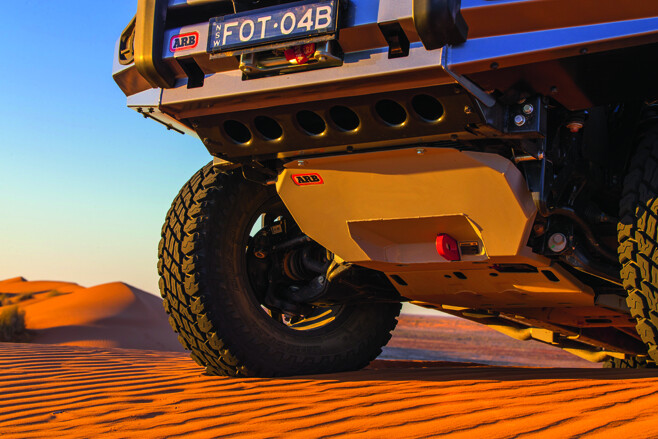
RECOVERY GEAR
- ARB recovery point
- Warn Magnum 10,000kg winch
- Bushranger recovery shackle at rear
- Complete recovery kit
- GME 6.6dBi gain UHF antenna
- GME dual band 6.1 dBi gain phone antenna
- GME headless 80channel UHF Radio (mc524)
- Strike Smoothtalker iPhone cradle
- ARB Intensity lights
- ARB fog lights in bar
- Wurton 40-inch spot/spread roof light
- Wurton rear flood work lights
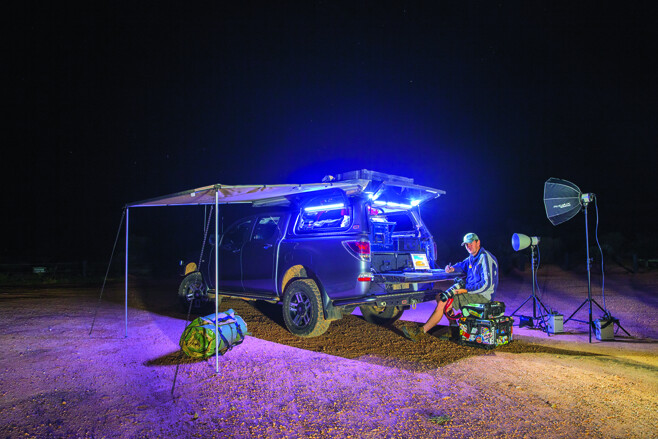
WHEELS AND TYRES
- 17-inch American Racing Wheels ATX Series Dune
- Cooper Discovery ST Maxx 285/70R17
- ARB tyre deflator and inflation
- ARB aluminium trade roof rack
- 4x MAXTRAX recovery tracks with retaining pin system
- Kaymar shovel and high-lift jack roof rack holder customised to hold long-handled shovel and camera tracking system
- 2 x 15-litre RotoPax removable diesel fuel cells with mounting kits
- ARB awning
INSIDE THE ARB SMOOTH CANOPY
- Dual vents for increasing air pressure in the canopy enclosure
- ARB Outback Solutions dual drawer system
- Custom LED lighting systems on each lift-up window and in roof system
- MSA 4X4 dropslide
- MSA 4X4 fridge barrier
- ARB 60L fridge/freezer
- Fire extinguisher in rear canopy area and front of driver’s seat
- 2 x MSA 4X4 utility bags
- First-aid kit
- 4 x Baintech CIG at or above rear of drawer system
- 5 x Internal 240V power
- Complete ARB recovery kit
- ARB dual air compressor
- ARB air tank
- Redarc 40amp charger
- 105Ah AGM battery
- Cotek (Redarc) 1000W pure sine wave inverter
- Custom fuse module for all rear power
- Cotek remote control module
- 2 x external 240V power
- 4 x Baintech USB outlets
- Baintech battery monitoring module at rear of drawers for quick referencing
- Custom Baintech fuse module for all front power
- Distribution for all rear power
- Diesel pre-filter
- 3in Manta exhaust system
- Hema HN7 Navigator custom mount on dash with reverse camera
- Custom iPad mount for Hema Explorer mapping
- 4 x Baintech USB outlets
- Baintech battery monitoring module for quick referencing of front battery
- 2 x Baintech CIG at rear centre console
- Redarc brake controller
- Custom light and Air Locker switches in roof replacing sunglasses compartment
- Snatch strap and 2 x shackles under seat for easy access
Get the latest info on all things 4X4 Australia by signing up to our newsletter.
Jeep’s 49th annual Easter Jeep Safari held at Moab, Utah, USA will see the unveiling of a number of new, and very tasty, Jeep concept vehicles.
The concept vehicles have been put together by a team of specialist engineers, designers and fabricators who have produced some 50 concept vehicles for the Easter Jeep Safari since 2002. The vehicles will showcase a range of production and prototype Mopar and Jeep Performance Parts. This year’s crop includes:
- Jeep Chief: The Wrangler-based ‘Chief’ is an throwback to the original ‘full-size’ Cherokee, the SJ, which was produced from 1974 to 1983 and developed from the iconic Wagoneer. The concept is 1970’s California-surfer in style right down to the 17-inch slotted mags and chopped roofline. The Chief is powered by the 3.6-litre V6 mated to a six-speed manual and sports a range of Jeep Performance Parts including a two-inch lift kit, Fox Shocks, front and rear Dana 44s with lockers, modified Rubicon rock rails and a cold-air intake.
- Jeep Staff Car: Based on a Wrangler, the ‘Staff Car’ pays homage to original military Jeep, the vehicle that started the whole Jeep thing and kicked started the world’s love of 4x4s. Military-style features include 16-inch steel wheels with 35-inch bar treads, a canvas roof, cut-back guards, an external jerry can, a guard-mounted blackout lamp, and an axe and spade. The Staff Car has no B-pillar and no doors, while the interior has bench seats front and back, no carpets, an integrated roll-cage, and an inbuilt cooler that looks like an ammunition box! The Staff Car runs a two-inch lift, Fox shocks, Dana 44s, all from the Mopar catalogue, and is powered by the 3.6-litre V6 mated to a manual gearbox.
- Jeep Wrangler Africa: The ‘Africa’, powered by the Wrangler’s 2.8-litre diesel mated to an automatic transmission, is an expedition vehicle that wouldn’t be out of place in Outback Australia. Features include an extended, high-roof body for extra gear-carrying capacity, a high-clearance front steel bumper complete with winch, rock rails, two jerry cans mounted behind the front guards, and an underbody-mounted spare. The Africa has a two-inch lift, Fox Shocks, special sway-bar links, Dana 44s, and 17s with 35-inch muddies.
- Jeep Grand Cherokee Overlander: The Overlander is a Grand Cherokee for the serious traveller. Powered by the 3.0-litre V6 diesel it has an integrated front-mounted winch, tow hooks larger wheel flares, rock rails, and 18-inch milled wheels with BF Goodrich all-terrains. The Overlander also as a roof-mounted two-person, hard-shell tent that easily deployable.
- Jeep Renegade Desert Hawk: The ‘Desert Hawk’ is based on the Renegade Trailhawk, the most off-road capable of the new Renegade range, a ‘baby’ Jeep that will be released in Australia late 2015. The Desert Hawk is mainly a cosmetic exercise but it does have a few Mopar items including rock rails, a skid plate, trailer hitch and rood rack. The Desert Hawk is powered by the 2.4-litre ‘Tigershark petrol four-cylinder mated to a ZF nine-speed automatic gearbox.
- Jeep Cherokee Canyon Trail: The ‘Canyon Trail’ is an adaption of the Cherokee Trailhawk, the off-road ‘hero’ in the new Cherokee range. Aside from a swag of cosmetic enhancements, the Canyon Trail has JPP rock rails, a two-piece fuel-tank skid plates, front suspension skid plates and two additional underbody skid plates. The Canyon Trail runs 17-inch wheels with BF Goodrich A/Ts and is powered by the 2.4-litre ‘Tigershark’ petrol four mated to the dual-range 4×4 system complete with rear locker.
- Jeep Wrangler Red Rock Responder: The Wrangler-based ‘Red Rock’ is an off-road support and emergency vehicle, and the toughest of this year’s concepts. It comes 37-inch, bead-locked mud terrains on 17s, four-inch lift, Fox Shocks, 5.83:1 Dana 60 axles, Warn winch, prototype rock rails and cold-air intake. It also has Rubicon 10th Anniversary front and rear bumpers and guards, once concept parts that are now production-line. Special side stowage boxes have a compressor, a high-lift jack, a fire extinguisher, recovery gear and various tools. Plenty of luxury inside however with Mopar ‘Katzkin’ red leather seats. The Red Rock Responder is powered by the 3.6 V6 mated to an automatic transmission.
Land Rover’s replacement for the popular Freelander proves it is better in almost every department, but can’t wait for new diesel engines.
WHAT IS IT? The first model in Land Rover’s revamped Discovery family. It’s effectively a replacement for the venerable Freelander, except longer, more practical and better looking.
WHY ARE WE TESTING IT? With impressive packaging, chic styling and serious off-road ability, it has the potential to be a class leader in the cut-throat compact premium SUV segment.
THE 4X4 VERDICT Alongside ‘versatile’ in the dictionary should be a picture of the Discovery Sport. Refined, capable and practical, it’s also appealingly affordable. Only ageing diesel engines let it down.
PLUS: Chic good looks; dynamic ability; refined road manners; class-leading off-road ability; price MINUS: Noisy, sluggish diesel
THE 4X4 REVIEW IF SOMETHING looks too good to be true, it almost always is. So we were wary of Land Rover’s new Discovery Sport, which on paper looks seriously appealing.
Not only is its $53,300 starting price cheaper than its rivals (Audi Q5 and BMW X3), but thanks to chic new styling, it’s better looking, too. Throw in stunning practicality, the option of 5+2 seating and Land Rover’s latest off-road technology and the Disco Sport’s package looks good. Almost too good.
Happily, though, we can report that after a day of throwing it down rocky cliffs and over slippery mountain passes, the Disco Sport lives up to the hype.
The first model in Land Rover’s revamped Discovery family, Disco Sport replaces the venerable Freelander, but is 89mm longer and, thanks to an ever faster and more capable version of Land Rover’s Terrain Response System, is even more capable off-road.
Think of it as a more versatile, seven-seat Evoque, with which it shares the same platform, front suspension componentry and range of 2.0-litre petrol and 2.2-litre diesel engines.
But while some of the Disco Sport’s hardware is familiar, there’s plenty that’s new. A lightweight and redesigned multi-link rear suspension improves ride quality and handling. Recalibrated steering is feelsome, direct and well weighted. And a highlight is an interior that manages to feel both luxurious and suitably rugged courtesy of heavy-duty floor mats and hardwearing plastics.
It’s practical, too. The rear seats slide fore and aft 160mm to boost luggage space, and the optional ($1990) third-row seats fold completely flat. Tick this option, though, and you lose the standard full-size spare for a space saver.
Three engine choices are offered, two diesels – TD4 (110kW/400Nm) and SD4 (140kW/420Nm) – and a 177kW Si4 turbo-petrol. All are available with Land Rover’s smooth-shifting nine-speed automatic while the diesel variants, which will make up the majority of sales, also have the choice of a Getrag six-speed manual.
Equipment levels are split across base SE (all drivetrains), HSE (diesels only) and HSE Luxury (SD4 only) variants, all with extensive standard kit: reversing camera, lane-departure warning, autonomous emergency brake, rear parking sensors and an electric tailgate. There’s also a pedestrian airbag in the bonnet, which is a first for this segment.
We sampled the SE SD4 at the local launch, on slippery roads outside Canberra. Here, even on coarse and heavily rutted dirt tracks, the Discovery Sport proved impressively civilised. The handling on wet, switchback mountain roads was surefooted and predictable, while the sharp and direct steering gave a distinctly sporty feel.
It’s off-road, though, where the Disco Sport trounces its rivals. Capable of conquering terrain that would give a Q5 or X3 the cold sweats, the Disco Sport stays true to the heritage of its Discovery nameplate.
Yet it’s not perfect. The biggest weakness is the diesel drivetrain, which, despite its strong 420Nm output, can feel doughy and sluggish. In a car bristling with Land Rover’s latest technology, the oiler feels distinctly last-gen, which it is; Land Rover’s new family of 2.0-litre Ingenium engines is already planned and will slot in within two years.
Still, there’s no denying the Discovery Sport is an extremely appealing package that offers class-leading off-road ability, refined road manners and pleasing performance. Combine its rugged versatility with chic good looks and a well executed, practical interior and the Disco Sport is an SUV that’ll be just as at home on the driveway of a posh city suburb as climbing and conquering cliff faces.
SPECS Model: Land Rover Discovery Sport SE SD4 Engine: 2179cc 4cyl, dohc, 16v, TD Max power: 140kW @ 4000rpm Max torque: 420Nm @ 1750rpm Transmission: 9-speed automatic Weight: 1775kg 0-100km/h: 8.9sec (claimed) Economy: 6.1L/10km Price: $56,500 On sale: May
Get the latest info on all things 4X4 Australia by signing up to our newsletter.
Ford has finally made public the full details of the Ranger’s much anticipated mid-life makeover some four and a half years after the Australian designed and developed ute first broke cover back in mid 2010.
The new Ranger was revealed in Thailand where it will be built for Asia-Pacific markets, Australia included. The Ranger is sold in 180 global markets with production also in South Africa (for Africa and Europe) and in Argentina (for South America). The Ranger is not sold in North America where Ford has a strong presence with its F-Series light trucks.
The Ranger’s mid-generation makeover starts with revised front-end styling and runs to a new interior highlighted by an all-new dashboard, and brings a host of new convenience, safety and fuel-saving technologies. Revised suspension tuning is also claimed to improve the ride comfort and handling of what is already a well-sorted ute.
The Ranger’s existing engines will be carried over but with several notable changes. The 3.2 five-cylinder diesel has been updated with a new exhaust-gas recirculation system and other changes, claiming fuel efficiency improvements of up to 18 percent.
Meanwhile, the optional 2.2-litre four-cylinder diesel has been beefed up from 110kW to 118kW and will also be offered in a new extra fuel-efficient, low-power 96kW variant, although both 2.2 engines may not be available in Australia. The 2.5-litre four-cylinder petrol engine will be available in Ranger 4×2.
Diesel powertrains offer improved fuel efficiency thanks to ‘Start/Stop Technology’ that automatically cuts the engine once the vehicle is stopped at traffic lights and such, and then automatically restarts the engine once the driver is ready to move away.
Variable-assistance electric power steering also replaces the conventional hydraulic power steering used previously, doing away with the power-steering pump for improved fuel efficiency and lower noise levels. Improved steering feel too, according to Ford.
The Ranger will retain the existing part-time dual-range 4X4 system complete with a driver-switched rear locker, but an optional higher final-drive ratio, for highway-driving fuel savings, will be available. Ford has also reportedly addressed the poor shift quality of the 3.2’s manual box by ditching the rod-style actuation system for a cable-operated arrangement taken from the 2.2.
The interior changes are lead by a new dashboard courtesy of the up-coming Ford Everest 4×4 wagon, the key element of which is a 200mm multi-function touch-screen display for the sat nav, reversing camera, and information, entertainment and climate-control functions. There’s also a new digital instrument cluster.
The Ranger will also adopt Ford’s ‘Sync2 voice-control technology for phone connectivity and message reading, navigation, climate control and entertainment. As well as Bluetooth connectivity the Ranger will come with two USB ports and SD-card and auxiliary inputs, as well as a 240-volt power socket on the lower dash for running laptops and the like.
There’s also a range of new driver-assist technologies including radar-operated adaptive cruise control, forward-alert crash mitigation that warns the driver of a possible collision, and ‘Lane-Keeping Alert’ that will warn the driver via a vibration at the steering wheel if the vehicle is drifting out of its lane. The system can even gently steer the vehicle back on course if the driver doesn’t take action. The system can also detect if the driver is getting drowsy and driving erratically, and will warn of the same via an increasingly loud audio alarm.
The new Ranger will also come with a tyre-pressure monitoring system.
Get the latest info on all things 4X4 Australia by signing up to our newsletter.
Subscribe to one of five magazines to receive 100 entries into The Ultimate Getaway package, valued at over $100,000.
COMPETITION HAS NOW CLOSED WINNER ANNOUNCED 4 NOVEMBER 2015
PACKAGE INCLUDES:
1 X STABICRAFT 1650 FISHER
- Mercury 100hp Command Thrust outboard
- Lowrance HDS-9 Gen2 Touch with StructureScan, SonicHub sound system, dash-mounted VHF marine radio, handheld VHF and Navionics Platinum Charts
- Transtyle AT1700 all-aluminium trailer featuring torsion suspension, hydraulic override brakes and alloy wheels
- Rods and reels by Abu Garcia, Penn, and Berkley Boat package alone valued at $45,000
1 X 2015 MAJESTIC SIERRA XTREME OFF-ROAD CARAVAN TO THE VALUE OF $57,990
- Recessed Swift grill
- Gas/elec hot-water system
- Ibis roof air-conditioner
- Twin 95lt water tanks
- Picnic table
- Aussie Traveller charcoal awning
Competition commences 11/04/15 and closes 30/09/15. For full terms and conditions, please visit www.tradeboats.com.au/competitions. Winner will be notified on 04/11/15. Competition authorised under permit numbers: NSW LTPS/15/02076, ACT TP 15/05161, VIC 15/543, SA T15/444
Our annual Best in Class awards have taken a new twist this year. For 2015, we will look at each class in greater depth, instead of announcing each class winner in one large feature. First up are the medium wagons, specifically the diesel variants. Gathered here for this comparo are the pick of the crop: Jeep Grand Cherokee, Land Rover Discovery and Toyota Prado.
The Best in Class award is based not only on this current test, but previous testing of different variants of these models under a broad range of conditions. The award’s also based on resale valve, service costs, service back-up and aftermarket accessory support. After putting these diesel rigs through the wringer once again, here’s our verdict.
1ST: LAND ROVER DISCOVERY TDV6
It may be near the end of its life cycle but Land Rover’s Discovery still has all the hallmarks of modern design.
What you see here is effectively a Discovery 4, although Land Rover has now dropped the ‘4’ designation in readiness for a bout of new models, where Discovery will be a product portfolio rather than a specific model.
The Discovery 4 is heavily based on the Discovery 3, so this current Discovery is in effect the end-product of 12 years of evolution. It’s old, but certainly doesn’t feel like it. In fact, it just keeps getting better.
VIDEO REVIEW: Land Rover Discovery TDV6
The latest significant inclusions; the 155kW and 520Nm 3.0-litre bi-turbodiesel and accompanying eight-speed automatic gearbox – that arrived for the MY13 model year – are the key to this particular ‘TDV6’ variant, which is the least expensive in the range. It starts a $69,330, an entry point that’s still well-above the least expensive Prado diesel (the $55,990 GX manual) and entry-level Grand Cherokee diesel (the $53,000 Laredo).
So what makes it a winner?
ON-ROAD PERFORMANCE AND HANDLING
The TDV6 may be the less-powerful of the two diesel engines but it rarely feels wanting, despite the Discovery being a heavy vehicle. In general driving the TDV6 feels quite spritely, and for this you can thank its maximum torque of 520Nm being available from as low as 1500rpm. You can also thank its brilliant eight-speed automatic gearbox, with its broad spread of ratios beneficial for initial pick-up and long highway legs. The engine is smooth and quiet, and the excellent refinement is echoed in the quick, decisive and ultra-smooth shifts from the eight-speed.
As the Disco is heavy and tall, you’d expect its handling to suffer. You do feel the weight in very tight corners, but otherwise the Discovery’s dynamics – thanks largely to the well-sorted steering and fully-independent suspension – are engaging and offer reassuring stability with a cosseting and quiet ride.
OFF-ROAD
For a chassis that works so well on-road, the Discovery is amazing off-road. The key here is that, despite the suspension being fully independent, it has decent wheel travel. Add in its ability to be ‘lifted’ off-road via the height-adjustable air spring, its highly sophisticated electronic control systems, deep low-range gearing, ‘smart’ shift protocols of the eight-speed and a commanding drive position, and the Discovery is highly capable. To give its best off-road performance, however, it needs the optional ($1060) self-locking rear differential.
CABIN, ACCOMMODATION AND SAFETY
The Discovery’s cabin sets the standard in its class for space efficiency and comfort. For the money, though, it’s not well-equipped and at this spec level doesn’t come standard with third-row seats or sat nav; both costly options. This latest Discovery hasn’t been ANCAP rated, so by default it carries over the four-star rating of the Discovery 3.
PRACTICALITIES
There are two weak points with the Discovery in terms of practicality. The 19-inch wheel and tyre package isn’t ideal, and the fuel tank is too small. The latter is easily fixed via aftermarket enhancement while the former can be alleviated, but not solved completely, by tyre choice and a bespoke 18-inch aftermarket wheel.
SUM UP
The Discovery TDV6 wins here thanks to its unique and standard-setting combination of on-road finesse, off-road capability and its clever cabin. At this entry point, though, it’s neither cheap nor perfect, but it’s still the yardstick. Let’s hope when it’s replaced in 2016, Land Rover comes up with something as good, if not better.
SPECIFICATIONS
- Engine – V6 bi-turbodiesel
- Capacity – 2993cc
- Power – 155kW @ 4000rpm
- Torque – 520Nm @ 1500-2500rpm
- Gearbox – eight-speed automatic
- 4X4 System – dual-range full-time
- Crawl Ratio – 51.1:1
- Construction – separate chassis
- Front suspension – independent/air springs
- Rear suspension – independent/air springs
- Tyre/wheel spec -255/55R19
- Kerb Weight – 2558kg
- GVM – 3240kg
- Payload – 682kg
- Towing capacity – 3500kg
- Seating capacity – five/seven
- Fuel tank capacity – 82.3 litres
- ADR fuel claim – 8.8L/100km
- On-test consumption – 10.8L/100km
- Touring range* – 712km
- Price – $69,330 (plus on-roads)
2ND: TOYOTA PRADO D-4D
The Prado is starting to show its age, but its core values remain undiluted.
The previous update of the 150 Series Prado was in late 2013, after first seeing the light of day in late 2009. Even then the 150 was a remake of the 120, which first appeared in early 2003. This means the core vehicle of this latest 150 Series is now 12 years old.
With prices ranging from $55,900 for the five-seat GX manual, to $92,120 for the lavishly equipped Kakadu, there’s a Prado for everyone – from the commercial-fleet buyer to the well-heeled business executive. The most popular model is the GXL automatic; the variant we will mainly be focusing on.
ON-ROAD PERFORMANCE AND HANDLING
The Prado is powered by a four-cylinder turbodiesel; its opposition in this test are both V6-powered. What’s more it claims a modest 127kW of power and an equally modest 410Nm of torque; well short of even the ‘detuned’ 155kW and 520Nm of the Discovery, or the 184kW and 570Nm of the Jeep. The Prado is also shackled by its ageing five-speed automatic, whereas the other two have what is effectively the same state-of-the-art eight-speed automatic.
The result is adequate but far from inspiring performance and, in this company, the Prado’s refinement is average at best. When driven in isolation the Prado is far more convincing, but it doesn’t compare well when driven back-to-back with either the very-polished Discovery or the slick-and-quick Grand Cherokee. Good fuel economy, though.
The same goes for on-road dynamics and ride. The Prado is plush on all surfaces and well isolated from road noise, but it lacks the stability and the agility of the sportier Discovery and the near sports car-like Grand Cherokee.
OFF-ROAD
Head into the bush, however, and the Prado reveals a different side to its personality. It’s capable, comfortable and thoroughly relaxed. It’s softer riding than the Discovery, which gets firm when the suspension is raised, and in a different league than the Grand Cherokee, which is particularly harsh when its optional air suspension is jacked up. The Prado could do with more clearance and deeper low-range gearing, though.
CABIN, ACCOMMODATION AND SAFETY
All Prado variants, from the first of the 150 Series, have a maximum five-star safety rating; a bonus here against the four-star rated Grand Cherokee and unrated (but, by default) four-star Discovery.
The Prado’s cabin is comfortable and reasonably spacious, although the third-row seats eat into the luggage space too much and aren’t as well arranged as the 120 series’.
PRACTICALITIES
Except for its lower 2500kg tow rating, the Prado is a clear winner in terms of its practicality. A sensible wheel and tyre package, generous fuel capacity and no shortage of aftermarket support are all positives that the others can’t match. Add in Toyota’s more extensive dealer network and it’s the first vehicle you’d pick for an outback expedition.
SUM UP
If you’re looking for a thoroughly practical 4×4 wagon you can’t go past the Prado. With a more modern and sophisticated powertrain and sharper dynamics it would be the overall winner. As it is, however, the Prado is certainly showing its age. It will be interesting to see what Toyota come up with when the 150 Series is finally superseded.
SPECIFICATIONS
- Engine – 4cyl turbodiesel
- Capacity – 2982cc
- Power – 127kW @ 3400rpm
- Torque – 410Nm @ 1600-2800rpm
- Gearbox – six-speed man/five-speed auto
- 4X4 System – dual-range full-time
- Crawl Ratio – 35.3:1
- Construction – separate chassis
- Front suspension – independent/coil springs
- Rear suspension – live axle/coil springs
- Tyre/wheel spec – 265/65R17 (base models)
- Kerb Weight – 2205kg (GX)
- GVM – 2990kg
- Payload – 785kg (GX)
- Towing capacity – 2500kg
- Seating capacity – five/seven
- Fuel tank capacity – 150 litres (Altitude: 87 litres)
- ADR fuel claim – 8.5 litres/100km
- On-test consumption – 9.8 litres/100km
- Touring range* – 1480km
- Price Range – $55,900 – $92,120 (plus on roads)
3rd: Jeep Grand Cherokee CRD
Australia’s most popular 4×4 wagon for good reason.
The latest iteration of the Grand Cherokee arrived here in mid-2013 with a new ZF eight-speed automatic gearbox; essentially the same ’box in the Land Rover Discovery. At the same time the VM Motori-sourced V6 turbodiesel engine was tweaked to provide more power and torque and a smoother power delivery.
The Grand Cherokee is based on a platform with fully-independent suspension, one shared with the Mercedes-Benz ML; a hangover from when Chrysler (Jeep’s owner) was itself owned by Mercedes. Depending on the model, or the options fitted, the Grand Cherokee has height-adjustable air springs or coil springs and comes with or without a rear locker. These are make-or-break factors when it comes to the Grand Cherokee’s off-road ability (see breakout).
ON-ROAD PERFORMANCE AND HANDLING
With its punchy engine and slick eight-speed automatic, the relatively small and light (in this company, anyway) Grand Cherokee diesel is the clear performance winner. It will show a clean set of heels to the other two, anywhere, anytime.
The powertrain is also highly refined, although the engine isn’t quite as smooth and quiet as the Discovery’s. It’s got decent fuel economy too, though the actual on-road consumption doesn’t reflect the excellent ADR figure of 7.5L/100km.
The Grand Cherokee’s willing engine performance is matched by sharp handing that’s noticeably sportier than both the Discovery and the Prado. One benefit of the height-adjustable air springs is a lower ride height at highway speeds which improves handing and the aerodynamic penetration. The 18-inch wheels, rather than the optional 20s, provide surprisingly plush ride comfort.
OFF-ROAD
The Grand Cherokee’s spark starts to fade when it leaves the blacktop, however, due to its limited wheel travel. That’s where the rear locker comes in to negate this problem and, without the locker, the Grand Cherokee is a very modest off-road performer.
Without the height-adjustable air springs, clearance is also a problem and, while the air springs negate this, the ride can be harsh and noisy when the vehicle is jacked up. With the air suspension and the rear locker, the Grand Cherokee is capable off-road but it lacks the comfort and the relaxed off-road demeanour of the other two.
The Grand Cherokee also has the least off-road friendly driving position in this test – it feels more like passenger wagon that a traditional 4×4.
CABIN, ACCOMMODATION AND SAFETY
The Grand Cherokee’s smaller cabin doesn’t offer third-row seating like the other two and it has the least amount of luggage space, though it’s otherwise very comfortable. Its long list of standard inclusions put it well ahead of the other two in terms of kit for money. And surprisingly for recent design, the Grand Cherokee offers four rather than five-star ANCAP safety.
PRACTICALITIES
Positives here include a decent fuel range and the availability of a practical (265/60R18) wheel and tyre package that can be fitted right across the range. Not so good is the odd (245/65R18) spare on a steel wheel, the air intake under the bonnet lip and the fact that a front recovery hook is a dealer-fit accessory. Of the three vehicles here, the Grand Cherokee is also the least supported by the aftermarket.
SUM UP
The Grand Cherokee is all about value. The base-model Laredo is a bargain at $53,000 (plus on-road costs) and an additional $4000 will get you the two key options; height-adjustable suspension and the off-road pack, which includes the rear locker. It’s also the best on-road drive here.
SPECIFICATIONS
- Engine – V6 turbodiesel
- Capacity – 2982cc
- Power – 184kW @ 4000rpm
- Torque – 570Nm @ 2000rpm
- Gearbox – eight-speed automatic
- 4X4 System – dual-range full-time
- Crawl Ratio – 44.2:1
- Construction – monocoque
- Front suspension – independent/air or coil springs
- Rear suspension – independent/air or coil springs
- Tyre/wheel spec – 65/60R18 (see text)
- Kerb Weight – 2267kg (Laredo)
- GVM – 2949kg
- Payload – 682kg (Laredo)
- Towing capacity – 3500kg
- Seating capacity – five
- Fuel tank capacity – 93.5 litres
- ADR fuel claim – 7.5 litres/100km
- On-test consumption – 10.2 litres/100km
- Touring range* – 867km
- Price range – $53,000 – $72,000 (plus on roads)
Get the latest info on all things 4X4 Australia by signing up to our newsletter.