
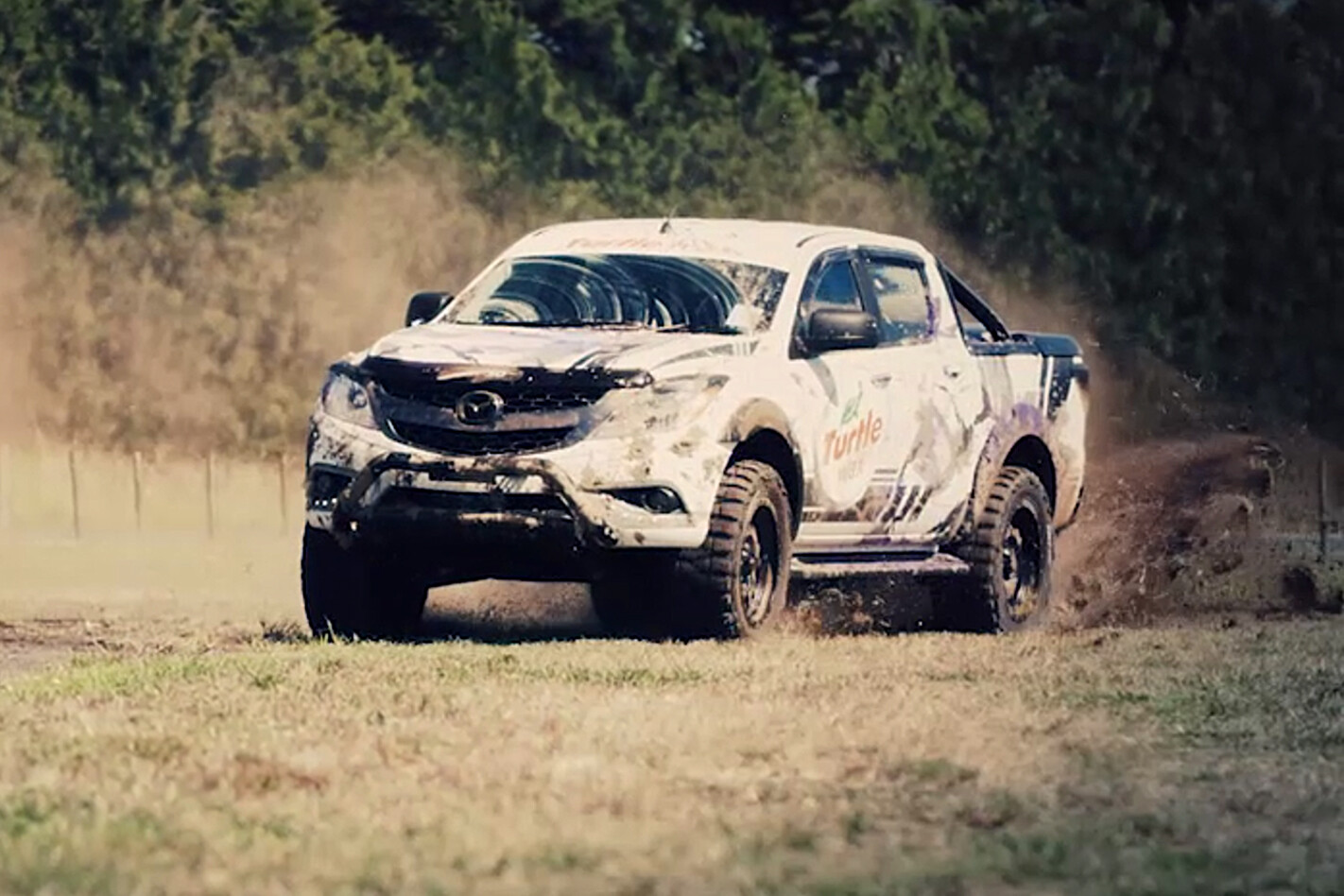
In their latest video campaign Turtle Wax Australia teams up with professional drifter Mad Mike Whiddett. Watch Mad Mike put his Mazda BT-50 through its paces.
Get the latest info on all things 4X4 Australia by signing up to our newsletter.
Toyota has officially pulled the wraps off its eight-generation Hilux, the first all-new Hilux in ten years. But while Toyota was happy to reveal the highlights of this new model, many of the details are yet to be made public.
- Slightly bigger new body
- New 130kW/450Nm 2.8 diesel engine
- 3500kg towing capacity
The new Hilux will come in three model grades, Workmate, SR and SR5 and with the choice of three cabins, single, extended and double cab.
In general terms, Toyota says the new models are tougher and more work-capable than ever before, but will also bring new levels of comfort, refinement and sophistication.
Headlining the new model is an all-new 2.8-litre four-cylinder diesel (1GD designation) that claims 130kW, a 4kW increase over the current 3.0-litre diesel. Better news is the increase in torque, which is now up to a maximum of 450Nm on tap from 1600 to 2400rpm.
Toyota were reluctant to discuss details but it appears that the 450Nm engine will only come with the new six-speed automatic gearbox while the new six-speed manual will have the maximum torque figure pegged back, although Toyota would not confirm whether the 420Nm figure quoted elsewhere is correct.
Either way, this a significant improvement over the 360Nm that the current 3.0-litre puts out with the auto and the 343Nm it makes when mated to the manual box. The new diesel is also 10 percent more fuel efficient than the outgoing engine.
The current 4.0-litre petrol V6 will also be carried over in 4×4 models while 4×2 will get an all-new 110kW/400Nm 2.4 litre diesel and a revised version of the current 2.7-litre four-cylinder petrol engine. While the 2.4-litre diesel will be the main engine for the 4×2 range it may also appear in the Workmate spec 4×4 models.
The 4×4 drive models will have a conventional part-time, dual-range system but a rotary dial will replace the transfer level of the current model. It is not certain at this stage if the new Hilux will come with a rear locker as per the Ranger/BT-50 twins and the VW Amarok but photographs of the interior of models in Thailand suggest it will be available.
The chassis is straightforward with an independent double-wishbone, coil-spring front end and a leaf-sprung live axle rear. The leaf springs are however longer than the current model to improve the ride compliance while the ladder frame is claimed to be stronger and more robust than the current model.
The new Hilux will ride on a mixture of 16, 17 and 18-inch wheels with the SR5 that was shown getting 18s wearing 265/60 HT tyres. Other models will come with AT tyres.
The new Hilux is 20mm wider and 70mm longer than the current model but has a slightly lower roofline. The extra size means both a more spacious cabin and a bigger tray. The fuel capacity is also up from 76 to 80 litres.
The maximum tow rating is now up to 3500kg while maximum payloads are as high as 1240kg.
All variants are also strong on safety with seven cabin airbags, ESC, ETC and a reversing camera standard across the range. Toyota expects all variants to achieve the maximum five-star ANCAP safety rating.
Get the latest info on all things 4X4 Australia by signing up to our newsletter.
New 4x4s are great but they don’t come ready to hit the bush straight off the new car showroom.
There are a few additions you should consider before you head outback this touring season.
Glenn Torrens explains some essential 4×4 equipment.
Get the latest info on all things 4X4 Australia by signing up to our newsletter.
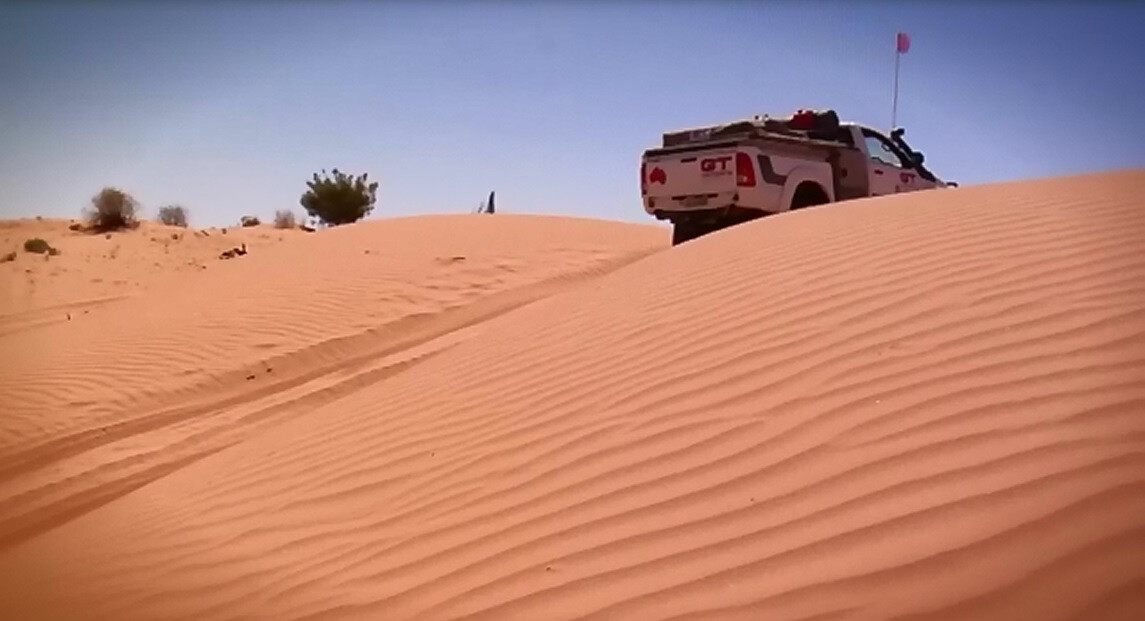
Whether you’re hitting the beaches or doing the deserts, driving on soft sand requires a certain set of skills if you want to make it over the next dune.
Glenn Torrens explains a few simple practices for successful sand driving.
Want more? See our top 5 tips for beach driving…
Our trip to the Victorian High Country with Ironman 4×4 summed up all that is good about 4×4 ownership – stunning bush locations, great mates, well-built 4x4s, and beautiful weather conditions.
Throw in some historic high country cattlemen’s’ huts and a few bush pubs and it was an idyllic escape from the city.
Get the latest info on all things 4X4 Australia by signing up to our newsletter.
When plans were forming about the weekend away with the guys from Patriot Campers, it was evident from the get-go that it would be an action packed weekend. Justin Montesalvo, owner and operator of Patriot Campers was adamant in his email of what to bring for the weekend – normal camping essentials and TOYS, TOYS, TOYS.
We met the Patriot crew at a property on the Boyd River near the Nymboida National Park to start the weekend with some white water canoeing and tubing. The Nymboida National Park is roughly 40km south-west of Grafton in Northern NSW and boasts some beautiful scenery consisting of rock formations, rivers and creeks with stone beaches dotted along the banks and lush green forestry. There are plenty of activities to partake in, with mountain bike, hiking and 4WD trails, canoeing and swimming in the rivers and creeks, and best of all, limited to no phone reception.
The extended Patriot Family and friends sure like their Toyotas, with several 200 Series Cruisers, a Hilux and a 79 series making up the pack. When asked why the crew all drive Toyotas, Justin’s response was simple; “Our whole family drives Toyotas because that’s what we were brought up with. Nothing beats a twin-turbo V8 diesel, it’s a pretty simple choice”.
The Patriot campsite was on the Boyd River about 5km north of Dalmorton, where there were a few more Toyotas mixed with a laundry list of off road toys. From ATV buggies, to dirt bikes and quads it was pretty clear the Patriot crew like their toys and it’s easy to see how the latest addition to the Patriot range, the Toy Hauler 560 (TH560) came about. The camp site was idyllic, with the small rapids of the river only 20 meters away with a few river stone beaches dotted along the banks.
The action soon stepped up a few notches from the white water canoeing once the buggies, dirt bike and ATV’s were fuelled up and tearing around for the next few hours. As a dirt bike rider for years I had never really paid any attention to the full size side by side ATV buggies such as the Polaris RZR 1000, I always figured they were a bit of a novelty. But it took less than 20 seconds riding shotgun with Justin at the wheel to change my mind. These are an impressive bit of kit and ridiculously quick and extremely capable over just about any terrain.
Later in the afternoon we set off into the forest to recover one of the buggies that had had lost an argument with a tree stump the day before. After some running repairs it was up and running again, ready for another session the next day.
The next day we set off to another part of the property to set up an area where the kids could ride their dirt bikes and some of the adults could head off and explore in the buggies. A TH560 was set up a the base for the kids to ride around the area and it became obvious that as much as the Patriot gang like to get out and enjoy there toys, spending time with the family and encouraging the kids to get out and enjoy the outdoors is high on the list of priorities too.
The weekend was a blur of buggies, dirt bikes, quads, white water canoeing, 4WDing, swimming and camping in some Northern NSW most beautiful scenery. The Patriot crew of family and friends were extremely welcoming and after spending the weekend with them it is obvious, they work hard all week so they can enjoy their camping and toys on the weekends.
Justin’s LC200 Stretch Ute
Among 200 Series Land Cruisers at the camp, Justin’s highly modified 2015 model stood out from the pack. It has had the back chopped and a 650mm chassis extension by the guys at Creative Conversions. In addition to this it had a Patriot Campers custom tray that includes a 70 litre water tank under the tray with an electric pump, a side-out kitchen, a tray-mounted stereo, and a set of Maxtrax plus a high lift Jack. The finish of the tray is extremely high quality and holds the same look and feel as the X1 and TH560 trailers.
The 200 Series is fitted with a wish list of accessories making it an exceptionally capable tourer. Up front is a TJM bar and winch sporting a set of Great White spot lights and LED lightbars, powered by a 100amp hour lithium battery with Redarc BMS1230 and TJM Battery Monitor. The Cruiser rides on a set of Icon remote reservoir coilovers, with front and rear lockers pushing 35×12.50×17 BFG Mud Terrains to get it out of any tough terrain.
A TORQIT Diesel Tuner and Pedal Torque set up to squeeze some extra power out of the turbo diesel V8 and with a 4-inch stainless Beaudesert Exhaust the LC200 sounds tough and looks the part to match. A Rhino Rack roof basket gives extra storage and a long range fuel tank adds touring range.
When asked what sort of attention he gets driving the LC200 towing the TH560 Justin said, “I literally can’t take that setup anywhere without being mobbed every time we stop. We get barricaded on the highway by people wanting to check it out”.
For this trip the Cruiser had the kid’s trio of Yamaha dirt bikes on the tray while a Polaris RZR100 rode on the Toy Hauler.
TOY HAULLER 560
There were three TH560s on this trip each carrying a Polaris 1000cc RZR buggy on their massive 1.70m x 3.00m decks. The TH560s are a sight to see, with the carrying capacity on the back plus all the features and living area of the smaller Patriot X1 Camper on the front. It’s the next level trailer for serious touring with the capacity to carry five dirt bikes, or one side by side ATV, a pair of jet skis, or two ATV’s. Pictures do not give this thing justice.
Get the latest info on all things 4X4 Australia by signing up to our newsletter.
4×4 Australia caught up with the team from Ironman 4×4 for a few days of exploring and product testing in the Victorian High Country.
The plan was to hit as many of the popular spots as we could within a tight timeline and Mount Blue Rag was one of the most spectacular.
Keep an eye on this page for more updates on this epic adventure including our first Australian drive of the New Nissan Navara.
Want more great images and good times from our High Country Adventure with Ironman 4×4? See more footage here
Get the latest info on all things 4X4 Australia by signing up to our newsletter.
The Mackay Region is a treasure trove for nature lovers, with stunning beaches, breathtaking rainforests, exotic islands, and an abundance of wildlife. Then there’s Mackay City itself, which offers palm tree lined streets dotted with art deco buildings and cute cafes. There’s virtually something for everyone is this tropical paradise, and it’s yours to discover today.
THINGS TO DO
If you’re dreaming of a little relaxation, look no further. Enjoy a picnic lunch at the striking Finch Hatton Gorge, savour some tapas or a couple cocktails at the Mackay Marina, or take a dip in a cool rainforest swimming hole.
If you’re looking for a little more action, jump in a kayak and head out to one of the Great Barrier Reef islands, visit Clairview for some first class fishing and crabbing (keep an eye out for a dugong), or explore the rocky outcrops and mountain ranges that offer are sure to inspire photographers and bushwalkers alike.
And as for those who come baring a 4WD, there’s no shortage of challenging and exciting tracks to explore.
NATIONAL PARKS
Count ‘em: there are 24 National Parks surrounding the Mackay Region. What’s more, each of these stunning parks is unique, with its own marvels to explore. Spot wild platypus in the Eungella National Park, cast a line while watching the kangaroos feed on the beach at Cape Hillsborough National Park, or enjoy secluded serenity at a remote camping ground in Cape Palmerston National Park. Whether you enjoy bushwalking, bird watching or having a splash in some truly crystal clear waters, you’re unlikely to tire of Mackay’s unlimited possibilities.
Click here for more information and great holiday deals in The Mackay Region
Get the latest info on all things 4X4 Australia by signing up to our newsletter.
Our story starts in Alice Springs in 1966, covers most of The Outback and Far North Queensland – with side trips to Denmark and Papua New Guinea – and ends in Melbourne 30-odd years later, where Paul Ross was born.
When he was 14, Paul moved to The Alice at a time when the outback town was still the frontier, as he recalls. “There were only about 5000 people there and the Stuart Arms Hotel still had tie-rails for horses. It was a fabulous place to grow up, especially if you worked in the outback like I did.” He was 18 when he found his Series 1 Land Rover Station Wagon.
“I bought it off an aboriginal man called Milton Liddle, who was a friend of mine and had a wood yard off the Stuart Highway. Milton got it in a Department of Works auction, probably in a job-lot because he had a lot of Series 1 utes that he used to collect mulga and he didn’t want a station wagon. I’d had a long-wheelbase Series 1 ute but I hadn’t seen a five-door and I thought: ‘What a beaut thing!’. With its twin-skinned ‘Safari’ roof it was the perfect camping car.” Paul paid $150 for it.
Series 1 Land Rover chassis and running gear were imported from the UK and the bodies were made and the cars assembled by the Pressed Metal Corporation in Enfield in Sydney. Paul’s’ car was in excellent condition and painted in garish Department of Civil Aviation yellow and he believes it came off the Daly River airstrip, where Super Constellations would land en route to Sydney. The DCA used Land Rover wagons to ferry aircrew to the planes. “It was originally a 12-seater and they were built to get around a tax loophole, reportedly, and classed as a light bus,” he says. “They only made 7000 plus the prototype before they went to the 10-seater Series 2.”
The DCA yellow had to go and Ross soon gave it a rough respray but kept one bolt under the driver’s seat yellow to remind him of the car’s origins. Since then he has resprayed it twice in ‘koala’ grey. At the time he was working as a surveyor for the Department of Lands and Surveys and during long stints in remote corners of the Outback he honed his mechanical abilities and came to appreciate the ‘impossible-to-kill’ Land Rover.
“There was nothing out there then just thousands of miles of dirt,” he says. “We’d go out for six-week stints and come back for week. It was a hard life but it was fun and the money was good. We had a Land Cruiser and a Land Rover and an old four-wheel drive Bedford to carry fuel and water. I’ve seen places nobody will go to again.
“In 1967, myself and Dick Comber surveyed the Northern Territory/South Australian border and put the offsets in Surveyor General’s Corner. The next year we put the block and the brass plaque in then started to throw over towards Poeppels Corner. We’d cut two metre-wide traverse lines and lay the blocks and pegs on our way to Poeppels. You could sit on a rise and look back over your traverse line going over the cusp of the earth; it was amazing. When we got to the Stuart Highway the border was out of whack, so we took the sign out and moved it up the road, which gave South Australia a bit more territory.”
When he wasn’t working Paul would go “tripping” in the car he calls ‘Zippy’ (after its ZPI 111 number plate) to far flung places like Halls Creek, the Canning Stock Route, Cape York, Darwin, and The Gulf. Ross has no idea exactly how many kilometres Zippy has travelled but most of them have been hardcore.
“When I lived in Alice I used to visit my father in Melbourne and I’d come down the Oodnadatta Track. The South Road was 1000 miles of corrugations so deep you could disappear in them. There was no bitumen, there was no Stuart Highway, it was all dirt from Port Augusta to Alice Springs, just a little bit of bitumen at Woomera.” And when you’re a surveyor the middle of the Aussie nowhere, it’s handy to be handy with the spanners.
“I was the only one who knew how to fix cars, my old man taught me,” Paul says. “That’s why I like Land Rovers, they’re simple. If I do take Zippy back to some of the places that I used to survey it can’t stick me up. I carry two spare axles but there’s nothing else that can go wrong with it. It has never let me down, not once, and we’ve had it in some bloody incredible spots.”
Zippy was mechanically original when Ross bought it but the asthmatic 2.0-litre four under the bonnet didn’t cut it and was replaced by a second-hand high-compression 161-cube Holden ‘red’ motor. But it wasn’t much better and it was turfed for a reconditioned Embee Performance 161 in 1971, during one of Paul’s trips to Melbourne.
“That Embee engine has done hundreds of thousands of miles and never broken down but it blew a head gasket after the photo shoot!” Paul laughs. “It’s a bit tired now so I’m building up a 173, which will probably have a Weber, extractors and a Yella Terra head. But Zippy still has its original gearbox which is beautiful and quiet.” Ross also has a good tip for early Land Rover owners.
“I recommend anyone with a Series Land Rover to put Range Rover diff centres in, don’t bother with an overdrive. They slot straight into a 48-model banjo diff, take 10-spline axles, all you have to do is take the dowels out. Doing that lifts the ratio so you have a higher cruising speed. I think it’s a brilliant conversion.”
Ross met his wife Margit in 1974. She had flown from Copenhagen to Singapore in a very dodgy Russian plane then hopped a Qantas ‘Wallaby Route’ flight to Darwin where she boarded the ‘milk run’ plane to Alice to meet up with a Danish girlfriend, who also knew Paul. It was love at first sight for Paul, who was by now working for the Department of Rural Health. Margit smiles mischievously and says she and her friend Karen “used” Paul because “he had the car we needed to get to Cape York.” It was the start of many adventures together, including living on a beach on The Cape for six weeks and having the army drop supplies from Caribou transporters.
After their Cape York trip, they left the Land Rover in shed in Cooktown and flew to Port Moresby for New Guinea’s independence celebrations in 1975 and explored the country with a young man who would later become prime minister, Paias Wingti. Then they caught a ship back to Australia, picked up the Land Rover, and drove the 3000-plus kilometres to Melbourne where they lived on a strawberry farm in the Dandenong Ranges before relocating to Denmark. Again, the Land Rover was left in a shed. Six months later they were back in New Guinea where Paul managed a quarry in New Britain for a year before they returned to Australia and the Land Rover. Zippy is like a homing beacon.
In the ‘90s, Paul and Margit lived the “good life” on an island in Denmark for seven years while the Land Rover languished in his mother’s garage in Alice Springs. Reunited, Zippy needed only routine maintenance – air in the tyres, new tailshafts, kingpin tensions, tie-rod ends, new exhaust and new brake seals – before it was driven back to Melbourne where the couple has been based since. But their wanderlust is insatiable and they’re about to sell the mud-brick house they built themselves and head off again, towing their 1956 Carapak Twelve Nine caravan. Favourite trip?
“We went into the Simpson Desert with my son Torben looking for an old opal mine,” he remembers. “An old bloke in Alice called Tom Findlay gave me a map showing an opal adit an Englishman had dug in 1910. We found it, following old fence lines, and we found opal so we’re going back with my brother, who also has a Land Rover, to make a film about it.”
4X4 Australia first bumped into Paul and Zippy in a suburban supermarket carpark and struck up a conversation but that happens a lot, he reckons. “If you pull up in a caravan park somewhere, people will immediately come up to the car for a chat and I’ve had lots of offers for it. It’s a good old beast, it’s been everywhere.” Well, almost. There’s a bond between this man and this machine that is unbreakable and for Paul and Zippy, there will always be another Outback track to survey.
HOLDING UP THE GHAN
“I did an axle towing a 25-foot bond-wood caravan from Melbourne to Alice Springs. I was going to put the car and van on flat-top carriage at Port Augusta for the leg to Alice because the road north would have been too rough for the van. I got to the railway crossing at Augusta and was just about over it when a rear axle went, so I was blocking the tracks. Then the train came and I had to tell the driver to wait while I fixed the car.
“In those days I couldn’t afford free-wheeling hubs and didn’t run a front tailshaft but I kept one in the car. So I bolted in the front tailshaft, put it in 4WD, and pulled the van onto the flat-top with front-wheel drive, which was a pretty good effort. I think I’ve broken about four axles in 49 years”
Get the latest info on all things 4X4 Australia by signing up to our newsletter.
The June 2015 issue of 4×4 Australia Magazine goes on sale this week and in it you’ll find all you need to get you gee’d up for a Simpson Desert adventure this touring season.
Central Australia outback travel puts your 4×4 through the harshest of conditions and daily vehicle checks should be a part of your routine. Glenn Torrens shows you what to look for to ensure you stay on track.
Get the latest info on all things 4X4 Australia by signing up to our newsletter.