
Buy any of the following magazines at a participating Coles Express store and receive a FREE small coffee!
- Unique Cars
- Wheels
- Street Machine
- Motorcycle Trader
- Deals on Wheels
- 4×4 Australia
- Australian Motorcycle News
- Motor
- Australasian Dirt Bike
Get the latest info on all things 4X4 Australia by signing up to our newsletter.
Nissan confirmed today that it has dropped the manufacturer’s suggested retail price (MSRP) of its two remaining Y62 Patrol models, the Ti and Ti-L, while the ST-L grade has been given the boot.
The Patrol V8 Ti 4WD automatic’s MSRP of $93,390 has been cut to $69,990, to give an estimated drive away price of $77,424, and the Patrol V8 Ti-L 4WD automatic’s MSRP of $114,490 has been cut to $86,990, to give an estimated drive away price of $95,308.
The ST-L grade, however, which had a recommended price of $82,690, has been discontinued.
The model had been priced at about $2,000 more than one of its main competitors, the Toyota Land Cruiser 200 series GXL V8, which had a recommended price of $80,990.
But unlike Nissan, Toyota offers drivers a diesel model, the GXL TDV8, for just $3,000 more.
Nissan’s new price structure represents a significant increase in value for customers, who may have shied away from an expensive and thirsty petrol engine, while the discontinuation of the Patrol V8 ST-L means that customers will receive more features as standard, for less.
Features maintained that are now available as standard include:
- Hydraulic Body Motion Control (HBMC) suspension system
- Leather-accented seats
- Satellite Navigation
- Around View Monitor
- Tyre Pressure Monitor System
Another improvement, according to Nissan, is a new gear-shift lever position, now moved to the right-hand side of the centre console, located closer to driver.
Patrol V8 features a VK56VD petrol V8 engine, producing 298kW of power and 560Nm of torque, with a seven-speed automatic transmission and the Nissan all-mode 4×4 system with electronic 4WD selection.
Patrol V8 Ti and Ti-L still have eight- and seven-seat capacity respectively.
The colours available have also changed from Alpine White to Ivory Pearl and Precision Grey to Gun Metallic.
Get the latest info on all things 4X4 Australia by signing up to our newsletter.
The sand is soft and the seaweed is like porridge. Wait, is that the tide coming in?
4X4 Australia Editor-At-Large Ron Moon gives a few pointers on avoiding disaster when 4x4ing on the beach.
The 4X4 Australia gang travelled smoothly along the Great Australian Bight recently thanks to teamwork, the right gear and careful planning.
For more on the crew’s epic adventure grab a copy of 4X4 Australia’s August edition at your local newsagent.
Click here to watch Across the Bight: Part 1.
Get the latest info on all things 4X4 Australia by signing up to our newsletter.
Toyota’s new GD-Series engines will hit Australian shores in the updated Prado and the new generation HiLux later this year.
The D-4D turbodiesel is the first of the series, with new design and technology set to achieve higher fuel efficiency, lower emissions and quieter operation.
According to Toyota, the engine (1GD-FTV) is the first in the world with Thermo Swing Wall Insulation Technology, making it one of the most thermally efficient on the market, with a thermal efficiency rating of 44 per cent.
Although it is smaller than the 3.0-litre engine it is replacing, it is said to offer 25 per cent more torque.
There is also 11 per cent more torque available at low revs and a 15 per cent improvement in fuel economy.
Toyota Australia Product Public Relations Manager Steve Coughlan said the GD-Series will be offered in Australia later this year – first, in the updated Prado and then later with the new generation HiLux.
The Prado will be available with the new 1GD-FTV 2.8L and the New Generation Hilux will be available with both the 1GD-FTV (2.8L) and, for the first time in Australia, a smaller capacity 2.4L (2GD-FTV).
“These new engines have been developed from the ground up and will be offered in a broad array of markets around the world,” Coughlan said.
“With many regions having different regulatory and emissions requirements, engine configurations vary based on local conditions.”
The Australian engines will offer compliance to Euro 5 emissions standards and include a Diesel Particulate Filter (DPF) to provide lower emissions.
There are no immediate plans to offer the urea-based (selective catalytic reduction) SCR technology.
Engine technical specifications
u00a0 | 1GD-FTV | 2GD-FTV |
Displacement (cc) | 2,754 | 2,393 |
Bore x stroke (mm) | 92.0 x 103.6 | 92.0 x 90.0 |
Compression ratio | 15.6:1 | 15.6:1 |
Max. power (kW @ rpm) | 130 @ 3,400 | 110 @ 1,200 |
Max. torque (Nm @ rpm) | 450 @ 1,600 u2013 2,400 | 330 @ 1,600 u2013 2,000 |
Low-speed torque (Nm @ rpm) | 370Nm @ 1,200 | 330 Nm @ 1,200 |
Exact specifications may vary according to national market.
New engine features
According to Toyota, the new engines have shown high thermal efficiency, quiet operation and powerful performance in extremely hot and cold environments and at high altitudes above 4,500 metres.
Toyota has made the engine catalyst 30 per cent smaller and has reduced the number of exhaust layouts from 18 to just three, simplifying the engines’ deployment worldwide and reducing the environmental impact.
Next generation advanced thermal insulation diesel combustion
The new engine’s performance has been largely credited to the application of Thermo Swing Wall Insulation Technology, and to a SiRPA (a silica-reinforced porous, anodised aluminium coating) on the pistons. This reduces the cooling loss during combustion by about 30 per cent. SiRPA’s high insulation and dissipation qualities make it easy to heat and to cool.
The air intake port has been shaped to allow a significant increase in the amount of airflow into the cylinders; the piston combustion chamber shape has been revised; and the common rail fuel injection system allows for more advanced pressure control and injection optimisation. Air consumption is maximised, which enables high thermal efficiency and low emissions to be achieved.
Precise pilot injection, matching the state of the ambient air, takes place ahead of the main injection to shorten ignition delay. This means stable combustion is achieved, even in harsh environments, together with quiet running and high thermal efficiency.
Compact, high-efficiency variable geometry turbocharger
The GD engines use a new turbocharger that is 30 per cent smaller than its predecessor. Produced in-house by Toyota, it has a new turbine that improves efficiency and a new impeller that gives instantaneous throttle response and allows maximum torque to be obtained over wide engine rev range.
Toyota-first urea selective catalyst reduction system
Using Toyota’s proprietary, compact, high-dispersion urea selective catalyst reduction system eliminates up to 99 per cent of NOx emissions, one of the principal causes of air pollution. This helps the engine conform to Euro 6 and other international emissions standards.
Production and markets
The current KD family of engines will be phased out gradually and replaced with the new GD units, By 2016, production will reach about 700,000 units a year, available in around 90 world markets. Toyota aims to increase this number to at least 150 by 2020.
Get the latest info on all things 4X4 Australia by signing up to our newsletter.
THIS POLL IS NOW CLOSED.
What is the ultimate 4×4? Our expert panel has voted on its top ten – to be revealed in 4×4 Australia’s August edition. But what would your 4×4 dream team be?
Poll:
- Land Rover
- Land Rover Discovery 3 & 4
- Nissan Patrol GQ
- Range Rover
- Toyota Landcruiser 40 series
- Toyota Landcruiser 60 series
- Toyota Landcruiser 70 series
- Toyota Landcruiser 80 series
- Toyota HiLux
- WW2 US Army Jeep
Stay tuned for more and the final verdict on our top ten 4x4s.
THIS POLL IS NOW CLOSED.
Get the latest info on all things 4X4 Australia by signing up to our newsletter.
Australian motoring bodies have hit out against Toyota Australia President Dave Buttner’s comments that bull bars for Toyota’s new HiLux utility range are “fashion accessories”.
Buttner made the comment at the recent opening of Melbourne’s new Abcor plant, which will produce about 12,000 steel bull bars a year for Toyota’s HiLux range.
RACQ Executive Manager Technical and Safety Policy Steve Spalding has since warned urban drivers against fitting bull bars for fashion, saying the bars could increase injury risks for pedestrians.
“Bull bars should only be used if there’s a genuine risk of an animal strike,” Spalding said.
“We don’t want to see the unnecessary fitment of bull bars to city-based cars, or for there to be any increased risk of serious injury to vulnerable road users such as pedestrians or cyclists.”
Spalding said state and national standards should be met when bull bars are fitted.
He said bull bars also need to be compatible with the cars they are fitted to, so that safety systems aren’t affected.
“Bull bars should only be fitted when it’s a necessity, and should never be purchased to simply improve the look of a car.”
But according to 4WD Industry Council research, bull bars are mainly fitted on vehicles driven in regional and rural areas to protect occupants involved in collisions with animals.
The council said bull bars are also used as a platform to mount vital accessories, including electric winches, auxiliary lighting, communication equipment, recovery points and under-vehicle protection panels.
Council research conducted in 2011 on 42,600 motorists showed vehicles collided with animals about 25,000 to 30,000 times a year.
Animal strike risk was highest in poor light conditions at dusk or at night.
Kangaroos were estimated to account for between 70 per cent to 85 per cent of incidents.
The study also found that the likelihood of occupant injury following an animal strike was about 30 times higher in a non-bull bar equipped vehicle.
“In addition to providing physical safety for vehicle occupants in a collision with an animal, the bull bar plays a critical role in reducing the likelihood of vehicle immobilisation in remote locations, which can also have adverse safety implications,” Australian Automotive Aftermarket Association (AAAA) Executive Director Stuart Charity said.
“The Council research also revealed that up to 74 per cent of people who have encountered an animal strike collision believed that if they had no bull bar fitted, they would have had to swerve or take other evasive action, which could have resulted in a far worse accident due to impact with other vehicles, trees or road side infrastructure.
“While manufacturers may offer opinion on their customer motivations in relation to the fitment of bull bars, vehicle aesthetics did not rate a mention as a motivating factor in our extensive research of Australian 4WD vehicle owners.
“The 4WD Industry Council encourages people who use their vehicles for travel in rural and regional Australia, to fit a bull bar that meets the Australian Standard. In addition to increasing occupant safety, this will ensure that the bull bar conforms to the integrated safety features of the vehicle and mitigate risks to other road users.”
The 4WD Drive Industry Council is a specialist section of the Australian Automotive Aftermarket Association.
Toyota Australia had no further comment.
Get the latest info on all things 4X4 Australia by signing up to our newsletter.
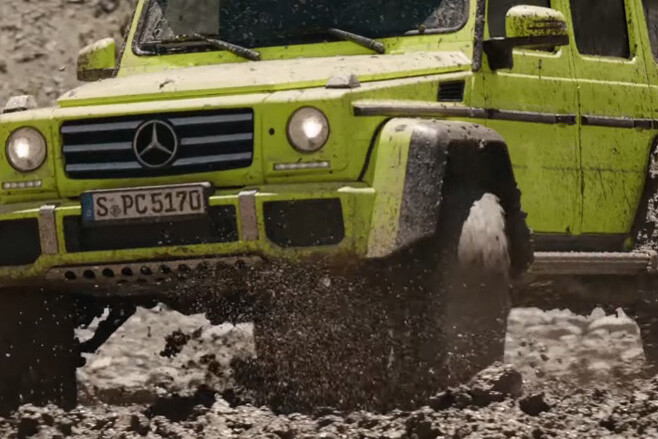
Mercedes Benz announced on the weekend that the insane G500 4×4-2 will go into production later this year.
Not so happy about the fact that it will be left hand drive only or that we’ll never be able to afford one, but we can only watch this vid and dream.
Get the latest info on all things 4X4 Australia by signing up to our newsletter.
Turtle Wax Australia teams up with professional drifter Mad Mike Whiddett in a new video campaign. Watch the full video of Mad Mike putting his Mazda BT-50 through its paces, then check out Turtle Wax Australia on Facebook.
The 4X4 Australia gang travels smoothly along the Great Australian Bight thanks to correct convoy procedures and reliable communications.
For more on the crew’s epic adventure grab a copy of 4X4 Australia’s August edition at your local newsagent.
Click here to watch Across the Bight: Part 1.
British adventurer Bear Grylls has been flown in to help fit a one-of-a-kind ‘Defender 2,000,000’ as Solihull production of the current Defender model winds down.
Is the Land Rover Defender the best 4×4 ever? See 4×4 Australia’s August edition for our expert panel’s top ten 4x4s of all time.
Grylls flew in to help fit the vehicle at the Solihull facility in May with representatives from the International Federation of Red Cross and Red Crescent Societies (IFRC) and Born Free, including actress Virginia McKenna.
Not usually known for his appreciation of the finer things, the adventurer was more than happy to praise the special Defender, which features Santorini-Black finishes, custom-stitched seats, unique logos and badges, and a map of Red Wharf Bay– where the design for the original Land Rover was first drawn in the sand – engraved into the aluminium fender.
“Known and respected by me and many other adventurers for their rugged reliability – it was an honour to be asked to take part in the build of this very special car,” Grylls said.
The custom Defender, to be unveiled at the Goodwood Festival of Speed on June 25-28, celebrates 67 years of Land Rover and commemorates UK production of the two-millionth Series Land Rover and Defender.
As part of the celebration, the vehicle features a unique ‘2,000,000’ badge on the vehicle’s rear, leather seats with the ‘Red Wharf Bay’ graphic, and special logos stitched on the headrests.
On the front and rear are S90 HUE registration plates – a reference to the first ever pre-production Land Rover, registration ‘HUE 166’ – while an aluminium plaque, signed by everyone who helped assemble the vehicle, is also fitted to the driver’s seat plinth.
The vehicle will be auctioned at a charity event held at the Bonhams auction house in New Bond Street, London on December 16.
Funds raised will be donated to the IFRC and Born Free Foundation.
Bonhams Chairman Robert Brooks said he was delighted to be auctioning the two-millionth Series Land Rover and Defender at Bonham’s global headquarters.
“It’s an honour to offer this landmark vehicle and I’ve no doubt there will be some spirited bidding,” he said.
Production of the original Land Rover Series I began at the Lode Lane facility in 1947 ahead of its launch at the Amsterdam Motor Show on April 30, 1948.
Since then two million examples of the Series I, II III and Defender have been produced at Solihull.
Jaguar Land Rover Chief Executive Ralf Speth, who also helped build the vehicle, said the Defender had been the transport of choice for explorers, charity organisations, farmers and even royalty.
“Throughout history it has helped pioneers to reach the unreachable,” he said.
“What started life as an agricultural workhorse has transcended the automotive world to become a worldwide design icon.”
Production of the current Land Rover Defender is set to end at Solihull at the end of 2015.
But the resulting increased demand for the vehicle has led speculation that Land Rover will continue producing it at an overseas production facility.