
So you’ve forked out a wad of cash for Toyota’s hairy-chested 70 Series Land Cruiser.
Proud as punch, you sink the go-pedal to get a bit of noise from the V8 as you rumble away from the salesman. All good so far.
The 70 Series is no doubt one of the few remaining tough-as-nails, fair-dinkum 4x4s left to choose from. So you’re riding high in this Jurassic-era-inspired bucket of bolts with its coil-spring and live-axle front end, manly long-throw gearbox, low-range stick on the floor (where it should be), and a long leaf-spring rear end, complete with a narrow wheel track.
Then your bubble bursts. Everything was just too good to be true. You discover that the front-wheel track is 1515mm while rear-wheel track is 1420mm. What the? That’s a 95mm difference! Then, to rub a shovel full of salt into your wounds, the first time you load your manly Cruiser up, she sags and drags like a pound dog with worms. Oh, the humility of owning a 4×4 that handles terribly on road, fair-to-crap off road (depending on terrain), and can’t handle the weight that your mate’s wheelbarrow takes in its stride.
With the rear wheels following a completely different line to that of the front wheels, Toyota has half-buggered what should be a champion 4×4. Sand driving is twice as hard; ruts, rocks and pretty much all uneven surfaces are harder to drive because of the narrow rear end.
Toyota widened the front track (up from 1435mm in the previous six-cylinder model’s front end) to squeeze a 90-degree V8 diesel under the bonnet. But why didn’t they throw a few extra inches into the rear end while they were at it? It was cheaper not to.. Leaf springs carry heavy loads, right? Unfortunately, the OE leaf springs on the 70 Series need to be replaced with aftermarket units to really tackle the job they were intended for – which is great for the aftermarket mob.
Enter Jmacx Off Road Solutions. Its hands-on owner, Jason McIntosh, is a mechanical engineer, an ex-V8-Supercar builder and a general problem-solving extraordinaire. After seeing his bolt-in, five-link rear-coil suspension kit, complete with replacement diff and axle housing, I was ready to sign on the dotted line within minutes of meeting him and I don’t even own a 70 Series Cruiser!
This kit is worth a look for all 70 Series Cruiser owners who want to correct the Cruiser’s aforementioned shortcomings. It’s impressively designed, and it’s made with the highest-grade materials. It has also been engineer-approved via swerve testing and red-tape ticks.
Yep, the Jmacx kit rectifies the narrow rear-wheel track to match the front track of 1515mm. Plus, it allows drivers to stick to factory or aftermarket leaf springs or to opt for better riding coil springs.
That’s right, you can have a workhorse Cruiser with rear coil springs, complete with a five-link suspension set up – that’s upper and lower control arms and panhard rod; all heavy duty and adjustable. Included in the kit are external chassis-strengthening plates, control-arm mounts, coil retainers, bump stops, pin kit, brake lines and fixing hardware
Now, don’t think for a second that coil springs are a soft option for those who need to carry a load. No, sir, this kit allows a GVM upgrade to 3900kg. Coils can carry any weight – you just need to specify the correct spring rates to deal with the load. Also, with coils it’s easier to ‘build-in’ variable spring rates for a softer ride when the vehicle is empty and a stiffer rate when it carts cement bags, camping gear or heavy caravans. Air bags within the coils, or even a full air-bag replacement kit, are also available.
Another advantage of this kit is that it reduces unsprung weight. A typical pair of Cruiser rear-leaf springs can weigh up to 130kg, compared to a pair of coils, which are about 14kg.
This reduction dramatically improves shock absorber workings, which leads to less shock fade and improved handling on all driving surfaces – the faster and rougher the track is, the more improvement you’ll see. The bolt-in brackets and associated components weigh about 50kg, but it’s not unsprung weight and it’s still lighter than the factory gear you just binned. So, you’ve effectively gained a little payload.
If you have ARB Air Lockers, TJM Pro Lockers, Eaton Lockers or Toyota factory lockers, they can all be slotted into the new diff housing. On Jason’s rig he has custom-fabricated a 6mm, 350-tensile steel housing with DOM six-inch braced axle tubes, and matching front and back wheel track.
The diff pumpkin is a laser-cut, pressed and welded, 350-tensile steel unit, and the new axles are 43/40 billet chrome-moly, heat-treated, long-splined full-floating items, claimed to be 200 per cent stronger than the originals. All standard ancillaries (wheel bearings, diff centres and brake lines) are simply removed from the OE housing and re-placed to the Jmacx unit.
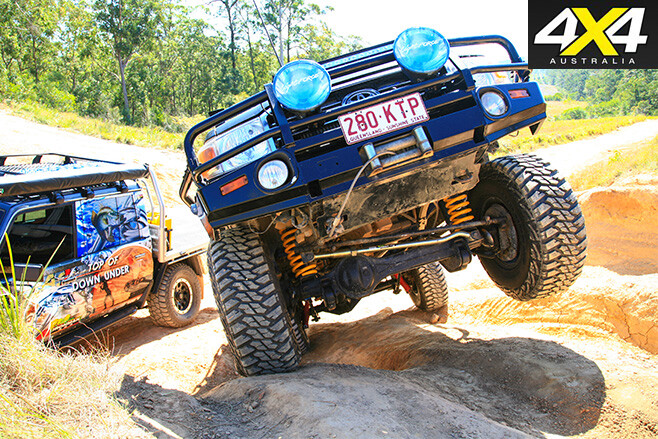
The only item that will need re-routing is the exhaust system to clear the new suspension components. This is also a good time to upgrade to a custom Jmacx three-inch system. Jason’s kit includes either a mild-steel or stainless-steel mandrel-bent, three-inch system from the turbo back, as well as a high-flow cat and muffler.
Regarding the heavy-duty upper and lower adjustable control arms and adjustable panhard rod: they are all factory 80 Series Land Cruiser specifications, so too are the coil spring and shock absorbers (pin uppers and eye lowers). Regardless of whether you walk into a Toyota or Airbag Man aftermarket suspension supplier, all you need to ask for is 80 Series gear.
While on the point of coils and shocks – these are the only components that are not supplied standard in the kit. Jason reckons that, because there are literally hundreds of options to choose from, each customer deserves the right to get exactly what they want. Maybe you want brand A coils or brand B shocks to return a silky-smooth high-speed ride on those relentless outback corrugations. Or maybe you want heavy-duty load-hauling ability to cart your game-fishing boat on the weekend. The choice is yours.
NOT ALL ABOUT FLEX Coils can flex more than leaf springs, but don’t think that coils or this kit are made only for weekend rock-hopping warriors. Nope, this rear-end coil-suspension kit works better on all road surfaces at all speeds. The ride will be more comfortable, safer and the handling will be more predictable on high-speed corrugations, rutted dirt tracks, sand and even long stretches of bitumen.
Of course, your coil-spring rate and shock-absorber combination will largely determine ride quality and weight-carrying ability. Given the availability of a progressively rated coil spring, it is easy to have the best of both worlds, regarding comfort and weight carrying.
For off-road driving, another advantage of the rear-coil spring set-up is that ground clearance is improved. Generally, the lower-weight bearing leaves in the pack and the U-bolts are the lowest point under the vehicle. These can hook up while climbing over objects, but, with the coil replacement, these low points are non-existent and the new lowest parts are the lower control-arm ends.
RRP prices of the kits are: $5000 for the replacement differential and axle housing; $10,500 for the complete diff/axle housing and five-link bolt-in coil kit; and $980 for the three-inch (mild steel) $1200 (stainless-steel) exhaust kit. Prices include shipping and insurance within Australia. See www.jmacx.com.au
Daniel Craig in a black Land Rover Defender – it doesn’t get much tougher than that.
Land Rover has revealed the two Defenders that will appear alongside the brooding Daniel Craig in the forthcoming James Bond movie, Spectre.
Specially modified, the Defenders were constructed by the JLR Special Operations division, with 37-inch off-road tyres and enhanced body protection to tackle the snow-covered mountain roads used for filming.
The Defender is a clever choice for the 24th instalment of the Bond franchise, which sees Bond seeking to uncover a sinister organisation after he gets a cryptic message from his past.
The murdered-out four-wheel drive (pictured) fits well with the dark direction the James Bond franchise has taken in recent times.
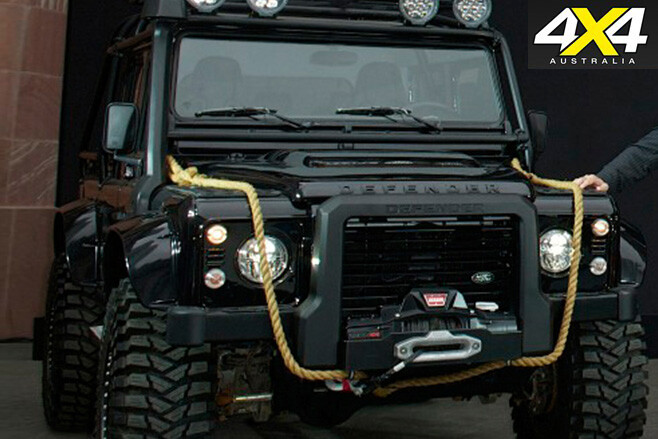
The Defender is a tough, capable and serious machine, but one that, like Daniel Craig, is past its use-by date, with production of the current Defender now in its final phase.
But that doesn’t stop Bond or the vehicle from indulging in their share of fast women, faster driving and, of course, testosterone-fuelled explosions.
It’s a shame the Defender is on the way out; placing a modded-up version of the Defender warhorse in the newest Bond movie is surely great advertising.
Possibly the only better way to pull the pocket strings of Land Rover’s biggest market, ageing men, would be to stick a scantily clad Angelina Jolie inside one. But they already did that in the movie Lara Croft: Tomb Raider.
Land Rover recently revealed a Land Rover Defender concept car at the Frankfurt Motor Show. The special collector’s Defender pedal car concept previews a full-production pedal car model that will go on sale in the UK 2016.
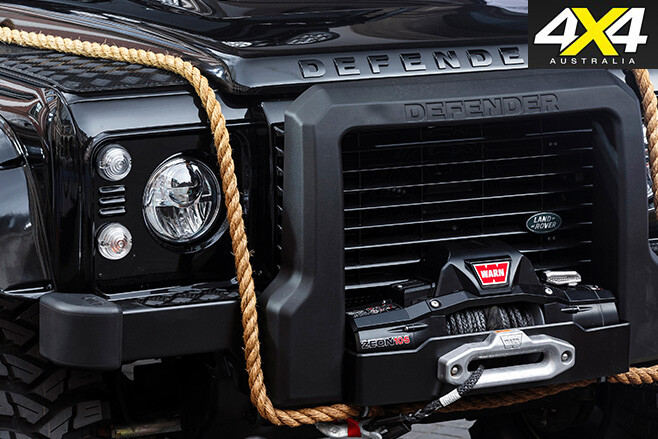
The Defender also appeared in the previous Bond film, Skyfall, and then there was the publicity stunt that saw Bear Grylls, along with other stars, build a special ‘Defender 2,000,000’.
At the very least, the latest Bond appearance adds to an ongoing tribute to one of the world’s most iconic vehicles.
At most, it is part of a clever campaign to help Land Rover sell something… exactly what that is, we don’t know yet.
The Series Land Rover and Defender have been produced in Solihull, UK, since 1948
Spectre will be released worldwide from October.
The hybrid versions of the new-generation, aluminium-monocoque Range Rover and Range Rover Sport have finally arrived in Australia.
These hybrids are unusual in as much as they are diesel-electric, rather than petrol-electric, and unique in as much as they are the first hybrids with serious 4×4 ability, because they offer the same off-road prowess as their conventionally powered RR and RRS counterparts.
Here we are driving the RR Sport HSE Hybrid, the cheapest way to get into any hybrid in the Range Rover/Range Rover Sport line-up. Still, it will set you back $146,900, which is $16,800 more than an equivalent but conventional RR Sport, the SDV6 HSE, and $33,800 more than the lower-spec RR Sport SDV6 SE.
The Hybrid’s 215kW diesel engine comes from the MY14 3.0-litre SDV6 and is mated to an electric motor/generator that produces a maximum output of 35kW and 170Nm. Combined with the diesel engine the total output is 250kW at 4000rpm and 700Nm between 1500 and 3000rpm, which is more than handy in anyone’s language.
The hybrid system is very straightforward and is based around an electric motor/generator integrated into the eight-speed automatic gearbox. The whole unit is produced by German transmission specialist ZF.
The hybrid system also incorporates a liquid-cooled lithium-ion battery pack, held in a protective boron-steel cradle mounted under the vehicle. The battery pack takes up some of the space where the bigger (105-litre) fuel tank of non-hybrid V6 RRS models resides and limits the fuel capacity to 80 litres. All up the hybrid-specific components add around 120kg in weight.
The operation of the system is simple. When the vehicle is slowing down the electric motor/generator, driven by the vehicle’s momentum via the gearbox, goes into generator mode and charges the battery pack. When acceleration is called for, the motor/generator goes into motor mode and, powered by the battery, helps the diesel engine to drive the vehicle. When and where the electric motor helps is controlled by electronics using Land Rover-specific software.
Essentially what the system does is capture energy that would otherwise be lost, store it in the battery pack and then reuse it. The benefit is both reduced fuel use and better performance.
But the system does have its limitations and it does its best work in stop-start city and urban driving – it contributes far less on the open road. This is typical of hybrids and applies equally for diesel-electric hybrids as it does for petrol-electric hybrids.
The reason for this is two-fold. For the charging system to be at its most effective, the vehicle not only needs to be slowing down but also needs the brakes applied. In stop-start city and urban driving this occurs all the time; so all good. But constant on-and-off-the-throttle driving and braking is not needed on the open-road, so the charging opportunities are far more limited and can be non-existent for extended periods of time.
The other factor at play is that the electric motor does its best work by adding its considerable torque right from zero rpm, but it doesn’t add a lot of power at high rpm. In effect what happens is that the electric motor helps the vehicle off the line, but has less and less input once underway.
Around town, the RRS Hybrid is certainly punchy off the line with a 0-100km/h time of 6.7 seconds. That’s half a second quicker than the MY14 215kW/600Nm SDV6 diesel, upon which the Hybrid is based, and 0.3sec faster than the updated MY15 225kW/700Nm SDV6. The RRS Hybrid’s urban ADR fuel figure of 5.8L/100km is even more remarkable, especially as the MY14 SDV6 claims 8.7L/100km in the same test.
We couldn’t get down near the 5.8L/100km figure in the real world, averaging more like 9.0L/100km around town. That’s still much better than the 11.0L/100km that a conventional SDV6 would use in similar urban driving.
In urban use, the Hybrid is quite a different experience to the standard diesel. It will initially start and run at low speeds and under low loads (driving out of a carpark, for example) just on the electric motor if the battery pack is well charged.
This is an eerily quiet experience and takes some getting used to. From there, the diesel motor cuts in automatically and seamlessly as speeds and loads increase. An automatic stop-start function also helps to save fuel and this is fully integrated into the hybrid system.
There is also an Electric Vehicle (EV) mode, where you can switch the vehicle to full-electric operation at speeds up to 48km/h and for up to 1.6km, depending on the battery-pack charge. Even when EV mode is selected, if the battery pack runs low, the diesel engine will still automatically cut in if needed. If you select EV mode when there’s insufficient charge in the battery pack the system comes up with the message: “EV mode temporarily unavailable”.
On the open road the RRS Hybrid’s fuel consumption is much the same as a standard SDV6 diesel, according to the ADR test’s extra-urban figure of 6.7L/100km verses 6.8L/100km for the MY14 SDV6. And our testing backed that up as the Hybrid used around 8.0L/100km in conditions you’d expect an SDV6 to do much the same.
The Hybrid still has some extra open-road performance and overtaking zip, especially from lower speeds, but only when the battery pack has sufficient charge in it.
If the battery-charge gauge is accurate, the battery seems to sit at around the middle third of the charge range most of the time for country driving, simply because the opportunities to charge it are limited. It never seems to fully run out of charge, but can sometimes appear to contribute little or nothing.
The good news is that the RRS Hybrid drives just like any V6 diesel RRS, even without any assistance from the electric motor. That is, in a word, brilliant. Nothing else offers the same on-road finesse combined with effortless off-road ability, except for another RR Sport or the more expensive Range Rover.
That said, it’s hard to make a case for the Hybrid unless you’re driving regime is very urban-based, especially given the extra asking cost of the Hybrid compared to one of the conventional RR Sport six-cylinder diesels.
Perhaps more telling is the fact that the RR Sport Hybrid is marginally more expensive than the sublime RR Sport 4.4-litre bi-turbodiesel V8.
Specs:
Engine 24v DOHC bi-turbodiesel V6 Capacity 2993CC Max Power 250kW @ 4000rpm Max Torque 700Nm @ 1500-300rpm Electric Motor 35kW/170Nm Gearbox eight-speed automatic 4×4 System dual-range full time Construction aluminium monocoque Front Suspension independent; adjustable air springs Rear Suspension independent; adjustable air springs Wheel/Tyre Spec 275/45R21 110Y Kerb Weight 2372kg GVM 3000kg Payload 628kg Towing Capacity 3000kg Seating Capacity five Fuel Tank Capacity 80 litres ADR Fuel-Use Claim 6.4 litres/100km On-Test Fuel Case 9.0 litres/100km Touring Range 839km Base Price $146,900 Price As Tested $163,450
The legendary Outback Challenge is on again for 2015 (Sept 25 – Oct 2) on properties around Broken Hill. To mark the event, we have a couple of the 2014 event DVDs to give away!
The Outback Challenge is a 7-day event catering to the best Off-Road vehicles from around the world. It is a cross-country 4×4 event that uses the technology of GPS similar to that of the Dakar Rally. However its point of difference is that not only is the Australian Outback remote but it is also extreme!
Teams need the best suspension available along with extreme tyres and a driveline tough enough to hold it all together. When the terrain becomes impassable to most, the latest technology in high speed competition winches will get competitors and their machines to their final destination. It sounds extreme and it is! One day would break most, but to push hard for 6 days will reveal the best of the best in strategy, survival, endurance and team work. This event will not be won in one day and many will find out the hard way. It’s the smart players with the reliable machinery that will prevail.
To enter, simply tell us in 25 words or less what appeals to you most about the Outback Challenge and go into the draw to win 1 of 2 copies of the 2014 event DVD.
For more information on the Outback Challenge visit www.outbackchallenge.com.au
COMPETITION NOW CLOSED
Keen adventurers know that the best tracks are sometimes the ones least travelled.
The Barraba Track in northern New South Wales is one of these. A locked trail, it’s only accessible to eight four-wheel drives each week, and it can be closed after rain or snow. But that doesn’t mean it’s an overly difficult track, even if you do need a real 4×4 with some decent ground clearance to drive it.
Once boasting a host of mineral mines, Barraba is a quaint town, where drivers can find fuel, a small supermarket, mechanical services, a café and a tourism office. If you want to drive the Barraba Trail, you’ll need to visit the café or the tourism office to pay a $10 fee and a $40 refundable deposit for an access key. Staff may also give you a map and some reading material on the area.
You can then start heading about 45km west on sealed and unsealed roads towards Mt Kaputar National Park, passing working properties and hobby farms along the way. At the park, the access gate won’t be locked, but there will be signage to inform you of basic park information and regulations.
One of the first things you’ll notice after passing through the gate is the thick undergrowth and deep-red soil, typical of volcano country. That’s because the track starts below Mount Kaputar, which rises to an altitude of about 1500m and was formed by two volcanos active about 20 million years ago.
Erosion has since carved a dramatic landscape of valleys and cliffs, so the Barraba Trail can be quite rocky. But select 4WD low and the climb shouldn’t be a problem for most decent four-wheel drives.
The entire park has been classed as a wilderness area, and it’s easy to see why. It’s home to a number of endangered and vulnerable plants and animals, and around every corner there’s a new selection of forests, from old-growth forests and valleys of grass trees to some of the most western rainforest in New South Wales.
The track is only about eight kilometres long, but allow yourself at least an hour of driving to soak up the experience. A great and necessary stop on the way is Brushy Mountain, located about four kays up the track. Brushy Mountain has a picnic area with a drop toilet and barbecues, but, more importantly, it has the first of the locked gates. The only way past the gate is with the key you should have collected – the large gates are definitely there for a reason.
Between the track’s two locked gates is a drive of about 4.5km. There are some sharp rises and falls along the way, with narrow road sections and corners sign-posted at five kilometres. NPWS warns that the track is steep and winding, and it would be interesting meeting another 4WD coming the other way, because there isn’t much room to pass; most of the track is only bulldozer blade wide.
Climbing to an altitude of 1510 metres, you’ll see stringybarks and blackbutts replaced by snow and mountain gums and then ferns and grass trees. The air also cools down dramatically as you reach the last locked gate near the summit.
There are several camping options in the park. Dawson Springs, which is the highest camping area in the park, has toilets, large fire bins and hot showers. The camping spot is well set up for those with tents and camper trailers, or for day visitors exploring the area.
Mt Kaputar NP is part of a volcanic skeleton, which rises to the Nandewar Ranges and now provides a picturesque background for visitors to the north-western slopes and plains. The Nandewar Range is remnant of a large volcanic complex built up by repeated eruptions during the Miocene Epoch between 21 million to 17 million years ago.
It’s a great place to explore for a few days and there are quite a few walks to be done, from five-minute strolls to overnight hikes. There are also some wheelchair-friendly viewing decks, which is great to see. This is one place that should be on everyone’s must-do list.
The track is often closed because of bad weather. See the NPWS website www.nationalparks.nsw.gov.au for directions to the 4WD-only track and for travel warnings.
Common-rail diesel. No doubt you’ve seen these words a thousand times in this magazine and elsewhere. But just what is a common-rail diesel? And, for that matter what is the rail and what’s so common about it?
It refers to fuel rail, which is a fuel reservoir generally tube shaped. The word common refers to the fact that this fuel rail – or reservoir – supplies fuel to all the engine’s injectors in any line of cylinders. That’s a tech contrast to older engines where each injector was supplied by an individual – not common – line from the high pressure fuel pump.
In an in-line engine there is one fuel rail, but in V engines, like a V6 or V8, two rails, one for each bank of cylinders, are fed from the high pressure pump. The common rail is generally located as close to the injectors as possible.
Common-rail diesel systems use a pump that delivers the fuel to the common rail, or rails, at extremely high pressures; in some cases more than 2000bar.
The advantage of having the fuel in the common-rail at extremely high pressures, and close to the injectors, means that the required fuel can be injected into the combustion chamber in an extremely short period of time. So quickly, in fact, that for any one engine cycle (or combustion event) the fuel is delivered via multiple short squirts. The timing and duration of each of these multiple injections is finely tuned to maximise the engine’s torque delivery and smoothness, and minimise emissions and noise.
The fact that the fuel can be delivered to the combustion chamber quickly and accurately, depending on the needs of the engine at that exact point in time, means that the performance, efficiency and refinement can be optimised.
To achieve this, common-rail injection also relies on a sophisticated electronic brain that gathers information on things including throttle position, engine revs, road speed, engine oil, coolant temperature, and intake air density from various sensors. It then works out the exact amount of fuel that’s required. This brain is called the Electronic Control Unit, or ECU.
Unfortunately most sophisticated technology has a downside, and in the case of common-rail injection there are significant potential problems.
First up, common-rail systems require highly refined and scrupulously clean diesel fuel; some European car companies delayed bringing their first-generation common-rail diesel engines to Australia in the late 1990s until our diesel-fuel quality was improved, which happened via government mandate.
This legislation, among other things, was aimed at reducing sulphur content. This in itself creates another problem as sulphur is a lubricant, which can reduce wear in diesel pumps and the like.
Also, any contaminates or water in diesel fuel can be disastrous to both the injectors and the fuel pump, the two big-dollar components in common-rail systems. Unlike older diesel injection systems where the pumps and injectors could be serviced and repaired by a diesel mechanic, those used in common-rail systems generally need to be replaced as a whole unit when they fail. And when an injector is replaced it often has to be set-up electronically, which requires vehicle-specific diagnostic equipment. This brings cost and practicality problems, especially in remote locations.
If you have common-rail diesel there are a few simple things that you can do to reduce the risk of problems. Always try to fill up at a major fuel station with a high turnover, as their fuel is likely to be cleaner. Avoid bio-diesel and never, ever use homemade bio-diesel. Avoid filling out of fuel drums where possible.
Try to avoid filling in the rain in the open, as even a small amount of water in diesel fuel can cause problems. If your vehicle has a water trap in the fuel system, clean it regularly. Finally, don’t substitute cheap aftermarket fuel filters for genuine OEM articles.
The genuine ones will be more expensive, but it’s cheap insurance against the cost of repairs if a dodgy filter lets contaminants through to the fuel pump and injectors. However, a quality secondary filter can be added to the system as added protection.
This circuit of Central Australia and the East MacDonnell Ranges makes for a good three- or four-day trip with ancient Aboriginal art, early pioneer history and natural delights.
There’s also a chance you’ll find a gemstone to remember your adventures by.
The trip starts in Alice Springs and continues along the Ross Highway’s bitumen, passing the Emily Gap turnoff after about 10km and the Jessie Gap turnoff after about 18km. Both gaps are delightful, and Emily Gap has a large and impressive Aboriginal rock painting that depicts the Caterpillar Dreaming. Depending on rainfall, you might have to get your feet wet to see it, though.
Approximately 12km later you’ll come to a road junction where the Explorers 4WD Route veers to the right. You can continue along the Ross Highway, or turn right on to the good dirt of the Explorers Route.
After about 42km on the dirt tracks, the route will swing north for 15km, crossing the sandy bed of a creek a number of times before coming to the track into N’Dhala Gorge. Take this track for another four kilometres and you will arrive at a small camping area close to the mouth of the gorge.
Walking through the gorge in the early morning is an enjoyable experience. A host of birds delight in the water points that are scattered along the creek’s rocky bed, while flowering trees and shrubs provide them with nectar. The area is best known, though, for its thousands of ancient Aboriginal rock engravings, or petroglyphs.
Back on the Explorers Route, the track north crosses the sandy bed of the creek a couple more times before arriving eight kilometres later at the Ross River Homestead access road, just a short distance from this well-known resort. The old homestead, one of the first to opens its doors to travellers in Central Australia, has limited supplies and offers accommodation, camping and tours.
Just a few kilometres west of the homestead you’ll meet with the main Ross Highway. It’s only a short backtrack west down the bitumen to the turnoff to Trephina Gorge, which offers some of the best camping in the area and some excellent walking trails.
Heading east from the junction the route turns to a well-maintained gravel road for 32km to the Arltunga Historic Reserve. You’ll pass the Arltunga Bush Hotel (now closed) and just past here you’ll enter the small Arltunga gold fossicking area, which is located on the southern boundary of the historical reserve. This area is the only spot where fossicking, if that is what you are into, is allowed around here.
It’s well worth spending a day in and around Arltunga, which was the site in 1887 of the first gold rush in Central Australia. Six years later the population had dwindled to just 300 and within a few years they had all left, but not before 7000 tonnes of rock had been crushed for 9500 ounces of gold.
Many of the first miners here were Cornishmen fresh from the famous mines in South Australia. Today, many of the buildings they built in this remote and dry region of Australia have been restored as a testimony and a monument to the miners’ skill and pioneering endeavour.
Just east of the deserted bush hotel, a road leads north into the historic reserve and the well-set-up, but normally unmanned Visitor Centre. North of the Visitor Centre you’ll find the old police post and gaol and another road leading to the Government Works area where a gold battery had been established. Here are the most significant ruins of the gold fields along with an old boiler and assorted machinery.
By travelling a short distance east at ‘The Cross Roads’, where there was once a store and hotel, you can continue to the White Range Cemetery or walk to the old mining areas in the White Range.
From the Cross Roads a reasonable dirt road (the Arltunga Tourist Drive, the Explorers Route and part of the Binns Track) heads north and this is the one to take, exiting the reserve and passing Claraville Homestead about 10km later. It then crosses the upper reaches of the Hale River, before coming to Old Ambalindum Homestead, which offers pleasant camping and accommodation.
About 50km west of Old Ambalindum, you’ll come to the junction of The Pinnacle Road; straight ahead leads 48km back to the Stuart Highway, while heading north (our recommended way) for 40km along a good dirt road leads to the blacktop of the Plenty Highway.
Along the way, the road passes through the Strangeways Range and skirts along the edge of Gillen Creek before passing the access track to the Mud Tank Zircon Fossicking Field. You can camp at the field, but it is a bit rough with no facilities.
The Gemtree Caravan Park, situated on the Plenty, just eight kilometres west of where you meet the bitumen, is a top spot to spend a day or two. Gemtree can fulfil your basic needs and has camping and cabin accommodation. Their tours, led by an expert fossicker, will give you a high chance of success in finding some fine gemstones.
From Gemtree it’s 70km back to the Stuart Highway and another 70km to Alice Springs. Take three days to do this jaunt. Maybe spend an extra couple of days at Gemtree – you’ll love it!
Click here to explore more of the Northern Territory.
The Frankfurt Motor Show didn’t have much for 4×4 enthusiasts.
But we were keen to collar the Land Rover execs for any word on the new Defender, and we weren’t disappointed – although, it was not what we expected.
The brand created a special collector’s Defender pedal car concept, previewing a full-production pedal car model that will go on sale in the UK 2016.
With production of current Defender now in its final phase, the unique pedal car concept represents a fitting tribute to the one of the world’s most iconic vehicles.
The Series Land Rover and Defender have been produced in Solihull, UK, since 1948.
The exclusive Defender pedal car is hand-built in the UK and styled to commemorate the legacy of the first-ever pre-production Land Rover, affectionately known as ‘Huey’, given its original numberplate of ‘HUE 166’.
The concept model is constructed using a rolled–edge aluminium frame complete with individual chassis number and personalised numberplate.
It is hand-finished in the same Loire Blue found on the full-scale Defender colour palette.
This exclusive version is constructed precisely to scale to incorporate all of the Defender’s distinctive characteristics such as protective chequer plate, cylindrical running bars and rugged off-road tyres complete with mudflaps.
The drive assembly is constructed to enable the young driver to pedal both forwards and backwards while a spring suspension and working brakes – complete with parking brake – will allow the little one to go on many big adventures.
Inside, a leather trimmed seats and steering wheel complete the overall design of the Defender pedal car.
The final production version of the Land Rover pedal car concept is expected to cost around £10,000.
We’ll continue to search out news on the full-size ‘new’ Defender, due out in 2017-2018, wherever possible.
Toyota has sold twice as many FJ Cruisers as expected.
With an average of 194 FJ Cruisers sold a month since 2011, total sales have peaked at 10,000. To put that into perspective, almost 2000 Toyota Hiluxes, still the best-selling four-wheel drives in Australia, were sold in July this year.
Production of the left-hand drive FJs bound for the USA ended a year ago and it was feared RHD production would soon follow but Toyota Australia says its keen to hang on to the quirky retro wagon as long as possible.
The FJ Cruiser has a loyal following and is a modern interpretation of the Land Cruiser FJ40 that was sold in Australia during the ’60s, ’70s and early ’80s.
It is powered by a 200kW, 380Nm twin-cam 4.0-litre V6 petrol engine driven through a five-speed automatic transmission. It uses just 11.4L/100km of fuel for a notional range of almost 1400km from its 159 litres of fuel capacity.
The FJ Cruiser is priced from $46,990.
The Triton ute has been Mitsubishi’s best-selling model, and one of Australia’s top-selling dual cabs.
But that’s mostly because of price – it’s been one of the cheapest utes available. Mitsubishi is hoping to keep that momentum going with this: an all-new Triton.
Price and specifications
Price: $47,490 Engine: 2.4-litre 4-cylinder turbo diesel, 133kW at 3500rpm, 430Nm at 2500rpm Transmission and 4WD system: 5-speed auto, part-time dual range 4WD Braked tow capacity: 3100kg Spare tyre: Full-size Fuel tank: 75 litres Fuel use (claimed): 7.6L/100km Fuel use on test: 12.8L/100km Approach/departure angles: 30 degrees/22 degrees Ground clearance: 205mm
WHAT’S THE DEAL?
It’s an all-new Triton, codenamed MQ, which replaces the ML/MN. Styling is evolutionary but Mitsubishi says everything is fresh.
Four-wheel drive versions of the dual-cab Triton start at $36,990 (plus on-road costs) for a GLX manual diesel. For that you get 16-inch steel wheels, cruise control, stability control and seven airbags (dual front, front-side, side curtain and a driver’s knee airbag). The five-year warranty is handy, especially if you’re looking to do some big trips – and want the additional peace of mind over the three-year coverage of most utes.
By the time you get to the Exceed tested here there are LED daytime running lights and the obligatory sports bar, as well as 17-inch alloy wheels. There’s also digital radio tuning (only useful in major cities), dual-zone air-conditioning, smart key entry, leather trim, rain-sensing wipers, reversing camera and sat-nav displayed on a 7.0-inch touchscreen. Soft and hard tonneau covers are optional.
It’s a fair bit of gear and, at $47,490, it comes in thousands of dollars cheaper than the similarly equipped utes from rivals.
PRACTICALITY
At 3000mm the Triton’s wheelbase is shorter than most rivals. That’s partly because the rear wheels sit closer to the passenger compartment. But the cabin also feels slightly smaller than that of rivals. Rear seat space, in particular, is best for kids rather than adults when you consider the leg room.
Up front it’s decent, though, and the steering wheel is adjustable for reach and rake, making it easier to find the right driving position. Storage spaces are generous and vision OK.
But the central touchscreen looks a bit like an afterthought and isn’t the easiest thing to navigate, with menus that aren’t particularly user-friendly. The buttons, too, are fiddly, which makes the whole system more difficult to juggle on the move.
ON THE ROAD
The MQ Triton gets a new 2.4-litre diesel with 133kW and 430Nm. The torque is the key figure, although it’s not produced until 2500rpm; below that it’s a tad lazy. Letting the side down is the five-speed auto (most rivals have six, seven or eight ratios). When under way it becomes apparent an extra gear or two would be handy to keep the engine bubbling along and boost performance.
Claimed fuel use is 7.6 litres per 100km, although we used 12.8L/100km in our mix of suburban, freeway and off-road driving.
To drive it’s basic but honest, with some bounciness when there’s no weight on board, particularly in that rear-end. The leaf springs don’t help and can make for some testing bumps, something not much fun on your average B-road.
But at least the turning circle is good by dual-cab standards, claimed at 11.8 metres.
OFF-ROAD
The Triton has 205mm ground clearance and the requisite underbody protection. The approach angle is a decent 30 degrees and the departure angle as high as 28 degrees for GLX, which misses out on the rear step and more elaborate bumper. In many ways that makes it the better bet for those looking to get serious off-road, because the 22 degrees for the Exceed is a lot less useful, made worse once you plonk the optional tow bar on. It easily scrapes or gets hung up when you start with some pitching or falling off drop-offs.
The Super Select II four-wheel drive system allows easy shifting between 4×2 and 4×4. And 4H can be engaged at any time, allowing for extra traction on slippery surfaces – or just in preparation. There’s also a locking centre diff, which teams with a locking rear diff in the Exceed for additional traction. It’s a useful setup that works well for trickier terrain.
At 3100kg the Triton’s tow capacity falls 400kg short of class leaders, but it’s still able to lug a decent load.
VERDICT
It’s all about the value with the Triton. Feature for feature the price of entry is less than most competitors, and the five-year warranty is an added bonus.
The rest of the truck is less convincing – be it driving dynamics or the lacklustre departure angle – which may be why Mitsubishi appears to have focused its efforts on keen pricing. At least the good turning circle and decent 4WD system redeem it some points.