
Jumps, bumps, berms and air time – sounds like motocross, but the off-road action at the Polaris RZR Championship came on four wheels.
4X4 Australia recently jumped at the chance to compete in round five of the ballsy new RZR Championship.
The result wasn’t exactly what we’d hoped for: 4X4 AU editor Matt Raudonikis was red-flagged in one heat, ended up on his roof in another and came last in the other three heats – all this after he rolled a buggy and hurt his neck during the practice run leading up to the unique event. But Matt says it was still a “hell of a lot of fun”… Go hard or go home, as they say.
For the full story, grab a copy of the November edition of 4X4 Australia on shelves now at newsagents, or subscribe to 4X4 Australia in electronic or print format. (It comes with a bonus LowRange DVD.)
Meanwhile, here’s another clip of Patriot Campers boys, Matty and Justin, in action. They took out overall first and second place in this year’s championship.
This here’s our mag, now on good mag stands. You can stick it in your backpack; you can hold it in your hand. Amen…
The November edition of 4X4 Australia is on shelves now – and it comes with a bonus LowRange DVD! With John Rooth now on the 4X4 Australia team, we’re offering you LowRange Episode One – The Boys Are Back! (RRP $14.95) – bundled with your magazine.
Check out the trailer below for a sneak peek of this awesome adventure.
Also inside this month’s mag is a hellishly blacked-out Hilux custom, the new Prado, the Isuzu D-Max and MU-X, and a pack of stock-standard Amaroks having a crack at Cape York and Gunshot Creek.
We also introduce the first part of our Hilux giveaway project, in which we’ll kit out a 2010 model for one lucky reader!
Grab your copy of 4X4 Australia from newsagents or by subscribing to 4X4 Australia in electronic or print format.
In the meantime, have a gander at what’s inside:
Project Hilux Giveaway: Part One
4X4 has a project car – a 2010 Hilux, which we’ll be giving away to a lucky ready once we’re done kitting it up. Check out the mag out for more details.
Custom 4×4: Hell-Lux
This off-road warrior could have ended up on the farm. Now it’s pumping out more than double the power of a standard Hilux – and it’s looking good doing it.
First Drive: New Prado
The Prado 150 Series has a smaller diesel engine and an extra ratio in the auto ‘box. But is it any better?
Driven: Isuzu D-Max and MU-X
Isuzu utes aren’t the fanciest things on the road. But even with a truck-load of modifications they’re still cheaper than most high-end utes. We check out what off-road legend Harry Suzuki has been doing to kit-out these workday beasts. Amaroks to the Cape
Corrugations, deep-water crossings and crocs – off-roading in Cape York is one of the world’s last great four-wheel drive adventures. Can a convoy of standard Amaroks survive it?
4×4 Industry Escape
Take the biggest names in the Aussie 4×4 industry away for a winter trip to the Vic High Country and you’re sure to see some chilling off-road action.
Explore: Skytrek, SA
The Skytrek 4×4 track is 80km long and takes six hours to drive. That gives you plenty of time to take in the amazing views. Or you could just look at the pretty pictures we took.
Gear: Patriot Campers
A couple of unhappy campers drew their dream camper in the sand. Patriot Campers was the result. We go back to where it all started: Stradbroke Island.
Explore: Olary Ranges, SA
Never heard of Boolcoomatta Reserve? Ron and Viv Moon check it out.
A Shovel to Grind: Jim McNabb
After the success of Jim’s ‘How to crap in Outback Australia’ YouTube video – in which he shows us exactly how to use a shovel to bury poo – we paid him a visit to see what else we could learn.
Event: Moreton Island Fishing Classic
Whether exploring Moreton Island’s many 4×4 tracks or fishing its gutters, punters at the Fishing Classic find it hard not to get hooked.
The Razors Edge: Polaris RZR 1000 Championship
4×4 editor Matt Raudonikis rolled a buggy and hurt his neck during the practice run leading up to this event, but that didn’t stop him from returning to have a lot of fun on the jumps, bumps and berms. He did end up on his roof again, though. But, hey, go hard or go home, as they say.
Gear: Magnuson Supercharged Jeep
There she blows. Dropping a V8 into your Jeep isn’t the only way to get a bit more squirt. How about a supercharger kit? It’s definitely cheaper.
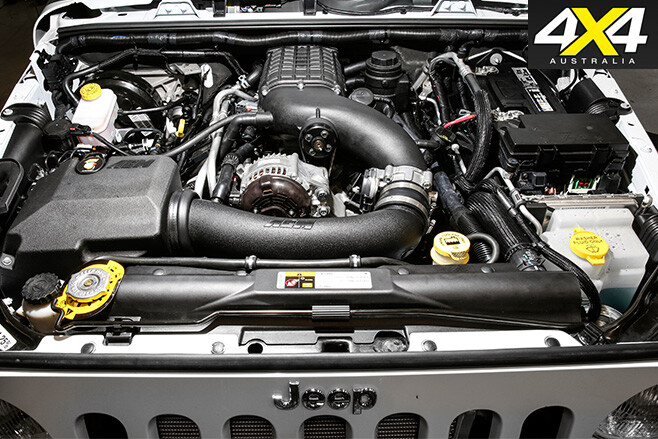
…as always, the mag has the latest news and events, stats and figures, as well as the industry’s most respected names.
Grab your copy of 4X4 Australia from newsagents or subscribe to 4X4 Australia in electronic or print format.
Kayak fishing has been one of the fastest growing sectors of the angling scene here in Australia – and in many other parts of the world – for at least a decade now.
Interestingly, this phenomenon shows little sign of slowing. Sales of kayaks and related paraphernalia continue to boom, marking this as one of the strongest niches in the marine and boating industry.
I must admit that I’ve been a little slow to embrace the whole kayak thing. I spent lots of time sitting (usually with a wet bum) in various old-school style canoes throughout my early fishing career, and I was delighted when I could finally afford to graduate to a real boat. Don’t get me wrong: canoes have their place and I’ve enjoyed some wonderful times in them, though once you’ve fished from a craft that’s sufficiently large and stable to stand up in – especially one with a raised casting deck – it’s very hard to willingly go back to the low, cramped, unstable, and often wet confines of a canoe.
There were other factors holding me back from kayak fishing, too. One was a perception that many kayak fishers, as well as those who catered to their equipment needs, seemed to be missing the whole point of simple, minimalist boating. Some of the kayak rigs I saw on the water, and in magazines or videos, had more fruit hanging off them in the way of electronics and accessories than my 4.8-metre trailer boat! Some even required dedicated trailers just to get them to the water’s edge and more than half an hour of fiddling, tweaking and setting up before they were good to go. Wasn’t portability and ease of use supposed to be the whole point of ’yakking?
Then there were some of the people involved in the kayak fishing scene. Apologies in advance for generalising, but I have hunch that a disproportionate number of them drive Volvos, drink soy lattes, have kids named Tiffany and Sebastian, and own flash, imported pushbikes, not to mention too many items of lycra clothing. In fact, for a couple of years, I disparagingly referred to these kayakers as cyclists of the sea.
I’m sure you get my drift. Just as a handful of cyclists with a certain attitude give the rest a bad name with an I-own-the-road mentality and a penchant for pedalling en masse in front of heavy traffic, so too there’s a sub-set of kayakers who look down their noses at all other watercraft users. Unfortunately, they don’t do their cause, nor their fellow enthusiasts, a lot of good.
So, I’m sure you’ll understand that I was more than a little bemused when my good lady Jo not only organised herself a kayak to fish from, but also picked up one for me. Oh, the shame…
For almost a year I staunchly resisted temptation (for want of a better word). However, a recent road trip that required us to leave the boat at home effectively forced me into the dreaded kayak…
And you know what? I had a bloody great time! We fished the lower Murray River between Mildura and Renmark for several days, then caught the ferry across to Kangaroo Island where we explored a bunch of the island’s secretive and wild little estuaries.
I caught golden perch and Murray cod on the big river (including a whopping great cod just over a metre in length – a new personal best) as well as bream, salmon and mullet on KI. To be honest, I had a ball and didn’t feel too disadvantaged at all by being confined to the kayak.
It helps that we both have state-of-the-art Native Watercraft pedal-powered set-ups that leave their occupant’s hands free for fishing. I can see this nifty sit-on vessel becoming an increasingly important part of my overall fishing life in coming years, though I staunchly refuse to wear anything made from lycra.
Even in near 40-degree heat, the view as I popped up over a small dune was one of the most refreshing I’d ever seen: an expanse of minty-green lake, edged with lush reeds, was absolutely teeming with birdlife.
After nearly three weeks of nothing but dust and desert, seeing the lake was glorious.
Stepping out of the Hilux, I saw something move – toward tussocks of grass by the edge of the lake, a dingo trotted warily over the rich-red desert sand, which swirled like ice-cream, with whiter alluvial dirt. Seconds later, I spied a pair of emu bobbing along the dune I’d just traversed. It was easy to see that Coongie Lakes is a remarkable place.
You can be excused for not having heard of the place, despite it being part of the same inland river system as one of Australia’s most noteworthy waterways, the Cooper Creek. Maybe that relative anonymity is a good thing, because Coongie Lakes’ isolation – smack-bang in the middle of Burke and Wills country in the far north-west of South Australia – means it’s too far to travel for the weekend wallies wanting to conquer tough tracks.
Despite the area’s isolation, the drive from Innamincka to Malkumba-Coongie Lakes National Park is a relatively easy one, with not much more to think about than the usual corrugations, occasional soft sections and a scattering of mining traffic.
As with much of inland and outback Australia, this 100km trek reminds modern travellers of the hardy and dedicated – but ultimately misguided – pioneer pastoralists who attempted to eke out an existence in the harsh dry landscape. The most noteworthy sign of these pioneers is the Kudriemitchie Outstation, around 85km from Innamincka.
Just past the Outstation, a trio of delightful campsites – Kudriemitchie one, two and three – offer terrifically tranquil places to pop up a tent and relax for a while on the banks of the Cooper. Those three sites are worth the trek, but go an extra 20km and the lake shores will reveal a contrast that Australia’s few semi-permanent desert waterways provide – you’ll see a green paradise abundant with life thriving against the hot orange landscape.
Coongie’s camping areas are situated on the banks of Cooper Creek, where the lakes drain towards Innamincka (and, eventually, Lake Eyre). There are also sites around the south-eastern shore of the lake itself.
The creek-side sites have drop toilets nearby while the shore sites, accessed via the aptly named Lakeside Drive, are bush-camp. As is the case anywhere in the great outdoors, you are encouraged to stick to made trails.
Unfortunately, I saw fresh tyre tracks where they shouldn’t have been (and, disgracefully, plenty of dunny paper, too). The stupidity and arrogance of this raises a middle finger to the best efforts of the South Australian Parks staff and the original occupants of this area.
With the heat of the day subsiding, you can spend an hour or two wandering along the shores of the lake. Like many outback waterways, there’s usually several years between high tides – the lakes are replenished by rains in Western Queensland and were last full three years ago – so the shore of the lakes are often a wide expanse of grass. There are plenty of stark, dead trees on the lake shores – evidence of years without water – and they’re a terrific perch for the local wildlife.
On the ground there are animal tracks everywhere, while closer to the water’s edge there are mussel shells and several middens in the dunes.
Make sure you’re back at your campsite for sundown and dusk. Nursing a refreshing beer after choosing a Cooper-side site, I found myself enthralled by an incredible nature show. For around an hour before sunset, the air was filled with the screeching and bickering of hundreds of Major Mitchell’s cockatoos as they livened up from their tree-top afternoon siesta.
Opposite my site, a lone water-bird carefully paced its way along the creek bank, probing for a feed among the green floating plants. What I first thought were chunks of timber floating in the water turned out to be dozens of tortoises, nosing the air close to the surface of the cloudy water.
As the sun dropped over the horizon, the surface of the Cooper began almost fizzing with activity: insects touched down and inquisitive fish joined the tortoises for a look and an opportunistic nibble. Fishing is forbidden in the area, but as someone who’s enjoyed flicking a few lures over the years, I couldn’t help but think – how many fish are in here?
Minutes later, a few pelicans came in for a long swishy landing on the water. The few became many more as, for around 20 minutes, a 100-metre stretch of creek directly in front of the campsite was bombarded by pelicans landing in the water.
With camp lights on and the kitchen set up, I had my bug repellent out and ready. I was waiting to be attacked by biting insects, yet despite thousands of flying things buzzing around the lights – and suiciding on my hotplate as I cooked my dinner – there were no stings.
The next morning was tainted with regret for me, because I only planned for two days and one night at Coongie Lakes when the area deserved more time to really look around. Don’t make the same mistake, because it is a truly remarkable place.
Click here to explore more of South Australia.
Among the more important things taken on 4X4 Australia’s recent Great Australian Bight expedition were UHF radios.
Car-to-car communications (C2C comms) are essential for safety and convenience when travelling in a convoy. They allow drivers to discuss hazards or points of interest on the road, and to just chit-chat as they drive. The most common and reliable form of C2C comms is the use of UHF radios, and we needed units for all three Rovers.
Oricom came to the party with three different UHF units and antennae to suit. As the cars were not ours and had to be returned to original condition when we gave them back, mounting the radios semi-temporarily posed a few challenges. For a start, the two Discoveries didn’t have bull bars – the preferred place to fit the antennae – and we couldn’t put any holes in the interior trim to mount the head units.
The Oricom radios supplied were the UHF300,UHF380 and the UHF028PNP. The UHF028 was probably the ideal set-up for our semi-temporary installs, as it’s made to be easily put in and out of vehicles without having to permanently mount it. The PNP signifies Plug and Play, so it’s pretty simple. The five-watt, 80-channel head unit sits in a bracket that can go anywhere and it comes with a 12-volt ciggie lighter plug and magnetic-base antenna for easy fitting.
The UHF028PNP even has its own carry case that keeps all the components together and ready to go when they are not fitted to a car.
The Oricom UHF380 was also well-suited for fitting to the Discovery, but for a different reason. The 380 features a compact remote head unit that can be stashed anywhere in the vehicle cabin, with all the controls and the LCD screen that the operator needs incorporated in the handset. Also a five-watt, 80-channel radio, the 380 includes all the features of the other Oricom UHFs, but the remote head unit means it’s easier to install in modern vehicle cabins where space might be a premium and isn’t easily found.
The UHF300 is your traditional head unit with display and seperate handpiece. It’s a five-watt, 80-channel radio that you mount somewhere within reach and sight of the driver for everyday access. A clever feature of the 300 is that the head unit can be flipped upside down to fit a particular spot in your vehicle and the display rights itself to accommodate this.
Each of the Oricom UHF units worked well to keep us in touch with each other and the other vehicles in our convoy, which at times stretched out for kilometres. The range was reasonable depending on the terrain, with the best reception in the flatter country.
The only problem we faced was knocking the magnetic antennae off the roofs of the Discoveries when we were in tight scrub, so we strategically placed them within the confines of the roof racks.
Check out the range of Oricom UHF radios at www.oricom.com.au
Click here for great tips on 4×4 convoy communication
Deep in a rugged forest, trails with tricky hairpin turns and clear river crossings climb fast to altitudes of up to 1000 metres.
This is Deua National Park – just four hours south of Sydney. Perfect for a weekend getaway, the park boasts some of the region’s most challenging four-wheel drive trails, with some so steep that trailers have been banned.
But first things first: before you hit the dirt – to avoid tackling the steep stuff on an empty stomach – stop in at Braidwood bakery, where you can stock up on fresh bread and indulge in a decent cup of ground coffee. Depending on your timing, you’ll often see other four-wheel drivers doing the same thing, whether in kitted-out Land Rovers or battle-scarred Toyotas.
You then head for Snowball Road, a good spot to air-down the tyres before facing the first real 4×4 test of the trip: the Minuma Range Fire Trail.
The start of this trail has some steep rocky sections, where you’ll probably need low range and a locked diff to avoid losing traction and sliding on an awkward angle on the ascents. If you’re travelling in a convoy, a UHF radio will also come in handy, not just to alert your mates when you become stuck, but also to share a bit of banter before they get you back on the road and moving.
After a couple of kilometres of the track, you’ll reach the really steep stuff, where you’ll see nothing but sky as you move on to the Dampier Trail; a fire trail that gives passengers a great view of the valley below and a good indication of the height you’ve climbed. The trail is also a continuation of Middle Mountain Road, which will eventually link you to the Bendethera Fire Trail.
You’ll probably want to break for smoko before heading on to the popular Bendethera Trail. This track is undoubtedly one of the highlights of the Deua NP, with its steep mountain drops and ascents. The hills will challenge many 4x4ers, and they certainly command respect, particularly when wet.
After a couple of kilometres of slow driving, you’ll eventually reach the valley floor that is the magical Bendethera Valley; the perfect place for the first campsite of the weekend.
Expect cold weather up here during the winter, especially at night time, and remember that for every 100 metres you climb, the temperature will fall about one degree. So bring those woolly socks your mother-in-law gave your for Christmas – you might just be glad to have them up here as you knuckle down for the night.
With some luck, it’ll be dry and not too foggy when you wake up the next day. You might even see a mob of kangaroos through the icy mist. After downing coffee and breakfast, discuss the day’s driving ahead, pack your vehicles, and get ready to hit the trails again, with the well-known Merricumbene Fire Trail the first on the list.
On the Merricumbene Trail, you’ll move straight on to famously steep ascents and drops. If you have a fear of heights, the best advice is to not look out your side window. Everyone in your convoy will be in concentration mode, with little conversation over the airwaves and plenty of tight hairpins keeping them on their toes.
This is no time to question the ability of your vehicle’s engine braking. The driving is technical and if the trails are wet, you’ll need to be extra careful, as some of the descents can be quite daunting.
The driving pattern is consistent: as you come to the crest of one hill, you will immediately be presented with an even higher one in front of you. This will be the norm for a couple of hours – up, down, up, down, blue sky, brown dirt, blue sky, brown dirt.
It’s a cracker of a track. The Merricumbene Fire Trail’s highest elevation along its length is 1020m. Its lowest point is 71.7m. To say this 34km trail is mountainous is an understatement. Apparently the total ascent/descent along the length of the Merricumbene Fire Trail is 2142m/1702m. Now that’s a lot of going up and down in one day.
You won’t find flat ground for a while, so the best advice is to pull over for lunch at the base of one of the many hills. By evening you should arrive at the unpredictable Deua River crossing. Before entering the National Park, ask the park ranger about the height of the river, because the river’s depth can change dramatically depending on weather conditions.
At the very least, have a good look to see if the river looks manageable enough for you to get across without any major issues. Once over the river, continue on to the Arulen campsite for the night.
The weekend will be coming to an end, but not before the last of the tracks to be tackled, which will include the Zig Zag and Quart Pot trails. You’ll finish at the Corn Trail, a narrow pack-horse trail once used to bring cattle and gold down from the Tableland.
A couple of days in the Deua NP is a great way to improve your hill-climbing skills, but be prepared as the tracks are not recommended for vehicles lacking low range and decent tyres, simply because the trails are too steep and there are a number of water crossings that can be high after rains.
This elevated wilderness is the perfect destination for a weekend adventure. It guarantees challenging hill driving, river crossings, cracking campsites and spectacular hilltop views that will most definitely make you appreciate the value of owning a 4×4.
Such is Toyota’s confidence in its new eighth-generation Hilux that it was launched on some of the most difficult off-road tracks ever used by a manufacturer to introduce a new 4×4 to the specialist off-road media.
This is the first all-new Hilux in ten years and it’s the result of more than six years of design, development, testing, redesign, and then more testing and redesign.
Toyota has left no stone unturned to produce a vehicle that’s comprehensively better than its predecessor, both on and off the road, and it will no doubt further cement the Hilux as Australia’s best-selling 4×4, if not Australia’s overall best-selling car, within the next 12 months.
The new Hilux comes in no fewer than 31 variants, which is eight more than the out-going model. Of those 31 variants, 19 are 4×4 models and of those 19 more than half are dual cabs.
Hilux 4×4 buyers can choose from two all-new diesel engines and a 4.0-litre petrol V6, which is carried over from the previous Hilux with minor revisions. Both diesels are available with all-new six-speed manual and automatic gearboxes while the V6 is only available with the new six-speed automatic.
The two new diesels share much technology, but differ in size. The smaller 2.4-litre 110kW/400Nm diesel is only available in the base-spec Workmate models while the larger 2.8-litre 130kW/450Nm diesel comes in the mid- (SR) and top- (SR5) spec models. When mated to the six-speed manual, the 2.8’s maximum torque is pegged at 420Nm.
First impressions behind the wheel are of a far more modern, stylish and car-like interior, with even the Workmate models getting a tablet-style multi-function touchscreen that dominates the dashboard. In all models, drivers have the benefit of tilt and reach steering wheel adjustment while SR and SR5 models have the benefit of seat height adjustment. The cabin is also slightly taller and wider than before.
As soon as the diesel engines start they sound more refined and quiet, with far less diesel rattle and knock than with the out-going 3.0-litre engine.
Once underway, the engines continue to convey improved refinement and, at times, both feel and sound surprisingly non-diesel like.
Thanks to the 2.8’s extra torque (90Nm in auto form), it initially responds better than the outgoing 3.0-litre. Ultimately, however, the outright performance is only marginally better than the 3.0-litre. That’s partly because the six-speed auto adds an extra overdrive ratio rather than tightening up the ratios gaps.
With the manual box the 2.8 actually feels spritelier than with the auto, despite the reduced torque. In SR5 spec the 2.8 manual also gains an ‘intelligent mode’, which makes it nearly stall-proof from take-off, and it also softens the shifts by matching the engine revs.
In many ways the real surprise packet is the 2.4-litre diesel. It gives little away to its bigger brother in most driving situations, even if it doesn’t match the pedal-to-the metal punch of the 2.8 diesel.
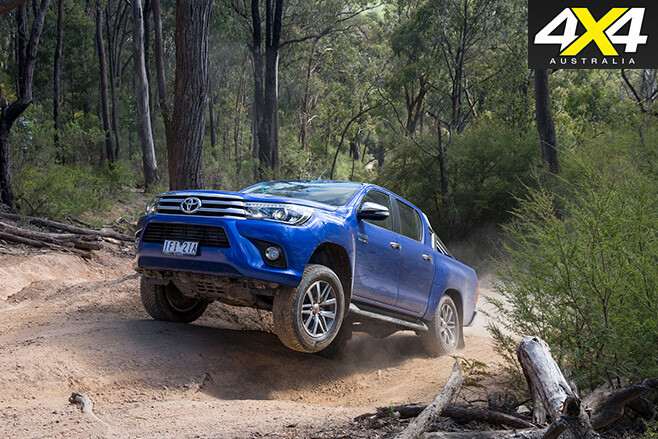
Both diesels mate nicely to the six-speed auto, which is a more refined and ‘intelligent’ gearbox than the outgoing five-speed automatic.
Thanks to the all-new and stiffer frame, among other changes, the Hilux also rides and handles better than before. Even though the Hilux still feels a lot like a ute because of its load-carrying rear suspension, its front-to-rear suspension match is much better, as is its light-load (200kg as tested) ride compliance.
But as good as the new Hilux is on road, the biggest improvement comes off-road. Not only is the ground clearance improved, but there is more rear wheel travel (up 65mm), thanks to redesigned rear suspension that incorporates 100mm longer leaf springs.
Perhaps more significant is the new A-TRC electronic traction control that is far more aggressive in limiting wheel spin. Such is the effectiveness of the A-TRC that the rear diff lock, which is now standard on the SR and SR5 models, is almost redundant.
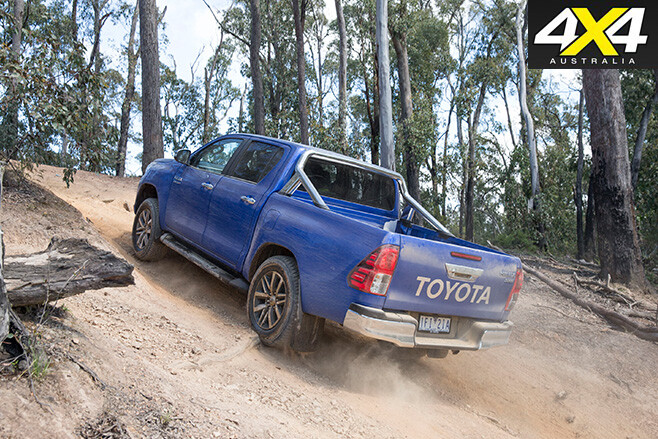
When the rear locker is engaged, the A-TRC is disabled across the front axle, a move that’s in the interest of driveline durability according to Toyota.
In another good move, not only can the Electronic Stability Control be manually disabled either by a dashboard switch or by selecting low-range, but the A-TRC can also be switched right off in situations (like mud and sand), where momentum is more important than traction.
Those who use their Hilux in more severe off-road conditions will also appreciate the much more extensive and robust underbody protection that this new Hilux offers.
(Note: one of the pictured blue Hiluxes is a pre-production test car that has been through extensive heavy-duty, off-road testing and evaluation. This is why there is no number plate and there is damage to the side steps)
With the recent edition of John Rooth to the 4X4 Australia team, our November issue will include a bonus DVD for you to enjoy!
In association with Roothy’s LowRange, we proudly offer you the opportunity to grab ‘Episode 1 – The Boys Are Back!’ (RRP $14.95) bundled with our November issue – on sale 8/10/15!
Check out the trailer below for a sneak peek of this awesome adventure and grab the mag in store!
Think big news in the four-wheel drive world and the new Toyota Hilux is about as big as it gets.
While 4X4 Australia has been busy getting all the facts together about the eighth-generation Hilux and its equipment, Toby Hagon and Fraser Stronach have been out driving the top-selling ute.
Their initial impressions are pretty positive, as Hagon explains in the above video.
There are few, if any, 110 per cent perfect four-wheel drive utes straight off the showroom floor.
Even today, when vehicles have become more sophisticated, inside and out, there are still things to be added, subtracted or polished for performance, comfort and style. This is the case even when a ute is as good as Volkswagen’s Amarok; an award-winning truck heavily praised for its space, ride comfort and handling.
The German-engineered Amarok might not trouble the scoreboards of the big players in the off-road segment – Ford, Toyota, Nissan and Mitsubishi – but Volkswagen Australia says the ute still hits its sales targets in Australia, one of the Amarok’s biggest markets, with 7716 four-wheel drives and 569 two-wheel drives sold last year.
More telling, however, is that Amarok owners are a loyal and enthusiastic mob, often keen to take extra vehicle needs into their own hands.
One of those owners is Queenslander Peter Bouma, a co-founder of Crimsafe, the renowned security-screen firm.
After four years living in the United States and driving a storming Ford Raptor pick-up, Peter was chasing something smart and comfortable. He didn’t like leaving his Raptor behind, but thought it would be a touch impractical back here in Australia because of its bulk.
“And I think here I’d be bored in it,” Peter says.
“In the States I did a lot of driving – had a radar detector in the middle of my screen and the sweet spot on that thing was 90mph (145km/h) all day.
“It made a nice rumble and you could take it anywhere – an amazing truck and very comfortable.”
Peter says he has been lucky with cars and he is used to having a few comforts in his machines. For driving in Oz, though, it was the Amarok that caught his attention with its creature comforts, ride comfort and cabin space.
“But the look of the standard one didn’t win me over,” he says. “So I had to find out what I could do and that’s where I came across the guys from Wolf who I think have helped me come up with a really nice-looking ute.”
Peter started off with an Amarok Dark Label ute, bought in February this year. The special-edition VW is based on the Highline model and comes with (as factory standard) bi-xenon headlights; LED daytime running lights; matte-black sports bar and side steps; smoked tail-lights; and black paint for the wheels, rear bumper and door handles.
Inside, the Dark Label, with a $56,990 recommended retail price for the six-speed manual, arrived with Alcantara trim, a carbonfibre look to the seat bolster, and heated front seats.
With an all-round comfortable factory rig to build on, Peter tossed the keys to the Wolf 4×4 crew at Deception Bay, just to the north of Brisbane.
The result? A handsome Volkswagen dual cab, set up as a comfortable touring truck for all kinds of roads.
The mods have surely given the white Amarok a tougher presence, on and off the road. Extra ride height, bigger wheels and tyres, and a black-wrapped bonnet come together in a style suggestive of a pre-runner.
The Amarok wasn’t to be Peter’s main get-around machine, but he still wanted something that went and looked a bit more special than standard. Wolf’s Tristan Gibbons was instrumental in the desired customisation.
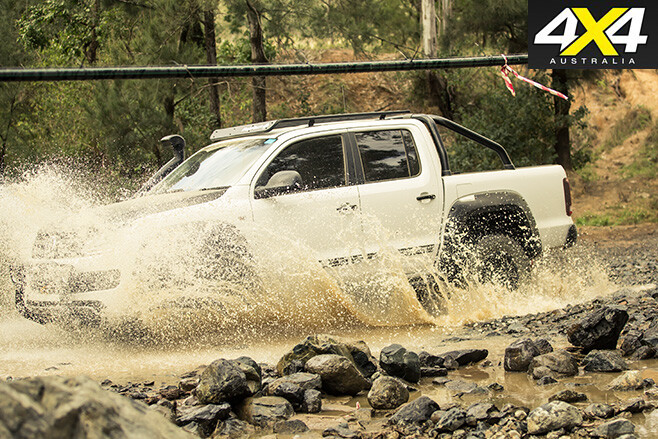
“Peter’s one of these guys – every car he owns has some sort of modifications and he tries to make them look really nice,” Tristan explains.
“So he came to us, and went ‘what would you recommend to do?’”
“He basically looked at my ute and went, ‘everything you have got on yours, plus more’.
Tristan was handed the keys and an almost-open cheque book to turn the dual cab into a more capable and more stylish machine like some of Tristan’s earlier custom jobs. The job ended up costing close to $28,000, including an engine remap plus a custom three-inch exhaust from the turbos back.
Up front there’s a Delta 4×4 nudge bar (black, of course) with Peak Explorer LED driving lights.
There’s an AFN hidden mount for the Runva 11 XP winch, plus there’s a little modification to the chromed VW badge on the grille to make sure the business of the winch is hidden and tidy.
“You go to the showroom and sometimes see people trying to do this,” Tristan says as he turns the big badge and twists it free of the grille to expose the winch control box. It’s a neat trick, made possible by modifying the badge’s clips.
Peter’s ute’s bonnet has a black wrap with neat Wolf bonnet protector up front and a Seikel snorkel on the right-hand flank.
The windows have been given an extra tint and there are MSA seat covers for protection – otherwise, the interior is pretty stock.
Up top there’s a BajaRack utility flat rack with a pair of small LED lights for seeing out back when the sun goes down.
The rear tray is covered with a retractable Roll-N-Lock hard tonneau cover with a Raptor Rack to mount a pair of Maxtrax on top of the Roll-N-Lock’s front housing. The back-end has also been fitted with the very clever EZDown system; a strut that gently lowers the tailgate.
For body protection, this VW has MCC sidesteps below the doors and a full AFN underbody kit.
It sits on Delta Classic wheels fitted with 305/60R18 Mickey Thompson ATZ P3s and covered with Bushwhacker guard flares (black, of course).
All this is smoothed out and supported by Bilstein shocks with King springs at the front (Wolf had sold out of some Outback Armour gear prior to doing this ute) with Outback Armour leaf springs at the rear. It’s now due for a 40mm body lift.
To keep all this on the move, Peter also took his VW off for some engine treatment. It’s now running with a Maptech re-tune of the ECU, plus a full three-inch exhaust system, which helps the TD1400 twin-turbo diesel exhale a bit better. This increases the trucks power to about 150kW (a factory model offers about 132kW and 400Nm). The upgrade also sweetens the exhaust note a little.
Peter says the extra grunt from behind the wheel has transformed the ute beyond his expectations.
“When you put the bigger wheels on, it does take a bit more energy.
“I’ve always done performance modifications to my cars – I’m used to high-performance vehicles.
“This one was a bit of a shock for me – it’s made a helluva difference and turned it into something quite decent and useful.”
He had worried that the Bilstein shocks would affect the ute’s ride, but now he thinks, if anything, the aftermarket shocks have improved the vehicle’s overall ride comfort.
“I’m also happy with the Mickey Thompson tyres.”
“They’re big sneakers on that thing and I get no wheel noise – quite amazing.” Peter is proud of his modded Amarok – how it looks and how it goes.
“It’s not my family car, but it’s one that we’ll certainly be doing some camping holidays in and I’ve got a mate with a farm at Stanthorpe (southwest of Brisbane).
“I grew up on a farm and done a fair bit of four-wheel driving, not for a long time, but it’s something I certainly want to do in the future.
“And so I wanted something that was nice and robust and looked a bit tough.”
This striking VW Amarok certainly fits the bill.