
The complexity of the modern four-wheel drive is astounding, most notably in the area of electronics.
I was out in the field the other day and I saw possibly the most electronically complex off-roader around – a 70 Series Land Cruiser! Admittedly, this was a heavily modified, one-off vehicle, built over several months to perform a specific task in remote areas. But there are plenty of recreational touring 70s out there that are jam-packed with complex aftermarket electronic systems.
When the 70 Series was first launched way back in 1984, it was one of the most basic (albeit effective) off-road vehicles on the market. Much of the tech could be traced back to the days of horse-drawn wagons: separate chassis, live axles and leaf springs. Yup, she was a simple old beast.
In fact, while mechanically superior to a horse (at least in terms of vehicle propulsion), the diesel engine of the original Land Cruiser was also a basic bit of kit. The 70 Series’ original 2H diesel engine was a 4.0L OHV inline six with a mechanical indirect injection set-up. And even the engine that replaced it was simple by today’s standards; the 1HZ 4.2L six gained overhead cams but retained mechanical pre-chamber indirect injection technology.
Even the early petrol engines had little in the way of electronics, other than the starting system, ignition system, and lighting and accessories system.
This meant the electronics in early Land Cruiser 70s had to do little more than provide enough grunt to the starter motor to get the thing fired up, as well as enough voltage to illuminate a pair of halogen headlights, the ciggy lighter and maybe some spotties.
And if recreational four-wheel drivers got their hands on an old 70 Series Cruiser, they’d likely have fitted a deep-cycle battery to power the fridge along with a manual isolation switch to ensure the starter battery always had enough grunt to get going in the morning. In some cases, they’d even have a fancy set-up with an automatically operating isolator by way of a solenoid.
The current-model Land Cruiser is a different kettle of fish. While it retains the old separate chassis and solid rear axle with leaf springs, it now also features (gasp) coils up front! Well, okay, that’s not so flash by today’s standards, but the technological marvel that is the 1VD-FTV 4.5L TDV8 certainly is. This engine features electronically controlled common-rail direct injection technology for precise fuel metering and dual electronic throttle valves, which means there are more demands on the vehicle’s electrical system.
Of course, there are loads of more technologically advanced off-roaders on the market than the current 70 Series Cruiser, with additional electronically controlled features including ABS, EBD, TC, ESC, GPS and more, but it’s once you start throwing aftermarket gear on a vehicle such as the 70 Series that the complexity level increases substantially.
Think of all the things the modern recreational four-wheel driver takes for granted these days: winch; driving lights; light bars; work lights; air compressor; UHF; sat-phone; mobile phone; sat-nav; iPad or Android tablet; smartphone; reversing camera; dash-cam; fridge; kids’ entertainment… the list goes on, and all of these devices, whether affixed to the vehicle permanently or just plugged in for charging, require vast amounts of energy to keep operational.
Compared to a Land Cruiser 70 Series in the mid-1980s, today there’s a hell of a lot of electrical demand and complexity. To keep power to all of these devices, a modern touring 4×4 will usually be fitted with a dual-battery system and computer-controlled monitoring and charging system – as well as a stack of wiring, fuses, relays, inverters and numerous power outlets – of the standard 12V DC variety as well as USB outlets and 240V AC outlets.
Once upon a time, four-wheel drivers armed with some basic mechanical know-how could generally get themselves out of strife if something broke. These days, you’d just about need a post-graduate degree in electrical engineering to keep your vehicle running if it suffered an electrical fault in a remote location.
On the plus side, modern four-wheel drives are far more reliable than they used to be… but when it comes to aftermarket electronics, it’s best to get qualified experts to look after the installation.
A new Ford Everest spontaneously caught fire in New South Wales this week.
Fire and Rescue NSW sent two crews from Charlestown to fight the fire on Redhead Road after multiple triple-zero calls were made at around 4.30pm, Tuesday.
“They were on the scene within six or seven minutes,” a Fire and Rescue spokeswoman said.
“When they got there, the car was well alight. The road itself was blocked while crews fought the fire. It looks like the fire was extinguished by about 5pm, but the vehicle was destroyed.”
Ford Australia spokesman Wes Sherwood told 4X4 Australia the fire, which destroyed the Everest in less than 30 minutes, was surprising for Ford.
“We’re not going to speculate on what could happen,” Sherwood said.
“Our focus is on trying to find out what the facts are. We want to investigate the matter as thoroughly as possible.”
There are about 1000 Everest SUVs and more than 100,000 Ford Ranger utes on the road. The Ford Ranger and Everest have the same engine and electrical system and are made on the same Thailand production line.
What was left of the vehicle, which was being driven by News Corp Australia journalist Peter Barnwell when it caught fire, was returned to Ford.
No-one was injured during the fire.
Nissan has launched the remaining 13 variants of its Navara NP300 range; nine of which are four-wheel drive; all of which have rear leaf-spring suspension.
The new variants include single cab, king cab and dual cab-chassis models and add to the 14 dual cab variants that went on sale in June this year, bringing the total variants on offer to 27.
Of these 27 variants, 16 in total are 4×4, three are single cabs, six are king cabs, seven are dual cabs, ten have manual transmissions, and six have automatics. If you include transmission options, the list of new versions goes up to 20.
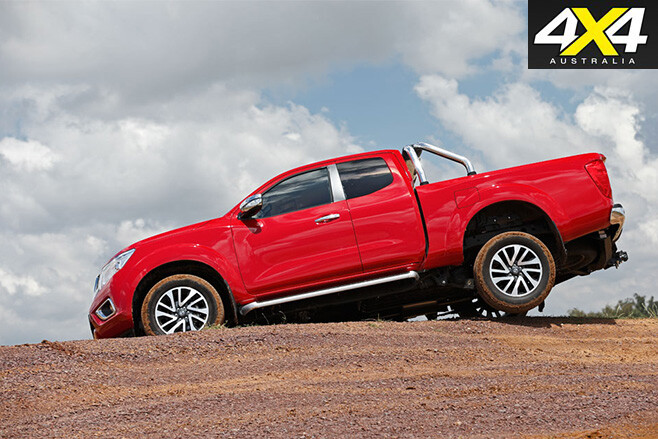
What all this means is the Navara now has more variations than ever before and, significantly, the 13 new workhorses that complete the range have returned to a classic leaf-spring suspension set-up at the rear.
Nissan’s first run of dual cab Navaras bucked the norm in June when they launched with multi-link coil springs instead of leaf-springs at the rear.
Also significant, however, is the addition of another engine option for the single cab, dual cab and king cab 4×4 models: they are now available with a single turbo-diesel engine.
Previously, the NP300 had come with an intercooled 2.3-litre bi-turbo-diesel, producing 140kW and 450Nm. The new intercooled 2.3-litre single turbo-diesel produces 120kW at 3750rpm, and 403Nm.
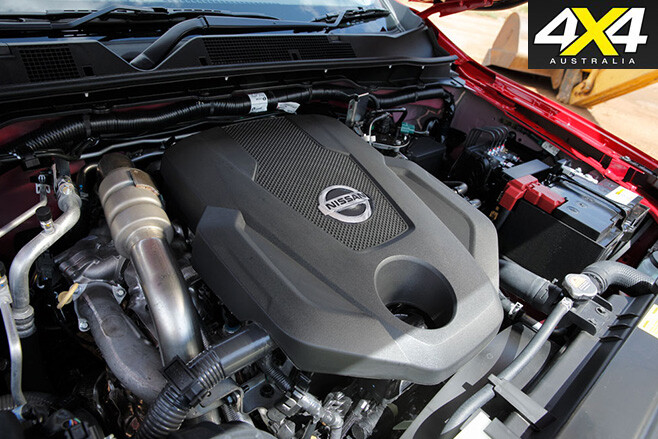
As part of the change, the Navara single cab 4x4s, which all have cab chassis bodies, come only with the single turbo; the RX-spec king cab, available with a pick-up or cab chassis body, also comes with the single turbo; while the higher ST- or ST-X-spec king cab 4x4s each have the bi-turbo.
Even dual cab 4×4 buyers can opt for a single turbo-diesel with an RX-spec pick-up or cab chassis variant. The RX dual cab-chassis variant is also the only dual cab offered with leaf rear springs.
Across the 4×4 range, the single turbos are only available with a six-speed manual transmission, except in the dual cab RX pick-up and the single cab RX cab chassis, which each offer the seven-speed automatic as an option. The ADR fuel economy for the single turbo with an automatic is 7.1L/100km, or 6.6L/100km with the manual.
DRIVE IMPRESSIONS
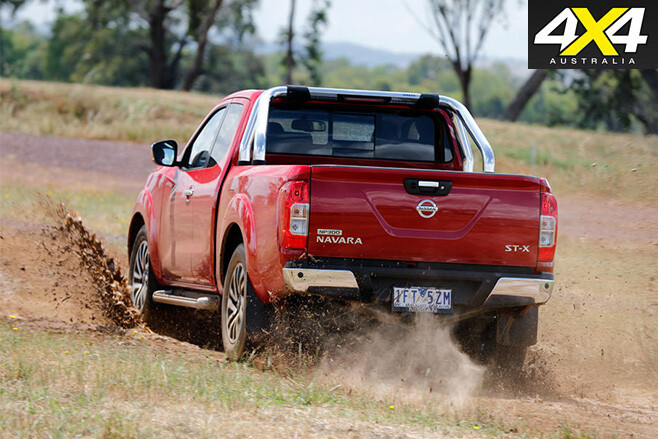
At the new workhorse range’s national launch in Albury, Victoria, 4X4 Australia tested the performance of an ST-spec king cab. The king cab we drove was a bi-turbo variant, with an automatic transmission and a pick-up body; we didn’t get to test the single turbo.
But engine options aside, there was still an obvious difference between the new workhorses and the dual cab variants launched earlier this year, and that related to how they handle on- and off-road.
Nissan’s bold decision to release the first run of NP300s with multi-link coils was thought to indicate market demand for more car-like handling. And as can be expected, the ride in the NP300’s leaf-spring variants is not as refined, especially when the ute is unladen.
On bitumen, the ride is firm and at times erratic over inconsistencies, with vibration through the steering wheel and cabin. The firmer ride is a trade-off of having suspension designed to better carry a load.
Leafs can be more rigid but spread the load widely over the vehicle’s chassis, whereas coil springs transfer it to a single point.
On dirt, the rear end floats a bit over corrugations, but so will the rear of almost any unladen ute. The ride quality would probably improve with more weight in the back.
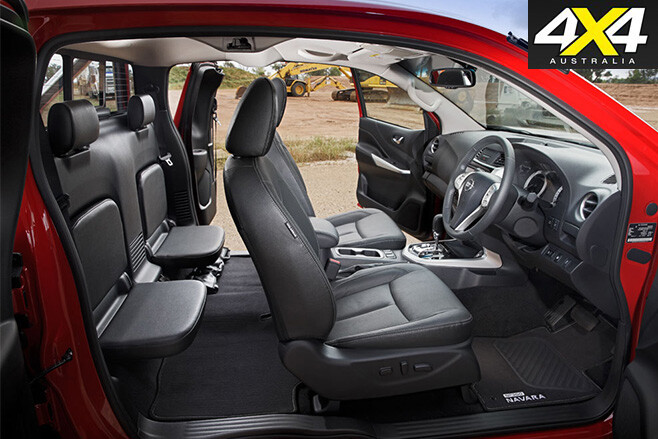
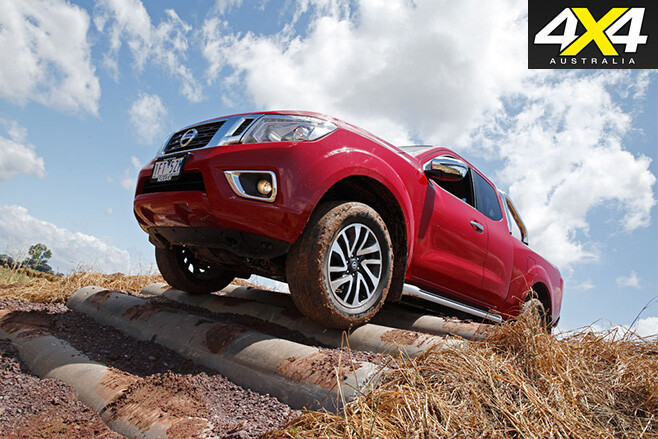
For more serious off-roading, we took the king cab to a small 4×4 course with moguls, logs, water, sand and steep rises and descents. Unladen, it handled everything with ease. However, when it came to the logs, the suspension bottomed out if you weren’t careful – the leaf springs offer less wheel travel than the coils.
For fans of the old D40 leaf springs, the leaf springs on the new NP300 are six kilograms lighter, 24mm shorter and offer better clearance.
Nevertheless, on the surface the new NP300 variants are much the same as the variants released earlier this year. The new appeal of the NP300 range is in the detailed options available to commercial and fleet buyers.
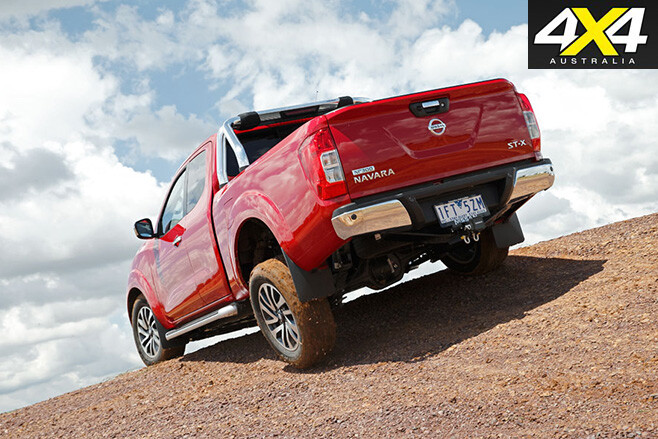
The Navara is already Nissan’s best-selling model in Australia, comprising anywhere between 25 and 30 per cent of its annual sales. Nissan hopes this success will continue and the new leaf-sprung model will pick up where the popular Navara D40 and D22 left off.
With the recent launch of the new Toyota Hilux, and the upgrade of the Ford Ranger and Mazda BT-50 – all of which have leaf-sprung rears – Nissan’s leaf-spring and single-turbo options should help the company retain its share of the commercial ute market, which demands simplicity, durability and practicality over refinement.
Individual needs will determine whether buyers opt for a manual, an automatic, a single turbo, a bi-turbo, a petrol engine, a diesel engine, a single cab, a dual cab, leaf springs or coil springs.
Nissan has done its best to make sure there is something for everyone.
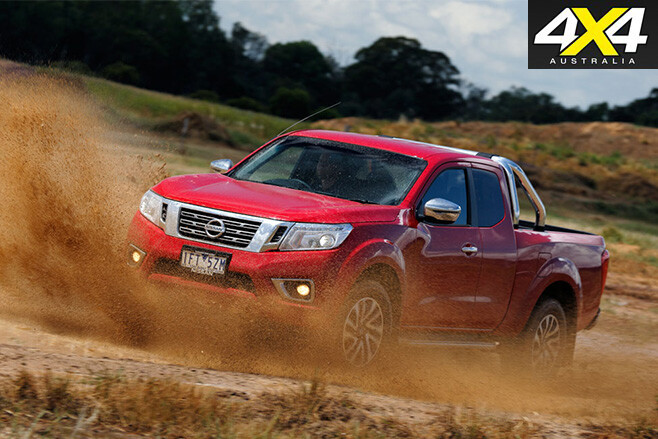
King Cab 4×4
u00a0 | ST 4×4 Pickup |
Engine | 2.3d twin-turbo |
Output | 140kW/450Nm |
Gearbox | 6-sp. man.(7-sp. auto opt.)u00a0 |
Payload (Auto) | 1002kg (999kg) |
Towing capacity | 3500kg |
Fuel (Auto) | 6.5L/100km(7.0)u00a0 u00a0 |
2015 NP300 workhorse pricing*
| Single cab | u00a0 |
| Single cab DX 4×4 diesel cab chassis | $31,990 |
| Single cab RX 4×4 diesel cab chassis | $32,990 |
| Single cab RX 4×4 diesel cab chassis (a) | $35,490 |
| King cab | u00a0 |
| King cab RX 4×4 diesel pick-up | $36,990 |
| King cab ST 4×4 diesel pick-up | $42,990 |
| King cab ST 4×4 diesel pick-up (a) | $45,490 |
| King cab ST-X 4×4 diesel pick-up | $48,990 |
| King cab ST-X 4×4 diesel pick-up (a) | $51,490 |
| Dual cab chassis | u00a0 |
| Dual cab RX 4×4 diesel cab chassis | $38,490 |
*Excludes on-road costs
Safari Automotive is probably the biggest name on the planet for 4WD snorkels, and like many others in the Australian 4WD aftermarket industry, it has humble beginnings.
Safari Automotive kicked off in the early 1980s and came about because company founders Peter and Sheryl Luxon couldn’t find the products they needed when 4WDing, so they set about producing gear for themselves. Initially called Luxon’s 4WD Equipment, Safari started off as a small 4WD hire and general accessory business.
“Peter and Sheryl were hiring out 4WDs,” explains David Luxon, Peter and Sheryl’s son and current marketing manager of Safari. “That led to selling other aftermarket components from other suppliers, so they started a workshop fitting Koni suspension and other products like that.
“Then they destroyed a couple of engines in 4WDs, going through river crossings and into bogholes. From that they started looking into how to protect your engine from river crossings and general 4WDing.”
The early Safari snorkels were manufactured from fibreglass and they had a much smaller diameter than today’s product. The move to producing today’s style of snorkels through rotational moulding, using polyethylene, didn’t take place until the early to mid-1990s.
As has always been the case with Safari Automotive products, all research, development, design and manufacturing takes place locally. “We’ve got two premises in Croydon South (Victoria), and all of our research, development and design work is done locally in Melbourne,” David says. “All of our parts are moulded in Melbourne, and all of our small components are sourced in Melbourne – we’ve been very conscious of keeping it made in Australia.”
With a lot of cheaper, imported snorkels now flooding the market, you’d think Safari’s locally designed and manufactured ethos would be hard to maintain, but David Luxon explains that’s not the case. “When [cheap imports] first started, we saw it as a major threat,” he says.
“However, as time goes on, I guess what tends to happen is that people become aware of the quality issues that are associated with these low-cost products. You can’t have your cake and eat it, too. You can’t have a high-quality durable product by Australian standards but pay 30 or 40 per cent less for it. The two can’t co-exist, so we’re much less worried about it today than we were a few years ago. Today we’re concentrating on the strength of our product.
“There will always be a section of the market that will want to pay less for a lower quality product, and that’s just not what Safari is about,” David continues. “We’ve never been a low-cost product designer. Our mentality from a design and manufacturing process is that the quality of our products always meets or exceeds the quality of the standard components on any vehicle.”
As well as snorkels, Safari Automotive is well-known around the world for its performance kits, including turbo, intercooler and exhaust systems.
“We certainly don’t do the volume of turbos that we did going back to the ’80s and ’90s,” David says. “But there are still applications around the world where emissions aren’t up to our standards. They still sell 1HZs in other parts of the world, so there are still parts of the world where we sell those turbo systems.
“We have a fully sound-insulated four-wheel dynamometer with state-of-the-art technology and equipment that runs that dynamometer. We also have the largest privately-owned flow bench in Australia, which allows us to flow basically any product you can conceive of, so we can measure the performance of airflow. This is really critical not just for snorkels but for airboxes and different components.
“David Inall (General Manager of Safari Automotive) is our technical engineering guru.
There are probably not many people in Australia who have his knowledge of turbocharging and engineering of automotive vehicles outside of OEM, so we’re very fortunate to have his expertise from an engineering background and also from an export sales perspective. He’s been a big player for us in helping us to forge into other markets around the world.”
Overseas sales are also a very big part of the Safari Automotive business. “We are very proud to be an exporter,” David says. “The Safari name is a worldwide name. We supply the Americas, Europe, Asia and South Africa. There aren’t many parts of the world where Safari products aren’t sold.”
David is unashamedly proud of Safari Automotive; where it’s come from, where it’s at, and where it’s heading.
“The Australian 4×4 industry is a very exciting industry to be in,” he says. “We’re very fortunate that we’re in such a great industry in such a great country. We really love the fact that we’re part of that pioneering 4×4 element in Australia, and Safari has grown up with the Australian 4×4 industry. We’re always going to be committed to making extremely high-quality products that people can rely and depend upon when they’re travelling in the outback.”
So what’s on the horizon?
“Safari Automotive stopped selling tuning software and chips a few years ago, however we are currently in the process of [establishing] an engineering program to get back into the tuning and performance market for the current range of vehicles,” David explains.
“Next year we will definitely be launching some new product lines focused around performance tuning and performance upgrades for all of the current popular diesel factory turbo intercooled pick-ups and wagons.”
Contact
Safari Automotive 73 Merrindale Drive, South Croydon, 3136 Ph: (03) 9761 7244 Web: www.safarisnorkel.com
We’re driving west, breaking out of the confines, congestion and limitations of Melbourne’s roads and heading bush on what is an exciting day.
Why? We’re in Ford’s all-new Everest, the closest thing to a serious 4×4 wagon we’ve ever seen designed and developed in Australia, save for oddities like the Holden-based Overlander some 40 years back.
The Everest is based on the Ford Ranger ute, the design and development of which was also headquartered here in Australia, which further cements its home-grown stature.
The success (or otherwise – but we’ll bet on success) of the Everest will no doubt influence Ford’s global plans to maintain Australia as a research and development centre capable of developing new vehicles even after Ford ends its car-building in Australia in 2016.
The R&D centre would employ about 1500 staff, mostly designers and design engineers, and could be Australia’s biggest single automotive industry employer – once Toyota and Holden end Australian production in 2017. So a successful Everest will help consolidate that future.
The Everest is one of two vehicles that will eventually replace the Falcon-based Ford Territory, which will disappear with the Ford Falcon when Ford’s local vehicle production stops. However, unlike the monocoque Territory, with its fully independent suspension and single-range traction-control-based AWD, the Everest is a 4×4 with a separate chassis, live rear axle and dual-range gearing.
Keeping the Everest honest here is the Toyota Prado with a new 2.8-litre diesel engine and six-speed automatic gearbox. It’s no secret that the Everest is aimed squarely at the Prado, the best-selling 4×4 wagon in Australia. So this really is the acid test.
The Everest also lines up against the Holden Colorado 7, the Isuzu MU-X and the Mitsubishi Challenger – a new model is due in December – and, Toyota’s Hilux-based Fortuner 4×4 wagon when it arrives to liven up the party.
Powertrains and performance
To quieten the Ranger’s somewhat gruff, commercially derived 3.2-litre five-cylinder diesel, and to make it cleaner so the Everest can meet Euro 6 emission standards, a more sophisticated, higher-pressure common-rail fuel system is used, as is AdBlue pollutant-reducing technology.
As a result, the Everest’s maximum power is 143kW; 4kW less than the Ford Ranger’s maximum. Max torque remains at 470Nm, though. Those figures are still 13kW and 20Nm higher than the figures produced by the 2.8-litre diesel in the Prado, and this is evident on the road, thanks to the lower and tighter ratio spread of the Everest’s six-speed automatic transmission.
The Prado is notably lighter than the Everest, which helps with acceleration off the mark, but the Everest’s extra power and lower gearing more than compensate, providing performance that’s noticeably livelier, especially when maximum attack is called for – such as overtaking on a highway.
Ford’s efforts to quieten the 3.2 five-cylinder have, however, fallen short of the standard set by Toyota’s new 2.8 four. The 2.8-litre is more refined than the 3.0-litre it replaces (the engine that Ford no doubt benchmarked the Everest against).
Compared to the Prado, the Everest’s engine fares the worst noise-wise under load at low-engine speeds, despite the Everest’s cabin having Ford’s Active Noise Cancellation.
Still, the Everest is generally quiet and smooth-running, and if it weren’t for the excellent refinement of the Prado’s new 2.8, the Everest’s low-rev noise wouldn’t even rate a mention.
Both these vehicles’ six-speed automatics are smooth and have smart shift protocols, but the Everest’s gearbox tune feels sportier than the touring-orientated Prado gearbox with its two overdrive ratios. Everest’s sixth is actually near identical to fifth in the Prado’s six-speed, which means the Prado’s sixth gear is extra tall, given the two vehicles have (as-good-as) identical axle ratios and tyre diameters.
Despite the shorter gearing and a higher official ADR fuel figure than the Prado (8.5L versus 8.0L/100km), the Everest manages to match the Prado for economy, with both averaging 10.4L/100km on this test.
On-road ride and handling
Drive these two side-by-side on a twisting mountain road and you’ll very quickly learn that the Everest feels like a sports car compared to the Prado. Where the Prado is all body roll and understeer, the Everest has much flatter and more neutral handling.
Like the Prado, the Everest uses a live rear axle with coils, but with a Watts linkage for sideways location of the axle instead of the simple Panhard rod of the Prado. The flipside of this is that the Prado’s softer longer-travel suspension and more supple ride means it’s nicer to drive once the roads straighten up, especially if the surface is broken and bumpy.
Specs
| u00a0 | u00a0 | Toyota Prado 150 GX | u00a0 | Ford Everest Trend |
| Engine | u00a0 | DOHC 16-valve 4-cyl turbodiesel | u00a0 | DOHC 20-valve 5-cyl turbodiesel |
| Capacity | u00a0 | 2.8-litre (2755cc) | u00a0 | 3.2-litre (3198cc) |
| Power | u00a0 | 130kW @ 3400rpm | u00a0 | 143kW @ 3000rpm |
| Torque | u00a0 | 450Nm @ 1600-2400rpm | u00a0 | 470Nm @ 1750-2500rpm |
| Gearbox | u00a0 | 6-speed auto | u00a0 | 6-speed auto |
| 4X4 System | u00a0 | Full-time dual-range | u00a0 | Full-time dual-range |
| Crawl Ratio | u00a0 | 36.1:1 | u00a0 | 38.6:1 |
| Construction | u00a0 | separate chassis | u00a0 | separate chassis |
| Front suspension | u00a0 | independent/coil springs | u00a0 | independent/coil springs |
| Rear suspension | u00a0 | live axle/coil springs | u00a0 | live axle/coil springs |
| Wheel/tyre spec | u00a0 | 265/65R17 112S | u00a0 | 265/60R18 110T |
| Kerb Mass | u00a0 | 2205kg | u00a0 | 2407kg |
| GVM | u00a0 | 2900kg | u00a0 | 3100kg |
| Payload | u00a0 | 695kg | u00a0 | 693kg |
| Towing Capacity | u00a0 | 2500kg | u00a0 | 3000kg |
| Seating capacity | u00a0 | seven | u00a0 | seven |
| Fuel tank capacity | u00a0 | 150 litres | u00a0 | 80 litres |
| ADR fuel claim | u00a0 | 8.0L/100km | u00a0 | 8.5L/100km |
| On-test consumption | u00a0 | 10.4L/100km | u00a0 | 10.4L/100km |
| Touring range* | u00a0 | 1392kmu00a0 | u00a0 | 719km |
| Price | u00a0 | $58,040 plus on-road costs (metallic paint) | u00a0 | $62,190 plus on-road costs (nav/prem paint) |
*Based on test consumption and 50km ‘safety margin’.
Off road
Like the Prado, the Everest has a full-time 4×4 system, which can be actuated via a dial in the centre console. The Everest’s system has an electronic-clutch centre diff that automatically diverts engine torque to the axle that can use it most – up to 100 per cent of the engine’s effort can be delivered to either axle.
In the default Normal mode the drive is split 40/60 between the front and rear, or the driver can select three specific off-road settings: Snow/Mud/Grass; Sand; or Rock. And like Land Rover’s pioneering Terrain Response system, Ford’s Multi Terrain Selector (MTS) tweaks the vehicle’s driveline settings to enhance off-road performance. The Rock setting can only be used in low-range. MTS is standard across the Everest range, as is a driver-engaged rear diff lock.
The Everest generally matches the Prado in terms of ground clearance and approach, ramp-over and departure angles, but it can’t match the Prado’s long-travel suspension – even if the Everest’s rear locker (a feature on the Kakadu-spec Prado) compensates for its shorter suspension travel.
Interestingly, the Everest claims a deeper wading depth than that of the Prado (800 versus 700mm), even though it gets its engine air from under its bonnet lip rather than the inner mudguard. Both Ford and Toyota offer snorkels.
Cabins and accommodation
The Everest has a modern, well-appointed and nicely finished cabin. From a driver’s perspective, it feels more like a passenger wagon than a traditional 4×4, as you sit lower and farther back than in the Prado, which has a taller and more forward driving position.
Still, the Everest is a comfortable place to be, even if there’s no reach (only tilt) adjustment for the steering wheel; something that is standard on the Prado across the range.
The Prado also has a slightly wider seat, which means the centre passenger is better catered for, and its third row suits bigger kids more than the Everest’s third row. The Everest does, however, have a longer load space and more luggage space behind the third-row seats when it’s in use.
Practicalities
A big win for the Prado is its 150-litre fuel capacity, which is nearly double the Everest’s 80-litre capacity – a major bonus for remote-area tourers. Countering that advantage is the Everest’s 3000kg max tow rating; 500kg higher than the Prado’s. The Everest also has a 200kg-higher GVM than the Prado, but the payload benefit is reduced by the Everest’s heavier weight.
One thing Everest buyers will appreciate is that it runs on Prado tyre sizes, which should broaden the options of those looking for alternative off-road rubber for touring duty or replacement tyres in out of the way places.
Prices and equipment
Unlike the Prado, which comes with the choice of a manual gearbox (diesel), or with a petrol V6, the Everest is only available as a diesel auto. The Everest also only offers three spec levels, whereas the Prado has four.
Regardless of this detail, one look at the Everest model range and price list shows a price/equipment strategy designed to attract potential Prado buyers.
The base model Everest Ambiente starts at $54,990, which is exactly the same price as the Prado GX five-seat auto. So for the same money, you get seven seats in the Everest, plus a rear diff lock, MTS, rear parking sensors and details including twice the number of 12-volt outlets.
At this level, the Prado can only counter with tilt-and-reach steering wheel adjustment, auto unlock (via a smart key) and pushbutton start; advantages the Prado holds right up to the top-spec models.
Next up the Everest price list is the Trend at $60,990, which is exactly $1000 less than the price of the Prado GXL auto, but the Trend brings more features, including some safety technology only available in the $84,490 Kakadu-spec Prado.
Sum up
The Everest’s value-for-money equipment levels across all grades, especially in the mid- and high-spec models, is its main advantage over the Prado. Backing that are the – arguably – more substantial benefits of stronger performance and sharper, sportier handing.
The Prado counters with powertrain refinement, ride comfort both on and off the road, better use of cabin space, and bush practicality – that 150-litre fuel range. Toyota’s service back-up and extensive touring-grade accessory availability are also advantages.
Regardless of where your brand allegiance lies, Ford’s new Everest undeniably brings a serious challenge to Toyota’s enduringly popular Prado; something that the less sophisticated Holden Colorado 7, Isuzu MU-X and Mitsubishi Challenger have all failed to do.
Like these three, the Everest may be based on a ute, but it sure doesn’t feel like it.
Prices*
| EVEREST | u00a0 | u00a0 | u00a0 | PRADO | u00a0 | u00a0 |
| Everest Ambiente | u00a0 | $54,990 | u00a0 | Prado GX 5-seat (auto) | u00a0 | $54,990 |
| Everest Trend | u00a0 | $60,990 | u00a0 | Prado GX 7-seat (auto) | u00a0 | $57,490 |
| Everest Titanium | u00a0 | $76,990 | u00a0 | Prado GXL (auto) | u00a0 | $61,990 |
| u00a0 | u00a0 | u00a0 | u00a0 | Prado VXu00a0 | u00a0 | $73,990 |
| u00a0 | u00a0 | u00a0 | u00a0 | Prado Kakadu | u00a0 | $84,490 |
*Only the Prado diesel automatics listed. The Prado GX and GXL diesels are also available in manual for $2000 less. The Prado is also available with a petrol V6. Prices do not include on-road costs.
The cowboy lowers himself onto the 900kg heaving mass of bull inside the tiny chute, his legs bashing against the steel rails.
He pulls his rope over his gloved hand, tying himself to the animal bucking below him. He breathes deeply, grits his teeth and nods determinedly, signalling the opening of the chute gate.
The bull lurches for the light, bucking, kicking, jumping and spiralling in fury, trying to throw the bloke off his back. The bloke thrusts his spurs into the bull’s shoulders, gaining control and defying gravity. The crowd erupts as the eight-second bell rings.
It’s New Year’s Eve and this is how the outback celebrates.
The Tibooburra New Year’s Rodeo has been held in the tiny north-western New South Wales town for the past 30 or so years and is attended by hundreds of people, including travellers keen to experience the outback the way the locals do. For that reason, despite the heat, the festive season is one of the best times to head bush.
A meandering festive itinerary begins in Bedourie, South West Queensland. The community’s 140 people participate in a Christmas lights competition, brightening the desert oasis into a jolly glow of light on the otherwise empty horizon. The competition is judged the week before Christmas, but the lights still twinkle on the majority of houses right up until the big day.
For a more iconic dose of Christmas spirit, head to Bedourie’s sister town, Birdsville, 186km south of Bedourie, on Christmas Eve. The Birdsville State School’s P&C holds a Christmas raffle with donated prizes worth thousands of dollars, the proceeds of which help send the school’s five students to school camp, which is distant and expensive.
A Christmas Eve at the Birdsville Hotel is like no other, says local Jody Barr. “Santa will often shout the bar for a few hours, meaning that every local in town will be there,” Jody says. “Unlike most of the year in Birdsville, the number of locals will outnumber the visitors, meaning that you can experience the town as we know it, rather than as a traveller’s hot-spot.
You can even order your Christmas Day grog delivery and the pub will deliver direct to your room or campsite, which is the only day of the year they’ll deliver.”
The best part about Christmas in Birdsville, though, is a legendary Birdsville Bakery Christmas lunch. Generally closed over the summer months, Dusty and Teresa open the bakery doors for one scrumptious meal on Christmas Day. “One year they served up an amazing seven-course degustation-like lunch, which was served around a fireworks display and Santa arriving on a team of camels,” Jody says.
“Some years, if there are fewer locals spending Christmas in town, the lunch may be a quieter affair, but everyone who has ever attended says it’s a cracker of a day in one of the outback’s most iconic and unique establishments.”
Recover from the feast like the locals do and cool down at Pelican Point, the beautiful beach on the Birdsville billabong’s peninsula. Or, if you’re lucky enough that the Diamantina River is running, head down to the old crossing and join the locals catching yabbies and huge yellowbelly with their bare hands.
Once you know most of the locals in Birdsville on a first-name basis, which won’t take long, you can head to Tibooburra. Whichever route you choose, make sure you’re prepared.
“While summer is the best time to experience the real outback, it’s also the most dangerous,” Birdsville mechanic Peter Barnes says. “Extreme heat and long, deserted roads mean that it’s essential, as always, to carry plenty of food and water and know the golden rule of remaining with your vehicle if anything does happen.”
When you reach Tibooburra, your first stop should be the Family Hotel to check out its amazing interior. The whole building is a collection of murals – some rather lewd – painted by famous Australian artists, including Pro Hart. Get the goss on the New Year rodeo schedule from pub owners Melissa and Burt before checking out local attractions, including historic gold mine sites, national parks and scenic lookouts.
Then, at the horse and bike gymkhana that precedes the rodeo, watch experienced stockmen and women compete in obstacle races and events testing their skill and expertise on a motorbike or horse. The main-event rodeo kicks off late in the afternoon and is a display of guts and determination as much as skill and experience. The world’s most dangerous sport, an outback Australian rodeo is a legacy unto itself, and the 15-minute fireworks display that heralds the arrival of the new year rivals the best city pyrotechnic displays.
Mildura carpenter Josh travelled to Tibooburra specifically to watch the rodeo. “I’ve been to a couple of bush rodeos and I thought I’d head here for New Year’s Eve as I’ve heard this is a great event,” he says. “I try and get outback every summer for a few reasons. Mainly, it’s because work is pretty quiet so I can take more time off, but also because it’s a great time of year to see what I think is the ‘real’ outback. I love being able to meet locals, especially station workers, because their lives are pretty interesting and they’re happy to let me in on the best fishing spots.”
To top off a brilliant summer break, join revellers in the main street of Tibooburra on New Year’s Day as they wander across the road between the town’s two pubs. How two pubs can thrive in a town of only 150 people remains a mystery, but both put on fabulous New Year’s Day “recovery” entertainment.
The aforementioned Family Hotel sets up a swimming pool made of hay bales and plastic tarps in front of the hotel. Meanwhile, the Tibooburra Hotel, affectionately known by most as “the two-story”, brings in a mechanical bull and gets karaoke pumping to keep the crowds entertained.
Lining up for the mechanical bull, carpenter Josh says that this summer break in the outback is one of his best yet. “I’ve had the best time here,” he says. “Why anyone would want to bring in the New Year in Sydney or New York beats me.”
Click here to explore more of New South Wales.
Ric was a giant of the four-wheel drive industry, both here in Australia and overseas.
Along with the late Wayne Cantell, Ric was a co-founder of Australia’s first all-Australian off-road magazine, aptly titled Off Road Australia, which was launched in 1974.
Following that, in 1976, he launched a four-wheel drive publication for his then-publisher before he went out on his own – with wife Willemina – and launched his beloved and independent Bushdriver magazine in 1977.
By the time I met Ric some 17 years later, he was already a legend in his field, having travelled throughout much of Australia, and having competed in and covered a number of off-road events in places such as Borneo, Malaysia, Morocco, Europe and the USA.
It was on an international vehicle launch in the mid-1990s when I first met Ric. My boss at the time, none other than 4X4 Australia’s current Road Test Editor, Fraser Stronach, gave me a heads-up on the other journos I’d be travelling to Europe with, which included 4×4 publishing luminaries such as Ron Moon and, of course, Ric Williams. “Ric will probably be late for the flight and he’ll try to get you hooked on Jack Daniels,” Fraser warned.
As I sat in the top-deck of a Qantas Boeing 747 at Sydney Airport for the first time, waiting for the behemoth to be pushed back into position to taxi to the runway, I considered myself very fortunate to have a vacant seat next to me for the first, long leg of the flight. Then I heard the announcement: “We’re just waiting on one more passenger to board and we’ll be on our way shortly.”
About 10-15 minutes later, a scruffy-looking fellow with long hair and a grey beard, and wearing a photographer’s vest, plonked himself down beside me and, when asked by the flight attendant whether he’d prefer Champagne or orange juice prior to takeoff, he responded: “A JD and Coke, thanks.”
Ric introduced himself and settled in for the flight, not once mentioning the reason he had delayed 363 other travellers, and never seeming fazed by almost missing the flight altogether. After some small talk and one more JD Ric nodded off, not waking until we’d almost touched down.
I spent plenty of time with Ric over the next few years on various vehicle launches and motor shows around Australia and overseas. Back in those days I was a smoker, as was Ric, so we were often exiled to the small corner of a room or sent outside where we could enjoy our addiction with like-minded chaffers.
He loved talking about four-wheel driving, off-road events, photography, new four-wheel drives, magazines and … well … four-wheel drives. RIP Ric!
As you’d expect of all-terrains, the Toyo Open Country A/T II tyres fitted to my Nissan Navara D22 have been subjected to a variety of driving conditions, including sealed and unsealed roads, off-road tracks and beach driving… all while the vehicle has been both laden and unladen, with and without a trailer.
With 10,000km under their belts (excuse the pun), we thought it was time to have a close look at them.
The 265/75R16 OPAT IIs have performed well on the Navara. Considering their LT (light-truck) construction and somewhat chunky tread pattern, on-road noise is minimal and grip levels are high, even in the wet.
As you’d expect of an LT, unladen ride quality is slightly harsher than the previous passenger-construction tyres fitted to the Navara, but tweaking air pressures (35psi up front; 32psi in the rear) has resulted in a comfortable outcome.
When there’s a decent load in the tub, or when towing, I’ve been running 35psi front and rear, and that seems to offer a good balance of ride quality and grip on the road. Off-road performance has proved impressive. The tyres provide good traction in wet and slippery conditions, and with air pressure dropped to 22psi they even perform well in muddy bogholes.
On the soft sands of Stockton Beach, NSW, with air pressure dropped to 18psi, the OPAT IIs bagged-out nicely, but not so much that there would be a threat of staking a sidewall. Despite the vehicle’s modest power output, the Toyo-shod D22 performed well on the sand.
As for wear, the OPAT IIs look good; they are showing no signs of chipping and the wear rate across the tread is even, indicating that I have the air pressures spot on.
But rather than just do a visual inspection, Stephen Burke, Toyo Tyre & Rubber Australia’s Tyre Technical Manager, kindly dropped by to help out with a 10,000km assessment of the OPAT IIs. He accurately measured block depth across the tread of all four tyres and noted that the wear rate was impressively even at around 11mm. He did note some shoulder wear, but nothing unexpected.
“The manufacturers try to make a tyre that’s got good off-road grip but still good performance on sealed roads,” Stephen explained. “So the compromise is you’re still going to have some block flex on the shoulders, and that usually leads to a little bit of feathering on both shoulders – as per this tyre here (the driver’s side front) and that tiny bit of heel/toe wear – so we have the trailing edge of the block wearing a little faster than the leading edge. That is pretty much the nature of an A/T tyre, mainly on the steer axle.
“So, really, I wouldn’t touch it [35/32psi unladen on-road air pressure],” Stephen advised. “Wear is the same both sides. A little less [pressure] and you’d probably get more of that feathering on the shoulders; more [pressure] and you’re going to compromise grip levels and a little bit of ride comfort as well.”
To maximise tyre life, Stephen says a good rule of thumb is to rotate the tyres every time the vehicle is due for a service, but as the Navara hasn’t been doing a lot of work lately, I reckon I will set myself a tyre-rotation schedule of every 10,000km.
For more information and tips on Gear, check out our page here.
The development of a quad-turbo diesel at BMW has been rumoured for a while, but it now looks like a reality.
BMW has had a tri-turbo diesel engine in its X5 and X6 models for a few years, but the use of four turbos is the next step in multiple-turbodiesel engines.
What’s this got to do with your 4×4, you may ask? Well, probably not much at all right now, but it represents the leading edge of an automotive diesel engine technology – namely, the use of multiple turbochargers – that is becoming more of a fact of life.
Multi-turbo technology is, of course, already here in the Nissan Navara NP300, the Volkswagen Amarok, the Land Rover Discovery and in various Range Rover models, among others. Even the 4.5-litre V8 diesel in Toyota’s ubiquitous 200 Series has two turbos.
How BMW will arrange the four turbos on its 3.0-litre, straight-six diesel is anyone’s guess, as the X5’s current tri-turbo system is complicated enough. The new quad-turbo is claimed to produce 300kW and 800Nm – 20kW and 40Nm up on the current tri-turbo. This is an astonishing output for a 3.0-litre diesel.
Of all the current multiple-turbo systems, the 200 Series V8 is the simplest, as you’d expect, given Toyota’s reliability-first engineering philosophy.
Not that the 200’s engine doesn’t make good power and torque (now 200kW and 640Nm for the MY15 model) but it does that off the back of its big 4.5-litre capacity as much as it does off the back of having more than one turbo.
It’s easy to get confused about how all these multi-turbo systems work, due, in part, to the fact that different manufacturers often use the same name to describe completely different technologies.
Both Toyota (with its LC200) and Nissan (with its NP300), for example, call their respective systems “twin-turbo”. In reality, they are completely different arrangements, save for the fact that both have two turbos.
The LC200’s two variable-geometry turbos are twins. In fact, they are identical twins. More importantly, they work independently of each other in what is called parallel turbocharging.
With each turbo located close to its respective cylinder head in the big V8, the plumbing to and from each turbo is simplified. It also allows each turbocharger to be located close to the exhaust ports of its respective cylinder head, which helps the turbo’s response.
Toyota’s V8, like most, has a wide, 90-degree ‘right’ angle between its cylinders, so the cylinder heads are well apart. One turbo shared between the two is always going to be a compromise.
The Nissan NP300’s ‘twin-turbo’ system couldn’t be more different from the Toyota’s ‘twin-turbo’ system. With the Nissan system the two turbos are quite different from each other and work in an arrangement that’s called sequential turbocharging.
The Nissan arrangement uses a smaller, higher-pressure turbo coupled with a larger lower-pressure turbo. The smaller, low-inertia turbo, which operates initially by itself, gives good off-idle and low-rpm response, because it doesn’t have a lot of mechanical inertia to overcome and can spin up quickly.
As engine speeds and engine loads increase, the larger turbo gradually takes over from the smaller turbo to look after the mid- and high-rpm engine demands. When the bigger turbo is up to pressure, the smaller turbo is bypassed.
Volkswagen uses the same sort of arrangement in the Amarok as Nissan does in the NP300, but VW calls it ‘bi-turbo’. In our specification panels we also use the ‘bi-turbo’ tag for systems like those in the NP300 and Amarok, where there are two different turbos. This distinguishes them from systems like Toyota’s, where the two turbos are the same, or ‘twins’ of each other.
The Land Rover two-turbo system – as used in the Discovery, Range Rover Sport and Range Rover models – is similar to VW’s and Nissan’s in as much as the two turbos are different sizes and types, but Land Rover’s system works in a different way again.
The primary and main turbo is a medium-sized, variable-geometry unit that does most of the work, most of the time. For most driving it’s the only turbo used. At higher speeds and under heavy loads, a second, smaller, fixed-geometry turbo comes in to work alongside the primary turbo to provide extra pumping capacity. So, while this second turbo comes into play sequentially, it operates in parallel once up and running. Land Rover calls this system ‘parallel sequential’ turbocharging.
BMW’s tri-turbo system, the forebear of the new quad-turbo system, is effectively a combination of the Amarok/NP300 arrangement and the Land Rover system. The first two turbos of BMW’s three work as per the two of VW/Nissan system. From there the third turbo comes in at high engine speeds and loads, as per the second turbo of the Land Rover system.
Where BMW will go from there with its quad-turbo system is, however, anyone’s guess…
You probably don’t understand exactly how a DC-Solar battery charger works. But that doesn’t mean you don’t expect that magic little box to work without any dramas.
How hard can it be to provide a decent charger for a technology that’s been around since at least the 1800s? Well, it turns out it is pretty hard, unless, of course, you’re from Brown and Watson International (BWI), and even then it’s no piece of Pavlova.
Established in 1954, BWI is an importer, exporter and developer, and was once involved in everything from manufacturing transport equipment to toy wholesaling and furniture. Nowadays, it owns Projecta and the Australian rights to Narva lights, with its Melbourne-based headquarters employing full-time designers and engineers – not to mention three laboratories that test everything from lumens to vibration durability.
The crew also does pretty good sandwiches, so 4X4 Australia recently dropped in to have a bite to eat (disclosure) and to see exactly what goes into delivering a quality product to a customer. Here’s what we learned…
Start at the start It should go without saying that a product starts with the customer and what they need, but it’s maddening how many companies get it wrong. BWI marketing manager George Davies says to get it right a company needs to work closely with end users, installers and service people. “I still remember the day a guy called me up and asked if he could use an air compressor to go scuba diving,” George says. “I said no. But thanks for the enquiry anyway. Put that one on the product checklist.”
Jokes aside, once the customers’ needs are determined, the company can then survey the market for existing offerings and develop a detailed technical and functional brief for a new product.
Find the right gear When you know what people want, you then need the right stuff to make it all happen. The folks at BWI call this “sourcing technology solutions to meet the brief”.
For example, with Projecta’s newly released DC-Solar battery charger, the IDC25, BWI wanted to make a voltage/power converter (the part of the system that boosts the input voltage up to charge the auxiliary battery) that was efficient and could operate under a range of conditions. George says they did this by working with an IC manufacturer to extend their standard solution to meet the performance needs of Projecta.
BWI was able to select the best supply partner to work with on the product, with price, technical competence and experience major considerations.
Design and simulations With a supply partner recruited, the project can move to the design stage, where both the electronic and mechanical design can be finalised and detailed. BWI does this by using 3D CAD modelling with simulations for functions like stress and thermal management.
Once design in the virtual computer environment is complete, functional prototypes can be made. George says these usually take several iterations and allow all the computer simulations to be tested in the real world. It’s an important step because there are usually unforeseen conditions in the real world that need to be addressed.
“If you have done a thorough job of the early stages of the development, then the issues that arise usually can be addressed by software or minor hardware changes,” he says.
“With IDC25, we had to make a number of adjustments to the control software at this point to deal with “real world” conditions, like the solar coming on and off instantly (which happens when you drive through a tunnel).”
Choose your weapons If the prototypes work, you’ll need the tools to manufacture the end product, which for BWI can include plastic moulds, extrusion dies, circuit boards (PCB) and many jigs and fixtures for production and production-line testing.
When the tools are finished, trial parts are produced and checked. Changes are then made to the tools to correct any minor errors and adjust the fit of all the parts to ensure the finished assembly fits together perfectly.
Test the pilot Now you should be ready for the first pilot run of a product. This is where all the major testing makes sure the product isn’t going to cark it. Parts should be subjected to a lengthy test and validation program.
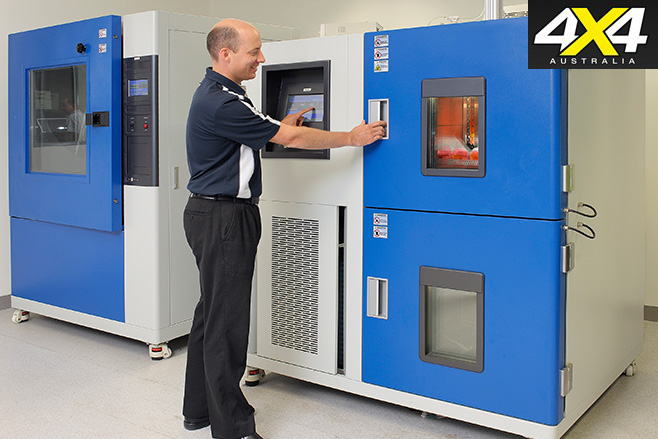
At BWI this typically includes field trials to test the product in the real world, as well as many lab tests, such a ingress protection tests, which check for dust and water resistance; and thermal shock tests, where the product is continuously subjected to rapid temperature change (typically minus-40°C to plus-80°C) to test the durability of the mechanical structure and electronic assembly.
Next is the barrage of electrical tests, such as reverse connection, over-under voltage and voltage surges. These tests should ensure that when a product hits the market, it does what it’s supposed to – for a long time.
More testing The last step, but certainly not the least important, is the ongoing testing of the production runs. This varies greatly depending on the type of product, but in the case of the IDC25 charger it includes a burn-in test of each charger for two hours, followed by a full-function test (input voltage, output voltage, voltage set points for each charge stage, etc.) to ensure every unit meets the specifications set.
And, evidently, that’s how a Melbourne-based company like BWI can survive in a market flooded with cheap imports – by going the extra mile to ensure quality.