
The Fortuner slots in below the Prado as the most affordable proper off-road diesel in the Toyota line-up.
WHAT’S THE DEAL?
Prices start at $47,990 for the entry-level GX, which gets cruise control, auto headlights, a reversing camera and seating for seven. The wheels are steel 17-inch units but, as with all models, it gets a rear diff lock.
As with all models, an auto transmission adds $2000.
From there it’s a step up to the GXL ($52,990), which adds alloy wheels, roof rails, smart key entry, tinted windows and an auto up/down function for all electric windows (the GX gets that functionality only on the driver’s window). There’s also an ‘intelligent manual transmission’, which includes a mode to match engine revs on gear changes. It’s particularly useful on downshifts where it gives a race driver-like blip of the throttle for seamless changes.
Topping the range is a new nameplate in the Crusade ($59,990), which is the model we’ve tested here. It gets 18-inch alloys, sat-nav, digital radio, a powered tailgate, powered driver’s seat, some leather trim, fake wood trim and a 220V power point.
PRACTICALITY
It’s slightly shorter (by 135mm), narrower (30mm) and lower (45mm) than a Prado and sits on a wheelbase that’s 40mm shorter. The length comparisons are skewed by the Prado’s tyre protruding on the swing-out tailgate, whereas the Fortuner’s tyre sits under the rear (meaning only one 80-litre fuel tank rather than the twin tanks that total 150 litres in the Prado).
Inside there’s not the sense of space – particularly head room – of a Prado. But there’s decent room to move and seating for seven. All three rows get fresh air courtesy of vents in the roof.
The centre seatbelt in the middle row comes out of the roof, and the seats themselves flip and slide in a 60/40 configuration.
The third row folds against the size similar to the previous generation 120-Series Prado and the current 200 Series Land Cruiser. It means they take up a fair bit of space, although they can be bolted out for those never planning to use them.
With those seats folded up to the side, the boot space goes from generous to average.
Still, there’s respectable storage elsewhere – door pockets and a cooled centre console, for example – and a decent layout to the main controls up front.
ON THE ROAD
The Fortuner is largely Hilux underneath but with a slightly shorter wheelbase and coil spring rear-end. No surprises then that’s it’s got that rugged, utilitarian feel to it. With one or two on board, it’s reactive to city bumps and prone to some rocking and rolling through bends.
But it deals well with chunky dirt roads and lumpy tracks.
The 2.8-litre four-cylinder turbo-diesel – the same one used in the Hilux and Prado – is honest but uninspiring. The 130kW of power is largely academic because it’s the 450Nm you’ll be using most. It’s not as quiet as it is in the recently updated Prado, but it feels more lively because the Fortuner is a few hundred kilos lighter (from 2110kg, for the GX, to 2135kg, for the Crusade).
Like all Toyota off-roaders the steering has vagueness, but it’s faithful in its responses.
OFF-ROAD
Key to the Fortuner’s ability is its towering 279mm of ground clearance. It also gets the Hilux’s full artillery of steel protection for mechanical vitals underneath.
It sets the scene for what is a very capable off-roader.
The four-wheel drive system is part-time, so with torque going to all four wheels it can’t be driven on bitumen. But off-road it combines with the locking rear differential for excellent traction.
Wheel articulation is also decent ensuring you have to really cross it up before wheels start hanging in the air.
Unlike some Toyotas – and the recently released Ford Everest – there’s no terrain select system to adjust throttle and transmission sensitivity (and tailor the traction control). Such a system would be handy in low speed rock crawling, where the relatively sensitive throttle (in low range) means being gentle with the right foot.
The 30-degree approach angle is also great, with the steel underbody protection generally the first thing to come in contact with something at the front. At the rear the spare tyre partly protects the bumper, but we found it was the mud flaps that were the first things to scrape.
The Fortuner is claimed to tow up to 3000kg, but that’s only for the manual, which gets slightly less torque than the auto (420Nm versus 450Nm). The auto still outdoes the Prado, though with a 2800kg capacity.
While the Fortuner’s 80-litre fuel tank is on par with key ute-based SUV rivals – Isuzu MU-X, Holden Colorado7, Mitsubishi Pajero Sport and Everest – it’s almost half the size of the Prado’s, limiting the realistic range to about 600km.
As with other Toyotas, there’s an extensive range of accessories, including bullbars, roof racks, a snorkel and an integrated Warn Winch. There’s also a separate fuse box under the bonnet to make it easier to wire extra gear.
VERDICT
It’s simple, honest and impressively effective off-road. The Fortuner doesn’t set any new standards. But it does offer a rugged and capable alternative to the Prado for those who don’t needs its slightly larger dimensions.
There are notable compromises, but the core engineering ensures it’s a 4×4 you’ll likely see more of in the bush. One of the early challenges could be getting hold of one; Toyota is supply-constrained on Fortuner throughout 2016.
Price and specifications
Price: $59,990
Engine: 2.8-litre 4-cylinder turbo diesel, 130kW at 3400rpm, 450Nm at 1600-2400rpm
Transmission and 4WD system: 6-speed auto, part time dual-range 4WD
Braked tow capacity: 2800kg
Spare tyre: Full size
Fuel tank: 80 litres
Fuel use (claimed): 8.6L/100km
Fuel use on test: 11.5L/100km
Approach/departure angles: 30 degrees/25 degrees
Ground clearance: 279mm
Headlights can be set incorrectly or out of alignment for many reasons. Either they were never set up properly at the factory, the headlight unit was replaced at some stage, or the vehicle has bumped into something.
To set up headlights properly, you will need a relatively clear wall (a garage door, for example) and level ground of at least 11 metres leading up to the wall in a straight line. You only need to set up low beams if the headlights are a dual filament type – the high beams are set according to low beam adjustment. This adjustment procedure is only for conventional halogen headlights.
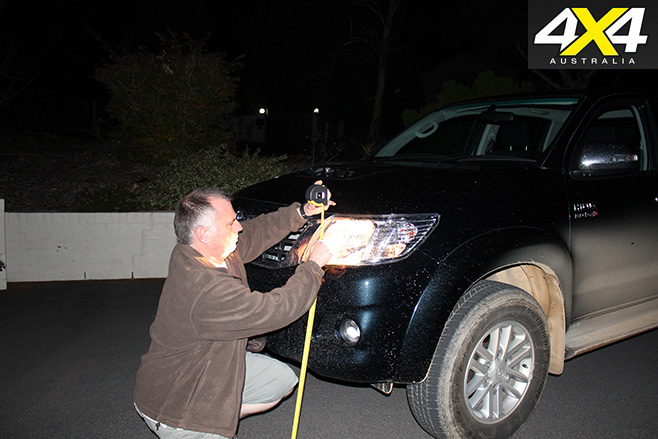
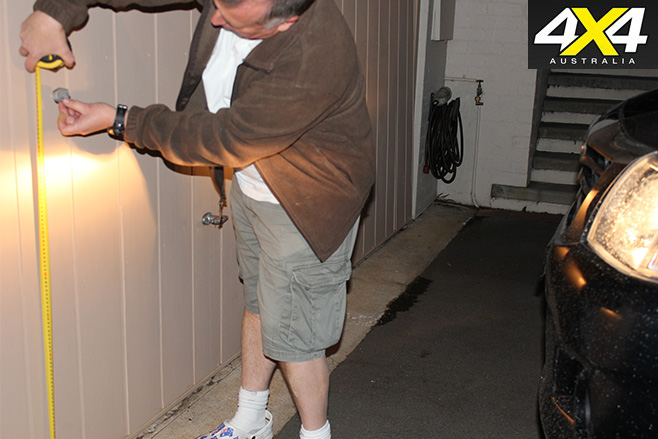
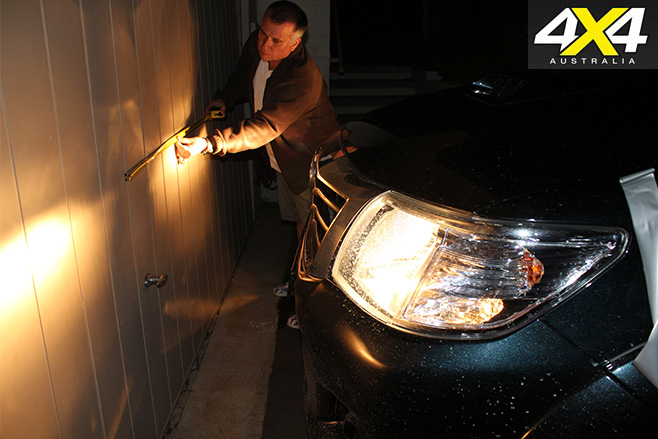
Set up the vehicle with a full tank of fuel, the weight representing a driver on board and correct tyre pressures. Then measure from the ground to the headlight’s horizontal centreline and using this measurement, mark the wall. Make sure that the mark is directly in front of the headlight at its vertical centreline – it’s easiest to do with the vehicle close to the wall. Then measure the horizontal centreline of the vehicle and mark this line on the wall.
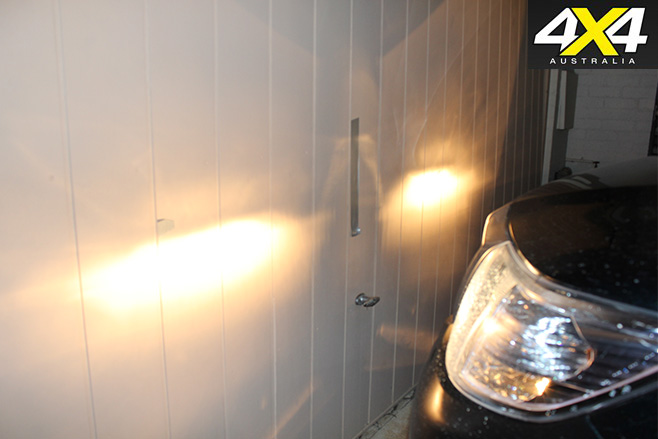
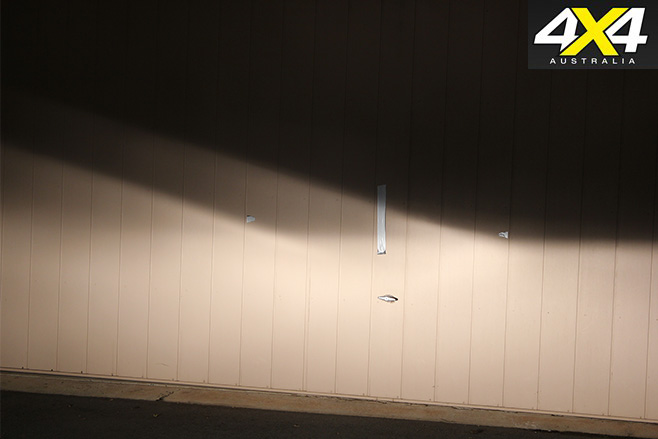
Now measure and mark 7.5 metres away from the wall then reverse the vehicle so that the front is at the 7.5 metre mark. The next step is best done at twilight or in darkness. Turn on the headlights on low beam and see where the beam shape falls; you will notice a V-shaped pattern to the way the light falls. The bottom of the ‘V’ should fall about 40mm from the left tape mark on the wall and for the right headlight, about 40mm to the left and then 40mm down.
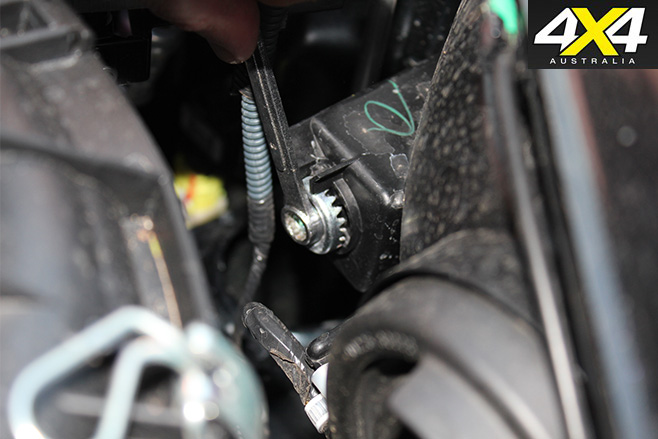
To adjust the headlight, consult your owner’s manual, but usually an adjustment screw, one for vertical adjustment and one for horizontal adjustment, can be found behind the headlight assembly.
1. Measure from the ground to the centreline of the headlight.
2. Use previous measurement to mark the wall or the garage door with tape.
3. Measure from vehicle centreline to headlight centreline and use this measurement on door.
4. Mark centreline on door or wall with tape.
5. Measure 7.5 metres from wall.
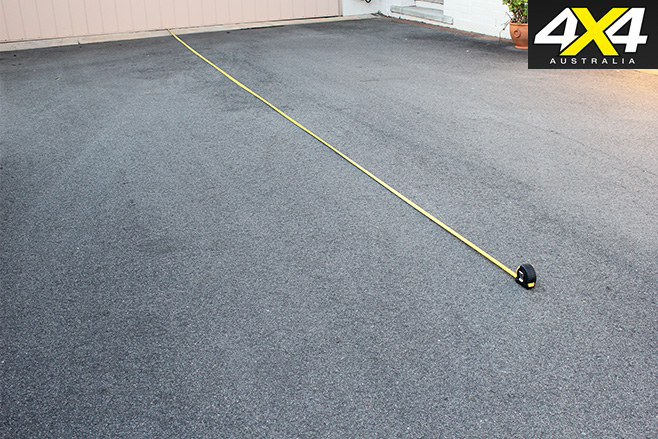
6. Mark the 7.5 metre point with tape.
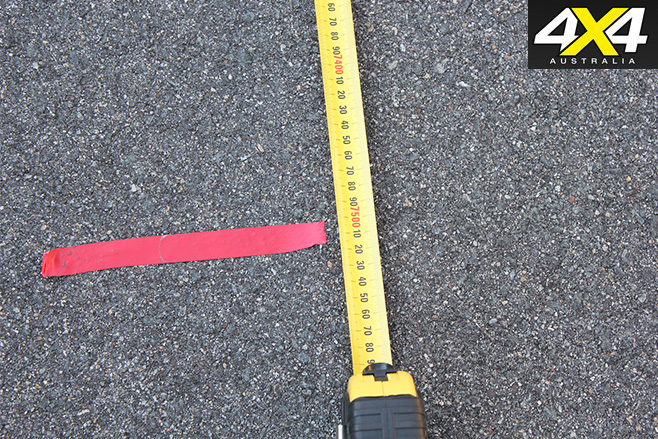
7. Reverse vehicle away from wall in a straight line until the front is at the 7.5 metre mark.
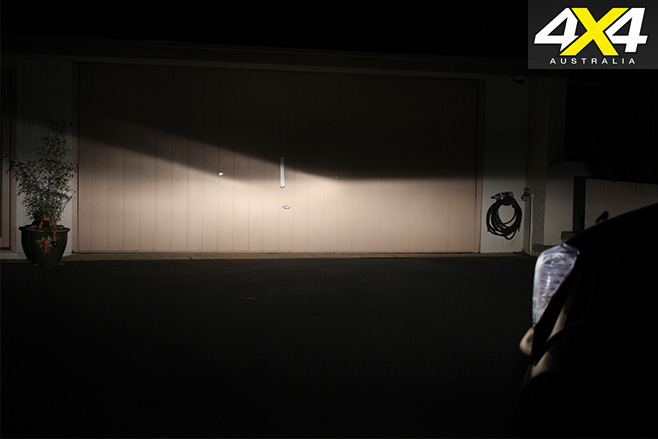
8. Here you can see headlight alignment is out.
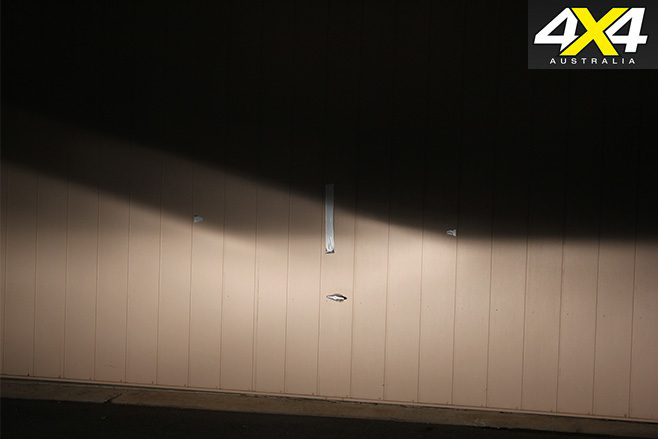
9. The centre of the left ‘V’ should be about 40mm below the tape mark.
10. Find the headlight adjusters and re-align headlights to their correct positions.
Short of a Jeep-bodied monster truck, it’s pretty hard to think of a more comprehensively modified Wrangler than the metallic-green one you’re looking at right now.
Oh sure, it started life as a 2008 Wrangler Unlimited but, as you can probably see, it’s now a whole lot more than that. In fact, there hasn’t been one aspect of the rig that hasn’t been fiddled with or outright re-engineered; not a single system that hasn’t been refined or replaced in the name of showing nature who’s boss.
And don’t go thinking that it’s some kind of trophy-hunting bitumen queen. Cos it ain’t. Its owner and creator, Melbourne-based Andrew Speedie (top name for a car guy), drives the Wrangler just as Jeep intended.
“It’s not a daily-driver, but we get it out on plenty of weekends,” Andrew says. “Mainly around the Victorian High Country and Toolangi and that area. It’s done 72,000km and I’ve owned it from new. I’m not one for screaming through bog holes and getting it caked in mud and whatever; I’m more into the technical type of track.”
Mind you, it wouldn’t really matter what Andrew pointed the Jeep at, the thing is so heavily adapted to off-road life that it’d probably just chug over the top of anything silly or slow enough to get in its way.
So where do we start with the mods? Okay, let’s try the driveline. Andrew has turned his back on the traditional V8 heart transplant argument, and has instead gone down the forced induction track, retaining the 3.8-litre V6 but bolting a dirty great Magnuson supercharger to it.
The TVS1320 blower is a twin-screw type of blower and pumps through a water-to-air intercooler after drawing from a snorkel set-up. It takes its instructions from a custom VCM tune for the on-board brain that has neatly got around the usual tuning problems of poor idling, rough running and the check-engine light flashing up on the dashboard. Long-tube headers help the V6 breathe out just as the blower helps it breathe in.
A conservative 6psi of boost and the 3.8 V6’s inherent strength and durability have meant that the engine has never been opened, and this, Andrew reckons, is probably the only area of the vehicle that remains stock. But with a healthy 40-plus per cent hike in power and torque at the wheels, the huffed-upon V6 gets things moving pretty well.
“The thing for me is not necessarily the power,” he says. “It’s the torque. It sails up the road, even though – look at it – it’s a brick.”
Backing up the huff and puff is a Jeep four-speed auto and transfer-case, but they’ve been joined by a Rubicrawler reduction box for true crawler gears and the ability to select, say, low-low-range two-wheel drive. US specialist Rugged Ridge supplied the beefed-up driveshafts and there’s also a bigger aftermarket tranny cooler.
Continuing the theme of eliminating any weak link in the powertrain, Andrew specified a pair of Dana 44 diffs with Eaton locker centres and 5.13:1 final-drive ratios. And with tall 37.0-inch Nitto Trail Grapplers on Pro Comp Xtreme alloy wheels, you can see the sense in that.
“You hear of guys who run big tyres and supercharged engines but don’t change the diff ratio,” Andrew explains. “So what they’re really doing is using the blower to offset the tyres.”
It makes perfect sense, too, and lowering the final drive to bring the revs-to-road speed ratio back to more or less stock has meant that all that extra power and torque can be used to slingshot the Wrangler up hills and out of holes rather than simply compensate for the huge rolling diameter – and, therefore, much taller gearing – of a set of 37-inchers.
So what else is going on here? Well, the Jeep suspension was flung into the nearest bin and replaced with aftermarket gear with higher steering mounts to cope with the three-and-a-half inch lift (which actually looks more than that).
Synergy springs are fitted and there’s a pair of Fox remote-reservoir shocks at each corner, too. US specialist TeraFlex supplied the brake rotors at each corner and there are four-pot calipers up front. Andrew is considering a rear caliper upgrade, but for the moment the stock Wrangler rear grabbers do just fine.
On the off-chance that the Wrangler meets the insurmountable, there’s a 12,000-pound Smittybilt winch mounted on a compact front bar and tough, metal body protection is bolted to the corners of the vehicle, along the rockers and underneath in the form of bash plates. Wider aftermarket guards keep the tyres out of the rain and the paintwork is still brilliant, despite many of those 72,000km on the odometer being in the bush.
Inside, the attention to detail continues. Extra gauges are a cinch for something with so much extra poke, and the dual battery monitor is mounted prominently, too.
Corbeau buckets fill the front half and Andrew reckons the rear seat is on borrowed time. It won’t, however, be replaced with a new pew; instead he’ll turn the seat area into secure compartments for a fridge and other outback necessities.
Swing open the tailgate and you’ll find a fold-out table at the ready, along with a solid cargo blind that is also lockable, giving a secure space to stash valuables even when the removable hard-top is at home in the garage. There’s also a huge bank of Anderson plugs, while the second battery lives under the floor in the cargo area. Very neat, very effective.
Probably the major interior addition is the sports cage that mounts in multiple places to the Jeep’s floorpan and structure, offering not just roll-over protection, but extra rigidity; handy, since Andrew admits he likes the vehicle best when the roof is off. The Poison Spyder-manufactured cage is padded, beautifully made and even mounts a pair of speakers for the stereo.
You could look at this car and presume Andrew grabbed a catalogue and ticked every box on every page before hammering his credit card into submission. And, of course, there is a financial price to be paid for this high level of modification.
Andrew plays the dollar-question pretty close to his chest, but it’s clear that he has spent more on modifications and accessories than it costs to buy the vehicle new. Obviously, that more than likely tips it over the $100,000 mark, but unlike many vehicles you can actually see where the cash has gone.
In fact, look really closely and you can see the attention to detail is quite incredible, suggesting that plenty of planning went into the mods. More than that, every piece works properly with the one it’s bolted to, and the Wrangler emerges as a high-end collection of well-considered bits and pieces. That, in turn, makes it more than the sum of its parts.
And when you look at the list of those parts, that’s really saying something.
Toyota’s new 2.8-litre, four-cylinder diesel engine…
It’s now in the Prado, the new Hilux and the Fortuner, and it offers a modest 3kW increase in peak power over the 3.0-litre engine it replaces.
Nevertheless, it is still a significant achievement.
Despite being eight per cent smaller in capacity, it produces 10 per cent more torque (now 450Nm; previously 410Nm) and more low- and middle-rpm power as a result.
But the smaller capacity is not the big efficiency story, as the new 2.8 engine’s 15.6:1 compression ratio is a significant 15 per cent lower than the 3.0-litre’s ratio of 17.9:1.
Compression ratio is a vital part of engine design. Higher compression ratios allow more mechanical energy to be extracted from the fuel being burnt and are a simple way to develop more power without increasing either engine speed or engine capacity.
The compression ratio of an engine is simply the volume of the cylinder when the piston is at the bottom of its stroke, compared to the volume of the cylinder when the piston is at the top of its stroke.
Increasing the compression ratio means the air-fuel mixture is squeezed into a smaller space, and when the mixture is ignited, higher pressures are applied to the piston.
This increased pressure on the piston provides more torque at the engine’s crankshaft (through the mechanical means of the conrod acting on the crankshaft’s big-end journal). That extra torque then produces more power.
In spark ignition (i.e. petrol) engines, compression ratios that are too high lead to pre-ignition (or detonation). This is where the fuel is ignited not by the spark plug, as it should be, but by the heat generated by the air being compressed, in what is an out-of-control and potentially engine-destroying explosion within the combustion chamber.
Diesel engines are designed to use the heat generated by compressing the air to ignite the fuel and have traditionally had high compression ratios. In fact, even as recently as 10 years ago, many 4×4 diesels had compression ratios up around 22:1 or even 23:1, a far cry from this new 2.8-litre’s 15.6:1.
Even though diesels are designed to have high compression ratios, and high compression ratios provide efficiency, it’s not all good news. A more forceful and violent explosion within the combustion chamber produces more noise in the form of diesel ‘knock’ and ‘rattle’, and potentially more engine vibration.
High compression ratios also produce more environmentally damaging oxides of nitrogen, commonly referred to as NOx; another reason why modern diesels are moving to lower compression ratios.
One thing that’s very obvious with this new 2.8 is that it’s much quieter and more refined than the outgoing 3.0-litre.
So how does a smaller engine with a lower compression ratio manage to make more power and torque than a bigger engine with a higher compression ratio, given that increasing an engine’s capacity and compression ratio is a straightforward way to increase torque and power?
The simple answer is that the 2.8 is more efficient at extracting energy from the fuel. Despite the lower compression ratios, the effective operating pressure within its cylinders is higher. This operating pressure is commonly called Brake Mean Effective Pressure (see ‘What is BMEP?’ sidebar).
The 2.8 achieves its higher BMEP despite a much lower compression ratio thanks largely to its common-rail fuel-injection system.
The common-rail system employed for Toyota’s new 2.8 engine runs at 2500bar, or around 35,000psi. That’s 1000 times what you put in your four-wheel drive’s tyres when they are pumped right up. Some common-rail systems use pressures as high as 3000bar.
The high fuel pressure means it takes less time to deliver the required fuel into the combustion chamber. Common-rail systems actually deliver the fuel to the combustion chamber in several small squirts rather than in one injection, as per older diesel engines.
The number and timing of these small, individual squirts of fuel depend on the load on the engine and on engine speed, and are designed to optimise flame propagation within the combustion chamber so the fuel is burnt most efficiently.
Interestingly, while European diesels commonly use very sophisticated piezo-electric injectors, Toyota’s 2.8-litre diesel uses more traditional electro-magnetic solenoid injectors, which are potentially less fuel-quality sensitive.
What is BMEP?
Brake Mean Effective Pressure (BMEP) is a measure of the operating pressure in an engine’s cylinders averaged out over the compression and power strokes. It’s a standard and handy measure of an engine’s “state of tune”. Highly tuned engines have high BMEP figures, while “soft-tune” engines have lower BMEP figures.
With any engine, if you increase the BMEP you will produce more power. Along with engine size and engine speed, BMEP defines how much power can be produced simply because more pressure on the piston will produce more torque at the crankshaft and therefore more power.
BMEP is a theoretical measure calculated from dynamometer-measured torque and is different from (although related to) measured cylinder pressure, commonly called Indicated Mean Effective Pressure, or IMEP.
Camp chairs are getting more comfortable all the time, though that comfort comes at a price, with many chairs now taking up too much storage space in 4x4s.
For those looking for an option that gives back some space, these Helinox chairs are worth a thought.
When packed in their zippered mesh carry bags the Sunset and Camp Chairs are less than 51cm long and 1.5kg each, so they’re light and compact enough to fit in anyone’s space-challenged vehicle.
But to be honest, I was a little discouraged when I first saw them. “Too much of a pain,” I said, staring at the chair seat and pile of alloy poles. However, the poles are spring-loaded and clip together in an idiot-proof manner. The seat itself then fits to the frame via support holes, and the job is done. It doesn’t take much longer to prepare than the seats we usually drag around in our trucks.
How do they perform comfort-wise? Well, they give plenty of support. I preferred the Camp Chair to the Sunset Chair, which is the more lounge-style model. The Sunset even has a tote bag that attaches with a concealed Velcro flap, so that you can use a towel or jumper as a head rest.
Over a four-day weekend, the only complaint I had was that there wasn’t a place to hold my beer. The chairs are strong and supported all our campers without a problem. They are rated to hold up to 145kg.
We did, however, notice when coming back to camp a couple of times that of all the chairs at our site, only two had blown over – the very light Helinox chairs. From then on, when we left camp to explore we pulled both the Helinox chairs away from the campfire. It’s not a serious issue, but something to keep in mind.
They’re not cheap. The Sunset Chair’s RRP is $196 ($174 online direct) and the Camp Chair’s RRP is $188 ($158 online direct). But they’re a good option nonetheless. We were pleasantly surprised by their overall package, not least by their comfort.
Small and light, they are perfect for those with space-challenged vehicles, and they’re good for the fishermen and walkers among us.
RATED
Available from: www.helinox.com.au RRP: Camp Chair $188.00; Sunset Chair – $196.00 We say: Compact and light. Ideal for backpacking.
For more information and tips on Gear, check out our page here.
While the Everest is based on the chassis of the Ranger, it is priced higher than most other ute-based SUVs.
That’s because Ford sees it competing more with the hugely successful Toyota Prado.
WHAT’S THE DEAL?
The price of entry for the basic Ambiente (the model we’ve tested here) is $54,990 (plus on-road costs). For that you get 17-inch alloy wheels, auto headlights, rear parking sensors, a reversing camera, and the usual array of cruise control and Bluetooth connectivity.
However, the central screen that displays information for the sound system and phone is tiny, at just 4.2 inches across the diagonal.
Step up to the Trend ($60,990) and the wheels go up to 18 inches and the cruise control gets an active feature that uses radar to lock on to the car in front. The pokey touchscreen is replaced with an 8-inch unit teamed with the Sync voice-operated infotainment system. And there are extras such as tinted windows, a powered tailgate, rain-sensing wipers, side steps and dual-zone air-conditioning. Active safety gear includes forward collision warning and a lane keeping system.
From there it’s a big step up to the flagship Titanium ($76,990), which adds leather seats, adjustable ambient lighting inside, heated front seats, sat-nav, panoramic sunroof and blind spot warning. The wheels step up to 20-inch units and come with a tyre-pressure monitoring system.
However, there’s no smart key entry on any model and, like the Ranger it’s based on, the Everest misses out on reach adjustment for the steering.
A towbar is $1000 on all models.
PRACTICALITY
There’s a relatively high floor on the Everest, which makes for a decent climb into the cabin, especially on the Ambiente, which does without side steps. Once there, it’s a comfortable place with good front seats and plenty of binnacles for odds and ends. It’s a shame about that lack of reach adjustment to the steering wheel, which would top off an otherwise great driving position.
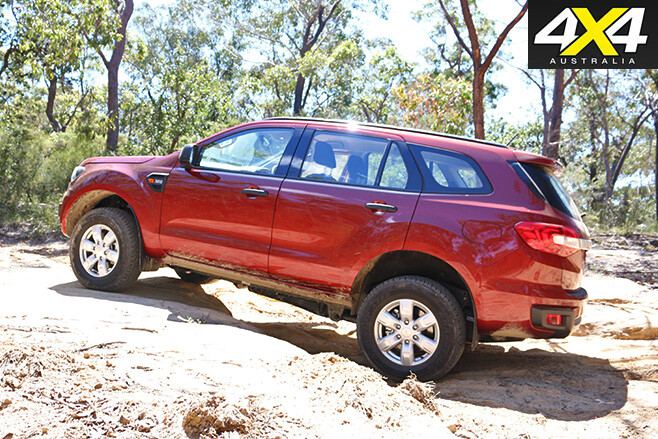
Adults in the middle row are almost short of headroom, but – as with the third row – at least there’s a stream of fresh air thanks to the roof-mounted vents. The middle row slides forward and back and can be folded flat using a separate lever.
The third row split-folds into the floor. One bonus for those with kids is the flexibility of where you can place child seats. While most 4WDs only have top tether points in the centre row of seats, the Everest also gets them in the third row. Sure, it doesn’t leave much room for luggage with all seven seats in play, but it’s great for when your 4×4 is confined to the suburbs.
ON THE ROAD
Ute-based SUVs often feel pretty rugged in regular driving, but the Everest sets a high standard. The highlight is its refinement. While the 3.2-litre five-cylinder diesel can be heard, it’s nowhere near as vocal as it is in the Ranger. Put that down to some clever noise cancelling; three microphones in the roof monitor noise coming from under the bonnet and send opposing frequencies through the speakers to significantly hush the cabin. Road and wind noise, too, are well contained, making for a relaxed cruiser.
Through corners the Everest does a good job dealing with its relatively high centre of gravity. The steering is light yet accurate and decent body control makes the whole equation fairly viceless. And having the permanent 4WD system gives you confidence punching out of intersections or slippery hairpin bends.
The turbo diesel has plenty of grunt – 143kW and 470Nm – but it’s lugging around a big vehicle in the Everest; even the base Ambiente is 2370kg, with the top-whack Titanium just shy of 2.5 tonnes. Still, the easily accessible low rev torque makes for respectable progress. And the six-speed auto is pretty cluey, holding gears on descents and decisively plucking lower gears as required when accelerating.
OFF-ROAD
While it’s based on the Ranger, the Everest is a quite different beast off-road. That’s due mainly to its unique four-wheel drive system. The full-time system uses a torque-on-demand system to apportion drive front and rear.
The Everest also gets a Terrain Management System, which alters the throttle response, gear changes and traction control for different conditions.
In Snow/Grass/Gravel it reduces throttle sensitivity and upshifts sooner to use the torque and maximise traction. In Sand it holds gears longer to allow for higher revs and allows for more wheel slip to maintain momentum; the torque delivery and throttle sensitivity are also high. Rock mode is only allowed in low range and locks the transmission in first gear (which can be frustrating if you’ve got short bursts of dirt track between rocky patches); it also reduces throttle sensitivity but has a more aggressive traction control mode to reduce wheel spin.
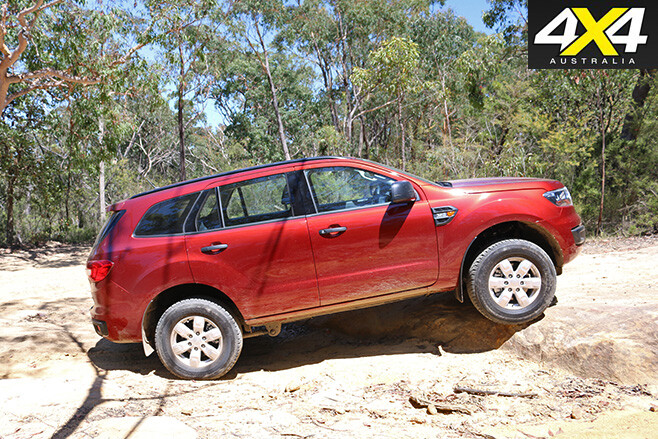
As well as hill descent control – commonplace on modern SUVs, even the soft ones – the Everest gets hill ascent control, for controlled low-speed throttle applications when climbing steep grades. The speed of each can be adjusted by blipping up and down on the gear selector manual mode.
It’s all clever stuff and, importantly, all works well to make for easier progress in more challenging terrain. It teams with a decent 225mm of clearance, good approach and departure angles and good underbody protection to make for a very capable and easy to use off-roader. Throw in the 800mm wading depth and the Everest cements itself as one of the best in the business.
VERDICT
The Everest is a big step up for ute-based SUVs – but you pay for it. Its pricing if against the legendary Toyota Prado is bold. Yet the main things it lacks are headroom in the middle row and an extended fuel tank.
Otherwise, there’s a clever 4×4 system setting the foundation for excellent off-road performance. Throw in great on-road manners and excellent refinement and the Everest is a fine 4×4.
Price and specifications
Price: $54,990
Engine: 3.2-litre five-cylinder turbo diesel, 143kW at 3000rpm, 470Nm at 1750-2500rpm
Transmission and 4WD system: Dual-range torque on demand full-time 4WD
Braked tow capacity: 3000kg
Spare tyre: Full size
Fuel tank: 80 litres
Fuel use (claimed): 8.5L/100km
Fuel use on test: 11.3L/100km
Approach/departure angles: 29.5 degrees/25.0 degrees
Ground clearance: 225mm
The rush of new and revised utes this year has reshaped a vital and vibrant sector of the 4×4 landscape on a scale we have not seen for some time.
The run of new utes kicked off early in the year when Mitsubishi launched its fifth-generation Triton. Next up was the new Nissan Navara NP300. Like the Triton, the Nissan represented the first-generational change of the Navara in ten years.
In quick succession the Ford Ranger and the closely related Mazda BT-50 were both revised, although the upgrades to the Ranger ran far deeper than the facelift given to the BT-50. In fact, the two utes are now noticeably different, whereas before they were essentially the same with only very minor mechanical variations.
Finally, there’s the new Toyota Hilux. Given its market-place popularity, this is really the ‘biggie’ and the ute that’s most likely to have the biggest impact on the market.
Carried over essentially unchanged this year are the three other mainstream utes: the Holden Colorado, the Isuzu D-Max and the Volkswagen Amarok. The Amarok model line-up, however, has been revised with the introduction of a new base-model, the Core.
For this test we have lined up all eight of these popular 4×4 utes. They are all mid-spec dual-cab automatics. Where there is more than one engine available, as is the case with the Hilux, Ranger and Navara, we have gone for the main engine option.
To test their mettle we put them through a series of exhaustive off-road tests and drove them on a wide variety of roads, ranging from good-quality bitumen and secondary bitumen to unsealed roads.
Then we pulled out the tape measure and climbed all over them. We even ran them down the dragstrip!
TESTING TIMES This ute shootout was done at The Melbourne 4×4 Training and Proving Ground. The proving ground gave us every type of terrain, gradient, road surface and off-road situation that we could ever want to test a vehicle in – and all in one, controlled, safe environment. We could drive for days to find the variety that was on offer there. Couple this with the top-notch facilities and a conference centre and it was the perfect base for our use.
The facility also offers both accredited and non-accredited driver training, rally and drifting schools and even rides in property owner Robbie Emmins’s Centurion tank. That’s something you won’t find anywhere else!
The 4×4 Proving Ground is not open to the general public, so you must be part of a course or event to visit the property. Visit the website at www.melbourne4x4.com.au to see when there is a course for you.
Ford Ranger
Ford’s Ranger is designed and developed in Australia, and is sold in markets right around the world.
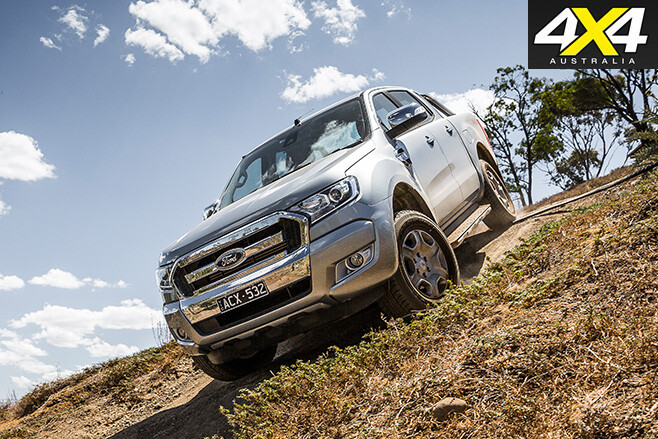
The Ford Ranger PX first appeared in late 2011 and despite carrying over the name of its predecessor it was, in fact, an all-new ute. Most significantly it was a Ford product through and through, whereas the first vehicle to carry the Ranger nameplate in Australia was a re-badged Mazda.
Right from the get-go the Ranger PX has done well for Ford, but it looks set to do even better with the raft of changes that the PXII upgrade has brought. Aside from a new front-end treatment and new dashboard, the Ranger has a smaller, more efficient turbo for faster spool up, new fuel injectors, changes to the cylinder head and various measures to improve engine NVH.
The electronic control of the 4×4 system has also been significantly enhanced, while electric-power steering has replaced the hydraulically assisted steering used previously. Ford has also successfully addressed the much-criticised shift action of the six-speed manual and introduced a raft of high-end safety features as an option on the two top-spec models.
On-road performance, handling and ride In this company the Ranger has a big engine (3.2-litre, five-cylinder), which makes for strong on-paper power and torque numbers.
In the 400-metre sprint the Ranger was bettered only by the lighter Holden Colorado. It fared much better than the Mazda, which claims the same maximum power and torque – evidence that Ford’s revision of the turbo and injectors has paid useful dividends. The Ranger’s engine is also much quieter than the Mazda’s, again evidence of the effectiveness of the mid-life revisions.
The engine mates nicely to the generally agreeable six-speed automatic, while the much improved shift action of the six-speed manual means that buyers now have two viable gearbox options.
Ford nailed the Ranger’s on-road ride and handling right from the start, and the Ranger remains at the pointy-end of the field in this regard despite the fact that most of its competitors are newer. It still has a firm ride at the rear, as you’d expect, but it’s not harsh or uncomfortable, and it has one of the best front-to-rear suspension matches.
The newly introduced electric power steering also works well; it’s very light at low speeds, but it firms up nicely at higher speeds.
Off-Road The Ranger’s very light low-speed steering makes it presence felt off-road; it’s certainly the most effortless here.
The other significant mid-life upgrade that aids the Ranger’s off-road credentials is that traction control stays active on the front axle when the rear differential lock is engaged. A rear locker is standard (or optional) on all Ranger 4×4 dual-cab utes with the 3.2-litre engine depending on spec.
With the help of its locker and newly tweaked ETC, the Ranger cleared all of the set-piece climbs, although its sheer size, long wheelbase and only-okay over-bonnet vision don’t work in its favour in tight off-road situations.
Cabin and accommodation The Ranger is big on the outside, and the cabin is big, too. Only the Amarok’s cabin is wider, but the Ranger (and BT-50) beat the Volkswagen for combined front and rear legroom.
The new dashboard, with its larger touchscreen, is also an improvement. The seating position is generally comfortable; though it’s a shame Ford couldn’t introduce tilt-and-reach steering-wheel adjustment as part of the Ranger’s mid-life upgrade.
Somewhat surprisingly, a reversing camera is not available across all grades.
Practicalities The big torquey engine is a good starting point for work duties, as is the class-leading towing rating, GVM and GCM figures. Those venturing off-road have the security of the engine breathing through the inner guard, and the option of replacing the 18-inch tyres on the top-spec Wildtrak with 17s from the lower spec models.
The Ranger is also backed up by a dealer network second only to Toyota’s, and there’s a wide selection of aftermarket equipment available.
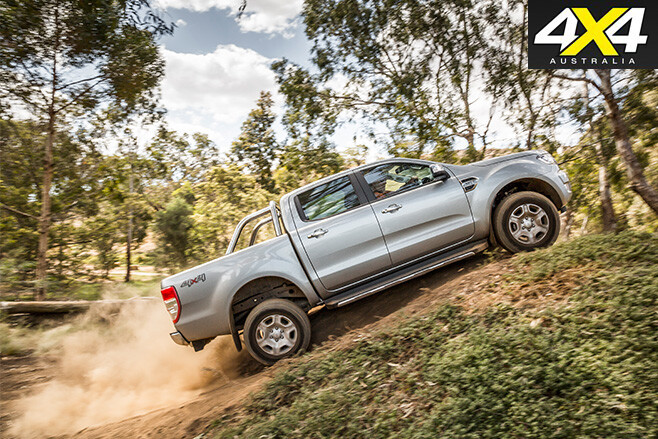
Specs: Ford Ranger XLT
Engine: 3.2-litre 5-cyl turbo- diesel Max power/torque: 147kW/470Nm Gearbox: six-speed automatic 4×4 system: dual-range part-time Kerb weight: 2159kg GVM: 3200kg Payload: 1041kg Towing capacity: 3500kg GCM: 6000kg Fuel tank capacity: 80 litres ADR fuel cons: 9.2 litres/100km
Ford Ranger prices* XL: $48,790 XL Plus: $52,960 XLS: $50,090 XLT: $56,390 Wildtrak: $59,890 *Automatic 3.2-litre 4×4 Dual-Cab Pick-Ups only, unless noted. Manual saves $2000.
Sum up The Ranger has always been an excellent ute thanks to its combination of on-road civility, off-road ability, solid work credentials and its roomy cabin. With a mid-life update, Ford has built on the Ranger’s core values to produce an even better ute. And while all models have appeal, the XLT and Wildtrak’s optional high-end safety features make them a standout in the current ute market.
Holden Colorado
The Holden Colorado offers plenty of performance, but is that enough for it to keep up with the opposition?
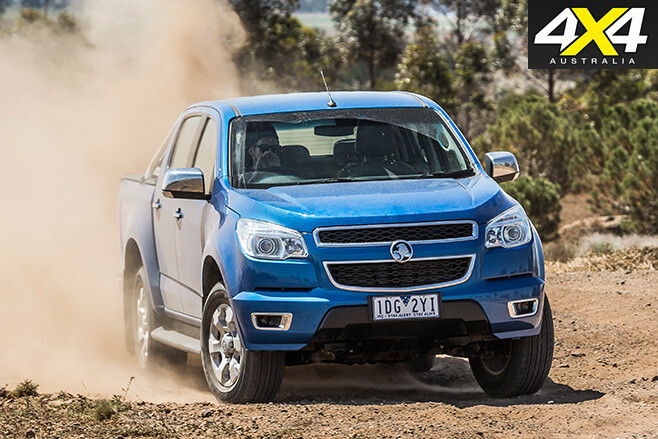
Up until this Holden Colorado arrived in 2012, all Holden 4×4 utes – the previous-generation Colorado and all the Rodeos before that – were essentially Isuzus. This Colorado, however, is a General Motors product from the ground up. It was developed by a global GM team based in Brazil (where dual-cab utes are big business), but with input from Holden engineers and designers.
For the 2014 model year the Colorado underwent an engine upgrade and gained a new six-speed manual gearbox, as well as a raft of new safety and technology equipment. Additions include trailer-sway control, rear park assist, and a reversing camera for the LTZ model.
On-road performance, handling and ride All Colorados are powered by a 2.8-litre four-cylinder diesel from Italian diesel specialist VM Motori. It’s essentially the same engine used in the Jeep Wrangler with a different tune.
The 2014 engine upgrade saw maximum power increase from 132kW to 147kW – obviously aimed at matching the output of the 3.2 five-cylinder in the Ranger and BT-50.
When mated to the optional six-speed auto it gains an extra 30Nm of torque to bring it up to a class-leading 500Nm; although when mated to the new six-speed manual that replaced the previous five-speed manual, maximum torque remains at 440Nm.
The fact that it’s among the lighter utes here makes it the performance leader, although not by a significant amount.
However, that performance comes at the cost of noise and a generally harsh and unrefined feel from the engine. The six-speed automatic doesn’t help matters, either, as it can be indecisive and is generally one of the least likeable gearboxes here. For its part, the manual has a positive shift action, but the overall gearing is way too tall for all but high-speed flat roads.
On the road the Colorado rides and handles respectably well, but lacks steering feel and has a somewhat heavy and ungainly demeanour compared to the better-sorted utes. It’s not bad, but it’s certainly not great.
Off-road Along with the Isuzu D-Max, the Colorado is the only ute here that doesn’t offer a rear diff lock at any spec level. On our set-piece climbs it didn’t perform well and, tellingly, it was one of the three utes that failed the most difficult of the test climbs.
Like all the other utes, the Colorado has ETC, but it’s not that effective; although that may also come down to wheel travel, or lack thereof. The Colorado also feels big off-road, and has restricted views. Its ground clearance and approach and departure angles are competitive, though.
Cabin and accommodation The Colorado offers five-star safety in what is a big and spacious cabin. It’s not as big inside as the Amarok, Ranger or BT-50, but it’s not far behind and it’s certainly roomier than the Triton, Hilux or Navara.
It’s reasonably comfortable, but the steering wheel lacks reach adjustment. The cabin fit-and-finish is also off the money, while the app-driven satellite navigation and lack of a CD player may irk some buyers.
Practicalities The Colorado matches the best here in terms of towing capacity and Gross Combined Mass. Given it’s also reasonably light, its 3100kg GVM also translates to a decent payload. Like all of the utes, there is no rear recovery hook, but there are two up front. The Colorado also draws its intake air from the inner guard, which is a good arrangement and makes fitting a snorkel relatively easy.
Given the Colorado has been around for a few years now, there’s a good range of aftermarket gear available. Another plus is that Holden has good dealer representation in country areas.
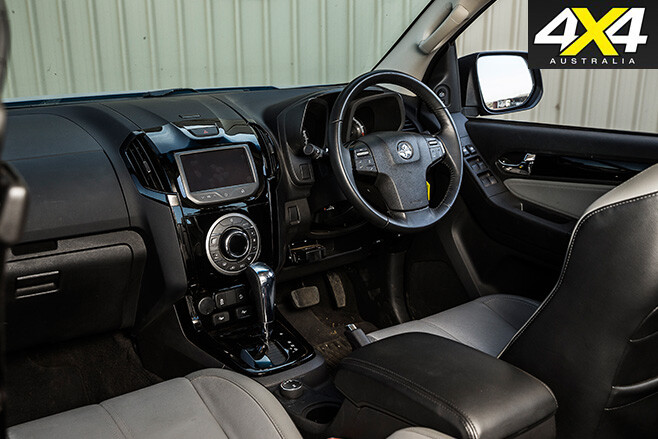
Specs: Holden Colorado LTZ
Engine: 2.8-litre 4-cyl turbo- diesel Max power/torque: 147kW/500Nm Gearbox: six-speed automatic 4×4 system: dual-range part-time Kerb weight: 2053kg GVM: 3100kg Payload: 1047kg Towing capacity: 3500kg GCM: 6000kg Fuel tank capacity: 76 litres ADR fuel cons: 9.1 litres/100km
Holden Colorado prices* LS: $47,690 LT: $48,690 LTZ: $53,190 Z71: $57,190 *Automatic 4×4 Dual-Cab Pick-Ups only. Manual saves $2200.
Sum up The fact Holden has had a couple of goes at tweaking the Colorado since its launch just over three years ago says that even Holden wasn’t all that happy with the original effort, and there’s also a facelift planned for next year. In the meantime, the Colorado offers class-leading performance, good ‘working’ credentials and a roomy cabin, but not a lot else.
Isuzu D-Max
The D-Max shares much with the Colorado, but is still a very different vehicle.
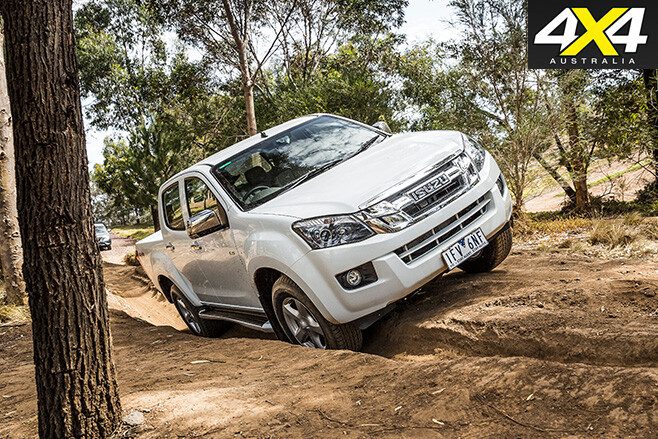
Once badged as Holden Rodeos, Isuzu utes have long been a part of the Australian automotive landscape. As a seller of utes in its own right, however, Isuzu has only existed in Oz since 2008 when it introduced the D-Max; a 100 per cent Isuzu product.
What you see here is the second vehicle to carry the D-Max nameplate in Australia. It arrived in 2012 and represents a departure from the previous Isuzu/General Motors relationship. The frame and body shell of this D-Max is essentially a GM design, rather than an Isuzu design, and is shared with the current Colorado.
Where the D-Max is completely different from the Colorado is with its engine, gearbox(s), rear axle, suspension tune, external body panels and interior fit-out.
On-road performance, handling and ride Powering the D-Max is a revised and updated version of the 3.0-litre four-cylinder turbo-diesel used in the previous-generation D-Max. It was also used in the last of the Holden Rodeos and the original Colorado.
This engine is not the last word in refinement, but it’s a well-proven design that offers decent performance thanks in part to the D-Max’s relative lightness. In fact, you would have to say that the D-Max performs better than its on-paper power and torque numbers suggest.
The D-Max’s five-speed automatic gearbox comes from the Japanese transmission specialist Aisin and is essentially the same gearbox that was used in the Toyota Prado up until recently (and in the original petrol 200 Series).
This gearbox offers reasonable refinement, but its shift protocols seem more focused on economy than anything else, which makes it less than likeable in more demanding driving conditions (unless you use it in the ‘manual’ mode). The alternate gearbox is a five-speed manual carried over from the previous-generation D-Max.
On road the D-Max rides and handles okay, but it’s certainly not up there with the frontrunners, as the vehicle lacks the poise and balance offered by the likes of the Amarok and Ranger.
Off-road The D-Max has moderate wheel travel and a somewhat ineffective traction control system, and it doesn’t come with a rear locker. It struggled on the set-piece climbs and couldn’t clear the most difficult climb.
This aside, the D-Max is still handy enough off-road, as it is competitive in terms of ground clearance and the like.
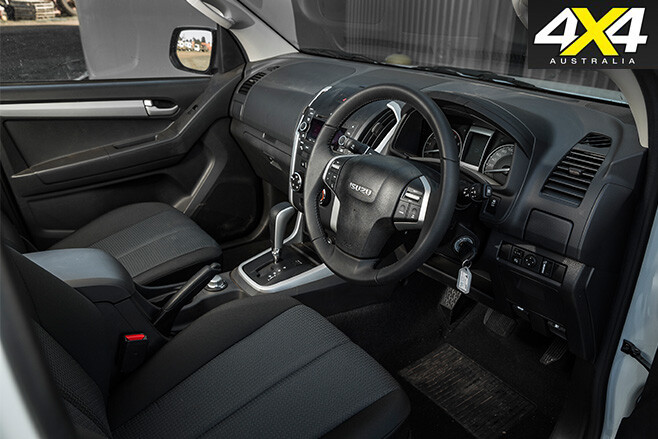
Cabin and accommodation While the D-Max’s cab isn’t as big as the Amarok, Ranger and BT-50, it’s still a decent size, especially across the rear seat, and it offers five-star safety.
The general cabin presentation feels more commercial than passenger and lacks the polish of most here, save for the Colorado. There’s also no tilt-and-reach steering wheel adjustment, but, otherwise, it’s comfortable enough for the driver. On a more positive note, the equipment levels are good for the money, especially higher up in the range.
Practicalities The D-Max offers a class-leading 3500kg tow rating. And while its GVM is down 250kg on the best here, its relatively light weight means the payloads are competitive.
Under the bonnet, the engine draws its air from the inner guard. And unlike many utes here there are two, rather than one, recovery hooks up front.
Specs: Isuzu D-Max LS-U
Engine: 3.0-litre 4-cyl turbo- diesel Max power/torque: 130kW/380Nm Gearbox: five-speed automatic 4X4 system: dual-range part-time Kerb weight: 1945kg GVM: 2950kg Payload: 1005kg Towing capacity: 3500kg GCM: 5950kg Fuel tank capacity: 76 litres ADR fuel consumption: 8.1 litres/100km
Isuzu D-Max prices* SX: $45,000 LS-M: $47,100 LS-U: $48,300 LS-Terrain: $53,000 *Automatic 4×4 Dual-Cab Pick-Ups only. Manual saves $2200.
Sum up As an on- or off-road vehicle, the D-Max is nothing special in this company, but does come back into its own as an ownership proposition. It strength lies in the fact that both the engine and gearbox have proven reliability and years of service behind them, something which doesn’t apply to the new powertrains here. The D-Max is also sharply priced and offers good bang for your bucks, right through the range.
Mazda BT-50
Mazda’s recent facelift of its BT-50 brings appealing style tweaks but little mechanical change.
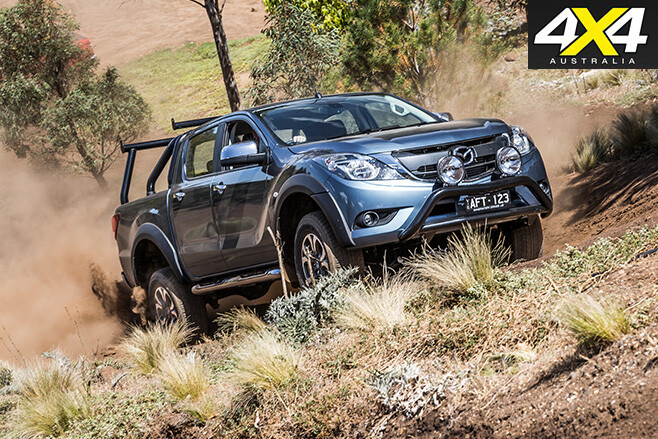
The basic mechanical package of this BT-50 appeared in late 2011 and shared nothing with the first Mazda ute to carry the BT-50 nameplate. Whereas that first BT-50 was actually a Mazda, this BT-50 owes more to Ford and shares much with the Ranger.
Before the recent facelift of both the BT-50 and the Ranger, the differences between the two were mainly cosmetic, but that has all changed now. Whereas Ford has introduced a raft of mechanical changes to its Ranger, Mazda’s rework of the BT-50 is limited to exterior styling, a new dash for mid- and top-spec models and some equipment changes.
The only mechanical change of note – and a most welcome one at that – is a new linkage for the six-speed manual designed to address the previously very vague shift action.
On-road performance, handling and ride The BT-50’s 3.2-litre five-cylinder turbo-diesel is a Ford-sourced unit originally designed for commercial use and is not a particularly quiet or refined engine in this company. Whereas Ford has done much to address various NVH issues with the engine in the revamped Ranger, Mazda hasn’t, and the difference is telling.
Also telling is the fact that Ford’s 3.2 now outperforms the Mazda’s 3.2, despite the two claiming identical maximum power and torque figures. Whereas the Ford is a frontrunner here, performance-wise, the Mazda is a tail-ender, which proves that ‘fat’ in power and torque curves, or the shape of them, is far more important than the maximum figures.
This doesn’t mean the Mazda’s engine doesn’t do a good job. It’s an easy-going, low-revving engine that’s generally unfussed and, while it’s a bit gruff and lumpy at low speeds, it smooths out nicely at highway speeds.
For its part, the six-speed auto also mates well to the torquey, low-revving nature of the engine and offers generally smooth, ‘intelligent’ and well-timed shifts. For those wanting the control of a manual, the new linkage system brings much improved shift quality.
One thing that Mazda (and Ford) got particularly right with this shared platform some five years back is the on-road dynamics. Unlike the Ranger, which now has electric power steering, the BT-50 has retained hydraulic power steering, which means more steering effort at low speeds but a bit more feel and feedback at highway speed. The BT-50 offers a positive road feel and surprisingly tidy handling, despite its leaf-sprung live axle at the rear and load-carrying suspension tune.
Off-road All three BT-50 dual-cab 4x4s come with a rear diff lock as standard, but when the locker is engaged the electronic traction control is cancelled across the front and rear axles. This is no longer the case with the upgraded Ranger.
On our set-piece climbs the Mazda did well and managed to clear even the most difficult of the climbs, provided its rear locker was engaged. Without the locker it marginally failed to make the most difficult climb.
Like the Ranger, the BT-50 is a big, long ute, which does it no favours in tight off-road situations. But, otherwise, it’s a solid off-road performer.
Cabin and accommodation As with the Ranger, the BT-50’s cabin is big and spacious and the best here in terms of combined front and rear legroom, although the Amarok has more shoulder room across the rear seat.
The BT-50 also has a comfortable driving position, but the lack of reach adjustment for the steering wheel is a negative point.
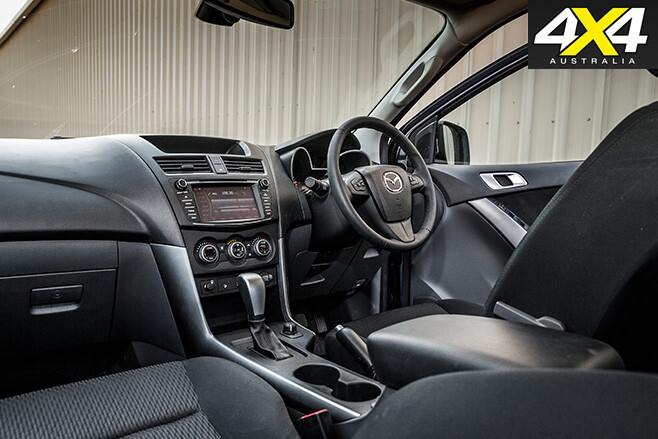
Also surprising is that despite the new, much larger dashboard touchscreen on the mid- and top-spec models, the review camera still displays in the corner of the rear-view mirror.
Practicalities With its big, torquey engine, class-leading tow capacity and GVM/GCM, the BT-50 has working credentials as good as it gets in this company.
Mazda also offers a good range of factory accessories for the BT-50 and it’s well catered for by the aftermarket.
Specs: Mazda BT-50 XTR
Engine: 3.2-litre 5-cyl turbo- diesel Max power/torque: 147kW/470Nm Gearbox: six-speed automatic 4X4 system: dual-range part-time Kerb weight: 2118kg GVM: 3200kg Payload: 1082kg Towing capacity: 3500kg GCM: 6000kg Fuel tank capacity: 80 litres ADR fuel consumption: 9.2 litres/100km
Mazda BT-50 prices* XT: $46,615 XTR: $51,700 GT: $53,790 *Automatic 4×4 Dual-Cab Pick-Ups only. Manual saves $2000.
Sum up Driven in isolation the BT-50 is a good thing both on and off the road, and as both a work and play ute. It’s just a pity the recent facelift didn’t bring the in-depth changes that have made the Ranger a far better ute than it was in its original guise.
Mitsubishi Triton
Mitsubishi’s new Triton may be small in size, but it’s got big bang for buck.
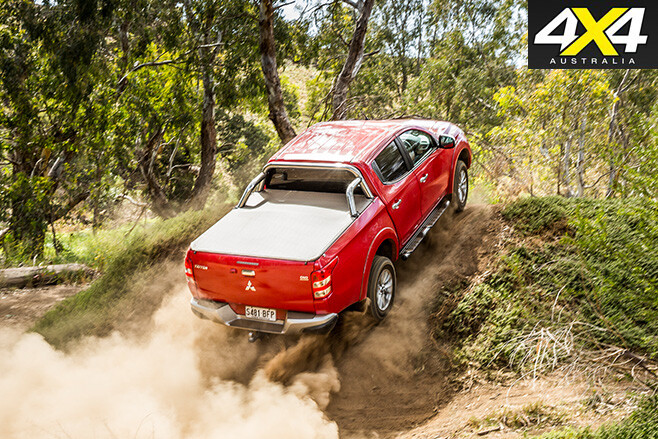
In creating this new, fifth-gen Triton, Mitsubishi hasn’t started with a clean-sheet design.
Instead, it’s taken the previous-generation Triton, pulled it apart, and then put it back together with a whole lot of new or revised parts.
Most notably it has an all-new 2.4-litre engine, new six-speed manual gearbox, new transfer case, revised suspension, and a slightly bigger cabin. The five-speed auto that was previously only available on the top-spec model is also now available across the range.
On-road performance, handling and ride The Triton’s new 2.4-litre engine is quite revvy, with its maximum torque not available until 2500rpm; a very high figure for a modern turbo-diesel. When mated to the six-speed manual, the Triton is particularly ‘soft’ off idle and at low rpm, but the auto, as tested here, effectively masks this characteristic.
The Triton’s engine is noticeably smooth, quiet and refined in this company and, helped by the fact that the Triton is relatively light, it also offers competitive performance, even if it generally revs a little harder in doing so.
The Triton has one of the older autos here (and with fewer ratios than all but the D-Max).
While it doesn’t do a bad job, it’s not as decisive and quick shifting as it could be.
The base-spec GLX Triton comes with conventional part-time 4×4, whereas the mid- and top-spec models come with Mitubishi’s Super Select 4×4 system – a unique arrangement in this company. Super Select gives the option of four different drive modes, including full-time 4×4, which is very useful on roads with constantly varying (sealed/unsealed/wet/dry) conditions. The benefit of Super Select aside, the Triton also has a light and sporty road feel, highlighted by its crisp steering. The main on-road negative is that the unladed ride is among the harshest in this company.
Off-road At this mid-spec level, the Triton isn’t strong off-road, as it doesn’t have a rear locker. With limited rear wheel travel and a relatively ineffective traction control system, the Triton struggled most on our set-piece climbs. Of the entire group, it made it the shortest distance up the hardest climb.
The good news is that a rear locker is standard on the top-spec Exceed, which is a similar price to most of its mid-spec competitors.
The Triton’s relatively short wheelbase helps in tight situations and the Super Select means that you can have 4×4 drive without locking the centre diff, which can be very useful at times.
Cabin and accommodation This new Triton has a slightly bigger cabin than the previous model, but it’s still the smallest in this company, and is certainly more of a squeeze for three adults across the back seat.
However, the cabin’s fit-and-finish is far better than before and the driver has the benefit of tilt-and-reach steering wheel adjustment; one of only three utes here to have this handy feature. It also has a five-star safety rating.
The not-particularly comfortable front seats in the previous model have also been improved, but still failed to find favour with all our test drivers.
Practicalities The Triton’s relatively short wheelbase means just about all of the tub is behind the rear axle line, which is not ideal for carrying heavier loads. The Triton also has a relatively low GVM and modest payloads. Its 3100kg towing capacity is also short of the class leaders.
A worthwhile change from the previous-gen Triton is that the engine air intake comes via the inner mudguard rather than from under the bonnet lip.
Specs: Mitsubishi Triton GLS
Engine: 2.4 litre 4-cyl turbo- diesel Max power/torque: 133kW/430Nm Gearbox: five-speed automatic 4X4 System: dual-range full-time (+2WD) Kerb weight: 1950kg GVM: 2900kg Payload: 950kg Towing capacity: 3100kg GCM: 5885kg Fuel tank capacity: 75 litres ADR fuel consumption: 7.6 litres/100km
Mitsubishi Triton prices* GLX: $39,490 GLS: $43,490 Exceed: $47,490 *Automatic 4×4 Dual-Cab Pick-Ups only. Manual saves $2500.
Sum up The Triton is a fun ute to drive and has the benefit of its Super Select 4×4 system, but more than anything else it represents great value. The entry-level dual-cab is way cheaper than anything else here, while the top-spec, bells-and-whistles Exceed comes at everyone else’s mid-spec prices.
Nissan Navara
Nissan’s new Navara offers a raft of technical features not found on other Japanese utes.
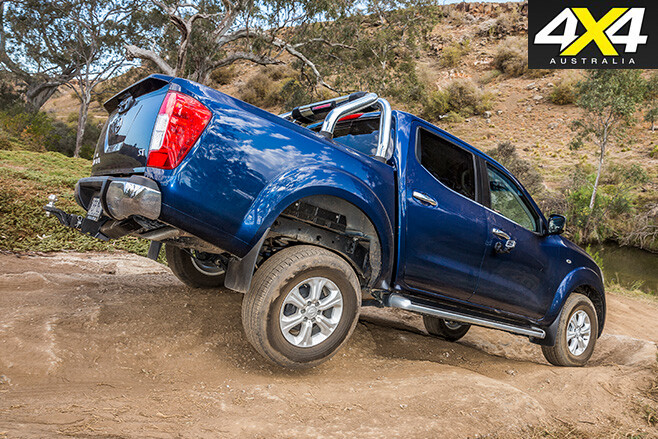
The Navara NP300 (or D23) you see here is new from the ground up and represents a number of ‘firsts’ for a mainstream Japanese ute. Most notably the mid- and top-spec models have a Renault-sourced bi-turbo 2.3-litre diesel. All dual-cab variants also have a coil-sprung live axle at the rear, which replaces the leaf-spring live axle used in the previous Navara and generally across the ute market.
In designing the new NP300, Nissan has also bucked the trend to build a bigger ute, as the NP300 is slightly smaller and lighter than the D40 it replaces.
On-road performance, handling and ride On road this engine is both responsive at low revs and punchy at higher revs and, combined with the seven-speed auto, it pushes the Navara towards the front of the pack in terms of straight-line performance.
The engine is also smooth and generally quiet except under load wherein it becomes surprisingly harsh and noisy, which is perhaps a reflection that this engine was originally designed for commercial applications in Renault delivery vans.
For its part, the seven-speed auto is slick and quick-shifting but often likes to pick up the taller ratios earlier and hang onto them longer, which can often have you switching to the gearbox’s ‘manual’ mode for better control in more demanding driving situations.
The Navara is generally a sweet handling ute, but the steering is heavy and slow, which takes the shine off its on-road demeanour. You may also think that its coil sprung rear end would ride more comfortably than the leaf-spring opposition, but that’s not the case given that it still has to manage similar payloads. What the five-link, coil-spring rear end does provide is better drive and stability through and out of bumpy and corrugated corners.
Off-road The mid- and top-spec Navaras come standard with a rear locker and, like the lockers on the Ranger and Amarok, it doesn’t cancel the electronic traction control across the front axle when it’s engaged. Without the locker engaged, the Navara didn’t do too well on our set-piece climbs, as the traction control doesn’t seem as effective as some competition. But it did manage the more difficult climb with the locker in operation.
The Navara also rides a little low and was often the first to bottom out, and the odd-shaped bonnet does the Navara no favours in terms of driver vision.
On a more positive note, the shift protocols of the seven-speed work well off-road, which is a welcome change from the seven-speed auto that was behind the TDV6 550 in the Navara D40. Thanks to the seven-speed auto, there’s also a notably low crawl ratio.
Cabin and accommodation The Navara has a modern car-like cabin that’s generally quiet regardless of speed and road surface, although the previously mentioned engine noise under load is an on-going NVH issue.
The cabin isn’t as big most here, which rear-seat passengers will especially notice, although the Navara’s rear seat does a better job of seating three than the Triton. Surprisingly for an all-new design, there’s no reach adjustment for the steering wheel and no centre headrest for the rear seats.
The top-spec ST-X does, however, have a sunroof; a unique feature in this class of vehicle. While on all models, the centre panel of the rear window can be opened.
Practicalities The Navara matches the best in class with its 3500kg tow rating and despite having a low GVM, its light weight helps redress the balance in terms of payloads. The ST-X also has adjustable tie-downs in the tub; a unique feature here.
The ST-X has relatively low profile tyres on its 18-inch wheels, but there’s no problem in swapping these from the 16s on the ST if you wish to fit more off-road suitable rubber.
Not so good is the fact that the engine’s air-take is adjacent to the top of the radiator (very un-Nissan-4×4-like!). As a result, the claimed wading depth is also now a low 450mm – something creek-crossing owners may want to address with an intake snorkel.
Also noteworthy here is the long 20,000km service interval.
Specs: Nissan Navara NP300 ST
Engine: 2.3 litre 4-cyl bi-turbo- diesel Max power/torque: 140kW/450Nm Gearbox: seven-speed automatic 4X4 system: dual-range part-time Kerb weight: 1865kg GVM: 2910kg Payload: 1045kg Towing capacity: 3500kg GCM: 5910kg Fuel tank capacity: 80 litres ADR fuel consumption: 7.0 litres/100km
Nissan Navara NP300 prices* ST: $48,490 ST-X: $54,490 * Automatic bi-turbo 4×4 Dual-Cab Pick-Ups only. Manual saves $2500.
Sum up Given the Navaras many high-tech features, especially in terms of its powertrain, it’s surprising that it doesn’t offer some sort of full-time 4×4 to further press home this advantage. After all, the last-generation Pathfinder offered on-demand full-time 4×4, as does the Y62 Patrol. In many ways this new Navara is a few steps forward, but it’s also a few steps sideways.
Toyota Hilux
Toyota’s new Hilux gets more muscle despite a downsized engine capacity.
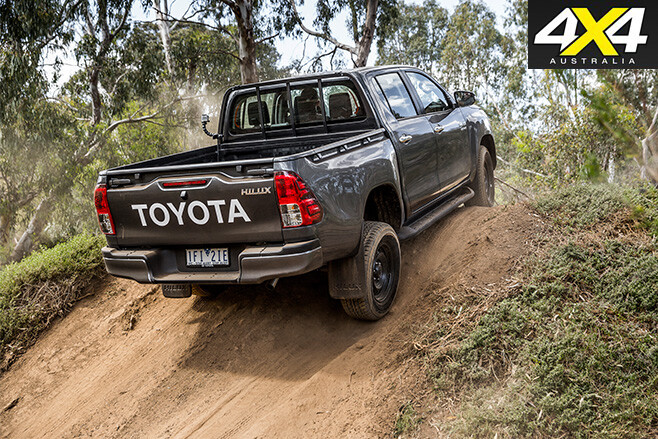
This eighth-generation Hilux is the first new Hilux in 10 years. It’s been more than six years and more than one-million kilometres in the making, and it won’t be replaced for another 10 years, all being well. It is a vital model for Toyota’s local and global ambitions.
Most significantly, the Hilux brings completely new powertrains, which will be shared with other models including the Fortuner and Prado. It also has a new chassis and new bodies.
The key engine is an all-new 2.8-litre diesel that replaces the long serving 3.0-litre diesel used in the previous-generation Hilux and Prado until recently. Another new engine, a 2.4-litre diesel, as well as the carried-over petrol V6 are also available in Hilux 4×4 models. Both diesels are available with new six-speed manual and automatic gearboxes, while the V6 is auto-only.
On-road performance, handling and ride Here we have a mid-spec SR, not that you’d know it given the black steel wheels and ‘work’ tub, which make it look more like a base-spec trade or farm ute. This is the cheapest way to get the new 2.8-litre engine in a dual-cab 4×4 (as the Workmate 4×4 comes with the smaller 2.4-litre engine). The SR would be more appropriately tagged the ‘Workmate 2.8’.
The new 2.8-litre diesel makes slightly more power than the 3.0-litre it replaces (130kW up from 126kW), but the maximum torque jumps from 360Nm to 450Nm when the engine is mated with the new six-speed auto, as tested here.
The extra torque provides solid low-rpm response, but the pedal-to-the-metal performance isn’t anything special, and the Hilux is among the slowest vehicles here in term of its acceleration. In fact, it was the slowest over 400 metres. The new six-speed gearbox is no help. Compared to the previous five-speed, it merely adds a second overdrive ratio rather than tightening up the ratio spread.
Better news comes in the form of much improved refinement, as the new 2.8 is one of the smoother and quieter engines, while the new auto is also much improved in terms of shift quality.
The new Hilux also steers, rides and handles better than before and is one of the better utes, even if the unladen ride is still firmer than most here.
Off-road More significant than the Hilux’s improved on-road performance, is a much better showing off-road. Rear wheel travel is now more than half a metre (520mm, in fact), an improvement of 67mm over the old Hilux, and probably the best in this company. It certainly feels like it…
The Hilux also has faster-acting and more aggressive traction control than the previous model, and all 2.8 dual-cab models now have a rear diff lock. However, engaging the locker cancels the traction control on both axles, not just the rear. Toyota claims this is in the interest of driveline durability.
The Hilux has more extensive and robust underbody protection than before, which is part of its local development.
On our set-piece climbs, the Hilux was a stellar performer and cleared the most difficult climb with the rear locker. In fact, on some climbs it actually performed better without the locker, which is testament to the effectiveness of its traction control and to the rear locker cancelling front-axle traction control.
Cabin and accommodation The Hilux’s cabin feels more passenger-car than commercial-vehicle thanks in part to a tablet-style multi-function touchscreen that dominates the dashboard on all models, Workmate included.
The cabin is not notably larger than the out-going model, which means it’s among the smaller here, although there is slightly more shoulder and headroom up front than before and slightly more rear-seat legroom. All 4×4 models now have tilt-and-reach steering-wheel adjustments, although some of our taller drivers found that they would prefer more reach adjustment.
Practicalities In terms of ‘work’ numbers, the Hilux isn’t anything special on paper. It falls short of the best here in terms tow rating (3200kg with the auto 2.8; 3500kg with the manual 2.8), payloads and GVM/GCM.
That’s not to say the Hilux isn’t up for hard work, but it’s probably more a reflection of Toyota’s conservative, durability-first approach when quoting figures like these.
This new Hilux also comes with the biggest range of factory accessories ever offered by Toyota, and you can bet your bottom dollar that the aftermarket won’t be far behind – all of which enhances its practicality even further.
Specs: Toyota Hilux SR
Engine: 2.8-litre 4-cyl turbo- diesel Max power/torque: 130kW/450Nm Gearbox: six-speed automatic 4X4 system: dual-range part-time Kerb weight: 2080kg GVM: 3000kg Payload: 920kg Towing capacity: 3200kg GCM: 5650kg Fuel tank capacity: 80 litres ADR Fuel consumption: 8.5 litres/100km
Toyota Hilux prices* SR: $48,490 SR5: $55,990 SR5+: $57,990 *Automatic 2.8-litre 4×4 Dual-Cab Pick-Ups only. Manual saves $2000.
Sum up Compared to the previous Hilux, this new Hilux is more refined on-road, much more capable off-road and can tow and carry more than before. For the money, it may not be all that well-equipped but, as ever, with Toyota the appeal runs far deeper than equipment lists.
Volkswagen Amarok
The Amarok is the oldest design here, but it’s still ahead of the game in many ways.
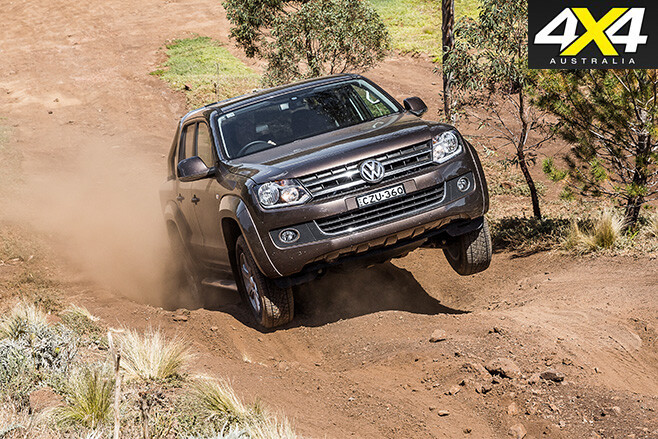
Volkswagen’s Amarok has been around in Australia since early 2011 and, aside from the introduction of the eight-speed automatic in 2012 and a tweak here and there with the model range, little has changed.
In most ways the Amarok follows standard ute design with a separate chassis, double-wishbone coil-sprung front suspension and a leaf-sprung live axle at the rear. But separating it from the pack is its 2.0-litre bi-turbo-diesel engine, eight-speed auto and single-range full-time 4×4 system. It also has a notably wide and spacious cabin and a big tub, which set it apart when it was released and is still a noteworthy advantage.
On-road performance, handling and ride The Amarok has the smallest engine here, but thanks to its bi-turbo arrangement it offers decent performance – even if it’s not among the performance leaders. Better news comes in the form of its refinement, as it’s certainly the smoothest and quietest engine here.
The eight-speed auto is also the best gearbox in terms of shift quality, shift speed and shift timing, and combines with the engine to produce a powertrain that’s a cut above the rest.
The Amarok’s chassis carries on the same polished performance and offers the sharpest steering and most positive road feel. The full-time 4×4 system adds extra security, grip and drive on more demanding road surfaces such as bumpy and wet bitumen and unsealed roads.
In many ways the Amarok feels more passenger car than ute, and buyers wishing to have even more of a passenger car and less of a ute ‘feel’ can opt for the softer-riding ‘Comfort’ springs at the rear.
Off-road The Amarok’s single-range 4×4 system shouldn’t work in steep off-road conditions, but thanks to a relatively low first gear, courtesy of its eight-speed gearbox and the torque convertor’s high stall ratio, it actually works exceptionally well.
On our set-piece climbs the Amarok sat right up at the front of the field and cleared the toughest climb without needing its rear locker. And if you do wish to engage the rear locker, it doesn’t cancel the traction control on the front axle, which makes for even more effective off-road performance. Simply brilliant.
The self-locking and self-proportioning ‘automatic’ centre diff is also part of the secret, as it can direct the engine’s torque to the axle that can use it most, whereas all of the other utes spilt the torque 50/50, front to rear.
The Amarok’s 4×4 system is so clever and effective that you can go from cruising down the freeway at 110km/h straight on to a steep off-road climb, without touching a button or a lever.
If you want, there is an ‘off-road’ button that activates the hill-descent control and tweaks the stability and traction control systems for off-road use, and there’s a separate switch to disable the stability control. The Amarok also comes with Pirelli Scorpion ATRs – a nice touch.
Cabin and accommodation The Amarok has a spacious cabin that’s nicely finished and detailed, but also understated in typical German fashion.
The front seats are as good as it gets and the driver also has the benefit of tilt-and-reach steering wheel adjustment. The Amarok also has the widest rear seat here and the maximum five-star safety rating.
Practicalities The Amarok’s 3000kg tow rating is the lowest here, although only 100kg less than the Triton and 200kg less than the Hilux – so it’s not really a make-or-break issue.
Countering that is its solid 3040kg GVM and competitive payload figures. If the optional ‘comfort’ springs are fitted at the rear, the GVM is reduced to 2820kg and the payloads down to around 800kg, which is still more than enough for most uses. A handy feature to note is a light to illuminate the tub.
The VW draws its engine intake air just near the top of the radiator, and its official wading depth is 500mm – so a snorkel would be a handy addition.
Specs: Volkswagen Highline TDI420
Engine: 2.0-litre 4-cyl bi-turbo- diesel Max power/torque: 132kW/420Nm Gearbox: eight-speed automatic 4X4 system: single-range full-time Kerb weight: 2040kg GVM: 3040kg Payload: 1000kg Towing capacity: 3000kg GCM: 5840kg Fuel tank capacity: 80 litres ADR fuel consumption: 8.3 litres/100km
Volkswagen Amarok prices* Core: $45,990 Trendline: $49,990 Highline: $55,490 Ultimate: $65,290 *Automatic 4×4 Dual-Cab Pick-Ups only. Manual saves $3000
Sum up The Amarok is a great on-road drive and is brilliantly effective off-road, so much so that nothing else offers such a wide spectrum of performance. But it’s also the most mechanically complex ute here, and VW dealers are thin on the ground away from the major population centres.
The verdict
Ranking these utes from one to eight was always going to be difficult, given that dual-cab 4x4s, by their very nature, can fulfil so many roles. That’s the reason why they are so popular.
On any given day all of these utes could be a farm truck, a tradie’s work vehicle, family transport, a 4×4 tourer or a 4×4 play thing. And over any period of ownership they may all perform most, if not all, of these roles. Whatever way you look at it, dual-cab 4x4s are arguably the most multi-functional vehicle anywhere in the world.
Weighing up the eight, we see them fall into three natural groups – two tail-enders, three middle rankers and three frontrunners.
The two tail-enders are the Colorado and the D-Max. These two share common chassis and body-shell DNA but differ very much in powertrains and all other details. Finishing eighth is the Colorado. The best thing the Colorado has going for it is pedal-to-the metal performance, which is the best here. There’s not much else.
Starting with the same basic platform, Isuzu has done a much better job with its D-Max, which has significant appeal thanks to its robust and well-proven powertrain and sharp pricing.
The three middle rankers are a very diverse group and include the Navara, the Triton and the BT-50.
Nissan could have done much better with the Navara, but it falls short of expectation given that it’s a once-in-ten years offering. That’s not to say it’s a bad ute at all, just that it could have been so much better. It finishes sixth.
Although there’s not much in it, the Triton sneaks in front of the Navara into fifth thanks to its great value and the functionality of its Super Select 4×4 system. It’s also an engaging drive.
In fourth place is the BT-50. Like the closely related Ranger, the BT-50 has always been a good thing, but where Ford has kicked the game on with a serious revamp of the Ranger, Mazda hasn’t (beyond some small detail changes).
That leaves the Amarok, the Ranger and the Hilux. The Amarok has long been our class champ but is now relegated to third place given it hasn’t changed while others have. In fact, it’s the oldest design here. The Amarok is still a brilliant thing, especially with the eight-speed automatic and the new base-model Core (as an auto) represents particularly good value.
Finishing second is the Ranger. Ford has done a five-star job with the Ranger revamp, improving it across the board. Where once the Ranger and BT-50 were a much-of-a-muchness to drive, the Ranger is now streets ahead in performance, refinement and off-road ability; all testament to the good work its engineers have done.
Taking all before it is, however, the new Hilux. Toyota has done an exceptionally thorough job with the Hilux, especially in terms of its much-improved off-road performance and significantly improved on-road refinement. But more than anything else, the Hilux is the vehicle that you’re best off with if you want to go seriously ‘bush’, and isn’t that what it is all about?
New World Order
1. Toyota Hilux 2. Ford Ranger 3. Volkswagen Amarok 4. Mazda BT-50 5. Mitsubishi Triton 6. Nissan Navara 7. Isuzu D-Max 8. Holden Colorado
Last night in London the 2 millionth Land Rover Defender built sold for what is thought to be a record amount for any version of the iconic model: £400,000.
The one-of-a-kind Defender was sold at a prestigious charity auction at Bonhams, with all proceeds to be donated to Land Rover’s humanitarian and conservation partners.
This is thought to be the most valuable production Land Rover ever sold at auction and it was bought by a bidder from Qatar.
The vehicle was built in May 2015 by an all-star cast of brand ambassadors and people from Land Rover’s history, including Bear Grylls, Virginia McKenna OBE, and Stephen and Nick Wilks, sons of the founders of Land Rover.
The proceeds from the sale will be donated to the International Federation of Red Cross and Red Crescent Societies, which will use the donation to help communities in south-east Nepal to improve management of natural disasters; and the Born Free Foundation, which plans to use the funds to support the ‘Project Lion Rover’ wildlife conservation initiative in Meru National Park, Kenya.
The project provides critical equipment to help protect lions and other wildlife and establishes education and community involvement to tackle issues such as snaring and poaching.
Production of the Land Rover Defender is expected to end in January 2016 with the last ever model also expected to attract plenty of interest.
An all-new replacement is tipped to be launched in 2017 but it will be a far cry from the Landie that has stood the test of time for more than 60 years.
Meanwhile in Australia, a private owner from Sydney was recently advertising a Limited Edition Defender 90 Heritage for $85,000. The retail price for this rare vehicle is less than $60,000. This was one of only a 130 Heritage editions that came to Australia, and it was being offered with just 52 kilometres on the clock. Most of these collectibles were thought to have been snapped up by Land Rover enthusiasts.
Sway bar bushes and grommets are routine replacements for vehicles that have clocked up a heap of kilometres.
It’ll vary according to the vehicle and how it’s used, but anything with more than 100,000km is fair game for new bushes.
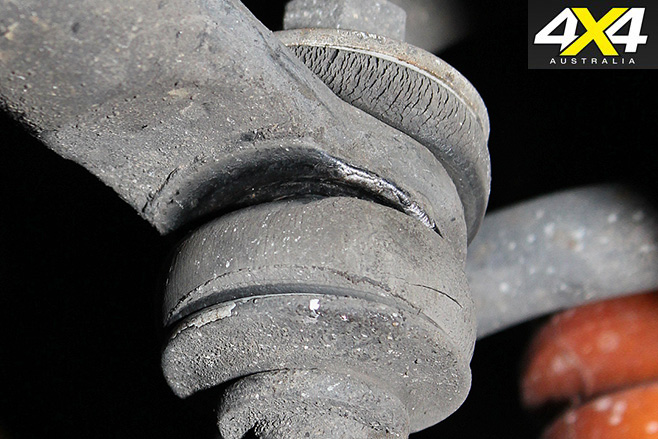
You’ll know the time’s up on the existing bushings when they begin to crack or get out of shape. Another sign of bushings behaving badly is when the sway bar rattles when you drive over bumps.
The bushings insulate the sway bar at the two attachment points at the frame (or chassis) and the grommets insulate the sway bar ends where they attach to the sway bar links.
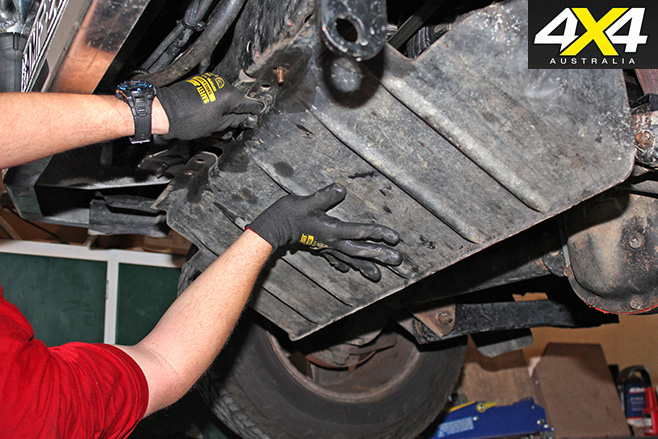
Removing the old bushes simply requires the removal of a bash plate (if any) or any other components such as a lower engine cover that might be in the way.
Then the sway bar can be unbolted from the links and the frame.
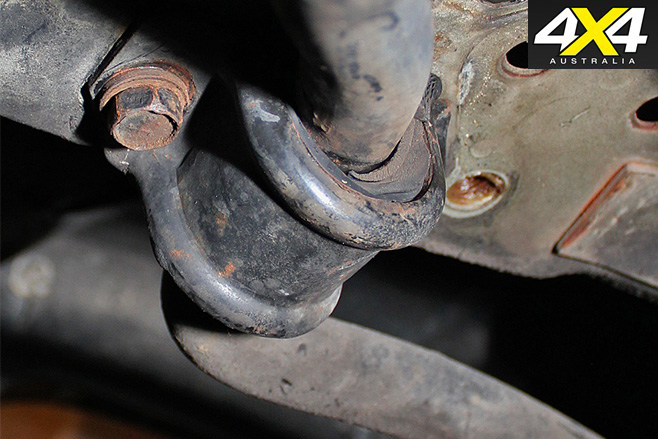
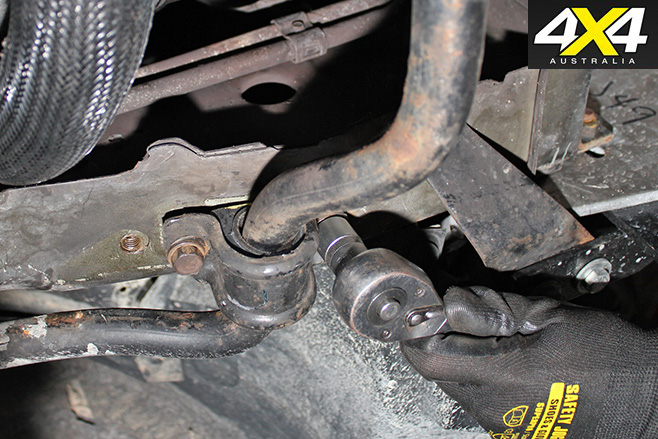
The sway bar bushings often have a split in them so that they can be removed easily over the sway bar (as those pictured here), but even if they’re not, they can be taken off the sway bar ends once it’s removed from the links.
After the new bushings have been fitted, the grommets can be installed at the links at each end of the sway bar. Bolt it all up to your vehicle-specific torque settings, re-fit the bash plate and the job’s done.
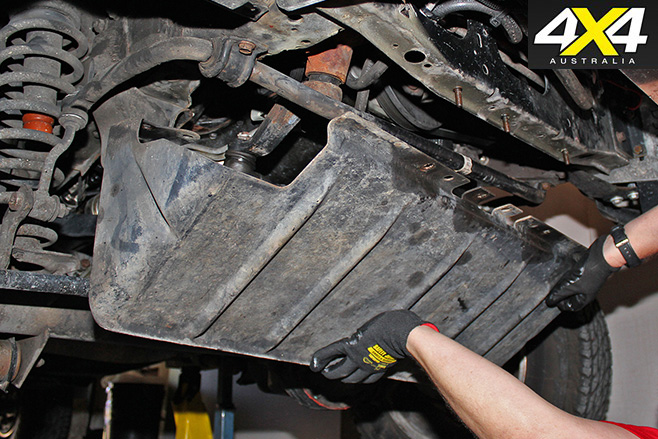
1. Remove engine cover or bash plate to gain access to the sway bar.
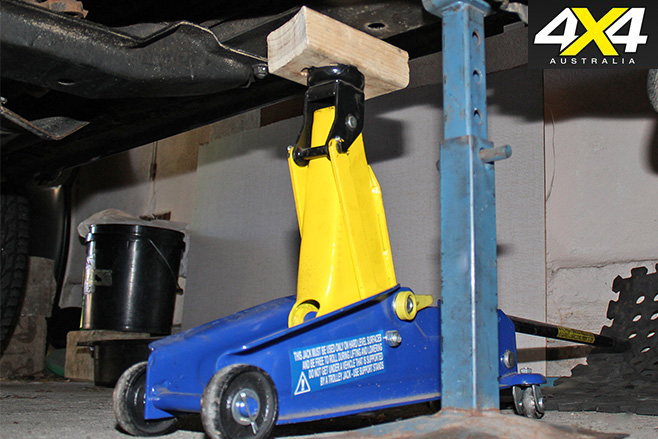
2. Jack up vehicle and support with stands.
3.Rubber cracking on this upper bushing suggests it is on its way out.
4. This sway bar to frame bushing is quite distorted and needs replacing.
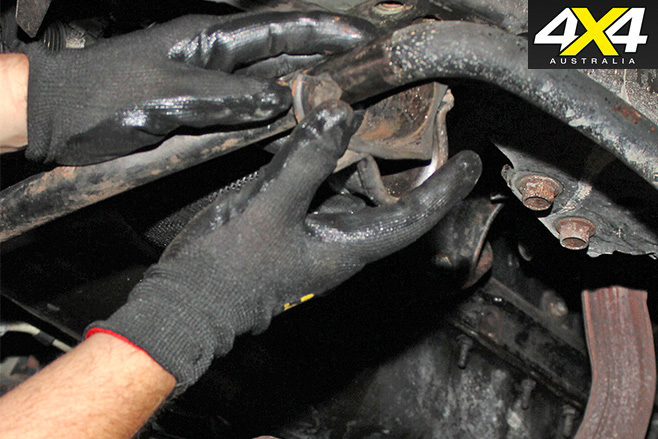
5. Remove the sway bar to frame securing clamp.
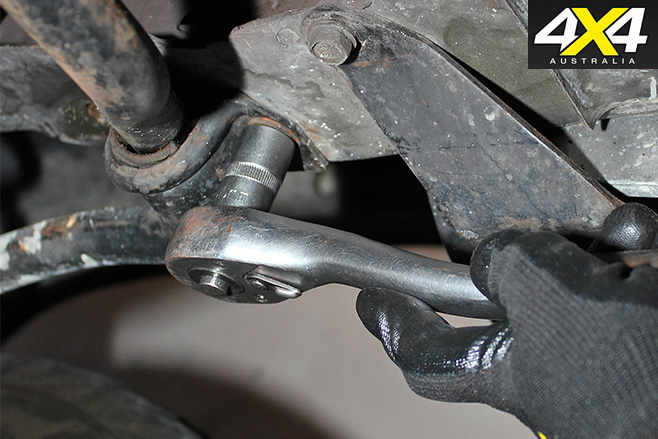
6. Separate the bushing from the sway bar clamps.
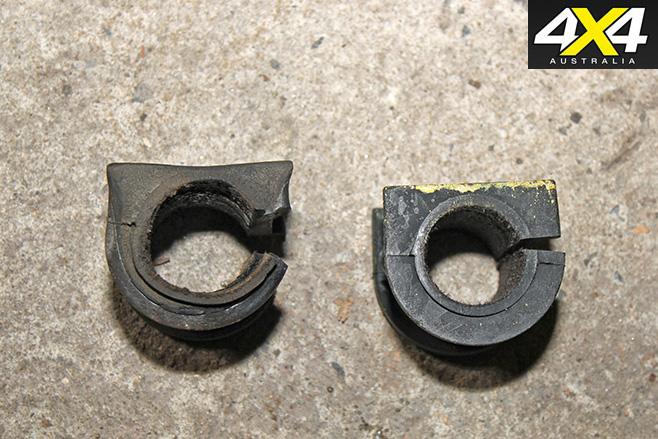
7. Old versus new sway bar to frame bushings.
8. Unbolt the sway bar to link connection.
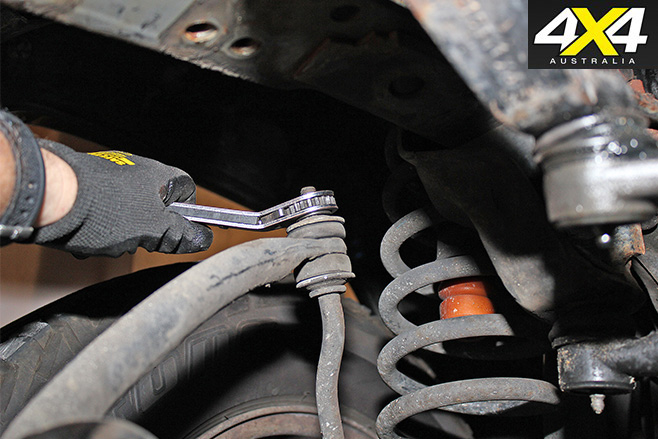
9. Remove the retainer, then top grommet followed by the sway bar and lower grommet.
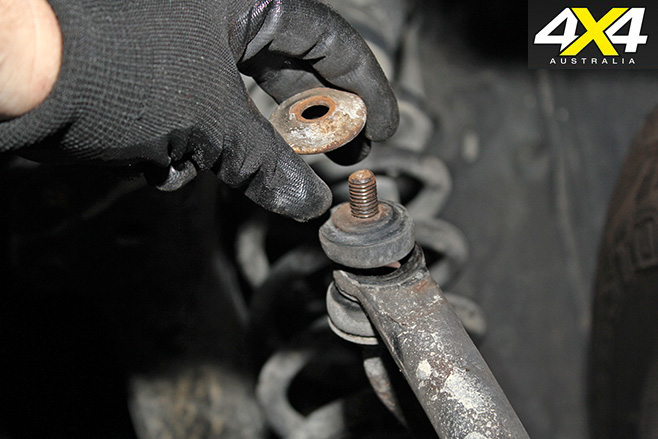
10. Fit new grommets and sway bar to sway bar links.
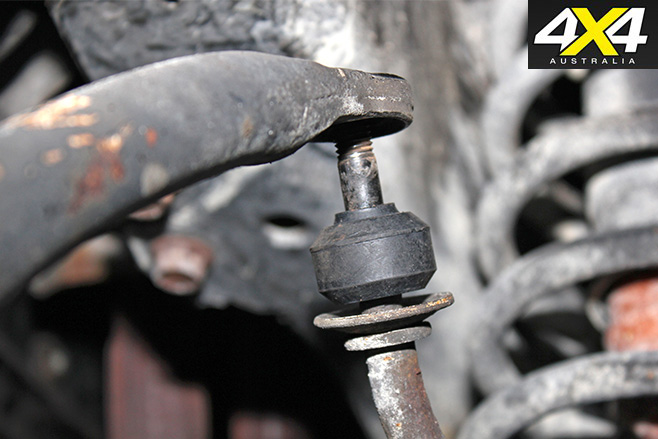
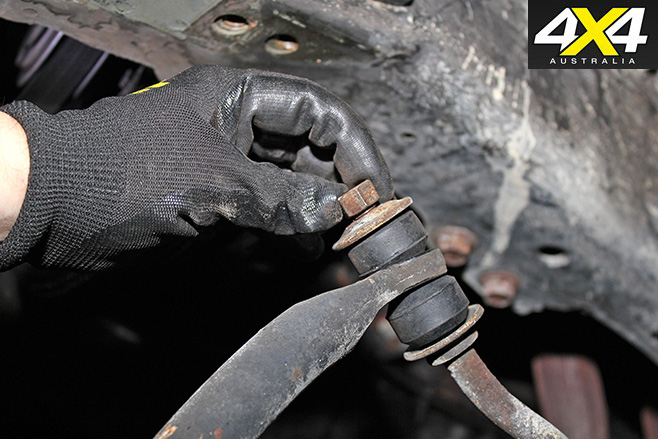
11. Re-attach remaining grommets, retainers and retainer nuts to sway bar link.
12. Fit new sway bar bushing and clamp to sway bar.
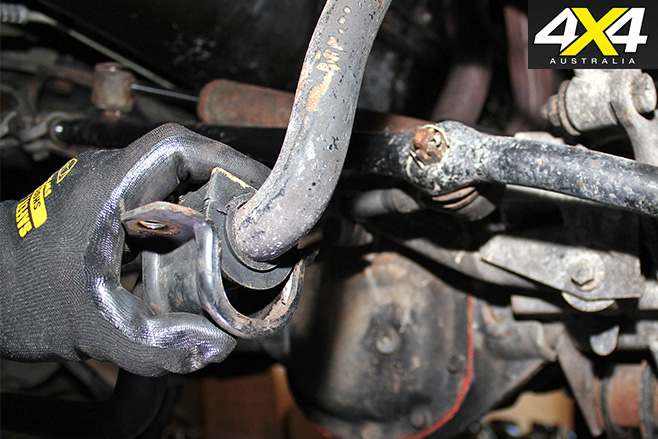
13. Clamp down new bushes and sway bar to frame.
14. Re-attach bash plate and remove vehicle safety stands.
For more information and tips on Gear, check out our page here.
Few things in life are more satisfying than reaching into your vehicle’s 12V fridge to pull out an icy-cold drink while witnessing a stunning sunset in the middle of nowhere.
To power that fridge – plus lights and other accessories – when you’re camping, as well as start your vehicle the next day, you rely on one or two little boxes of magic: your vehicle’s batteries. But different accessories, and the needs of the vehicle itself, mean there are different types of batteries designed and constructed for different tasks…
BATTERY BASICS A battery works by converting chemical energy to electrical energy. The most simple – and most common – vehicle battery design is the flooded wet-cell battery. In this design, a series of metal plates are immersed in liquid acid (the electrolyte) and connected to two terminals, which provide a connection to the vehicle’s electrical system.
Inside the battery the plates are kept from touching each other – to stop destruction of the battery – by separators, resembling something like a liquorice all-sort. It’s all housed in a tough plastic case.
A chemical reaction between the plates and the electrolyte results in power that can start the vehicle and run its accessories. The beautiful part of all this is that the chemical reaction is reversible. Going one way, electrical energy is made available to make stuff (lights, fridges) work.
Going the other way, the application of electrical energy to the battery (from the vehicle’s alternator – a battery charger that plugs into your house supply – or from a solar panel) results in the chemical reaction being reversed. Through this process the battery is recharged and ready to go again.
Fully charged, a conventional lead-acid battery (most batteries rely on lead as the main ingredient of its plates) will show a voltage of around 12.6V. The vehicle’s alternator will generally provide current somewhere in the range of 13.6 to 14.0V; sometimes a little more. It’s this increased voltage from the alternator that provides the pressure (to put it simply) to charge the battery. This voltage – from the battery or from the alternator when the engine is running – provides the force to operate the vehicle’s other electrical devices, too.
Usually, your vehicle battery’s first job of the day is to provide power to unlock the doors and then start the vehicle’s engine. However, only a small amount of oomph is needed to unlock a set of door locks, while the starter motor needs several horsepower to turn over the engine, especially a diesel engine on a cold morning. It’s easy to see that these two tasks have wildly varying power needs.
Things get even more complicated when a battery is asked to provide power for an extended period of time – such as when running a fridge overnight, or for a day or two, with the vehicle’s engine off. To cope with these varying power needs, different types of batteries are available.
The basic lead-acid chemistry principle remains similar; however, differences in internal manufacturing technology provide different performance and durability characteristics. In other words, some batteries are better suited than others for providing power for particular jobs in a vehicle.
GETTING STARTED Starting batteries (sometimes referred to as an SLI: starting/lighting/ignition) are designed for starting vehicles. These batteries are good at delivering a big burst of energy for only a few seconds. A starting battery contains thin lead plates and is typically of flooded wet-cell construction.
Because the plates are thin, more of them can fit inside the battery, which means more surface area is exposed to the electrolyte. This extra exposure allows the energetic chemical reaction needed to produce a sudden jolt of starting power.
In service, the energy lost during starting is topped up straight away by the engine’s alternator, which also provides the power to the vehicle’s electrical accessories. In most vehicles, the battery doesn’t provide much – if any – power while the vehicle is being driven.
There’s a catch for 4×4 owners, though. Without going all white-coat and propeller-head with the chemistry, starter batteries generally don’t like being worked too hard – or, discharged too far – as it damages the internals and shortens the life of the battery. Discharge (or flatten) a conventional starting battery too far, too often – possibly as little as five times – and, chances are, you’ll kill it.
GOING DEEPER Deep-cycle batteries offer different performance that usually makes them more suitable for second-battery use in 4×4 and camping situations. Rather than needing to smack a starter motor with a jolt of power, deep-cycle batteries are designed to spoon out power over a substantially longer period of time.
In the context of battery tech, a cycle refers to a usage pattern whereby a battery draws on its charge reserves to power an accessory before the battery is recharged by a vehicle alternator or some other source of charge. Deep-cycle batteries can provide more power than starting batteries without permanent damage. In other words, they can be cycled deeper – hence the name.
This deep-cycle ability is due, in part, to thicker internal plates that don’t degrade as quickly with repeated deep-cycling (discharging) of the battery.
Deep-cycle batteries tolerate starting duties far better than starter batteries tolerate deep-cycling. But, size-for-size, you can’t match a starter battery’s ability to provide quick hits of power to crank a starter motor.
BETTER ALL-ROUND Different plate technology within the battery – using different materials and construction techniques – can increase performance of both starter and deep-cycle batteries.
According to Century Yuasa Batteries (who assisted with this article), alloys of antinomy can make a deep-cycle battery better: it can have a longer service life; a superior cycle life; and can perform better in hot conditions.
Alloys of calcium enhance starter/SLI battery performance with higher cold cranking amps, quicker recharge and a longer shelf life. And yes, it’s possible to create a hybrid battery using both antinomy and calcium.
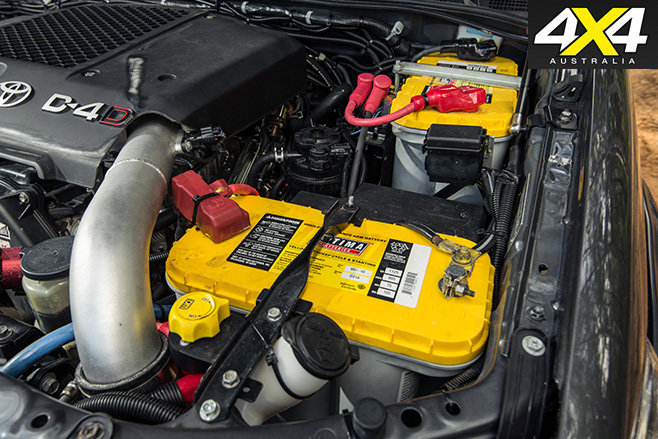
Blend the best performance/power delivery characteristics of starting and deep-cycle batteries and you have what is often referred to as an all-rounder battery. These are particularly relevant for four-wheel drives and other vehicles used for camping and touring, as they offer the best of both worlds: they cope with starting and the engine-off powering of accessories such as fridges for extended periods of time.
They’re usually built stronger, too. Like marine batteries, the internals are better-anchored into a tougher case to survive vibrations and rough movements.
ABSORBED GLASS MAT (AGM) This refers to the construction technique rather than the output performance of the battery. But, because AGM is a buzz-word in the 4×4 world, we’ll take a quick look at it.
AGM batteries hold the electrolyte (acid) in a layer of fibreglass matting between the plates. During manufacture, the plates are pressed together with the glass mat to create a very sturdy matrix before the electrolyte is introduced and the battery sealed. This makes the battery just about spill-proof and more durable – performance-wise and mechanically. Because AGM batteries typically carry slightly bigger plates in the same sized box, they can usually deliver a corresponding increase in cranking grunt and recharge quicker when depleted (if the charging system is up to the task) than a similar-sized wet-cell battery.
Deep-cycle batteries for automotive use are often AGM construction, too, and there is a move towards AGM for starting/SLI in later-model cars fitted with lots of electrical equipment.
Being sealed – and hence maintenance-free – AGM batteries can’t be topped-up like flooded wet-cell batteries. Therefore, they don’t like under-bonnet heat (anything above around 45C can be a problem as it causes fluid loss), which is why in later-model cars – and smart aftermarket 4×4 installations – they are usually installed in the cabin or boot rather than the engine bay.
GEL CELLS Gel cells also hold the electrolyte secure rather than have it present in the battery as a liquid. This holding medium is silica, which results in a jelly-like layer between the plates. Gel cells can tolerate deeper discharges and more of them, and most are used primarily for deep-cycle. Using the silica gel construction for quick hits of power – which is the type of power a flooded wet-cell starting battery is good for – causes damage in the gel. Like AGMs, gels are maintenance-free, so they can’t be topped up and require a comfier environment to give their best.
THE NEXT BIG THING? In the past couple of decades, battery technology has been largely moved forward by the laptop and mobile-phone markets – and, to some extent, hybrid cars – where power output from a lightweight source is a significant requirement. This tech has filtered to the car and camping scenes. Chemically, lithium batteries are a new ball game, compared to lead-acid batteries.
Batteries that use lithium chemistry (such as lithium phosphate) offer similar outputs, but with less weight than conventional lead-acid (wet-cell, AGM or gel) batteries. This lighter weight is significant when many batteries are needed – plenty of weight can be saved – in, for instance, a hybrid car.
Sure, the weight of one battery doesn’t make much difference in a 2.5-tonne 4×4 tourer. But lithium batteries are suited to vehicle-based deep-cycle installations as they tolerate deep discharge (approaching 90 per cent) while displaying life expectancy of several thousand cycles. This deep-discharge ability (think of it as an extended operating range) means the battery installation can be down-sized and meet the same level of performance for equipment and accessories.
There are other benefits, too. Lithium batteries offer a higher, more stable voltage when used under load and over the discharge cycle, and they tolerate storage when partially charged. Being of dry construction, they are also spill-proof and maintenance-free.
They do, however, require a stricter charging regime, and they aren’t cheap – they cost about five times as much as a similar-capacity lead/acid battery.
IS IT CHARGED? A fully charged lead-acid battery will typically show a voltage from around 12.6V to 12.7V, while a flat battery will have 10.5V or less (even though there is measurable voltage there, it’s too weak to get out of its own way because of the way the chemistry works).
Voltages in between can give a guide to the remaining charge in a battery. These numbers are determined by the lead-acid chemistry, so really can’t be changed or tweaked (or fibbed about). Due to the chemical, rather than mechanical, nature of batteries, these voltages are approximates only, so any claims such as, “it’s only 80 per cent charged” or “has 50 per cent capacity” are approximations and are influenced by conditions such as temperature and age.
A battery with a voltage of around 12.1V is regarded as 50 per cent charged, which is a safe and sensible discharge limit for a vehicle-starting battery. Deep cycles can cope with being pulled down to 80 per cent; but, in general, the less charge pulled out of a battery each cycle, the greater the number of cycles its life will have.
WHAT KILLS A BATTERY? Operating a battery beyond what it’s designed to do – asking it to deliver more current than it’s specified for, or discharging it too deeply – will shorten its life.
No matter what type of battery, leaving it discharged for any length of time causes sulfation; a situation which quickly clogs and kills a battery. Batteries that are seldom used – for instance, those fitted to classic vehicles or camper trailers – should be stored fully charged and given a recharge every month or so.
A three- or multi-stage charger (with a storage/maintenance mode) can be used to keep batteries in top shape, ready for the next adventure. Typical float chargers will maintain the voltage at the battery terminals at a little over 13V; many batteries have charging requirements listed in their specs. Conventional old-school chargers intended solely for flooded wet-cell batteries are not suitable for this as they keep the input current at more than 14V, which, beyond the point when the battery is fully charged, causes damage.
WHAT DO THE LETTERS AND NUMBERS MEAN? 12V: Voltage is the motive force provided by the electricity from the battery (and alternator) to make things work. Vehicle electrical systems are described as 12V, in recognition of normal batteries’ charged voltage of around 12.6-12.7V. To charge a battery, however, a higher voltage must be applied, so vehicle alternators are calibrated to deliver somewhere in the range of 13.8V to 14.4V. Many people get the alternator-determined charging-system voltage confused with the voltage – and hence fullness – of a charged battery.
CCA: Cold Cranking Amps. This is a measure of a starting battery’s ability to deliver current to a starter motor at minus 18°C. Of course, it doesn’t often get that cold in Australia, but this is an international standard that looks at the ability of the battery to deliver power. The bigger the CCA, the more starting stamina the battery has. A typical 4×4 battery has a CCA rating of more than 500, so it can deliver 500A for 30 seconds while retaining enough voltage to operate voltage-sensitive ignition systems (sometimes).
RC: Reserve Capacity. This is a measure of the battery’s ability to provide power for more gentle (non-starter) electrical loads. It’s based on how many minutes the battery will provide 25A without dropping below 10.5V, and hence keep a car going after a charging system failure. 10.5V is the accepted number for a flat.
AH: Amp Hours. This is particularly relevant to those of us who wish to use vehicle fridges. It’s the number of amps that can be provided continuously for one hour. Turn the equation around, and 100AH becomes 1A for 100 hours, or 4A for around 25 hours (one day). We’ll cover system size requirements in the future. Based on simple maths, however, and with a fridge cycling on and off and therefore drawing power for, say, one-quarter of the time on a mild day, and taking into account 50 per cent depth of discharge tolerance of a typical starting (not deep-cycle) battery, this battery will provide power for four days.
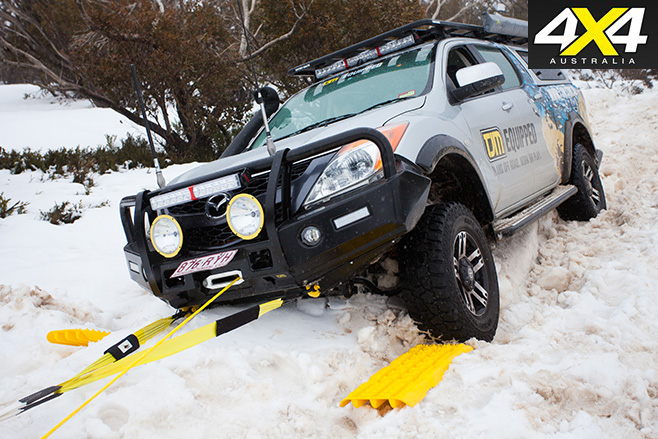
WINCHING? Even with the vehicle’s engine running (therefore charging), winching requires plenty of battery power. A pair of linked batteries is best for winching.
WASTE NOT Driving lights are usually operated while driving – with the alternator charging. However, if your vehicle’s charging system is working too hard, it can greatly increase charging time. So running headlights during the day might be great for safety, but not so great for your battery charge.
AD HOC Fridges generally use a small amount of power for a long time, but a starter motor needs a large amount of power for less than a second. So, different batteries are suited to different power needs and should be matched accordingly.
For more information and tips on Gear, check out our page here.