
I was on the verandah of the old homestead in the Flinders Ranges when 4X4 Australia editor, Matt, said I should start including Unlock Australia on these pages.
And Flinders is where it all started for me. The complete freedom of so much open space, which I enjoyed as a kid, underscores so many of the unnecessary restrictions placed on modern travellers. This country feels ancient – from the giant ghost gums in dry waterways to the rock ledges worn down from old mountain ranges. It’ll outlast the human race and our puny efforts.
In the 1960s it was all dirt once you left Port Augusta and there were more coal trains than cars. Like so many places in this wonderful country, the dirt kept it isolated until the creeping bitumen caught up. I’m a fan of sealed roads, though, as long as they get us to where the tracks start – and we can still access the intimate bits of our bush.
UNLOCK AUSTRALIA Unlock Australia (ULA) is a not-for-profit company that fights to open up public lands for outdoor recreation. Kim is one of ULA’s volunteer researchers. He dedicates plenty of time to the cause, because, as an ex-soldier, he knows the value of fighting for freedom.
Unlock isn’t about unlimited access, though, it’s about finding ways for the majority of Aussies who love their country to get out there responsibly. The ULA hotline for track and bush closures is [email protected].
RALLY THE TROOPS Meanwhile, I’ve flown over to Perth to rally some support for the cause – even the lightly populated west is seeing unprecedented gating and bollards for very little reason. I met up with some old mates while I was there.
Big Russ, nicknamed ‘the people’s champion’, is a big part of the off-road competition scene. That didn’t stop him worrying that I’d find the starter button on this Patrol-based rig.
FLUFFY’S DESIRE Daniel’s nickname is ‘Fluffy’, so you can bet that he’s damn good at what he does. Understanding and tuning shock-absorber rebound and compression damping isn’t necessary for most of us as long as we go for locally developed products.
These are competition shocks and Fluffy is doing a number on them to get the rates matched to the driver’s desire.
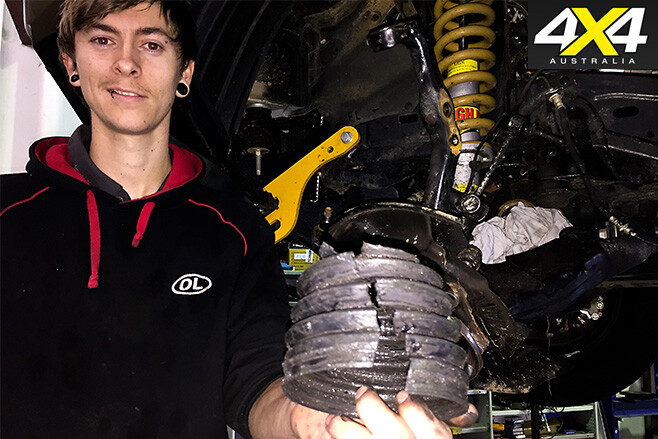
WATCH YOUR BOOTS I caught Ryan mid-way through replacing this torn CV boot and figured it was a good time to remind people to keep an eye on their boots in hard-stick country. It’s about a two hour job to replace a boot – as long as the CV’s okay!
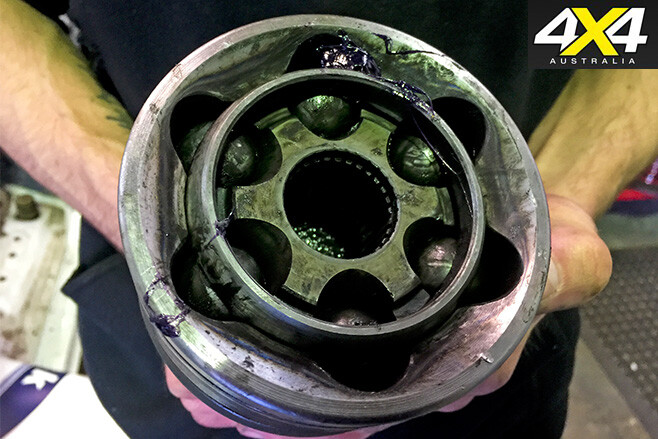
RUBBER AND TAPE This is the CV that was under the ripped boot, but it’ll be fine to re-use after a clean and grease. That’s because the owner realised the boot was torn in time. You can keep out a lot of muck by wrapping the boot with old inner-tube rubber and tape.
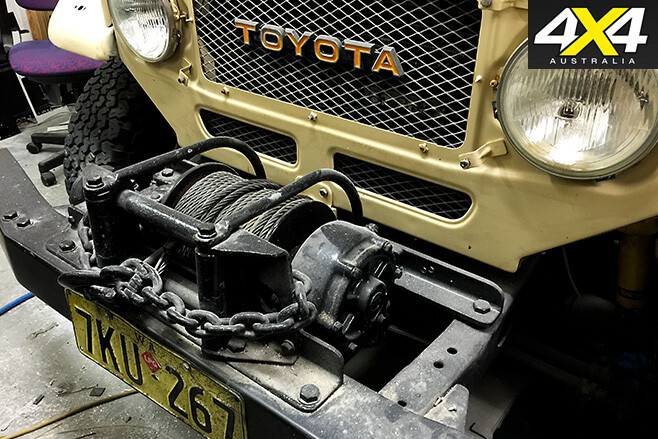
ARKANA Arkana was a Perth-based company that built specialised vehicles for industry and tour operators. This 47 Series was built for Telstra outback line work and featured a wagon-style body, low roof and a side door, too. They’re rare – I got the tip and had to go take a look!
In my old tour-guide days I helped sort the suspension on a few of the six-wheel Arkanas doing Cape duty. If you had a load of heavy buggers on board, they would break leaves pretty quickly, but usually – like most of the worst damage – it would happen on the fast corrugated tracks rather than the low-range stuff.
TRUCK UP A TREE A power take-off (PTO) winch will pull a truck up a tree – no joke, I’ve seen it – but it depends on the motor running. Having dropped one on my foot, I can tell you they weigh more than my handbrake in high heels, too.
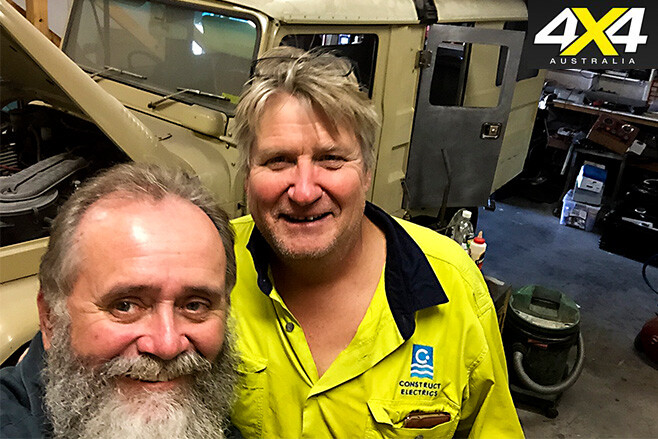
WESTERN SON Turns out marine electrician Dave Mills bought the Arkana as a project for his son Dan, so there’s no chance of me getting it shipped back to Brisbane.
NISSAN HELP I saw Pete’s truck outside Opposite Lock and had to take a step back to work it out. Yep, he’s pushed the front end forward a few inches with different linkages and shifted the back axle further back, too.
There are better approach and departure angles to suit the bigger tyres. I guess Nissans need all the help they can get, eh, Pete? Right, now where’s the airport again?
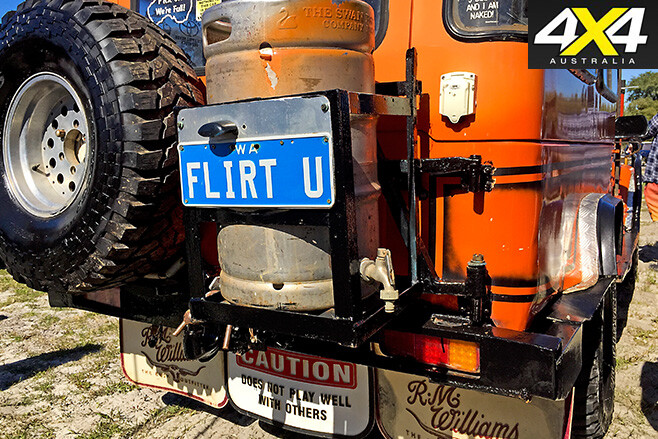
WANDERING KEG Here’s the real deal in modifications. Naturally it’s on a 47 Series Toyota! The owner found the beer keg in the middle of the road and is carrying it around until a brewery decides to refill it. Or something. I’m with you, brother!
With the profusion of electronic devices that we like to take with us, our dash is starting to resemble a jet fighter cockpit.
Mounting iPads, phones, iPods, Hema Navigators and the like can become quite a challenge, especially when you want the devices to be handy and easily read while you’re driving.
We had this issue mounting a new iPad Air, on or close to the centre of the dash in the Patrol, for mapping and navigation. We already had an iPod, phone and an HN-7 Navigator vying for room and had tried a cheap suction mount for the iPad, but it just wasn’t strong enough to hold the weight of an iPad over rough tracks.
In our spacious Dodge pick-up we have a RAM floor mount, which works pretty well with an iPad, but it really needs an extra brace to stop it vibrating on rough tracks. In the Patrol, the floor mount impinges on leg room so we were never happy with it.
With those experiences behind us, we went looking for something else – and found it with a RAM double-suction-cup kit from Mr Mobile, based in Sydney.
This kit is, like all RAM Mount products, top quality. It comes complete with dual 3.25-inch twist-lock suction cup bases, a double-socket arm (there’s a choice of three lengths), an EZ-Roll model-specific cradle for the Apple iPad, and a couple of one-inch ball sockets, along with the assorted screws, nuts and mounting plates.
All the items come in separate sealed plastic bags, with no note on how it goes together. Luckily it is pretty easy, even though I found myself undoing a few screws at times and re-arranging things.
I had ordered the long double-socket arm, but once I had the unit assembled I realised the arm wasn’t long enough to reach across the dash of the Patrol. This meant another order and an extra payment for postage and handling. Then I realised I needed another order – a double ball adaptor. Bugger!
So take note – if you want or need two arms, you’ll need a double ball adaptor to link them. Maybe Mr Mobile, who I was on first-name terms with by the time all this was done, should have told me I needed the adaptor when I ordered the second arm.
With the new iPad mounted in the RAM mount and bracket, we are very pleased with the result. The two arms and adaptor make positioning the iPad very flexible, and the unit doesn’t show any sign of falling off. With the way we have mounted it, the arm is partly supported by the dash, which means there is a minimum of vibration when on rough or rocky tracks.
RAM mounts (www.rammount.com) are manufactured in the USA and there are plenty of mounts and brackets to suit all sorts of devices. The products are widely available on the web. We chose Mr Mobile and we were fairly pleased with the service and delivery times.
Rated
We Say: Expensive, but works extremely well. Price: $150 (kit); $25 (extra arm); $30 (ball adaptor). Info: mrmobile.net.au
It’s the end of an era. But the show must go on.
Inside the March edition of 4X4 Australia we look at 67 years of Defender production and get our mitts on some shiny limited edition models (under strict instructions not to scratch them).
THE MARCH EDITION COMES WITH A FREE LOWRANGE DVD, ‘FIRST TIME THROUGH FINK’ – ON YA ROOTHY!
Also, we burn the midnight oil to find out what the best-selling 4×4 of 2015 was, and look at a half-million-dollar Land Cruiser – which somehow ends up on its side.
You can grab your copy of 4X4 Australia from newsagents or get it early next time by subscribing to 4X4 Australia in electronic or print format.
In the meantime, here’s more of what’s inside:
THE TOP 10 In Australia’s buoyant 4×4 market, utes continue to outdo wagons in popularity. Here’s the low-down on Australia’s best-selling 4x4s of 2015.
HOT ROD CRUISER The supercharged ‘Petersen Special’ FJ44 Land Cruiser is ICON 4×4’s off-road tribute to one of hot rodding’s founding fathers. Oh, and it’s a 6.2-litre, Chevy Gen IV V8 worth a mint.
LITTLE MATE, HILUX The Hilux 4×4 Workmate comes with a 2.4-litre diesel and not the 2.8-litre of the up-spec models. But is it up to hard yakka?
MYRTLE THE TURTLE Slow and steady wins the race. A lot of planning went into the resurrection of this old Land Cruiser, resulting in a home on wheels perfect for its owner.
LAND AND SEA Midway between Sydney and Brisbane, Coffs Harbour Coast is an easy day’s drive from either city. Pack your 4×4 and prepare to tackle some tough mountain drives close to the sea.
DAILY DRIVER Is the Iveco Daily the ultimate touring rig? Mark Allen hitches a ride with EVA to find out.
STATION LIFE For those who want a taste of life in the outback, Eldee Station offers a genuine experience as well as more than 100km of off-road tracks to explore.
THE SOLE OF YORKE Yorke Peninsula in South Australia may be mainly rolling farmland, but the coast has much to offer the four-wheel driver, camper, fisherman and diver.
HIT CLOSE TO HOME Kinchega National Park has history, culture, great driving and fantastic camping on the banks of the Darling River. Plus, it’s close to Sydney and Melbourne.
PLAN B Dual batteries explained: A dual battery system is essential for anyone who wants to power their gear – without the risk of running a battery flat – while out in the scrub.
LOADED ’LUX GIVEAWAY New suspension and bigger rolling stock get out Hilux giveaway car looking good and riding high.
THE REST As always, the mag also has the latest news and events, gear reviews, stats and figures as well as columns by the industry’s most respected names, such as John ‘Roothy’ Rooth, Ron Moon and Fraser Stronach.
Grab your copy of 4X4 Australia from newsagents or get it early next time by subscribing to 4X4 Australia in electronic or print format.
Some may say that Mick Whitehead (the owner of this red-hot GU ute) has dropped a Toyota engine into a Nissan body.
Others would prefer to suggest he’s wrapped a Nissan body around a Toyota engine. Some will no doubt call this transplant total sacrilege with brand mixing at its finest… or foulest, depending on which camp’s flag you may wave.
Others will welcome him to an astute and elite club whereby he has the best of both worlds that no one vehicle maker has been able to deliver – a supremely capable 4X4 with coil springs all round and a comfortable cabin, combined with one of the finest 4X4 diesel engines money can buy that delivers huge torque, good fuel economy and excellent reliability.
Either way, this melding of the two (arguably) most popular brands of 4X4 sees Mick with an extremely capable vehicle for touring and fair dinkum off-road prowess. What this GU can’t tackle is probably not worth tackling!
Kicking off with the ute he’s owned since new in 2001, complete with the Nissan 4.2-litre naturally-aspirated diesel anchor, Mick has peddled it for just on 10 years in various guises – comp vehicle, tourer, with aftermarket turbo, airbox, exhaust and suspension upgrades.
While the GU did improve over time, Mick needed (or just plain ol’ wanted is more like it) a better tow vehicle and highway performer. So, as part of that elite club we’ve mentioned above, he duly decided on a Toyota 1HD-FTE engine, transfer case and gearbox conversion.
Having developed this exact conversion over some years, Jason Dymock at Total Care 4WD was the chosen workshop to be allowed to touch Mick’s pride and joy.
WHAT DIDN’T GET THE AXE Much of Mick’s GU ute had been tried and tested over a long period of outback use and so wouldn’t be touched. The Old Man Emu four-inch suspension with rear (in-coil) adjustable Airbag Man airbags, the two-inch body blocks and those cool-looking alloy Classic II Mickey Thompson rims with 315/70R16 Cooper STT rubber all stayed as is.
The ARB barwork with Warn 10,000lb electric winch, huge rear-mounted 180-litre fuel tank and mid-mounted 60-litre water tank, together with the four IPF spotties (two halogen and two HID), super-comfortable Recaro pews, dual (GME and ICOM) UHF radios, various running gear-related gauges and trick camping tray with canvas canopy all stayed put – hey, what a tops set-up!
Mick had a few other mods that had developed over time to get the whole show rolling better, which luckily could also remain untouched: Nissan 4.6:1 ratio diff gears stuffed with ARB Air Lockers being the biggie, which kept cruising revs just right when combined with the larger diameter rubber. Then there are the lockers that would never be removed in a pink fit – a great weapon off-road regardless of engine type!
WHAT DID GET SWAPPED To make the whole job a little lighter on the hip pocket, Mick managed to sell off his Nissan engine, gearbox and transfer case which were all in top nick. In their place, he’s opted for a LandCruiser 4.2-litre 1HD-FTE engine, with transfer case and five-speed auto from a 100 Series Cruiser wagon with full-time 4X4. Yep, this ute is now a push-button, selectable 2WD to AWD for on-road use, with centre diff lock for off-road.
Apart from that brilliant intercooled turbo-diesel engine, Mick opted for a Steinbauer engine management chip upgrade with a three-inch custom-bent exhaust system and a custom-made top mount air-to-air intercooler sucking through a whopping bonnet-mounted air intake. (Too much power is never enough I say!) Mick and the lads at Total Care 4WD figure the upgraded Nissan pumps out (roughly) 560Nm and 195kW… whew, that’s damn impressive!
A gaggle of gauges reside on both the A-pillar and passenger-side dash to keep track of everything that moves on Mick’s truck. Temperatures for engine, gearbox, exhaust, plus turbo boost and oil pressure all serve to alert if something should go awry.
Having crawled all over this conversion, you’d be hard-pressed at picking it wasn’t standard. It looks like it belongs and obviously has had enormous amounts of research done to ensure all went together like a jigsaw. The complete upgraded Toyota driveline runs smoothly in conjunction with the standard original Nissan steering and suspension. It delivers far superior power and torque outputs on the open road and has proved itself on a few long-distance shake-down runs, as well as offering cracking low-range, off-road ability.
When we first met up with Mick, he insisted we jump in for a quick squirt up and down a few steep and winding high-speed back roads. Wow! Why wasn’t this done from the factory? The whole show looks and feels 99.9 percent factory-built. It runs smoothly, maintains its temperatures, brakes well, handles better than standard and has bucket loads of power to climb, overtake and haul Mick’s caravan. Perhaps if we shout loudly enough, a new marque may emerge … say Nissota or ToyTrol – who knows, it’s worth a try!
Some will say that if you have to rebuild a vehicle, or swap, change and modify too much of it, then you’ve purchased the wrong one in the first place. I’d tend to say that if no one maker can provide what you want – build the bloody thingyourself and have the best of both worlds. Well done Mick for having the cashews under your kilt to be different.
NOT FOR THE FAINT HEARTED
While plenty of DIYers and shops have swapped all manner of engines, this type would surely be near the top of the list for complexity: mechanically-operated engine swapped to drive-by-wire version; manual gearbox swapped to auto; part-time to constant four-wheel drive; engine exhaust, air intake and cleaners/filters changed to opposing sides of engine bay; plus the usual tailshaft mods, engine mount changes and various holes in the floor for the new gearbox/transfer case sticks.
That’s all the obvious stuff. Then there’s the fact that if you purchased the new driveline without a key, pedal box (there are no mechanical linkages in the Toyota system remember) or other small components, then the whole show won’t ‘talk’ to each other, leading to ballpein-hammer headaches and painful wrists from all that extra credit card swiping – it’ll cost you truckloads just for the small parts individually, so purchasing a complete kit initially is paramount.
On top of that, there are the lessons only learnt the hard way. Total Care 4WD has done a fistful of similar conversions, specialising in this particular engine type and they know which sump needs to be mated to the engine to clear the solid axle at full suspension compression; which engine mounts get partially used and mated to the original and all the little tricks needed to ensure the final product looks and works like factory fitment.
While I was going to detail a few of these tricks in case you were going to give this job a go at home, the over-sized shifta that Jason (the proprietor and hands-on fitter) quietly picked up and motioned my way during questioning, showed it just wasn’t worth a cracked skull for me spilling the beans on what’s taken him an awful lot of research and hard work to perfect. Basically, if you want to have a go – work it out for yourself … sorry. Put the shifta down now Jason – please.
A last warning: unless you’ve got a hell of a lot of mechanical nous and savvy – leave this type of engine change to the experts or reap the dire consequences of Murphy’s Law.
Justin at Patriot Campers sold his 200 Series super tourer to build a custom 79. The result was a wild rig with a lengthened chassis, premium suspension, a custom tray, the best aftermarket accessories and an 80 per cent increase in torque from the V8 diesel engine. He had previously delivered a super-touring 79 to customer Norm. Once it was done, he decided he had to have one for himself. As you would. Of course, his tourer has been given the works treatment.
- Check out Part 1 of the Land Cruiser 79 Series build.
- Check out Part 3 of the Land Cruiser 79 Series build.
- Check out Part 4 of the Land Cruiser 79 Series build.
The Bentley Bentayga’s job is to be the fastest, most powerful, most luxurious and most exclusive SUV in the world. If it delivers, then it will end the Range Rover’s decades-long reign.
This article was originally published in Wheels magazine.
WHAT IS IT? The Bentayga is a large luxury SUV aimed at those who want the best, no matter the price, and it’s Bentley’s first. It’s based on the Audi Q7 platform, but 80 percent of the parts have been changed to make it a uniquely Bentley experience, from the styling to the suspension, the engine to the exquisite, handcrafted interiors.
WHY WE’RE TESTING IT Bentley claims no other SUV – indeed, no other car – has the breadth of capabilities of the Bentayga. The luxury British carmaker claims it is equally at home off the road as it is on it, and that it’s the fastest SUV on the planet. We had to find out for ourselves.
MAIN RIVALS
The Bentayga’s $425K price tag puts it a cool $100K beyond its nearest rivals, the Range Rover Autobiography, Porsche Cayenne Turbo S and Mercedes-AMG GLS63. But Bentley buyers are unlikely to cross-shop: they want the best, no matter the price.
THE VERDICT Bentley’s goal with the Bentayga was to create the fastest, most powerful and most luxurious SUV in the world. And they nailed it. A price tag of $425K puts it out of reach of 99 percent of the population, but for those who want the best, it guarantees exclusivity.
PLUS: Effortless, serene, powerful and plush; competent on the road and off it. Quick, too MINUS: The price; some features should be standard
THE REVIEW THERE’S something perversely wonderful about being a hooligan in a $425K SUV on sand dunes. Unleashing 447kW and 900Nm from the Bentley Bentayga’s 6.0-litre, 12-cylinder engine to climb the dunes, then carving across the face just below the lip like a pro surfer on a wave, leaving huge rooster tails of sand in your wake.
There’s absolutely no chance an owner of a Bentley Bentayga will do this, and yet I’m only following the example of the car in front being driven by Bentley’s engineering boss, Rolf Frech.
On the next towering wave of sand, he attacks at an angle. When the 2.4-tonne luxury SUV loses its fight for altitude in the treacherously loose terrain, he keeps the throttle pegged, letting the Bentayga drift balletically along the wave before tilting the tiller down the face and surfing back to the bottom. I do the same, and the windscreen and panoramic sunroof get covered in sand.
No owner will ever mistreat their Bentayga SUV like we are. They would never risk getting sand in the leather stitching, or scratching a wood veneer dash hand crafted by 58 dedicated veneer artisans back at Crewe. And god forbid the Bollinger in the factory-developed picnic pack in the rear should get agitated and explode during such shenanigans.
And yet the fact that this Bentley SUV can play rough and rugged in the dunes is crucial to its appeal. Authenticity is important, says Frech. The Bentayga must be able to do what it says on the box. It must be capable off road.
In addition to that, it must be the last word in SUV luxury and refinement, and it absolutely must be a true Bentley.
This is Bentley’s first SUV, so it’s a game changer for the German-owned brand more British than mushy peas. It’s a new entrant in the luxury SUV market and it’s expected to add 50 percent to total Bentley sales in its first year alone. It’s built on VW Group’s MLB2 platform, the same set of building blocks that underpin the new Audi Q7, the next generation VW Touareg and Porsche Cayenne, and the 2018 Lamborghini Urus.
Despite these shared origins, Bentley claims 80 percent of the Bentayga is uniquely Bentley, from the re-engineered W12 engine and strengthened ZF 8-speed transmission to the suspension, the body panels, and of course the interior.
The interior is perhaps the most traditional part of this non-traditional Bentley SUV. It finds a deft balance between paying homage to decades of Bentley tradition and incorporating contemporary features and equipment.
Yes, there are organ pulls to activate the air vents, and acres of hand-stitched leather and hand-prepared wood veneer, all combined with a craftsmanship and attention to detail few brands can match.
But it also has cutting edge technologies, such as lane keeping assist and active cruise control. It can self-park, can even reverse a trailer, is night-vision equipped, and it has a plethora of cameras to help you navigate the urban jungle, or a real one.
Then there’s the luxury items like the panoramic roof (standard) and sexy, rimless, rear-view mirror (though Volvo XC90 got to market with that first), tray tables and multimedia tablets mounted in the front-seatbacks, and an 18-speaker, 1800W Naim sound system.
Every Bentayga takes 130 hours to build, and Bentley swears this is a handcrafted car, although in the next breath the company boasts about its aerospace-derived ‘superforming’ process first used on the Continental GT, which harnesses superheated air to shape the front quarter panels. Not exactly a bloke with a rubber mallet, but the results are undeniably top shelf.
The Bentayga is the first product of a $1.7 billion investment over the past few years that’s also expected to spawn an SUV coupe (with four doors) and a production version of the Bentley EXP10 Speed 6 concept revealed at the 2015 Geneva show. All these models and its existing lineup of Continental GT, Flying Spur and Mulsanne are hoped to drive Bentley to its goal of 20,000 sales per year by 2025 (Bentley has sold roughly 10,000 cars per annum for each of the past three years).
Part of that money went into redeveloping the 6.0-litre, twin-turbocharged W12 petrol engine, which now produces 447kW @ 6000rpm and 900Nm from 1250-4500rpm (and will replace the old W12 in other Bentley models progressively). It has direct as well as port injection, which Bentley says improves throttle response and reduces emissions, particularly during engine warm-up. It also has stop-start, coasting mode and cylinder deactivation, which disables six cylinders during light applications. All up, Bentley claims a 10.4 percent economy improvement, which is considerable but probably not a deal-breaker for somebody shelling out close to half a million bucks.
If customers are concerned about fuel economy, then news that Bentley is working on a V8 diesel variant for launch in the next two years, followed by a plug-in hybrid V8 petrol, might help salve their eco-conscience.
The Bentayga is not a pretty SUV – few are – but it is bold and stately. Darren Day, a member of the design team that worked on the Bentayga, tells us the design goal was “timeless, contemporary, and British”. That’s not an easy balance to strike. British can quickly become old-world and stuffy, and timeless could easily have been conservative and boring, especially given the negative public reaction to the ugly EXP-9F concept revealed at the 2012 Geneva show that previewed the Bentayga.
But there’s no denying the big, bluff Bentayga turns heads, and none moreso than the dirt bikers and buggy drivers stunned at the sight of a 2.4-tonne luxury SUV tearing around the dunes with them. Despite having a four wheel drive system that uses electronics to maintain traction instead of traditional locking diffs, the Bentayga shows impressive skills in the sand. It’s equally good on dirt surfaces, no matter how steep, and capable of maintaining forward movement even with wheels dangling many inches off the ground.
The Bentayga’s all-wheel drive system is similar in use to the Range Rover’s terrain response: the driver selects a terrain mode via a dial, and the computer does the rest, adjusting throttle and brake mapping, ESC and suspension settings to give the big wagon the best traction possible in the conditions.
In extreme conditions, it’s likely the Bentayga will fall just short of matching the Range Rover’s exemplary skills, but it’d be damn close. Its biggest weaknesses against that other British SUV are approach and departure angles, a result of the Bentayga’s long front and rear overhangs.
Again, it’s debatable whether an owner would take their Bentayga anywhere more rugged than a waterlogged carpark at the Polo.
It’ll also tow up to 3500kg – another first for a Bentley – and comes with a trailer-assist package like the one debuted on the Audi Q7 that can reverse-park a trailer for you. Audi has been unable to get that system homologated for Australia, due to tow-ball differences and backup chain requirements, which the system can’t win with. So it’s unlikely the Bentayga will have that trick in its arsenal in Oz either.
On the road the Bentayga is the epitome of SUV luxury, from its silky smooth and hugely powerful drivetrain to the cloud nine ride despite sitting on big 21-inch wheels and tyres. And yet it doesn’t feel cumbersome or slow responding to steering inputs, and will happily carve a sporting line through a series of corners if that’s your desire.
Perhaps the Bentayga’s greatest on-road trick is the way it sits commendably flat through corners. An active anti-roll system (dubbed EWAS) twists the roll bars in opposition to cornering forces, reducing bodyroll considerably, yet keeping each wheel free to absorb bumps with aplomb. Bentley claims this system, developed in collaboration with suspension company Schaeffler, is a world first in an SUV. The forthcoming Audi SQ7 and next-generation Porsche Cayenne will also take advantage of this active anti-roll bar system.
The W12 engine is a very strong, very willing performer, and has an evocative engine note when revved hard. At typical round-town speeds, however, it is practically silent, and its deep reserves of torque (900Nm from 1250rpm) means you don’t have to prod it much to get meaningful acceleration.
As for the cabin refinement: sublime and serene. Nothing short of a Mercedes-Benz S-Class or BMW 7 Series saloon can match the Bentayga’s ability to isolate occupants from the world outside.
The Bentayga comes in five-seat and four-seat configurations. The latter replaces the bench back seat with two adjustable front bucket seats, although they don’t have the bench seat’s ability to fold flat for long cargo loads.
Back seat legroom is not in short supply, but it’s not as generous as some might expect from a four-door carrying the Bentley badge. The boot is generous, but strangely must be operated by hand. An electric opening and closing tailgate is an optional extra.
That won’t matter to buyers who’ll think nothing of shelling out another $1000 or so to get the electric tailgate. It’s likely they’ll go a lot further, if Bentley’s voluminous range of customisations and options is any indicator. In all there are more than a million combinations of exterior and interior colours and materials to ensure your Bentayga is unique – if you’re prepared to pay.
One of those options is the All Terrain pack, which for an anticipated price of $8000 equips your Bentayga with a 4-mode rotary selector and the software smarts to maximise traction on snow, dirt, sand and gravel. Bentley expects around 50 percent of buyers to tick this box.
Another far more exclusive option – and one that has to go down as the most expensive factory option offered on any vehicle – is the Mulliner Tourbillon by Breitling. This dash-top timepiece is machined in solid gold, and features a mother of pearl face and eight diamond indexes – not to mention the complex and captivating tourbillon timekeeping mechanism. Breitling can only make four of these exclusive automotive timepieces each year, but a price tag of 150,000 euros means it’s unlikely that many of the 5000 anticipated Bentayga buyers each year will tick this particular box.
SPECS Model: Bentley Bentayga Engine: 5950cc W12, dohc, 48v, twin-turbo Max power: 447kW @ 6000rpm Max torque: 900Nm @ 1250-4500rpm Transmission: 8-speed automatic Weight: 2440kg 0-100km/h: 4.1sec (est) Fuel economy: 13.1L/100km (combined) Price: $425,000 (est) On sale: April
Step back in time with me to 1982. We are driving on a flat and straight country road in a 1981 4×4 Hilux single-cab farm ute. Its 2.2-litre, four-cylinder diesel claims all of 45kW – not that there’s anything particularly good or bad about that engine output. It’s just par for the day.
We’re doing 100km/h and using 10 litres of diesel every 100km we travel. Unladen, the Hilux does better than that, but today we have a decent load of hay bales on the back, so there’s more weight and, more importantly for highway driving, more aerodynamic resistance to overcome as the bales sit high and wide of the cab.
Still, 10.0L/100km is good. It means we are using just 100ml of diesel for every kilometre we travel. That would fill just over a quarter of a beer can – not much diesel at all to propel a well-laden ute a full kilometre. That’s testament to how much energy is stored in diesel fuel.
But there’s a catch. To successfully release all that energy, you need to ignite and burn the diesel in the engine’s combustion chambers and to do that you need a truckload of air. In fact, the amount of air needed to efficiently burn that small 100ml of diesel is about what would be contained within the 1.5×1.5×0.5m tub of a modern dual-cab ute; about one cubic metre, or 1000 litres worth of air.
Let’s say I put my foot down. As you’d expect, not much happens. The engine makes more noise, but the ute doesn’t accelerate with any haste. More power is needed to go significantly faster, but to get more power we need to burn more fuel. Getting the extra fuel into the engine is relatively simple, but getting the extra air into the engine to mix with that extra fuel is far more difficult, given the huge volumes of air involved.
At this point, the little four-cylinder diesel with its single overhead-cam two-valve cylinder head has pretty much reached the point where it can’t pump any more air into its cylinders, no matter how hard it tries.
What our engine needs is help, and help eventually comes in the form of a turbocharger – not for this 1981 ute, but down the track, with the further development of diesel engines.
In simple terms, the turbocharger is an additional air pump that helps the engine, because two ‘pumps’ are better than one. The extra air that the turbocharger pumps into the engine can be used to burn more fuel – which in turn releases more energy and makes more power.
The beauty of the turbocharger is that it’s relatively simple to fit to an existing engine and uses a ‘free’ energy source, as it’s driven by exhaust-gas pressure, which is energy that would otherwise be lost to the engine.
But things haven’t stopped there with diesels. Rather than bolting a turbo on to an engine with a simple two-valve cylinder head, you can bolt one on to an engine with a free-breathing, four-valve head operated by twin overhead cams. This helps with pumping even more air into the engine and also means even bigger turbochargers can be used.
Bigger turbos can pump more air than smaller ones, but there’s still a limit to how big you can go. Bigger turbochargers need more exhaust-gas pressure to drive them and therefore take longer to respond and don’t necessarily work well all the time. Ideally you want the quick response of a small turbo combined with the pumping capacity of a big turbo.
Enter the variable-geometry or variable-vane turbo. By changing the diameter of the inlet tract to the turbo’s turbine (see ‘Turbo Basics’ sidebar), this type of turbo can improve response without sacrificing pumping capacity.
Better still is the use of two turbochargers; a smaller turbocharger, which responds quickly, even to moderate exhaust-gas pressures, and a bigger turbocharger, which can ultimately pump lots of air. That way you can optimise both response and performance.
And that’s where we are today with the most sophisticated diesel engines in modern utes, namely, the new Nissan NP300 Navara and the VW Amarok.
Like the engine of our 1981 2.2-litre Hilux, the modern utes still have small capacities – 2.0 litres in the Volkswagen and 2.3 litres in the Navara – but where the old naturally aspirated Hilux made 45kW at best, the Volkswagen peaks at 132kW and the Nissan at 140kW. That is roughly three times the amount of power. Not that you need any more power to drive that same load of hay down the road at 100km/h.
Turbo Basics
A turbocharger consists of a turbine and a compressor, housed separately but fixed to a common shaft or axle.
The way the turbocharger works is simple: exhaust-gas pressure from the engine drives the turbine, which drives the turbo’s shaft. The shaft then drives the compressor wheel, which captures air, compresses it and pumps it into the engine, which benefits enormously by being fed with compressed air, rather than air at atmospheric pressure. It allows the engine to burn more fuel and to make more power.
The turbo’s characteristics and how it ‘adds’ to the engine’s performance can be optimised by varying the overall and relative sizes of the compressor and the turbine. The total volume of air and the pressure at which that air is delivered to the engine can be varied to produce different power characteristics.
After delivering a super-touring 79 to customer Norm, Patriot Camper’s Justin had to have one for himself, so he sold his 200 Series super tourer and is well in to the build of this wild rig with a lengthened chassis, premium suspension, a custom tray, the best aftermarket accessories and an 80 per cent increase in torque from the V8 diesel engine.
- Check out Part 2 of the Land Cruiser 79 Series build.
- Check out Part 3 of the Land Cruiser 79 Series build.
- Check out Part 4 of the Land Cruiser 79 Series build.
We’ve all seen the teasers and the final reveal of what The Naked Ute actually is, but before the campaign started, they let 4X4 Australia’s Dave Morley loose in the ute at the Melbourne 4×4 Proving and Training Grounds. Dave reckons that, like VW’s of yore, the stripped-out Amarok would make a great bush buggy.
With Korr’s round lights, light bars and double-stacked light bars bolted to the test Cruiser, we set out to clock up a few kilometres.
Were the lights any good? Yep, they were brilliant.
The distance and span that the lights shined was right up there with the best units we’ve tested. And the large-finned heat-sink aircraft-grade aluminium housing, polycarbonate lens, German-sourced Osram chips and IP69 rating (for the round driving light) provide specs as good as any you’ll find.
Almost every LED light we’ve tested has come with a 50,000-hour ‘promise’. Korr makes this promise, too, but the company also offers a three-year warranty on its range.
Performance-wise, Korr has made some big claims with regards to LUX readings over a long range – 1 LUX at 680m for the XDD680. Another big tick is that the LED bars come with spot and spread reflectors built in.
They provided excellent wide-close vision and a longer casting of light in the centre. Their patented hybrid combo reflector is said to be 94 per cent efficient for light throw, thereby making the most of useable light generation.
There are five offerings in the double row light bars, from the XDD220 (which claims 1 LUX at 220m) to the whopping XDD680 (which claims 1 LUX at 680m). There is also a range of single row and round light options.
In real life driving, these KORR lights certainly offer brilliant coverage and reach, and I’d be hard pressed finding anything on the market that would match their bang for buck, given their relatively cheaper than some other big name brands.
Rated
For more information: www.korrlighting.com.au
Round lights: XDR510: 48W driving light $319 XDR270F: 80W driving light $319
Single row LED bars: XDS310: 18W LED bar $169 XDS340: 36W LED bar $279 XDS440: 54W LED bar $369 XDS500: 71W LED bar $469
Double row LED bars: XDD220: 36W LED bar $159 XDD380: 72W LED bar $249 XDD500: 120W LED bar $399 XDD650: 240W LED bar $699 XDD680: 288W LED bar $829