You can go bush without a recovery kit, but you really shouldn’t. It’s as simple as that. At least that’s what we’ve all been told for the past couple of decades.
In fact, it’s almost impossible to pick up a four-wheel drive magazine without reading that safety and recovery gear should come before just about anything, including your first tank of diesel. The ability to safely and quickly self-extract is something that should be put before any single aspect of off-roading. There isn’t a camp oven or light bar that should be higher on your shopping list than the simple bow shackle.
It all sounds good in theory – except we’ve rarely been taught what should actually be in a recovery kit, or even how to identify or use the components in question. What’s included in a recovery kit has more or less been left up to manufacturers.
As a result, customers are often uninformed before plonking down their hard-earned cash, attempting to do things the right way. In this issue of our recovery guide, we’re aiming to rectify that. With a camera in hand, we’ve set out to put together a basic guide of what your kit should have in it, and what each item is actually for.
SLINGS AND STRAPS The main items in a recovery bag are slings and straps, and they’ve all got labels on them listing their intended use, such as snatch strap or tow strap. But they don’t come with an explanation of why they’re suited to those applications.
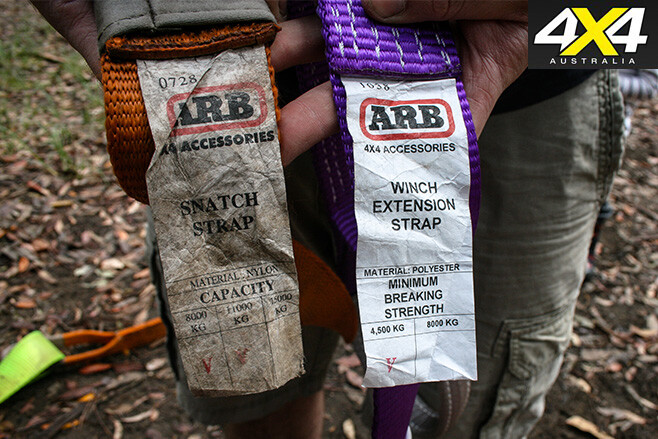
Any recovery kit worth its salt is going to have at least three straps: a snatch strap, a winch extension strap and a tree trunk protector. A more comprehensive kit can include tow straps and load equalising straps, although you can do without those in most circumstances.
The snatch strap should be your go-to recovery device in 90 per cent of situations, but there are a few important things you should be aware of before purchasing or using one. Despite a snatch strap’s appearance, it functions more like an elastic band than a rope. In a recovery situation, the strap will expand as you pull it and then attempt to snap itself shut when it reaches maximum stretch. This elasticity smooths out the recovery process and aids in applying more force to the stuck vehicle; the downside is repeatedly stretching the strap will weaken the fibres and lead to premature failure.
Snatch straps have a limited lifespan and should only be used for a handful of recoveries before they’re replaced. You’ll want somewhere near 25 per cent stretch in the strap and the breaking point should be two to three times the weight of the lightest vehicle being recovered.
Despite looking similar to a snatch strap, a winch extension strap is never a suitable replacement for the former. They’re designed to handle a static load rather than the shock loading from a snatch recovery, and they have a much lower maximum load rating. They are designed to be used in situations where a winching point is farther away than the standard winch rope can reach, or where extra length is required in multiple line pulls.
The final strap you’ll find in most kits is a tree trunk protector. For many tree species, losing an outer ring of bark can kill the tree. A tree trunk protector is a thick strap designed to spread the load over a larger area of the tree to prevent permanent damage occurring during winch recoveries. They allow the fitment of snatch blocks to aid in double line pulls or redirecting winching. They can also be used as a load equalising strap between two recovery points, although extra attention should be paid to ensure no damage occurs.
HARD PARTS Your recovery kit should also have at least a handful of rated bow shackles, at least one snatch block (only if you have a winch), and a set of heavy-duty leather gloves. More extensive kits can have components such as drag chains as well.
Rated D-shackles are quite common, although the bow shackles found in a recovery kit differ in that they’re able to accept a larger strap because of their shape and can handle loads in multiple directions – this is something that is vital in a recovery situation when things aren’t always perfect.
As rated bow shackles are expensive to manufacture, there are a large number of cheaper unrated items on the market. While these may have worked once for a friend of a friend, if things go pear-shaped, they can lead to a catastrophic situation. And when safety is on the line, it pays to pay.
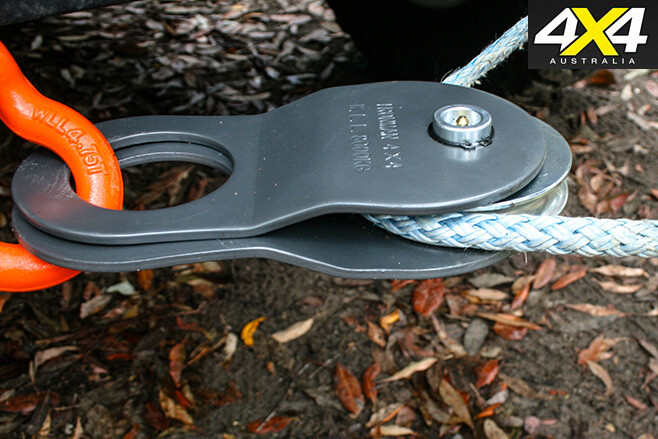
With enough line and two to three snatch blocks you can even winch yourself backwards out of a hole, or sideways if things really go south. It’s important to note that a snatch block should never be used with winch rope if it has previously been used with steel cable. The steel fibres can become embedded in the block and cause irreversible damage to your rope.
In years gone by the simple go-to was a drag chain. You just need to look at any 4×4 photo from the ’70s or ’80s and you’ll no doubt see lengths of chain used as bridle straps between recovery points or even in place of a tow strap. There are multiple issues with using a chain in either scenario.
A chain isn’t able to absorb any energy, making it incredibly dangerous in a shock loading situation. If failure were to occur you’d suddenly find yourself with a section of chain hurtling towards your rear windscreen at fatal speeds. That said, they still have their uses in certain situations where adjustability is required, such as when hand winching; something that’s not possible with a strap.
As with anything, you get what you pay for, and safety has no budget. You’re not talking big money for even the best you can buy, and saving $20 isn’t going to seem important when you’re stuck in a ditch with a broken strap or a shattered bow shackle.
What you actually need in a recovery kit
- Snatch strap
- Tree trunk protector
- Winch extension strap
- Rated bow shackles
- Cable/strap dampener
- Snatch block
- Part 1 of our 4×4 recovery guide: the basics
- Part 3 of our 4×4 recovery guide: the snatch
New cars, SUVs and commercial vehicles in Australia set a new record of 1.15 million sales in 2015, a 1.7 per cent increase on the previous record, set in 2013, and a 3.8 per cent increase on the 2014 sales.
This increase is largely due to the ever-growing popularity of SUVs (4×4 and soft roaders), which continue to close in on the sales lead of conventional passenger cars.
Meanwhile, utes continue to dominate the 4×4 market, even if sales of the Toyota Hilux and the Nissan Navara – both of which were at the end of long product cycles in 2015 – decreased from 2014 to 2015. All the other popular 4×4 utes, led by the Ford Ranger, increased sales in 2015, compared with what they achieved in 2014.
Only three 4×4 wagons, the Toyota Prado, Land Cruiser 200, and Jeep Grand Cherokee made it into the top-end for 2015, as they did in 2014, but only the LC200 increased its sales. Let’s take a closer look…
1. TOYOTA HILUX People’s Choice
Toyota’s Hilux is Australia’s most popular 4×4 and has been for the past 11 years.
Despite dropping 1380 sales from 2014 and selling an out-going model for most of the year, the Hilux held its number-one 4×4 sales spot for 2015. If you add sales of 4×2 models, the Hilux was Australia’s third most popular new vehicle overall last year, small passenger cars included.
The Hilux has been the most popular new vehicle overall in Western Australia for the past eight years, Queensland for the past nine years and the Northern Territory for the past 15 years. But where does that leave the new Hilux, which arrived just as 2015 came to a close? In December, Hilux 4×4 sales were just 11 units ahead of the increasingly popular Ford Ranger, so the sales supremacy fight will be on in 2016.
The new Hilux comes in a bigger range that includes 19 4×4 models, five more than before. For the first time in Hilux history there are two diesel engines, in addition to the 4.0-litre petrol V6 carried over from the previous-gen Hilux. Toyota now offers the V6 in both SR- and SR5-spec, where previously it was only available as an SR5. Given the low cost of fuel and that none of the other popular utes offers a petrol engine, this might be a smart move by Toyota.
What may work against the Hilux, especially in comparison to the Ranger, is that it now has a smaller engine than before, down from 3.0 litres to 2.8 litres, while the new base-spec Workmate has an even smaller engine, a 2.4.
In designing the new Hilux, Toyota’s engineers haven’t tried to build a bigger ute like the Ranger or the Volkswagen Amarok, but instead have set about producing a better version of what they had before.
While the new Hilux is quieter and more refined on the road, the big improvement is seen off-road, thanks to more ground clearance, enhanced rear-wheel travel, and a far more effective traction control system.
It also looks like Toyota has an up-spec Hilux in the wings, which makes sense if you look at the current line-up, where the supposedly mid-spec SR is more like a Workmate but with the 2.8 engine.
Specs: Toyota Hilux SR Engine: 2.8-litre 4-cyl turbo diesel Max Power/Torque: 130kW/450Nm Gearbox: six-speed automatic 4X4 System: dual-range part-time Kerb Weight: 2080kg GVM: 3000kg Towing capacity: 3200kg Fuel tank capacity: 80 litres ADR fuel claim: 8.5 litres/100km
2015 SALES: 25,939 2014 SALES: 27,319
2. FORD RANGER Rising Star
Ford’s Ranger was the big mover in 2015 and it looks set for another good year in 2016.
Ford’s Ranger is the rising star in the 4×4 market, with an additional 2762 sales in 2015 compared to 2014, the biggest increase of any of the vehicles in the top-ten 4x4s. And while the Ranger still finished second, behind the Hilux, it closed the gap between it and the Hilux, from 6645 to just 2503 sales.
Back in 2013, the Ranger 4×4 was in fourth place, with 16,913 sales. In 2012, the first full year of sales for the then new-generation (PX) Ranger, the 4×4 sales were just 12,743. That means that in the four years since the PX arrived in late 2011, Ranger 4×4 sales have increased by a whopping 84 per cent.
Perhaps the best news for the Ranger is just around the corner, given the large number of significant upgrades that accompanied the model’s mid-life facelift in late 2015.
Aside from new front-end styling and a new dashboard with a larger touchscreen, the Ranger has a smaller, more efficient turbo, new fuel injectors and changes to the cylinder head, all of which improve the engine’s response, especially at low rpm. A number of refinement details also make it smoother and quieter.
The Ranger gains electric power steering in place of the hydraulically assisted steering used previously. This makes for very light steering at parking speeds, and the system firms up the steering nicely at road speeds. But not everyone is a fan of it.
The electronic control of the 4×4 system has also been significantly enhanced so that the electronic traction control (ETC) stays active across the front axle when the rear diff lock is engaged. This gives a noticeable improvement off-road, given that previously the front ETC was deactivated when the rear locker was engaged. Ford has also successfully addressed the much criticised shift action of the six-speed manual.
The Ranger’s mid-life facelift also bought a raft of high-end safety features as an option on the two top-spec models.
No doubt the Ranger is well-placed to bring the fight up to the new Hilux in 2016. Let the battle begin.
Specs: Ford Ranger XLT Engine: 3.2-litre 5-cyl turbo diesel Max power/torque: 147kW/470Nm Gearbox: six-speed automatic 4X4 System: dual-range part-time Kerb Weight: 2159kg GVM: 3200kg Towing capacity: 3500kg Fuel tank capacity: 80 litres ADR fuel claim: 9.2 litres/100km
2015 SALES: 23,436 2014 SALES: 20,674
3. MITSUBISHI TRITON Bang for your Bucks
Mitsubishi’s new-generation Triton has picked up where the previous model left off.
Mitsubishi sold 19,990 4×4 Tritons in 2014 and 805 more again in 2015. In both years the Triton ranked third overall in 4×4 sales. Seeing that evidence, you’d think that nothing much has changed from 2014 to 2015, but that’s not the case.
At the end of the first quarter in 2015 Mitsubishi introduced a new-generation model, the MQ, which replaced the MN model.
In creating the MQ, Mitsubishi took the previous MN, pulled it apart, and then put it back together with an all-new 2.4-litre engine, a new six-speed manual gearbox, a new transfer case, tweaked suspension and a slightly bigger and far more polished cabin. The five-speed automatic that was previously only available on the top-spec GLX-R model also became available across the range, relegating the old four-speed auto to history.
Towards the end of the previous MN’s model-life it sold well, partly due to heavy discounting. When the new MQ arrived, Mitsubishi dropped the discounting but still priced the new model sharply. Very sharply, in fact.
The Triton is unique among 4×4 utes, in a number of ways. First, it is a good deal smaller than most of its competitors and can’t match the class leaders in terms of payloads or towing capacity. The fact that most of the tray of the dual-cab model overhangs the rear axle is also a negative when it comes to carrying heavy loads. But the Triton is more manoeuvrable than most, thanks to its relatively short wheelbase and it has sporty feel to the way it steers and handles. Mid- and top-spec models also offer full-time 4×4 in the form of Mitsubishi’s ‘Super Select’ system, which also incorporates a 2WD mode. This adds greatly to the Triton’s functionality and safety.
The Triton’s strong sales are even more remarkable given that the model range is nowhere near as extensive as that of the Hilux or the Ranger. The exterior styling also hasn’t won many fans – especially the styling of the cartoon-like grille, but if you’re after value in a new 4×4 ute, the Triton is certainly the first place to start looking.
Specs: Mitsubishi Triton GLS Engine: 2.4 litre 4-cyl turbo diesel Max Power/Torque: 133kW/430Nm Gearbox: five-speed automatic 4X4 System: dual-range full-time (+2WD) Kerb Weight: 1950kg GVM: 2900kg Towing capacity: 3100kg Fuel tank capacity: 75 litres ADR fuel claim: 7.6 litres/100km
2015 SALES: 20,795 2014 SALES: 19,990
4. HOLDEN COLORADO All Torque
A steady improvement in sales in the past few years has seen Holden’s Colorado rise to number four in the hit parade
In the game of snakes and ladders that is the new 4×4 sales race, the Colorado was a winner in 2015, moving up from sixth spot in 2014 to fourth in 2015.
But this ‘win’ wasn’t entirely attributable to all the good work of the Colorado. In fact, the Colorado gained just 802 sales from 2014 to 2015, but, crucially, the Jeep Grand Cherokee and the Toyota Prado, which last year were fourth and fifth respectively, lost ground in 2015.
If both these wagons held their 2014 sales in 2015, the Colorado would have maintained its sixth-spot ranking.
This generation Holden Colorado arrived in 2012 and unlike the previous Colorado and the various Rodeos, it wasn’t a rebadged Isuzu but a General Motors product from the ground up. It was actually developed by a global GM team based in Brazil, although with plenty of input from Holden engineers and designers.
Since then, the Colorado has undergone a couple of tweaks, most recently for the 2014 model year, when the engine was upgraded and a new six-speed manual gearbox was added to the line-up. The Colorado also gained a raft of new safety and technology equipment, including trailer-sway control, rear park assist, and a reversing camera for the top-spec LTZ model.
The Colorado does well sales-wise due to brand loyalty, an extensive dealer network and an aggressive marketing campaign, but, frankly, it’s not a frontrunner in terms of refinement or how it drives.
What it does do, however, is offer plenty of performance, thanks to the 500Nm of torque that its VM Motori 2.8-litre diesel offers with the automatic gearbox. In fact, as an automatic, it’s the strongest performing of the 4×4 utes.
With the manual gearbox, maximum torque is pegged at 440Nm, although the engine feels no less toey despite the fact that the manual is geared very tall.
Not so good is the Colorado’s modest off-road performance, which is not helped by the fact that it’s one of the few popular 4×4 utes that’s not offered with a rear diff lock.
Specs: Holden Colorado LTZ Engine: 2.8-litre 4-cyl turbo diesel Max Power/Torque: 147kW/500Nm Gearbox: six-speed automatic 4X4 System: dual-range part-time Kerb Weight: 2053kg GVM: 3100kg Towing capacity: 3500kg Fuel tank capacity: 76 litres ADR fuel claim: 9.1 litres/100km
2015 SALES: 15,963 2014 SALES: 15,161
5. TOYOTA PRADO The Perennial
Although surpassed in sales by Jeep’s Grand Cherokee last year, the Prado is back as Australia’s most popular 4×4 wagon.
The 150 Series Prado arrived in 2009 and is nearing the end of its model life, so it’s doing well to be Australia’s most popular 4×4 wagon and number five on the overall 4×4 sales chart.
Mind you, it hasn’t been without its challenges, as last year it ran second to Jeep’s Grand Cherokee in terms of 4×4 wagon popularity, although it was still fifth in the overall rankings.Compared with 2014 sales, it did drop 857 sales in 2015, but at the same time the Grand Cherokee nose-dived, which allowed the Prado to retain fifth position overall.
2015 was important for the Prado, as it gained a new 2.8-litre diesel engine, a new six-speed automatic gearbox and some extra kit, including sat-nav as standard on the volume-selling GXL.
The 2.8-litre diesel replaced the 3.0-litre diesel that first saw service in the previous-generation 120 Prado in 2006 and is shared with the all-new Hilux and Fortuner. Meanwhile, the new six-speed automatic replaced the previous five-speed auto, while the six-speed manual was carried over unchanged.
The chief reason for the new diesel is up-coming emissions regulations, which will probably mean the adoption of SCR (ad-blue) technology, for which the 2.8 is ready, even if it’s not fitted at this stage. Swapping the 2.8 into the Prado also means production cost savings, given parts commonality with Hilux and Fortuner.
Regardless of the new engine and gearbox, which bring refinement more than performance improvements, the Prado remains a comfortable tourer and a capable off-roader that is hard to go past for those looking for a wagon.
This year will, however, be a pivotal year for the Prado, as it will come under serious threat from the new Ford Everest, which offers more equipment, better on-road dynamics and stronger performance for the same money.
When you throw the new Fortuner into the mix, the situation gets even more interesting. Will Fortuner sales cannibalise Prado sales, or will they merely weaken the Everest’s push into this potentially lucrative market?
Specs: Toyota Prado GXL Engine: 2.8-litre 4-cyl turbo diesel Max Power/Torque: 130kW/450Nm Gearbox: six-speed automatic 4X4 System: dual-range full-time Kerb Weight: 2290kg GVM: 2900kg Towing capacity: 2500kg Fuel tank capacity: 150 litres ADR fuel claim: 8.0 litres/100km
2015 SALES: 15,255 2014 SALES: 16,112
6. NISSAN NAVARA Alternate Thinking
The complete line-up of Nissan’s new NP300 Navaras is finally here.
Despite selling 2521 fewer Navara 4x4s in 2015 than it did in 2014, the Navara moves up one spot in the top-ten 4×4 sales chart, thanks to the demise of Jeep’s Grand Cherokee. But that will bring no joy to Nissan, as the 17 per cent drop in Navara 4×4 sales is what really matters.
Nissan actually sold no fewer than three different generations of Navara during 2015, which must be some kind of record. For the first part of the year, Nissan sold both the D40 (which first appeared in late 2005) and the older, budget-priced D22 as an entry-level model, before the all-new NP300 was introduced mid-year. To make things even more complicated, the NP300 was initially only available as a dual-cab pick-up (with a coil-sprung rear end), and it wasn’t until very late in 2015 that Nissan completed the full NP300 range. The new models that arrived in November included single and extra-cab models and a dual-cab cab-chassis variant with a traditional leaf-sprung rear-end.
No doubt this would have left many potential Navara buyers somewhat confused and perhaps heading off to another dealership.
The NP300 was a long time coming, given the previous-generation D40 debuted 10 years ago. In designing the NP300, Nissan deliberately downsized instead of building a bigger ute to take on the likes of the Ford Ranger and the Volkswagen Amarok.
The Renault-sourced engines are also smaller (now 2.3 litres), although mid- and up-spec models use a bi-turbo arrangement (similar to the Amarok) to produce solid power and torque figures of 140kW and 450Nm. The single turbo version of the same engine used in the base-spec models claims 120kW and 403Nm. Gearboxes available are a six-speed manual or an optional seven-speed automatic.
Initial sales of the NP300 haven’t been setting the world on fire and no doubt Nissan will be hoping for a better year in 2016 now that the full range of NP300s is available.
Specs: Nissan Navara NP300 ST Engine: 2.3 litre 4-cyl bi-turbo diesel Max Power/Torque: 140kW/450Nm Gearbox: seven-speed automatic 4X4 System: dual-range part-time Kerb Weight: 1865kg GVM: 2910kg Towing capacity: 3500kg Fuel tank capacity: 80 litres ADR fuel claim: 7.0 litres/100km
2015 SALES: 12,272 2014 SALES: 14,793
7. JEEP GRAND CHEROKEE Yesterday’s Hero?
The Jeep Grand Cherokee’s meteoric sales rise has been matched by its plunge from grace.
Jeep’s Grand Cherokee was the big loser in 2015. In the 4×4 sales chart it slid from fourth place in 2014 to seventh place in 2015 and is no longer Australia’s most popular 4×4 wagon.
More significantly, its sales dropped by a whopping 4618 units (or 28 per cent) in 2015 compared with 2014. This is by far the biggest drop of any of the top-ten 4x4s, and is way in front of the Navara’s 2762 sales slide.
It’s hard to know why the Grand Cherokee has fallen from favour so quickly, although one theory is that people who see themselves as individuals often buy Jeeps and, as the Grand Cherokee has become more common in recent years, its appeal to this type of person has faded. Remember the self-deprecating “I bought a Jeep” campaign? Certainly the Grand Cherokee’s less-than-perfect build quality and niggling unreliability haven’t helped its cause.
Nor has the fact that this generation dates back to 2010 and it’s most recent facelift was in 2013.
So, if people aren’t buying Grand Cherokees, what are they buying? Well, that’s difficult to say, but they’re certainly not buying Toyota Prado’s, because the Prado’s sales decreased in 2015 compared with 2014 too. Some Grand Cherokee sales could have gone to Isuzu, which sold 1719 more MU-Xs than it did in 2014, or Holden, which sold 1536 more Colorado 7s in 2015 than in 2014. And while the Ford Everest was only on sale for a couple of months at the end of the year, it’s already managed to rack up 1245 sales.
Regardless of its declining popularity, the Grand Cherokee is still a great drive and one of the best back-road tourers going around. It has handling, performance and standard equipment that shame a Toyota Prado or a Land Rover Discovery, and it is still pretty handy off-road, even if it isn’t up to the all-terrain performance of those two.
Moving forward, it’s hard to see the Grand Cherokee going anywhere but backwards, given that it will be one year older and will come under increasing sales pressure from the Everest. A new-generation Grand Cherokee can’t come soon enough for Jeep.
Specs: Jeep Grand Cherokee CRD Laredo Engine: 3.0-litre V6 turbo diesel Max Power/Torque: 184kW/570Nm Gearbox: eight-speed automatic 4X4 System: dual-range full-time Kerb Weight: 2267kg GVM: 2949kg Towing capacity: 3500kg Fuel tank capacity: 93.5 litres ADR fuel claim: 7.5 litres/100km
2015 SALES: 11,964* 2014 SALES: 16,582* *Sales figures include a small percentage of 4×2 models.
8. ISUZU D-MAX The Quiet Achiever
Largely unnoticed in the top ten, the Isuzu D-Max’s sales continue to grow strongly.
Isuzu Ute Australia sold 1022 more D-Max 4x4s in 2015 than in 2014. That still ranks it number eight on the list of the top-ten best-selling 4x4s – which is where it ranked in 2014. This is nevertheless a 10 per cent jump in sales, but in a highly competitive market that saw the arrival of no fewer than five new or facelifted utes in 2015, the D-Max’s sales are still impressive, given the D-Max remains unchanged.
What is even more remarkable is the fact that Isuzu Ute Australia was only established in 2008, so the brand has come a long way in a very short time. Of course, Isuzu utes have been sold in Australia for a long time, but they were hidden behind Holden badges, a fact that seems to escape many people.
This generation D-Max arrived here in 2012 and has remained largely unchanged in the intervening period, save for upgrades to safety and towing ratings. The ladder chassis and body shell of this D-Max is essentially a GM design and is shared with the current Colorado, but the D-Max has its own engine, gearbox(s), rear axle, suspension tune, external body panels and interior fitout.
The D-Max’s 3.0-litre diesel is a revised version of what was used in the previous-generation D-Max and Colorado, and in the last of the Holden Rodeos. Consequently, it is a well-proven unit. Likewise, the D-Max’s five-speed automatic gearbox has a proven track record, as it’s essentially the same gearbox that was used in the Toyota Prado up until recently; it was also used in the original petrol 200 Series.
The fact that the D-Max’s powertrain is so well-proven is its real strength and that’s what makes it a good ownership proposition even though many competitor utes have more advanced designs. The D-Max is also sharply priced right across the range and the top-end models are especially well equipped for the asking price.
Specs: Isuzu D-Max LS-U Engine: 3.0-litre 4-cyl turbo diesel Max Power/Torque: 130kW/380Nm Gearbox: five-speed automatic 4X4 System: dual-range part-time Kerb Weight: 1945kg GVM: 2950kg Payload: 1005kg Towing capacity: 3500kg GCM: 5950kg Fuel tank capacity: 76 litres ADR fuel claim: 8.1 litres/100km
2015 SALES: 11,301 2014 SALES: 10,279
9. MAZDA BT-50 Built Tough
Given the strong sales of Ford’s Ranger, the mechanically similar BT-50 really should be doing better than it is.
Mazda’s BT-50 was ranked ninth for 4×4 sales in 2014 and it retained that ranking in 2015, although it achieved a modest 368 sales increase, up from 8312 to 8680.
The interesting thing here is that the BT-50 is a close cousin to Ford’s Ranger, but for every BT-50 Mazda sells, Ford sells nearly three Rangers. Now, Mazda may be happy to sell the BT-50 in those numbers, as the marque is enjoying record sales elsewhere, thanks to the popularity of its CX-5 and CX-3 SUVs and its Mazda 3 and Mazda 6 passenger cars.
The BT-50 came out in late 2011, about the same time as the Ford Ranger, and in their original guise the two were almost mechanically identical. Aside from the obvious styling and equipment differences, the two varied only in their steering-rack ratios and suspension damper calibration.
All of that changed last year when both the BT-50 and the Ranger underwent mid-life makeovers, but to vastly different degrees.
Where Ford introduced a raft of mechanical changes to its Ranger to improve its performance, off-road ability, driving feel and refinement, Mazda’s rework of the BT-50 was limited to exterior styling, a new dashboard for the mid- and top-spec models, and some equipment changes. The only mechanical change of note was a new linkage for the six-speed manual, designed to address the previously vague shift action.
At a time when ute engines are being downsized to smaller and smaller four-cylinder designs, the BT-50 (and the Ranger) stand out with their relatively large-capacity (3.2-litre), in-line, five-cylinder diesel. On the road the ‘big’ five is low-revving and has an easy and relaxed feel to it.
In fact, the BT-50 is a big ute all over – big cabin; big wheelbase; big GVM and payloads; and a class-leading towing capacity.
It is just a pity the BT-50’s recent facelift didn’t bring the in-depth changes that have made the Ranger a far better ute than it was in its original guise.
Specs: Mazda BT-50 XTR Engine: 3.2-litre 5-cyl turbo diesel Max Power/Torque: 147kW/470Nm Gearbox: six-speed automatic 4X4 System: dual-range part-time Kerb Weight: 2118kg GVM: 3200kg Payload: 1082kg Towing capacity: 3500kg GCM: 6000kg Fuel tank capacity: 80 litres ADR fuel claim: 9.2 litres/100km
2015 SALES: 8680 2014 SALES: 8312
10. TOYOTA LANDCRUISER 200 King Cruiser
Nothing beats a Land Cruiser 200 when it comes to go-anywhere comfort and versatility.
Toyota’s 200 Series Land Cruiser has been around for more than eight years, but despite its age and a relatively high price tag, it continues to sell well. In fact, in 2015 its sales were marginally better than in 2014 and it’s the only wagon in the 4×4 top ten to actually increase sales from 2014 to 2015.
The 200 Series benefits greatly from not having any direct competition, thanks to the fact that Nissan doesn’t offer a diesel version of its Y62 Patrol. In fact, while Toyota sold 8251 200s in 2015, total Patrol sales (combined Y61 and Y62) totalled just 1875. The 200 actually gets more competition from the Land Rover Discovery (2915 sales in 2015) than it does from the Patrol, which was the Land Cruiser’s key rival in the past.
In late 2015, the 200 received refreshed styling and some mechanical changes, which will no doubt see it through to the arrival of the new-generation Land Cruiser, which is well-advanced in its development and is due either late next year or in 2018.
The mechanical changes include new piezo injectors (replacing the electro-mechanical injectors used previously) and a particulate filter for the diesel V8. These changes have bought about an improvement in ADR fuel economy and exhaust emissions and have increased the claimed maximum power from 195kW to 200kW. At the same time, the largely unloved but still sweet 227kW petrol V8 has also been tweaked for better economy and emissions.
Meanwhile, a new grille, headlights, a V-shaped bonnet, front bumper and front mudguards distinguish the facelifted 200. At the rear there are new high-visibility LED taillights, among other changes.
The top-of-the-range Sahara also gained four external cameras that can help the driver place the vehicle in tight parking situations and in difficult off-road situations.
Regardless of these changes, the 200’s practicality as an ownership proposition underpins its continuing popularity. It works on and off the road, offers proven reliability and also has Australia’s biggest dealer network to back it up.
Specs: Toyota LandCruiser 200 Engine: 4.5-litre V8 turbo diesel Max Power/Torque: 200kW/650Nm Gearbox: six-speed automatic 4X4 System: dual-range full-time Kerb Weight: 2665kg GVM: 3300kg Towing capacity: 3500kg Fuel tank capacity: 138 litres ADR fuel claim: 9.5 litres/100km
2015 SALES: 8251 2014 SALES: 8154
To compare against the previous year’s top sellers, check out Australia’s best selling 4x4s in 2014.
Land Rover Australia only brought 54 Defender 90 Heritage Editions to Australia and they are set to become prized collector vehicles. Imagine our surprise when they let Dean Mellor take one for a spin. It was only surpassed by how surprised we were that they got it back from him at all.
When a party of three weather-beaten men drove in to Darwin on August 20, 1908, in an equally weather-beaten British-made Talbot motor car, they became the first to drive a car across the Australian continent.
It was a feat that had taken two years, two tries and two cars, and only after 42 days and their second attempt did they manage to break down the tyranny of distance between Adelaide, the capital of South Australia, and Port Darwin, then the ‘capital’ of the Northern Territory of South Australia.
At this stage of the motor car’s evolution, ‘motorists faced a hostile society of luddites, horse-loving reactionaries, regressive law makers and overzealous police’, Dr Kieran Tranter writes in his article ‘The History of the Haste-Wagons’.
There were only about 500 cars registered in South Australia; the car of the masses, the Ford Model T, was yet to be introduced to Australia; and the first west-east crossing by vehicle, by Francis Birtles (see 4X4 Australia’s June 2013 issue), was still a few years away.
Harry Dutton, who owned the Talbot, was a 28-year-old heir to a pastoral fortune. He lived at his family home of Anlaby Station just outside Kapunda, north-east of Adelaide. In 1907 it was decided that he would attempt the first south-north crossing of the continent, a distance of about 3400km.
With him would be Murray Aunger, who Harry’s father had recommended as the companion for the trip. Murray had helped establish the Lewis Motor Works in SA in the late 1890s, and he built the first car in the state in 1900. The Lewis company was by 1907 a major supplier of cars to wealthy South Australians.
Murray was the brain and the muscle behind the crossing attempts, and Harry was to later say, “the trip’s success was attributable entirely to the ability of Mr Aunger”. Murray, a whizz at anything mechanical, also went on to hold a number of Australian motoring records.
The first south-north attempt started in Adelaide on November 29, 1907, in a 15kW Talbot motor car they’d christened, ‘Angelina’.
The Talbot cars, built by Clement-Talbot Limited in London, quickly gained a reputation for being well-made, efficient and fast, and it was the first car, in 1913, to cover 100 miles (160km) in one hour. They were also expensive; a factory refurbished chassis was advertised at the time for £450, and a body for £350. That was more than most complete new cars when the average annual wage in Australia was just £158 per year!
A four-cylinder 3770cc water-cooled engine with mono-cast cylinders and a bore and stroke of 100mm x 120mm powered the vehicle. It had a rated output of 20hp (15kW). The 1908 model had its power increased to 25hp (19kW) and had a recommended cruising speed of around 75km/h.
These English cars often blew out, or dripped, more oil than they actually used, as they had no oil seals. Water use was also considerable, although the Talbots were equipped early on with a water pump, which made them more suited to Australian conditions than many other vehicle makes. The vehicles would also need greasing regularly, with a recommended greasing interval of just 900km.
The vehicle weighed around 1280kg and had a wooden body with a box featuring vertically opening doors in the rear. Its wheelbase was 9 feet and 8 inches long (2.95m) and its wheel track was 4 feet and 7 inches wide (1.4m).
The Talbot was fitted with wooden-spoke, artillery-type wheels originally running clincher-type tyres of about 35 inches by 5 inches (880mm x 120mm). Because tyre pressures of 60psi tyre were standard, they were highly susceptible to blowouts and coming off the rim.
Dutton or Auger never mentioned that, and they reported having only three punctures for the whole of the second trip. They probably ran lower tyre pressures because of the rough, mainly sandy terrain (and slow going), or maybe they used Michelin all-terrain-type tyres with a steel stud tread pattern; that’s a tyre brand that is still known for its great off-road rubber, although the steel studs have gone.
The front wheels were on a standard axle on semi-elliptical springs. The live rear axle was on half-elliptic springs and a transverse spring, giving the rear suspension a great degree of flexibility to cross rough terrain; there were no shock absorbers.
The gearbox was a three-speed unit and included a reverse gear, while the diff was of a conventional bevelled gear drive with fully floating hubs. The footbrake operated on the transmission, while the handbrake operated a contracting band on the rear wheels. There were no front brakes!
The vehicle was equipped with kerosene lamp lights, a speedometer and a gradiometer. Attached to the sides were a shovel, pick and an axe, while a rifle and a block and tackle made it into the survival/recovery kit. A complete set of spare tyres and a vulcanising kit for repairing both covers and tubes were also carried, along with assorted spare parts.
Provisions for a week found a spot in the heavily loaded vehicle, which had been modified to carry 385 litres of petrol. All up the vehicle weighed more than two tonnes.
Extra supplies of petrol and oil were sent ahead to Oodnadatta (the rail head for the Ghan Railway at the time), Alice Springs, Katherine (then called Catherine Creek), and Pine Creek, the latter just 225km south of Darwin.
The week before they set out, the car was tested in the sand hills of Henley Beach. The Kapunda Herald newspaper reported, “… with grades of one in seven, and though the wheels sank to the axles, the car ploughed through the sand without difficulty. The car is cream colored [sic], and not ungainly in appearance.”
Once the expedition set off, for the first couple of hundred kilometres after leaving Adelaide, the roads were good and the progress was excellent. But once they left the small town of Hawker, in the heart of the Flinders Ranges, the route followed the Overland Telegraph Line (OTL) and the horse track that ran beside it.
As they skirted around Lake Eyre, numerous dry and sandy creeks were crossed and, as the Brisbane Telegraph reported, “because of the steepness of their banks and the sandy character of their beds, in which the car wheels spun around uselessly, the motorists were obliged to construct corduroys in order to enable the car to negotiate these crossings.”
But even tougher going was ahead. When they reached Alice Springs on December 16, Harry Dutton wired from the Telegraph Station, and the Melbourne Table Talk weekly magazine reported later that month, “…that he is perfectly satisfied that the notorious Depot Sandhills, which extend for twenty five miles between Horseshoe Bend and Alice Well, and of which overlanding cyclists have always given such a lurid report, are too much for any car without outside assistance.”
The report from Harry Dutton continued: “The country was practically a billowy sea of soft sand. When the 20hp Talbot was set at the stiff inclines the loose drift-sand offered no resistance to the tyres, which simply spun round at terrific speed and tore great gaping holes into the ground.
Block and tackle were tried without success and even when the car had the assistance of a team of donkeys to haul it over the stiffest pinches there was considerable difficulty in steering the car, for the front wheels sank so deeply into the soft sand that it banked up in front of the front axle and had to be shovelled away.
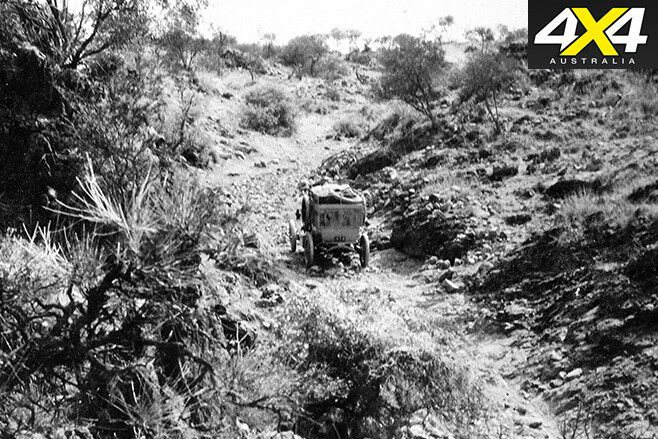
With a temperature of 114 (45°C) in the shade, it can easily be imagined what Messrs. Dutton and Aunger went through out on the barren sandhills. So far they have experienced no trouble with the car, which is standing the rough use splendidly.”
The two men and the tough Talbot pushed on through the rocky barrier of the MacDonnell Ranges and out on to the plains where they were plagued by tall grass and hidden termite mounds that could have smashed their steering, suspension or diff. Here, in this remote country, Dutton and Aunger met Francis Birtles, who was heading south on one of his many cycling record attempts across and around Australia.
But the team’s luck ran out soon afterwards. South of the Tennant Creek Telegraph Station (there was no town at this time), the pinion in the Talbot’s diff collapsed and, with the onset of the Wet Season, the vehicle was abandoned. Dutton and Aunger returned south to Oodnadatta on horseback and transferred to a train to travel on to Adelaide.
Undeterred by their failure, Harry bought another Talbot, this one a more powerful 25hp version, known as the Overlander (or ‘474’ – its rego number). Once again it was modified for the trip, much the same as Angelina had been, and on June 30, 1908, the two men once again set out from Adelaide.
They reached Hergott Springs (now Marree) on July 4, and then Oodnadatta after another week’s hard work in the sandy creeks around Lake Eyre. The report written in the Brisbane Telegraph in September 1908 captures some of the harshness of the trip through the sandy country farther north: “Progress through this class of country necessarily was slow, an average of 40 or 50 miles a day being as much as could be maintained … one occasion a full day’s hard work only reduced the distance to Port Darwin by 10 miles …”
At Alice Springs, the telegraph station officer, Ern Allchurch, joined the two men for the rest of the journey, and 30 days out from Adelaide, after a tough time in among the rocks and narrow passes of the MacDonnell Ranges, they came across the abandoned Talbot, Angelina.
She was in a pretty good state, considering the lengthy time spent out in the elements.
Some of the car’s woodwork had shrunk, the two rear tyres had perished, the locks were broken and some equipment had gone missing, and there was a healthy collection of spiders, wasps and centipedes to clean out. But it wasn’t long before the older vehicle was repaired and mobile once more with Harry at the wheel, while Murray drove the newer car.
They reached the Tennant Creek OTL station soon afterwards and pushed on. On August 8, as the party approached Daly Waters, they were caught in a vicious scrub fire. They were forced to make a 10-mile (16km) run through the inferno, puncturing three tyres on the fire-blackened stumps; the only punctures suffered on the trip!
Luckily, they made it safely through and a few days later reached the Katherine River, which surprisingly offered no great resistance to the group. The Edith Creek, though, a little further north, by Dutton’s report to the Brisbane Telegraph, “… proved a much more formidable obstacle. Here it was found necessary to cover the engines and rush the cars through the stream at top speed.”
Pine Creek, at the southern end of the then-railway line from Darwin, and 69 miles (111km) north of Edith Creek, was reached after a mammoth one-day run. From there, the men expected a relatively easy drive north but, with the coming of the railway line, the road to Darwin had been almost abandoned; its many bridges had been destroyed and the road had been washed away.
Angelina was already struggling in the creek crossings and was sent ahead on the train (the extra 3.5kW that the Overlander sported obviously made a massive difference).
The party pushed on in the Overlander and at Union Town (now abandoned), not far from Pine Creek, the locals confidently predicted that the expedition would end in failure or disaster. With those dire words hanging in the men’s ears, they drove on and, at Bridge Creek, a short distance farther north, found themselves looking at a sheer-sided creek, about nine metres deep and with a sharp turn at the bottom.
Now, the reporter with the Brisbane Telegraph must have been excited, because I’m pretty sure, staid old Harry wouldn’t have written this in his telegram: “It was a case of ‘do or die’.
Reversing the engines, therefore, and pulling the brakes hard down, they launched the cars over the bank of the creek, and, after a looping-the-loop experience with a serpentine instead of a somersault turn at the bottom of the creek, each found himself rushing at the opposite bank, the steel-shod tyres striking showers of sparks from the boulders as they struck against them. Pluck and perseverance again were victorious …”
As they got closer to their final destination, the jungle and verdant scrub closed in around them and they reported being covered in ants, spiders, “and other pestiferous denizens”. The party drove in to Port Darwin on the evening of the August 20, 1908, to “public rejoicing” and later a function was held in their honour.
While the men hadn’t explored any new country or blazed a new trail across the continent, what they had achieved was hailed as a great achievement right across the continent and proved that the motor vehicle was a force to be reckoned with.
The motor car, though, would take another 20 or 30 years to supplant the horse and camel, but in the meantime other adventurous souls read about Dutton and Aunger’s trip and set out on their own incredible travels.
100 years on, we take our cue from such great Australian travellers as Len Beadell and the Leyland Brothers, but we all follow in Dutton’s and Aunger’s footsteps when we travel the Oodnadatta Track, the old Ghan Line and the Stuart Highway north of Alice to Darwin. Tip your hat to them on the next trip north!
The Talbots and National Motor Museum (NMM)
Angelina was sold and destroyed by a fire in 1915, although its box body is the one you see on Overlander today at the NMM.
The Overlander was used for many years on the Dutton’s property, and, in 1959, Harry’s sons re-enacted the trip and drove the vehicle once again from Adelaide to Darwin. There was a road by then, but it was a bloody rough one – nothing like today’s Oodnadatta Track or Stuart Highway.
In 1977 the Birdwood Mill Museum purchased the vehicle, which was in pretty good condition, having been restored for the ’59 trip. It was refurbished again for the 1988 Castrol Bicentennial World Rally. Then in 2008 the Talbot followed – but didn’t drive – the original route as the travelling exhibition, Off the Beaten Track.
The vehicle is still in working condition and has pride of place at the National Motor Museum in Birdwood, South Australia.
While it is worthwhile to go to the museum for this vehicle alone, there are many other standouts housed and on display there. These include Tom ‘the Birdsville mailman’ Kruse’s truck; the Leyland Brothers’ Land Rover, which was the first to cross the continent from Steep Point to Bryon Bay; and many other truck and motoring classics.
For more on the NMM and the Talbot visit: motor.history.sa.gov.au
There are two aspects frequently glossed over in tales of grand outback adventures, and yet they are constant in the red-hot heart of Australia: flies and heat.
On almost any outback adventure, the air will be abuzz with countless winged bastards drinking the moisture of your skin, hair, mouth and, most annoyingly, eyes while the dry heat bakes your skin and saps your spirit.
But that’s part of the fun. The combination of the two is nature’s way of sorting the human wheat from the chaff; those not hardy enough to cop the discomfort suffer in the conditions and swiftly fade.
The outback and the desert are welcome challenges. Endure them and you enjoy them.
THE OPAL CAPITAL Coober Pedy is a stunning town; a quirky mishmash of indigenous and migrant culture, sprinkled with the trappings of modern-day life, including fast food, satellite television and brand-new dual-cab utes. All of this is set in – what from above looks like – a barren landscape peppered with potholes. Those potholes are signs of opal exploration, which has at times been the region’s lifeblood.
We landed on the small airstrip at Coober Pedy, threw our gear in 4X4 Australia’s new long-term Mazda BT-50 dual-cab XTR – bush-ready with bullbar and snorkel – and set off.
The search for opals here, about 846km from Adelaide, has been going on for more than a century; the first opal claim was pegged in February 1915. Living conditions above ground are so harsh that many years ago, some people started building their homes below ground, where the temperature is reportedly a constant 21°C – so you really can’t blame them.
We weren’t here to discover precious gemstones; we were here to tackle some of the toughest outback driving in Australia. Our convoy, heading north for Oodnadatta, had only hit about 9km on the trip meter when the bitumen ended and the fun – and gravel – started.
South Australia’s bewitching outback stretched away from us in all directions, beckoning us.
OODNADATTA It’s a mixed-up world out here, a captivating blend of gibber plains and sand hills; sometimes a moonscape; sometimes a stark blue sky over rocky outcrops. It hasn’t rained here in six years. Our route led through cattle stations north of Coober Pedy, including the imposing Mt Barry Station, which begins about 100km north of the dusty town.
Suffice to say, this is no country for city-slicker utes. If a vehicle doesn’t have what it takes to help its user survive out here, then it’s found out pretty quickly. Looks don’t count out here; ability and reliability do.
Journeys between towns are adventures unto themselves – through washouts and over corrugations in hard showers of scattered rocks. You could tackle these trips in a two-wheel drive, sure, but a four-wheel drive offers much more in the way of comfort, sure-footedness and dependability.
Our BT-50 had no problems. Most of the major tracks we drove during this bush jaunt were in pretty good nick and the section we did of the 620km-long Oodnadatta Track, stretching between Marree and Marla, was no different. But venture off-road and it takes judicious driving to avoid punctures.
After 230km, we entered Oodnadatta, the “hottest and driest” town in Australia, and pulled in to the legendary Pink Roadhouse – where it’s just $2 per litre of diesel – and tucked in to some burgers.
Later, a police officer borrowed our BT-50 to do some low-speed doughnuts around a dusty claypan. We watched on, sipping water and eating Jelly Babies below the scorching midday sun and a huge stagnant cloud of dust.
The ‘6×4 trail’ the South Australian cop was doing gentle circle-work on was located just outside of Oodnadatta. The bloke was having a ball.
Only minutes earlier, we had seen the police Land Cruiser approaching our position from a kilometre away, gliding across a rich-red, sandy track. We had seen this because we had been stuck – the door-sill was deep in sand, atop a dune. Bogged.
Don’t get me wrong: the BT-50 can go almost anywhere. It took two experienced but easily distracted journos to prevent it conquering this particular obstacle. We’d made a clumsy error: we’d relied on speed to tackle a small but steep-ish dune and had come unstuck at a mound of deep sand just before the dune’s crest.
Corrugations in the sand at the top – caused by drivers, such as us, with over-inflated tyres – had forced us into a terminal bounce, which had then drained all of our momentum. The more we tried to gun out of it, the deeper the wheels dug. We were going nowhere under our own steam.
We deserved the strife; we’d been running our tyres at 30psi, which, by my reckoning, was almost twice as much air as we should have had in them. With temperatures tickling the upper 40s at that stage, our tyres would have been nudging 35psi or more. The Mazda support crew swung into action, dropped our tyre pressures and snatch-strapped us out in no time.
We headed for our overnight accommodation at Arckaringa Station, about 90km south-west of Oodnadatta and 150km north of Coober Pedy, stopping at a lookout to marvel at the majestic wonder of the Painted Desert, an ancient inland sea bed so named because of the brightly coloured orange, yellow and white shale on the hills.
Standing there, soaking up the atmosphere, the Painted Desert looked unreal, like a massive painting perched in front of us, close enough to touch. Photographers and videographers in our party were working overtime, making the most of the stunning backdrop this amazing natural attraction provided (visit www.thepainteddesert.com.au).
After ditching our gear in our tents, we accepted an invitation from Arckaringa’s owner Paul to test out the BT-50s on an improvised 4WD course along twisting, sandy tracks, through dry riverbeds and up and down washed-out and rocky creek banks.
The BT-50s looked the goods and proved their mettle, but Paul still refused to commit when we asked him if he was going to ditch his Toyota for a Mazda.
ARCKARINGA STATION That night, we slept under billions of stars at Arckaringa. The station covers 2745km² and is rated by the South Australian Pastoral Board to run up to 2100 head of cattle. It has on-site cabins and camping and it’s a bloody top joint.
The next morning, as we drove out of the station in convoy, a wedge-tailed eagle wheeled about in the sky high above us.
On the return trip to Coober Pedy, we pulled off to the side of the track to tackle a bit of rock-crawling. We didn’t want the adventure to end. It was low-range fun on the steep climbs and hill-descent-control heaven on the descents.
There’s a raw delight to driving in the outback. Nothing like it. The scenery is incredible and ever-changing, as is the terrain, and the light is eye-scaldingly bright. During the day, the sky is crisp and clear blue; the night sky is a black blanket, peppered and aflame with bright, twinkling stars.
After more than 500km of outback adventure, every bloke in the BT-50-touring crew had a big-sky smile.
We’ve been out here loads of times, but that doesn’t matter in the grand scheme of things, because the landscape and light, the blue-sky brightness and the sun-bleached sand, the people and the places never fail to surprise. Never mind the flies and heat.
THE BT-50 Mazda’s updated BT-50 looks tougher and better than its predecessor. The old front end’s upswept ‘eyes’ and bashed-crab look have gone – replaced with a tough, chunky, squared-off presence (the ugly nose had been the only thing anyone could agree on as a flaw in the previous model).
New optional gear includes a great Hema Maps package, which you’d be crazy not to tick off on the order form.
Off-road, this BT-50 went everywhere it bloody wanted to – and it did it in comfort and style. We drove it over heavily corrugated dirt tracks, flirted with gibber plains and took on super-heated sand; all without feeling rattled, jolted or out of sorts; as we would have in some older unladen utes over such terrain.
With four-low and electronic aids selected (rock-solid Hill Descent Control included), this ute virtually drove itself over every off-road challenge we pointed it at. Choose the line, choose the gear and away you go.
The 3.2-litre five cylinder – producing an outback-ready 147kW at 3000rpm and 470Nm at 1750-2500rpm – is nicely mated to the six-speed auto, producing plenty of real-world power and low grunt when it matters.
It’s no disappointment on gravel or bitumen, offering a car-like ride that’s stable, predictable and comfortable. We also drove along sandy creek beds and up and down deeply rutted washouts without a problem.
We drove it up a rocky hillside as high as we could until the severity of the slope screamed at us to stop – or was it the Mazda crew?
When travelling in remote areas, it’s always a good idea to have reliable, easy-to-use equipment that pops up and packs down quickly.
So when we heard about the Malamoo 3-second tent range, marketed by Oztent, we were intrigued, even if the ‘3-second’ claim immediately alerted our BS detector.
Yes, the Malamoo takes longer than three seconds to set up and peg down. But not much longer. And, if anything, it demonstrates design innovation that we don’t see much of in camping equipment these days.
This two-person tent (bigger versions – the X-Tra and Mega – are available) has a clever double-ring frame that allows the tent to be set up quickly in around 30 seconds (definitely not three seconds) on good ground. The frame not only lofts the tent and edges the floor area, but also forms a rail for pegging it down.
Once set up, there’s a 2.4×1.8m floor and a ceiling height of one metre. That means there’s space enough for a mattress/sleeping bag, a clothing bag, and to sit down and pull off your boots.
Out the front is a handy compartment that allows you to store those boots out of the weather, and the tent’s two extra poles, guy ropes and pegs mean the front end can be set up into something of a verandah, while the flyscreen and rear window are made with a super-fine mesh that keeps out the bitey-bugs.
As well as the four pegs that clamp down the frame, there are four attached guy ropes that provide extra stability in strong winds.
Compared to a dome tent, the Malamoo has more structure, thanks to its circumferential frame. The tent also has a better chance of tolerating use on rocky-hard or sandy-soft ground, and if it’s impossible to sink your pegs, your gear inside can anchor the tent.
On the downside, we were a little disappointed that the pegs bent easily (surely heat-treated/hardened pegs would add only a few dollars to the tent’s overall cost), and the Malamoo also has a relatively thin floor, so you’ll need to set it up on a ground-sheet to prevent damage from sharp rocks that are prevalent in so many outback areas.
The Malamoo packs down into a flat bag of about one metre in diameter – you’ll need a little practice to get the hang of it (sewn-in instructions are provided). It’ll best be carried on a roof rack or sitting flat on top of other gear near the headlining of a wagon. Weight is around three kilos, which is negligible in the context of a circa 2.5-tonne 4×4 touring vehicle.
Verdict? Quicker than the common dome tent, but it doesn’t get past the common problems of tents used in arduous terrain.
Rated
GOOD: Quick set-up is an asset for longer adventures BAD: Pegs easily bend; thin floor PRICE: $180 INFO: www.oztent.com.au
So you reckon the inside of the Land Cruiser is getting a bit too snug for those long camping trips? Looking for something larger with a go-anywhere attitude? Or maybe you just want the perfect rugged platform for your dream motorhome?
Well, Mercedes-Benz may have just the right expedition truck for you. Sure, the Mercedes-Benz Unimog has been around forever, but a new model has just landed in Australia: the U430. The baby of the mog range, it is as much a tractor as it is a truck, and it is essentially a tool carrier – something to mount all types of equipment to, from mowers to snow ploughs and more.
Its brother, the big 6×6 Zetros, ups the ante, but you’ll need a heavy rigid licence to steer it. The constant six-wheel-drive Zetros has a military background, although the Australian Defence Force has chosen to use MAN for its future 6×6 trucks. The Zetros, nonetheless, is still here as a niche, go-anywhere truck.
We took both trucks for a spin. The U430 Unimog was the first of the new models to land in Australia, and this one is being used as a spreader, so the drive we took it on wasn’t too gnarly. But we did do some serious off-roading with the big Zetros.
LITTLE BROTHER: U430 UNIMOG The constant all-wheel drive U430 Unimog is powered by Benz’s Euro 6, 7.7-litre OM 936 engine, which creates 223kW and 1200Nm of twisty force. Behind the BlueTec donk is a dual-range, eight-speed, preselect, semi-auto tranny, which gets power to the dirt via the Mog’s famed portal axles.
The 430 we drove had also been optioned with CTI (Central Tyre Inflation) to help keep the little truck afloat in the muck. Another interesting feature is the Work Mode of the UG 100 transmission, which turns the semi-auto into a hydrostatic transmission for off-road work. This means no changing gears, or braking or using the clutch – just use the go-pedal.
On road, the Unimog uses a semi-auto, preselect tranny. You select the gear on the armrest selector and then push the clutch all the way to the floor to engage the selected gear. It’s a little counterintuitive, but you get the hang of it pretty quickly.
With a couple of tonnes of lime in the back, we headed to a local equestrian centre so we could have a play in the grass. The U430 will take a 4.5-tonne payload with the spreader body on the back. Even with half a load in the truck’s tray, the driver can still feel a high centre of gravity as the Mog rocks on its coil springs when cornering.
The 7.7-litre engine seems to have enough huff to haul the little truck along, but with a vehicle like this it is all about the gearing. Driveline noise is surprisingly good and, on the open road near the little Benz’s 90km/h limit, the dominating sound is the roar of the tractor-like off-road tyres.
The truck’s right-hand-drive conversion can be slightly off-putting. The steering box remains on the left and is joined to the steering wheel by a shaft that runs up into the left-hand side of the dashboard and then across the right-hand side of the cab.
The U430 is available with a feature called Vario Steer, which means that the steering wheel and instrument cluster can be unclipped and shifted across the cab for dual-control applications. The machine we tested wasn’t equipped with Vario Steer, but the shaft configuration remained, which explains the layout. That said – the little mog steered fine both on- and off-road.
BIG BROTHER: ZETROS 6X6 The Mercedes-Benz Zetros 6×6 takes off-roading to another level. It’s kind of ugly, brutish and cool at the same time. The odd-shaped cabin means it will fit into the cargo hold of a military transport aircraft; indeed, someone from Daimler recently suggested that I could drive one out of an aeroplane. I’m not sure what they were trying to say to me…
The Zetros uses a Euro 5, 7.2 litre OM926 LA engine, with 243kW and 1300Nm. Tranny options include a 3000 Series, six-speed Allison auto or a nine-speed Benz, synchro manual.
The Zetros is a constant all-wheel drive that uses a two-speed transfer case, which gives you a choice of 1.00:1 for road use or 1.69:1 for belting around the bush. All axles use a planetary hub-reduction drive and diff-locks are standard, front, center and rear. The whole kit and caboodle sits on steel parabolic springs. This all means it’s a pretty tough character.
The trouble is, it’s a very hard truck to review, because it’s hard to find the limitations of a vehicle that is designed to go anywhere. So, as I rolled along the freeway at 90km/h at 2000rpm, where the Zetros felt most comfortable, I began to fantasise about what I could do with the beast.
Driving though a house seemed like fun, but not many people would have a sense of humour about that. Pushing over trees for laughs wouldn’t win me many friends, either.
Out in the bush, this thing ate any obstacle we pointed it at. It flattened mounds of dirt and climbed hills that would make a Land Cruiser squirm. In fact, it became very clear that the only way we were going to unsettle this thing would’ve been with an improvised explosive device or some sniper fire.
The combination of chassis flex and parabolic springs did an excellent job of keeping all six tyres on the ground while roaring through the scrub. The Allison behaved quite well and is a nice, quiet installation. It didn’t appreciate being fiddled with in the bush, however, and it was hesitant to make manual downchanges at times. But it’s hard to ignore the tractability benefits of having a torque converter in an off-roader like this one.
Having a bonnet out front makes for a much better ride than with a Unimog, and cab access is also very easy for a big off-roader. The only downside is visibility, compared to the mog, but it’s also a much bigger truck. The accelerator pedal position is a little awkward, too, as the switch to right-hand drive means that there’s some wheel-arch intrusion under the pedal area.
But, to be honest, I was too busy hanging on the steering wheel and making juvenile whooping noises to notice. In between evil chuckles I even managed to notice that the Benz donk did a nice job of hauling the Zetros down rutted tracks and up hills. And you can throw it out of a plane.
My partner was excited because she had never driven a four-wheel drive and wanted to learn.
I was excited because I thought I’d get to show her how ‘awesome’ I am at 4x4ing.
The I-Venture Club training day should have been the perfect setting for us both to achieve our goals.
Since it was established, the club has aimed to “offer different experiences to different customers – from the first-time-out novice to the experienced ‘hardcore’ off-roader”.
But, more importantly, the club helps Isuzu 4×4 owners get the most out of their vehicles in a safe and structured environment, taking them to some of Australia’s most challenging off-road destinations, with the full support of qualified 4×4 instructors (the last thing you want after you’ve just bought a brand-new Isuzu is to look like a dummy in front of your mates or girlfriend or, worse, end up stranded on a beach as high tide looms).
Now, I’m not an Isuzu ute owner – but, being the honest, durable machine that an Isuzu is, it is probably one of the few new four-wheel drives I could afford to buy. So I was eager to get on the tracks at the Melbourne 4X4 Training and Proving Ground, Mount Cottrell, to see what it could do – and, thankfully, I didn’t have to wait too long.
After a quick session of theory with our 4×4 instructor, a bloke named David Wilson, and a warm up on some moguls, we were taken to a descent most of our crew wouldn’t have been able to walk down.
The idea of starting the day by driving off a cliff seemed to be to throw drivers in the ‘steep’ end to build their confidence. But it was also, no doubt, a way to exhibit Isuzu’s first-gear descent speed, which according to Dave, is world-class. To me, however, the descent was a chance to show off my ‘skills’.
“I want you to do the big leap of faith without the brakes,” Dave said as we assessed the obstacle.
I looked at my partner. I had earlier told her that when it was her turn to drive, she didn’t have to do anything she wasn’t comfortable with. She now seemed to be recalling my words, and didn’t want to take the plunge.
“It’ll be a piece of piss,” I said, contradicting my earlier statement. “Have a go. Don’t worry about the car. It’s not ours.” This didn’t reassure her. But the Isuzu crew gave us thorough instructions and that put her more at ease.
So off we went in our convoy, circling back towards the descent. I was among the first to approach the ramp on the other side of the drop. I accelerated up the mound and braked, with the Isuzu’s nose hanging over the edge and no solid ground in sight. “Now remember, no brakes.” Dave said.
Unfortunately, I ignored Dave and gently tapped the brakes all the way down. I made it to the flat at the bottom, of course, but it was still one of the worst descents of the day. I also didn’t get to experience the low-range reduction of the gearbox.
Hmmm. Luckily my partner does follow instructions and when it was her turn to tilt the D-Max down the hill, she bravely let go and the gearing comfortably brought us to the flat. The day was not exactly going how I had planned – I was supposed to be good at driving, not her.
Next up we were taken to a tricky-looking track to learn about side slippage, lean angles and what happens when you lose traction under the diagonally opposed wheels of a D-Max – a 4×4 without a rear diff lock. On the first part of the track, the right-hand-side wheel track steeply rose while the left-hand side sank.
The trick to driving this, we were told, was to resist turning into the upside of the hill – doing so on such a steep incline can cause the wheels to climb, bite in and roll the vehicle. My partner managed the section with ease, and even cruised over a bumpy section where the Isuzu crew had earlier gotten their D-Max stuck to show us how to pump the brakes while accelerating – a kind of manual traction control.
When it was my turn, I also got through the first part without too much trouble, but at the end, when I got to the steep mound, things went a bit awry. I accelerated gently upward until the D-Max’s diagonally opposed wheels completely lost traction. “That’s not working; reverse out,” Dave said.
So I reversed out and straight into another mound, losing my mudflap in the process. “Try coming up this way,” Dave suggested, guiding me to an easier line. But, again, I became stuck.
Once back at the bottom, I had one final try, charging up with more momentum this time, dirt flying everywhere as the wheels spun, bounced and ripped over the hill. Dave shook his head. “Okay, that wasn’t pretty, but it was effective.”
Yeah, it was effective – so effective it tore that section of the track up so badly they had to close it off to the rest of the convoy. Lesson learned – don’t be selfish.
As the day dragged on, it became more and more clear that my 50kg partner, who had never driven a 4×4 before in her life, was better not only than me, but also the entire convoy. In eight hours of driving at this serious 4×4 park, she didn’t get stuck once. How did this happen?
Simple, unlike me, she had gone to the course with the right attitude: she had been ready to learn and ready to follow instructions. And so she got the most out of the training. She didn’t push too hard and she gave the instructors, the course and the vehicle the respect they deserved.
And that philosophy suits Isuzu Utes to a tee – they don’t have all the bells and whistles or sophistication of some other utes, but if you’re willing to keep it simple and use your brain, you can still get a lot out of them. And if there are things they still can’t do, there’s always the aftermarket.
On the final obstacle of the day, my partner descended down a damp, rocky embankment and into a flowing creek – flawlessly. “That was the best descent I’ve seen all day,” Dave yelled through our window.
“I’ll never hear the end of this,” I thought, as I held the severed mudflap in my lap. Information on current I-Venture trips can be found at www.iventureclub.com.au.
As a limited edition model to mark the end of production, Dean reckons the Land Rover Defender Adventure 110 is a bit of a bargain. See why or check out the full review in the March issue of 4×4 Australia Magazine.
I was on the verandah of the old homestead in the Flinders Ranges when 4X4 Australia editor, Matt, said I should start including Unlock Australia on these pages.
And Flinders is where it all started for me. The complete freedom of so much open space, which I enjoyed as a kid, underscores so many of the unnecessary restrictions placed on modern travellers. This country feels ancient – from the giant ghost gums in dry waterways to the rock ledges worn down from old mountain ranges. It’ll outlast the human race and our puny efforts.
In the 1960s it was all dirt once you left Port Augusta and there were more coal trains than cars. Like so many places in this wonderful country, the dirt kept it isolated until the creeping bitumen caught up. I’m a fan of sealed roads, though, as long as they get us to where the tracks start – and we can still access the intimate bits of our bush.
UNLOCK AUSTRALIA Unlock Australia (ULA) is a not-for-profit company that fights to open up public lands for outdoor recreation. Kim is one of ULA’s volunteer researchers. He dedicates plenty of time to the cause, because, as an ex-soldier, he knows the value of fighting for freedom.
Unlock isn’t about unlimited access, though, it’s about finding ways for the majority of Aussies who love their country to get out there responsibly. The ULA hotline for track and bush closures is [email protected].
RALLY THE TROOPS Meanwhile, I’ve flown over to Perth to rally some support for the cause – even the lightly populated west is seeing unprecedented gating and bollards for very little reason. I met up with some old mates while I was there.
Big Russ, nicknamed ‘the people’s champion’, is a big part of the off-road competition scene. That didn’t stop him worrying that I’d find the starter button on this Patrol-based rig.
FLUFFY’S DESIRE Daniel’s nickname is ‘Fluffy’, so you can bet that he’s damn good at what he does. Understanding and tuning shock-absorber rebound and compression damping isn’t necessary for most of us as long as we go for locally developed products.
These are competition shocks and Fluffy is doing a number on them to get the rates matched to the driver’s desire.
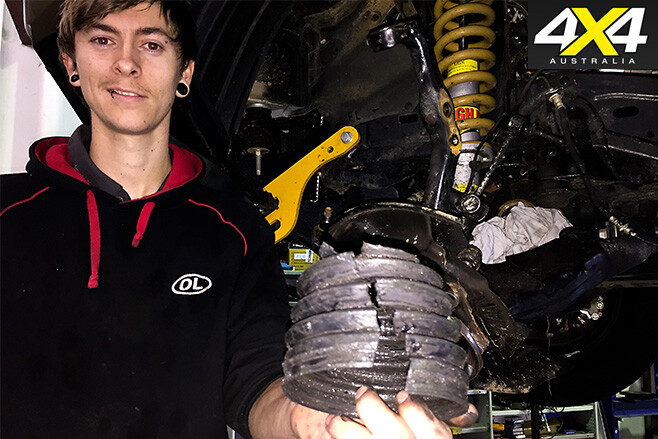
WATCH YOUR BOOTS I caught Ryan mid-way through replacing this torn CV boot and figured it was a good time to remind people to keep an eye on their boots in hard-stick country. It’s about a two hour job to replace a boot – as long as the CV’s okay!
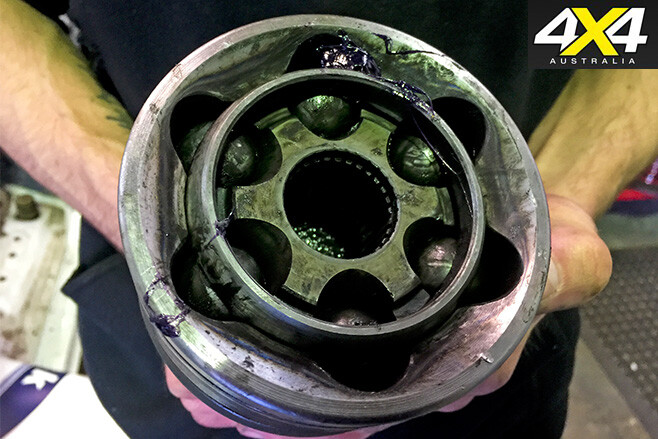
RUBBER AND TAPE This is the CV that was under the ripped boot, but it’ll be fine to re-use after a clean and grease. That’s because the owner realised the boot was torn in time. You can keep out a lot of muck by wrapping the boot with old inner-tube rubber and tape.
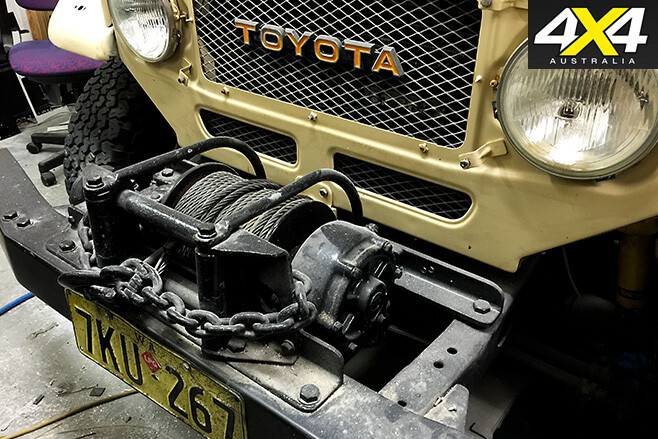
ARKANA Arkana was a Perth-based company that built specialised vehicles for industry and tour operators. This 47 Series was built for Telstra outback line work and featured a wagon-style body, low roof and a side door, too. They’re rare – I got the tip and had to go take a look!
In my old tour-guide days I helped sort the suspension on a few of the six-wheel Arkanas doing Cape duty. If you had a load of heavy buggers on board, they would break leaves pretty quickly, but usually – like most of the worst damage – it would happen on the fast corrugated tracks rather than the low-range stuff.
TRUCK UP A TREE A power take-off (PTO) winch will pull a truck up a tree – no joke, I’ve seen it – but it depends on the motor running. Having dropped one on my foot, I can tell you they weigh more than my handbrake in high heels, too.
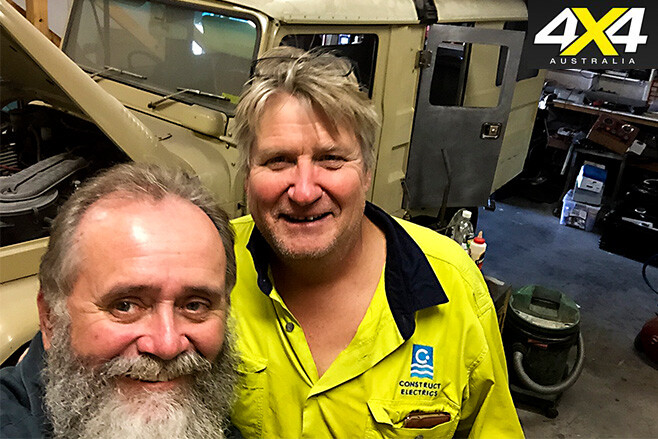
WESTERN SON Turns out marine electrician Dave Mills bought the Arkana as a project for his son Dan, so there’s no chance of me getting it shipped back to Brisbane.
NISSAN HELP I saw Pete’s truck outside Opposite Lock and had to take a step back to work it out. Yep, he’s pushed the front end forward a few inches with different linkages and shifted the back axle further back, too.
There are better approach and departure angles to suit the bigger tyres. I guess Nissans need all the help they can get, eh, Pete? Right, now where’s the airport again?
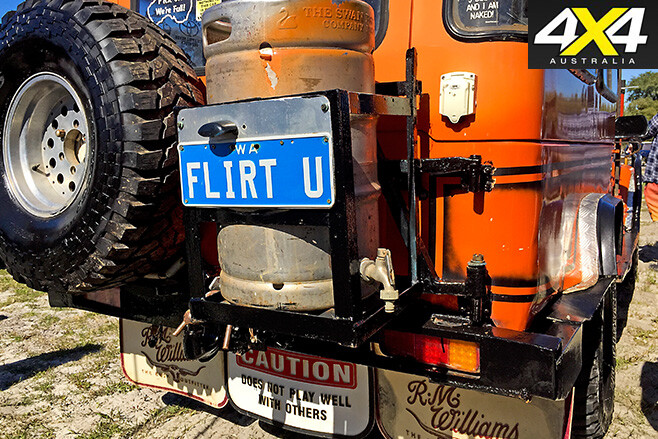
WANDERING KEG Here’s the real deal in modifications. Naturally it’s on a 47 Series Toyota! The owner found the beer keg in the middle of the road and is carrying it around until a brewery decides to refill it. Or something. I’m with you, brother!