Getting away for a family holiday is an adventure in itself.
In this instance, it was not so much the six-hour drive from Sydney to Warrabah National Park that’s an exploration, as it’s a mix of freeway and country B-roads finished off with some snaking gravel – but the trek into remote farming country that’s rarely regarded as holiday material by city folk. Or the myriad stopovers that perfectly showcase country Australia.
Northern New South Wales is fantastic destination to do some exploring, which for us meant saddling up in Toyota’s Fortuner wagon. The new 2.8-litre turbo diesel engine from the Prado delivers a stout 450Nm of torque, perfect for towing the Patriot X1 camper we’ve got hitched to the back (see sidebar). Mated to the six-speed auto gearbox in our top-of-the-line Crusade it makes for easy touring, comfortably devouring all but the steeper hills enroute. With towing fuel use hovering around 11 litres per 100km it’s respectably economical, too.
Heading to Warrabah – one of the little known of 516 national parks dotted across Australia – from Sydney you’ll pass through Tamworth, best known for its annual country music festival, plus its numerous equine events and its 12-metre golden guitar on the southern edge of town.
From there it’s quieter road north towards Manilla, right in the heart of cattle country. The quaint country town is the gateway to some local surprises, a list of which we’re taking note of to explore during our stay. Having a proper 4×4 – ladder frame chassis, low range and full-size spare tyre – ensures you can point the nose down any track that takes your fancy.
The Fortuner is well set up to smaller families (the Prado and Land Cruiser cater for larger ones) with seven seats for suburban duties and loads of space for luggage once the rear seats are folded against the sides to maximise load space. The top-of-the-range Crusade comes with plenty of creature comforts, such as leather seats, climate control air-conditioning, automatic headlights and smart key entry, which allows you to leave the key in your pocket to open the doors.
A reversing camera makes parking easier, and also makes it a snip to back the car up to the trailer. In the latter parts of the journey, though, we’re looking at what’s out the front and sides, not the back.
Pock-marked bitumen quickly turns to dirt and within kilometres reveals rolling, occasionally jagged hills that give a spectacular insight into the granite-strewn countryside ahead. The rocks are part of the Bundarra Granites that stretch to Queensland. River glimpses add to what is a scenic drive.
The harsher rocks are also part of the reason Warrabah exists. Being difficult to access and even more difficult to farm meant it was largely overlooked as productive land, instead turned into a nature reserve before achieving National Park status in 1984. These days it spreads across a relatively compact 5216 hectares, a land size that’s increased over the years as the NSW National Parks and Wildlife Service bought up available surrounding land.
Enter the park and there’s a broad smattering of camp sites, each with easy access to facilities. We headed for the Gum Hole site a few kilometres away, along what’s recommended as a four-wheel drive-only road. A two-wheel drive on its own should handle the undulating and occasionally steep track, although with the trailer in tow it pays to have some extra grunt – and ability.
Once there it reveals a spectacular camp ground on a much wider section of the river. It’s the perfect spot for a canoe or kayak, or even an inflatable pool toy for exploring the edges of the river. Kids – and the occasional adult – will love the giant rope swing that makes for a more spectacular aquatic entrance. The biggest appeal of Warrabah is the serenity. Crack open a book or just sit back with a glass of wine and soak up one of the most picturesque waterholes in the country.
We’re also here to explore the surrounding region, and while the X1 camper claims to go anywhere your tow car can we went solely in the Fortuner. First stop for us is the steep, twisting road to Mount Borah. A four-wheel drive isn’t mandatory but it definitely makes life more reassuring on the challenging road with its sharp pinches.
The Fortuner’s accurate steering and supple suspension deal nicely with the jarring bumps and tight bends. Cresting the hill gives a spectacular view of the surrounding area, and there’s a fair chance you’ll spot some paragliders using what’s regarded as one of the best launch locations in Australia. If you’re game you can even book a tandem flight through the local paragliding school.
Next it’s off to Split Rock Dam, an enormous water supply for the local region. It’s great for a swim and all sorts of water sports; perfect if you’ve got a boat.
We found some more challenging tracks, one on a private road where the owner allowed us to test the mettle of the Fortuner. The excellent 225mm of ground clearance ensures easy rock-hopping, while solid underbody protection gives confidence in tackling some of the more challenging obstacles. The steep approach (30 degrees) and departure (25 degrees) angles it makes for a formidable off-roader, and one unlikely to scrape its chin.
But as we learnt on 4×4 of the Year it’s the A-TRC active traction control that expands the Fortuner’s talents. It’s beautifully calibrated for serious off-road work, to the point where the locking rear differential isn’t really required. Even on gentle throttle applications it cleanly delivers torque to the wheels with traction, the low range gearing allowing low speed control when the going gets rough.
Being based on the rugged underpinnings of the Hilux also gives reassurance the Fortuner can handle some tougher treatment and still get you home reliably.
PATRIOT X1
Our home away from home was the clever Patriot X1 camper. Fully laden it’s a little over a tonne, yet cleverly folds out to a two-bedroom home with a comprehensive kitchen, BBQ, fridge and even a shower.
As Camper Trailer Australia’s Camper Trailer of the Year it’s a rugged package claimed to go wherever the car can, which is lucky, because we decided to put it to the test. It’s good knowing you can get a tad more adventurous without having to worry about what’s hitched behind.
It takes about 15 minutes to assemble with everything in place, including the optional second bedroom attached to ours. Complete with a king-sized main bed, loads of storage pockets and even in-built lighting it’s a luxurious way to go camping – anywhere.
Click here to see the Toyota Fortuner Crusade’s features and off-road capabilities.
Brett Anderson admits it: he’s a Toyota man through and through. In fact, he’s never owned any other brand of four-wheel drive, and he’s owned quite a few over the years.
Brett also owns a landscape maintenance business that services the north and western suburbs of Brisbane, employing a crew of 10. Of course, his daily driver is a new Toyota.
“I drive a new Hilux, my wife’s got a Prado and we’ve got a brand new 79 Series Land Cruiser ute as one of our work trucks,” Brett says. So why is this bloke, with a full arsenal of new Toyota 4x4s at his disposal, driving around in an old 40 Series Cruiser?
“I really like driving the old-school shape,” he says. “I’ve got the new Hilux, but every time I go off-road I think: ‘Oh, it’s my work car, it needs to present well for the business.’ “I look at a lot of tracks and I don’t want to risk damaging the car,” he says.
When Brett found this 1983-model 45 Series on a farm up in Toowoomba, it was a far cry from the almost-finished yellow beastie you now see gracing these pages. Although it still runs the standard driveline – 2H diesel engine and four-speed ’box – Brett has done a hell of a lot of work to the old girl to transform her into the capable and comfortable tourer that she is today.
When he picked the 45 up, Brett reckons it was in pretty good nick. “It was pretty clean,” he says. “It had a couple of little dents in it, on a couple of panels and the driver’s side door, and the roof had a little bit of rust in it. It’s got a fibreglass roof on it at the moment while the steel roof is being repaired, but, other than that, it’s pretty tidy.
“I haven’t painted the actual cab yet. I’ve just cleaned up the chassis, which had some sort of coating on it from new, this orange stuff that won’t come off. It had a fair bit of dirt in the chassis, so I cleaned all that up, then rust-proofed it all and then gave it a couple of coats of chassis black and tidied it all up, the diffs and the rest of it.”
The next step was to tailor the Cruiser to suit Brett’s requirements. The design brief for the 40 Series Brett calls Myrtle was very much based on his camping needs. “I’m into four-wheel driving and camping and fishing and that sort of thing,” he says. “We mainly go to the beach. A mate of mine and I, we go to Fraser Island every year for a week in August, so the main reason I decked it out the way I have is to set it up for that week that we’re up there.”
Hence the 40 Series’ name: “Because Myrtle the Turtle, she carries her house on her back.” Brett laughs, adding: “A bit of that and a bit of lemon-scented myrtle – obviously because she’s yellow.”
When it came to the ‘house on her back’, Brett employed the services of Darren Vassie, owner of Custom RV Creations & Repairs, and builder of two modified 80 Series Land Cruisers that have recently appeared in the pages of 4X4 Australia. “I knew what I wanted and Darren knew how to make it happen,” Brett says.
Brett has known Darren for many years and had no hesitation in asking him to do the work on the 40 Series. “Darren builds my trailers for work,” he says. “He’s built probably about three or four trailers for us, plus he also does all our maintenance on the trailers; twice a year he’ll come over and do all the bearings, adjust all the brakes and make sure all the lights are working. If the guys ever bang any of the trailers up, he repairs them, and he does a bit of mechanical work on some of my cars from time to time.
“Darren was still with [camper trailer manufacturer] Conqueror when I got the 40 Series, and he did the suspension and rebuilt the front-end when it was still in the shed here at my place,” Brett says. “I knew that he was going to leave Conqueror and go back out on his own, so I sort of gave him a bit of a hand because I’ve known him for a long time – it’s always hard when you’re just starting a business.
I said to him: “Well, how about we just leave the car over there and then when you don’t have any jobs on just work on my car. He was happy with that, and then just at every different stage, as we went through it, we spoke about what we were trying to achieve, and how and why.”
Darren equipped the Cruiser with a full Dobinson suspension set-up and raised the cabin by 50mm. In addition to the new springs and shocks, the rear-end of the 40 Series was fitted with Airbag Man airbags to better handle the weight of the vehicle when Brett has it fully loaded for a week away. An Eaton ELocker in the rear diff was also installed, to endow the Cruiser with additional traction when required. And it’d be hard to miss the set of 315/75R16 Dick Cepek Fun Country II tyres mounted to 16×10 Sunraysia-style steel rims.
Up the pointy end, Darren modified the existing bumper with a cradle to house Myrtle’s winch, and he mounted a couple of X-Ray Vision HID driving lights. He also fabricated the vehicle’s smart-looking three-inch snorkel and modified the engine’s standard air filter box to suit, then fitted extractors and a custom-made two-and-a-half inch stainless-steel exhaust system.
The design and fabrication of the canopy was specific to Brett’s requirements. “Brett wanted the retro look so that’s why it has curved corners on it,” Darren explains. The canopy is heavily braced around the rear so that it’s strong enough to hold the Cruiser’s spare wheel and a pair of recovery tracks, as well as to support the weight of a person climbing the ladder to the custom-made rack up top.
“The roof rack on the top; you can fully stand on that roof,” Darren says. “When you look at Brett, he’s like 140kg of man, so I made it pretty strong for him, so he can walk around up there.”
On the driver’s side, the rack is home to a shovel, while on the passenger side there’s an awning to provide shelter over the ‘kitchen’ side of the Cruiser. A Kaymar mount in front of the driver’s door means the bulky high-lift jack can be easily accessed and stowed without having to climb up onto the roof rack.
Brett was very specific with the way he wanted the interior of the canopy laid out.
“I knew what I wanted as far as the layout with the fridges because I’ve got an 80-litre Engel on one side and a 40-litre Engel on the other,” he says. “One of the problems that we had, because we were going to Fraser for a week, the bait wouldn’t last – those last few days the pillies would be all soft, so I wanted to keep the 40-litre Engel to use as a freezer for the bait for the second half of the holiday.
“What we needed, as far as batteries and the Redarc charging system and how it was all going to work with the battery gauges and switches – Darren knew how to make it all work, with what I wanted to achieve.”
Darren has hidden a lot of the electrical gear behind a neat chequerplate panel at the rear of the drawer system. To make sure there’s always plenty of electrical power for the fridges and lights, Myrtle has been equipped with a Redarc BCDC1240 charging system and a pair of Intimidator AGM batteries, while a Baintech volts/amperes gauge displays the state of charge. There’s also the facility to plug in solar panels and a generator for long stints in the one camping spot.
“There are two solar inputs, one on each side, and it’s got a battery charger as well, so if there’s no sun about and we want to charge it up we can just plug it into a generator,” Brett explains. “When we go up there [to Fraser Island], we do a couple of day trips, but the first few days we just like to set up and hang out and not really do too much, so the batteries don’t get that much of a charge up.”
As well as the fridges, the canopy houses a massive drawer system so there’s plenty of space for food, cooking gear, luggage and tools. There’s also a big icebox for when the capacity of the fridges has been exceeded on successful fishing expeditions.
At the rear of the canopy is another chequerplate panel, behind which is the plumbing for the shower. “He’s got hot and cold water there,” Darren says. “And he’s got a remote water pick-up; it’s a three-way valve, so you just turn the valve one way and you can pick up out of a bucket or he can draw from his tank, plus he’s got a hot water system in it as well, a heat exchanger.”
There’s plenty of water capacity, with a couple of big water tanks located on the underside of the canopy, and a 20L drinking water tank above the drawer system. An air compressor sits on top of the drawer system, and there’s an air tank underneath the tray. Darren has fitted a couple of air outlets, one on the back of the canopy near the water outlet for airing-up tyres and another near the air tank.
“You don’t want to be filling up your air tank while you’re filling up your tyres, because it’d take forever,” Darren says, “so there’s a switch inside where you just flick the air tank off, and then it’s just completely out of that one [air outlet] out the back to pump his tyres up with.”
The interior of the 40 Series is relatively standard; other than a switch to operate the Eaton ELocker, a screen for the reversing camera and Roothy’s signed approval on the glovebox lid, the dash looks pretty much like it did when the vehicle first saw the light of day more than 30 years ago.
The seats have been re-foamed and re-trimmed, there’s a basic GME UHF radio and there’s a mount for an iPod. There’s also a JVC head unit hooked up to a couple of 6×9 speakers mounted permanently in the canopy’s cabinetry.
“When you’ve got the awning out and you’re set up down the beach having a fish, you can have a bit of music going without having to blast it out the doors,” Brett says.
Despite having access to a new 79 Series Land Cruiser … and a Hilux … and a Prado, we can see why Brett Anderson would rather spend his recreational time in the old 40 Series he calls Myrtle.
After all, with the way he and Darren Vassie have set up the old girl, she truly is a home away from home, especially for a bloke who loves nothing more than to wile away the hours, fishing on the beach.
Where to next?
Brett’s pretty happy with the way Myrtle turned out, but – like most four-wheel drivers – he’s not entirely satisfied, so he has plans to pull out the old 2H diesel engine and four-speed gearbox.
“I bought an old 60 Series with a 12H-T and a five-speed in it,” Brett says. “I took that out last weekend and we’re just cleaning that up; Darren’s going to change the rear main seal and put new gaskets and seals through the whole motor, and then we’re going to pop that in and we’re going to re-spray [the cabin] at the same time.”
Once the new engine has been fitted, Brett intends to take the 40 Series on a few longer expeditions than the annual week-long getaway at Fraser Island. “We’re going to do a trip up to The Cape next year, so it’s all leading towards that,” he explains.
“I wouldn’t mind going out to Ayers Rock, across the Simpson. I’d like to plan a big trip once a year, because obviously being a seasonal business we’re really busy from September to May, so none of us have any time off during that period.
“I basically work seven days a week – so when winter comes along we take a few holidays then.” The seasonal nature of Brett’s business is perfectly matched to the four-wheel-drive touring season; perhaps we should all get into landscaping.
“I take my staff away a couple of times a year,” Brett says. “Normally at the end of our season, which is in May, I take them up to Land Cruiser [Mountain] Park up at Jimna, and then normally at the beginning of the season I take them up to Double Island Point for a weekend. We normally take the Friday off work and go up there.
“All of my staff, most of them are in to four-wheel driving, camping, fishing and that sort of stuff as well.” Is that a prerequisite for the job? “It is.” Brett laughs.
“I obviously try to employ guys who are like-minded because they’re going to get on well. I find that guys who are into four-wheel driving and camping, they think outside the square and are good at problem solving, and they can adapt that to their work as well.
“If they don’t own a four-wheel drive, it doesn’t mean that they don’t get the job, but it does help if they do.”
As the sun slowly drops below the horizon, the harsh light of day transforms into a gentle hue, giving the entire landscape a much softer appearance.
Above the golden glow in the distance, the sky begins to darken and the first bright stars can be spotted. After a very long day that began well before dawn, we’re now on top of the aptly named Sunset Hill on Eldee Station in outback New South Wales, 56km north-west of Broken Hill.
The day’s dust is being washed away by an icy cold pale ale and we’re about to tuck in to some cheese and bickies as we reflect on the preceding hours’ activities and take in the expansive and spectacular ochre view of the Mundi Mundi Plains before us.
This is bloody brilliant! You simply cannot find a better place in the country to immerse yourself in the iconic Australian Outback.
Off-road exploration
Eldee is a working sheep and cattle property that covers more than 150km² of semi-arid grazing country encapsulating a part of the Barrier Ranges and the Mundi Mundi Plains.
There are more than 100km of four-wheel drive tracks on Eldee that cover every type of terrain from steep and rocky climbs to sandy riverbeds, dry mudflats, creek crossings, deep gullies, old coach and mail roads, stock routes and much more.
Fourth-generation Eldee Station leaseholders Naomi and Stephen Schmidt opened the property to visitors more than 17 years ago and have been developing the tourism offering here ever since.
Today, there are several off-road driving options available to Eldee visitors: you can self-drive, join a tagalong, or take a ride in Eldee Station’s “luxury” 4×4 wagon. “It’s a Prado.” Naomi laughs. “But it’s a new one.”
There are, of course, a few rules that must be adhered to when driving around the property: drivers must be licensed; vehicles must be road-registered and mechanically sound; and a UHF radio must be fitted to check in with the homestead at predetermined intervals.
Despite never having to venture more than an hour or two from the homestead, you can easily spend a few days exploring the various tracks around Eldee Station, so you should ensure you always have plenty of fuel, food and water on board. And, as with any 4×4 adventure, at Eldee Station you need to abide by the “tread lightly” philosophy: take nothing but pictures and leave nothing but footprints.
And when driving around the property, bear in mind that this is a working sheep and cattle station, so it’s important to leave gates as you find them, and give stock and wildlife a wide berth, especially if you spot them drinking from a dam, creek or other water source.
So, other than the spectacular views, what else can you expect to find when exploring Eldee’s tracks?
“There’s wildlife, lots of kangaroos, eagles nesting, emus – in fact, the abundance and variety of birdlife here is quite staggering – and there’s also the Mundi Mundi Ruins,” Naomi explains. “There’s the bird feeding out here, we’ve got pet goats, pet sheep, a big horse … and there are new mountain bike tracks as well.”
The Eldee Station leasehold area was originally part of the Mundi Mundi Pastoral Run that was settled by the Whittings family in the late 1850s, making them the first European settlers on the Barrier Ranges. The Whittings left in around 1885 due to drought, and there are still remnants of their original homestead on what is now Eldee Station.
Wandering around these and other ruins on the property gives a sense of the incredible isolation and hardships the settlers must have encountered, not to mention the extremely hard work that would have gone in to constructing these impressive stone buildings.
The Schmidts also have a long history in the area, with Stephen’s great grandfather William, and his wife, Polly, gaining the lease, back in 1935, that now covers Eldee Station.
For visitors interested in the history of the station, there’s plenty of information posted around Eldee’s restaurant, and both Naomi and Stephen are happy to share what they know about their family’s long association with this part of the Outback.
This area was obviously inhabited many thousands of years prior to European settlement, and there is plenty of evidence on the property.
“There are fire hearths from the Aboriginals, camp ovens, and there’s a megafauna site up the creek that’s at least 30,000 to 40,000 years old,” Naomi says. And thanks to regular visits from Monash University’s geology department, Naomi and Stephen also know a fair bit about the geological evolution of Eldee.
Accessing the various historical sites and different geological formations on Eldee Station requires driving over some quite challenging tracks; the steep, rocky climbs in particular are only suited to those with reasonable off-road driving experience. This is true low-range territory, and is terrain best suited to vehicles with decent ground clearance and good underbody protection. Yep, it’s a lot of fun!
Facilities
At the end of a long day of off-road driving, Eldee Station offers visitors a number of accommodation options that cater to a wide range of visitors – from those who simply want to roll out their swags and cook their own meals to those who want something a little more luxurious, such as a comfy bed and access to a fully licensed restaurant.
Over the years, Naomi and Stephen have worked hard to continually develop the tourism offering at Eldee Station. “We started offering accommodation about 17 years ago,” Naomi explains. “At the time, we didn’t know a lot about tourism, but we diversified because wool prices were really bad, so were sheep prices, and our shearers’ quarters were just sitting here empty.
So we did the rooms up, and then we also discovered that there was a need for campsites as well, so we developed a grassed camping area with a camp kitchen, and we added more facilities in the amenities block.”
“This used to be a cafe,” Naomi says of Eldee’s big centrally located building, with its big windows and wrap-around verandah. “But I call it a restaurant now because I think that kind of thing fits in with the accommodation. Our deluxe rooms are better than three-and-a-half stars … we’re certainly not the primitive run-of-the-mill shearers’ quarters; we’ve got the queen beds, they’re air-conditioned, there’s an en suite…”
As for the food on offer, Naomi somewhat modestly explains: “I’ve done a course to learn how to make sourdough bread, and then I’ve had other training from another baker [on] how to do other breads and pastries, and slices and goodness knows what…”
The hosted nightly meals in the restaurant are simply fantastic – generous servings of homestead-style mains and succulent, rich deserts. “Stephen sits with guests while I’m in the kitchen, and people share stories and get to know each other, and connect with us…” Naomi says.
For those who want something more than the excellent 4WDing and fantastic food, Eldee Station offers plenty of other activities such as guided walks, photography, stargazing, scenic flights and more.
“We’ve got the heated spa, where people can relax at the end of the day, and there’s the plunge pool, which is very popular with the kids,” Naomi says. “We’re like a mini-destination.
We’ve got lots going on; we’re not just a B&B. We even had a wedding here recently; they were 4WDers who had been up here two years prior and they decided they wanted to come back and get married here.”
If you want a taste of real station life, at certain times of the year you can even participate in rounding up stock and helping out on the station. “We’ve got sheep and cattle, and at different times of the year there’s lamb marking and cattle marking, and shearing … so guests can join in at different times of the year doing different tasks such as helping to bring cattle and sheep in and things like that.
“We can even do shearing demonstrations for groups if they call early enough and make a booking; it’s got to be about six weeks ahead, as there is a shortage of shearers on the ground, so we need a bit of lead time.”
Testament to the hard work that Naomi and Stephen have put into the tourism offering at Eldee Station are the numerous awards they’ve won over the past few years, culminating in winning Gold at the New South Wales Tourism Awards last year in the Hosted Accommodation category.
The next time you’re out Broken Hill way, you really should add Eldee Station to your itinerary; it offers an Outback experience combined with spectacular scenery and genuine country hospitality that can’t be beaten. I can hardly wait to get back there – if not for the 4×4 tracks, then for the amazing sunsets viewed from high on the Barrier Ranges overlooking the Mundi Mundi Plains. Simply spectacular!
Getting there
Eldee Station is 56km north-west of Broken Hill, NSW. From Broken Hill, drive the 25km to Silverton (a fantastic destination in its own right) then continue straight on the main road for another 16km to Umberumberka Reservoir. It’s then another 19.6km straight ahead on the gravel road to the Eldee Station signpost. Turn right and drive through the gum creek and you’ll see the facilities to your left.
- Hosts: Naomi and Stephen Schmidt
- Phone: (08) 8091 2578
- Website: eldeestation.com
Travel Planner
- WHERE: Eldee Station, NSW.
- CAMPING: Powered and unpowered sites.
- FACILITIES: Three-and-a-half star suites, licensed restaurant, plunge pool, spa, toilets, showers.
- TRIP STANDARD: Easy to difficult, depending on tracks driven.
- MAPS AND GUIDES: Hema Outback NSW; Eldee Station map (available on-site).
- RESTRICTIONS AND PERMITS: Book ahead and always drop in at the homestead before driving on station tracks.
- CONTACTS AND INFORMATION: Eldee Station: www.eldeestation.com; Ph: (08) 8091 2578
Picture Perfect
For those interested in photography, Eldee Station offers more than stunning outback scenery and native flora and fauna. This is why renowned photographer Michael Ellem from Offroad Images regularly holds photography workshops here.
According to Michael, Eldee “offers a fantastic canvas for us to work with whilst still having the country-style hospitality which welcomes you in.”
If you attend one of these fully catered workshops, be prepared for some seriously long days behind the lens. “I plan to make the most of the good light and will be shooting well before dawn and well into the night,” Michael explains.
Aimed at beginner to intermediate photographers with their own DSLR cameras, the workshops use theory and practise to teach students about light painting, composition, the rule of thirds, aperture, capturing and creating a sense of motion, using light, shooting panoramics, shooting star trails, and much more.
For details or to book in to a course see: www.offroadimages.com.au
It would seem 2016 is the year of the new car. According to VFACTS sales data published last week, new car sales are 6.7 per cent higher than February 2015.
Sitting just behind passenger cars is the SUV segment which is at 69,932 sales year to date, more than 10,000 sales ahead of this time last year.
Of these, medium SUVs are taking the lead with the likes of Mazda CX-5, Hyundai Tucson and Nissan X-Trail topping the list.
TOP 10 SUVS FOR FEBRUARY 2016
| Rank | Model | Sales |
| 1. | Mazda CX-5 | 2156 |
| 2. | Hyundai Tucson | 1849 |
| 3. | Nissan X-Trail | 1669 |
| 4. | Toyota RAV4 | 1514 |
| 5. | Toyota Prado | 1295 |
| 6. | Subaru Forester | 1051u00a0 |
| 7. | Mitsubishi Outlander | 1035u00a0 |
| 8. | Toyota Kluger | 959u00a0 |
| 9. | Subaru Outback | 869u00a0 |
| 10. | Jeep Grand Cherokee | 770u00a0 |
When does excitement turn into panic, or thrill turn into spill? When does the joy of a new adventure turn into heartache?
The answer: when your brand-new fourbie grinds to a halt, belly deep in the sand, or it slides down the beach towards the surf.
It all seems so easy on television – family wagons gleefully plunging into rivers, before climbing fearlessly up and down steep hills, towards magically pristine campsites.
But if you’ve never actually driven off the blacktop, taking $50K-plus of hard-earned dollars into the unknown is more than a little scary.
It used to be that once a marketing department had enticed you to part with your money it was only the service department that wanted to see you – and get you to spend a few more dollars. Now, smart 4WD manufacturers are starting to realise that improving a customer’s experience with a new 4×4 can build brand loyalty and create new client recommendations.
Enter the the Isuzu I-Venture Club, an initiative put together to provide fun and informative driving experiences for Isuzu D-Max ute or MU-X wagon owners. While the drive days are tailored for completely novice 4WDers, even experienced folk will pick up more than a few tips and tricks, because the training is specific to the Isuzu product and how to get the very best performance from these particular vehicles.
A typical drive day starts with a good breakfast and some serious business as the lead trainer provides some clear and concise off-roading principles and an introduction to how a 4WD system works.
Participants receive a good grounding in things like tyre construction and the always-important selection of the correct tyre pressures. Plus, there are very specific tips and techniques for Isuzu vehicles to enable owners to develop an understanding of how to set up their vehicle to tackle various terrain.
Before the fidgets have time to set in, it’s time to hit the driver’s seat to put theory into practice. In Western Australia, this was on a favourite fourbie playground – the powdery white Lancelin sand dunes.
The trainer David Wilson and his Isuzu support team start things slowly on mild slopes and firmer sand before guiding, encouraging and cajoling the drivers to tackle the big slopes at ever more daunting angles.
As confidence soars (and smiles widen), Wilson mixes it up by finding a boggy, sloping beach to teach drivers about momentum, angles and track selection. And if no-one inadvertently goes belly deep, he convinces someone to “do the wrong thing” to demonstrate how easy it is get to stuck and how getting back on track is totally achievable.
With a big thumbs up from the drivers, Isuzu has been winning happy customers with their I-Venture initiative.
If you own an Isuzu, check out iventureclub.com.au for their next adventures in Queensland, New South Wales, Victoria, South Australia and Western Australia.
Around $250 will get you a day pass with a dedicated and experienced 4WD trainer for 1 vehicle/2 passengers, including breakfast and lunch.
Reader Code
For 10 chances to win, enter the reader code from the latest issue of 4×4 Australia below (Don’t have a magazine code? Keep scrolling down!):
Free Entry
Enter your details below for your chance to win!
If you’re out bush, you don’t want to monkey around when it comes to charging your portable electronic gear. These Powermonkey power packs are magic on the run.
POWERMONKEY EXPLORER We have recently been testing Powertraveller’s Powermonkey Explorer and Powermonkey Extreme 12V in Papua New Guinea, and both passed with flying colours. They effectively charged our phone, GPS, sat-nav, audio gear and cameras – all while we were on the move.
The Powermonkey Explorer and Powermonkey Extreme 12V belong to a larger family of power packs – which include the Powergorilla and Powerchimp – under the Powertraveller umbrella.
The Powermonkey Explorer comes with a selection of adapters and wall-socket extensions designed to work with mobile phones, iPods or MP3 players. The power pack includes a 2200mAh battery. This battery can be charged by mains electricity, via your computer, or you can use the in-built solar panel – like we did in Papua New Guinea.
The 2200mAh battery is an excellent size when you consider that most phone batteries are approximately 900mAh. At this rate, the Powermonkey Explorer should achieve between 1.5 to two full charges of your phone.
The variety of connections is impressive, including those for Samsung, LG, Nokia and Sony Ericsson phones, iPod/iPhone, as well as standard connections for devices using the mini or standard USB.
For around $160, the Powermonkey Explorer power pack will keep you on the run and connected.
RATED Available from: www.powerhungry.com.au RRP: from $159.95 We say: Compact, practical and powerful on the fly.
POWERMONKEY EXTREME The Powermonkey Extreme is the Explorer’s bigger brother and, since its initial launch in 2011, it has only improved. In 2013 it underwent a couple of significant changes, so it can now do everything the Explorer does, and more.
The Powermonkey Extreme houses a massive 9000mAh-capacity lithium polymer battery capable of recharging most 5V devices. However, the most important improvement for 2013 was the change to the Powermonkey Extreme’s DC output option.
The standard 5V USB socket remains, but the DC port has been upgraded to output 12V, meaning that it is now capable of recharging SLR camera batteries, portable DVD players, iPads and tablets.
The Powermonkey Extreme is lightweight and compact enough for even the most space-conscious travellers. It also comes with a female car charger socket so you can connect electronic devices to the Powermonkey Extreme when they might otherwise be limited to being recharged in your vehicle. This adds even more versatility to the Powermonkey range.
The Powermonkey Extreme can be recharged in three ways: via the universal mains charger, via the solar panel, or via USB. The rugged, clam-shell design solar panel offers three-watt max output, allowing full recharge in 18 to 22 hours.
The solar panel on the Powermonkey Extreme can be attached to tents or backpacks via the included Velcro strap. This makes it perfect for the outdoors.
The Powermonkey Extreme weighs 242g and measures 152 x 59.5 x 28mm, while the solar panel weighs 214g, measures 171 x 90mm and is 18mm deep when folded. The solar panel is Polysilicon and offers photovoltaic efficiency up to 17 per cent.
Waterproof for 30 minutes down to one metre – and shock resistant – the Powermonkey Extreme is perfect for the outdoor enthusiast and professional adventurer alike.
RATED Available from: www.powerhungry.com.au RRP: from $249.95 We say: A versatile product that’s made for the outdoors.
For more information and tips on Gear, check out our page here.
Jonathan Ward’s Californian-based company ICON 4×4 has made a name for re-engineering legendary off-roaders, including Ford Broncos and Toyota FJs.
Vote for Jonathon’s FJ44 to decide this year’s Custom 4×4 of the Year.
This FJ44, called the Petersen Special, is its latest and most advanced build so far, put together by Jonathan to celebrate both the delivery of the 100th ICON vehicle and the reopening of downtown Los Angeles’ legendary Petersen Museum after its complete rebuild and overhaul.
A centre for vehicle history since 1994, the Petersen Museum houses some of the most historically important and culturally significant cars ever made, and gives an important insight into the various niches and genres that make up the whole of car culture. Still located on Wilshire Boulevarde in Miracle Mile, the museum was recently reopened after the largest renovation to the building since it was constructed as a department store back in 1962.
The ICON FJ44 Petersen Special is another old frame built into a striking modern beast, with a modern 6.2-litre Chevy Gen IV V8 and heavy-duty off-road suspension. But it also has air conditioning, LED lighting, tough powdercoated finishes throughout and many tiny yet stunning detail pieces thanks to Jonathan’s background as an automotive designer.
That’s nothing unusual for an ICON-built vehicle, but the Petersen Special started as an internal project to showcase new engineering and design ideas. The new ideas run from the Sierra Brown powdercoating colour through to the redesigned buttons and controls in the cabin, as well as an all-new radius arm suspension system that ICON claims improves on-road driving performance.
The redesigned suspension features new Fox Racing 2.5 nitrogen-charged shocks with external reservoirs and Eibach springs. There’s a Panhard front linkage and a four-link in the rear, married to Currie Anti-Rock swaybars, heavy-duty Johnny joints and equal-length two-inch steel control arms.
The build starts as per all ICON Reformers – FJs and Broncos – with a new body stamped out of heavy-duty 5052 H32 aluminium, saving time that would otherwise be spent fixing rust or other maladies that normally appear on 60-year-old tin work.
Jonathan has the stretched extra-long-wheelbase bodies built and finished by hand, with the bonnet a brand-spanking-new OEM Toyota-stamped steel piece, and the grille a vintage original part.
ICON off-roaders are normally finished in a high-tech Teflon-polyester hybrid Cardinal powdercoated finish but the Petersen Special introduces the new Sierra Brown colour to the company’s palette of hues.
The Cardinal powdercoating was originally conceived for exterior industrial architectural uses before ICON refined it for automotive use. The ICON craftsmen treat the underside of the body, ’guards and inner floor surfaces in a heat-cured polyurea coating for reduction of vibration and heat transfer.
As with all ICON builds, the original frame has been binned in favour of a CAD-designed custom chassis by Art Morrison, featuring boxed and mandrel-bent mild steel rails. This is far stronger than the original frame and ICON also has had all accessory mounts precision laser cut to exact dimensions, meaning everything bolts together with far greater ease than old 1960s parts.
ICON not only uses jig tables for assembly, but also chassis-specific ones. This keeps every FJ, Bronco, Derelict or Reformer aligned and in perfect position, and it makes it far easier to fit the emissions-certified 420hp, 6.2-litre LS3 GM e-Rod crate motor, along with a custom Griffin aluminium radiator and twin thermos fans.
Legislative changes in America allow small-volume houses like ICON to bypass the strict emissions controls applied to the major manufacturers, which means the optional Magnusson supercharger can be fully road legal. With a 0-100km/h time of 5.9 seconds, the supercharged Petersen Special is no slouch.
A hand-built half-million-dollar FJ Land Cruiser needs the fit and finish expected of any exotic vehicle from Bentley or Mercedes-Benz, even if the FJ44 is an off-road vehicle. A modern electronically controlled 4L65 Hydra-Matic auto got the nod in the Petersen Special, and is optional on regular ICON builds.
It’s a heavy-duty but highly refined transmission that’s available in both rear-drive and four-wheel-drive outputs. It features adaptive shift electronic controls as well as electronically controlled capacity clutch (ECCC) technology to provide smooth shifting, while the 4L65 also reads signals from the engine ECU to prevent hunting between gears when climbing hills.
It has been paired to an Advance Adapters Atlas II transfer case to allow part-time 4×4 use, making for excellent on-road manners with tough-as-nails off-road ability. The Atlas II transfer case has a 3.0:1 low-range and 1:1 high-range transfer case, with an optional 5.0:1 low range. Twin-stick controls allow individual front and rear axle manipulation for maximum control in tricky ruts or riverbeds.
The diffs are custom built, using 0.75-tonne to 1.0-tonne Dynatrac Dana 60/44-based axle assemblies filled with 4.09-ratio final drives. ICON gives the choice of a late-model VW 2.0-litre diesel four cylinder or a Gen-IV Chevy petrol V8. This means driveshafts that are capable of handling plenty of torque and off-road abuse are required; General Driveshafts units are paired with heavy-duty 1310 units.
ARB air lockers and the matching on-board compressor system are optional and, given Jonathan ticked all the boxes for the Petersen Special, they’ve been added to the new build.
Wheels can make or break vehicles, so cast aluminium 18×8-inch rollers come standard on ICON FJs, while the Petersen Special wears new CNC-machined units wrapped in BFG 285/70 all-terrain rubber. They hide the optional Brembo six-piston and four-piston brake package featuring 355mm rotors up front and 345mm rotors on the rear.
Jonathan takes pride in his vehicles’ ability to be used off-road, so the 75L fuel tank has been boxed in by the chassis and fitted with a steel skidplate to protect it on trails. The tank itself has been powdercoated black, as are all fittings on the FJ44, while serviceability is as good as factory, with an in-tank sock filter and a large Bosch filter mounted on the chassis rail.
The waterproof cabin features a Polyurea floor surface coating and removable rubber plugs for drainage, while the seven (heated) seats have been covered in Chilewich inserts to match the floor mats. Dakota Digital made custom electronic gauges to be housed within a redesigned cluster.
This replicates an old-school style while ensuring modern reliability, as does the custom wiring loom with MIL-spec connectors, isolated engine harness, LED lighting throughout and 140A single-wire alternator.
As part of an update to the ICON FJ range, Jonathan revised the HVAC controls with closable floor and face vents, a demister and fourth-generation Vintage Air a/c. They’re trimmed either with black anodised aircraft-grade or jewellery-grade aluminium that’s enamel-coated. ICON has also included warning lights for turn signals, high-beam, parking brake, the ‘check engine’ feature, and 4×4 system lights.
Both 12-volt and USB-style marine-rated power ports live in a centre console using a locking system rated for gun safes! Special touches like this abound through the build, right down to the heavy-duty stainless-steel latches allowing the windscreen to fold flat for better vision and clearance.
As part of celebrating the reopened Petersen Museum, the Petersen Special has been put on display for six months. Once it has done its time on display, it will be up for sale, like all other ICON vehicles. However, if you have to ask the price, it’s unlikely you’ll be able to afford it, given even second-hand ICONs go for more than US$300,000.
Built to enjoy
You might think a company that’s invested US$350,000 into building a show vehicle would keep it wrapped up. However, ICON was only too happy to take it out to the desert for our photo session straight after the SEMA show. Then a week later this photo popped up.
ICON 4×4 CEO Jonathan Ward explains: “We had displayed the truck at SEMA and completed studio shots of it in high detail. Next step was to take it off-road. We did extensive rock crawling and were very pleased with the performance and all of our changes. As the sunset approached, we decided to try to get some glory shots of the vehicle turning at speed.
We found a flat area with a small oval track with shoulders on the turns. Got some great shots, and then the photographer asked me to do it a bit faster and let it slide through the turn. So we disengaged 4×4, and went for it.
I miss-factored the extra power from the supercharged motor, came in to the turn a bit too hot, and when it started to slide, the rear of the vehicle went up on the berm of the turn and dug in, resulting in me putting it down on its side. Other than some road rash and a bruised ego, all was okay!”
Vote for Jonathon’s FJ44 to decide this year’s Custom 4×4 of the Year.
Back in the mid-1980s, so-called ‘flying cars’ were being talked up as the way of the future.
They were going to make roads obsolete and traffic jams a thing of the past. 30 years later we are still waiting for them to take off.
Now driverless, or ‘autonomous’, cars are making all the headlines and, if you believe the hype, are about to become commonplace on our roads. A recently released research paper by commercial UK ‘think tank’ Juniper Research predicts autonomous cars will be widely adopted by consumers in five years, and in ten years there will be 20 million self-driving cars on the world’s roads.
I guess there’s nothing like positive thinking, but it seems this is very much a pipe dream. Lots of things will stand in the way of the adoption of autonomous cars. Some of these are obvious:
- For people who don’t wish to drive, there are alternative forms of transport including taxis, buses, trams and trains. Perhaps more significant will be the rise of ride-sharing, phone-app-driven services like Uber, as they provide an easy and convenient way to get about without having to drive yourself or even own a car.
- Autonomous cars won’t be cheap. They will need a whole raft of high-end technology such as radar, cameras and proximity sensors, not to mention sophisticated control software as well as robotics to control the steering, brakes and throttle.
- Conventional vehicles come in myriad types such as sports cars, hatchbacks, sedans, wagons, people movers, vans, utes and four-wheel drives. There is no way that autonomous cars will be offered in such a wide range. They will probably be restricted to small, city runabouts that will potentially satisfy just one segment of the new-car market. That alone will limit their market penetration, at least in the short and middle term.
- Autonomous cars will present a difficult challenge for lawmakers and vehicle insurers. Who is to blame if an autonomous car runs over a pedestrian? Will it fall back on the carmaker, the car owner or the software developer? If an autonomous car is faced with the dilemma of hitting a pedestrian or veering off to the side and into another car, what decision will it make and who is to blame if it makes the ‘wrong’ decision?
- Driving a car in heavy traffic on a multi-lane expressway, or in wet or slippery conditions, or down a winding and unsealed country road with varying levels of grip, or in any other demanding driving environment requires a driver to make complex and rapid decisions based on experience. This will be difficult to replicate in the central control unit, or ‘brain’, of an autonomous car. Even something as simple as a plastic bag blowing in front of a car, which a human driver will quickly perceive as a non-threat, may trigger hard braking from an autonomous car, potentially causing a rear-end accident. Likewise, when a pedestrian is waiting to cross a road, or is already crossing a road, a human can quickly access whether the pedestrian has seen the vehicle. If a pedestrian is looking the other way, a human will be alert to a potential problem. It’s hard to see how an autonomous car will be able to achieve the same level of sophisticated decision making.
- Autonomous cars will need their central control unit, or ‘brain’, to be 100 per cent reliable and ‘freeze-free’, something that has not been achieved with PCs, laptops, tablets, or even smartphones to date.
- Advocates of autonomous cars claim that they will be able to ‘talk’ to each other to help traffic flow. Nice idea, but only if they all have the same operating system with current updates. And, either way, autonomous cars will always have to share the road with conventional vehicles and put up with the foibles and often inconsistent driving of other road users. Experienced drivers can readily spot an ‘idiot’ driver and give them a wide berth, but will autonomous cars be that savvy?
- Google is currently leading the way in autonomous car development, but it has zilch experience as a carmaker. Moreover, Google cars will rely on Google Maps for navigation, a critical technology for any autonomous car. Google Maps and its associated sat-nav is poor at the best of times. This doesn’t bode well for a Google car being able to find its way, especially away from major population centres.
GOOD In a utopian society, the self-driving car would rid the world of traffic congestion. Who actually believes that’ll happen, though?
BAD RELIABILITY. No matter how good your PC or phone is, sometimes it’s gonna freeze. Same goes for the self-driving car.
Follow The Leader
Many of the technologies that will feature in autonomous cars are already in use and are becoming increasingly common. This includes adaptive cruise control, which automatically limits your vehicle’s speed to the speed of the vehicle in front, and will only allow your chosen ‘cruise’ speed if the lane ahead is clear.
Adaptive cruise control relies on forward-facing radar, also central to the automatic braking systems on many of today’s newer cars. With automatic braking, the car will apply the brakes if it perceives a threat that the driver hasn’t reacted to. Other current technologies that will be used on autonomous cars (but in a different role, given there won’t be a driver to alert) include blind-spot monitoring and lane-departure monitoring.
On current vehicles all of these technologies have some use, but none are perfect and some are even flawed, so there’s some work to do to perfect these basic autonomous vehicle features.
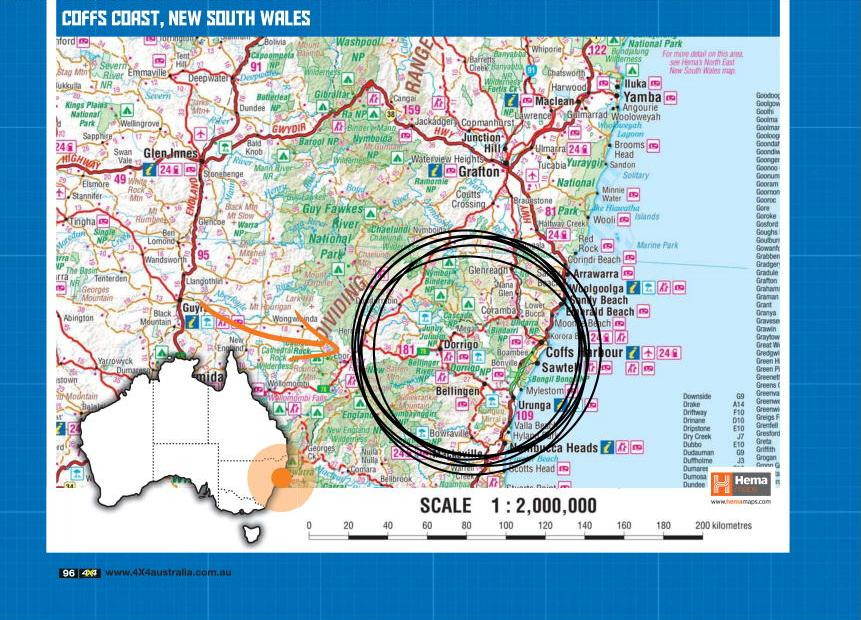
About 80 million years ago the Ebor Volcano erupted and created some of the best fourwheel driving Australia has to offer: the mountain region behind Coffs Harbour.
Here the mountains come closer to the sea than anywhere else on the east coast, and the terrain constantly changes from easy plateaus to sections of extreme four-wheel driving that can push drivers and their rigs to the limits.
From pristine rainforest pockets and lantana-infested areas to heavily timbered oldgrowth sections with some of the oldest and hardest timber in New South Wales, there are many features that make the Coffs Coast’s trails special. With ocean views, you can pick your way through huge gums along the ridges, while remaining close to the city centre’s creature comforts.
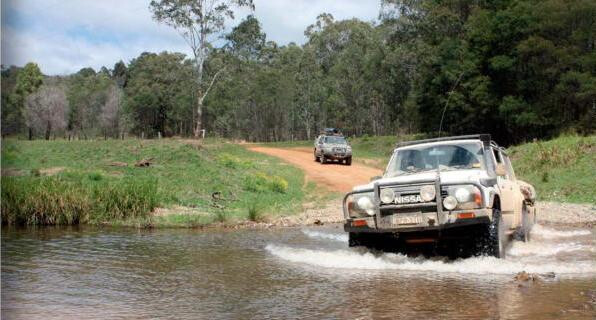
There is no need to have a fully specced-out comp truck to enjoy the Coffs hinterland, as there are enough tracks, from easy to mild, for any explorer.
But care still needs to be taken in the wetter months or even when storms are about, as track conditions can turn nasty, fast. As with any trip or adventure, preparation and maintenance need to be prioritised, especially because phone and UHF radio signals in the region can be sketchy.
There are many 4×4 workshops and accessories stores located on the Coffs Coast, but it is still best to head to the hills with a plan. Get some local knowledge at a friendly 4×4 shop and grab a handful of maps for an overview of the area. As on any trip, you will need to carry the basic recovery items; a UHF radio is handy, plus correct clothing for the conditions.
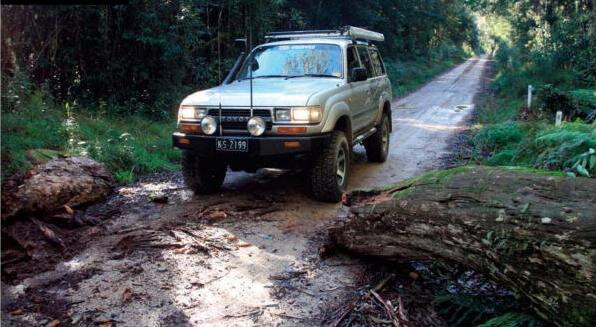
Several tracks are worth mentioning, but, again, you will need to seek local advice, as conditions do change constantly. The Rover Trail hugs the coast from Coffs north for several kilometres to give you coastal views towards the Solitary Islands. Another great one to tackle is Morbid Trail, which heads upwards towards Mount Coramba, the highest point on the Coffs Coast, giving you views across rugged terrain as well as ocean views.
Situated 6km from the heart of Coffs, this mountain is 700m above sea level, and with track names such as Rocky, Commando, Dump and Spur, you will need to come prepared. Or you could just head to Friday Creek, where you can spend hours relaxing in crystal-clear water filtered down from the hinterland – in summer the water is very refreshing.
The wilder tracks on the Coffs Coast demand respect. These tracks can break even the hardest and meanest 4x4s and drivers. But if the tracks still aren’t enough fun for you, there are activities such as sky diving, white water rafting on the Nymboida River, chasing elusive marlin off the coast, mountain bike riding in the local forests, scuba diving around the Solitary Islands, whale watching, on-road and off-road motorcycling, and even camel riding on the beach.
CAMPING AND ACTIVITIES From bush camps with river views to beach frontage sites where you can lose yourself for days, the region has some fantastic caravan parks for those who like to be spoilt with pools, shopping centres and local attractions.
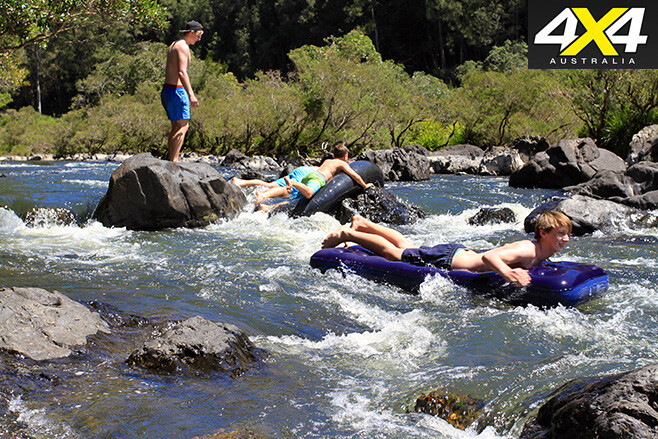
Nymboida, 60km west of Coffs, has some of the best river frontage camping spots you can find. Camp locations have picturesque views beside the mighty Nymboida River, where rafting companies begin trips downstream to tackle grade 4-5 rapids. The camp spots, which include grassed areas, also grant travellers access to pit toilets.
To camp out here, though, you will need to be selfsufficient, as there are no shops to duck back to and there is no phone reception. Nymboida is true gorge country, and although it’s only about two hours from the coast, travellers to the region may not see anyone else for days.
Keep an eye on weather conditions here, too, as storms in other gorge areas may cause the river to rise quickly.
The Coffs Coast region also includes the rainforest escarpments of Dorrigo, the golden beaches of Hungry Head and Urunga in the south, the Red Rock in the north and the blue waters of the Solitary Islands Marine Park. It boasts a temperate climate all year and has many activities and attractions.
It’s also one of those places where the Great Dividing Range meets the sea, allowing for a host of national parks and reserves: there are, in fact, 11 national parks, 14 nature reserves, 84,000 hectares of World Heritage Area, several Aboriginal sites and a regional park, 37 state forests, 90km of beach, and 71,100 hectares of Solitary Islands Marine Park.
You can also leave the bush behind for a while to explore other wonders of the Coffs Coast if the weather turns ugly or the missus wants to shop. From jetty jumping and cycling around town to eating out at first-class restaurants, there are many options.
The City of Coffs Harbour itself has several major shopping centres, fuel stops and mechanical workshops.
To slow down, visit Dorrigo, where there are several walks through World Heritage national parks. Or you can spend time angling for a variety of species of fish in one of many local rivers.
The hub of the Coffs Coast revolves around the historic Coffs Harbour jetty. The jetty juts out several hundred metres past beaches and the Coffs marina, where an evening stroll should definitely be on the to-do list when visiting the area.
For history buffs, there is a host of places to visit around the Coffs Coast, including the WWII gun bunkers, the old Glenreagh to Dorrigo railway line, which has a handful of sidings still standing, and about 200 registered gold mines that still can be found today.
There are several old gold mining villages, and don’t forgot the old loggers’ stumps that still litter the bush – you can see in the stumps the plank cutouts where old-timers stood with axes and saws up to 15 feet above the ground. The old mill at Cascade NP in the hinterland is always a hit with the kids, too, and for those who don’t scare too easily, the heritage listed Coffs Harbour Cemetery is worth a look.
If you love the ocean, you can camp so close to the water that you’ll breathe salt-sea air as you sleep. Situated just 40 minutes north of Coffs in the Yuraygir NP, Pebbly Beach has been earmarked as one of the top campsites on the eastern seaboard of NSW.
Timing is paramount here, as you cross a tidal creek to access the pristine campgrounds after a drive north along the coastline. Facilities include basic pit toilets, so again being selfsufficient is a must for those on long stays.
Camping on the Coffs Coast is suitable all year round, but be prepared for cool nights in winter and warm summer days. Cool nights mean fires are possible at some locations, while the hot summer days mean swimming in crystal-clear waterways, or riding the waves along the coastline. For those who need extra camping gear or just plain forgot something, there are several large camping stores in the Coffs area.
Perhaps the best thing about these iconic camping locations is they are available to those with tents, swags or camper trailers. National Parks and Wildlife Service (NPWS) looks after several camping locations here, and with the minimum fee paid, there are benefits such as the pit toilets, clean sites and even firewood.
TRAVEL INFO
WHERE Coffs Harbour is found midway between Sydney and Brisbane, allowing easy access by road, rail or air. It’s an easy day’s drive from either Sydney (550 km) or Brisbane (400km).
CAMPING Standard NPWS fees apply to camping areas. Most camp areas offer pit toilets, fire pits and National Parks often provides timber offcuts. Caravan park fees often change due to holiday peak times.
FACILITIES Available are standard National Parks and Wildlife Service (NPWS) facilities such as pit toilets and fire pits, which are clearly visible at most campsites. Camping is free in any state forest but there are no facilities. Caravan parks offer full amenities.
TRIP STANDARD Your level of experience and how your truck is set up should determine the tracks you tackle. Tracks range from extreme to easy. Some tracks have stunning coastal views while others traverse ridges and enter gullies where there are pristine waterways.
MAPS AND GUIDES Local state forest maps, guides and a 4×4 guide are available from 4WD & Ute Extras, Coffs Harbour.
PERMITS No permits are required to drive on 4×4-friendly beaches on the Coffs Coast or in the state forest area surrounding Coffs Harbour. Standard fees apply to designated NPWS camping areas.
CONTACTS AND INFORMATION NPWS: www.nationalparks.nsw.gov.au 4WD & Ute Extras, Coffs Harbour: 02 66 516 461