
Ned Cakovan is a fastidious kind of bloke – one who doesn’t make big decisions without first arming himself with all the available information.
Given this seemingly sensible, level-headed approach, you’re probably wondering what the hell a keen four-wheel driver like Ned is doing driving around in a petrol-powered V8 Y62 Patrol.
“I spent nine months deciding on a vehicle,” Ned says. “I test-drove every dual-cab ute on the market but, being a single dad with two kids, and my girlfriend at the time had two kids, a dual-cab just wouldn’t cut it. I needed something with more seats, so that’s why I looked at wagons.
“Initially I didn’t even consider a Y62 – it was more than $90,000 for the ST-L at the time, the base model, so I didn’t even think of it,” he says. “And, like everyone else, I thought, a V8 petrol … I’m not touching that! So I went looking for a 200 Series GXL diesel.”
Just as he was about to drop $94,000 on an optioned-up 200 Series, Ned saw a Facebook post about a price drop on the Y62 Patrol, which was enough to convince him to at least test drive the big Nissan wagon back-to-back with the Toyota.
“After driving the Y62 it was a no-brainer,” Ned says. “I didn’t care about fuel economy at that stage; the Y62 was that good to drive.”
It’s quite easy to understand that Ned could form such an opinion when you consider the Patrol is powered by a silky-smooth 5.6-litre V8 that pumps out a claimed 298kW and 560Nm, and that its fully independent coil-spring suspension set-up offers car-like levels of on-road ride and handling.
One thing Ned hadn’t taken into account when he bought the Patrol, however, was the lack of aftermarket gear available for the Y62. There were a few bullbars on the market – from ARB, TJM and Opposite Lock – and Kaymar did a rear bar, but that was about it. So Ned set about rectifying the situation by starting the Aussie Patrol Y62 group on Facebook, which now has more than 900 members.
“At the time I fitted an ARB bullbar,” Ned says, “and I put ARB Intensity LEDs on, but that was it – and that’s why I started the Facebook page. There were no steps, no sliders, no brush rails, there were no exhausts and no snorkels. It was very, very limited.”
It wasn’t long before the Facebook group starting flexing its collective muscles and one member was able to garner enough support from group members to convince a snorkel manufacturer to make a plastic snorkel to suit the Y62, hence the Tanami unit fitted to a few of the vehicles in the group.
Ned took another route in regards to the snorkel on his Y62, employing the services of a local Rockhampton fabrication shop called White Knuckles Industries to make a stainless steel unit.
“I found a fabricator in Rockhampton who does all the steps and sliders, so I’ve got all of his gear,” Ned explains. “I’ve got his snorkel and his side steps. We basically designed the step the way I wanted it, with a plate underneath so it’s actually a step that works as a slider – it’s angled a bit to help with clearance and there are no bolt-on brackets; instead it’s welded and it looks really neat and is super strong.”
There are quite a few other modifications on Ned’s Y62 that give it an edge off road, such as the 35-inch rubber on Black Rock steel rims, and the Old Man Emu suspension kit that gives a handy two-inch lift. Ned’s also fitted an aftermarket exhaust system to help the big 5.6-litre V8 breathe a bit better, and give it a tastier note; it’s made from 2.5-inch mild steel tube to the Y-junction and then three-inch mild-steel tube to a sports muffler.
“I’ve gone for mild steel, not stainless, because I do a lot of off-roading, and with the hot and cold as you go through water, stainless tends to crack on the mandrel bends because it’s hardened,” Ned says.
Up top, Ned modified his old GU Patrol’s MCB4x4 roof rack, on which he runs a light bar, recovery tracks, awning and work lamp, and he plans to fit a drawer system in the rear of the cabin that can be easily removed when the third-row seats are in use. “I’m in the early stages of designing it and a mate is going to help me build it,” he says.
So how does it go off road? “This is the first fully independent suspension four-wheel drive I’ve owned,” Ned says. “My GU had more mods than this, yet this one goes more places easier than my GU ever could.”
With excellent low-range reduction, loads of low-rpm torque, sophisticated electronic traction control and an OE rear diff lock, there’s no doubting that the Y62 Patrol is a pretty capable 4WD straight out of the box, and the few mods that Ned has added certainly add to its off-road capability and its overall practicality.
Of course, the big question hanging over the Y62 Patrol is its potentially high fuel consumption, and just how that affects its touring range. Ned reckons he gets as low as 12.7L/100km on the road and as high as 26L/100km off the road. But for the type of driving he does, the Y62 offers plenty of range. “I’m based in Rockhampton,” he says.
“We’ve got a new 4×4 adventure park, Dalliston Vale 4×4 Park, near here, and I’ve been there a couple of times. It’s a relatively short drive, you can do all the tracks in a day; it’s close, and you can camp there and have a lot of fun. I also go out to fish at Byfield NP a fair bit, driving on the dunes and the sand; it’s probably 40 to 60km from Rocky to Byfield and I fill up in town before I leave and fill up when I get back, and I’ve never used more than 23L/100km on that trip.”
With a 140L fuel capacity, those numbers give the big Patrol an average touring range around 600km. That’s not too bad.
While a big petrol-V8 wagon isn’t everyone’s cup of tea, Ned swears by the Y62 Patrol, as do many of the members of the Aussie Patrol Y62 Facebook group.
“At the end of the day, we don’t have to prove ourselves to anyone; we’re happy with our decision,” Ned says. “You can modify GU Patrols like nothing else and, while you can’t do that with a Y62, it’s such a superior car on the road, plus its capability off the road – I still can’t believe how good it is.”
Trent Leen’s Y62
If you’ve any interest in off-road competitions such as the Outback Challenge, you’ve no doubt heard the name Trent Leen. After all, he was runner-up in the first-ever Outback Challenge back in 1999, and he backed that performance up with a win in 2000, third place in 2001 and then another second place in 2005.
The vehicle on which many Outback Challenge competitors like Trent base their rigs is the live-axle Patrol – either a GQ or a GU model – because it’s tough, simple and capable, and relatively easy to modify. So it’s a little confronting, to say the least, for traditionalists to see a competitor of Trent’s calibre driving around in a fully independent suspension wagon such as the Y62.
“It originally started out as a car for my wife. We wanted something with seven seats, even though we ended up with eight seats, but we wanted to upgrade from a [TDV10] Touareg and we wanted something we could actually go out camping and four-wheel driving in,” Trent explains.
“I had a GU Patrol that I’d cut into a dual-cab ute at the time, but that was slowly becoming more work-orientated, and not really suited to going away on holidays and stuff, so that’s part of the reason we upgraded to something that’s a bit nicer to go away in, and the size and the room, the Y62 just ticked a lot of the boxes – and obviously the power was important coming out of a V10 Touareg.”
Based in Melbourne, Trent mainly uses the Y62 Patrol for trips into the Victorian High Country and, like Ned Cakovan, he says that fuel consumption and touring range aren’t really issues with the Y62.
“We’ve been up to Big Desert NP and the Border Track and stuff like that,” he says. “The economy, on paper, people freak out, but when we did Big Desert and the Border Track, we only used six litres more than a Ford Ranger. When you are loaded up and you’re in soft sand, you start putting some of these four-cylinder things under load and they’re drinking it just as hard as a big V8. We only carried one extra jerry can; we don’t have a long-range tank fitted.”
Trent opted for a Radflo suspension kit imported from the United States, which uses Total Chaos top arms and gives the Patrol a couple of inches extra ground clearance. Once installed, his mate Andrew Cassar of On Track 4×4 gave it another three-inch lift, fitting engineered lower arms and a diff drop front and rear. While he currently runs 35-inch BF Goodrich Mud Terrain KM2s, Trent says there’s plenty of space to fit the 37-inch Krawlers from his comp truck, which he’s keen on doing.
Trent is impressed with the result: “It’s not like it gives you much more travel compared to a live axle. But, with the independent, I would say the front works better than the live axles, so even though you’ve got less overall travel, what you’ve got works better.
“It’s got a factory rear locker; I haven’t really done any really extreme stuff with it, but climbing up steps it works so well; I’d be comfortable taking this anywhere except the more extreme areas where you wouldn’t want to take a new car anyway.”
Other mods on Trent’s Y62 include an ARB bar, a Warn 9000lb winch that’s been waterproofed and runs synthetic rope, a Tanami snorkel, a pair of Narva HID driving lights and a Narva light bar, a Rhino Pioneer platform roof rack and a Rasslar rear bar, which usually runs dual swingers for the spare wheel and dual jerry can holder. “I don’t always have them on because I’m always going in and out of the back door,” Trent says. “I only put them on when we go away on trips.”
Like Ned, Trent’s in the process of developing a tailored drawer system for the back of his Patrol; in this case a single drawer on the driver’s side that will mean only one seat has to be removed. “I’ve only got two girls, but I need all the seats for when all the friends come along,” he laughs.
HYDRAULIC LIFT
While there are a number of suspension kits to suit the suspension in the ST-L-spec Y62 Patrol, the same can’t be said for the Ti and Ti-L variants that run Nissan’s more complicated HBMC (Hydrualic Body Motion Control) set-up.
Fortunately for owners of the more luxurious-spec Y62 models, Andrew Cassar from On Track 4X4 has developed a solution.
“You can’t physically replace the struts and the shocks in the Tis and Ti-Ls, because it’s all hydraulically managed,” Andrew explains. “So we’ve managed to do a bit of an upgrade with them, where we supply an upgraded lower control arm to suit, which then gives the car two inches of lift. We’ve done quite a few to date and have sent them all over Australia, probably one or two kits a week.”
A Social Thing
“I started the (Aussie Patrol Y62) Facebook page a couple of weeks after I bought my Patrol,” Ned Cakovan explains.
“There wasn’t much information around. There was a GU Facebook page that I was always on, so I created the Y62 one. And I think in a year we’ve now got 800 people on the page [there were actually more than 900 last time we checked – ed].
“I don’t know how many are Y62 owners, but we’ve certainly got a very loyal, very knowledgeable core group who are very active in the page.
“We’ve got five admins and I’ve met all of them now [on various trips], so we all maintain the page’s integrity.
“It’s all about having fun and sharing our adventures.
“We’ve got heaps of people without Y62s on there; we’ve got a couple of Cruiser guys on there; we’re happy to have any one as long as they contribute constructively. We have a lot of fun and there’s a bit of banter and all that sort of stuff, but it’s really informative.
“We have some blokes on there who make me look like I know nothing about 4WDs; Trent Leen, for example, you’ll see his monster rig – you know, he’s the professional comp truck driver, and Andrew Cassar (On Track 4×4) is developing a lot of gear for us.
“We have tourers out there, like the grey nomads who travel all over Australia towing their big three-tonne vans through all sorts of country, and the information and the knowledge that they have, it’s incredible.”
While the Aussie Patrol Y62 Facebook page is a closed group, as Ned says, it’s open to anyone with the right attitude and who’s willing to contribute in a constructive manner. Get on there and check it out.
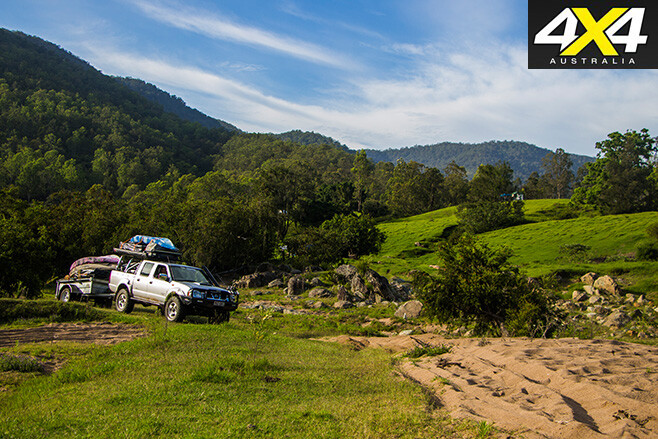
4×4 Australia spent a day out with members of the Y62 group in the Victorian High Country for this photo shoot. Such trips are conducted regularly by members of the group wherever they are.
HOLDEN HAS unveiled two special-edition models: the Colorado 7 Trailblazer and the Colorado Storm.
The Colorado 7 Trailblazer receives a number of aesthetic tweaks over and above the range-topping 7 LTZ. It gets new 18-inch High Country alloys, Z71 masked headlights, rear Trailblazer 4×4 decal, Trailblazer side badges, a Colorado-branded bonnet protector and carpet floor mats.
The Colorado 7 Trailblazer maintains the LTZ’s 3000kg towing capacity.
The Colorado Storm, based on the Crew Cab LTZ, returns with new 18-inch wheels, a black nudge and sports bar, Storm-branded bonnet protector, Storm-branded rear-door badges, and front and rear carpet mats. It’s a $500 premium over the Colorado Crew Cab LTZ.
The Storm carries over the Crew Cab LTZ’s 3500kg towing capacity.
Holden’s Executive Director of Marketing, Geraldine Davys, added: “This new range of special-edition vehicles has been created to support our customers’ lifestyles whilst offering the great value for money Holden prides itself on.”
Both models with be available nationwide from mid-April.
With the purchase of my new (well, new to me – she’s second-hand) Troopy, I figured quality rubber on decent rims would be one of the first additions I’d make.
Although the current trend is to fit alloy rims, and while there are good reasons for that choice, I’ve opted to stick to good-old steel rims from Dynamic Wheel Company.
There are plenty of look-a-like steel rims on the market, but the long-running Sunraysia-style is a resilient rim suited to the rugged Troopy and its intended long-term off-road use, especially given that they are rated at 1400kg per rim.
Another reason I opted for the Dynamic Wheel Company’s rims is the multitude of rim offsets available for 70 Series Land Cruisers. By choosing negative 25mm offset rims for my 70s rear, I could legally semi-rectify its mismatched front and rear wheel tracks (of 95mm), on the cheap.
This choice pushes the rear rims out by 25mm each, widening the track by 50mm, which is the legal maximum in New South Wales. The wider rim width (eight inches) and wider tyre selection (285/75R16) will (mostly) overcome the track issue.
I kept the standard zero-offset for the front and the spare, so I figure if I get a flat I’ll have a straight swap for the front, and I’ll simply (temporarily) put up with the mismatched offset on the rear.
I’ve resisted the temptation to go for larger diameter rims, and kept to the 16-inch measurement, to allow a wide array of rubber options and the best off-road ability (by way of tyre sidewall flex). Dynamic offers a decent diameter range, from 12 inches up to 18 inches for those that want to step up in size.
Why black? It’s a personal choice, that’s all. They are also available in white.
For the 70 Series – and many other four-wheel drives – the Dynamic Wheel Company does offer offsets (up to negative 44mm), which for off-road use would (almost) totally overcome the Cruiser’s track issues.
For more information on the range of Dynamic steel wheels, as well as the complete range of other steelies and alloys, check out www.dynamicwheelco.com.au.
Rated
Available from: www.dynamicwheelco.com.au RRP: From $110 We say: Tough steel that will cop loads of abuse
ONE OF the first accessories 4X4 Australia recommends to anyone outfitting their 4×4 vehicle is a dual-battery system. Whether you’re running a 12-volt fridge, camp lights, or anything else that might draw on your vehicle’s battery, you will want a secondary power source to ensure power remains should you drain the primary battery. A secondary battery is usually a back-up and it needs a means to manage its state of charge.
Click here for your chance to win 4×4 Australia’s Custom Toyota Hilux.
Piranha Off Road Products has been manufacturing and supplying dual-battery systems for 4×4 vehicles since the days when the only electrics on a car were the starter motor, lights and an AM wireless. Since then, vehicles have progressed to the modern cars and 4x4s which are now loaded with enough electronics to power the space shuttle, and Piranha has developed its battery systems to keep up with the latest technology.
Piranha not only manufactures the management system, but it also supplies a range of trays on which to solidly mount a second, or third, battery in your vehicle, and all the ancillary hardware required to make the most of the power that comes from it.
While our 2010 giveaway HiLux mightn’t represent the latest in vehicle technology, there’s enough wiring in there to confuse any bloke who’s handy with a shifter and a set of pliers. So, we went straight to Piranha for a dual-battery solution.
Allan, Denis and the crew at Piranha came up with a package based around a DBE140S management system, an in-cab battery charge monitor and all the associated hardware, including a power outlet in the tub of the Lux.
Piranha has done hundreds of such installs in this model HiLux and could probably do the job blindfolded, but installing the battery in our car threw up a small challenge. The bracket used to mount the Flashlube secondary diesel filter appeared to leave space for a second battery, but it didn’t take into account relocating a few OE components that have to move to fit the extra battery in. That posed no problem for a competent shop like Piranha, as they simply modified another bracket to accommodate the fuel filter, battery and the moved Toyota parts.
The modified battery tray is securely mounted to the inner ’guard at numerous points for strength and durability in harsh off-road conditions. It includes a bracket that mounts the DBE140S unit, the relocated Toyota parts, and an auxiliary fuse panel for any accessories that will be powered off the second battery. It all sits neat and tidy on the passenger side of the engine bay, along with the new battery.
The job of the management system is to ensure main and auxiliary batteries maintain charge from the vehicle alternator. The system also isolates the main starter battery from the accessories when the engine isn’t running and the alternator isn’t charging.
Picture this: You’re camped at your favourite spot by the river for a few days and running your 12-volt fridge, lights and other items off your auxiliary battery. Your auxiliary battery is the one that gets drained while the management system, in this case the DBE140S, isolates the main battery from the current draw of the accessories. Then when it’s time to go home and you turn the key to start your 4×4, the main battery still has the power to fire your engine and get you on your way. The Piranha management system then recharges both the main and auxiliary batteries as you drive along.
The DBE140S is sealed from water, dust and mud, allowing it to be mounted in any position in the vehicle – in our case, on the Piranha bracket. Piranha believes it’s the best value system on the market. It comes with a two-year warranty, or five years if fitted by an authorised Piranha agent (as ours has been).
The DBM3D monitor has been mounted in the cabin just ahead of the gearshift, where it is easily seen by the driver to keep an eye on the voltage and charging in both batteries. The digital display dims with headlights on and shows a warning for when voltage gets above 15-volts or below 10-volts. Neato!
The Piranha fuse box makes it safe and easy to power your accessories off the auxiliary battery. The first we fitted was wire a lead down to the back of the car where there are now two 12-volt outlets – one Engel-type plug and one ciggie plug, positioned where we’ll use them. Perfect for powering that fridge or lead light.
All up, the work done by Piranha Off Road and the parts supplied for the HiLux add up to around $1500 worth of kit. But with the 12-volt power needs now sorted, it’s just one more step to creating our awesome adventure vehicle.
Piranha Off Road Products Web: www.piranhaoffroad.com.au Ph: (03) 9762 1200 Factory 4, 383 Dorset Road, Boronia, Victoria
Want to see more of our Project HiLux build? Check out the below:Part 1 of our Project Hilux build Part 2 of our Project Hilux build Part 3 of our Project Hilux build Part 4 of our Project Hilux build Part 5 of our Project Hilux build
THIS month we hit some challenging terrain in a customised JK Wrangler Rubicon, and we take a GU Patrol straight from the showroom floor to the rough stuff.
We hit the red dust in a HiLux Extra-Cab manual, and we get our hands on a foreign-born baby, Jeep’s Renegade Trailhawk – in petrol-powered form. We also explain why tricked-up 4×4 utes will be the next big thing in Oz!
Grab the latest copy of 4X4 Australia from newsagents, or get it before everyone else by subscribing to 4X4 Australia in electronic or print format.
Here’s what we’ve packed into the May issue:
THE SINGLE BLOKE’S 4X4The Toyota HiLux Extra-Cab caters for the bloke who’s not tied down by a wife and three kids. It’s cheaper, and in many ways more practical, than the Dual-Cab.
FROM SHOWROOM TO TRAILSThe GU Patrol might be getting on in age, but it’s a fuss-free tourer that can handle itself off-road sans aftermarket modifications.
FOREIGN RENEGADEClassic Renegade is resurrected, but does the lack of a diesel engine hurt it on Australian soil?
CUSTOMISED RUBICONWe go under the hood of an extensively tweaked JK Wrangler Rubicon. This thing is an off-road juggernaut!
FAMILY GETAWAYWe strap a Patriot X1 Camper to the back of a Toyota Fortuner Crusade and take the family to Warrabah NP.
A CHEAP PRADOThe Chinese-made Haval H9 shares plenty of bits with the Toyota Prado, but can it all come together on a local drive?
ROCK-CRAWLING BRUTEThis custom G63 AMG can smash any obstacle in its way, but it’s also a comfy highway cruiser.
HILUX HAY RUNWe tag along with Aussie Helpers to help those affected by the drought in Western Queensland.
WESTERN FRONTWestern Australia’s Pilbara region is sparsely populated and full of activities. Ron Moon heads there.
SNOWY RIVER RUNWe trace the Snowy River from the summit to the sea, passing extraordinary countryside on the way.
HALF CAR-HALF BOATTaking the term ‘off-road’ to a new level, with a collection of ‘amphibious’ Ford GPA Jeeps.
MEETING ARTHUR GODDARDHe’s the man who is known as the godfather of the Land Rover. 4X4 Australia stops by for a chat with the great man.
CLOSE TO HOMECathedral Rock is only a stone’s throw from Coffs Harbour, so we thought we’d stop by for a visit.
LOADED ’LUX GIVEAWAY4X4 Australia’s giveaway HiLux receives a dual-battery system from Piranha Offroad.
THE REST
The regular bits and pieces have made the cut, including columns by John ‘Roothy’ Rooth, Ron Moon, Dean Mellor and Fraser Stronach. Plus we review all the latest gear, and give you a lesson on how to winch safely.
New South Wales isn’t blessed with as much beach camping as Queensland is, but what it does have is sublime bush camping, and a place such as The Gorge at Clarence River is no exception.
Less than two hours west of Grafton, The Gorge needs to be seen to be believed. Via Copmanhurst, the road to the property is just the start of what you’ll see when you arrive. With a view of the Clarence River in the distance, you’ll follow winding dirt through a picturesque landscape to 3365 hectares of serenity.
The Gorge has been in the Winters family for more than 100 years and is still a working cattle farm, but in more recent years it has become a tourist destination for those seeking a serious getaway. When you arrive at the house, Neil and Sue will come out to say g’day and then Neil will give you a tour of the property.
The campsites are clean and well-cleared, most are grassy and level, and all offer a spectacular view of the river with the mountains as a backdrop. You’ll be supplied firewood and you can gather your own driftwood if needed. Neil will also collect your rubbish each day from the bins supplied – it is little luxuries like this that make camping with the family a bit easier. If you don’t want to camp, there is an alternative. ‘The Shack’ is made of solid brick and stone and sits up near the house. It sleeps up to 12 people.
If camping is your thing, the campsite is one of those places where, once you’re set up, you can just sit down and chill for the entire trip, with no need to get in the truck to drive anywhere. You can put the electronics and social media away, fold out your camp chair, crack a cold one and just take it all in, gazing at the unbelievable scenery and abundance of surrounding birdlife. It’s heaven!
Fishing? Well, it’s hard to camp beside a river and not be a keen fisherman! If you don’t have your own boat or kayaks, don’t worry. You can hire a canoe for $20 a day, throw your fishing gear inside and glide up to the gorge to wet a line. The water is home to some good-sized bass and any fish caught must be released.
Paddling up the gorge is very peaceful, and the bonus of sitting low in the water is the ability to get to the smaller areas, close to the bank, where bigger boats can’t go. This allows you to take in the surrounding sheer rock faces that show their true colours as the sun moves over them.
If scenery doesn’t take your fancy, there are rapids, which you’ll get to after passing some smaller waterfalls. You can attempt the rapids if you’re an experienced paddler, but it’s not recommended if you’re not, as it’s easy to flip a kayak. It’s better to tie up on the right-hand side where there’s a small patch of sand.
You can then walk up the gorge towards the waterfall to the best fishing spots. If you have a boat with a motor, it’s possible to get through the rapids to one of the better fishing spots. Tie up among the rocks where the water is calm and you should be able to get out onto the rocks to cast your line.
If you choose to walk to the waterfall, there is no track to follow and it’s very rocky with a lot of big steps, so be mindful of your footing. Just follow the river and eventually it will open up to a spot where you will notice other people fishing.
Standing at the top of the gorge is breathtaking as you have a bird’s-eye view of the river below. Clambering down the rocks towards the water’s edge can be daunting if you don’t like heights, but you might only be here once, so summon the courage, as this will be your best chance to catch some fish!
The bass sit around the bottom of the rocks where the water swirls and pools. It’s calmer there and the fish can see their food more clearly. Please note that no bait fishing is allowed, so lure fishing is a must. Set up your rig in the early morning or late afternoon – there’s not much better than fishing at sunset!
Once your day of fishing is done, climb up the vertical rocks of one of the waterfalls. Just across the river from where the kayaks are tied is a smaller waterfall where there are a few flatter rocks to stand on. Tie up at the base of the waterfall and find your way to the top.
You’ll notice a bushwalking trail once you get up there. It’s best to go just on sunset, when the rocks and the mountains in the distance burst with colour. It’s definitely worth taking a camera to snap the landscape!
You know what tops this place off? The fact that you can take your four-legged friends as well. Campsites that allow dogs are becoming few and far between these days. You don’t have to fish every day, either. There will be days when you just want to do nothing.
So take some floaty toys, blow them up and relax in the water all afternoon. Or you can float with the current from up the river. If you have a mate with a boat, get them to drop you off farther up so you can float downstream. It gives you yet another amazing view of the property.
This place is one of those spots where it’s possible to do nothing all day and, really, if serenity is what you’re after – plus a place that’s affordable, caters for every family and offers many things to do – then this is for you. Make sure you get to this piece of paradise at least once. You’ll love it.
GOOD AT THE GORGE
- Dogs allowed
- Country hospitality
- Bush walking
- Tours
- Catch-and-release fishing
- Supplied firewood
- Daily rubbish removal
TRAVEL PLANNER
- WHERE: The Gorge, on the Clarence River, is about one hour and 20 minutes’ drive north-west of Grafton, via Copmanhurst, in northern NSW.
- CAMPING: $20 per car load, per night. There are a lot of different campsites, some accessible by most vehicles and some by 4×4 only. Neil, the owner of the property, takes you to your campsite on arrival.
- FACILITIES: There are toilets and showers at the main house, but it is just as easy to take your own.
- TRIP STANDARD: The road to the property is graded once off the blacktop, so it is easy for any vehicle to get in. There are no 4×4 tracks open to the public on the property.
- CONTACTS: Telephone: 02 6647 2173 Email: [email protected] Address: The Gorge, Via Copmanhurst, NSW, 2460
- RESTRICTIONS AND PERMITS: None
Click here to explore more of New South Wales.
Since production of the Land Rover Defender ceased on January 29, 2016, thefts of the model have skyrocketed in the UK, according to figures released by insurance company NFU Mutual.
Autocar.co.uk broke the news yesterday with claims the number of stolen cars has increased by as much as 69% in North Hampshire alone. It is believed this is due to the model’s rising value, rather than the lack of supply.
The news shouldn’t come as too much of a surprise, as the value of the Defender has dramatically increased following the end of the model’s production – the two millionth car sold for £400,000 (AU$750,000 approx.) in December 2015.
It’s understood a great number of the stolen rigs are being shipped and sold abroad, while the rising price of parts has seen a number of Defenders stripped down.
The thieves appear to be high-tech criminals with particular experience at overriding the Defender’s security systems.
Owners are urged to upgrade their Defenders defences with a transponder-based security marking system and tracker device. It’s also advised to etch all windows with the vehicle identification number.
The situation doesn’t appear to be as dire in Australia. Despite seeing similar price rises since Defender production ceased, there have been no reports of an increase in theft on local soil.
Justin takes us through the electricals that have gone in to what he calls the ’Ultimate 79’. Who are we to argue, this thing is a beast!
- Check out Part 1 of the Land Cruiser 79 Series build.
- Check out Part 2 of the Land Cruiser 79 Series build.
- Check out Part 3 of the Land Cruiser 79 Series build.
We featured the JMAX coil conversion for Land Cruiser 70s last year and it must have caught Justin’s attention because he’s fitted it to his Super Tourer 79.
- Check out Part 1 of the Land Cruiser 79 Series build.
- Check out Part 2 of the Land Cruiser 79 Series build.
- Check out Part 4 of the Land Cruiser 79 Series build.
Trying to imagine what things look like without their clothes on is a pastime for many of us and if you’ve ever extended this pastime to a Volkswagen Amarok, the news is good. Your wait is over. Here it is, naked.
What you’re looking at is an Amarok designed to not only reveal its mechanical secrets, but also to be unidentifiable as a VW product.
So it has no badging, no grille, and no exterior panels that might give the game away. And the disguise doesn’t stop there. The headlights and tail-lights are functional but are aftermarket units, as seen on any number of bullbars and boat trailers.
Inside, anything likely to aid with identification is also gone, including the switchgear, the instruments, with their distinctive VW family appearance, and even the shift pattern from the top of the manual gear lever.
VW even removed the seat cushions, preventing onlookers from making an informed guess of the vehicle’s heritage on that basis. In fact, I couldn’t find a single thing that stamped the car as a VW – even the moulded part number on the gearshift boot had been neatly sliced away.
So what’s the story? It’s all part of VW’s latest marketing strategy for the Amarok, which uses social media and television commercials to make potential four-wheel-drive ute buyers think without preconceived ideas about a particular brand.
It’s also a great way to showcase some of the Amarok’s cleverer elements, since you can now see the wide chassis rails, making for a bigger cabin, and the clever way the rear spring hangers run beside the rails, rather than under them. It’s an Aussie initiative, too. The concept was developed here and the vehicle was built here – it’s not a rip-off of an overseas project.
Of course, seeing an Amarok with no exterior sheet metal, no glass apart from a windscreen, no tray, and a stripped-out, sheet-metalled dashboard left us with only one question to ask: can we have a go? Fortunately, VW was eager to let us rip around a closed test track. Too eager, as it turned out – but I’ll get to that in good time.
The first thing you notice is that it is loud and smelly because there’s nothing to drown out mechanical or road noise and nothing to stop those delicious diesel fumes wafting into the cabin every time you back off the throttle. But thanks to the fact that Skeletor has shed something like 300kg in the process (VW’s best estimate), it takes very little throttle to get it moving pretty smartly.
Drive it though a creek, however, and you’ll soon find water oozing up through the many holes in the floor and splooshing in through where the door skins once were. Thinking of tackling a dusty track? You’re going to want to wear breathing apparatus.
The Naked Ute (as the VW marketing campaign was called) actually started life as a testing and homologation vehicle (known in the trade as a ‘sooty’). It was imported without taxes and duties and can therefore never be sold or registered in this country, so turning it into a tea bag was not the financial wrench it might have been. And once its days on the marketing catwalk are over, it’ll be handed over the VW Australia’s training centre for the apprentice techs to have a crack at.
Speaking of having a crack, while the Naked Ute lacked any bodywork, all the mechanical bits like the clever turbo set up, bash plates and transfer case (it’s a manual) are still present and accounted for, so it seemed pretty natural to flog the thing around a test track to see if a lack of duds made any difference. Smart money said it wouldn’t. Smart money was wrong.
On the rocky hills and steep little pinches that made up the test track, the only problem was the amount of dust getting into the cabin. No surprises there. But when it came to trying a water crossing, things didn’t go so well. Now, I’ve crossed plenty of rivers, creeks and floodways in Amaroks, and it’s never been a problem. So, imagine my surprise when this time the VW got almost all the way across a 350mm-deep stream, staggered a little and then carked it.
I’ve also heard enough engines being drowned over the years to know exactly what was going on here, so I did what any trained bushman would do: I sloshed across to the bank on foot and went and found a handy Volkswagen techie. Thirty seconds with the screwdriver revealed a soaking wet air filter but, luckily, no real water on the engine side of that filter. So, presumably, we hadn’t hydrauliced the thing. And, sure enough, after a dry filter and a few minutes of idling, the Amarok came good.
So what went wrong? Pretty simple when you look at it, really. Without the front bumper and a certain amount of sheet metal, the Amarok simply couldn’t set up a bow wave. This allowed the water I was pushing to wash back on to the front of the air box, where it was slurped up into the filter. It was made worse by the lack of the normal grille and plastic bits surrounding the headlight.
VW figured this was always going to be a possibility, so it had rigged up a small plastic flap (it looked like one of those plastic trays you get your takeaway beef and black bean sauce in) to try to divert the water a little. It was too little, as it turned out.
It will be interesting to see whether this new marketing campaign will actually get buyers thinking about ditching their current rides for a VW but, if nothing else, it reinforced for me the fact that changing one thing can often have a knock-on effect on something else you would never imagine to be related.