I knew things were going to get dicey when ominous thunderclouds, which had loomed overhead for much of the morning, unleashed a fury of lightning. It fractured the sky and brought with it a deluge uncommon for the season. As bulbous drops began to splatter against our visors, I called over the intercom to my co-driver, Trevor: “Things are going to get greasy… easy now.”
He backed off the accelerator of our Wide Open Baja buggy, but only slightly. The straightaway terminated with a left turn into a now-flowing creek bed; a bushy tree lay dead ahead. I knew we were carrying too much speed as he turned the wheels and applied the brakes. The car went into a four-wheel slide – we weren’t going to make it.
“Easy, easy, back off, GO RIGHT, GO RIGHT!” We cleared the tree by a mere metre. I rattled off a slurry of rapid fire instructions: “Go right, go right, punch it, don’t stop, don’t stop!”
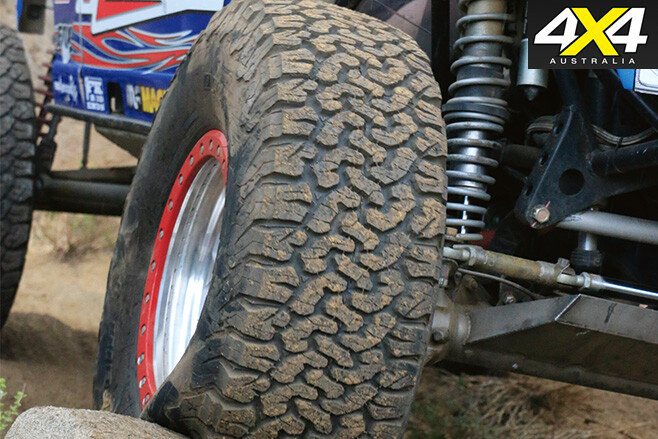
The tyres flung gloopy chunks of mud like a quartet of Gatling guns, which pelted us from all sides, and our adrenalin levels matched the haemorrhaging creek by the time we got back on track and plowed on.
We were in Baja Norte, Mexico’s frontier state, enroute to Mike’s Sky Rancho; an iconic enclave in the Sierra de San Pedro Mártir. Our mission for the next 48 hours was to flog BFGoodrich’s new All-Terrain KO2 tyres – which they claim to be their toughest All-Terrains to date – through Baja’s best.
Many fellow scribes choose to run BFGoodrich Mud-Terrain and All-Terrain KO tyres. So, it was an incredulous surprise when on a separate test earlier in 2015, the KO didn’t fare so well in a tyre shootout against six other leading all-terrains tyres.
My personal thoughts were (and still are) that the earlier KO was not a bad tyre, but the competition had since caught up and surpassed it. When I received word that the company was launching its next generation All-Terrain, the KO2, it not only confirmed our findings, but also reaffirmed my belief that BFGoodrich is committed to staying on the cutting edge of tyre technology.
The new tyre is said to be tougher and provide better traction and longer tread life. Short of performing a long-term test, Baja’s remote country would surely confirm or dispel the former two.
TREAD LIFE When it comes to improvements over the previous model, the company is boasting some formidable claims. The first is a 15 per cent increase in tread life on asphalt and a whopping 100 per cent on gravel roads.
BFGoodrich has presented a number of enhancements to the tread block and rubber compound to back up this claim, many of which come from technologies developed during its 40 years of racing at Baja. When I asked about the rubber and carbon cocktail, Senior Development Engineer Brandon Sturgis, who has been with BFG for 13 years, said: “It’s kind of like grandma’s secret recipe for lemon cake… she’s not going to tell you.” In short, the KO2 rubber has been optimally blended to reduce chipping and tearing without compromising adhesion.
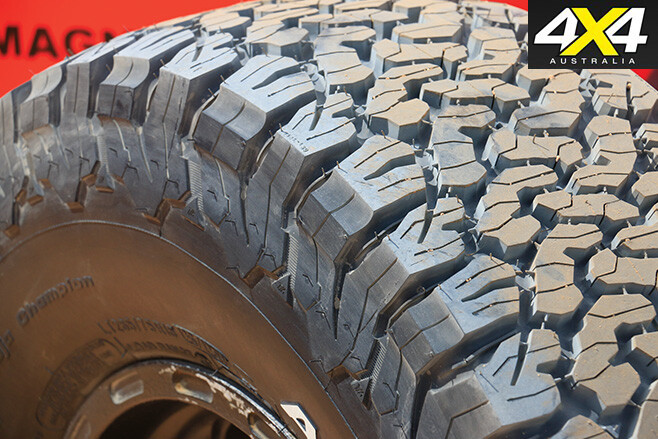
The new interlocking tread block, which includes interesting little pyramids, or stone ejectors, at the base of the voids, is designed to keep small gravel from becoming wedged in the void and grinding away at the carcass with each rotation of the tyre. The overall effect is uniform wear and extended tread life.
TOUGHNESS BFGoodrich’s All-Terrain and Mud-Terrain tyres have long been regarded as a ‘soft’ tyre.
When aired down to the 10psi range they provide excellent deformation, which allows the tread block to wrap effectively around the tractive surface (mechanical macro keying).
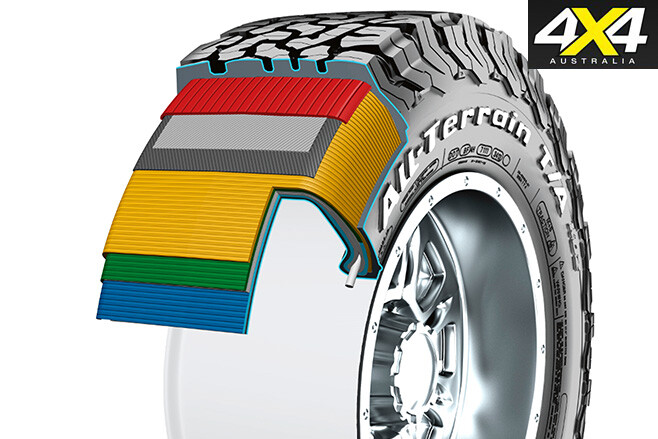
The negative aspect is soft sidewall versus tough sidewall. The engineers addressed the ‘toughness’ dilemma by borrowing CoreGard technology from their race-only Baja T/A KR2 tyre. CoreGard implements a rubber formula that is more resistant to splitting and bruising, and a thicker, more pronounced shoulder to reduce sidewall failures.
After reviewing field data on sidewall punctures, the engineers implemented computer modelling to develop a wraparound sidewall tread that deflects intruding objects.
BFGoodrich’s claim is a 20 per cent increase in sidewall durability. Jeff Cummins, a 38-year veteran of BFGoodrich’s racing program, said: “No tyre is indestructible, but I think we’re getting pretty close.”
TRACTION Attaining optimal traction and tread life is a delicate balance for any tyre. BFGoodrich is attributing their claim of a 10 to 19 per cent increase in traction (depending on the surface) to a combination of tread block design, rubber compound, a new SideBiter sidewall tread and an innovative 3D siping technique.
While many all-terrain tyres are siped these days, most have vertical, straight-cut sipes and few are full-depth. The KO2’s 3D sipes span nearly the full width of the tyre’s footprint and penetrate the lugs in a serpentine fashion, as if a piece of corrugated metal was drawn through the tyre laterally. At a surface level, the sipes work to enhance mechanical keying.
When under a load, the 3D component allows the sipe to interlock with itself, which reduces the possibility of chipping but remains flexible. The result is improved traction without compromising lug integrity. In mud, small ridges in the middle of the tread block voids (or ‘mud-phobic’ bars) are designed to reduce the suction effect and clear the void as the tyre rotates.
The KO2 has also been granted the Three-Peak Mountain Snowflake symbol, and a Rubber Manufacturers Association ‘snow worthiness’ certification that’s required in many mountain regions of the USA and Canada. I only logged a few dry-pavement kilometres with the KO2 in a Ford Raptor, but what I experienced was a smooth, well-handling tyre. It was quiet, had good line-holding properties in constant-radius turns and was predictable.
CLOSING THOUGHTS Baja’s off roads are unforgiving and I extend big kudos to the BFGoodrich engineering and marketing teams for allowing dozens of wing-nut journalists to flog the new KO2 with reckless abandon – rather than putting us on a finely manicured track with hazards removed.
We encountered high-speed graded dirt and marbled gravel roads, jagged shale outcroppings, steep and loose hill climbs, greasy and gloopy mud, soft-bottomed, bonnet-deep water crossings, and deep sand; everything but snow. As for our guides, they were all current racers. Each leg was fast and rough, like a mini Baja 25, 30, or 50.
This type of media program stands testament to the confidence BFGoodrich has in their product. Our 30-plus vehicles travelled roughly 480km each without a tyre failure (save one tyre that departed the vehicle with a broken wheel and steering knuckle attached).
Back in 1977, when BFG introduced the first All-Terrain, they distinguished themselves as being “the other guys”. Nearly four decades later, and with 80 Baja class wins and championships (more than any other brand), they simply stamp Baja Champion on the side of each tyre. Why not? The KO2 took a class win in the 2013 Baja 1000.
The BFGoodrich KO2 tyres are available now in limited sizes with more sizes becoming available as global production ramps up, and the initial world demand slows.
Check in with your BFGoodrich dealer for details and availability.
Unlike many other iconic Aussie 4×4 treks, this one straddles the Great Dividing Range almost mid-way between Sydney and Melbourne.
So for many people, getting there takes less than a day. The drive there is on bitumen roads, so there’s no punishment over thousands of kays of outback dust and corrugations just to get there.
But make no mistake, as with any travel into arduous terrain, trip preparation should be thorough and with consideration of the conditions. In this part of the country it can snow any day of the year – yes, really – and being clay country, more than a few minutes of rain can turn tracks to soap, meaning you’re going nowhere for a day or three.
SNOWY’S ORIGIN Our Snowy River trek begins with a visit to Thredbo. Established in the 1950s as a ski resort within the Kosciuszko National Park, Thredbo is a crackin’ little year-round holiday village; it’s certainly not a ghost town in summer. It offers plenty of accommodation and – more our style – has campgrounds within an easy 10-minute drive.
Thredbo’s Kosciuszko Express Chairlift provides quick access from the village to the Snowy’s Main Range, where you can climb Mount Kosciuszko and begin your summit-to-sea adventure.
This relatively easy walk from the chairlift is around 10km return through some hardy alpine country – some years it’s snowbound for up to nine months – and allows you the opportunity to see the high altitude meadows, sphagnum soaks and trickles of water that are the origins of the Snowy.
From Thredbo, it’s a 40-minute drive along the Alpine Way to Jindabyne, but a worthwhile extra loop is to explore the area between Jindabyne and Charlotte Pass. Also a ski resort and another kick-off point for hiking to Mount Kosciuszko (a 16km round trek up the old section of Kosciuszko Road now closed to vehicles) the lookout at Charlotte Pass gives a spectacular view of the Main Range and is a terrific place to watch the sun go down.
From the back of the Smiggin Holes resort carpark, a 5km dirt road takes you toward Mount Blue Cow and Guthega, two snow-ski areas linked to Perisher and close to Guthega (also known as Munyang) power station. Completed in 1955, this is the first, highest and smallest of the Snowy Scheme’s power stations. It’s fed water from a dam on the Snowy River just below Guthega Ski Resort (a short drive from the power station) and with views of the pipes that feed it, is an easily visible example of the incredible engineering – dams, tunnels, pipes and power stations – of the Snowy Scheme that was built between 1949 and 1974.
There’s camping on the banks of the Snowy close to the site of Island Bend, a Snowy Scheme workers’ town in the 1950s. Unfortunately, the now-cleared town site – once also a good place to camp – is now closed to public access due to asbestos contamination. However, there are alternative sites nearby and camping is also available at the caravan park at Sawpit Creek.
Jindabyne Dam is the reason old Jindabyne now lies sunken beneath the waters of the Snowy a couple of kays from the present town. The statue of Strzelecki, a gift from the people of Poland to commemorate his climbing and naming of Mount Kosciuszko, gazes out over the lake.
If you have a bit of time, you can take another day trip along the Snowy River Way to the grazing town of Dalgety and have a beer at the pub – camping is available right next to the river.
THE RIVER RUNS DEEP Jindabyne is your last opportunity to top-up tanks and tucker before the adventure continues. Find the Barry Way out of Jindabyne and you’ll soon be hugging the steep-sided valley as this twisty piece of dirt road again drops you to the Snowy.
Of course, grab 4WD in your vehicle at the end of the bitumen (around half an hour out of town) and it’s a great idea to take a few minutes at the lookout near the beginning of the ascent to drop tyre pressures – with no more bitumen until close to the coast, they’ll stay that way for the next few days – and take in more of the region’s commanding views.
The Snowy reappears just after its junction with Jacobs River, where there’s a campground. In fact, there are several campsites scattered along the banks of the Snowy as far as the border, which you’ll cross (where the Barry Way on the NSW side becomes the Snowy River Road) just before climbing out of the valley away from the Snowy and toward Victoria’s higher grazing land.
There, you’ll take a sign-posted left turn toward Little River and McKillops Bridge. The Little River Gorge is the deepest in Victoria and the view of the water – a trickle when we’ve visited – must be pretty good when it’s raging through. From there the road again becomes steep and narrow, at first following the gorge, then hugging other valley sides as it quickly drops to the Snowy. It’s a narrow, one-lane, winding, blind-cornered track that requires you to keep your eyes open for oncoming traffic. The blokes who built this road must have had genius, courage and toughness in equal parts.
Near the bottom of the valley there’s a track leading to Little River campsite, close to its junction with the Snowy. Further on, just before the bridge that shares its name, is McKillops Campground, where there are fireplaces, drop dunnies and a few areas to set up a camper trailer.
You will be able to cross the bridge and take a one-minute walk from the carpark to loll around in the Snowy (like we did) and wonder at what the springtime floods would have been like before the river was dammed upstream at Jindabyne 50 years ago.
IN LOW TO GET HIGH Until it was recently damaged by heavy rain and closed – possibly permanently, according to one local we chatted to – the Deddick Track began its steep climb up the mountains almost adjacent to the bridge.
Since the landslip, access to this track is via Colling Road and then Bowen Trail. From here you’ll be in low-range almost immediately. And, over the course of the day, you will ascend the peaks and drop back into valleys several times exploring the stark terrain of quintessential Snowy River country.
Due to bushfires opening up the landscape in recent years, the views from the ridgetops are spectacular and it’s possible to see far further than when the bush was thick. Fire is an eons-old cyclical characteristic of the Aussie bush, but the unfortunate amount of weeds we saw – in many places taller than our vehicles – isn’t.
A day’s touring, much of it in low-range, through this terrain should have you finish your day close to Mountain Creek, a tributary to the Snowy (like all watercourses around here!) and a great little place to camp.
The banks of the creek offer a few flat but tight grassy areas to roll out a swag, set up a tent or pop open a roof-topper. If it’s warm, you can again wash off the dust by languishing belly-deep on the pebbly creek bottom with a cold drink, as we did.
Ironically, you won’t see much of the Snowy itself on this part of the trek as its course runs through gorges inaccessible to vehicles.
CLIMBING THE STAIRS We set up at Mountain Creek early and relaxed for an extra hour or two in the afternoon, as we knew we weren’t far from Mount Joan Staircase. This is a notoriously steep section of track that climbs about 500m altitude in just a few kays.
We had been forewarned by on-coming travellers of the steepness of this section of track and that there were a few loose sections dotted with broken rock. Sure enough, it’s a track that leaves little room for error. Rather than one punishing run, it can be driven in stages, as there are several flat areas between the steep sections where you can prop or wait for oncoming traffic to pass. Trackside signs suggest you radio for oncoming traffic before you commit to the climb. It’s good advice.
Once Mount Joan has been climbed, you’ll hit general forestry tracks for about 15km until the end of the Deddick Track. From here on, you’ll be driving on better-established Yalmy Road as you gradually lose elevation through equally stunning country.
There’s another opportunity to splash in the Snowy at Jackson Crossing. We didn’t stay, but there’s good Snowy-side camping in this area, too; the river banks are wide, but the approach track was quite over-grown when we visited. Crossing the river here can get you out to the Buchan Road.
Our campground for the evening was at the site adjacent to Raymond Creek Falls. With its ancient Kimberley-like blood-red rock, it’s a worthwhile walk and there’s a rock pool.
Continuing south, the Garnet Track meanders through forest from Raymond Falls, gradually dropping to more open country toward the coast. There’s Snowy-side camping available at Wood Point, around 20 minutes from Orbost.
The Snowy meets the sea at Marlo, not far from Orbost, and a beer at Marlo Hotel is a great finish to the Snowy River’s mighty 351km course.
SNOWY RIVER REVIVAL AFTER being dammed at Jindabyne in the late 1960s, the Snowy River choked. This once mighty river that carried much of the NSW snowfields’ spring-time melt to the ocean was reduced to just one per cent of its pre-dammed water flow. This water flowed from a drainpipe at Jindabyne Dam.
That, and the regretful use of non-indigenous willows to stabilise creek banks within its catchment, meant the Snowy was sometimes nothing more than a string of stagnant pools.
It’s incredible to think the McKillops Bridge was raised to reduce the chance of it being swept away again by another Snowy spring-thaw flood; a fate it suffered just weeks after it was built in the 1930s.
Thankfully, decisions have been made to eradicate the willows and increase the Snowy’s flow to around 25 per cent of its original flow. It will never be as healthy as it was in its natural, mighty pre-Scheme days, but it’s healthier now than it has been for four decades. There are now far less of the weeds, alluvial sand and slimy ponds that many of us recall on our first acquaintance.
MCKILLOPS BRIDGE MCKILLOPS Bridge (and, before it was built, the ford across the Snowy) was once an important route for cattlemen. Just weeks after it was opened in 1934, the bridge was washed away by the Snowy River. The replacement had its deck raised on steel trusses on the reinforced concrete piers.
It’s difficult to imagine what the immense roar and rumble must have sounded like as the Snowy River, juiced up by the melting snows of the NSW High Country, swirled and ripped its way down this valley each spring.
However, the newer, taller bridge remains, having survived all the subsequent spring-time thaws. The bridge is heritage-listed due to its social and technological significance – the steel trusses’ arc-welded construction was high-tech stuff in the 1930s.
BRUMBIES OR FERAL HORSES? BANJO Patterson’s The Man From Snowy River was published in 1895. It summarised the exploits of several of the region’s expert cattlemen (most notably, Jack Riley) into one character and presented it to the suburbanites of Sydney and Melbourne.
The Man From Snowy River movie was released in 1982 and further cemented the horsemen’s folklore into the Australian psyche. It’s for these reasons some people wrongly believe horses are a natural or entitled part of the High Country landscape.
Chances are you’ll see some in Australia’s high country, especially in the areas of Kosciuszko National Park between the Brindabellas and Jindabyne, where higher, flatter terrain suits the wild horses more than the steeper valleys of Victoria.
Among the wild and crazy concept vehicles on the trails in Moab, Utah, at this year’s annual Easter Jeep Safari was this sneak peek at a production model we’ll see later this year.
The WK2 Grand Cherokee Trailhawk will see the Trailhawk name applied to the latest GC.
Jeep introduced the Trailhawk name on a Grand Cherokee concept vehicle at the 2012 Easter Jeep Safari. The idea was to deliver a unique and more rugged appearance, with a host of functional features that resulted in an increased level of off-road 4×4 capability. Since then we’ve seen it on the KL Cherokee and most recently on the Jeep Renegade SUV.
The Trailhawk will join the Grand Cherokee line-up as part of the upgrades to make the 2017 models. The bold exterior features a front fascia taken from the Grand Cherokee 75th Anniversary edition, Trailhawk-signature red tow hooks in the front and rear, 18-inch or optional 20-inch all-terrain tyres, new Trailhawk and Trail Rated badges with red accents, a roof rack, and optional Mopar rock rails for added protection. Skid plates and a Trailhawk-specific anti-glare hood decal are also standard.
The Grand Cherokee Trailhawk will be equipped with a host of standard off-road-capable features, including Jeep’s Quadra-Drive II 4×4 system with rear Electronic Limited Slip Differential (ELSD) for all powertrains and a unique version of Grand Cherokee’s Quadra-Lift air suspension that offers improved articulation and total suspension travel – something that has been a weak point for the current independently air-suspended GC.
Approach angles on the Jeep Grand Cherokee are 29.8 degrees or 36.1 degrees when the lower front fascia is removed for off-roading, while the breakover angle is 27.1 degrees and the departure angle is 22.8 degrees. Grand Cherokee Trailhawk models offer up to 10.8 inches of ground clearance.
Inside, Trailhawk models feature a unique black interior with leather and suede seats with red accent stitching, brushed Piano Black appliques, gun-metal finish on all painted interior parts, a Trailhawk badge on the steering wheel, and red accent stitching on the doors and console. A standard 8.4-inch touchscreen includes updated off-road pages showing wheel articulation and other vehicle 4×4 capability features including suspension height and 4×4 and Selec-Terrain modes.
When the 2017 model Grand Cherokee arrives in the third quarter of this year the range will continue with Laredo, Limited and Overland variants, plus the Trailhawk with the choice of petrol and diesel engines. It’s as yet unclear as to what powertrain will be offered in the Trailhawk, but we hope Jeep doesn’t continue its trend of only offering Trailhawks with petrol engines as per the Cherokee and Renegade models. The excellent 3.0-litre diesel V6 and eight-speed auto would be the ideal powertrain for the GC Trailhawk in Australia.
Feedback regarding 4X4 Australia’s annual 4X4 Of The Year (4X4OTY) test never fails to amaze me.
Even before the advent of online social media platforms such as Facebook, we’ve always received loads of letters regarding the 4X4OTY testing procedure and, of course, the result. And despite explaining precisely how the contenders are selected each year, and precisely how they are tested, judged and scored, there’s always feedback questioning the process, implying that the result is somehow rigged to favour a certain brand of vehicle due to some imagined bias, or graft and corruption.
For those of you who missed out on the February 2016 issue of 4X4 Australia, it was the new Ford Everest that picked up the most recent 4X4OTY gong. Here’s what James Burke had to say about that on 4X4 Australia’s Facebook page on January 14, 2016: “Ford paying big money for top spot again I see.”
Stason Smith goes one better, writing on the same day: “you guys suk! ford cant [sic] be better then [sic] Toyota or Nissan!!!! How much did you get paid to write this [sic] lies?” Hang on, guys; a Ford has not won the award in the past 31 years.
Of course, much of this negative feedback simply stems from the personal biases of the letter writers; they probably want validation for the vehicle purchase they have made. I make this assumption because I highly doubt they have gone to the effort or expense of driving all of the 4X4OTY contenders, let alone the effort of flogging them silly in as many on- and off-road situations as the experienced 4X4 Australia test team.
Then there are the people who wonder why their vehicle was not even included in the test. On January 14, at 7.04am, Loven David posted on Facebook: “Bullshit test…Why wasn’t the Isuzu and VW brand part of the test?”
So fired up was he that five minutes later he followed this comment up with: “It’s a bullshit test. Why didn’t you test Isuzu or VW Amarok? I did and they were far better. No major upgrades on these models because the ones you tested is [sic] still playing catchup [sic].”
Fortunately 4X4 Australia didn’t have to reply to Loven David, because Wayne Hall took it upon himself to do so at 7.19am, stating: “Presumably not enough of an upgrade this year (Didnt [sic] pay enough to the journo??).”
Crikey, Wayne! Are you for real? Do you really believe the car companies are so keen on winning 4X4OTY that they pay off journos?
Then there were those who pointed out the already highly publicised one-off fire that saw a Ford Everest press vehicle burn to the ground. As Brett Collins so eloquently wrote on Facebook: “People have short memories that exact test car burnt down, shouldn’t that be a red flag for automatic disqualification? couldn’t give me one for free i hope next years [sic] winner is more reliable.”
Brett, Ford traced the fault to an incorrectly fitted battery, not a systemic problem with the vehicle. It could happen to any four-wheel drive and, over the years, has happened to many.
Back in the good ol’ days of snail mail, I reckon 99 per cent of the feedback we received came from people who were genuine 4×4 enthusiasts and fans of 4X4 Australia, but in these modern times of instant publication via social media, I reckon there’s a lot of people out there who simply feel the need to air their opinions, even if they haven’t read the article on which they’re commenting.
It’s not all dodgy feedback and, in fact, many people go in to bat for 4X4 Australia’s stance, defending the magazine’s choice of 4X4OTY regardless of what they drive (thanks fellas). These people are easily identifiable as readers of the magazine, because they usually back up their statements with an understanding of the award’s vehicle selection process, and the method by which the vehicles are tested, judged and scored.
Oh, and they rarely display the emotional immaturity of the haters.
I learnt long ago that the best form of defence against social media attack was to simply let it through to the ’keeper, but sometimes I just can’t help myself.
“Bugger,” I thought as the Patrol ploughed to a halt in the thick, glutinous mud of the claypan.
Slipping out of the cab, my boots and I quickly became a few centimetres taller as the wet, clammy clay clung to everything. The front end of the Patrol was down, with the diff no doubt resting on the crust of mud. Meanwhile the tyres looked like slicks, caked in a thick coating of red-brown muck.
Luckily, the back end of the truck was just a short distance from terra firma, as all our momentum had been washed away in just a few metres of the fulvous-coloured, gummy earth.
Still, we were bogged – really and truly bogged – in the middle of the Simpson Desert, late in the season, with not a traveller in sight, and we weren’t within UHF radio-calling range. Apart from the new owners at the Mount Dare Hotel, we hadn’t seen a vehicle or another person since leaving Oodnadatta three days earlier.
If travelling with another vehicle, such a bogging wouldn’t be a huge problem; with the dexterous use of a snatch strap, we’d be back out on dry, firm ground, ready to push on in just a few minutes. But on our own, as we were, this was a major undertaking and there was no way out other than to get the MaxTrax off the roof rack and the shovel down from its holder to do some serious digging and lifting.
After an hour and four uses of the MaxTrax, we were back on hard ground, panting and sweating and covered in mud from head to foot. Then, back in the moving Patrol, we edged around the flooded-out country of the Spring Creek Delta, re-joining the main track near Freeth Junction.
While much of the main track east of Dalhousie Springs has been re-aligned in recent years to avoid the worst of the delta area, it seems not all of it has been bypassed. Later that afternoon, Purni Bore was an early but welcome stop that was made even better by the new shower that adorns the dune near the camping area. Mud-free, away from the delta and with the dunes still moist from the rains, the drive had been easy and we were looking forward to getting to the start of the Colson Track – our destination for the trip – the next day.
Our adventure had begun a few days earlier, when we’d left William Creek on the Oodnadatta Track rather hurriedly after being told rain was on its way. That night, we threw down our swags under a tin shack’s shelter and watched one of the most impressive thunder and lightning shows I’ve ever seen. Still, there wasn’t much rain in it and next morning we drove in to Oodnadatta, fuelled up and, with no roads officially closed, pushed on.
North of Hamilton Station we began to run into more and more water across the road, but nothing that was too long, deep or intimidating. Still, I thought, if it stays like this, we’ll stop at Eringa Waterhole – a favoured campsite – and wait for the roads to dry out a little. However, by the time we got to Eringa, the surrounding country had received much less rain and the tracks were almost dusty (at least for a short time), and we pushed on – luckily, as it turned out.
We spent that evening at the Mt Dare Hotel, yarning to one of the new lessees, Tony, about his short time at the remote pub, which is an important service centre for the west of the Simpson Desert. Just as the sun was setting, the thunder and lightning began, followed by a torrential rainstorm that in 10 minutes dumped 18mm of rain on the property, followed by another more leisurely 7mm in the next hour. The campground was awash!
The next morning we checked the road report and rang a few of the surrounding station properties. Most had received a similar amount of rain but no roads in the immediate area or within the desert were closed, so we said our goodbyes and headed off. That foray didn’t last long. While we could have pushed through the long, deep stretches of water that had appeared on the tracks, we didn’t want to chop the tracks up too much (or get stuck somewhere). So we returned to Mt Dare, set up the swags and had a yarn, a beer and a meal at the bar.
Our travels the next morning were a little more successful. While there was still water over the track in many places, it had dried back quite a lot and we easily ploughed through it. Where there was a side track, we simply dodged around the water. The last three kilometres into Dalhousie were the stickiest and slipperiest. We almost got stuck permanently in one section when the thick mud, much of it now clinging to the underside of the Patrol, stopped the transfer-box lever from selecting low range.
We sorted out the transfer selection at Dalhousie and had a swim in the spring to celebrate. My mate and I were the only two people at the oasis, a place usually popular with many travellers. Even the rangers had gone.
A short time later we crossed the rarely flowing Spring Creek then, less than 20km on, while trying to dodge a wide and long section of water-filled, muddy delta country, we got ourselves into the previously detailed pickle (we got bogged). Still, camped at Purni that evening, with magical birdlife tweeting around us and firm sandhills in front of us, we saw that things were starting to look up.
Nearly four hours of relatively easy driving across the dunes the next morning saw us at the intersection with the Colson Track. The route east follows the French Line, the first west-east route cut across the desert in the early 1960s. Initially it is a pretty good, sandy track, but where the ‘Rig Road’ swings south about 30km east of Purni, the French Line becomes a snakier and sandier route with steeper dunes. I hadn’t been on this western section of the line for about 15 years, so it was good to be back, but I reckon it twists and turns, to get around the sand blows and wind-eroded dune crests, more than it used to
At the crossroads we stopped for a brew and looked north along the wheel marks that are the Colson Track. This north-south route was named after the first European to cross the Simpson Desert in 1936, Ted Colson. It was constructed, like most of these desert roads, in the early 1960s to give access from Alice Springs to the oil exploration leases that existed around the Northern Territory/South Australian border. The route north actually begins on the more southerly east-west track across the desert, the WAA Line at Lynnies Junction. It crosses the French Line, where we met it, at Colson Junction, 22km north of the WAA.
The Colson passes through some sensitive Aboriginal areas and for much of the past 20 years, getting a permit to traverse this track has been near impossible. But in October of 2015, I heard that the Central Land Council (CLC) was occasionally issuing permits, so I rang them and got told to apply online. Two weeks later I had a ‘transit permit’. But while I thought I had a permit for the whole length of the route, I only had permission to head as far north from the border as Madigan’s Camp 5. That had repercussions!
Unaware that we were heading into forbidden territory we cruised north, crossing the NT border 19km later at a small rusting sign before coming to the remains of the Colson Oil Well. Like most of the wells in the desert they never hit payable oil, but they have certainly left a legacy of tracks for us to use.
North of the old well, the track momentarily deteriorated to a sandy blaze twisting across the low dunes. It started to improve on its way north and we passed a number of old mining tracks heading east. A faint, sandy blaze on a western dune, about 140km north of the border, marked where most Madigan Line travellers cross from Madigan’s Camp 1a (for cultural reasons, Traditional Owners ask people not to visit Madigan’s Camp 2) to the Colson where they can access Madigan’s Camp 5.
Cecil Madigan had crossed the desert through this area on his west-east crossing of the northern Simpson in 1939. It was after this trip that he named the Simpson Desert. Owen Correa, a desert tour operator, marked Madigan’s camps in 1994. It’s this route that today’s Madigan travellers follow, although access to Camps 3 and 4 is not permitted.
As we drove through this section, the country began to change and there were more shrubs and spindly trees to be seen. We’d passed through the driest section of the desert and had now come on to the ephemeral flood-out country of the farthest reaches of the Hale River and the small streams originating in the Allitra Tablelands. We could see just a few low, blue hills off to the far north-west.
As we got closer to Madigan’s Camp 5, there were signs of more recent mining exploration. Just north of a well-used but now abandoned crossroads we found the star picket and marker for Madigan’s camp, about 100 metres west of the main Colson Track.
Through here there were some pretty tempting spots where we could throw down our swags. If we had known we were now pushing into no-go territory we would have stopped, but blissfully unaware that we were doing anything wrong we pushed on, and the track quickly became little-used and badly eroded. The main access for the exploration company had been a newer track that had been pushed in from the west. We crossed an un-named sandy creek shaded by red gums and were again very tempted to stop. Still, we continued on, the day cooling after several hours of glaring heat.
After what turned out to be a bloody good run in just eight hours’ driving, we stopped for the night in the shade of some tallish acacias some 230km north of French Line.
The next day, we passed out of the Aboriginal lands and through the eastern boundary of the 485,000ha Numery Station. The route again improved to a well-marked but little-used track. The dunes, which had hemmed us in at the start, were now no more than long sand humps with a wide, flat interdunal valley between them. Ahead of us, there was a proud dome of rock. Like a beacon, it drew us towards it.
Strangely, the peak hasn’t got a name on any map I’ve found. However, a nearby mountain – one of numerous crests of the low, rugged range just to the north – wears the moniker of Mt Aralka. When we got closer we stopped to admire the surrounding country and the peak, which is just off the track.
The route then wound through the escarpment range country surrounding Mt Aralka, before heading directly east, skirting the northern bank of the Hale River and passing the sprawling estate of the Numery homestead. We stopped for a yarn with property’s caretakers, discovering that its new owners had removed most of its cattle, and the many camel skeletons we had seen were the result of a previous cull – all this to allow the country to regenerate.
A short time later we crossed the wide sandy bed of the Hale River, its bank lined with a wide border of tall, thick and healthy red gums. Now it was just a good dirt road through delightful range country for 180km to the heart of Australia, Alice Springs… wow, it was good to be back.
But that’s when the shit hit the proverbial fan! I found out I had gone where I shouldn’t have, which meant a few phone calls and emails to sort that not-so-small issue out. The result: I won’t be doing it again!
Travel Planner The Colson runs approximately 335km from the WAA Line to Numery Station. It is a remote, little-used track that gives access to the Madigan Line at Camp 5. While it actually continues north, it is in poor condition and access is not allowed by the Aboriginal Traditional Owners
Permits and Passes You’re only permitted to travel the Colson Track north through the NT to Madigan’s Camp 5, and for this you need a permit from the CLC (www.clc.org.au; (08) 8952 4566). You’re not allowed to go any farther north than Camp 5, but with a permit you may head east or west along the Madigan Line, as detailed in the map CLC supplies.
As part of any future permit for the Colson Track, it seems driving on any claypan off a marked track will be banned, as even when the claypans are dry, the resultant wheel marks are visible for many years.
A Desert Parks Pass from Environment SA is also required to access the Simpson Desert from the SA side.
Thinking of buying a new ute before tax time? Don’t go in uninformed.
Get your hands on 4×4 Australia’s UTES ’16.
Every new 4×4 Ute reviewed.
All the popular models tested on and off road.
Utes tow tested.
8 Cool Custom Utes
Guide to accessorising your 4×4 Ute
New Gear, plus much more!
Available in newsagents now or buy it online.
VOLKSWAGEN has officially announced the much-rumoured V6-diesel-powered Amarok will become a reality when the facelifted one-tonne truck goes on sale later this year.
VW group’s 3.0-litre unit will be fitted to top spec models, while the 2.0TDI bi-turbo engine will continue in lower spec models.
Making up to 550Nm from just 1500rpm, the 2967cc V6 Amarok will be the most torquey one-tonne ute available. It will outgun the current leader, Holden Colorado that claims 500NM from its 4-cylinder engine.
The VW V6 may also be offered in lower states of tune for various markets and specification levels.
It is expected the V6 Amarok will continue with the part-time, dual-range 4×4 system when backed by the six-speed manual gearbox, and full-time, single-range when backed by the eight-speed automatic transmission.
Buyers can expect the V6TDI Amarok to be the highest priced one-tonne ute on the market. The Amarok TDI420 Ultimate already holds that tag at a list price of $63,990, but we tip the V6, which will be an additional model to the range, will raise this price considerably.
We’re also tipping other manufacturers to bring out their own high-spec models to cash-in on the lucrative top-end of the market. However, no one else has suggested a V6TDI engine except Mercedes-Benz, whose Nissan Navara-based ute isn’t expected to surface until 2018.
The Amarok’s facelift doesn’t appear to bring much more than new bumpers, grille and lights, while safety tech is expected to improve with autonomous emergency braking.
The interior is yet to be revealed, but it’s expected to be updated in line with other new VW models. Likewise, towing capacity is tipped to increase from 3000kg to the class standard of 3500kg.
The VW Amarok has been a favourite with 4X4 Australia, winning the coveted Ute of the Year accolade on numerous occasions and impressing us with its dynamics, space and performance.
We can only expect this to continue when the V6TDI model arrives in the fourth quarter of this year.
Just when we thought serious four-wheel drive wagons were becoming a dying breed, along comes a new wave of models including the Ford Everest, Toyota Fortuner and Mitsubishi Pajero Sport.
It’s no coincidence that all these family wagons are based on utes; the Everest on the Ranger, the Fortuner on the Hilux and the Pajero Sport on the Triton.
All this comes down to economies of scale. Right around the world, Australia included, utes are big business and are being produced and sold in huge numbers. To leverage this success and gain even more commercial advantage, it makes sense to use those ute underpinnings to build a wagon, which isn’t a difficult thing, from an engineering point of view.
All the popular utes are built on a separate chassis so, in very simple terms, it’s just a matter of lifting the ute body off its chassis and replacing it with a wagon body. Of course things aren’t quite that simple, but at the same time, they aren’t too complicated either.
Today’s utes have very long wheelbases to accommodate roomy double-cabs and decent-sized trays, so the first step is to shorten the wheelbase. You also don’t need heavy-duty leaf springs so while you’re shortening the chassis rails you can junk the leaf springs and replace them with softer-riding coils. Finally, you can replace the rear drum brakes with discs.
This is a relatively cheap way to produce a 4×4 wagon, and it means the resulting wagon will enjoy the benefits of the ute’s robust and relatively simple platform – just what you want in a four-wheel drive.
Here we have lined up the Everest, Fortuner and the Pajero Sport, with the existing Holden’s Colorado 7 and Isuzu’s MU-X, both of which are also ute-derived wagons…
FORD EVEREST
THE EVEREST WAS OUR BEST NEW 4X4 Of 2015 AND IS THE MOST SOPHISTICATED OF THE FIVE WAGONS HERE.
The Everest arrived in late 2015 and is the only wagon here designed and developed in Australia. It comes in a range of three models, all with automatic transmissions.
POWERTRAIN AND PERFORMANCE The Everest is powered by the same 3.2-litre, five-cylinder diesel that’s in the Ranger. It also features the same engine upgrades that arrived with the Ranger’s mid-life facelift in 2015.
These include a smaller, more efficient turbo for faster spool-up, a revised fuel-injection system, and other cylinder-head changes aimed at making the engine quieter and more refined.
Where the Everest differs from the Ranger is in the use of selective catalytic reduction (aka AdBlue) tech that reduces the production of NOx so the Everest can meet up-coming Euro 6 emission standards. As a result of this ‘greening’, the Everest’s maximum power is 143kW, 4kW less than the Ranger’s, although maximum torque remains unchanged at 470Nm.
On the road this engine has a relaxed and easy gait, thanks to the fact its bigger capacity makes good power at low engine speeds. The five-cylinder arrangement also means it’s very smooth once underway, even if it has a somewhat lumpy idle, compared to its four-cylinder rivals.
The Everest performs strongly, despite being the heaviest vehicle here. Mind you, even without the extra weight, the 3.2-litre five tends to be a bit on the thirsty side, as evidenced by the Ranger and Mazda BT-50. It’s no surprise the Everest’s extra weight compounds the problem.
For its part, the six-speed auto offers well-timed, smooth and decisive shifts, and it doesn’t fidget between gears on undulating roads as much as some other wagons here.
HANDLING AND RIDE The first thing you notice about the Everest’s on-road dynamics is the light feel of its electrically assisted steering, especially at very low speeds. The steering weight increases at higher road speeds, but always feels somewhat remote and never offers high-quality feedback. The good news is you get used to the steering, and the rest of the dynamic performance is all good.
The Everest corners more neutrally than any vehicle here and has a surprisingly flat stance, even when pushed hard.
The other ace up the Everest’s sleeve is its full-time 4×4. On a dry, sealed road it’s not a significant benefit, but it really comes into its own on roads that alternate between being sealed and unsealed or wet and dry. And while the Pajero Sport has selectable full-time 4×4, it lacks the ‘smart’ centre diff of the Everest that directs the drive to the axle that can use it most.
OFF-ROAD The Everest’s strong showing continues off road, with one major exception: the over-bonnet visibility is the poorest here and can be a problem in more difficult going, especially when cresting steep inclines.
The other side of the story is that the Everest is one of the three vehicles here with a rear diff lock standard across the range. However, it’s the only one that keeps the traction control active on the front axle when the locker is engaged. This is a real bonus as the traction control alone isn’t as effective as it could be.
More generally, the Everest has good clearance and decent approach and departure angles, and although the air intake is under the bonnet lip, it’s still well-protected from water ingress.
CABIN AND ACCOMMODATION Even without reach adjustment for the steering wheel, the Everest offers a comfortable driving position for short and tall drivers, thanks to its excellent seats. Not so good are the small, hard-to-read symbols on the heating, ventilating and air-con (HVAC) controls, and the generally fiddly and busy nature of the dashboard.
Behind the front row is a mixed bag. The second row is among the best here, but the third row is the most difficult to get in and out of, and it’s the most cramped once you are in there. At least there’s a handy amount of luggage space behind the third row when it’s deployed.
WHAT YOU GET All Everests have seven seats, a rear-view camera, rear parking sensors, a 230V outlet, and a rear diff lock.
The Trend adds 18s, a power tailgate, side-steps, projector headlights, daytime running lamps, dual-zone climate, auto wipers, an 8.0-inch touchscreen, adaptive cruise control, forward crash mitigation, lane-departure warning, and sat-nav as an option.
The Titanium adds 20s, leather, electric-adjust seating, power-fold third row, HID headlights with LEDs, a sunroof, park assist, blind-spot monitoring, rear cross-traffic alert, tyre-pressure monitoring and sat-nav.
SUM UP The Everest didn’t win our 4×4 Of The Year for nothing. It’s a polished performer both on and off the road and offers a level of sophistication – in terms of its powertrain and equipment – that the others can’t match. But it’s also the most expensive vehicle here.
SPECS: FORD EVEREST TREND Engine: 3.2-litre 5-cyl turbo-diesel Maximum power: 143kW @ 3000rpm Maximum torque: 470Nm @ 1750-2500rpm Gearbox: six-speed automatic 4×4 system: dual-range full-time Crawl ratio: 38.6:1 Tyre spec: 265/60R18 110T Kerb weight: 2407kg GVM: 3100kg Payload: 693kg Towing capacity: 3000kg Fuel tank capacity: 80 litres ADR fuel claim: 8.5L/100km Test fuel use: 14.4L/100km Touring range*: 505km *Based on fuel tank capacity, test fuel use and a 50km ‘safety’ margin.
FORD EVEREST PRICES* Ambiente: $54,990 Trend: $60,990 Titanium: $76,990 *Does not include on-road costs.
HOLDEN COLORADO 7
THE COLORADO 7 CARRIES A HOLDEN BADGE BUT HAS AN INTERNATIONAL CHARACTER ALL OF ITS OWN
The Colorado 7 is the oldest vehicle here, arriving in late 2012 before a significant revamp just 12 months later. The Colorado 7 and the MU-X are of course related and share the same basic chassis structure and body shell but with different powertrains, suspension tunes, interiors, exterior detailing and equipment. The Colorado 7 is sold in Southeast Asia, India, Brazil, South Africa and parts of the Middle East as the Chevrolet TrailBlazer. In Australia the Colorado 7 comes in two models (LT and LTZ), both of which have an auto gearbox. There’s no manual option.
POWERTRAIN AND PERFORMANCE The Colorado 7 is powered by a 2.8-litre, four-cylinder diesel from Italian diesel specialist VM Motori. Thanks to intricacies of the global automotive industry that are too detailed to go into, this is essentially the same engine that’s in the Jeep Wrangler but with more grunt.
In the Colorado 7, it claims a substantial 147kW and 500Nm. This puts it at the head of the pack in this company when it comes to claimed power and torque. The engine is backed by a six-speed GM automatic transmission that’s also been used in the V8 Commodore.
Holden has squeezed more out of this engine than what it offered when the Colorado 7 first arrived, and in many ways it shows. In this company the engine is somewhat noisy and harsh, and it’s certainly the least refined here. It also needs more revs than all but the Pajero Sport’s engine to do its best work. This reflects in the fact that its economy is poorer than all but the much heavier Everest. The upside is the Colorado 7 is the performance leader here.
For its part, the gearbox shifts when you want it to and is well matched to the engine, but the shifts aren’t as smooth or as quick as the slicker gearboxes in the Everest, Fortuner and Pajero Sport.
HANDLING AND RIDE The Colorado 7 and the MU-X share the same basic chassis structure, but the two vehicles have gone their own way in terms of spring and damper calibration.
Holden has opted for a firmer set-up, which provides flatter handling, and on tight, winding roads the Holden is one of the better vehicles here, despite its steering not offering great feel or feedback. The downside is that the ride is hard, even harsh on some roads, and there’s also a fair deal of road noise compared to the other vehicles here.
OFF-ROAD The Colorado 7 offers great over-bonnet vision and covers all the off-road basics, including ground clearance and approach and departure angles. The six-speed auto works a treat off road, and it’s a nice touch the way the engine revs ‘blip’ on downshifts to smooth out the engagement of the lower gear.
On the negative side, the ride is harsh and uncomfortable, especially on rocky trails, something that can get particularly tiresome after extended time off road. The Colorado 7’s traction control isn’t the best either, and there’s no diff lock to resort to when the going gets particularly difficult.
That’s not to say the Colorado 7 isn’t a capable off-roader – it’s just not a frontrunner in this company.
CABIN AND ACCOMMODATION The Colorado 7 has an airy, open feel to the cabin and a comfortable driving position, despite not having reach adjustment for the steering wheel. Not so good is the dated look of the dash and the use of cheap, hard plastics.
Like the MU-X, the second-row seat has good headroom but less legroom than the Everest and the Fortuner, and the seating position has the same ‘legs up’ feel. Again, like in the MU-X, the third row is roomy and the best here at accommodating adults, although the seats, when folded down, make for a high cargo floor.
WHAT YOU GET The Colorado 7, in both models, comes with seven seats, a reversing camera, rear parking sensors, and a seven-inch touchscreen, which can be used as a sat-nav via a separately purchased smart phone app. Over and above the LT, the LTZ comes with leather, electric-adjust for the driver’s seat, climate control air-con, self-levelling projector headlights and 18-inch alloys, rather than the 16s on the LT.
SUM UP Despite slow sales at first, the Colorado 7 has grown in popularity thanks to sharp pricing and plenty of TV ads. Since its release in late 2012 it has been revamped a couple of times and is coming up for another facelift this year. If you think all that suggests Holden has never been entirely happy with the Colorado 7, you’re probably right.
SPECS: HOLDEN COLORADO 7 LTZ Engine: 2.8-litre 4-cyl turbodiesel Maximum power: 147kW @ 3600rpm Maximum torque: 500Nm @ 2000rpm Gearbox: six-speed automatic 4×4 system: dual-range part-time Crawl ratio: 36.4:1 Tyre spec: 265/60R18 110T Kerb weight: 2205kg GVM: 2820kg Payload: 615kg Towing capacity: 3000kg Fuel tank capacity: 76 litres ADR fuel claim: 9.2L/100km Test fuel use: 14.3L/100km Touring range*: 481km *Based on fuel tank capacity, test fuel use and a 50km ‘safety’ margin.
HOLDEN COLORADO PRICES* LT: $47,990 LTZ: $51,490 *Does not include on-road costs.
ISUZU MU-X
WHAT THE MU-X LACKS IN TECHINCAL SOPHISTICATION IT MAKES UP FOR WITH ITS BASIC, WELL-PROVEN POWERTRAIN
Isuzu’s MU-X debuted in Australia in late 2013 after the release of Isuzu’s D-Max ute, upon which the wagon is based. Since then it has remained virtually unchanged and, of the five wagons tested here, it is one of only two offered with a manual gearbox. It’s also the only one sold with a 2WD option.
POWERTRAIN AND PERFORMANCE The MU-X’s 3.0-litre, four-cylinder diesel claims 130kW and 380Nm, which puts it at the tail-end of the field in terms of on-paper power and torque – the Toyota Fortuner also claims 130kW, but it produces more torque, 450Nm.
The MU-X’s diesel is the latest iteration of the Isuzu engine used as far back as the last Holden Rodeo (which was an Isuzu anyway), and it’s backed by the Aisin five-speed auto used widely by Toyota in various Prado and Land Cruiser models.
On the road the engine offers easy performance; it has good torque from idle and is only found wanting in pedal-to-the-metal situations such as overtaking. It’s not the quietest or most refined engine here, given most of the other engines are newer designs, but it’s not bad and is more pleasant in terms of noise vibration and harshness (NVH) than the Colorado 7’s engine. It’s also one of the more economical, as we have found many times before, even if it falls short of the Fortuner’s economy in this contest.
For its part, the gearbox feels a little old-school in this company and is the only five-speed here (all the rest have six or more speeds). The shifts are still relatively smooth, but they are not always well-timed, and the overall shift protocols seem skewed towards economy rather than performance, which can be frustrating on more demanding roads.
HANDLING AND RIDE None of these wagons scale any great heights in terms of on-road handling, as they are all based on commercial underpinnings and have live rear axles.
As with most the vehicles here – except the Everest – the MU-X tends to understeer when pushed hard and there’s a fair degree of body roll. The upside to this is the MU-X’s relatively soft and comfortable ride, something that sets it apart from the Colorado 7, with which it shares its basic chassis.
OFF-ROAD The MU-X is a solid and tough off-roader that has all the basics right, including decent wheel travel, good clearance and tidy approach and departure angles. It also has excellent over-bonnet visibility. But it lacks a rear locker and the traction control isn’t as effective as some of the others.
The MU-X also has the least effective engine braking and doesn’t come with hill-descent control, although that’s never a make-or-break issue when you have dual-range gearing. The gearbox also lacks the ‘smart’ off-road shift protocols of the others and requires the driver to use manual control more in difficult going.
CABIN AND ACCOMMODATION The MU-X’s cabin looks dated compared to the newer designs from Mitsubishi, Ford and Toyota, and it has more of a commercial feel than a passenger-vehicle feel. That said, the dash is modest and well laid-out and there’s nothing that doesn’t ‘work’ in a simple and predicable way. The driving position, too, is reasonably comfortable, even without reach adjustment for the steering wheel.
The second-row seat has good headroom but less leg room than the second rows in the Everest and the Fortuner, and the seating position feels somewhat ‘legs up’. In contrast, the third-row seat, along with the Colorado’s, is the best here, although when folded down the seats eat into the luggage space and create a high cargo floor.
WHAT YOU GET All models, except the top-spec LS-T, come with the option of a manual or automatic transmission, and all have seven seats and rear parking sensors. Above the base LS-M, the LS-U adds dual-zone climate control, air-con outlets for the rear-seat passengers, fog lights, side-steps and roof rails, while 17s replace 16s. The LS-T adds leather seats with electric-adjust for the driver, sat-nav and a reversing camera. The LS-T also has a premium audio system with eight, rather than six, speakers and a rear DVD system with a 10-inch, roof-mounted screen.
SUM UP The MU-X is one of the two older designs here and in many ways it shows. But it’s well priced and has an exceptionally well-proven engine and gearbox. It has a basic design and its electronics are relatively simple, meaning there’s less to go wrong than in the far more complex Everest or Pajero Sport. It’s also one of only two vehicles here offered with a manual gearbox
SPECS: ISUZU MU-X LS-T Engine: 3.0-litre 4-cyl turbodiesel Maximum power: 130kW @ 3600rpm Maximum torque: 380Nm @1800–2800rpm Gearbox: five-speed automatic 4×4 system: dual-range part-time Crawl ratio: 32.6:1 Tyre spec: 255/65R17 110S Kerb weight: 2060kg GVM: 2750kg Payload: 690kg Towing capacity: 3000kg Fuel tank capacity: 76 litres ADR fuel claim: 8.1L/100km Test fuel use: 12.8L/100km Touring range*: 544km *Based on fuel tank capacity, test fuel use and a 50km ‘safety’ margin.
ISUZU MU-X 4X4 PRICES* LS-M (manual) $45,600 LS-M (auto) $47,800 LS-U (manual) $47,100 LS-U (auto) $49,300 LS-T (auto only) $54,000 *Does not include on-road costs.
MITSUBISHI PAJERO SPORT
DESPITE ITS NAME, THE PAJERO SPORT HAS NOTHING TO DO WITH THE PAJERO, EXCEPT THAT MITSUBISHI MAKES BOTH.
Based on the new Triton that arrived early in 2015, the Pajero Sport is a replacement for the Challenger, but with a new name. Well, the name is new for Australia, as in some overseas markets the previous generations of the Challenger have been called Pajero Sport for the better part of 20 years.
In this company the Pajero Sport is the odd man out. It seats five rather than seven, is generally smaller than the rest and is the only one that doesn’t share the auto ’box of its donor ute, which in this case is a good thing. It also comes with selectable full-time 4×4, not part-time.
POWERTRAIN AND PERFORMANCE The Pajero Sport is powered by the same 2.4-litre turbo-diesel that debuted in the new Triton in early 2015. This engine follows the trend of recent diesel development, with a relatively low compression ratio (15.5:1) and a small but fast-responding turbo.
For a relatively small engine, it claims strong figures of 133kW and 430Nm. Max torque isn’t achieved until 2500rpm, which is a very high figure for a modern turbodiesel, given that most achieve maximum torque on the south side of 2000rpm. This engine is mated to an eight-speed Aisin automatic rather than the five-speed automatic found in the new Triton.
On the road this engine is relatively quiet and refined, certainly more so than the Colorado 7’s and MU-X’s. It performs better than its numbers suggest, thanks to its close ratios of its eight-speed and its relative lightness. What the auto also does is effectively mask that its engine lacks the low-rpm punch of the other engines, so it never feels wanting in comparison.
The Pajero Sport also achieved the second best fuel economy, after the Toyota, which is a good thing as it has the smallest fuel tank, at just 68 litres – 12 litres short of the best here.
HANDLING AND RIDE The Pajero Sport feels small and nimble in this company, but it would feel a lot sportier if Mitsubishi hadn’t decided to opt for a soft suspension tune. The end result is a fair degree of body roll and understeer when pushed hard. On a positive note, the ride quality on rough roads is excellent.
Regardless of the suspension tune, the Sport’s on-road trump card is its selectable full-time 4×4, which is just the ticket for wet bitumen, gravel and in situations where the road surface is constantly changing. It’s not an ‘active’ full-time 4×4 system like the Everest’s, as it uses a conventional mechanical diff that is fully open unless manually locked by the driver via the rotary switch that controls the Super Select system.
Unlike the Everest, however, the Pajero Sport has the option of 2WD, which is useful for long highway drives.
OFF-ROAD The Pajero Sport doesn’t win too many prizes off road. It gets the job done, but over-bonnet vision, ground clearance and its departure angle aren’t great. It feels to be down on rear-wheel travel, and the traction control could be more effective.
The mid-spec GLS and top-spec Exceed do, however, have a rear locker as standard but, as with the Fortuner, engaging the rear locker cancels the traction on both axles.
The eight-speed auto works well off road and has the lowest crawl ratio, but downshifts can be abrupt at times. At least the soft suspension tune means a very comfortable off-road ride.
CABIN AND ACCOMMODATION The Pajero Sport has a very modern and expensive feel to its cabin, but the dash is overly complicated and busy. In this company the cabin also feels smaller and more closed-in.
Tilt-and-reach steering wheel adjustment is a plus and the driving position should please short drivers, though tall drivers will be a bit cramped, especially by the large centre console. The second-row seat is also the smallest here and, while there’s no third row, there’s plenty of luggage space.
WHAT YOU GET All Pajero Sport models have five seats, 18-inch alloys, LED headlamps and DRLs, tilt-and-reach steering wheel adjustment, ‘smart’ entry and start, digital radio, hill-descent control, rear parking sensors and a reversing camera. Over the GLX, the GLS has a rear locker, a cargo blind, dual-zone climate, leather, electric-adjust seats for driver and passenger, six speakers (up from four), and auto headlights and wipers. The top-spec Exceed then adds headlight washers, two additional speakers, a rear DVD system, blind-spot monitoring and forward crash mitigation.
SUM UP In this company the Pajero Sport is very well priced. Its official starting point is cheaper than anything here, and the top-spec model is cheaper than all but the top-spec Colorado 7. To give another perspective, the top-spec Pajero Sport is cheaper than the base-spec Everest.
SPECS: MITSUBISHI PAJERO SPORT EXCEED Engine: 2.4 litre 4-cyl turbodiesel Maximum power: 133kW @ 3500rpm Maximum torque: 430Nm @ 2500rpm Gearbox: eight-speed automatic 4×4 system: dual-range full-time (+2WD) Crawl ratio: 45.9:1 Tyre spec: 265/60R18 110H Kerb weight: 2070kg GVM: 2710kg Payload: 640kg Towing capacity: 3100kg Fuel tank capacity: 68 litres ADR fuel claim: 8.0L/100km Test fuel use: 12.7L/100km Touring range*: 485km *Based on fuel tank capacity, test fuel use and a 50km ‘safety’ margin.
MITSUBISHI PAJERO SPORT PRICES* GLX: $45,000 GLS: $48,500 Exceed: $52,750 *Does not include on-road costs.
TOYOTA FORTUNER
TOYOTA’S ALL-NEW FORTUNER CARRIES ON WHERE THE 4RUNNER LEFT OFF MANY YEARS AGO.
Developed alongside the all-new Hilux, the Fortuner is in every sense a modern-day 4Runner.
But why would Toyota bother with the Fortuner when it already has its hugely successful Prado? Well, the Fortuner is noticeably cheaper than the Prado and, at the lower end of the range, better equipped as well.
The Fortuner comes in a six-model range, the most extensive here. It’s available in three spec levels, with the option of a six-speed manual or a six-speed automatic across the range.
POWERTRAIN AND PERFORMANCE The Fortuner is powered by Toyota’s new 2.8-litre GD-1 diesel, where GD stands for Global Diesel. It claims a modest 130kW, the equal lowest power output here, but it offers a substantial 450Nm, which is on tap from as low as 1600rpm and continues unabated until 2400rpm. No other engine here has its maximum torque arrive at such a low engine speed.
On the road the 130kW doesn’t translate to scintillating pedal-to-the-metal performance, given the Fortuner weighs more than 2100kg, but the engine is still responsive, willing and generally effortless in give-and-take driving. Also impressive is its noise abatement and general refinement, which is the best here.
Nice refinement, too, from the new six-speed auto, which offers smooth shifts and generally smart shift protocols. Thanks to two overdrive ratios, it offers very tall highway gearing, but there’s also some shuffling between the fifth and sixth when on undulating roads, at legal highway speeds. This is a gearbox designed for economy, not performance.
RIDE AND HANDLING In most ways, the Fortuner rides and handles the way you would expect of a vehicle based on a ute, although it does have a soft, compliant and well-sorted ride on rough roads, thanks no doubt to the large amount of local suspension tuning done during its development.
The Fortuner’s steering calibration was also done locally and is light at low speeds but offers decent feel and feedback at higher road speeds. Not so good is its tendency to understeer when pushed hard in tight corners, which is typical of the conservative approach Toyota takes to chassis balance in its 4x4s and SUVs.
OFF-ROAD The Fortuner’s off-road credentials centre on its generous ground clearance, steep approach and departure angles, and excellent rear-wheel travel. There’s good vision, too, from the driver’s seat.
All models come with a driver-switched rear diff lock, but it’s not all that useful, as engaging the rear locker cancels traction control on both axles.
The good news is that the off-road tuned ‘A-TRC’ traction control is the best here. Like the Hilux, the Fortuner has solid underbody protection. The auto gearbox also works well off road.
CABIN AND ACCOMMODATION The Fortuner’s passenger car-like dash is dominated by a tablet-style touchscreen, which has some functionality issues.
Better news comes in the form of tilt-and-reach steering wheel adjustment and driver’s-seat height adjustment on all models. This is one of the few vehicles here that suits both tall and short drivers.
The second-row passengers are well looked after in terms of leg room, but the head room isn’t as good as in the Everest, MU-X or Colorado 7. One handy feature is that the second-row seat adjusts fore and aft so the legroom can be adjusted to accommodate different-height passengers in the second and third rows.
The third-row seats fold up against the side windows rather than folding down, as per the other seven-seaters here, but there’s not much luggage space left once the third row is deployed. The third row is roomier than the Everest’s but not as accommodating as the Colorado 7’s or MU-X’s. No tie-down points in the luggage space is a major negative.
WHAT YOU GET All Fortuner models come with seven seats, tilt-and-reach steering wheel adjustment, a cool box, auto headlights, a reversing camera, and a rear diff lock. Over and above the GX, the GXL adds ‘smart’ key entry, push-button start, 17-inch alloys (instead of the GX’s black steelies), roof rails, front fog lights, rear parking sensors, downhill assist, and paddle shifters for the auto. The Crusade adds sat-nav, leather, climate control, an electric-adjust driver’s seat, a power tailgate, a 220V socket, 18s, LED headlights and daytime running lights.
SUM UP The strength of the Fortuner is that it shares much with the Hilux (powertrain included) and this bodes well for reliability and longevity. It’s well priced and well-equipped for its price, although the lack of sat-nav on the mid-spec GXL may push buyers towards the top-spec Crusade, therefore diminishing this affordability factor.
SPECS: TOYOTA FORTUNER CRUSADE Engine: 2.8-litre 4-cyl turbodiesel Maximum power: 130kW @ 3400rpm Maximum torque: 450Nm @ 1600-2400rpm Gearbox: six-speed automatic 4×4 system: dual-range part-time Crawl ratio: 36.1:1 Tyre spec: 265/60R18 110T Kerb weight: 2135kg GVM: 2750kg Payload: 615kg Towing capacity: 2800kg Fuel tank capacity: 80 litres ADR fuel claim: 7.8L/100km Test fuel use: 12.1L/100km Touring range*: 611km
TOYOTA FORTUNER PRICES* GX (manual): $47,990 GX (auto): $49,990 GXL (manual): $52,990 GXL (auto): $54,990 Crusade (manual): $59,990 Crusade (automatic): $61,990 *Does not include on-road costs.
THE VERDICT
These five wagons have their various strengths and weaknesses, but they are all similar in their general capabilities. All have five-star ANCAP safety and all, except the Pajero Sport, seat seven people. In auto form they can also tow between 2800kg (Fortuner) and 3100kg (Pajero Sport), although the manual Fortuner is rated to tow 3000kg.
More importantly, all of these vehicles can be driven straight from the showroom into reasonably difficult 4×4 country, without having to change anything, provided it’s not too wet, in which case the standard tyres would become a liability.
Speaking of tyres, all five wagons have off-road suitable wheel and tyre specification. 18s are standard and all will accept the 16s or 17s off their respective lower-spec models, or their ute counterpart. They all also come with full-sized spares.
We asked our five test drivers to rank the vehicles from one to five on the basis of no cost difference. For all drivers the Everest ranked number one and the Fortuner ranked number two. From there opinions varied, with the Pajero Sport receiving three third places, one fourth place and one fifth place. The MU-X was close behind with two third places and three fourth places while the Colorado 7 received one fourth place and four fifth places.
All that’s very subjective, as the cost of these 4x4s varies widely, with more than $10,000 difference in the entry-level prices and more than $25,000 difference in the price of the top-spec models.
If value for money is what you’re after and you don’t need seven seats, it’s hard to go past the Pajero Sport, which has the lowest starting price ($45,000) – even the top-spec model ($52,750) is cheaper than the base-spec Everest ($54,990). The Pajero Sport offers full-time 4×4 and is well-equipped across the range while the Exceed comes with advanced safety features. However, some buyers won’t like the lack of a CD player or that there’s no in-built sat-nav; there’s only an embedded app that grants access to sat-nav from your smart phone.
The MU-X offers solid value and should be a good ownership proposition, given its well-proven powertrain. It doesn’t have much in the way of notable equipment (bar the rear DVD in the LS-T), but it still has most things you want. The MU-X is a better proposition than its cousin, the Colorado 7, which, like the Pajero Sport, doesn’t have a CD player and only offers sat-nav via a smart phone app.
The Fortuner and the Everest stand out from the others thanks to a few things, but, most notably, because of their superior off-road ability, which puts them both in a different league.
For its part, the Fortuner is cheaper than the Everest and comes with the option of a manual gearbox. It’s also a simpler vehicle than the Everest and would be the first choice for an outback tourer, given the commonality of parts with the Hilux. It’s just a pity that if you want sat-nav in your Fortuner you need to get the top-spec Crusade, which, at $59,990 for the manual or $61,990 for the auto, sees its price advantage over the Everest evaporate.
The best drive here, especially on-road, is the Everest, thanks to its ‘smart’ full-time 4×4. The Everest is at its best, in terms of value, in the mid-spec Trend ($60,990), even if you have to fork out an extra $600 for the sat-nav.
Team Petticoat is a couple of girls who compete at the highest levels in extreme winch challenge competition, all for the sheer love of heavy-duty four-wheel driving.
I’ve been chasing the girls for a while now – er, can we re-phrase that? It’s just so refreshing to see ladies competing in what’s usually seen as a male-dominated field. And let’s face it guys, the more girls who get into off-roading, the better it is for all of us.
In my case, it was heaps better, because I got a day off from working on Milo in the workshop.
Emily Taylor (pictured) and her schoolmate Katie Ireland are Team Petticoat. They got the name years ago when Em’s dad, Neil, referred to a team of guys in a winching competition as a “bunch of blokes in petticoats”, as his daughter was obviously a better operator.
Now that’s not the only part Neil plays in this classy act. An earthmoving contractor for the past 30-plus years, Neil knows plenty about machinery and has always been a solid four-wheel driver at heart. In fact, most of his time off has been spent building up trucks to take his wife, Carolyn, and their two kids on beach and bush trips whenever possible.
All that travelling came to a stop when Neil and Carolyn bought The Springs 4WD Adventure Park, about 15 minutes south of Warwick in south-east Queensland. Suddenly they had hundreds of acres of bush, plenty of brilliant campgrounds and some of the hardest tracks in the country right smack-bang in their backyard. That was about six years ago, and it wasn’t long after that Emily got serious about competing in the off-road arena.
Neil built up the 75 Series Toyota and, like most trucks, it’s been a work in progress ever since. While we watched Em put it through its paces in the front paddock, Neil was listening for clacking CVs. He found one and talked about replacing the Optima batteries and working some more travel into the double-coiled suspension. All I saw was some awesome travel and a truck that’d go anywhere.
Then it was my turn to go for a ride. Now, your average Rooth is a timid sort of mouse, quite at home in an old Toyota that behaves like a Bobcat running on two cylinders. He’s happy enough when the leaf packs scrape over anything bigger than a couple of house bricks in a pile. Sure, I’ve had more than a few goes in competition trucks, but usually with pretty dire results.
So, it’d be politically incorrect to mention that I was a tad nervous about climbing up some horrible rocks with Emily at the wheel. But two things were immediately obvious – this truck works and Em’s wheel placement is superb! The result? Well, I reckon some of the guys in those winch challenges have been pretty scared by the thought of being beaten up by a couple of girls in a fuchsia and lilac Toyota.
And you know what? This happens every time I get near one of these competition beasts – all the way home in my old Mustard 47, all I could think about was welding up my own comp truck and going out to play. Winch challenges are a tough and hard world to play in but, by crikey, launching around tracks that’d chew up an ordinary 4WD is one hell of a way to have a good time. Just ask Em and Katie! If you can catch them, that is!
As 4×4 enthusiasts, we’re all about the off road. Off road means unsealed tracks, steep drops, jagged rocks and other nasties that might wreak havoc on your tyres and rims.
But you have comprehensive car insurance, why should you have to worry? The truth is – you might have to. It’s always important to get your car insurance right when you’re buying a new or used 4×4. Make sure you know how much you’ll be paying for your loan and insurance up front before committing yourself. Always use a car loan repayments calculator and find insurance quotes before proceeding.
Everyone knows the 4×4 owner’s hip pocket pain
Replacing a tyre or a rim on your 4×4 is an expensive prospect. For the bigger and tougher tyres, you could be out of pocket upwards of $300. If you have to fork out for all four…it may easily cost four figures. Replacing cracked or warped rims costs even more. It also means your 4×4 is out of commission while it’s repaired. You may even have to pay for a tow-truck or specialised roadside assistance to get your vehicle to a repair centre.
Comprehensive doesn’t mean completely covered
Even if “comprehensive” insurance falls short, you can buy separate tyre and rim insurance. Depending on what level of cover you purchase, you can cover your tyres and rims against blow outs, encounters with rocks, odd kerbs and road debris and other accidental damage. Your claim payout will usually cover the costs of buying new tyres or rim repairs. You will have to pay an excess in many cases, but that’s usually far lower than paying for it yourself.
You can even buy high value and high extras policies. These policies may cover emergency accommodation if the damage occurred far away from your home. Some offer no excess claims and one-off payments that cover your tyres and rims for beyond the usual 12 months.
Can you bundle tyre and rim insurance?
Tyre and rim insurance could be paired with other types of insurance such as modification insurance. This could be as simple as an LPG swapout, new seats, engine mods and so on and so forth. If you’ve been steadily upgrading your pride and joy throughout the years – your tyres and rims included – you should consider looking at a policy that covers all those mods and other bits and pieces that you assume is covered under a comprehensive policy. You may be in for a rude awakening!
Follow the rules or pay
Remember, you have to make sure you’re following the rules of your policy to ensure you get what you entitled to. If you add oversize tyres on your vehicle and blow them out, your insurance company may not cover the damage as your vehicle may be unroadworthy! So talk to an insurance professional to make sure you’re covered properly.