
ISUZU and General Motors have ended their relationship developing pick-up utes in Asia, a deal which was struck back in 2006.
This means both companies won’t jointly develop the next generation of one-tonners, sold in Australia as the Isuzu D-Max and Holden Colorado.
“Both GM and Isuzu agree that due to unique requirements for each company, joint development of the next-generation midsize pick-up truck for markets is no longer the optimal model for this project,” GM said in a statement.
An unnamed GM executive told Reuters that: “It doesn’t make sense for us [GM] trying to copy the business strategy of the Japanese rivals in Southeast Asia.”
GM will instead recalibrate its focus and target the higher end of Southeast Asia’s SUV and ute markets, while Isuzu will continue focusing on affordable, durable and off-road capable rigs.
Earlier this month it was revealed that Mazda ended its rocky relationship with Ford and has instead joined forces with Isuzu to produce the next-gen BT-50.
It is expected that this relationship will lead to an Isuzu-developed ute powered by the latest Mazda powertrains.
Isuzu’s current line-up is heralded for its off-road toughness and go-anywhere appeal, but the 3.0-litre diesel is ageing and in need of a serious update. That’s where Mazda’s latest powertrain could spark things up.
With the partner-sharing Navara-based Renault Alaskan and Navara-based Mercedes-Benz GLT also on the horizon, the 4×4 market is heading for a shake-up. Fun times ahead for the booming segment!
DIESEL engines have come along in leaps and bounds in recent years thanks to a technology revolution. That revolution is based on electronic control of extreme-pressure fuel injection systems and the ever-more-sophisticated turbocharger, which is now universally employed on diesels, sometimes in multiples on any one engine.
You probably think that’s why a modern diesel-powered 4×4 will typically use 20 or 30 per cent less fuel than a petrol-powered equivalent, but the fuel-efficiency advantage of a diesel runs much deeper than that.
Most importantly, diesel fuel contains more energy than petrol. It’s a simple as that. The extra energy in every litre of diesel will take you further than the lesser amount of energy in a litre of petrol. The difference isn’t great but it’s significant, and runs between six and 16 per cent, the exact difference being dependent on the specific grade and blend of the diesel and petrol in question.
Given the engine in your 4×4 merely converts the potential energy in the fuel into mechanical energy, the more energy you put in the more energy you get out. The trick is not to waste too much along the way through heat, noise, mechanical losses and the like.
The other inherent advantage of diesel engines over petrol engines is the mechanical efficiency of their higher compression ratios. Modern diesels run compression ratios that are typically 50 per cent higher than current petrol engines, and it wasn’t long ago that diesels had compression ratios twice as high as typical petrol donks.
The idea here is that by squeezing more air/fuel mixture into a small space you create a more forceful explosion, which acts on the piston to create more torque at the crankshaft. Higher compression ratios generate greater pumping losses than lower ratios, but the extra energy used in compressing the air/fuel mixture to a greater extent creates a bigger bang in the combustion chamber.
Why don’t petrol engines run high compressions ratios like diesels? The answer is again very simple and down to an inherent virtue of diesel fuel. Diesel is a far more stable fuel than petrol and will stand much higher temperatures before it will ignite. High compression ratios create a lot of heat and that’s what ignites the fuel in a diesel engine.
If you try to compress a petrol/air mixture to the compression ratios seen in a diesel the result is an uncontrolled explosion in the combustion chamber called pre-ignition. Also called ‘knocking’, this uncontrolled explosion can lead to catastrophic engine failure.
Given the advantage high compression ratios bring, modern petrol engines push the boundaries of high compression via combustion-chamber design, knock sensors and high-octane petrol (among other things), but could never run the sort of ratios you see in a diesel.
Diesel compression ratios have come down in recent years in order to improve engine refinement, given that lower compression means less noise, harshness and vibration.
There’s also an environmental benefit, as lower compression ratios lead to reduced output of the various oxides of nitrogen (collectively known as NOx), a particularly nasty group of pollutants and arguably the biggest stumbling block for diesel engines in the future. Greenies are big on this!
So next time you marvel at the technology in a modern diesel engine don’t forget about the inherent benefits of diesel, a fuel that’s more energy-rich yet at the same time less volatile than petrol.
Ethanol energy
PETROL may contain less energy than diesel but both contain a great deal more energy than ethanol, which offers a very poor energy return on a volume or weight basis. In fact, ethanol has one third less energy by volume than petrol, or put another way, petrol has 50 per cent more energy by volume than ethanol.
Ethanol makes up 10 per cent of E10 fuel, and ethanol’s lower energy content is the reason why your car won’t go as far on a litre of E10 as it will on a litre of straight petrol. E10’s lower energy level erodes its lower cost at the pump, sometimes making it more expensive in the long run.
What’s not to be confused here is that ethanol has a higher octane rating than petrol, which means it’s useful for engines running high compression ratios and/or forced induction such as turbocharging. In other words, it’s a good racing fuel when you’re not concerned about fuel economy.
If you’re a diesel driver who thinks none of this is a concern, you need to think again. We all pay for ethanol via a federal subsidy of around 38 cents per litre, which makes it cheaper for those people who buy it. Effectively we are all paying for ethanol, despite the fact that it’s an energy-deficient fuel of dubious environmental value. Go figure.
CROSS-axle diff locks are undoubtedly one of the best go-forward accessories you can add to your four-wheel drive. Sure, good rubber and suspension, as well as increased power and driver ability all help, but throwing in a set of lockers takes any 4×4 to a new level of capability – especially on a non-flexing Troopy.
Not that the rear leaf and front coils don’t flex at all, it’s just that they are no match for a super-flexy custom-coiled job. Given this relative lack of articulation, a set of lockers will help not just when suspension flex runs out, but also with grip-free situations like mud, snow, uphill and downhill driving. Even sand driving will see some benefit, albeit generally less than other surfaces.
I’ve opted for a set of Harrop-Eaton ELockers for my long-term project. Eaton is a proven American-based company that has been around for donkey’s years, while Australian-specific models have been developed via Melbourne-based Harrop and sold via Harrop, Opposite Lock and Terrain Tamer outlets.
The ELocker is manufactured with precision-forged gears and four pinions, providing superior strength and durability over standard equipment. There are both front and rear locker offerings available for most Australian-sourced 4x4s.
WHY LOCK? LET’S get one thing straight about differential locks: You don’t have to be a weekend warrior, rock-hopper or off-road racer to enjoy the advantages lockers offer. No siree – the average tourer, family 4×4 or long-distance adventurer will see just as much bang for their buck thanks to the ‘get out of the muck free’ card that a locker offers. Heck, even trying to haul a boat trailer up a slippery ramp can be made so much easier at the flick of switch – provided you don’t wind the diff up by using it too long on a hard surface.
The more difficult the terrain, the more you’ll enjoy the benefits of a diff lock. However, keep in mind that if you do get stuck with a locker (or two) engaged, it’ll probably be a massive recovery effort given the extra go-forward drive they offer.
WHY ELOCK? FOR starters, an ELocker is simple. Once the locker unit is installed into the diff centre, all you need to do is run a wire to each diff.
The ELocker is electromagnetically activated, being manually switched in-cab by the driver. Once it’s engaged, all the wheels will continuously drive until you’re confident you can revert back to unlocked diffs, which is achieved using the same switches (one for the front and one for the rear locker).
Lockers can also be used to help negotiate and tackle obstacles slowly without damaging your 4×4. Instead of using momentum and crashing over rocks or ruts, you can select a low gear and crawl over (almost) anything without the (possible) resultant damage.
ONE OR TWO? ONE ELocker is great, but two is better. A great option with the ELocker pair is you can use the rear, the front or both at any time – it’s your choice. However, care must be taken when locking the front diff, as you lose steering ability when you ‘power on’, creating a tendency for the 4×4 to pull straight ahead.
ELockers can be fitted by competent DIYers and most mechanics. I opted for the professional services of Opposite Lock South Sydney to install mine, as I knew they had all the required specialty tools on hand. They ensured all settings were correct within the diff housing, plus they used a Terrain Tamer bearing kit.
Simple electrical lines run from the in-dash switches to each diff, and I’ve fitted the two switches into existing ‘push-outs’ just to the right of the steering wheel.
Despite revelling in the ‘go-anywhere’ ability the ELockers provide, I’m also cautious not to push the limits of gravity with such a tall and narrow 4×4. However, when the Troopy struggles for traction, I’m confident that at the push of a button (or two) I’ll have the necessary traction required to pull and push the albino behemoth over pretty much anything in its path. Plus I’m confident it can just as quickly revert back to unlocked open diff centres for on-road mile-munching – that’s a win-win all ’round.
RATED
Available from: www.oppositelock.com.au, www.terraintamer.com.au, www.harrop.com.au RRP: From $1499 (model-dependent). We say: Simple; reliable; total traction.
NEW 4x4s come in all shapes, sizes and prices.
Here at 4X4 Australia we’ve driven all of them a number of times, so this is our Dirty Dozen, our 12 best ‘new’ 4×4 buys, right down to the specifics of powertrain and spec level. There are eight turbo-diesels – three of which have two turbos apiece – and four petrols. There are no manuals among our preferred variants, but four of them have manual options. The remaining eight are auto-only – a sign of the times.
1. SUZUKI JIMNY AUTOMATIC
The Jimny Sierra traces a direct lineage back to the original 4×4 created by Suzuki nearly 50 years ago.
The Jimny is an old-school-tough 4×4. Old-school in this case means a separate chassis and live axles back and front, just like a Toyota 70 Series, a GU Patrol, a Land Rover Defender or a Jeep Wrangler.
The Jimny comes with either a five-speed manual or a four-speed automatic transmission, but in one trim level. For a number of reasons we prefer the auto, but there’s a case to be made for the manual (the $2000 discount, for one).
With either manual or auto you get a 1.3-litre four-cylinder petrol engine that claims a very modest 62.5kW at a heady 6000rpm and 110Nm that doesn’t come onstream until 4100rpm. The Jimny’s engine features double overhead cams, four valves per cylinder and variable valve timing on the inlet side, and it was introduced to the Jimny in 2005.
Offsetting the low power and torque numbers is a kerb weight of just 1075kg, so in terms of power-to-weight that’s the same as having a 2150kg 4×4 with 125kW, which is not unusual. However, the engine still needs plenty of revs to give its best, which doesn’t help the otherwise good fuel economy.
The manual is the pick for on-road driving, but the auto comes into its own off-road – particularly for rock climbing, given the gearing multiplier effect of the torque converter helps overcome the modest crawl ratio and the lack of engine torque at low engine speeds. The auto also works better in sand and has the advantage of longer highway legs.
The Jimny ticks all the basic boxes when off-road: light weight, decent clearance, generous wheel travel (thanks to its front and rear live axles), steep approach and departure angles, a tight turning circle and good visibility. The newly fitted electronic traction control (from 2015-on) helps off-road and is a welcome addition.
The Jimny’s light weight makes for a fun on-road drive, but its relatively narrow track and tall stance are limiting factors when pushing on. Surprisingly, for a very light 4×4 with front and rear live axles, ride quality and general stability are both better than expected.
The Jimny’s big limitation is its size. It seats just four, and if you’re going away for a bush weekend there’s really only room for two people plus luggage. The small 40-litre fuel tank and 95RON fuel requirement are also limitations you need to be aware of.
Still, the Jimny is a fun-filled, highly practical, down-to-earth 4×4 that’s great value for the money. Plus it’s supported by a wide range of aftermarket enhancements.
SPECS Price: $22,990 Engine: 1.3-litre 4-cyl petrol Power: 62.5kW Torque: 110Nm Gearbox: four-speed automatic 4×4 system:dual-range part-time Front suspension: live axle/coil springs Rear suspension: live axle/coil springs Kerb weight: 1075kg GVM: 1420kg Towing capacity: 1300kg Fuel tank capacity: 40 litresADR fuel claim: 7.4L/100km
2. VOLKSWAGEN AMAROK TDI420 CORE
The Amarok’s eight-speed breaks all the rules, but it’s brilliantly clever and capable. And in Core spec, it’s dirt-cheap.
JUST in case you weren’t aware, the Volkswagen Amarok comes with two different gearboxes mated to their own 4×4 system. The six-speed manual comes with conventional dual-range, part-time 4×4. On paper this traditional 4×4 system looks like the pick, given the automatic doesn’t have a two-speed transfer case. But that’s not the case – far from it, in fact.
Importantly, the low first gear of the eight-speed auto and the torque converter’s high stall ratio help counter the lack of low-range gearing. The 4×4 system mated to the auto transmission also has the benefit of a self-proportioning and self-locking centre differential, similar to what you’ll find in a Land Rover Discovery or Range Rover, which delivers off-road benefits as well as the on-road functionality of full-time 4×4.
The Amarok auto’s 4×4 system is so clever you can go from cruising down the freeway at any speed straight onto a steep and gnarly off-road climb without touching a lever or a single button. And the Amarok auto will get the job done as well as, if not better than, any other ute in its class. It’s simply astonishing.
If you do get into trouble the Amarok has a driver-switched rear locker to call upon and, unlike the rear locker on the HiLux and the Triton, activating the Amarok’s rear locker doesn’t cancel the electronic traction control, so it’s another win-win.
The Amarok has a smallish 2.0-litre engine, but thanks to its bi-turbo arrangement it still offers power and torque that’s competitive in its class. The engine stands out for its willingness to rev harder than those of its competitors, and it’s also strong off idle. That’s the benefit of having one smaller and one larger turbo.
By modern diesel standards the Amarok’s engine is smooth, quiet and refined, while the eight-speed auto is sweet in terms of shift quality, shift speed and shift timing. The Amarok’s chassis maintains the same polished performance as the engine and offers precise steering and surprisingly sporty handing.
The Amarok has a big, spacious and comfortable cabin with supportive front seats, tilt-and-reach steering wheel adjustment for the driver, and the widest back seat in its class. The Core spec is basic yet functional, but the deletion of the 12-volt outlet from the dash-top and another from the tub (both standard on other Amarok models) are notable negatives. The softer-riding ‘Comfort’ rear leaf springs (optional elsewhere on Amarok 4x4s) also aren’t available on the Core.
At the time of writing the automatic was a ‘special’ no-cost option, providing a saving of $3000. That’s almost too good to ignore.
SPECS Price: $45,990 Engine: 2.0-litre 4-cyl bi-turbo-diesel Power: 132kW Torque: 420Nm Gearbox: eight-speed automatic 4×4 system: single-range full-time Front suspension: independent/coil springs Rear suspension: live axle/leaf springs Kerb weight: 1989kg GVM: 3040kg Towing capacity: 3000kg Fuel tank capacity: 80 litres ADR fuel claim: 8.3L/100km
3. TOYOTA FJ CRUISER
Much more than a Prado in fancy dress, Toyota’s FJ Cruiser offers seriously good value for money.
YOU better get in quick if you want an FJ Cruiser, as production of Australian-delivered Cruisers will cease in August. The FJ will still be around in local showrooms for a while after that, but for how long is difficult to say.
The FJ is essentially a petrol Prado but with part-time 4×4 and a shortened wheelbase. It also only comes with a five-speed automatic. The lack of a diesel engine and, to a lesser extent, a manual gearbox has no doubt limited its sales, but that doesn’t mean it’s not a good thing. When it arrived in Australia in 2011 it took out our annual 4X4 Of The Year award against very stiff competition, and it’s still one of our favourites here at 4X4 Australia.
The FJ’s 4.0-litre V6, complete with variable valve timing on both cams, claims 200kW and 380Nm in typically Toyota-like ‘soft’ tune, where power spread, not peak power, is the name of the game.
The FJ is around 200kg lighter than a petrol-powered Prado, so outright performance and mid-range flexibility are noticeably better. The five-speed gearbox works well with the engine and has a gated shift for ‘manual’ gear selection, rather than the tip-shift of the current Prado.
Perhaps the biggest surprise of all is the FJ’s modest thirst, no doubt helped by its reduced weight and the engine’s soft tune. Combined with the 159-litre fuel capacity, this makes for a decent touring range.
The reduced weight and better mass centralisation, thanks to little rear overhang, also makes for surprisingly good on-road dynamics, despite the soft suspension and some unsettling from the live rear axle on bumpier roads.
As good as the FJ is on-road, it comes into its own off-road thanks to its supple long-travel suspension and superior ground clearance and approach, departure and ramp-over angles (compared to a Prado). In fact, it has the best approach and departure angles of any Toyota 4×4.
The FJ comes with a driver-operated rear diff lock and, while engaging this negates the traction control on both axles, the driver can reinstate off-road-specific traction control (A-TRC) across the front axle even when the rear diff is locked, which is a major bonus when the going gets tough.
Given the FJ misses out on the third-row seating of the Prado – and access to the rear seat is somewhat restricted – it’s not really a family 4×4. However, the cabin is surprisingly comfortable and plenty roomy for a two-person getaway. Add in the fact the FJ is well supported by the aftermarket and you have a robust, practical, capable and Toyota-reliable enthusiast’s 4×4.
SPECS Price: $46,990 Engine: 4.0-litre V6 petrol Power: 200kW Torque: 380Nm Gearbox: five-speed automatic 4X4 system: dual-range part-time Front suspension: independent/coil springs Rear suspension: live axle/coil springs Kerb weight: 2000kg GVM: 2510kg Towing capacity: 2250kg Fuel tank capacity: 159 litres ADR fuel claim: 11.4L/100km
4. MITSUBISHI TRITON EXCEED
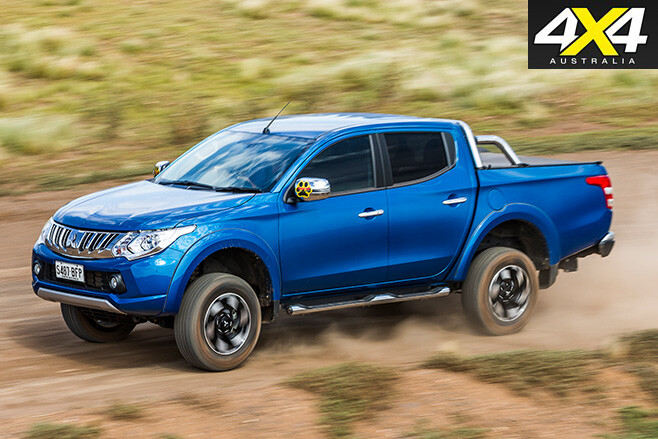
Mitsubishi’s Triton is Australia’s third best-selling ute for good reason – it’s exceptional value for your hard-earned.
IN creating the fifth-generation (MQ) Triton, released in early 2015, Mitsubishi didn’t try to build a big ute like the Ford Ranger, Volkswagen Amarok, Holden Colorado, or any other new-generation ute released a few years earlier. Instead it took the previous-generation Triton, pulled it apart and put it back together with a whole raft of new or revised parts.
The most notable of these are an all-new 2.4-litre engine, new six-speed manual, heavily revised suspension and a slightly bigger cabin. The result is a smaller ute than the Ranger (and friends), with a lower GVM and less towing capacity. The Triton’s relatively short wheelbase also means just about the entire tray is behind the rear axle, which isn’t ideal for carrying heavier loads.
However, the Triton has a couple of big aces up its sleeve in the form of extremely sharp pricing and selectable full-time 4×4 in the mid- and top-spec models – the Volkswagen Amarok auto is the other mainstream ute to offer full-time 4×4.
The Triton’s value for money comes to the fore in the top-spec Exceed model, our pick of the range. For the price of most competitors’ mid-spec manual dual-cabs you get a five-speed auto as standard, Super Select selectable full-time 4×4 system, a rear locker, keyless entry, push-button start, leather seats (with electric adjust for the driver), sat-nav via a seven-inch touchscreen, and a reversing camera. You also get auto wipers and headlights, paddle shifters for the five-speed auto, dual-zone climate, daytime running lamps, sidesteps, and all the safety stuff that’s standard across the rest of the range. Against competitors’ top-spec dual-cabs you’ll save between $6K and $12K.
The Triton’s new 2.4-litre donk is quite revvy given its maximum torque isn’t available until 2500rpm, but the auto effectively masks any sense there’s insufficient power at low revs. The engine is relatively smooth, quiet and refined. By class standards the Triton also offers competitive performance thanks in part to its light weight.
On the move the Triton has light and sporty handling compared to most in its class, and it benefits from the all-roads functionality of selectable full-time 4×4. With Super Select the driver can also select rear-wheel drive, which stands this system apart from conventional full-time 4×4 systems.
The Exceed isn’t class-leading when off-road, but its rear locker puts it in front of lower-spec Tritons. The relatively short wheelbase helps in tight situations and the Super Select means you can have 4×4 drive without locking the centre diff, which can be very useful at times.
The Exceed’s cabin is nicely detailed and the driver has the benefit of tilt-and-reach steering wheel adjustment, which isn’t standard on many competitor utes. All up, the Exceed is great value.
SPECS Price: $47,990 Engine: 2.4-litre 4-cyl turbo-diesel Max power: 133kW Torque: 430Nm Gearbox: five-speed automatic 4×4 system: dual-range full-time (+2WD) Front suspension: independent/coil springs Rear suspension: live axle/leaf springs Kerb weight: 1965kg GVM: 2900kg Towing capacity: 3100kg Fuel tank capacity: 75 litres ADR fuel claim: 7.6L/100km
5. JEEP WRANGLER RUBICON
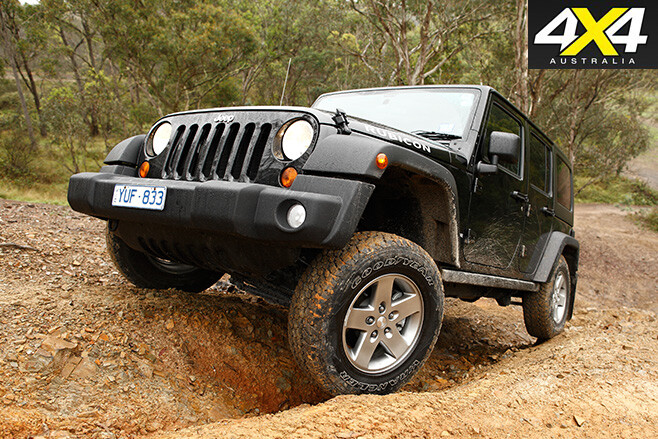
The Wrangler is the most off-road-capable Jeep, and the Rubicon is the most off-road-capable Wrangler.
WALK into a Jeep showroom and you’ll see a wide variety of different vehicles all sporting a Jeep badge. Trouble is: appearances are deceptive. Of all the vehicles currently sold as Jeeps, only the Wrangler can be considered a ‘proper’ Jeep.
What’s important here is that the current-generation Wrangler dates back nearly 10 years and is nearing the end of its production cycle. What the next generation Wrangler will bring to the party is yet to be confirmed. Could this be the last ‘proper’ Jeep? Only time will tell.
For the off-road enthusiast the standout in the Wrangler range is the Rubicon, which has always been petrol-only. But unlike times past it’s now only available as a four-door and with an automatic gearbox.
The Rubicon is mechanically different from the ‘bread and butter’ Wranglers thanks to lower diff and transfer case ratios, so even with the five-speed automatic you have an impressively low 53.5:1 crawl ratio. Unlike other Wranglers the Rubicon also comes with front and rear driver-switched diff locks and a front sway bar that can be disconnected (via a dashboard switch) to maximise the front wheel travel.
The Rubicon’s front and rear coil-sprung live axles underpin its impressive off-road ability. They provide generous travel at both ends and, combined with the electronic traction control and extra-low gearing, will get you most places. If things get tough then disconnecting the front sway bar gives you even more front-wheel travel, and if you still need more help you have the front and rear lockers to call upon. Off-road kit in a stock 4×4 simply doesn’t come any better.
What eventually stops the Rubicon is its ground clearance, but this is easily addressed via a bigger wheel/tyre package or a lift kit, given the live-axle design.
On the road the 3.6-litre V6 is smooth, willing and flexible; rapid even at high engine speeds. It’s all helped by a slick five-speed automatic with ‘manual’ shifting.
The Rubicon does its best work off-road, but it isn’t too shabby on-road provided the tarmac is reasonably smooth. At higher speeds on bumpy roads it tends to bump steer, but this is something you learn to live with.
The Rubicon’s interior is nicely finished and generally comfortable, but shorter drivers will find the vision over the dash isn’t as good as it could be. Bonus points for the removable panels in the hardtop and the fact the hardtop can be removed altogether and replaced with a fold-down soft-top. And if you really want the open-air feel, you can always remove the doors. This alone makes the Rubicon (and any Wrangler for that matter) unique in today’s 4×4 market.
SPECS Price: $53,990 Engine: 3.6-litre V6 petrol Power: 209kW Torque: 347Nm Gearbox: five-speed automatic 4×4 system: dual-range part-time Front suspension: live axle/coil springs Rear suspension: live axle/coil springs Kerb weight: 2073kg GVM: 2540kg Towing capacity: 2000kg Fuel tank capacity: 85.2 litres ADR fuel claim: 11.9L/100km
6. FORD RANGER XLT AUTOMATIC
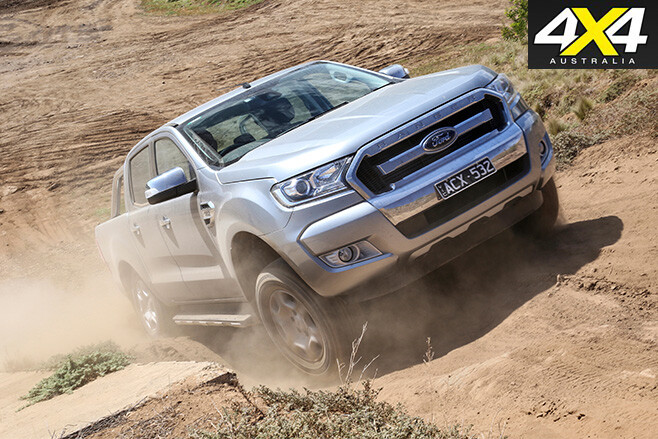
The Ford Ranger is Australia’s second-best-selling 4×4, and it’s closing in on the ever-popular Hilux.
THE Ford Ranger PX first appeared in late 2011, and despite carrying over the name of its predecessor it was in fact an all-new ute. Most significantly, its design and development was headquartered here in Australia.
The Ranger underwent a major facelift in mid-2015, with revised front-end styling and interior changes including a new dashboard and larger multi-function touchscreen. More significant were the mechanical upgrades, including a more efficient turbo for faster spool-up, new fuel injectors, changes to the cylinder head, and various other measures to improve engine performance and NVH.
Electric power steering also replaced the previous hydraulically assisted unit, while the electronic control of the 4×4 system was significantly enhanced. For example, when you engage the rear locker the electronic traction control remains active on the front axle, whereas before it was cancelled both front and rear.
Interestingly, none of these changes were made to the Mazda BT-50. Initially the BT-50 was a near identical twin to the Ford Ranger, but it’s now notably different and not as good.
Ford also successfully addressed the crook shift action of the six-speed manual with the 2015 upgrade, but our choice is still the six-speed automatic. For spec level we would then go for the XLT, as it brings sat-nav, a bigger eight-inch touchscreen, dual-zone climate, a centre-console cooler, rear parking sensors, auto wipers, sports bar and a 12-volt outlet in the tub.
The most notable thing about the Ranger is that it’s a big ute in just about every sense. Along with the BT-50 it has the longest wheelbase, the longest cabin and the biggest engine: a 3.2-litre five-cylinder turbo-diesel where smaller four-cylinder turbo-diesels are the class norm. It also has a class-leading GVM and tow rating.
On the road the engine delivers effortless performance without having to rev hard, and it has a particularly relaxed and smooth gait at highway speeds. The engine mates nicely to the six-speed auto.
By ute standards the Ranger handles and rides well on-road, while the new electric power steering makes for much easier low-speed manoeuvring both in car parks and in tight off-road situations.
The Ranger is right up there at the pointy end of the field when off-road, thanks in part to its recent revisions. If you want a big ute that can do it all, it’s hard to go past the Ranger XLT auto.
SPECS Price: $56,390 Engine: 3.2-litre 5-cyl turbo-diesel Power: 147kW Torque: 470Nm Gearbox: six-speed automatic 4×4 system: dual-range part-time Front suspension: independent/coil springs Rear suspension: live axle/leaf springs Kerb weight: 2159kg GVM: 3200kg Towing capacity: 3500kg Fuel tank capacity: 80 litres ADR fuel claim: 9.2L/100km
7. FORD EVEREST TREND
The current 4X4OTY makes this list off the back of great value for money and a broad spectrum of capabilities.
JUST in case you didn’t know, the Everest is essentially a wagon version of Ford’s highly successful Australian-developed Ranger ute. Aside from the obvious body change, there are coil springs in place of leaf springs for the rear axle, disc brakes instead of drums at the rear, and an active full-time 4×4 system rather than the Ranger’s part-time system. The wheelbase has also been reduced from the Ranger’s extraordinarily long 3220mm.
Our pick of the three-model, all-automatic range is the mid-spec Trend, which is the 4X4 Of The Year winner.
For an extra $6000 over the still well-equipped, base-spec Ambiente, the Trend gains adaptive cruise control, forward-crash mitigation, lane-keeping assistance, projector headlights with auto high-beam on/off, daytime running lamps, auto wipers, front parking sensors and a power tailgate. You also get a premium audio system, a much bigger touchscreen (eight-inch instead of 4.2) and sat-nav as a $600 option, which is not available on the base spec at all. That’s plenty of kit for just $6K.
Mind you, you also get 18s instead of 17s. The Everest runs Prado tyre spec in 17- and 18-inch sizes, so tyre availability is good. Meanwhile, the jump to the top-spec Titanium is a significant $16K, but for that you get 20s, which you definitely don’t want if you are planning to take your Everest to the bush.
The Everest shares the 2015 face-lifted Ranger’s 3.2-litre inline five-cylinder diesel engine, but with AdBlue pollutant-reducing technology and a touch less power. The five-cylinder design is a little lumpy at idle but smooths out nicely at highway speeds, where it has a relaxed gait quite different to competitor four-cylinder designs. It’s strong at low revs and doesn’t need to be revved hard to give its best.
Despite the Everest’s hefty weight and live-axle rear suspension it feels quite sporty through corners, and the electric power steering, which is exceptionally light at parking speeds and when off-road, firms up nicely at higher road speeds. Active full-time 4×4 is also a major benefit on all-road, all-weather driving.
The Everest could do with a tad more clearance and wheel travel when driving off-road, but it does have the benefit of a driver-switched rear locker, which doesn’t cancel the traction control across the front axle when engaged.
The Everest offers a spacious and comfortable seven-seat cabin thanks in part to a wheelbase – while shortened from the Ranger – that matches a Land Cruiser 200. The amount of luggage space behind the rear seats when the third row is deployed is impressive. Not so good is the vision from the driver’s seat or the lack of tilt-and-reach steering wheel adjustment.
SPECS Price: $60,990 Engine: 3.2-litre 5-cyl turbo-diesel Power: 143kW Torque: 470Nm Gearbox: six-speed automatic 4×4 system: dual-range full-time Front suspension: independent/coil springs Rear suspension: live axle/coil springs Kerb weight: 2407kg GVM: 3100kg Towing capacity: 3000kg Fuel tank capacity: 80 litres ADR fuel claim: 8.5L/100km
8. LAND ROVER DISCOVERY TDV6
Nearing the end of its life, Land Rover’s Discovery remains the benchmark in so many ways.
LIKE a number of vehicles in the Dirty Dozen, the Discovery is a former 4X4 Of The Year winner. In fact, the Discovery has been a habitual 4X4OTY winner, the last time when the TDV6 you see here was released in 2012.
Back then it was called Discovery 4 – now it’s just called Discovery to distinguish it from the Discovery Sport, effectively a third-generation Freelander.
Either way, the TDV6 is the latest iteration of a vehicle line that goes back some 13 years to the original Discovery 3 (the 4 being just a development of the D3’s basic platform).
The TDV6 is the entry model in the Discovery line-up and is comfortably the pick of the range for a number of reasons. First up, just about all the features that don’t come standard with the TDV6 can be added as options, with only a handful of high-end entertainment options unavailable, including rear DVD and digital TV.
Most importantly you can add leather, third-row seats, sat-nav and a rear auto-locking differential, among other options – most of which are standard on the more expensive SDV6.
The SDV6 also comes with a more powerful version of the Discovery’s 3.0-litre bi-turbo-diesel V6, which offers 183kW and 600Nm versus 155kW and 520Nm for the TDV6.
But here’s the rub: the SDV6 and the TDV6 engines are mechanically identical and only differ in tuning software. A Land Rover dealer isn’t about to do the tune-up for you, and they’ll probably say it will void your warranty. However, it can be done – and it’s not hard. Plus, you’re not tuning the engine beyond what it’s designed for – something that’s not the case with most diesel engine upgrades. Either way, the low-tune engine mates beautifully to the slick ZF eight-speed gearbox to produce a relaxed, adequately powerful and refined powertrain.
Unlike the Prado and 200 Series, the Discovery has height-adjustable air spring suspension, so it’s relatively low on-road ride height doesn’t compromise off-road clearance and vice versa. In fact, the Discovery works beautifully both on- and off-road. However, the rear-locker option is a must for anyone who wants to fully utilise their Discovery’s off-road potential.
Complementing the Discovery’s broad spectrum of on- and off-road capabilities is its big, space-efficient cabin that remains a standard-setter in functionality.
As ever, the Discovery’s small fuel capacity and wheel and tyre spec are practical shortcomings. The former can be addressed relatively easily, the latter not so. But still, the Discovery is a great 4×4. Let’s hope its replacement due next year is at least as good.
SPECS Price: $69,630 Engine: 3.0-litre V6 bi-turbo-diesel Power: 155kW Torque: 520Nm Gearbox: eight-speed automatic 4×4 system: dual-range full-time Front suspension: independent/air springs Rear suspension: independent/air springs Kerb weight: 2558kg GVM: 3240kg Towing capacity: 3500kg Fuel tank capacity: 82.3 litres ADR fuel claim: 8.8L/100km
9. NISSAN PATROL Y62 Ti
Thanks to a huge price cut last year, Nissan’s unloved V8 Patrol now looks like good shopping.
LAST year Nissan slashed nearly $30K off the top-spec Ti-L model in its Y62 Patrol V8 range, which had been on sale for a few years and not impacted the sales charts. At the same time the base-spec ST-L was dropped and the price of the mid-spec Ti, effectively now the new base model, was cut $24K to $69,990. That puts the Ti $23K cheaper than a petrol 200 VX and $28K cheaper than a diesel 200 VX (the VX being the closest 200 Series spec-level to the Patrol Ti).
Put another way, $69,990 for the Patrol Ti makes it $3K to $4K cheaper than a petrol or diesel Prado VX, which is astonishing given what the Y62 offers.
First up, the Y62 is a big 4×4. Drive it back-to-back with a 200 and the Y62 almost feels like a bigger class of vehicle. The second-row seat is especially generous compared to the 200 and its luggage space is also notably larger.
The Y62 offers a 5.6-litre V8 that makes the 4.6-litre (petrol) V8 in the 200 seem a bit limp-wristed. The numbers tell part of the story (298kW/560Nm versus 228kW/439Nm), but the other part is that Nissan’s V8 comes from an engine family with serious motorsport credentials. This includes the V8 used by Nissan in its local V8 Supercars and the V8 that dominates the LMP2 class in international sports car endurance racing (Le Mans 24 Hour, etc).
The Y62’s 298kW makes it one very potent 4×4 on-road, and for those who like V8s it’s a much more vocal engine than the 200’s rather subdued 4.6.
To help keep all this performance and a fair bit of weight (2800kg) in check, the Y62 has something very special in the suspension department: Hydraulic Body Motion Control (HBMC). HBMC is a far more sophisticated suspension system than what’s under a 200, even one with KDSS.
HBMC is a fully independent coil-spring system with active dampers that limit on-road bodyroll but also maximise off-road wheel travel, and all without mechanical sway bars. The system works brilliantly. The Y62 corners much flatter than a 200 on-road yet can still keep up with a 200 off-road, even if it needs more under-engine protection for very rocky going.
At $69,990 the Ti is very well-equipped, but the big downside is that the Y62 is thirsty. The always-conservative official ADR fuel number, 14.4L/100km in this case, probably tells you all you need to know. On our last test we averaged 17.7L/100km. The time before that, with more low-range work, it registered 21.3L/100km.
The upside is that there’s a 140-litre tank, so the range is still okay. And with the $23K to $28K saving over a 200 VX, that’s a lot of free fuel before you hit price parity.
SPECS Price: $69,990 Engine: 5.6-litre V8 petrol Power: 298kW Torque: 560Nm Gearbox: seven-speed automatic 4×4 system: dual-range on-demand Front suspension: independent/coil springs Rear suspension: independent/coil springs Kerb weight: 2800kg GVM: 3450kg Towing capacity: 3500kg Fuel tank capacity: 140 litres ADR fuel claim: 14.4L/100km
10. TOYOTA PRADO VX
The Prado is Australia’s best-selling 4×4 wagon for good reason. Many good reasons in fact.
OTHER than a short period back in 2014 when Jeep Grand Cherokee sales were peaking, the Prado has long been Australia’s best-selling 4×4 wagon. Before the rise in popularity of 4×4 utes it was Australia’s best-selling 4×4 overall.
The Prado is now the default Land Cruiser, given the 200’s ritzy pricing (and possibly larger size) is not to everyone’s liking. In many ways, not least in size, the Prado is today’s 80 or 100 Series – in their day the most popular 4x4s.
The Prado is a proper Land Cruiser, a 150 Series to be precise. That’s something often not acknowledged and even denied – just because it’s smaller than a 200 doesn’t mean it’s a lesser vehicle.
The big question is: What Prado from the nine-model range is the pick? Discounting the three petrol models, there are two ways to go with the diesel. If you’re planning on building a bush tourer then the five-seat GX, probably in manual, is the only way to go. However, if you want more of a general-duties, day-to-day family 4×4, then we think it’s worth bypassing the popular GXL auto and going for a VX.
Trouble is the VX is an additional $12K over and above the $61,990 GXL auto, which seems like a lot until you drive the two back-to-back. The VX offers far sportier and flatter on-road handing and better off-road performance, thanks to longer and more supple wheel travel.
The difference is the VX’s Kinetic Dynamic Suspension System (KDSS), a brilliantly simple hydro-mechanical system that automatically adjusts the tension on the suspension’s sway bars. KDSS is standard on the VX but unfortunately unavailable on the GXL, even as an option.
The VX also ups the ante with leather, heated front- and second-row seats, electric seat and steering wheel adjustment, power-fold third-row seating, auto headlights and wipers, a 17-speaker premium audio system and front parking sensors. You also get 18s instead of 17s, but the tyre spec is still very bush-friendly.
Compared to the previous 3.0-litre diesel, the new 2.8-litre diesel is noticeably quieter, smoother and more flexible, but it doesn’t offer a significant jump in outright performance.
As ever, the Prado cabin is comfortable, roomy and nicely detailed, especially at the VX spec. Practical features, such as the 150-litre fuel tank, are all supported by an extensive dealer network. Plus there’s a vast array of aftermarket enhancements available.
SPECS Price: $73,990 Engine: 2.8-litre 4-cyl turbo-diesel Power: 130kW Torque: 450Nm Gearbox: six-speed automatic 4×4 system: dual-range part-time Front suspension: independent/coil springs Rear suspension: live axle/coil springs Kerb weight: 2400kg (approx.) GVM: 2900kg Towing capacity: 2500kg Fuel tank capacity: 150 litres ADR fuel claim: 8.4L/100km
11. TOYOTA LAND CRUISER 200 GX
The GX is not only the least-expensive 200 Series, it’s the most bush-ready.
WHAT list of best 4×4 buys wouldn’t include the 200 Series, the crown jewel in Toyota’s extensive range of off-road vehicles? Trouble is, which 200, given they are priced almost like crown jewels? Go for a top-spec Sahara and you’re at $120K even before on-road costs.
For our money the base-spec GX is the best value and is particularly attractive as a starting point for a 4×4 tourer. Mind you, it’s still expensive compared to a 78 Troop Carrier or the slightly cheaper 76 Wagon. If you go for the base-spec Workmate 76 you can save $18K over a 200 GX.
However, comparing the 200 to a current 76, 78 or 79DC doesn’t do any sort of favour to the 200. Sure, they are both Toyota Land Cruisers, but they feel like they come from different worlds, such is the huge gulf between them. The 70 drives like a third-world truck, while the 200 drives like a first-world luxury 4×4. The 200 is light years ahead in comfort, refinement, ride and handling, engine performance, and the ability to cover huge distances without unduly fatiguing the driver or passengers. It’s also well ahead in active and passive safety.
The 70 is a more rugged and ultimately more capable off-road workhorse, but it’s badly compromised by its way-too-short highway gearing and single-turbo V8 diesel, which isn’t nearly as efficient as the 200’s twin-turbo V8. Throw in the 70’s blunt front aerodynamics and an engine that revs unduly even at modest highway speeds, and it’s no wonder it can drink fuel like it has a petrol V8 under the bonnet – and at a rate 15 to 20 per cent greater than a 200!
The GX didn’t arrive until late in 2011, some four years after the 200 range debuted and it’s effectively a stripped version of the popular 200 GXL. You still get the 195kW/640Nm twin-turbo 4.5-litre V8 diesel complete with the sweet six-speed auto and the full raft of electronic chassis systems including stability, traction and crawl control. The GX also has front, side and curtain airbags.
Gone from the GXL are the third-row seats, carpet floors, proximity ignition key with push-button start, alloy wheels and horizontally split rear tailgate. In their place the GX has five seats, vinyl floor coverings, a conventional ignition key, steel wheels and rear ‘barn’ doors. The GX then gains a factory snorkel, the only 200 thus equipped. And with the third-row seats and other things gone, it has a higher payload than other 200s. Much bigger load space, too.
SPECS Price: $76,500 Engine: 4.5-litre V8 twin-turbo-diesel Power: 195kW Torque: 650Nm Gearbox: six-speed automatic 4×4 system: dual-range full-time Front suspension: independent/coil springs Rear suspension: live axle/coil springs Kerb weight: 2640kg GVM: 3350kg Towing capacity: 3500kg Fuel tank capacity: 138 litres ADR fuel claim: 10.3L/100km
12. RANGE ROVER SPORT SDV8
Few people have $150K to spend on a new 4×4, but if you do, there’s only one choice.
THERE are no surprises that a Range Rover of some description has made the Dirty Dozen list. The question is: which Range Rover? For our money it’s the Range Rover Sport SDV8, which is not only the pick of the vast Range Rover/Range Rover Sport line-up, but it’s better than any 4×4 or SUV from Audi, Bentley, BMW, Mercedes-Benz, Lexus or Porsche. The RRS SDV8 was our 4X4OTY two years back, so it joins the other 4X4OTY winners on this list.
For those who don’t know their Range Rovers, the SDV8 designation means it has the 4.4-litre bi-turbo-diesel V8, one of a vast array of engines available in the RRS or indeed the RR itself.
The distinction between the Range Rover and the Range Rover Sport is important here, too. In effect there’s little mechanical difference between the two as they share platforms and most of the multiple powertrain options. The key difference is in the body. The Range Rover’s is longer, taller and wider than the sleeker and, for most, more handsome body of the Sport.
That this second-generation RRS can claim to be a proper Range Rover sets it apart from the first-generation Range Rover Sport, which was built on a Discovery 3 platform. Key to this generation of RRS (and RR) is the all-aluminium monocoque construction, which brings considerable weight savings over both the steel separate chassis of the first-generation RRS and the steel monocoque of the previous-gen RR.
At 2400kg, the RRS Sport is still heavy but doesn’t feel it due to impeccable road manners and the effortless and ample power of the 250kW/740Nm diesel V8.
The SDV8 is one of three diesels on offer, the other two being 3.0-litre V6 diesels in different states of tune. There’s also a diesel-electric hybrid and four petrol engines, two supercharged V6s and two supercharged V8s, the most potent of which, the SRV, makes a mighty 405kW. That’s a truckload of fun, but it’s another $75K over the SDV8 – and it’s thirsty.
The SDV8 is the complete package. On-road it’s a luxury car with sports car performance and frugal economy, yet off-road it’s amazingly capable and will scramble up a gnarly hill with the best of them. The wheel/tyre spec isn’t the most practical, but at least in this generation of Range Rover and Range Rover Sport there’s been a move towards higher-profile tyres for any given wheel size, a welcome move in terms of off-road functionality.
SPECS Price: $145,310 Engine: 4.4-litre V8 bi-turbo-diesel Power: 250kW Torque: 740Nm Gearbox: eight-speed automatic 4×4 system: dual-range full-time Front suspension: independent/air springs Rear suspension: independent/air springs Kerb weight: 2398kg GVM: 3200kg Towing capacity: 3500kg Fuel tank capacity: 105 litres ADR fuel claim: 8.7L/100km
This week, as Roothy takes a break from his regular cooking duties, we check out some of the shenanigans he gets up to at camp.
Roothy is a master with the tongs, which often means he neglects other campsite duties – as this video displays.
It seems camping with the great man can be harder than it looks!
Check out the vid for a laugh.
TOYO tires has teamed up with Active Vehicle Engineering to roll out a tricked-up 1959 British Ferret 4×4 Military Scout.
Active Vehicle Engineering heavily modified the go-anywhere war rig so that it can overcome almost-impassable objects, as seen in the video.
The biggest mechanical upgrade is the addition of a Chevrolet LS engine in the rear to boost horsepower and give it increased off-road urge, while King Shocks underneath allow the Ferret to mount anything in its path.
The six huge Toyo Open Country M/T tyres are mounted on custom wheels, and two of the tyres are operated via hydraulic motors located on the inside.
The Toyo muddies are designed specifically for soft off-road terrain, with a robust construction to limit sidewall damage and punctures – the perfect companion for a tailor-made off-road juggernaut like the Ferret.
In this video showcasing the talents of Toyo’s M/T tyres, the Ferret, piloted by BJ Baldwin – seven-time American off-road racing champion and driver of the #97 Monster Energy Trophy Truck – conquers fallen logs, water crossings, steep climbs and jagged rocks.
A fancy addition is a custom-built launcher with a grappling hook, which is attached to the winch cable. The video displays the hook in action getting the Ferret out of strife, though we’re still dubious as to how effective it actually is.
We’ve asked Toyo for a drive and we’re still waiting to see if and when that’s possible. Stay tuned to 4X4 Australia and we’ll let you know if it’s happening. We damn well hope so!
THE Hilux might be considered tough, but it’s passenger-car-plush on the inside, especially in this top-spec SR5.
Standard features include user-friendly touchscreen with sat-nav, cruise control, two 12-volt accessory sockets, a 220-volt connector, and power operation for the windows, mirrors and door locks.
The front seats offer greater comfort and support, while the thinner seat frames add 10mm of knee space for rear-seat double- and extra-cab occupants. These SR5 seats even have leather accents – luxury in a place like the Canning. Storage-wise there are more than a dozen different compartments to stow gear.
The SR5 also gets keyless smart entry and start, automatic air-conditioning, premium steering wheel and shift knob, upgraded instrument cluster with cool blue illumination, an alarm, automatic headlamp levelling and silver highlights throughout the interior.
Comprehensive safety features include seven airbags across the range.
To accommodate families, all Hilux double-cabs feature a top-tether anchor and two ISOFIX child-restraint attachment points for the rear. Seatbelt reminders are now standard on front seats in all variants – and for rear seats on double-cabs.
Who says you need to rough it in the outback?
I RECENTLY drove down a little-used track that was slowly being reclaimed by the bushes and shrubs that once resided in its fertile soil.
It was initially a little tricky trying to avoid some overhanging ‘scratchy’ trees, but the first couple of hundred metres didn’t present much of a challenge. Then, as the density of the foliage increased, the track itself started to deteriorate under the vehicle’s tyres, with hidden washouts and fallen rocks strewn across our path.
As we rounded a bend, it became abundantly obvious we couldn’t proceed. Originally cut into the side of a very steep hill, a substantial landslide had now made the track completely impassable. There wasn’t enough space to safely turn around; I’d have to reverse back up the treacherous track.
My usual co-driver on such adventures wasn’t in the passenger seat; he was about 300m away on the other side of a ridge operating a UAV that was filming our lack of progress. Instead, his 17-year-old son Timbo sat beside me, making jokes about his “years of experience” of off-road driving.
“Well, Timbo, it’s time to prove your mettle,” I thought, as I instructed him to jump out and direct me back up.
I’ve worked with Timbo’s old man for more than a decade; I do the driving and he takes the photos. Over the years we’ve managed to safely put some four-wheel drives into some very extreme situations, all in the name of chasing that ‘perfect’ shot. In doing so, we’ve developed a pretty good system for manoeuvring vehicles in tricky spots, through a combination of hand signals and talking on the UHF. In fact, we’ve done this successfully so many times now I no longer need to watch where I’m going at all; I just keep my eyes on his hand signals and listen for his instructions over the air. Basically, I do as I’m told.
Now young Timbo loves his four-wheel driving. He gets behind the wheel of his dad’s rig whenever he gets the chance, then as soon as we stop somewhere to set up for a shot he’s up on the roof rack grabbing his RC crawler out of the gear bag and driving it up some mountain somewhere ’til it’s time to press on to the next photo op. Like his dad, he seems to have a knack for off-road driving.
Bearing his enthusiasm in mind, I thought he’d make a pretty decent navi, regardless of his limited experience. Preparing to back out of our current tricky predicament, I double-checked the position of the mirrors, engaged reverse, glanced at the reversing monitor and awaited Timbo’s instructions. Nothing.
“Timbo!” I called. “You ready?”
He stood there, motionless, not quite sure what to do.
“Mate, I need you to tell me what’s behind me,” I said. “Just let me know if I need to turn left or right and keep an eye out that I’m not going to back into anything.”
“Okay, back her up, she’ll be right,” he mumbled, not inspiring much confidence.
I reckon we’d reversed about 50m when I noticed the right rear wheel was about to fall into a massive washout. I hadn’t heard any “left-hand down” calls or seen any hand signals at all, despite the fact Timbo could easily see the hole in which I was about to fall.
It was as though he was frozen with fear.
I jumped out of the vehicle and had a quiet word with him. “Mate, all I need you to do is tell me to turn left or right,” I said, but he implied that he wasn’t at all confident issuing those instructions. This made me wonder what I’d feel like as a 17-year-old kid, directing a vastly more experienced (read: much older) four-wheel driver back up a track that we should probably have never driven down in the first place. Was it fair of me to place such a burden of responsibility on this young bloke?
Regardless of the rights or wrongs, we had to somehow get back up the track. We went for a wander on foot and eventually agreed upon a suitable spot to turn around. Tim assured me he wouldn’t let me drive over the precipice to a horrible, fiery death and, eventually, we managed a reasonably safe 30-odd-point turn and made our way back to the main track.
“He’s pretty handy with that RC crawler,” I told his old man. “I thought he’d be a good navi.”
“Have you seen how many times he’s crashed that thing?” laughed his dad.
THE Toyota Hilux SR5 comes with some clever chassis electronics and traction aids, the most useful of which is ATRAC traction control.
The electronic traction control quickly asserted itself as a handy tool on the rugged sections of the Canning Stock Route. Being so remote this is not the place you want to get stuck, and it was reassuring to have this system under us.
Clambering out of a particularly challenging creek crossing there were some brief flares of wheelspin, but the electronics soon sorted things out, diverting drive to the wheels that were still gripping on the sharp, loose rocks.
The traction control is so effective that it negates the need for a diff lock, but Toyota gives you one on the SR5 anyway. But trust us, the traction control does a better job, because when you engage the diff lock the traction control is disabled and the front axle runs as an open diff. Clever electronics get the job done.
RECENTLY on our Facebook page we gave our readers the chance to send in pics of their off-road adventure machines.
Plenty of you sent through some cracking pics, and here are a handful of them!
Check out Part 1, Part 2 and Part 3 of Readers’ Rigs to see what your fellow enthusiasts are hitting the tracks with.
Stay tuned in to our Facebook page for the next opportunity to send in pics of your 4×4. You never know, it might even get published in the mag one day and, if we really like it, perhaps you’ll even see it on the cover of 4X4 Australia!
2014 JEEP JK WRANGLER ‘OSCAR MIKE’ FREEDOM EDITION: NATHAN BURGESS
WHAT IT’S GOT: 3.5-inch tuned Bilstein/AEV shocks suited to dual-rate heavy-duty springs; TeraFlex geometry-correction and brake-line drop brackets; Fox Performance Series steering dampener with high-clearance relocation; ARB Dana 44 diff guard; 33-inch Pro Comp Xtreme A/Ts on 17-inch Dynamic Soft 8 steel rims; rear sway-bar delete; custom-fabricated stubby bar with reinforced winch, fairlead and D-ring mounts; Rubicon rock sliders; Cree LED rock lights; LED underbody rock lights; Spiderwebshade bikini top; 12-volt power inverter; custom-made rear-door stainless-steel trail table; hardlined twin air compressors mounted to rollcage (double as grab handles); special-edition leather trim; blacked-out interior components; LED interior lighting; additional rear recovery points mounted to chassis; and Hayman Reese tow bar/recovery points. A rear tyre carrier is next on the list.
It has seen inner NSW trails and now spends its weekends crawling around Janowen Hills 4WD Park (personal favourite), the springs, Scenic Rim National Park, the Glasshouse Mountains, as well as family beach runs on Bribie Island and Rainbow Beach.
2000 GU PATROL – DEAN DAL SANTO
WHAT IT’S GOT: The 3.0-litre turbo-diesel (the hand grenade) has made it to 306,000km without any engine mods. It also has: two-inch lift on 33-inch Bighorns; VRS winch; Nightstalker spotties; and a 60-litre Waeco fridge. It survived a 45,000km trip around Australia.
2005 FORD COURIER – GREG TURNER
WHAT IT’S GOT: It has a 2.5-litre turbo-diesel. Mods include: Ironman 4×4 bullbar and winch; 22-inch light bar; a set of old Oscar’s driving lights, which I’ve had on my last four vehicles and they do the job well; UHF aerial on the bullbar; and an 80-channel UHF.
I also have a roof rack with a shovel and hi-lift jack on one side, and an Ironman 4×4 awning on the other – this all sits on the canopy. Inside the canopy I have two batteries that run my 50-litre Waeco fridge and 40-litre Stirling fridge.
The suspension has been lifted about two inches to help with the weight of the fridges and other stuff in the ute, as well as towing the hardfloor camper which also has a battery (it charges off an Anderson plug when in transit). The trailer is set up to carry two kayaks.
I have owned it for 12 months and it is the first twin-cab I have owned; all my other 4x4s have been wagons.
Some of the best places I have been to include the Victorian High Country, Rocklands Reservoir, Clyde Mountain, Fraser Island and areas of western Victoria. This vehicle has been set up for touring and I am currently touring Queensland and hope to get to Fraser Island again. I would like to fit a snorkel and have the vehicle dyno-tuned for a bit more power.
2013 TOYOTA HILUX SR5 – PRINCE DOG
WHAT IT’S GOT: Bought it new in 2013 and have added ARB bars front and rear; ARB canopy; OME 50mm lift; BFG All Terrains; and the trusty Lightforce XGTs on the front. It has been on many trips to Stockton Beach, Blacksmiths Beach and the Flinders Ranges.
100 SERIES LAND CRUISER – THOMAS DALTON
WHAT IT’S GOT: Fitted with 1HD-T engine; three-inch lift; two-inch body lift; 35-inch tyres; ARB bullbar, rock sliders and front and rear lockers; Warn winch; rear drawers; and ’cage. I’m currently fitting an HPD front mount intercooler to the car!
2014 MITSUBISHI PC CHALLENGER – EVAN CHRISTOPHOROU
WHAT IT’S GOT: I’ve had it for a year. Mods include: 2.5-inch Bilstein lift, 33-inch Nitto Trail Grapplers; TJM winch bar with Runva winch and LED spotties; rear drawer set-up with inverter and Waeco fridge; ARB compressor under the seat; 40-inch Baja Designs light bar on a Rhino-Rack pioneer platform; twin jerry can holder on the roof; Piranha dual-battery system with Sidewinder battery monitor; DP chip with throttle controller; and a TaipanXP catch can. Mods to come include: Raslarr rear bar and rock sliders.
Best place so far has been Licola to Dargo through the Vic High Country, where the Challenger surprised me very much with its capabilities.
2007 GU PATROL WAGON – DAN PARKER
WHAT IT’S GOT: Three-inch lift; 85-litre on-board water, rear drawers; 65-litre DualZone Primus fridge, VMS mapping; TX3500 UHF; 33-inch muddies; hardtop rooftop tent with 120-watt solar hard-wired; Rhino-Rack pioneer platform; shovel holder; 50-inch light bar; HID spotties; rock lights; and rear lights. Motor has upgraded Long Ranger auxiliary fuel tank; three-inch stainless; chip; and an upgraded intercooler on the 3.0CRD. That’s all I can remember for now.
2012 JEEP JK WRANGLER – WILL DANG
WHAT IT’S GOT: I bought this new. It was stock, but now it has: 3.5-inch TeraFlex Synergy lift; front and rear bars, tyre carrier, windshield light bracket and an X20 winch all from Smittybilt; AEV snorkel; custom drawer system; three-inch straight-through exhaust; and 33-inch muddies – the list goes on.
MITSUBISHI MN TRITON – TROY LUFF
WHAT IT’S GOT: 65-litre water tank; 80-litre Waeco fridge; two-inch lift; 32-inch muddies; 260-watt solar wired to a CTEK DC-DC charger; three-inch exhaust; ECU remap; two spare wheels; and much more.
105 SERIES TOYOTA LANDCRUISER – JASON SLADE
WHAT IT’S GOT: Our 105 series Cruiser, fully fitted for remote-area touring!