
THE word ‘understatement’ can go a long way when customising a four-wheel drive. Subtle touches, some often hidden, can improve a vehicle’s style and abilities, without frightening the daylights out of the wombats.
This article was originally published in the November 2014 issue of 4×4 Australia.
Queensland-based Jeep outfitter, Stu Murchison, is a master of substance and style. A suspension guru from way back, he’s had a bucketload of experience in the motor business and these days works full-time on enhancing Jeeps for improved on- and offroad encounters.
Stu and his Murchison crew can do wild builds and major rebuilds, but a lot of his work to date has been adding some extra polish to current model Jeep Grand Cherokees.
Although the Grand Cherokee is acknowledged by critics and consumers as a decent 4WD wagon and tourer, Stu understands some owners want theirs to go a little bit further into the never-never.
“We are known for being the ‘Grand Cherokee people’ here because out of all the Jeep businesses in Australia we started with the other six or seven models of Jeep [rather than Wrangler],” Stu said.
“We started with Cherokee, Patriot, Compass, Grand, Commander and then came into Wrangler later on because that was such an easy thing for us to do. So we started out with the hard models and created custom products and solutions for them and then moved on to the easy stuff.”
‘Custom, Comfortable and Capable’ is the Murchison Products motto, using a mix of bespoke Australian and American products.
With a decade of testing coils and shocks for independently sprung Jeeps, Stu believes these wagons can handle a lift up to 2.5 inches for better offroad ability without compromising on-road dynamics or comforts.
The Murchison showcase for these CRDSTU suspension set-ups is a black Grand Cherokee. While in this case the work is pretty much hidden, other Murchison modifications help turn a handsome wagon into a head-turner. It still works as a family tourer and pragmatic offroader, but the black beauty has real road presence through quality but subtle add-ons.
The wagon is a 2013 CRD Laredo with a VM Motori 3.0-litre V6 diesel, single turbocharger, two-speed transfer case and five-speed auto transmission – a solid combination. However, there are a couple of nuances to this Grand Cherokee which perhaps best highlight Stu’s long-standing aversion to average products and workmanship.
One is plain enough to see: the custom-made and prototype snorkel is a piece of auto art, fitting the style of the Jeep better than just about any snorkel on any machine out there.
“We’ve gone from a full CAD-style, 3D drawing with a minimalistic shape and profile but one which still provides the required airflow.
“We wanted to really complement and modernise the design of the snorkel and not have some big, boofy agricultural thing sticking out of it,” Stu said.
This Murchison snorkel for WK2 Grand Cherokees should be on the market by the end of 2014.
The other touch that illustrates Stu’s attention to detail is the fitting of the GME, five-watt UHF radio. The unit is hidden out of sight, with a handheld mic tucked away behind the lid of a dashboard console box and the speaker built into the transmission tunnel.
There is little else added inside the Grand Cherokee aside from Mopar slush mats for the floor and a Redarc brake controller for a trailer.
This particular wagon runs with Jeep’s Selec-Terrain system which allows the driver to dial in modes for different engine and transmission responses depending on the terrain. Plus there’s an electrically operated driver’s seat and, with the standard ergonomics and general cabin layout of the Grand Cherokee, it’s a comfortable workplace.
Up front is an Australian-made Uneek bar, which is a full winch bar with recovery points, as well as a Uneek skid plate. Rock rails are a genuine Mopar product.
The Grand Cherokee is kitted out with a Murchison Products CRDSTU 2.5-inch suspension lift plus anti-top-out plates front and rear.
The good-looking black wheels are an 18×9 KMC product with 275/65 R18 BF Goodrich All Terrain rubber. A set of Bushwhacker flares add 20mm to the ’guards to keep the package legal and the body a little bit cleaner.
There is a factory tow bar out back and a Rhino Rack Pioneer roof rack system up top with a pair of LED work lights pointed back. Stu said this low-lying, flat and aluminium roof rack isn’t roof-top heavy but can carry a fair bit. It could, with reinforced mounts, handle a roof-top tent. “It’s good for carrying basics and also a spare tyre,” Stu said.
“Unfortunately the factory spare is inside the boot, so if on a massive trip and the boot is jam-packed to the roof with equipment, the last thing you want to do is change a tyre beside the road and pull everything out. So a lot of people dig it [the spare] out of the boot and put it on the caravan hitch or on the roof.”
To help keep the wagon up with the traffic and over the dunes, the Murchison crew have added a custom, three-inch stainless-steel twin exhaust system. It begins from behind the DPF and runs back without mufflers for a sporting tone that’s still street legal.
The result is an extra 12kW to the factory’s 140kW. Plus, for a little extra pick-up, the original plastic muffler on the intake pipe’s been swapped for a straight-through, tapered, stainless-steel pipe.
Stu was about to rewrite the Jeep’s ECU, change torque converter maps and a little more for some extra gallop from this black beauty when we visited. He’s since indicated that the results of the tuning are impressive.
A quick highway haul and forest run shows up the impressive Murchison wagon. Highway ride is excellent and the suspension kit offers a comfortable ride over rough tracks, best appreciated on the bigger lumps. The lift does mean drivers require more concentration as there’s a little body roll.
The lift, plus the underbody protection and a decent set of tyres, gives the wagon more confidence when the tracks turn tough. But perhaps one of the best bits of this Murchison Grand Cherokee is under the bonnet.
The Jeep’s V6 diesel has always been a decent workmate, but the little tweaks here make it more of a playmate. It picks up a tad better than standard and revs a bit easier, with a sweet exhaust sound. The improvements to Stu’s ride gives it better offroad ability while maintaining the Grand Cherokee’s family-friendly touring ability.
The modifications made to this Jeep are as customers request and Stu says one of the first things they want is to lift the nose off the ground, either through a levelling lift or a 2.5-inch lift. “Underbody armour and protection also seems to be a priority with a lot of customers because of that low factory stance,” he said.
“Then the second tier of customers usually go for larger tyres and offset rims and the bullbar-style set-ups.”
These days, Murchison Products for Grand Cherokees are sold and used across Australia, as are all manner of suspension tunes and offroad gear for all models of Jeep.
Now Stu has turned his attention to developing gear for the all-new KL Jeep Cherokees.
“[Focusing on] lift kits, tyres, snorkel, bar work; the whole lot because I think the Cherokees are going to be a hugely successful little car,” he said.
And with the Murchison touch, the Cherokee will be extra capable with perhaps a little more road presence yet again.
INFO The CRDSTU 2.5-inch to 2.75-inch lift kit for the Jeep Grand Cherokee is listed from $1095. For the full catalogue of visit their website Murchison products.
If you liked this mean Murchison Cherokee, check out their recently built Jeep JK Wrangler ute.
I’m in the middle of nowhere and I start hearing a clicking noise that gets progressively louder.
I eventually work out it’s from the rear wheel area and mistakenly diagnose it as just a rock or something caught in the brakes. Yep, big mistake! Well, you might have guessed it, the noise just got louder and louder until the rear wheel bearing collapsed and rendered the vehicle useless.
THE RELAXED APPROACH Now, I reckon a fella’s frame of mind and the amount of energy exerted is a massive thing to consider when you’re broken down. So, instead of pulling up in the sun and ripping things apart in the heat, I chose to pull up in the shade and relax until it cooled down a bit. That gave me some time to assess the situation in the right frame of mind – not a cooked one.
THE RIGHT STEPS Realising I was in a real breakdown predicament, it was time to start thinking about how to handle the situation. The steps are pretty easy – conserve your energy, preserve water and wait!
I had plenty of water on board and, after checking the map, I knew there was a river only a kay or two up the road as well. So my main priorities of having adequate water and shade were covered – phew!
Luckily, in my situation, I had the tools and skills to pull the hub apart and regrease the bearings enough to limp the Troopy a few kays until I found phone reception and was able to call for help.
Once I had alerted the relevant authorities, I got the vehicle on to the main track and put the bonnet up to signal that the vehicle was, in fact, broken down and help was needed.
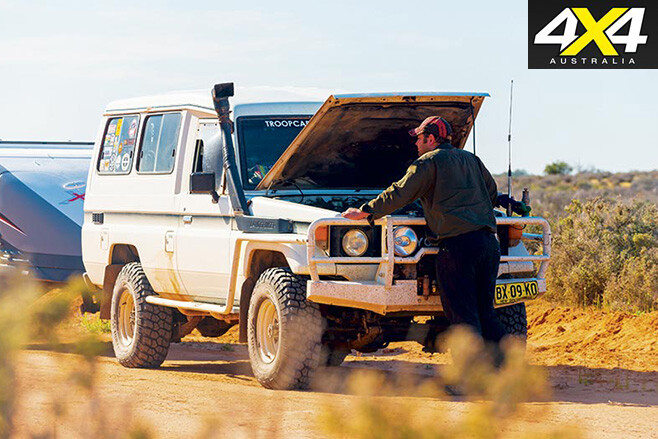
You’ll exert far less energy sitting around in the shade than walking in the sun. You’ll probably end up getting help a lot quicker, too!
WRAPPING IT UP At the end of the day there are plenty of people who travel with a convoy of 4WDs when heading out bush, which is obviously a much safer option than going solo.
So what am I trying to say? Simple. If you’re well prepared, being stranded doesn’t have to be as frightening as you think it might be. Most of the time a breakdown in the Outback won’t turn into a life-threatening situation.
Just take the time to prepare properly and the worst thing about a breakdown in the Outback should be that you’ll have to stay put for a few days – and we can all live with that, eh?
HOW comfortable do you need to be during an off-road adventure? Well, that’s really one of those piece-of-string questions isn’t it? It all depends on who you are and who you’re travelling with.
I’m starting to realise there’s a bit of a circle of life thing attached to my camping life. As a lad I’d drape a canvas sheet over the motorbike and wrap myself in a couple of Indian blankets on the ground. They were partly waterproof, very ticklish and warm enough for most of the southern states (most of the year). But I was young, poor and very single. Try getting the wife to cuddle up on the ground under a tarp!
Plus, as your editor knows, there’s not a lot of carrying space on a motorcycle. Once we got into 4x4s the whole world opened up. In fact, I remember hitting the bush for work back in the 1970s in the boss’s G60 Nissan with a big canvas pole tent, a mattress on the roof, sleeping bags and pillows. I even carried a foldable table and a one-burner-ring LPG bottle. Talk about plush! But that was work and that meant weeks away at a time.
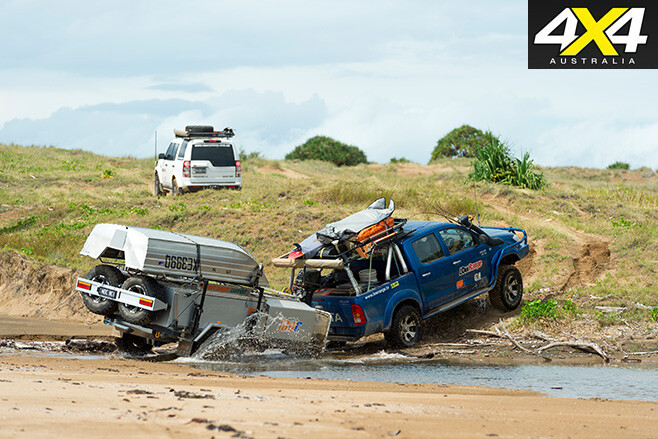
Holidays used to see my girlfriend and I sleeping on foam mats and sleeping bags in an Egyptian Cotton two-man tent. We had a water container and lived off biscuits and cheese for the most part, drinking port at night because there wasn’t any way of keeping stuff cool. No worries when you’re 18, of course. Later on it was swags, and sometime a decade or more ago I discovered stretchers.
Meanwhile the wife wanted the security of a camper trailer for the kids when we got to that stage, and that’s how our family camps went. There’s nothing quite like a trailer when you have got a bunch of kids running amok – if for no other reason than the solitude it provides.
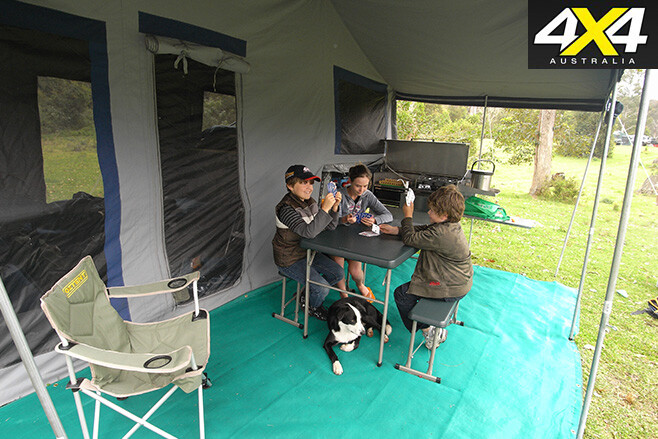
That’s also the stage when you need to be carting heaps of gear. Open our old trailer and you’ll find everything from the shade mesh ‘grass’ the wife loves to have under the awning, to the collapsible clothes hoist. There’s a pop-up bin, a table and five chairs, plenty of lights, and a box full of things like footys and kites. And you know what? Most of it has had a run.
Now that my little family is on the other side of that trailer hump, we’re starting to think outside the box. It started with the lads asking for swags of their own for Christmas, and then setting them up on the periphery of our camp. A little bit of independence goes a long way when you’re 12.
From there the wife started staying at home with our eldest daughter, preferring to do girl things, while the lads and I took off on more adventurous trips with our swags. In fact, after a decade of family camper trailer holidays I can see a time when I sell the trailer because it’s not getting any use. Me? I’m fine with a swag, but once the wife experienced the new style of ’vans with a hot shower, well, I’m thinking her swag might have been a waste of money.
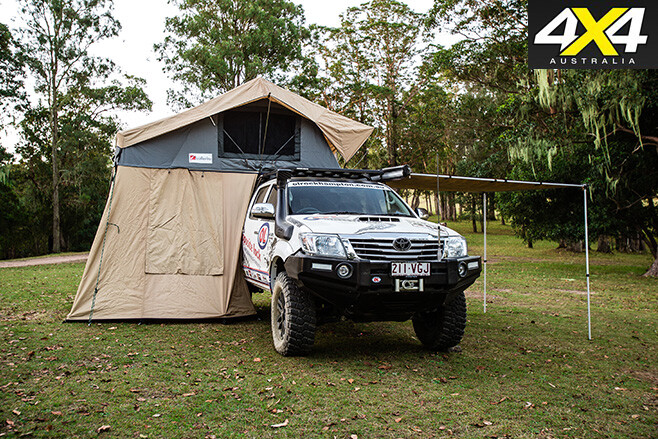
Last year I finally traded my old roof topper for some Cruiser bits. Living on top of the truck was terrific, especially on the beach, with a great breeze and the chance to shake off the sand on the way up the ladder. However, the older I got the more trips up and down that ladder I had to make during the night. Not a real problem, not until the knee operation anyway.
The main reason the roof topper was kept in the shed was because 40s are easy enough to tip over as it is. Weighing in at around 50kg and sitting up high on the rack, it worked like a pendulum if things got hectic when chucking Milo from side to side on springs that have been severely softened already.
One day when I’m old, crusty and retired – the wife reckons I’m two out of three already – the plan is to drive around Australia in an old Toyota and explore new tracks. Sounds like work but without the cameras!
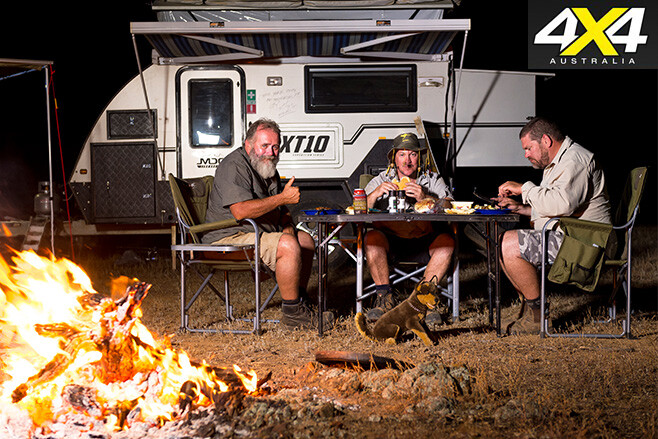
A while ago I was camping with my mates ‘Troopy’ Pete Richens and Steve Gordon up at LandCruiser Park, and it was hard to get away from the brilliance and comfort both these blokes have built into the back of their Troopies. Chuck in a comfortable bed, some curtains and drawers for the kitchen stuff, and perhaps sleeping in the back of the truck is where it’s at.
Full circle? We’ll see! Catch you up a track, eh?
IT’S BEEN quite some time since the last update on my D22 Navara, so here’s a recap: It was bought secondhand in mid-2013 and was totally standard other than an OE sports lid, tub liner and an engine immobiliser. Since then I’ve slowly been modifying it to better suit my needs.
First up I fitted the 2008 Navara with a set of Toyo Open Country A/T II (OPAT II) tyres, followed by a steel Nissan bullbar, Narva Ultima 225 HID driving lights, Oricom 5W UHF radio, and then a Tough Dog suspension system.
For a previous job, editing Australasian Dirt Bike magazine, this set-up worked well; it only took five minutes or so to whip off the sports lid if I wanted to haul a couple of bikes around. But I haven’t been doing much riding lately, so I sold the sports lid on eBay for a couple of hundred bucks and bought a secondhand ARB canopy for $400.
Other than paint, the canopy was in great condition, and it came with flip-up windows on both sides and a full set of working locks and keys. Located about 100km from home, I strapped the canopy down securely to the back of the Navara and took it home to give it a freshen-up. I sanded it back and headed off to Autobarn to buy some paint.
Originally I was going to spray it using my air compressor set-up, but without a lot of experience using this method I ended up asking the bloke at the counter to mix up the colour and supply it in aerosol cans. This may have cost a little more but I felt a lot more confident I’d get the result I was after.
After taping up the windows and badges, I applied three coats of primer, three coats of colour and three coats of clear, and I reckon it turned out pretty well. I then bought some new rubber seals and fitted the canopy to the tub, set about sorting the wiring for the interior light and the high-mount stop light, and fixed a sticky window lock by squirting it full of graphite powder.
Next up I fitted a set of el cheapo Chinese-made drawers, which came with a built-in fridge slide. For less than $500 they’re not bad, with double roller bearings on the drawers and a reasonable finish, but the old adage you get what you pay for still rings true as the drawers aren’t particularly deep, they weigh in at a hefty 100kg, and the bolt to secure the fridge slide is useless (I replaced it with a $10 bolt from Bunnings).
After securing my old Engel to the fridge slide I headed down to see my local auto sparky to have a 12V power outlet fitted in the tub. I’ll fit a dual battery system sometime soon, but I haven’t decided between a deep cycle battery in the engine bay or one in a portable power box.
While the Tough Dog suspension kit (new rear leaves and 41mm foam cell dampers front and rear) had already improved ride quality markedly, the extra weight of the canopy and drawer system now makes it feel like a magic carpet ride. Well, maybe that’s a bit of an exaggeration, but it’s a hell of a lot better than a standard unladen D22.
Toyo’s technical manager Stephen Burke has been keeping a close eye on the OPAT IIs and had originally suggested I run road pressures of 35psi up front and 32psi in the rear when the Navara was unladen; this produced the best possible ride quality and even wear across the tread. Since fitting the canopy and drawer system, I’ve been running 35psi front and rear on the road.
I rotated the Toyos at 10,000km and added the spare to the mix. So far they have shown minimal wear, have provided exceptional on-road performance (wet and dry), and have exceeded my expectations off-road. Grip in slippery conditions is much better than the modestly aggressive tread pattern suggests it should be, and a long drive on icy roads on a recent snow trip resulted in reassuring feedback and plenty of traction.
Other than the aforementioned dual battery set-up, I still want to fit a snorkel to the Navara, and perhaps an electric winch – and maybe a locker. Other than that, I just need to find the time to get out there and enjoy it.
4X4 SHED: SPECS Total km: 102,300km Date acquired: July 2013 Price: $20,000 Km this month: 1500km Av fuel: 11.0L/100km
THERE’S an in-car camera video doing the rounds of Facebook that captures a rolled-up piece of foam – similar to a swag – blowing out of the back of a boat being towed along a highway. Behind the boat is a motorcyclist.
Thankfully, the motorcyclist wasn’t badly injured (the voice in the video tells us he’s up), but it just goes to show how easily things can turn awry – and how important it is to make sure everything you’re carrying is properly loaded and tied to the vehicle.
In fact, to help prevent situations like this there’s legislation in many states – or existing legislation is being more rigorously enforced – regarding tying down (or making secure) any and all equipment and materials in the back of a ute.
With so many utes being used for work and play, and with a greater chance for stuff to go wrong, it’s easy to see why our diligent lads and ladies in uniform are keen to keep the roads safe. Word is: if someone can reach into your load area and grab a crushed soft drink can, for example, then your load isn’t secure. That makes sense, because even something as trivial as a chip packet can cause a dangerous distraction to other drivers if it blows off a tray at 110km/h.
Enter the Safeguard Cargo Net, a certified, load-rated cargo containment net. Editor Matt and I grabbed one of these nets recently in preparation for a week-long outback trek, and even as we were loading our borrowed ute with the office fridge and other stuff, we were immediately impressed with its strength and ease of use.
The Safeguard utilises a tight grid of webbing inter-filled with a fine see-through mesh. Unlike those conventional el-cheapo nets we’ve all used in the past, the Safeguard has plenty of body so it doesn’t easily get tangled or crumpled.
Radiating toward each corner are several tethers to allow easy adjustment using the karabiners, to suit varying load heights/sizes. The final pull-down of the Safeguard over your equipment is via cam-lock-equipped straps.
The triple-layer-edge straps mean it’s possible to pull the Safeguard’s edges down tight to the floor of a ute tub to wrap all the way over, say, a load of firewood.
For ease of use and effectiveness, the Safeguard Cargo Net is available in eight sizes. Scores a double GT thumbs-up.
RATED
Available from: www.safeguardnet.com.au RRP: From $250 (est.) We say: Clever, simple, durable.
BURGERS are cheap, easy and tasty and, let’s be honest, mum and dad love them just as much as the kids.
Not keen to add burgers to your menu? Check out these recipes Roothy’s thrown together.
All you need for this one is: mincemeat, curry powder, teriyaki sauce, an egg, an avocado, cheese, bread rolls and hot tomato chutney.
First, add some mincemeat, curry powder and teriyaki sauce to a mixing bowl. Chuck in a cracked egg and mix away. Once it’s thoroughly mixed through, place the burgers on a frying pan/grill and start to cook them up.
Next, chop up an avocado (yes, Roothy calls it a vegetable), scrape out the innards, place it in a separate bowl, and then mash it up.
Cut the bread rolls in half and spread some avo across one half (keep it healthy and don’t use butter), then throw a beef patty on top.
The next part is what makes this dish ‘gourmet’: Spread a generous layer of hot tomato chutney on top (mind you, it can be any chutney). Add a slice of cheese and you’re done. Delish.
Roothy adds: “Not only was that really easy, but it was really cheap. And it’s just so much tastier and so much better for you than you-know-who.”
Can’t argue with that!
NISSAN has announced its Series II update for the Navara range will hit showrooms in November.
There are now more than 30 models (4×2 and 4×4) in the Navara Series II range. Key specification changes include the addition of sat-nav to all ST dual-cab grades, and new vinyl floor (instead of carpet) in RX dual-cab and single-cab grades.
Buyers can now also opt for a dual-cab RX 4×4 cab-chassis with an automatic transmission; while a sunroof is now an option, instead of standard, for ST-X dual-cab grades.
The Navara Series II range also sees the addition of a new ‘SL’ to the dual-cab line-up, which will be squarely aimed at tradesmen and fleet customers.
The SL will have six-speed manual and seven-speed automatic transmission options, and it will feature 16x7in steelies wrapped in 255/70R16 rubber.
The SL retains many of the upper-spec ST’s features, including the 140kW/450Nm 2.3-litre twin-turbo-diesel engine, a wide-style body, a reversing camera, and NissanConnect smartphone integration.
To cap off the revised line-up, the rear suspension of all dual-cab Series II Navaras has been tweaked and calibrated for local conditions. This means new dampers front and rear, as well as revised springs and rebound dampers.
FULL PRICING
| Single Cab | MSRP | Change | Estimated drive-away |
| DX 4u00d72 single cab petrol manual cab chassis | $19,490 | – | $24,933 |
| DX 4u00d74 single cab diesel manual cab chassis | $31,990 | – | $37,899 |
| RX 4u00d72 single cab diesel manual cab chassis | $25,990 | – | $31,706 |
| RX 4u00d74 single cab diesel manual cab chassis | $32,990 | – | $38,931 |
| RX 4u00d74 single cab diesel automatic cab chassis | $35,490 | – | $41,511 |
| King Cab | u00a0 | u00a0 | u00a0 |
| RX 4u00d72 king cab diesel manual cab chassis | $28,490 | u00a0 | $34,115 |
| RX 4u00d74 king cab diesel manual cab chassis | $35,490 | u00a0 | $41,340 |
| RX 4u00d74 king cab diesel manual pick-up | $36,990 | u00a0 | $40,861 |
| ST 4u00d74 king cab diesel manual pick-up | $43,990 | +$1,000 | $48,086 |
| ST 4u00d74 king cab diesel automatic pick-up | $46,490 | +$1,000 | $50,666 |
| ST-X 4u00d74 king cab diesel manual pick-up | $49,990 | +$1,000 | $54,278 |
| ST-X 4u00d74 king cab diesel automatic pick-up | $52,490 | +$1,000 | $56,859 |
| Dual Cab | u00a0 | u00a0 | u00a0 |
| DX 4u00d72 dual cab petrol manual pick-up | $26,490 | u00a0 | $30,024 |
| DX 4u00d72 dual cab petrol automatic pick-up | $28,990 | u00a0 | $32,604 |
| RX 4u00d72 dual cab diesel manual pick-up | $32,990 | u00a0 | $36,733 |
| RX 4u00d72 dual cab diesel automatic pick-up | $35,490 | u00a0 | $39,313 |
| ST 4u00d72 dual cab diesel manual pick-up | $39,990 | +$1,000 | $43,957 |
| ST 4u00d72 dual cab diesel automatic pick-up | $42,490 | +$1,000 | $46,538 |
| ST-X 4u00d72 dual cab diesel manual pick-up | $44,990 | New Grade | $49,118 |
| ST-X 4u00d72 dual cab diesel manual pick-up w/sunroof | $45,990 | +$1,000 | $50,150 |
| ST-X 4u00d72 dual cab diesel automatic pick-up | $47,490 | New Grade | $51,698 |
| ST-X 4u00d72 dual cab diesel automatic pick-up w/sunroof | $48,490 | +$1,000 | $52,730 |
| RX 4u00d74 dual cab diesel manual cab chassis | $38,490 | u00a0 | $44,253 |
| RX 4u00d74 dual cab diesel automatic cab chassis | $40,990 | New Grade | $46,833 |
| RX 4u00d74 dual cab diesel manual pick-up | $39,990 | u00a0 | $43,957 |
| RX 4u00d74 dual cab diesel automatic pick-up | $42,490 | u00a0 | $46,538 |
| SL 4u00d74 dual cab diesel manual pick-up | $43,990 | New Grade | $48,086 |
| SL 4u00d74 dual cab diesel automatic pick-up | $46,490 | New Grade | $50,666 |
| ST 4u00d74 dual cab diesel manual pick-up | $46,990 | +$1,000 | $51,182 |
| ST 4u00d74 dual cab diesel automatic pick-up | $49,490 | +$1,000 | $53,762 |
| ST-X 4u00d74 dual cab diesel manual pick-up | $51,990 | New Grade | $56,343 |
| ST-X 4u00d74 dual cab diesel manual pick-up w/sunroof | $52,990 | +$1,000 | $57,375 |
| ST-X 4u00d74 dual cab diesel automatic pick-up | $54,490 | New Grade | $58,923 |
| ST-X 4u00d74 dual cab diesel automatic pick-up w/sunroof | $55,490 | +$1,000 | $59,955 |
WHILE the pre-dawn alarm was annoyingly persistent, the sound of wind and rain outside made the effort of sliding out from under a warm doona even more difficult.
What force would be strong enough to drag a sane person from their Saturday morning sleep-in to brave an unseasonably cold spring morning? How about the opportunity to be involved in something truly remarkable and unique: the smashing of a world record?
We were heading up to the sleepy seaside town of Lancelin, around 90 minutes’ drive north of Perth. Lancelin has beautiful, warm, white and sandy beaches, cool and clear turquoise waters, and a friendly welcoming community with a can-help attitude towards all visitors.
The beaches provide good fishing, awesome kite-boarding and stunning sunsets. Plus it’s impossible to forget that 4WDing and sand-boarding here on the endless white ocean of Lancelin dunes is legendary.
So what better way for the Western Australian 4WD community to show their appreciation for all the good times they’ve enjoyed than to lend a hand to support Lancelin in its bid to rewrite the Guinness World Record for the longest ever 4WD convoy.
This was no simple task, especially when event organiser Kym Illman set his sights on not just beating the previous record of 154 fourbies driving in a line in Qatar, but smashing it.
With a target of 500 4WDs to be registered, recorded, coordinated, officiated, racked and stacked, directed, tracked and ticked off at the finish line, this had to be a team effort.
Mind you, if there was anyone who could have come close to single-handedly achieving this feat it would have been Kym Illman. The MD for Messages On Hold is a successful business mentor, professional wildlife photographer, best-selling author, founder of Canity online training, a competitive racing driver and, proudly, Australia’s most notorious ambush marketer (plus an attentive dad and husband). Yep, Kym’s zest for getting things done would make the Energizer Bunny breathless.
But Kym is deeply committed to promoting the town and strengthening local business opportunities, so organising the Lancelin Muster was just another challenge that was going to be done to the best of Kym’s considerable ability. It turned out that registering 500 4WDs was the only easy part.
Kym said: “Initially I put a single post on Facebook to see if any would be interested. Having received 189 responses in record time it was a strong enough indication that there was more than enough traction to make this happen.”
In fact, more than 200 vehicles pre-registered before ticket sales officially went online. And when they did, the tickets sold out within a week.
“Given Lancelin’s dunes are such a drawcard for 4WD enthusiasts, we thought a world record attempt would draw a huge number of them to town,” Kym reckoned. “About 10 per cent of the town’s population was directly involved with the event, either through financial support or volunteering. There’s no doubt it drew locals closer together and the visitors who entered were full of praise for the warm welcome they received.”
With the support of the local shire council and the overwhelming majority of local businesses and residents willing to put their support behind such a great community event, it was destined to be a success.
The day started at 7.00am when Nola and Mick Brown from the Lancelin Beach Hotel had VIP ticketholders enjoying a hot cooked buffet breakfast to get the energy levels up for the day ahead. The anticipation was already building, smiles widened and the camaraderie and witty jokes between brand loyalists flowed back and forth. Anyone who stopped the convoy by getting bogged was never going to live it down!
By 8:00am an army of marshals was directing arriving vehicles into designated parking areas, and drivers were lined up at the registration booth where, thanks to Tonya Illman’s organisational skills and Lyn McSherry’s efficiency, the registration process ran smoothly.
Mark Haffenden from Eureka 4WD Training and I worked through the sea of 4WDs to choose some worthy winners for ‘Show ’n’ Shine’ prizes – a challenging task given the number of owners whose pride was clearly reflected in the presentation of their vehicles.
Expertly led by a police escort provided by Sargent Steve McCrea and Constable Grabe, the 4x4s safely paraded through Lancelin to form up at the base of the dunes. Sargent McCrea commented: “It was a pleasure to be involved. There was a brilliant atmosphere and positive interaction between participants, committee, organisers, helpers and emergency services.”
Looking across the row upon row of 4WDs as they stretched across the white sands all lined up ready for the event was an impressive sight. The atmosphere was electric and the excitement was building. The Hon Christian Porter MP said: “Without a doubt the best event I’ve seen in my electorate and probably the state over the past decade. Absolutely outstanding!”
As the countdown began there was a huge eruption of vehicle horns and a deafening cheer from the crowd as Christian Porter waved the checkered flag back and forth to bring the pace car across the start line. Mark Haffenden and Byron Palmer counted out the vehicles as they left the start line and, to be absolutely sure the record was safely validated, Frank Peczka (Lancelin’s postmaster) and I stood by to record each 4WD as it successfully completed the required course distance.
Slowly and methodically weaving its way back and forth like an enormous prehistoric mechanical serpent, the convoy took on a life of its own. From the air it resembled a procession of ants avoiding all distractions, sticking to a singular focus with one objective in mind: to stay on track and cross that finish line. Even Mother Nature smiled; the warm sunshine was a welcome relief after the cold, wet start to the day. Slowly but surely the convoy moved in unison as the distance from the lead vehicle to the finish line became shorter with each completed turn.
The sense of tension and excitement as the pace car crossed the line was heightened by the cheering of passengers in each consecutive vehicle as they passed the finishing post. 10, 20, 30; the numbers continued to climb. 130, 140, 150, 154; the same number of vehicles as the original record. The screams of delight and achievement from vehicle 155 as it topped the record were amazing, but there was no time to celebrate yet. 200, 250, 300, 350. With 400 looming in our sights, the energy from the crowd and cheers from the vehicles had reached fever pitch. 420, 430, 440. Finally the last vehicle crossed the line as number 449 – what an outstanding achievement and accomplishment from the community of Lancelin.
Read more about the behind-the-scenes activities of the world record attempt in an upcoming issue of 4X4 Australia.
SPONSORS TO THANK Line-X Protective Coatings Perth Diesel Performance RedArc Off Road Equipment ORE Getaway Outdoors Supercheap Auto Midland 4WD Centre Morley Canvas 4×4 USA Modern Motor Trimmers Driven 4×4 Eureka 4WD Training Western 4WDriver Land Rover Experience
ROOTHY has returned from South Africa with a valuable piece of advice on how to dispose of your “mess” when you’re camping.
Laugh as you may, but not cleaning up after yourself is a serious problem in the bush. And those that refuse to do so are forcing parks and campsites to lock their gates, punishing the rest of us.
“Poo tickets are a problem in the bush, and it’s one more reason why they lock us out,” Roothy says.
His solution is simple: “All you do, once you’ve finished your business, is set fire to the toilet paper. It’s so easy.”
Dig a hole, do your business, light a fire, cover it up. That’s it!
Thankfully it’s a simulated demonstration, and Roothy is only burning dunny paper. Phew.
The video reminds us of this unintentionally hilarious video uploaded to YouTube last year.
Who can forget Sherbrooke Community Radio President Jim McNabb’s instructional video educating careless campers on how to properly clean up their mess when out bush?
The three-minute video explains, much to Jim’s frustration, how easy it is to correctly go number two when you don’t have a loo.
“Unfortunately, there seems to be a generation that has some simple problems with their mentality,” was Jim’s summation of the problem.
If the videos teach us anything, it’s that we need to clean up after ourselves if we want tracks around the country to remain open. It’s a no-brainer.
BOX Rallies – Shitbox Rally Australia, Mystery Box Rally and Shitbox Rally NZ – today announced it has contributed more than $10 million to cancer research and awareness.
All funds raised from the off-road challenges go directly to the Cancer Council’s cancer research and awareness programs – while participants of the Shitbox Rally NZ can elect to contribute to either the Cancer Council or the Cancer Society of NZ.
James Freeman founded Box Rallies in 2010 following the death of his parents. Both died from cancer within 12 months of each other.
“Our lives have all been touched by cancer one way or another,” James said. “Box Rallies creates opportunities to bring like-minded individuals together for a once-in-a-lifetime adventure to tackle this terrible disease and the impact it has on the community.”
“I am very proud of what we have achieved in just seven years,” he said. “A big thank you to everyone who has supported Box Rallies in the past, present and those fundraising right now for the 2017 events.”
The Shitbox Rally sees participants driving run-down cars – worth not a cent more than $1000 – across some of Australia’s most challenging tracks.
Previous routes have included Mackay to Hobart in 2016, Canberra to Townsville via the Birdsville Track in 2015, and Perth to Darwin via the Gibb River Road in 2014.
Over the past seven years the Shitbox Rally has raised more than $8 million for cancer research, making it the largest independent fundraiser for the Cancer Council in Australia.
To qualify to be in the Shitbox Rally, supporters need to raise at least $4000.
The 2017 Shitbox Rally – from Adelaide to Cairns – begins on May 27, 2017. While the second-ever Shitbox Rally NZ will return in February next year.