
Today’s popular 4×4 dual-cabs make big claims when it comes to tow ratings and payloads, but are they really up to serious yakka?
We test the Toyota Hilux to see how its GCM, GVM and Payload fare against other industry icons.
LOAD TEST Toyota’s eighth-generation Hilux brought a smaller diesel (down from 3.0 to 2.8 litres) but a big jump in towing capacity.
The payloads remain modest, however, despite an increase of the diesel’s GVM from 2780kg to 3000kg, as the vehicle itself gained weight that negated much of the extra GVM.
The truth is the Hilux has the lowest payload rating of our seven utes, and even the lighter SR-spec dual-cab pick-up can’t technically carry (by around 40kg) our driver, observer, towbar and 800kg pallet of bagged cement that we used to test all the vehicles.
There are four foldaway tie-down eyes – cast rather than extruded metal – in the back of the Hilux’s tub. Once the 800kg pallet was in and secured the rear suspension dropped 60mm. In other words, it coped as well as any rival and much better than some.
Once underway up the hill you could feel the nose was a little up, but steering remained nicely positive. Impressive stability, too, with good sway and roll control from the chassis and no bottoming on the bumps. All up, the Hilux feels very composed, despite being at max payload and then a smidge!
The 2.8-litre was also a polished performer when coping with the 970kg payload and hardly felt the weight at all. With 450Nm on tap at just 1600rpm it isn’t far shy of what the considerably bigger 3.2L fives in the Ford and the Mazda can do – and it certainly felt every bit as strong as its 450Nm claim. It’s a sweet engine and bettered all the others in terms of general refinement, though it’s worth noting Ford’s Ranger and Mitsubishi’s Triton came close.
The six-speed auto also brought a refined feel, with quick and smooth shifts, and it worked nicely with the engine in getting the 800kg up the hill with a minimum of fuss. It was also good on the descent, as it readily auto backshifted once the brakes had been tapped. Does it need to be explained that this means less reliance on the gearbox’s manual tip-shift?
Not ideal with this new six-speeder, especially with so much weight on board, are the very tall fifth and sixth gears, which are both overdrives. Fifth gear here is actually taller than fifth in the superseded five-speed, despite the fact that there’s still an extra gear to go!
The long and short of it is that the engine can’t often hold sixth at legal highway speeds on undulating roads, even with a light load, so it tends to shuffle between fifth and sixth. To put it another way, it’s well-geared for Europe.
TOW TEST While the manual Hilux gets the magic 3500kg towing tick, the auto comes in at 3200kg, so our Hilux was matched with the lighter 2800kg trailer weight we used when putting the Triton through its paces.
The Hilux’s 130kW/450Nm 2.8 is a very civilised little engine and this is still the case under load. It doesn’t have the same launch factor as the Ford/Mazda duo, or even the Holden for that matter, but it pulled away confidently and with purpose. The six-speed slid through the cogs well and did its utmost to keep the revs within the engine’s wide torque band. Climbing the hill at 3000rpm in second gear saw the Hilux haul very well.
On the downhill the transmission needed a firm hand and a few measured stabs of the brake pedal to keep things in check.
The rear suspension of the Toyota feels every bit as work-ready as the Hilux’s image and reputation would suggest. The outboard spring mountings proved very stable under load and the vehicle remained reasonably flat in corners. It was also easy to steer and control, even when bleeding off speed on the downhill run.
Even though the Hilux engine shares the same displacement as the Holden, the Toyota felt a little more revvy. However, the conservative engineering approach that is a hallmark of the marque was evident. You get the feeling that the Hilux has more to give but is holding back.
At our lower 2800kg tow load the Hilux felt like a great all-rounder, but in typical Toyota fashion, it didn’t want to brag about it.
SPECS: TOYOTA HILUX* Engine 3.2-litre 5-cyl turbo-diesel Max power/torque 130kW/470Nm Gearbox six-speed automatic 4X4 System dual-range part-time Kerb Weight 2068kg to 2200kg GVM 3200kg Payload 1000kg to 1132kg Towing capacity 3500kg Towball download 350kg GCM 6000kg Fuel tank capacity 80L ADR fuel claim 9.2L/100km *4×4 dual-cab pick-up automatics only
TOYOTA HILUX PRICES* SR $46,490 SR5 $53,990 SR5+ $55,990 *2.8-litre 4×4 dual-cab pick-up manuals
WE’VE made no secret that we here at 4X4 Australia like the Ford Everest.
We were instantly impressed with the ability of the Australian-developed wagon when we went on a development drive through the Simpson Desert with some Everest prototypes more than a year before they were launched.
We were again knocked out by its ride and refinement when we finally drove the production models in Thailand, and then back home in Victoria when we pitched it against some key rivals in the 4×4 wagon class.
When we lined the Everest up in the strongest 4×4 Of The Year field in many years it took top honours as the pick of 2015, and it backed up that award when we drove our long-term tester on an outback adventure back in June.
The only thing left to know was how well the Everest performed with some touring kit on it. Unlike many other vehicle manufacturers, Ford Australia has dropped the ball when it comes to offering a strong range of off-road-focused accessories for its 4x4s; so it’s left that to an aftermarket industry that is only too happy to jump on the opportunity.
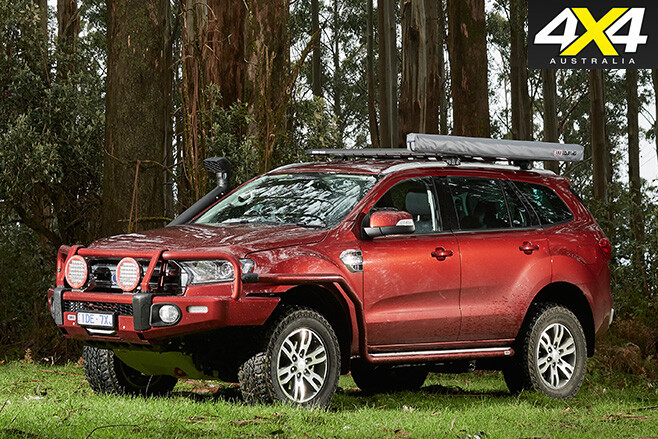
ARB certainly took up the challenge, and this vehicle is loaded with products it offers for the Ford. As the Everest shares many components with the Ford Ranger ute, ARB already had many products to suit, but some had to be re-engineered for the wagon, while others had to be specifically developed for it.
SUSPENSION & PROTECTION THE first upgrade most owners will make to any new 4×4 to improve its all-terrain performance is to replace the tyres, and the standard rubber on this Everest Trend was replaced with a set of Cooper ST Maxx on the factory 18-inch alloy wheels. The ST Maxx is an aggressive all-terrain-style tread pattern and is well-suited to a family 4×4 that sees double duty in both the bush and the ’burbs.
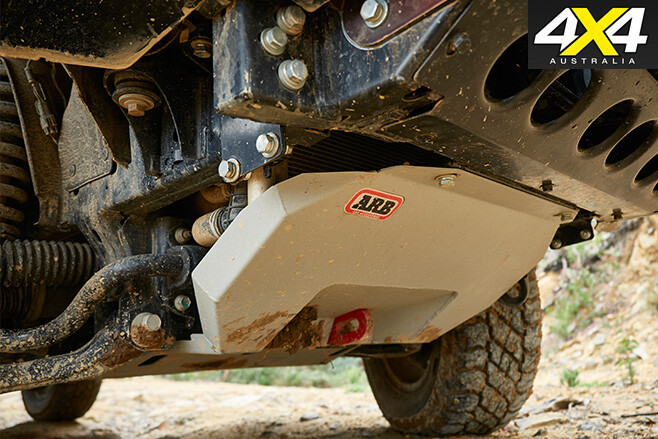
The tyres work with ARB’s Old Man Emu suspension package, which consists of raised coil springs that give a 40mm lift in ground clearance, along with matched OME Nitrocharger Sport shocks. While the increased ride height keeps the undercarriage a bit further away from the terrain, the underside also benefits from a replacement underbody protection plate made from 3mm zinc-coated steel.
Also protecting the Everest is an ARB Summit steel bullbar, brush bars and side steps, each colour-matched in Ford’s Sunset Red. As with all of ARB’s body protection bars, the Summit bar and side protection bars are airbag compliant and improve the safety of the vehicle without compromising any of the OE safety systems. This includes the front parking sensors, radar cruise control and emergency brake warning systems.
The bullbar provides the mounting point for a Warn Zeon winch and ARB Intensity LED lights. We have criticised Ford’s factory head lights and, specifically, the high beam as performing poorly on dark outback roads, so a quality LED light such as the Intensity is a must-have for any Everest owner. They make a significant improvement to night driving in the Ford.
Not everything added to this Everest comes from ARB, but it all can be bought through ARB stores. The air-intake snorkel, for example, comes from Safari 4×4, another great Australian aftermarket accessory company.
While the mechanical package on this car remains otherwise standard, we have seen the 3.2-litre diesel engine in the Everest woken up with an aftermarket intake, exhaust and tune package.The roof rack on the Everest comes from the Rhino Rack catalogue and is one of the Pioneer platform designs. These versatile racks can be customised to carry all manner of gear and/or sporting equipment, but here it just mounts an ARB Touring side awning to provide a roll-out shelter when camping. It could have been handy on our wet day out in the forest.
SLIPPIN’ & SLIDIN’ THE tracks outside Melbourne were wet and slippery on our day out with the Everest. Mud tyres might have been more appropriate for the conditions, and we were limited to the tracks we could cover.The spate of wet and windy weather had left many of the tracks deeply rutted and, despite the added ground clearance afforded by the suspension, the underbody protection proved its worth as it straddled the ruts. Likewise, the side steps got a workout getting over the many trees and branches down across the tracks.
We noticed the added height as soon as we got in to the cabin of the ARB car. It’s a bigger step up and you look down on the road more than you do from the standard wagon. Yet the Everest has a nice, large glasshouse giving the driver plenty of vision forward and around the vehicle, and you only just notice the top of the bullbar peeping above the bonnet line.
When driving on gravel roads the ARB suspension feels firmer than standard and offers more control of the vehicle with less fore and aft pitching under brakes. It’s not too stiff, but we did end up dropping the tyre pressure for more comfort and to better cope with the gloopy conditions. There was no way we would have driven some of those tracks on the OE road tyres!
With these mild modifications the Everest improves its all-road touring ability, but not at the cost of the attributes that we have awarded it for in the past. The engine is still that lopey, torquey five-cylinder diesel; the six-speed automatic is positive and sure shifting; the electric power steering is well calibrated at both low and road speeds; and the overall fit, feel and ability of the car is top-shelf. The additions make a good thing better and turn the Everest into a tourer you could happily take the family around Australia with.
TO celebrate all that was great about the 2016 SEMA Show, we’ve thrown together a quick video featuring the show’s best bits.
Sure, the show is done-and-dusted for another year – and we’re back to reality at 4X4 HQ – but we couldn’t resist reliving what was a wild, crazy and sensational week.
The enormity of the event is evidenced by the sheer number of aftermarket experts in attendance. Close to 2500 exhibiting companies, 60,000 international buyers and in excess of 150,000 people walked through the doors throughout the four-day event.
Plenty of Australians were showcasing their merchandise throughout the event, and there were plenty of Aussies among the crowds as well.
A drift arena (as seen in the video) kept the masses amused, and Trophy Trucks from the Baja 1000 lit up the arena at select times throughout the week.
The event culminated in a massive carpark party on the final night, where all of the wild, crazy and ridiculous rides converged. This was a highlight of our SEMA experience.
The 2017 SEMA Show will take place in Las Vegas from October 31 – don’t think about it, just get your flights booked now.
Read all about the 2016 SEMA Show in our January issue, out December 8.
THE release of a Jeep Wrangler ute in Australia was all but confirmed at the Los Angeles Motor Show recently when Mike Manley, Jeep’s global chief, revealed to motoring.com.au that, “there’s no question on right-hand drive for the pick-up”.
Specific dates were also revealed for the first time, with Manley saying: “Production of pick-up will be September 2018, so by the time that gets into international markets you’re probably looking at early [20]19.”
FCA Australia confirmed its interest in a ute variant of the next-gen Jeep Wrangler (expected to be called JL) back in April, 2016.
Zac Loo, FCA’s head of product strategy and marketing, said at the time: “We’re looking at extending that (Wrangler) line beyond just two- and four-door variants that we have today with the pick-up.”
By introducing a ute to its line-up, Jeep will hope to cash in on a booming segment in Australia.
October’s VFACTS report showed that sales of Light Commercial Vehicles (LCVs) and SUVs are soaring, with the Hilux and Ranger (4×4 and 4×2 variants) leading the overall sales charts.
In fact, October saw the combined sales of SUVs and LCVs account for 56.2 per cent of national vehicle sales. So now’s the time to enter the market!
As well as the double-cab ute, the JL Wrangler is also expected to continue with both two- and four-door variants (soft-tap and hardtop) and a choice of petrol and diesel powertrains.
The JL Wrangler will go into production at the Toledo, Ohio, plant.
Today’s popular 4×4 dual-cabs make big claims when it comes to tow ratings and payloads, but are they really up to serious yakka?
We test the 2016 Mitsubishi Triton to see how its GCM, GVM and Payload fare against other industry icons.
LOAD TEST The Triton was a new design in early 2015. Most notably it got a new-generation 2.4-litre engine, the smallest of our test vehicles with the exception of the Navara, which is only 2.3 litres but packs twin turbos for extra grunt.
The Triton is notably smaller and lighter than the Ranger and BT-50 in particular, but also smaller than the Colorado and the D-Max.
The Triton’s tub has four small and less useful tie-downs and, once loaded, the Triton’s rear sank some 105mm, which is not far shy of twice the droop observed in the utes least impacted by the same load. Trouble is, the Triton has a notably shorter wheelbase and most of the tub is behind the line of the rear axle.
The 800kg pallet plus driver, observer and tow bar bumped into the Triton’s legal payload. The base-spec model is okay but the top-spec Exceed falls 40kg short – so technically our observer should have had to get out and walk!
Heading up our hill with that 800kg in the tub the Triton felt nose-up, although the steering feel and general chassis stability remained okay even as the rear suspension bottomed out over the bigger bumps.
Worth noting is that the Triton is the only ute to offer full-time 4×4, via Mitsubishi’s Super Select system, which also has a 2WD mode. On dry roads this is no big deal, but in the wet or when towing heavy loads, full-time 4×4 brings significant drivability and safety advantages.
While the Triton’s chassis certainly reacted to the weight of the pallet, the 2.4-litre engine made a much better fist of things. It needed more revs than the other engines to do the job – maximum torque is at 2500rpm – but nevertheless it still did it well.
While it needs to rev, it’s happy doing it and remained quiet and refined. If there’s one way to make a smooth-running and quiet diesel, it’s to drop the capacity to minimise the inherent vibration of an inline four configuration. A big four will vibrate more than a little one, it’s as simple as that.
The engine does well despite having only five ratios to play with in a gearbox that now feels old in terms of shift quality. One positive here is that the Triton is the only ute with paddle shifters, which are more than handy for controlling descents, given the Triton doesn’t offer much engine braking.
TOW TEST I have to admit I wasn’t holding high hopes for the Triton’s performance. It’s specced for lighter towing, and the short wheelbase and long rear overhang has it pegged as not being the most worthy of towing contenders.
Well, I was most surprised. Our lighter 2800kg trailer didn’t have as much vertical impact on the Triton’s posterior as I thought. It knew it was there but it didn’t drag its bum on the ground.
The big star is the performance of the Triton’s 133kW 2.4-litre engine. The diminutive donk punched above its weight once it got some boost and rpm and its 430Nm came into play. Sure, it’s a revvy little unit and suffers from turbo lag off the line, but at peak torque between 2500 and 3000rpm it really steps up to the mark.
While the gearbox needs a nudge to do the right thing, this was made easy by the rather nifty paddle shifters on the steering column, making manual intervention just a fingertip away. Mitsubishi is to be commended for leaving those paddles fixed to the column, rather than spinning with the wheel. It ain’t no sports car and the fixed paddle position is much more practical on a 4×4 load hauler.
The smaller capacity means the engine doesn’t give much back pressure, so leaning on it to try and hold the Triton back on the downhill run while under load resulted in higher revs, rather than any real braking.
SPECS: MITSUBISHI TRITON* Engine 2.4 litre 4-cyl turbo-diesel Max Power/Torque 133kW/430Nm Gearbox five-speed automatic 4X4 System dual-range full-time (+2WD) Kerb Weight 1930kg to 1965kg GVM 2900kg Payload 935kg to 970kg Towing capacity 3100kg Towball download 310kg GCM 5885kg Fuel tank capacity 75L ADR fuel claim 7.6L/100km *4×4 dual-cab pick-up automatics only
MITSUBISHI TRITON PRICES* GLX $36,490 GLX+ $36,990 GLS $40,990 Exceed (auto) $47,790 *4×4 dual-cab pick-up manual only unless noted
MORE: Mitsubishi Triton Range Review MORE: Mitsubishi Triton Specs, Range & Price
IT WAS a little over a year ago when I wrote about driving a bog-standard 1991 Nissan GQ Patrol. The then-25-year-old wagon proved remarkably capable off-road and reasonably comfortable on it – even by today’s standards.
Sure, it proved woefully underpowered when confronted with steep inclines on the highway, but the engine’s modest 85kW and 264Nm were put to good use off the road thanks to the Patrol’s decent low-range gearing. With plenty of wheel travel, loads of ground clearance and a reasonably effective limited-slip rear diff, the stock GQ would’ve put many a modern 4WD to shame on rough off-road terrain.
By the time you read this column I’ll have been reacquainted with that same Patrol, but it’s no longer the standard, tired, old (338,000km) wagon it once was. In fact, it’s been patched up, modified and accessorised. Now it is ready to take on a two-week trip across the Simpson Desert, starting in Alice Springs and finishing up in Broken Hill.
I’m really looking forward to getting back into the Patrol, but I’ll be damn careful to make sure I’m not the first person to put a scratch on it; it’s been given a full re-spray and fitted with colour-matched front and rear bars, side rails, side steps and roof rack.
Under the bonnet the old TD42 4.2-litre diesel engine has been given a serious boost in power and torque thanks to the fitment of a Safari turbo system consisting a turbocharger, intercooler and exhaust. That should amount to 140kW and 430Nm or so – the sort of power and torque outputs that drivers of modern turbo-diesel engines are now accustomed to.
The inside of the Patrol has also been given a makeover, and a pair of Recaro seats will ensure it’s as comfortable to drive as any modern 4×4 wagon. Some of the safety and convenience features include a cargo barrier, drawer system, fridge slide and roof console, as well as a host of gauges to display boost, EGT and battery status.
To tackle the red dunes of the Simpson, the Patrol has been given a three-inch ride height increase thanks to an OME suspension system and 33×12.5in R15 Cooper STT Pro tyres on Track steel rims. Air lockers are fitted front and rear, plus there’s a Warn winch up front in case the Patrol has to recover any ‘modern’ vehicles it encounters along the way.
Other accessories fitted to the GQ include a Safari snorkel; a dual-battery set-up consisting of an ARB battery tray; Redarc BCDC battery charger and 55Ah Optima Yellow Top battery; Intensity LED driving lights; and a Kaymar rear bar with twin wheel carriers.
The Patrol won’t be the only old vehicle on this trip, which has been organised by ARB to celebrate its 40-plus years of operation. Called the ARB Off Road Icons, the other vehicles joining the GQ Patrol will be a Toyota FJ40 LandCruiser, a live-axle (LN106) Toyota Hilux, and a Land Rover Defender 300Tdi. All have been given similar makeovers to the Patrol. So, despite their age, they should have no problems traversing the iconic Simpson Desert’s red dunes.
What will the Off Road Icons trip prove? It will undoubtedly show that you don’t need to spend big on a brand new 4×4 to get out there and enjoy Australia’s most iconic off-road destinations. Just about all of the gear fitted to these 20-plus-year-old vehicles is still available, including bullbars, rear-step bars, roof racks, dual battery systems, turbo kits and more.
With the right trip preparation and quality equipment on your side, you should be able to tackle just about any off-road trip in any old 4×4, which is just as well because one day I want to do the Madigan Line in a Series IIA SWB Landy – with the roof down – wearing a wide-brimmed hat.
Any Land Rover mechanics keen to come along for the ride?
Today’s popular 4×4 dual-cabs make big claims when it comes to tow ratings and payloads, but are they really up to serious yakka?
We test the Nissan Navara to see how its GCM, GVM and Payload fare against other industry icons.
LOAD TEST The Navara NP300, another new arrival in 2015, and commonly known as the D23, has replaced both the (two generations old) D22 and the more recent D40 in Nissan’s ute line-up.
Interestingly, the NP300 will also provide the basis for up-coming utes from Renault and Mercedes-Benz.
The Nissan stands out for a couple of reasons. Firstly, all NP300 dual-cab pick-ups come with coil springs at the rear, and it’s also the only ute on test to have two turbos rather than one. The sophisticated bi-turbo arrangement features smaller and larger turbos arranged sequentially on a 2.3-litre engine of Renault origins.
You can get a Navara dual-cab 4×4 with leaf springs at the rear but only in the base-spec RX cab-chassis, which comes with a single-turbo version (120kW) of the same 2.3-litre engine.
The Navara has adjustable tie-downs on the sides of the tub but the hook eyes need to be bigger to be truly useful. With the 800kg pallet in the back the Navara’s rear dropped by 100mm – more than any other ute tested bar the Triton.
Also like the Mitsubishi, the 800kg pallet caused problems for the Navara’s legal payload when the extra weight of the driver, observer and tow bar was taken into account. The lighter ST is okay, but with the heavier ST-X you’re technically 40kg over payload.
Underway with the 800kg on board and heading up the winding hill, chassis-wise the Navara didn’t feel great. Over the bumps it bottomed out frequently and the sway from the rear was far more of an issue than with the leaf-sprung vehicles. All in all it didn’t feel happy.
The better news is the engine, which dismissed the 800kg and goes on with the job in admirable fashion. It’s a bit noisier under load than you’d expect of a modern European diesel, which is a reminder that it was really destined for commercial-vehicle applications.
The Navara is also unusual in this company for its seven-speed automatic, which does most things well and enhances what the punchy engine has to offer. No auto downshifts, however, on the descent, which meant resorting to the selector’s tip-shift function during our test, given engine braking from this small diesel isn’t great.
TOW TEST The coil-sprung multi-link rear end was the subject of much speculation before we even got to the tow test, and our worst fears were confirmed: the Navara’s rear plummeted when we hooked up the 3500kg trailer.
Now for the good news: the bi-turbo 2.3-litre engine at the other end is a mill that does a lot with what it’s got. Sequential turbocharging kept the combustibles flowing at a decent rate, extracting plenty of power from the relatively small capacity and bestowing the Navara with the grunt to have a decent go. With seven speeds there was a lot of gear changing, but the auto still helped to get the most out of the engine.
As with most of the others, the gearbox needed to be manually shifted to stop running away on downhills, especially given the lack of engine braking from the smaller unit.
The chassis is another thing altogether. I don’t say this lightly, but this ute should not be rated to tow 3500kg. Under load the NP300 bump-steered like no other vehicle in this test. The nose pointed skywards and the rear end squirmed more than a politician during a travel-expense audit. I wouldn’t want to head to the local Bunnings like this.
The Navara’s hitch had a ball downforce rating of 300kg, less than the 10 per cent of load usually used as a yardstick for a towed 3500kg. Luckily, using a forklift and pallet as a counterweight meant we were able to move it around the get downforce and weight distribution to optimum levels. It would be hard to find a more balanced load to put behind a vehicle than the one we used!
Given the performance of the coils it would be interesting to test the leaf-sprung RX dual-cab cab-chassis, even if it does have a less powerful 2.3-litre single-turbo engine, to see if the leaves restore control. It’s also worth mentioning that the NP300 doesn’t feature trailer-sway control.
SPECS: NISSAN NAVARA NP300* Engine 2.3-litre 4-cyl bi-turbo diesel Max Power/Torque 140kW/450Nm Gearbox seven-speed automatic 4X4 System dual-range part-time Kerb Weight 1924kg to 1980kg GVM 2910kg Payload 930kg to 986kg Towing capacity 3500kg Towball download 300kg GCM 5910kg Fuel tank capacity 80L ADR fuel claim 7.0L/100km *4×4 bi-turbo dual-cab pick-up automatics only
NISSAN NAVARA NP300 PRICES* ST $45,990 ST-X $51,990 * 4×4 bi-turbo dual-cab pick-up manuals only
MCC 4×4 Accessories is no stranger to supplying Australia and the world with aftermarket bullbars, rear bars, roof racks, side steps and drawer systems.
Given they are no flash-in-the-pan mob, I gave them the nod for one of their rear bar wheel carriers – I’d even have a go at fitting it myself to save a few bucks.
The mighty Troopy already hangs its spare wheel off the rear barn door, but I wanted to relocate that heavy rim-and-tyre combo to a dedicated arm to help prevent door cracking. I also wanted the option of a second spare or a couple of jerry cans.
MCC provides rear bar options with just one spare wheel carrier, dual wheel carriers or, as I wanted, a spare wheel carrier plus a double jerry holder. Each bar includes four high-lift jacking points (one each side and two at the rear). Each bar also incorporates adjustable heads; easy-to-use latches to hold the arms closed and self-locking pins to keep them open; pre-drilled parking sensor holes with rubber caps; and neat, round LED parking, braking and reversing lights.
Each arm can handle up to a 35-inch tyre and is easily removed. And while some MCC models offer an inclusive towbar, my set-up utilises the standard Toyota towbar, so the new bar fits above it.
There is no way this stuff could get damaged in transit, given the pile of plastic and cardboard left over. I was a little put off by the bags of nuts, bolts, washers and brackets with no step-by-step instructions; rather, there was just one exploded diagram.
All welds seemed to be neat and tidy, powdercoating even, and all holes, slots and patterns first class. Then I spotted the bends in the carry arms. While I’m sure they will take the weight of a wheel and a couple of jerries, they looked as if they’d been bent over Arnie’s knee. Nonetheless, I removed the original rear bumper bar and door-mounted wheel carrier and tipped all those new nuts and bolts onto the shed floor.
Being a first-time fitter of a rear bar, let alone an MCC rear bar, the job was a lot slower than you’d expect. One problem was that the already fitted towbar brackets and larger diameter Taipan exhaust system prevented some MCC brackets fitting easily. That would be the same deal regardless of what brand of rear bar you’re using, but it’s worth noting by anyone contemplating doing this sort of stuff at home.
Another hurdle was the different plugs MCC provide for the in-built LED lights – they differ from standard Toyota offerings. I also needed extra wiring for the extra pair of MCC reversing lights. Taking the easy route, I had my local sparky rewire and provide waterproof connectors and load resistors to ensure the LED blinkers blink at the correct rate – a necessity given they place less load than traditional halogen bulbs.
I could have spent a month of Sundays manufacturing custom brackets to get around the aforementioned custom exhaust and towbar mounts, but I took the easy route and palmed the job to my local mechanic-cum-parts fitter.
As I loaded the dual arms onto the main bar, I greased the bearings, spun the castle nuts on, and locked it all into place via the final split pin. With the right spare wheel in place, the left-side dual jerry holder bolted to the arm, and all locking levers and weight-resting pads adjusted, I couldn’t help trying the high-lift jack points – just to be sure it all worked as planned.
The recessed round holes on the sides (instead of square) help the jack tongue slot in easily. My jack wouldn’t slot all the way through, but it went in far enough to do the job.
There is some movement in the right-side arm, so time and corrugations will tell how well it holds up under all that weight. But so far I’m stoked with the MCC bar.
RATED Available from: www.mcc4x4.com RRP: $1950 single wheel carrier and dual jerry holder; fitting $400. We say: Convenient, innovative.
ROOTHY’S out on Bribie Island, and to feed the troops from BCF he has whacked together a delicious chicken BLT wrap for lunch.
Check out Roothy’s other recipes here.
The key part of this meal is bacon – preferably rindless. Why rindless? Well, according to Roothy, “You don’t want to be chewing into bits of rind, not at this time of day anyway!”
You’ll also need avocado (or, in Roothy’s case, chilli, garlic and coriander avocado), lettuce, tomatoes, parmesan cheese and, of course, a wrap.
First, get the bacon nice and crispy before setting it aside. Then cut up a head of lettuce (don’t buy bags of lettuce, as you get more bang for your buck with an entire lettuce) and a few tomatoes.
Apply the avocado, the bacon, the lettuce and tomato into the wrap, and then sprinkle on the cheese.
It’s simple, healthy and filling. Healthy? “You can say bacon’s healthy, if you cut the rind off it,” Roothy added.
It’ll feed the troops and it’s super easy. Try it next time you’re out and about.
“This kind of stuff, it’s simple enough that the kids should be able to do it – honestly. And it tastes fantastic.”
Today’s popular 4×4 dual-cabs make big claims when it comes to tow ratings and payloads, but are they really up to serious yakka?
We test the Isuzu D-Max to see how its GCM, GVM and Payload fare against other industry icons.
LOAD TEST You may notice that the D-Max has a new tailgate, new alloys and a ‘shark fin’ antenna. There are changes inside as well, with a new instrument cluster and larger touchscreen on the mid-spec variants, but that’s the extent of the D-Max’s most recent (MY15.5) updates. Along with the BT-50, the D-Max is the oldest design in our test group, bearing in mind that the Hilux, Navara and Triton are all-new while the Ranger and the Colorado have been significantly revamped – including mechanical changes – in the past year.
As in its earlier incarnation, the D-Max’s tub has four decently sized tie-down hooks, and with the 800kg load secured the rear ride height dropped around 60mm, as good as the best of its test rivals. Our total payload of 970kg (including driver, etc.) is 40kg to 80kg shy of the max figures for the various D-Max dual-cab 4×4 pick-ups.
With the 800kg pallet in the tub and heading up the hill, Isuzu’s D-Max felt a little nose-up
but it didn’t bottom out on any of the bumps. While this did make the steering noticeably lighter, the chassis was generally composed, stable and confident.
Not so good is the D-Max’s 3.0-litre engine, which feels the weight in the tub more than any of the rest in the test. While the maximum power of 130kW is competitive with the less powerful engines, its 380Nm of max torque is well short of all the rest. This lower torque output translates to less power off idle and at low revs, something you definitely don’t want when hauling a big load up a steep hill.
The D-Max still got the job done, it just had to work harder at it than the others. It is, after all, a much older engine than those powering its rivals. The engine refinement is also nothing special in this company, although I’d still note that it isn’t bad.
The five-speed auto also does the engine few favours. Not only does it have fewer ratios than all but the Triton, there’s nothing flash about the way it shifts up or down on the hill. Like the engine, it’s an older design.
The flip side to all this is that the D-Max’s engine is a reliable, established design that has done more than a few laps. Likewise, the gearbox is well proven and comes from an Aisin gearbox family previously and widely used by Toyota in its Prado and LandCruiser models.
With the deadline for Euro 5 emission compliance looming, Isuzu will have to do something engine-wise for the D-Max for MY17, even if it’s just the addition of a diesel particulate filter. Perhaps the changes will run deeper than that and there will be more power and torque as well. Only time will tell.
TOW TEST The unassuming D-Max took our load reasonably well. Its bum sagged a little under the weight, but there’s a stoicism about the Isuzu that gives you the impression it will have a crack at just about anything.
However, in the current competitive climate the D-Max is seriously challenged by the performance and refinement onslaught of vehicles in this segment. The venerable 130kW/ 380Nm powerplant aims to please but in this company is left wanting. And, like the Navara, it also lacks trailer sway control.
The generational lag between the Isuzu and the rest of the flock is very apparent at max weight. On the uphill drags the D-Max roared, clambered and snorted while falling short of its rivals’ performances. The tacho hovered at 3000rpm in second gear – and there it stayed as the D-Max hauled itself up the hill.
The rear end also had a tough time.
There was a bit of bump steer out back, but the steering remained reasonably composed and the Isuzu was easily controlled on the up and the down. Again, the five-speed self-shifter may be tough but it’s not the most intuitive bit of gear.
On the upside, the engine did help to hold back our load on the downhill runs once there was some manual intervention with the ’box. You do get the impression, however, that the D-Max would take this sort of beating day in and day out without a hiccup.
SPECS: ISUZU D-MAX* Engine 3.0-litre 4-cyl turbo-diesel Max Power/Torque 130kW/380Nm Gearbox five-speed automatic 4X4 System dual-range part-time Tare Weight 1910kg to 1940kg GVM 2950kg Payload 1010kg to 1040kg Towing capacity 3500kg Towball download 350kg GCM 5950kg Fuel tank capacity 76L ADR fuel claim 8.1L/100km *4×4 dual-cab pick-up automatics only
ISUZU D-MAX PRICES* SX $42,800 LS-M $44,900 LS-U $46,100 LS-Terrain (auto) $53,000 *4×4 dual-cab pick-up manuals only, unless otherwise noted