They say timing is everything, and when you go to watch wildlife there is never a truer phrase spoken.
Earlier this year we were wandering the west coast of South Australia, savouring the idyllic camping, the great beaches, and the spectacular cliffs and headlands. It’s an area we’ve been lucky enough to have explored since we were young blokes, searching for a wave or a rocky reef to spearfish.
This latest trip saw us head to Port Lincoln for a planned shark cage-dive with Calypso Star Charters – no previous diving or snorkeling experience was required. The weather was clear and calm as we headed out of the marina on the Calypso Star, with the sun rising as we cruised past Cape Donington then turned south, passing the historic Memory Cove. We then slipped by Thistle Island into the more open waters of the Southern Ocean for the final leg to the Neptune Islands.
The Neptunes are a known great white haunt; the sharks are attracted to these remote rocks because of a large New Zealand fur seal colony and a smaller Australian sea lion colony that sees around 5000 pups born each year.
These islands and the surrounding waters are protected in the Neptune Islands Group Marine Park, and it’s the only place in Australia where you can cage-dive to experience a close and safe encounter with a great white.
The success of the venture is entirely up to the wildlife itself, and sometimes they don’t make an appearance. Such was the case when we went out. I was in the first group to enter the cage and, while the water was pretty clear and there were a heap of fish swarming around, no shark made an appearance. That became the norm for the day. A good-sized mako shark came and thrilled the group, as well as a smaller bronze whaler, but that was all. No great white!
We were unlucky, being in the middle of a fortnight-long lull in sightings. Rather surprisingly, Calypso Star lets people know when prolonged intervals go without a great white encounter and they give you the opportunity to postpone your dive. If you do go out and don’t see a white pointer, then you get a good discount on another trip – that’s just about as good a deal as you’ll get anywhere when it comes to the vagaries of wildlife watching.
While the great whites are around the Neptune Islands all year ’round, there are peak times for seeing these sharks. The best months are around seal pupping time, late in the year (October to January), so if you want to see a great white in its natural habitat then book your trip for these months quickly. Having a look at the comprehensive records Calypso Star keeps, over those months they see white pointers on nearly every outing with a success rate of well over 90 per cent.
We’ll be going back when the chances of seeing one of these predators is almost guaranteed. Maybe we’ll see you in Port Lincoln over the next few months.
THERE’S a new player in the heavy-duty off-road cab-chassis market, yet it’s one of the oldest 4×4 vehicles around.
Mercedes-Benz has finally seen fit to offer its ‘Professional W461’ models from the G-Class range here. The first in the range is this cab-chassis truck, while a five-door wagon will come in the second quarter of 2017.
The Professional part of the G-Pro range is that these vehicles are civilian versions of military vehicles used by the ADF. The Professional is built on the same W461 platform as the mil-spec trucks and differs from the W460 G350 and G63AMG models in that they lack any form of luxury equipment and feature heavier duty chassis and componentry. These are purpose-built workhorses with none of the plush attributes you might expect behind the three-pointed star.
The G-Wagen has been made in Austria for 37 years and, despite many upgrades in that time, it hasn’t changed all that much. It is still the rugged body-on-frame truck that it has always been, with unrivalled off-road ability.
The G has been offered in Australia a number of times over the last three decades with limited success, but it was most recently reintroduced back in 2011 with the two luxury W460 models. This was on the back of the contract with the ADF to replace its ageing fleet of Land Rovers with W461 G-Wagens. The G-Professional has never been made freely available to the public in Australia, although a number of government departments have purchased them for specific fleet use.
We first drove a G-Professional cab-chassis on the Canning Stock Route five years ago and there was talk of making it available in Australia then. However, the introduction was held up while MB Australia pushed the head office to have electronic stability control fitted in order to get five-star safety rating – an essential box to tick if you want to tender for government fleets.
What we’ve finally ended up with is a truck with an impressive set of figures. The G-Pro has a 4490kg GVM, giving it a 2085kg payload – that’s nearly twice that of a Toyota LC79 single cab that has a 1235kg payload. More significant is the G’s long wheelbase of 3428mm (LC79 Single Cab: 3180mm) which puts the rear axle way back under the chassis and the load area, reducing the amount of load that would hang behind the axle. The W461 could be the perfect platform on which to mount a camper for off-road expeditions.
The drivetrain starts with a detuned version of Benz’s venerable 3.0-litre V6 diesel engine. In this trim it makes just 135kW at 3800rpm and 400Nm at 1600 from 2600rpm, a far cry from the 600Nm it makes in other Mercedes-Benz vehicles. It is tuned this way so that it can cope with the poor quality fuel found in many countries.
G-spotters might also notice the extra bump in the bonnet of 461s as opposed to 460s. This is to clear an air pump that is part of the emissions gear on these detuned engines.
Behind the V6 is a five-speed auto and full-time 4WD with the G’s signature triple diff locks. Each lock can be activated individually and the vehicle can be driven in low range with the centre diff unlocked.
All locked up and with an approach angle of 38°, departure angle of 35°, a ramp-over angle of 22° and 245mm of ground clearance, the G should be unstoppable.
Not all the numbers are great, though. The towing capacity is just 2210kg for a 6700kg GCM, and here’s the killer: the price is $119,900 plus a tray and on-road costs. Before you go and dismiss the G-Pro on cost alone, consider the equipment it has over and above a $65K LC79 Single Cab, including the auto transmission, standard diff locks, much higher payload and more usable long wheelbase.
Also not so good is the cabin equipment. It’s a bare-bones workhorse with wind-up windows, a basic aftermarket-style audio unit that has only been fitted to meet the Bluetooth requirements of many fleet vehicle buyers, and no carpet or sound deadening.
We’ll have a full road test of the G –Professional cab-chassis next week.
SPECS: MERCEDES-BENZ G300 CDI CAB CHASSIS Engine: 3.0-litre V6 turbo-diesel Maximum power: 135kW @ 3800rpm Maximum torque: 400Nm @ 1600-2600rpm Gearbox: five-speed automatic 4×4 system: dual-range full-time Crawl ratio: 41.0:1 Tyre spec: 265/75R16 Kerb weight: 2410kg GVM: 4490kg GCM: 6700kg Payload: 2080kg Towing capacity: 2210kg Fuel tank capacity: 97 litres ADR fuel claim: NA
EVERYONE loves pancakes, don’t they? They’re the perfect way to kick-start a morning! They can also double-up as a dessert treat for the entire family.
Prefer a healthier start to the day? Then check out these recipes.
Right, you don’t have to be a master chef to put this dessert dish together, as it’s one of the easiest meals you’ll ever make.
All you need is oil, pancake mix, bacon, a few bananas and maple syrup.
Simply fry up the bacon on a pan until it’s nice and crispy. Remove the bacon, but leave a layer of fat to sizzle away before applying the pancake mixture.
Slice up some banana and apply it to the top of the pancake mix before carefully flipping it over.
“You want to get this right otherwise you end up with mush in the pan. It still tastes good, but it’s mushy,” Roothy says in the video.
Once both sides are cooked through, add a rasher of crispy bacon on top and smother with maple syrup.
“The best part is when you get a little bit of banana, a little bit of pancake and a little bit of bacon with some maple syrup all at the same time in one mouthful,” Roothy adds. “It’s to die for, it’s fantastic!”
This is the perfect breakfast treat, plus it’ll keep the kids quiet for a few minutes!
ISUZU UTE Australia has recalled 12 of its 15.5MY Isuzu MU-X due to an incorrectly fitted fuel tank band.
*Article updated 2/12/16. Please note, all 12 owners affected by Isuzu MU-X recall have been contacted by Isuzu Ute Australia.
The recall issued today states that “the fuel band fixing bolts may not be tightened to the correct torque specification.”
The risk is that the bolts may gradually loosen during the day-to-day operation of the vehicle, which could cause the fuel tank to detach and drop down. This could result in fuel spillage.
Isuzu Ute Australia has contacted all 12 owners of affected MU-Xs. Owners of affected MU-X vehicles have been recommended to contact their nearest Isuzu Ute dealer for inspection and tightening of the fuel tank band fixing bolts.
In further recall news, Nissan today joined the growing list of recalls for malfunctioning airbags.
Recall notices were issued for particular Nissan D22 Navaras (JN1CPUD22A0030007 to JN1CPUD22A0033519) and Y61 Patrols (JN1***Y61A0001716 to JN1***Y61A0681762) due to the risk of passenger airbag inflators allowing moisture to enter the airbag inflator.
The recall claims this could cause the propellant in the inflator units to deteriorate, which may lead to “abnormal passenger airbag deployment or metal fragment scatter.”
This obviously poses a serious safety hazard to the vehicle’s occupants.
Owners of affected vehicles will be notified by Nissan Australia as soon as parts become available. Free reparation will take place at Nissan dealerships.
BORN in 1975 in a suburban Melbourne backyard, ARB celebrated its 40th year of operations in 2015.
So it was last year that the company started hatching plans for its Off Road Icons project: get a bunch of old-school four-wheel drives together, fix them up, kit them out and send them across the Simpson Desert.
The idea was a beauty. Not only would it be a great way to mark the company’s four decades in business, but it would also prove you don’t need a shiny new vehicle to tackle such an iconic trip, and that even if you own a vehicle up to 40 years old, ARB can still supply accessories to suit it. In fact, just about all of the gear fitted to these four vehicles is still available through ARB stores around the country.
The four Off Road Icons were sourced from different states. The lads at ARB HQ in Kilsyth, Victoria, were charged with finding a suitable Toyota FJ40 LandCruiser; ARB in Western Australia found a 300Tdi Land Rover Defender; ARB Queensland picked up a Toyota LN106 Hilux (the last of the live-axle models); and ARB NSW headed to Orange where it had located a well-used but very standard Nissan GQ Patrol.
Of course, with some of the Icon’s odos showing well in excess of 300,000km, the vehicles would need some serious mechanical attention if they were to successfully cross the largest sand desert in the world. That is what they got, with one of them receiving a complete engine transplant prior to departure.
Driving the Icons across the Simpson Desert would be a motley crew of 4×4 journos from all corners of the globe. From the US there would be Chris Collard, 4X4 Australia’s US Correspondent and Editor of US magazine Overland Journal; Fred Williams from Petersen’s Four Wheeler Network; and Wes Siler from respected adventure publication Outside.
From the UK would be South African Patrick Cruywagen, Deputy Editor of Land Rover Monthly, also writing for South African magazine Leisure Wheels. From China would be publisher Wang Qing (pronounced von-ching) from FB Life. And from Australia would be Sam Purcell from digital publication Unsealed 4X4, and yours truly from 4X4 Australia.
As well as the four Icons, the fleet would consist of several current model vehicles including a new Toyota Hilux driven by ARB Marketing Manager Sam Boden and ARB International Marketing expert Moea Theroux; a Toyota 79 Series LandCruiser ‘back-up truck’ driven by trip organiser Mark Lowry; a Mazda BT-50 ‘tucker truck’ driven by David Cox (previously of Mt Dare Hotel fame) and co-piloted by experienced bush-cook Vicky Lennox; and a Ford Ranger ‘photo car’ jammed full of camera and video gear driven by Offroad Images’ Michael Ellem and Adam Bennett.
Before the start of the trip, the four Off Road Icons were shipped from their respective home states and given a thorough check-over at Outback 4WD in Bayswater, Victoria. Several mechanical issues were detected and rectified prior to departure, including sourcing and installing a new 300Tdi engine in the Defender, which was performed by ARB’s resident Landy expert Stephen Lawn.
Once fully prepped and equipped with gear, the Icons were shipped to ARB Alice Springs, where they were stored until the landing of the trip participants. The ARB crew arrived first, having driven up from Melbourne over a few days, while Michael Ellem had driven across from Sydney with his wife Gabrielle. The journos had all flown in to Alice by Monday afternoon and, after heading into town to get some last-minute supplies and taking a short drive out to the Tropic of Capricorn monument for a happy snap, we all met up for an introductory dinner.
While some of the OS journos had travelled extensively in Australia before, we soon discovered that others had never landed on our shores before. We also found out Wang Qing’s mastery of the English language was, in fact, extremely limited. Nevertheless, after a feed, a few drinks and plenty of laughs, we soon knew we were all going to get along well, and we were all eager to get going.
1980 TOYOTA LANDCRUISER FJ40
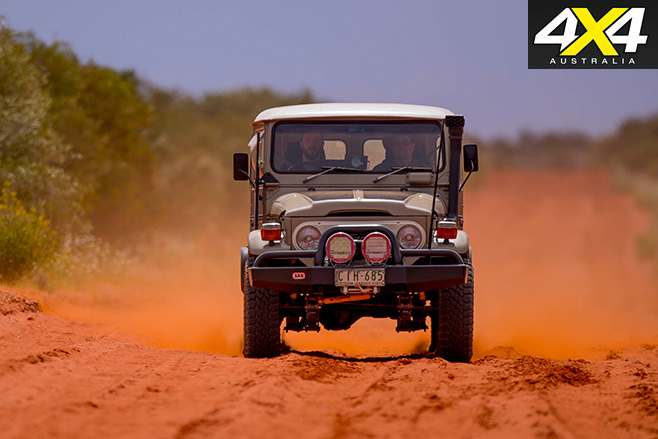
It should be noted that all of the accessories fitted to the FJ40 are available in-store. It’s been equipped with a full Old Man Emu suspension kit – four new leaves, shocks all ’round, bushes and U-bolts – which has lifted it up about 50mm. It also sports an ARB Deluxe bullbar, a Warn M8274-50 8000lb high-mount winch, a Safari snorkel, a set of AR32 Intensity LEDs, upgraded IPF Fatboy H4 headlight globes, and a new wiring loom.
Down the back, a Kaymar rear bar not only offers protection but also holds the spare-wheel carrier, double jerry can holder and work light, while underneath a Long Ranger 87-litre auxiliary fuel tank more than doubles the standard capacity of the LandCruiser. Just as well, as it was sucking down ULP at a rate of 25.9L/100km on the relatively easy drive from Alice Springs to Mt Dare.
The ARB team made the most of the 40’s small cabin, fitting a single Outback Solutions roller drawer and finding space for accessories including an ARB twin air compressor and air tank, power outlets for the fridge and some other electrical components including a Redarc BCDC battery charger, auxiliary battery and solar set-up.
A pair of Recaro seats provided a lot more comfort, and there’s a GME UHF radio, a glovebox-mounted sound system, a heap of Redarc gauges, a remote fridge monitor and an ARB reversing camera.
Finishing off the LandCruiser 40 Series is a set of black Dynamic steel rims wearing 265/75R16 Cooper S/T Maxx tyres.
1991 NISSAN PATROL GQ
THE ARB NSW team picked up the GQ Patrol in Orange, NSW. It had 338,000km on the clock, but despite that it was in surprisingly good mechanical condition, although the body had plenty of minor battle scars.
The ARB boys gave the Patrol a good tidy-up and full re-spray, and then the modifications began. It was fitted with a new set of ROH Black Track steel rims wearing 33×12.5R15 Cooper STT Pro tyres, and ARB air lockers were added front and rear. A full Old Man Emu suspension system consisting long-travel coil springs front and rear, complemented with matched Nitrocharger shock absorbers, gives a three-inch lift, a better ride and more traction than the GQ ever had as standard.
An adjustable Panhard rod and trailing arms ensure correct geometry, and an OME steering damper is fitted up front.
The engine has been boosted courtesy of a Safari turbo system with intercooler and three-inch exhaust. Of course, it breathes through a Safari snorkel and is fed from a Long Ranger 147-litre replacement fuel tank.
There’s an ARB bullbar with side rails and steps, and a Kaymar rear bar with twin wheel carriers. The bullbar sports a pair of ARB Intensity LED driving lights and a Warn winch, while a full-length alloy roof rack carries gear and holds an ARB awning.
Inside, comfort has been improved with a pair of Recaro seats, while a roof console houses a GME UHF radio and an ARB fridge monitor. A Milford cargo barrier keeps things in check, and there’s an Outback Solutions drawer system and fridge slide with a 60-litre ARB fridge.
Redarc boost, EGT and dual-battery gauges are mounted in the centre console, and powering all of the accessories is a dual-battery set-up consisting of an ARB battery tray, Redarc BCDC battery charger and a 55Ah Optima Yellow Top battery pack.
1994 TOYOTA HILUX LN106
DESPITE showing more than 300,000km on its odo, the Hilux sourced by the team at ARB Queensland for the Off Road Icons project was in good mechanical order; they found it just needed an oil change and service, and upgraded brake lines and hoses.
A Safari turbo kit was fitted, as well as a two-and-a-half inch straight-through exhaust; combined, these two modifications add 30 per cent more power and 40 per cent more torque.
The Hilux was also fitted with an ARB Deluxe winch bullbar up front, side rails, steps, and an ARB rear bar, all colour-coded to match the flares. The bullbar holds a pair of ARB Intensity AR21 spot/spread beam combination driving lights and is home to a 10,000lb Smittybilt Gen 2 X20 winch with wireless remote.
An Old Man Emu suspension upgrade gives enough lift to accommodate the 32×11.5R15 Cooper Discoverer STT Pro tyres, which are mounted to a set of great-looking 15x8in Bathurst Globe Alloy rims. Ensuring the Hilux has all the traction it’ll ever need are a pair of ARB air lockers, actuated by an ARB CKMA12 high output air compressor.
An Outback Solutions drawer system has been fitted in the tub with a 78-litre ARB fridge sitting on the fridge slide. Whatever doesn’t fit inside the vehicle goes up on a Rhino-Rack Pioneer Platform.
A pair of Recaro seats ensures occupants are supremely comfortable, while a GME TX3350 UHF has been fitted under the dash for vehicle-to-vehicle communications.
The only item that was fitted to the Hilux that is no longer available from ARB is the high-roof canopy. The team bought one secondhand and refurbished it at ARB’s Brendale warehouse.
1995 LAND ROVER DISCOVERY 300TDI
WITH 250,000km on the odo, it was initially thought the Land Rover Defender’s 300Tdi 2.5-litre direct injection turbo-diesel donk was in relatively good shape, and that the only mechanical issues were a leaking gearbox seal and a few minor brake issues. But when the vehicle was shipped from Perth to Melbourne for a final check-over, it was discovered the engine was terminally ill.
ARB’s resident Landy expert Stephen Lawn was asked to source, rebuild and fit a new 300Tdi, which he achieved in record time – the list of repairs runs deep.
Prior to this last-minute fix, the Defender was given a major tidy-up, including new foot wells, some panel beating and new paint. It was then accessorised from the ARB warehouse. The Defender wears a Commercial Bar up front with a Warn XDC 9.5 winch running synthetic rope.
Extra lighting is courtesy a pair of IPF 900XL HID driving lights and upgraded IPF headlights. Tasked with carrying nine of the swags required on the trip is an ARB roof rack.
An OME suspension kit with long travel springs and matching shocks gives a lift of around 30mm, as well as greater load-carrying ability. An ARB air locker at the rear provides additional traction. Recaro seats add comfort, while other interior mods include a GME TX4500S UHF radio and Redarc gauges.
The Defender’s original Sunraysia rims were retained but fitted with LT235/85R16 Cooper Discoverer A/T3 tyres. While these were certainly the least aggressive of all the tyres fitted to the ARB Off Road Icons, they proved great performers in the desert and offered surprisingly good traction in muddy conditions.
Stay tuned for more of our ARB Off-Road Icons’ trip to the Simpson Desert.
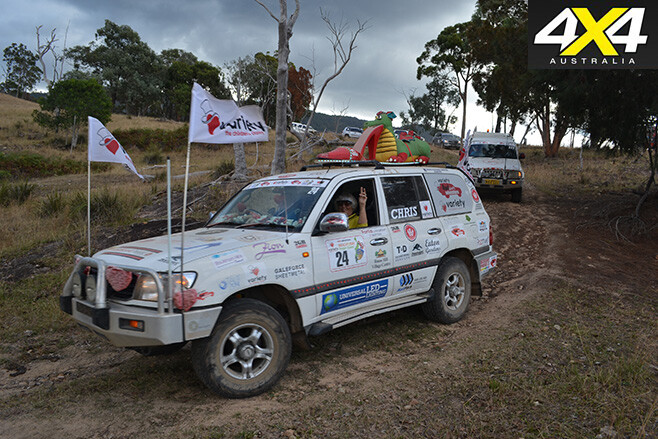
THE Variety 4WD Charity Adventure will head to Tasmania in 2017 to raise money for children who are sick, disadvantaged, or have special needs.
The adventure will open up dusty trails not normally assessable by the general public, and the group will tackle creek beds and craggy mountain tracks in their pursuit of perfect ocean views.
The 2017 adventure will depart from Port Melbourne, Victoria, on April 2 and travel to Devonport, Tasmania, via ferry. Once on land, the convoy will hit the dirt tracks and travel from Stanley to Smithton, Corinna, Strahan, Derwent Bridge, Strathgordon, Hobart, Fingal, Launceston and Port Sorell. The group will return to Port Melbourne from Devonport on April 8.
“The 2017 Variety 4WD Charity Adventure enables you to escape the nine-to-five routine with this premier, boutique event doing 4WDing and accommodation in style – all whilst helping kids who are sick, disadvantaged or have special needs,” said Stuart Telfer, Variety’s NSW Motoring Events Manager.
Accommodation and food is all part of the package – all participants have to do is show up.
“We take care of everything for you, all you need to do is turn the key and start your adventure,” Mr Telfer added.
To participate and put your money to a good cause, register for the 2017 Variety 4WD Charity Adventure.
OVER the past few issues of 4X4 Australia I’ve detailed some of the work that’s gone into fixing up Milo, following 20 or so years of travel on some of the worst tracks in the country.
It takes a particular kind of time frame and mindset to constantly repair an old truck. In recent years Milo copped what was needed to get back on the track, but it has rarely been more than patch-up jobs. Mechanically she kept going, but almost every other part started deteriorating quicker than prawns left in the sun.
I’d bought a half-way-decent ’83 Troopy with the intention of replacing Milo’s body, but after fish-plating almost every part of the chassis in the last decade I figured the chassis would need swapping out, too.
This raised the question: when is the original truck no longer original? While both Milo’s body and chassis have suffered severely the truck itself is essentially ‘the old girl’ I built a couple of decades ago and, after the last bout of repairs, I reckon she’s fine for road travel. Milo’s also safer than most of her generation thanks to upgraded brakes, steering and suspension, which is all as good as it gets.
What bothers me is that I know what I’ve done to both body and chassis, from the point of view of repairs and taking it over too many tracks. Watching the body split all the way from firewall to floorpan was an interesting experience, especially when you could see the road through the crack. That was metal fatigue, so even after reinforcing it with a strip of 1mm steel it’s just a matter of time before it splits again. Similarly there’s no more fresh steel around the door frames to reinforce; it’s all reinforcement already.
You’ve already seen how my lads and I repaired the crucial front panel by building a dummy one from angle iron. That’s working well, but it can’t make up for the twisting effect the last few years of belting around with a weakened panel did. Yep, that’s the ultimate cost of modification isn’t it? When the lads suggested bunging in an intercooler I knew there’d be a price to pay.
Parts of the chassis have been repaired over the decades, too, but by replacing both body and chassis it was starting to look like a new truck with the same name. And there’s a part of my heart devoted to old Milo. After all, we’ve shared the past 20 years and been to some incredible places. I’ve lived in the old girl for months at a time – you get connected!
So after grappling with my conscience, and following some thought-provoking beers, I realised the best bet would be to leave old Milo as she is and build a new truck for the harder tracks. Enter Milo 2; although, it’s debatable whether the name or the colour will remain the same. If you’ve got an opinion on that I’d love to hear it.
Right, having decided a ‘new’ truck was the answer, I had to get real about who’d be doing the work. I barely get enough time for running repairs these days, and the sheer effort required to get a project finished in the time frame meant a fair bit of outsourcing. But while some workshops can handle basic tuning and simple upgrades, it takes a special sort of shop to build a truck successfully from the ground up.
I started looking for the right skills and tools to do the job. Ideally it’d be part of a network of businesses that are used to working together, so I could get some rust-proofing, glass work and the myriad other things involved in a full rebuild done in the most time-effective manner possible.
Then there’s the technical and legal aspects involved in registering a modified vehicle, something only a handful of specialists understand. Plus it had to be a workshop I could trust to do the job required, while allowing me plenty of input along the way.
Not an easy combination until my mate Simon suggested having a yarn with the lads at Sunshine Coast Opposite Lock. Yes, they’re based in Caloundra, almost 100km from the Mudflats, but they ticked absolutely every box I had, and then some.
OL Sunny Coast is operated by the Flannigan family, and I knew old Ron’s pedigree on the spanners went back some 50 years since building up mechanical businesses in Victoria. His sons Nick and Andrew are both trained mechanics and total 4WD nuts, too. They build and drive Nissans, but I figured they deserved a taste of Toyota quality.
So Simon had a yarn with his mate Nick Ball who manages the shop. Nick’s another off-road nut with a lifetime of experience in the industry and, crucially, the expertise to source the right parts. I went up to take a look at the last competition truck Nick Flannigan built with help from his brother Andrew and the crew. A week later, the decision was made: Milo 2 went on their trailer and now I commute up the coast on a regular basis.
To get the old ’83 on the trailer we had to haul her up with the original Milo’s winch – it was very fitting. It was a tad embarrassing that Nick brought his Nissan down to tow the trailer, but I’m getting over that.
If you’ve ever wanted to build a truck from the ground up, I’ve got a few yarns you might enjoy.
While it was exciting for us to have a bunch of new – not just updated – cars to test in 2015, the Ford Everest was just too good, winning the 4×4 Of The Year title.
As the week wore on and we sat down around the campfire each night to reflect, it became obvious that the Everest was winning favour with our judges. All the comments about it were positive, but so too were many comments about the other cars on test.
Interestingly, the only updated car in the group, the Toyota Prado, was also hard to fault and no-one had a bad thing to say about it. In reality, there were no duds in the group and every one of them was in the running for the top award.
Regardless of how much judges might say they like a car, or not, during a week, that isn’t how the winner is determined. Each of the judges, seven of them this year, scored each of the vehicles according to five 4X4OTY criteria, to give each car a score out of 50. It’s black and white – if the judges are fair dinkum, what they like or don’t like shouldn’t come in to the equation. What works, and what doesn’t work, is what matters. When the judge’s scores are compiled, we add them up to find the winner.
The Everest scored 259 points out of a possible 350, the Prado was close behind with 250 points, and The Hilux scored 244 points in total. Five of our seven judges scored the Everest highest, while the Hilux and Prado topped one judge’s score each.
Even though we had a bumper crop of new 4x4s, it was disappointing to find that very few of them raised the bar – by introducing new technology to the segment or taking the lead away from established class favourites – in their selected category. None of the new utes have had full-time 4×4 or the latest electronic safety systems introduced to their ranges. In some cases these things are available in other markets, but the manufacturers have chosen not to give them to Australian drivers.
The tech and features in the Everest might not be all new, but the new model has brought these features down to a more affordable price point so that more Australian families can drive in safer, more capable 4×4 cars.
Ford has done a stellar job to refine the Ranger’s powertrain to suit the Everest and put it in a wagon body that stands up to the best in the class. The Everest has given buyers another alternative in the 4×4 wagon market and it’s one that is worthy of their consideration. It is a car that the engineers of Ford Australia can be proud of.
The contenders
To be in contention for the 4X4OTY title a four-wheel drive had to be all-new or have major upgrades, and 2015 bred a bumper crop of vehicles for us to consider. 4×4 one-tonne utes were the hottest property on the market, with all the big names being either replaced with new models or heavily revised. These included Australia’s best-selling 4×4, the Toyota Hilux, which was also the most anticipated new model release of the year. There was no question about the Hilux making our list of finalists.
Five of our six finalists were new models, with two of those bringing all-new nameplates to the 4×4 fold – the Ford Everest and Toyota Fortuna. This was refreshing after a period of decline in new ‘real’ 4x4s and, while they’re not proper 4x4s like 70 Series Cruisers, old-school Patrols, or Jeep Wranglers, anything with low range and half-decent ability is okay in this era. The Toyota Prado was the only ‘old’ vehicle here but joined the finalists thanks to the inclusion of a new engine and gearbox, and it proved it’s still a handy tool to have in the shed.
To be in contention for the 4X4OTY title a vehicle must be all-new or have major upgrades such as a new powertrain and/or improved technology.
The field was split 50:50 between utes and wagons this year. Toyota’s Hilux, Mitsubishi’s Triton and Nissan’s Navara were all-new models, while others in the 4×4 ute class, such as Mazda’s BT-50 and Ford’s Ranger, have had only minor updates and didn’t qualify for contention.
An interesting point about this year’s finalists is they all have decent price points; no big-dollar pavement pounders made the field this time and the top ticket price was just $62,000, for the Prado, placing all of these rides in the budget of most new 4×4 buyers.
The one significant new luxury 4×4 from 2015 was the Range Rover Hybrid and, while its manufacturer, Land Rover, claims the hybrid is off-road capable, the benefits of any hybrid powertrain are only felt in urban driving and not when touring or off road. Any of the pure diesel powertrains are still a better call for the off-roading Rangie buyer.
So, with the field of finalists set, we reigned in our panel of expert road testers and took off for a week of tough evaluation. As always, the vehicles were not judged against each other, but against the established 4X4OTY criteria. This is what allows us to test utes alongside wagons, and luxury 4x4s against affordable family rides.
The 4x4OTY criteria
VALUE FOR MONEY is judged according to a vehicle’s equipment level, safety features and price relative to its direct competitors. Just because a vehicle has a high price doesn’t mean it’s not good value – in the same way a cheap car isn’t always good value.
BREAKING NEW GROUND refers to advancements in technology and design –how a vehicle has raised the bar in its class to take 4x4s to a higher level is judged. If a vehicle has the latest safety features, worthy engine technology or an advanced driveline, it will score well here.
BUILT TOUGH refers to how strong a vehicle is and how well it will cope with the rigours of tough off-road driving environments. Will it be up to the task or fall apart at the first hurdle?
BUSHABILITY is how well a vehicle is equipped for off-road travel. Suitability of the standard tyres for rough roads, touring range, available accessories and underbody protection are just some of the factors considered here. Is this a vehicle you would chose to drive around Australia the rough way, or is it best left to the suburbs?
DOING THE JOB is judged according to a vehicle’s design brief. Does a luxury vehicle have all the latest in comfort and convenience features and do they work in the real world? How well a ute carries a load, or a seven seater accommodates a family will all come in to play here.
Our judges’ final scores
| u00a0 | Everest | Fortuna | Hilux | Navara | Prado | Triton |
| TOTAL | 259 | 227 | 244 | 212 | 250 | 227 |
MORE 4X4 OF THE YEAR
HOME: 4X4 OF THE YEAR 2016
On the shortlist for 4X4OTY 2016 were the Hilux, Triton, Fortuner, Prado, Navara and Everest.
THE FINALISTS
The six best 4×4 vehicles of 2015 battling it out to be crowned 4×4 Of The Year 2016.
THE RESULTS
Only one of the six best 4x4s from 2015 can be crowned 4×4 Of The Year 2016
4X4 OF THE YEAR HOME
Finding Australia’s Best 4x4s
Our annual 4×4 Of The Year awards have been run and won and the full feature is in the February issue of 4X4 Australia Magazine, on sale now!
John Rooth joined our regular team of experts on the 4x4OTY trip in 2016 and it was bit of learning curve for him to see how the award is judged.
Take a look at some of the behind the scenes action and stay tuned over the coming week as we look at the 4x4OTY finalists and the winning rig.
The results are in, click here to find out who won the 2016 4X4 Of The Year.
THE FINALISTS
The six best 4×4 vehicles of 2015 battling it out to be crowned 4×4 Of The Year 2016.
THE RESULTS
Only one of the six best 4x4s from 2015 can be crowned 4×4 Of The Year 2016
TOUGH DOG SUSPENSION
Tough Dog brought its new Hilux along to the party to show how much of an improvement you can expect with a quality aftermarket suspension kit.
THE CRITERIA
As always, the vehicles were not judged against each other, but against the established 4X4OTY criteria.
MEET THE JUDGES
With more than 245 years of four-wheel driving experience between them, our judges rate as some of the most experienced in Australia.
TESTING TRACKS
The 4X4OTY test route must challenge each vehicle’s individual capabilities.
HOME: 4X4 OF THE YEAR
Finding the best 4×4 in Australia
THE UTE you see here may at first glance look like any other new Hilux, but in fact it’s rare enough to one day become a collector’s item.
Why? Because it’s powered by a petrol engine, and petrol engines are almost non-existent among today’s crop of popular 4×4 one-tonne utes. Only Toyota offers a petrol engine in this class, and even then just one per cent of new Hilux 4x4s sold have the petrol engine: a 4.0-litre V6. The rest are powered by either the 2.4- or the 2.8-litre diesels.
All of which begs the question: Is a petrol engine that bad an idea when it comes to powering a 4×4 dual cab these days, that it’s now nearly extinct due to the surge in popularity of turbo-diesels? It wasn’t always this way. Just 10 years ago Toyota, Holden, Ford, Nissan, Mitsubishi and Mazda all offered petrol-powered 4×4 dual-cabs.
Truth be told I can’t exactly remember the last petrol dual-cab 4×4 I drove before I jumped into this Toyota Hilux V6, but first impressions were that this deserves better than just one per cent of Hilux sales.
Jumping in the V6 was a revelation after driving seven popular diesel dual-cabs for last month’s ute load and tow test. Extremely quiet, refined and smooth, it was almost like something from another planet. Flexible power delivery, too, and with a good amount of stick provided you put your boot in. With a maximum of 175kW on tap it has one-third more power than the Hilux’s 2.8-litre diesel.
The 4.0-litre V6 in question is a detuned version of the 207kW V6 in the Prado 150. One of the notable differences is that the 207kW engine has variable valve timing on both inlet and exhaust cams, while the 175kW engine only has variable inlet-valve timing – this alone doesn’t account for the difference in power output, though.
The Hilux’s V6 is mated to the new six-speed automatic transmission that backs the 2.8-litre diesel and it’s the only gearbox option. Both fifth and sixth gears in the six-speed auto are overdrive gears, and very tall ones at that. Surprisingly the V6 also carries the same final-drive gearing as the diesel, which is unusual given the V6 has far less torque than the diesel at low and middle engine speeds, needs nearly 2000 more rpm to make its maximum power, and has a much higher redline.
The tall final-drive gearing takes the edge off the acceleration, as you’d expect. Tellingly, moving the shifter across to the ‘Sport’ side of the ’box at highway speeds drops the box from sixth straight to fourth – it doesn’t even bother with fifth.
So for performance driving you effectively have a four-speed auto, leaving fifth and sixth only for light-throttle cruising. It also means there’s a lot of shuffling between fourth, fifth and sixth at legal highway speeds on undulating, give-and-take roads.
The tall gearing no doubt attempts to address the elephant in the room, namely fuel consumption. The official ADR figures tell the story at least in terms of relativity with the diesel. According to the widely quoted ‘combined-cycle’ figure, the V6 uses 41 per cent more fuel than the 2.8-litre diesel auto. In the ‘urban cycle’ (town driving) the V6 does even worse, using 50 per cent more fuel than the diesel.
However, things improve with the ‘extra-urban cycle’ (country driving) where the V6 only uses 30 per cent more fuel. Our real-world test saw the V6 average 13.6L/100km in conditions that would see the 2.8-litre diesel (auto) average around 10.5L/100km, which is around a 30 per cent difference.
This heavier consumption means that at $1.30 per litre for both diesel and petrol, the V6 driver would be forking out around $4.00 more for every 100km travelled than the diesel driver. However, how fuel costs actually pan out are dependent on the relative cost of petrol and diesel, which varies from metro to country within any one state, and from state to state as well. The V6 is also optimised for more expensive premium 95RON unleaded; although, it appears to run fine on regular 91RON unleaded.
Regardless of relative fuel costs, one thing you can’t avoid with the V6 compared to the diesel is filling up more often; although, the V6 is more pleasant to fill up. No hunting or queuing for the diesel pump and no smelly, slippery diesel to contend with, which is so often the case with poorly maintained servo forecourts.
For new-car buyers, Toyota’s ‘Service Advantage’ pricing means the petrol buyer doesn’t get a service-cost advantage over the diesel during the three-year warranty period. Beyond that, though, the petrol V6 should be cheaper and simpler to service than the most complex turbo-diesel.
At both SR and SR5 spec the V6 is the same price as an equivalent diesel auto, which is obviously no incentive to buy given the poorer fuel economy – it’s a pity Toyota hasn’t seen fit to discount the V6 over the diesel. A $4000 discount, for example, means you could drive somewhere around 100,000km in the V6 before you’d ‘spend’ the initial savings, if both petrol and diesel was around $1.30 per litre.
Alternately, Toyota could drop in the Prado’s 207kW V6 and lower the final-drive gearing to ramp up the fun factor. Then you wouldn’t be so concerned about fuel economy!
SPECS Engine: DOHC, 24v, petrol V6 Capacity: 4-litre (3956cc) Max Power: 175kW @ 5200rpm Max Torque: 376Nm @ 3800rpm Gearbox: six-speed auto 4×4 System: dual-range part-time Crawl Ratio: 36.1:1 Construction: separate chassis Front suspension: independent/coil springs Rear suspension: live axle/leaf springs Tyre/wheel spec: 265/60R18 110H Kerb weight: 2000kg GVM: 3000kg Payload: 1000kg Towing capacity: 3000kg Towball download: 300kg GCM: 5750kg Seating capacity: five Fuel tank capacity: 80 litres ADR fuel claim: 12.0L/100km Test av. fuel use: 13.6L/100km Price: $55,990 (plus ORC)