
Didn’t get what you wanted under the Christmas tree this year? Then take a look at these readers’ rigs to get some inspiration on how to treat your 4×4 to an upgrade.
Check out more Readers’ Rigs here.
Take a photo of your 4×4 the next time you’re overlanding, and then post it on our Facebook page. It may get published in the mag one day and, if we really like it, perhaps you’ll even see it on the cover of 4X4 Australia!
FORD EVEREST – CHRISTOPHER MARK
WHAT’S IT GOT: An ARB Summit bullbar, ARB brush rails and steps, Warn 9000lb winch, Ironman 4×4 Foam Cell Pro suspension, CSA Raptor 18×8 wheels, Cooper ST Max 285 65R18 tyres, TJM snorkel, Redarc brake controller, GME UHF 80ch remote head, aftermarket three-stage heated front seats, Roadsafe recovery points, Roadsafe bash plates, Rhino roof bars, Rhino rack, 4WD SC 9in LEDs, 4WD SC 900mm drawers (modified), Kings Awning 2.5×2.5m, Kings high lift and brackets, and a Projecta DC/DC charger with 100ah battery.
There are probably more I can’t think of! All of the mods were added before finding out about the MA vehicle classification (some by Ford). It’s a go-anywhere off-road Everest. Bush pinstripes to prove it’s been in the hard-to-get-to spots.
The picture was taken on our big desert/sunset country trip late in October, 2016. We were waiting for the others in our convoy on the Murrayville track. The Everest had 5km on the clock at the time. It’s only a new truck; it was delivered August 2, 2016.
MAZDA BT-50 – BRENT EASON
WHAT’S IT GOT: It’s pretty much got the ARB catalogue, with some extra poke done to the suspension, my Aussie ingenuity custom drawers, an LED light set-up in the canopy, a Rhino rack with all the kit, and 305/70 16 Mickey P3s. Still plenty of dollars to be spent, but it’s my ultra-tourer at the moment.
It’s been everywhere: up the Blue Mountains, Lithgow, McBrides Beach, Anna Bay, and Stockton for fishing and hiking trips.
2008 TOYOTA HILUX – JASON BUCKLEY
WHAT’S IT GOT: TJM-equipped bar, steps, brush bars and back bar; Rhino rack; Fyrlyt Nemesis 9000; Xray Vision light bar; DPChip; Redarc dual battery/solar; GME two-way; Mickey Thompson MTZs and MT wheels; Tough Dog springs and shocks all around; Hema HN7; and Pioneer sounds. Last trip was a three-month run from Moss Vale, NSW, to the tip (Weipa, OTT, Tip, Karumba), then on to King Ash Bay, Kakadu, through the centre and back home. Plus plenty of fishing/4WDing between June and August.
2014 MITSUBISHI CHALLENGER PC – ENRIQUE ENRIQUEZ
WHAT’S IT GOT: It’s pretty much standard under the bonnet (2.5L CRD Turbo), automatic, TJM winch, compatible steel bullbar, TJM snorkel, aftermarket 17in SSW alloy wheels, and Windforce AT tyres in LT265/70 17. It also has a Rhino roof rack pioneer platform; 4WD super select; 2H, 4H, 4HLC and 4LLC; stock centre diff lock; and stock rear diff lock. There are more mods to come. I am fairly new to the 4WD scene, and I love it. We have a little group here in SA. The best place I’ve been so far was when we went camping to Morgan, SA. I’ve had it since July this year.
TOYOTA PRADO – JOHN DUKE
WHAT’S IT GOT: James Baroud Grand Raid rooftop tent, front and rear diff locks, rear drawers, two-inch lift, and BFG all terrains. I’ve had it three and a half years and the best places I’ve taken it include the Canning Stock Route, Cape York, Lorella Springs, Simpson Desert and Binns Track.
TOYOTA LANDCRUISER – LUKE CONROY
WHAT IT’S GOT: Jmacx coil kit, 16×10 Allied Wheels, Cross Country Cooler, ECU mods, four-inch pipe to twin three-inch cruise twin batteries, Department of Interior roof and floor consoles, three Fyrlyt lights, and 12,000lb winch. It’s about six months old. It’s been to Beachport in the dunes, the High Country and most places in between.
The future of iconic British manufacturer Land Rover lies under the bonnet of this otherwise largely nondescript Discovery Sport.
It’s called an Ingenium engine; one of a family of diesel and petrol engines that will power Land Rover, Range Rover (and Jaguar cars) well into the future. For this you can thank the giant Indian industrial and technology conglomerate Tata, or more specifically its subsidiary Tata Motors, which acquired Land Rover and Jaguar in 2008.
Tata has poured billions of dollars into Land Rover. As well as upgrading existing manufacturing facilities, Tata has built an all-new factory in the UK Midlands specifically designed to produce the Ingenium engine. Only announced in 2011 but up and running by 2014, this new factory is currently being doubled in size and is a part of Tata’s A$5.6 billion spend on Land Rover infrastructure in the UK since 2010.
Tata also hasn’t held back in investing heavily in the design and development of the Ingenium engine itself. This is a spare-no-expense effort. Using a modular-design 500cc cylinder as a starting point, a number of different size and configuration engines – such as a two-litre four or a three-litre six – can be created. Petrol and diesel engines will also share some common architecture and parts where possible, thus cutting production costs even further.
Under the bonnet of this Discovery Sport is a two-litre four-cylinder turbo-diesel. It’s called the Td4 150, where 150 stands for 150 metric horsepower. In our money that’s 110kW, and it comes with 380Nm. The Discovery Sport also gets a 132kW/430Nm version of what is effectively the same engine but in a different state of tune. It’s called the Td4 180. The next generation (full-size) Discovery due here in 2017 will feature the 132kW/430Nm engine (in base-spec models) as well as a bi-turbo ‘SD4’ version of the same two-litre four-cylinder engine that claims 177kW/500Nm. The 177kW version will also be available in the Range Rover Sport from January 2017.
I wasn’t exactly sure which of the two optional diesel engines was tucked under the bonnet of Discovery Sport when I picked it up, as there aren’t any telltale badges. It turned out to be the 110kW/380Nm unit, but it could have been the 132kW/430Nm version as it performed so strongly. The Discovery Sport may not be heavy, but at 1900kg (seven-seat version, as tested) it’s not exactly light either, so a decent ask for a 110kW two-litre diesel even if it does have nine gears – courtesy of ZF – to help.
Most noticeably, this new Ingenium diesel engine is almost petrol-quiet and particularly smooth thanks in part to counter-rotating balance shafts usually only found in bigger (and inherently more vibration-prone) four-cylinder engines. Fours of this size (and even bigger) usually do without balance shafts.
For a single-turbo design the Ingenium is also remarkably flexible, being both strong off the bottom end and zippy up top, revving cleanly to 4000rpm and beyond. It’s strong enough to successfully carry its super tall (75km/h/1000rpm) top gear, wafting along below 1500rpm at expressway speeds – at least on the flat. However, any sort of open-road incline will see the gearbox shift back to eighth or seventh, which are still very tall gears. And unless you watch the tachometer you would probably not notice that the gearbox has even back-shifted, such is its seamless nature.
As well as its high-pressure (1800 bar) injection and a low-inertia variable-geometry turbo, the Ingenium engine follows modern design trends with a mild (for a diesel) 15.5:1 compression ratio for reduced diesel knock and lower NOx emissions, which is crucial in meeting ever-tightening regulations.
On that count the Ingenium comes with the latest ‘clean-diesel’ tech – a particulate filter and Selective Catalytic Reduction (AdBlue) – so that it can meet upcoming Euro 6 standards. The Ingenium diesel has variable exhaust valve timing (not for extra performance) as part of its emissions hardware. The Ingenium design also uses low friction internals and has a number of electronic controls to cut parasitic power losses involved in driving the coolant and oil pumps.
In the Discovery Sport this engine claims just 5.3L/100km in the official fuel-use test, a very frugal figure by any measure. In our on-road test it used 8.1L/100km; still very good without being as good as you may expect.
The engine tested here is in the mildest state of tune of the three four-cylinder Ingenium diesels, but it’s still in a relatively high state of tune compared to other latest-design diesels such as Toyota’s new 2.8. A 2.8 built to the same tune as this Td4 150 would, for example, make 154kW/532Nm. A 2.8 with the same tune as the more powerful Td4 180 would make 185kW/602Nm, which would be more than handy in a Hilux, and that’s all with a single turbocharger.
The bi-turbo Ingenium diesel has even more potential. Given the four-cylinder SD4 makes 177kW and 500Nm, a three-litre six-cylinder variant would make 265kW and 750Nm, if indeed a bi-turbo six comes along. Current indications are the diesel sixes will be single turbo, but that still means 200kW/650Nm or thereabouts, which sounds more than useful even in a heavy 4×4.
Aside from its smooth, quiet and flexible Ingenium engine, this Discovery Sport does what all Discovery Sports do: it combines polished handling with a supple ride, even on rough roads. It’s handy enough for mild off-road use, even if it’s in a completely different, and lesser, league than its big brother – the Discovery – when it comes to getting dirty.
MSA 4×4 Accessories is a Gold Coast-based outfitter of four-wheel drives, forever chasing fresh approaches to packing and storage solutions in recreational getaway and work vehicles.
The business was kickstarted in Perth about 15 years ago, making canvas seat covers. Nowadays MSA has a swag of gear, from stubbie holders to rubbish bags that fit over spare wheels on rear doors.
The company still designs, makes and wholesales canvas seat covers, but now there are also drop-slide fridge carriers, cargo barriers, drawers and generator bags among some 50 MSA products sold by more than 450 stockists across the country.
MSA has a dedicated factory in China, with the gear all designed in Australia; some research and development is done in Perth, some on the Gold Coast.
With a fleet of 4WDs – including a worked-over Ford Everest – in the shed, all of MSA’s new products are given a pasting on long expeditions for real-world testing and refinement.
The bulk of designs come from within the MSA crew captained by director Shane Miles, a well-travelled 4WDer who’s always on the look-out for new ideas.
MSA 4×4 specialise in crafting storage solutions for 4WDs. A taste of the company’s offerings include an explorer aluminium storage drawer system (RRP $2549), canvas seat covers with cotton lining and integrated lumbar supports, front and rear (RRP $933), seat organisers (RRP $108 each) and a tourer pack (RRP $438).
For a complete list of the storage expert’s catalogue, head to www.msa4x4.com.au
HOLDEN’S new Trailblazer was co-developed alongside the significantly updated 2017 Colorado ute, and it shares much of the extensive list of new hardware involved in the ute’s down-to the-last-nut-and-bolt rebirth.
The Holden Trailblazer is effectively a wagon version of the Colorado ute, made possible by little more than swapping the body – separate-chassis construction and changing the rear suspension and brakes.
Like the Colorado 7 it replaces, the Trailblazer is only offered as a seven-seat with automatic transmission (in two spec levels) and competes in a now-well-populated class of ute-based wagons that includes the Ford Everest, Toyota Fortuner, Isuzu MU-X and Mitsubishi Pajero Sport.
POWERTRAIN AND PERFORMANCE DESPITE all the changes the Trailblazer’s 2.8-litre diesel from Italian diesel specialist VM Motori claims no more power and torque than before, but at 147kW and 500Nm it was class-leading anyway, and pedal-to-the-metal delivers on that promise.
What these unchanged figures don’t show is how much smoother and quieter this engine is than before. Thanks to deep-seated changes the previously harsh, noisy and generally unpleasant engine has been changed to a smooth, sweet and relatively quiet ride.
The 2.8 still needs more revs than some competitor engines to give its best, but it does this without fuss and with plenty of reward. At the same time the off-idle and low-rpm driveability has also been improved thanks to revised fuel mapping and other revisions of the fuel-delivery system.
Changes to the GM-sourced six-speed automatic are also most welcome. This gearbox was never bad, but it’s now arguably the best in this wagon-made-from-ute class with smooth, pro-active shifts and nicely tuned shift protocols (where the ’box isn’t always looking to shift up into the tallest gear possible, as so many do – annoyingly – presumably for fuel economy).
One performance figure that has changed in this remake is the official ADR combined-cycle fuel figure, which has dropped from 9.2 to 8.2L/100km. Aside from the new fuel mapping and changes to the automatic transmission, the adoption of electric power steering is also behind this improvement.
On the road these savings play out with a relatively thrifty test average of 9.9L/100km. Anything below 11.0L/100km is good with this class of vehicle.
WHAT’S NEW THE Trailblazer is effectively a Colorado 7 stripped down and put back together again with a large number of new and revised parts.
The key changes include repositioned engine balance shafts; revised fuel injection with additional injector sound proofing; a new torque convertor and other changes for the six-speed automatic; new engine and transmission mounts; new body mounts; new suspension dampers; and electric power steering. Body changes run to new roof mouldings, exterior mirror mounts, door seals, sliding glass channels, B-pillar inserts and a thicker windscreen.
HANDLING AND RIDE THE adoption of electric power steering in place of hydraulic power steering is also one of two key changes to the chassis. As well as saving on fuel (as there’s no power-robbing hydraulic pump to drive) it allows a much broader tuning of the steering weight and effort.
What you notice first up is how little steering effort is required when manoeuvring the Trailblazer at parking and low speeds, which is welcome given the size and weight. Once underway, the steering weight increases to provide good feel and feedback at open-road speeds.
Unlike the Colorado ute, the Trailblazer doesn’t get new springs and swaybars (the front suspension of the ute is actually now closer to the wagon’s tune) but it does get new ‘digressive’ (falling rate) dampers in place of the previously installed linear-rate dampers.
The end result is a wagon that rides, steers and handles very well on most roads. It still doesn’t like really sharp bumps hit at speed – where the suspension can tend to crash – and the live rear axle can make its presence felt on rough roads at higher speeds.
Still, the Trailblazer feels good even on lumpy and bumpy back roads. It’s also quieter in terms of road noise compared to the Colorado 7, and this brings a new level of running refinement.
OFF-ROAD THE electric power steering also works to the Trailblazer’s advantage off-road, especially in tight situations with a much lighter steering effort than the Colorado 7. There’s slightly less lock-to-lock turns needed as well.
In transition from Colorado 7 to Trailblazer, Holden has also tweaked the electronic traction control, but otherwise it’s very much business as usual off-road. What the Trailblazer does off-road is much like what the Colorado 7 did.
The Trailblazer has the same part-time 4×4 system as the Colorado 7 (and Colorado ute for that matter) and unlike the majority of its competitors there’s no rear locker. Not that a locker is the holy grail in this equation, given the lockers in competitor vehicles – bar the Everest – deactivate the traction control on both axles when engaged, so they don’t necessarily always provide an off-road advantage.
Little has changed in terms of its off-road arsenal, so the Trailblazer is good without being great. It’s more than handy for most recreational 4×4 use, but it’s unable to deliver on that last five or 10 per cent when things get particularly difficult.
It’s certainly no Everest or Fortuner off-road, and it needs more suspension travel to be at the top of the class – or a rear locker that keeps the traction active on the front axle. Notable positives include the gearbox’s intuitive and smooth shift protocols, and features such as the auto throttle ‘blip’ on downshifts to help smooth out the engagement of the lower gear.
CABIN, EQUIPMENT AND SAFETY THE Trailblazer has an airy, spacious and open-feel cabin that qualifies for a five-star ANCAP safety thanks in part to seven airbags – two front, two side and two curtain, as well a driver’s knee airbag that the Trailblazer has gained over the Colorado 7.
Despite only having tilt (and no reach) adjustment for the steering wheel, the Trailblazer still offers a comfortable driving position; although the front seats feel a little flat.
The second-row seat, which is good for two medium-sized adults and one child, has decent headroom, but the legroom isn’t great and the seating position has a ‘legs up’ feel. However, the third row is noticeably roomy and can even accommodate adults; although, when folded away the seats make for a high cargo floor, and when deployed the partition doesn’t leave much of a cargo area. No tie-down hooks on the cargo floor, either.
Both Trailblazer models gain Apple CarPlay and Android Auto over the Colorado 7, displayed via Holden MyLink on an eight-inch touchscreen in the LTZ version (as tested here) and a seven-inch screen in the lower-spec LT. The LTZ comes with leather upholstery, electric adjust for the driver’s seat, heated front seats, climate control, self-levelling projector headlights, DRLs, blind-spot monitoring and rear cross-traffic alert. The LTZ also sports 18-inch alloys rather than the LT’s 17s, while both models benefit from a reversing camera and rear parking sensors.
PRACTICALITIES THE Trailblazer ticks most boxes with regards to being a practical 4×4, thanks largely to being based on a robust ute platform. To start with there’s a practical wheel and tyre spec, and if you don’t like the 18s on the LTZ you can fit the OEM 17s from the LT. There’s also a full-size spare, front and rear recovery points, a handy 3000kg towing rating, and plenty of engine power to tow right up to that max.
Under the bonnet a large air filter breathes through from the inner guard, but there’s not much room for a second battery due in part to the standard large battery. Not so good for touring range is the small 76-litre fuel tank.
SUM UP THERE’S no doubt the Trailblazer is a far better vehicle than the Colorado 7, thanks to what has been a thorough from-the-ground-up revision. Most notably, it’s far more refined than before yet still delivers on performance, both of which combine to produce what is now an engaging on-road drive.
Where the Trailblazer needs to be improved is off-road. It does the job, but it’s no stand-out; although there’s not much that a little aftermarket enhancement wouldn’t fix.
After all that, it’s sharply priced and has more standard equipment than before.
SPECS Engine: DOHC 16-valve 4-cyl turbo-diesel Maximum power: 147kW @ 3600rpm Maximum torque: 500Nm @ 2000rpm Gearbox: six-speed automatic 4×4 system: dual-range part-time Crawl ratio: 36.4:1 Tyre spec: 265/60R18 110T Kerb weight: 2203kg GVM: 2820kg Payload: 617kg Towing capacity: 3000kg Fuel tank capacity: 76.0L Test fuel use: 9.9L/100km Touring range*: 717km Price: $52,490 (plus ORC) *Based on fuel tank capacity, test fuel use and a 50km ‘safety’ margin.
When Peter Barnes moved to Birdsville in the ’80s, the isolated outback town was a far cry from the 4×4 mecca it is today. Now, as he contemplates retirment, Barnes’y looks back over a life well lived in the bush.
This article about Peter Barnes was originally published in the April 2014 issue of 4×4 Australia.
As a young mechanic, Peter Barnes and his wife Bronwynne loaded up their HiLux, said goodbye to their hometown of Millicent in South Australia and ventured up the Birdsville Track to a job they planned to stay in only until they earned enough cash to move back home. Little did they know they were about to embark on a journey that would not come to a close until more than 30 years later.
They were heading into cattle country to work on a station owned by local pastoralist and Birdsville native, David Brook. David soon realised the value of the innovative mechanic and the young couple moved into town so Barnes’y (as he likes to spell his nickname) could work as a travelling mechanic servicing all of David’s stations.
Back then, Birdsville was a tiny dust-blown town on the edge of the largely unexplored Simpson Desert. It was only the very adventurous traveller who dared to attempt a desert crossing or a Birdsville Track trip, so it was rare that Peter had to fix a traveller’s vehicle or change a tyre by hand using just tyre levers and a hammer.
When he wasn’t working on station equipment, the curious Barnes’y would cruise into the desert in his Suzuki; lone trips that taught him the secrets of the Simpson, a place where people mysteriously disappeared in those days.
“I’d be the only one out there; the only one, perhaps, who had ever been in some of those places,” he said.
“I just loved driving around out there. I didn’t have a UHF or a sat phone — it was just me and the desert.”
It was from this era that the stories of Birdsville and the Simpson are the most remarkable. Barnes’y tells dramatic yet true stories of criminals on the run and cars inexplicably abandoned. He tells of coming across two foreign travellers close to death as they stumbled away from their broken-down car looking for water in the middle of summer.
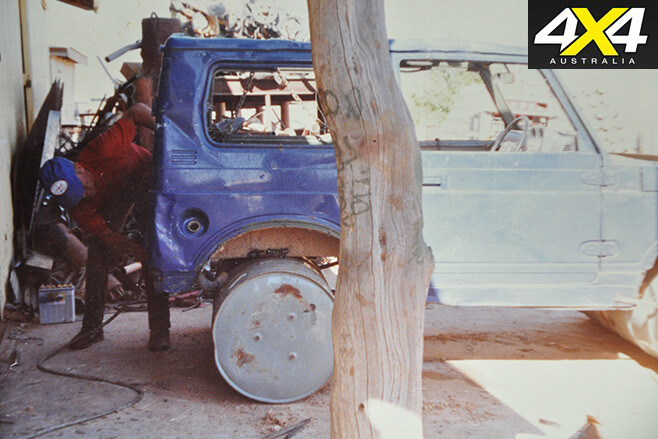
In 1989, before the Diamantina Bridge was built, floods cut Birdsville off from all road traffic, including the supply trucks. As a joke, and also as a last-ditch transport effort, Barnes’y built the ‘Birdsville Booze Bus’, a Suzuki floating on empty 44-gallon drums and powered by an outboard motor. In it, he carted many loads of precious XXXX cargo across the swollen river.
Around the same time, the Barnes family’s daily driver was a Valiant Charger, a true Australian muscle car. The photo of him jumping the Charger over the lip of ‘Big Red’ — a 40-metre-high sand dune — still hangs in the main bar of the Birdsville Hotel today. Barnes is one of few drivers to have been photographed in a two-wheel drive at the top of the dune, which some 4WDs still struggle to climb.
Bronwynne worked in the Birdsville general store. She generally served only station ringers and Birdsville locals, but learnt to overcome the challenges of running a retail business in the outback in the days before air-conditioning and refrigerated road trains became common. It was invaluable experience for what was to come.
By the end of the 1980s, 4WDs were becoming more affordable, capable and viable vehicle options for the average family. The availability of more 4WDs meant that more Australians were taking to the road to explore their country. Birdsville suddenly went from being ‘the back of beyond’ to a feasible holiday destination.
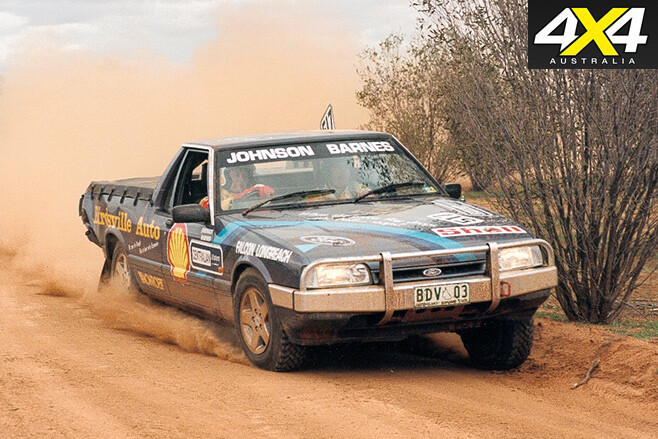
To cope with the influx of travellers, Peter, a passionate Suzuki fan, put an LJ80 on the roof of his shed to make him easier to find. He installed the first tyre-changing machine in Birdsville, which is still in use today, and travellers loved his brand of dry, outback humour.
T-shirts bearing the slogans “Barnes’y patched me bus up” and “We may be rough but at least we’re expensive” are still treasured souvenirs for many early recreational outback travellers.
Bronwynne’s tiny general store and Peter’s simple back-street shed were now too small to cope with the growing number of travellers. In 1991, Barnes’y took a year off to build what is now the Birdsville Roadhouse, a business that he and Bronwynne have built up over the past couple of decades to be Birdsville’s one-stop-shop for everything from mechanical repairs to groceries, souvenirs and camping equipment.
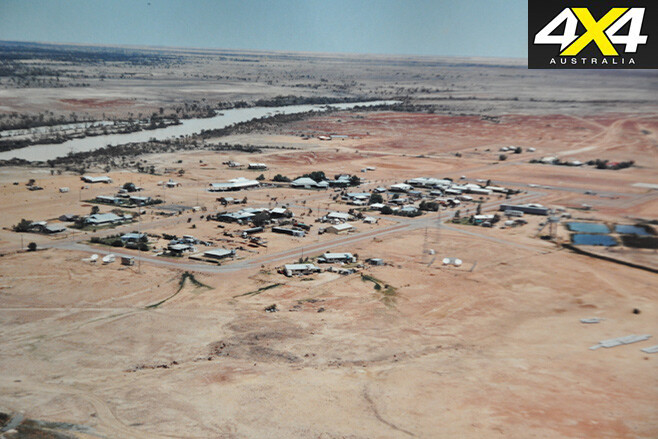
Barnes’y also raced in several Australian Safaris and became the face of Ford’s Courier ute, gracing Australian television screens with his trademark humour. The Ford connection also saw him partner one of Australia’s motorsport legends in a Falcon ute.
“Dick Johnson wanted to race off-road,” he said. “Ford called me up and asked if he could race in my ute, so I ended up navigating for him at Finke. That ute still races, too.”
In the early 1990s, Barnes’y met a group of young Germans travelling around Australia in a monster of a 4WD truck, one of only three in Australia at the time. He decided that he had to have one and sourced an ex-German Army MAN truck, converted it to right-hand drive and installed a motorhome on the back, painted by Birdsville artist Wolfgang John.
Taking a hiatus from the business, Peter, Bronwynne and son Sam, then aged 10, embarked on a round-Australia trip.
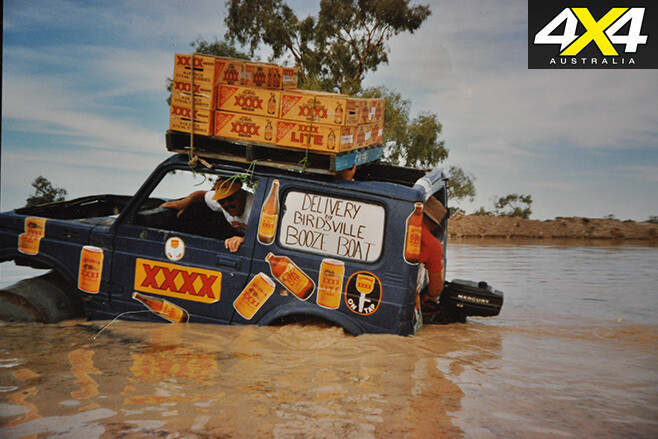
“When we crossed the desert, we went as far as Eyre Creek on the first day and camped there with some mates,” Barnes’y said. “We got a flat tyre at Eyre Creek and did the rest of the desert without a spare. We were pretty lucky we didn’t get stuck.”
A year and many kilometres later, they parked the motorhome in the Australian Transport Museum and moved to Papua New Guinea for a while before returning to manage another Brook-owned cattle station, Murnpeowie on the Strzelecki Track.
They have fond memories of their six years on ‘Mumpy’, including the construction of a 4WD buggy designed for mustering on rough terrain, and the time they carted a wild donkey home in the passenger seat.
They also recall their resurgence in offroad racing. Peter had dabbled in it since he was a teen and was keen to get his son involved.
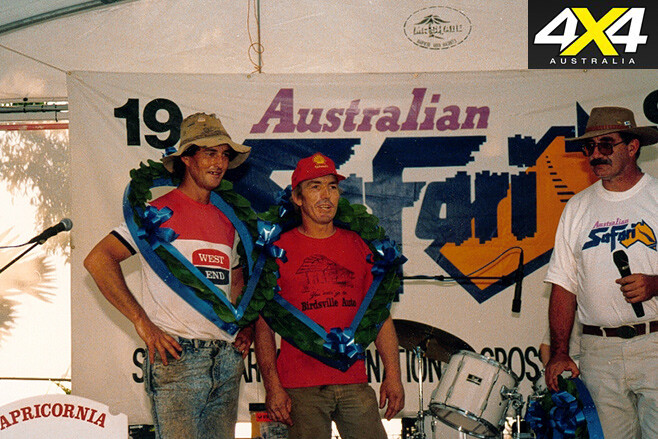
The Krakka Koldee Racing Team hit the offroad tracks in a 1300cc Suzuki-powered dune buggy, winning their class in the Finke Desert Race, the Australian Off Road Championship and the South Australian Championship.
These days, the Suzuki has been replaced by a 3.5-litre Nissan 350Z-powered Pro Lite buggy driven by Sam, but this year, 10 years after their buggy revival, Barnes’y is contemplating getting the old girl out for one last competitive spin.
After more travelling, Peter and Bronwynne were convinced to move back to Birdsville in 2008 to once again take the reins of the Roadhouse. The business has grown exponentially over the ensuing five years and the conversion of their treasured MAN to a tilt-tray truck has made Barnes’y an essential outback rescue service.
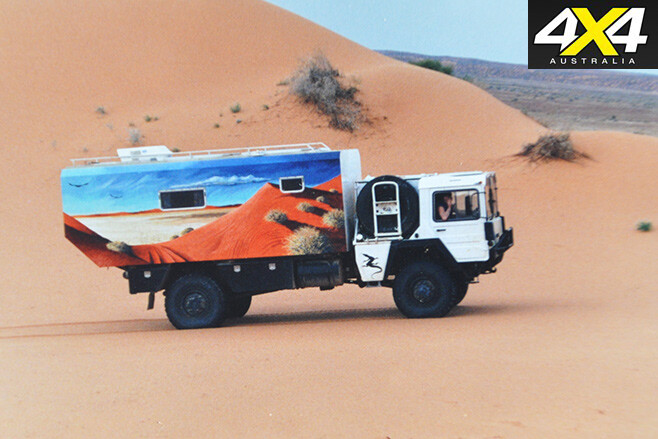
He’s rescued countless stranded travellers from the depths of the Simpson Desert and spent many sleepless nights rushing to the rescue of travellers in need.
“I rescued one bloke who was pretty grateful for a ride in the truck,” Barnes’y said. “He kept saying that he was glad he broke down because otherwise he never would’ve got a ride.”
The ‘monster’ truck has been a welcome sight for many travellers in trouble, whether it’s a quick, flawless rescue or a long nightmare.
“I had to go about 40 kilometres into the desert to bring out an F250,” he said. “It wouldn’t fit on the tray, so I had to tow it out of the desert over a heap of sand dunes with the truck — it was the only thing that could tow it. It took us nine hours to travel 40 kilometres.”
These days, as more families flock to the Simpson Desert in search of one of Australia’s last frontiers, Barnes’y provides a mantle of safety to those who attempt the sometimes dangerous desert crossing. Whether he’s called on or not, his very existence is reassurance enough.
Peter may be the one at the wheel of the MAN and under the broken 4WDs in the workshop, but Bronwynne, the kind and strong woman beside him, is an equally essential member of the famous outback team.
By its very nature, Birdsville is always evolving and changing, but without Bronwynne and Barnes’y, Birdsville would be a very different place. When they move on, many wonder if there’s anyone out there who could take their place.
“It’s a great job,” Pete said. “It’s led me on some great adventures, I’ve met some amazing people and every day is as good as the last. I’ve had the time of my life.”
The market is flooded with all sorts of gear for every aspect of a 4×4 build. That’s why we compare the market’s best: to make the decision easier for you.
Whether it be lights, recovery boards, fridges, storage or winches, we’ve tried and tested it.
Here are a handful of the most popular gear tests of 2016.
We lined up single- and double-row LED light bars on a dark outback road and tested how decent each light’s output was, as well as how much currant they drew. Great White, XRay Vision, Ironman 4×4, Dura Vision and Narva came along for the ride.
Strapping a set of recovery boards to your 4×4 is a no-brainer. You’ll never know when you’ll need them, and when you do they’ll prove invaluable. There are plenty of boards on the market, but can any get you out of strife as easily as a set of MaxTrax?
3: Product test: Runva 11XP Premium winch
We ran Runva’s 11XP 12V Premium winch through the gauntlet to see if it was as good as people said. The winch comes with a 15,000lb-rated snatch block, wired and wireless remotes, black powdercoated aluminium hawse fairlead, a rated bow shackle, shackle thimble attached to the rope’s end, and a neoprene winch body cover. It retails for $879.
4: 4×4 Vehicle loading and GVM explained
You’d be shocked at how many 4x4s we see out on the tracks that are loaded incorrectly, or are carrying too much weight. This article explains how to properly prepare your 4×4 – and distribute weight evenly – for remote-area travel.
Unichip’s Q4 tuning module alters – on the fly – the mapping of an engine to suit driving situations. It can hike performance, and bring power on more effectively and efficiently. Check out what happened when we fit one to a LandCruiser ute!
For 50 years the annual SEMA (Specialty Equipment Market Association) Show has brought the prime players in the automotive aftermarket industry together in Las Vegas, USA, to display their wares and talents to buyers from around the world.
Over that past half century the SEMA Show has grown in to one of the largest automotive gatherings anywhere in the world. Think of the biggest car show you know of in Australia and multiply it tenfold and you have some idea of the scope of the event. Just the 4×4 and off-road hall is as big as Australia’s largest indoor show.
SEMA attracts companies from every end of the auto spectrum; from off-road to sports cars, drifting to drag racing, LED lights to body shops, classic to customs, and street rods to monster trucks. If you can think of a trend in auto styling or performance then it will be represented at the SEMA Show.
With close to 2500 exhibiting companies, 60,000 international buyers in attendance, and in excess of 150,000 people treading the boards over the four-day event, this show is massive.
4×4 and off-road has always been a part of SEMA, but it has been the boom segment in recent years and it seems to get bigger every year in line with the market trend towards go-anywhere vehicles. Each year you will usually see a new and exciting 4×4 that the exhibitors flock to in order to display their products, but since its launch almost 10 years ago Jeep’s JK Wrangler has been the show truck of choice.
You see Jeeps of all models and in all states of modification at SEMA, from restored WWII classics to wild full-custom rock monsters and global expedition rigs. There isn’t a single part of a modern Jeep that hasn’t been reproduced, reinvented, improved upon, strengthened and made better by the aftermarket industry.
Other 4×4 vehicles popular in 2016 included the Toyota Tacoma and 2017 Ford Super Duty-Trucks, and they were scattered around the show on various booths and stands with all kinds of mods and styles. The pick-up trucks usually cop the pre-runner style of the Baja contenders.
Speaking of Baja, the 1000 had a display of its own out in the front carpark, with Trophy Trucks from all the big-name racers on display and smoking tyres in the drift arena at select times throughout the week. The gruelling 1000-mile off-road Baja race is held in Mexico just two weeks after the SEMA show.
Australia is well-represented at the SEMA Show, both in the booths and among the crowds. In fact, you couldn’t turn around in any of the halls without hearing that familiar Aussie accent. The big 4×4 accessories brands – ARB and TJM – had major displays, while the likes of Redarc and Lightforce were well represented.
Both ARB and TJM displayed lines of new product for the Toyota Tacoma on neatly set-up rigs, indicating the strength of those brands in the USA and the expected growth of the latest Toyota pick-up there. It was also nice to see images from the recent Off Road Icons trip (see page 120) on the ARB USA booth; the Americans on that trip were still raving about the epic adventure.
The SEMA Show is held during the first week of November each year at the Las Vegas Convention Centre, and the 2017 show starts on October 31. It’s an industry-only event with no public access until the final evening, when all the wild and whacky cars from the event cruise out of the convention centre and across the road to a massive carpark where there is mega car show with a party atmosphere. With live music, drifting and all the top vehicles on display, this night is a highlight of the show. Worth sticking around for, even when your feet are screaming at you to sit down and put them up.
With a booming aftermarket industry that’s full of new and exciting 4×4 products, 2016 saw a swag full of gear land on our desks for dissection.
Every 4X4 Australia issue was packed full of product tests, as well as gear comparisons, to ensure our readers had the necessary knowledge when buying gear for their rigs.
Here are the five most-popular product tests and gear comparisons of 2016.
1: Product test: FYRLYT 9000 Nemesis
Mark Allen rigged up a set of FYRLYT’s 900 Nemesis halogens to his Cruiser’s bullbar and set off into the night. With each light packing a 250W globe, can this old tech keep up with modern HIDs and LEDs?
2: Dual battery systems explained
Any serious remote-area traveller knows the importance of utilising a dual battery system. One battery to run the car; one battery to run things when set-up at camp. GT explains how and where to install a second battery, and how to maintain and efficiently utilise two batteries.
3: Round LED driving lights comparison
We collated the best LED round driving lights and pit them up against each other to see which light worked best. ARB, Big Red, Great White, Lightforce, XRAY Vision and Power Vision coughed up a range of round LEDs, ranging in price from $279 to $810. Which light shines brightest?
4: 12-volt air compressor comparison
When Mark Allen compares products, he compares them thoroughly, leaving no stone unturned. For this 12-volt air compressor comparison he gathered 15 units and tested six important aspects: maximum pressure, air-flow rate, duty cycle, portability, accessories and, of course, price.
5: Eight-way fridge comparison
We compared eight of the most-popular units on the market and put them through a stringent five-day testing process to see which one was the best fridge to take on your next camping adventure.
2016 was a breakout year for the Light Commercial Vehicle.
More and more people shifted their savings into big lumps of metal capable of exploring remote tracks, and we’re glad they did.
This meant some big things happened on the news front in 2016, and we’ve compiled five more news stories that caused a stir during the year.
We can only imagine how big 2017 is going to be for the 4×4 community! Stay tuned.
1: 2017 Tacoma TRD Pro shoots to thrill
We took a look inside and beneath the 2017 Toyota Tacoma TRD Pro following its revelation at the Chicago Auto Show in February. We checked out its droolworthy TRD-tuned suspension with Fox 2.5 internal bypass shocks and TRD-tuned front springs, and also the one-inch lift and corresponding rear leaf spring update!
Volkswagen rolled out a matte-orange V8-powered Amarok at the 2016 Geneva Auto Show, and it almost sent the web into meltdown. The ‘Desert Passion’ Amarok’s stonking V8 pumps out a wild 302kW and 930Nm!
The Y61 GU Patrol’s replacement, the Y62, was selling like hotcakes back in April, 2016. Nissan Australia CEO, Richard Emery, said at the time: “By being honest with ourselves and our dealers with where that car was and what it was capable of, we repositioned and respecified that car, and really priced and specced it at what the market expectation was,” said Emery of the current model. “And surprise, surprise, people started buying it in droves.”
Earlier this year, Vee dub executives confirmed an Amarok-based three-row wagon is in planning for development. They claimed plans for a wagon built on the ute’s ladder chassis had been initiated back in 2011. What a tantalising wagon segment it will be if and when it lands down under.
5: LandCruiser 70 Series receives updates ahead of Q4 launch
Before the updated LC70 Series launched, we outlined the significant safety and performance upgrades the venerable Cruiser will receive. It’s since arrived, and it’s one helluva machine!
The 2017 Drive 4 Life 4WD tour will tackle the Victorian High Country, and 4X4 Australia has once again jumped on board as a major sponsor.
Drive 4 Life is an annual 4WD event that raises money for the Northcott foundation (formerly known as the NSW Society for Crippled Children). To date, Drive 4 Life has raised $745,000 for Northcott.
Northcott, which has helped communities for more than 80 years, provides support and services to people with disabilities, as well as their families and carers. In particular, funds raised by Drive 4 Life go to Northcott’s Equipment Loan Pool, which provides people in need with wheelchairs and other mobility equipment.
To raise money, vehicles participating in the 2017 Drive 4 Life tour are required to donate $1000 to Northcott.
The 2017 Drive 4 Life event will kick off at 3.30pm on March 19 in Harrietville, Victoria. The tour will end with a dinner at the Snowline Hotel in Harrietville on March 24.
Throughout the five days of the tour, participants will cover 450-500km of off-road tracks within an area bounded by Licola in the south, Mt Buller in the west and the Great Alpine Road in the north.
Covering approximately six hours of driving per day, participants are required to have 4x4s up to the task of overcoming challenging terrain. Because of this, Drive 4 Life recommends all vehicles run all-terrain tyres and have high- and low-range.
Other essential items to bring include a five-watt UHF radio with an external aerial, first-aid kit, 20 litres of water, a snatch strap, D or bow shackles, recovery points front and rear, and a pre-trip full vehicle service or check-up.
Non-essential items include a cargo barrier, fire extinguisher, spare drive belts for fan/alternator/power steering/air-con, spare radiator hoses, tyre pressure gauge, 12-volt electric tyre pump, and a roof rack.
So what are you waiting for? Get involved in Drive 4 Life, have a great time, and help a great cause.