A twist on the Greek pastitsio.
INGREDIENTS
- 1 tbs oil
- 1 onion – chopped
- 2 or more tsp minced garlic
- 1-2 tsp minced chilli or paste (or use fresh, finely chopped chilli)
- 1 zucchini – grated
- 1 carrot – grated
- 500g beef mince
- 550g jar pasta sauce (with or without flavourings)
- 2 tsp sugar (can use more or less as it helps take the acidity out of the tomatoes)
- 375g spaghetti – break lengths in half
- 2 cups béchamel sauce (plain or cheesy) – see recipe below
- ½ cup grated Parmesan cheese and/or a mix of cheese
- 4 tbs butter
- 4 tbs plain flour
- 2 cups hot milk
- Salt and pepper (for seasoning)
- Heat the oil in a large pan and sauté the onion, garlic and chilli for a few minutes until softened.
- Add the zucchini and carrot and stir over a medium to high heat until softened.
- Remove and set aside.
- Add a little more oil to the pan, heat and add the mince and cook until browned. Make sure you break up the mince so you don’t have any lumps.
- Add the pasta sauce and sautéed vegetables and mix through.
- Bring to the boil, then reduce the heat to a simmer, cover and cook for about 20 to 30 minutes – the longer you cook it, the more the flavour will develop.
- While the sauce is cooking, cook the spaghetti in a large pan of boiling, salted water until al dente.
- Add the hot cooked spaghetti to the cooked mince sauce and mix well.
- Spoon into an ovenproof, or casserole, dish and gently press the mince mixture down.
- Spoon the béchamel sauce over the top and spread evenly over the mince then sprinkle with cheese.
- Bake in a moderate oven for about 30 minutes or until the top has browned and the ingredients are heated through.
- Melt the butter in a large saucepan and then add the flour.
- Mix well and cook over a very low heat for about 5 minutes – this helps get rid of any ‘floury’ taste in the sauce.
- Add the hot milk at once, and whisk well – adding the hot milk at once means you won’t get lumps.
- Cook over a moderate heat for 5 to 10 minutes until the sauce is thick. Whisk often and add more milk if it gets too thick. But, it does needs to be thick.
- You can add some dried basil, oregano or dried Italian herbs, along with fresh basil or oregano to the mince. You can also add chopped mushrooms and use as many vegetables as you like.
- Béchamel sauce: You can add ½ cup of grated cheese – Parmesan, or a mix of Parmesan, cheddar, mozzarella and provolone. As well as some ground nutmeg.
A RECALL has been issued for more than 1000 second-gen Mazda BT-50s (UP) sold between October 31, 2011 and December 3, 2012. This issue affects only automatic models.
According to the recall report, “there is a possibility that an intermittent Output Shaft Speed Sensor failure may result in an unintended downshift in first gear”.
The obvious safety concern is that this failure could cause abrupt wheel-speed reduction, which may lead to the rear tyres locking up and a loss in vehicle control.
To see if your BT-50 is one of the affected vehicles, check this link.
In September last year, a recall was also issued for Mazda’s BT-50 dual-cab ute (series number: UP0YF1 and UR0YF1) due to a dodgy return spring on the rear folding seatback latch.
This hazard increased the risk of serious injury, as the backseat may shift position during braking if it isn’t secured into position.
Mazda will send a letter in the mail to all owners of affected BT-50s, where they’ll be advised to take their utes to the nearest Mazda dealer for free reparation.
Whether this latest recall impacts the mechanically similar Ford Ranger is as yet unknown.
One of the most common failures on a live axle is the universal joints. Worn universals will often sound like a worn bearing, or you may feel clunking from the front end. The way to test them is to get under the vehicle and check if the uni joints have any play. If the do, then they should be replaced.
There are maintenance free universal joints and also ones that come with a grease fitting – it’s up to you which type to use. Replacing the uni joints is not a difficult job but you do need a large socket to undo the wheel nut and you’ll need access to a large vice to press in the new uni joint caps.
Removing the old uni joints can need a fair bit of hammer action (the ones on this vehicle pictured looked like they were the originals and felt as though they were welded in). When the caps come out, expect to have a lot of needle bearings flying out all over the place – luckily these are not reused so you won’t need to worry about finding them.
When fitting the new uni joints, it can be a bit awkward setting up the vice to press in the caps – otherwise it’s a simple process. Make sure to thoroughly clean the axle and apply a light coating of grease before carefully re-fitting the axle into the diff housing.
01. Loosen wheel nuts, then jack up vehicle and place on support stands. Remove the wheel.
02. Remove split pin and discard. Use a new split pin when reassembling.
03. Remove hub-securing nut. Put a screwdriver in the disc to lock the hub while loosening the nut.
04. Remove brake caliper and secure with wire or a cable tie. Don’t let it hang from the brake hose.
05. Remove the brake disc.
06. Remove the hub. In this case the wheel bearings are integral with the hub.
07. Carefully remove the axle from the differential housing.
08. Remove the four circlips from the universal joint.
09. Place the shaft on a vice and hit it close to the joint until the universal joint cap comes out.
10. Remove the cap , turn the joint over and hammer out the cap on the opposite side.
11. Separate the shafts.
12. Place shaft so exposed joint ends are resting on a vice. Hammer shaft so remaining caps are forced out.
13. The new universal joint and caps. Some come with a grease nipple like this one.
14. Take off the caps and squeeze the new joint into the axle.
15. Press caps into place with a vice. Use same method to fit other two caps. Fit four new clips on uni joint.
16. Grease the axle before carefully refitting it in the diff housing.
THIS 2013 Jeep JKU Wrangler Rubicon is owner Benn Collings’ weekend warrior.
It’s powered by a stock 3.6-litre Pentastar V6 that breathes through an AUS4WD custom stainless snorkel and an AIRAID MXP air box to generate extra power and improve fuel economy. The factory muffler was replaced by a Hi-Flo unit.
Benn replaced the Rubicon’s D35 front axle with a beefier D44 unit, and it’s fed by a high-angle Teraflex Rzeppa driveshaft. The unit features Poison Spyder diff covers to protect the Yukon 4.56 gears and factory lockers. The axle features EVO 44 Magnum diff sleeves and EVO knuckle and control arm brackets.
The Rubicon utilises a Fox steering damper, a Synergy high-steer flip kit and a Teraflex Panhard relocation bracket. It’s also got Synergy springs, Fox remote reservoir shocks and a Synergy adjustable lower trailing arms.
37in Mickey Thompson MTZ mud terrains wrapped around Mickey Thompson SideBiter II alloy wheels are on each corner.
Also helping when off-road is an ARB Stubby bullbar, Aurora LED light bars, and a Road Runner Offroad low-mount winch (an AUS4WD high-mount Warn will soon be taking its place).
High clearance ‘flat fenders’ from Double Black Offroad run down the Rubicon’s sides, and these are complemented by removable Ranuki Offroad Dirty Flaps and Uneek 4×4 rock sliders.
For complete coverage of this mean and green JKU Wrangler Rubicon – and to read the full list of mods – pick up a copy of 4X4 Australia’s March 2017 issue, in stores now. Also, watch the above video to witness the Jeep in off-road action.
AS I write this 40 people have been killed on our highways and byways over the Christmas-New Year break, with an unknown number seriously injured. If the past few years are anything to go by, many of those accidents would be caused by fatigue.
We should all be aware of how big a danger fatigue is on our roads, the telltale signs of the onset of fatigue, and what to do to circumvent any accident caused by fatigue.
Fatigue is one of the ‘big three’ killers on our roads and is right up there with speed and alcohol as a major cause of road accidents. Many people aren’t used to long-distance driving, and many jump into the 4WD after a long day at work and head off with the family to some remote beach, river, or desert oasis for a long weekend. This can be a recipe for a disaster.
Victorian figures show that fatigue is a major cause of road crashes, resulting in around 50 deaths and approximately 300 serious injuries every year. In Western Australia, where stunningly boring and long roads between towns is more the norm than the exception, the WA Road Safety Commission reckons fatigue could be responsible for up to 30 per cent of the fatalities on the state’s roads each year.
Elsewhere around Australia the figures are much the same, while the same national data on road accidents indicates there is a significant increase in fatigue-related crashes in holiday periods, such as over the Christmas and Easter breaks.
Fatigue can decrease your alertness, slow down reaction times, inhibit decision making, decrease tolerances to other road users, make you more prone to poor lane tracking, and make you unable to maintain a set speed.
Early danger signs of fatigue include missing a gear, road sign or exit, wandering thoughts, slowing unintentionally, and/or braking too late. If you’re driving and you’re yawning, blinking more than usual, having trouble keeping your head up, notice your eyes closing for a moment or going out of focus, or that you have forgotten driving the last few kilometres, then it’s time to stop and get off the road.
Being drowsy can quickly lead to a micro sleep which can last up to five seconds, and at 100km/h your vehicle is travelling at nearly 28 metres per second. Fatigue-related crashes are twice as likely to be fatal, as sleeping drivers don’t brake.
Over the years I’ve got to know the telltale signs when it comes to feeling tired. Just last week when coming back from the Vic High Country I was yawning and blinking, so I stopped, walked around the vehicle a few times, took a few deep breaths of mountain air and jumped back in and drove on.
An hour later I was doing the same thing, so I stopped again and had a wander around. However, only sleep cures fatigue, so I found a shady tree just down the road, rang Viv to let her know I’d be late and shut my eyes for a quick doze. Two hours later I woke, and the rest of the journey passed without a blink or a yawn.
With Easter just around the corner, make sure you and your family don’t end up as statistics of the road toll. Know your limitations, have a good night’s sleep before setting out, plan to swap drivers regularly, and take plenty of rests. Also, run your vehicle’s air system on fresh (not recirculate) to ensure plenty of clean, outside air is entering the vehicle.
Want more opinions from Footloose?
Check Ron’s bid to cut Australia’s regional road tolls
Ron’s reason’s to avoid camping during school holiday
IT’S OFTEN said that two is better than one, but I find that’s not always the case. For example, take 12-volt camping fridge/freezers. I’ve sampled a few dual-zone units and find most fail to achieve the desired result of creating two totally separate zones of different temperatures.
Some units simply incorporate their evaporator on one end of the fridge and have a (removable) inner wall to separate the zones. It then relies on the coldest air wafting from the zone you are trying to freeze to the other end that you’re attempting to use as just a fridge. Removing that wall then supposedly converts your fridge/freezer into a single-zone fridge or freezer. Sadly, it doesn’t always work as planned with this method, and I’ve been left with frozen food and drinks instead of nicely chilled.
Other units have two separate zones with two separate controls that allow individual temperature settings. Technically, this will work better than the above method but, sadly, some fridge controls don’t work as intended and I’ve ended up with frozen beer, limp lettuce and a car-load of unhappy campers.
Having recently tested many single-zone fridges (September, 2016) and finding the then newly released Opposite Lock fridge to be ahead of the rest, I figured I would put the (also recently released) 72-litre combination fridge/freezer to a long-term test.
Before setting off on yet another adventure, I connected the unit with 240 volts in the shed just to monitor temperatures in both zones. I set the 32-litre section to -21°C and the 40-litre section to 3°C and the results were positive. I then reversed the temperatures within the zones and achieved perfect results yet again. Fiddling with the temperatures in each zone to see how clever the Opposite Lock electronics were also returned pleasing results.
Plonking the fridge box into the Troopy revealed how large it is. At 71.5cm long x 45.5cm wide x 60.5cm tall, and weighing 30kg when empty, you won’t be carting it around by yourself when full. And therein lays my only gripe with this dual-zoned fridge/freezer: the higher a box is, the harder it is to easily access the contents. Something will almost always be under something else, making it harder to access compared to a longer and lower unit which allows more side-by-side packing.
The internal removable basket is similarly tall and narrow, but it can at least allow the contents of the larger zone to be lifted out for easier access. The other (smaller) zone has no basket. It’s impossible to have a large fridge without either taking up a lot of floor space or incorporating tall walls. Basically, you have to have one or the other. The final decision may well depend on your 4×4 set-up. With my Troopy, I have plenty of in-cabin height, so it’s not a drama.
Having been chugging away on 12 volts in the back of my 4×4 for well on five months now, this Opposite Lock 72-litre fridge/freezer has performed impeccably with regards to maintaining pre-set temperatures as well as efficiency. It has run the battery flat a few times given it’s sat in the driveway for more than a few days at a time – yes, I know I should have turned it off, but with the variable voltage cut-out settings of 10.0, 10.7 and 11.8, not too much damage can be done to the deep-cycle battery given it will switch itself off at the pre-set voltage.
A useful feature I find invaluable is the standard wireless remote temperature readout that plugs into a ciggie socket. With readouts for both the compartments, as well as battery voltage, I know the fridge is working as intended while driving. The ciggie power plug easily converts to a merit-style by removing the red end-cap, and this provides an improved connection point that is less likely to fall out over rougher roads.
The included canvas (outer) and reflective (inner) travel cover keeps direct sunlight (and heat) off the fridge, so it can help with battery longevity via less compressor run-times.
Being able to offer the kids icy poles and ice cream while out camping, as well as keeping frozen meat and veggies in the freezer section, is pure camping indulgence and something I’ve not been able to achieve before. In combination with having crispy, cold lettuce, icy cold (non-frozen) beer and milk in the other zone, the fridge has kept all of my family members more than happy.
Given both sides (or zones) of this unit can be used as either a fridge or freezer, or the whole thing used as a dedicated fridge or as dedicated freezer, makes this a versatile and user-friendly combination fridge/freezer.
This impressive dual-zone fridge is a real winner, and given its quality 60mm-thick, polyurethane-injected and insulated cabinet, variable-speed 66-watt Snowmaster compressor with auto and economy settings, excellent fridge seals, internal LED lights (in both of the zones) and over-centre lockable latches on the two separate lids, it should keep my whole crew happy – that’s the theory at least.
It also has an open-lid alarm, which should prove invaluable when the kids try to nick another icy pole.
RATED
Available from: www.oppositelock.com.au RRP: $1549 We say: Reliable, brilliant and a must-have.
A trip to the Flinders and Gammon Ranges ticks all the boxes when it comes to spectacular scenery and challenging terrain.
This must-see part of Australia can be divided into three distinct regions; the Southern Flinders Ranges, the Central Flinders (i.e. Flinders Ranges National Park) and the Northern Flinders, which leads into the equally adventurous and spectacular Gammon Ranges. Each destination offers a diverse range of four-wheel drive tracks with famous red mountains, towering gum trees, rugged landscapes and an abundance of indigenous wildlife littering the horizon.
Heading north from the southern cities, your first interesting stop will be Wilpena Pound. This natural amphitheatre is located in a huge crater surrounded by mountains. Luxurious accommodation is available at Wilpena Pound Resort, as well as a modern information centre, campsites and fuel.
Upon leaving the Pound, you’ll begin to notice the spectacular colours this landscape is famous for. Rugged bright cliff faces, stunning red landscapes, yellow and orange ochre clay pigments bedded into the earth, ancient gorges and extensive plains all under a blanket of blue skies which stay that way most of the year.
This landscape has dramatically changed over the years. Hundreds of millions of years ago, the dusty track from Wilpena Pound to Blinman and then to Arkaroola, was once an inland sea. Now, the land has formed the mountain ranges that can be seen today. You need to be entirely self-sufficient in this area, so bring plenty of water, food and firewood – you’re not allowed to collect wood from within the parks.
The quality of the 4WD tracks in the Flinders and Gammon Ranges will not disappoint even the most adventurous 4WDer. Enthusiasts are spoilt for choice with a diverse range of self-drive tracks and private properties on offer, like the Skytrek Willow Springs Station – an impressive 70km track covering all sorts of terrain. The track takes about half a day to complete.
If you’re hungry, or thirsty for a beer after a dusty days driving, a good stopover in the area is the famous pub at Parachilna; The Prairie Hotel. You can set up camp right beside the pub and sample the menu at this iconic watering hole. The signature dishes of camel, emu and kangaroo are an appropriate dinner to accompany any outback trip. It’s a little bit out of the way when heading north to Arkaroola and the Gammon Ranges, but the minor diversion is well worth it.
From Parachilna, head north-east through Wirrealpa. The track will take you back to Blinman and on to Balcanoona. This is a hard day of driving as the track can be challenging in parts. From Wirrealpa, you still have another 90km of dusty track to conquer before reaching Balcanoona. On the plus side, you’ll be driving along the edge of both the Flinders and Gammon Ranges with amazing views over the wide open spaces east of the mountain ranges.
Before too long, you’ll enter the Vulkathunha-Gammon Ranges National Park. Like the Flinders, this area is also rugged land, though not quite as red – but the light coloured plains are equally as spectacular as the neighbouring peaks.
The first European traveller in the region was Edward Eyre who, in 1840, trekked to the top of Mount Serle and spotted Lake Frome to the east. He was convinced he was surrounded by a crescent of impassable salt lakes, so like many explorers of the time, he turned back believing there was no route north.
Lake Frome is a huge white salt lake that dominates the horizon. The lake is more than 110km long and 40km wide and was named after Edward Charles Frome, the man who mapped the area back in the mid-1800s.
Arkaroola is, approximately 32km further from Balcanoona on a well-graded, yet dusty track. You’ll see warning signs on this road alerting you to feral camels that often run across the track. The Flinders and the Gammon Ranges are home to an array of wildlife including dingoes, emus, goats, red and western grey kangaroos, and don’t forget the recently re-established population of yellow-footed rock-wallabies.
There’s been a huge effort in recent years to protect the near extinct yellow-footed rock-wallaby, and it seems that all efforts have proven successful. If you’re lucky, you might even spot one hanging out in the higher rocky terrain. You’re also likely to see huge wedge-tailed eagles and many feral goats.
Arkaroola can be a surprisingly busy spot. Fellow 4WDers use the settlement to refuel and do spot checks on their vehicles before heading into the Gammon Ranges. The first thing you notice upon arrival into Arkaroola is the extensive rock display at the entrance to the village.
The display exhibits the types of minerals that have been mined over the years from the area. Other features on show include an interesting rock sculpture of two Aboriginal men and some traditional wagons and drill bits that were used by the many energy companies that have worked in the region.
At the Arkaroola information centre there’s maps and books on what the area has to offer, and you can also get a bite to eat in the cafeteria. The town of Arkaroola is a quirky place with an interesting history – two of Arkaroola’s well-known residents, Reg and Griselda Sprigg, put the town on the map after purchasing the original sheep property in the 1960s.
They then dedicated their lives to returning the land to its natural state. It’s also worth noting that the late Reg Sprigg, a geologist and conservationist, was also the first man to cross the Simpson in a motor vehicle.
If you have some time to spend in the area, there is a number of interesting tourism activities for 4WDers near town. This includes the well-publicised ecotourism rugged 4WD Ridgetop Tour. This tour runs along an amazing track to the top of the surrounding mountains; it’s an organised tour that uses custom-made 4x4s owned by the company.
If you don’t want to spend the night in one of the well-serviced campsites in Arkaroola, you can continue on to the Gammon Ranges. There are some spectacular bush camping sites located right in the middle of the breathtaking scenery.
There’s not too much that beats finding the perfect remote campsite, and when you do, it makes your adventure even more special. You also appreciate the benefits of owning a 4WD and more importantly using it for what it was built for; getting off the beaten track and finding magical bush locations. Another bonus of being out here is that you will be guaranteed no light pollution – at night you will see stars like you have never seen before. Arkaroola has a number of observatories and informative ways to view the night sky. See the office staff for details.
A trip to the Flinders and surrounding Arkaroola in the Gammon Ranges is an experience you’ll never forget. It’s an adventure that will give you an appetite for more of this dry but beautiful environment, offering sunshine, an abundance of indigenous wildlife, rocky gorges, salt lakes, wide open plains, challenging 4WD tracks and rugged mountains. All of which make this ancient land unique.
There is no question about it, a trip to the Flinders and Gammon Ranges gets under your skin and has a draw that will pull you back.
TRAVEL PLANNER
GETTING THERE The Flinders Ranges National Park can be found between Hawker and Blinman. You’ll start to hit the Gammon Ranges en route to Arkaroola.
Get there via Broken Hill and Peterborough or you can go as far as Leigh Creek and take Copley Road.
STAYING THERE There are a number of first-class bush camps throughout the Flinders and Gammon Ranges. We camped north-east of Arkaroola on a dried-up creek.
Official camping sites are also available at Wilpena Pound and at Skytrek Willow Springs Station, with basic amenities available. Arkaroola also has good camping facilities with excellent amenities.
ROAD CONDITIONS Some of the roads can be challenging. The main tracks are in relatively good condition but the less travelled tracks take time as progress is dictated by narrow, dusty and rocky terrain. When you get to Wirrealpa it’s still another 90km of rough driving along the edge of the Flinders en route to Balcanoona.
BEST TIME TO TRAVEL The Flinders and adjoining Gammon Ranges enjoy clear sunny days all year round.
FUEL AND SUPPLIES The nearest major town is Hawker. Fuel can also be purchased at the Wilpena Pound. Basic supplies and fuel can also be purchased when you get to Arkaroola.
MAPS Australia Easy Read Road and 4WD Atlas: 9th Edition. From the SA Department of Environment and Natural Resources. Size: 1:50,000.
KEY CONTACTS Flinders Ranges National Park: (08) 8648 0048. Wilpena Pound Resort: (08) 8648 0004. Arkaroola Visitor Centre: (08) 8648 4848. Outback South Australia Tourism: 1800 633 060. Parks South Australia: (08) 8204 1910. Hawkers Motors: (08) 8648 4014.
BUDGET ATTRACTIONS There are plenty of things to do so everybody should leave satisfied. You can go gold panning, bushwalking, and mountain biking. Scenic flights are also available close to Skytrek Willow Springs Station with amazing views of Wilpena Pound.
WHAT TO TAKE This is remote travelling, so you’ll need to be totally self-sufficient. Bring plenty of water and food. Also take your own firewood as you’re not allowed to take it from the parks.
THINGS TO DO The Flinders and Gammon Ranges are ideal for artists and photographers. The kids can enjoy excellent bushwalking with marked trails scattered throughout the region. You can also explore plenty of geographical formations or nearby aboriginal rock markings.TRIP STANDARD The Flinders is suited to relatively high-clearance vehicles – it can get rough depending on the tracks you take. Despite being very arid it’s advisable to check road conditions before departing. Road closures may apply during and after wet weather. For 24 hour info on road conditions, contact the Transport SA Road Condition Report on 1300 361 033.
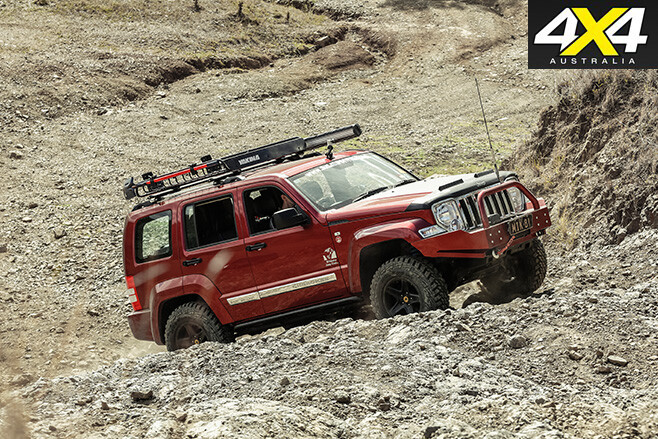
For Michael Dobele, cruising through the great outdoors in his modified Jeep Cherokee is a welcome change of scenery from his office job.
This article was originally published in the April 2014 issue of 4×4 Australia.
“I got my early experience with off road driving in Byfield National Park and Five Rocks,” the Rockhampton-raised Brisneylander said.
“It’s a really nice area. As teenagers, some weekends we’d pack up our crappy little 4x4s and go camping. I had a couple of mates with Suzukis — really early ones! They were little buzz boxes but we took them anywhere. I think back and we did things with those vehicles that you wouldn’t dream of doing now. But that’s how it is when you’re 21.”
His first 4×4 was a Jeep Wrangler, “I used to own a 2000 model TJ Wrangler. I had that for a couple of years. I didn’t do too much with it, just a bit of beach-work and that was about it.
“Then I did the family thing — got married, had kids — and I needed a house deposit.”
So the Jeep was sold, and the 4×4 dream was put on hold until finances settled. But before too long, the search was on for another Wrangler — or perhaps a Cherokee wagon.
“It was December 2011 and there was a run-out deal because they were discontinuing the Cherokee. The prices had been slashed and there were ridiculously good deals! But, if I was to get one, it had to be my daily driver, fit the family for camping trips and also be a bit of fun for weekends away with mates,” Michael said.
So he bought a Jeep! Cherry Red, carrying a 3.7-litre petrol V6 mated to a four-speed auto. It didn’t take long for Michael to begin modifications to enhance the Cherokee’s off road ability.
“I knew the suspension in these was wallowy and I wanted to lift it for better ground clearance. They are quite low. So that was always going to happen,” he said.
“When I first had it, it was sitting right at the top of its stroke. But that was before any of the extra equipment went on. Now, with the extra weight, it’s far more comfortable,” Michael said of the Lovells suspension kit that went under the Jeep to raise and stiffen the suspension.
Michael’s next challenge was replacing the Jeep’s standard 18-inch wheels and tyres with more off road focused hoops.
“I had to ditch those low-profile 18s! They were useless for anything off road. I had to do some shopping around for some decent 16-inchers. I could have fitted cheap steelies, but I wanted something that looked good.”
The Jeep doesn’t have the same stud pattern as most Japanese or Thai 4x4s (6-studders) so the range of off-the-shelf wheels differs for the Jeep — and other 4WDs such as a Hilux, D-Max or Tritons. But Michael got lucky — he was offered a set of old-stock 16×8-inch AEV Bridgers by Murchison Products which are now powder-coated black.
“They’re a great looking wheel and the offset is perfect.
“They pack out the stance perfectly — right to the edge of the wheel-arches.” The tyres he used are 245/75/16 Summit Mud Hogs, replacing the original Bridgestones.
The sill-mounted rock sliders were next to go on. Built by APT Fabrication, they’ve been a good investment. “Those things have saved my arse! They’re probably the best equipment I have bought. We removed the Jeep’s standard plastic sill caps to tuck them up higher as I didn’t want to lose any ground clearance,” he said.
With no ‘off-the-shelf’ front bar available for the KK Cherokee from the main 4×4 accessories stores, Michael enlisted the help of a specialist, Melbourne’s Uneek 4×4, for a special-build item. Wanting to make 10 bull bars for customers, it took Uneek 4×4 close to nine months to design and prototype the bar. The beautifully colour-coded result, including recovery points and provision for the synthetic-wrapped 11,000lb Runva winch, was worth the wait.
As Michael also needed to tow a camper trailer, the tow bar remains the dealer-spec Jeep/Mopar unit, and Mopar under-body bash plates were also used. “I wish I’d put them on sooner,” Michael said.
“Even though they’re not expensive, I kept putting off spending the money to buy them. But one day off road I damaged a front axle shaft.
“That cost me $1500 to fix and wouldn’t have happened if I’d got off my arse and just spent the $300 on the under-body protection.”
Inside, Michael installed a Uniden radio with the controls on the hand-set to save space as well as a 12V accessory socket in the back. Due to limited interior space, Michael decided on Yakima roof racks which fit the width and length of the Jeep and also has a roll-out awning to keep the sun off the kids Chase and Mia, on those sunny day trips to the beach with wife Elissa. “I wanted a cage [edged] style rack and this one works well,” Michael said.
Day to day, the well-equipped petrol automatic Jeep is a comfy daily driver and freeway cruiser, with a terrific basic layout, well-developed traction control and very capable off road capabilities thanks to Michael’s enhancements.
“Elissa loves camping but she’s not real keen on the actual off road driving,” Michael said.
“So we do day trips and simple weekends with the family. I’ll do more technical weekends away with mates or the Jeep club where we’ll go to a 4WD park.
“We usually do a club trip once a month where we’ll go up to LandCruiser Park — good camping and good tracks there — or The Springs and Cityview.
“We’re quite spoiled up here in Queensland. We also get over to Moreton and Stradbroke and of course Fraser isn’t too far up the coast.”
SPECS: 2011 JEEP CHEROKEE LIMITED
Owner: Michael Dobele, Qld. Engine: Type 3.7-litre petrol V6 Transmission: Standard four-speed auto with dual-range part-time 4WD Power: 151kW Torque: 314Nm Suspension Front: Independent with coil springs. Upgraded 2-inch Lovells springs and dampers Suspension Rear: Live axle, coil springs. Upgraded 2-inch Lovells springs and dampers Wheels & tyres: Wheels: 16×8-inch AEV Bridger with black powdercoat finish Tyres: 245/75/16 Summit Mud Hog M/T Exterior Mods: Bullbar: Uneek 4×4 front bar with integral recovery points. Runva 11,000lb winch. APT Fabrications side steps. Mopar tow bar. Yakima roof rack. Mopar underbody protection pack.
GETTIN’ IT DONE
Jeep falls behind when it comes to aftermarket equipment in Australia. Sure, there’s plenty of stuff available from the USA, but much of it (in particular front protection bars) is illegal in Australia because it doesn’t meet our safety standards.
The bar on the front of Michael’s KK was specially designed and built by Uneek 4×4 in Victoria after strong inquiry from local Jeep owners.
Uneek’s David Fitzpatrick explains, “A few blokes got together on an online forum, complaining that they couldn’t buy a bar for the Cherokee. So I said that if we could get 10 customers, we’d design and make a batch.”
With 12 deposits, Uneek committed to its first batch of 15 ADR-compliant and air-bag compatible front protection bars. For more info check out the Uneek 4×4 website.
We were camped just outside a small provincial park in central Canada a few months ago when we were woken by a large black bear shaking the back of our Dodge Ram and slide-on Four Wheel Camper.
I had, rather stupidly, left some rubbish on our swing-away tailgate box and the bear had come to investigate. He liked what he found, as he destroyed the bag and spread the contents all around the parking area in his desire to find food.
A blast on a hand-held fog horn (often sold as a bear-repelling device in North America) was treated with absolute contempt by the animal, but luckily for us he wandered away a short time later with just a sharp dismissive snort as a final farewell.
It got me thinking about other occurrences that have happened to me when things go bump in the night. One that immediately springs to mind happened many years ago at Douglas Hot Springs in the NT, way before it became the popular camping and day-use area it is now.
We were camped there, close to the Douglas River, when we were woken with the old Landie shaking from stem to stern. Looking out the front window we were somewhat surprised to see a big water buffalo with an impressive set of horns giving himself a good rub on our home-made bullbar. Needless to say we didn’t get out of the car until sunrise when the ol’ bull was seen wandering, a bit like a bulldozer, through the nearby pandanus scrub.
Some 30 years ago we were camped on a remote creek at Cape York with a swamp nearby that flooded as the high tide pushed water back up the creek, even though we were many kilometres inland. The nearby crossing of the creek also went from just a trickle of water across it to a rather tricky and challenging metre-plus-deep crossing, which caught us out once – after which we waited for low tide.
We had been camped there for a couple of days as we explored a nearby river system with an inflatable boat and a canoe (which is another story in itself) and had gone to bed when a short time later we were woken by our then young son calling to us in a weak and frightened manner.
When I got out of our tent I was surprised to see a big scrub bull wandering around his little tent. The bull got as big a shock as I did and he trotted off, crashing his way through the bush in his haste to depart. I breathed a sigh of relief at his departure, and our son was extremely happy to get out of the tent!
I was talking to a friend recently about similar encounters when he told me of the time he had gone to sleep in his swag and woke up with a crushing feeling on or around his chest. When he awoke properly he found he had a big goanna lazing across his body, but luckily for all concerned it quickly departed when he moved.
In a similar situation we were camped on the Canning Stock Route and had gone to sleep in our swag when something later that night woke me. I lay there gathering my senses and wondering why I had woken when another movement just a metre or so away caught my eye.
Slowly lifting my head to get a better look, a dingo stared back at me, his eyes just a glint in the pale moonlight. After a short few seconds he wheeled away and trotted off into the darkness. The next morning it became apparent how close he came to my sleeping position. Since then we’ve bought a dome-style swag!
I expect many intrepid campers have had similar experiences – feel free to let us know!
Our small two-vehicle convoy ground to a halt on top of a soft, red and raw dune as the faint shot line we had been following completely vanished.
Despite being marked clearly on maps, the route had varied all day from barely visible to absolutely non-existent and now we were faced with the prospect of another section of cross-country travel. This time, though, there seemed to be even more thick scrub and vegetation between the dunes and the depressions as well as around the saltpans and short-lived creeks.
Off in the distance there was what looked like a corridor of thinner vegetation. Problem was it was to the east – the complete opposite of the direction we wanted to go. Keeping in mind that, sooner or later, we’d have to swing west, we decided to head that way and see what the next inter-dunal valley would hold.
Just as we were about to head off, the sound of barely audible wheezing of air from a slowly deflating tyre on my mate’s Nissan Patrol caught our attention. Out came the spray washing fluid and the tyre plug kit and within five minutes we had managed to plug the offending leak.
My Patrol was wearing its normal attire of Cooper ST Maxx rubber – not exactly the set-up for cross country and trackless travel – and while I hadn’t got a puncture yet, it was more good fortune than anything else. In such conditions I prefer to run older but tougher cross plies; I even have a set of solid MRF M77 tyres at home which have proven to be darn near puncture-proof in scrubby and stakey conditions. I was the lucky one though – my mate Brenton unfortunately ended our latest outback foray with a couple of punctures.
Our adventure had started a few days earlier when we had travelled from the Aboriginal community of Papunya down to the much smaller community of Haasts Bluff. This route can be an alternative to or from Alice Springs to the Tanami Road, or the route west via the Gary Junction Road as it passes the great distinctive peak of Haasts Bluff, which is worth the drive just for that.
Brenton had been in touch with Douglas Multa, the chairman of the Haasts Bluff community and the Traditional Owner of all the country in and around the Cleland Hills. Our trip was to be a recce to see if a guided tour could be arranged to the enigmatic hills as a commercial venture for the community and their newly formed indigenous rangers to engage in.
We dropped in, saw Douglas and, after our introductions, got the latest information on the track and the access to the hills. His words “You’ll have trouble heading much further west to Kintore, but you can try” were to come back to us quite a few times as we pushed west from the ranges.
With full tanks of fuel – both Brenton’s and my Patrol carry more than 250 litres of fuel when fully loaded, along with a 100 litres of water plus two spare tyres and all the assorted gear you need for a remote desert trip – we cruised westwards on the red, sandy and graded road, away from the small community. This track almost sits on top of that imaginary line of Longitude that marks the Tropic of Capricorn.
To the north, Mt Crawford, a big sheer-sided massif, stood high above the sandy plain. Mt Crawford is the most dominant point of this range, with Blanche Tower (Winparku in native tongue) visible behind it. Sadly we didn’t have permission to go there, so with my curiosity held in check we pushed on to Limestone Bore. With the track striking south-west we headed for the more remote Tarawara Bore. Both bores showed signs of the pastoral occupation of this country before it was handed back to the Aboriginal people.
After taking the wrong track at Brown’s Bore we became slightly misplaced geographically but, after a few hundred metres, we realised we were heading the wrong way. We retraced our steps back to the bore, with tumbled-down fencing and troughs marking the spot, and picked up a track that first headed north before striking west once more.
It quickly became obvious the route was seldom used, with tall seeding spinifex dotting the middle of the track. It wasn’t long before we fitted grass blinds to the front of both Patrols to protect the radiators from blocking with junk and overheating.
We passed yet another ‘No Entry’ sign and pushed on, dodging through a gap in a low rocky range where an ephemeral creek had washed away all signs of wheel tracks and modern man. Close to the range’s low cliffs we found signs of Aboriginal people who had once used this favoured area to camp and hunt.
After traversing another 50km west we swung onto a more subtle track and headed towards the eastern ramparts of the Cleland Hills. We pulled up at a small camping area used by Traditional Owners (TOs) and indigenous rangers when they come out here for sacred ceremonies or environmental work.
This spot was close to the Muruntji Rockhole (however, this is marked on most maps as Muranji) but it was too late in the afternoon for any further on-foot exploration.
The next morning we woke to a glorious sunrise which lit up the nearby cliffs in a blaze of rich colour. Unfortunately, while the omens seemed in our favour, our search for the ‘faces’ of the Cleland Hills, made famous by Michael Terry in the 1960s, was to no avail.
The ‘faces’ and stylised figures that have made the Cleland Hills famous have previously been attributed to interplanetary visitors, but other researchers aren’t quite so liberal with their theories (see Michael Terry’s theories about ‘secret visitors’ at Austhrutime and search ‘Cleland Hills faces’).
Similar petroglyphs have been found in other Australian desert environments, but the Cleland Hills engravings remain unique. And while a nearby occupational site has been dated to 22,000 years ago, the age of the faces has still not been determined.
It’s important to do your research before embarking on a remote desert jaunt, and this became painfully and embarrassingly clear as we realised we were searching in the wrong area. The offer, however, to come to this remote place had suddenly appeared and I wasn’t going to miss the opportunity, poor research or not.
It was probably for the best that we didn’t find the faces, as we later found out that we didn’t have permission to visit Thomas Reservoir (as named by Terry) where the ‘faces’ can be found with some diligent searching. Next time we’ll hopefully have a TO or a local ranger with us to guide our exploration of these unique hills.
We attempted to explore around the escarpment of the ranges until the rising sun and heat drove us back to camp. In that short time we managed to find some rock shelters and pools of water hidden in the hills along with some faint Aboriginal art and grooves where spears or tools had once been sharpened. Small victories, but still well worth the trip.
With little more to gain from staying at that location we fired up the Patrols and headed south around the great arc of the Cleland Hills to continue westward and then north towards distant Kintore.
While we had the latest maps, Google Earth satellite images and Hema navigators to guide us, the quickly eroding and overgrown tracks forced us to go cross-country. Established more than 40 years ago in the 1970s, most of the shot lines have disappeared from lack of use – so as to make some maps near useless.
Two days after leaving our camp at the Cleland Hills we unexpectedly came upon a modern track network south of Johnstone Hill which wasn’t marked on any of our maps and invisible on Google Earth. Our maps showed a track to the south, so, despite it being in the wrong direction again, we headed that way. Luckily, our hunch paid off and we drove onto a well-used mining and oil exploration road, about 70km east of the Sandy Blight Road.
Our speed increased from the frustrating 5-8km/h we had been averaging for the past day or so to a relatively quick 40-50km/h. We camped just short of the Sandy Blight Road with the impressive Mt Strickland as a backdrop. The next day we were back on a good dirt road, our annual adventure over as we headed back to Papunya. All that remained was lengthy discussions with the Traditional Owners on further access for tour groups, which are still ongoing!
TRAVEL PLANNER
Papunya is 250km west of Alice Springs via the Western Macs and Haasts Bluff. The community has a general store that supplies fuel and food to passing travellers.
Kintore is 520km west of Alice Springs along the Gary Junction Road. There is also a well-stocked store supplying fuel and supplies.
Visiting the Cleland Hills is only possible with permission from the Haasts Bluff Traditional Owners or from the Central Lands Council in Alice Springs. Guided tag-along tours may be available in the near future.
What’s your next off-road destination? Find out and explore.