
MAZDA’S all-important CX-5 is fundamental to the success of the Japanese company.
The first-gen model, released in 2012, accounted for approximately 25 per cent of Mazda’s global sales. So it was imperative for Mazda’s engineers to listen to customers and ensure the few shortcomings of the first-gen model were rectified. And listen they did.
The most notable cause for concern of the first-gen CX-5, of which 1.4 million units were sold across 120 countries, was the worrying level of NVH. To this end, Mazda implemented a range of NVH improvements across the model line-up.
Read our review of the popular 2015 Mazda CX-5 Grand Tourer.
NVH IMMEDIATELY obvious, as both passenger and driver, were the improved levels of NVH. On a variety of roads – inner-city, freeways and mildly challenging twisties – the cabin remained isolated from tyre and wind noise at both high and low speeds. Mazda claims the level of quietness to be “roughly equivalent to that of travelling 20km/h slower than on the previous model”.
Structural changes to the second-gen model resulting in NVH improvements include hollowing the front stabilisers, adding dynamic dampers to the front struts, and minimising gaps between body panels, pillars and sills throughout the vehicle.
The occasional buzz and rattle remains on the really coarse stuff (not that it’d bother 4x4ers), but the cabin is a much quieter place to live than its predecessor.
POWERTRAIN DESPITE being a new-generation CX-5, powertrain calibrations (read: refinements) are minor. The three-strong engine line-up includes the 129kW/420Nm SkyActiv-D 2.2-litre diesel, the 114kW/200Nm SkyActiv -G 2.0-litre petrol and the 140kW/251Nm SkyActiv -G 2.5-litre petrol.
However, there are a few new technologies adopted by the second-gen CX-5’s diesel engine: High-Precision DE Boost Control, Natural Sound Smoother, and Natural Sound Frequency Control – again reinforcing the much-improved levels of NVH.
All engines are mated to a six-speed automatic transmission (only the entry-level 2.0-litre Maxx sports a six-speed self-shifter), which offers clean and swift gear changes. Although on a few steep inclines the changes weren’t readily deployed.
There’s also a claimed 4.4 per cent fuel-consumption improvement across the range.
For further on-road stability, the new CX-5 features Mazda’s G-Vectoring Control (GVC) tech, which basically adjusts the engine’s torque in relation to steering wheel and lock placement.
OFF-ROAD? NOT quite. The test route in and around Gold Coast and Brisbane was restricted to black-top – it is a mid-sized SUV after all. We managed to plant ourselves into the plush cabin of both the Maxx Sport and new-to-the-range Touring models, and both handled the smooth Queensland roads with aplomb.
The mid-sized SUV stuck to the road like glue, a credit to the newly installed GVC tech. The more-exxy Touring did provide a more substantial feel to the steering – perhaps due to the weight increase.
Newly installed safety features across the range also improve the driving experience. Mazda’s Radar Cruise Control with Stop-and-Go function measures the distance to the car ahead and controls the tempo and brakes accordingly, but it’s only available on the top-spec Akera model.
Traffic-sign recognition, found in Touring, GT and Akera models, works consistently well; though it failed to recognise a few roadwork speed signs.
The CX-5 measures up at 4550mm long, 1840mm wide and 1675mm tall. Laden ground clearance is 185mm; unladen is 193mm. It has a braked towing capacity of 1800kg (unbraked: 750kg).
PRACTICALITIES The simplistic, clean and functional design was achieved by removing all unnecessary elements.
The monochromatic interior of the CX-5 is neatly presented, with the only cheap plastic found in the centre console next to the driver’s (and passenger’s) legs.
We also found issue with the low placement of climate control buttons, which distracts the driver’s focus from the road. With unused space higher on the dash, it seems to be a simple oversight.
The rear seats (with air vents in all models bar the Maxx) are spacious and comfortable enough for three kids or a couple of adults, while there’s plenty of space in the boot for a decent non-remote road trip – 1342 litres with the rear seats folded down, or 442 litres with them up.
A “grand temporary tyre” (Mazda’s way of not calling it a space saver) resides in the rear, much to the chagrin of many drivers. It saves on weight and space, though, and it’s actually bigger than your regular space saver, so it’s not entirely a bad thing.
HIGH HOPES MAZDA intends the CX-5 to remain the number one mid-sized SUV of choice for Australian customers, while also retaining strong repurchase rates.
Alastair Doak, Mazda Australia’s director of marketing, told a packed media contingent that the sales forecast of the new CX-5 is approximately 2000 units per month, with the Maxx Sport predicted to be the most-popular model with an expected 30 per cent share.
Engine-wise, the 2.5-litre petrol is expected to be the most popular (60 per cent of sales), followed by the 2.2-litre diesel (25 per cent) and the 2.0-litre petrol (15 per cent).
RANGE AND PRICING
| Model | Engine | Transmission | MLP |
| Maxx | 2.0L Petrol 6MT | FWD | $28,690u00a0 |
| u00a0 | 2.0L Petrol 6AT | FWD | $30,690u00a0 |
| u00a0 | 2.5L Petrol 6AT | AWD | $33,690u00a0 |
| Maxx Sport | 2.0L Petrol 6AT | FWD | $34,390u00a0 |
| u00a0 | 2.5L Petrol 6AT | AWD | $37,390u00a0 |
| u00a0 | 2.2L Diesel 6AT | AWD | $40,390u00a0 |
| Touring | 2.5L Petrol 6AT | AWD | $38,990u00a0 |
| u00a0 | 2.2L Diesel 6AT | AWD | $41,990u00a0 |
| GT | 2.5L Petrol 6AT | AWD | $44,390u00a0 |
| u00a0 | 2.2L Diesel 6AT | AWD | $47,390u00a0 |
| Akera | 2.5L Petrol 6AT | AWD | $46,990u00a0 |
| u00a0 | 2.2L Diesel 6AT | AWD | $49,990 |
VERDICT MAZDA didn’t need to make radical changes to what was already a good thing, and it hasn’t. The changes it did make, however, have made a good thing a great thing. The addition of new driving technologies and improved NVH has resulted in a quieter cabin and a smoother on-road performance. It should be a sales monster!
Would we take it off-road? What do you think?
OUR latest guests to the 4X4 Garage are the folks from Narva, who are utilising LED as a light source for, what it claims to be, one of the best aftermarket lights on the market: the Ultima 215 LED.
“We have looked very carefully at how we can use LED technology to develop the perfect driving light,” George Davies, Narva Marketing Manager, explained. To that end, Narva has utilised 33 5W Cree LEDs. “We’ve used the latest Cree XP-G2 chips, and that means we’re able to get 165W of light and 10,500 lumens. What that means for the driver is that when they’re getting to their destination they’ve got good penetration down the road, but when they get off-road they get that nice, wide spread of light.”
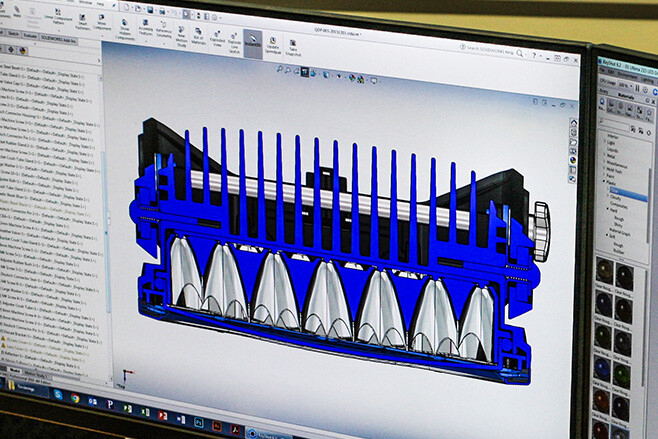
The LED chips sit within a diecast housing that’s supported by a tough pressure diecast mounting bracket. This is kept tight via three stainless steel bolts with nyloc nuts. Lateral movement is locked, but vertical angle adjustment can be altered on the fly without tools. The unit’s anchored by a polyurethane suspension system and an alloy adjustment knob. The 215 also features an in-built light pipe that meets ECE requirements. A hard-coated lens and see-through lens protector are made from polycarbonate to protect the lamps from stone damage and abrasions.
The 2.8kg lamp is IP66 and IP67 rated and features Narva’s Active Thermal Management System, an integrated Deutsch Connector and a Gore-Tex breather vent.
Without the lens cover the unit measures 215mm wide x 112mm deep x 235mm tall, which means it’ll fit a wide range of bullbars.
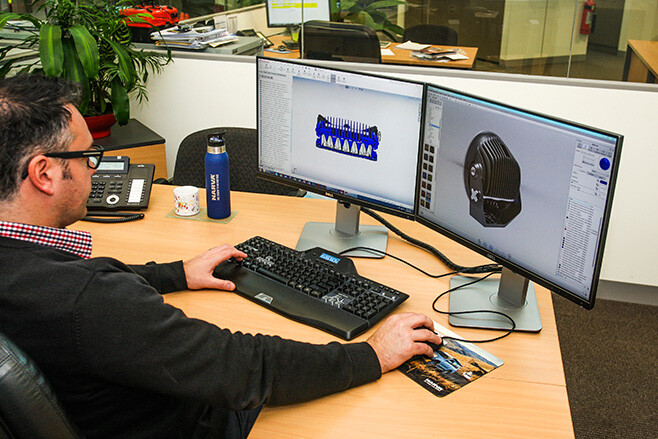
“Our product is designed in-house. We’ve got our own engineers and designers. We make sure the product is fit for the Australian market. We make sure we offer a product that has a point of difference and stands out,” Davies said.
To see how the Ultima 215 transforms from a CAD design into a physical LED, we ventured to where the magic happens at Narva’s production facility in Melbourne’s south-east.
The massive home-base incorporates an intensive testing regime, where Narva’s boffins run each light through a number of comprehensive tests to ensure they are all ready for real-world use.
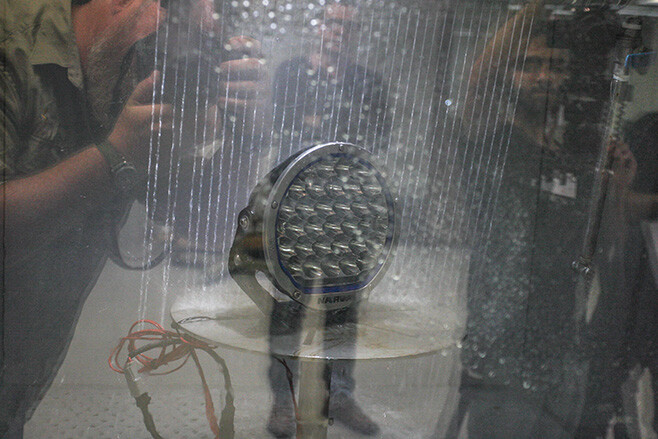
Jo Banks, Production Development Manager at Narva, was on deck to guide us through the extensive process. “Before you torture it, we torture it as best we can to ensure you’re not going to have any issues,” he said. “We have a number of pieces of equipment here to do that.”
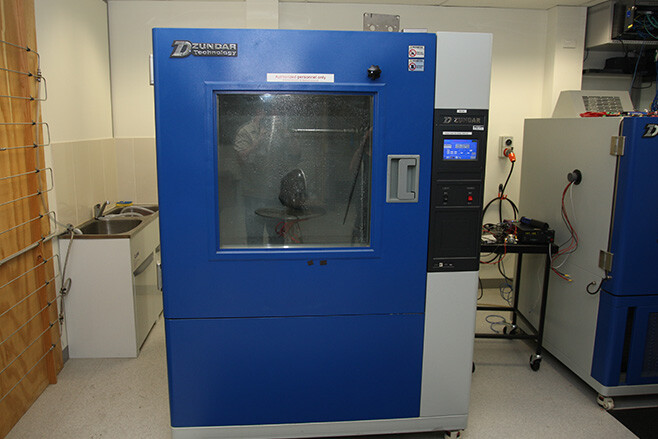
Narva’s rain chamber is one such device that tests a light’s ability to withstand rain. “The unit is sprayed from all angles by the spray bar as the product spins around on the turntable,” Banks said.
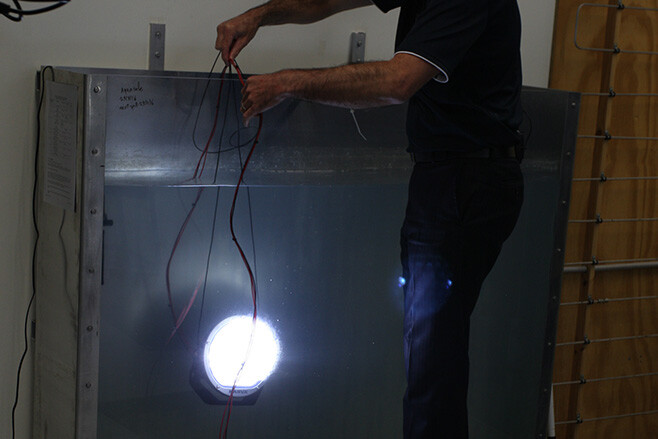
A submersion tank, next on the line, tests a light seal’s ability to keep the ingress of water out when it is totally submerged in water. “The 215 is a lamp with a breather, so rather than being entirely sealed it’s sealed, but with a Gore-Tex breather vent on the back, which allows the air pressure inside the lamp to balance. But once submerged the vent locks and seals against any water,” Banks told us.
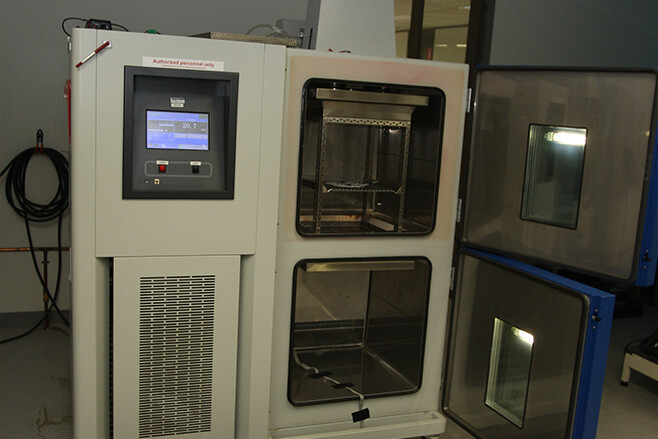
Next up is the , which tests the unit’s paint finishes, glues, resins and plastics. “It allows us to have controlled temperature and humidity in the chamber,” Banks added. The heat test can run 24 hours a day at varying temps.
A dust ingress test, which uses talcom powder instead of dust, takes about six hours for the powder to settle. While a thermal shock machine – two temperature chambers on top of each other (freezer and oven) – moves the test sample between extremely hot (100°C) and extremely cold (-60°C) to test a unit’s ability to withstand varying temperatures. The Ultima 215 has an operating temperature that ranges from -40°C to 65°C.
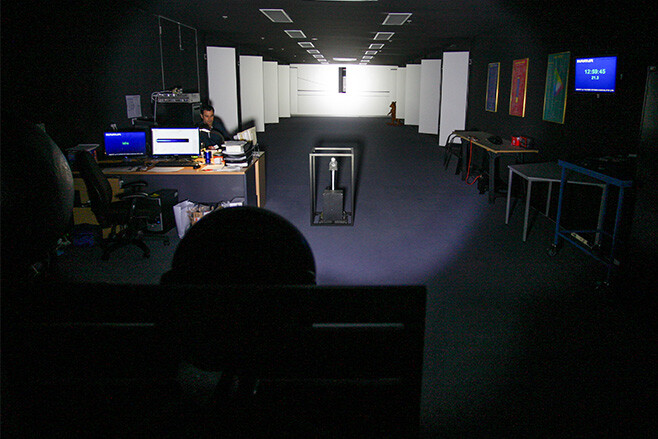
Narva also has its own light lab, which features a 25m and a 5m photo cell, where it’s able to work out how far and how wide a light can penetrate. The Ultima 215 LEDs pierce the road ahead to a distance of 900m. It also has a great widespread ability, affording the 4×4 superior protection. “When you’re off-road you want to have a good, wide spread of light. This allows you to get good coverage and avoid animal strikes,” George Davies added.
Up to 60 per cent of all testing is done in-house at Narva, with the rest taking place with the company’s manufacturing partners. After the thorough testing process, Jo Banks said they “end up with the knowledge that we know the product is going to survive in the real world in harsh conditions, as we’ve been able to recreate in the lab here conditions equal to or more severe than what you’re actually going to see in the real world.”
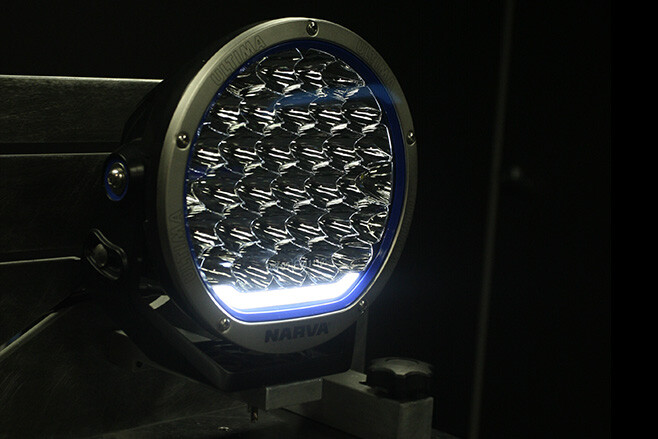
The Ultima 215 LEDs are slated for a May 2017 release at an expected RRP of $699 per lamp. We’ll be sticking a set to the front of a 4×4 soon, so watch this space for a complete review.
CHINESE vehicle manufacturer LDV has confirmed it will debut its T60 into the Australian ute market this October.
The ute, first seen at the 2016 Guangzhou International Motor Show, will be available in single- and double-cab configurations. There will also be two- and four-wheel drive variants, manual and automatic versions, and two trim and equipment levels.
“This model line-up covers the significant part of the market, and these versions will be joined by additional variants as required to meet changing market demands,” Dinesh Chinnappa, General Manager of LDV Australia, said.
Details are vague, but what is known is that the T60 will be powered by a 110kW 2.8-litre turbo-diesel engine and will measure 5300mm long and 1900mm wide.
LDV Australia has big expectations for its all-new ute. “In preparation for the arrival of the T60 we are opening new dealers in country areas and enlarging our urban representation,” explained Mr Chinnappa. “There is little doubt that from day one, the T60 will be LDV’s best-selling model in Australia.”
LDV vehicles come with a three-year 100,000km warranty, with 24-hour roadside assistance.
Pricing is yet to be released, but the T60 is expected to be at the budget end of the LCV market.
“It is too early to provide specific price points for the new LDV T60 range,” Mr said Chinnappa. “But we are determined that it will build upon the value for money proposition of the LDV van range.”
IF YOUR Easter plans have you packing the 4×4 and heading off-road (as they should), then you’ll need a durable fridge that’s capable of transporting all-important beer and grub (and Easter eggs for the kids) to the most remote regions.
Evakool’s feature-packed TravelMate range is perfect for such adventures, and there’s a suitably sized fridge within the range for all occasions.
There are two types of fridges within the range of six fridges: end-opening and side-opening designs. End-opening fridges include the TravelMate 38-litre, 45-litre and 50-litre. Side-opening fridges include the 50-litre, 65-litre and 80-litre.
All fridges within the TravelMate range utilise a high-quality Secop/Danfoss compressor, and TravelMate fridges are capable of running multiple voltages and will operate on 12v/24v and 240v.
The fridges also include a unique removable lid that’s designed so that the fridge can be opened at either end, or completely removed; a fully insulated polypropylene cabinet; a cooling capacity up to -55°C; low voltage protection; a bright internal LED light; a USB socket; and a five-year warranty (backed by a nationwide service network) for peace of mind.
There are no hidden charges, and customers also receive a protective cover at no extra cost.
Are you still unsure? Evakool has set up a comparison tool on its website where the TravelMate range fronts up against two other similar sized, well-known fridges. So you can see for yourself how the Evakool stacks up. Visit Evakool.
RRP:
35-litre: $858 45-litre: $888 50-litre: $928 65-litre: $978 75-litre: $998
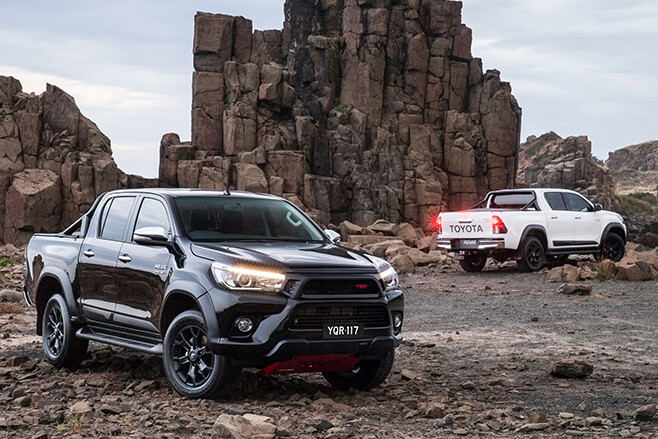
TOYOTA Australia has resurrected the TRD (Toyota Racing Development) badge and applied it to the Hilux, with a dolled-up model set to take on the Ford Ranger Wildtrak.
Priced from $58,990 for the double-cab 4×4 with a manual transmission in white, or $59,540 in black (the only two TRD colours offered, add $2000 for auto), the TRD ’Lux has the popular Wildtrak squarely in its sights.
Buyers hoping for performance upgrades with the TRD badge will be disappointed, as the suspension package and mechanical package (450Nm (auto) 2.8L diesel engine) remains the same as a regular SR5 Hilux.
In the USA, the petrol-fuelled TRD models feature Bilstein suspension, all-terrain tyres and underbody protection as part of the packages available on Tacoma, Tundra and 4Runner 4×4 models.
In Australia we get a bright red TRD-branded skid plate under an aggressive TRD grille, TRD lower bumper cover and TRD wheel-arch flares. The black 18-inch alloy wheels run regular road-biased OE fitment tyres. Over the tub liner in the tray is a soft tonneau cover and black sports bar, while a towing kit, tail-light covers and TRD mudflaps complete the package.
TRD extras extend to branded carpet floor mats inside and, for automatic variants, a TRD gear knob.
Toyota last used the TRD badge in Australia back in 2008 when it created the supercharged V6-powered TRD Hilux and Aurion models, but the program was short-lived and not well received by the buying public. We hope this new-model TRD Hilux proves more popular and leads to some improved performance models in future developments.
This time around Toyota has chosen the SR5 Hilux to build on, as the top-spec variant accounts for more than half of Hilux 4×4 sales. The public has also shown a penchant for dressed-up, top-spec variants like the Ford Wildtrak and Holden’s Z71 Colorado.
“We have responded to demand by compiling premium components, including the respected TRD brand, that will further distinguish Hilux from the competitors and from every other Hilux in our range,” said Tony Cramb, Toyota Australia’s executive director of sales and marketing. “Local buyers voted with their wallets to make Hilux the best-selling vehicle in Australia last year – and the majority clearly indicated their preference for upmarket features combined with Hilux’s renowned go-anywhere capability.”
IF YOU can’t play with the big boys, then get out of the sandpit!
Toyota has jumped mud-tyres-first into the sandpit with its new collaboration with iconic toy manufacturer, Tonka.
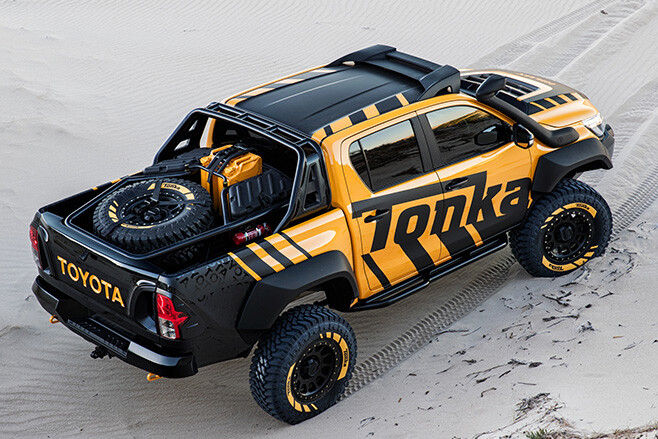
It has taken its own iconic toy, the Hilux, and transformed it into a life-sized Tonka Truck using some pretty unique add-ons.
Designed in-house by Toyota’s own team of designers, The Hilux Tonka Concept features bespoke carbon-fibre bodywork, 35-inch tyres on black alloy wheels, LED light bars and, most interestingly, portal axles developed by Marks 4WD. This is the first application of Marks portals for independent front suspension, an indication of possible future product from the innovative engineering company.
Toyota product design chief Nicolas Hogios said the extreme style and capability of the Hilux Tonka Concept would capture the imagination of kids and adults alike.
“We have taken Tonka out of the sandpit and reinvented Hilux from top to bottom and from nose to tail,” he said. “Inspired by the Tonka trucks that kids play with in their backyards, the Hilux Tonka Concept goes way beyond the already hugely capable abilities of Hilux to traverse rocks and other rugged terrain.”
As well as the Marks 4WD portals, other off-road equipment fitted to the Tonka Hilux includes Toyo Open Country M/T tyres, Method Race Wheels and King Suspension. There’s a 12-volt winch behind the custom-crafted front bar, and the tray houses a custom rack to haul the spare wheel, recovery gear, a couple of jerry cans and storage bins.
“The Hilux Tonka Concept is dramatic evidence that our local team loves to have fun, we’re keen to explore new ideas and we’re always looking to push the boundaries of what’s possible,” Hogios said.
Both Tonka and Toyota are celebrating milestones this year, with 70 and 80 years in business respectively. In its 49 years the Hilux has sold more than 16 million units globally, and in 2016 it was the top-selling vehicle in Australia.
Before you get too excited about getting your own Tonka Hilux, Toyota won’t be offering a version of it for sale to the public, but there is the new TRD Hilux for those wanting something more than just an SR5. We only hope Tonka produces a version we can all afford to play with.
Your first glimpse of Robe is not what you would expect.
This article was originally published in the June 2014 issue of 4X4 Australia.
As you drive into the famed South Australian coastal town, you are greeted by a road nestled in thick scrub, weaving and winding past a couple of nondescript lakes before it disgorges you onto the outskirts of a small-town shopping strip. No sweeping views of an azure sea, or coastal bluffs to take your breath away – your welcome is a bit unspectacular really.
Robe is no Cote d’Azur; it’s far more subtle than that. The small town is on one of Australia’s most breathtaking coastlines – the Limestone Coast. This region of South Australia is one of Australia’s best natural environments, featuring some outstanding spots for four-wheel driving, fishing, bushwalking and camping.
South of the Robe township, nestled into the rugged coastline, sits Little Dip Conservation Park. The park protects numerous lakes in the area and can be accessed via Nora Creina Drive, which is mostly unsealed roads, or from the coastal tracks from Robe.
The park has four camping grounds, which vary in accessibility and outlook. The Long Gully Campground is probably the most accessible for those trailing a camper trailer or caravan, with flat, open grounds and just a swing at the entrance. The other campgrounds – Old Man Lake, Stony Rise and The Gums – are much tighter for access and camping spots, but offer more shade and better access to the beach.
There’s no power or drinking water at the park, so you’ll have to bring in all supplies, but it’s graced with a pit toilet and a rainwater tank.
The Long Gully Campground is in a hollow about one kilometre from the surf and is well-protected from off-shore winds by the surrounding hills. Midges are known to love this area, so you’ll need adequate protection when camping here, especially in the warmer months.
Getting to the beach takes about 10 minutes on foot or just a couple minutes in a car. The vehicle track takes you left out of the campground and down a dirt road for about 200 metres before arriving at the back of the dunes.
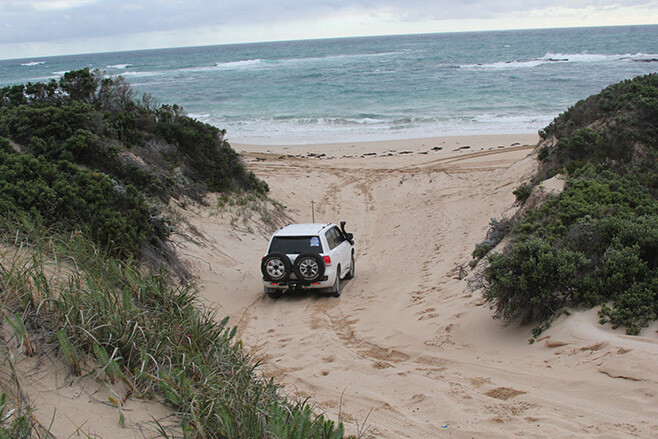
The sand tracks to the beaches among the dunes are easy, but it is a good idea to lower your tyre pressures. Tyre pressures of 15-18psi should do the trick, but be prepared to set them lower still.
The beaches here are renowned for their ability to suck a 4×4 down to its chassis like quicksand. The combination of coarse sand and the right amount of moisture (or lack of it) result in beaches that easily become very soft and boggy. If driving the beaches in a single vehicle, sand tracks and a long-handled shovel are a must. But it’s advisable to go in convoy and take a snatch strap.
The beaches hold the secrets of the Bunganditj (Bo-an-dick) people, who were the first to live in this coastal environment. They lived on the coast from Robe to the mouth of the Glenelg River at Nelson in Victoria for more than 30,000 years. Shell middens, rock shelters and burial grounds in the area are a reminder of the lifestyle of the land’s original custodians.
The bay in which Robe is nestled was first noted by an expedition in 1802, when it was named Guichen Bay by Nicholas Baudin in honour of Admiral de Guichen. In 1846, the town and port were surveyed by the South Australian Government and became what we now know as Robe. It was named after the Governor of South Australia, Lieutenant Frederick Holt Robe.
The town and port boomed over the next two decades. By 1856 Robe had become the second major colonial out-port, attracting settlers and merchants alike. Today, it is the surf that is a major attraction and the envy of many coastal towns. Long Beach is home to the National Kite Surfing Championships and the Robe Surfing Classic, while Beachport and Browns Bay east of Port MacDonnell attract lots of surfers.
If jumping out on a board isn’t your thing and you prefer getting your feet wet with a trusty rod and line, then fishing on the beaches in the park can yield a catch of salmon, mulloway, rays, flathead, snapper and King George whiting. Rock fishing for salmon, mullet, snapper and sweep is popular at Stony Rise and Little Dip.
In addition to exploring the numerous beaches and headlands, there are also two walking tracks in the park. The Fresh Water Lake Walk takes you along the exposed, rocky coastline and into the coastal mallee. And the walk along the Big Dip Lake to the Lake Eliza Hike offers views across the plains to the Woakwine Range.
The most difficult part of staying in the Little Dip Conservation Park is trying to decide how long to stay because there’s a raft of beautiful natural locations on this part of the Great Australian Bight.
TRAVEL PLANNER
WHERE Robe is situated on Guichen Bay, 350km south-east of Adelaide, and 550km west of Melbourne, near the South Australian border.
CAMPING The Little Dip Conservation Park has four camp grounds: Long Gully, Old Man Lake, Stony Rise and The Gums. Camping fees at the time of writing are $13 per vehicle (maximum of eight people). Extra persons are $7, or $5 for each person in parties of 20 or more.
WHAT TO TAKE Drinking water and all other supplies. Top-up with fuel before entering the park at Robe.
SUPPLIES AND FACILITIES Only basic facilities are available in the park – a pit toilet at Long Gully. The closest major centre is Robe itself, 13km to the north, for food and fuel supplies. Both wood and solid fuel fires are prohibited throughout the year, while gas fires are allowed other than on days of total fire ban. On the ocean beach foreshores, wood and solid fuel fires are permitted between the high and low water marks, except for total fire ban days.
TRIP STANDARD The road to the park entrance on Nora Creina Rd is sealed for a short distance, but the remainder is unsealed two-lane roads. The last kilometre to Long Gully Campground is rough and potholed. There is plenty of wildlife out at night in this area, so if arriving or leaving between dawn or dusk, drive with extreme caution. Beach driving is permitted on most beaches in this area, but fitting a sand flag is highly recommended. Sand here is coarse and can be very boggy and difficult to traverse, even for the experienced four-wheel driver. Speed is restricted to 40km/h. Sand tracks and a long-handed shovel should be taken as a minimum, and tyre pressures should be set low, around 15psi.
CONTACTS AND INFORMATION Visit South Australia Robe tourism Department of environment, water and natural resources
MAPS AND GUIDES Robe maps and guides
What’s your next off-road destination? Find out and explore.
On a trip up the north-west coast of Australia, 4X4 Australia and CamperTrailer Australia magazines joined forces to see just how far Isuzu’s D-Max LS-U and Mu-X LS-T, with camper trailers in tow, could get us.
This article was originally published in the October 2014 issue of 4X4 Australia.
Both these four-wheel drives have favourable reputations; the second-gen D-Max is running in the top 10 best-selling 4x4s of 2014 while its younger brother, the Mu-X, launched in 2013 is quickly finding its place in the Australian market, and is regarded as a strong and reliable family 4×4.
The Mu-X is the seven seat wagon version of the D-Max ute and it uses the same powertrain. So how did these four-wheel drives fare in the West Australian outback, towing camper trailers for more than 3000km over two weeks?
APPEARANCE As far as utes go, the D-Max is attractive – it’s tough and masculine, and the smooth bodylines give it a touch of class. And it’s this toughness that makes it so popular. But, the interior is basic – even in the top-spec there’s nothing overly amazing about it. With synthetic seats and a dash that lacks brute masculinity it is just what you’d expect from a workhorse ute.
Yes, it’s got audio controls on the steering wheel, an audio unit with iPod and phone connectivity and a ‘sky sound’ roof-mounted sound system – the device connectivity is via an auxiliary point and the Bluetooth system can be a little jumpy. But this is about as fancy as it gets, there’s nothing that makes it stand out technologically from any other ute.
The tray has plenty of room for storage, but, as with all utes, it’s not water or dust proof so be wary. Given we were travelling through red dusty plains, over sand dunes, and at times through heavy rain, it was a good thing we had plenty of storage space in our Follow Me Campers trailers.
The seven-seater Mu-X has a lot more going for it. From the outside, the wagon is tough with a touch of elegance, making it a decent family wagon; for those wanting the best of both worlds, this is a reasonable option.
There’s plenty of room in the boot, and on our trip the Mu-X was our main storage vehicle. There are a lot of ‘stowaway’ spots in the Mu-X with two glove boxes, a top-box above the dash and plenty of cup-holders. Leather seats, and an infotainment system with GPS gives the wagon another up on the more workman-like D-Max.
Be warned, the audio unit uses a micro USB connection, so buyers will need to fork out more cash for an extra cord.
Neither the D-Max nor the Mu-X are particularly comfortable over long drives. If we had the choice, we’d change the seats to something with more support.
DRIVABILITY Given both vehicles share the same mechanicals, the drive experience is quite similar. They are both fuss-free and effortless with tolerable noise levels. Off the beaten track the vehicles are admirable, yet won’t earn the title as extreme off road front-runners anytime soon.
Standard on both the D-Max and Mu-X is cruise control, which worked against them on the steeper climbs on our trip up the north coast of Western Australia. With the cruise activated, the transmission held the higher gears a long time at the expense of vehicle speed so we opted to limit cruise control use to flat stretches only – despite driving for hundreds of kilometres a day. The extra weight of the trailers connected to the rear didn’t help either.
The Mu-X’s softer suspension calibration from its all-coil combination felt strong side winds along the coastal highway. The D-Max retains a work-ready leaf rear end which, combined with its larger footprint on the road, felt better planted in all conditions.
Both vehicles proved competent at towing. Over the two week journey we barely noticed the extra few tonnes loaded onto the back, except when the cars were chugging up those steep inclines.
The second-gen D-Max has a tow-rating of 3500kg, upped from 3000kg on previous models. While the Mu-X makes do with just 3000kg.
TECHNO NO SHOW The D-Max’s inferior infotainment unit was an annoyance – driving for long distances warrants a better option for music. There was no USB connectivity option – only an auxiliary input – and no digital screen for a reversing camera or GPS. But this is a ute, after all.
The tray’s hardcover latches on the D-Max were also a weak point – the latches kept coming loose. A few readers have expressed similar experiences with the latches on the bonnet. Granted, we were driving over heavily corrugated roads, but being an off road vehicle, this shouldn’t be an issue. We made a stop at a local hardware store and managed to fix the latch, but then the second one started to fault. With the lid detached and constantly clunking for the final leg of our trip, it made it a bit of a drag.
The Mu-X’s small 65-litre fuel tank is something buyers need to consider if long distances are planned. Having to constantly stop to re-fuel ate into our road time, and it’s something you need to consider when heading into remote areas. We got caught coming out of Francois Peron National Park when the Mu-X ran out of fuel. Those narrow roads aren’t ideal to re-fuel from jerry cans.
The D-Max has a 76-litre tank and while this isn’t a massive difference, it was certainly noticeable.
Fuel economy for both vehicles is up there with the best in their class. The D-Max claims 8.1L/100km and the Mu-X 8.4L/100km.
THE TECHNICAL STUFF For $53,500, the Mu-X LS-T has a lot of features for money. It trumps the D-Max with rear-park assist, leather seats, touchscreen navigation, reversing camera and a roof mounted DVD entertainment system.
The D-Max LS-U, at $44,000, doesn’t get the same level of features, but then again, it has all the basics you would need in an off road workhorse ute, with air-con, power windows, central locking, cruise control, and power-adjustable side mirrors.
Both Isuzus get a five-star ANCAP safety rating and both sport the same 3.0-litre turbodiesel, in-line four-cylinder engine, producing 130kW and 380Nm. The gearboxes are exactly the same as well, with the Aisin AW TB50-LS five-speed automatic pushed in to service.
The Isuzus come with 17-inch alloy wheels; and for the trip we replaced the standard tyres with more durable Toyo Open Country A/T II tyres (see below) which made a world of difference across rutted roads, corrugations and sand.
Isuzu claims the Mu-X is a vehicle that works as well on as it does off road – and we tend to agree. It’s great for those city commutes, but will also get the job done off road and on those longer trips away, especially when towing. The Mu-X could become a real contender in the Aussie market; if only the fuel tank was a bit bigger.
The D-Max, on the other hand, has already earned its reputation as a reliable vehicle. It’s nothing too fancy and doesn’t have all the gadgets and gizmos attractive to gen-y buyers, but it’s a work-horse ute and doesn’t need anything to flashy to get the job done.
SPECS
Isuzu MU-X LS-T Engine: L4TD/3.0 Max power: 130kW Max torque: 380Nm Gearbox: 5-speed “Rev-Tronic” Auto 4×4 system: Part time 4×4 (2-high, 4-high and 4-low) Front suspension: Coil suspension with gas filled shock absorbers Rear suspension: Multi-link with gas filled shock absorbers GVM: 2750kg Payload: 675kg Towing capacity: 3000kg Seating capacity: Seven Fueltank capacity: 65L Consumption: 8.4L/100km Price: From $53,500
Isuzu D-Max LS-U Engine: L4TD/3.0 Max Power: 130kW Max Torque: 380Nm Gearbox: 5-speed auto or 5-speed manual 4×4 System: Part Time 4×4 (2-high, 4-high and 4-low). Front suspension: Coil suspension with gas filled shock absorbers Rear suspension: Overslung rear leaf suspension –1360mm long span. GVM: 2950kg Payload: 1055kg Towing capacity: 3500kg Seating capacity: Five Fueltank capacity: 76L Consumption: 8.3L/100km (MT) or 8.1L/100km (AT) Price: From $44,000
Toyo Tires Open Country A/T II
We replaced the tyres of the Isuzus with .
The A/T IIs have superior performance and are aimed at increasing tread life and better traction than their predecessors.
With our Toyo Tires A/T IIs, we drove the vehicles over soft sand, heavily corrugated roads and rocks with ease.
The tyres have a squared shoulder, scalloped shoulder lugs for better traction, and wide grooves for those slippery situations. The side tread gives more resistance to damage on the shoulder, which can be disastrous when travelling on outback roads.
The Toyo A/T IIs are the same production tyres that Bruce Garland and the Isuzu Motorsports team sucessfully ran on their Mu-X in the Finke Desert Race this year.
Over the two weeks of our trip, the tyres were filled with air and let back down several times and were put through the wringer over varying terrains.
The tyres had excellent traction and made off road driving easier.
With no punctures and only one bogging, which was probably more a result of too much air in the tyres than anything else, it’s safe to say the A/T IIs really impressed.
On road, they provided us with a smooth drive, good braking performance and a quiet ride.
On close inspection at the end of our trip, there was little to no damage to the tyres, other than maybe a little bit of red dust stuck to the rubber.
All in all, these tyres are up there as some of the best available for on and off roading.
When the weather warms up, it’s time for friends and family to gather around the barbecue and enjoy good company and food. A good friend makes this salad for such occasions, and not only does it look fabulous, but it’s also easy to make and tastes great.
INGREDIENTS
- ½ lettuce – washed and shredded
- 2 cups frozen peas (or if using a packet of dehydrated peas, cook and cool)
- 1 or 2 carrots – grated
- 2 or 3 hard boiled eggs – mashed lightly with a fork or thinly sliced
- 1 cup mushrooms – thinly sliced
- ½ cup grated cheese
- 1 cup mayonnaise and/or plain Greek yoghurt
- 2 tsp sour cream
- 2 tsp French mustard
- 1 tbs lemon juice
- 6 spring onions – thinly sliced
- 1-2 tomatoes – sliced or cut into wedges (or use cherry or roma tomatoes)
- 4 rashers of bacon – sliced/chopped and sautéed until crispy (can also use sliced ham)
- 1 tbs fresh parsley – chopped
- Get everything together and prepared before you start layering. Ingredient quantities can vary, depending on how many you’re feeding. This amount will serve a large group.
- Using a large bowl (if at home, use a glass one), place the lettuce evenly in the bottom of the dish.
- Arrange the following, layer upon layer: uncooked frozen peas, carrots, eggs, mushrooms and cheese.
- Combine the mayonnaise/yoghurt, sour cream, mustard, lemon juice and spring onions and mix until combined. Spread this mixture evenly over the cheese (it’s easier if you dollop spoonfuls over the cheese as close together as you can and then gently spread it out).
- Arrange the tomatoes over the mayo mix, than sprinkle over the bacon and parsley to finish.
- Refrigerate for at least an hour, and then serve.
You can mix up the layers before you add the mayo mix however you like. Also add whatever vegetables you like and substitute vegetables out that you don’t. Corn, snow peas and sliced radish mix well.
For more recipes: Check out Ron & Viv Moon’s website or follow their Facebook page.
VALE
I’d like to dedicate this salad to our very good friend, and Maz’s partner, Big Pete Dwyer, who passed away suddenly in September 2014. He was well known and respected throughout the four-wheel drive industry and Vic 4WD clubs, and he will be very sadly missed. He really enjoyed this salad and thought it looked great.
IT’S getting pretty rare these days to see a four-wheel drive without some kind of LED lighting on board.
The advantages over conventional filament lighting are many and start with low current draw and extend to light weight, compact/flexible designs, toughness, dustproof/waterproof construction and, increasingly, good lighting performance. Not for nothing did the trucking industry adopt LED technology some 20 years ago.
The catch is that a lot of the LED lights you see hanging off bullbars and roof racks these days amount to not much more than flood beam work-light stuff. The sort of thing you’d see on the back of a tractor or lighting up the forecourt of a wrecking yard to deter souvenir hunters.
Oh sure, those units send out plenty of light, but the beam tends to be scattered, lighting up the trees above and the paddocks to each side rather than just the road and its immediate surroundings. And, in an outright sense, those units can’t begin to match the beam penetration of a good set of conventional driving lights.
The solution is to get hold of an LED driving light that’s been designed for that purpose. You’ll still pick up all the benefits, but you’ll also be getting a light that sends its beam where you need it to be for driving in the bush after dark. Hella has a couple of likely suspects on the market, starting with a model called the 350 and now a new, bigger version called the Light Bar 470.
The 470 measures 528mm across and houses 16 automotive-specific LEDs. It weighs in at less than a kilo and draws 35 watts. There are also two variations on the 470 theme: a model that approximates a beefed-up high-beam pattern, and another with what amounts to the old-fashioned pencil-beam stuff.
We stuck a pair of 470s on our 80 Series (one high beam, one pencil) and headed out into the bush to see what happened. For a start, mounting them is pretty simple and you can get away with bolting them straight on to a bumper bar or whatever you like. However, I elected to make up a plate for each unit to sit on, to relieve any stresses across the body of the light.
I’m sure it was unnecessary, but I tend to go into overkill on this stuff. If nothing else, it gives a nice flat surface for the included mounting brackets to sit on. Don’t be tempted to do without a relay just because they’re LEDs either, as 35 watts is still a fair bit of current.
Parking the vehicle against a wall to aim the lights, it becomes immediately obvious these aren’t flood-beam work lights. Both the high beam and pencil beam have distinct, sharply focused beam patterns. The upshot of that is that the light is being concentrated where you want it and there’s much less distracting peripheral illumination and light-scatter.
Around town the lights are powerful enough to create glare from reflective road signs and, in built-up areas, you may want to isolate the Hellas and rely on the car’s standard lights. But out in the bush these things tear a hole in the night. A Cruiser with a 1HZ was never much of a bet to be able to outrun its headlights, but now there’s absolutely no chance.
RATED
Available from: www.sparesbox.com.au RRP: $504 per light WE SAY: A fine-performing LED driving light. Hella quality product.