
AUSTRALIAN manufacturers just don’t get it. Holden trots out special edition Commodores with exotic engines that push out supercar-like power, but when it comes to 4×4 utes, it leaves product planning to the work-experience kid. Now, this isn’t a stab at Holden per se, as all the major players are guilty of it.
Vote for the Holden LS3 Colorado to win the 2017 Custom 4×4 of the Year
While we’re all fawning over the latest Raptor or Ram, the top-spec Aussie utes get little more than sticker kits and plastic chrome – if you’re lucky you might get tacky leather trim thrown in and some fibreglass panels. It’ll cost you $10K extra for the privilege, and you’re still left with the exact same engine and suspension as the base model.
We’re not alone in thinking manufacturers have missed the mark either; although, in the case of Tony from newly formed Killa Special Vehicles, he’s got the know-how to do something about it.
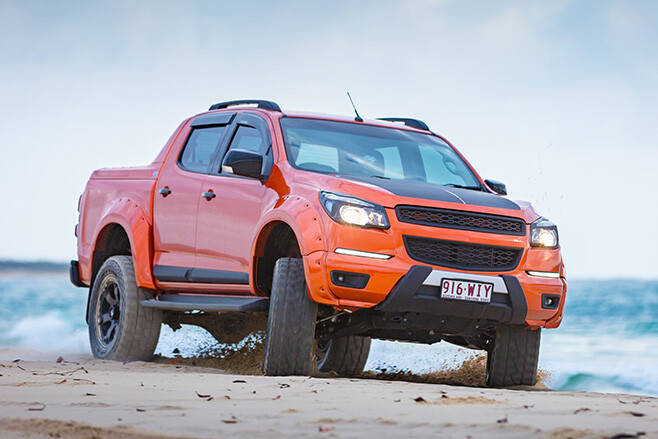
The vehicle you’re looking at is essentially the prototype for a business rarely seen in Australia, even less so in the 4×4 market. A 340rwhp LS3-powered V8 Colorado that earns the moniker of Z71 with an engine conversion the likes we’ve never seen before. “I’ve been reading the magazine and always wondered why won’t Holden build this, Ford build that.” Tony told us. “I figured, why can’t we do it?”
2017 Holden Colorado Z71 Quick Review
To kick-start the project Tony teamed up with Steve from Killa Kustom Kables & Conversions and set to work. As nothing like this had ever been done before, Tony purchased a statutory write-off RG Colorado that’d allow Steve to slice his way through sheetmetal and the electrical system to see if the conversion was even viable. Physically getting it in the engine bay was the easy part.
With no commercially available adaptors and nothing but blank stares when the topic of electrical integration came up, the pair had their work cut out for them. After countless hours spent on the project, and more than a little electrical wizardry, the write-off was powered up and Tony was on the hunt for a suitable replacement that would be a little more fitting of what the team had in mind.
The heart of the beast is a General Motors LS3 V8 engine. A 6.2-litre, 400hp+ lump normally found in high-end HSV performance cars – although, it has seen service in Corvettes and Camaros.
With around 580Nm available the torque is comparable to the twin-turbo V8 diesel found in 200 Series Land Cruisers, making it the perfect choice for the substantially lighter Colorado.
It’s backed by a 6L80E, a fully electronic six-speed automatic transmission that’s seen duties in everything from Cadillac CTS-Vs through to H2 Hummers and 2500HD Silverados, so it’s more than up to the task of serious off-roading or towing.
The combination feeds power through a secret squirrel adaptor with custom engine mounts, before the standard Colorado transfer case sends drive to front and rear diffs. This isn’t exactly a backyard engine conversion.
2017 Holden Colorado: Research & development drive
That’s the easy part sorted – from here Steve was tasked with making the thing run. Those of you familiar with engine conversions would know how much is involved in the simple side of things, like turning the engine on and off with the key, turning fuel pumps on, and making electronically controlled engines and transmissions talk to each other. Even making factory gauges work accurately is often enough to shelve most projects.
Steve and Tony took things one step further. Through what Steve would only describe as “CAN bus translators” they’ve managed to fully integrate the new drivetrain into the Colorado’s electrical system. That means all your standard fare like speedo, tacho and all the other digital gauges work, but so do some of the trickier things, too.
“You jump in it and everything works like factory,” Tony said. “Hill-start assist still comes up, downhill assist works.” Even things like traction control and climate control are all still fully functional. If Holden was to release a Colorado with an LS3 heart, this is exactly how it would function.
The plan wasn’t just to offer engine conversions, but complete turn-key performance packages that’d rival anything the factory could offer. So, once the driveline was sorted the pair turned their attention to what the rest of the vehicle would look like. Hidden underneath the bright orange bodywork and oversized flares is a full set of Fox 2.0 suspension.
The front sits 75mm higher with Fox remote reservoir coilovers, while the rear has had a slight lift with extended shackles on the standard leaves and Fox remote reservoir shocks.
The result is a package that has the comfort of a standard dual-cab family ute with the off-road performance to handle corrugations, hard cornering and more than a few jumps when the situation arises. The altitude adjustment has left enough room in the wheel arches for 305/70R18 Mickey Thompson ATZ P3 all-terrains wrapped around a set of 18-inch Fuel alloy wheels.
The rest of the Colorado remains reasonably standard, as it was always intended as a showpiece rather than a hardcore tourer. It’s got enough grunt to win more than a few street races, and suspension that’ll soak up your best Baja 1000 impersonation, all while maintaining the full suite of factory electronics and returning 14.0L/100km fuel figures.
Holden Colorado Z71 vs Ford Ranger XLT comparison review
“The Z71 was planned as a mid-tier offering,” Tony said. “We’re aiming to have three different packages all based on low-kilometre, year-or-two-old models for a similar price as a new stock version.” Each tier level will have its own engine package, various trim levels and suspension ranging from better than stock through to desert-racing chase truck.
The Colorado isn’t the kind of custom four-wheel drive we’d normally feature, but you’ll have to forgive us for getting more than a little excited about home-grown 4x4s with pants-tightening power.
FORD has upgraded its 2017 Everest range to include new models, revised pricing and extra features as standard.
To capitalise on the ever-strengthening SUV market, a price-savvy, five-seat Ambiente now starts the model range. Available in RWD and 4WD, the five-seat Ambiente is powered by the same 3.2-litre engine and six-speed auto seen across the range.
“The addition of the five-seat Everest gives more Australians access to an award-winning SUV with five-star safety, space for the whole family and genuine off-road ability,” Graeme Whickman, Ford Australia President and CEO said.”
It’s now $7000 cheaper to plant yourself in an Everest, with the new five-seat RWD Ambiente a $47,990 proposition. Previously, the seven-seat Ambiente ($54,990) was the entry-level offering.
If you prefer power transferred to all wheels (as you should) the cheapest option is the new 4WD five-seat Ambiente, priced at $52,990. While 1000 bucks has been trimmed off the once-base-model seven-seat Ambiente, placing it at $53,990.
Features now standard on the Ambiente include SYNC3 with eight-inch colour touchscreen, dual-zone climate control, driver instrument cluster, 10-speaker audio and running boards.
The mid-spec, seven-seat Trend now receives embedded SYNC3 sat-nav as standard. But, more importantly, the prices of both the RWD and 4WD versions have been slashed by $2K – the RWD now $53,990; the 4WD now $58,990.
The price of the up-spec, seven-seat Titanium has been cut from $76,705 to $74,990.
2017 EVEREST RANGE
Ford Everest Ambiente 3.2L RWD 6-speed automatic five-seat $47,990 (new) 3.2L RWD 6-speed automatic seven-seat $48,990 (new) 3.2L 4WD 6-speed automatic five-seat $52,990 (new) 3.2L 4WD 6-speed automatic seven-seat $53,990 (previously $54,990)
Ford Everest Trend 3.2L RWD 6-speed automatic seven-seat $53,990 (previously $55,990) 3.2L 4WD 6-speed automatic seven- seat $58,990 (previously $60,990)
Ford Everest Titanium 3.2L 4WD 6-speed automatic seven-seat $74,990 (previously $76,705)
FOLLOWING the launch of the Prado Altitude earlier this month, Toyota has revealed a special edition Altitude version of its legendary 200 Series.
The 200 Series Altitude utilises the underpinnings of GXL turbo-diesel models, which means the eight-seater is powered by the Japanese brand’s 200kW/650Nm 4.5-litre twin-turbo-diesel engine mated to a six-speed automatic transmission.
The special edition four-wheeler includes a raft of additions aimed at improving luxury, comfort, convenience and safety. Tony Cramb, Toyota Australia’s executive director of sales and marketing, said: “Comprehensive upgrades make the Altitude the ideal choice for those who aspire to a vehicle that delivers an even more luxurious and desirable package.”
The Altitude carries over plenty of kit from the LC200 GXL – seven airbags, reversing camera, vehicle stability and traction control, multi-terrain anti-skid brakes, hill-start assist, trailer-sway control, 17-inch alloys, aluminium side steps, keyless entry and roof rails – but adds a few more niceties.
Leather-accented upholstery, power-adjust front seats and a refrigerated cool box now live inside, while LED fog lamps, rain-sensing wipers and Altitude badging adorns the exterior.
The driver also benefits from high-quality LED Optitron meters and a 4.2-inch multi-information display.
The 200 Series Altitude asks $93,460 (MRP), meaning you get all the extras and convenience features for a mere $4630 premium over a GXL turbo-diesel.
Limited to just 600 vehicles, you best get in quick.
NISSAN’S luxury arm Infiniti has revealed a QX80 concept which it calls Monograph, at the New York Auto Show this week.
The concept ditches the disturbed dolphin look of the current QX80 model with a more upmarket and commanding style better befitting that of a luxury brand. By fitting a larger radiator grille and raising the headlamps on the front end, Infiniti has achieved a look that is more conventional in the luxury SUV market.
The QX80 is, of course, based on the Nissan Y62 Patrol, and this exterior update could signal what we might expect not only of the next QX80 but also of the next Patrol, which in its current guise is now more than seven years old.
The Patrol is sold globally, and in the USA it replaced the Armada badge. It is powered primarily by a stonking 5.6-litre petrol V8, but there is also a 4.0-litre V6 petrol engine offered in some markets. The lack of a diesel engine option has stifled sales of the Y62 in Australia, but starting at $70,000 the Patrol offers a lot of 4×4 for the money.
By comparison, the current QX80 costs $110,900, and it is looks more than price or engine choice that keeps buyers away. Hopefully this fresh-styled Monograph concept provides an indication of things to come and encourages more interest in the large luxury wagon.

WITH 394mm of ground clearance and approach and departures angles of 56 and 53 degrees respectively, is this the future of off-road vehicles?
Bollinger Motors, a US-based start-up company, is well on the way to unveiling its first, full-electric on- and off-road vehicle.
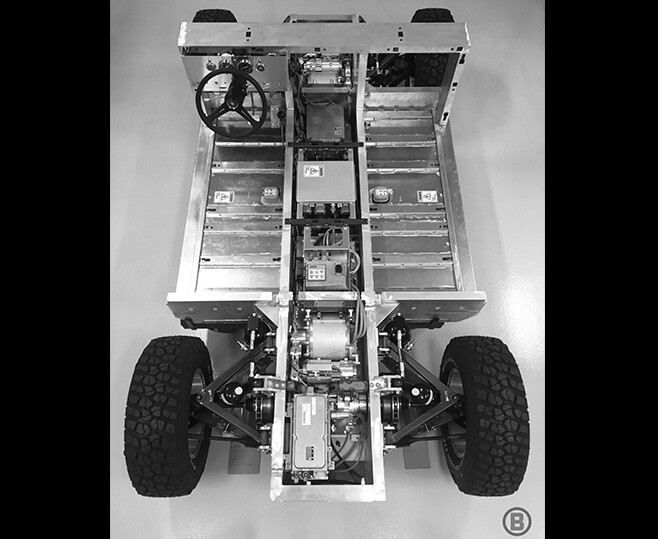
The bare aluminium chassis recently shown by the company reveals a lightweight structure powered by front and rear electric motors, and it features full independent suspension with 254mm of travel, detachable sway bars, massive inboard-mounted disc brakes, and hub reduction portal axles to give plenty of ground clearance and get monstrous amounts of torque to the tyres. Helping with ground clearance and traction are 285/70 17 BFG Mud Terrain tyres.
The chassis has a wheelbase of 2467mm, so think of it as being about 100mm longer than a Defender 90. This means it will be a relatively compact vehicle, and Bollinger is saying the body will be function over form, so again we’re thinking Defender-like.
Bollinger’s press release goes on to say: “Our all-electric medium-duty truck was created with revolutionary storage and hauling capabilities and second-to-none on- and off-road capabilities, making it the perfect work truck which also offers best-in-class ground clearance, torque and traction.”
Nothing has been revealed about the output of the motors, the four-wheel drive system, or the range of the vehicle, but the company is planning a full launch of the completed truck in July this year.
“When I designed this truck I wanted it to have rugged good looks with a very bold presence,” said Robert Bollinger, the company’s founder and CEO. “I envisioned the vehicle as the ultimate truck for work and play, which would be the perfect truck for ranchers, builders, DIYers and off-roaders, but without the environmental effects and carbon footprint of a traditional gas-powered SUV.”
Bollinger’s 4×4 is an interesting project to say the least, and it’s one we’ll be following to see what the final product looks like. We can hopefully let you know how it performs on- and off-road, too!
YEP, your eyes aren’t deceiving you – this one-of-a-kind X-Trail isn’t computer generated. It has been built and it’s debuting later this week.
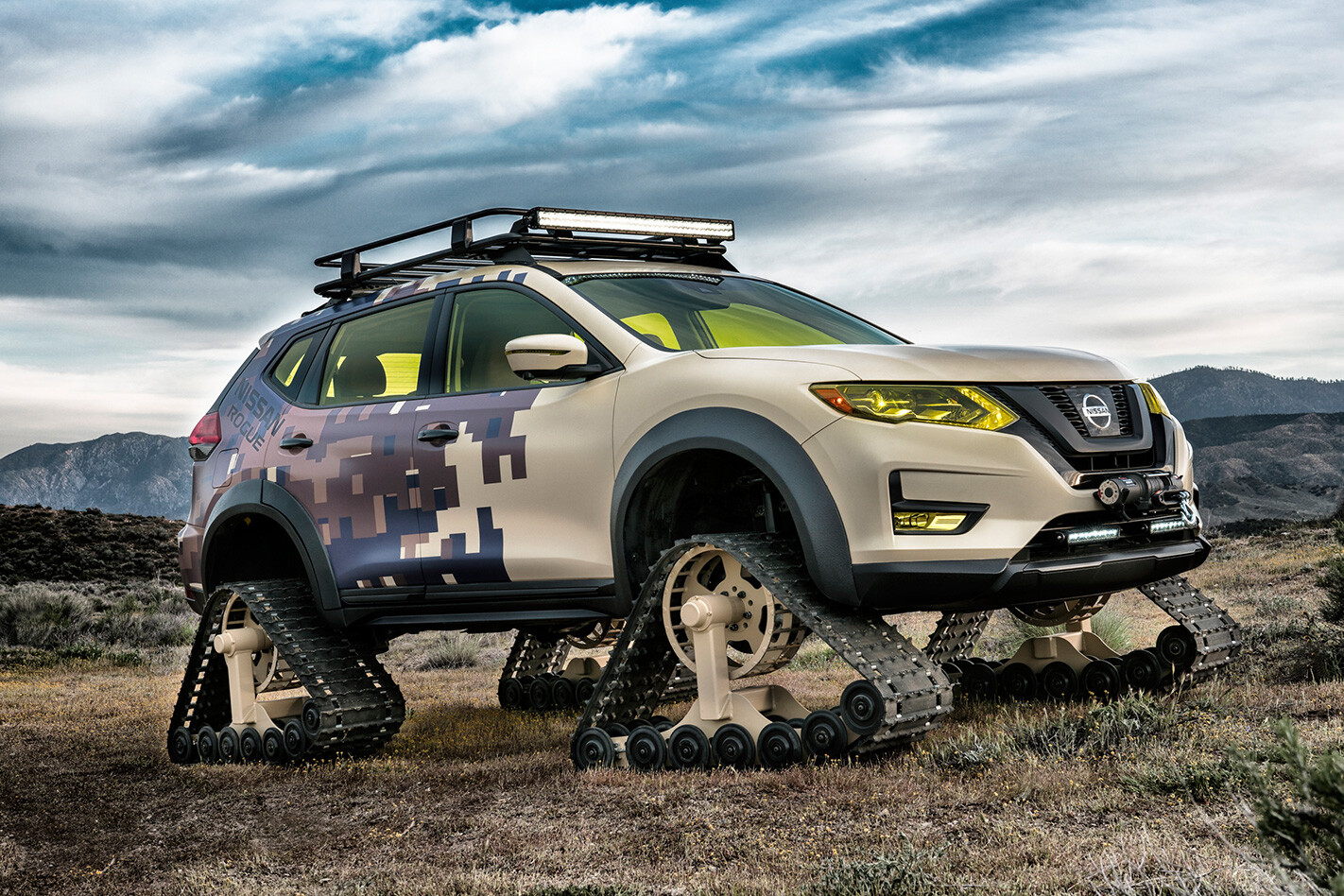
Nissan USA has given the X-Trail’s (called a Rogue for the US market) normally absent off-road ability a lift with its Trail Warrior Project.
Set to debut at the New York International Auto Show later this week, the one-off project vehicle sets itself apart (and above) from the crossover SUV it’s based on thanks to 30-inch-high Dominator Tracks from American Track Truck.
The snow/sand tracks are 48 inches long and 15 inches wide, and they represent a vehicle capable of dominating snow banks and sand dunes.
Suspension and tyre wells have obviously been modified to cater for the track system, but the drivetrain is otherwise untouched. That means the standard 2.5-litre DOHC 16-valve in-line four-cylinder (130kW/237Nm) engine and Xtronic transmission remain.
“This new Rogue Trail Warrior adds a new dimension to family adventures with its snow/sand tracks, gear basket, winch and camo paint,” Michael Bunce, vice president of product planning at Nissan North America said. “If you want to stand out from the crowd during a day on the slopes or the beach, this is the vehicle to take.”
And stand out from the crowd it certainly does, with its special camo exterior wrap and an extensive equipment list that includes tinted headlights, custom fender flares, an ARB gear basket, LED lights and a Warn 4K winch.
Nissan X-Trail ST 4WD: 10 things you didn’t know
The one-of-a-kind X-Trail will cause many a punter to flock to the Nissan display at the New York International Auto Show, running April 14-23.
Who said SUVs aren’t off-road capable?
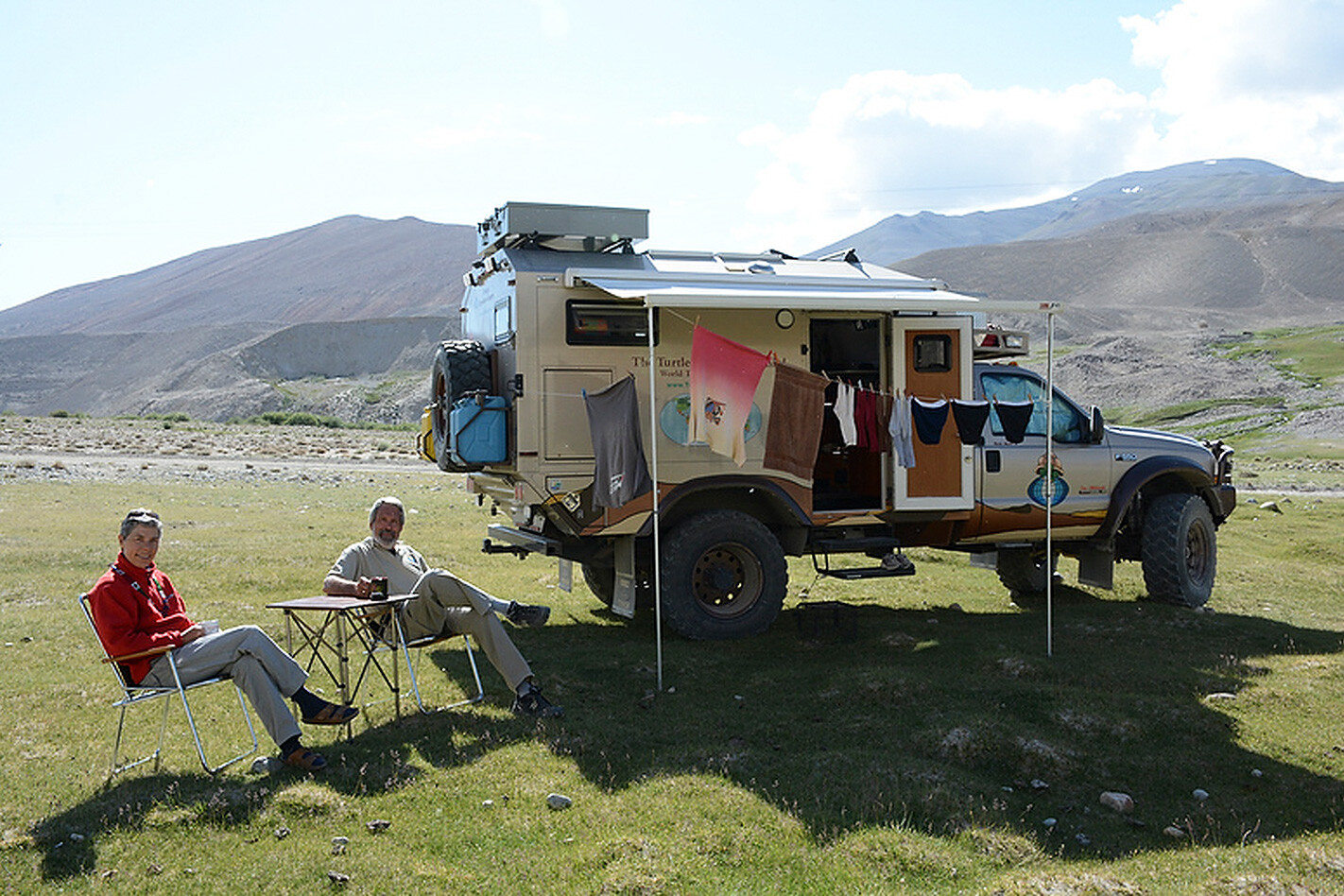
THE NAMES Gary and Monika Wescott are as familiar to overlanding circles as Mallory and Hillary are to mountaineers. They have been weaving an intricate web of tracks across and around our blue planet since the 1970s.
Tales of their adventures have been featured on television shows, in international newspapers, and have graced the pages of magazines the world over. A seed of inspiration that originated at a cafe in Istanbul, Turkey, germinated into a lifestyle that has become the envy of millions. Their method of travel is slow, relaxed, and methodical, and resembles that of their mascot, the Galápagos tortoise. And as is the case with a tortoise, their house is always right behind them.
Like many successful endeavours, this nomadic duo hasn’t achieved overland nirvana alone. They have relied on several generations of Turtles, their latest being the exquisite example of overland bliss before you, the Turtle V. The Wescotts recently returned from a two-year, 64,000km expedition across Europe, the Middle East, Istanbul and Asia, and we caught up with them in Northern California for a detailed look.
Planning an off-road adventure? Explore more here
To the casual observer this global explorer may appear like other uber-overland rigs with a custom home in tow, but further examination reveals features and details that could only be conceived by minds that thoroughly understand the challenges of living on the road, in some of the most difficult environments this planet can dish up.
Gary said, “The goals were safety, comfort, functional performance and reliability. Above all, reliability.” To ensure these objectives were met he worked with the most knowledgeable mechanical and fabrication specialists in the world.
SUSPENSION AND DRIVETRAIN THE LATEST Turtle rolled out of Ford’s Kentucky truck plant with a tough, working suspension, but a number of tweaks would be required to survive its future as a world traveller. The first was to install heavier duty National springs and Rancho RS9000XL adjustable shocks at each corner.
Fore and aft Hellwig sway bars, along with rear Hellwig air-assist bags control bodyroll and the additional weight of the onboard house. The OE duallies were exchanged for Michelin 335/80/R20 XZL MPT tyres on custom 20x11in Rickson wheels.
A Lee hydraulic ram assist keeps them rolling down the road in a straight line. Because the failure of a 41-inch tyre can be disastrous, a SmarTire wireless pressure/temperature monitoring system was added. The final configuration has provided a functional and reliable suspension that is reasonably comfortable.
The decision to maintain a stock-height suspension mandated trimming the fenders to eliminate rubbing. Bushwacker stepped in to assist and used the Turtle as a template to fabricate its first Super Duty cutout fender flares.
Dana 60 and 135S axles, which are fitted with an ARB Air Locker and Eaton Detroit Truetrac respectively, are kept contaminant-free by K&N breathers and take no issue with the 550’s 17,500-pound (7938kg) GVWR. Dynatrac Free-Spin hubs were installed up front after two sets of the factory unit bearings failed.
Twin Extreme Outback compressors and an AccuAir 5-gallon (19-litre) tank support the ARB locker, air bags and Fiamm air horns, as well as power pneumatic tools and any tyre needs. With long hauls through remote regions in its future, a Transfer Flow 33.8-gallon (128-litre) auxiliary fuel cell was installed, increasing capacity to 75 gallons (284 litres) and providing a range of 1000 miles (1600km). A custom switchover valve manages tank selection.
UNDER THE BONNET AND RECOVERY THE BASE vehicle is a 1999 Ford F-550 equipped with a Navistar 7.3-litre Power Stroke intercooled turbo-diesel and six-speed manual transmission. The mill, which was the one millionth Power Stroke off the assembly line, generates 305hp (227kW) and 550lb-ft of torque (746Nm). The OE air filter was tossed in lieu of a more space-efficient system, and Bacon fabricated a custom tray for a K&N high-flow washable unit and Outerwears Pre-Filter.
The truck was ordered with the ambulance package, which allowed for an auxiliary alternator. An externally regulated Prestolite/Leece-Neville high-output unit is managed by a Balmar Max marine charge controller and dedicated to charging an array of ‘house’ batteries. Bringing the Power Stroke to life is a pair of Odyssey Extreme Series batteries and MPA Xtreme starter. Other improvements include an ATS Aurora 3000 turbo, Dieselsite high-pressure oil pump, and Dieselsite coolant filter.
The Buckstop bumper holds an array of PIAA long-range driving and fog lights, as well as a Warn 16,500-pound winch spooled with Viking synthetic line. It has lockable storage compartments on each side, mounts for GoPro and Total Vision cameras, and dual 2in receivers that double as Hi-Lift jack points. A Lund Industries X-Terminator Wrap bug shield (interchangeable with their winter shield) was installed to protect the radiators and coolers from gravel, kamikaze birds and bugs.
OFFICE ERGONOMICS WHEN your office is equipped with a steering wheel, crafting it to be ergonomically comfortable as well as functional can make life on the road a joy. When in the midst of a monsoon or trudging through the emptiness of the Gobi Desert, quick reference to critical vehicle functions is a must.
The cab was initially stripped down and treated with easy-to-clean Rhino lining and Kraco multi-season rubber floor mats. Dynamat was added to the floor, doors and hood to add a measure of noise abatement. Recaro orthopaedic seats with MasterCraft four-point harnesses were installed, and Halon fire extinguishers are within arm’s reach on both sides of the cab. A custom walnut console provides handy access to maps and small items. Overhead is a Cobra CB, Optronics map lights, JRV auxiliary light switches and SmarTire monitor. To aid in hydration on the road, Platypus Big Zip water bags hang from the back of each seat.
A full array of mechanical AutoMeter Pro-Comp gauges ride on the dash in clear view of the driver, as does a Garmin GPS and bright red AutoMeter Pro-Lite (alerts the driver of a sudden drop in oil pressure). A display monitor was added for the Total Vision front, rear and interior cameras, and an Airguide interior/exterior temperature gauge keeps the pilot apprised of possible icing on the road. Due to the F-550’s 30-inch doorsill height (Monika is petite in stature), a set of Kodiak Sidewinder steps which automatically deploy when a door is opened were installed.
A TURTLE IS ONLY AS GOOD AS ITS SHELL TURTLES, though they move slowly and with purpose, do have their own limitations. Their bodies are wide, which can limit passage through narrow, mud-walled streets of third-world villages. Size and weight can be the nemesis of overland vehicles, and these factors were at the forefront of the Wescott’s minds when it came to their ‘shell’.
The superstructure consists of an aluminium exoskeleton fitted with Nida-Core extruded polypropylene composite honeycomb panels skinned with a thin layer of fibreglass. The panels, which are attached to the frame with Sikaflex marine adhesive, are lightweight, provide excellent insulation and are extremely rigid. German-made Seitz dual-pane windows feature roll-up privacy shades and roll-down mosquito nets. Cab-over designs provide an instant bed and additional storage, but aerodynamics and height considerations won out, thus the tapered nose and walls.
When travelling across South America and Siberia, the Wescotts learned that traditional four-point mounting systems flex in technical terrain; the torsional effect causes fatigue to the camper’s frame. The solution was a three-point system commonly used on expedition campers. The two front mounts ride on polypropylene pads while the rear pivots on a single centre point, allowing the frame to twist independently of the camper (you can’t twist a box).
The rear racks hold NATO-style jerry cans and a spare tyre, which is raised and lowered with a one-tonne Maasdam Pow’R Pull manual hoist attached to a removable overhead boom. Below is a set of Darr aluminium sand ladders, and the Hi-Lift jack and gear stow securely in exterior storage compartments. Additional features include PIAA backup/flood lights and Grote SuperNova LED stop/turn indicators.
THE ABODE THE INTERIOR is no less than luxurious, albeit in a condensed form. A dedicated bathroom was foregone for a Thetford Porta Potti that slides on tracks into the doorway, which also doubles as a shower stall. A slide-out bed sits in the back, while the front is utilised as a living room, dinette and work space.
Under the seating area is a 40-gallon (151-litre) water tank and Hunter radiator that keeps the camper warm while on the road. A diesel Espar Hydronic D5 fluid heater plumbed to a Flat Plate heat exchanger provides continuous hot water and will preheat the engine when needed.
When parked on cold nights, an Espar Airtronic (also diesel) keeps the house toasty warm. Filling electrical power requirements is a bank of Odyssey Extreme Series batteries, kept topped off by a pair of roof-mounted BP 85-watt solar panels. A PROsine 100-amp, 2000-watt inverter provides 110 AC and will charge the batteries when hooked up to shore power.
The galley consists of a Magic Chef three-burner propane stove, Dometic CoolMatic compressor refrigerator/freezer (12V/110V) and two sinks. There is ample counter space and loads of storage. With diesel hot water and heat, the two 20-pound (18kg) Manchester LPG tanks are sufficient for three months on the road and can be filled anywhere in the world. Even with the aforementioned luxuries of indoor living at their disposal, Gary and Monika prefer the outdoors. To starboard is a Fiamma crank-out awning for sunny days and rainy nights.
The Turtle V was designed by Gary and Monika (with a pencil and paper) and built with the assistance of craftsmen from around the US. The only major failure was the house door, which was replaced with a custom, one-off unit from Global Expedition Vehicles. Considering it was completed in 2000 (if any build is ever complete) and continues to stand in a class of its own after traversing dozens of countries and spinning the odometer to almost 322,000km, one could argue that The Turtle V is the ultimate live-on-the-road overlander.
As a last question we asked Gary why there is no Australian flag among the many on the back of Turtle V. “Ever since being one of the American journalists on the 1986 Australian Camel Trophy, I have wanted to return to see Australia at my own pace,” he replied. “We have always said, yeah, Australia is on our bucket list, but we’ll do it when were old. It is such a safe place to travel with your own vehicle, but we wouldn’t attempt it unless we had a full year. Getting The Turtle V cleaned and certified for Australian customs might be a challenge in itself.”
SPECS: 1999 Ford F-550 Engine: Navistar 7.3L turbo-diesel, ATS Aurora 3000 turbo Output: 305hp @ 3200rpm; 550 lb-ft @ 2000 rpm (227kW/746Nm) Transmission: OE Transfer Case: 450Nm @ 1600-2400rpm Axles: Dana 60, Dana 135S Differentials: ARB Air Locker, Eaton Detroit Truetrac Tyres/wheels: Michelin 335/80/R20 XZL MPT, 20x11in Rickson Suspension: National springs, Rancho RS9000XL shocks Steering: Lee hydraulic assist Rear suspension: live axle/coil springs Bumper: Buckstop custom Recovery: Warn 16,500-lb winch, Viking synthetic rope, Hi-Lift Fuel cell/gal/range: Transfer Flow/ 75 gal (284 litres)/ 1600km range Compressor: Extreme Outback Extreme Air Batteries: Odyssey Extreme (6) Lighting: PIAA, Grote SuperNova
Check out more custom rigs here
TURTLE TIMELINE
TURTLE I (1970-1981) When Gary Wescott came up with the idea of travelling around the world in a four-wheel drive, a Land Rover seemed like the obvious choice. The Turtle I, Tortuga Azul (Blue Turtle), was a 1967 Land Rover 109 with the spare traditionally mounted on the hood. Gary designed the interior to sleep two occupants and carry enough gear for a five-year trek through Central and South America. The original Rover 2000 petrol mill was eventually traded for a Chevrolet 250 six-cylinder engine. It was fitted with stock bumpers, Dick Cepek tyres and a Warn 8000-pound winch.
TURTLE II (1981-1988) The second Turtle, a Chevy 4WD pick-up, carried a pop-up camper to improve life on the road. The original Callen abode lacked the utility needed and was replaced with a Four Wheel Camper, which served as the Wescott’s home until 1988. After having issues with the original 350 V8, the Turtle II received a big-block 454 and TH400 auto transmission. Accessories included Hobrecht bumpers, a Warn winch, BFGoodrich Mud Terrain tyres, and a Rough Country suspension. A big improvement over the Turtle I was the ability to carry an aluminium fishing boat and an outboard motor up top.
TURTLE III (1987-1996) In 1987, after having their adventure stories printed in numerous mags, Gary and Monika were noticed by Ford Motor Company. They were provided with an F-350 4WD powered by a 6.9-litre International diesel and four-speed manual, the Turtle III. It too received a Four Wheel Camper and Warn winch, along with ARB locking differentials, Alco wheels and BFGoodrich tyres. Its first adventure was a 50,000-mile, 14-month trek through South America, which included the Atacama Desert, the jungles of the Amazon, and 16,000-foot passes of the Andes. Prior to being retired in 1996 it received a new 7.3-litre Navistar turbo-diesel.
TURTLE IV (1992-2001) With a 36,000-mile expedition around the Northern Hemisphere in the works, the Turtle IV, a Ford F-350 turbo-diesel, included mods specifically designed to withstand -60°C conditions. The 7.3-litre Navistar diesel, Four Wheel Camper and cab were upfitted with engine and fuel preheaters, diesel space-heaters, high-tech insulation and a trailer to haul fuel. The Turtle IV had ARB lockers, Rancho suspensions, BFG tyres, a Mile Marker winch, National Springs, Optima batteries, and a K&N air filter and intake system. The Turtle IV completed the wintery expedition before being retired in 2001.
THE descent was steep and scrambly, the Cruiser growling in low-range first as we edged down the track, picking a line to keep us out of the erosion gullies and to maintain all four wheels on the deck as much as possible.
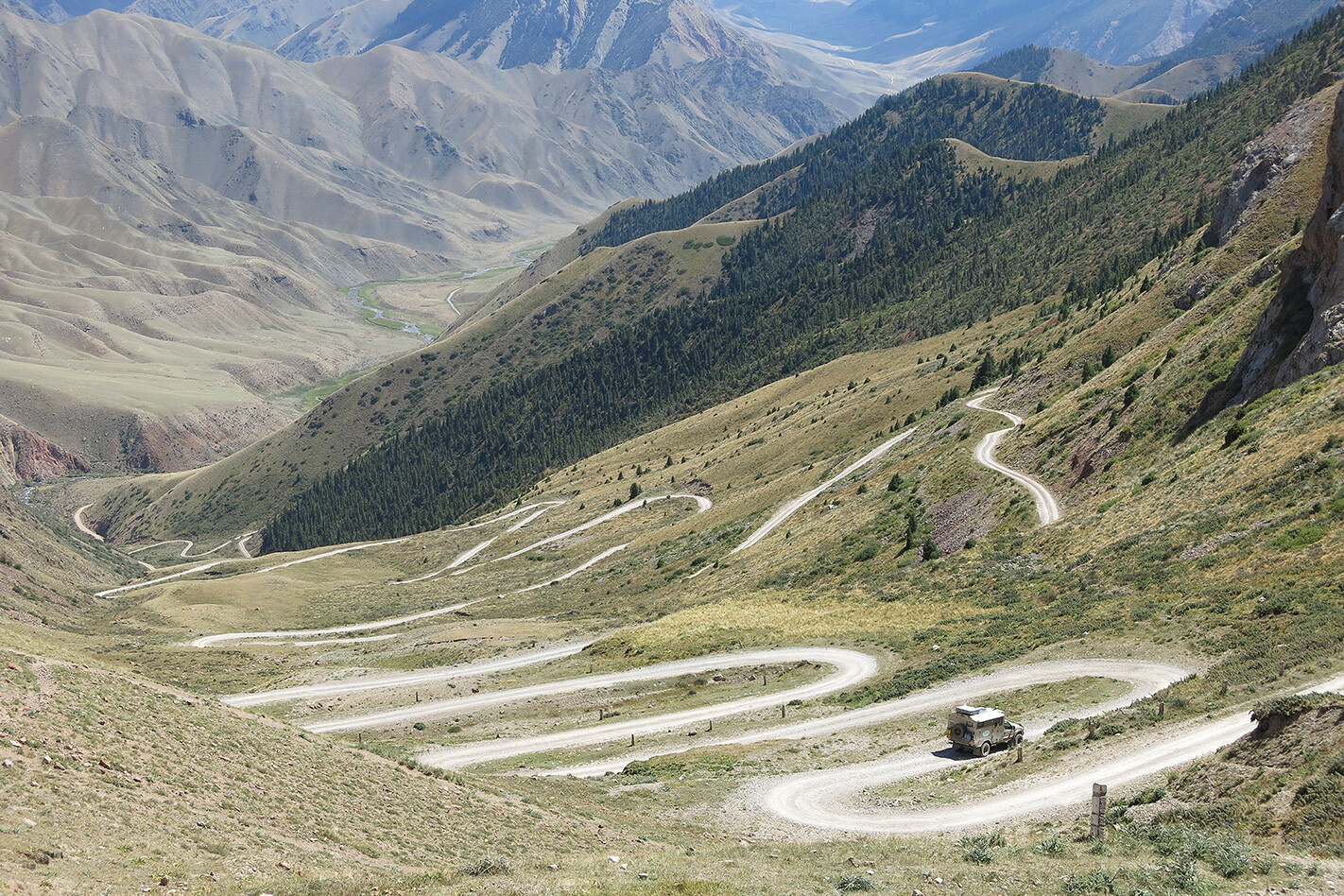
It was relatively simple, really, made even easier by the well-set-up and extremely capable LC76 I was driving. We were mapping and working on the next edition of Hema’s Victorian High Country Atlas & Guide and, while I hadn’t been on this series of tracks for a few years, I knew we had a lot more descents and more difficult climbs to come that would test both me and the vehicle.
We were on the Ingeegoodbee Track having just left the somewhat grandiosely named Barry Way, and almost immediately the track was for 4WDs. A sign at the start gives some indication of its difficulty, with a blunt warning of ‘no trailers’. I guess some rules weren’t meant to be broken.
This tough track – one of the hardest long-distance routes in the Victorian High Country – begins just seven kilometres north along the Snowy River Road from the historic hamlet of Suggan Buggan, or, if you are coming south from Jindabyne in NSW, it’s just 11km south of Willis on the NSW/Vic border.
The route is one of the most important historical tracks in East Gippsland and was originally an Aboriginal pathway. When James McFarlane, from the Monaro in NSW, crossed the remote and mighty Snowy River in 1833-1834 with a mob of cattle, he followed that route and established himself at what became known as McFarlanes Flat. That marked the beginning of the connection with the High Country in Victoria by the famous mountain cattlemen.
Some believe the ruins of the original hut at McFarlanes Flat was the first European building in Victoria, dating from around 1834 and possibly predating the more well-known Henty brothers’ settlement in Portland by up to 12 months.
As European colonisation increased, the pathway through here became the major stock route for the movement of cattle from the Monaro district to East Gippsland, and it opened up the remote forests of the region to European occupation. It also provided a means of communication between early European settlements of eastern Victoria and the more established areas of southern NSW.
The track today immediately becomes steep, climbing to a great viewpoint near Mount Menaak which is worth a stop. A short time later you need to turn west onto the McFarlane Flat Track, with the route north on the Ingeegoodbee Track being gated six kilometres further on. The route west dips and climbs a few times, to get you into the swing of the difficulty level ahead, before making the aforementioned steep descent to the Ingeegoodbee River, some 11km from the main road.
The route continues to be challenging nearly all the way to McFarlanes Flat, which is more a scattering of lightly treed, grassy plains spread through the forest. More substantial grassy plains are north of the main track, and these can be visited by following a faint track that branches off the main route near the remnants of an old fence line. Roughly 500 metres further along the fence the track swings away from the fence line and you will come to the ruins of Buff Rogers Hut (built back in 1981, but destroyed in the 2003 bushfires) one kilometre from the main track. This replaced the much earlier and historic McFarlanes Flat Hut, which is now just an insignificant pile of stones nearby.
Back on the main route you cross the Berrima River and then come to the junction of the Snow Gum Trail. This leads a short distance to a locked gate and is the closest access point for walkers and mountain-bike riders to access the delightful Cowombat Flat, the source of the mighty Murray River and the historic border cairn on Forest Hill. The latter two are only accessible via a bit of a bush-bashing through the spindly snowgum scrub. In fact, it’s best to go to Cowombat Flat and then follow the river up to the springs and the cairn.
The main track turns south at the aforementioned junction and becomes the Cobberas Trail, which enters rugged and steep country as it drops and crosses first Freestone Creek and, 100 metres later, the Suggan Buggan River. The climb out of the valley is long, difficult and extremely memorable.
There are some good views of the rugged Cobberas to the west, and at one point you pass a fenced and signposted research plot just off the main track. There are a few bush camps dotted through here, and you’ll find the best just four kilometres from the main Limestone Road: Playgrounds Bush Camp. It’s a pleasant spot which acts as the starting point for a 6.5km walking trail to the top of Mt Cobberas No 1 (allow six to seven hours for the return trip). From here it is a short drive to Limestone Road and then an easy run to the delightful and large camping area at Native Dog Flat, which makes a good spot to pull up and camp for the night.
Continuing west along the good gravel of the Limestone-Black Mountain Road for about nine kilometres you’ll then turn north onto the Limestone Creek Track. This route begins easily enough and there are some pleasant camping spots dotted along the creek.
As you get farther along the track the route becomes harder and much more challenging, with some steep descents and very hard climbs where you’ll crawl and claw your way to the top of each and every hill. On a couple of these climbs I had to use the Cruiser’s lockers to get to the top – one of the few trails we’ve done during our surveys that demanded such action. Don’t be surprised if you fail and need to back up and try it all over again.
About 12km from the main road you’ll come to a track junction, turning right takes you a short distance to The Poplars, a small but pleasant camping spot nestling beside the fast-flowing waters of a nascent Murray River. Back at the junction, turning left will take you onto McCarthys Track, which again climbs steeply. Once at the top of the climb you’ll be among snow gums and come to a set of cross tracks where you need to turn right (north) onto the Davies Plain Track.
The route, now flat and a lot easier, crosses the small snow pasture of Charlie Creek Plain, before crossing Charlie Creek and passing by Charlie Hut. There’s some very pleasant camping here, but please remain on the main track. If camping, be careful where you pull over as much of the area is boggy and once churned up will take years to recover. The main track then enters thick scrubby country, much of it regrowth from the 2003 fires that ravaged the region.
A little farther north the route comes to a sublime snowy and grassy veld and the Davies Plain Hut; first built in 1892, rebuilt after the 1939 bushfires, and then greatly refurbished in about 1995. There is a magical cleared area around the hut perfect for pitching a tent or throwing down a swag. You’ll often see gang-gang cockatoos around here, while wild horses and deer are also a common sight.
Once you’ve torn yourself away from this magical spot, the route drops just a short distance from the hut to a crossing of the babbling Davies Plain Creek. From here the track descends and climbs through forest ravaged by the 2003 fires. The close-knit scrub often scratches and clings to your vehicle.
Finally you’ll come to Buckwong Creek, a camping area and creek crossing, and from here it’s an easy drive to a major track junction and info sign just south of the Murray River. Veering left will take you to Dogmans Hut and onwards to a number of 4WD routes that eventually take you to Corryong or Omeo. Straight ahead the junction will dip you into a normally shallow crossing of the Murray River, where you’ll climb the northern bank into the southern section of Kosciuszko National Park, with its fabulous camping along the river, some 20km south-west of the ski resort of Thredbo.
You’ll probably breathe a sigh of relief once here, even more so if you have come through relatively unscathed. But I can guarantee you’ll never forget the tremendous camping and the incredibly challenging circuit of steep tracks and snow plains in Victoria’s remote High Country.
TRAVEL PLANNER
- WARNING: Many of these tracks are rated as Double Black Diamond in difficulty (see www.4wdvictoria.org.au for more information) meaning some are impassable and very dangerous in even slight wet weather.
- It’s strongly suggested that trailers aren’t to be taken on any of the difficult tracks. Trailers and vans aren’t recommended on the Barry Way; although we have seen some. Native Dog Flat, Suggan Buggan bush camping area and the camping areas on both sides of the Murray River can easily be reached with an off-road camper trailer.
- All tracks in the alpine area of Victoria are subject to seasonal road closures. For the latest go to: www.parkweb.vic.gov.au/safety/closures
- WEBSITES: Alpine NP Kosciuszko NP
When we drove the 20th Anniversary Jeep and RAM 2500 from American Expedition Vehicles (AEV) last year, the other vehicle they had in tow was a RAM 1500 that was displayed at the SEMA show the week before.
AEV is a long time manufacturer of quality upgrades for Jeep Wranglers and more recently the RAM 2500 Prospector but this is the first time it has delved in to the IFS RAM 1500.
The result of the R&D on that earlier vehicle has just been launched at the AEV RAM Recruit and it includes all the quality upgrades you expect from AEV including Bilstein-equipped Dual-Sport 4-inch suspension.
The 1500 presented a new challenge to AEV with its IFS as all the Jeep and RAM 2500 vehicles have live axles, but they tackled it with their usual professionalism manufacturing specific cast aluminium steering knuckles that maintain correct steering geometry with the raised suspension while reducing unsprung weight.
The 1500 muscles up for the AEV conversion utilizing the front end panels from the heavy duty 2500 vehicles allowing AEV to fit its heat reduction bonnet and heavy duty AEV front bar.
Further protection comes from a 4mm stamped steel skid plate under the front end that appears moulded to the vehicle to give protection while not limiting ground clearance. There’s also a selection of AEV alloy wheels and 35-inch tyres that can be fitted to tailor the Recruit to the owners liking.
Unlike the RAM 2500 pick-ups that are powered by the awesome Cummins inline six-cylinder engine, the 1500’s diesel option is the 3.0L VM Motori V6 that we are familiar with from the Grand Cherokee. It is backed by the 8-speed ZF auto and it was this combo AEV 1500 that we drove in the USA.
Like the other AEV conversions, the RAM drove like a new car, just with vastly improved ability thanks to the clever suspension design, oversized off road tyres and the added clearance afforded by the AEV front bar.
It would be a sensible choice for the driver who doesn’t need the heavy duty ability of the Prospector 2500 and would appreciate the on road performance and drivability of the IFS Recruit 1500.
While the RAM 1500 is not officially sold in Australia there are a number of importers who convert and sell them here.
AEV has two local distributors here – Murchison Products in Brisbane and Jeep Konection in Melbourne and either of them can look after you for all your AEV RAM and Jeep products. See the full range at AEV Conversions.
FROM editing the famous Petersen’s 4-Wheel & Off-Road magazine to fronting Dirt Every Day on The Enthusiast Network, Fred Williams has become quite the big deal in the American four-wheelin’ scene, as he likes to call it.
But far from letting fame go to his head, Fred remains a humble bloke with a great sense of humour and, you might think from watching his videos, just the one jacket.
MAKING MAGAZINES FRED is no Johnny-come-lately on the four-wheelin’ scene; he has been an avid 4×4 fan since he was a kid growing up on the family farm.
“I grew up on a dairy farm, with a bunch of tractors and trucks, and that’s kind of where I got into four-wheelin’,” Fred explained. “I actually wanted a Jeep because I read the same magazine that I eventually worked for, Petersen’s 4-Wheel & Off-Road magazine.”
The transition from magazine reader to magazine contributor was much easier than Fred expected it would be. In the late 1990s Fred had just quit his job in Colorado where he was building sets for shows at an art museum. At the time he was driving an XJ Cherokee, and he tracked down a bloke who wrote stories for 4-Wheel & Off-Road because he wanted to talk to him “about Jeeps and trucks and stuff”. Fred then popped the question: “I asked him ‘How did you get into four-wheeling? Into writing for the magazine?’ and he said ‘Oh, you want to write for the magazine? Call this guy, and tell him I sent you.’
“I really didn’t think I was qualified at all to be a writer, because I was an enthusiast but I was kind of in between jobs. I left Colorado and was just driving around out west and I ran into this guy and, the way he said it, it just seemed a lot easier than I thought it would be.
“So I called the guy that he had told me to call, and I said ‘Hey, I want to write for the magazine’, and he said, ‘Alright, write something and send it to me’. I think I probably spent about a month and a half figuring out how to try and write my very first article,” admitted Fred.
“I actually wrote about a Land Rover. They never ran the story, but then he had me doing other stories… he needed a technical story, then he needed event coverage,” recalled Fred of his early days in magazine publishing. “Back then it took me weeks to figure out which photo I wanted… plus back then everything was still on slide film, so you would have to sort the slides, pick out the best one and write a caption. And when you haven’t done it before, it just seems so hard to figure out. It has definitely become easier over the years.”
After four years as a contributor to 4-Wheel & Off-Road, Fred signed up for a full-time gig as Feature Editor in 2002. “So I was Feature Editor for quite a few years, and then other guys that I worked with either moved on or went to different magazines, so I became Technical Editor,” explained Fred, of what was essentially a promotion. “Basically you’re a Feature Editor, then you’re a Technical Editor and then you’re the Editor, or Editor In Chief.”
After several years as Technical Editor, Fred assumed the head honcho role of Editor In Chief in 2014. “I did that for about two years and, just recently because of my video show which is taking up a lot of time, my title is now Editor At Large,” said Fred.
A NEW MEDIUM THAT video show is Dirt Every Day, and Fred has no one to blame but himself for the creation of this time-consuming beast which has grown in popularity at an exponential rate.
In addition to 4-Wheel & Off-Road, Fred’s publisher (The Enthusiasts Network) also produces a popular car magazine called Motor Trend, which had already started its own YouTube channel. “They were doing all these videos about cars, like two cars head to head or a car driving somewhere, and then they started a second show called Roadkill, which was kind of more of a hot rod, monster garage type thing, where they were modifying cars and doing shenanigans,” explained Fred. “But it was still all on the asphalt, it was all street-based drag racing and all that type of stuff.
“So one day I went to the guy in charge and said ‘You guys should do an off-road show’. Off-road stuff has this third dynamic where you have dirt and dust and hills, and the terrain isn’t always flat and it opens up a whole new perspective on something different for the viewers to watch. Plus we have a huge off-road group in The Enthusiasts Network, so I was like, ‘Why do we not have an off-road show?’
“They didn’t even respond; I sent this email and didn’t get any kind of response for about four to six months. Then they called me in and said ‘We want you to do this off-road show’, and I said ‘No. I don’t want to do the off-road show. I just think you guys should do it’, and they were like ‘No, no, no, we want you to do the off-road show’. “I guess they figured because I wrote for the magazine I could do an off-road video show, and after a while I said ‘Oh well, okay, I’ll do it, but I don’t really have time to do it, so I’ll just do one video a month’, and they said ‘No, you need to do two videos a month’.
“So be careful what you wish for… and what you suggest,” laughed Fred. “The next thing I knew I was the Technical Editor and was doing Dirt Every Day, two videos a month, and I had no idea what I was doing! And they didn’t have any idea what I was doing either, they just said ‘Here’s a cameraman; figure it out’.”
At the start Fred admits to hauling said cameraman up to his workshop where they would try to nut something out to make a video. “It kinda drove him crazy because I didn’t have a plan and I didn’t have a storyline or any of that… I just kind of winged it, and it seemed to work.
“There was a few times the cameraman wanted to kill me because I was so disorganised, but I also had no idea how it was supposed to work, or how to make it work better. I was just like ‘Show up, we’ll do car stuff, we’ll play with trucks’, and it just started to grow from there.
“When it really got crazy was when I was running the magazine. When I got promoted to run the magazine and do Dirt Every Day I was just pulling my hair out trying to get everything done. I mean, being the editor of a magazine is a full-time job, and doing the creative and hosting for a video show is also a full-time job, so I had two full-time jobs going on and not a lot of support, because we were kind of like the unknown off-road show and they just didn’t know what to do with us. So nobody really meddled with it, they just let us go off and do our thing, but it started to grow and grow and grow.”
THE SHOW THESE days Fred and his team put a hell of a lot more planning into producing Dirt Every Day, a show that is not afraid to broach any subject so long as it’s got something to do with off-roading.
“Dirt Every Day is pretty much anything off-road, from vehicles that we build and modify, to off-road adventures,” explained Fred. “We did a trip from coast to coast, border to border, in a brand new Toyota Tundra. We’ve modified vehicles like putting an ARB lift on a new Wrangler in the driveway, just to show people how to do it. And we’ve also done some more crazy stunts like where we turned a 24ft motorhome into a giant go-kart with 46-inch tyres on the back; you would sit on the rear axle, and this Chevy V8 gas engine was way up in the front and there was this giant steering column that ran the whole length of the thing… it was ridiculous.”
Other heavily modified vehicles that have appeared on Dirt Every Day include a twin-engine all-wheel drive Cadillac, an old Range Rover joined up with a Ford Ranger, and a Ford F350 that’s been transformed into a rock-crawling monster truck. And with a little help from his mates and industry contacts, Fred builds all of this stuff himself.
“Yeah, [I build them all] in my workshop and in my driveway,” Fred said. “I have a buddy, his name’s Dave Chappel, and he’s been on a bunch of the shows, but he also has a full-time job so every now and then we’ll get different co-hosts, we’ll bring people in who are my buddies who work on projects who are nearby that want to be on the show, or sometimes there will be somebody who’s a sponsor or an advertiser who wants to be involved and we’ll bring someone in to be a co-host.
“That [motorhome] episode, there was a local college, a university that had an off-road club, so I invited all of these kids over to help tear apart a motorhome; it was awesome, we had like 25 or 30 people just in the driveway ripping a motorhome apart. My neighbours thought I was nuts.”
It was that ‘Motorhome Mashup’ episode that really started to grow the Dirt Every Day audience. “That was our first one that took off, and we got a million views,” Fred said. “When [the show] started I had no idea what were good numbers – how many views meant that the show was doing well.
“One day we did this installation of an ARB suspension on a Jeep Wrangler in the driveway. I was going to do the install for a [magazine] article and I just said, well, bring the camera crew up, the cameraman, the one guy, and I said come on up here and we’ll just film me installing this and I’ll just kind of do it as an explanation, like a ‘how to’. And when Andy Brown, CEO of ARB, called me from Australia to thank me for running a video, I realised this show’s actually doing something; it’s not just my mum and my brother watching it, there’s actually people watching it, because we had got a few hundred thousand, maybe half a million views on it, so that’s when I kind of started realising this thing can go somewhere.”
“So this year we’ve done a bunch of shenanigans,” Fred told us. “We’ve raced a Volkswagen Kombi against a Ford Pre-Runner. And we put a Cummins diesel in a Jeep Wrangler, and in America you don’t get diesel Jeeps, so that was a big deal. After we did that we drove the Jeep underwater, like 12 feet underwater, and that show has just shot through the roof; I think we got over two million views in a week, which is definitely our biggest show so far.”
Fred said the audience for Dirt Every Day is not the same as it would be for a magazine such as 4-Wheel & Off-Road, and that a lot of kids watch the show on both The Enthusiast Network and YouTube, so he tailors it to suit. “We try to keep it pretty clean so that kids can watch it,” Fred said. “Because I’ll go to off-road events and families will come up and their little kids are stoked to ask me questions about Dirt Every Day, so we don’t curse on the show and we don’t swear and we try and keep it G-rated.”
OFF-ROAD ENTHUSIAST FRED Williams is undoubtedly a charismatic character, and one of the main reasons Dirt Every Day has proven so successful is undoubtedly because he comes across as the genuine off-road enthusiast that he is.
“I’ve built lots of project vehicles,” Fred said. “Full-size Chevy trucks, Toyotas, Land Cruisers, lots of Jeeps, Fords, Dodges, gas engines, diesel engines… so I’ve got to build a lot of different project vehicles, I’ve met a lot of different people. It’s kind of cool because it isn’t life or death stuff here; this is people’s pastime, it’s all about fun and adventure. It’s not like we’re curing cancer or teaching kids how to read, what we do here is not needed, it’s all extra credit.
“So it’s kind of fun to have a job where most of the time people are pretty excited to talk to you because the people you’re talking to are other off-roaders, whether they’re in Australia or South America or any different part of America, whether they’re mud boggers or rock crawlers or desert guys or overlanders, it’s a fun occupation because it’s not really that important…
“That’s what’s cool about the whole off-road scene. We’re just out here having fun and we get to meet people who do really cool stuff, really awesome photographers and really great drivers and people that are inventing random little widgets to make their trucks work better. Then the next thing you know, 40 years later, they’ve turned it into a multi-million dollar business. It happens all the time.”
Fred and Red
FRED even met the girl of his dreams while four-wheelin’.
“One place we go every year is Moab, Utah, for the big Moab Easter Jeep Safari,” explained Fred. “I was on this trip two years ago and there was a girl who was working in the Jeep booth. I said, ‘Hey, we’re doing a night run tonight. Do you want to go along?’ and she and her sister both worked in the Jeep booth and they were like ‘Yeah, we’ll come.’
“So a bunch of us piled into Jeeps and headed out. I was leading the group and this girl Ashley was riding with me. We got halfway through the trail and it was really dark and one of the guys radioed to us and said ‘I’m runnin’ out of fuel, I gotta turn around’. So we turned the group around and headed back to town, but now I was at the back of the group.
“Then I heard a funny noise coming from my Jeep… the left front tyre has fallen off. So I’m out in the middle of the desert, I’ve got this girl with me who I hardly know, everybody else has ditched us. So we’re out there with this broken Jeep, no spare tyre, no jack, barely any tools and it’s getting dark.
“So I say ‘Here, hold this flashlight’, and I run the winch line up into a tree, winch the front-end off the ground, steal some lug nuts off of the other wheels, bolt the wheel back on with three lug nuts, and we start heading back into town. Eventually the rest of the group figures out we’re not there, so they turn around and come back, and when they get back to us the girl talks to her sister and then she ditches me, she gets in another vehicle and they leave.
“So I’m like, well, that goes to show, your Jeep breaks, the girls are gonna ditch ya. But it actually turned out for the better, because I spoke to that girl that night, and just about every night since then for the past two and a half years.”