
IN A WORLD where free information reigns supreme, it’s often difficult to find the diamonds in the crap.
All it takes is a quick search online to find thread after thread of ill-educated opinions sprouting off some nonsense about whatever happens to be the latest trend in internet-land. $30 canvas seat covers apparently as good as the Aussie-made gear, humungous suspension lifts that’d rival Goliath in terms of size and likelihood of failure, and the latest hair-brained idea that seems to be gaining momentum faster than a rich, old billionaire – removing emissions equipment for such incredibly valuable reasons such as “it sounds better” and “me mate did it and loves it”. It’d almost be comical if it wasn’t having a serious effect on engine longevity.
What we’re referring to is the growing trend of tampering with and removing important emissions systems such as Exhaust Gas Recirculators and Diesel Particulate Filters. To get to the bottom of it we’ve gone straight to the source, with three of the best diesel experts all throwing their weight into an on-going battle between good and evil, the underdog and the all-powerful government, and internet modifications and common sense.
Enrolled in this month’s instalment of tech advice is Andrew Leimroth from Berrima Diesel, Paul Farrell from Geelong Performance Centre, and Stephen Booth from PowerTorque Victoria.
UNDERSTANDING EMISSIONS SYSTEMS
WE ARE big proponents of the internal combustion engine around here. They’re fantastic inventions that have given millions of people the ability to travel long distances with a load in relative comfort. That said, they do have a downside, and it’s a doozy.
Forget all the back and forth about climate change and emissions effects on the earth, it’s a scientific fact that diesel emissions cause lung damage, respiratory problems, acid rains, smog, and cancer in humans. It’s a direct result of the various emissions they produce such as Carbon Monoxide (CO), Hydrocarbons (HC), Nitric Oxide and Nitrogen Dioxide (NOx), and soot or Particulate Matter (PM).
These three systems all work in varying ways. Catalytic convertors, most commonly found in petrol 4x4s and more recently in diesels, are used to convert carbon monoxide, hydrocarbons and nitrogen oxides into less harmful carbon dioxide, water and nitrogen. DPFs add another layer of complexity, aiming to break down large diesel particulates (soot) into smaller, less harmful ash. Paul added: “Similar to a catalytic convertor, a DPF removes diesel particulates from the exhaust gas.
There are pressure sensors either side of the DPF which are monitored by the vehicles ECU. When the pressure gets high enough, indicating a certain amount of blockage, the ECU commands what’s known as a burn. The injection timing is retarded, which heats the DPF to a very high temperature and burns the particulates out of the DPF.”
A new system known as SCR or selective catalytic reduction injects a mixture of deionized water and urea, commonly known as AdBlue, in a further attempt to reduce diesel soot. “It’s mostly in the American stuff,” Stephen added. “They’re usually a stage of emissions ahead of us.”
HOW AN EGR WORKS
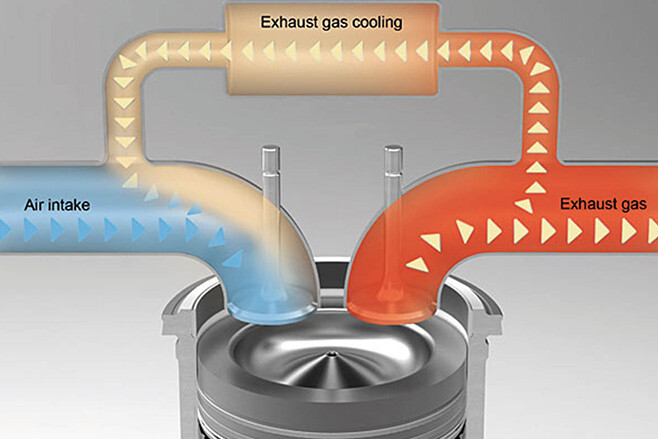
WHILE most common emissions systems are designed to deal with harmful pollutants after they’ve been made – filtering them out in various ways – EGR is designed to prevent them being made in the first place. NOx is formed when Nitrogen and Oxygen molecules are present with temperatures north of 1500°C and is responsible for the smog often seen in cities, as well as acid rain.
As diesel engines rely on heat rather than spark to ignite, NOx has been a constant problem when talking diesel emissions. One way manufacturers have tried to curtail the production of NOx in the first place is to lower combustion temperatures. “What an EGR does is effectively plumb hot exhaust gas from the manifold back into the intake, re-burning exhaust gas.” Paul said. “The end result is less emissions out the tail pipe.”
Flash tuning 101: ECU Re-mapping
The net result of this is replacing flammable oxygen with inert exhaust gases, causing a colder combustion cycle and lower levels of NOx formation.
However, things aren’t always how they seem. Andrew brought up the point that while the basic design of an EGR system hasn’t changed drastically, their purpose has. “EGR was about NOx emissions before, but that’s sort of evolved with the new diesels having much lower compression than old,” he said. “Instead of running at around 450-500psi they’re getting down as low as the 300s using high pressure common rail injection, precise timing and multiple injections to get a good burn at lower compressions.” All of this results in naturally lowed NOx emissions, leaving the EGR there for efficiency reasons rather than emissions.
THE BAD
ON PAPER an EGR sounds like a pretty damn good piece of kit to have on any 4×4, allowing the manufacturer to control combustion temperatures, reduce emissions, and do so with minimal complexity. Why then are so many people rushing to block off or even remove these systems? “Eventually the EGR gunks up the intake system,” said Stephen. “The combination of oil and vapor combined in the inlet manifold clogs it up.” The oil vapor he’s referring to is caused by engine blow-by, a completely separate operation in any engine but one that causes catastrophic issues. Around each piston in an engine are a series of piston rings, designed to help seal the combustion chamber and allow the forces of igniting diesel or petrol to push down on the piston, rather than past it. The problem is these rings don’t make a perfect seal.
As the engine runs through its strokes, small amounts of pressure are able to escape past the piston rings and into the lower half of the engine, pressuring the crank case. To relieve this pressure, manufacturers fit a breather to the top of the rocker cover that allows the oil-misted air to escape. Rather than this misted air venting into the atmosphere it’s plumbed into the intake, the result is a thin film of oil coating the inside of the intake manifold right through to the combustion chamber.
When the spent exhaust gases are reintroduced to the intake they stick to the oily residue and build up. “With the two of them combined it’s a recipe for disaster,” said Andrew. “The inlet manifold gets blocked up, but it’s only because it’s all oily and wet. If the EGR was by itself it wouldn’t happen anymore than you would see in an exhaust pipe. It’s not really there to recirculate the soot, but by the nature of a diesel engine it does bring them through.” Paul added that on his routine services he often comes across clogged intakes that require a full strip-down to clean. “We’ve seen the intake ports blocked down to less than 50 per cent of their original size.”
WHAT ARE YOUR OPTIONS?
RATHER than an EGR being the issue as so many people believe, the problem is the inlet manifold becoming clogged from a build-up of oil residue and exhaust soot. Remove either one and there’s no longer an issue. Luckily, one is a whole lot easier to do than the other. “Most people can get away with fitting a decent catch can like a Provent to remove the oil vapor,” Stephen said. “If that’s done most of the exhaust gas soot goes straight through without sticking to the inlet manifold.”
It’s worth mentioning there are varying quality levels when it comes to catch cans, and a price spectrum that ranges from spare change to a few hundred dollars. On the budget end is your typical alloy box (an inlet in and an inlet out). The problem is these rely on magic to remove the oil from the air, which isn’t too successful and can often have issues like reduced openings which can cause a build-up of pressure inside the engine. This can cause gaskets and seals to blow out from the inside, resulting in an engine literally pumping its oil out the dipstick tube.
Quality items will generally run a filter element, which will remove the oil from the air as it passes through and drastically cut down any oily residue in the inlet track and prevent the exhaust soot from building up. These filters are often either plumbed back into the sump, or are manually drained to remove the oil build up. To prevent over pressurisation if something is clogged, they’ll often have a pressure release system as well.
The other more drastic approach is to remove the EGR system itself. With no exhaust soot going through the intake system there’s nothing to stick to the oily residue. In simple engines this can be achieved by physically installing a block-off plate that will stop the gases flowing through the system, although most modern engines will register the block and throw a code, possibly causing your 4×4 to go into limp mode. In many late-model vehicles a custom tune can instead stop the valves from ever opening, but that does come with more issues than it’s worth.
THE REPURCUSSIONS
THERE are a few considerations you’ll have to make when you find yourself with that $20 eBay plate and a set of screwdrivers in hand. The first and most likely to make people pause for consideration is warranty. Most manufacturers are well within their legal rights to knock back any warranty claims that are even loosely related to a modification you’ve made, legal or otherwise. As the EGR system is directly related to a turbocharger failure down the track, it could see you out of pocket for any repairs, even unrelated problems where the EGR removal shouldn’t have caused an issue can still see you in a battle with fair trading to get things fixed.
From there the serious risks start. Sure, you’ll cop an on-the-spot fine from Mr Plod for driving a defective vehicle if you’re found, but there are much bigger things to be concerned with than that. The Protection of the Environment Operations (Clean Air) Regulation of 2010 states: “The owner of a motor vehicle who uses the motor vehicle, or causes or allows it to be used, must ensure that at the time of that use, any anti-pollution device that has been fitted to the motor vehicle has not been removed, disconnected or impaired, or adjusted or modified in such a way as to result in the emission of excessive air impurities by the motor vehicle”.
The penalty that little piece of legislation can net you is 200 penalty units as an individual or up to 400 as a business. Big deal, right? Well, it would be if penalty units weren’t around $150 a piece in some states. That’s a maximum fine of near on $30,000 for blocking or removing your EGR system or DPF from your exhaust. Are you likely to get caught? Probably not, but don’t go bragging about it on social media, either. After all, there are smarter ways to get the job done that won’t ruin you financially.
CONTACTS
BERRIMA DIESEL SERVICE Ph: (02) 4877 1256 W: www.berrimadiesel.com
GEELONG PERFORMANCE CENTRE Ph: (03) 5277 2503 W: www.geelongperformance.com.au
POWER TORQUE VIC Ph: 0417 558 799 W: www.facebook.com/powertorquevic/
THE Cape York Peninsula is an incredible natural environment, with breathtaking sceneries, long and sandy beaches, the largest lowland and tidal (mangrove) rainforests in Australia, the longest parabolic sand dunes in the world, perched dune lakes, endless monsoon woodlands, coastal flood plains, arid grass lands, an abundance of riverine systems that feed waterfalls, tidal estuaries, and wetlands that extend to far horizons.
These environments house a vast array of wildlife and flora native to the area, including the largest reptile in the world: the misnamed saltwater (Estuarine) crocodile. Put simply, it eats people if they’re stupid enough to ignore the dangers – and people are killed every year across the tropics. The crocs live in both fresh and saltwater environments, sometimes hundreds of kilometres inland in stream pools and billabongs. They also inhabit remote islands and coral cays in the Coral Sea.
The Cape has seen little change since Lieutenant James Cook raised a flag on Possession Island, just west of the Cape’s Tip, in 1770. It remains sparsely populated with less than 20,000 people calling it home.
The official historic border of the Cape is north of Mitchell River and Rifle Creek at Mount Molloy. The official scientific border is the longitudinal line that extends from Cooktown to Pormpuraaw, but no-one takes much note of it. The “scientific” Cape is about 115,350km² in size and extends more than 1000km from Cairns to the Tip. It’s bounded by the Great Barrier Reef lagoon to the eastern side, the Torres Strait to the north, and the Gulf of Carpentaria to the west.
The Cape only has two seasons, Wet and Dry. For the Wet, the amount of rainfall and the season’s duration varies from year to year. It’s recommended not to travel once the build-up of rainfall commences in November, with the Wet proper often beginning anytime from Christmas and lasting until late-April. Many bush tracks remain closed until June, and National Parks rarely open until mid-May. The times of travel and track openings are totally dependent on the vagaries and the duration of the Wet.
Access to the Cape is possible via the Peninsula Developmental Road (PDR), which extends from Lakeland, south of Cooktown, to Weipa. The urban myth that the region is a third world country is far from true, as much of the PDR has long stretches of bitumen and well-maintained dirt sections. In fact, about three quarters of the road will be bitumen by 2018.
Currently the PDR is sealed as far as Laura, with long stretches of bitumen sections extending to Weipa. Sealed roads are being continuously added and are the cause of complaints from many 4WD travellers who reckon the Cape is losing its wilderness identity. That may be so, but people who live there are just as entitled to good roads as the rest of the country.
However, more adventurous routes run from Cooktown via the Battlecamp and Starcke tracks. The latter is maintained as far as the Starcke River, before a proper bulldust track takes over and runs to the Rinyirru or Cape Melville National Parks. Even more isolated routes are from the Burke Developmental Road between Mareeba and Kowanyama. Check it out on a Hema Cape York Map.
Laura, Coen, Weipa and Portlands Road are small towns and are backed up by roadhouses at Hann River, Musgrave, Archer River, Moreton and Jardine. Hope Vale and Lockhart River are the only Aboriginal communities on the east coast, while Pormpuraaw, Aurukun and Napranum are on the west coast. There are five communities in the Northern Peninsula Area (NPA): Injinoo, Umagico, New Mapoon, Seisia and Bamaga.
These communities have supermarkets, post offices, schools, medical centres, police stations, as well as fuel, basic supplies, limited mechanical repairs, accommodation and camping facilities. Permits aren’t required to visit Indigenous communities or Deed of Grant in Trust (DOGIT) lands, but no alcohol is allowed, even when passing through.
The roadhouses have accommodation, campgrounds, meals, fuel and some basic repairs, while Cooktown, Weipa and the NPA stock almost all supplies.
Most of the land in the Peninsula is DOGIT titled, which means it’s owned by Indigenous people. The rest consists of National Parks and reserves, which are jointly managed by Queensland National Parks and Wildlife and the traditional owners.
There are few limitations to camping along roads and tracks. Many people overnight in roadside burrow pits, parallel to running streams, on the beach, or under a shady place. Others prefer a meal and shower at a roadhouse or township, or even a comfortable room for the night (book ahead if you wish to do that).
All Aboriginal communities, except Napranum and a few on the NPA, have basic campgrounds and motel-style accommodation. Some restrictions may apply and people are asked to respect the customs and avoid speeding, as children and dogs play in the streets. The only campfire restrictions on the Cape are when you’re in National Parks, as it’s claimed animals use dead timber for shelter and fires may pose a fire risk.
Thanks to the maintenance of the PDR, Bamaga Road and the main arteries to Pormpuraaw and Portland Roads, a Cape trek isn’t hard. However, a 4WD vehicle is highly recommended for exploring remote and infamous tracks like the Old Telegraph Track (OTT), the Frenchmans Track and others. Most stock standard 4WDs are fine, unless you want to drop it off the bank into Gunshot Creek.
A bullbar and an external intake snorkel are must-haves if you plan to cross rivers and creeks on the above mentioned tracks, while driving lights are recommended as there are plenty of wandering kangaroos, horses and cattle. Modified tyres aren’t needed unless you plan to go up in the Wet season – I use Toyo M55 All-Terrains and they’re simply amazing when it comes to driving on rough bush tracks, no matter what the surface is like. The tyres should be 36psi on the PDR and elsewhere but down to 16psi for sand and beach excursions, so invest in a reliable air compressor and tyre gauge. Also carry spare radiator hoses and driving belts, shock bushes, bearings, grease and rags, a comprehensive took box, recovery gear and plenty of drinking water.
Tents and off-road-capable camper trailers are popular for these tracks, and rooftop tents are recommended by neurotic urban travellers who are in constant fear of snakes and crocodiles. However, a 30-second Oztent, or a mozzie dome, rain shelter and swag is all you need. Rooftop tents restrict movement of the vehicle if you wish to go for a drive from the camp, and people also tend to fall down from vehicles when they forget where they are at night.
Keep a Cape trip simple by keeping weight down and improving mobility. A camp oven and barbecue plate is simple to cook on over an open fire, and small Gasmate stoves are hugely popular. A folding table and chair is a must, as is a 4x6m tarpaulin for use as a fly for a semi-permanent camp – because it often rains on the Cape, especially early in the Dry season when the trade winds slam into the east coast. You can use poles and ropes for it, or tie a length of rope between two trees for an A-frame to provide shelter from sun, dew and rain. Also carry some winter gear, as parts of the Cape can cool down to 5-8°C during June-July.
To get the most out of your Cape experience, do the research and visit the many towns, communities and people. Above all else, enjoy camping out under the stars with the dingoes howling in the darkness.
CAST A LINE
FISHING is one of the main reasons people visit the Cape, and it’s as easy as sitting on one of the many jetties or beaches at: Cooktown, Seisia, Elim Beach at Hopevale, Cape Flattery, Melville Bay, Bathurst Bay, Lloyd Bay, Chili Beach, Captain Billy Landing, Pormpuraaw, Weipa and the NPA.
The jetties, beaches and estuaries offer barramundi, trevally, queenfish, Spanish mackerel, cod and more. The only problem on the east coast beaches and some estuaries is that when the southeast trade wind blows the froth off the waves makes fishing often impossible. But on the west coast the trade winds blow over the coast and touch down about two kilometres from shore, leaving a calm inshore corridor that has amazing fishing. There are also many streams and estuaries where a boat or tinnie is a must.
Barramundi is what makes the Cape tick. If you are a barra virgin, hire a guide when in Cooktown, Weipa or Seisia and find out how it’s done. Take a selection of hooks ranging from 3/0 to 5/0, sinkers and a good reliable rod and reel. Both mono and braid lines needs to be 20lb or better.
If you don’t have any barramundi lures buy them in Atherton, Cairns, Cooktown or Weipa. Their prices are comparable or better to those in the south and they only stock the lures and colours that the fish bite on. Plus, you get updated information where the fish are biting and on what.
Port Douglas and Cooktown are the closest towns to the Great Barrier Reef, and regular day charters operate to the reef for sight-seeing, diving and fishing.
TIPS AND TRICKS
FIST-sized rocks hurtling towards your windscreen are common sight, and if you hit an airborne rock at speed you’re up for the cost of a new window. Slow down to 60km/h and move off the road to avoid it. Never switch into another “lane” on dirt sections, where piled-up gravel ridges divide the track, at speed. Vehicles will fish-tail and, in a worst case scenario, roll over.
When overtaking, call the vehicle ahead on channel 40. Radios are almost mandatory, as there is a lot of 50m-long road-train traffic. Some folk don’t like moving over, so give them the road and save your windscreen. Sometimes it’s best to take a break, boil the billy and go for a walk.
Article originally published in May 2013 issue of 4X4 Australia.
THE dual-cab ute, once only a work-ready commercial prospect, is now a multi-function, family-friendly, fun-seeking off-road rig. Choosing the best fit for your needs is all about balance and compromise for optimal work and play.
You also need to decide if your ute will stay in its OEM skin or whether there are sufficient aftermarket accessories to take your new toy to the required level of off-road performance.
When John Ludlam from ARB’s head office in Perth called me to say the lads had just finished putting the final touches on their new Ford Ranger dual-cab tourer, I was keen to take a closer look. I wanted to see what had made the cut to improve the capability and appeal of this popular mining workhorse and what it offered to private buyers.
The Ranger is a formidable vehicle. There’s accommodation for five adults, with acceptable head- and legroom, and an interior design that embraces tough truck visual appeal but offers comfortable, supportive seats and good visibility. The creature comforts also fall easily to hand.
A punchy 3.2-litre five-cylinder diesel – albeit a little rough at idle – with the optional six-speed auto is the preferred option over the manual to exploit the engine’s torque characteristics. Given a respectable payload of 1000kg and a deep long tub the base product ticks all of the practicality boxes.
Modified rigs take it to the next level as an extension of the owner’s style and personality. With the Ranger, ARB has spent considerable time and effort to ensure its products match and complement original OEM standards and quality. The colour-coded bullbar gives the Ranger a purposeful, muscular stance, further enhancing the Ford’s square jaw-line, as opposed to its kissing cousin, the BT-50. The bar has solid steel construction, quality welds with improved structural integrity at critical points, finished in the same Ford blue colour. With optional side-steps and rails, there’s additional protection to underbody doorsills and front quarter guards.
The rear step, encompassing a hitch rated to the Ranger’s tow capacity, will help minimise damage to rear panels and tailgate. It also provides a stepping point, covered in alloy chequerplate, to reach gear stored on top of the smooth-skinned canopy on the roof-rack. A set of Intensity LED driving lights and new snorkel design complete the aesthetics. But beauty is only skin deep – we wanted to know how the mods would improve the Ranger’s capability as a serious tourer.
The Old Man Emu (OME) suspension was the first aspect to be scrutinised. In standard guise, despite its commercial pedigree, the Ranger demonstrates predictable on-road dynamics, offering a relaxed ride that soaks up most blacktop irregularities without jarring your back. Nicely weighted steering and a flat stance in all but the most enthusiastic cornering, it’s not a bad base from which to start.
In town, the OME suspension gives nothing away in terms of original road-holding and – cornering comfort – it actually fills in the gaps and irons out the minor irregularities for an even smoother ride. The OME development team has even provided different suspension options. Rather than a one-size-fits-all scenario, you can tailor your suspension set-up to intended loads and terrain to be travelled.
Front spring rates have subtle increases over original units; our test vehicle has them matched for carrying a bullbar and winch. Where the OME suspension particularly gains in ride quality is in the development and tuning of the strut configuration, which offers an extra 25mm of travel with improved shock-absorber control across changing terrain. Overall ride height is bumped up by 50mm.
There are three leaf-spring options for the tail-end, from light to medium loads with supple ride comfort, to the heavier 300 and 600kg constant load springs. If running the heavier units, the matched greasable shackles and U-bolts are a worthy investment. Despite the Ranger’s sizable GVM, a further GVM upgrade is under development.
Punting around sweeping country bends, the vehicle’s ride control over dips and rises is markedly improved, significantly reducing the twitchiness that is characteristic of unladen utes. While the rear bar, canopy, roof-rack and fridge packed with goodies added a little downward load, we suspect the improvements in control offered by the OME’s calibrated spring and shock set-up would become even more evident after adding in the real-world weight of mum, dad, kids, camping, fishing and recovery gear, plus hooking up a camper-trailer.
Twisting up the Ranger over embankments, gullies and rocky outcrops we needed every one of the extra 25mm in travel. With articulation at its limit and steep turns covered in ball-bearing gravel, the Ranger’s rear diff lock was engaged on more than one occasion.
Watching the suspension from the outside as it was being compressed, then fully extended, was interesting. Dealing with torturous angles as we picked a path through rocky outcrops confirmed the breadth of control achieved off-road, without sacrificing well-mannered on-road handling.
The additional underbody protection plates provide reassurance over rough terrain where large jagged rocks are happy to act as nature’s impromptu can openers for sumps and transmission oil pans.
With bodywork protection and handling sorted, what about touring practicalities? Drop a canopy on most utes and you’ve got a covered storage area that will dwarf most wagons for volume. But, unless you enjoy unloading everything to get to the bottom of the pile, a set of cargo drawers to stow important gear that can be easily accessed is a must. The Ranger’s deep, long tub means the double drawers are cavernous. After mounting a large fridge on the slide and packing standard recovery gear into one drawer, there was so much room left that the gear looked rather sparse – not a bad problem to have when packing for a big trip.
The new Outback drawers are modular, providing several different options depending on the gear you want to carry. Their operation is smooth, and the easy-grip, positive locking handles will be a benefit when the drawers are fully loaded. We also appreciate the “don’t chop your fingers off” cut-out in the top of each drawer.
The canopy has load-bearing framework on the inside, allowing the roof-rack to be mounted up top. This particular roof-rack had mesh flooring, ideal to strap down lighter gear, such as a swag, canvas clothes bag or roof-top tent – because the roof-rack is open at the front and rear (no bars), longer items can be stowed with the addition of front roof bars on the vehicle. We’d choose easy-release bars to remove when not required, as you may notice wind noise from the bars above the cab. The rack is positioned well back on the canopy, helping to minimise noise intrusion in the cabin. The canopy can be optioned with sliding or lift-up side windows for easy access, with security mesh installed if needed.
The quick set-up awning is child’s play for one person, and the storage bag easily unzips and peels over backwards to stay out of the way. Unfold the canvas, drop down the pivoting support legs and tension bars and – presto – cool shade to enjoy a comfortable lunch break.
Diesels have more frugal drinking habits, but the need to carry extra fuel for extended trips away can be a challenge. The Long Ranger tank installed in our test vehicle is the larger of two options available. The 150-litre model increased carrying capacity by 88 per cent and we found it didn’t impact on the vehicle’s ramp-over angle when cresting hill climbs. There’s also a smaller 132-litre version – offering a 65 per cent increase over standard – which finishes flush with the base of the chassis for those buyers who prefer maximum clearance.
The importance of clean, dry air for a diesel can never be underestimated. A snorkel is a logical addition if you’re likely to be travelling on sandy and dusty gravel tracks, or know your adventures will include plenty of water crossings. Safari has crafted a design to exceed the airflow needs of the 3.2-litre donk. The body is a durable, thick-walled, UV-stable polyethylene material, with brass inserts to secure it to the vehicle. Its unusual potbelly design adds a curved look not often found in boxy snorkels. But, apparently, it’s all about creating effective airflow, not following vehicle curves or making a new fashion statement.
Safari suggested the ram will help separate water if driving in a heavy downpour. Given the heat wave experienced in Perth at the time of testing, there was no way we’d get the chance to test that claim. However, we did find the ram effective at catching clean air after several hours on very dry gravel roads heavily coated in a fine, talcum powder-like dust.
The standard Ford Ranger is a solid performer in a sea of dual-cab variants. Drive one for any length of time and you quickly grow accustomed to its well-mannered persona. Like those comfy hiking boots or your favourite denim, it’s just easy to live with.
ARB’s Ranger is a good example of what can be achieved when setting up a dual-cab for touring, with well-chosen accessories properly matched to the recipient vehicle and fit for the driver’s intended use.
WELL, I finally put my money where my mouth is. I found the perfect Land Rover Series III the other day on Gumtree – restored, neat body, hardly any rust, immaculate interior, a load of accessories and my favourite light green with white roof. I contacted the vendor and organised a time to inspect said vehicle, which was precisely 100km from my place according to Google Maps.
Despite having three days’ notice, when I arrived to have a look the vendor was milling around the front of the Landy trying to refit the battery, which he’d earlier had on the charger. Once the battery was back in situ and the cables were attached, he tried to fire up the engine, which he said hadn’t been started for five months or so. After turning over a couple of times the little 2.25-litre four came to life, with barely a puff of smoke from the tailpipe; so far so good. Then it stopped.
At this point the vendor told me he probably should have put fuel in the Landy the previous day… but he hadn’t. He then headed off to the servo with a jerry can and didn’t return until about 30 minutes later.
The vendor fired up the Landy again and I jumped in the passenger seat for our first lap around the block. To show me how effective the brakes were he slammed them on as we exited his driveway, and my head almost went through the windscreen. I suggested a little warning might have been nice.
I jumped behind the wheel for our second lap and was pleasantly surprised by how well the little Landy handled and rode; it was certainly much better than my old Series IIA. When we returned I put an offer on the table, telling the vendor precisely what I though the car was worth. Despite his Gumtree advertisement stating the price as “negotiable”, no negotiating took place; he simply refused my offer and bade me farewell.
As I drove away I started to wonder if I’d let a good Landy get away, but then I reminded myself that the apparently ‘non-negotiable’ price was simply too high. I would keep looking.
I had a change of heart when I again started perusing Gumtree a few days later. No, I didn’t go back and buy the ‘non-negotiable’ Series III; I spotted a 1994 Defender 110 Wagon up on the Sunshine Coast with a price tag that seemed too good to be true. I called the vendor, was assured that the Defender “drove beautifully” and arranged to meet at Sunshine Coast Airport at 11.05am the following day.
I live in Wollongong, so my day began at 6am when a mate kindly gave me a lift to the train station. I arrived at Sydney airport with an hour or so to spare before my flight to Queensland was due to depart, so I found a little café that did a wicked bacon and egg brekky and a decent coffee. Despite its reputation, the Jetstar team almost managed to get the flight off the ground as scheduled, and we were only about 10 minutes behind when we landed on the Sunshine Coast.
Now, whenever I put a car on the market I make sure it’s as clean as it possibly can be. You know – washed, polished, vacuumed and smelling fresh. While I never expected a cheap and well-used ’94 Landy to present very well, I at least thought it might have been subjected to a quick tidy up, but no, not this one. In fact, it was a bloody mess.
I had a look around and could immediately see the thing was leaking oil from all seals and orifices, but hey, that’s just a Landy thing, right? I could see there was some rust in the lower door frames, but nothing that couldn’t be fixed. I took it for a drive and, while I had concerns about a clunk in the driveline and a wobble in the steering, I thought these too were solvable problems. After all, this thing was a steal at $10K. Streuth, it even had air conditioning, front and rear ARB Air Lockers, a dual battery system, a roof rack and an Ironman 4×4 awning. The vendor was also chucking in a Bahco toolkit, an inverter, a battery charger, a pair of MaxTrax, a high-lift jack and a few other extras.
For better or worse I did the deal and began the 1200km drive back to the ’Gong. And a fantastic drive it was! I stopped at the nearest servo to check fluids and tyre pressures, and it was here that I noticed each wheel was shod with a different brand of tyre, even the spare! The steering wobble was bad at 90km/h but settled down at 100. The window washer came on but wouldn’t switch off until the reservoir was almost empty. And on a couple of occasions the throttle jammed when I floored it to climb steep hills. But I loved every minute of it.
I made it home by 2.30am and the Defender immediately marked its territory on the driveway. Yep, I’ve got plenty of work in front of me, but I’m pretty damn happy about it.
DECENT lighting is invaluable for off-roaders, whether it be to illuminate a freeway to avoid kamikaze kangaroos, light up a path on a night-time rock-crawling adventure, or just for scooting around town.
This is advertiser content.
Piranha Off Road Products understands this better than most, and it also knows that LED lighting has fast become the norm for light bars, headlights and driving lights.
So, it has created an LIDL3 LED wiring harness to help get those lights shining brighter, longer and wider.
“There are a multitude of ways to increase vision at night, from different globes, higher wattage globes and the like. However, they will only be as good as the wiring that carries the power to that globe,” said Alan Johnson, MD of Piranha.
“Traditionally, 4WDs and some cars had very poor halogen lighting, so we developed the Super Loom kit which introduced superior wiring and relays, which made the lights perform at their peak. From here we created driving light looms to get those lights firing at peak wattage as well.
“With the introduction of high output LED lighting the wiring was again the weak link, so we developed an LED-specific wiring loom which still incorporates a relay and gives vehicle owners the ability to easily mount their light bars pretty much anywhere on the vehicle, as the loom has been manufactured with extra length.”
The Australian-made loom, including a 40amp relay, will set you back $65. A range of switches to suit various vehicles can also be purchased.
CONTACT Website: www.piranhaoffroad.com.au; www.facebook.com/piranhaoffroadproducts Phone: (03) 9762 1200
AN off-road-ready concept of the upcoming T60 ute was unveiled by Chinese carmaker LDV at the 2017 Shanghai Motor Show.
The T60 Off Road Concept differs from the double-cab 4×4 ute it’s based on thanks to some heavy head-to-tail tweaking.
Most notably, the concept 4×4’s raised suspension has been strengthened via the addition of heavy duty springs and adjustable shocks. The improved suspension is assisted further by insertion of heavy duty flairs in the wheel arches to cater for off-road tyres and alloy wheels.
Hyundai Santa Fe becomes first passenger car to cross Antarctica
Pesky rocks and sticks are kept clear of vital components via full-length, heavy duty underbody protection, which also improves approach angles at the front.
Further additions over the base-model ute include a matte-black grille; a heavy duty front bumper hiding a winch and additional lighting; a heavy duty rear bumper with towing shackles; a heavy duty roof rack housing a light bar; strengthening beams in the load tray and engine department; and a snorkel.
Not resting on its laurels, LDV also built a concept version of its upcoming D90.
The D90 All Terrain, based on the SUV version which was revealed earlier this month, has had its bog-standard wheels and tyres replaced by an all-terrain track system – like something you’d see army tank.
Boosting ground clearance substantially, as well as providing extra traction and a wider foot print, the new tracks are built to carve through snow, sand and mud.
The stock T60 ute and D90 SUV will debut in Australia this September, and full details and pricing will be available towards the second half of 2017.
THERE’S no RAA in Oodnadatta, no RACV halfway up Billy Goat’s Bluff, and you’ve got another thing coming if you try and call the RACQ with a flat tyre at the bottom of Gunshot.
It’s this reason we bang on about self-reliance and maintaining a well-stocked tool kit like a deranged bearded man preaches the end is nigh. And while the deranged bearded man might not hit the mark, you can bet your bottom dollar having the knowledge to get out of trouble – and the tools to do it – has saved more than a few lives on outback adventures.
This month we’re taking a look at one of the most under-rated pieces of equipment in any off-roaders kit: the jack. Now it’s easy to get excited over the latest laser-guided pneumatically operated mega jack, but unless you’re prepping your Prado to take on the Baja 1000 tools like that are often not the right tool for the job and will seriously eat into the fuel funds.
Here we’ll be looking at the pros and cons of the most typical jacks you’ll find in any 4×4, from high-lifts and exhaust jacks through to the stock one under your back seat right now.
OEM OEM (Original Equipment Manufacturer) jacks are often the first things people bin when buying a new 4×4. They’re seen as underpowered, undersized and of little benefit when you start installing suspension lifts and larger tyres. They often come in two varieties: screw-type or scissor jacks.
Scissor jacks earn their ridicule for low safe working loads (SWL), flimsy construction and low lift height, but screw jacks are undeserving of the hate. They’re simple in operation, with a pinion gear running against a crown wheel much like a diff. As the pinion and crown wheel spin they spin a worm gear, which pushes the lifting plate up or pulls it down.
The benefits of a jack like this are that there’s very little that can go wrong with them, and almost nothing that could cause instant failure under normal operation. Due to being able to run one worm gear inside of another they also have a surprising amount of lift for such a small package – our one tested having 230mm of lift for a maximum extended height of 420mm. Even with 35in tyres a Cruiser or Patrol’s axle tubes will be a maximum height of around 400mm, so the stock jack with a 50mm-thick timber base plate will still lift enough to change a tyre.
Unfortunately, life isn’t all sunshine and roses. Screw jacks often have limited lifting capacity under 2000kg, and depending on how heavy your 4×4 is lifting one end off the ground can overload the jack. However, they’re useful for lifting a wheel off the ground to change a tyre, or as a press to replace bearings in the field.
BOTTLE JACKS OFTEN seen as an upgrade to the screw jack, hydraulic bottle jacks are one of the most common jacks you’ll see. They’re available in multiple SWLs, from as little as 2000kg right through to 20,000kg; although, unless you’re planning on balancing five fully loaded 4x4s on the one jack, those weights may be overkill.
Much like a screw jack, hydraulic bottle jacks are incredibly compact, often occupying the spot the OEM screw jack came in. Rather than a series of gears inside, a bottle jack works by pumping hydraulic fluid from the storage container (the large bottle-shaped part) into the chamber underneath the jack’s ram. The benefit of this over a screw jack is the huge mechanical advantage you get, making it easier to move heavy loads.
The downside is that due to their design they aren’t able to lift as high as a screw jack. Despite having a larger capacity (10T) our bottle jack had a maximum lift height of 480mm with only 140mm of available travel, and a further 80mm in the screw top adjuster. They’re also considerably heavier than a screw-type jack and are more difficult to lower due to requiring the pressure release valve to be cracked, rather than a second pump to pump it out. Careful attention should also be paid to not damaging the seals.
Bottle jacks provide a larger lifting force over a smaller distance, and they’re available in many sizes. Some can be optioned with angled V mounts to more securely grab an axle tube; although, that will remove their ability to be used as a press. They’ll serve as a suitable replacement to an OEM jack, but whether or not they’re an upgrade is up for debate.
TROLLEY JACKS WHEN it comes to heavy lifting, trolley jacks are often seen as the go-to option. Much like a bottle jack they work by pumping hydraulic fluid from one compartment to another. Ironically enough, most trolley jacks require a bottle jack hidden underneath the main arm to do the lifting.
Trolley jacks are undoubtedly easier to use on flat ground than either bottle or screw jacks. They trade lifting capacity for speed and can have a wheel jacked up and back down before a bottle or screw jack could even reach the axle tube to start jacking.
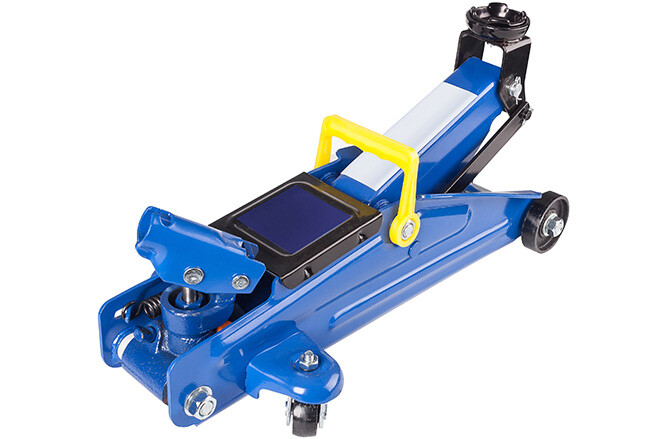
Lifting capacities range from 1400kg to 3000kg, and a longer reach allows you to position the jack underneath the 4×4 without having to get under there yourself. Due to their large base they’re also far more stable than most other options.
On the downside they’re incredibly bulky and heavy, taking up considerable storage space and eating into your GVM. They offer around 300mm of lift, which isn’t much when they start from as low as 130mm, but 300mm is plenty when fitted with an extension; although, due to the arc they operate on, the jack will need to roll freely underneath to keep the 4×4 centred, which can be difficult in rough terrain. Some off-road-specific versions are becoming commercially available, and they offer skid plates to prevent them sinking in soft terrain and have had their weight cut down to 20kg.
If you’re planning on doing a lot of lifting and don’t want to swing off a jack handle for 20 minutes, then a trolley jack is a great option, but you trade a lot of benefits for speed.
HIGH-LIFTS THE ubiquitous high-lift jack is almost a fashion choice for many off-roaders, being firmly attached to rear bars and roof racks with often very little understanding of why it’s even there.
Unlike the previous jacks, a high-lift works more like a ladder. The spine has holes along its centre which allow the pins, or feet, of the lifting mechanism to walk their way up. With a long handle and very little distance between holes, the mechanical advantage is huge. They’re generally rated over 2000kg and offer lifting heights unheard of in any other type of jack. They can also be used in a variety of other roles such as a homemade press, tyre-bead breaker, or even a make-shift winch if the $50 special and free stubby cooler leaves you in the lurch.
The downside is they’re incredibly unstable, and the jack handle has bested more than a few jaw bones over the years. They’re also tall and won’t fit under the vehicle, so can’t be used to jack an axle tube up, instead relying on slings or limiting straps to get the job done.
They’ve become part of the overlander uniform and it’s not without reason, they just shouldn’t be the go-to tool if you need to change a tyre or work on your brakes. Think of them as part of your recovery kit rather than a jack and you’ll have years of success.
EXHAUST JACKS EXHAUST jacks can be completely useless in one tool kit, and a god-send in another. Their design and operation is incredibly simple: a heavy-duty bag that’s taller than it is wide slips underneath the 4×4, while a connection hose slips over the exhaust tip. As the exhaust gases fill the bag it pushes upwards, lifting your 4×4 off the ground.
They’re lightweight and pack flat, making them easy to store behind seats, down the side of drawers or anywhere else that’s usually dead space. They also have the largest base of all the jacks and are able to easily conform to uneven terrain, making them perfect in soft sand. Their low profile also means you can easily slide them under bogged vehicles.
They offer around 750mm of lift, which is huge if you’re bogged but not a great deal if you’re attempting to raise a lifted 4×4 off the rock sliders. They’re also rated up to around 4000kg, but aren’t recommended for lifting underneath axles or any sharp or hot objects. On the downside they are vulnerable to damage, aren’t easy to control up or down, and have a very narrow range of uses.
If you’re constantly travelling on sand they can be an absolute life-saver. On rocky or reasonably firm terrain they’ll rarely be the best option.
FIVE RULES TO WORKING ON A RAISED 4X4 1: A STABLE BASE Unless you’re lifting a can of coke with a trolley jack, chances are you’ll be putting a significant amount of weight onto a concentrated point. High-lifts, bottle jacks and screw jacks all benefit from a base when lifting on anything other than hard-packed dirt. They can also provide a more stable platform that prevents the jack from slipping.2: THE RIGHT JACK Don’t use a high-lift when a bottle jack will do, don’t use a bottle jack when you need a high-lift, and don’t use an exhaust jack if you’re planning on getting under it.
3: DON’T BE A PANCAKE Stop and think about what you’re doing. In even the most routine jacking operation you’re lifting a tonne or two into the air and balancing it on one shaft. What will happen if it comes off? Axle stands and a set of wheel chocks are an absolute must in any situation. If you’re out bush then at least throw the spare tyre underneath.
4: KEEP IT LOW The higher you lift something, the less stable it’ll be. Not just because the 4×4 is higher, but because jacks become less stable the higher they’re wound up. It amplifies any movement at the bottom and can quickly push the 4×4 off the jack.
5: PREDICT THE FUTURE When you lift a 4×4 you change its centre of gravity, what’s holding it in place, and how stable it is. Think about what you’ll do and what effect it will have on the rest of the 4×4. Will turning the wheel you’ve just lifted off the ground force one of the fronts to turn, rolling you off the jack? Will jacking it up in the first place send it careening downhill, warranting connecting the winch line before you lift it? If you’re on your own changing a tyre you’ll still be on your own if you roll your 4×4 or break your tools. so use your noggin.
Article originally published in December 2014 issue of 4X4 Australia.
VERY few of today’s 4x4s can trace a direct line of ancestry back through history like the Suzuki Jimny Sierra. In much the same way a contemporary Jeep Wrangler is the direct descendant of the original Jeep ‘created’ by the US Army in World War II – and the current Land Rover Defender is the descendent of the original 1948 Land Rover – today’s Jimny Sierra is the latest incarnation of 45 years of Suzuki 4×4.
Suzuki’s history dates back to 1909, but back then the company didn’t manufacture cars, 4x4s or even motorcycles. When founded in 1909 by Michio Suzuki it was known as the ‘Suzuki Loom Works’ and it produced textile-spinning looms for Japan’s silk industry.
In 1937, Suzuki decided to expand into the auto industry. However, plans for its tiny 800cc car were shelved during World War II because the Japanese government declared civilian cars to be non-essential. Following the war Suzuki returned to producing textile machinery, but in 1951 it produced a motorised bicycle called the ‘Power Free’. By 1954 Suzuki was producing 6000 motorcycles per month and had officially changed its name to Suzuki Motor Co., Ltd. A year later it produced its first production car: the ‘Suzulight’.
Fast forward to 1968, when Suzuki bought the small Japanese car company Hope Motor Company, which had just introduced a tiny 4×4 called the HopeStar ON360. Suzuki re-engineered the HopeStar, including adding its own air-cooled 360cc twin-cylinder two-stroke engine, and launched what was called the LJ10 in 1970.
This was a very basic, open-top 4×4 with canvas doors and just three seats, as the spare sat inside the vehicle behind the driver. This was so the LJ10 wouldn’t exceed – for registration reasons – the external size restrictions for its class in Japan. The LJ10 weighed just 600kg and had a wheelbase of less than two metres. It was built on a separate chassis and featured leaf spring live axles, front and rear, as well as a part-time dual-range 4×4 system. Two years later the LJ10 was replaced with the LJ20, which brought with it a slight jump in power and water-cooling to its two-stroke engine.
In late 1975, following the success of the LJ10 and LJ20 on the domestic market, Suzuki decided to export the little 4×4, with an initial focus on Australia. To this end Suzuki repowered the LJ20 with a water-cooled 540cc three-cylinder two-stroke engine, and in doing so created the LJ50.
Available as a soft-top, canvas-door model or as a hard-top, metal-door model, the LJ50 was an instant success in Australia; both as a recreational 4×4 and as a farm vehicle. Even though the three-cylinder engine produced just 25kW and 57Nm, the LJ50’s light 635kg meant it had adequate performance and a top speed nearing 100km/h.
More significant was the fact that its light weight meant the Suzuki wasn’t fazed by soft surfaces such as sand and mud and, in its day, the mighty midget embarrassed many bigger, more powerful 4x4s.
The final iteration of the LJ series, the LJ80, arrived in Australia in 1978 and was powered by a 797cc four-cylinder four-stroke engine that claimed 31kW. This was a simple, single overhead cam, eight-valve carburettor engine. The body featured larger flared wheel arches and a higher bonnet line to accommodate the taller engine. The track was also widened, the final-drive gearing raised and the interior upgraded. A long-wheelbase ute version, designated the LJ81 and called the Stockman in Australia, was also introduced.
The second-gen model, called the Sierra in Australia but going under a variety of names around the world, arrived in Oz in July 1981. It came with a 970cc SOHC eight-valve four-cylinder four-stroke engine that claimed 39kW and was mated to a four-speed manual. It was available as a soft-top, hard-top or a long-wheelbase ute.
In 1984 a new 47kW 1324cc four-cylinder four-stroke engine, mated to a five-speed manual, was added to the range – the 970cc engine continued in the ute and cab-chassis variants. A soft-top built on the long wheelbase was also introduced in 1984 and a high-roof variant was subsequently introduced.
In 1991 the 1324cc engine made way for a new 1298cc engine that claimed 47kW – the 970cc engine and four-speed manual soldiered on in ute and cab-chassis models. This model line-up continued during the 90s with a short-wheelbase soft-top, a short-wheelbase hard-top, a long-wheelbase soft-top, a long-wheelbase ute and long-wheelbase cab-chassis versions. Given there were various state distributors for Suzuki in Australia at this time, different variants were available in different states.
In late 1996 the Sierra’s underpinnings were revamped with coil springs replacing leaf springs, although the live axles and separate chassis’ were retained. This brought about much-needed improvement to the Sierra’s on-road handling and general civility – though there’s still much debate as to whether the leaf springs or coil springs are better off-road.
In late 1998, the third-generation model, dubbed the Jimny and later referred to as the Jimny Sierra, arrived in Australia. The Jimny not only looked entirely different to its predecessor but was also longer, wider and, unlike the Sierra, only came in one body style. The Jimny featured a new engine, shift-on-the-fly 4×4 engagement and came with the option of a four-speed automatic. Underneath, however, it retained a separate chassis and coil-sprung front and rear live axles.
The new engine retained the 1298cc capacity of its predecessor but gained a 16-valve head and fuel injection for a 12kW power boost. It claimed 59kW and 104Nm. However, that engine was short-lived and in October 2000 a new 1328cc engine with double overhead cams arrived. This only bumped the claimed peak power up by 1kW (to 60kW) but the peak torque increased to 110Nm. It also offered more low-rpm torque, better fuel efficiency and lower emissions. Later that same year a soft-top arrived, but this was fazed out in late 2002.
In early 2005 the Jimny gained a refreshed style and a revamped interior, while the engine adopted variable-valve timing, which jumped the peak power to 62.5kW. While the peak torque remained at 110Nm, the torque at lower engine speeds was increased and both the five-speed manual and the four-speed automatic were upgraded. The Jimny also gained push-button 4×4 selection, but one negative was that the new VVT engine asked for premium 95RON fuel.
An update in October 2014 saw the adoption of electronic stability and traction control, as well as a new wheel design, new instruments and a new steering wheel.
HOLDEN DROVER
HOLDEN sold a rebadged version of the Suzuki Sierra from March 1985 until 1987. It was mechanically identical to the Sierra with the 1324cc engine and five-speed manual and was offered as a soft-top, standard hard-top, a ‘Deluxe’ high-roof hard-top and as a long-wheelbase ute and cab-chassis.
WHILE Mercedes is busily testing the first all-new G-Class in almost four decades, the outgoing model is saying farewell with a very bold statement: a stretched landaulet that goes by the name of Maybach.
With an impressive silhouette that makes the prototype Rolls-Royce Cullinan look like a Smart Fortwo, and a level of luxury that’s way beyond what we’ve seen in the Bentley Bentayga, Mercedes-Maybach claims it to be the ultimate SUV. Period!
Riding the gigantic G-Class is truly elevating in two ways: Literally, because Mercedes is using the same portal axles that we know from the AMG G63 6×6 and G500 4×4² variants, in combination with mighty 22-inch wheels. That raises ground clearance to almost 500mm and lifts the driver higher than in any other stock SUV on or off the road. While going through the African jungle on a luxury safari experience, you feel more like riding an elephant than being stuffed into a tin can on wheels. And figuratively, because stepping up the electrically powered running boards is like stepping up in society and being king at least for the day.
Since Mercedes wants the Maybach Landaulet to be the cream of the crop, the engine choice was easy: the most powerful one they have in stock. So, once again, the G-Class uses the V12 Powerpack that we know from other AMG 65 models, just with a nobler, understated sound. And, as it turns out, it’s definitely the right choice. Because neither the Landaulet’s 3.3 tonnes or its shipping container-like aerodynamics faze the twelve-cylinder much.
463kW and 1000Nm are more than enough for a very smooth and effortless ride. And even if there are a lot of cheaper SUVs with better acceleration times and higher top speeds, it’s an impressive, heart-stirring experience to pilot this giant from 0 to 60mph in less than six seconds, or to push it up to 112mph (180km/h). The faster you drive it, the more grateful you are for the 300 additional millimetres of track width and the stretched 3428mm wheelbase. Finally, the G-Class no longer drives like a frightened, wild animal on a game drive. Instead, it’s become as secure and dignified as a charging rhino.
But as fascinating as the drive might be, it’s even more captivating to sit back one row and let someone else do the work behind the wheel. There is simply no other SUV and no convertible with as much backseat comfort as in this Landaulet. The private jet-like comfort starts with massaging and air-conditioned seats from the S-Class that can be reclined into a bed position. It continues with increased leg room, a bar complete with silver champagne flutes, and an impressive infotainment system. This backseat can quite easily be considered the most luxurious sunbed in the world. And to avoid people peeking in and seeing your belly button during that intimate ride into the great wide open, you can raise a roll-up partition between yourself and your driver while letting the roof down – both at the push of a button.
But privacy may not exactly be what the typical buyer of this type of vehicle is looking for. In which case, this Maybach is also the perfect choice. One just needs to stand up, grab the massive handles that you already know from the dashboard and stick your head out of the giant roof to feel like the pope on tour.
The Maybach Landaulet might be the most comfortable and promising G-Class ever, but it’s also one of the most disappointing – at least for anyone showing up after the first 99 lucky customers have put in their order for one of these limited edition SUVs. After that, no more Maybach Gs will be built, regardless of how much money one puts on the table. And even if the estimated $750,000 price tag makes the Maybach G650 Landaulet the most expensive Mercedes in the line-up, they won’t have any problems selling them.
However, the sad and frustrated can take some comfort in knowing that the next generation G-Class is not far away. And even though it may not be as wide and generous as this regal ride, it will be the most comfortable G in history. At least for us mere mortals.
Want more? Click the gallery above for more images…
THE web-based booking systems used to reserve campsites in Australia are a bloody pain.
It started in Queensland a few years ago and has now spread to all states, but thankfully not all parks and reserves have taken this system on board. The parks that utilise the web-based systems include all the parks on Cape York, the Bungle Bungle Ranges in WA, and many parks in other states.
Devised by someone who sits in an office all day and hasn’t a clue about the requirements of the travelling public, the web-based booking system requires you to plan your trip down to each and every day and night before you leave home.
This web-based system may work pretty well for people who stay a week or more at the one spot, but it’s a bloody pain for the many of us who tour and camp on a whim. The system makes no allowances for breakdowns, and it also surmises that you have phone and/or web access while travelling. Mobile phone access remains an issue Australia-wide once you get away from the cities and major regional centres, and web access is generally much worse.
Case in point: We were in the Little Desert NP in Western Victoria and decided we’d camp for the night at the next designated campsite. Of course, we found when we got there that there was no self-registration shelter or pay-in box, and the only way to camp legally was to book and pay online. Trouble was, while there were a couple of signs telling us how to do it, there was absolutely no mobile phone reception (Telstra or Optus).
But it gets even crazier at some parks. At the Bungles, for instance, you have to book your campsite online, but you pay your access/entry fee at the information centre inside the park. How ridiculous is that? Then, last year, when we decided we’d like to stay an extra day, we were told we’d have to do that online. We pointed out to the lady, who should have known anyway, that there was no internet access. After a discussion that went on for some time, that included the fact we were about the only people in the campground, she relented by saying, “I’m doing you a favour, but don’t tell anyone.” A favour? Yeah, right.
Another time, when we were down in Innes NP at the foot of Yorke Peninsula, we decided we wanted to camp for a night. At the information centre there was a self-registration computer set-up that required a credit card payment. Guess what? It didn’t work! We’ve had the same issue on Cape York with the self-registration computers that are scattered around the Cape, supposedly for our convenience.
From what we’ve heard from various sources – online forums, park rangers, etc. – this web-based system causes a lot of angst for both the campers and the rangers involved. Of course, if the powers that be have decided online booking is the way it will be, then come hell or high water that is what will happen.
However, some places we’ve visited have used a more sensible approach. While touring the parks and reserves in the US and Canada we found very few campsites that relied on web-based booking systems. Those that did had a mix of sites, some which could be booked online and other sites that could be booked and paid for at an info/entry shelter.
It doesn’t seem to be too hard. Keep the on-site pay-in stations for those spur-of-the-moment travellers and have a web-based system for those who can and want to do that. That would suit all of us! But I’m guessing the powers that be here in Australia will have plenty of reasons for not doing that and bugger the people who use the parks most.