
OKAY, now if this gets too simple for you, remember I’m writing it for me. And I’m pretty simple when it comes to high-tech stuff, so hang on to your hammer and let’s take a look at how diesel engines work.
I’ve got a feeling Editor Matt will be laughing right about now. As an old mechanic who still likes to play with the tools he knows all this stuff, but I figure there’ll be a few people out there who could use a refresher. And to be honest, even though I’ve been playing with diesels for 40 years, I’m still learning things. All it takes is to hang out with the experts for a day or two.
So last month we pulled the engine out of a 61 Series Toyota to get a sample of the last of the mechanical-injection turbo-diesels Toyota produced. Some people reckon it’s the best motor the factory ever built, but I’ll reserve my decision on that until Milo 2 has done her first million kilometres or so.
I’m doing what I did with the original Milo, mostly because 10 years and 500,000km later it’s still working really well.
The engine, gearbox and transfer have been trucked down to Melbourne to Terrain Tamer for a full rebuild. Terrain Tamer’s ‘exchange’ units use many parts developed over the years that are stronger than stock to start with. You get that when people all over the country are sending you their tired and broken dungers – lots of experience at the pit face seeing what works and what needs improving.
But before the motor left the Sunshine Coast we plucked out two vital components: the fuel pump and the turbocharger. These two bits are critical to a diesel’s performance for a whole lot of reasons. And just like the last time a decade ago, I’m taking them over to MTQ Engine Systems, Australia’s largest diesel fuel-injection specialists. This, by the way, is what pretty much every diesel workshop in the country does with these components – takes them to a specialist.
Before understanding why the fuel pump is so critical we probably need to recap how a diesel works. In a petrol motor, the fuel air mix is exploded by a spark. In a diesel, it’s exploded by the high temperatures air can achieve when it’s compressed. That’s why we need things like glow plugs, or pre-warmers, to get this temperature cycle working before the pistons romp up that cylinder and squeeze the living daylights out of the air. Then right when the air has been squeezed so much it’s hot enough to explode something, the injector cracks open with a blast of fuel.
That happens just before ‘top dead centre’ of the compression stroke which, just like a big leg on a bicycle pedal, means the biggest part of the energy is expended forcing that piston down again. It twists the crank… and you know the rest because you let the clutch out and the whole plot shot off down the road in a series of explosions that are almost too amazing to comprehend.
In order for the injector to squirt fuel into an already highly compressed and hot environment, the fuel pump has to develop incredible pressure. This is typically at least 15,000psi, roughly 500 times the pressure of a bicycle tyre. That sort of pressure is enough to blast diesel straight through your skin, which is why you never muck around with diesel fuel lines when they’re running. The old ‘pluck lead and see which one’s not firing’ thing that works so well for us bush mechanics on petrol engines just doesn’t cut the mustard on diesels.
Milo 2’s 12HT motor features an inline injection pump, which these days is only seen on heavy industrial engines, rural plant-like harvesters and tractors, and big trucks. The ‘small’ diesel world has been overtaken by rotary pumps and common rail-injection which allow much greater power and efficiency at higher engine revs. A lot of that has to do with economy, not just the economy of fuel consumption but the economies of saving a few quid at the production level – replacing expensive mechanical bits with computers and all that jazz.
And you get to see why when you look inside a mechanical inline-injection pump. Not only does it look like a mini six-cylinder inline engine with a cam shaft driving a series of ‘pistons’, it also has to add or subtract fuel to each squirt – oh, how technical the Rooth does wax – depending on whether we’re climbing that hill or coasting down the other side. As each piston has a constant stroke volume, varying fuel delivery is achieved by rotating the cylinders themselves to vary their injection volume.
Don’t worry if that doesn’t make sense. What does make sense is when you see the governor rod moving backwards and forwards twisting all the cylinders at the same rate to achieve some sort of consistency. Then you spend another hour or so playing with the governor and marvelling at how it works.
Right, have we learnt anything? I have, if the pump plays up take it to MTQ and pick it up a day later. And then don’t fret about how much it cost because, by crikey, there are some parts, effort and expertise required to get it right. Most of all, though, knowing how many little, precise mechanical components are rubbing themselves silly in there is just one more reason to fit a good fuel filter, use quality oil and always change the oil filter.
Lubrication is everything and is also very cheap insurance. I’ll let you know how it goes once we’ve got it all back together.
WHILE strong-selling dual cabs are receiving styling kits aplenty, their SUV twins have been left largely out in the cold – until now.
The Colorado-based Trailblazer goes on sale in June with the black-themed Z71 treatment, with the initial run of 400 Special Editions being offered at a $1000 premium. Like the Colorado, the Z71 Trailblazer uses the LTZ specification as a base to add the extra styling enhancements.
“The Trailblazer Z71 Special Edition adds stand-out styling to our adventure-ready, family-friendly 4×4 SUV, showing customers they really can have it all,” Holden’s Director of Communications, Sean Poppitt, said.
The exterior design changes include painted 18-inch alloys from the Z71 Colorado and black side mouldings, belt-line mouldings, mirrors, door handles and B-pillar appliques in gloss black. Z71 nomenclature is displayed with bonnet decals, headrest embroidery and floor mats.
Heated (front) leather seats, a rear-view camera and an infotainment system with support for Apple CarPlay/Android Auto remain as some of the interior highlights.
Mechanically the Z71 Trailblazer is unchanged, with the 2.8-litre 147kW/500Nm turbo diesel, the three-tonne towing capacity and shift-on-the-fly AWD system remaining.
“With its impressive performance on and off roads, as well as its connectivity and active safety technology, Trailblazer has already proved itself a well-equipped performer and now with new black wheels and black styling features it can do it all with an even greater presence on the roads,” Poppitt said.
The Z71 is available in four colours: Summit White, Absolute Red, Satin Steel Grey and Mineral Black, with the latter two attract a $550 premium for prestige paint.
THE Ford Ranger remains the best-selling 4×4 on the market, again shifting more units in a month than the Toyota Hilux (2708 versus 2607).
The Ranger has stood ahead of the pack on the 4×4 sales charts for every month so far this year, giving it 22.2 per cent year-to-date cut of the overall 4×4 market. For April, the Hilux has again taken the silver medal (a consistent theme this year), sharing a 20.8 per cent slice (year-to-date).
Holden’s Colorado has bumped the Triton from third spot on the podium this month, shifting 1622 units (a 51.6 per cent increase month-to-month) to the Mitsubishi’s 1114, while the Prado finished fourth with 1301 monthly sales.
Despite being a weaker sales month overall, Light Commercial Vehicles continue to perform well, scoring a 3.1 per cent increase for April. Even more impressive was the performance of 4×4 utilities, which notched up a monthly increase of 11.1 per cent.
Explaining the slow overall activity, Tony Weber, chief executive of the FCAI, said: “There were two less selling days overall in April this year compared with last, but added to this was the dampening effect that the holiday period had on dealership traffic as many families headed off to enjoy a final break before winter.”
Further proving the current dominance of LCVs, the Toyota Hilux (4×4 and 4×2) topped the overall sales market with 3430 sales, and the Ford Ranger (4×2 and 4×2) was the next best with 3120.
These were followed by the Corolla (2555 sales), Mazda3 (2313) and CX-5 (2313).
u00a0 | 4X4 | APR 17 | MAR 17 | YTD |
1 | Ford Ranger | 2708 | 3304 | 10,730 |
2 | Toyota Hilux | 2607 | 3115 | 10,066 |
3 | Holden Colorado | 1622 | 1671 | 5724 |
4 | Toyota Prado | 1301 | 1383 | 5049 |
5 | Mitsubishi Triton | 1114 | 2350 | 6189 |
6 | Nissan Navara | 1103 | 1409 | 4245 |
7 | Toyota Land Cruiser Wagon | 1032 | 1194 | 3883 |
8 | Isuzu Ute D-MAX | 921 | 1132 | 3142 |
9 | Mazda BT-50 | 617 | 856 | 2929 |
10 | Toyota Land Cruiser PU/CC | 597 | 817 | 2403 |
TOYOTA’S 2.8-litre 1GD-FTV engine is the go-to mill for the company’s smaller 4x4s and was transplanted, along with a new six-speed automatic transmission, to the Prado, bringing more power, torque and, significantly, improved refinement to the popular family wagon.
Toyota didn’t do much else to the Prado back in 2015 – the mid-spec GXL model received sat-nav as standard, while the top-spec Kakadu got some fresh safety tech. Otherwise, it was business as usual, and that’s not such a bad thing.
The 120 Series and the more-recent 150 Series Prados have always been supreme tourers, and there was no reason to change that for the updated model. The Prado has plenty of interior space; compliant suspension that gives a silky, though sometimes wallowing, ride; and a no-fills level of specification. The improved NVH, and hence refinement of the freshly fitted engine, adds to the perfect recipe.
Throw in an unmatched 150 litres of fuel capacity and the Prado beats any standard vehicle for touring range. The new six-speed transmission gives a second overdrive for highway touring, but tends to search between fifth and sixth at 100km/h.
The supple suspension, big cabin, and commanding view of the track ahead make the Prado just as dominant on the tracks as it is on the open roads. The Toyota is really at home here and the rougher it gets the happier it seems to be. The high-riding wagon is never challenged for clearance and its long-travel rear end tackled the toughest tracks the High Country could throw its way. The new 2.8-litre, six-speed powertrain was flawless in this terrain, although it required a heavy stomp on the throttle to get it up steeper hills.
Speaking of hills, on a rutted climb at the Melbourne 4×4 Proving Ground, the Prado put that plentiful rear-wheel travel to good use to conquer the climb. It needs it, too, as a rear diff lock is only found in the Kakadu-spec. The ETC also pulsed and grinded its way up the hill, but got the Prado there in the end.
As expected, there are no clearance issues for the Prado, and low range, first gear, is all you need for a controlled descent – no electronic wizardry required!
The Prado’s cabin is accommodating, with a seating position that only a bespoke wagon body can deliver. It isn’t left wanting for much, even if the GXL’s cabin is pretty basic, and the inclusion of standard sat-nav barely makes up for the fact that spec-for-dollar the Toyota is trumped by the Ford Everest. Sure, the Prado is basic, but it does everything it needs to and it all feels good quality and easy to use. Maybe that comes down to the familiarity of the ageing model.
The GXL-spec offers rear seat control for the climate control and has vents right through to the rearmost seats, which are best left for the kids on short trips. The Prado also has tie-down points in the cargo area. There’s a 12-volt outlet, a USB outlet, and a 220-volt outlet in the cabin.
The Prado does everything asked of it without fuss or fanfare and is a near-on perfect blank canvas on which to create a long-distance tourer. Its only criticism is centred on its looks and its dopey-eyed front-end treatment, but the Prado has never been a looker. It just gets the job done without being pretty, and that’s what so many people find appealing about it.
In our interview with Fred Williams from DIRT EVERY DAY, we met his partner Ashley Hill who along with her sister, Brit, make up The Jeep Girls.
For the past two years on the Easter Jeep Safari at Moab, Utah, Ashley and Brit have hosted The Jeep Girls Ladies Run, where the ladies take the wheel of Jeeps and other vehicles to experience the thrills and challenges of four-wheeling in one of the best places in the world to do it.
It’s a big day out for all involved and is set to be an annual part of the EJS.
Looking for something closer to home for a girls’ 4×4 weekend? The Australian Offroad Academy conducts ladies-only ‘Girls Got Grit’ weekends on the beautiful Fraser Island.
AUSTRALIA is home to some of the best coastal drives on the planet and, just a couple of hours’ drive north of Sydney, one of these drives will lead you to a spectacular campsite in the Hat Head National Park.
This beach-hugging adventure starts just north of Port Macquarie and incorporates beach and unsealed roads. The amazing diversity of the coastal track north of Port Macquarie is definitely a well-kept secret, with the track beginning once you dismount the ferry at Settlement Point Ferry North.
This trip introduces travellers to a number of stunning natural attractions, as well as some low-range action, before arriving at the perfect coastal campsite known as Hat Head National Park. Have your camera at the ready as this route is home to dingoes, koalas, kangaroos, wallabies, reptiles and a variety of bird species.
The journey begins by catching a ferry from Settlement Point across the Hasting River to the North Shore. After the ferry ride that lasts only a couple of minutes follow the signposts to Plomer Road, which leads to Point Plomer. You have two choices here: you can either take the beach drive or the track that runs parallel to the beach behind the dunes. We decided to take the Point Plomer Track behind the beach, as we had planned to tackle some of the Killick Beach further up the coast.
The Point Plomer Track is a narrow, soft sand track with a few large potholes thrown into the mix. As you drive along you’ll notice some opportunities to veer off to the right to access the beach, and if you have the time on your side you should definitely check out some of the spectacular beaches along this route – so have an air compressor at the ready.
Keep an eye on low-flung branches that overhang the track, as they’ll scrape the side of your vehicle if you get too close. There are also some deep depressions along the track with not much room to skim around them; these are fine when dry, but in wet conditions these depressions can quickly fill with water and cover the full width of the track. Take your time in wet conditions and you shouldn’t have any dramas in a standard 4WD. The Point Plomer Track runs for 12km before finally arriving at the beach and campsite at Point Plomer; the camping ground here is located right beside the beach.
After Point Plomer continue hugging the coastline until you reach the Limeburners Creek Nature Reserve, and if you have time check out Saltwater Lake and the nearby rainforest. There are also plenty of interesting sites along this track to pull over for a cuppa and admire the beautiful coastline – one of these spots is just to the right of the Limeburners Reserve information sign.
Point Plomer Track continues to run through the scrub behind the long, narrow Goolawah Lagoon, and after a few kilometres it arrives at the Goolawah Beach which looks out at the Tasman Sea – part of the South Pacific Ocean. In the distance you will see the huge water tank overlooking the 5km-long beach at Crescent Head. Along this beach you’re also likely to see plenty of fishermen chancing their luck as they cast their rods from the comfort of the shore.
The town of Crescent Head has a real chilled-out feel about it, with a tidy population of 1200. If you have time, drive up to the large water tower in the town, which provides great views of the Goolawah National Park, Killick Beach and Hat Head National Park in the distance.
A couple of kilometres out of town we took the signposted right-hand turn for Richardson’s Crossing, the entry point to the impressive Killick Beach, an 11km low-range beach run that will take you all the way to the Hungry Gate Campground.
You’ll need to get a permit to access Killick Beach from the Crescent Head campground/information office. If you happen to have a surfboard attached to your 4WD then you’re in the right place, as this area is also an international hotspot for surfing.
It is advisable to check out tidal times before tackling Killick Beach, as you don’t want to be rushing late in the evening on a quiet beach as the tide is making its way in. Remember, you have 11km of beach driving ahead, so keep that in mind before going onto the beach late in the evening. We learned this from experience, as we had left it a bit late before reaching Killick Beach and it was a bit of a rush trying to make sure we made it to our camp ahead of the incoming tide. We didn’t get the chance to enjoy the beach run as we were too busy wiping the sweat from our brows in an attempt to reach the end of the beach. With that said, Killick Beach is a striking white-sand beach backed by large sand dunes, and it’s important to maintain momentum even if you aren’t in a rush as it can be pretty soft in parts.
After plodding along we were very relieved to see the exit point to reach our campsite. It’s a good idea to put down the foot as you approach the exit, as it can be a bit tricky with soft sand and a bit of an incline. Upon exiting the beach you’ll now be close to the Hungry Gate Campground in the Hat Head National Park – our final destination on this short coastal trip.
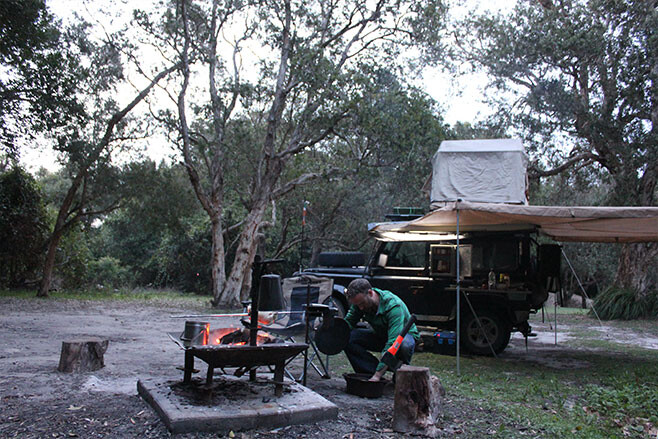
Within a couple of minutes of leaving the beach we reached the campsite, an open area with a spacious feel that’s protected from the ocean by large sand dunes and thick vegetation. There are also some hidden corners where you can hide away from the main camping area, and we parked the Land Rover in a sheltered area behind the dunes under a large gum tree. You are never far from civilisation on this track, but you can feel isolated and very much away from it all and that makes this place even more special.
The Hungry Gate Campsite is a bit of a gem; it’s quiet, secluded and offers fire pits and plenty of space. After setting up camp it was on with the fire and out with the rotisserie for a well-deserved dinner of roast chicken washed down with a couple of cold beers. We pitched up here for two nights and enjoyed some chill-out time, a spot of fishing and some tasty camp cooking.
If you decide to tackle this route in the near future don’t forget recovery gear and a shovel – you don’t want to get stuck when the tide is coming in. Also, allow for extra fuel as you will burn more fuel than normal while driving on the beach.
Many of the campsites along this coastal route rely on honesty boxes, so bring change. Insect repellent is a must as the mozzies can be a bit of a pain in the ass around some of the campsites, particularly in summer.
Other than that, simply enjoy what this little part of the world has to offer. Fish along Limeburners Nature Reserve, stroll through the rainforest canopy at Sea Acres Nature Reserve, and stop and take some time out to enjoy the many beautiful beaches and headlands you’ll pass along Point Plomber Track.
With a number of options for great fishing, beach driving and bush-type camping, this adventure has all of the ingredients for a cracking weekend away in your 4WD.
TRAVEL PLANNER STAYING THERE WE camped at the Hungry Gate Campground which is located right beside the beach and is protected by the park’s unspoiled sand dunes. The area is surrounded by thick heath and woodland vegetation. Bring drinking water as there are only basic amenities. GPS: Latitude 31° 4’ 47.172”S Longitude 153° 2’ 31.452”E
TRACK CONDITIONS POINT Plomber Track: Conditions vary significantly depending on the weather. The sand can get soft in places, though you should have no issues with a standard 4WD. The real fun on this trip is the beach driving, and like all beach driving you should be prepared.
KILLICK Beach: The northern entry point on Killick Beach to the Hat Head campsite can be a challenge, particularly at low tide, so make sure you adjust tyre pressures. Maintain momentum as you drive along this beach as it is soft in parts; it is advisable to keep the momentum going in order to avoid any chance of stalling. Also check the tidal times.
FUEL & SUPPLIES FUEL is available at Port Macquarie, Crescent Head, Hat Head and South West Rocks. Port Macquarie has a major town centre and all necessary supplies can be obtained here. Crescent Head also has facilities, while Hat Head has limited services including a pub and a service station.
TRAVEL DISTANCES PORT Macquarie is 388km from Sydney and 550km from Brisbane.
MAPS THE Port Macquarie Tourist Centre provides a detailed beach map of the area.
RESTRICTIONS AND PERMITS BEACH permits for the financial year (July 1 to June 30) are available for a fee and cover the Kempsey, Hastings and Nambucca Shires. A current registration number is required when requesting a Beach Permit. They can be purchased from the council’s customer service centre.
They may also be purchased from Crescent Head Caravan Park, Grassy Head Caravan Park, Hat Head Caravan Park, Hat Head General Store, South West Rocks General Store, South West Rocks Service Station, South West Rocks Bait Marine and Tackle, and Stuarts Point Caravan Park. Note: if you intend to purchase from these outlets, it may be worthwhile confirming they have them in stock first.
THE duffle bag has been around for many, many years and has remained the popular choice for vehicle-borne adventurers.
This type of load-lugger is popular for their basic design, cavernous volume (for minimal weight), and tough build and fabrics. Duffle bags can be tied to a yak or donkey for a climbing adventure, or just thrown in the back of a 4×4.
Numerous brands have duffle bags in their luggage range, and they all follow a very similar design DNA – a cylindrical space with a small enclosure (lid) up top. So it’s interesting to see highly regarded Aussie brand Sea To Summit (STS) enter the competitive duffle-bag market. The designers at STS have definitely done their homework with this duffle, addressing a number of design points and aiming to improve them.
The most obvious new design feature – and one that we reckon most people will applaud – is the oversized lid. For those used to shoving their hands in the (often) smallish opening of their duffle and scrabbling around blindly in the hope of finding a particular item, this bag’s large clam-shell-type lid opens to expose most of the space inside, making access far simpler. Access is made easier again by the simple design tweak of using brightly coloured fabric inside, allowing gear to be more easily spotted.
The Sea to Summit Duffle is constructed using heavy-duty nylon material and features a padded base and lid. There are external compression straps and lash loops for securing the duffle to a roof rack. The lid is also built tough, and a dual-zipper ensures it won’t break when pulled or tensioned (or if you have over-packed) and aids in upping the security of your gear inside.
The handles can be attached/detached to suit three different carrying options for when you’re out and away from your vehicle: a backpack-style harness, an over-the-shoulder set-up, or just carrying it with the two straps like a piece of carry-on luggage. Two small magnets in the handles mean you no longer have to fiddle with Velcro tabs to secure them together – they just snap together once each handle is close enough to the other. It’s simple but it makes a difference.
The 130-litre duffle has proven faultless over the past few months. Nothing much can go wrong with a duffle bag anyway, but little things like faster joining of straps for carrying, the three-way strap/harness system, and – most obviously – the awesome large lid have been much appreciated. Add in the bombproof construction and I reckon it will do excellent load-lugging service for many years.
The Sea to Summit Duffle is available in four sizes (45L, 65L, 90L and 130L) and in three colours (blue, orange and charcoal). It’s available now.
RRP: $179.95 (45L); $199.95 (65L); $229.95 (90L); $249.95 (130L)
WE SAY: durable, easy to access contents.
ISUZU UTE Australia has recently celebrated a milestone, surpassing 100,000 cumulative sales of its D-MAX ute and MU-X wagon.
It’s a considerable achievement in a highly competitive market segment, where, in March 2017, the D-MAX was the eighth best-selling vehicle on the overall 4×4 sales charts (1132 units) – the MU-X finished 13th with 650 sales.
“Since launch, our products have been endorsed with awards both here and internationally, leaving no doubt they are capable performers,” said IUA’s Managing Director and CEO Yasu Takeuchi. “This is backed by the positive feedback we receive from both our private and fleet customers, who put our vehicles to the test in some very extreme conditions, day-in, day-out.”
The D-MAX and MU-X brands first arrived on local soil in 2008, and since then have experienced exponential success in the Australian market – for eight consecutive years IUA has posted double-digit sales growth.
D-MAX ute sales have consistently been on the up since its 2008 launch. Back then, the Japanese carmaker shifted 273 3.0-litre common-rail diesel-powered units. The following year, 3566 utes were dispatched from the showroom floor.
A tougher style upgrade in 2010 saw annual sales rise yet again, to a total of 6497 units. In 2011, 6397 D-MAX utes were sold off the back of IUA’s Max Run Challenge, where the D-MAX averaged 5.49L/100km on a 3452km run from Melbourne to Cairns.
The D-MAX entered another era in 2012 when a new D-MAX (with the same 3.0-litre donk) arrived to tackle Australia’s red dust – 7782 units were sold that year.
10,209 utes were sold in 2013, the same year the company introduced its five-year warranty and five years of Roadside Assistance.
The D-MAX was awarded a five-star ANCAP safety rating in 2014 – and Isuzu introduced the 3.5-tonne towing capacity – to boost annual sales to 16,674. This was also buoyed by stronger fleet sales.
Annual sales increased in 2015 and 2016, with figures of 20,984 and 23,377 respectively.
An all-new D-MAX, with an upgraded 430Nm 3.0-litre turbo-diesel engine and new six-speed automatic and manual transmissions, was launched in 2017 and has taken the overall sales total past 100,000.
When the MU-X wagon was launched in 2013, Isuzu sold 120 units. That number has consistently grown year on year – 4625 units in 2014; 6344 in 2015; and 7018 in 2016.
To keep up with the steady sales increase, Isuzu’s dealer network has also grown from 39 (in 2008) to more than 130 dealers Australia-wide.
Isuzu doesn’t expect this trend to be slowing down anytime soon, with plans afoot for further strategic growth.
“I believe that if we can continue to deliver on our promises and respect the trust of our customers, our brand will continue to grow from strength to strength,” Mr Takeuchi said.
ALAN Johnson, founder and owner of Piranha Off Road Products, probably knows more about Suzuki 4x4s than anyone in Australia. So we asked him a few questions about the tough little off-roaders.
Article originally published in December 2014 issue of 4X4 Australia.
4X4: What started your interest in Suzuki 4x4s? AJ: I owned a Land Rover Series 2A and spent most of my time working on it. My brother purchased a LJ50 and it never broke down. I sold the Land Rover and bought an LJ80 hard top. My 4WD passion bloomed and the Victorian Suzuki 4WD Club was formed. And the fun began!
4X4: How many Suzuki 4x4s have you owned? AJ: Probably over 30 from LJ50, LJ80, various Sierras, Vitaras and Grand Virtaras.
4X4: How many do you own now? AJ: Ten that go, nine that don’t go.
4X4: In your opinion what is the best Suzuki 4X4 ever made? AJ: I love them all but the 1.3 [litre] Sierra with a five-speed gearbox was the quantum leap from toy to serious car. Long trips were now seriously possible. The world opened up.
4X4: What are the best points of the Sierra and/or Jimny? AJ: Sierra: simple; reliable; adequate power; cheap and easy to modify; timeless style; Japanese quality; an outstanding car for its time. Jimny: coil springs; 1.3 EFI motor; quiet; comfortable; capable with minor modifications; great fun at an affordable price.
4X4: What are the worst points of the Sierra and/or Jimny? AJ: Sierra: noisy by modern standards; slow, but more time to enjoy the trip; hard to get a good one now. Jimny: needs bigger wheels really badly; needs lower gearing if bigger wheels fitted; but genuinely a good starting point to build a mini monster off-roader.
4X4: What are the key modifications needed to make a Sierra and/or Jimny better off-road? AJ: Sierra: 30 x 9.5 [inch] tyres on 15×7 [inch] rims; quality springs and shocks; diff breathers; bigger battery or dual batteries; bigger alternator; snorkel; lower ratio transfer box; diff locks; chrome alloy front axle and CV joints; fuel tank guard; extractors and better exhaust. Jimny: springs and shockers; possible body lift; bigger wheels and tyres; snorkel; diff breathers; cut guards to allow fitment of tyres; extractors; diff locks; chrome alloy axles; tank guard; fit Sierra transfer box with low auto gears.
4X4: Closing words? AJ: Buying, driving and modifying a Suzuki is life-changing. A Suzuki is a small fun package that opens up a world of off-road travel like no other. After 35 years of Suzuki passion and adventures, and at nearly 60, I’m attempting the first ever solar-electric Suzuki to cross the Simpson Desert. A world record beckons and the fun never stops.
ISUZU’S MU-X has been a favourite wagon among four-wheel drive enthusiasts thanks to its durability and value for money.
Isuzu Ute Australia (IUA) has built on these strengths for the 2017 model updates, adding a better feeling interior, a choice of six-speed transmissions, and performance upgrades.
The MU-X has received two updates for 2017. The first came back in February, with updates to the 3.0-litre diesel engine (which it shares with the D-MAX ute) to increase torque to 430Nm, add the new six-speed auto and manual transmission, and make it Euro 5-compliant. The latest update brings new front- and rear-end styling, softer interior touch points, and reduced engine noise transmission to the cabin.
The 3.0-litre diesel engine is the only choice in both IUA vehicles, and in these days of shrinking capacities it’s on the larger side of engines in this class. That’s not a bad thing. The unfussed and lazy way it gets the job done means this capacity has won over many Isuzu owners. Don’t think lazy is a negative, either, as the smaller engines in most competitor vehicles get busy at highway speed and don’t conquer long distances in the relaxed manner the Isuzu mill does.
Durability and economy are also strong points with owners who are proud of years of faultless service and moderate fuel use, even when towing large trailers. The official combined fuel consumption figure drops as low as 7.9L/100km depending on the variant chosen, and it remains one of the best in the 4×4 wagon segment.
Part of the good fuel number can be attributed to the new six-speed auto transmission from Aisin. Not only does it allow the engine to do its best regardless of the terrain, but it also makes touring more relaxed and comfortable. On our highway drive it was never found hunting between the top ratios, even with a three-tonne trailer hooked up behind it.
Despite the efforts to quieten it down, the engine is still quite vocal from inside the cabin when there’s a load on the tow bar. These efforts extend to updated injectors and additional sound deadening in the firewall, floors, engine bay and at the base of the windscreen. The sound isn’t intrusive, but if you’re new to a diesel engine then you might find it so.
Thankfully the new audio and navigation system is a big step up from the fiddly aftermarket system that was in previous IUA vehicles. This one is integrated into the centre stack and much more user-friendly, so blocking out any external noise is only a volume adjustment away. Unfortunately, this is done by buttons as there is no volume dial fitted.
Otherwise, the interior of the updated MU-X remains a nice place to tour in, and there are a lot less of the hard plastics that the model was criticised for in the past. These have been replaced with soft-touch, leather-like trims with new piano black and silver adornments. The MU-X, even in the lower spec levels, now has an almost upmarket feel to its cabin.
The leather seats in the top of the range LS-T have a quilted design that adds to the quality feel, along with a drop-down DVD player/screen for rear-seat passengers. If you’re in need of a third row, then rest assured the MU-X’s is one of the better ones available. Able to seat adults for short trips and children for longer rides, it is a usable seat that folds flat to the floor when not in use.
The MU-X’s four-wheel drive system is also the real deal, featuring two-wheel drive for regular on-road use as well as four-wheel drive with low range. The system is supplemented by electronic traction control but is lacking a rear differential lock that many of its competitors come with. Past tests of the MU-X have shown that it could do with the rear diff lock, but this launch drive didn’t give us the off-road terrain to test it again.
The 2017 updates to the MU-X have raised prices by around $1000 depending on variant specification, but with the top-spec LS-T coming in at less than $60K it still offers plenty of bus for your bucks. The improved interior and additional engine torque are the big-ticket items that should entice new buyers as well as encourage current owners to update to the latest offering.
Add in a five-year/130,000km warranty, five-year roadside assistance and five-year/50,000km capped price servicing, and the package looks even better; although, we would like to see IUA back its proven reliability with unlimited kilometres on its warranty.
Capped price servicing for the first five years means the cost for the regular servicing shouldn’t be any more than $1500 in total. This all adds to the value-for-money argument that makes the LU-X so appealing.
MU-X RANGE AND PRICES
4×4 LS-M (man): $48,000
4×4 LS-M (auto): $50,100
4×4 LS-U (man): $50,300
4×4 LS-U (auto): $52,400
4×4 LS-T (auto): $56,100