
SURROUNDED by crumbling ruins, you’d never guess the iconic Silverton Hotel is only 25km from Broken Hill.
The original pub was built in 1884 by John DeBaun, when Silverton was a mining powerhouse. He soon moved it into a two-storey building that burnt down in 1918. In that year the pub moved into its current building, which used to be the town’s post office.
The character-laden main bar of the Silverton Hotel has walls lined with hats, guitars and funny signs, and there’s plenty of old memorabilia about the place. “It’s a hotel and a museum all mixed together,” laughs publican Peter Price.
The pub has a large covered entertainment area and there’s a stage for live music. It also offers great “pub tucker” at affordable prices.
If you’re keen to stay the night, there are seven self-contained units out the back, opposite the ruins of the original two-storey pub. The exterior of the accommodation block is made from recycled timber and iron, but the rooms themselves feature modern décor and offer plenty of space and comfort… and hot showers.
The town of Silverton has attractions including many local artists and the famous Mad Max Museum, and the pub should definitely be at the top of your list the next time you head to outback NSW.
ESSENTIALS Hours: 5am-12pm (Mon-Sat); 10am-10pm (Sun) Beers on tap: XXXX Gold, Tooheys New and Old, and Hahn SuperDry ($7 schooner) Other refreshments: Selection of cans, stubbies, soft drinks, and red and white wines Meals: Breakfast $8.50-$16; Lunch around $12; Dinner $15-$27 Accommodation: $120 for double w/en-suite; $25 per extra person
CONTACT Phone: (08) 8088 5313 Email: [email protected] Website: silvertonhotel.com.au Manager/owner: Peter Price Address: 12 Layard Street, Silverton NSW 2880
ROUNDING a bend on the track I braked to a sudden halt as the sight of a large wedge-tailed eagle perched on a dead tree less than 20m in front of me.
This article was first published in 4×4 Australia magazine’s January 2011 issue.
The freshly killed remains of a large rabbit hung from its razor-sharp talons as the wedgie went through the motions of stripping the meat from the bone. Reaching over to the seat beside me for the binoculars, I slowly raised them to my eyes and began examining the feeding methods of this magnificent bird of prey.
Apparently unperturbed by my presence, the massive golden-brown raptor gorged itself for another 15 minutes before alighting from the branch with rabbit carcass and flying off towards the nearby hills.
Nangar National Park in central west NSW is one of those magic spots where you can be fairly sure of having close encounters with native wildlife during your stay. For me, the place was much nicer than I had originally expected after reading the park brochure before I went there.
Maybe that was partially due to lucky timing, as I visited Nangar a few weeks after recent heavy rain had transformed the normally dry brown landscape around the base of the hills into a carpet of green.
Situated between the wheat and sheep towns of Canowindra and Forbes about 340km west of Sydney, the park protects remnant stands of dense vegetation that was once common throughout this area before land clearing began.
Nangar also supports an amazing array of wildlife including wallaroos, eastern grey kangaroos, swamp wallabies and red-necked wallabies. You may even be lucky enough to spot a koala as they have supposedly been sighted in the park, although I must admit after many hours of neck straining looking for those iconic tree dwelling marsupials I didn’t see one.
Birdlife is also reasonably prolific in this rugged inland wilderness and includes brilliant songsters such as the Gilbert’s Whistler, colourful eastern rosellas and red-rump parrots and the swift flying peregrine falcon.
If you scan the hills you might even see an endangered glossy black cockatoo feeding on the large seeds of the black cypress tree. Nangar is at the western edge of the birds known range and provides an important refuge for the protection of this species.
Encounters with outback wildlife
The tiny town of Eugowra midway between Canowindra and Forbes is the starting point and the nearest place to stock up with food, fuel and water before heading out to the park. Situated on the banks of Mandagery Creek, Eugowra has population of around 700 and services grazing properties in the surrounding district.
First settled around 1860 by gold miners heading out to the Lachlan goldfields, this pretty little village has some lovely old buildings that are worth a look at including the courthouse and the Central Hotel.
From Eugowra, head out of town along the road to Orange for 10km to the park turn-off, which is very well signed and hard to miss. About 3km along the way you will see a small roadside picnic area on the right near Escort Rock which was site of one of Australia’s most audacious robberies.
It was 1862 and gold fever had gripped the district with many miners making their fortunes in the fields. Their hard-earned wealth was normally put on specially escorted gold coaches for the fast dash to secure banks in bigger towns.
But bushrangers Ben Hall and Frank Gardiner and the other six men in their gang had got wind that a very large shipment of the precious metal was on its way and were waiting for the coach as it thundered along the road near Escort Rock.
The gang used two stolen bullock teams to block the road then opened fire on the helpless occupants of the coach when it was forced to stop. Two troopers in the police escort were wounded but managed to escape, allowing the gang to make off with all the loot.
The gang got away with of 2,719 ounces of gold 3,700 pounds in cash, which at today’s gold price is more than $3 million. From the Nangar turn-off, it’s about 2.5km along a gravel road to the national park boundary then another 2km up to the information sign near the site of the old homestead.
Due to the scarcity of water and harsh nature of the terrain, Nangar was never totally cleared like other properties in the surrounding district and much of the original vegetation such as mugga ironbark and black cypress still covers a lot of the park.
Aboriginal people lived and hunted throughout the Nangar region for thousands of years and anthropologists are still finding stone implements and scar trees where bark was removed for shields and food containers.
The first settlers to arrive in Nangar were the Cassey family who came there during the Great Depression in 1928. After constructing a house, small shearing shed and holding yards, this pioneering family used axes and crosscut saws to clear trees along the valleys and creek lines.
A couple of dams were constructed to supply water for the livestock and a small orchard near the homestead, but the general harsh nature of the environment meant the Cassey’s were constantly battling the elements to try and make a living. Drought was a constant problem with the few small creeks on the property often running dry due to lack of rain.
Stock losses were also high due to sheep becoming lost in the thick bush or being taken by dingoes. By the mid 1940’s the family had had enough and moved off the block leaving the property to a succession of other owners until the NPWS purchased the land in 1994. With the addition of Nangar State Forest two years later the park now covers an area of 9196ha.
It’s worth spending an hour or so checking out the hand-hewn timber stockyards and the rusting remains of old vehicles and farm machinery that are scattered around near the old homestead site. Unfortunately some bonehead arsonists burnt the homestead down in September 2009 destroying an irreplaceable part of Australia’s history.
Once you leave the old homestead site the valley starts to become narrower as the track twists and turns for about 3.2km up to Terarra Creek Picnic and Camping Area. The country that you pass through is extremely picturesque with the track crossing Terarra Creek a number of times before it finally reaches the camping ground.
Set in a well grassed shaded area near Terarra Creek, the camping area would be an excellent place to spend a few days if you were looking for peace and quiet as it gets very few visitors.
If you were thinking about going for a swim, however, forget it, as the creek in this area is nothing more than a narrow stream about a metre wide meandering through dense stands of bottlebrush. Rugged, thickly vegetated hills covered with mugga ironbark and Black cypress rise up steeply from the creek making it an excellent place to scan the trees for birds and other wildlife.
The newly constructed camping ground has toilets, picnic tables and fireplaces. If you really feel the need for a small fire make sure that you bring in your own wood from outside the park since fallen timber provides shelter for many native animals.
It is essential that you are carrying adequate drinking water for the length of your stay as Terarra Creek is sometimes bone dry and there are no other water sources in the park. The weather at Nangar can often be extreme, with daily temperatures during the height of summer nudging 40 degrees while nights in mid winter can often drop to zero and below.
From the camping ground it’s only a short 10 minute drive up to Dripping Rock, one of the geological highlights in the park. This stunning rock wall, over which water streams during heavy rain, was formed over countless millions of years by the action of water slowly eroding away the rock.
Even in drier times there is usually a trickle of water dripping down the rock into a pool below. This lovely little waterhole is a magnet for kangaroos, wallaroos, birds and other surrounding wildlife.
Explore more 4×4 Australia destinations
Much of the area around Dripping Rock was cleared for grazing prior to the area being gazetted a national park, but nature is slowly coming back with the conical shapes of both white and black cypress trees along with tumbledown gum and red box covering the surrounding hills.
One distinctive looking tree with bright green leaves that dots the clearings around Dripping Rock is the kurrajong. Farmers left these trees as emergency food for stock and only cut them down in times of severe drought so they could be used as sheep fodder. There is a small picnic area with two tables near Dripping Rock where you can relax and take in the scenery.
The real four-wheel driving in Nangar National Park begins after you leave Dripping Rock and start heading up though the former state forest to Mount Nangar Lookout. The first 4km of the 10km long drive to the lookout is relatively tame as the narrow track weaves its way gently up trough dense stands of white and black cypress.
There is a dramatic change in the vegetation as the track becomes rougher and begins to climb steeply past large specimens of ironbark and grey box. Birdlife through here is prolific and if you stop your car and be quiet for a few minutes you will hear the melodious calls from noisy friar-birds and other nectar-eating birds feasting on the flowers of the surrounding eucalypts.
Just on 5.8km after leaving Dripping Rock you come to Y-junction in the track. The left-hand fork climbs steadily upwards for 4km to the lookout while the right-hand fork continues on towards the national park boundary 3.8km away.
The panorama stretching before you from the lookout can be spellbinding with magnificent views along the jagged cliffs of the Nangar Range and the cleared grazing country to the north of the park. The lookout is an excellent place to spot birds of prey such as the wedge-tailed eagle and spotter harrier and if you are extremely lucky the endangered peregrine falcon.
Once you return to the Y junction it’s a relatively easy drive down to the gate at the park boundary—remember to close it, then another 5.7km on through state forest and cleared farming land to the road that runs between Long Pocket and Canowindra. Here you can either turn left and head back to Eugowra – about 34km, or go right to Canowindra about 15km away.
In 2018, the British off-road icon will celebrate 70 years of off-road touring, exploration and its many decades of aid work – not to mention continuing to produce (and expand) its range of four-wheel drives.
For any and all Landy-files keen to celebrate this moment, Cooma, New South Wales, is the location of the big bash.
Jointly run and supported by Land Rover Owners Club Australia, Victoria Land Rover Owners Club, Range Rover Club NSW, Land Rover Australia, Snowy Hydro, Snowy Monaro Regional Council, Cooma Monaro Historic Automobile Club, Inc., and the town of Cooma itself, the event will run through the Easter long weekend, March 30 to April 2, 2018.
The four days will be packed with things to do, with registration and check-in opening on Thursday, March 29, between 3pm and 8pm (at the Cooma Car Club, Bolaro Street Cooma).
From Day 2 to Day 4 there will be activities available, including self-guided and guided trips, a Grand Display of all entered vehicles (Land Rovers only, of course), a swap meet, LRA vehicles to check out, and a gala dinner and awards night on the Sunday, before a big final farewell brekky on the Easter Monday from 7.30am.
For more info, check out: www.landrover70thcooma.com
Everything you need to know about 4×4 Australia competitions.
Win $10,000 worth of Ironman Gear!
- Visit competition. Competition now closed.
- Congratulations to J. Jackson, QLD, who has won $10,000 worth of Ironman 4×4 accessories!
Win an MSA 4×4 Explorer Aluminium Storage Drawer System
- Visit competition. Competition now closed.
- Congratulations to Leonard O, NSW, who has won a MSA 4X4 Explorer Aluminium Storage Double Drawer System, valued at $ 2,499.
4X4 Christmas Gear Giveaway
- Visit competition. Competition now closed.
- Congratulations to Toby B, VIC, who has won a pair of Narva Ultima 215 LED driving lights valued at $599 each.
- Congratulations to Mitch T, VIC, who has won a pair of Original MaxTrax MKII valued at $299.
- Congratulations to Johnny S, VIC, who has won a Projecta Power Hub with 300W Pure Sine valued at $499.
- Congratulations to Frank Y, WA, who has won a Minelab GF 40 Series metal detector valued at $299.
- Congratulations to Phil W, SA, who has won a pair of Lightforce Venom LEDs valued at $958.
Custom 4×4 of the Year
- Visit competition. Competition now closed.
- Congrats to our winners: John P, NSW, Wayne R, QLD, Dale M, NSW & Dwaine L, QLD.
4X4 Sherpa Steed 17,000lb Winch Giveaway
- Visit competition. Competition now closed
- Congratulations to Tim W., VIC, for subscribing to 4×4 Australia magazine and winning a Sherpa Steed 17,000lb winch.
Win a Toyota Hilux
- Visit competition. Competition now closed
Win the Ultimate Adventures Package
- Visit competition. Competition now closed
Win the Outback Challenge 2014 DVD
- Visit competition. Competition now closed
Win 1 of 10 4X4 Australia Packs!
- Visit competition. Competition now closed
Win a $5000 Ironman 4×4 voucher
- Visit competition. Competition now closed
PATRIOT Campers’ Justin Montesalvo knows how to get your attention.
Vote for the Patriot Campers’ 6×6 LC79 to win 2017 Custom 4×4 of the Year
A raft of top-notch camper trailers – and then the Super Tourer 4×4 builds – has seen the hard-working Queenslander and his team garner loads of respect in the four-wheel drive touring world.
And, as you can see with this off-road work-of-art, Patriot Campers ain’t slowing down. This 6×6 Land Cruiser 79 stole the recent Melbourne 4X4 Show.
The build is epic and started with the team stripping out the back end of a brand-new LC79 ute and then effectively cutting off the back end of it. The reason for this was the fitment of a complete JMACX 6×6 system to replace the standard rear axle/leaf spring setup.
The JMACX replacement entailed new rails mounting the coil spring suspension and trailing arms, but with this vehicle actually using height-adjustable (up to 100mm), self-levelling Airbag Man airbags (in lieu of coils) and prototype TJM remote reservoir shocks. Both diffs are also JMACX jobbies; the rear keeps the factory Toyota locker, the front is a Detroit soft-locker.
Justin was keen to go bigger than the 35-inch tyres that the JMACX setup usually features, by fitting 37-inch Mickey Thompson MTZs and +35 offset ROH wheels, and then – just because that wasn’t enough – he worked with Marks 4WD Adaptors to fit a set of its portal hubs to each axle.
These hubs give the Super Tourer an additional 150mm under-diff clearance and – due to their gear reduction – help compensate for the larger rolling stock. It’s a lot of weight to carry around, but GSL Fabrications came to the party and Justin gave them free rein to up the grunt from the TDV8.
The result: Fitment of GSL’s 100% kit that, as you may guess, signifies a 100 per cent increase in torque.
This LC79’s tray and canopy setup is a new Super Tourer design chock-full of storage; flip-up covers on each side allow access to the fridge/freezer and the canopy also features slide-out drawers, as well as fuel filler covers and space on the tray for two of those oversized 37s.
On top of the canopy you’ll find a solar panel. There are more storage compartments under the rear sills, plus a full-width slide-out drawer under the tray’s rear end.
Barwork is courtesy of TJM, with the front bar including an integrated TJM Torq 12,000lb winch. The interior is full leather, with the essentials (such as Hema HX-1 and UHF radio) and the trim/colour matching perfectly with the exterior and reflecting the quality of this entire build that goes above factory-spec level in terms of fit and finish – and desirability.
COMPETITION NOW CLOSED.
Congratulations to Leonard O, NSW, who has won a MSA 4X4 Explorer Aluminium Storage Double Drawer System, valued at $ 2,499.
THANKS to our friends at MSA 4X4 Accessories, we’re giving away an Explorer Aluminium Double Drawer System valued at up to $2899.
MSA 4×4 claims its Explorer Aluminium Storage Drawer System is Australia’s most advanced 4WD storage system ever. Similar in size to most other drawer units on the market, the Explorer expertly maximises its storage space so that no inch is wasted.
Thanks to Pro-Glide technology, each drawer can handle up to 250kg. Other features include an open-stay block to hold a drawer open on steep inclines; the MSA 4X4-designed handle lock system for maximum security; and an LED strip light flush-mounted to the inside of the drawer.
The Explorer Aluminium Double Drawer System is compatible with MSA 4X4 drop slides, fridge slides and fridge barriers. The ADR-compliant system comes with a lifetime guarantee.
For your chance to win the set-up, simply fill in your details below. Good luck!
LAST month I had a good old rattle catching up on the progress we made with Milo2.
But how come not much happened in the months before that? Right, here goes. It all started with an invitation to a wedding. Mark and Shay, friends of ours through the off-roading fraternity, were getting married after 25 years of thinking about it – at least I know I’m not the only one who can dodge a deadline… Naturally, my wife Karen was hanging out to go.
Girls love weddings and, to be honest, I figured this one would be a beauty from a bloke’s point of view. Anything that sounds like a party in Darwin is always going to be good! Mark is known to most people as eMDee, the didgeridoo player who’s wowed audiences around the world.
He’s an interesting bloke and his travels within the Aboriginal communities up north always fascinate me. I’ve got a lot of mates there, too, so every way we looked at it, we were going to go. But there were other demands – as always, work was getting in the way of life.
After almost 18 months of not shooting any fresh DVDs, there was a whole lot of pent-up demand. I’d spent a good part of that break catching up on Milo maintenance – after 20 years of constant abuse with a string of patch-ups, there’s still a truckload to go – but the business side of things demanded something be shot pretty soon.
Dirty Work: Roothy talks turbo and diesel
So the dilemma was to fly to Darwin and have a week off, or go shooting footage? Maybe I shouldn’t have said that in front of the wife because she, dead-keen to get to this wedding no matter what, jumped straight in with ‘why not do both’? That grew into ‘let’s take Milo to Darwin and film the whole trip’.
And, seeing as we’d be up there in the truck, we figured we’d get Mark and Shay and the local 4WD mob to come out and show us a few tracks? Bingo, an idea was formed. I love my little truck and the thought of driving some big miles didn’t bother me the slightest.
What did bother me was taking the wife, who’d never been farther than Stradbroke Island in Milo. That was when the kids were little and the old girl was still a petrol-powered Troopcarrier with floor mats and a tiny exhaust. If you haven’t had a close look at Milo in recent years, let me explain.
Driving on more than 750,000km of the worst roads in Australia has taken its toll. The little 13BT diesel is loud and throbbing – I wear ear muffs at highway speeds – and with a turbo next to the firewall it heats up the cabin, too.
There are holes in the floor to let the water out, and the only comfort feature left are a set of Black Duck seat covers and flaps that let air blow around your feet. None of this bothers me because, like Editor Matt, I cut my teeth riding motorcycles around this wonderful country of ours.
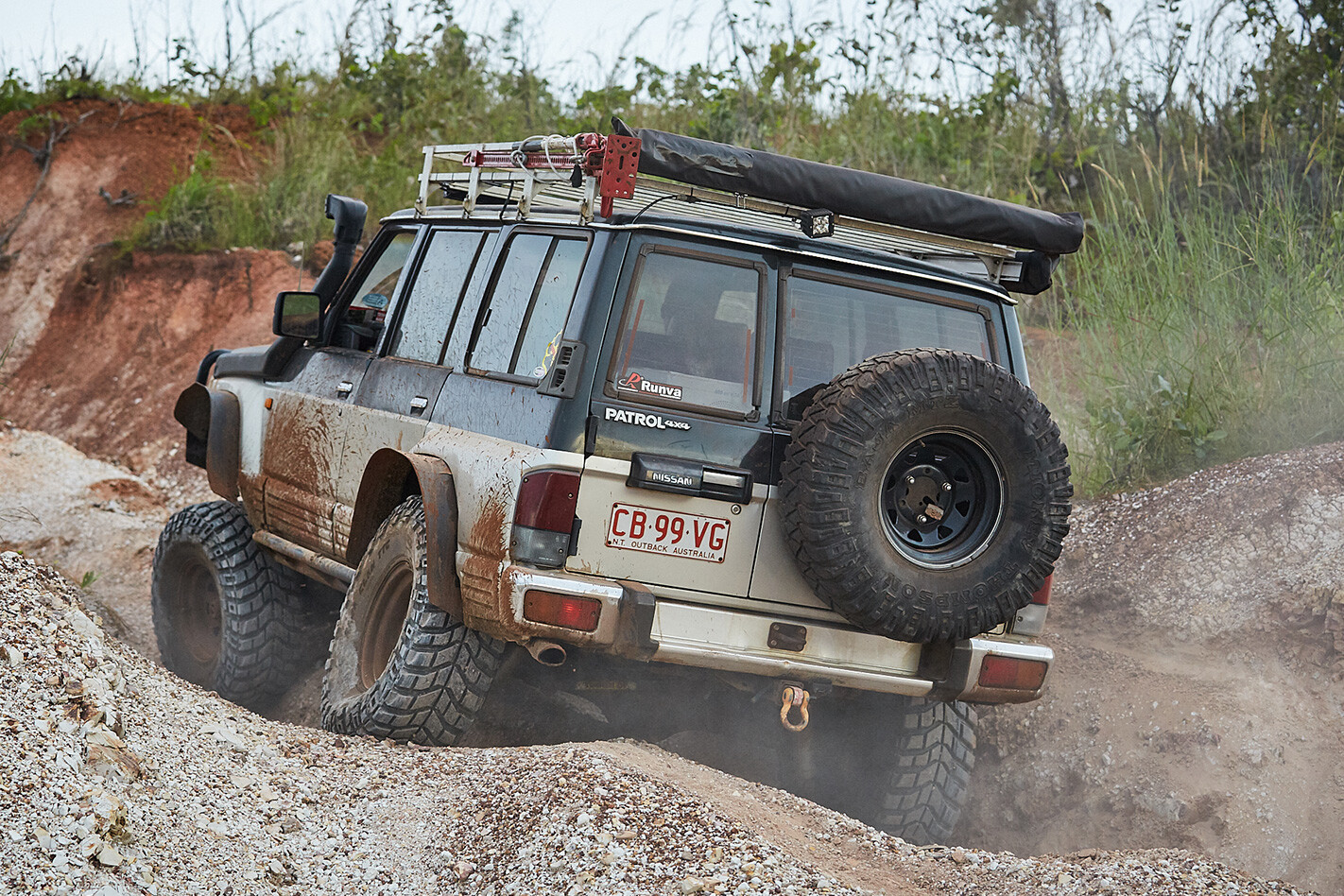
Just keeping the rain off your melon – well, some of it, she leaks a bit – a windscreen in front of your face and a seat you can move around on makes pulling 1000km days in Milo infinitely more comfortable than doing the same on a bareknuckle trail bike.
Maybe there was a selfish tinge of ‘it’ll serve the wife right to get a dose of how hard I work to make a living’. I’ve been on the road almost half of the child-raising years she’s spent at home dealing with nappies, dance classes and footy training, and more than once it’s been a competition to see who’s worn out the most when a trip’s done.
The worst thing is, sometimes a really tough bush trip can look like a never-ending round of pub meals and beer when the receipts are being tallied. It gets worse when the photographer sends his shots over and the mud and dust you remember eating is transformed into magnificent views and wonderful places.
Yes, I did have a habit of whingeing a lot when I got home; usually I’d be tired and sick of looking after myself. It’s a bloke thing. Maybe it’d be good to share it after all those years of doing it on my own. Anyway, I knew if we were filming we’d need a camera car for the team, so she could always bail out and travel in air-conditioned comfort.
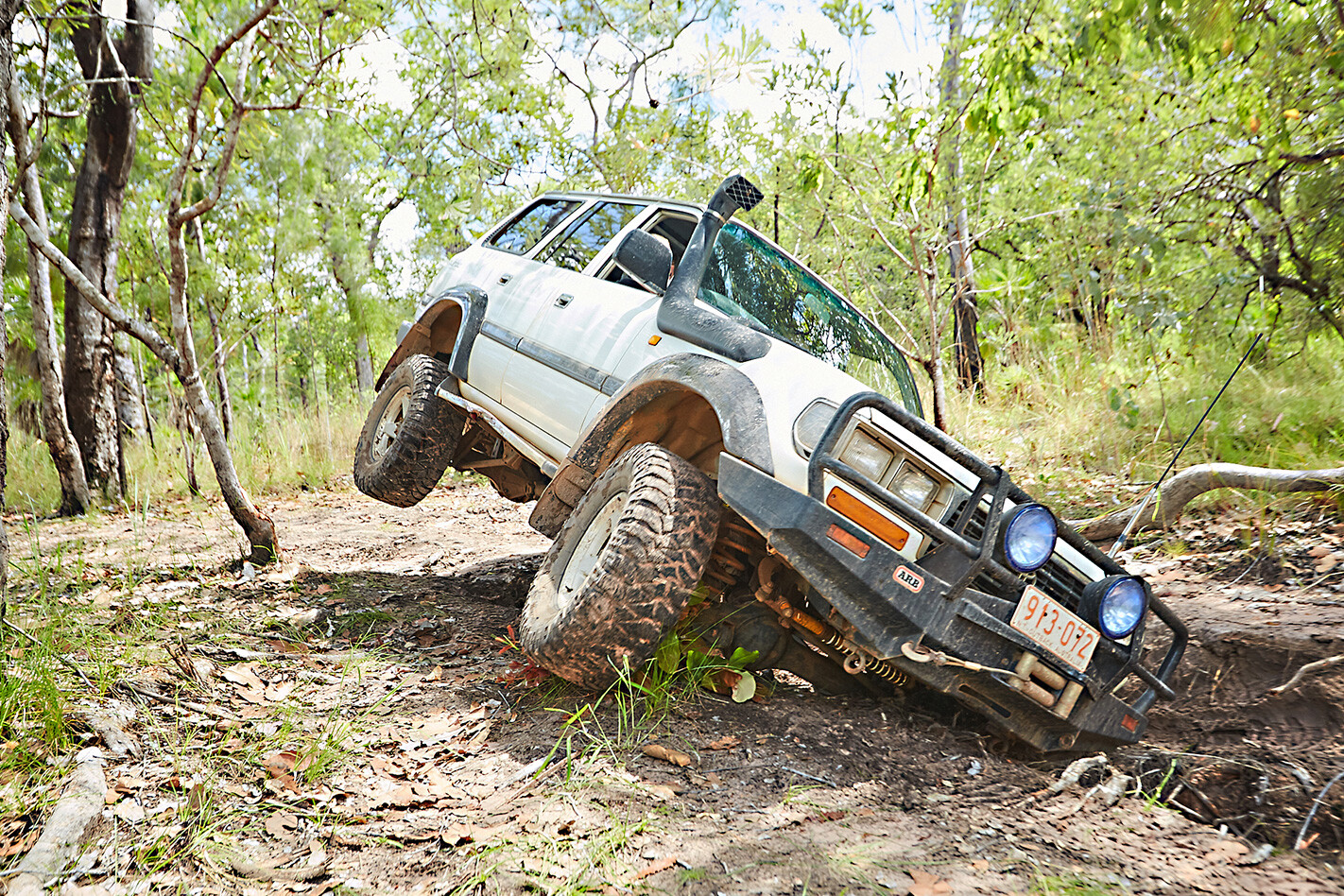
So, plans were made. Westpoint and Jeep came good with a Grand Cherokee which, with its leather, air-con and cruise control, underlined what a primitive little earth-moving machine Milo was.
My mate Simon wanted to bring his 61 Sahara, so before the sun came up on a cold Brisbane morning our little convoy climbed over the Toowoomba Ranges and headed due west. Talk about adventure bound! How did she go? Do you mean the truck or the wife? Same time, same channel folks. I’ll let you know next month.
But boy, did we have some adventures. So much so, when we got back we had a huge task of just cutting down the footage – we still finished with two DVDs instead of one.
I guess the big question is ‘will Karen want to go on more trips in Milo?’ I still don’t know, but I’ll let you know when she’s talking to me again…
MODIFYING a four-wheel drive can be a tricky business.
Vote for the Toyota N80 Hilux to win 2017 Custom 4×4 of the Year
Go too crazy with a big lift, huge tyres and other ‘radical’ mods, and you suddenly have a rig that goes against a 4×4’s DNA and is totally impractical.
That’s one thing Joe Emmerton wanted to avoid when building up his N80 Hilux. For Joe, his modified tourer had to be tough and practical – he’s a mad-keen fisho and hunter, so the Hilux needed to get to some remote places to pursue his hobbies.
After opting for the top-end SR5 and ticking the colour-coding and premo interior, Joe set to work on tweaking the Toyota for its future work.
The standard Hilux front struts were tossed in favour of a schmick four-inch lift setup – Bilstein monotube dampers and a set of custom-rate H&R coil springs from Heasman Steering and Suspension – and added more height via a 50mm bodylift from VMN. All this gave the Hilux a ride height 150mm higher than stock.
To rein in binding CV joints due to the big lift, Joe fitted a diff-drop setup from Phat Bars and heavy-duty adjustable arms from CalOffroad that combined with an adjustable OME-style ball joint to bring the front-end geometry back closer to spec. The suspension had re-arched rear springs, Bilstein remote reservoir 5160 dampers, and Snake Racing extended shackles for a four-inch lift at the back.
“On dirt roads and corrugations, having the remote res in the rear keeps it consistent and doesn’t fade,” Joe reckons.
The final touch was a set of 305/65R17 Mickey Thompson Baja MTZ mud terrains with 17-inch Dynamic D-Hole steel wheels in a -30 offset.
Other sensible modifications include a Locker Anytime module, which allows Joe to engage the rear locker in high or low range, as well as rear-wheel drive, ideal for slippery boat ramps.
Up front is an AFN4X4 hoopless bullbar fitted with a Runva 11XP 11,000lb winch, underbelly Phat Bars bash plates and a set of angled rock sliders, with the stock rear bumper lifted 100mm via Dowtech lift brackets.
The Hilux tray is fitted with a cool Rhino-Rack low-profile tray-mount rack system, with a Howling Moon rooftop tent.
Momentum is upped thanks to a four-inch Fabulous Fabrications snorkel and three-inch exhaust from Arclite Engineering. Just Autos (QLD) tweaked the donk for 50 per cent more torque, improving fuel consumption as well.
The interior reflects Joe’s practicality, with just a GME UHF and Engel fridge fitted.
Sensible improvements aimed at the owner’s needs make this one of the smartest modified rigs we’ve seen.
STRUGGLING for gift ideas this holiday season? Don’t worry, we’ve got you covered!
OPPOSITE LOCK 65L FRIDGE/FREEZER Oppy Lock has boosted its fridge/freezer range with the addition of this 65-litre single-door unit. Featuring a tough stainless steel cabinet with 60mm high-density polyurethane foam insulation, this fridge is built for outback touring. The stainless steel latches, handles and hinges ensure reliable and durable service. The fridge can be powered via 12V, 24V and 240V, and includes three low-battery voltage cutout settings.
Its 66W Snomaster compressor ensures smooth running and a low current draw of 2.5A (low speed) and 5A on high speed. The temp range is -22°C to 10°C and it comes with a five-year compressor warranty and two-year Aus-wide parts warranty. Also included are a wireless temp/battery monitor and a transit bag. Inside the fridge is an LED light – plus, it also has an open-lid alarm. Website: www.oppositelock.com.au RRP: $1549
TOUR DE OZ Overlanding means just that for today’s off-road tourers, but for four intrepid adventurers just prior to the turn of the last century, it meant jumping on a bicycle to become the first to circumnavigate Australia using human power on two wheels. What started as a grand overland adventure for West Australian cyclist Arthur Richardson, whose aim was to be the first to complete this 18,507km epic feat, soon turned into a race against a trio of eastern seaboard riders.
Melbourne-based Kiwi brothers Frank and Alex White and Brisbane-based Aussie Donald Mackay were aiming for the same goal, but following a counter-clockwise route. The ensuing ‘race’ saw the four riders ride over and through some of Australia’s toughest country. A cracking read of a time when ‘overlanding’ was bloody wild stuff. Website: www.harpercollins.com.au RRP: $30
EVAKOOL RV18 FRIDGE/FREEZER For those with minimal spare space in their 4WD, this new compact fridge/freezer from Evakool is perfect. With space for 16 375ml cans or a mix of drinks and food (including a dairy shelf), the RV18 is ideal for those on road trips or overnight camping adventures. The slim design (230mm width) means it can be fitted between passengers in the second row.
The RV18 features an Evakool CK15 compressor and can be run as a fridge or as a freezer, with an operating temperature range of 10°C and -18°C. The unit is light in weight (a paltry 8.7kg), has an impact-resistant polypropylene cabinet and lid, an internal LED light, digital control panel, and can be operated via 12V, 24V or through 240V mains (using an adaptor). The RV18 comes with a two-year warranty. Website: evakool.com RRP: $549
PROJECTA SMART CONTROLLER Projecta has just released a new range of compact automatic four-stage Smart Solar Charge Controllers. These units deliver a four-stage charging process and enable users to alter settings and charging profiles to suit their particular power management requirements, such as the battery type used (Wet, AGM or Gel).
The models – SC220, SC245, SC260 – all offer similar features (including two 5V 2.4A USB ports), with the biggest difference being the amp capacity each can handle from the solar panels they are connected to.For example, the SC220 is designed for use with 20amp solar panels, hence the ‘20’ in the model number. The units are all EMC-approved, offer digital LCD screens and are equipped with a low-voltage disconnect function for battery protection. Website: www.projecta.com.au
MSA 4X4 DASH ORGANISER Designed to mould to any dash shape, MSA 4×4’s dash organiser design has been upgraded. Ensuring all your at-hand travel essentials can be easily accessed, the organiser now features five pockets for small items (think sunnies, mobile phones, etc.) and a large pocket for your map. Objects are secured via elastic straps to ensure they don’t fall out negotiating bumpy terrain, and the unit is secured to your dash (or dash mat) using Velcro and adhesive strips.
The organiser’s unique ability to mould to the dash is due to the internal flexible aluminium strip, with the overall manufacturing quality what you’d expect from this Aussie company. The dash organiser measures 185mm long by 365mm wide, making it an easy fit to all 4×4 dashboards. Website: www.msa4x4.com.au RRP: $69.95
TERRAIN TAMER WATER PUMP These tough new replacement water pumps feature a one-piece casting for robustness, with each unit precision-machined for excellent sealing and to eliminate the potential for leaks. This top-notch engineering also means a proper fit to your rig. The Terrain Tamer water pump range features heavy-duty bearings, ceramic seals and nitrile O-rings for maximum durability and longevity.
Plus, these features also assist a regulated flow, with each unit tested to ISO/TS16949:2009 quality standards for optimum safety and reliable performance. This new range from Terrain Tamer is constantly expanding and currently offers water pumps for popular Toyota, Nissan, Ford, Isuzu, Mazda and Mitsubishi 4WDs. Website: www.terraintamer.com
No dreams are out of reach – just ask the team at American Vehicle Specialists (AVS) and you can go beyond the norm and end up behind the wheel of something like this uber-tough Toyota TRD Tundra.
Vote for the Toyota TRD Tundra to win 2017 Custom 4×4 of the Year
Yep, we know – Aussies are unfortunately not given the chance to buy these big rigs through local Toyota dealers, but AVS can sort out a right-hand drive version that looks and performs no different from the ones that trundle around US tracks. They can even go one almighty big step further and tweak the standard rig to produce something like this.
This Tundra is a one-off project from AVS and sports a raft of mods, not the least being the supercharged 5.7-litre V8 petrol engine. In stock form the Tundra’s ‘regular’ 284kW-543Nm 5.7-litre V8 is impressive, but AVS thought a bit more stonk was necessary, fitting a Magnuson supercharger (courtesy of VCM Performance), pushing power to 410kW and torque to a heady 745Nm.
Custom Toyota Tundra Platinum Edition
A TRD twin stainless steel exhaust system lets you know all about it, too.
Not wanting to stop there, AVS set to work on the body itself. This matte black bruiser is 230mm wider than the stock Tundra, courtesy of a set of FiberwerX replacement guards. AVS then widened the wheel track by 120mm via fitment of a long-travel suspension setup that pretty much ditched all the stock gear.
Pro Comp 2.75-inch body internal bypass coilover dampers (which up the ride height by four inches) sport external reservoirs and work with replacement cast alloy upper and lower control arms, with more robust ball joints enabling a huge 350mm of wheel travel up front. Additional work on the front end includes extended CV shafts and tie-rod extensions.
The rear end copped a similar working over; a Pro Comp kit lifts it by four inches, with additional leaf springs and longer shackles, combining with a 2.5-inch damper, behind the height gain. AVS filled those huge guards with a set of 35-inch Toyo Open Country M/Ts, wrapped around XD Monster 20×9 alloy wheels.
US-based Rock Slide Engineering were the go-to for the Tundra barwork; the heavy-duty plate aluminium front bar houses an Ironman 4×4 12,000lb winch and it has provision for LED lighting in the centre and at either wing.
Speaking of lighting up, a replacement Rigid Industries grille sports a 20-inch Rigid Industries E-Series light bar in the centre and D-Series LEDs on each wing. Replacement front headlights and rear tail-lights are courtesy of Spyder Auto.
Oh, and the schmick paint-job? Rob at RK Restorations waved his spray can over the big Toyota and the matte black wrap was applied by Exotic Graphics. It seems we’re back in black, indeed…