
When compared to manually-operated differential locks (which we looked at earlier), auto lockers require no driver input, but they also help the inexperienced off-roader to get further down a difficult track than his or her ability might otherwise allow.
This article was originally published in 4×4 Australia’s July 2012 issue
Conversely, they may take such a driver further into trouble as there is no need to read the terrain ahead, as is the case with a manual locker that needs to be switched on and off. The auto locker does all that for you on- and off-road.
These lockers are at work all day every day on all road surfaces. Driving up a slippery boat ramp, skating around on slimy, muddy tracks as well as tackling your favourite rocks and ruts, the auto locker will be helping you look the hero at all times. Besides having a much lower price tag than manual diff-locks, the big plus with auto lockers is the fact that they are more suitable for front diffs as they offer easier steering compared to the (almost) non-existent steering you have with an engaged manual locker.
Now, this is where many people become a little confused with the operation of (most) auto lockers. They are, in fact, in the locked position when you are driving straight ahead and unlocked when you turn a corner when the outer wheel is turning faster than the inner wheel.
This wheel overrun is then re-locked when both wheels are rotating at the same speed again. So now you have a locked diff for those hairy situations plus a diff that’s effectively open for on-road use and ease of steering, all rolled into one.
There are however a couple of negatives including some clicking and/or clunking as the locker’s teeth disengage and engage. Also, with some 4X4s, or when tackling tight turns and roundabouts, you may feel a slight resistance to the steering input and your turning circle may be larger as the locker cuts in and out.
Your driving style may also affect the workings of an auto locker as too much on and off with the throttle while cornering tends to upset some units. You’re also likely to get a little higher tyre wear with this type of on-road use.
In off-road situations, though, while powering through a difficult obstacle, the diff will remain locked regardless of whether you’re turning, during wheel slip or even with wheels lifting off the ground, and that’s exactly what you want. It’s the driving torque from the engine, acting on the diff’s internals, that keeps the locker in the locked position.
So, without any input from the driver and no predisposition of how difficult the terrain, your auto-locker-packed 4X4 will outperform stock-standard vehicles hands down. Onlookers will bow down on the tracks in disbelief at your driving skills – just don’t tell them your ride is modified and no one will be any the wiser.
Oh, and your ride need not be a highly modified semi-competition vehicle to benefit from installing auto lockers. The average family 4X4 will reap the rewards equally, as will dad with his kids strapped into the back seats. Conquering those harder tracks is always news-worthy stuff for kids when they get back to school.
POWERTRAX LOCK-RIGHT
The Powertrax Lock-Right automatic locker is manufactured in the USA by Richmond Gears and incorporates couplers with ramped teeth that are maintained in the locked position when the vehicle is driven straight ahead. The higher the drive input, the more firmly the opposing teeth are locked into position.
The unlocking happens when the faster (outside) wheel overruns the slower (inside) wheel via the ramping and cross shaft. The Lock-Right replaces the planetary gears, but retains the OE carrier, crown wheel and the ring and pinion gears.
For more information see www.Richmondgear.com.
DETROIT LOCKER
Probably one of the best known auto lockers in the world, the Detroit was one of the first of its kind to offer a differential effect and total automatic locking. It provides full drive to wheels on both sides of an axle via a series of spring-loaded clutches with interlocking teeth. The automatic disengaging of these teeth happens during wheel overrun (turning corners). The automatic re-engaging happens when the axle speeds equalise. This, in effect, provides (on-road) differential effect while offering off-road locking qualities.
Over the years, the Detroit has evolved to the current Soft Locker version where the interlocking teeth have been ramped on the leading and trailing faces to help avoid the severe clunking often associated with auto lockers during operation. Belonging to the same Detroit family is the No Spin, but it comes without its own hemisphere casing and is aimed more towards industrial and truck use. The Detroit, however, is set in its own case and drops into your diff housing.
Yet another offering from Detroit is the Truetrac. Not really a true diff lock, it uses a helically-geared limited-slip diff centre, as opposed to an OE clutch-pack-style limited-slip diff centre. The Truetrac will certainly get you further down the track than an open diff, but it’ll never perform as well as an proper auto locker for 4X4 use. There’s a comprehensive range of Detroit lockers available for front and rear fitting for most 4X4s.
For more information visit www.harrop.com.au, call 1300-HARROP, or check out Harroptv on YouTube.
LOKKA LOCKER
Made in Australia, the Lokka has very few moving parts (a pair of cam and axle gears, plus springs and pins) and utilises a cam mechanism to keep itself locked. The heat-treated alloy Lokka replaces the planetary gears, but keeps the OE carrier, crown wheel, ring and pinion gears.
The locking action happens when the pinion cross shaft engages its mating surfaces. The more power that is fed into the diff via more throttle, the harder the surfaces clamp together. The unlocking happens via the ramping effect of the low-profile teeth when one wheel tries to overrun the opposite side wheel. The low-tension springs allow this unlocking action to take place even on surfaces with poor traction.
For more info see www.4wdsystems.com.au, call 08 8369 0033 or drop into the head office at 599 North East Road, Gillies Plains in South Australia.
SPARTAN LOCKER
Manufactured by USA Standard Gear in the States, the Spartan Locker is a mechanical-locking unit that drops into the OE carrier and replaces the spider gears. The Spartan utilises high-nickel-content chrome-moly parts and maintains the standard case.
Low-profile ramped mating teeth, combined with springs and pins allow easy unlocking and locking action.
For more information visit www.wooders.com.au or call Wooders Garage on 02 9477 4312 or drop into unit 2/4 Leighton Place, Hornsby, NSW.
TO OUR urban population, Arnhem Land is just someplace, somewhere in the great Australian Outback.
The formation of the Kakadu National Park in 1979 on its western border did a lot to make people aware of it, but, unfortunately, due to the urban mindset, it was not Kakadu but the Crocodile Dundee movies that brought the hidden world into our living rooms, though many still have no idea where it is.
I have been associated with the Top End since the early 1960s and have made many trips into Arnhem Land. I lived in Kakadu from 1979 until 1989, and my first trip into Arnhem Land proper was in May 1975 when my wife, Eileen, drove our new Series 3 Land Rover trayback across Cahills Crossing on the East Alligator River and headed north from Oenpelli to Malay Bay on the Arafura Sea.
A week earlier we had been in southern Arnhem Land and visited Aboriginal outstations, Beswick, Weemol and Bulman. I hunted my first Asiatic water buffalos and caught metre-plus barramundi in the Wilton River – the meat was given to the locals.
We did other trips into Arnhem Land over the years, and I spent three weeks in Maningrida in 1978 while recuperating from an operation as a guest of old mate, Wally Brummell. I fished almost every day and spent a lot of time exploring this amazing region.
More trips were undertaken – mostly hunting trips north of Oenpelli on the headwaters of the King and Goomadeer Rivers – when I lived in Jabiru. I used to drive up from Jabiru to Maningrida, on a road that was little more than a bulldust track and no wider than a Toyota Land Cruiser.
When Alex Julius took over the Arnhemland Barramundi Nature Lodge at Maningrida, it resulted in more fishing trips. I often drove vehicles and towed boats up to the lodge from Darwin, a 500km trip, with just over half of the roads sealed.
Beyond Cahills Crossing is an encapsulated world that is still largely forbidden to travellers. Here, vast flood plains unfold to the base of the Arnhem Land Escarpment, which rises up to 250m in some places. Much of this area was chosen for the Crocodile Dundee movies due its jaw-dropping scenery. Lily-clad billabongs alive with waterfowl – and home to the largest and meanest crocodiles in the world – fringe the sandstone escarpment and outliers.
The nearby community of Gunbalanya has an outstanding art gallery, where local art is displayed and sold. Visitors are welcome but a permit from the Northern Land Council must be obtained before crossing the river. Permits to travel beyond the community are harder to obtain but not impossible – the Cobourg Peninsula is controlled by NT National Parks, who allow a limited number of vehicles in.
I have travelled to the Peninsula several times, but mostly to Maningrida via the Central Arnhem Road. It has evolved from the original bulldust track of the 1980s to a wide, maintained road where locals drive cars; although, judging from the dead, rusted hulks beside the road, many don’t make it – it’s also the reason a 4WD is highly recommended.
Due to my connection with the Barra lodge, I have driven the road in all sorts of weather and conditions. One memorable trip was when Ken Phillips, a retired NT copper, and I towed a 5.2-metre plate boat from Darwin to the lodge.
The road had just opened, with reports from the lodge that a road inspector had made it in. That was enough for us to take off before daylight in a 100 Series Land Cruiser wagon. Cahills Crossing was still running high after a bountiful wet season, but we had timed the incoming tide properly and, when both currents were level and becalmed, we drove across it – the water about 80cm deep.
The King River was running high, but the heavy sand in the Goomadeer River gave us some anxious moments. Beyond it we struck mile after mile of overfilled table drains that flowed across the road. It was slow-going and it took us ages before we reached the metre-plus deep and strongly flowing Liverpool River. ‘Knock-em-down’ storms were forming all about us, and there was no turning back. We wound the windows down and, with no seatbelts, drove into it.
Three-quarters of the way across I became aware that the trailer and boat were floating behind us and threatening to pull the wagon downstream, but the front wheels dug in and we drove onto the hard bank, shouting with glee.
Between us and the Mann River lay more treacherous bogs, overflowing table-drains and flooded creeks. Had we met anyone coming the other way, someone would have had to back-up for a long way. The Mann has two crossings separated by a small island, and both were waist-deep as I waded across it to take some photos of the crossing. Crocodiles, what crocodiles?
Ken made it easy and we drove out of the river banks into a huge storm that lasted all the way to the lodge. Flooded creeks, washouts and drains slowed us down, and it was almost dark when we arrived. That was one hell of a trip, and thinking back we had a lot of luck on our side.
Yet I repeated it a few years later in a Toyota Troopie. It was the end of the dry season, when early storms were creating flash flooding and wreaking havoc across the north. With me was fishing guide, Grassy; he drove the first stage to Cahills Crossing, which was running high, but with two tonnes of supplies in the back, the load kept the vehicle on track. Arnhem Land is an alcohol-free zone, but lodges have special concessions for clients.
We met a truck driver near the Goomadeer River, and he said the Liverpool was un-crossable for the Toyota as the water was up to the top tray of his semi-trailer. Grassy was all for turning back while we could, as we were now surrounded by big storms. Seeing we had come this far I decided we should at least have a look.
The Liverpool was deep but it wasn’t flowing too hard, and I had crossed the river twice that year and knew where the deepest spots were on the 40-metre-wide stream. So I drove into it as Grassy worked my Nikon camera. It was deep alright, and the water splashed over the bonnet and onto the windscreen before it shallowed and I drove jubilantly out onto high ground.
The Mann River was a metre deep in a couple of spots, but the Toyota never faltered. The beer cartons had fallen apart and the bottle labels had vanished when we unloaded the Troopie. It was a guessing game for clients on the beer they were drinking, but in the end it all tasted the same.
During the cooler months there’s often a lack of fishing clients at the lodge, due to the myth that barra don’t bite when the water is cold. So I suggested to Alex Julius that birders might take up the space, and we did a survey on what species were present. It was beyond expectations, as the three-day survey turned up 194 species within a 50km radius of the lodge. That was amazing, especially when it included rare species that had never been recorded in the region.
In the coming years I did many stints as a bird guide in Central Arnhem Land and added another 30-odd species to the list, making the lodge one of the premier birdwatching destinations in the world.
The nature of Central Arnhem Land is outstanding – almost 300 species of birds, more than 20 species of frogs, 70-odd species of reptiles and about 50 mammals call it home. The region has coral cays, beaches, sand dunes, mangroves, tidal flats, flood plains, crater lakes, billabongs, escarpments, rainforests and scrub. It’s possible to visit a bird-rich coral cay in the morning and sit in a cool shelter under the lee of the Arnhem Land Escarpment in the afternoon.
Years ago these shelters were the homes of Aboriginal people, who lived on the plains and along the watercourse in the dry season; they moved inland for the wet season. The evidence of their passing is in the remains of partly burned logs, sticks and fire ashes, but most of all in the friezes of rock art that adorn the walls. The smooth rocks, from thousands of years of people sitting on them, and the indents on rocks where seeds and ochre were ground with stones, also provide evidence.
The landscape’s features – monsoon rainforests, pools, billabongs and, in particular, rock shelters – have important cultural significance to Aborigines. These feelings are very strong in Arnhem Land, as the bonds to the country have never been severed by settlers.
It’s a privilege sitting beneath a cool shelter, listening to the dreamtime stories from an elder. The condition imposed on the lodge insists that an elder always accompanies a tour group, to ensure they don’t stray into a forbidden area.
To the casual visitor, identifying sites of significance is impossible, and should visitors walk or trespass into a site of a dangerous nature, either by accident or intentional, bad things may happen – not only to them, but to the custodians and the land itself. It’s one reason why visiting Arnhem Land is difficult for the casual visitor and, to ensure no laws are broken, it’s often a condition of entry that a traditional owner is present, especially in the stone country.
Many people living in Arnhem Land have never been outside their own ‘country’, and many don’t speak or understand English or Kriol. They live to traditions that go back thousands of years and fear that any unauthorised intrusion by outsiders may bring sickness, bad luck and even death upon the tribes.
Many such sites are associated with the Rainbow Serpent, the creator of all things and the most powerful religious being in Aboriginal mythology and religion. Often such sites are difficult to define because many elders fear to go near them, an indicator of how important these sites are.
There has been much talk to open Arnhem Land up to tourism, but so far this is only possible by joining an organised tour group or as a guest of a nature/fishing/hunting camps and lodges. Self-drive tours have so far been restricted to conditional entry areas only.
It’s not as easy as just opening the borders and letting the masses in – like what happens on the Cape York Peninsula every dry season – because visitors need to be educated and they must respect the land, its owners, culture, values and beliefs of the locals. And, judging from the minority of grots that are defiling the Cape, this unfortunately doesn’t happen in the real world.
There is also the matter of supplies, vehicle repairs, fuel, reliable maps and track access from main routes into places of significance and beauty. Arnhem Land is an extremely valuable study area on how other parts of Australia once were before settlements, farming, mining and industry were introduced. We have much to learn from this truly unique region.
Before its borders are opened to the masses by the removal of the permit systems – as advocated by self-interest groups – significant studies must be undertaken on the consequences to the people, flora and fauna.
It’s our last true tropical frontier and, by making sure an orderly process of access and support industry is implemented, it is highly recommended we continue to protect Australia’s last remaining true wilderness.
History lesson
ARNHEM Land was first discovered by Europeans when Commander Jan Carstensz noted its shores from his ship the Aernem, in 1623. Dutch ships visited Melville Island in 1705, well before English seafarer Lt. James Cook ‘discovered’ Australia in 1770.
This was a time when Macassans from Sulawesi had already established Australia’s first export industry: trepang. Others came: King, Wickham and Stokes were sea-land explorers searching for the great mythical inland river that was supposed to extend right into the very bowels of the continent.
The Macassans had spent more than 100 years of trepang fishing on our coasts by the time the British established a military settlement at Fort Dundas on Melville Island in 1824-29. It was followed by Raffles Bay in 1827-29 and Victoria on Port Essington during 1838-49. All failed.
The British military presence on our northern coast was to prevent French or Dutch claims to it. The settlements brought the British in contact with the natives and the trepangers, with whom they enjoyed a little trade. The Brits imported animals – buffalo, pigs, Timor ponies, banteng cattle, dogs and cats – into the settlements, which brought vast changes to this fragile country when the British abandoned the north and left the animals to their own resources.
Victoria was moderately successful had it not been for its utter isolation and diseases, as well as the deadly attacks by pirates on supply ships from Singapore and India. One notable event was when a ragged party of explorers arrived from overland in 1846: the Dr. Ludwig Leichhardt expedition.
It had left the Darling Downs, west of Brisbane, 18 months earlier, a rare feat that went largely unrecognised by the NSW Government Surveyor-General Mitchell at the time, because Leichhardt was a Prussian and had undertaken the trip without his permission – or, as some sources report, Mitchell had plans to do it himself.
South Australia annexed the Northern Territory and chose Escape Cliffs on the Adelaide River for the first civilian settlement, but it was abandoned and Palmerston in 1869 (later Darwin) became the first successful settlement in the tropics.
Travel Planner
PERMITS The region is Aboriginal land, so it requires a permit stating your reason to visit. Permits are issued by the Northern Land Council: visit nlc.org.au
Cobourg Peninsula permits are issued by the NT Government: see nt.gov.au
The moon slowly rose in the sky, illuminating the clear waters of Jeanneret Beach along the Bay of Fires. It’s no wonder Lonely Planet has called the Bay of Fires, “the world’s top travel destination”.
This article was originally published in 4×4 Australia’s May 2012 issue.
Long stretches of white sandy beach with clear turquoise-blue water, surrounded by lichen-stained rocks, make for breathtaking scenery. The area owes its name to Captain Tobias Furneaux who spotted several fires along the coast in 1773. He was convinced the coast was densely populated and evidence of Aboriginal occupation can be found along the coast today.
If you’re keen on bush camping, you can set up your tent right next to the beach. Camping is free here – it is not often you are afforded multi-million dollar views without a multi-million dollar price-tag to contend with.
The shire of St Helens has a water tap in town where campers can fill up their water tanks and jerry cans. Add to this an excellent laundromat, with a café where you can have a cup of coffee while you wait, and you have the recipe for the perfect weekend getaway.
With six different camping areas from which to choose, there is room for everyone. The area at Jeanneret Beach is especially suitable for families with young children. The kids can play in the lovely soft sand and climb the rocks, while mum and dad laze around on the beach and enjoy the beauty of this stretch of coast.
For a bit of adventure, head north to Eddystone Point, Tasmania’s easternmost point.
This section of the Bay of Fires is in Mt William National Park. The lighthouse at Eddystone Point was built in 1889 and has incredible cliff-top views. The three lighthouse keepers’ cottages are occupied by Aboriginal people, so you may only admire the lodgings from a distance.
A short walking track to Abbotsbury beach leads visitors over the sand dunes to the coast. This stretch of coastline can be wild and treacherous, with the many shipwrecks off-shore attesting to this harsh reality.
Once you’ve seen the lighthouse, head back towards St Helens but don’t miss the turn-off to Anson’s Bay. The start of the track is almost directly opposite the turn-off to Deep Creek campground. A notice from the Ranger warns drivers to only attempt this track if they are experienced four-wheel drivers with a high-clearance 4X4. This is the starting point of a fantastic off-road experience, with plenty of challenges.
The track is just 8km long, but makes for an interesting drive and the ocean views are definitely worth it. Signs are non-existent along the track so it’s a matter of trial and error for those attempting to navigate their way along the route. After heavy rain, drivers will also have to contend with mud holes. All part of the dirty fun.
At the end of the track, you hit sealed road and follow the signs back to St Helens. The Bay of Fires truly is a top travel destination and the kind of place you need to experience for yourself, at least once in a lifetime.
Travel Planner
WHERE The Bay of Fires starts 10km north of St Helens (254km north-east of Hobart) and extends from Binalong Bay in the south to Eddystone Point in the north.
GETTING THERE St Helens can be accessed via the A3 from Hobart, Binalong Bay Road (C850) and a left turn onto C848 to The Gardens.
CAMPING There are numerous bush camping facilities along the Bay of Fires. Camping is free but sites are on a first-in, first-served basis. There are drop toilets. Maximum stay is four weeks. For enquiries, contact St Helens visitors information centre on 03 6376 1744.
WHAT TO BRING Drinking water. Fuel and groceries are available in St Helens.
MAPS Hema’s Tasmania Atlas & Guide and Tasmania Handy Map
THINGS TO DO Enjoy the white sandy beaches, a day in St Helens, explore the road up to The Gardens… or simply relax and do nothing.
OFFICIAL pricing has been confirmed for Mercedes-AMG’s upcoming G63, with the power-savvy wagon entering the local market just shy of $250K, at $247,700.
On sale at local showrooms at the end of Q3, the G63 will arrive with AMG’s twin-turbo 4.0-litre V8 that’s good for 430kW and 850Nm – 30kW and 90Nm more than its twin-turbo 5.5-litre V8 predecessor.
The monster V8 will be paired with a short-shifting nine-speed AMG SpeedShift transmission with on-the-fly switchable low range. The new AMG Ride Control adaptive damping also allows drivers to select different suspension profiles: Comfort, Sport or Sport+.
For the off-road inclined, the G63 features three locking diffs, three off-road drive modes (Sand, Trail and Rock), double wishbone independent front suspension, adaptive adjustable damping, ladder-frame chassis made of high-strength steel, lower kerb weight, and improved fording (now 700mm) and ground clearance (now 238mm).
There’s now more leg, shoulder and elbow room for front and rear passengers, and the windscreen has been widened for increased visibility.
WHAT ELSE HAS IT GOT? – Two 12.3-inch widescreen displays – Multibeam LEDs – Burmester surround sound system – Ambient lighting with 64 colours and eight colour schemes – Standard Parking Package with Active Parking Assist and 360° camera – A sliding glass sunroof with tilt function – A selectable AMG sports exhaust system – KEYLESS-GO starting function – AMG Performance steering wheel in Nappa leather – 21-inch AMG 5-Twin spoke alloy wheels – COMAND Online infotainment system
THE NIGHT PACKAGE
For an extra $5900 punters get darkened and tinted indicator lenses; black exterior door mirror housings; obsidian black trim elements in the bumper in; black under-guard; black spare wheel housing; and 22-inch AMG multi-spoke alloy wheels in black, with a silver flange.
THE EDITION 1
Add $19,500 on top of the standard price ($247,700) and you’ll receive a package with a heap more aesthetic niceties: red trim on the door mirrors; 22-inch AMG black multi-spoke wheels, with a red flange; Nappa leather seats in black/red with diamond stitching; multi-contour adjustment for the front seats with massage and acclimatisation; a silver shadow finish on the air vents; metal AMG badges embedded in the front-seat back-rests; AMG Performance steering wheel in Nappa leather, with red stitching and a red 12 o’clock marker; and the interior trim is finished with red-pepper carbon fibre.
HERE’S are six reader-submitted 4x4s picks that was recently featured on the March issue of 4×4 Australia.
To get involved post a pic and a description of your rig on our special site here or post it to our Facebook page.
We feature a bunch of readers’ rigs in the magazine each month, where we award one lucky punter with a $200 voucher to spend at Piranha Off Road.
TOYOTA HILUX: JEREMY LANDT (4×4 Australia Readers’ Rigs Winner of the Month)
275hp and 850Nm of locked and lifted Toyota Hilux set up for off-road touring with the works – rolling on 35s. It’s the ultimate base, with quick set-up and pack-up. I’ve built this as is from the factory floor, with only the best components fitted.
2012 TOYOTA FJ CRUISER: NEIL LAWLEY
Kit includes a Safari snorkel, ECB alloy front bar, Kaymar rear bar with one spare and two fuel carriers, ARB rock sliders, Superior Engineering upper control arms, two-inch lift via Old Man Emu suspension, ERP’s rust protection, diff breather, Ironman 4×4 underbody protection, Rhino Rack Platform, IPF Xtreme 900 HIDs, light bar, TMAX 10000lb winch, LRA 120l second fuel tank, UHF, King steelies and 285/70/17 Nittos, and Bushwacker flares.
2015 TOYOTA LAND CRUISER 79: SHIROI TRUCK NANAMARURAN
Land Cruiser 70 30th Anniversary Edition, from Japan, with the 4.0L petrol V6 engine.
2016 TOYOTA LAND CRUISER 79: DAHRIN WIRTZ
“I ordered my Cruiser in November 2015 to avoid having the DPF. When it arrived in February 2016 I got to work on it and have not stopped ever since. The 70 series has a few issues such as wheel track, gear ratios, clutch, etc., but it is by far one of the best and most capable 4WDs on the market.”
2016 FORD RANGER WILDTRAK: MICHAEL GORDON
Features include 17-inch SSW black chrome rims, Mickey Thompson ATZ P3s, two-inch Bilstein Platinum Lift; ARB Summit front and rear bars; custom in-cabin drawers, and iDrive.
2012 JEEP WRANGLER JKU: STEVE CASS
It’s a four-door with the 3.6-litre Pentastar petrol and five-speed auto. Complete with 3-inch lift and 34-inch muddies, and proper suspension setup including updated front end. It’s got an RR front steel bullbar with Warn winch; steel rock sliders and underbody protection; auxiliary fuel tank giving more than 150 litres; custom rear drawers and tailgate table; a dual Optima battery system under the hood managed by Redarc DCDC charger; and a built-in ARB compressor. Love it, as it’s reliable, economical and goes everywhere and gets us back each time safely.
A RECALL has been issued for 2014-2018 Ram 2500 (DJ) and 3500 (D2) pick-ups due to a fault with the vehicle’s Brake Transmission Shift Interlock (BTSI) locking pin.
– Click here for the VIN list of affected vehicles (MY14/15/16).
– Click here for the VIN list of affected vehicles (MY17/18).
The vehicles in question were sold nationally between January 1, 2014, and December 31, 2017, through authorised RAM dealers.
What’s the issue? There’s a chance the pin may become stuck in the open position, which “may allow the transmission to be shifted out of PARK into any gear position without depression of the brake pedal and/or without the key in the ignition, if a key is applicable”.
The recall report indicates that “the ability to shift the transmission out of PARK position without a key in the ignition or brake pedal application increases the potential for an unintended vehicle rollaway that may increase the risk of a crash and/or occupant injury”.
A letter will be sent in the mail to owners of affected MY17/18 models, where they’ll be advised to contact an authorised RAM dealer for inspection and a software fix. For owners of MY14/15/16 models, the rectification will be available in June 2018.
The report advised that “vehicle performance is not altered and [the vehicle] can be driven as normal. The rectification is a running change to make the vehicle safer overall”.
Earlier this week another recall was issued for the Ram 2500 and 3500 due to a faulty water pump.
The humble cooler – or ‘Esky’, as Aussies know it – has been the go-to food and beverage hold-all for short trips for decades. These simple units, packed with ice, are ubiquitous to campgrounds around Australia for good reason: as long as you have access to ice, an Esky will never fail.
The construction means there’s nothing that can go wrong with them and, for the most basic ones, they are pretty cheap. If you’re camping consists mostly of weekends away – or you’re a regular boatie and/or angler – they are brilliant bang for your bucks in regards to keeping food (or your catch) fresh and beers cold.
Pelican is a brand renowned for producing near-indestructible protective cases for civilian and military use, ranging from those designed for laptop computers through to larger storage cases that can be secured in or on your 4×4. The brand recently branched into the cooler market, bringing with it all you’d expect in regards to construction standards, build quality and optimum performance.
Its Elite Cooler range covers capacities from 19 to 236 litres, in a variety of colour schemes. This white and grey 50QT (QT signifies the US-specific Quart measurement, which equates to around 47 litres) Elite Cooler has been residing in the back of the Discovery for the past two months.
As you’d expect with any product adorned with the Pelican label, this thing is built tough (so tough, the company offers a lifetime guarantee). The hard plastic exterior protects 50mm of polyurethane insulation inside, and there’s a freezer-grade gasket lining the lid.
All hardware is stainless steel for resistance to corrosion; the moulded handles are tough enough to use as tie-down points; a drain and tethered plug take care of melted ice; there’s a lock hasp; and there’s a bottle opener in the lid. Plus, there’s a fish scale on the lid for anglers.
Pelican is very confident in the cooling capabilities of its Elite Cooler range, claiming up to 10 days of ice retention. That’s a very big claim and one that is, of course, somewhat reliant on conditions and where you store your cooler when camping (in the vehicle, the tent vestibule, or under a shady tree).
During one particularly hot three-day camping trip, with the 50QT spending time in the sun (and then inside the tent awning), we didn’t come close to needing to replenish the ice – unlike our fellow campers who did two runs to the local store. The 50mm of insulation and the super-tight seal definitely helped here.
Whether we’d get the claimed 10 days would, again, be totally dependent on conditions, but having used a variety of Eskys over many years of camping, this one definitely excelled. The hardware and thick insulation, plus the unit’s overall size (762mm x 516mm x 518mm), contributes to a hefty dry weight of 12kg – and necessitates plenty of cargo space. Even empty, this thing is a handful to lug around – full, it’s a two-person job.
The 50QT’s bulk also saw it chew up a fair amount of space inside the Disco’s cargo area; although, I had no qualms loading gear on top of the lid, as it’s a solid unit.
The asking price is pretty high, but with a bombproof construction, the fact it retains ice for a more-than-decent amount of time, and the lifetime guarantee, you can safely assume you’ll still be pulling coldies out of this big bopper 10-plus years from now. You can’t argue with that.
RATED
Available from: www.pelicanstore.com.au RRP: $429.95 We Say: Bombproof; top-notch construction; excels at its design brief.
THE famous Easter Jeep Safari in Moab, Utah, is about to begin, and that means all of us off-road fanatics get the chance to see what crazy off-road concept vehicles Jeep and Mopar have come up with for this year’s event.
Seven rugged concept rigs, all of which feature plenty of off-road aftermarket gear from Mopar and Jeep Performance Parts, will be crunching the challenging Moab trails at the 52nd running of this famous annual Jeep event, and it’s something Jeep’s head honchos look forward to each year.
“Pushing the limit is something the Jeep brand is no stranger to, and these seven new, exciting and capable concept vehicles are the latest example of that,” said Mike Manley, Head of Jeep Brand, FCA. “Every year we look forward to introducing new concept vehicles and ideas to our enthusiasts. The Moab Easter Jeep Safari presents a unique and perfect opportunity to collect valuable insight from our most loyal customers.”
As you’d expect, Jeep’s Wrangler once again hogs a majority of the spotlight, with five of the seven modified vehicles based on the brand’s iconic model.
“When it comes to customisation, no vehicle can match the Jeep Wrangler,” said Pietro Gorlier, Head of Parts and Service (Mopar), FCA. “This is why we worked very closely with the Jeep brand… Almost all Wrangler vehicles sold are fitted with at least one Mopar accessory, and you see this perfect combination between vehicle and accessories come to life every year at the Easter Jeep Safari.”
4SPEED ON THE FLOOR – 4SPEED Concept
LIGHT, fast and nimble is how Jeep describes the 4SPEED concept, a welterweight successor to the 2011 Pork Chop and 2013 Stitch, carrying over that duo’s doors-off styling, as well as offering a shortened body (but stock wheelbase length) for improved approach/departure angles. Further assisting its off-road cred are Dana 44 front and rear axles with a low 4.10 ratio, along with 35-inch BFGoodrich muddies rolling on trick 18-inch monoblock wheels.
The 4SPEED attains its light weight via extensive use of carbon fibre, as the bonnet, fender flares and rear tub are all carbon-fibre. Powering this little big-bopper is Jeep’s new 2.0-litre turbocharged inline four-cylinder engine.
ACKNOWLEDGING HERITAGE – Wagoneer Roadtrip concept
THE Jeep Wagoneer was originally produced from 1963 to 1991. This Jeep Wagoneer Roadtrip is a nod to that heritage, being based on a 1965 Wagoneer and retaining that vehicle’s original steel body, with a number of drivetrain and chassis tweaks.
The wheelbase has been lengthened considerably (125mm) and the body stretched to suit, while custom fender flares cover the widened track of this modified rig. Integrated rock rails offer belly protection and are the finishing touches to a raft of hardcore off-road mods that include Dana 44 front/rear axles (with diff locks), a four-link suspension setup (with coils) and strong 17-inch steel wheels shod with 33-inch BFGoodrich Mud Terrain rubber.
The interior has retained its original appearance (front/rear bench seats, door panels, etc.) with the addition of a custom cooler and a rad toolbox made using the valve cover off the vehicle’s original 230 Tornado six-cylinder engine. The new engine is a sweet 5.7L V8 backed by a four-speed auto. Nice, very nice…
BAJA BRUISER – Sandstorm concept
FROM heritage to driving trails in a hurry, the Jeep Sandstorm is – as the name hints – built with one thing mind: rapid movement across desert terrain, drawing its engineering and styling from Baja desert racers. Power is via a monster 6.4L V8 (drawn from the Mopar Performance catalogue, no less), backed by a six-speed manual transmission. The Baja styling is clearly evident with a vented carbon fibre bonnet, more vents on all four fender flares and a spare wheel mounted flat in the rear cargo/cage area. The rear doors have been chopped as well.
Other off-road accessories include high-clearance front/rear bumpers, rock rails and an on-board air compressor. Ensuring oodles of off-road capability, the Sandstorm has had its front axle moved forward 100mm and now features a heavy-duty long-arm four-link suspension and track bar setup. The rear axle has also been moved back (50mm) and uses a triangulated trailing arm four-link suspension. This longer wheelbase is ideal for stability, as is the custom coilover/bypass shock setup underneath, improving front and rear wheel travel significantly.
Upping durability even more is a set of Dynatrac 60 axles front and rear, with an ultra-low 5.68 gear ratio, pushing a set of 17-inch beadlock wheels and huge 39.5-inch BFGoodrich Krawler tyres. The interior is suitably race-styled, with an integrated custom cage, race-inspired instrument cluster and a bed-lined floor.
SIZE AIN’T EVERYTHING – B-Ute concept
THE B-Ute is based on Jeep’s Renegade soft-roader (powered by a 2.4-litre petrol engine and nine-speed auto) and showcases numerous accessories available for this diminutive off-roader. A 1.5-inch lift and 30mm-offset 17-inch wheels/BFGoodrich T/A Champion tyres (covered by wider fender flares) give the B-Ute a more purposeful stance. This is backed up by the bonnet’s heat extractors (vents) and fitment of a roof-rack and rock rails.
A tricked-up interior – carbonite and piano-black cosmetic highlights and all-weather mats – complete the mods. Yeah, it looks tiny, but we reckon you could still have some serious fun in this little Jeep.
GOOD ENOUGH TO EAT – Nacho Jeep concept
The Nacho Jeep – yeah, the colour, hence the name – features a number of Jeep Performance Parts (JPP) such as the JPP-badged bonnet that includes a cold-air intake to feed the 2.0-litre turbo four-cylinder petrol donk.
Also fitted are LED lights (on the A-pillar and brush guard) that are mounted via JPP brackets and work in conjunction with LED header lights that are fitted to the top of the windscreen to light up the trail ahead. Finishing the frontal treatment is a Mopar grille and a Rubicon bumper that is fitted with a Warn winch.
The Nacho rides 50mm higher courtesy of a lift and is fitted with beefy 55mm-diameter aluminium shocks. Large 37-inch tyres roll on 17-inch beadlock wheels to provide even more body clearance. JPP rock rails and 50mm round tube doors enhance the sense of purpose. Keeping with the practicality bent, the spare tyre tailgate hinge is reinforced to lug one of those big 37-inch spares. The interior is all-leather (Black Katzkin) with accented light tungsten stitching.
JEEPERS, IT’S A JEEP – Jeepster concept
THE Jeep Jeepster (say that fast five times, we dare you) is based on a Rubicon Wrangler with styling and two-tone paint job (Firecracker Red/Bright White) hinting at the original 1966 Jeepster. The concept’s hardtop has been chopped by 50mm and the custom windshield is raked back 2.5-degrees more than normal, promoting a sleeker profile. Impressively, the windshield can still be folded down.
The JPP bonnet on the Jeepster does away with the cold-air intake, while the numerous LED lights (5- and 7-inch sizes; two are also fitted to the Rubicon front bumper bar along with a Warn winch) punch out up to 8000 lumens of brightness. Along with all that brightness and bling, the Jeepster is also uber-capable off-road.
Featuring a 50mm lift and oversized 55mm body shocks, along with 37-inch BFGoodrich KO2 tyres (rolling on 17-inch beadlock-capable wheels), the Jeepster has an impressive amount of clearance.
The concept’s tubular roll cage replaces the stock sports bar and the spare wheel has been relocated to a custom in-cabin spare tyre carrier. This also allows for a set of concept storage packs to be mounted to the Jeepster’s tailgate – ideal for storage of food, tools and water. The rest of the interior is premium, with black leather seats and a Firecracker Red instrument panel inserts offsetting the darker colours.
A MILDER WILD – J-Wagon concept
THE Jeep J-Wagon is a Wrangler four-door-based concept designed to reflect the fact that most owners will use their Wranglers both in town and off-road. The premium styling is enhanced by the Warm Neutral Grey paintwork and tinted windows, with a JPP bonnet featuring a cut-out kit suited to the optional snorkel. New 5-inch LED lights assist with night driving.
The 17-inch wheels hold 35-inch BFGoodrich KM3 rubber (there’s another wheel/tyre on the reinforced spare wheel holder at the rear), while the black metal concept rock sliders protect the J-Wagon’s underbelly. Matching this subtle bar work is a concept JPP low-profile roof-rack. Inside, the camel-coloured leather seats complete the swish picture.
The dirt road we were travelling on had parallelled the ridges of the Richardson Mountains ever since we had climbed out of Eagle River Valley and cruised across the rolling tundra for our latest crossing of the Arctic Circle.
This feature was originally published in 4×4 Australia’s December 2012 issue
That imaginary line encircles the globe and marks the point where, at the Summer Solstice (usually occurring between June 20 and 22 in the Northern Hemisphere), the sun never falls below the horizon. At the Winter Solstice (between December 20 and 22), the sun never rises above the horizon.
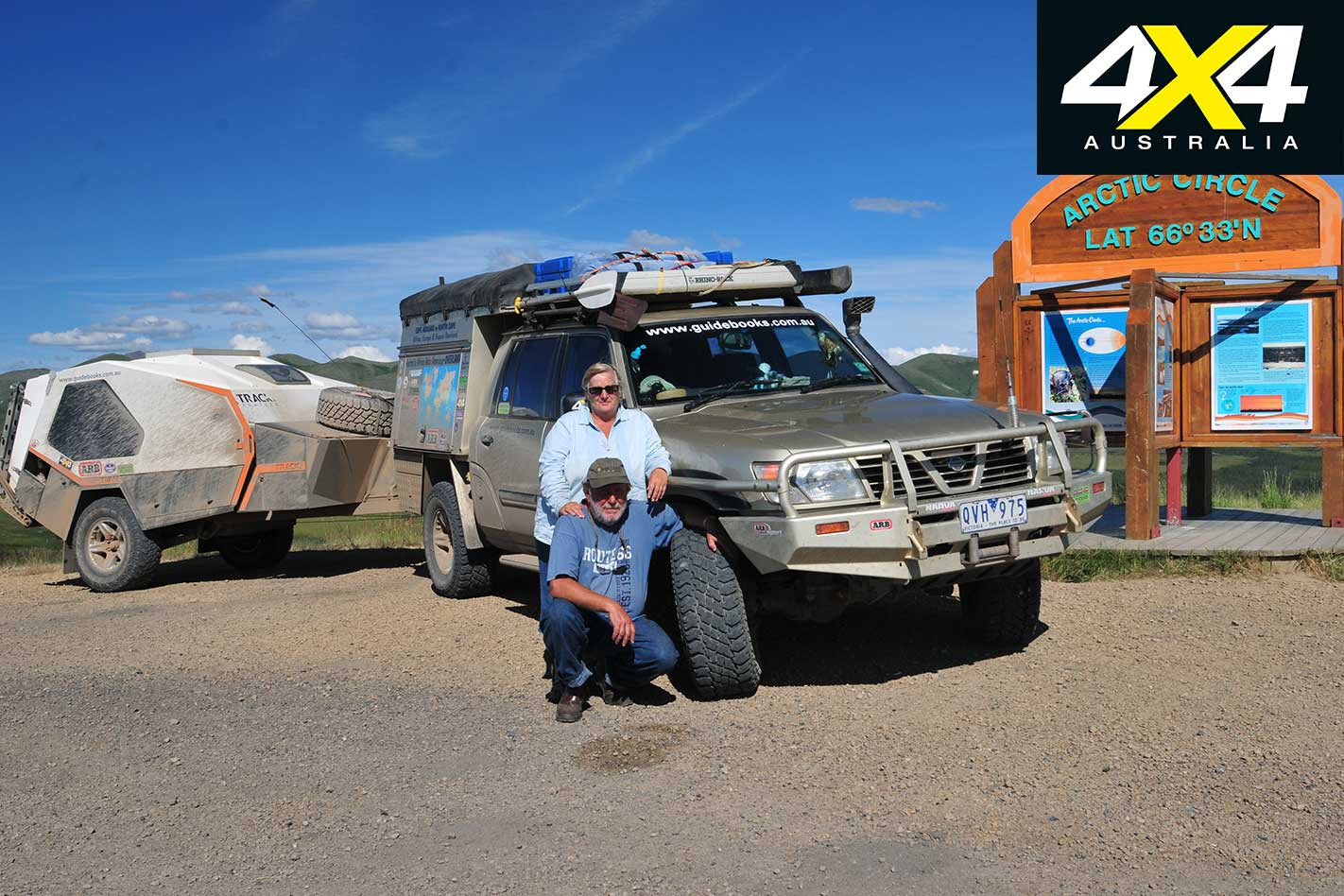
We have crossed the Arctic Circle twice during our world travels; once when heading north through Norway and again a few weeks later as we headed to Russia through Finland. This time we were in the far north of Canada, heading for the remote outpost of Inuvik at the northern end of the Dempster Highway.
From the time the first sod was turned in 1959, the Dempster took 20 years to build. Today it is the only road in Canada that crosses the Arctic Circle. In winter it is one of the ice roads made famous by the hit TV show, Ice Road Truckers, but we were there during the height of summer, when the country north of the Arctic Circle is the so-called Land of the Midnight Sun.
Our journey through Canada had begun a few weeks previously when we had crossed the US-Canada border into southern Alberta. The ragged peaks of the Rockies looked close enough to touch from the picture frame of the Patrol’s passenger window.
As spectacular as the Canadian Rockies are in Alberta, we didn’t dally too long, just long enough to wander the Cowboy Trail and visit the Bar U Ranch, one of the country’s most famous ranches, and now run as a historic site by the Canadian National Parks Service.
It is claimed that outlaw Sundance Kid (real name: Harry Alonzo Longabaugh; an infamous bank robber in the late 1800s and early 1900s) worked here while trying to dodge the long arm of US law. We seem to keep encountering the Kid’s legacy ever since we were in Bolivia and southern Argentina – he certainly got around!
We also checked out Head-Smashed-In Buffalo Jump (love the name) where, before horses came to the Great Plains, Native Americans, on foot, drove bison to their death over a low cliff. Our route then led us north through the trendy ski towns of Banff and Jasper and we mixed briefly with the rich and not-so-famous at Lake Louise.
High-tailing it onto a dirt road, we escaped the tourist throngs and the RVs that make their way north to Alaska on their annual pilgrimage from the USA and Canada’s deep south. We slipped through northern British Columbia only to find the dirt road we wanted to take was closed due to flood damage.
Forced onto the Alaska Highway – a road that was pushed through the Canadian wilderness in the dark days of World War II to give Alaska a land link with the lower 48 states – we continued north with all the other pilgrims. It’s a route that retains its adventurous and challenging reputation even though the road has long been tarred and dotted with small towns, servos and campgrounds.
Near the small community of Watson Lake we crossed into the Yukon and immediately found a dirt road to our liking. This route first follows the Frances River, then the Finlayson and Pelly rivers, before meeting the mighty Yukon River.
Isolated hamlets, with their inhabitants busy mining for gold or trapping for furs (or both, depending on the season), dot this wild region of Canada. Immediately, we decided to ease up on the accelerator, and chose to dawdle our way deeper into these wild lands.
Not wanting to break the spell too quickly, we headed for the old mining towns of Mayo and Keno City. The latter is a rustic town perched on the edge of Keno Hill, which even today continues to yield its wealth of silver to big miners, and nuggets of gold to small dredge operators.
At Dawson City we had a chance to step back in time. This town, on the banks of the Yukon River, was the epicentre of the late 1890s Klondike gold rush and it still hangs onto its Wild West charm and character. Only a couple of the streets here are paved – the rest are dirt with wooden sidewalks – and many of the buildings date back to when this was once the world’s richest gold-mining town.
The nearby river valleys have been turned over so much in the past hundred years that they resemble huge gravel pits, the earth washed away and sieved for increasingly finer particles of gold. While hydraulic sluicing of the hillsides has been banned in the Yukon, small dredge operators still work the flowing waters of the ice-fed streams.
From Dawson City we joined the Dempster Highway, which for much of the way follows an old dog-sled trail and is named after Royal Canadian Mounted Police inspector, William J Dempster.
As a young constable, Dempster frequently ran the dog-sled trail from Dawson City to Fort McPherson in the Northwest Territories. He later gained more fame when he and two other constables were sent out in March 1911 to rescue another police patrol unit [A Royal Northwest Mounted Police patrol of four men, led by Francis Joseph Fitzgerald, that became known as ‘The Lost Patrol’] that was long overdue to arrive in Dawson City.
Sadly, they only found the frozen bodies of the unit members, which were recovered and are now buried at the First Nation community of Fort McPherson. It’s about 770km from Dawson City, north across the Arctic wilderness to the First Nation settlement of Inuvik.
Once again we said goodbye to most of the RVs as we slipped onto the well maintained dirt highway. At first, the road followed the North Klondike River and then climbed into the spectacular Tombstone Range as we passed through the fine mountain vistas and magnificent wild country of Tombstone Territorial Park.
Around the halfway mark we reached the small settlement of Eagle Plains, and then a short time later, the Arctic Circle Monument. Further north, among the peaks of the Richardson Mountains, we reached the border of the Northwest Territories.
This sparsely populated region of far-north Canada encompasses an area the combined physical size of South Australia and Victoria, but with a population of just 44,000.
Across this rolling tundra, bare of trees, the Porcupine caribou herd – containing more than 150,000 animals – wander on their annual migration, first heading north to the coast in early spring and again in autumn as they head south back to their winter feeding grounds.
We missed a small mob of between 5000 and 6000 animals by a couple of hours (or so we were told by locals and travellers), the plains appearing devoid of all life as we drove north. In summer, though, the plains are ablaze with colour, especially with the purple and mauve of fireweed, which in places carpets the ground in an unbroken display.
Still, in autumn the tundra puts on one of its most dazzling mantles as the low scrub and bushes transform from vivid green to a range of yellow, brown, gold and red hues and then to the sombre colours of winter.
At the Peel River – and much larger Mackenzie – ferries shuttle vehicles across the water during summer, while an ice bridge in winter keeps traffic moving. Only when the rivers freeze and break up is traffic flow interrupted. We were lucky. Unseasonably, a flood of water came down the Peel and washed the ferry away, closing the crossing for a week just after we had returned south.
On the banks of the Peel is the small historic settlement of Fort McPherson; its cemetery contains the graves of that unfortunate RNMP patrol of 1911. On the Mackenzie’s banks, at the confluence of the smaller Arctic Red River, is the native settlement of Tsiigehtchic.
Here, we met a fellow Aussie. Hailing from Brisbane, the ex-pat has lived in the village for the last few years working as an electrician on the mining sites around the area. Married to a local, we asked if he would ever return to Queensland. His reply? “Probably not, too many people, and the only thing I dislike about this place is the month or so of absolutely no sunlight.”
A few hours later we drove into Inuvik and the end of the summer road. In winter, an ice road heads north across the Mackenzie delta and along the shores of the Arctic Ocean to Tuktoyaktuk. After a day in this small town we were to retrace our steps south and head for Alaska, but that ice road heading north looked tempting – maybe tempting enough to draw us back in winter.
Travel Planner
Travelling in Canada is easy and rewarding with plenty to see and do. Crossing the border from the USA is a cinch and by far the easiest border we have crossed in our global travels. You can hire or buy an RV at Canadream; www.canadream.com. There are several other RV hire companies.
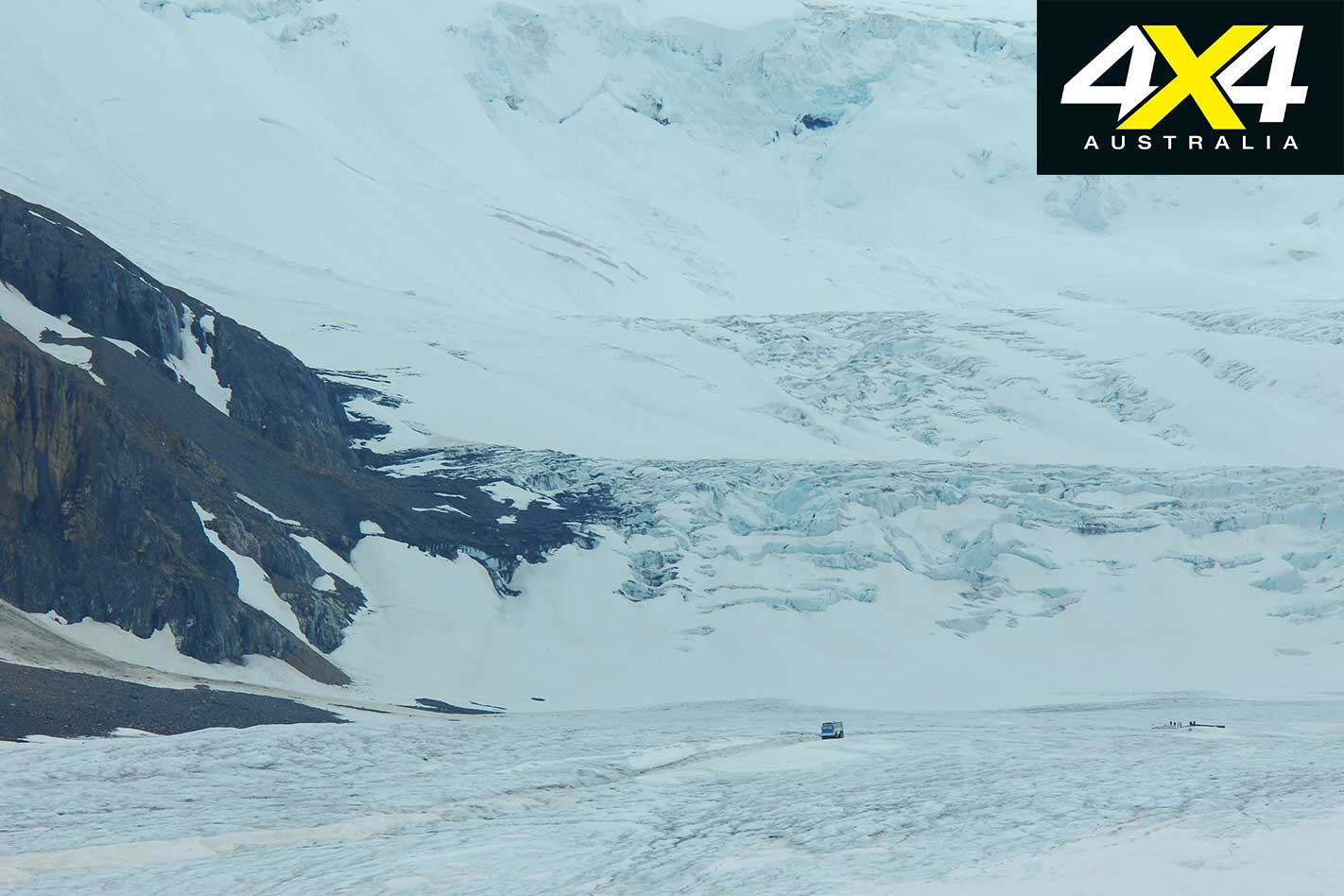
For info on the Canada’s three western provinces check out: http://travelyukon.com; http://travelalberta.com; www.hellobc.com. For Parks Canada visit www.pc.gc.ca/eng/index.aspx. For info on parks, camping and fishing in the Yukon check out: www.env.gov.yk.ca/
MITSUBISHI has joined the growing list of manufacturers that have released special edition dual cabs, by announcing the release of its Triton Blackline.
Based on the 2018 GLS 4×4 Double Cab model, the majority of changes the Blackline receives mainly involve trim and style updates – powertrain and underbody components remain unchanged.
What is gets is a black mesh grille; black exterior handles; black door mirrors; Triton Blackline door decal; black-finish fender flares, side steps, rear step bumper, sports bar and 17-inch alloys; carpet mats; and a tub liner.
The Blackline also get a rear diff lock as standard, as well as smart key entry with one touch start.
The competitively priced Triton was 2017’s third best-selling 4×4 in Australia (20,513 sales), behind Ford’s Ranger (36,932) and Toyota’s Hilux (35,297).
The Triton Blackline is available now with a drive-away price of $41,990 (six-speed manual) and $44,990 (five-speed auto).
MORE: Mitsubishi Triton Range Review MORE: Mitsubishi Triton Specs, Range & Price