
A hugely speculative article from another publication suggests that Ford and Volkswagen could partner on their next mid-size pick-ups.
Stupider things have happened but when you look at the facts you see Volkswagen’s Amarok is the oldest vehicle in its class and its relatively low sales number would make it difficult to invest in the huge amount needed to develop a next model; particularly when you consider the huge amounts the company has paid out in the wake of the diesel emissions scandal.
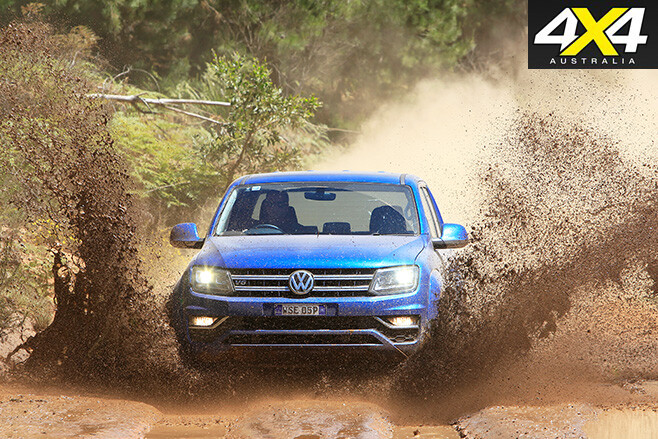
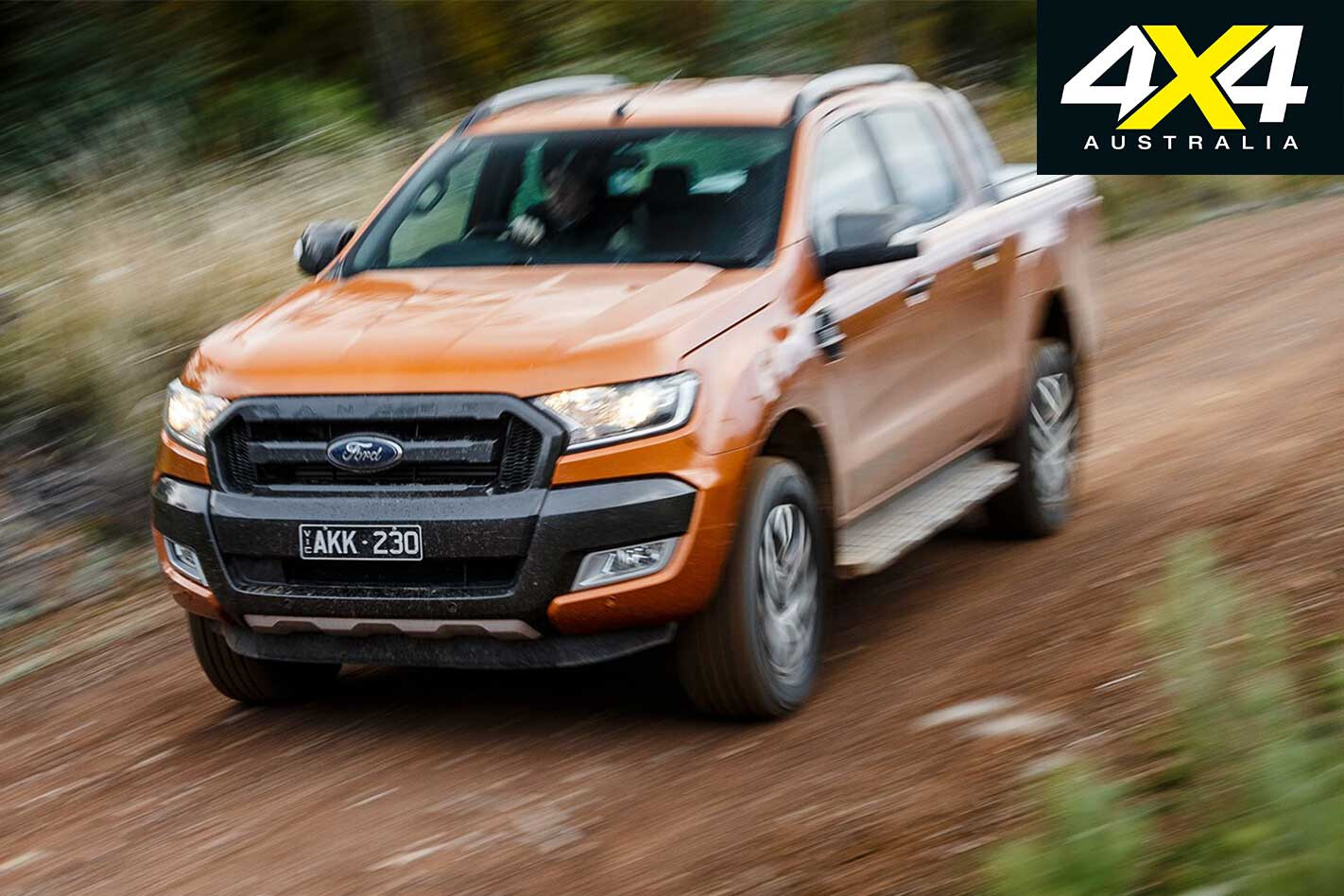
In the meantime, Ford’s Ranger is about to extend its global reach as it spreads in to the USA and its economies of scale will look even better down the track.
While the article suggested the obvious that VW could build its next Amarok on a shared Ranger platform we suggest that the opposite would be a better option. Certainly from a ute buyers perspective.
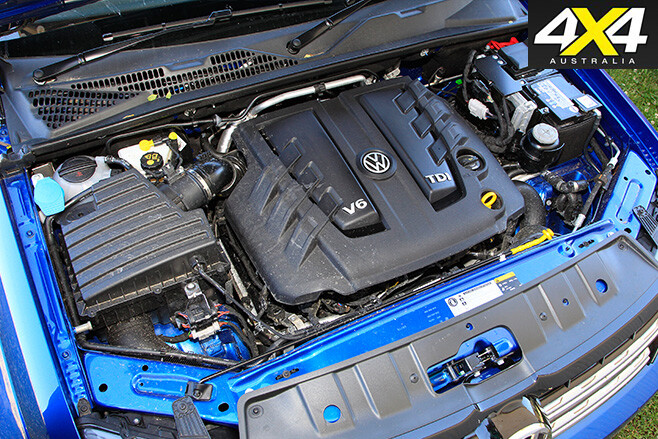
VW struggled with Amarok sales due to the perceived weaknesses of only offering a relatively small 2.0-litre bi-turbo diesel engine in the initial vehicles, but sales have spiked since the arrival of the V6 powered ‘Rok which remains the best engine in its class. In fact the Amarok is still in many ways the best vehicle in the category.
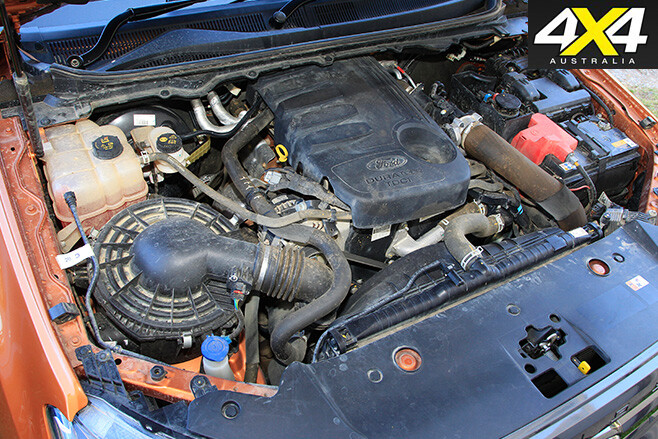
One of the strong selling points for the Ford Ranger has always been its grunty inline 5-cylinder engine which at 3.2 litres capacity is the biggest in the category. That aging engine is on the way out as Ford moves to a, guess what – a 2.0-litre bi-turbo diesel.
Regardless of the high torque numbers, this engine will have less favour with Ranger buyers than the bigger option as indicated by the negative comments all over social media about the 2.0-litre going in the Ranger Raptor.
Australians like a big diesel engine and upwards of 3.0 litres is the magic number. Aside from the VW and Mercedes-Benz V6 diesels, everything else is getting smaller in the name of efficiency regardless of the superior drivability of the bigger engines and what Aussie buyers want. We’re only small fish in a much bigger pond.
There’s no official word of Ford and VW partnering on a ute. The statement quoted other synergies between the two brands, more specifically commercial vans, but nothing on the truck front.
Dr. Thomas Sedran, head of strategy for Volkswagen Group, said in the statement, “Markets and customer demand are changing at an incredible speed. Both companies have strong and complementary positions in different commercial vehicle segments already. To adapt to the challenging environment, it is of utmost importance to gain flexibility through alliances. This is a core element of our Volkswagen Group Strategy 2025. The potential industrial cooperation with Ford is seen as an opportunity to improve competitiveness of both companies globally.”
But as we said, stupider things have happened.
As Australian 4-wheel drivers, the Victorian High Country is a special place for us. Steep challenging tracks, stunning mountain views and a pioneering history that resonates with anyone who has an affiliation for the bush are just some of the attractions that bring us back there year after year.
If you caught our recent DVD Series from the Vic High Country, you would have seen a short part of an interview Ron Moon did with High Country Cattlemen Graeme Stoney and Charlie Lovick.
The Stoneys and the Lovicks ran cattle on the western ranges of the alps for generations before the government stopped cattle grazing in the national parks and these guys know the mountains better than anyone. They have a passion for the area that is infectious and to hear them talk about the land they love and what’s happening to it is something anyone who has visited the area, or aspires to visit it, should hear.
Ron’s chat with the fellas was too good not to share so here it is in full.
For more information on the cattlemen and their plight, take a look at the website of the Mountain Cattlemen’s Association of Victoria’s website at www.mcav.com.au. There’s plenty of history there to be leant and the association’s annual events arte not to be missed.
THE monster July 2018 issue of 4X4 Australia will be on shelves June 21.
Picking up a copy of the July 2018 issue of 4X4 Australia magazine will also net you episode 3 of the 4X4 Adventure Series DVD to the Vic High Country. In this final Vic High Country episode, off-road icon Ron Moon leads the crew from the Dargo Hotel and on to Mount Blue Rag, Talbotville goldfields, through the Wonnangatta Valley and up the flanks of Mount Stirling.
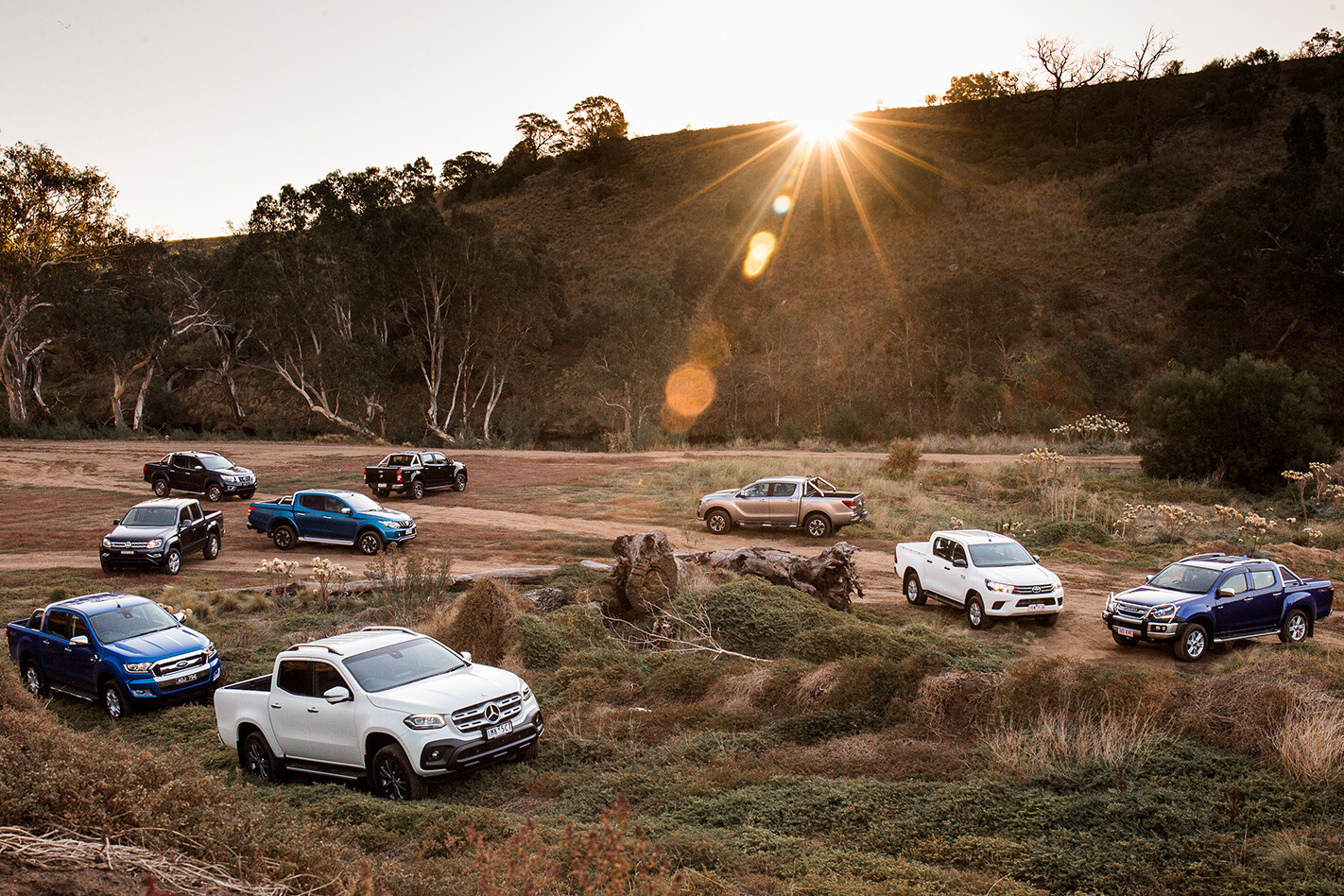
A massive nine-way ute comparo takes up a good portion of the mag this month, with Merc’s X-Class fronting up to all of its main rivals in an on- and off-road showdown.
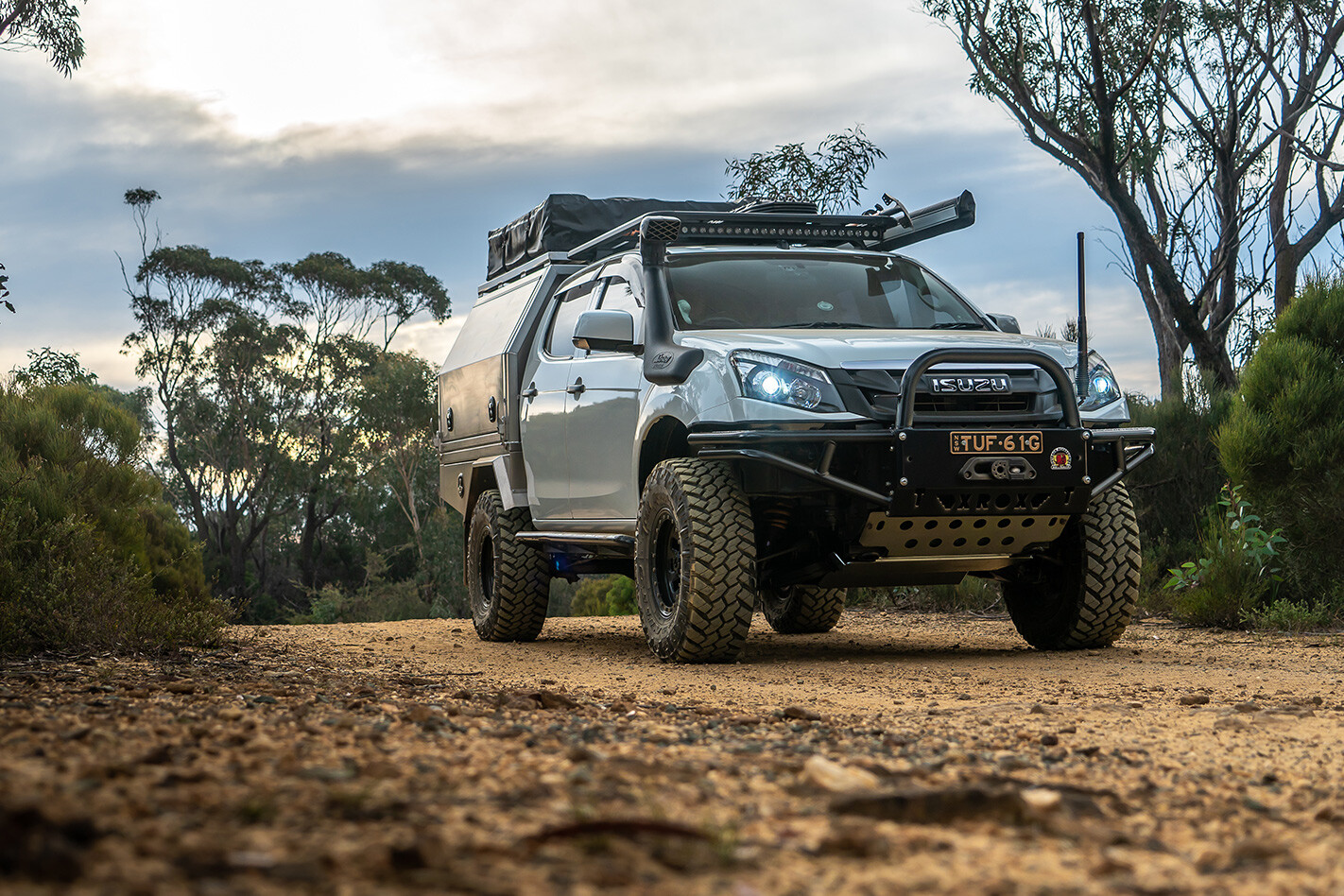
Two killer customs also turned a few heads at 4X4 HQ: a BJ40 with a beefy 4.5-litre TDV8, and a neat D-Max tinkered to perfection.
Our Vic High Country trip highlighted why it’s one of Australia’s best off-road destinations; we list five quick escapes close to Darwin in the top end; and we’ve managed to squeeze in an Ultimate Buyers’ Guide for off-road tyres.
WHAT ELSE IS THERE?
- Holden 1 Tonner – bullbar dramas
- Final adventure in our resident Patrol Ti-L
- Kinkuna escape, Queensland
- Product tests and monthly rants
- Expert view with Ford’s Vehicle Integration Core Attributes Supervisor
It’s always an exciting time when two parts of a major project come together for the first time. Sure, all the little bits and pieces are important in their own right, but, there is nothing like having to step back a few paces to take in all the glory of the whole picture.
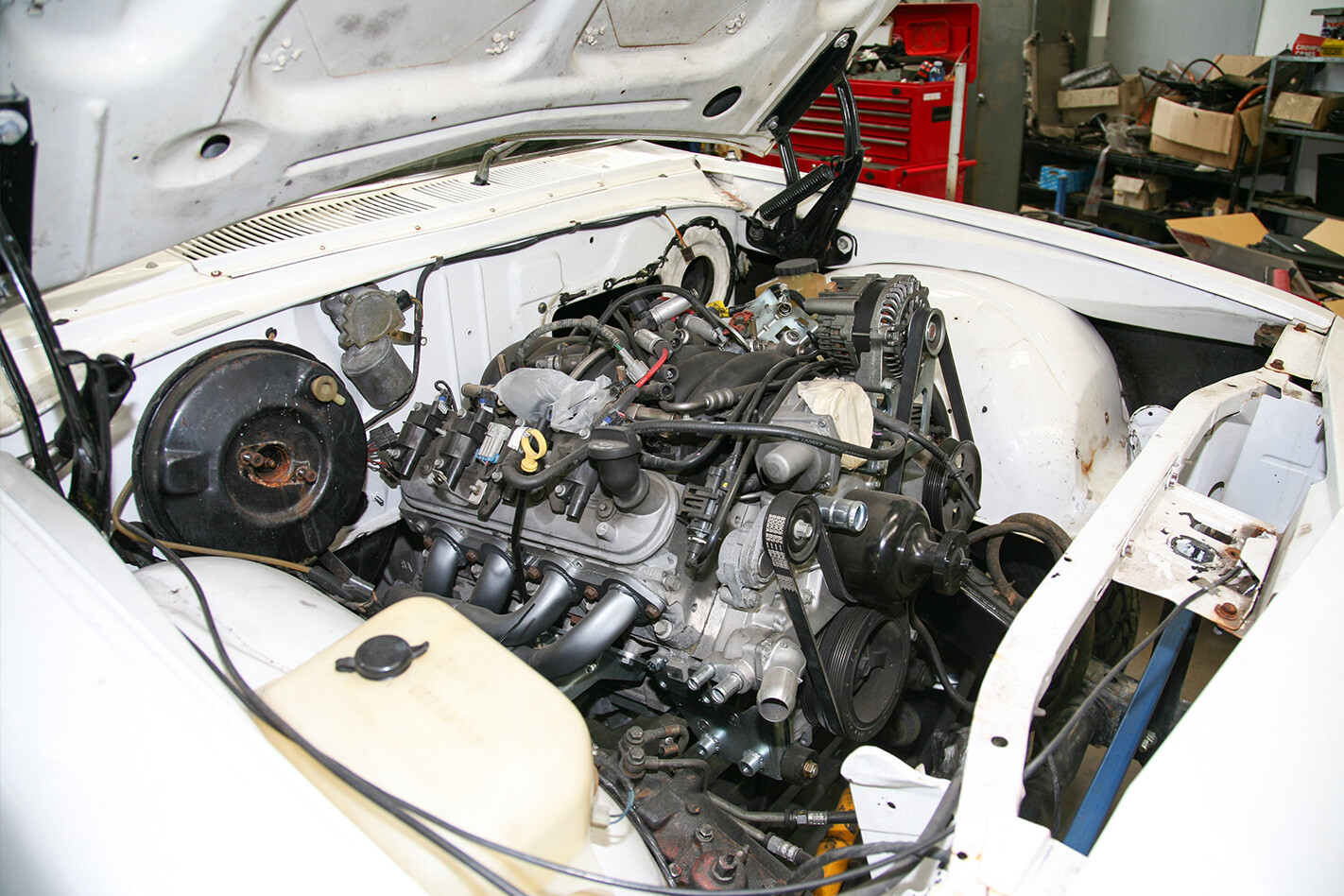
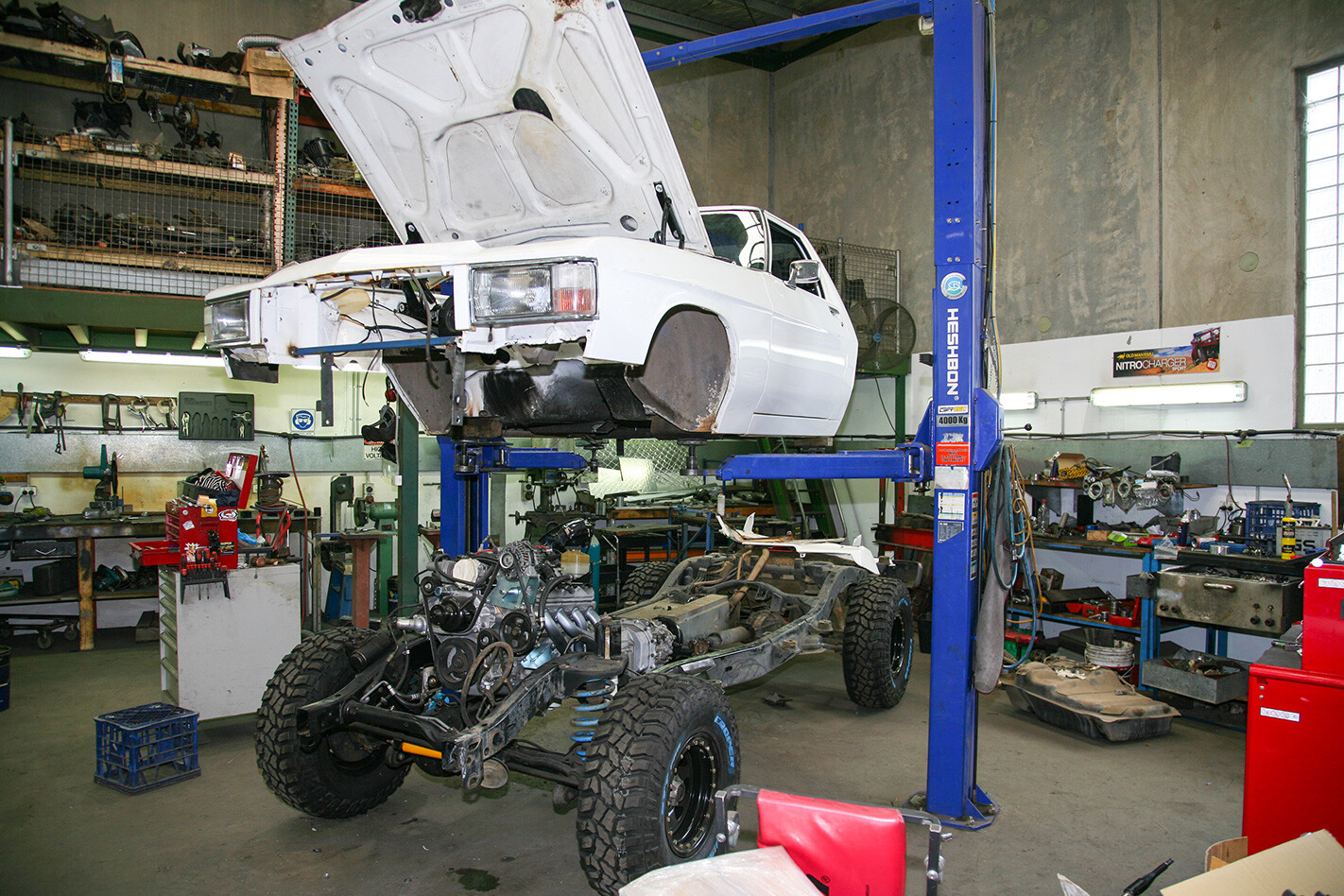
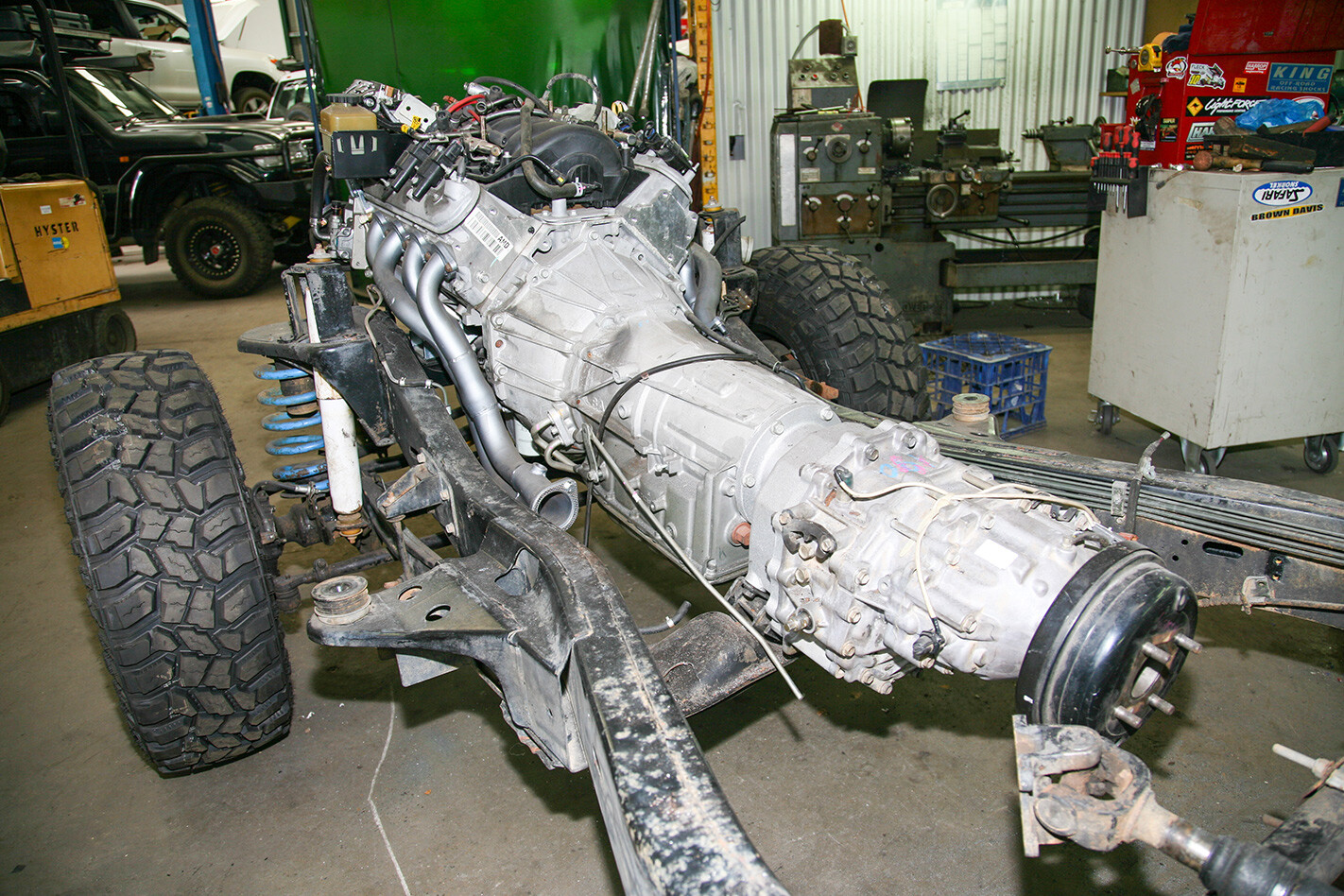
I was well and truly clenching as my Holden 1-tonner cab was gently lowered over the 6.2-litre LS3 engine and six-speed automatic cog swapper; would the inner ’guards hit the custom extractors, would the bonnet clear the high-mounted alternator, will there be enough room for a radiator without having to butcher the front end of my 1977 Holden cab?
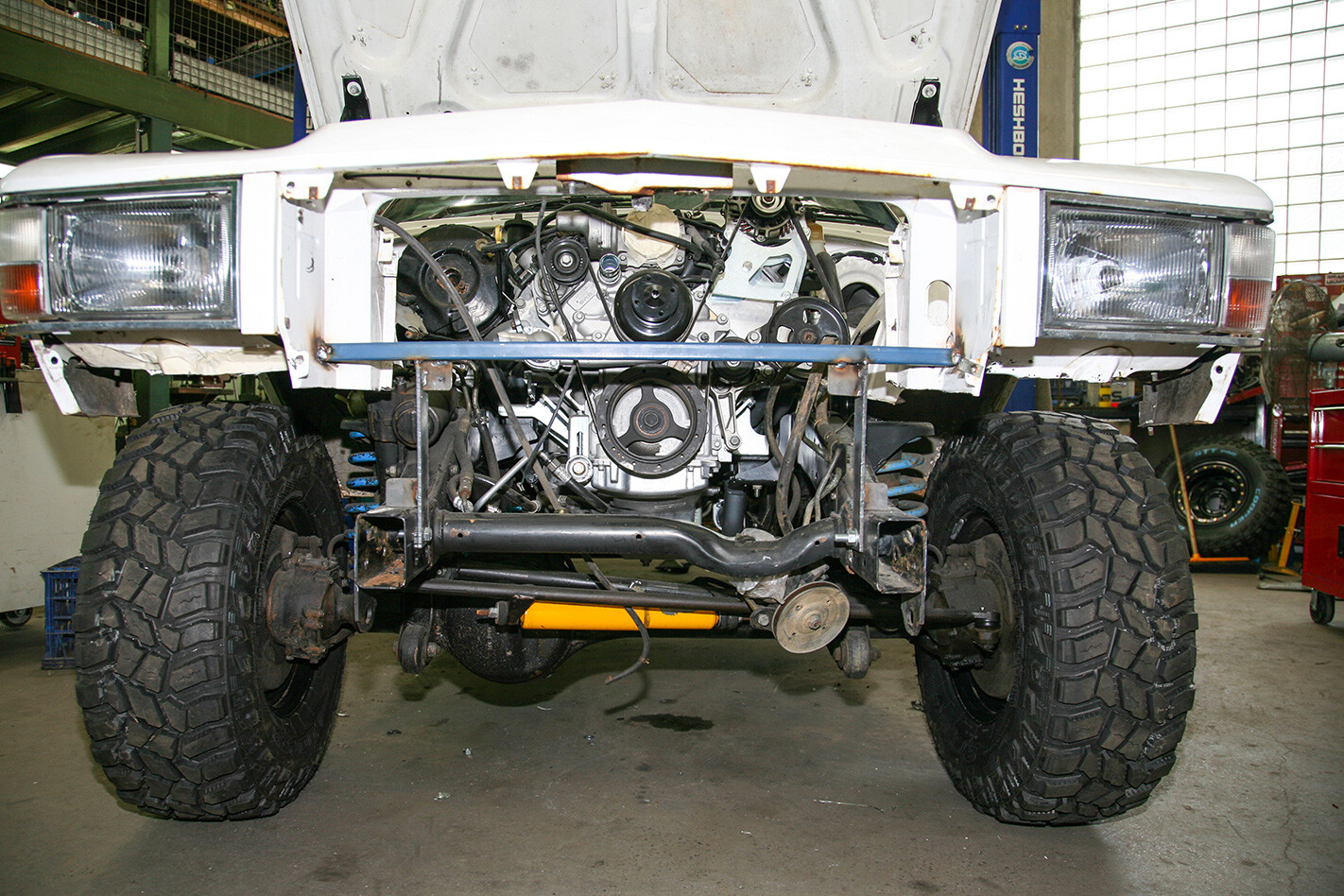
Admittedly, there had been a lot of work prior to ensure nothing would foul. Plus, given the cab is a two-door, I don’t have to worry about aligning front and rear wheels into set-position wheel arches. With only the front two arches to worry about, and not being too concerned about the height of the cab via a body lift and custom mounts (within reason), I was pretty confident of the fitting. Besides, if it doesn’t fit, we’ll hit it with a bigger hammer or take to the angle grinder and make it fit!
Given there is no off-the-shelf kit to fit an old Holden cab onto a GQ Patrol chassis, the body mounts will all be custom made. Basically, when we lower the cab to a spot where it ‘looks’ right and doesn’t hit other parts or prevent suspension movement, then, whammo, that’s where it calls ‘home’. Total Care’s head fabricator, Aaron, came up with the ingenious idea of removing the OE GQ body mounts from the chassis, repositioning them (front to rear and side to side) and reattaching them. Well, bugger me, they are still deemed OE body mounts – clever, huh?
One of the most important steps of any oddball vehicle build is to keep your engineer in the loop with exactly what you’re planning and show them during and after completing any custom part. Playing by the engineer’s rules will ensure an easy flow from build to on-road registration. Obviously there are costs involved by engineering a vehicle, but those costs are far outweighed by any hassles you’ll otherwise have down the track with the boys in blue, or, heaven forbid, if you’re involved in a car accident and the knocking back of an insurance claim. If you hurt another road user in an illegally modified car, kiss your freedom and your wallet goodbye.
Prior to lowering the Tonner cab on to the GQ chassis, the Total Care 4WD crew grafted the GQ steering column into the Holden dash, which should provide a little extra driver comfort and safety with it being tilt adjustable and collapsible, compared to the solid javelin-like old Holden column that is clearly aimed right at the driver’s chest.
While the old Tonner seats were okay, they are no match for the contoured, electrically operated VE Maloo pews which boast both height and forward/rear adjustments to cater for my lanky frame. Again, the engineer will check the mounts made for fitting them. If the distance between the two Maloo buckets allows, I’ll re-use the original Holden centre console which has a flip-up armrest with a small pocket underneath. Some form of cutting/customising of the fake plastic woodgrain panel that surrounds the gear stick will be needed, but only time will tell if we go ahead or start from scratch with a new console.
My first 4×4, back in the mid 1980s, didn’t have air-con. Neither did the next four; one was a 1956 Willys Jeep so it wasn’t really needed, but it’s simply not something I had ever wished for or considered back then. Fast forward more than 30 years and air-con is something most, including me, can’t do without. Call me going soft, or simply wanting as much comfort as possible, but I wanted air-con in my old Tonner if it was physically possible. A Vintage Air condenser system has been paired up with an air compressor unit from an LS1 engine and a generic evaporator. All were sourced by Steve the Sparky and Jason at Total Care.
Another major advantage of including an air-conditioner is the ability to effectively demist the windscreen. There is nothing worse than smearing your grubby hands across the windscreen while trying to peer out past the frosted glass and grunge combo, which is also extremely dangerous. The Vintage Air kit came with flexible tubing to allow piping into the existing Tonner dash and demist vents. Another nice touch was the option of retro-style gauges to adjust from fresh to recycled, as well as varying the outlet.
To help keep a bit of that pulsing, angry, neck-snappin’ LS3 engine noise out of the cabin, I’ve lashed out and fitted Dynamat sound deadening to the floor and firewall and reused the original black carpet and underfelt. I could just use a nice, quiet muffler, but, nah! The flexible stick-on coating also aids in preventing the heat from the engine and the exhaust system from melting my double pluggers.
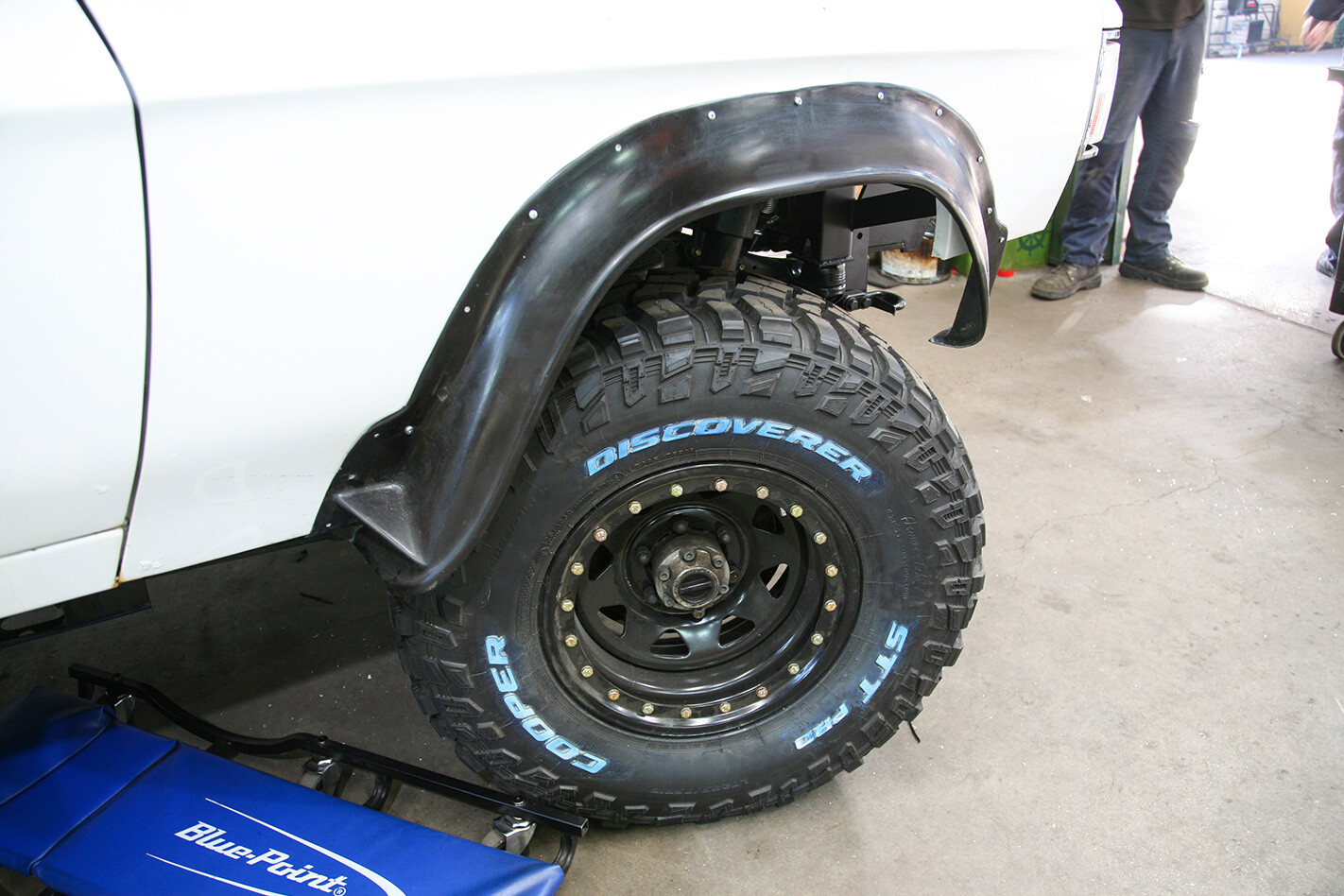
A few months back I lashed out and bought a set of 33-inch (285/75R16) Cooper STT Pros and whacked them on 16-inch Dynamic steel-imitation bead-lock rims. Wanting as wide a stance as possible, while keeping it all legal, I went with a negative 13mm offset rim (standard GQ Nissan Patrol is plus 10mm) which puts the wheel track change to 46mm over, which is less than the 50mm maximum change allowed.
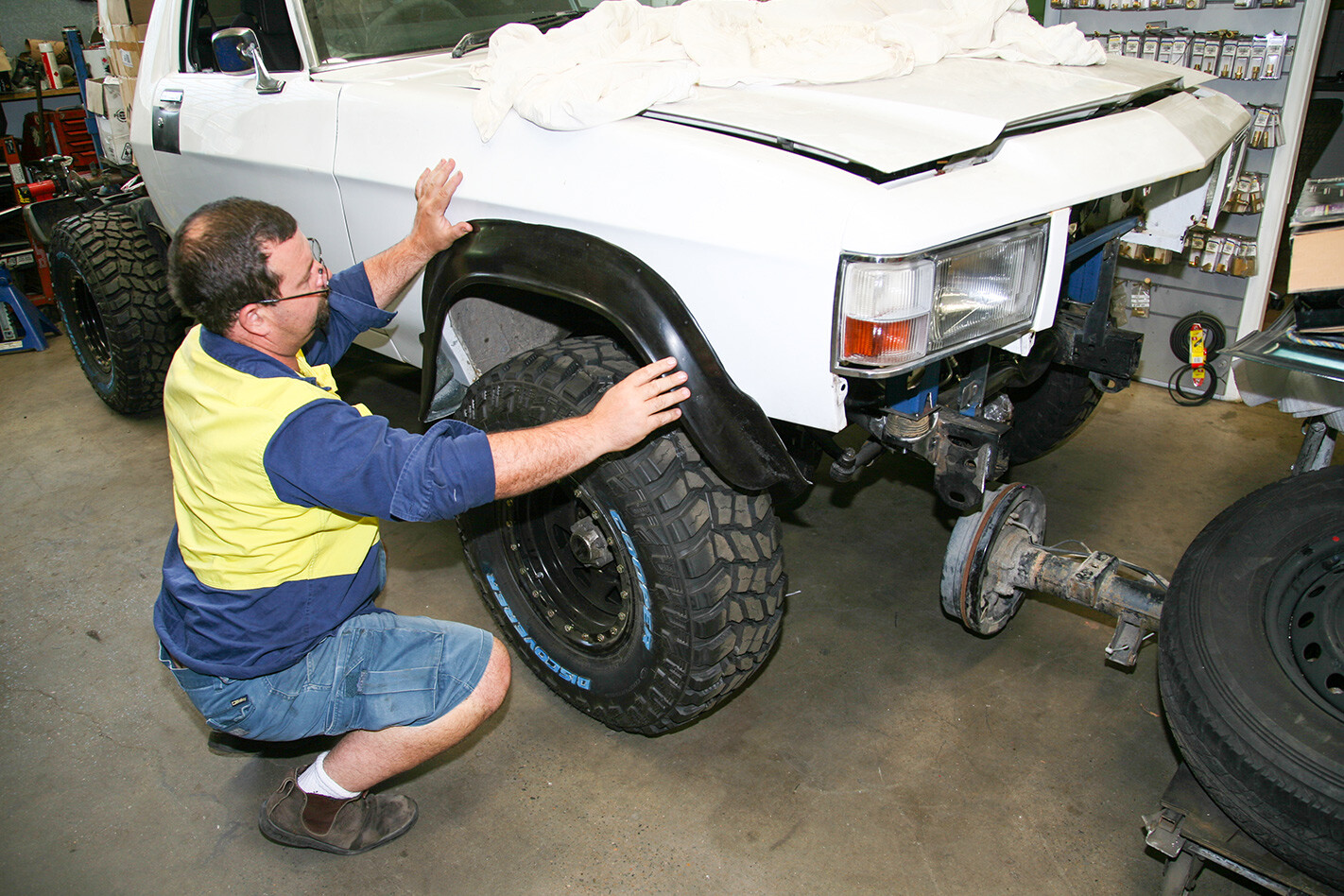
With the lowering of the cab over the chunky off-road rubber and the need to ensure legality of the tyre tread not protruding past the ’guards, I needed to fit flares. Incredibly, I managed to track down the daughter of Arthur Hayward, the mastermind of the original Holden Overlanders. She still has the moulds and sells the flares for both front and rear ends of these mighty Holdens. My build is not a dinky-di Overlander, but all the panels are the same as original works, so the flares fit perfectly. A few holes drilled and a bit of trimming of the ’guards at the front end and that was a pretty easy job. The Tonner’s smaller wheel arch doesn’t allow the 33-inch Coopers to fully enter, but having the body sitting higher overcomes the need for excessive ’guard cutting – phew!
While I wanted a period-correct steering wheel –three slotted alloy spokes with a black grip – my engineer vetoed that given they did not have a padded horn button; lucky I asked him first! I had to choose a wheel that incorporated the relevant padding and was ADR compliant, but not necessarily compliant for airbags. Given my project will be registered as a Nissan Patrol, because it’s based on the chassis that is used – yeah, I know, it looks like a Holden on the outside – all legalities must comply with the year of the vehicle it’s registered as; in this case, a 1990 Nissan GQ Patrol. A 350mm diameter Autotecnica Racer Pro steering wheel in black leather with Patrol Boss kit was chosen to help guide the Tonner around the countryside.
Stepping back to the legalities and needing to conform with what the basis of the vehicle is; that’s another reason I opted for a GQ Patrol and not a GU Patrol. There are no airbags, no side impact beams in the doors and no overly complicated electronic safety inclusions like anti-lock brakes, traction control, or, in the case of the Maloo, launch control. Yeah, I know, all these safety features are the latest and greatest way of keeping us alive on the road, but that’s just how I’m rolling with the Tonner.
More exciting times to come soon with the manufacturing of a few custom parts, as well as one of my biggest procrastination problems: what type of bullbar do we make? I’m thinking of a combination of a traditional ute four- or five-poster with a more off-road (read non-road-kill scraper) orientated design with tapered wings for maximum protection and approach angles all rolled into one. I did consider a tube bar, a modern-style rounded jobbie, and even a neat single bumper bar replacement in steel, but given this won’t just be a shopping trolley tray-back, I want decent all-round protection from wildlife and Mother Earth.
I won’t be using the old alloy farm tray, so will be making a more heavy-duty off-road and camping suitable steel-framed unit, lined with alloy chequer plate with front and rear hoops … I must teach myself some form of computer sketching instead of handing the fabricator’s pencil-on-paper doodles!
I also plan on recessing an electric winch into the bar and grill, as well as providing plenty of space for decent size driving lights, so stay tuned to see what the welder comes up with and make sure you have a gander at the build-up videos on our website.
We knew the swim would be brief. The sun was sinking behind the gorge walls, and we didn’t have head torches to negotiate the hike back to our vehicles. Still, we shivered happily in the deep blue waterhole, surrounded by cathedral-like ancient rock.
This article was originally published in the October 2011 issue of 4×4 Australia.
Necks craned, we were watching ornithologist (bird expert) Simon Cherriman abseil down the face of Amalia Gorge, in El Questro Wilderness Park, in the northern Kimberley. Simon was using his climbing skills – handy for birdwatching – to conduct a vertical transect of the gorge wall, tagging cracks and crevices for future studies on behalf of the herpetologists (amphibian and reptile biologists) monitoring his descent from below. Most of the scientists would stay until dark and return later that evening in search of Litoria splendida, the brightly-coloured (and aptly-named) magnificent tree frog, found only in the Kimberley.
Scattered around the rest of the park – and as far as the lower Ord River, near Kununurra – scientists and volunteers were partaking in their own studies, from goannas, fish and freshwater crocodiles, to turtles and small native mammals, each with a common cause, to document species and habitats before the onslaught of the feral cane toad in this pristine wilderness. A sad and, it seems, inevitable reality. The expedition, funded and organised by the Australian Geographic Society (AGS), would constitute one of the country’s first ‘before and after’ studies of an area affected by the cane toad, providing a more accurate picture of the pest’s true impact.
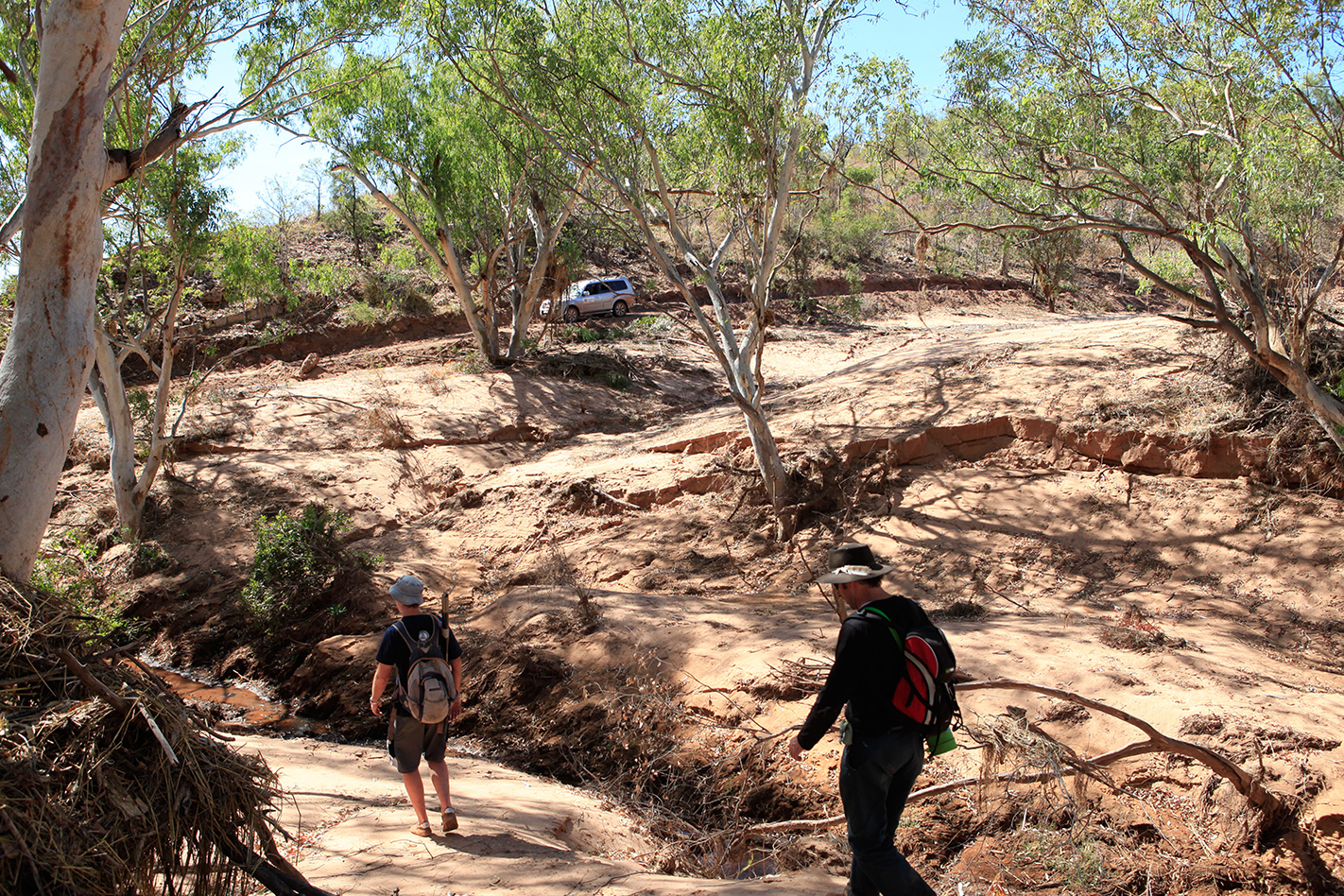
Back at Amalia Gorge, the rest of us, including rock-star herpetologist Steve Wilson – whose accomplishments lent him near-celebrity status among the younger biologists – dried ourselves and commenced the rocky walk back to our waiting 4X4s.
I had learnt to look closer at the rock beneath my feet at this time of day, cautious of snakes enjoying the lingering warmth before the onset of the cool evening. So, it was with this increased observance that I stumbled across a large snake skin, which I promptly, and proudly, pointed out to Steve.
“Ah yes, we saw that on the way in,” Steve said, examining the papery brown skin in his hands. “This was an enormous mulga; a real whopper. Probably shed fairly recently, too.”
I laughed hesitantly, shifted my feet and checked our periphery, while Steve went on to describe the large and relatively docile (his words) mulga or king brown snake (Pseudechis australis), jokingly personifying it with a deep voice, like a gentleman in an armchair cradling a snifter of whisky. I’m sure Steve feels the deadly snake is somewhat misunderstood – and not just because of its common name, which leads many to mistakenly believe it to be a brown snake (it is, in fact, a species of black snake).
While I couldn’t quite share his affection for the venomous reptile, I did enjoy the new perspective and assurance it offered.
Back at base camp, the official AGS expedition mess tent would be abuzz with laptops, notebooks and cameras, jarred specimens and bagged reptiles, as well as dusty 4X4s coming and going, loaded with scientists, staff and eager volunteers wielding traps, nets and buckets to collect much-needed data on one of the least-surveyed areas of WA, and the country.
This was going to be no ordinary stay in the Kimberley. In the next two weeks, I would find myself inspecting goanna traps, hiking and wading through gorges in the dark, netting butterflies, assisting in micro-chipping frogs and snorkelling for turtles.
Travelling with biologists and ecologists opened up a world of hidden life that could otherwise be easily overlooked – and is at risk of being lost altogether.
THE FRONT LINE
Prior to the scientific expedition, volunteers for not-for-profit foundation, Stop the Toad, endured weeks of labour in the early dry season heat to construct a 1.3km toad-proof fence at the boundary of Emma Gorge, just outside El Questro, in an attempt to create a refuge for native fauna from the toxic toad.
As part of the AGS research, pit and funnel traps were laid along the toad fence to catch and document animals moving around the area. On a daily basis, herpetologists and volunteers would uncover dozens of frogs, reptiles and tiny marsupials for study.
Dubbed “the fence that keeps on giving”, the numbers of species found were high, yet a sense of melancholy lingered like bulldust in the air as the scientists predicted the findings of follow-up studies just one or two wet seasons down the track.
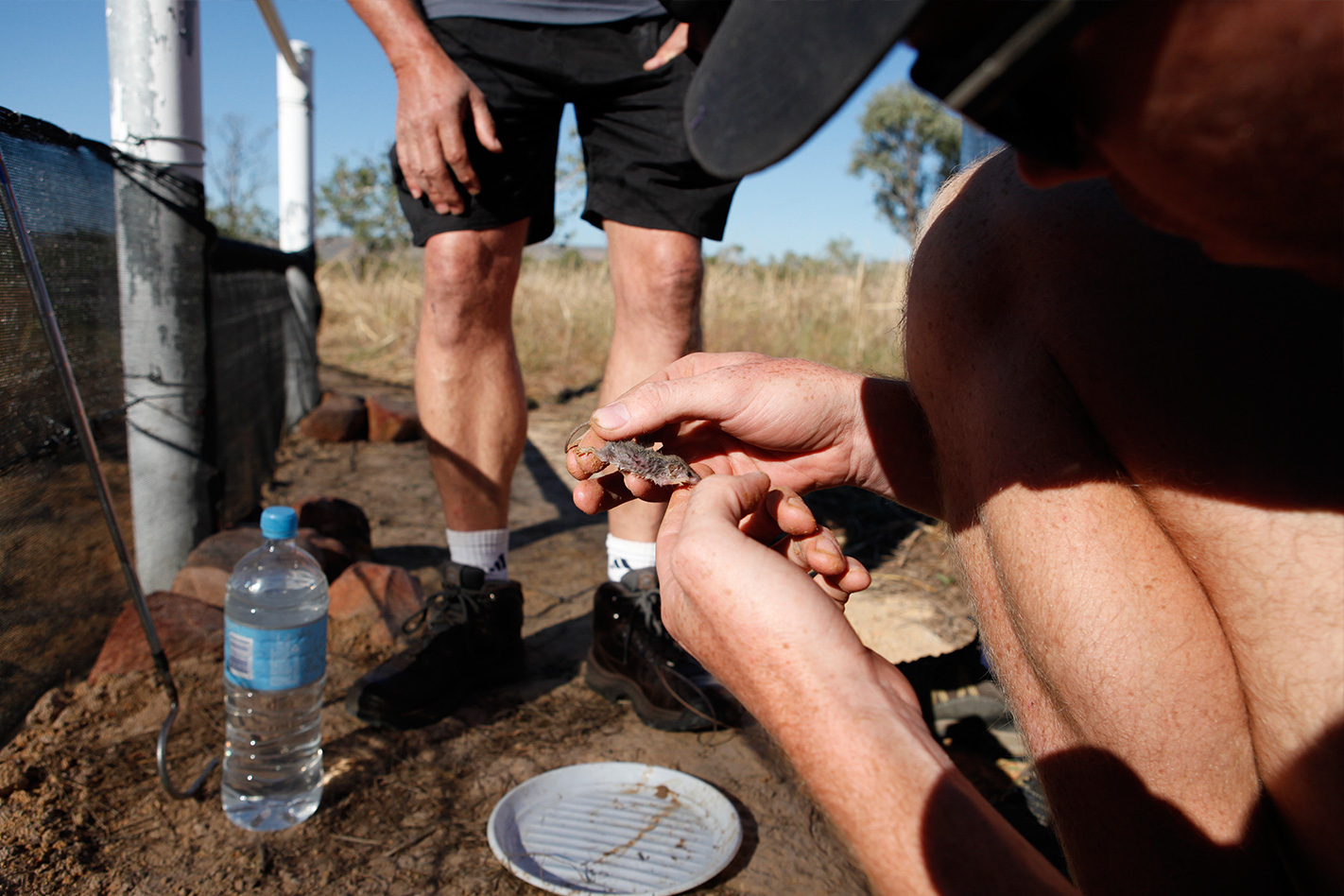
“The fence is effective in sampling small fauna, but as far as stopping the toad goes, I think, sadly, all it’s doing is buying time,” said Steve Wilson, who was using the expedition to document species for the next edition of his award-winning, co-authored book, A complete guide to the reptiles of Australia.
“For example, those ancient yellow-spotted monitors that patrol the campground will probably be dead in two years. Almost all because of toads.” But the undercurrent of despondency didn’t affect the sense of responsibility surrounding the trip.
As expedition chief scientist, Sean Doody, pointed out, community efforts have significantly impacted toad numbers and measurably reduced their damage over the years, while studies like the AGS expedition have a real chance of contributing to future attempts at controlling the toad.
Sean spent most days on the Ord River, near Kununurra, where the cane toad has already arrived, in order to produce quicker results and secure support for more cane toad impact studies down the track. “If we don’t understand the damage the toads cause, there’s no way we can say we’re doing anything about it,” Sean said.
FISHY BUSINESS
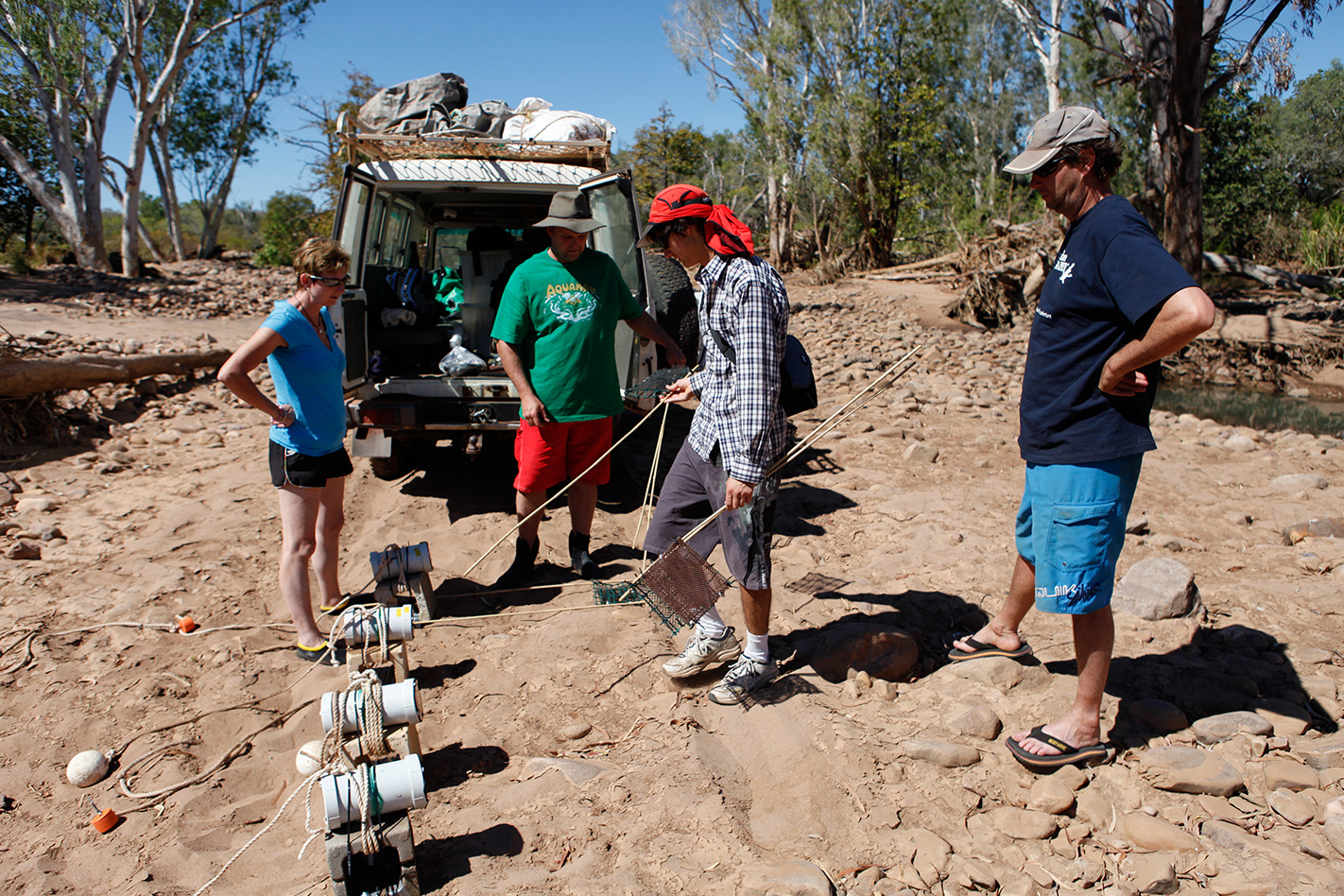
The tinny rattled on the roof of the old Troopie as we bounced over boulders towards the creek’s edge. I was spending the day with fish ecologists Brendan ‘Ebb’ Ebner and David ‘Morgs’ Morgan, who collaborated on the trip, documenting freshwater species around El Questro.
For biologists that specialise in water-based animals, their sense of humour couldn’t get much drier, and there was plenty of material as the volunteers stuffed bespoke contraptions for attracting and filming fish with sun-ripened pilchards and prawns. (Ebb: “I don’t know much about buying perfume for my wife, but I know she doesn’t much appreciate Chanel Negative 147.”) The devices are called Baited Remote Underwater Video Stations – or BRUVS – making the scientific duo, and anyone involved in the research, officially BRUVers.
Morgs drove up from Perth, while Ebb was over from Far North Queensland. The two had collaborated on several studies prior to the expedition and could have been mistaken for a couple of typical fisherman – with the added insight of doctorates in ichthyology. And, as with most fishos, there was always time for a yarn and a laugh with these two, but fish conservation was something they took very seriously.
Cane toads are poisonous at every stage of their existence; as an egg, tadpole and, of course, a fully-developed toad. This means that land animals with a taste for amphibians are not the only creatures at risk as toads migrate across the country.
“Sean Doody recommended that we fish-heads come along on the AGS trip, as he has found freshwater crocodiles in the Northern Territory dead following consumption of cane toads,” explained Ebb. “Since freshwater crocodiles are a major predator of fish, we suspect the cane toad invasion may have repercussions for the freshwater fish community in the Kimberley.”
But the risks could be even further reaching. Morgs spends a lot of time working with indigenous Australians and fears for those who traditionally cook fish whole as they could unintentionally ingest toad poison, resulting in illness, or even death. They may be larrikins, but Ebb and Morgs know more than most that the potential damage caused by the toad is no joke.
CLOSELY MONITORED
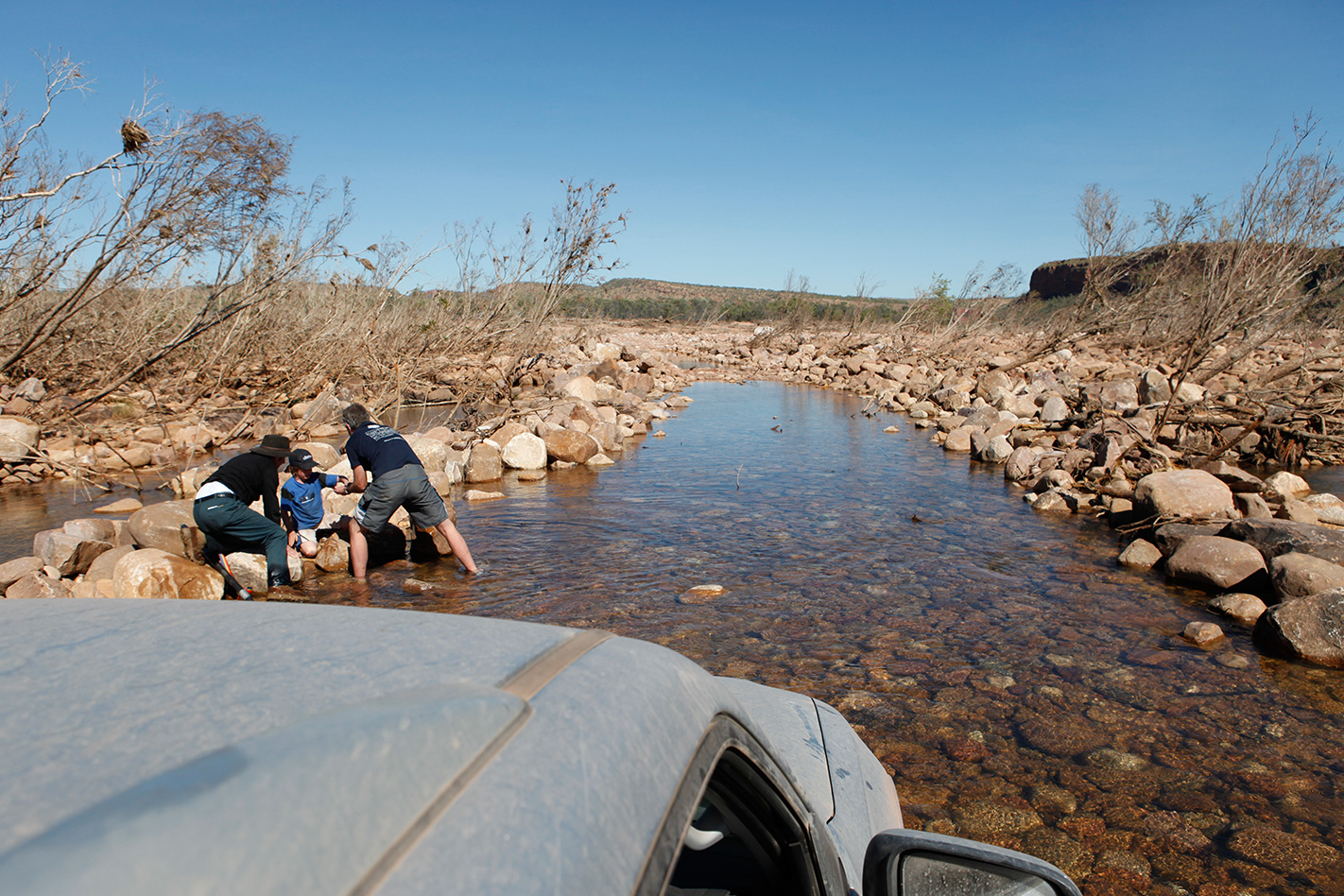
I couldn’t help but cringe at the grating sound of metal on rock as the Pajero dropped wheels between boulders along Branco’s Crossing. The driver, scientist Colin McHenry, was busy scanning the rocks for any signs of life, while I mentally prepared my explanation to Mitsubishi about the Paj’s bruised and battered belly.
Suddenly, there was a shout of excitement from Colin’s son, Cormac, sitting next to me in the back seat. I quickly became the only person left in the vehicle as Colin braked, and he and an excited volunteer followed Cormac through the shin-deep water to a small Mitchell’s water monitor (Varanus mitchelli) that had been sunning itself by the crossing. The monitor (or goanna) would be bagged and taken back to camp for study (and later returned to the same spot), for the good – unbeknown to him – of his species.
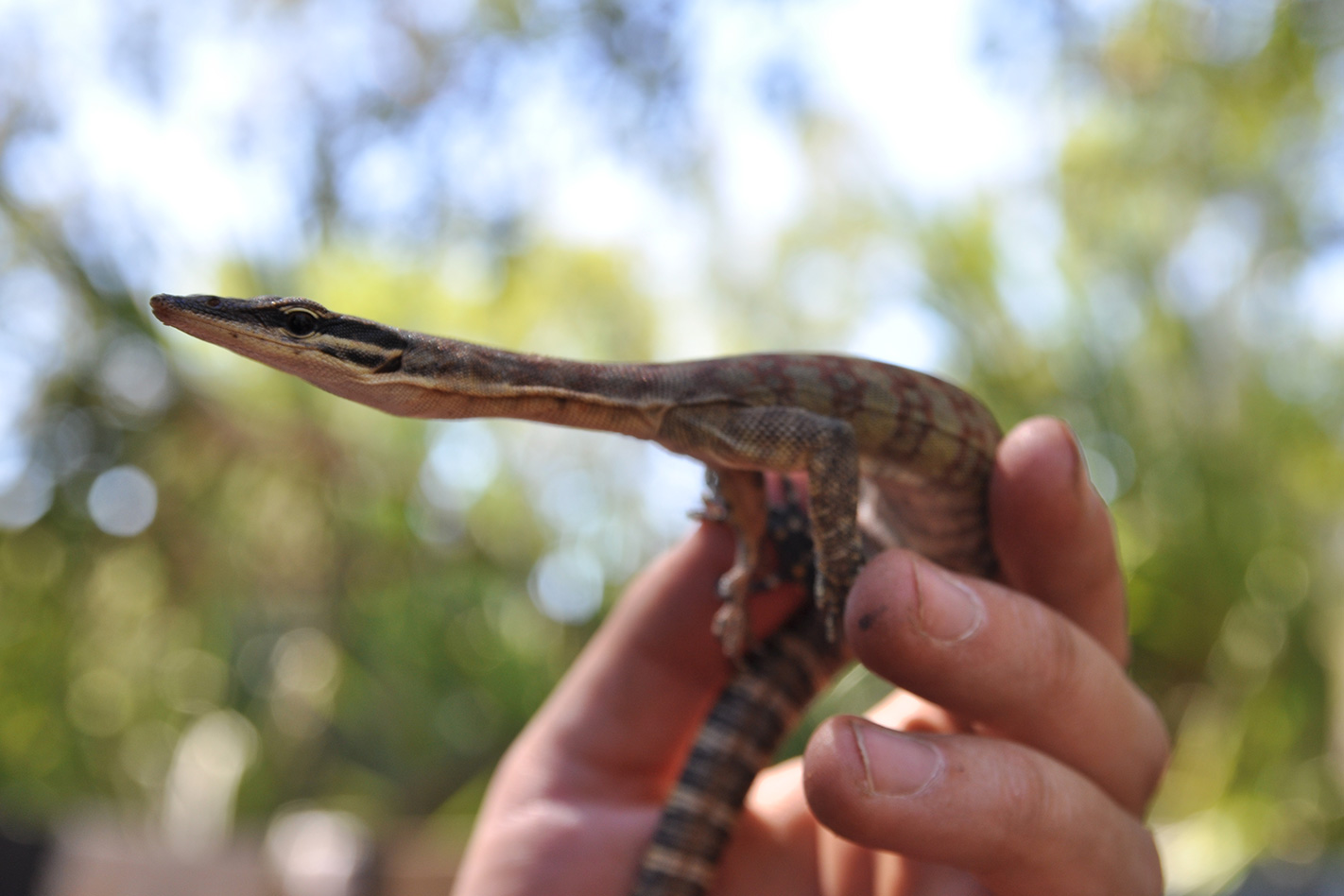
For Colin, a biologist who has specialised in palaeontology and is currently focussing on the biomechanics of goannas, the AGS expedition was a chance to continue his ongoing studies in and around El Questro.
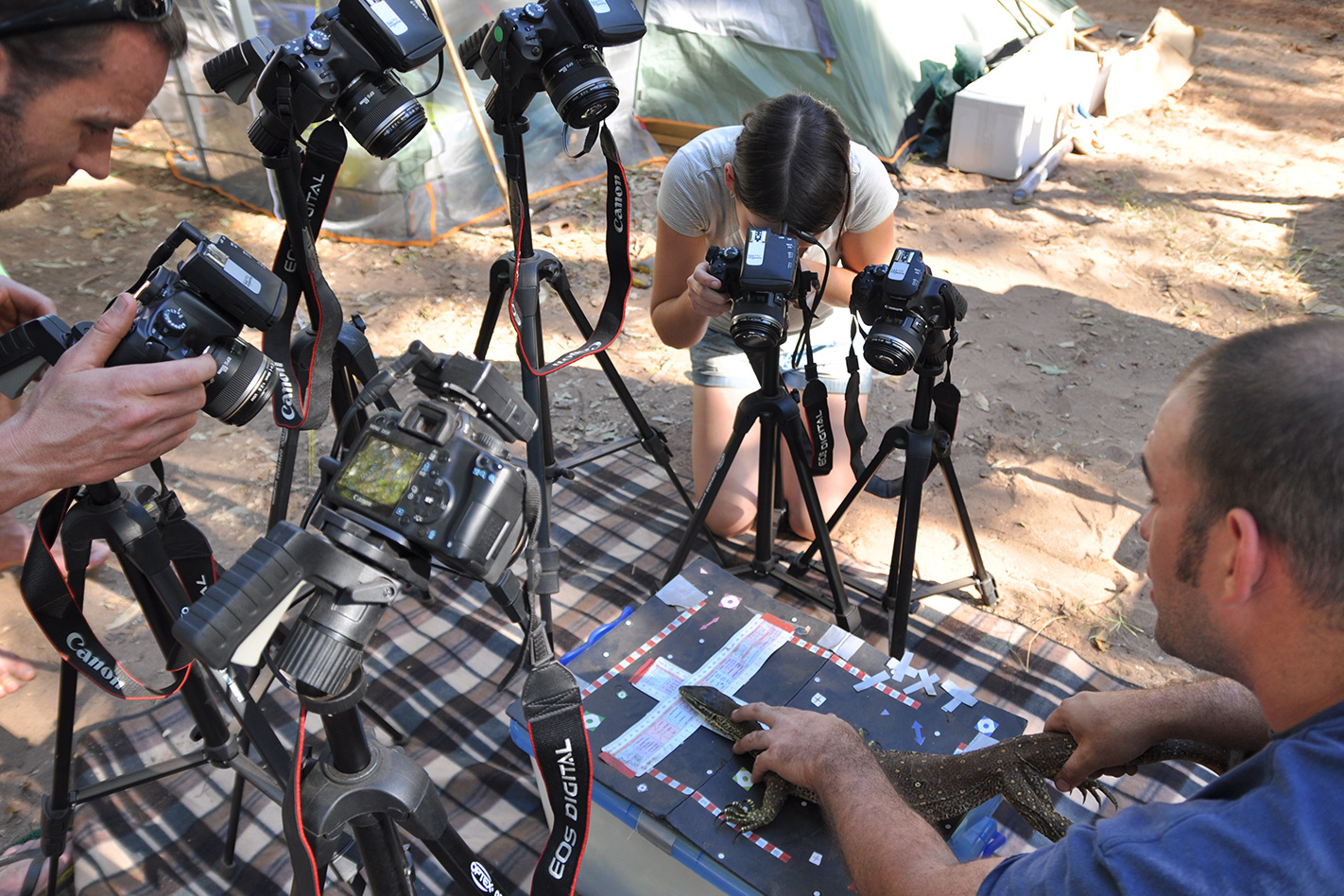
As well as capturing, measuring and recording the goannas found in the park, Colin and his team were using 3D photography to produce computer models of reptiles. The scientists would nab an available 4X4 early in the morning – before the heat of the day set in – to check traps laid around the park, with catches taken back to camp to be photographed from multiple directions to produce the models. Doing so would help the scientific community gain a comprehensive understanding of goanna populations in the Kimberley before the arrival of the toad, which will no doubt provide a dangerously irresistible morsel for the impressive lizards.
The Pajero handled the crossing with no problem, and the scientists had one more specimen to fill out their data. Soggy shoes returned to the Paj’s leather interior and we continued to clank and clunk on our way, all smiles and straight priorities.
MOBILE HOMERS
One of the reasons Christina Castellano, US-based director of turtle conservation at the Orianne Society, is so passionate about turtles is that “they make people happy”, she said. And it’s true.
As we waded through a creek just outside Emma Gorge (about two kays off the Gibb River Road) and I spotted my first sandstone long-necked turtle (Chelodina burrungandjii), I couldn’t help but smile at the creature I held up proudly, announcing my discovery to Christina and her husband Sean Doody, searching the reeds ahead.
Christina quickly measured, weighed, documented and harmlessly notched the turtle before returning it to the water, as she did the eight others we found that day – along with dozens more documented over the duration of the expedition.
Sadly, turtles will be living side-by-side with the cane toad when it arrives in the Kimberley, which may prove a perilously close liaison, given turtles’ taste for small, meaty prey. “The sandstone long-necked turtle is an efficient ambush predator,” explained Christina.
“It hides under a rock or among tree roots beneath the water, waiting for the movement of passing prey, then strikes quickly, inhaling fish, insects, and soon, perhaps, cane toads. We know that some species, like goannas, can die from just mouthing the toxin, so even if the turtle spits out the toad, it may still prove to be fatal.”
Christina’s data collected in the Kimberley will not only help to measure any declines after the arrival of the toad, it will also help garner a better understanding of these “secretive” creatures, of which – like almost everything in this remote part of the world – surprisingly little is known.
A DAY IN THE LIFE
I joined a group of volunteers following Simon Cherriman up a steep ascent to see an eagle’s nest he spotted in a big boab tree.
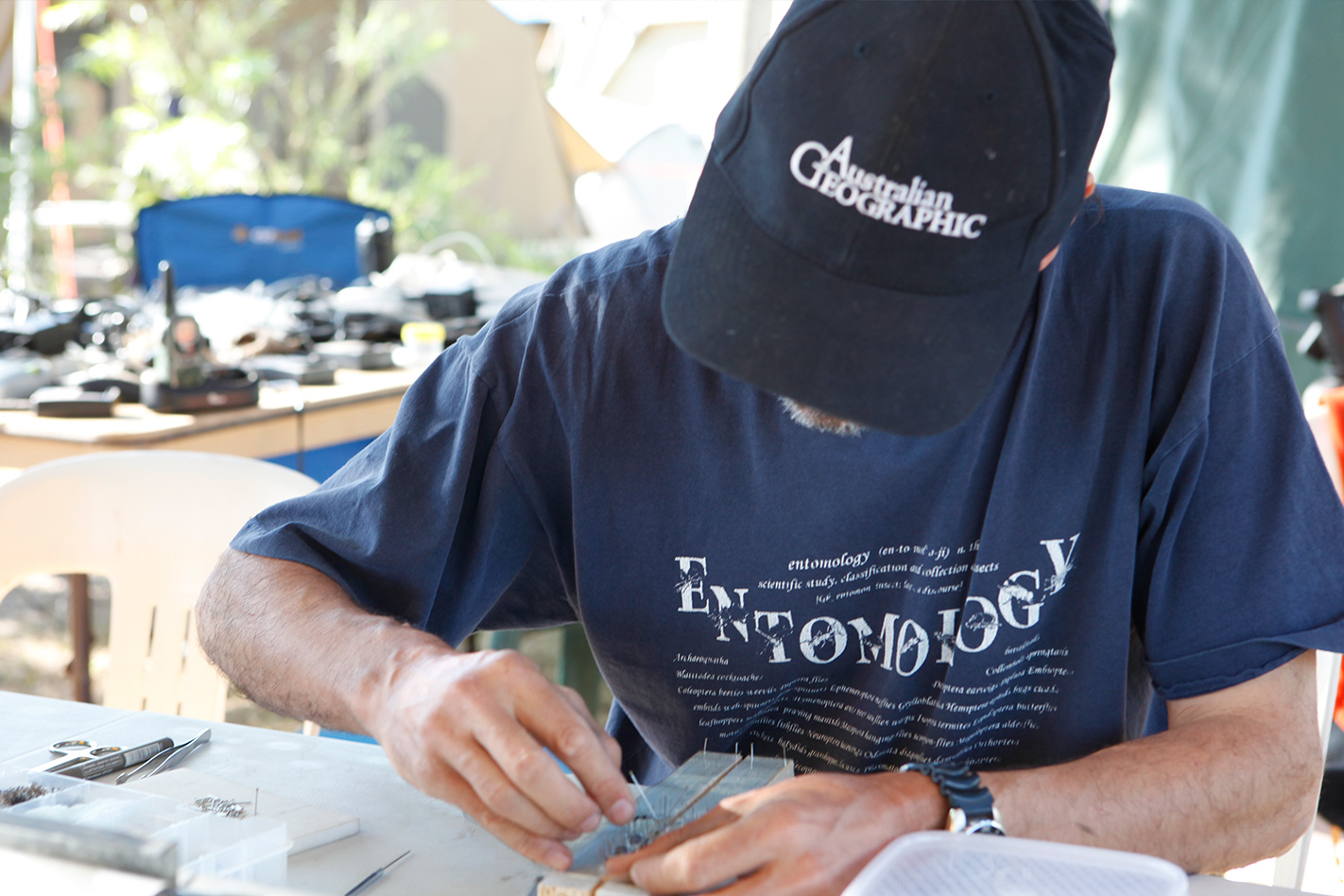
Perched on a rock, breathless from the hike, and absorbing the view over El Questro, I reflected on the fact that, just that morning, I had been netting butterflies near the idyllic Zebedee Springs with entomologist Michael Braby. Author of definitive field guide, Butterflies of Australia, Michael used the expedition to study butterfly species in El Questro for the Northern Territory Government.
During the trip, he documented a total of 50 different species – an impressive number, considering there are 85 known species in the entire Kimberley. While the probable impact of cane toads on invertebrates such as butterflies is less tangible, introduced species affect entire ecosystems, and indirect impacts are also important to measure.
Meanwhile, Simon Cherriman’s object of study – and his unrivalled passion – the wedge-tailed eagle (Aquila audax) is at a more direct risk from the spread of the cane toad through predation – of the toad itself, or, more likely, the carrion of animals that have died ingesting the toad.
Two metre tall, dreadlocked, full of enthusiasm and winner of the 2011 AGS Young Conservationist of the Year award, Simon used the trip to collect material for his second documentary, and simply to gain a greater understanding, like everyone else, of what’s actually out there.
Ankles stinging from the spinifex grass, we eventually left the eagle’s nest and descended the hill towards the setting sun, ready to finish another long day in the field.
Well, not quite yet. Simon was to make one side trip before returning to camp, to set a motion-sensing camera and hopefully pick up wallaby footage. The group followed his lofty figure across the hill, when he pointed excitedly ahead. He had spotted a fresh snake slide – the herpetologists would love this. Eyes to the ground, we continued to trail him, and the elusive reptile, into the scrub.
Hopefully the camp cook wouldn’t mind if we were a little late for dinner.
THE IMPORTANT STUFF
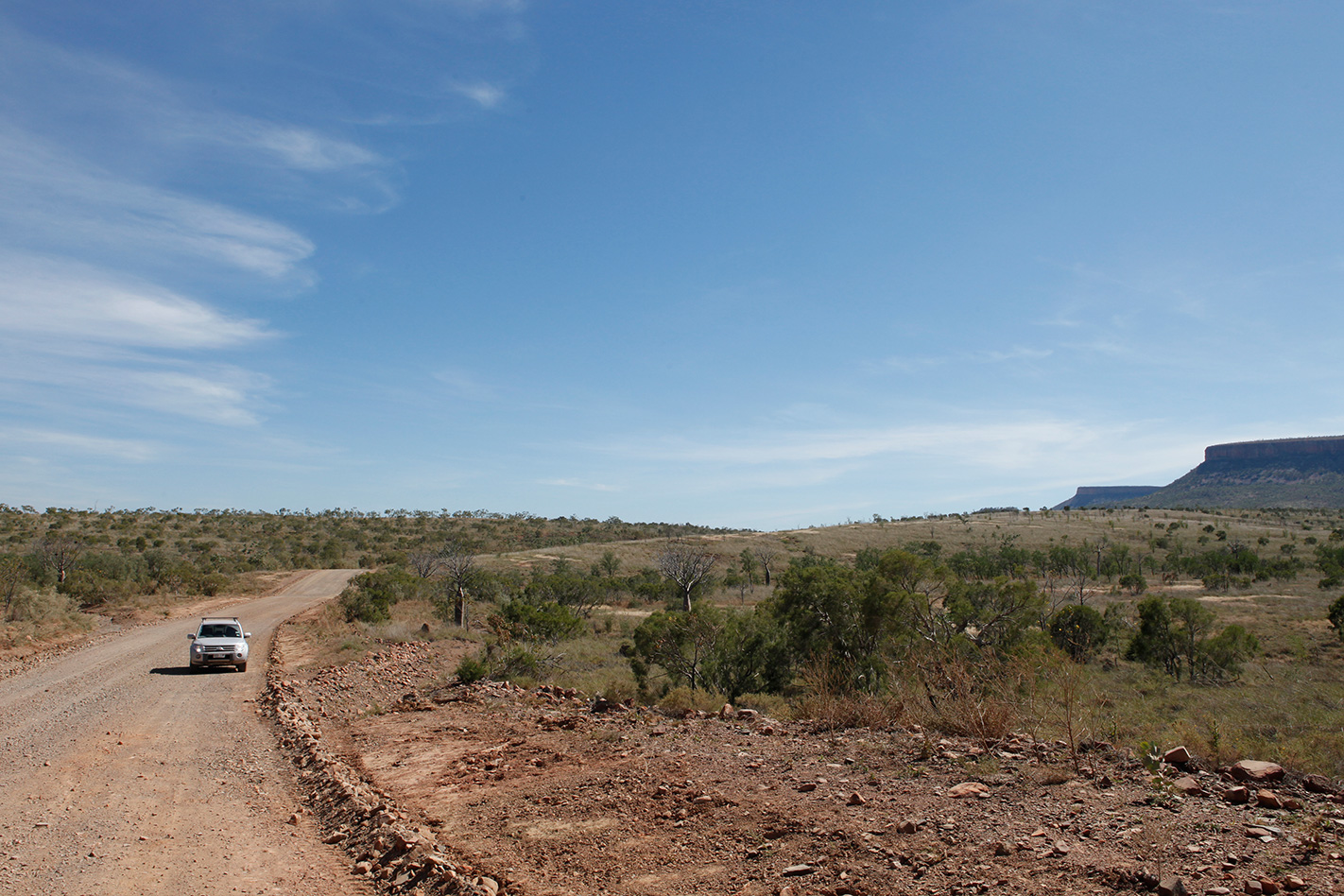
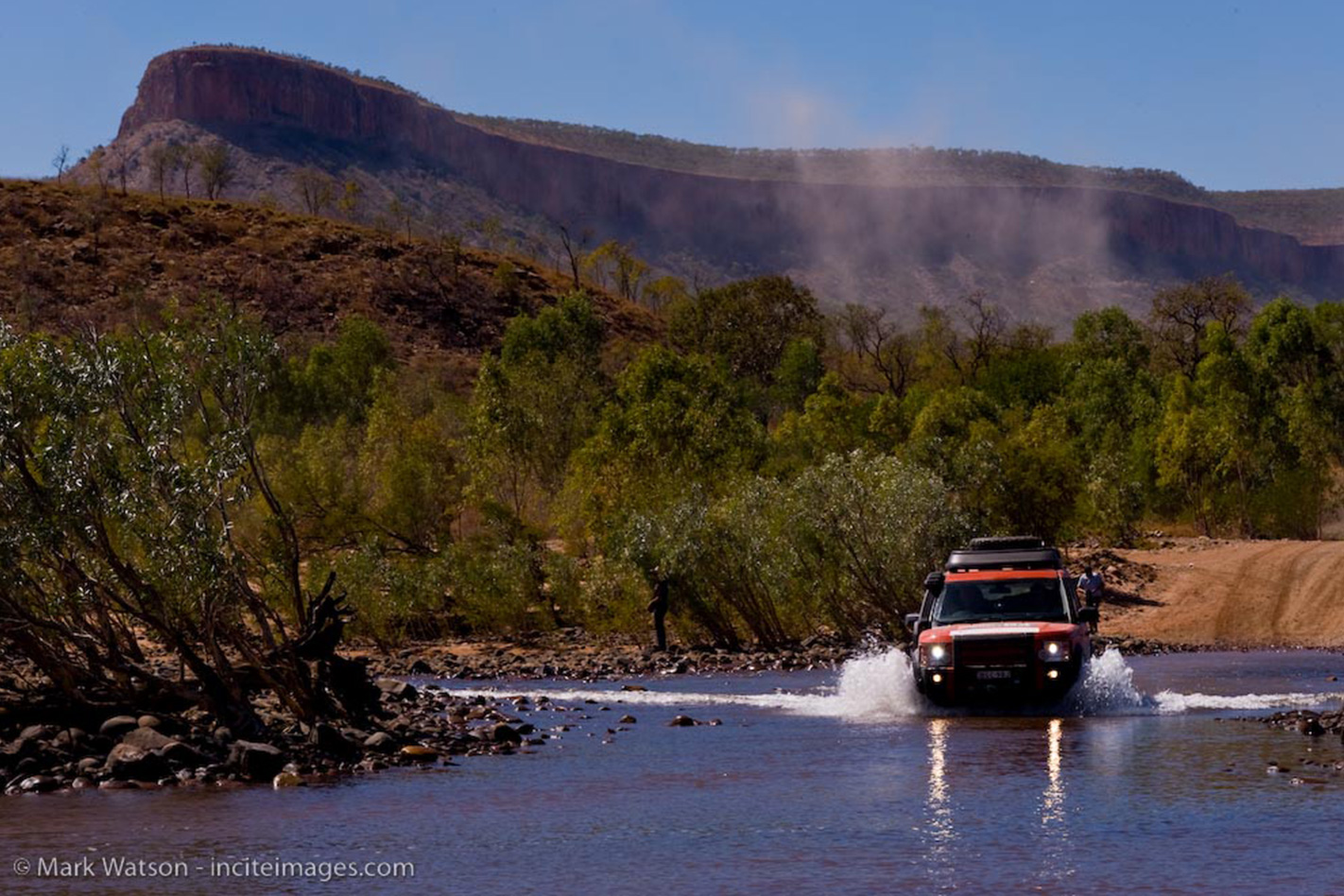
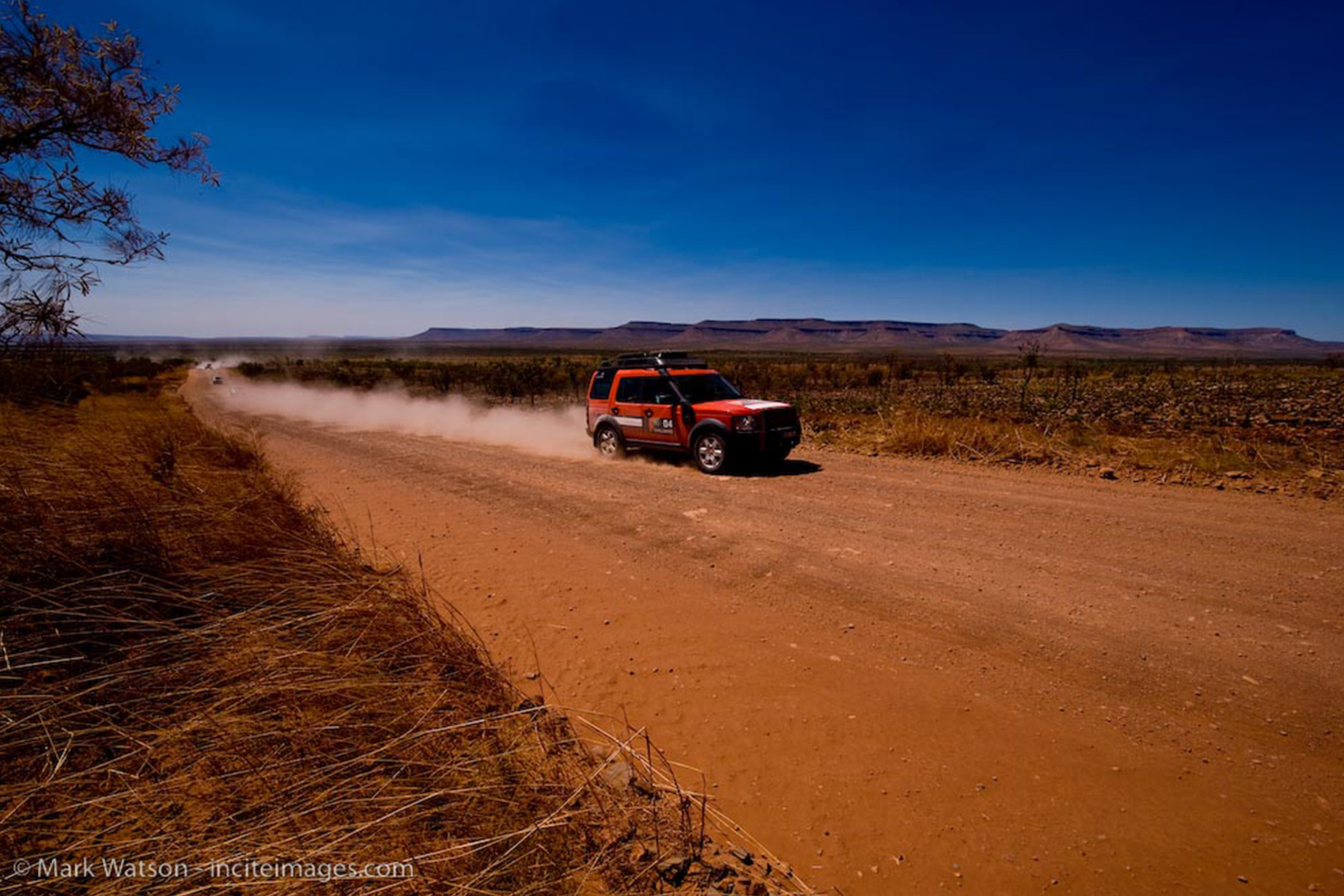
In order to get anywhere around El Questro Wilderness Park, a capable 4X4 is a must. Sand, corrugations and rocky water crossings are the name of the game out here (not to mention access via the infamous Gibb River Road, and the dirt tracks around the spectacular Cockburn Ranges) and the El Questro park rangers are well accustomed to recovering travellers with vehicles (and experience) not quite up to scratch.
So, while the scientists were busy documenting mammal and reptile species, it was very important that – as the resident 4X4 journo – I also conducted a thorough investigation into the awesome off-road tracks on offer. Oh well, if I must…
SaddleBack Ridge
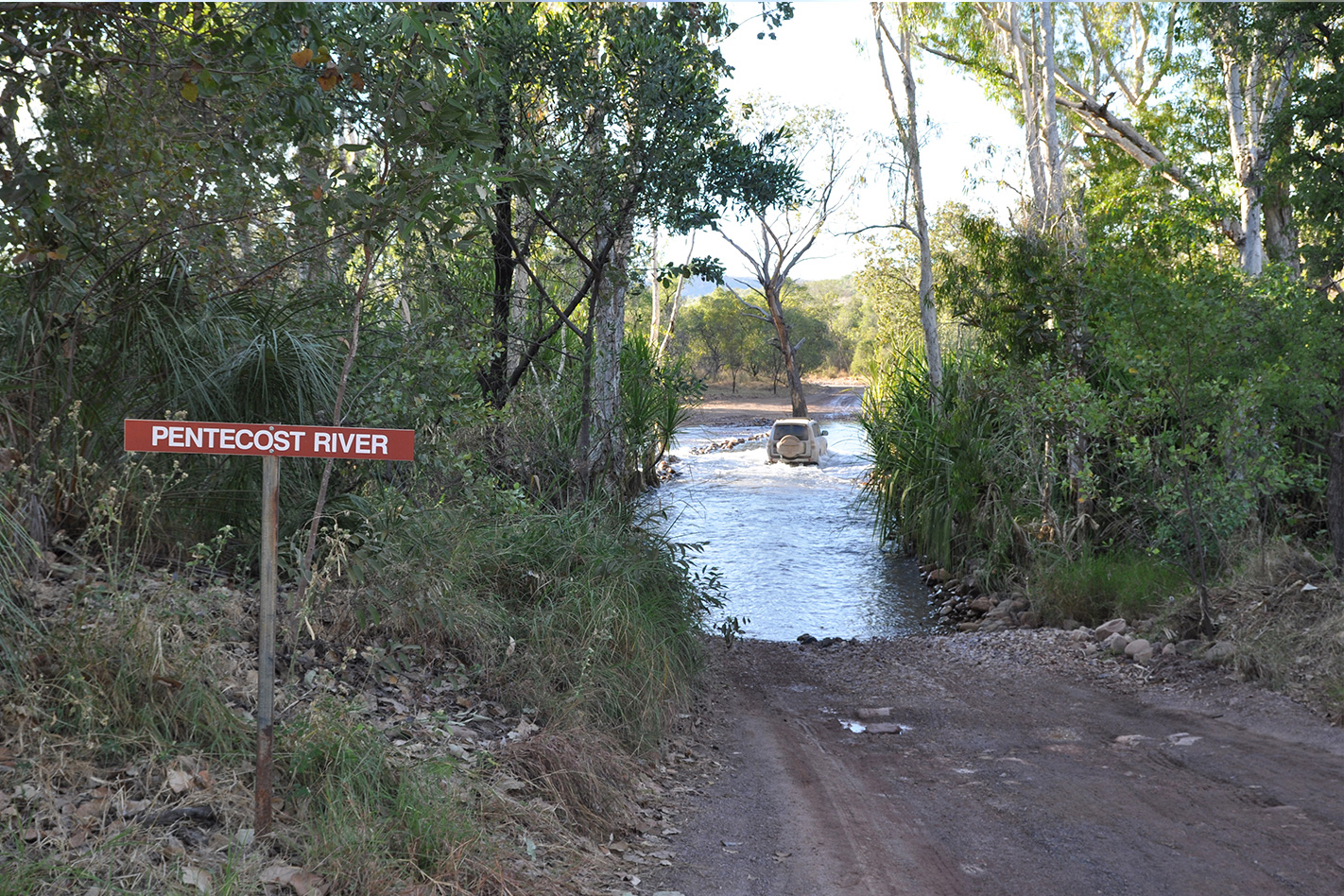
After trundling down a steep embankment of boulders to cross the Pentecost River, the rocky terrain quickly turns to soft bulldust surrounded by dry spinifex landscape as you climb the narrow, winding 7km track to the Saddleback Ridge lookout – a popular sunset viewing spot. It’s a good idea to engage low-range for the majority of this track, particularly at the water crossing and on descent. Tyres should be kept below road pressures for driving throughout El Questro.
Branco’s Lookout
The write-up for the track to Branco’s back at the El Questro station didn’t sound as serious as the one for Saddleback, but it was more of a challenge, if you ask me. Branco’s Crossing, which traverses the Chamberlain River, was a real test for the vehicles’ underbody protection. Engage low-range, take it slow, and try not to cringe as you clank and clunk across the slippery rocks. Another steep, twisting and turning climb and plenty of soft bulldust makes up the rest of the track, with a spectacular lookout over the Chamberlain as fitting reward.
Explosion Gorge
While this track was officially still closed when I visited El Questro, following last year’s record wet season, I was lucky enough to tag along with wilderness park manager, Micko Bass, on a staff reconnaissance trip in one of the station safari vehicles (a modified LandCruiser ute). This track turns off after Branco’s Crossing and ends at Explosion Gorge where Micko told me a big salty resides. This would make a great combined off-road jaunt, finishing with the nearby track to Branco’s Lookout for yet another outback sunset opportunity.
KNOW THINE ENEMY
The cane toad (Bufo marinus) was introduced from Hawaii to north Queensland in 1935 in an attempt to control sugar cane beetles. The secretions of its prominent parotoid glands are highly toxic and dangerous to almost all native carnivores.
Cane toads are toxic at every stage of their existence. The female lays eggs in the tens of thousands, and these form dense schools of tadpoles.
Distribution extends from northern New South Wales, throughout Queensland and the Northern Territory, to the eastern border of Western Australia, into the Kimberley.
While community, government and scientific efforts have culled huge numbers over the years, there have been no sure signs of success in halting the cane toad’s spread.
THE iconic Humvee has returned, thanks to US-based Mil-Spec Automotive (MSA), who is rebuilding these iconic military off-road beasts to create new vehicles.
The Launch Edition (LE) is hand-built in MSA’s Wichita, Kansas, factory and will be powered by a monster 6.6-litre Duramax turbo-diesel engine that pumps out 372kW and 1355Nm, backed by an Allison 1000 six-speed auto gearbox. The exhaust is custom – MSA has built its own 3.5-inch diameter performance plumbing for the vehicle. All of this combines for impressive performance: expect a 0-100km/h figure of seven seconds.
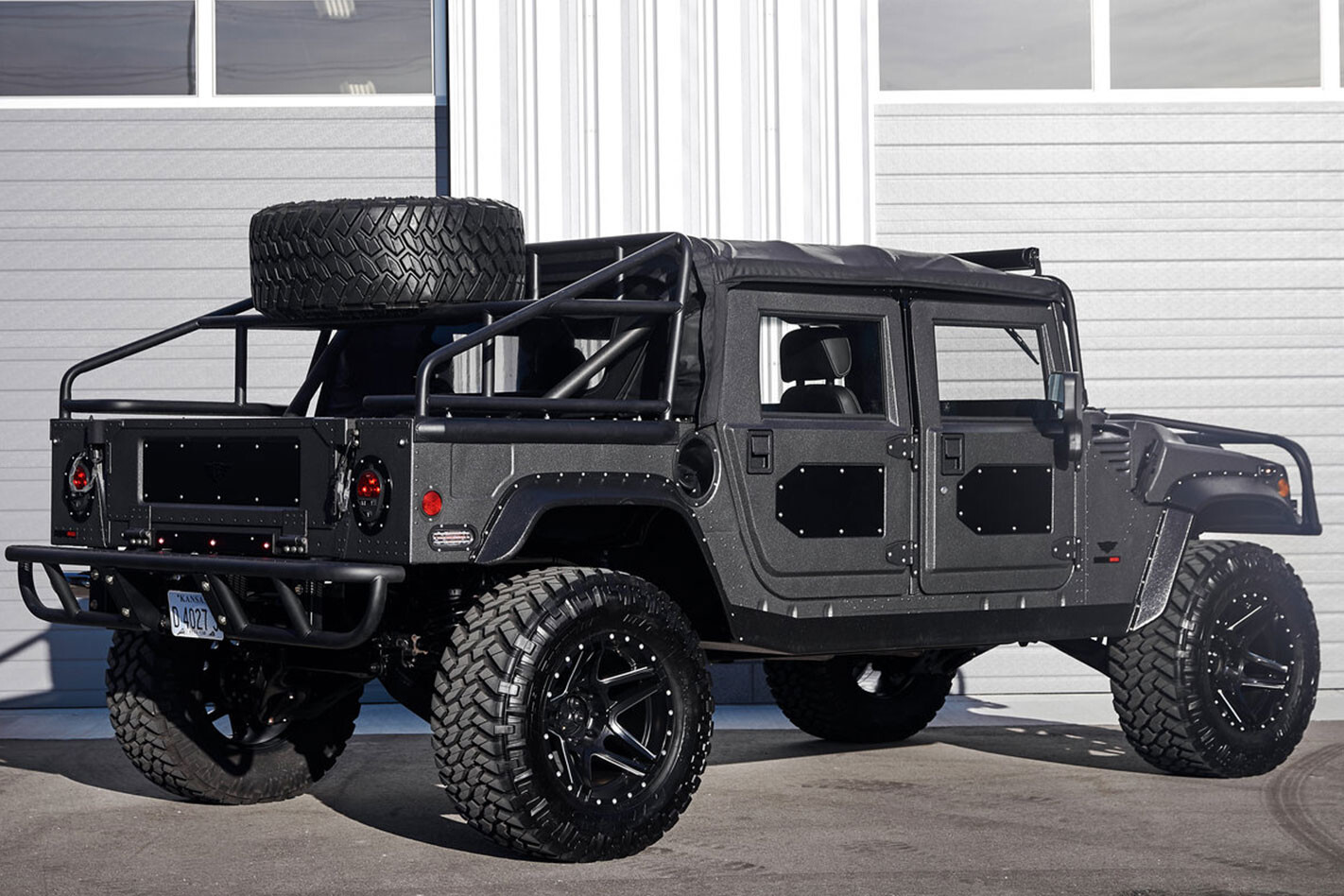
The MSA H1 LE looks, as you’d expect considering the donor vehicles/chassis, most like its original military-only namesake, rather than the later civilian-market-oriented H2 and H3, with its distinctive slab sides and windscreen. At 4965mm long, 2197mm wide and 2159mm in height, this new rig ain’t exactly petite. It is, in fact, slightly longer (by 300mm) and taller (by 134mm; owing to the MSA suspension kit and off-road wheel/tyre combo) than the original H1 Hummer.
There are five configurations available: four-door ute, four-door ‘slantback’, four-door wagon, four-door ‘SUV’ (with a third-row of seats and a fibreglass, rather than steel hardtop), and a two-door ute, with an extended-length tray measuring 1900mm long, 1287mm wide and 337mm in height.
The big rig comes with some impressive off-road specs, sitting on a separate chassis remanufactured and powdercoated by MSA – where the company takes apart an original H1 chassis then rebuilds it to its own tolerances – independent suspension front/rear with heavy-duty half shafts and fixed-mount diffs, plus geared portal axle hubs, running alloy wheels and Nitto Ridge Grappler rubber.
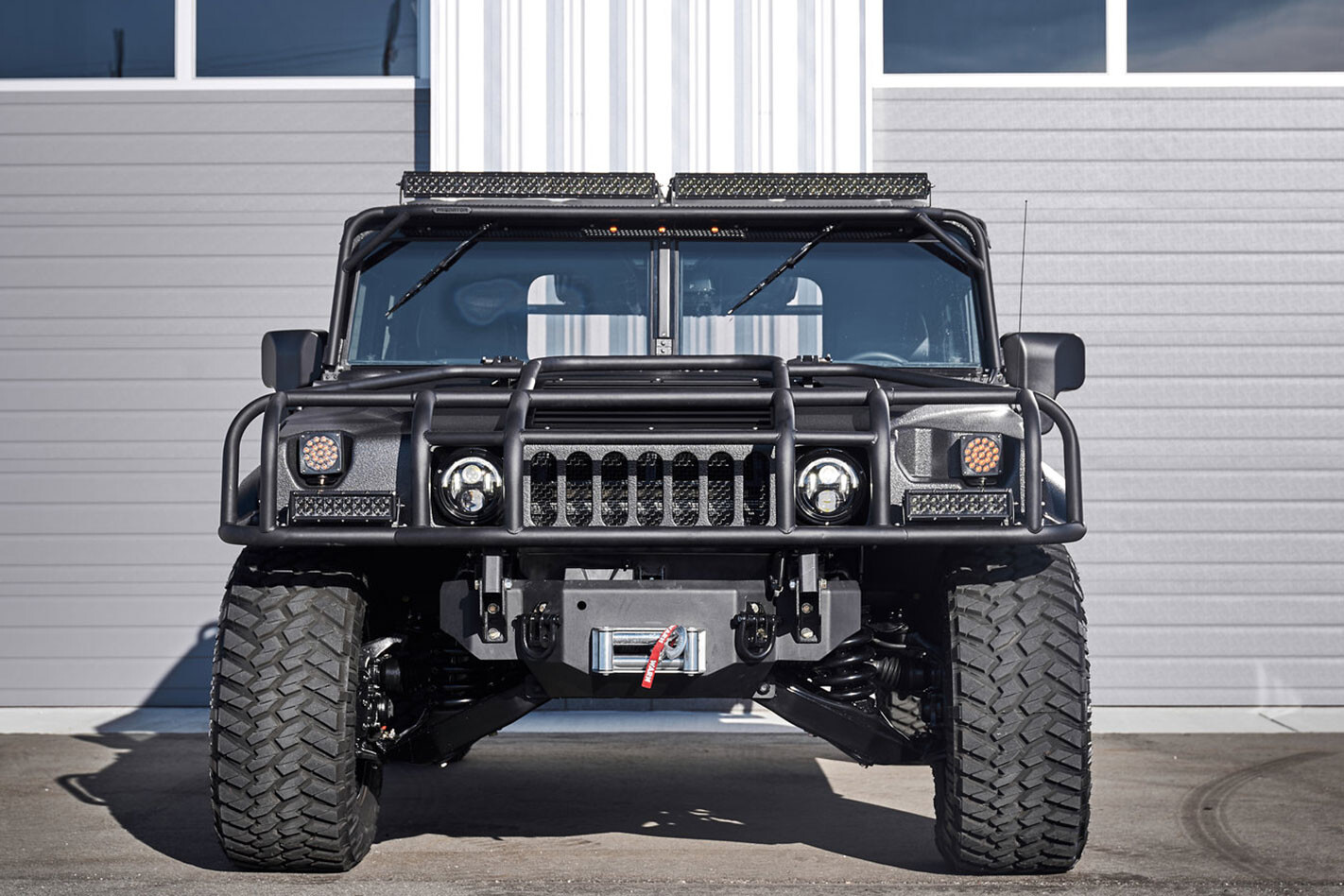
Wading depth is 1068mm (up from the original’s 760mm) and ground clearance a high 457mm. Under-bonnet you’ll find a dual-battery setup, ARB 12V twin compressor (for tyre inflation, etc.) and a 200-amp alternator. Oddly, the steering wheel is non-adjustable (think: Land Rover Defender-like).
The body is constructed of hardened reinforced aerospace-grade aluminium with body panels including a protective Kevlar coating (you can also opt for a gloss paint finish). There’s also an external low-profile snorkel, hood vent to keep that big oiler cool, and the engine bay is ceramic-coated.
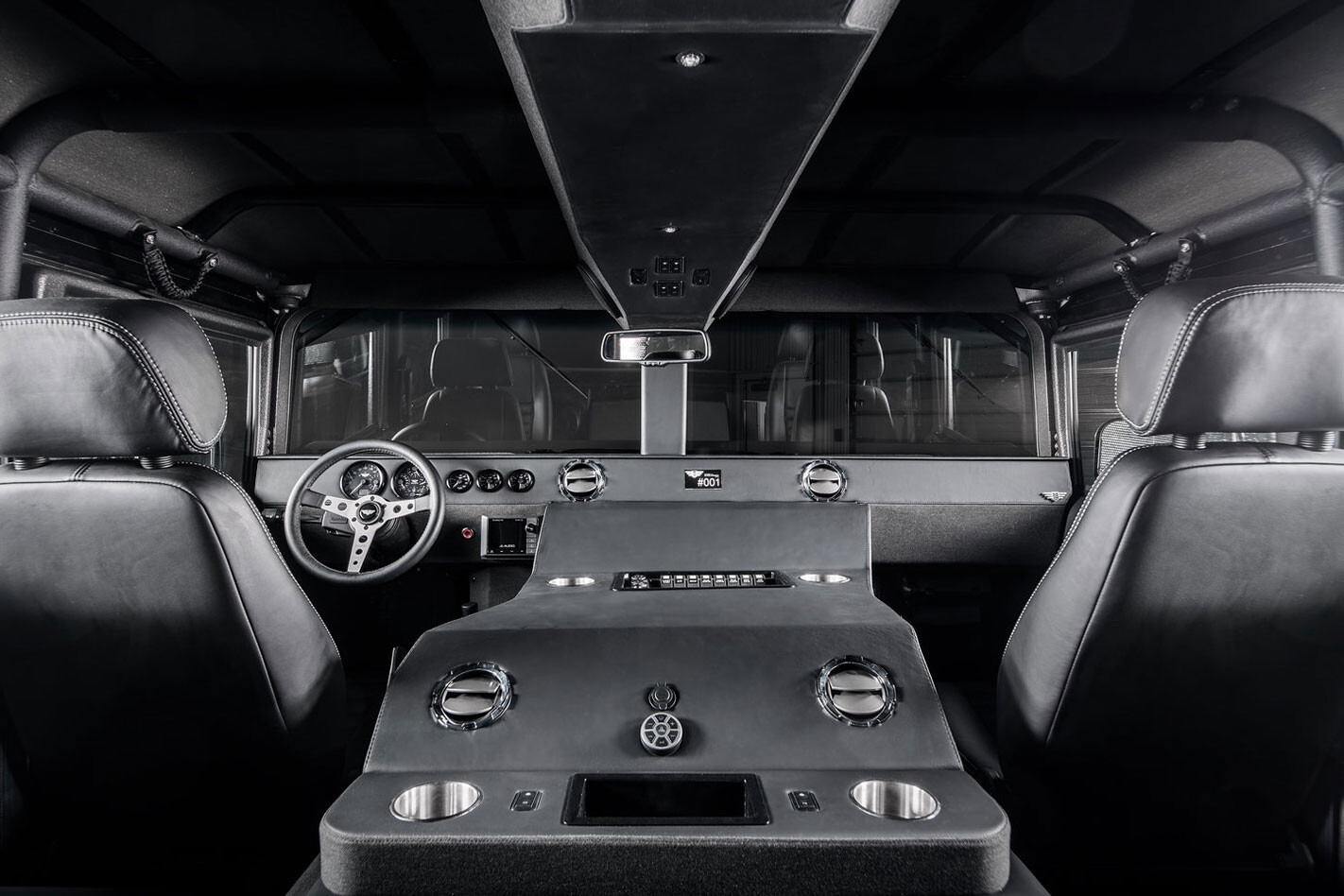
Add in an approach angle of 57 degrees, departure of 42 degrees and ramp-over of 29 degrees, as well as a payload of 1271kg, and you’ve got a good base for a tough desert tourer.
The fully aluminium interior is all MSA-customised to ensure optimum use of the available space, with airbags, three-point seatbelts, a MSA gauge cluster, MOMO steering wheel, overhead console and very trick driver/passenger door window defrost. The windshield is also heated and all windows and mirrors are powered.
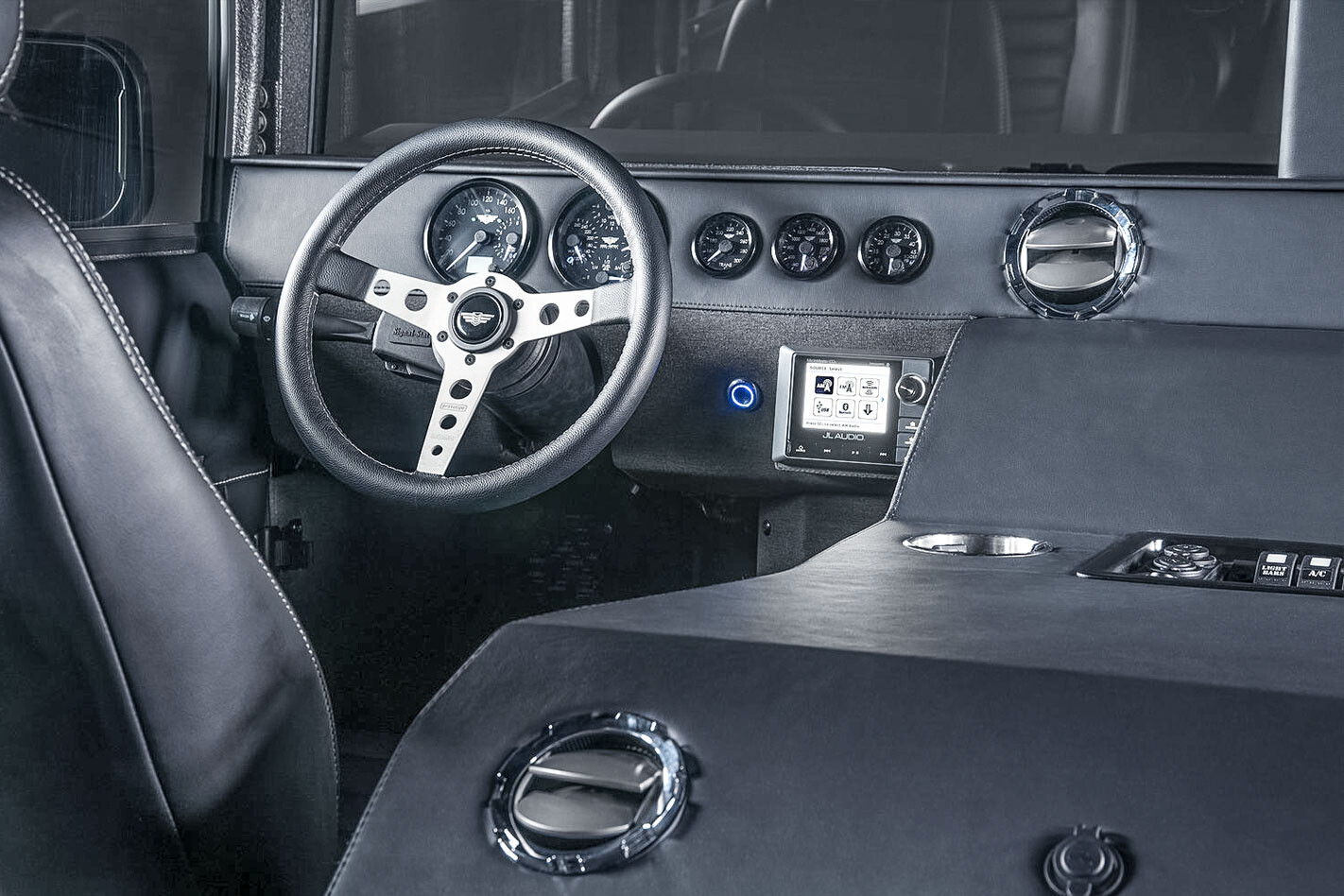
Interior lighting is all LED and there are dual USB charge points, along with oodles of storage (locking rear box, overhead and front/rear storage trays). The LED headlights keep the night lit up, while the reversing camera ensures you can see out from high up the front. You can even unleash your inner gangster thanks to the JL Audio premium sound system (with amp).
The MSA H1 LE’s five models can also be further customised, with interior materials, paintwork and additional suspension tweaks offered by MSA. It will really depend on how deep buyers’ pockets are, with the H1 starting at US$218,499 (AU$293,555). There’s no word on Aussie availability, but for those with deep pockets who are after a seriously unique off-roader, it might be time to have a chat to the accountant…
Over the last four years, it has been an annual tradition for Tony Carvallo and Fred Williams to work on building Jeep vehicles together for the annual Easter Jeep Safari at Moab, Utah, USA.
The tradition is that Tony comes to California, he helps out Fred, and every year Fred promises Tony that they will go to the brewery and do something fun. Well, what’s more fun than playing with Jeeps? And Tony is still waiting for the opportunity to visit the brewery. He likes to joke that the brewery doesn’t actually exist because he has yet to see it.
Two years into their annual Jeep build tradition, Fred and Tony were conversing on the phone during one of their creative brainstorming sessions and loosely talked about doing something with the next new Wrangler.
Over the years, Brittany and I have gotten to know Fred and Tony well. They’re a little bit silly, always down for a good time, and really good at the work they do. Brittany and I caught up with Tony and Fred to chat about the creation and evolution of the CODE1 on its first visit to the red rocks of Moab, Utah, for the Easter Jeep Safari.AH: How did this idea come about? TC: I asked myself how to condense fear of the new. The new Wranglers typically were not welcomed with open arms. With the YJ, people said, ‘Oh no! Square headlights!’ With the TJ, people said, ‘Coil springs on a Jeep?’
With the JK, people said, ‘That thing is too big for the trail!’ And I said to myself, ‘What about the JL?’ Working on developing the new JL for Jeep as the JL Product Planning Manager, it was a project that I put so much blood, sweat and tears in. Fred and I wanted to do something cool with it on our own, without support of major builders or Jeep corp, to show that anyone can easily modify the JL.
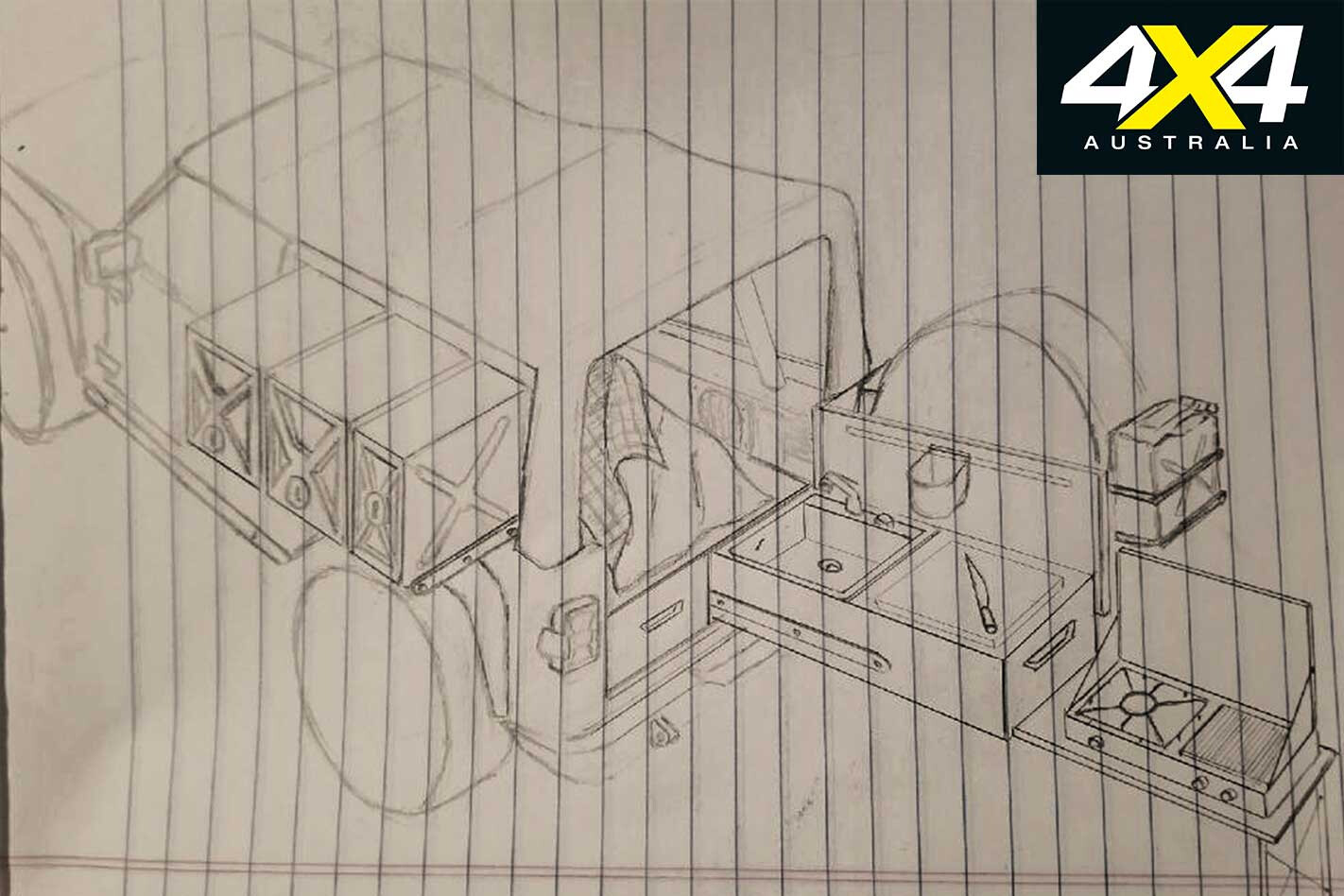
AH: The CODE1 sketches are amazing! TC: It’s very funny, because growing up as a kid, I would get in trouble for doodling and sketching Jeeps during class. It was always Jeeps! I still can’t draw people, but I’ve gotten good at sketching Jeeps!AH: This “Jeep thing” is in your blood? TC: I knew I wanted to work for Jeep since I was 10 years old. I was close to graduating (and) I sent my resume to HR 1000 times. At the time, I was working making pizzas and serving brews at the college brew. Shortly after, I got an interview at Jeep. I worked for Jeep ultimately for my passion.
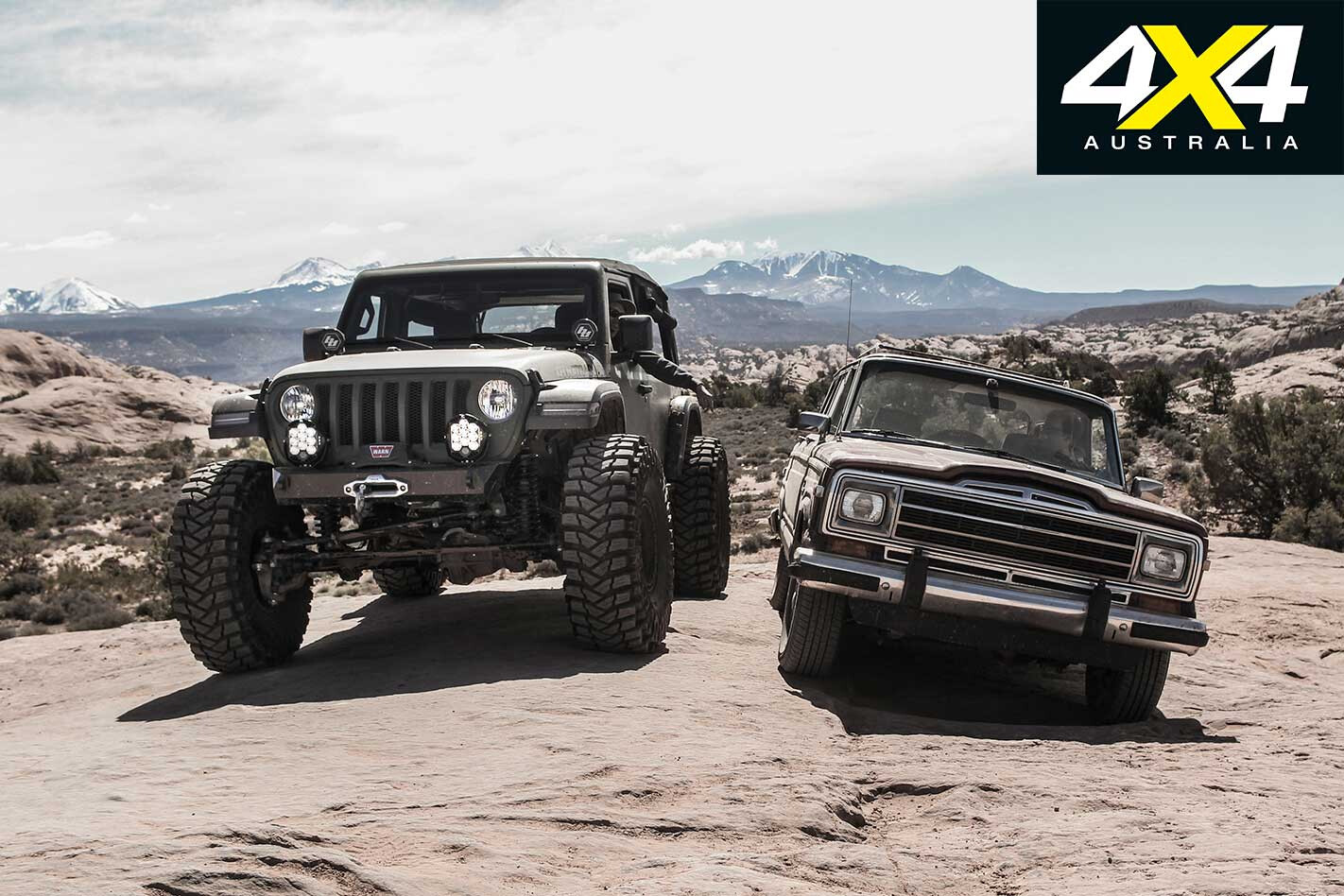
AH: You worked for Jeep for 18 years, and now you’re on a new adventure? TC: I love the JL so much, I just wanted to take it to the next level. It’s funny because I have this personality that once I finish a project I have to do something next.
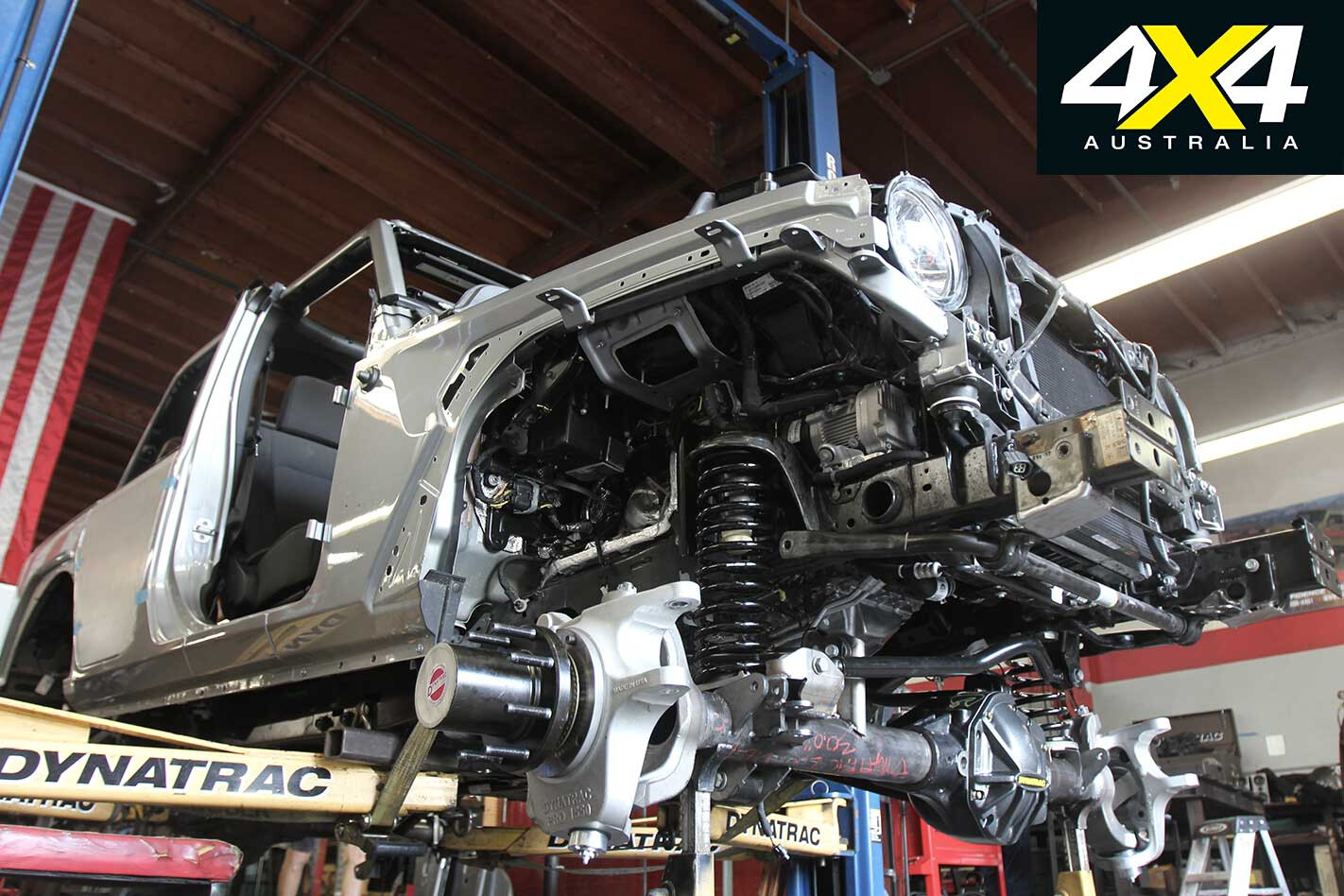
My mission has always been, I set a goal and I go do that. I set another goal and I do that. Without goals I get kind of lost. It’s kinda crazy because the stars aligned. I always wanted to live in California and be close to the world of off-roading. It was like a dream come true. I currently work for Dynatrac as an engineer.AH: Tell us about your ideas on developing the CODE1 with Fred. TC: There are two key items that Fred and I totally planned out on the new JL. Fred said that it had to have 42-inch-tall tyres and I loved the idea of a two-door stretch LJ, so we thought we’d start with a four-door JL and take off the rear doors. The Dynatrac ProRock XD60/80 axles definitely gives the vehicle a significant performance increase; that was very helpful on the red rocks in Moab.
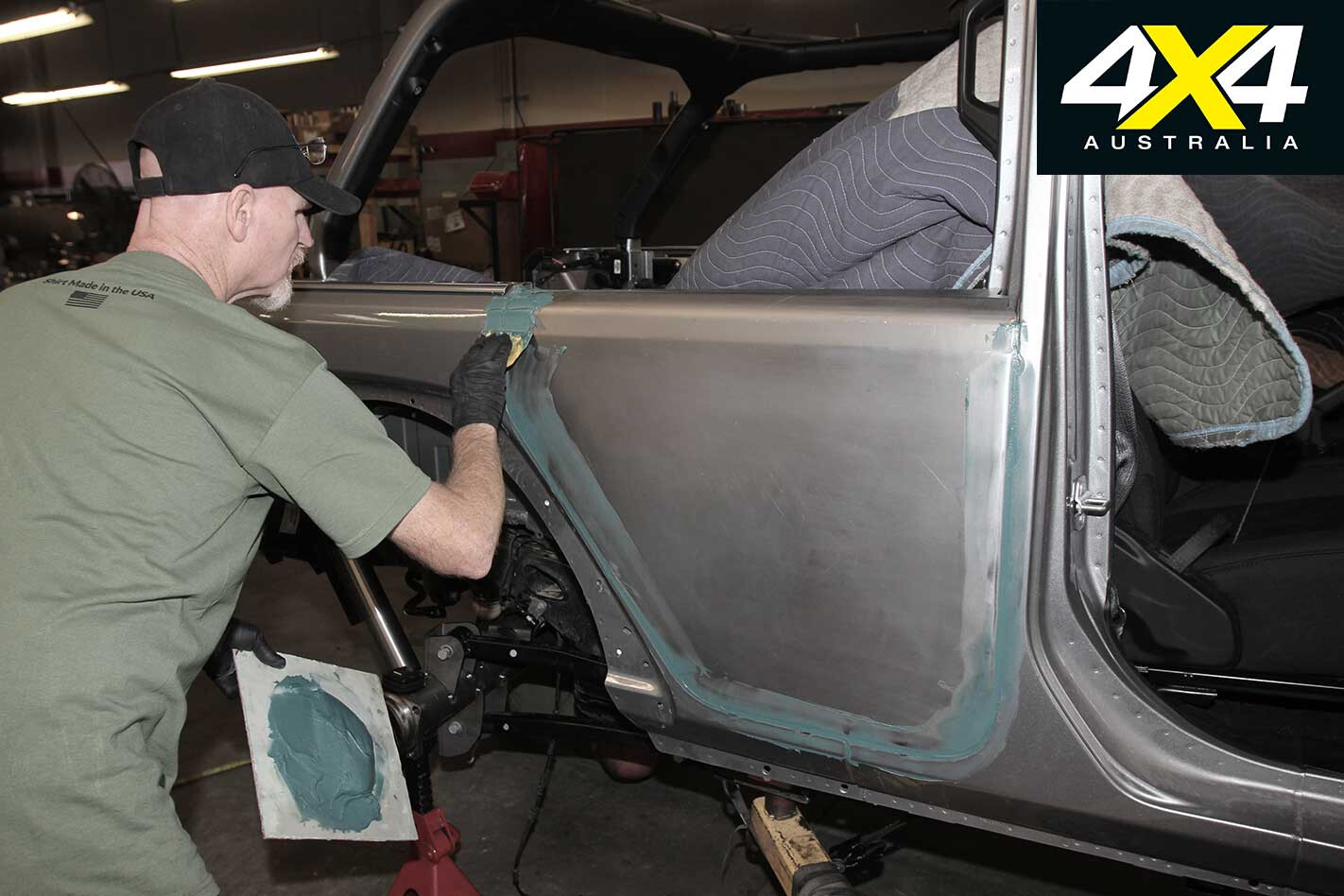
AH: Is this the first time the CODE1 has been to Moab? TC: Although we were tempted to visit Moab on our road trip from Detroit to California after we purchased the JL, we were on such a time crunch. We waited in Michigan for almost a week to pick up the JL we had ordered. We couldn’t wait anymore for the JL we had ordered, so last minute we located a dealer that had a JL Sport model in Ohio.
The JLs were literally selling as soon as they arrived at the dealerships. We rushed to Ohio to buy this silver one. So yes, it’s the first time it’s been in Moab. It really stood out in Moab because it was the first JL built to this extreme level, with a really unique green colour. The JL platform is awesome, it is the ultimate canvas.
AH: Are there any things you were worried about during this build? TC: I was worried about the whole thing. We definitely had a deep concern for the new power electric steering because it is brand-new on Wrangler. We also had a few issues with the transfer case, but I took the transfer case apart and worked some magic.
AH: How did you fit 42-inch-tall tyres on the CODE1 while maintaining the original fender flares? TC: We went with a four-inch lift from Off Road Evolution and used MOPAR fender flares that allowed us to fit larger tyres.
AH: You guys were the first to modify a JL, and you guys did it fast. TC: Yes! There was very little sleep during this build, but we would sleep at least four hours each night. This project took serious co-ordination. We had to make sure all of the pieces arrived on time. We did the entire build in about eight days.
AH: They say that it takes a team to make a dream. TC: We had such a great team to help us get the job done. Mel and Drew from EVO helped for two days. Bestops’ Fernando came with an industrial sewing machine and made the custom top in one day. Jason from Hans came and helped for two days. Aaron from Baja Designs came out for two days and provided the CODE1 with lights, and he came with tons of parts and pieces to make it happen. Mike Kim came with Fox, measured the CODE1 for shocks and even helped us mount our beadlock tyres. The entire Dynatrac staff were incredibly helpful and supportive.
AH: Fred and Tony, what were your thoughts about driving the CODE1 in Moab compared to a stock JL? TC: I felt like I was off-roading a big La-Z-boy on lockers.
FW: After driving the JL in stock form from Ohio to California it’s an obvious improvement over a JK in that the vehicle is more refined and the eight-speed automatic is far better at keeping the Pentastar V6 in its power band.
Once we completed the build of CODE1, this JL has really grown up. The beefy Dynatrac axles have no issues turning the 42-inch-tall tyres, and the power and gearing seemed spot on for an all-around fun Jeep. Our biggest concern was the new electric power steering system, but even that didn’t hinder our off-road driving for the CODE1 out here.
Sure, time may eventually reveal some steering or other drivetrain or electrical weakness as can happen with new vehicles, but so far we feel the Jeep is working great.
AH: Tell us about the other components on the CODE1 that made it perform so well out in Moab. TC: It’s hard to point one. Moab is a really special place with slick rock and incredible terrain. It was really special to use the equipment we put on the vehicle. It’s one thing to modify a vehicle, and it’s another to actually use the equipment. All of the components meshed so well and made CODE1 perform so smooth and amazing on the trails.
AH: Fred, can you run us through all of the parts you guys added to the CODE1? FW: Of course!
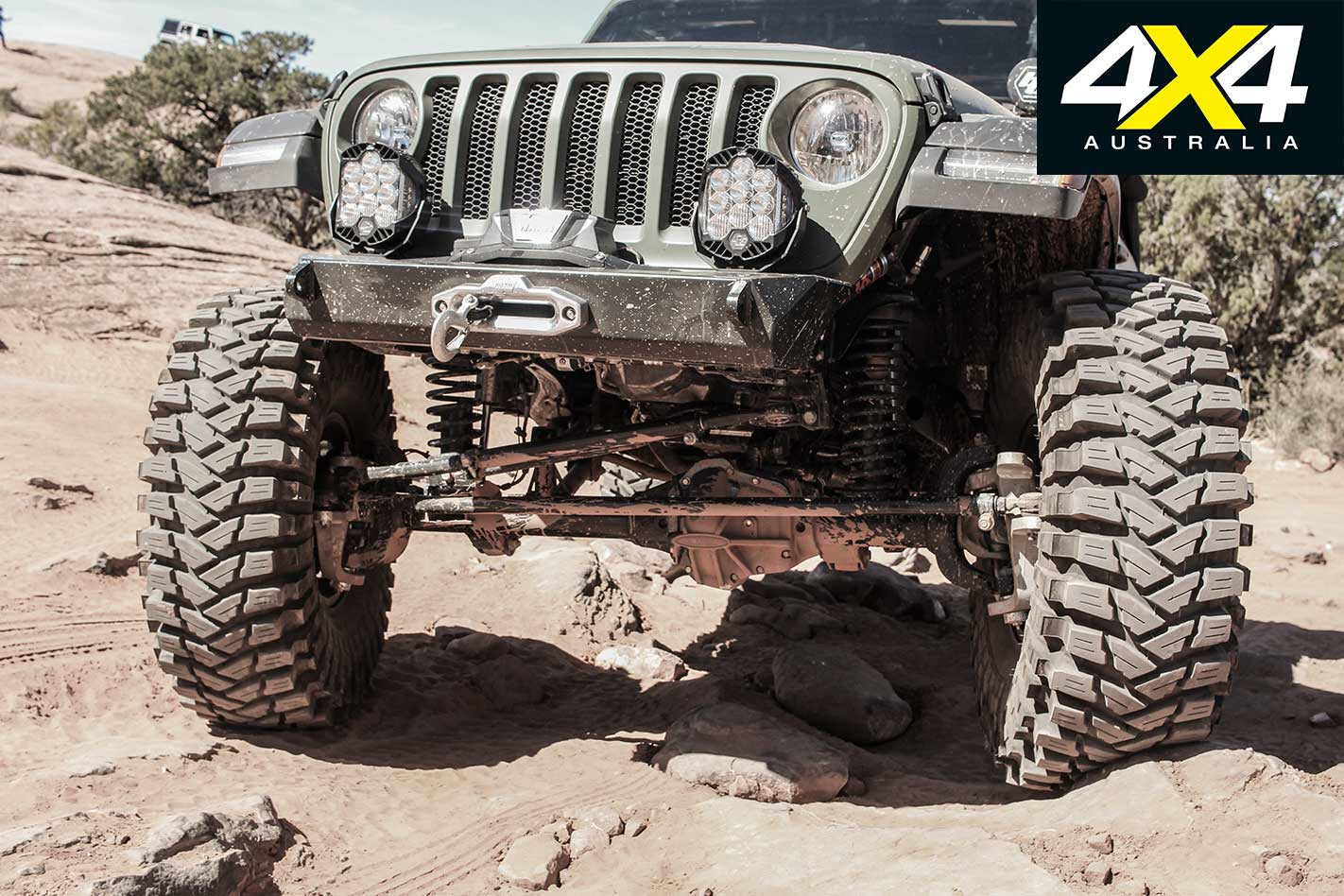
• Off Road Evolution: We mocked up an EVO Manufacturing front bumper and winch mount, the bumper improves the approach angle and provides sturdy D-ring mount positions. Although this was a prototype bumper, production bumpers will be available soon. We also used the first EVO Manufacturing four-inch Extreme Overlanding suspension system for a JL. The suspension uses adjustable front and rear control arms with swivel joints to set the ideal location for the rear axle. It also allowed us to have great articulation and suspension travel. The EVO Extreme Overlander suspension for JLs is available in two-inch and four-inch lifts. We went with the four-inch lift so that we could clear the 42-inch Maxxis Tyres.
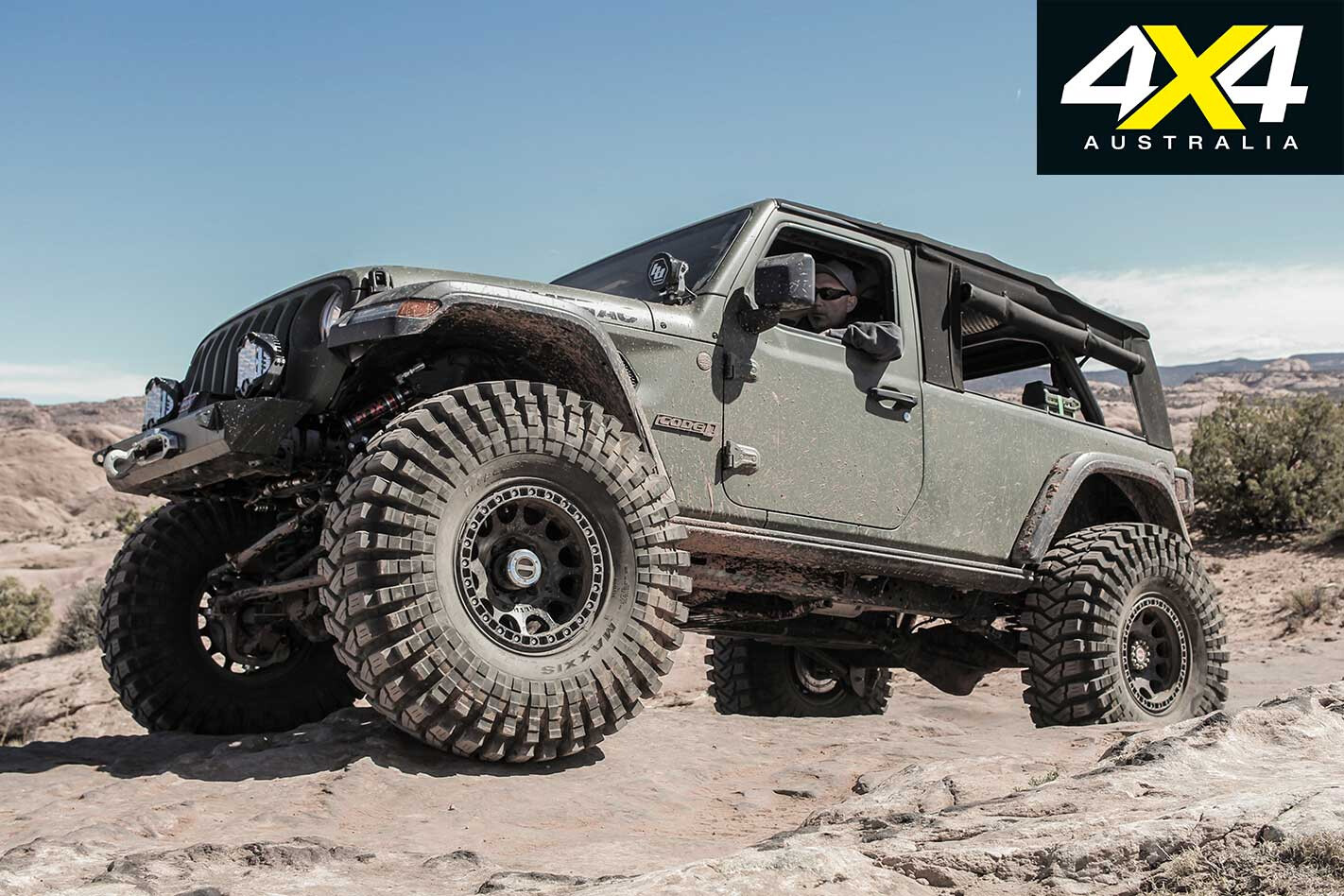
• Warn ZEON 10-S winch fits great on the JL, with great pulling power.
• Baja Design LP9 off-road LED lights are very bright and feature both a low-beam and high-beam function, perfect for on- and off-road trail use, especially in Moab.
• MOPAR High Top fenders allowed additional clearance for 42-inch tyres, but keeps the factory look. We also used MOPAR rock rails, an auxiliary switch pod, floor mats and a fuel filler cover.
• Maxxis Tyres: We used bias ply 42-inch Maxxis Trepador tyres; they gave the Jeep ground clearance, traction and an aggressive look.
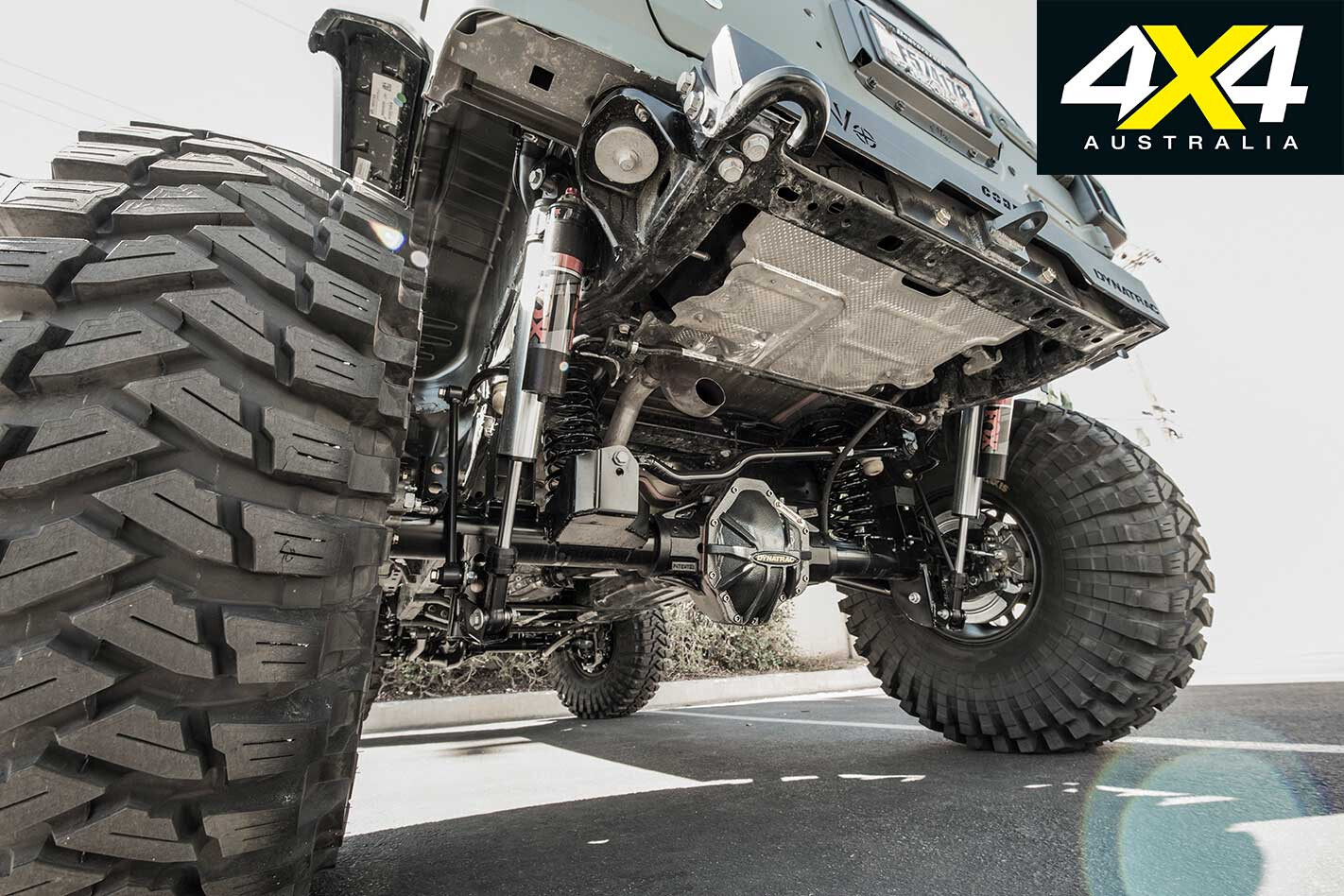
• Method Race Wheels: 17 x 9-inch Matte Black 105 Beadlock Wheels complemented our black softop, black fender flares and black bumpers.
• ProRock XD60 axles: The Dynatrac team went back to the drawing board to find ways to increase flexibility and strength. The patented design provides the industry’s best ground clearance, yet still holds a larger differential and 10.1-inch ring gear. The ProRockXD60 uses a unique 1550LT wheel ends which reduced wheel scrub and stress on the all of the steering components, making it easier for us to steer while fitting a massive steering joint. This is one of the ways we we’re able to steer with 42-inch Treps and keep from overly stressing the factory electric power-steering pump.
• ProRock 80: It’s the ultimate rear axle upgrade. It’s the industry’s lightest axle in its class that handles the most torque and ground clearance. It can handle a giant vehicle, massive tyres and a heavy right foot. It’s really perfect for any situation thrown at us, and it’s really suitable for any of Moab’s trails.
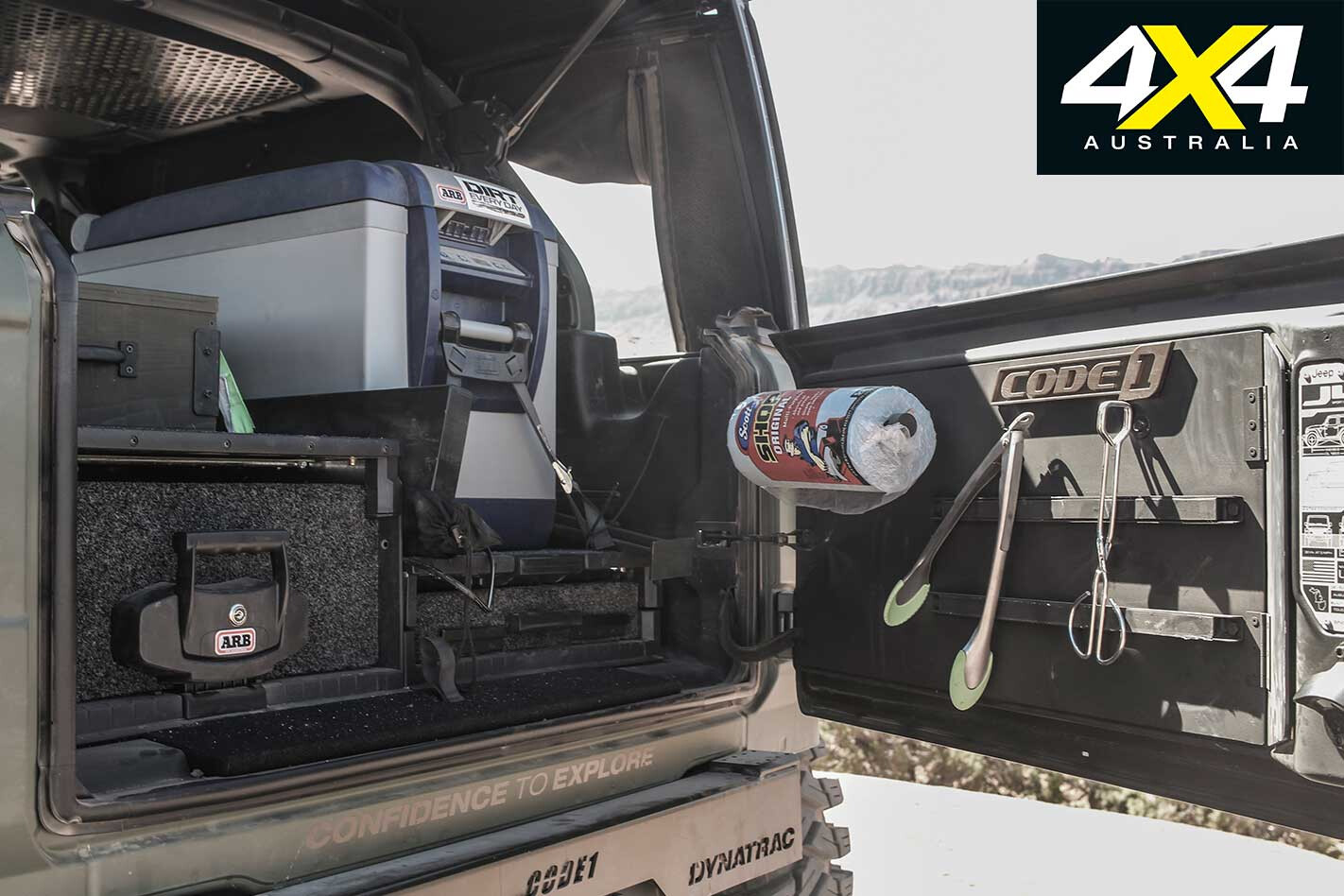
• Bestop custom soft-top used the JL framework, but has solid-zip outside panels that can be removed or rolled up. This gives us access to the bed, but also a dark-cave-like sleeping space if we want to camp out in the bed of the CODE1.
• Fox 2.5 adjustable shocks with remote reservoirs and Dual Speed Compression (DSC) adjusters. These performance series shocks have up to 22 different settings for both high- and low-speed compression, allowing each corner of the CODE1 to be dialed in for optimal ride control.
• ARB refrigerator, storage compartments and recovery kit give us room for gear and grub.
• Hans PowerPack 300 portable power and solar generator were positioned in the cargo area for our upcoming overlanding adventures.
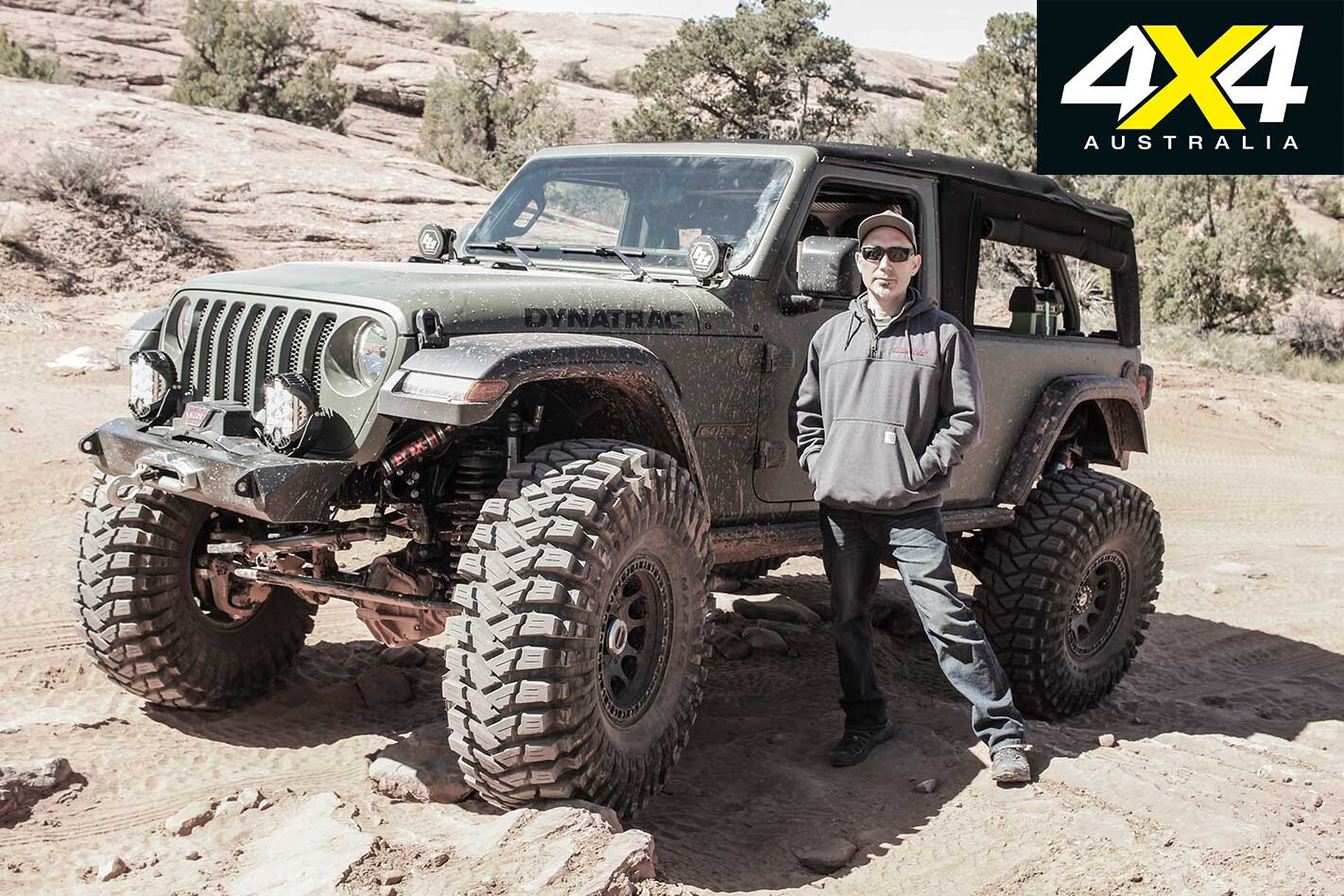
AH: CODE1 is a real head-turner out here in Moab. TC: We’ve seen a lot of JLs in Moab this year, but there’s only one CODE1. It’s really funny, because the first thing people say is, “It’s the CODE1!” Then they ask me where Fred is. One of my favourite parts of this project was working on it with Fred.
AH: When can we see the CODE1 again? TC: Next stop, Overland Expo.AH: Thank you Fred and Tony for spending some time with us out in Moab. We can’t wait to see what you guys will do together next.
Trail oven
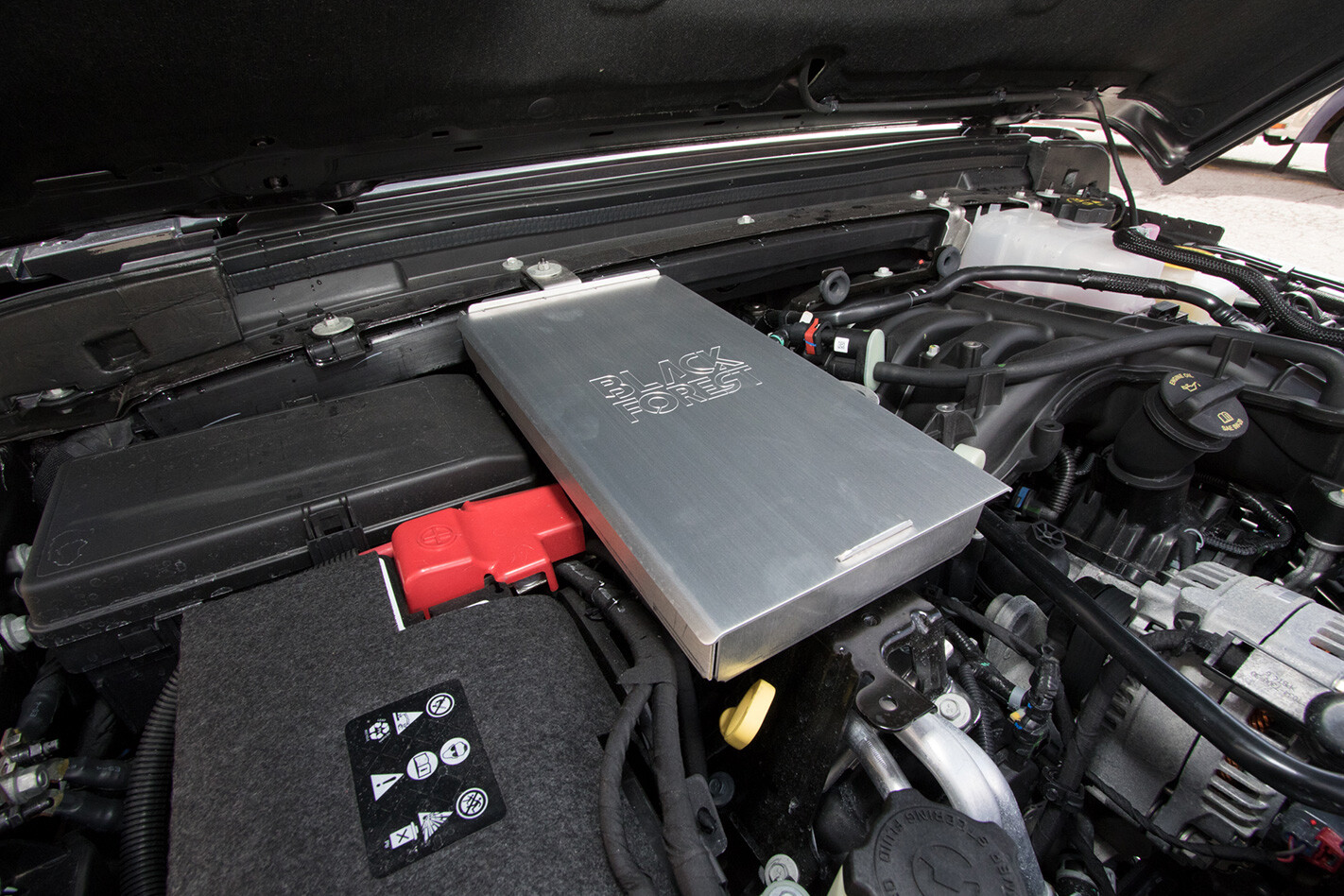
The guys at Black Forest, a subsidiary of Webasto, got tired of eating cold meals on the trail and created this handy trail oven. It easily mounts on Jeeps with the 3.6-litre V6 (other applications forthcoming) and is perfect for heating snags or burritos.
Camp kitchen
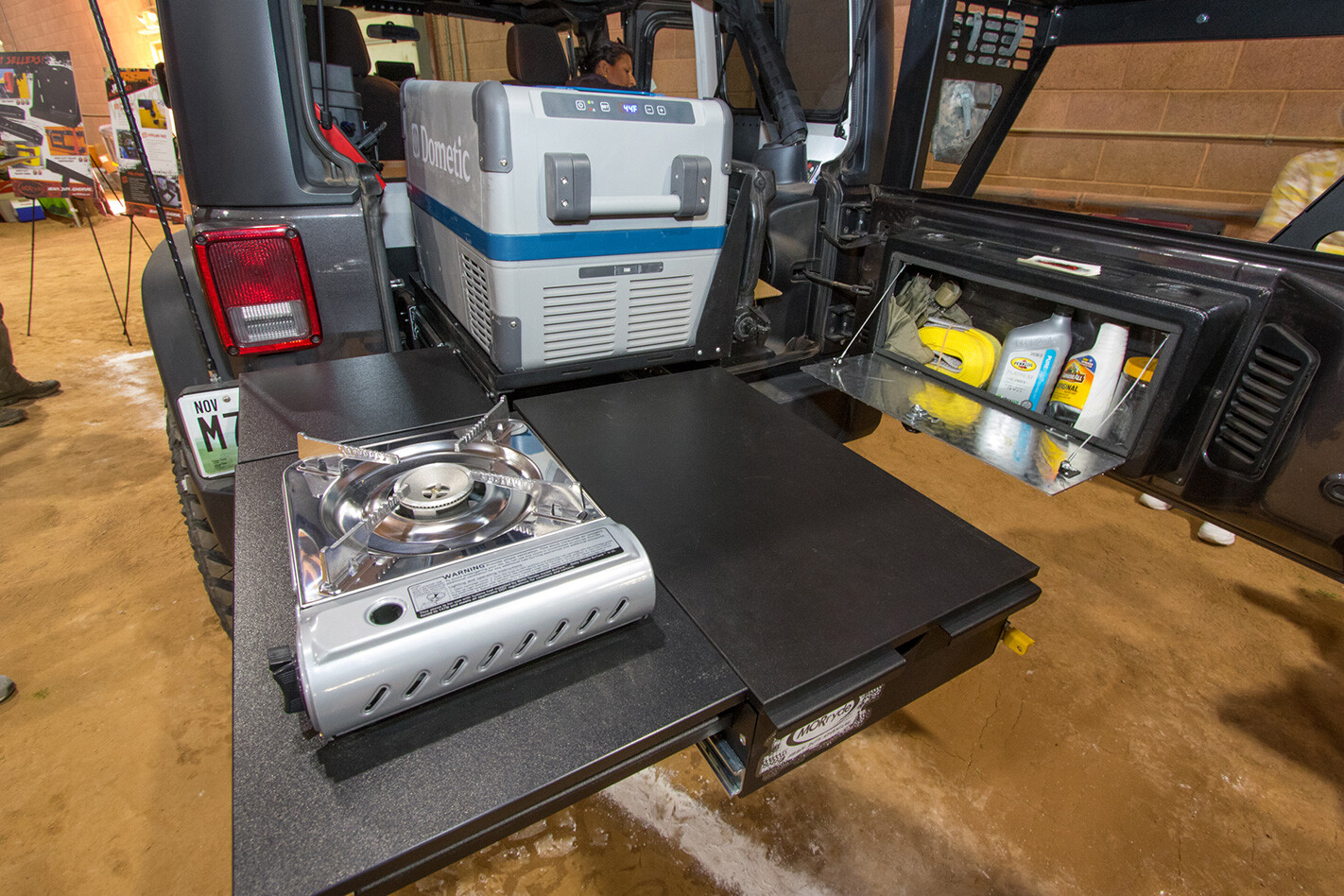
For the Jeep-driving outback gourmet, MORryde developed a slide-out camp kitchen and rear gate storage. The stove tray folds into the fridge slider and the storage cubby provides additional workspace and a place to store recovery gear or a mess kit.
Tyre rack
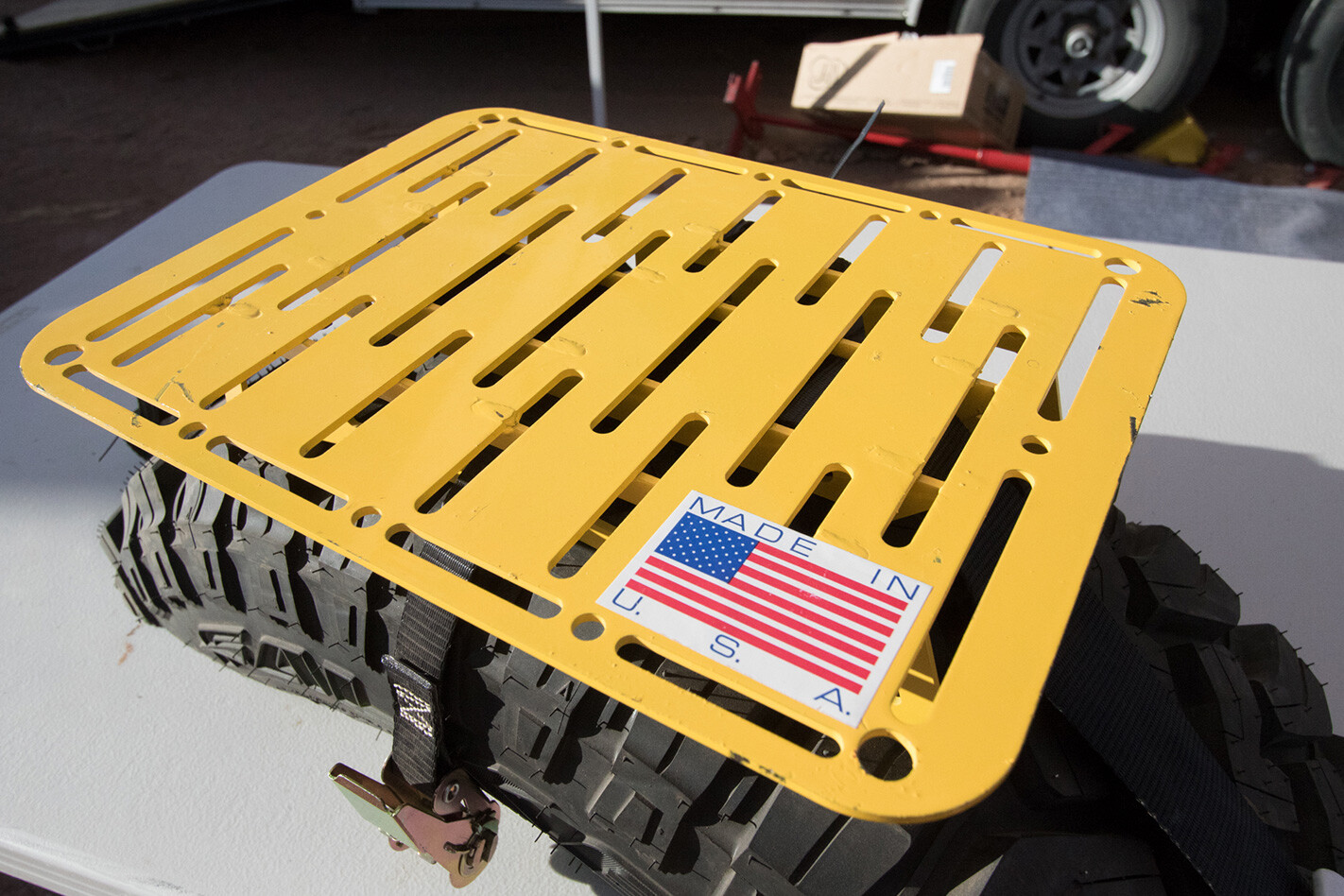
The Bugoutrack tyre-mounted rack attaches with a ratchet strap and is handy for securing quickly needed items such as recovery straps (or an Esky full of coldies).
Atlas new kit
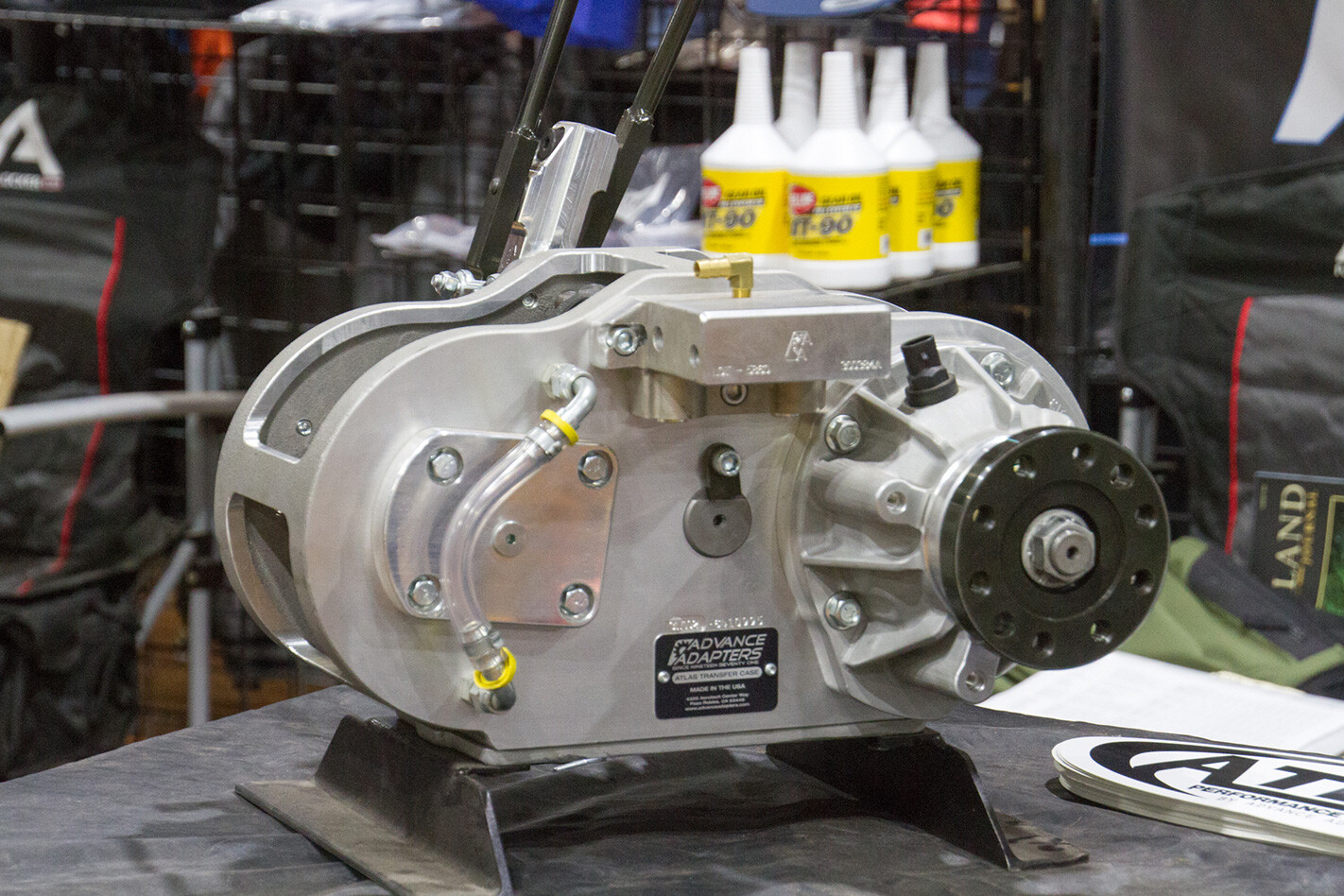
The Atlas transfer case, by Advanced Adapters, has long been the go-to solution for bulletproof gear reduction. The company tells us they are near completion on a version for the ZF 850RE 8-speed automatic, standard transmission on the Wrangler JL.
Shocks
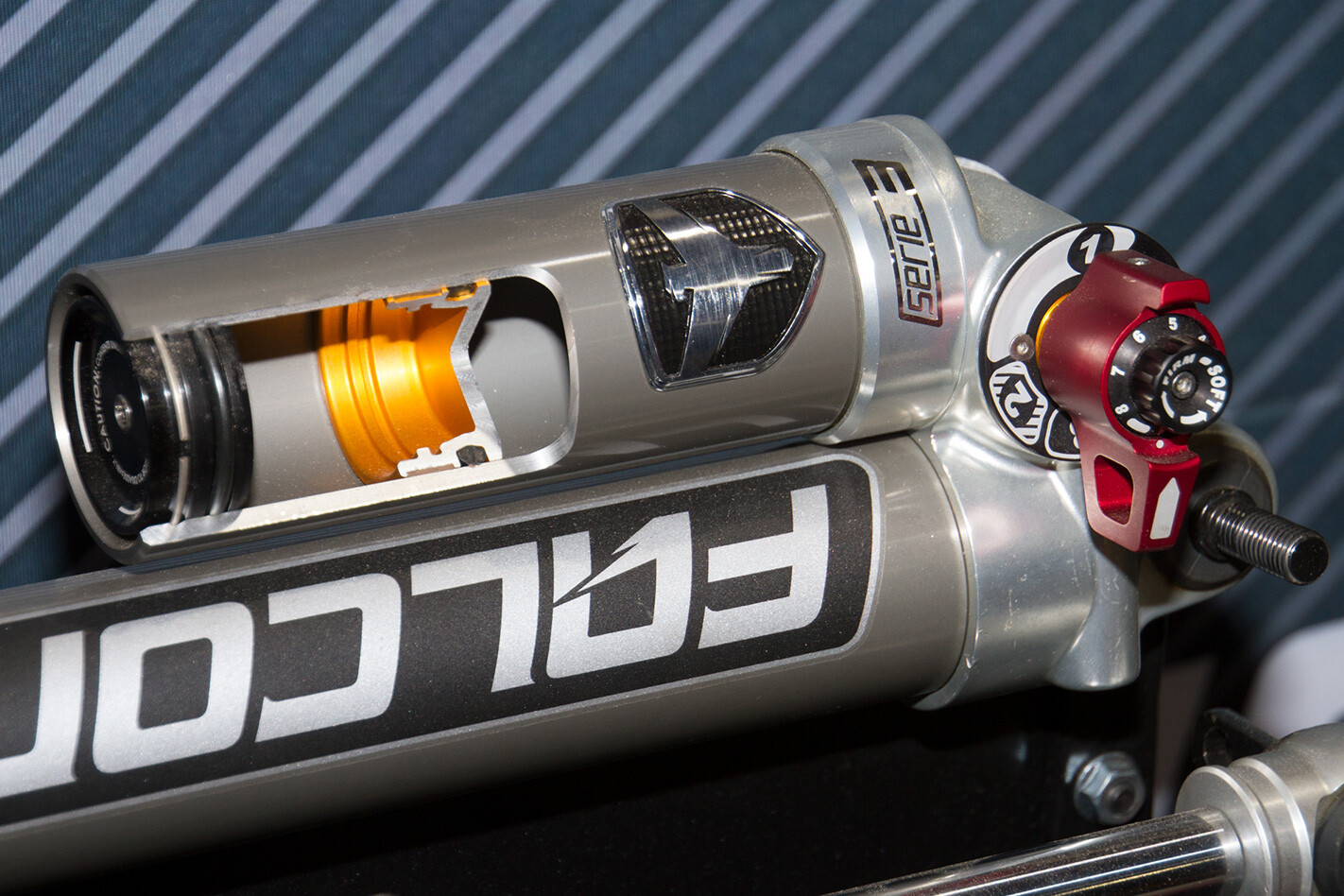
Leading the charge on Jeep-specific adjustable shocks, Falcon (a subsidiary of Teraflex) recently introduced its 2.5-inch Series 3 Piggyback. A large aluminium dial allows for 10 damping settings in two ranges and the 0.75-inch shafts should hold up to any trail abuse.
Side tanks
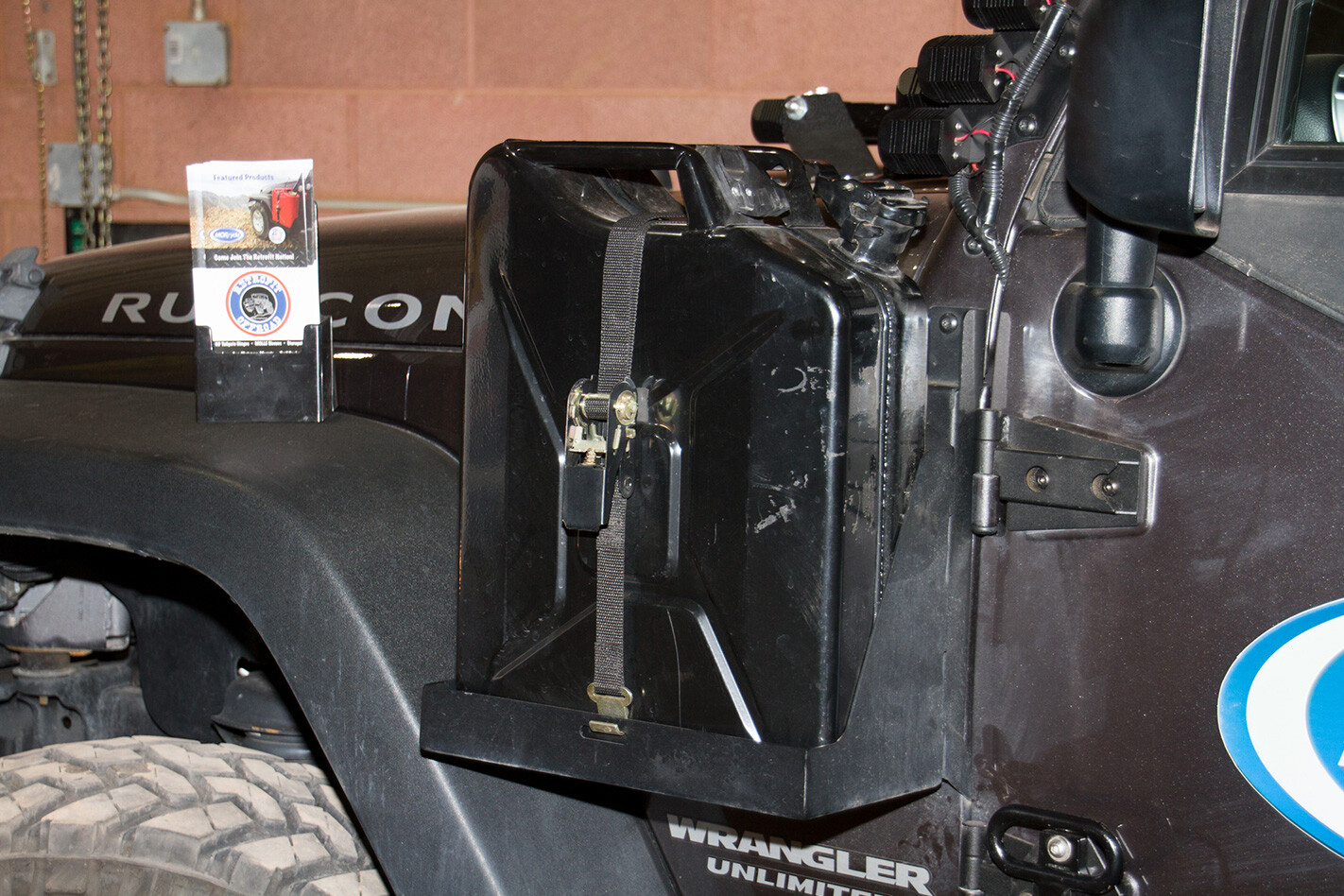
If your extended outback travel requires heaps of fuel, MORryde has a side-mount jerry can tray to help boost range. Available for driver or passenger side applications, the tray will provide an extra 20 litres close at hand.
Rock jocks
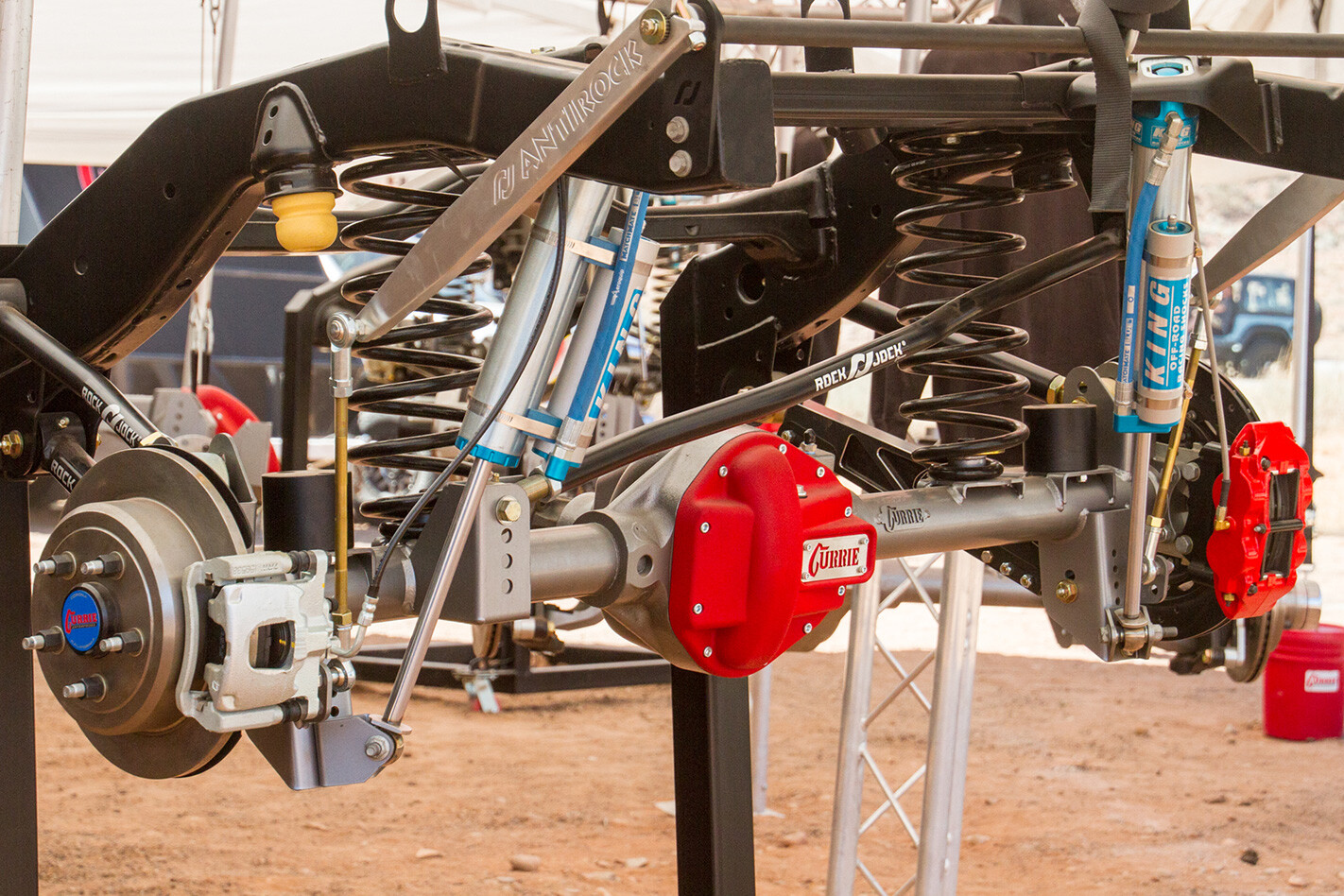
Currie Enterprises began in the drag racing scene but developed into a premier purveyor of bulletproof axles. Their Rock Jock Series (Dana 44, 60, and 70 equivalent) is standard equipment for many Moab Jeepers.
Sliding tray
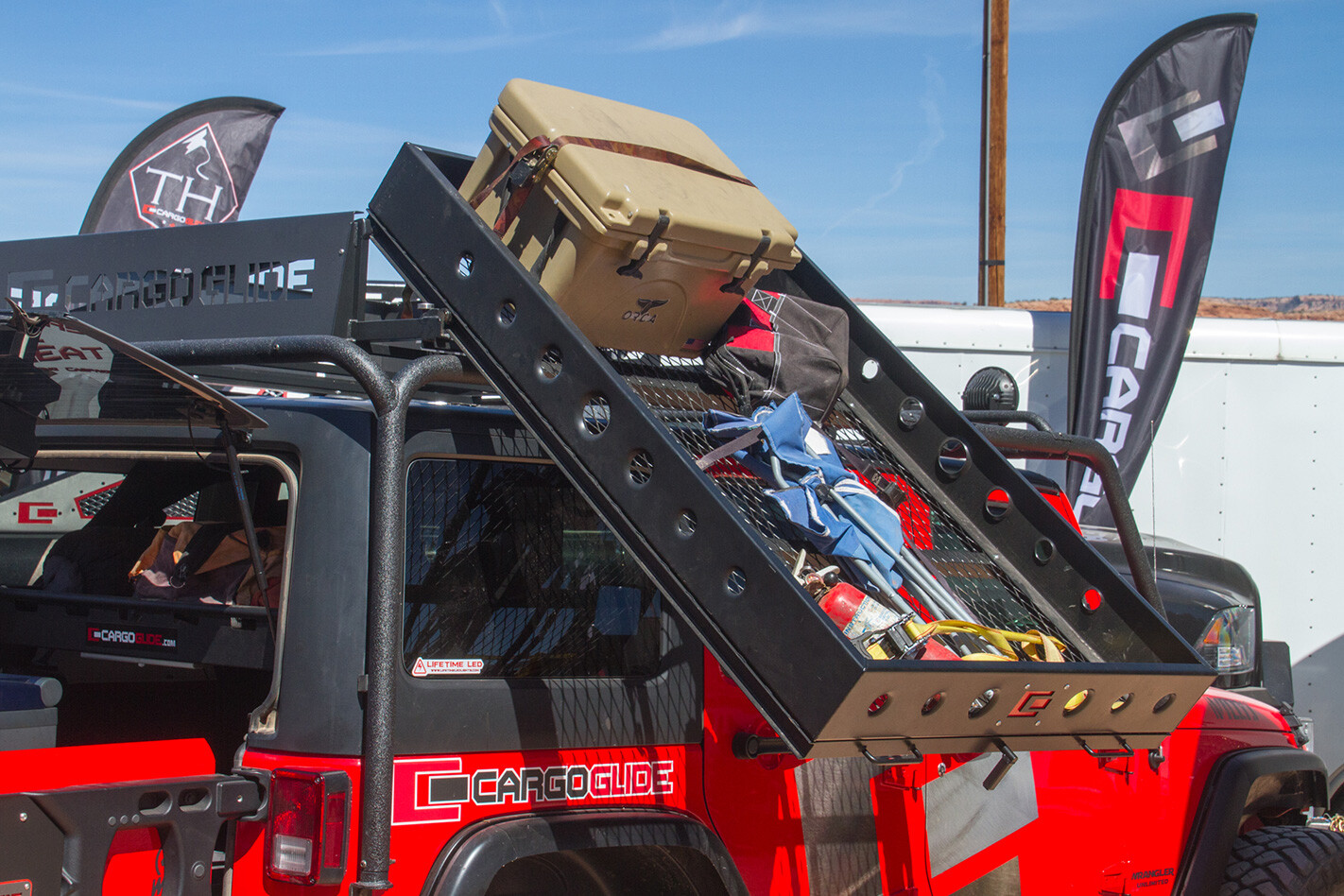
This aluminium sliding tray, a prototype from CargoGlide, has promise. It pulls out and locks in place for easy access to gear, and the company states it will mount to most aftermarket roof racks.
Pop-up tent
Ursa Minor Vehicles has adapted its pop-up rooftop abode to the Jeep Wrangler JK. With a comfortable bed and direct access to the driver’s seat, it offers many advantages over a standard roof tent. We’re told a version is in the works for the new JL as well.
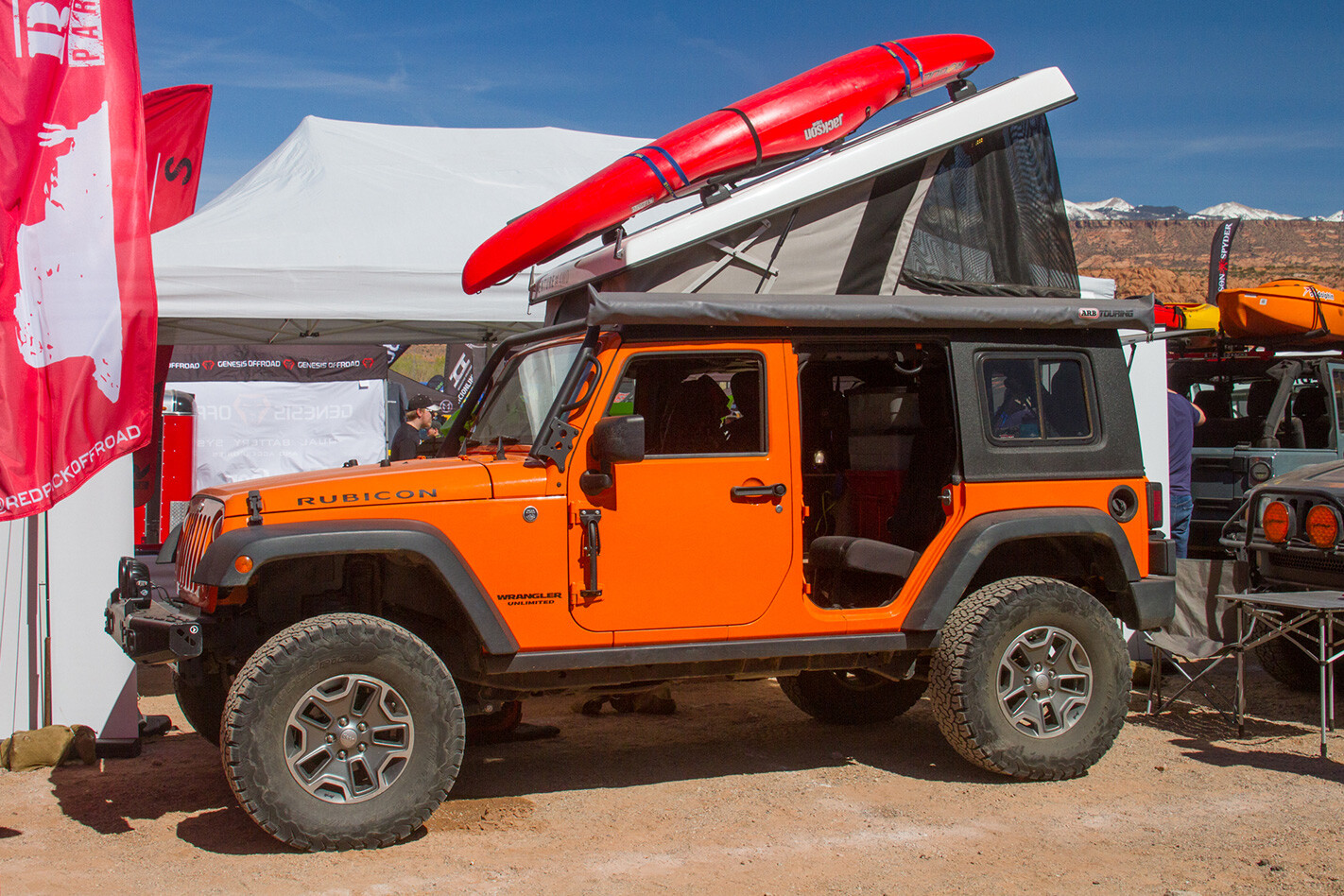
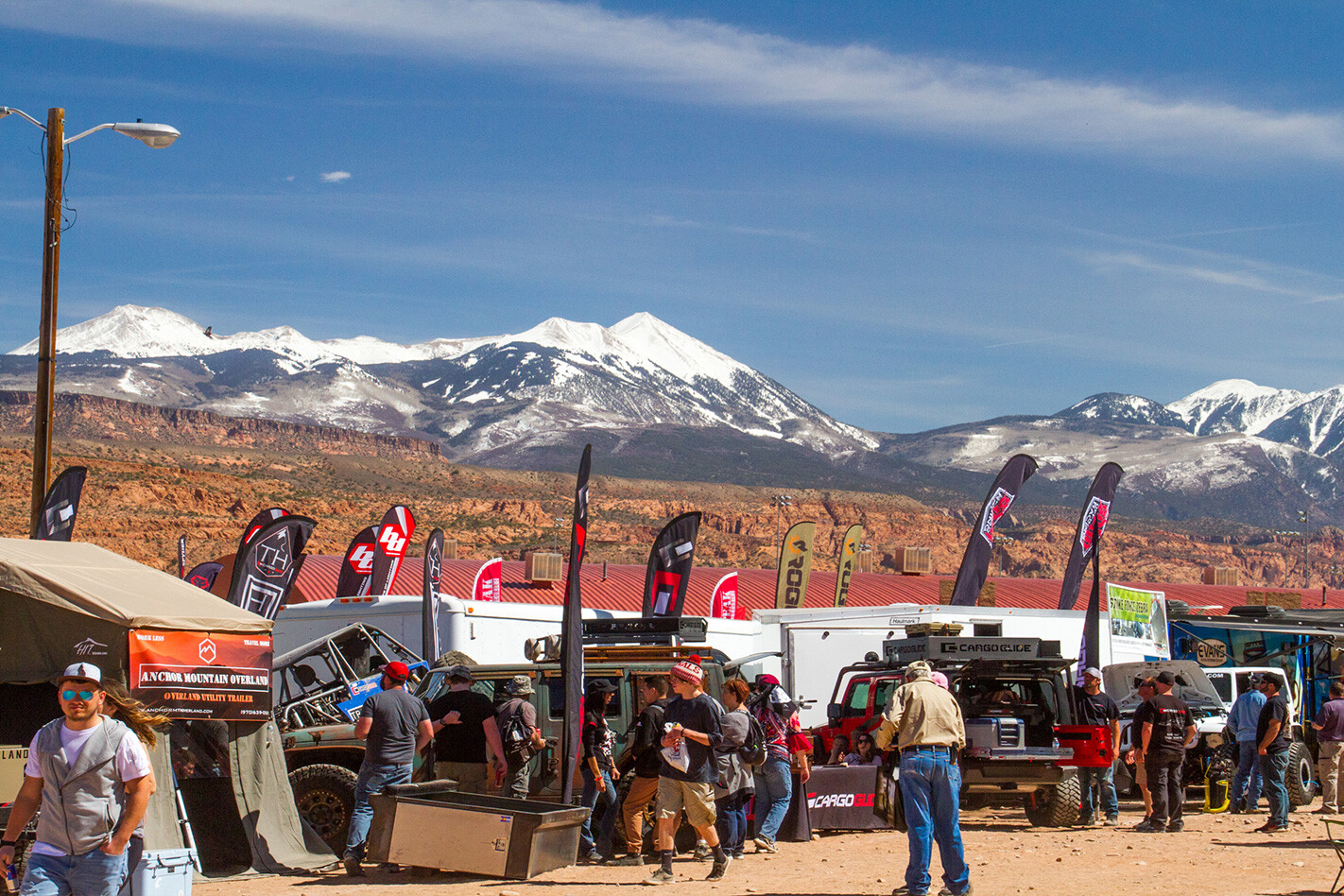
Show stop Walking the Jeep Safari vendor show, which features hundreds of manufacturers from the world over, is a relaxing way to spend an afternoon.
Mid-western NSW is jam-packed with history, holiday destinations and great camping.
On a recent trip we decided to explore several areas of interest that included traversing the Barraba Track to Mount Kaputar, Pilliga Forest and down to the wonderful Warrumbungles. We knew that by heading west from our east-coast base in winter it would get rather cool, but that just added to the excitement.
Mt Kaputar National Park is part of a geological skeleton of a once-active volcano. These rock ramparts rise to the Nandewar Range and provide a picturesque backdrop for the residents of, and visitors to, the North Western Slopes and Plains. The Nandewar Range forms remnants of a large volcanic complex built up by repeated eruptions during the Miocene Epoch, between 23 million and 16 million years ago.
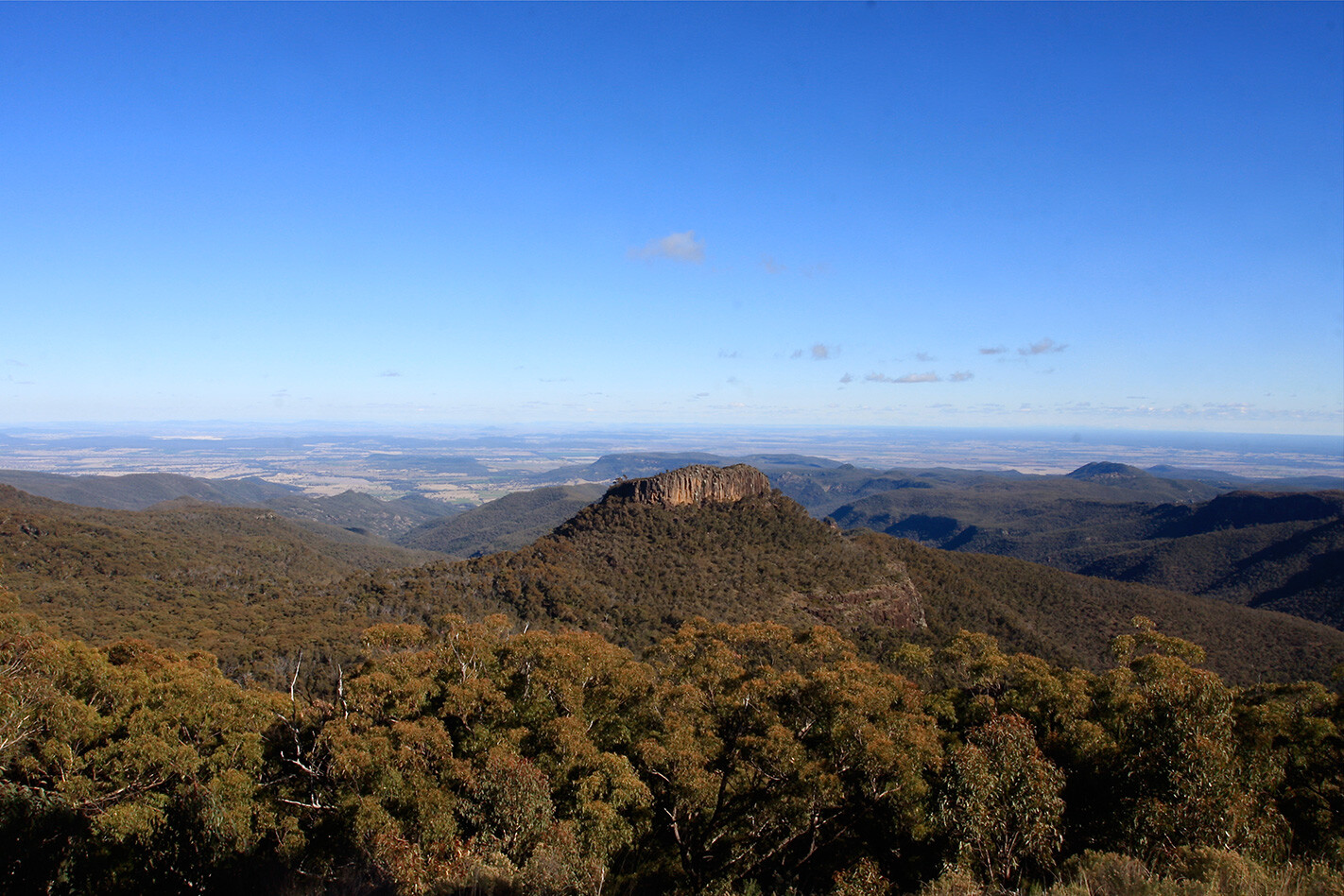
Instead of heading along the well-travelled roads towards Mt Kaputar, we decided to wheel along a little-known track from Barraba to Kaputar’s summit. The Barraba Track is locked and only eight 4X4s each week are allowed to traverse this route. While there is nothing hard about the track, you do need a 4X4 with reasonable ground clearance and you need to adhere to the conditions. The track reaches 1510m above sea level, so it only takes a small amount rain or snow for the route to be closed.
Barraba, a quaint little town with basic facilities, once bustled amid a host of mineral mines, but now it is a quiet western NSW outpost. After obtaining the gate key and some local information regarding track conditions we headed 45km west from town. Along the way we passed through established working properties and a few hobby farms via sealed and unsealed roads.
Entry to Mount Kaputar NP is via a gate, which isn’t locked, but signs inform you of basic park information and regulations. It was evident, even from here, that this was volcano country, with deep red soil and thick undergrowth that seems to thrive in these conditions. Starting at about 400m above sea level and at the base of the mountain, the road surface can be rocky but, by if you select low-range, it won’t be a problem for most 4X4s.
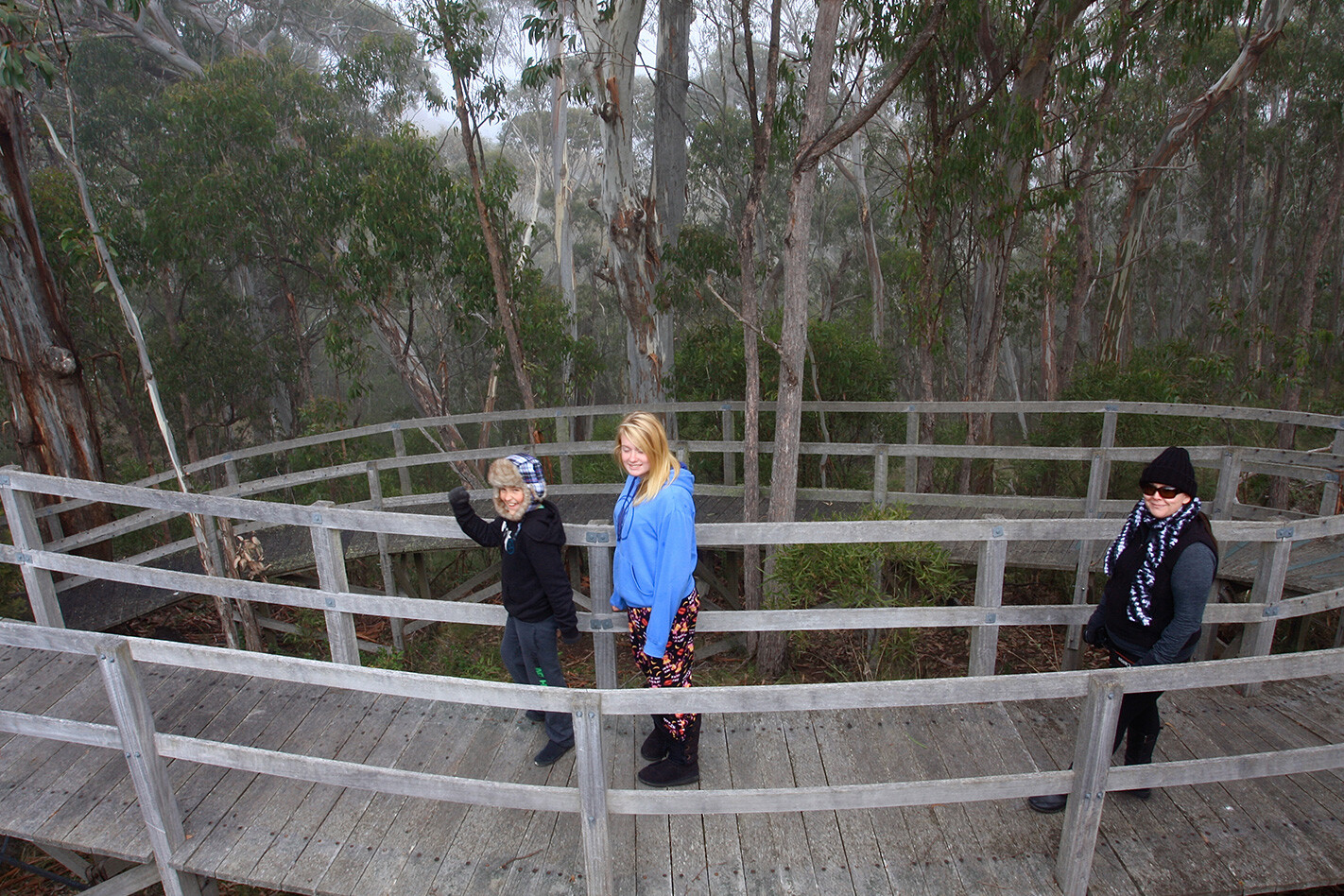
The 51,000ha park has been classified as a wilderness area, and it’s easy to see why. The park is also home to various endangered and vulnerable plants and animals. Every corner of the track seemed to give way to a new selection of greenery, from old-growth forests, valleys of grass trees to some of the westernmost rainforest in NSW.
While the track is only 8.5km long we allowed an hour for the journey to give us ample time to soak up the experience. A great stopping point is Brushy Mountain Picnic Area, about 4km along the track. It’s basic but includes a drop toilet and barbecue facilities.
Brushy Mountain had the first of the locked gates and the only way in was with our designated NPWS key – the gates are large and obvious in their purpose.
Between the two locked gates was a 4.5km drive; we found this section interesting with sharp rises and falls along the way, narrow pinches and corners signposted at 5km/h – it would pose a challenge to meet another 4X4 coming the opposite way.
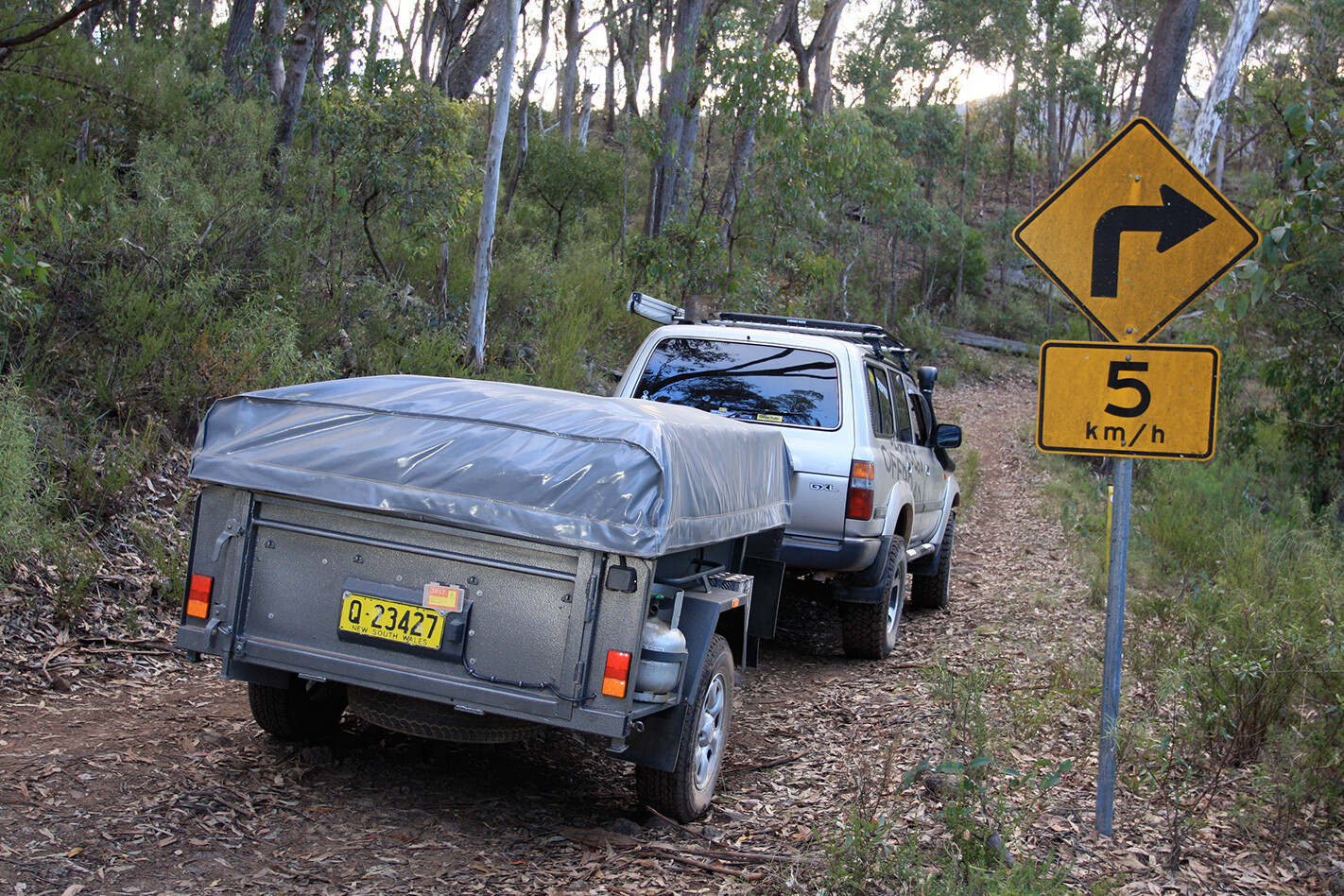
Climbing to 1510m, we noticed a change in the foliage; huge gums dominated and sub-alpine vegetation lined the road. We felt the air cool dramatically as we finally found the last locked gate close to the summit.
There are a few camping options from which to pick in the park. We chose Dawson Springs. It is the highest camping area in Kaputar and has great facilities with hot showers, toilets and large fire bins.
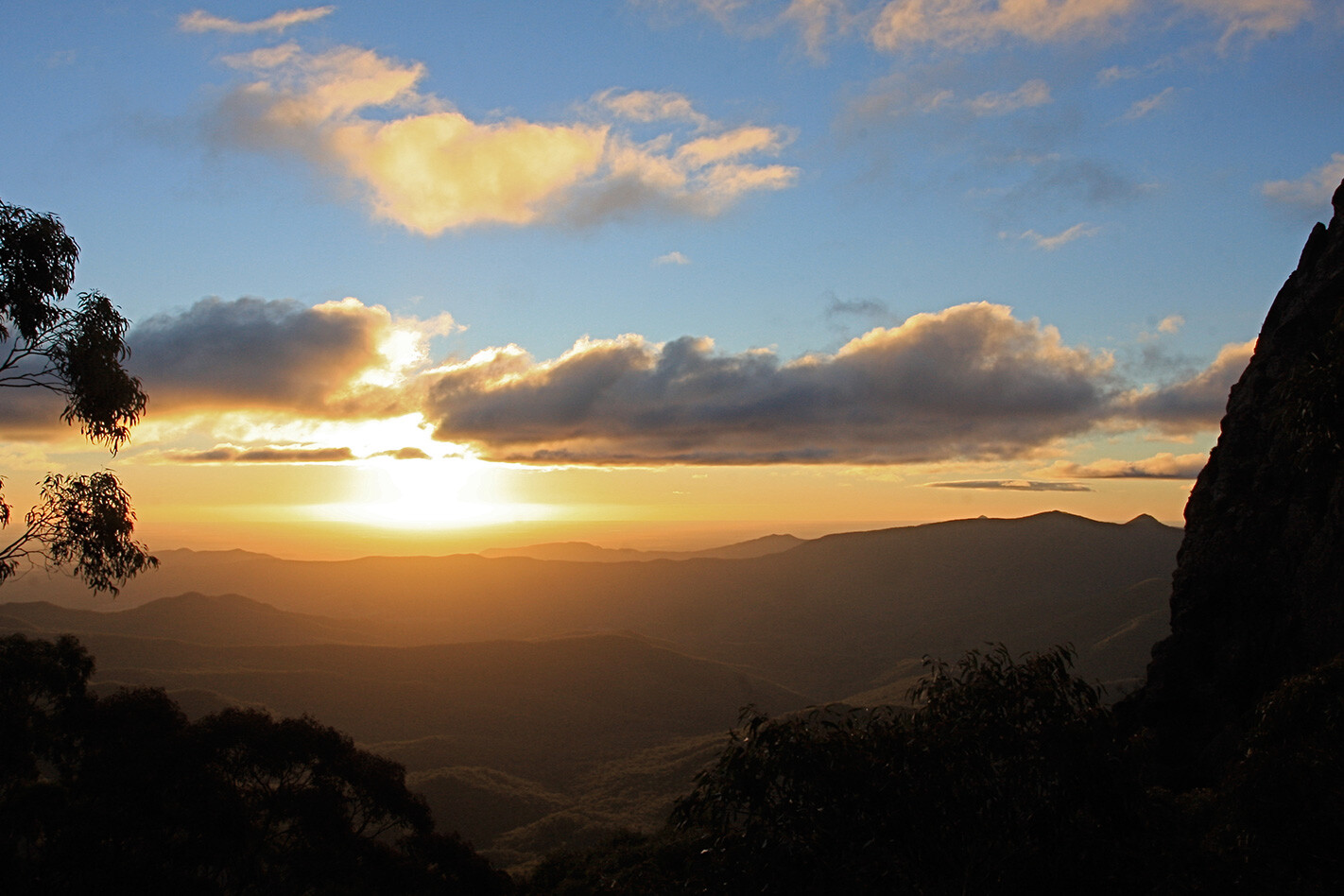
Dawson Springs is well set out for travellers with tents, camper-trailers or day visitors exploring the area. After we set up camp we headed out to explore the local walks and discover the park’s stunning views and history. At the summit of Mt Kaputar we were surprised with the amount of ice that was still falling from the trees despite it being the afternoon. Once our focus shifted we looked beyond to stunningly clear views across the plains below.
Walking tracks in the park range from mild to wild, and there are lookouts close to the road that offer wheelchair access. The Governor Walk is a great track to explore for those with at least some level of fitness. This two-kilometre walk leads to a large volcanic plug where you have uninterrupted views across the landscape below. Be warned though – there are sections where you pass exposed cliff edges; it’s worth the effort but be vigilant, especially with children.
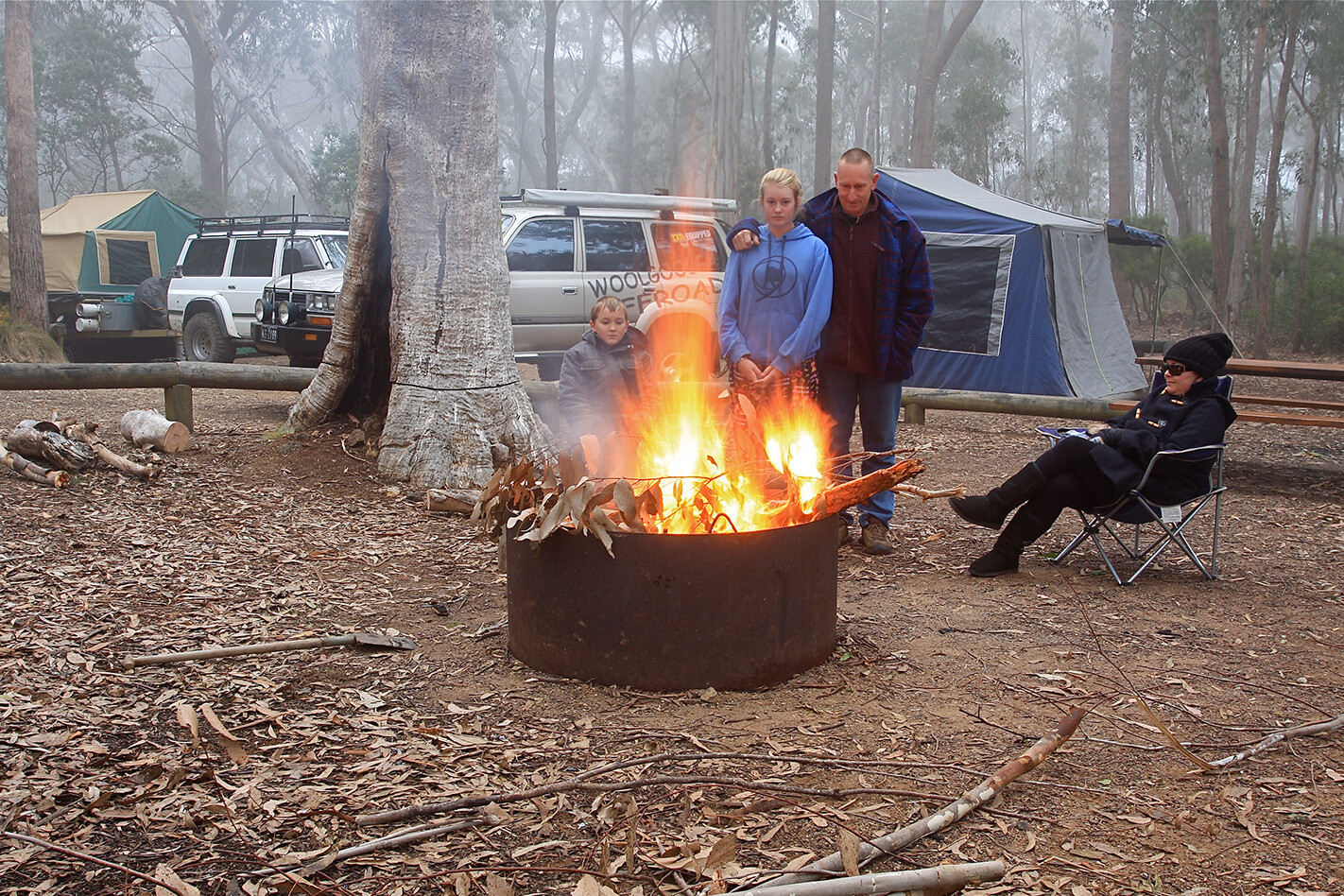
With these walks under our belt it was now time to kick back around camp and utilise the large fire bins provided. Remember: this is a national park so you need to bring your own firewood. Winter nights are extremely cold here. With the wind-chill factor, expect temperatures to drop below zero regularly, and don’t be surprised at the fog that rolls in early in the evening.
Early the next morning, it was surprising to see wallabies and birds cruising the campsites looking for scraps from the previous night. Let them scavenge, but be aware that intentionally feeding the animals is discouraged as it upsets their natural digestive system.
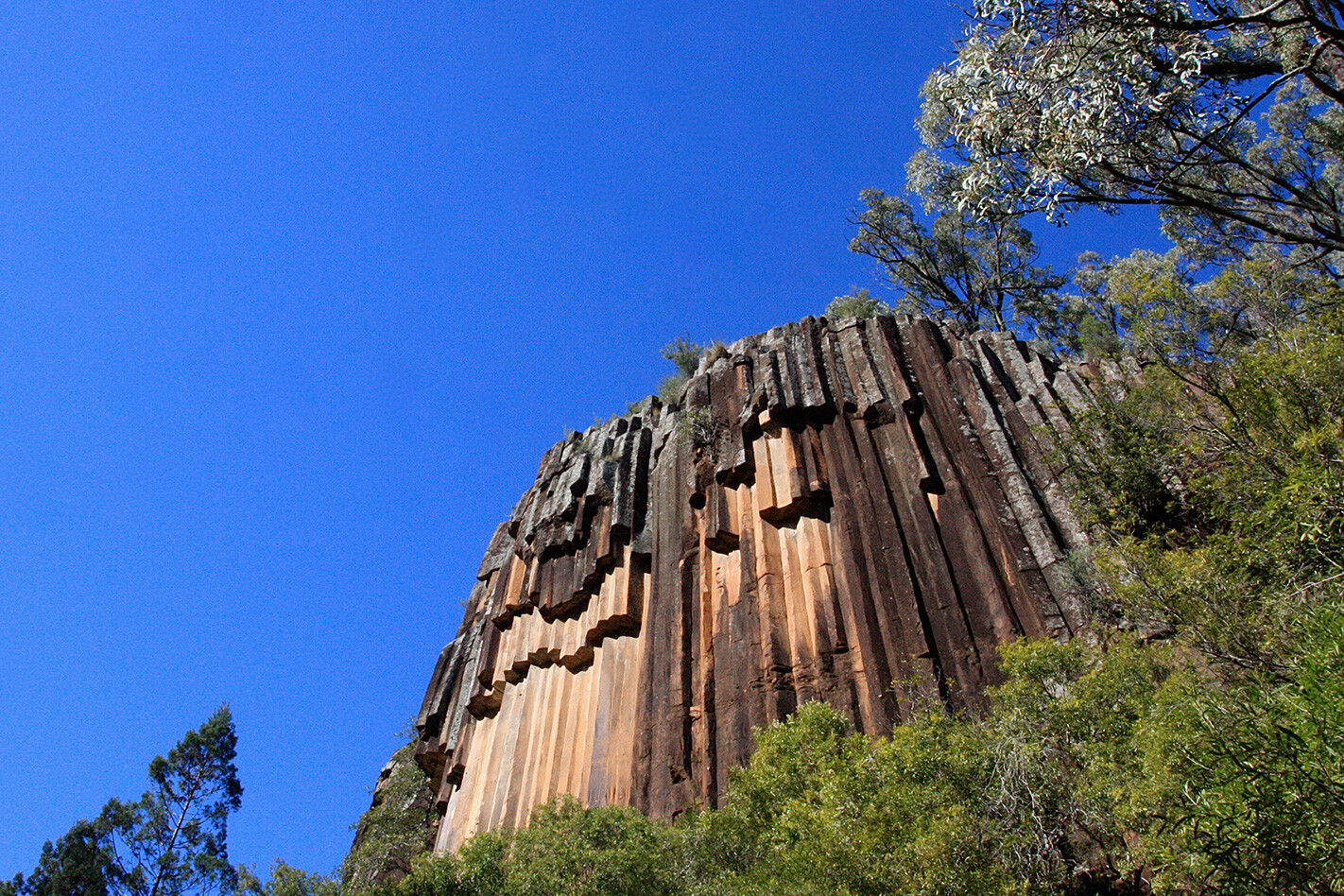
The northern side is another great section of the park to explore. It’s where you will find Sawn Rocks, one of Australia’s best examples of the geology formation known as ‘organ pipes’. To access Sawn Rocks, you need to leave the main part of the park and trek across to nearby Narrabri, before heading along the Bingara Road for 35km. No camping is allowed at Sawn Rocks, but the facilities here are top-class, with free barbecues, toilets and a sealed walkway that allows easy access.
If you’re feeling energetic enough you can follow the formed stairs down into the lower gorge to explore the horizontal polygonal structures or fallen rocks in the Bobbiwaa Creek bed. The 40-metre-high cliff face is the sheared-off remains of a basalt lava flow from the Nandewar volcano which dominated the area 21 million years ago. When the molten rock with the basalt lava flow cooled slowly and, importantly, evenly, this enabled the individual crystals within the molten rock to align perfectly with each other. These rocks formations are well worth the drive.
Sawn Rocks is an area in which you can easily lose an hour or two with the walk and lunch, but our destination was further west towards the Pilliga Forest. Heading back into Narrabri and restocking with food and fuel, the road westward soon beckoned us. The Kamilaroi Highway, a narrow sealed road, follows the Namoi River towards the rich cotton-growing area of Wee Waa. Wee Waa can be translated from its Aboriginal language origins as ‘fire for roasting’, and it was the first town on the Namoi River; squatters settled in the area in 1837. The birthplace of Australia’s modern cotton industry, Wee Waa relies on the rich soils and nutrients derived from the volcanic spewings of Mount Kaputar.
We were lucky enough to pass through Wee Waa during the cotton harvest. The kids thought it was great to learn where cotton comes from and how it is processed. Judging by the amount of cotton beside the local roads, it had been a great season. Wee Waa has a friendly population of about 2000 people and has basic facilities.
Our next destination was Pilliga, 56km west of Wee Waa. It is, in fact, approachable from five directions, four of them on dirt roads, but the road from Wee Waa to Pilliga is sealed.
The Pilliga community has set aside several acres of land just out of town for free camping. We were pleasantly surprised as we pulled in; it has hot artesian bore baths (sunk in 1902), toilets, showers and fully grassed grounds. It seemed everyone was here for the same reason – to experience the hot baths that reportedly have a therapeutic effect. We can say that the warm baths were a welcome sight after the cool nights at Mt Kaputar.
Fires are allowed here but again, it’s BYO firewood. Luckily, we found a local who occasionally brings in trailer-loads of firewood for a gold-coin donation – how good are country folk!? From the campground there is a two-kilometre walk around the surrounding wetlands. If you are lucky you might see a host of birdlife, from emus, kites, ibis, diverse types of robins to willy wagtails.
Out here you get the real sense of being outback. Enjoy cool clear nights where the star trails seem to hit the ground, stunning sunrises and sunsets, spotting satellites as they track across the sky and breathing that fresh country air.
TRAVEL PLANNER
GETTING THERE Mount Kaputar National Park is in mid-western NSW, 66km east of Narrabri. The Pilliga Forest and camping area are 100km west of Narrabri. The Barraba Track starts just west of Barraba and a key is needed for this route.
CAMPING There are camping areas at Dawson Springs and Bark Hut. These areas have toilets, showers and fire pits. National Park fees of $5 per adult and $3 per child per night apply. Pilliga has a free camping area which has hot springs, basic toilets and showers and fires are permitted. No dogs or generators at Mt Kaputar, but they are allowed at Pilliga.
WHAT TO TAKE You need to be self-sufficient with food, water, spare supplies and firewood. Bins are provided at both locations. Winters are bitterly cold and temperatures often fall below zero so be well prepared.
SUPPLIES & FACILITIES The nearest major town, Narrabri, has large supermarkets, mechanical workshops and main facilities. Barraba has basic facilities from fuel to food.
TRIP STANDARD The road into Mt Kaputar has 26km of unsealed road, which is narrow and steep in sections, with another 30km that’s sealed until the highest point in the park. These roads are subject to closures in heavy rain or snow. The road is not suitable for caravans. Pilliga camping area is suitable for all types of camping, and is sealed to the entry. The Barraba Track is 4X4-only and is subject to closure due to snow or rain.
PERMITS No permits are needed but camping fees are payable at Mt Kaputar NP.
MAHINDRA’S new Pik-Up 4×4 has arrived in Australia and brings significant changes, headlined by a more powerful engine, a six-speed manual gearbox, fresh styling, a new interior, more equipment, and, for the first time, electronic chassis control systems (as its fitment on all-new light commercial vehicles became mandatory at the end of 2017).
This top-to-bottom rebirth comes some 10 years after the Pik-Up first arrived in Australia, and it follows the 2011 update that saw a new, more-powerful Euro-5 compliant 2.2-litre diesel replace the original 2.5-litre diesel.
What we are driving here is the top-spec (S10) dual-cab 4×4 and, as you can tell from its looks, the Pik-Up is more in the style of a Land Cruiser 79 than something like a Hilux or Ranger, given it is more ‘light-truck’ than ‘passenger ute’ in its general body style and design intent.
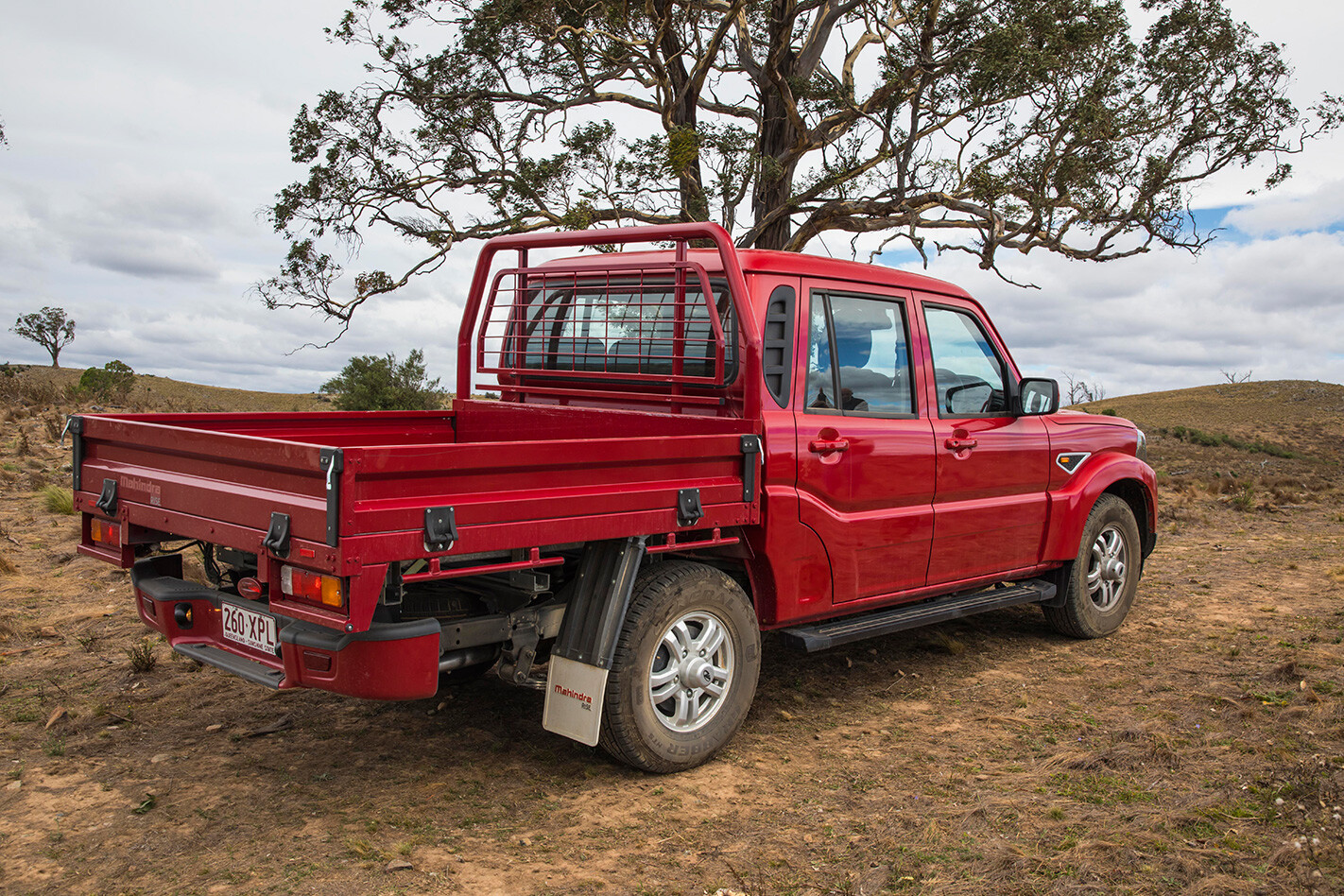
The Pik-Up’s trump card is pricing, with the S6 dual-cab (with factory tub) less than $29,990 drive-away and the up-spec S10, also with a factory tub, just $2K more. Our test vehicle is an S10 but with the tub replaced with a deluxe heavy-duty colour-coded steel tray, making it a $34,990 drive-away proposition. Compare that to the $80K+ you pay to get an LC79 double-cab (with a tray and air-con).
In the April 2018 issue of 4X4 Australia we tested the new Pik-Up 4×4 single-cab and came away very impressed, so we were keen to see how the more versatile dual-cab shapes up, especially as a recreational 4×4.
POWERTRAIN AND PERFORMANCE
DESPITE its upgraded 2.2-litre four-cylinder diesel, the Pik-Up is still no powerhouse on paper and claims a modest 103kW (up from 90kW) and 330Nm (up from 290Nm). But these numbers don’t really reflect what is a willing and energetic engine that gets on with the job with little fuss. Perhaps the secret is that the 330Nm is available from just 1600rpm and doesn’t diminish until 2800rpm, which provides a nicely linear power delivery over a wide rpm band. That said, the Pik-Up doesn’t have much left in reserve for overtaking at highway speeds, and this is one of the few situations where more power would be welcome.
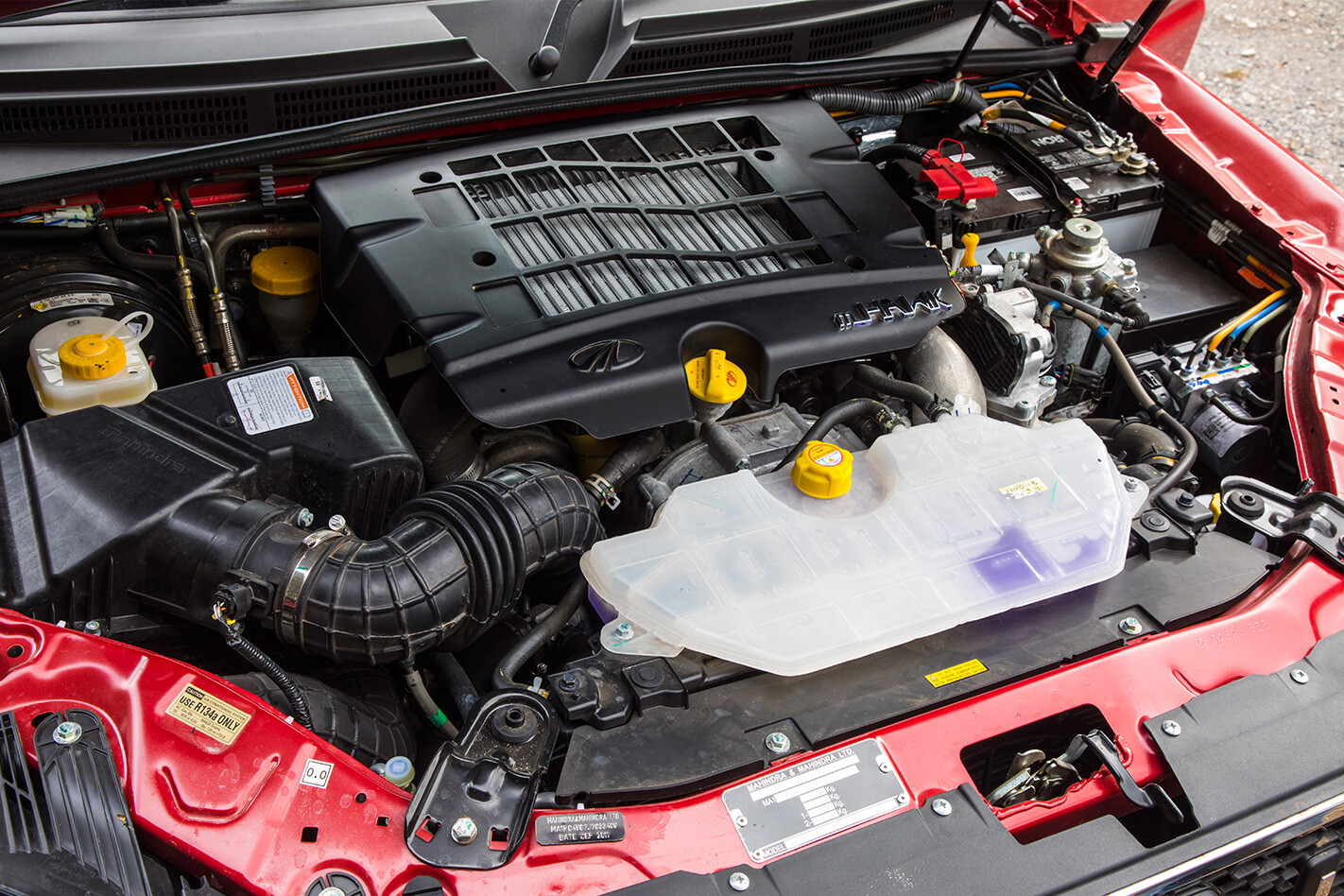
The new engine also impresses with its refinement and noise control, and certainly sounds and feels more like a quality passenger-car diesel than something you would find in a commercial work and farm vehicle.
For its part, the six-speed manual offers short and crisp shifts, with overall gearing short enough so that open road and expressway hills can be conquered in top, yet tall enough to not feel busy at highway speeds. At 100km/h in sixth, the engine spins at a relatively modest 2000rpm and feels very relaxed and happy.
ON-ROAD
THE Pik-Up is a relatively high-riding work and farm ute, so don’t expect it to handle like a go-kart on-road. That said, the Pik-Up offers decent steering feel and feedback and doesn’t do anything particularly untoward on bumpy country roads. However, unladen ride quality is on the firm side and you can be bounced around a bit, but this is the downside of its ability to carry its maximum payload (1000kg+) without becoming too soft or soggy (see Payload Test breakout on page 72).
OFF-ROAD
THERE’S nothing too shabby about the Pik-Up when off-road, with excellent visibility from the upright driving position, more ground clearance than the factory claim of 210mm suggests, and off-road friendly 16-inch wheel and tyre specification. The Pik-Up also comes standard with an Eaton (mechanical) self-locker at the rear, which works even in two-wheel drive. In addition, the Pik-Up has electronic traction control that stays active on the front axle in four-wheel drive even when the Eaton locker engages, all of which makes the Pik-Up more sophisticated in this regard than the majority of the popular mainstream utes.
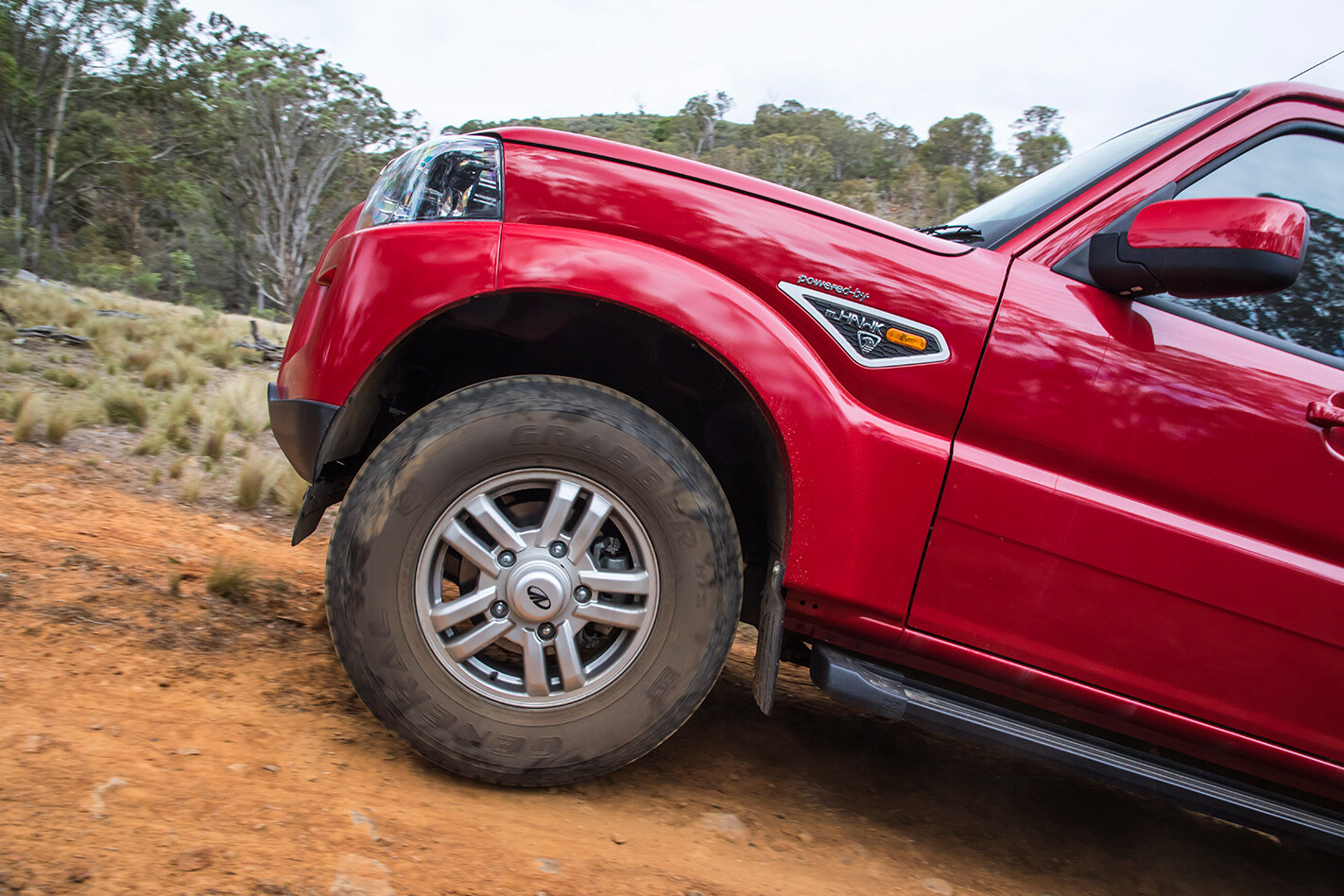
More wheel travel from the independent torsion-bar front-end would be welcome. The rear leaf-sprung live axle does better for travel, and what trouble you may have when the Pik-Up starts to lift wheels is countered by the locker and the traction control. It’s still no LC79 in gnarly off-road conditions, but it’s still more than handy. Part-time 4×4, operated via a rotary dial, comes courtesy of a BorgWarner transfer case, and the engagement and disengagement of both High4 and Low4 proved seamless and relatively quick, which is not always the case with electro-magnetic transfer boxes. Plenty of reduction in low range, too, for steep country.
CABIN AND SAFETY
THE Pik-Up’s upright cabin is spacious both back and front. There’s no steering-wheel reach adjustment (only tilt adjustment), but the driver’s seat has height adjustment, and both driver and front passenger get fold-down armrests, both part of the S10’s extra kit (see Equipment breakout). There’s heaps of headroom, decent legroom and sufficient width for three adults in the back seat, too, even if the seat is relatively upright and somewhat hard.
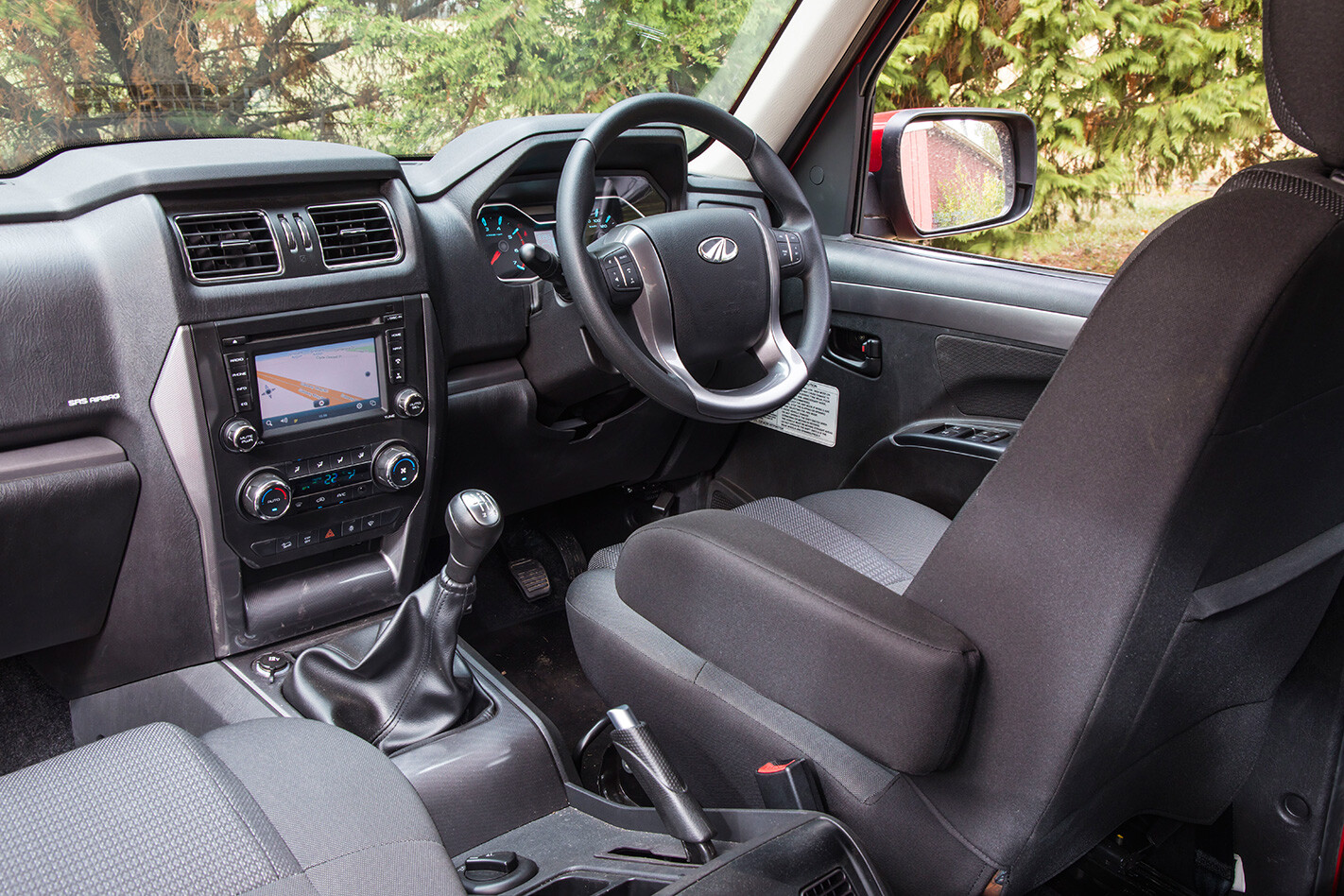
The cabin is much better finished than before and generally feels more modern, but could be better in detail. It needs more centre-console storage, bottle holders in the front doors, and more secure stowage for the jack handle and wheel brace, which are both ‘Velcro-ed’ under the rear seat and soon ‘float’ around.
This new Pik-Up hasn’t been ANCAP safety tested; although, the previous model achieved a three-star rating without electronic stability, traction control and rollover mitigation, now fitted.
PRACTICALITIES
AT A TIME when most utes boast 3500kg tow ratings the Pik-Up offers 2500kg, which is still handy enough depending on what you wish to tow. The Pik-Up is more than competitive with its 1000kg+ payload claim, though.
The standard 80-litre fuel tank provides a reasonable fuel range given the engine is relatively thrifty, and there’s room underneath to fit a long-range tank if needs be. Lots of options, too, in terms of all-terrain and mud-terrain tyres (some in Light Truck construction) to replace the standard 245/75R16 (111 S) General Grabber HTs (made in the USA, no less), which are still more than handy off-road away from deep mud.
Factory accessories include a winch-compatible steel bullbar, a snorkel, various trays and a towbar. A suspension upgrade and lift kit, a stainless-steel nudgebar and a bashplate are all in Mahindra’s accessory pipeline.
Nice detail touches around the Pik-Up include gas bonnet-struts and a manual fuel-pump prime; although, the lack of a lock for the fuel cap isn’t ideal.
The Pik-Up has 15,000km or 12-month service intervals with service provided by 40 dealers nationally, while the warranty is the industry standard three years/100,000km.
EQUIPMENT
PIK-UP dual-cab 4x4s are offered in base S6 spec or top S10 spec. Equipment on the S6 runs to electronic traction and stability control, an Eaton self-engaging rear locker, 16-inch steel wheels, air-con, driver and passenger airbags, three-point seatbelts and headrests for all passengers, and ISOFIX child-seat anchor points.
The S10 adds 16-inch alloys, a six-inch touchscreen, sat-nav, a reversing camera, Bluetooth, driver’s seat height adjustment, automatic headlights and windscreen wipers, day-time running lights, and climate and cruise control.
MAX PAYLOAD TEST
LIKE all utes we test, we loaded the Pik-Up with what is effectively a maximum payload. With a GVM of 3150kg – 50kg less than the heavier LC79 but 100kg more than the similar-weight Hilux – the Pik-Up has a very competitive payload, around 1050kg with this steel tray and 1070kg with the factory tub.
Our test involved 800kg on a full-sized pallet. With the longer cabin of the dual-cab, this weight is all behind the rear axle rather than over it as it is with a single-cab. Add in driver and passenger (another 150kg) and 50kg of miscellaneous gear and you’re right on the 1050kg maximum payload. How did it handle it? Well, very nicely indeed.
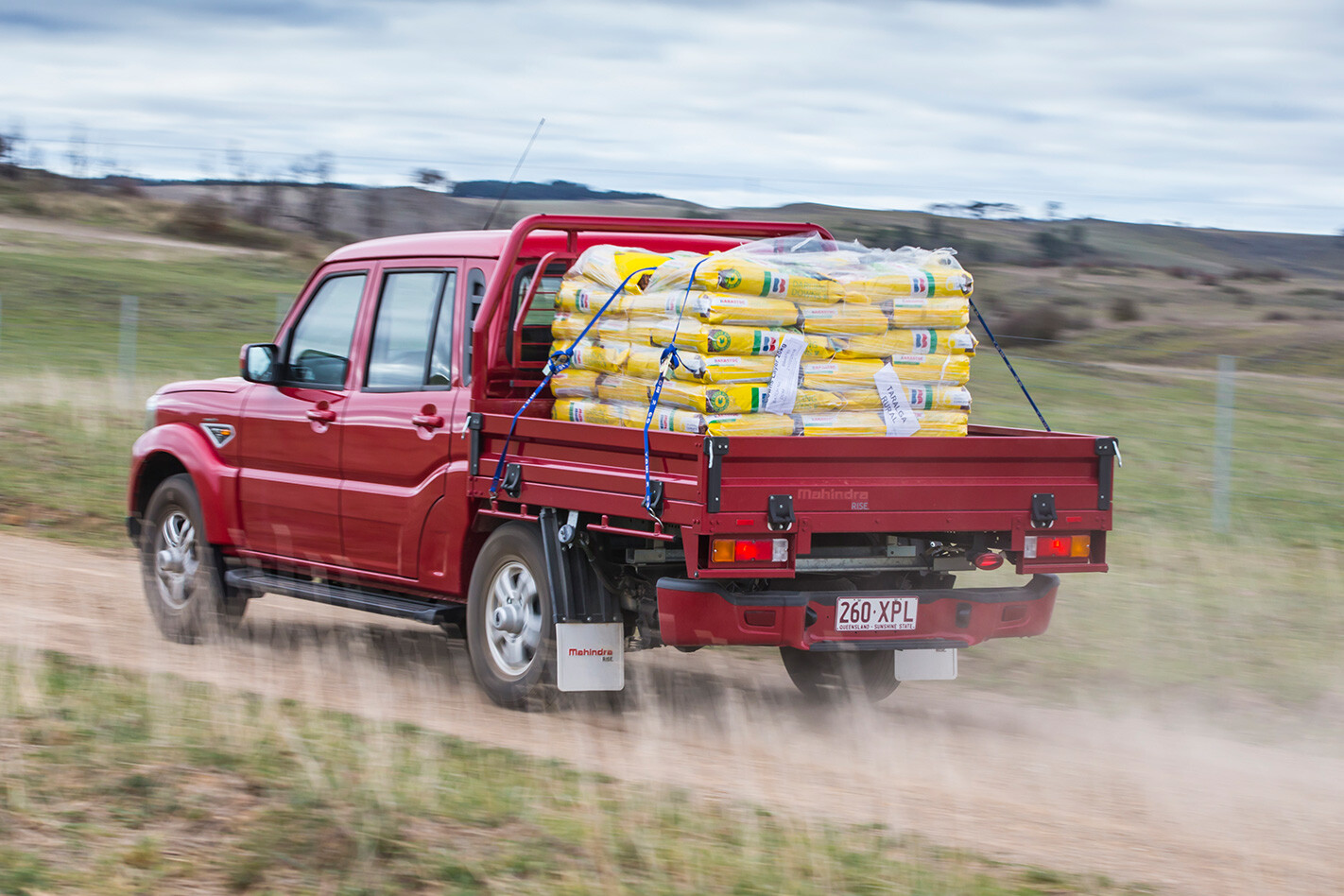
The back of the Pik-Up dropped just 60mm at the axle line, which levelled the vehicle rather than lifted the nose. On the road you could feel the weight on the back, but the Pik-Up remained stable and secure and rode a lot more smoothly. The engine felt the weight in general acceleration and hill-climbing, but it didn’t need to work excessively hard to maintain highway speeds. Top job all ’round.
SUM UP
GIVEN its price point, the Pik-Up is better to drive than it should be. It’s surprisingly pleasant on-road (better than an LC79 in many ways), can carry a decent load and is more than useful off-road. It also looks to be solidly built and, in the 10 years the Pik-Up has been in Australia, it has earned a reputation for decent reliability. As a farm and work vehicle it deserves to sell much better than it does … every farm should have one, in fact.
Is it a good proposition as a recreational family 4×4? Well, it certainly offers a lot of functionality for the money, and if you don’t need the power and performance of other mainstream utes – or more than a 2500kg tow rating – it’s well worth a look.
MAHINDRA PIK-UP 4X4 DUAL-CAB/CHASSIS SPECS
Engine 2.2-litre 4cyl turbo-diesel Max power 103kW at 4000rpm Max torque 330Nm at 1600-2800rpm Gearbox Six-speed manual 4×4 system Dual-range part-time Front suspension Independent/torsion bars Rear suspension Live axle/leaf springs Tyre/wheel spec 245/75R16 111S Unladen weight 1940kg (no tray) GVM 3150kg Payload 1210kg (minus tray) Towing capacity 2500kg GCM 5150kg Ground clearance 210mm (see text) Fuel tank capacity 80 litres ADR fuel claim 8.8 litres/100km Test fuel use 10.5 litres/100km Touring range 712km* *Based on test fuel use, claimed fuel capacity and a 50km ‘safety’ margin.
MAHINDRA PIK-UP 4X4 PRICING*S6 Single-cab/chassis: $26,990 S6 Dual-cab/chassis: $29,490 S6 Dual-cab ute: $29,990 S10 Dual-cab ute: $31,990 *Prices are driveaway.