
I’VE spent the last few weeks driving behind Narva’s Ultima LED 225 driving lights and Explora double-row light bar.
The Ultima LEDs come in either 175 or 225mm diameter cases, with the smaller light featuring two 15W Cree LEDs and the latter getting three Cree 15W LEDs. Cree is an American-based high-performance LED and lighting products manufacturer, which now has major production facilities in China.
The colour temperature of the LEDs is 5000°K, which is close to normal daylight, and the lights have a Colour Rendering Index (CRI) of 70. The housing is an extra tough, glass-reinforced polymer with a hard-coated polycarbonate lens and lens protector, while a fully integrated DT connector ensures a secure power connection.
The combination kits come with a plug-n-play wiring harness, and the single-light kits come with a prewired DT connector. The lights are fully sealed against water and dust ingress, to IP67 standard, which means they can stand being immersed in water (up to a metre in depth) for 30 minutes.
The multi-position mounting bracket, with stainless steel mounting hardware, is sturdy. Initially, we didn’t have the mount tightened enough and, while it stayed aimed correctly when on bitumen, it needed to be retightened on the corrugated and potholed dirt to Tibooburra.
The reflector – utilising Narva’s ‘Optic Drive’ technology – is designed to capture and focus more of the light generated by the LEDs and pushing that light down the road, to where you want it; and an inbuilt LED light pipe, running horizontally across the centre of the light, has been approved as a front-position light for daytime driving.
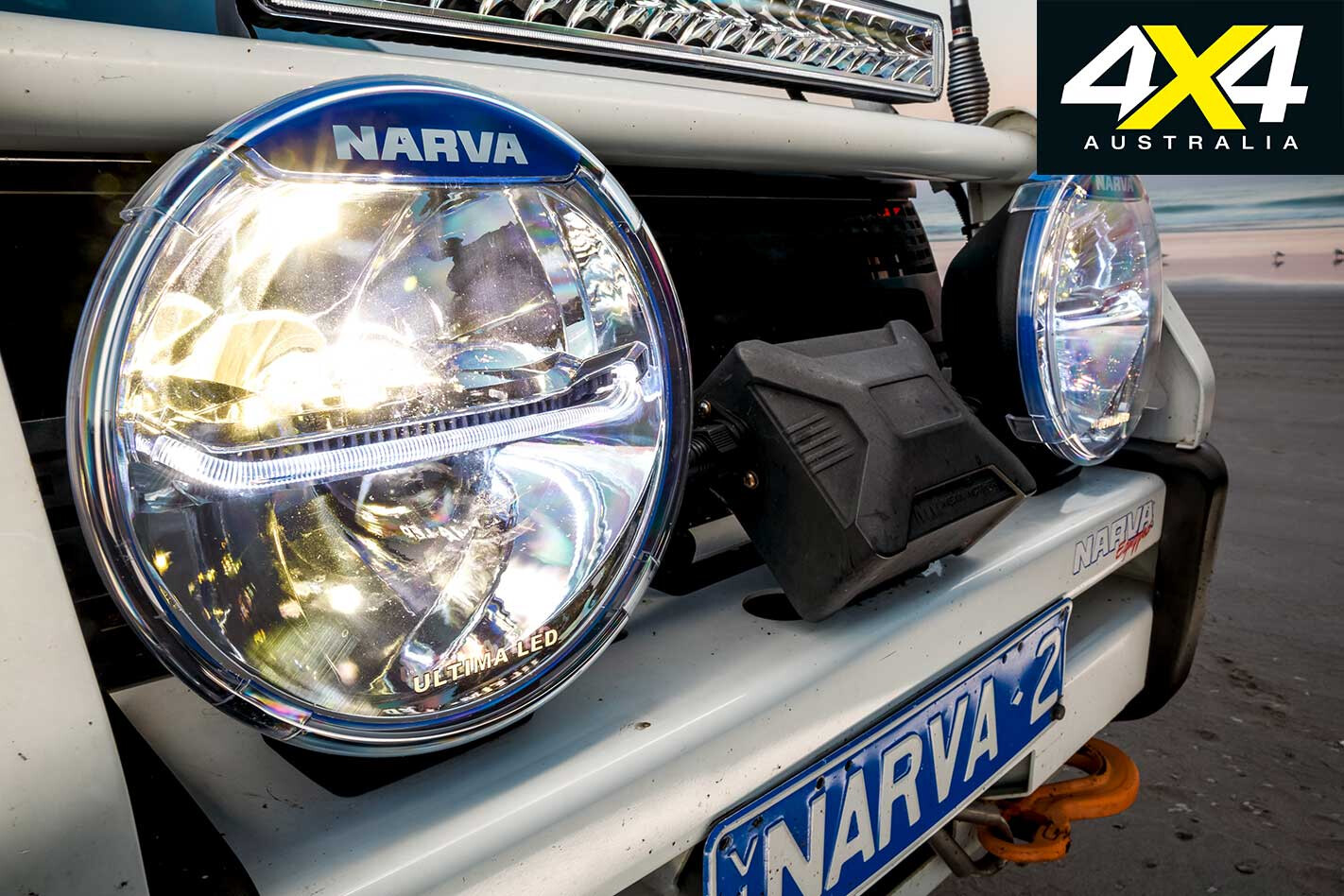
An internal heatsink (to suck heat away from the LEDs) is backed by reflector vents, to help eliminate condensation and lens fog; while an ‘Active Thermal Management System’ enables the lamp to run harder for longer.
Our vehicle was set-up with Ultima 225 broad-beam and pencil-beam pattern lights, which together throw a beam of 730 metres (at 1 Lux) down the road. You’ll get up to 800 metres with two pencil-beam lights. The smaller 175 lights fall a little short of these figures.
These lights were easy on the eye and extended far enough down the road to illuminate kangaroos and other wildlife before I got to them. The beam also throws a fair amount of light to the side of the road, but it’s not unnecessarily bright on the peripheral.
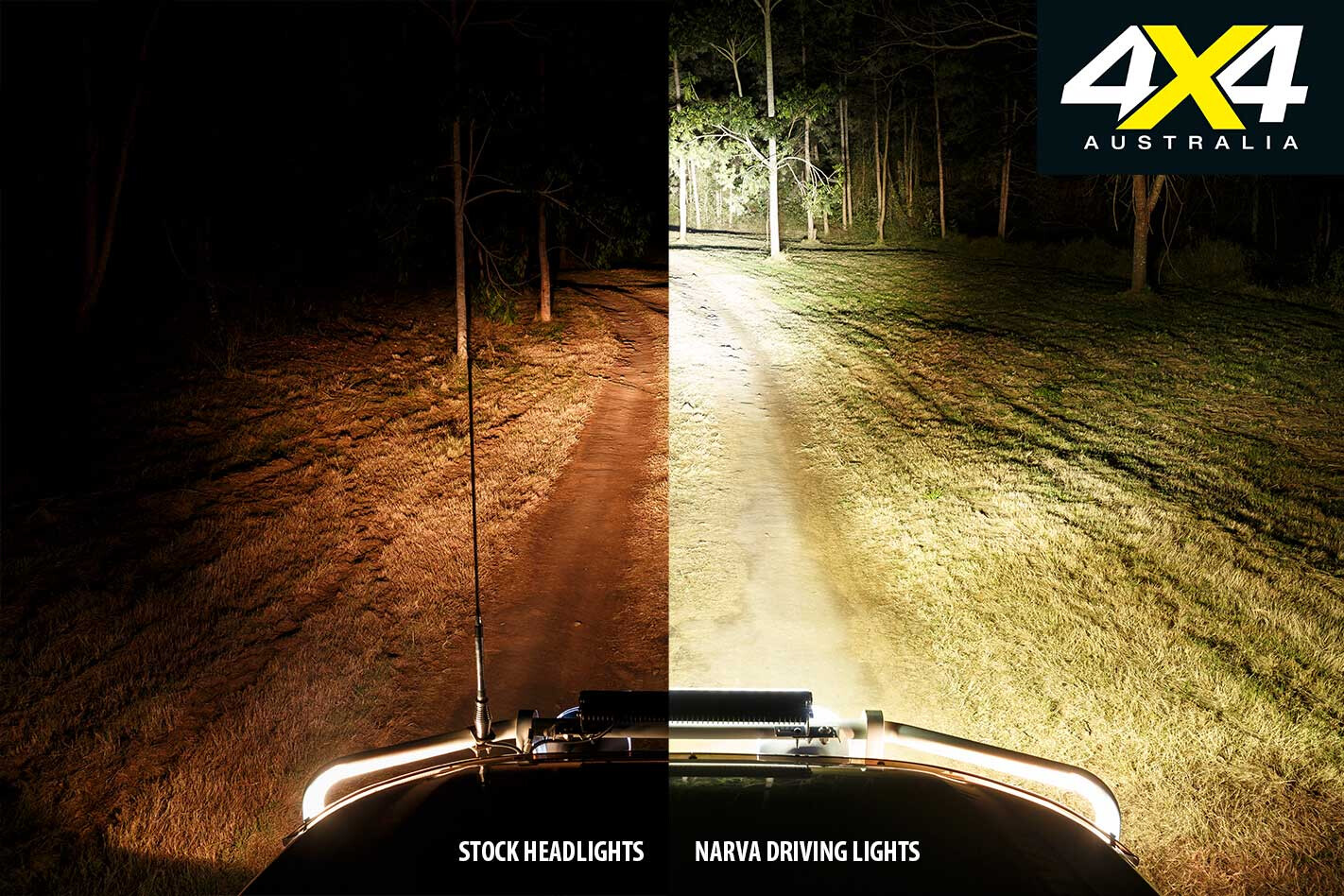
We also fitted a 22-inch double-row LED light bar which comes with 36 five-Watt Osram LEDs, making a total of 180 Watts with a colour temp of 5700°K. The housing is die-cast aluminium, the polycarbonate lens is virtually unbreakable, and the complete unit is fully sealed and waterproof to IP69K standard. It has stainless steel brackets, mounting hardware and a wiring harness.
This light bar sends light down the road for 460 metres (at 1 Lux); the smaller bars will do a slightly lesser job. The light was flexible and had a good, wide pattern that extended a reasonable distance.
To optimise performance, I’d go for two pencil beams (for distance) and the double-row 22-inch light bar (for maximum light up close and out wide). You’ll pay a little more for the two single-light kits, but it’ll be worth it. Still, the combo kits offer impressive lighting and are very well priced.
RATED Available from: www.narva.com.au
ULTIMA DRIVING LIGHTS 225 RRP: $899 WE SAY: Good looking, high performing, great value lights.
EXPLORA LIGHT BARS RRP: 14-inch single-row $149; 22-inch single-row $299; 22-inch double-row $399 WE SAY: Very flexible light with a good wide pattern.
CRI
The Colour Rendering Index can best be explained by how different colours appear and how close they are to what they look like under natural light, which is rated at 100. Most normal, white LEDs on the market fall around the 70 mark on the CRI.
RATED Available from: www.powertec.com.au www.arb.com.au/stores/arb-broken-hill/ RRP: Around $1000 WE SAY: Great to improve your phone usage in the bush.
THE 2018 DEWALT SXS Australian Championship wrapped up over the weekend, with Simon Evans maintaining top position to claim the crown.
Evans led the six-stage championship going into the final round and, despite losing a rear wheel from his #360 Polaris RZR Turbo in the final round’s semi-final – forcing him to watch the grand final from the sidelines – scraped home to win the Championship in a tight tussle against Queensland’s Brett Comiskey.
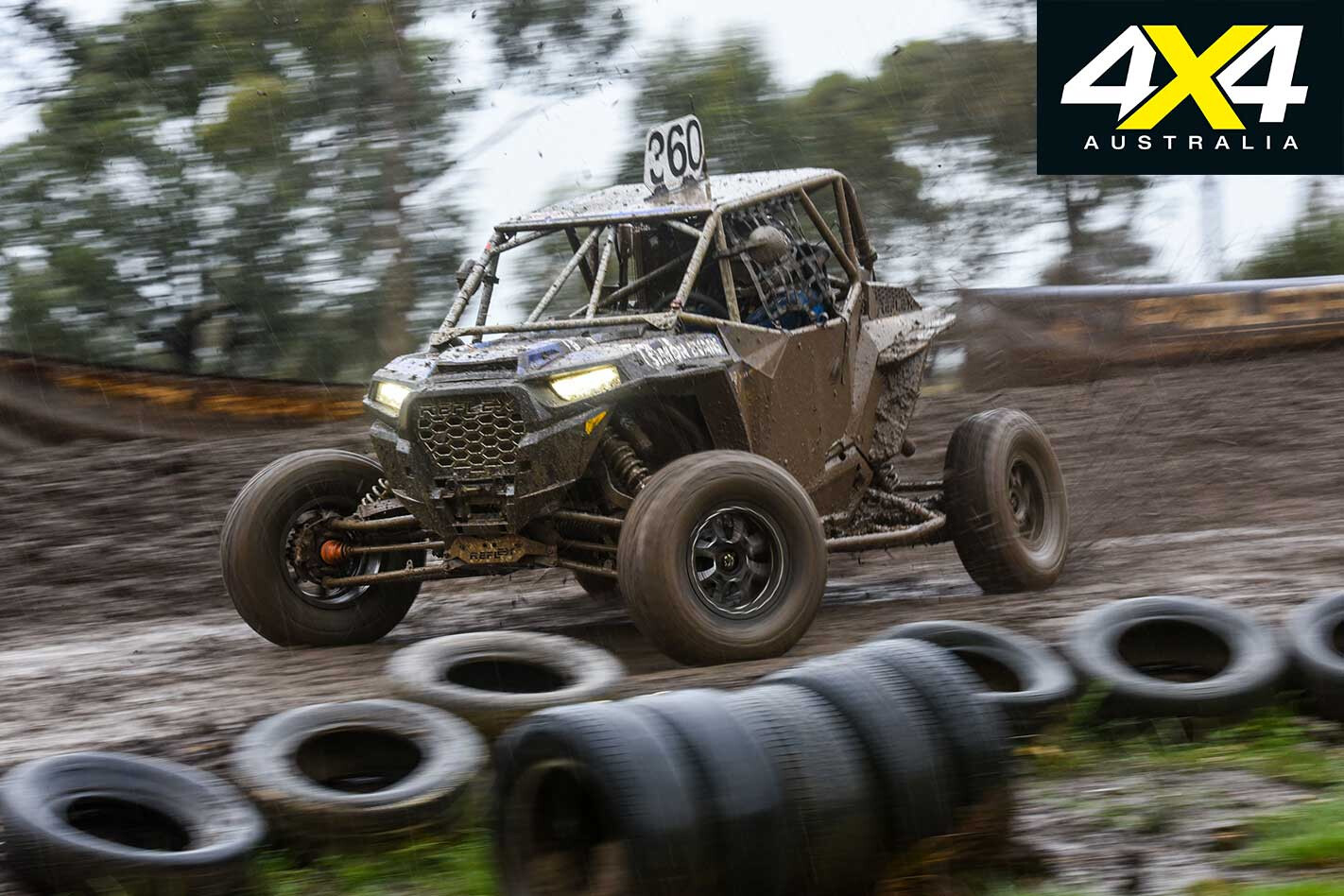
Comiskey came hard in the final stage in #51 CanAm Maverick X, but fell short to finish second outright by just two points. Stephen Henry snapped up the final position on the podium, trailing Comiskey by a slim four points overall.
The sixth and final round of the Championship was held at Broadford State Motorcycle Sports Complex, with 2017 champ Ewan McClue steering his #657 CanAm Maverick X3 to the round victory, his second outright win for the season.
Toby Price, behind the wheel of his #87 CanAm Maverick X3, finished second overall, while Cody Crocker piloted his #619 Polaris RZR Turbo to third spot.
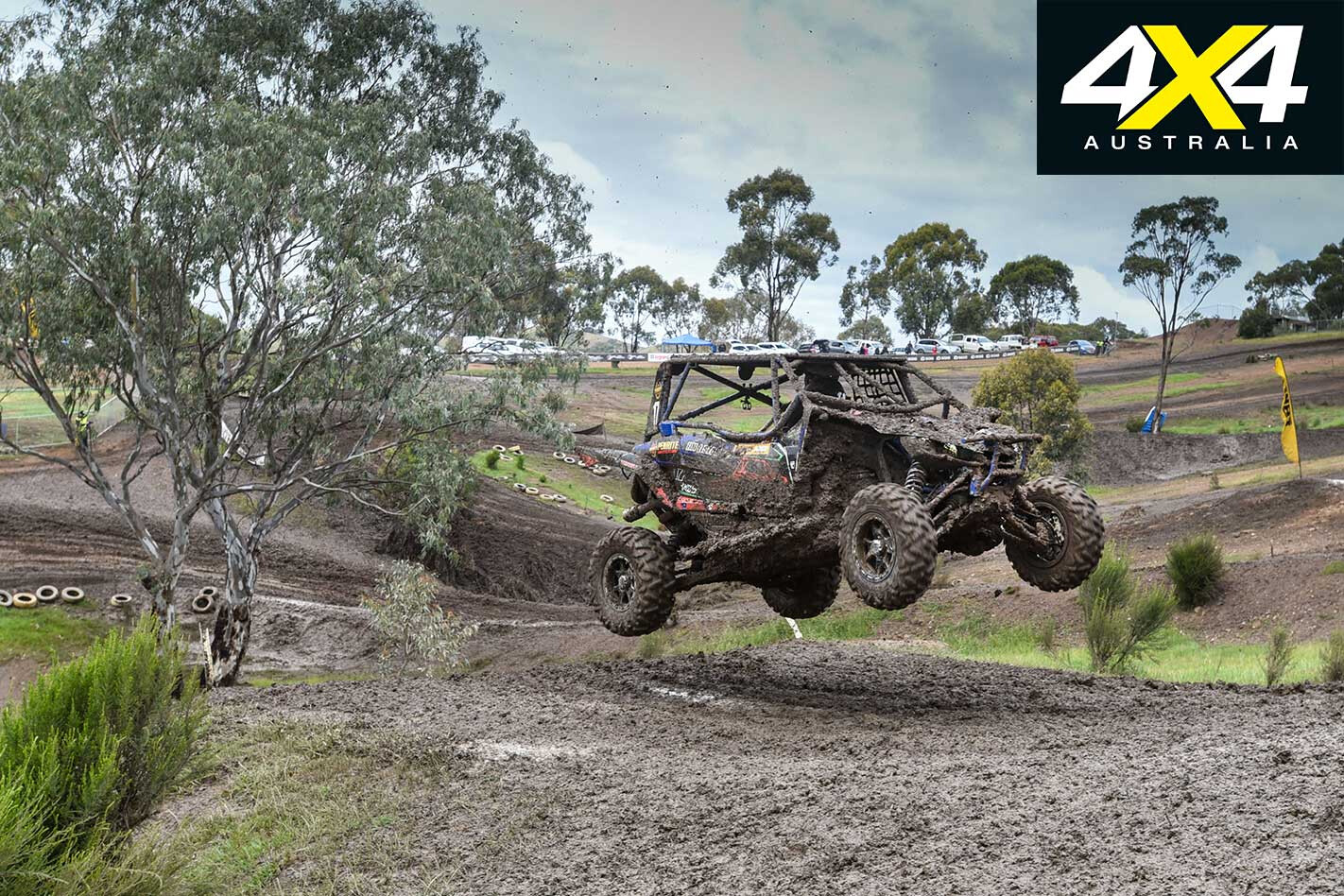
Tim Liston claimed top honours for the final round in the SXS Sport category, and was followed across the line by Shannon Leach and then Mitch Keyte. Keyte – in his #42 Southern Spreaders Racing Polaris RZR – did enough, however, to with the 2018 SXS Sport Class Championship ahead of Tom Evans (second) and Tom Liston (third).
To catch more action, a six-part TV series begins on November 4 on Channel 9. For dates and more info, visit: sxs-racing.com
THE TERM snowball is something that gets thrown around a lot when talking cars. Wanted to fit a set of speakers and ended up installing a new head deck as well? That’s snowballing. A cheeky headlight upgrade that ends up with a set of LED lights strapped to the roof? You bet that’s a snowball.
However, while a snowball is relatively small, the implication of the saying is something that builds from nothing and gradually picks up pace, growing larger and larger until it’s out of control. It’s this version of a snowball that best defines Justin Suffolk’s lifelong passion with cars, and, by extension, the mish-mash of high-octane performance car and uber-capable 4×4 laid out before you.
Like most off-roaders, Justin found himself behind the tiller of a dual-cab ute after searching for a suitable tow vehicle.
“I had a VH Commodore,” he said with a laugh. “It was getting too much for street driving and I wanted something that could tow it around. I bought a Hilux, sold the Commodore, and used all the money to buy 4WD parts.”
Like any good snowballed project it didn’t take long for Justin to slice and dice the 2013 Hilux into something barely recognisable to the manufacturer and something vastly different to what his insurance papers say.
To get to the heart of what makes this Hilux special, we’ll need to kick things off up front. That PSICO intercooler is part of a package that sees the 3.0-litre common rail turbo-diesel pushing 179kW to the rear wheels – a huge jump over the factory 89kW – giving Justin a hefty increase in power. To achieve those results, the PSICO intercooler draws fresh air through a four-inch Phat Bars stainless steel snorkel, before compressing it with an S3 GTurbo.
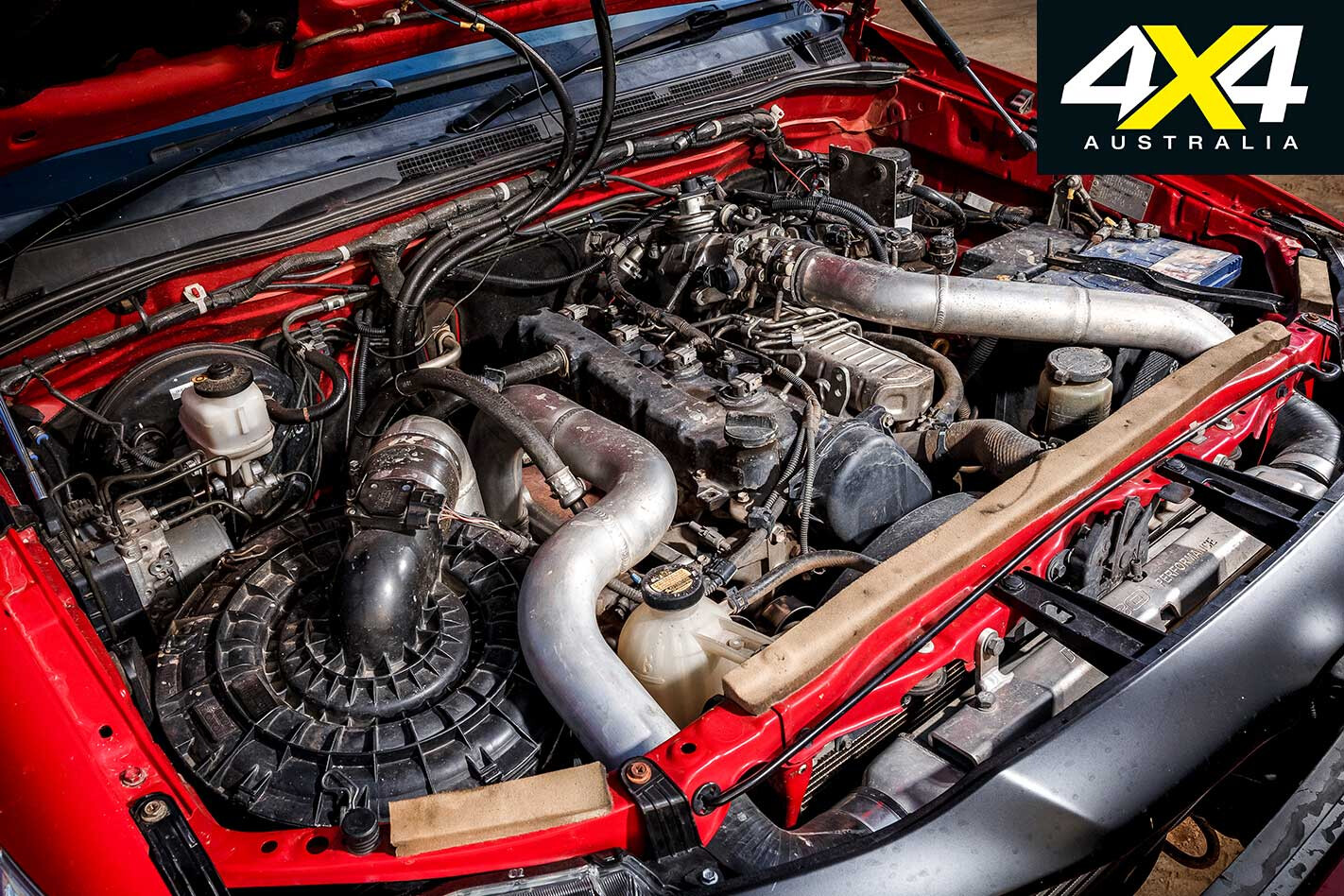
From here the factory ECU teams up with an HKS controller to fine-tune the oil burner’s parameters. Just Autos have mapped the stock ECU with an aggressive tune, and then used the HKS controller to fine-tune it to perfection.
Upgraded injector caps have given the setup an increase in fuel volume without ramping up pressure or duration to dangerous levels, and a three-inch turbo-back exhaust barks spent exhaust gases rearwards.
To get the power to the ground, Justin rolled out the spanners and installed a heavy-duty MV Automatics torque convertor and valve body to tighten up the standard transmission.
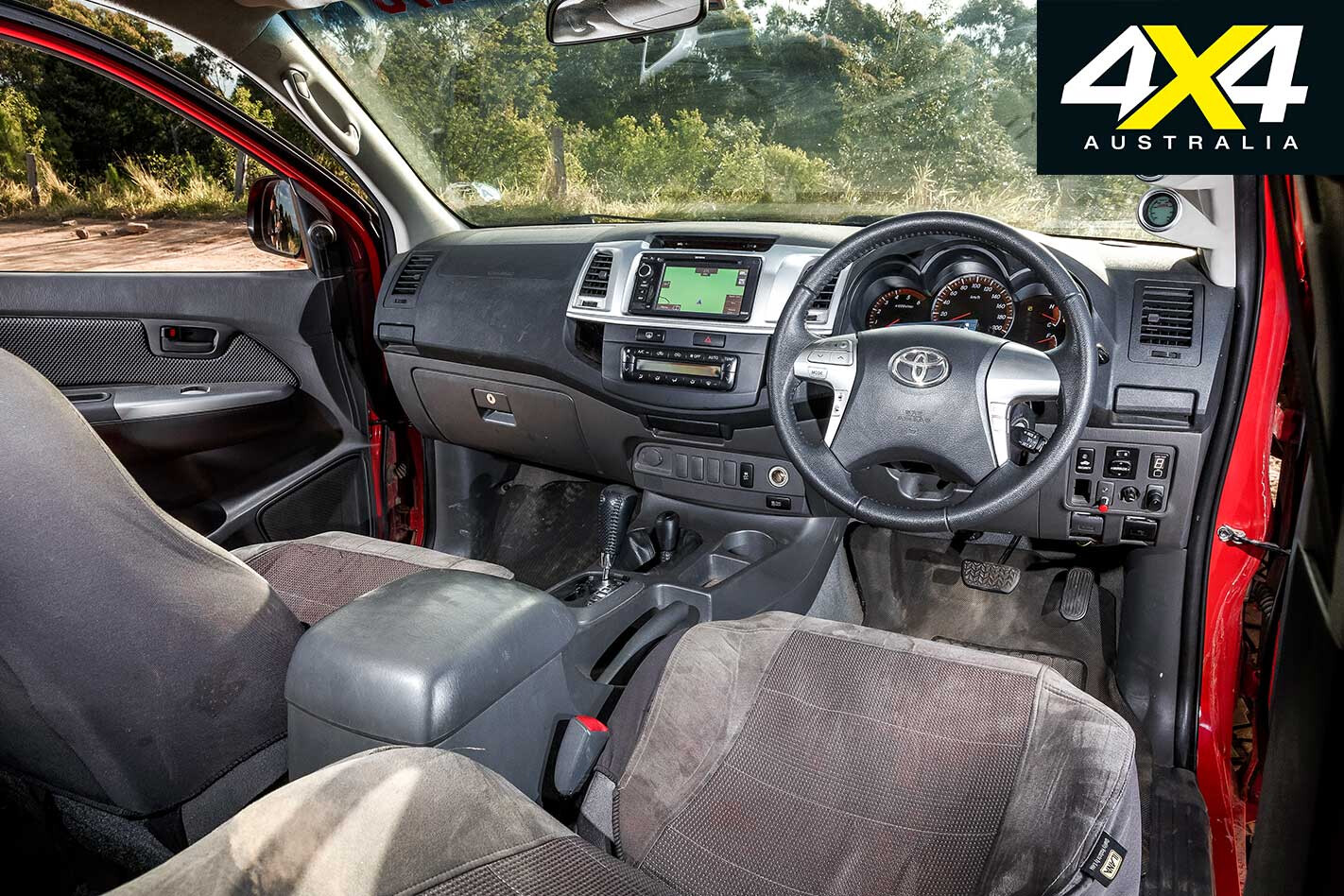
Two external oil coolers stop the red rocket from getting too hot under the collar, 4.56 gears at either end account for the larger rolling stock, while twin auto lockers (a Detroit in the rear and LOKKA up front) ensure traction is never an issue… as long as Justin doesn’t mash the loud pedal.
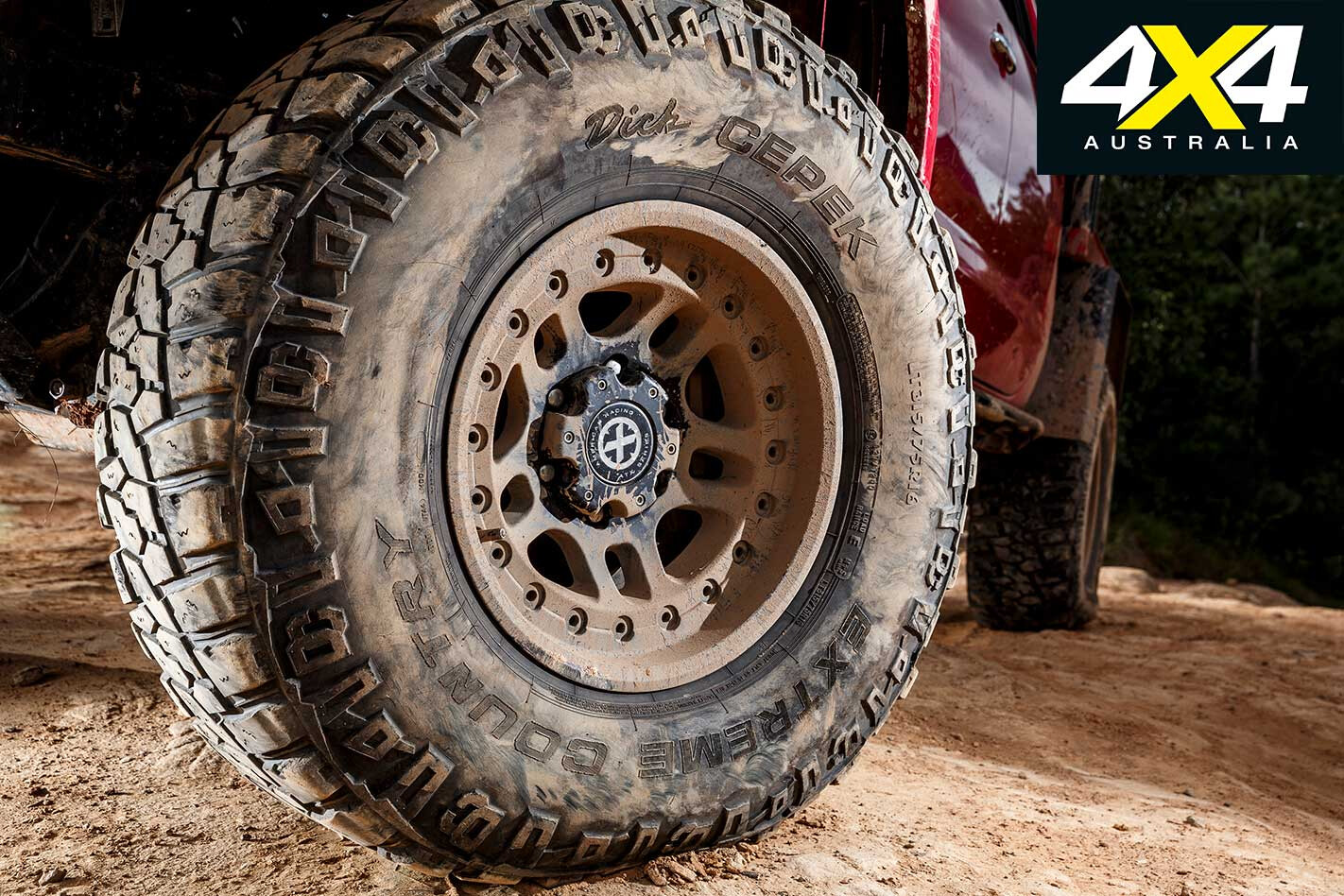
Any chain is only as strong as its weakest link, and there are no rusty connections from the tip of the snorkel right down to the tread blocks. On each corner is a chunky Dick Cepek Extreme Country, which punch in at a metric 315/75 R16 (that’s a hair under a 35-inch tyre). They’re wrapped around a set of 16×8-inch American Racing ‘Cornice’ wheels.
Huge flares try their hardest to keep the poke under cover, stopping Justin becoming closely acquainted with the local constabulary.
Before you go racing down to your local tyre shop with credit card in hand, it’s important to know it takes a hell of a lot of work to shoehorn 35s beneath a Hilux – even more if you want them to work off-road.
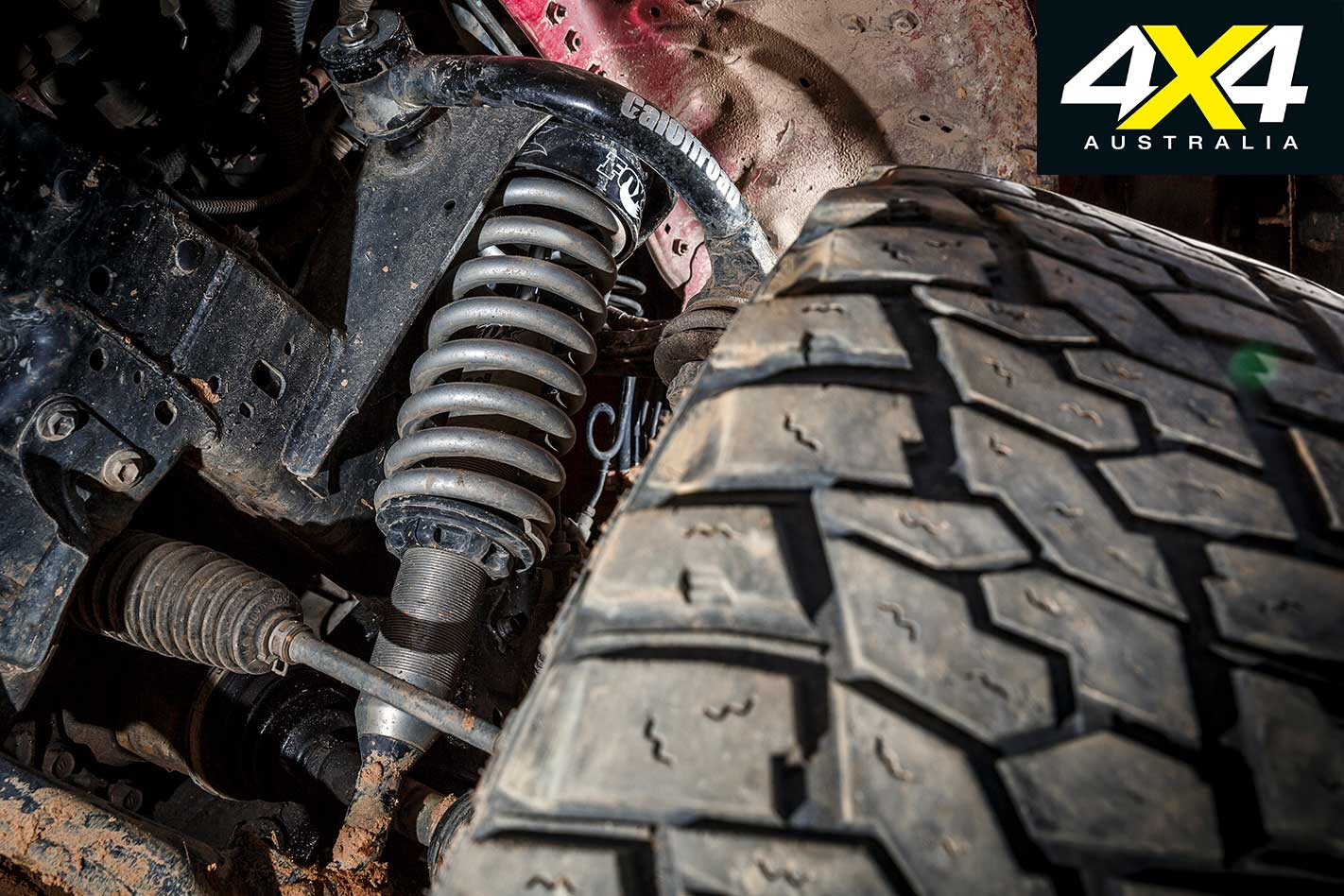
Up front, Justin again reached out to the crew at Phat Bars, who replaced the old, sagged factory struts with a set of oh-so-shiny Fox 2.0 units. They’ve been fitted with 700lb Eibach coils on both sides, helping boost the Lux’s ride height 50mm over stock – a further 50mm in body lift helps give the Lux its aggressive stance.
To stop the CV joints tearing themselves to shreds at the first sign of a wombat hole, a diff drop was fitted to flatten out the CV angle, getting them back inside their safe operating angles. The upper control arms have also been swapped out for adjustable units from CalOffroad. The adjustable ball-joint offers a strength upgrade from the stock unit, allows the alignment to be dialled in, and frees up much needed down travel.
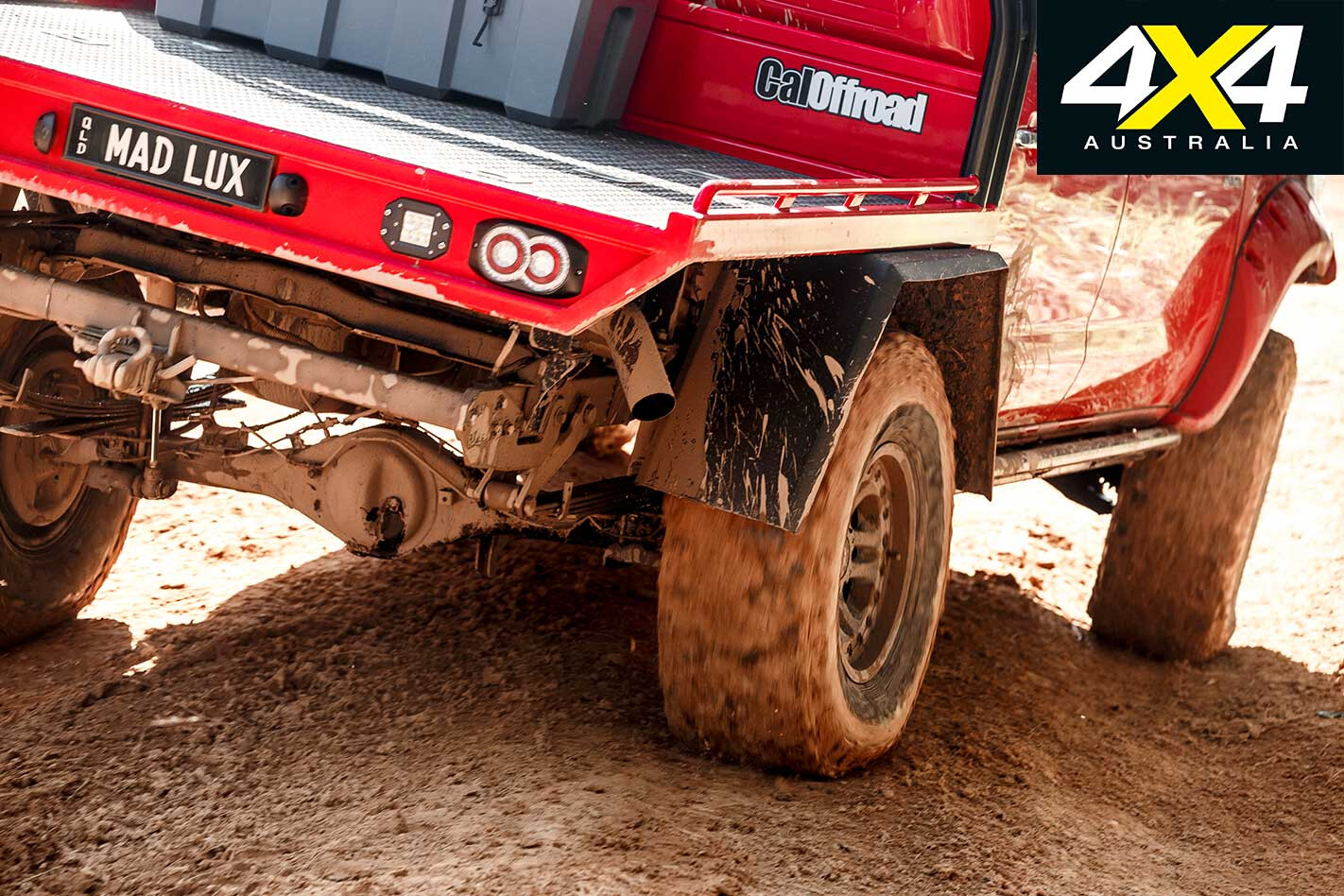
Things are more customised in the rear. Rather than a bolt-in lift kit, Justin opted for a set of stock leaf springs from an RG Colorado, which have been reset to allow for additional lift over stock height; however, their longer length gives the perfect shackle angle for ride and comfort when paired with 200mm extended shackles. The whole lot is kept under control with another pair of Fox 2.0 shocks.
With the underpinnings of Justin’s Hilux resembling a teeth-gnashing animal, it was only fitting the outside had the attitude to match. A wolf in wolf’s clothing. A stout ‘Muzzbar’ from South East Qld Fabrication is backed up with 5mm of reinforced-steel bash plates from Phat Bars. They’ve up-armoured the driveline from the radiator right back past the sump and transmission, before finishing up just after the transfer case.
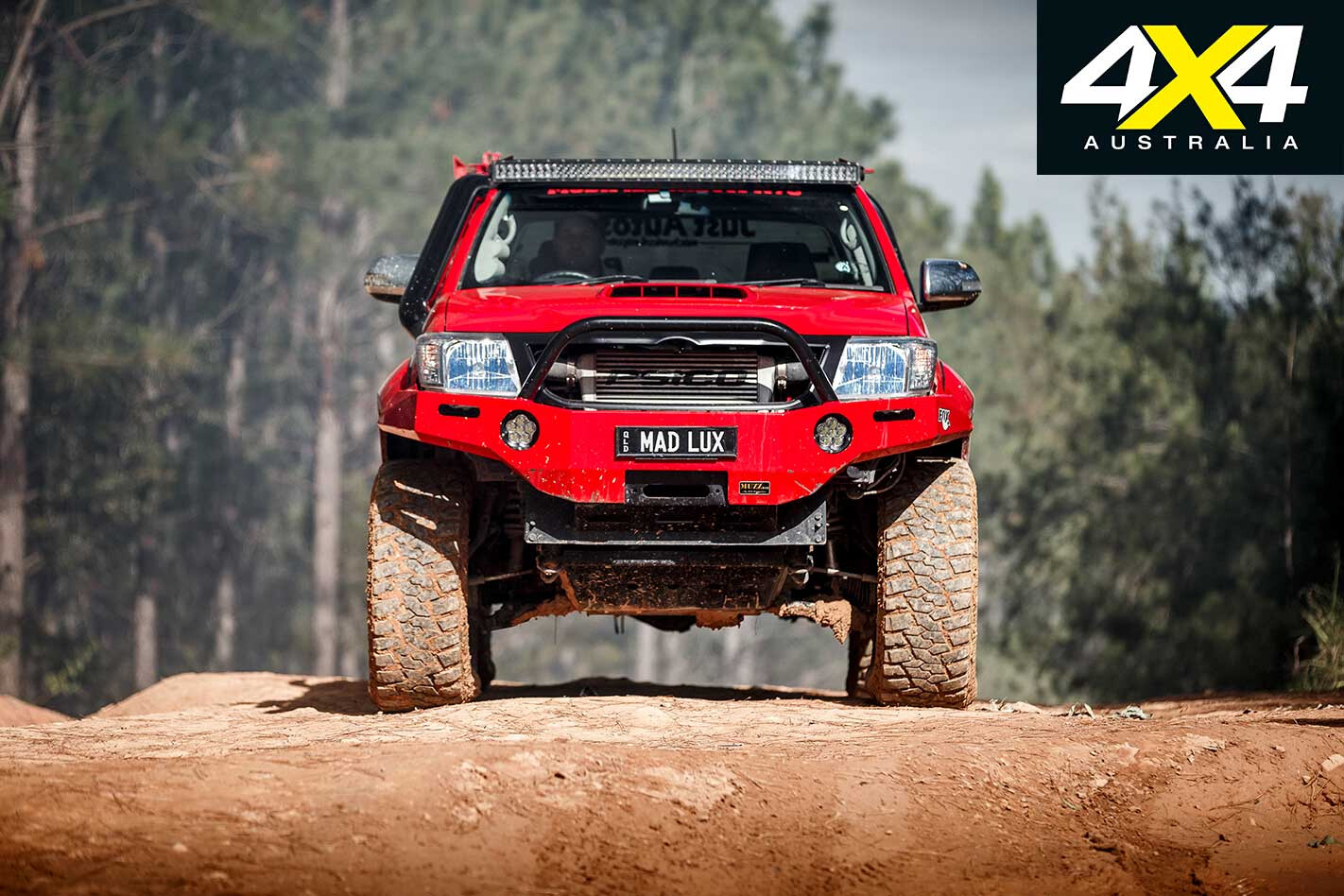
The flanks have been similarly armoured-up, with a pair of high-clearance Phat Bars rock sliders deflecting any rocks Justin pushes perilously close to the Lux’s sheetmetal; although, with the LED lights pumping out more lumens than the sun, Justin will have plenty of warning.
That form-and-function mentality has been applied all the way to the tail-lights. Justin placed a special order with Paul Hanlen from Phat Bars for a one-off tray, which has been zapped together with a 4mm-thick box section running along either flank, effectively giving Justin a full-length slider that’ll take the full weight of the Lux.
On hardcore weekenders you’ll find the tray loaded with a swag and fridge, while family adventures call for the camper to be hitched to the tow bar. Who said snowballed projects can’t be fun for the whole family?
Counting Teeth
YOU’VE probably heard the term ‘diff ratios’ and wondered just what the hell those numbers mean. Luckily, it’s incredibly simple, and 30 seconds reading will teach you what you need to know.
The higher the number, the lower the gearing. A 4.56 ratio requires 4.56 turns of the driveshaft to turn the axle one rotation. A 3.9 gear, while being numerically lower, only requires the driveshaft to spin 3.9 times for every one axle rotation, making the engine rev higher and work harder.
Going to a lower gear (numerically higher) gives the engine an extra-long lever to account for larger tyres, helping crawl back some much needed torque.
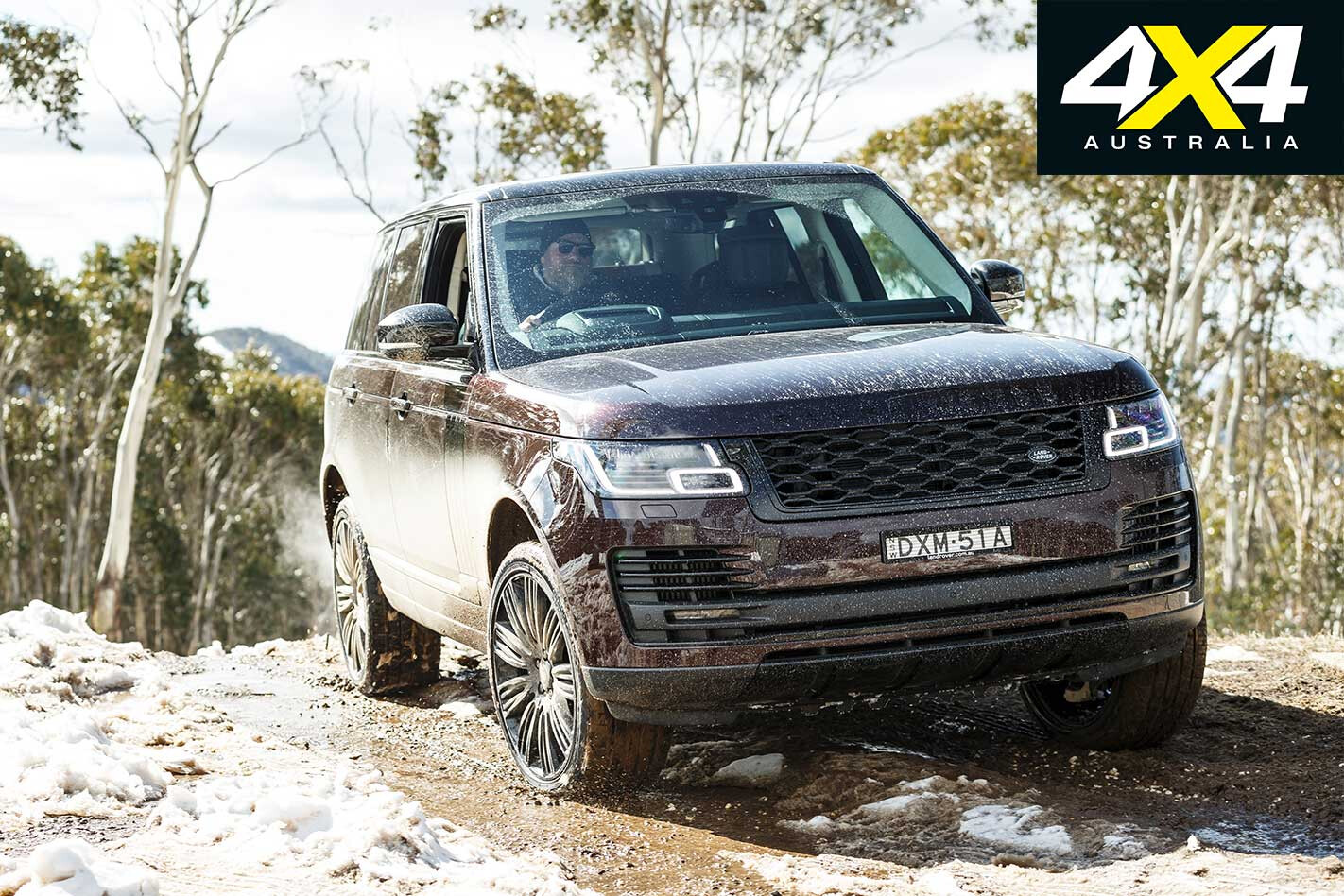
IT HAD been a few years since I’d driven a new Range Rover and the week spent in the SDV8 Autobiography tested in this issue was a welcome time. It’s easy to write off these iconic 4x4s as nothing more than lashings of luxury and oodles of electronics, but the flash Rangie still went pretty well on gravel and snow-covered roads.
It was also interesting to consider that the Rangie is nearly 50 years old.
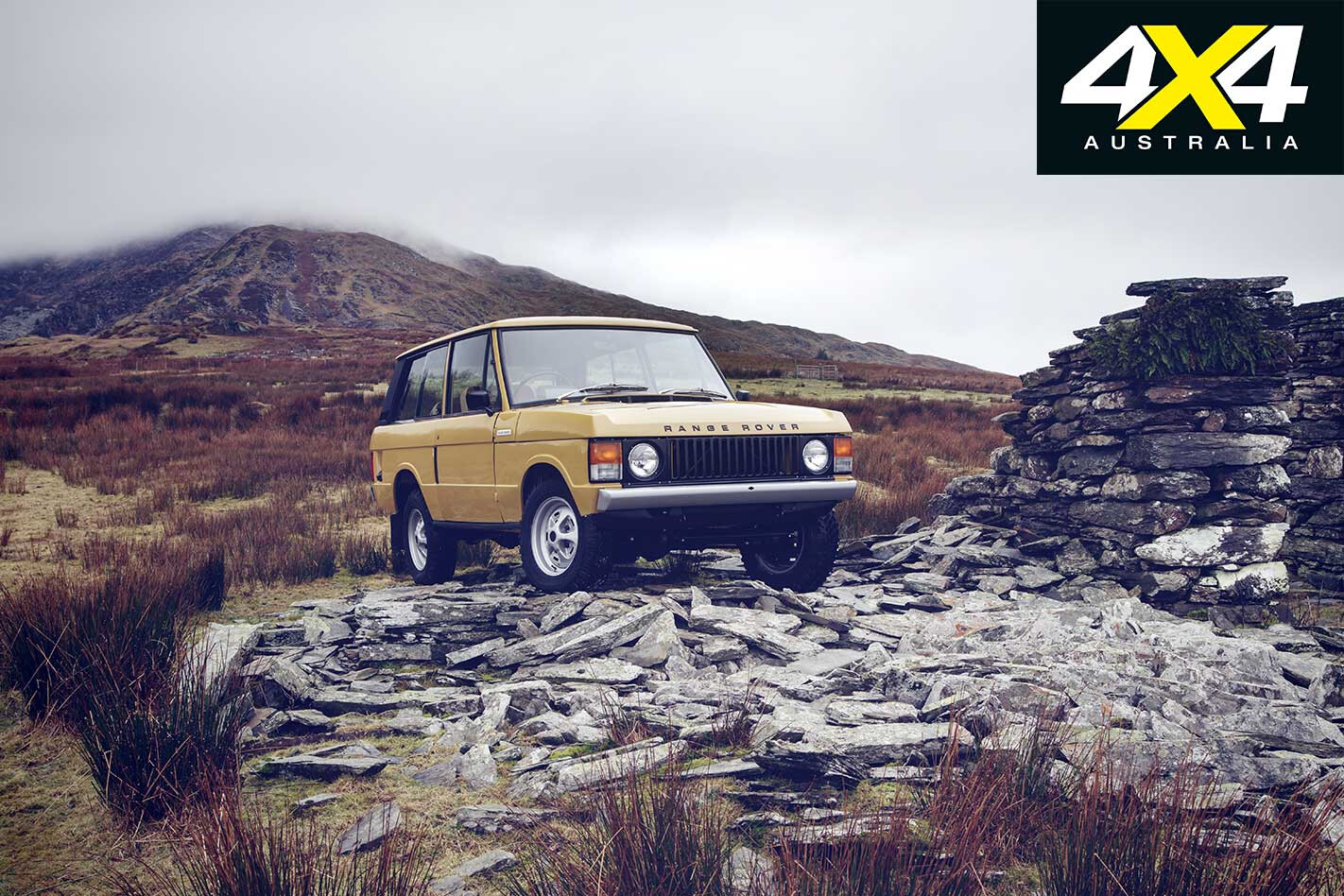
Back in 1995, to mark the Rangie’s 25th anniversary, I got to drive an original 1970 model. I was excited about driving the old two door Range Rover, the car that conceived the idea of a luxury 4×4 that rode on coil springs instead of the leafs that every other truck was running.
The car itself was a very tidy, unrestored example and the 3.5L carburetted V8 engine rumbled into life at the first twist of the ignition. The huge flat windscreen and narrow A-pillars gave a grand view of all around me and I admit that it did feel very regal, despite its age.
The drive was equally as commanding and it motored down the Sydney freeway with grace. About the only thing I could fault was the old four-speed gearbox, which was a bit notchy in its operation and lacking an overdrive that would have made highway cruising so much more pleasant.
Later that day the 1970 Rangie and I met up with a then new P38A Range Rover and the experience of driving that wasn’t anywhere near as special. The cabin was cramped and felt as if it has been stuffed with luxury features that it wasn’t designed for. The then fuel injected and larger capacity V8 engine also felt asthmatic when called on to overtake in comparison with the original.
I was pretty impressed with that Classic Range Rover and decided then that I’d own one, one day. That day hasn’t come yet and now the prices of those early trucks, ones still in good and unmolested condition, are going up and well out of my budget. A lot like the new Rangie actually, just on a far grander scale.
WE CAN all dream – and dream big. But, making that oversized dream a reality ain’t always easy. Thankfully, for the thousands of off-roaders around Oz, Kalen Ziflian and the team behind Club 4X4 Insurance have made their particular dream – offering comprehensive vehicle insurance for off-roaders – very real.
With a bunch of keen 4×4 enthusiasts who live and breathe the 4×4 lifestyle and, most importantly, understand what that means in terms of vehicles and their owners, Club 4×4 has managed to differentiate itself from the myriad vehicle insurance companies tending their wares. It’s unsurprising, then, that the idea grew from a few yarns around a campfire.
Local knowledge
“THE IDEA had been floating around in one of the shareholders’ head for some time, but it kicked off officially in October 2015, so just on three years ago,” says Kalen.
“The idea behind it was that, looking at the insurance landscape, there was pretty much coverage for most different motoring enthusiasts – whether it was performance, classic cars, age groups – but there was no-one that did a direct to market offering for 4WD enthusiasts.”
Selling a product you know intimately from a consumer viewpoint is a real boon for Club 4×4 and also for clients; it means there’s an understanding on both sides of the fence when it comes to the variables associated with what you are, or are not, covered for, you get a bit of leeway from those who know the scene. Kalen refers to it as ‘reasonability’.
“Most insurers who see something that is illegal will shut you down pretty quick, whether it be that they see it when they take the policy on or, more devastatingly, when it is at the point of claim,” he says.
“We take a position of reasonability on this because we understand the disparity in laws from state to state. So if you have the vehicle on 35s and a lift, yes, you are obviously way over in terms of what your total increased height is allowed to be. But if you, say, side swipe a pole in a carpark, you’re not going to have an issue because that (modification) couldn’t have contributed to that incident. If you roll the same vehicle however, the increased centre of gravity would have certainly been a contributing factor in that incident – that’s where you will have issues with lodging that claim.”
That reasonability stems from Club 4×4’s knowledge of the difficulty of dealing with different state regulations and rules around what is legal/what is not in regards to vehicle mods – something Kalen has intimate knowledge of, thanks to being on the board of the 4WD Council.
Community benefits
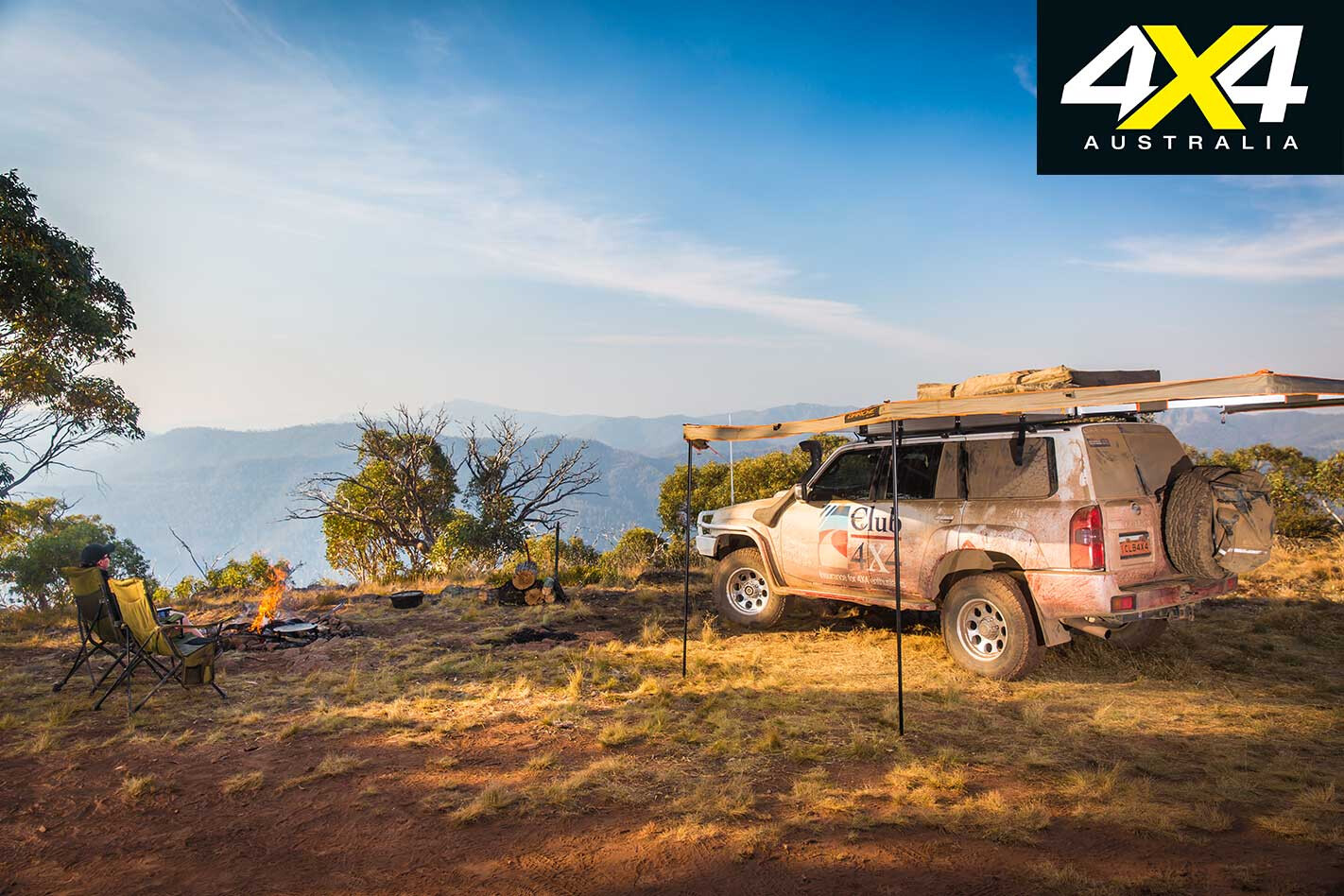
WITH A name such as Club 4×4 it’s not hard to see what Kalen and the team’s ethos is; being involved in the four-wheel drive scene – all the way from the grassroots up – is what has attributed to the company’s success.
Impressively, this also means there’s no holier-than-thou attitude from Club 4×4 when it comes to educating and interacting with its clients; they are happy to get down in the dirt with their clients, regardless of the questions, with Kalen often spending after-hours time in the digital space, addressing any issues related to the company’s policies.
“A lot of the changes we’ve driven in the product have stemmed from market feedback that was often found on forums and social pages; it’s about listening and giving people the product they want,” he reckons.
“People are very passionate in this space and sometimes it means you are dealing with someone who is complaining about something and that can be a bit tough. But ultimately I have found that those complaints lead to feedback that then leads to the opportunity to do different things, so any interaction is good interaction.”
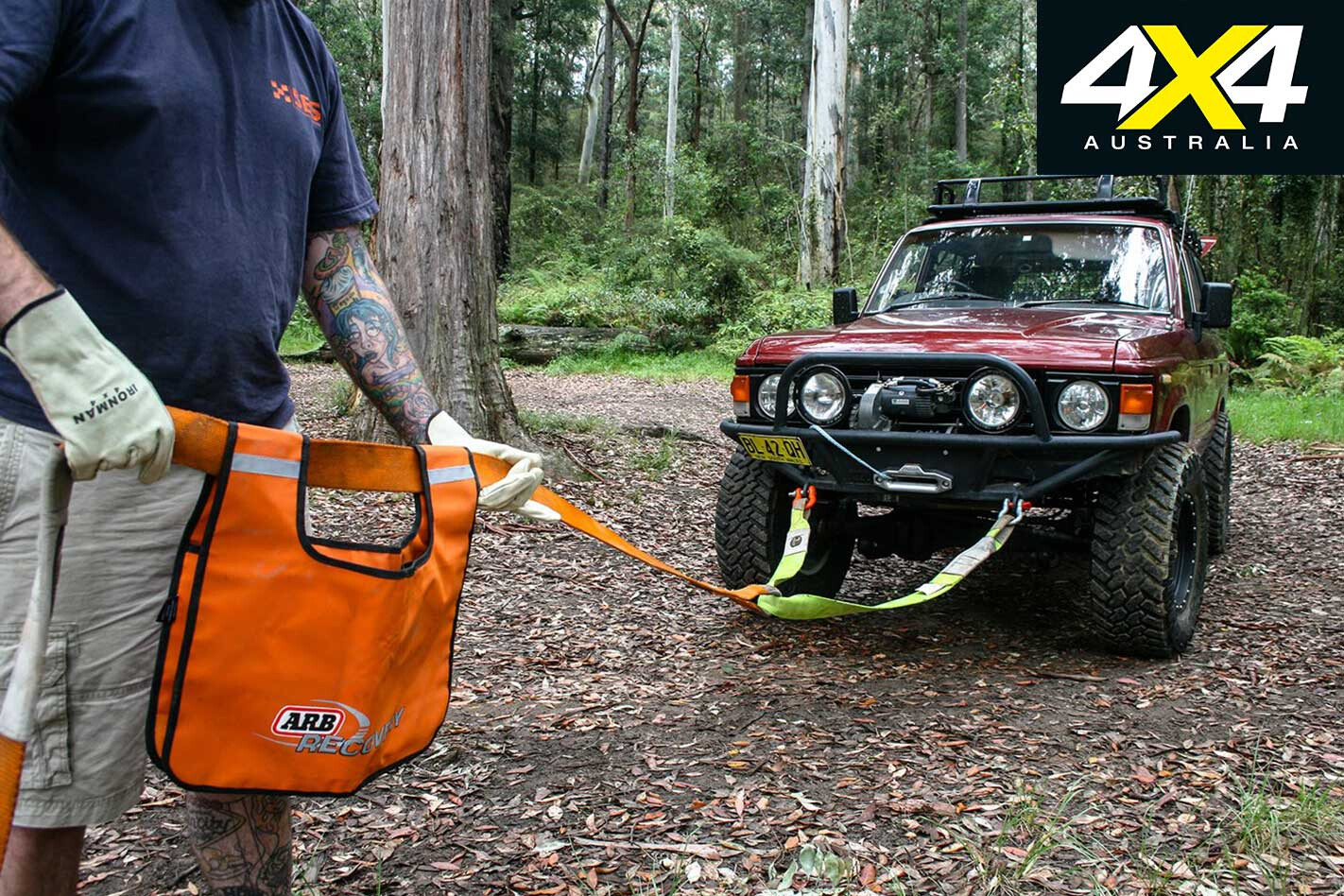
Being a part of the off-road clan brings with it extensive knowledge of how and where owners’ vehicles are used – and the same goes for camper-trailers and caravans. Kalen cites the fact Club 4×4’s tow-related insurance eliminates any reference to gazetted and non-gazetted roads – a big difference to mainstream insurers.
The community-fostering feel continues with Club 4×4’s downloadable guide to insuring a four-wheel drive. The aim is to avoid hiding behind ‘fine print’ and it also gives the company a chance to, again, educate current and potential customers as to what is really covered by their policy – with vehicle recovery the perfect example.
“The guide was something we put together specifically for that because people would say ‘Off-road recovery?’ My insurer will recover me if I have an accident,” Kalen says. “Well, that’s not what that product is about; it’s not about when you’ve had an accident, it’s about when you’re broken down or bogged, because every roadside assist policy in Australia has an off-road exclusion and a lot of people don’t know that.” Education is key.
Representative honours
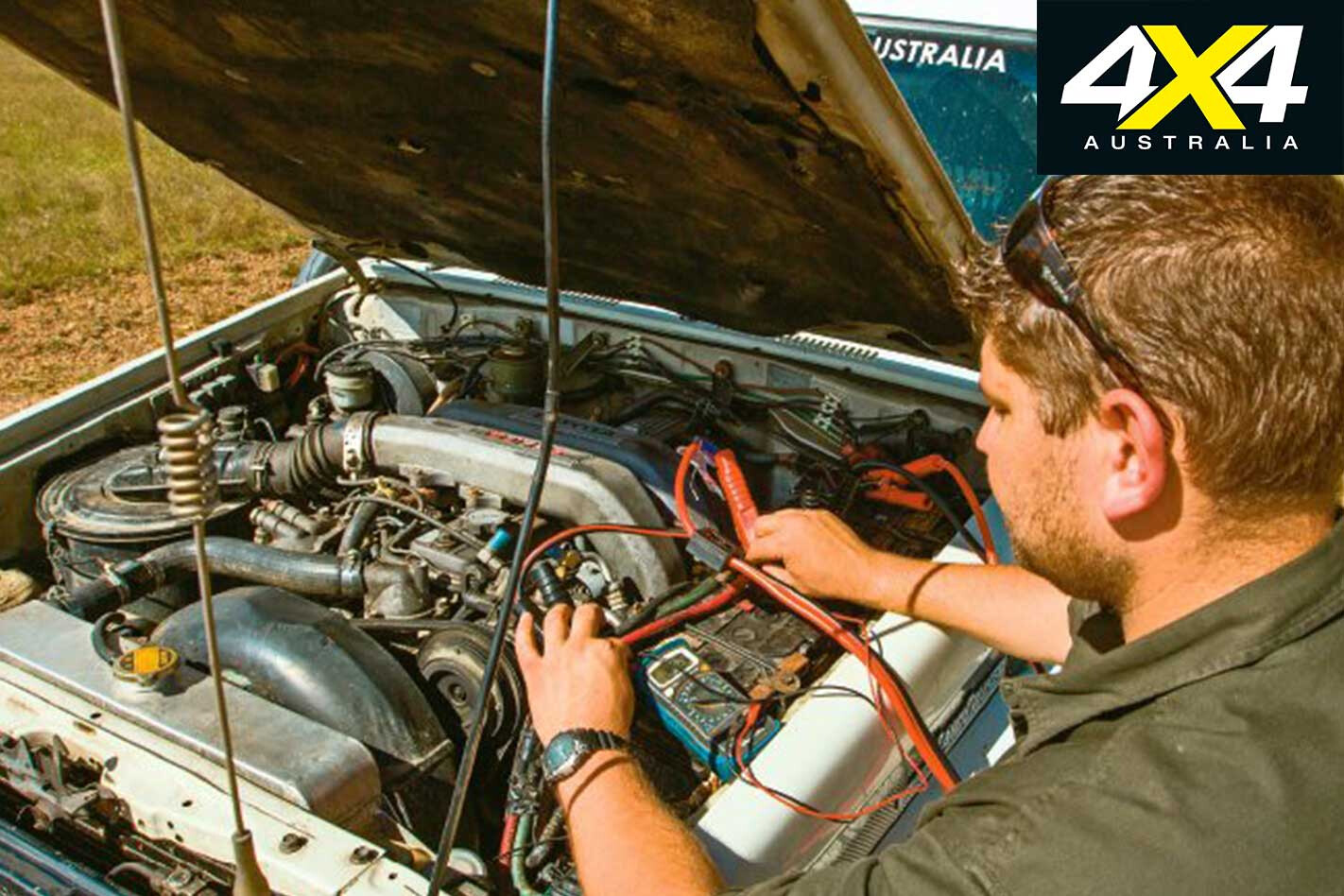
IT’S EASY to be cynical and see an ulterior motive behind how Club 4×4 interacts with – and educates – its customers. However, that would be to ignore the fact the team behind it are, themselves, ‘clients’. They are passionate four-wheel drivers, too.
This is evident in a different type of education for Kalen who volunteers on the 4WD Council, working in conjunction with the Australian Automotive Aftermarket Association (AAAA) to deal with state and federal government bodies who legislate vehicle regulations. It’s a difficult task, but when it directly affects you and your clients and the lifestyle you share, it’s worth the effort.
“I think they (governments) do listen, and we have had some great wins from a persistent and fact based approach,” he affirms. “My biggest gripe is that as a group of four-wheel drivers we need to be a little bit more understanding of how we are perceived. It is just so easy for people to assume that everyone that jumps behind the wheel of a lifted fourby is out doing doughnuts in off-road carparks or on campgrounds, because that’s what gets publicised. I think we need to clean up our act and find ways to publicise the positives.
“At the moment its way too easy to peg us as the five per cent who are out there doing the wrong things and it ends up with us losing access to certain places and being targeted on the road too. The majority of us are just tourists in our own country, contributing to incomes in country towns.”
The future is covered
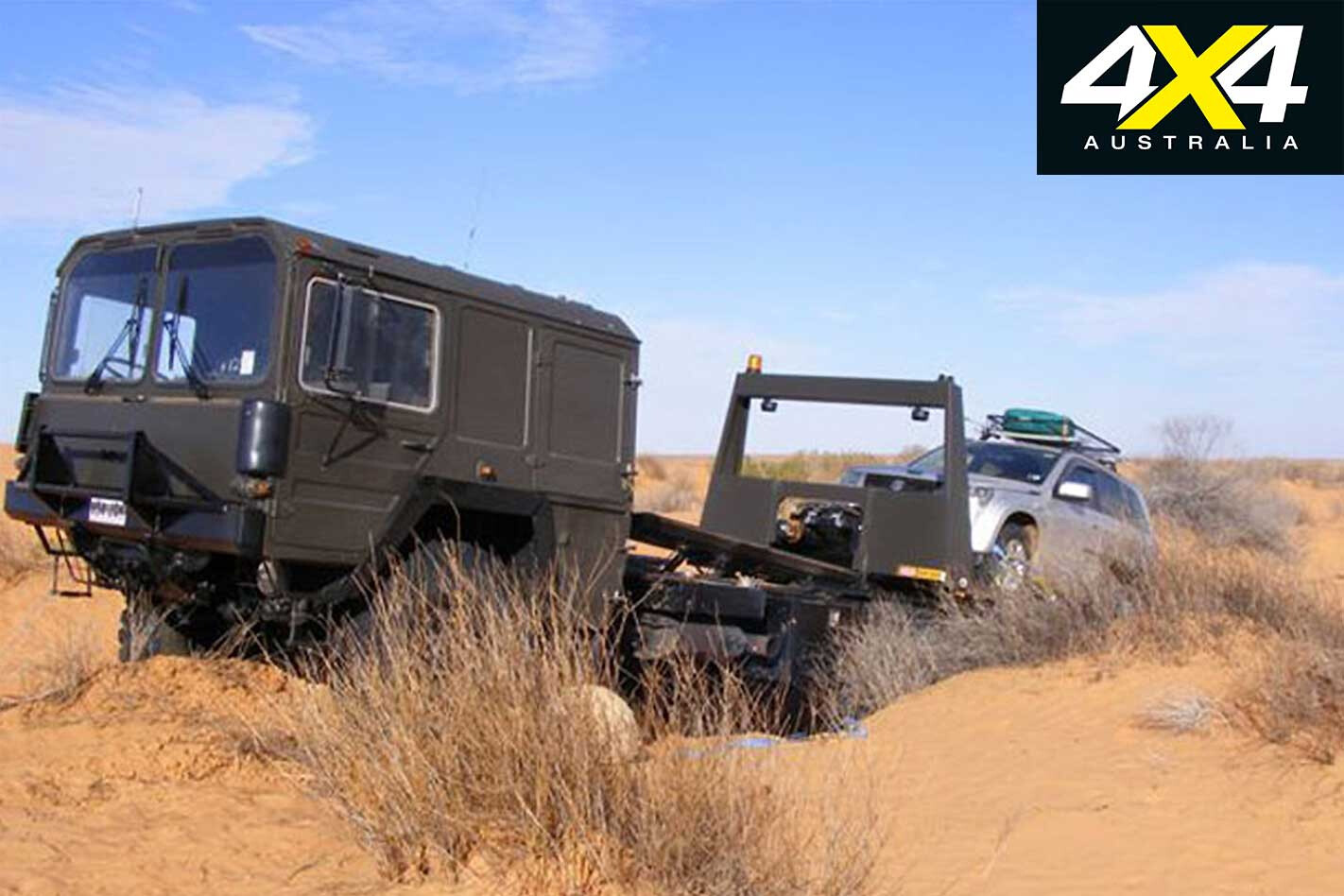
SINCE its inception, Club 4×4’s growth has far outstripped what the founders thought it would be three years on. This reflects the fact four-wheel drivers had been looking for not only this specialist insurance product, but dealing with a company that lives the same lifestyle. It’d probably be easy for ‘the Club’ to rest on its laurels. However, the company still has new ideas to implement in the next 12 months.
“We are really pleased with the way the product has been received and the community we are building ,” Kalen says. “And we are looking at ways to provide our members with products they might have with other insurers at the moment to try and have everything in one place.”
As Kalen laughingly said when we first started chatting: “No-one trusts an insurer, mate.” And he’s not far wrong – in general. But there are always exceptions and listening to how enthusiastic he is for not only Club 4×4 and its success, but also the behind-the-scenes work he (and others there) does to protect the off-roading lifestyle, this is probably one “insurance guy” you wouldn’t slam the door on.
MAREEBA, 60km east from Cairns, is situated between the wet tropic’s eastern coastal range and the Great Dividing Range to the west. The rich farming region is north of the Atherton Tablelands’ volcanic province and is the gateway to Cape York Peninsula and the northern Gulf country. The Mitchell River marks the historic border of the two regions.
The region has many attractions – a rainforest, waterfalls, historic towns, mining sites and bird watching – and is home to more than 430 species of birds, more than anywhere else in Australia. For many travellers heading to the Cape or ending a Gulf adventure, Mareeba is the place to pull up stumps for a few days. The local rodeo ground has free camping, which is pretty much packed out in the dry season; but other parks make up for this shortfall.
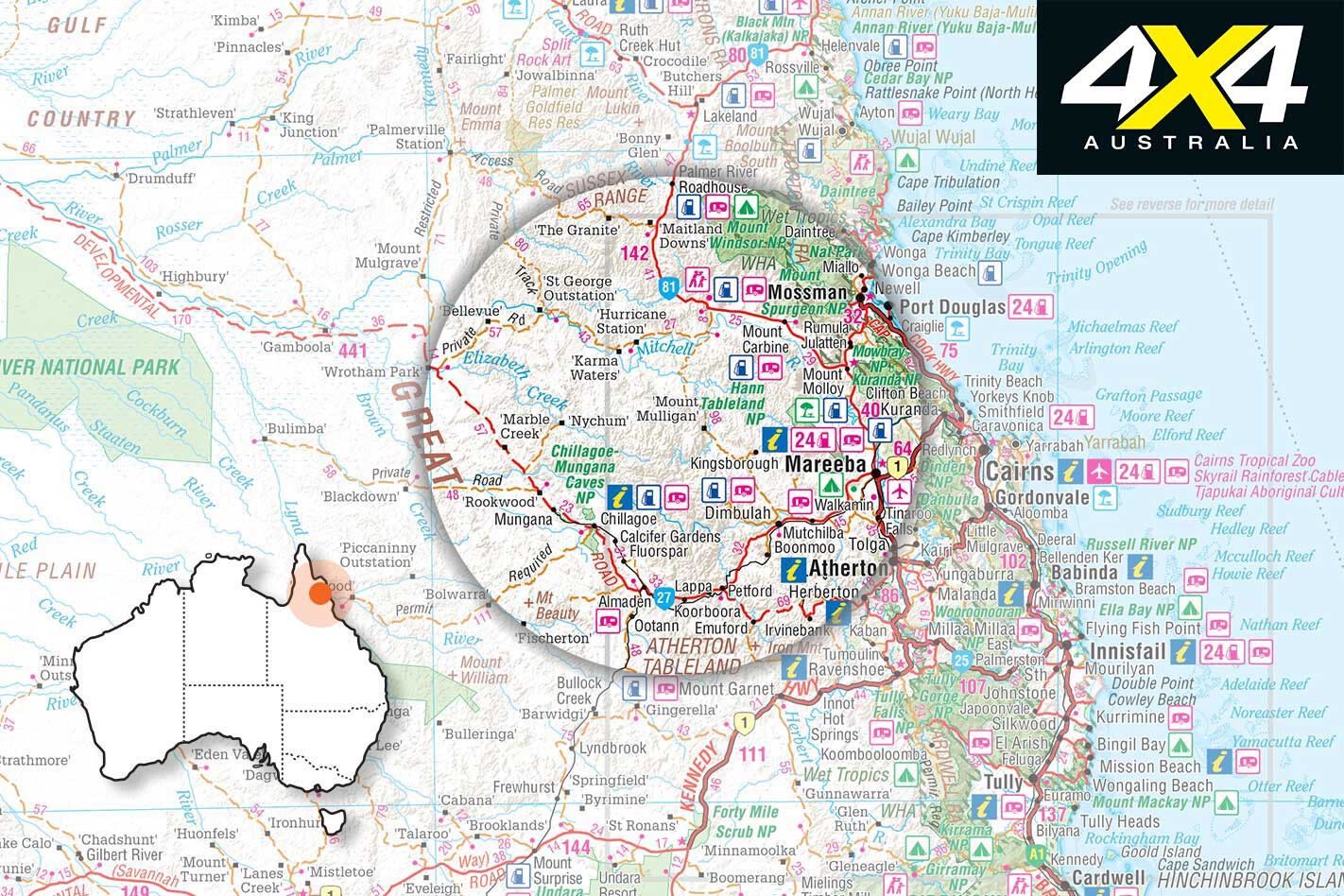
I’ve lived in Mareeba for 15 years and I’m still exploring much of what the region has to offer. My wife and I get out a fair bit on day tours, visiting historic places and natural attractions. Recently, we headed out to the indigenous-owned Kondoparinga Station, 129km north-west from Mareeba on the Wheelbarrow Way, via Dimbulah.
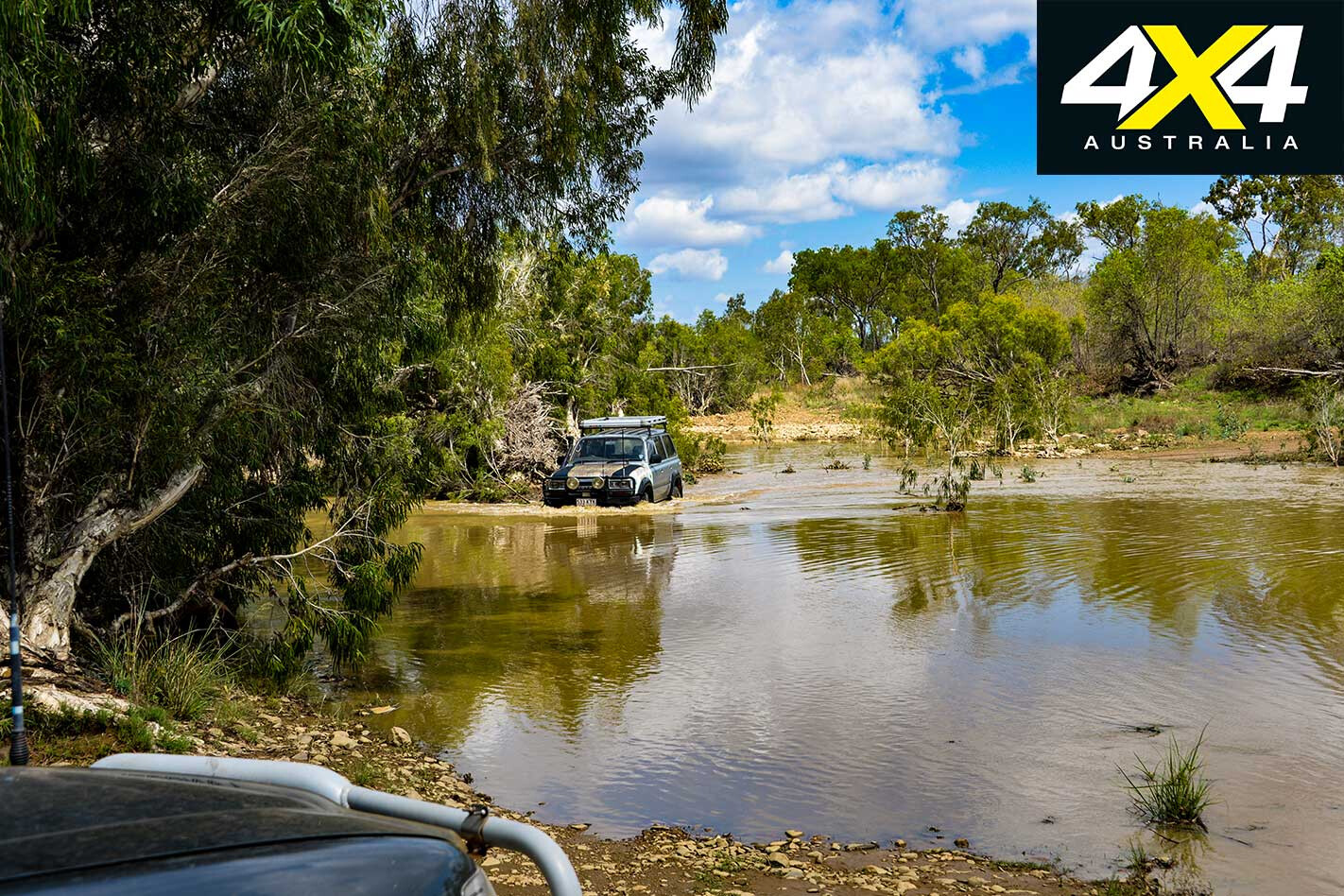
Our plan was to do a full circuit from the station to the Mulligan Highway and return via Mount Carbine, but an early start to the wet season had dumped near 100mm rain and the Old Cooktown Crossing on the Mitchell River was reported to be “touchy”.
The drive to Dimbulah traverses rich farming country, with cattle, mangoes, avocados, limes, vegetables, grapes, hay and more produced in these wide valleys of the Great Dividing Range. Increasingly, rugged cattle country is encountered about 20km west of Dimbulah, where signs warn that this is private property; but, fear not, the entire road is gazetted, though there have been attempts made to close it.
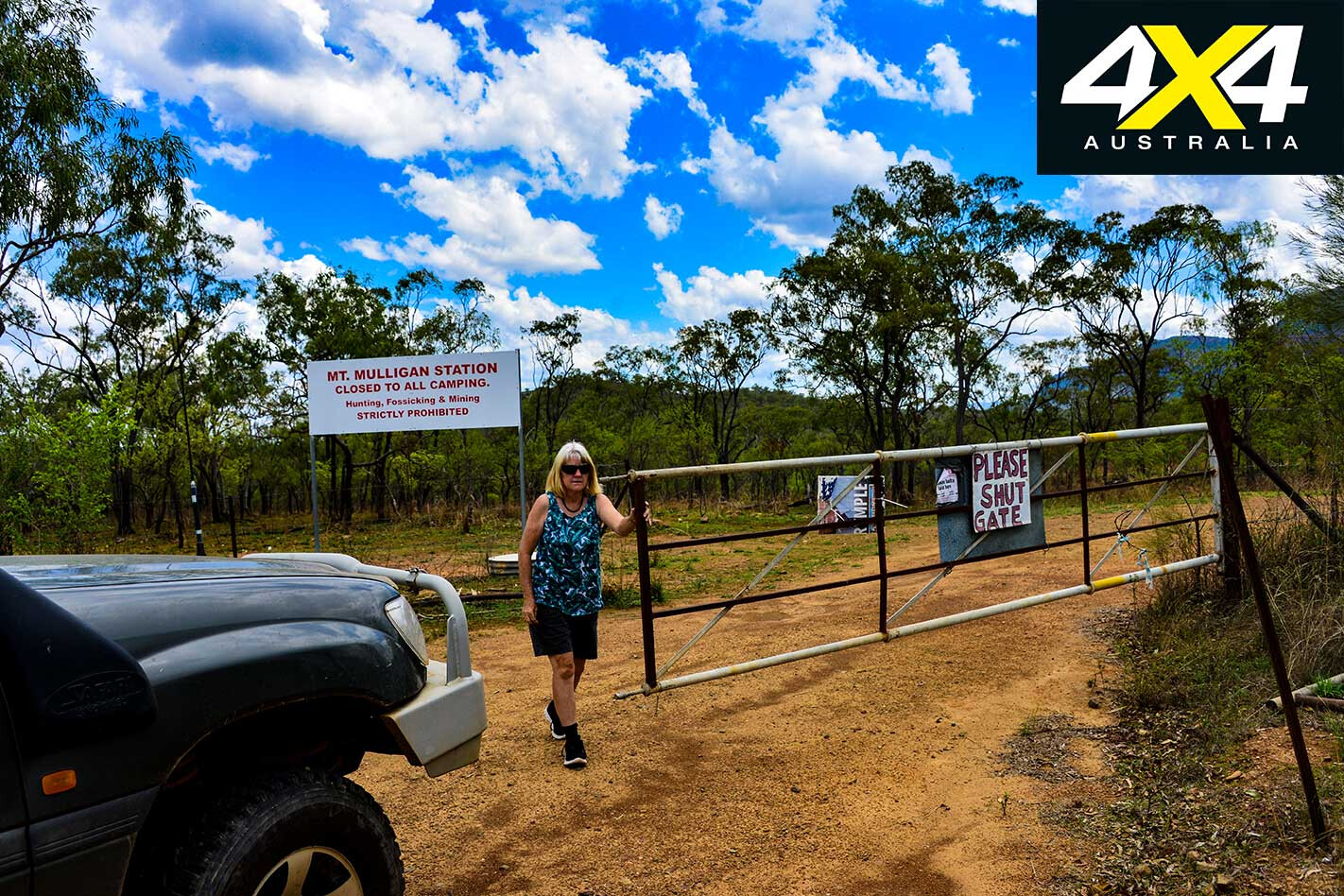
Mount Mulligan Station has been purchased by developer, Chris Morris, who has begun the construction of a $5 million tourist resort, with more planned for other attractions in the area. He has also purchased the Tyrconnell Mine – previously offering accommodation and camping for visitors – with plans to spoil the rich and famous there. Hopefully, he doesn’t overlook cashed-up grey nomads, either.
The future of the Tyrconnell Mine is uncertain, as there’s now a locked gate at the entrance. Locking up areas is wrong, especially when our population is expanding and more people are seeking bush escapes.
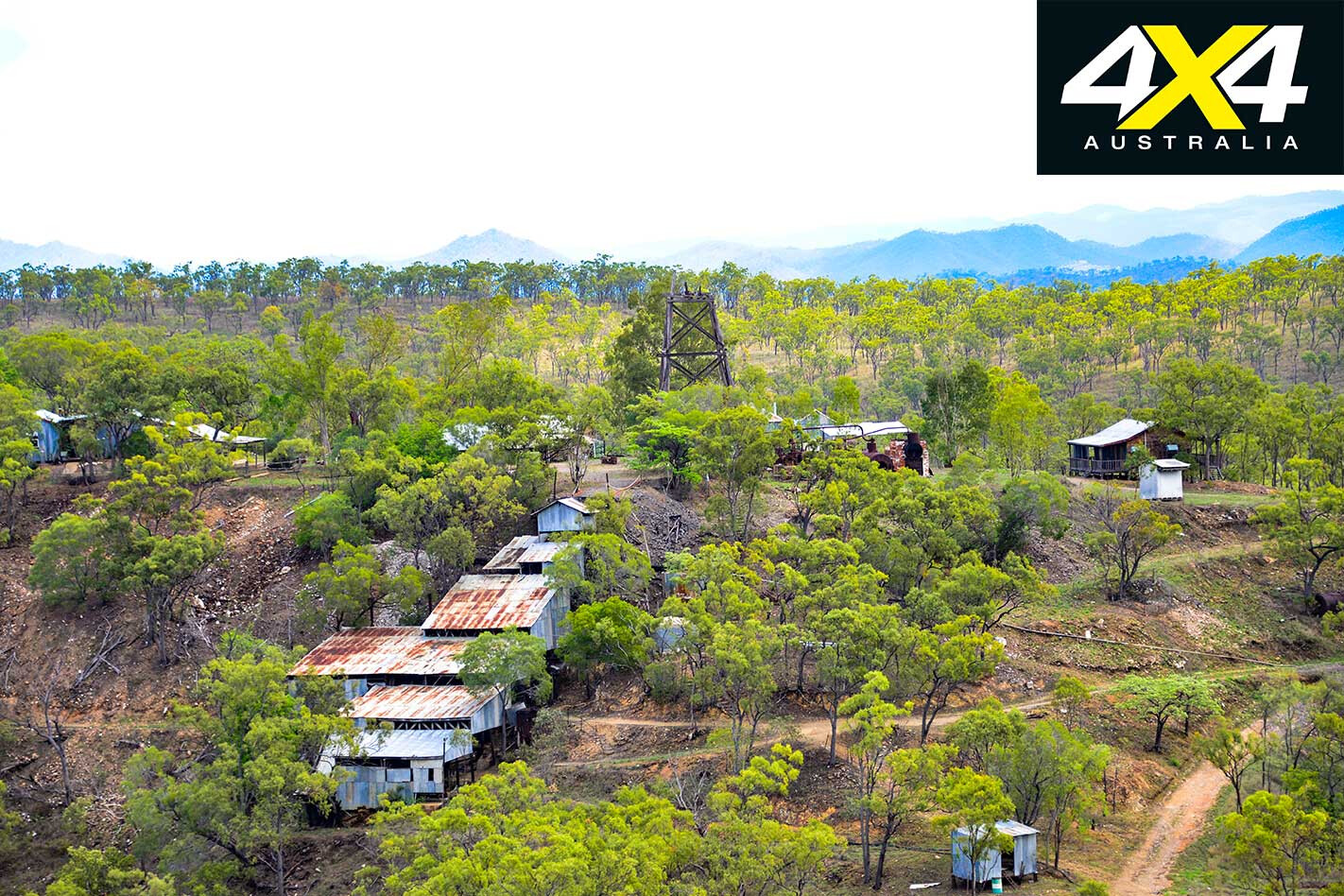
A few years ago the previous owners of the mine were gifted $300,000 by taxpayers for the construction of period cottages and campgrounds and the maintenance of the heritage-listed treatment plant. That was done, but now we are shut out. All is not lost, though, as the region still has many attractions open to visitors, including some of the most amazing mountain views.
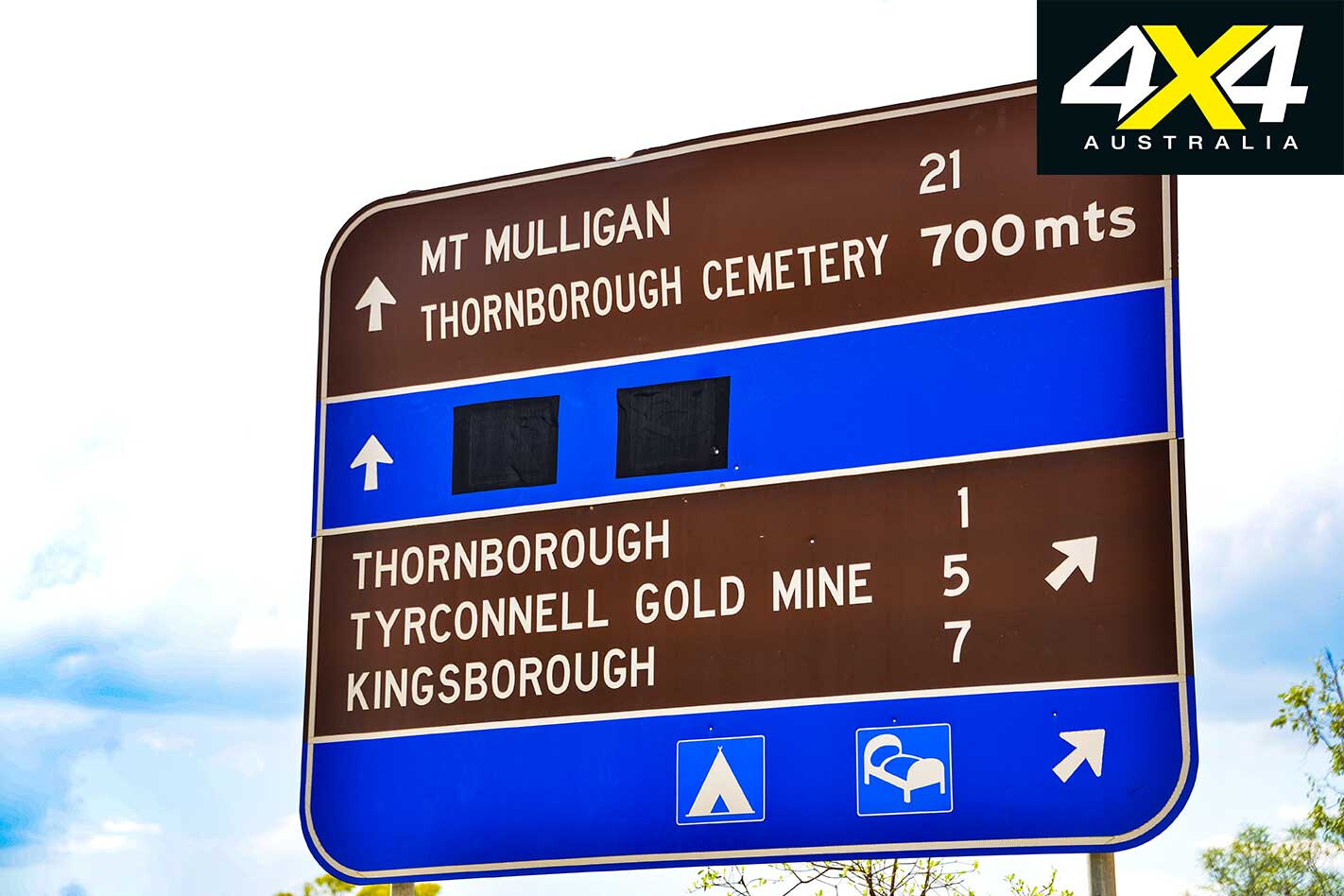
The bitumen ends 12km north of Dimbulah, but the dirt had just been graded and was in excellent condition; although, every creek crossing was running from a storm the previous evening. Out first stop was at the Thornborough Cemetery, just after the Tyrconnell Mine turn-off, where the early pioneers of what was once one of the richest gold mining fields in Australia are buried.
About a quarter of the graves are etched with dates that range from 1877 to 1927, with one particular grave holding the body of 20-year-old Victor Cummings, a coal miner who was killed in the Mount Mulligan mine disaster.
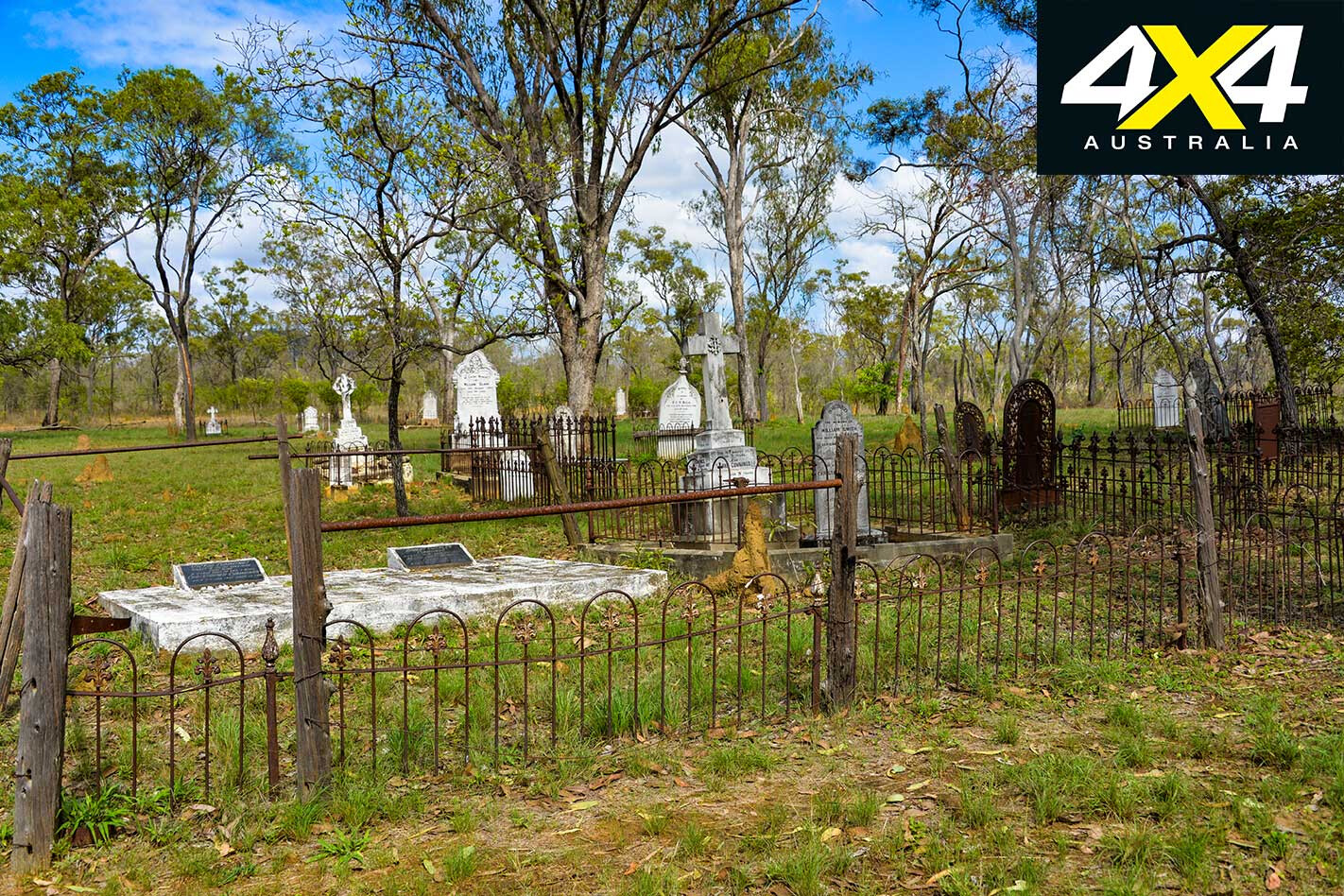
Another headstone of note is of the five Murphy children, all whom died within 11 years of each other from 1899 to 1910, aged seven months to 11 years. The Murphy family owned a hotel at Kingsborough and later at Pinnacle Creek. Many children are buried in the old cemeteries, a testimony to how harsh life was in the bush back then.
James Venture Mulligan reported gold on the Hodgkinson River, east of Mount Mulligan, on January 17, 1876, which had been named in his honour by explorer Frank Hann. A rush ensued after Mulligan reported the new field on March 16, 1876, when claiming the government’s 10,000-pound reward for finding payable gold.
Thousands of wide-eyed hopefuls rushed the Hodgkinson River from Cooktown and Croydon, and more than 2000 Cooktown diggers were marooned on a flooded Mitchell River for weeks and ran out of food – they were to be disappointed, as the surface alluvial gold soon ran out.
The best gold was under the ground and required heavy mining equipment and investments. Rum-fueled diggers rioted and went on the hunt to lynch Mulligan, who had set up a store. He fled but later returned when the mob calmed down.
Big companies took over the field and sank shafts and set up treatment plants. Getting heavy equipment onto the field was a feat in itself, as it was hauled in by horse-and-wagon crews up the “Bump Track” from Craiglie at Port Douglas, via Mount Molloy and beyond to the Hodgkinson.
Many small miners also did okay by sinking shafts down hard rock and finding rich veins of gold, turning them into instant millionaires. There were dozens of mines on the field ranging from small “shows” to huge sites like the Tyrconnell, Beaconsfield, Northcote, Thornborough, Kingsborough, Lizzie Redmond and General Grant.
Much of it is still there, a reminder of a time when people lived in rough iron-clad or bush timber structures. There were pubs, hotels and roadside shanties that, judging by the piles of broken bottles, did very well indeed. The evidence is in the epitaphs on the gravestones of those who could afford them; others are buried in unmarked graves, some fortunate enough to have stones placed on top by family or friends.
Thornborough had a population of some 2000 people, but the only building still remaining is part of the old Canton Hotel. It’s occupied and trespassers aren’t welcome. Down the road a little, the Tyrconnel Mine’s poppet head and buildings stand sentinel-like on a high hill overlooking the Hodgkinson Field.
The maintained road passes it and, after dipping out of Explorer’s Creek, it climbs up a high range from where an unmarked lookout overlooks the now-silent complex of the still-intact Tyrconnel plant.
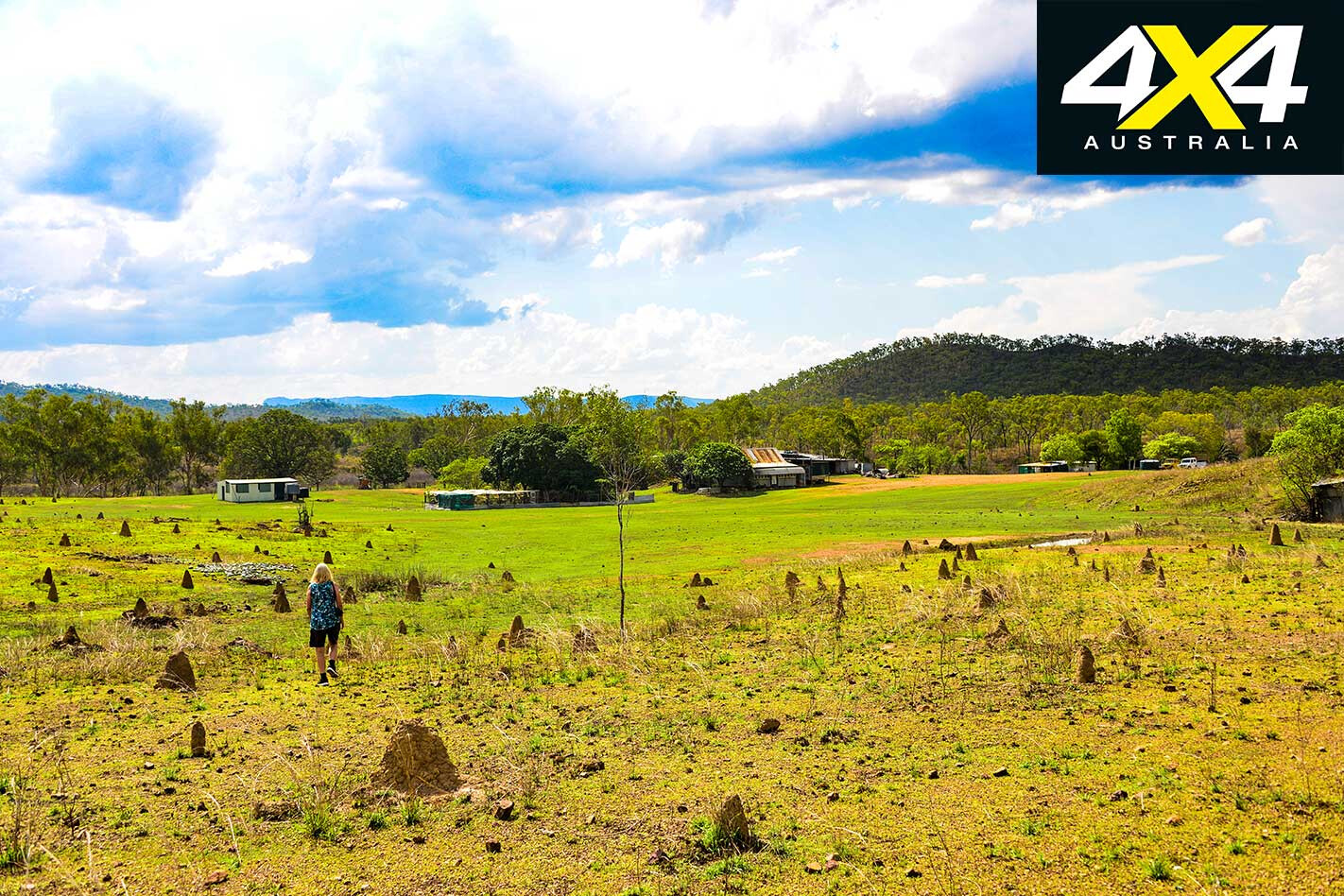
Beyond the Kingsborough Cemetery – to your right, on top of the range – the road overlooks Caledonia Creek, where a dam built in 1901 holds 20 million gallons of water. It kept the General Grant mine going, and the mine now stands out on the edge of a steep hill (oddly, its leaning chimney was actually built that way). The old Kingsborough stamper and buildings are set in lush gardens, where splashes of colour add to the ambience.
Once a rich town, it had 10 hotels and other amenities of the day. From here, the main road once turned east to Port Douglas, but it has fallen into disrepair and is now closed. Privately-owned period-galvanised iron cottages now indicate where the town once stood.
There are limited campsites available at the Kingsborough Mine on a first-in, first-served basis, and the owner Ike spins great tales of how things were in the days of yesteryear.
MOUNT MULLIGAN MOUNT Mulligan is a free-standing, rock-and-sandstone massif that stands 800 metres tall. It is 18km long and 6.5km wide and runs in a north-south direction. The indigenous owners call it Ngarrabullgan – though, others claim it is Woothakata – and it has high value as a site of significance.
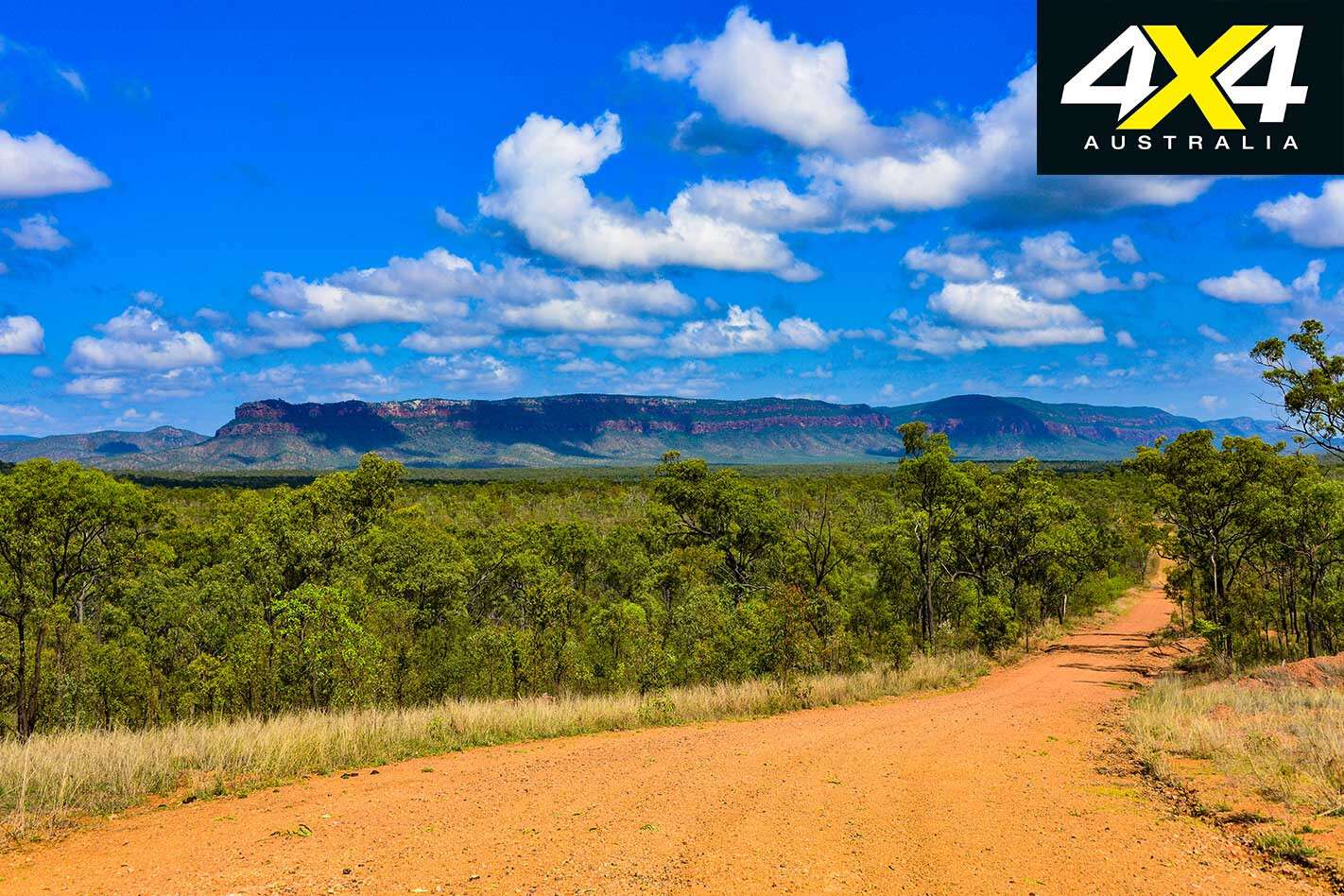
Our next stop was the Mount Mulligan Mine. The entrance, past the old hospital, is now closed and the only entrance to the old mine is near the cemetery. Coal was discovered on its eastern side in 1907, the same year that James Mulligan died and was buried at Mount Molloy.
It was the only coal field in the far north, and mining commenced there soon after. The town of Mount Mulligan was laid out on August 5, 1913, and a railway from Dimbulah reached the mine in 1914. The coal was mined from a shaft dug into the lower Permian layer within the cliff face, and it supplied the Queensland railways.
On the morning of September 19, 1921, school children sang the national anthem as the Australian flag was raised. Suddenly, there was a huge explosion and a speeding, billowing black cloud shot out of the mineshaft about one kilometre away. The kids screamed in terror as they were flung to the ground.
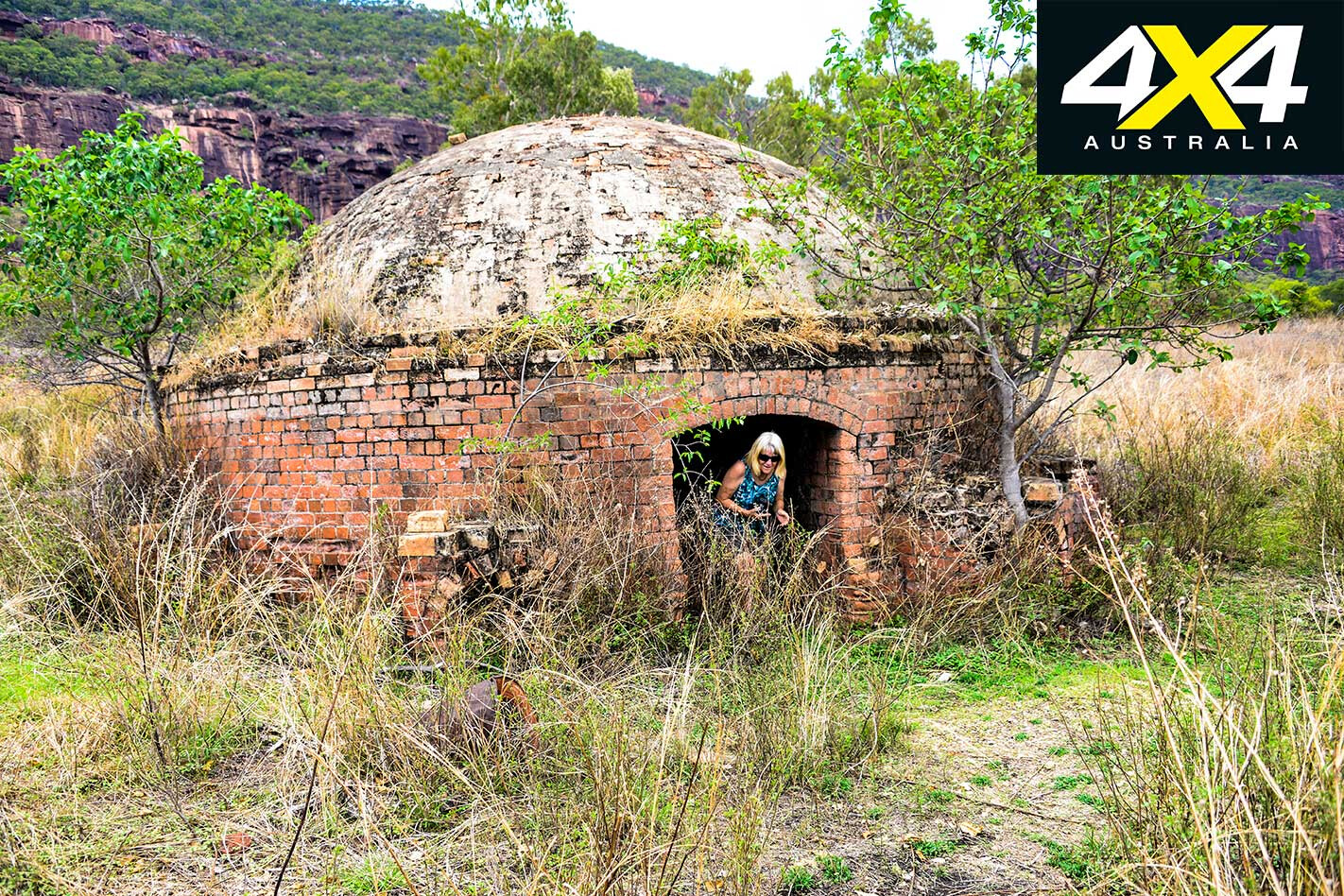
At that very moment every schoolchild (and their siblings at home) became instant orphans and their mothers became instant widows, as workers died in the coal-dust explosion. In all, 75 men were killed; and one can only image the grief those poor women and children endured.
The blast carried all the way to Mount Molloy and Dimbulah, and it was said it was even heard at Irvinebank and Chillagoe. Help arrived within hours, but there was nothing to be done. All but one body was recovered and buried at a new purpose-made cemetery. The mine re-opened in 1923 and was worked until 1957, when dieselisation of the railways forced its closure.
Townhouses and other buildings were dismantled and moved elsewhere by rail, as was the railway; although, the hospital remained to be used as a station homestead. At its height Mount Mulligan had a population of 300 people.
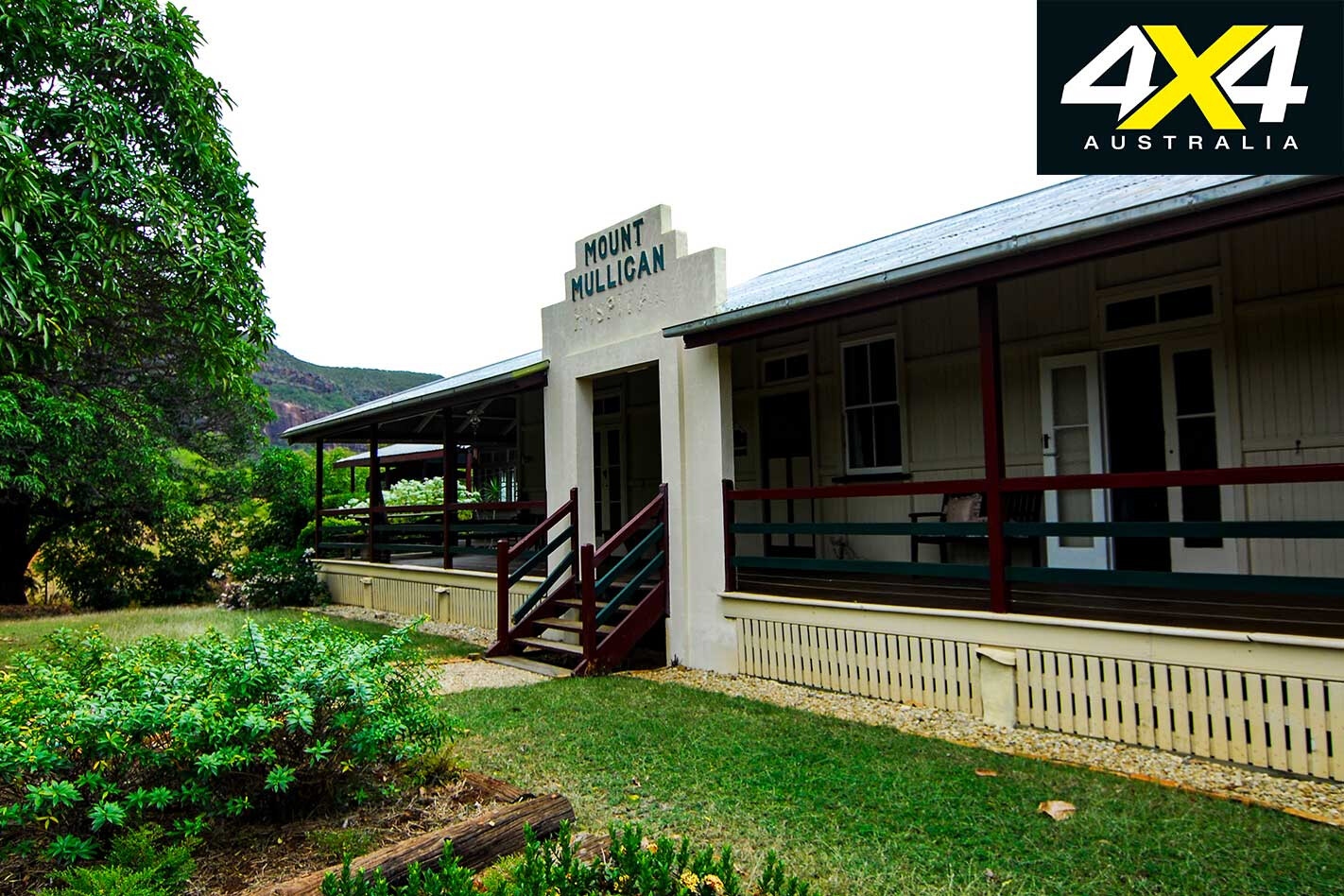
Apart from the chimney, brick kiln and remnants of concrete blocks, stumps and rusted water tanks, little else remains of the mine and township. All of the main cemeteries in the region are maintained by the Cairns 4WD Club.
We continued on to catch-up with old mate Wayne Peacock, who contracts for the Kondoparinga traditional owners to book, manage and control designated camping areas and visitors on the property. He lives on the other side of the Hodgkinson River, which was running high.
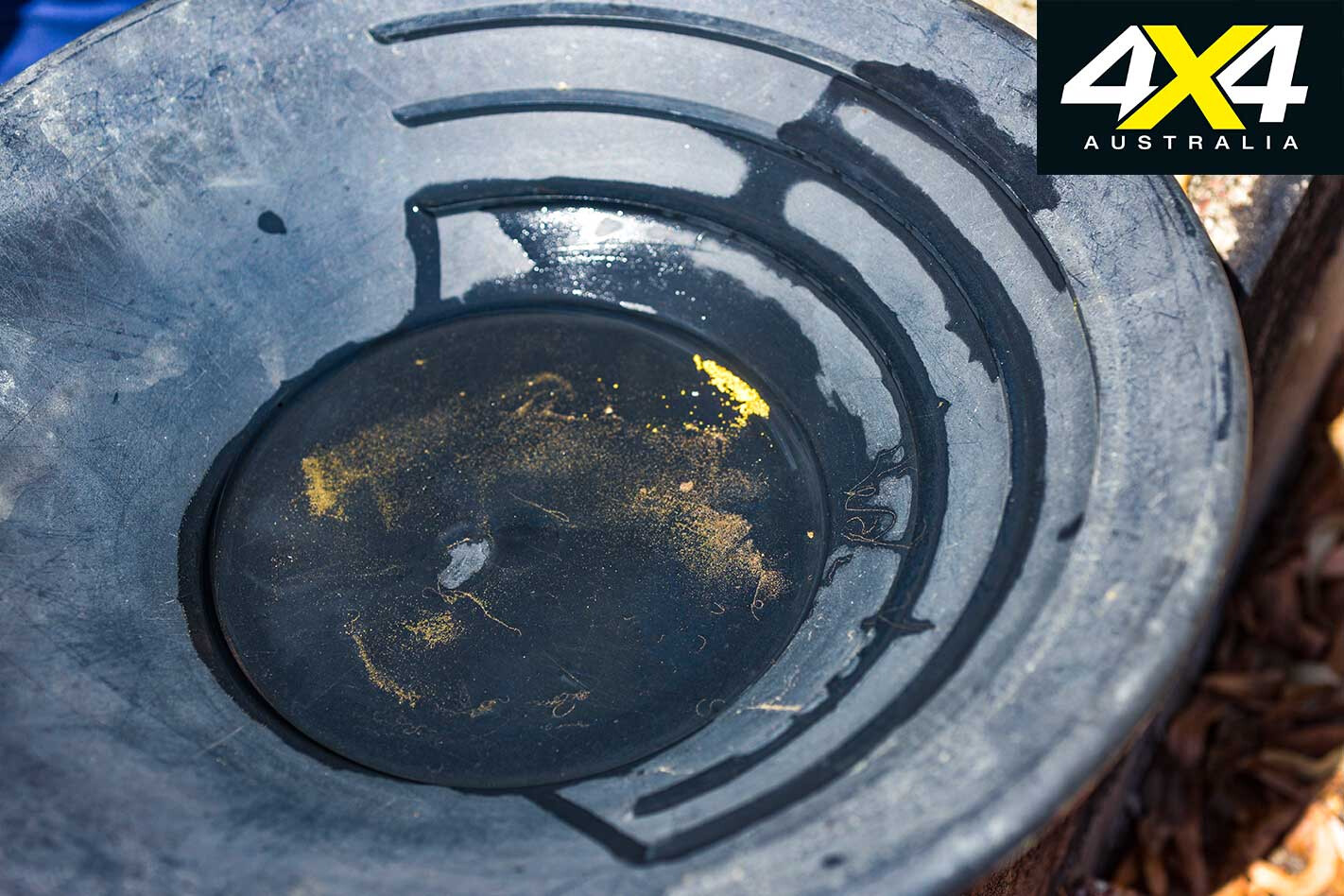
As I was unsure of its height and best place to cross I called Wayne on the radio, and he soon turned up and drove across to show me the way. Wayne is a keen prospector and was more than happy to show off his collection of old relics and specks of gold.
In fact, most campers are fossickers seeking gold, and, despite modern methods of extraction in recent years, plenty of gold remains in this country; both panning and detecting still bring rewards to those who work at it.
The camps are located on the eastern side of the main track to the Cooktown Crossing. The Mareeba-based T/Os have future plans to open up other areas of this vast station for visitors, including a walking track up to the top of Mount Mulligan.
There is also a free campground on the crossing, which is on Brookfield Station, owned by the Australian Conservatory. It’s an Australian taxpayer-gifted property, which means no access unless you’re a member.
If Kondaparinga politics run smoothly, some big changes may happen should the T/Os continue on their path to develop this beautiful station for environmentally friendly camping and fossicking. There is still gold in “them thar hills”, but inviting others to share this wealth of wilderness may be a bigger money spinner than gold.
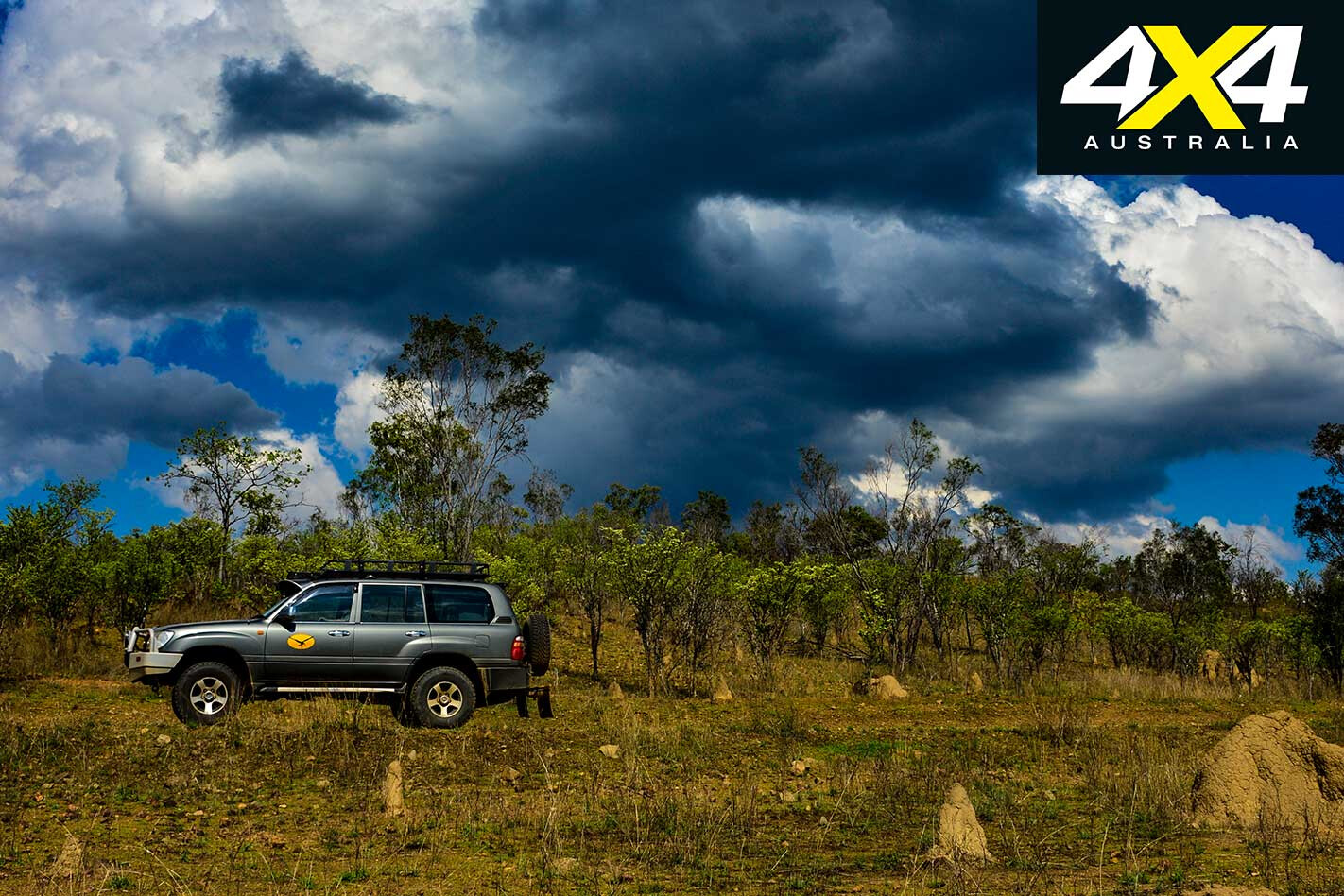
By late afternoon, we decided to move on as thunder rumbled over the Mount Mulligan massif, while dark storm clouds obliterated the western horizon. The weather was closing in fast, with continuous thunder rumbling beyond the surrounding hills.
Wayne told us that the Cooktown Crossing was running quite high, so we turned back the way we had come to see it all again. By the time we reached Dimbulah the southern hills of the Great Divide had vanished under black, lightning-troubled clouds. The wet season was nigh, but what a great day it had been indeed.
VOLKSWAGEN dropped the curtains to reveal its Caddy Beach campervan back in July, and it made its first public appearance at Melbourne Leisurefest held recently at Sandown Racecourse.
The Caddy “shack” mightn’t be able to rock-climb or reach remote campsites beyond the black stump, but it’s set up to give you a good night’s kip as long as you don’t veer off the blacktop.
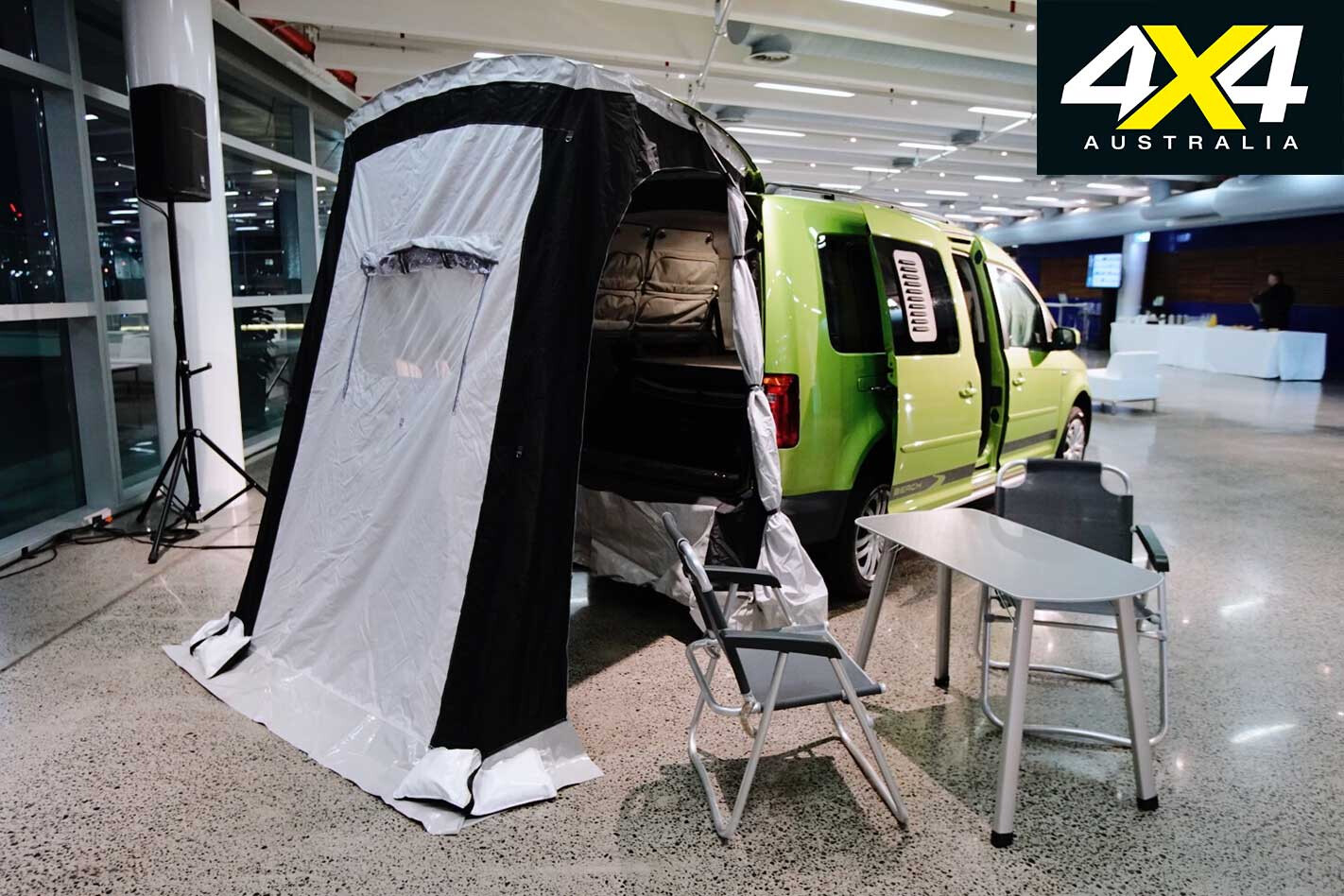
Utilising the long-wheelbased Caddy Maxi Trendline, the Caddy Beach includes a fold-out bed, a walkthrough tent at the tailgate, two folding camp chairs and a table, tray tables for rear passengers, block-out window curtains, a rechargeable torch, and four storage bags for rear side windows.
The Caddy’s 92kW/220Nm four-cylinder turbo-petrol engine is mated to a seven-speed DSG transmission. It comes standard with autonomous braking (front Assist with City Emergency Brake), adaptive cruise control and lane assist. ‘Beach’ decal means it’ll blend in when planted kerbside at Byron Bay.
At its July unveiling, Nicholas Reid, Marketing Manager of Volkswagen Commercial Vehicles Australia, said: “This marks our return to the campervan market in Australia. With the iconic and ubiquitous Kombi van, Volkswagen forged a strong connection with travellers and explorers around the world. The Caddy Beach continues this tradition with the latest in engineering and technology.”
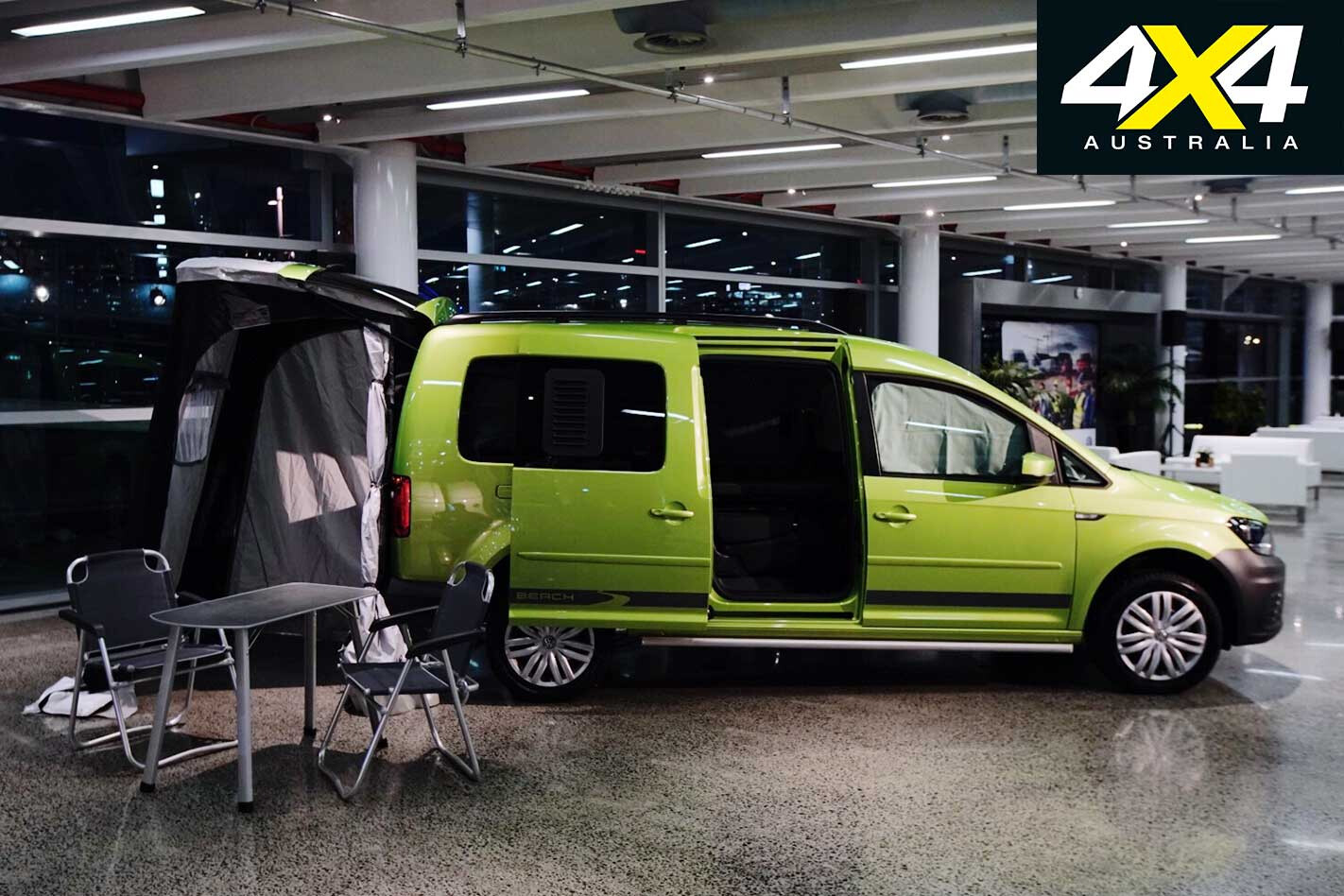
The Caddy Beach will be priced from $44,990 when it’s launched later this year.
CARLEX Design, known for its memorable and unique automotive designs, has penned the X-Class EXY 6×6 Concept.
The brand’s German division – HQ is in Poland – designed the complex version of the Mercedes-Benz X-Class, and it’s oozing with equal parts boldness and quirkiness.
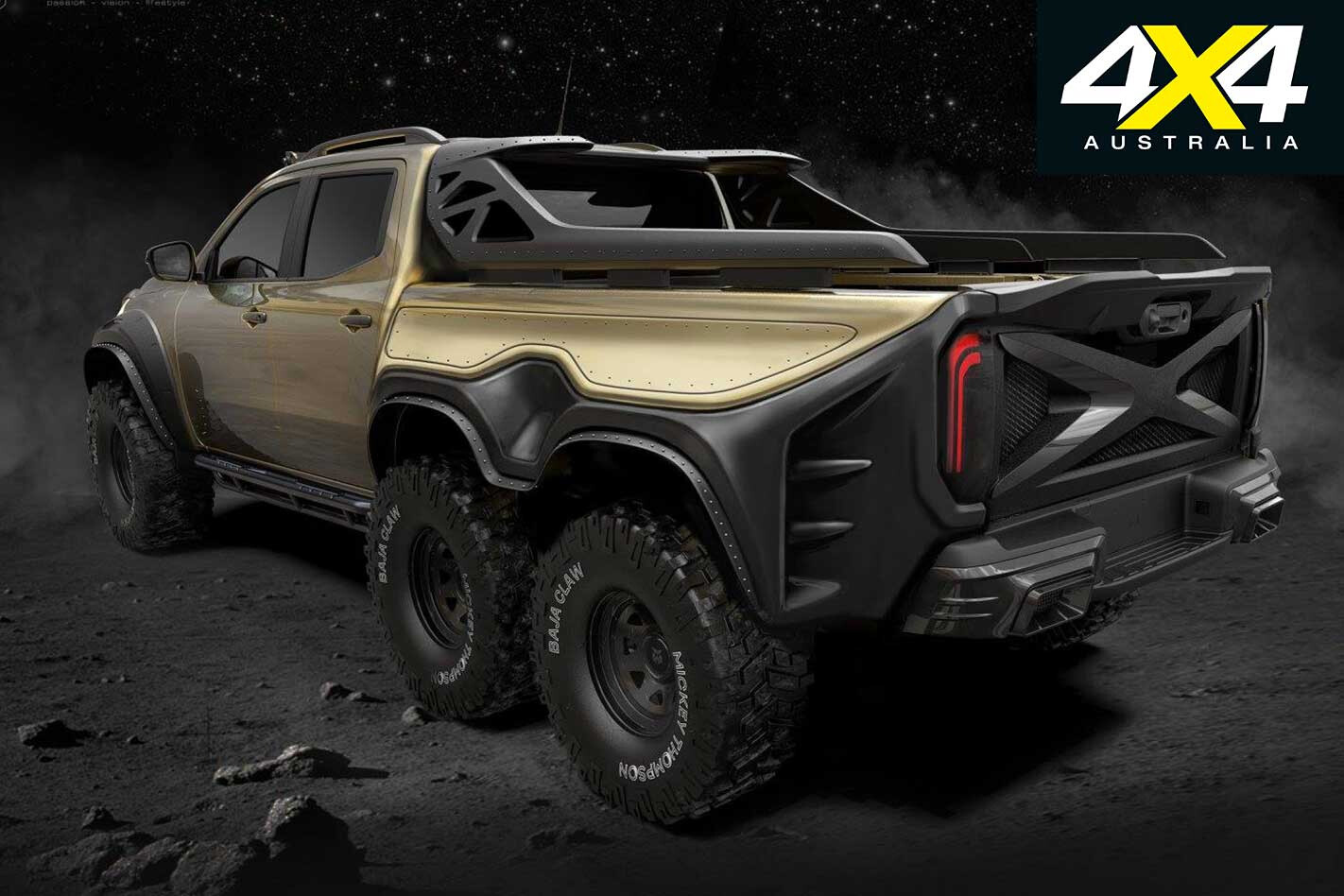
Carlex Design didn’t release any specific information when it launched the images to its Facebook page earlier this week – along with: “See our new, amazing concept design for the Mercedes X-Class EXY 6×6. We are beginning a new week with a strong entry” – but there are a few significant tweaks, other than the addition of two extra wheels.
The ballsy six-wheeler features a longer tray, massive air-intakes, a bonnet scoop, in-your-face fender flares, a light bar up top, and a centralised winch positioned beneath the number plate. A big X marks the spot on the rear tailgate, which is positioned above a new rear bumper.
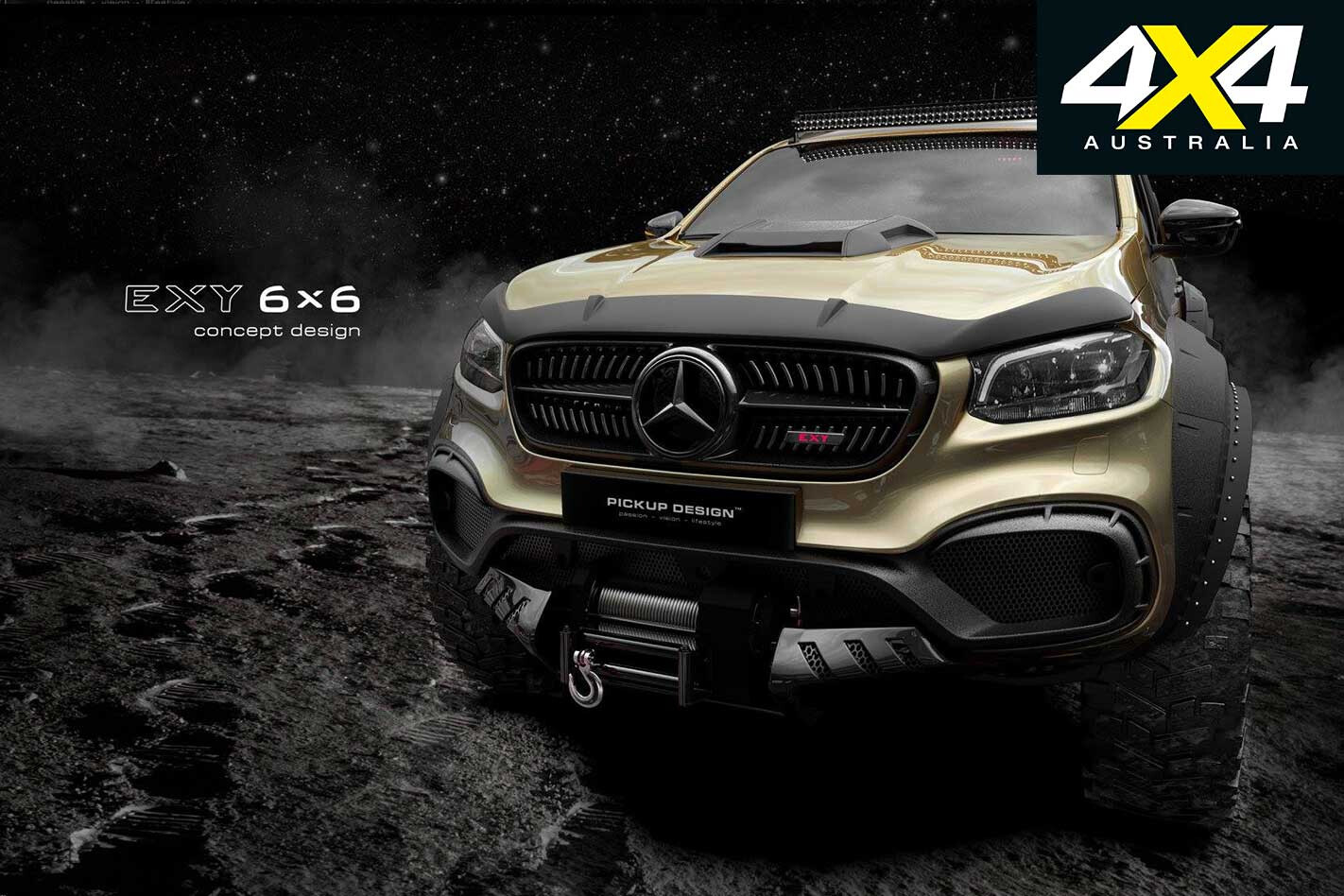
Mercedes-Benz’s X250d, which generates 140kW and 450Nm, is currently on sale, but the looming X350d gets the 3.0-litre six-cylinder turbo-diesel and will punch out 190kW and 550Nm.
Carlex Designs’ Pickup Design division has stylised wild creations to suit the Volkswagen Amarok, Nissan Navara, Toyota Hilux, Fiat Fullback and Mitsubishi L200 (Triton). Check them out at: www.pickupdesign.com/en
IF YOU SAT down and thought about what’s required in a modern, four-wheel-drive ute with a GVM of 3200kg and a towing capacity of 3500kg, it’s a fair bet that one of the elements you’d probably be including would be a disc brake on each wheel.
Yet, largely for reasons of cost-containment, the big-selling current-model dual cabs don’t. The manufacturers have stuck with a drum-braked rear end and that’s your lot. Take it or leave it.
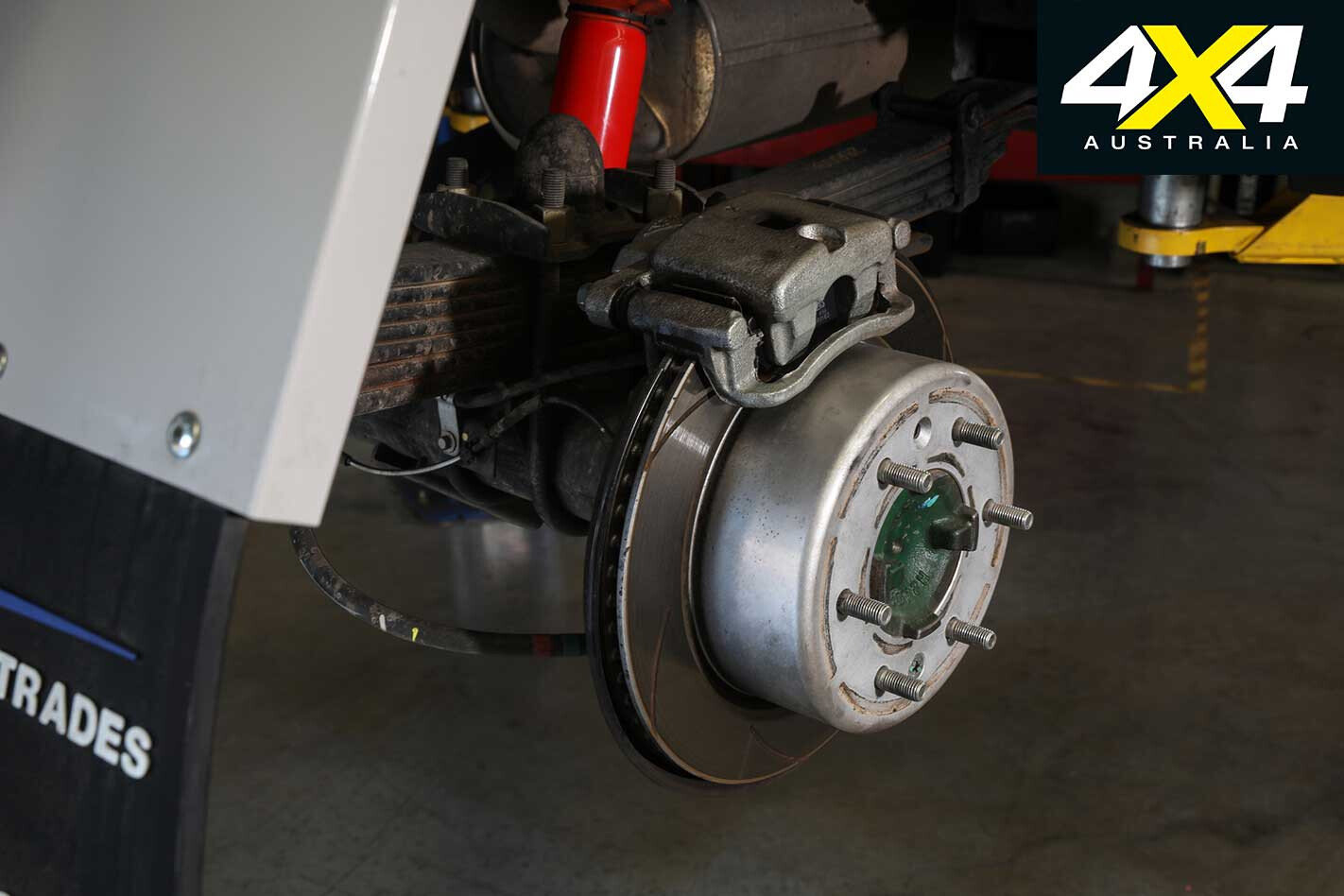
However, consider the advantages of a disc-brake rear-end on something like a Ford Ranger or Toyota Hilux. Shorter stopping distances is the obvious one, especially when you’re heavily loaded or towing a big tandem with a Bobcat on the back.
Aside from quicker, shorter stops, though, a disc-brake setup will typically give greater fade resistance, a bonus for those who operate in hilly country or just making multiple stops.
Off-road, a slotted disc-brake rotor isn’t affected by mud or water ingress like a drum brake is, and then there’s the matter of all those clever electronics that give modern four-wheels drives such brilliant low-grip ability.
By combining the characteristics of both anti-lock braking and electronic stability control, today’s dual cabs can provide the sort of grip and traction that it once took front and rear diff locks to produce. In fact, in testing we’ve done here at 4X4 Australia, the modern electronic methods sometimes produce superior traction to conventional lockers.
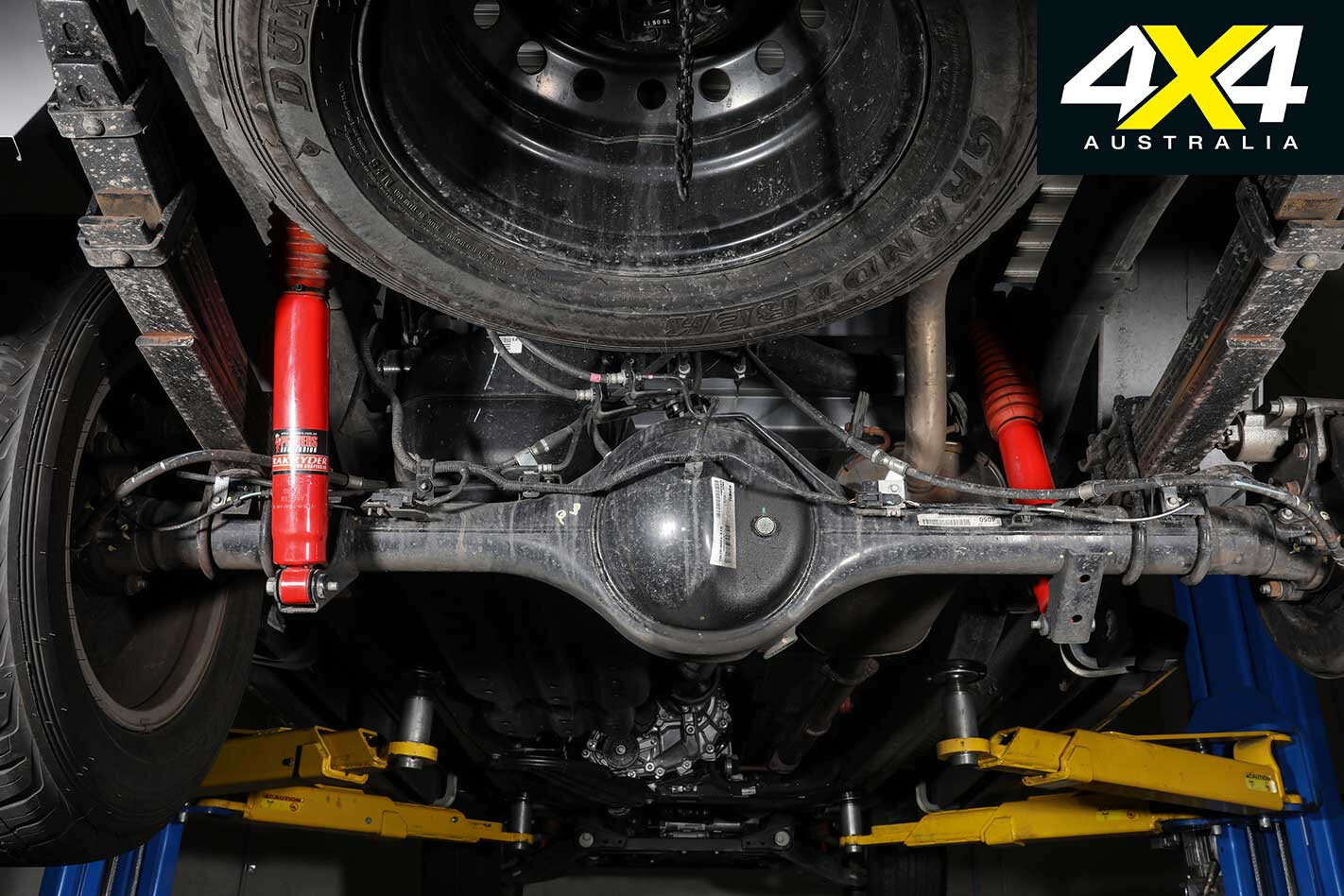
The catch with this is that the electronic systems, thanks to their constant cycling of the brakes to maintain traction, can get the hardware awfully hot, awfully quickly. But if you had a disc-braked rear-end which is far better at radiating heat (that fade resistance thing again) then these electronic traction aids could potentially work better for longer.
So a rear-axle disc-brake conversion seems like a pretty good idea, and that’s where Pedders comes in. The brains trust at Pedders have come up with a kit that takes a Ford Ranger (and its twin, the Mazda BT-50), Toyota Hilux or Isuzu D-Max from drums to discs at the blunt end.
The kits can be fitted at any mechanical workshop or, if you’re the fairly handy type, you could fit it yourself.
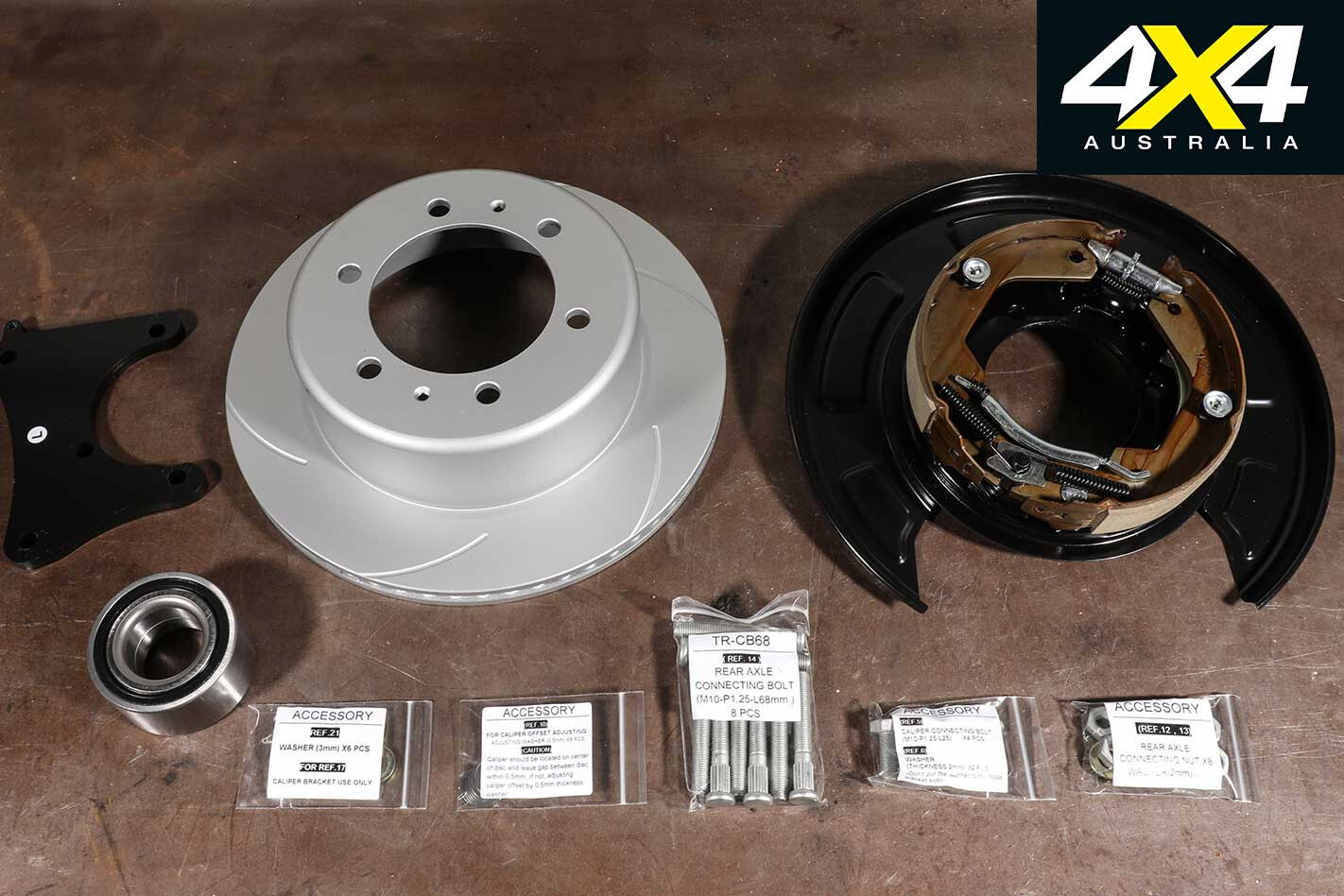
So what do you get? In a nutshell, everything from the hardware to the instructions, right down to the fasteners, all bagged up and labelled to make it as simple as possible. That includes the slotted one-piece rotors, a pair of calipers, Kevlar-ceramic pads, the park-brake setup, backing plates and brackets.
It’s important to note, too, that this isn’t a collection of everybody else’s part numbers. No, every piece has been engineered to Pedders’ own specifications and manufactured exclusively. This has enabled Pedders to get away without fiddling with master cylinders, proportioning valves and other settings.
Because the calipers have been designed with the OE front brakes as a known quantity, the brake bias can be established and fixed via the rear caliper-piston size itself. Crucially, the ABS operation is not affected, either.
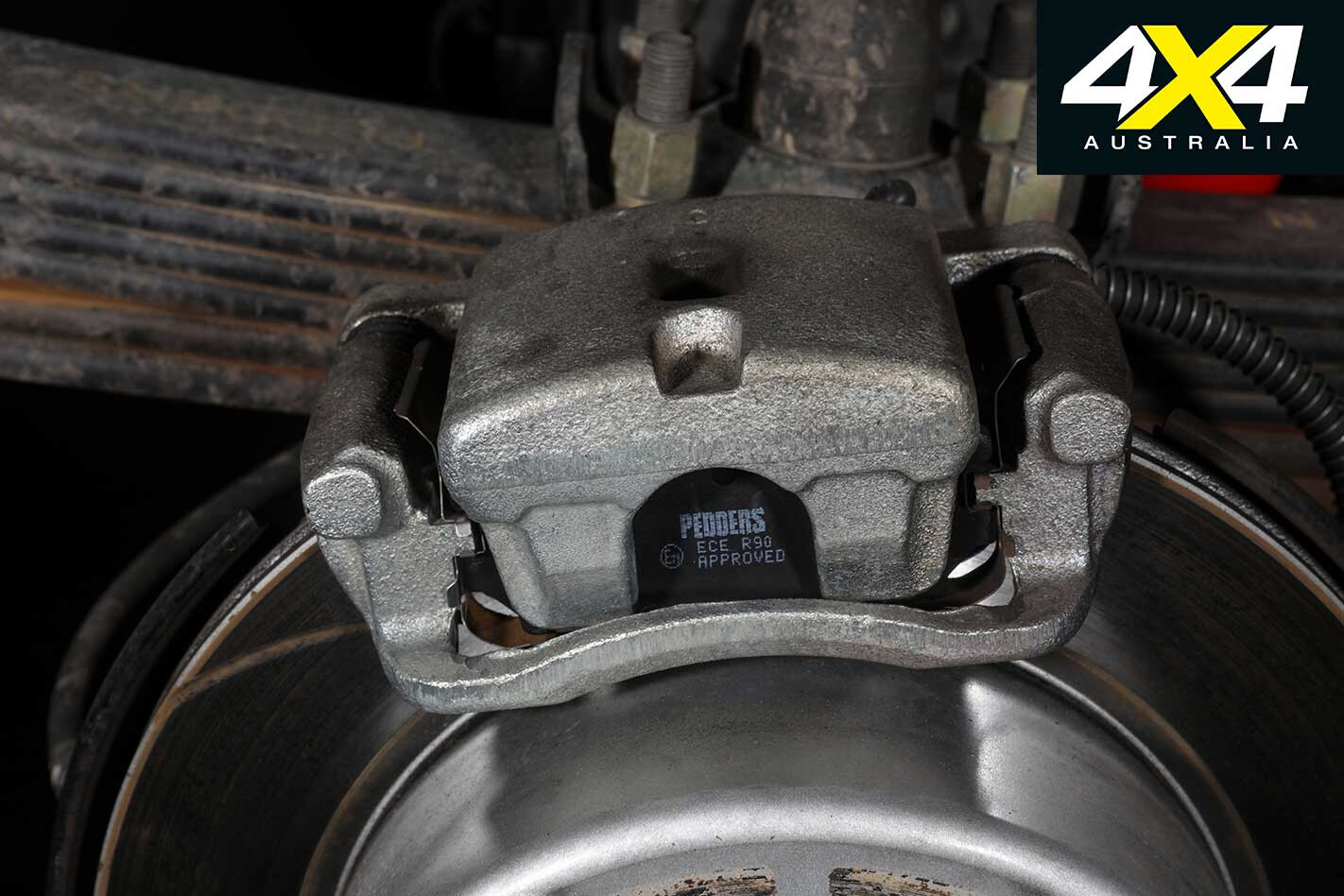
The park-brake is now an expanding-shoe arrangement, incorporated into the rotor’s top-hat, just like a drum park brake. This is to give the maximum swept area to hold the vehicle against static loads, and testing has shown that the entire setup exceeds all ADR requirements.
In fact, the whole setup has been tested beyond all statutory performance targets and, in in-house testing, has shown that a fully loaded Ranger, from 100km/h, will stop an average of 14 metres shorter with the conversion kit fitted than the stock vehicle. And the more you load it, the bigger that difference will theoretically become. Then throw in multiple stops in quick succession and the kit should widen the performance gap further.
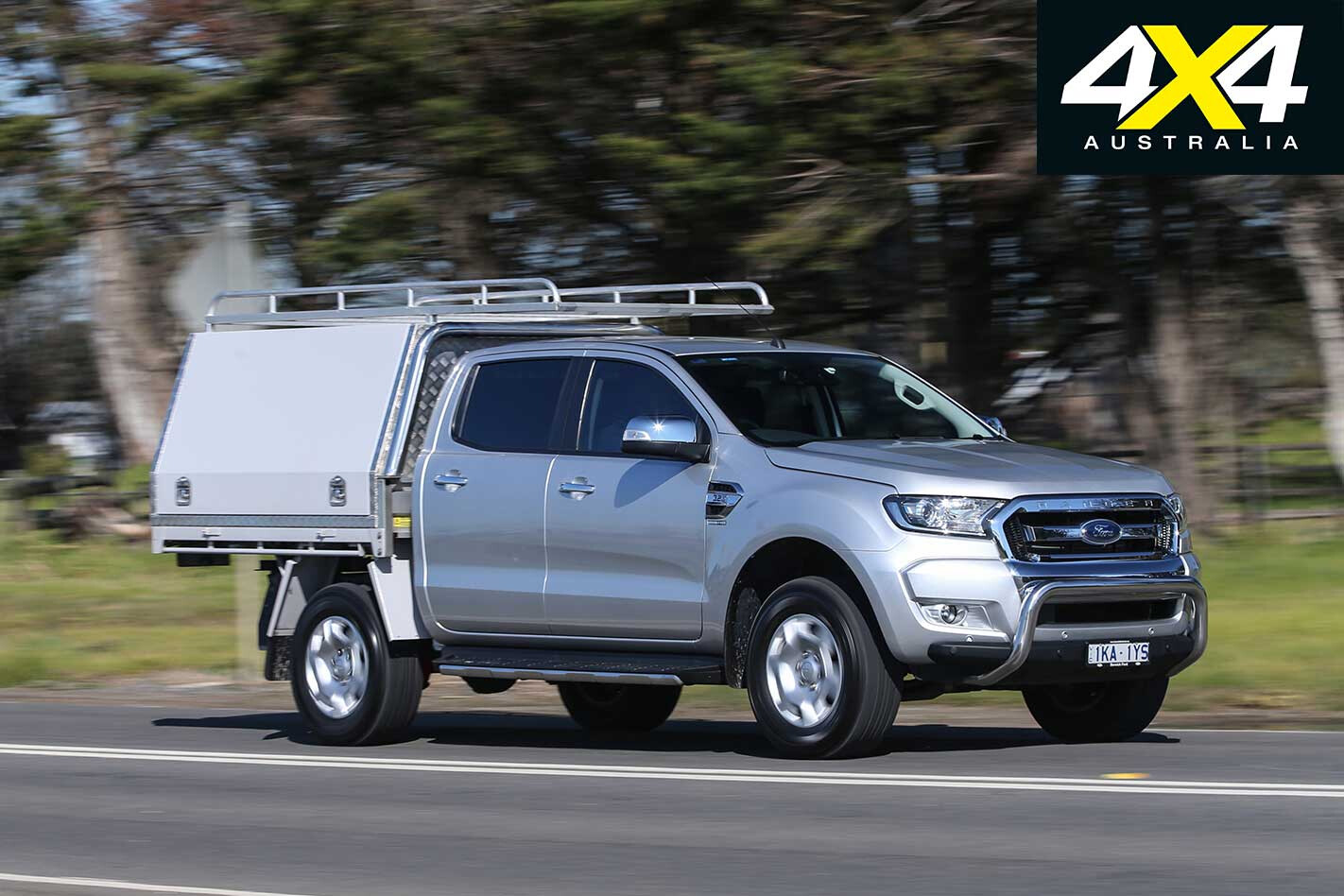
The kit is designed as a straight bolt-on deal, and Pedders reckons there’s been plenty of overseas interest in the setup (since the vehicles it covers are all global ones). There’s a warranty of two years or 40,000km on the Pedders gear, and the only thing to do beyond bolting it on is to have the modified vehicle independently engineered to eliminate insurance and registration hassles (budget on between $400 and $600 for this).
As an aftermarket kit, that responsibility falls to the vehicle’s owner, but it should be a fairly simple rubber-stamp job once the trade is up to speed with the kit. Spares? Any Pedders outlet should suffice, of which there are 120 nationally.
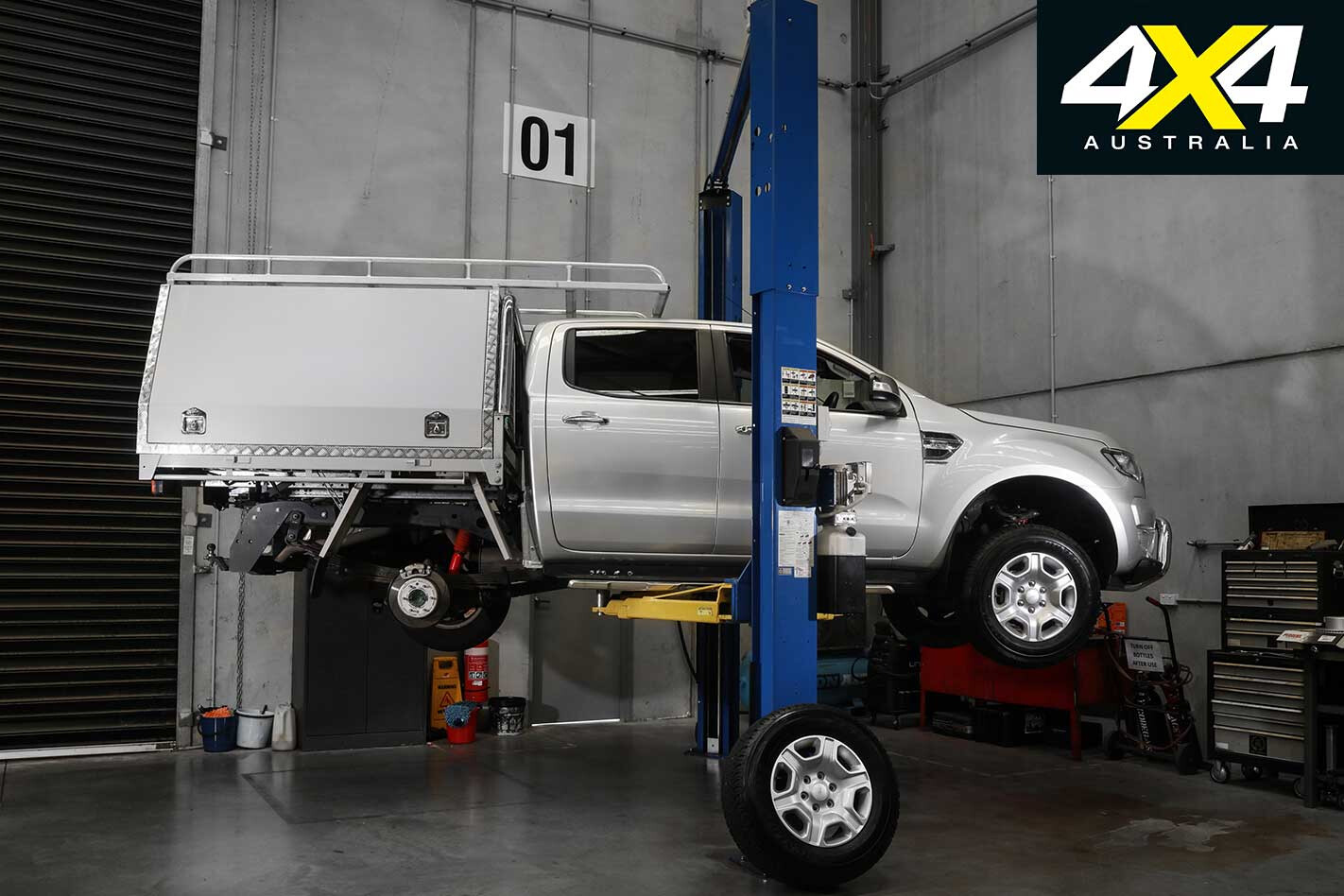
Looking at the kit in place with a few hundred kays of Melbourne-winter road grime plastered on, it’s difficult to pick the Pedders setup from what you’d imagine a Ranger with a factory disc rear-end would look like. And to drive it is kind of more of the same.
The vehicle we sampled was a heavily loaded Ranger dual cab with a service-body full of air-conditioning gear onboard, so the weight distribution would be well rearward of that of a stock, unladen Ranger 3.2. But, of course, that also makes it a prime candidate for this modification.
Based on either pedal feel, brake noise or smoothness in normal driving, there’s no real apparent difference (which in reality is a compliment in itself). But when the chips are down, the disc-braked vehicle will always perform much better.
In the end, that’s the point, in a way: while it’s a relatively costly modification at $2370 plus fitting, if you don’t want to do it yourself, this is not something that’s going to appeal to dual-cab owners chasing bling or glory. However, if you really do work your ute, whether that’s on-road with a big load or off-road where the traction aids need to do their stuff, then this could be money very well spent indeed.
RATED Available from: www.pedders.com.au RRP: $2370 (excl. fitment) We Say: Worthwhile upgrade for improved braking performance
GVM Lift
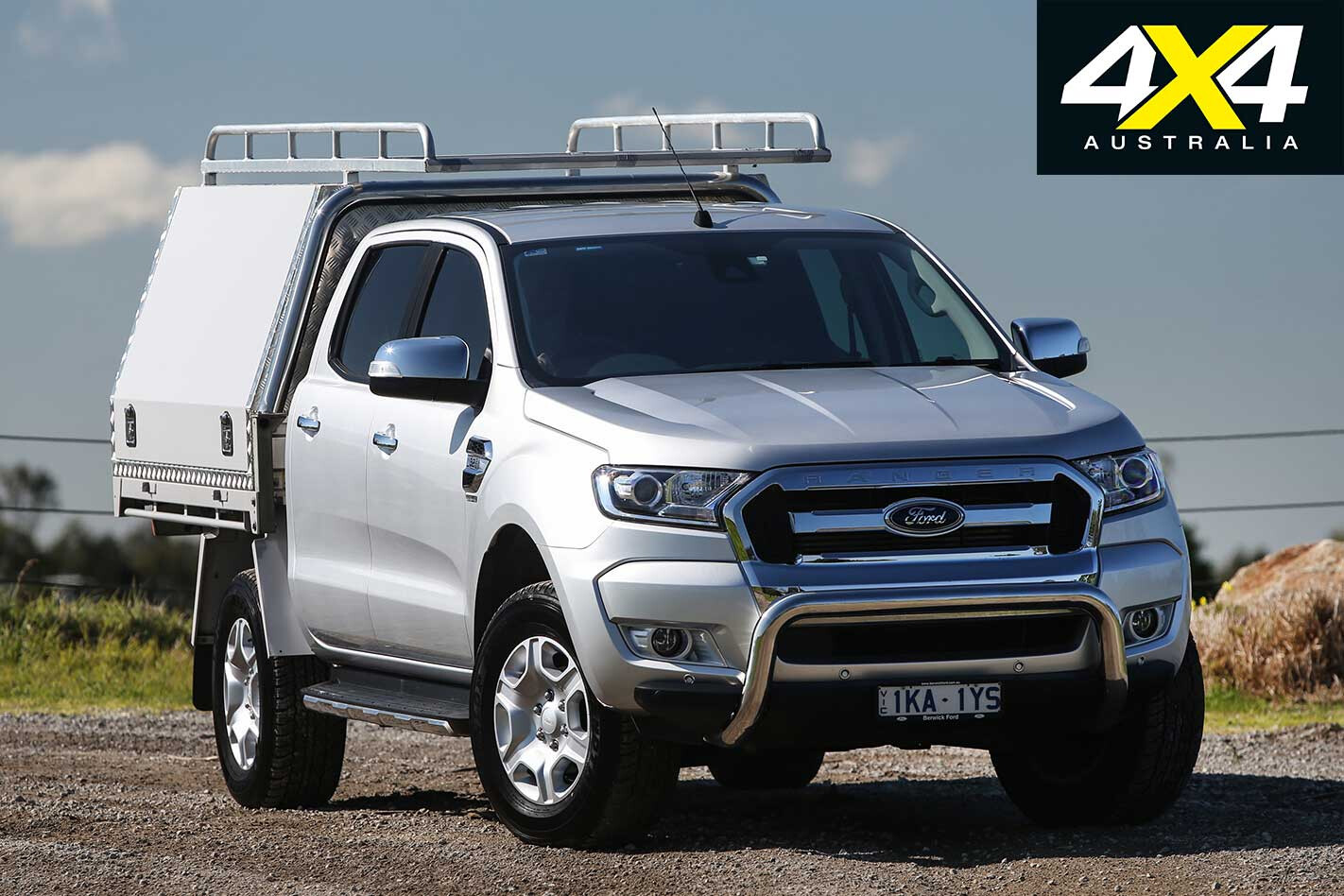
THE RANGER we drove for this look-see also had one of Pedders’ GVM+ suspension kits fitted, which gives a bit more payload headroom to vehicles that often operate at or near their official GVM limit. There are currently 20 utes and vans that the Pedders GVM+ gear can offer a leg-up to and, in the case of the Ranger we sampled, the kit takes the GVM from 3200 to 3500kg.
In the Ranger’s case, the kit includes struts and coils, leaf rear springs, dampers, replacement U-bolts, shackle-pins and all the relevant bushes. The best news is that the whole shebang is certified by the Feds in Canberra, so there won’t be any legal or insurance blow-back.
Despite the weight our test car was packing the kit managed to maintain the ride quality these utes tend to develop as the load on the back increases, however, it managed to prevent the damping going to hell (as is often the case).
In fact, over a fairly lumpy section of bitumen, we found the Ranger was solid and stable at speed and makes an even better platform for the disc-brake conversion.
THE sprawling Mount Seaview Resort, west of Port Macquarie, has mountains, faraway campsites and gullies of deep river crossings, so it’s the perfect spot to be introduced to Yamaha’s latest off-roader: the two-seater Wolverine X2.
The go-anywhere buggy is a side-by-side vehicle with part-time four-wheel drive and a heap of ability for rough work. It’s not cheap for an off-road-only machine, at $21,499, but it is uber competent and comfortable; some would pay this much for suspension work on a full-sized 4WD and still not ride ruts and whoop-dee-dos as well as this.
Whether spewing dirt on steep ascents, splashing through creeks or dodging through the trees, this is a magic machine for work or play. It’s no slouch when the tracks open up, either.
The latest X2 gets the new 847cc twin-cylinder motor, which generates 47 per cent more torque and 32 per cent more power than the outgoing X2. That’s hooked up to Yamaha’s Ultramatic CVT transmission, which slurs through its belt system at lower revs than before and then delivers to either the rear wheels or all four.
Drive-by-wire throttle and a speed control key to limit top speed to 40km/h are both new for the two-seat Wolverine.
The machine is 1.5 metres wide, 1.9 metres high and a tad less than three metres long, and it weighs in at around 700kg. Its compact body is a tad narrower than before, and it sits on a slightly shorter wheelbase and a galvanised chassis.
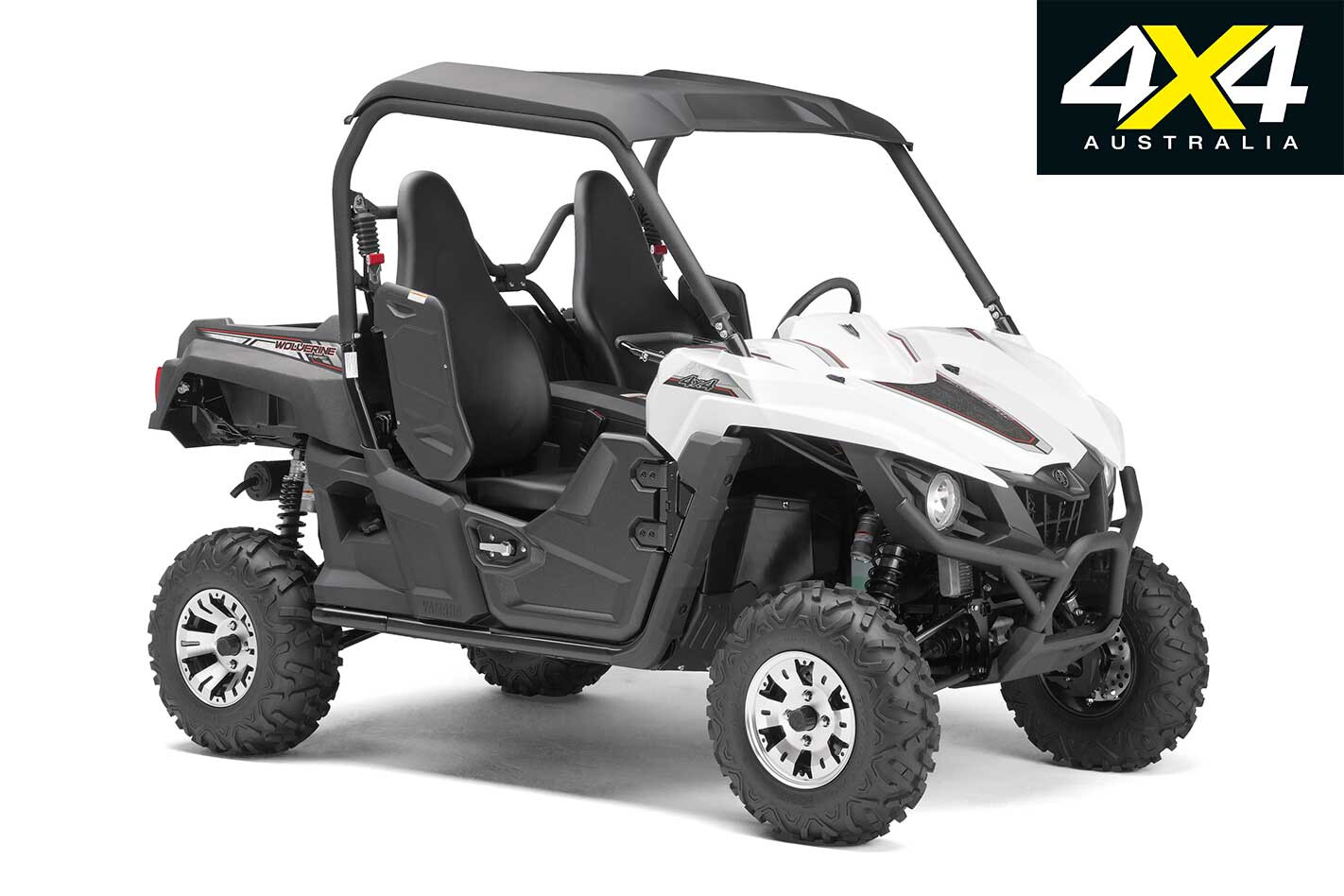
The roll cage is new, the cabin doors are higher, the tilt tray is longer and wider than before, and the payload is up from 136kg to 272kg. The reworked cabin has a tilt-adjustable steering column, a lower dash and high-backed, slide-adjustable seats with seat belts.
An LCD display features a speedo, odo, trip and hour meters, and warning lights, but there’s no tachometer.
The X2 features 280mm of ground clearance and a standard hardtop, and there’s also a heap of factory options to add including winches, heaters and a fully enclosed cabin. Accessory mounting points and necessary wiring is all set to go from the showroom floor.
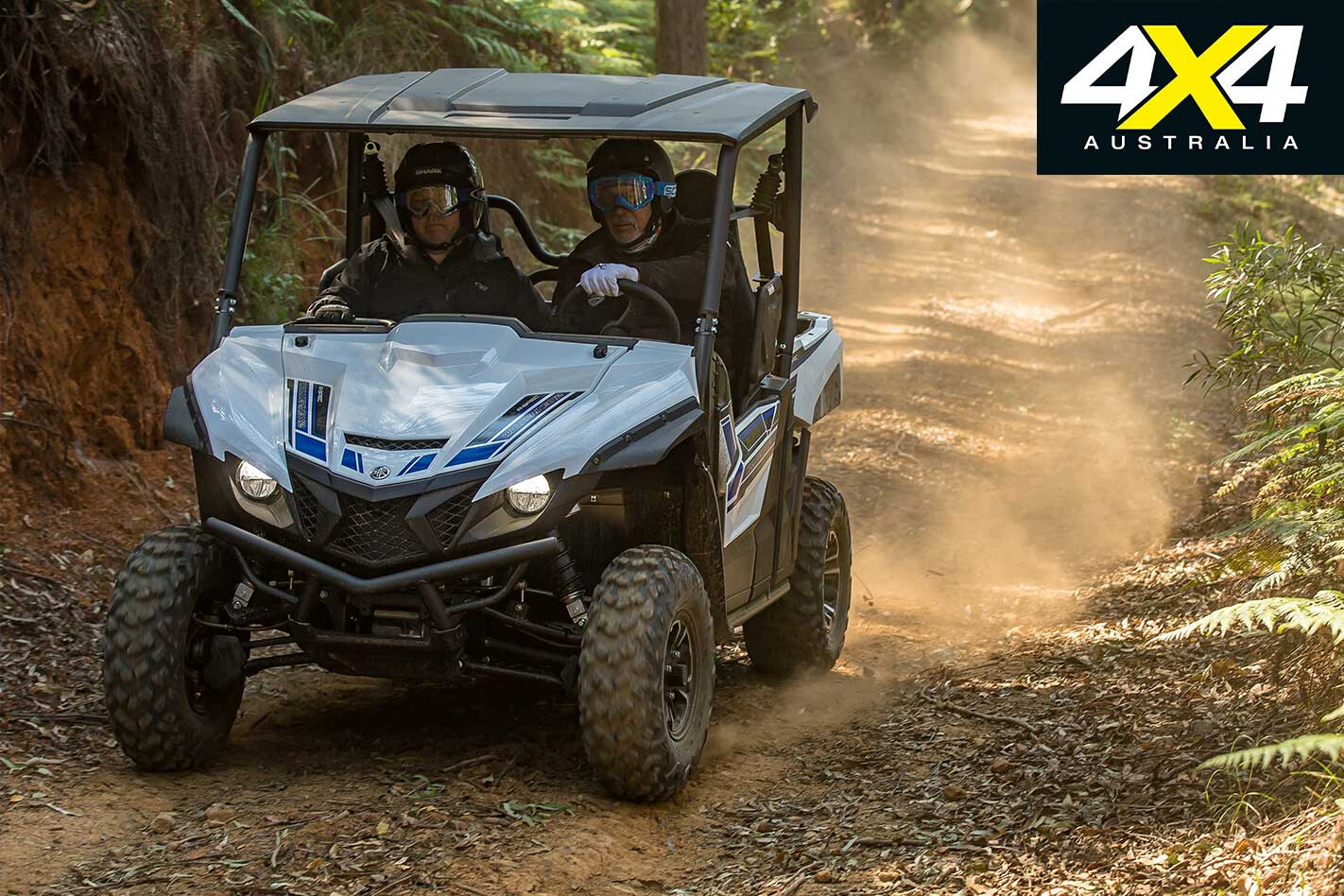
Chief among the accessories is Yamaha’s Adventure Pro GPS, which is powered by Magellan. It’s an Android-based tablet capable of navigating owners through the scrub, recording the journey and then on-sending, monitoring the vehicle’s engine, and storing apps such as Weatherzone.
THE DRIVE
THE first thing you notice about the X2 is how quiet it is, as Yamaha put a great deal of work into the exhaust system and engine mounts to quell noise and vibration. You then realise it’s still quick with two onboard – and it’s light and easy to steer – with smart torque and power responses from the parallel twin.
This responsiveness comes into its own on ascents, where you can drop off the throttle to better negotiate a tougher section and then power away again without fear of losing momentum.
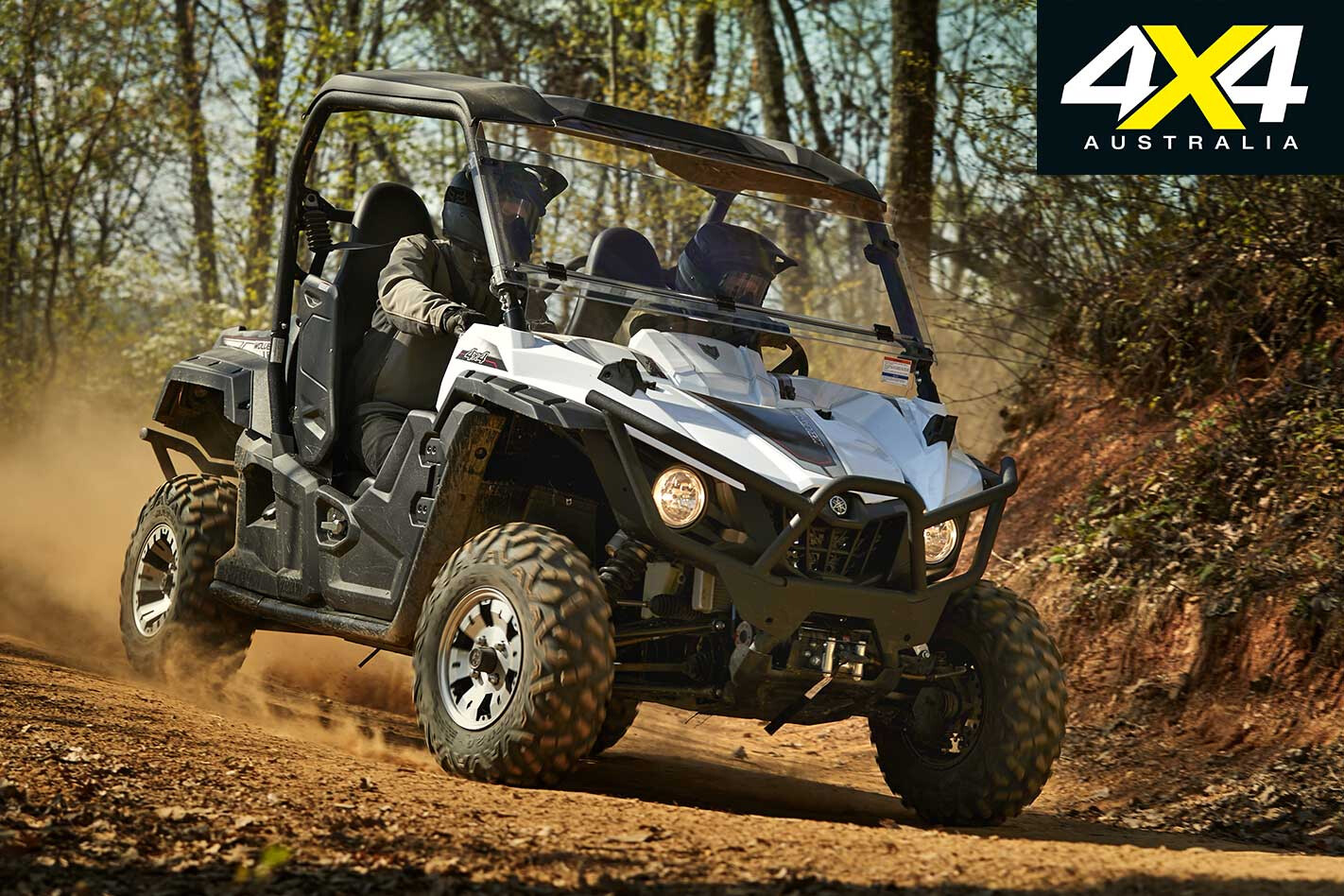
While four-low means the X2 will climb almost anything, the locking diff is a boon in steep ascents, eliminating any scrabbling for traction from the Maxxis rubber. Downhill braking is likewise impressive. Yamaha’s CVT has a larger centrifugal clutch to help maintain constant belt tension, and the one-way sprag clutch helps eliminate free-wheeling on steep descents.
Through all of this, it’s the X2’s suspension – independent, double wishbone with anti-sway bar, all ’round – which impresses time and time again. There’s 221mm of wheel travel up front and 226mm down back. All this is backed by KYB piggyback shock absorbers. It’s this ride comfort – plus that smooth, ever-willing engine-transmission combo – that lifts driver confidence.
Yamaha Aus expect some 40 per cent of sales will go to agricultural users, 30 per cent to recreational buyers, 20 per cent to commercial, and 10 per cent to hunters.
RATED Available from: www.yamaha-motor.com.au RRP: $21,499 We Say: More power and ride comfort – what’s not to like?
MORE INFO Track Attack: Yamaha is working with authorities around the country to open up more private and public territory for recreational SXS drivers.