
HERE’S are five reader-submitted 4x4s picks that was recently featured on the November issue of 4×4 Australia.
To get involved post a pic and a description of your rig on our special site here or post it to our Facebook page.
We feature a bunch of readers’ rigs in the magazine each month, where we award one lucky punter with a $200 voucher to spend at Piranha Off Road.
2009 FORD RANGER: MARCUS CHOPPING (4×4 Australia Readers’ Rigs Winner of the Month)
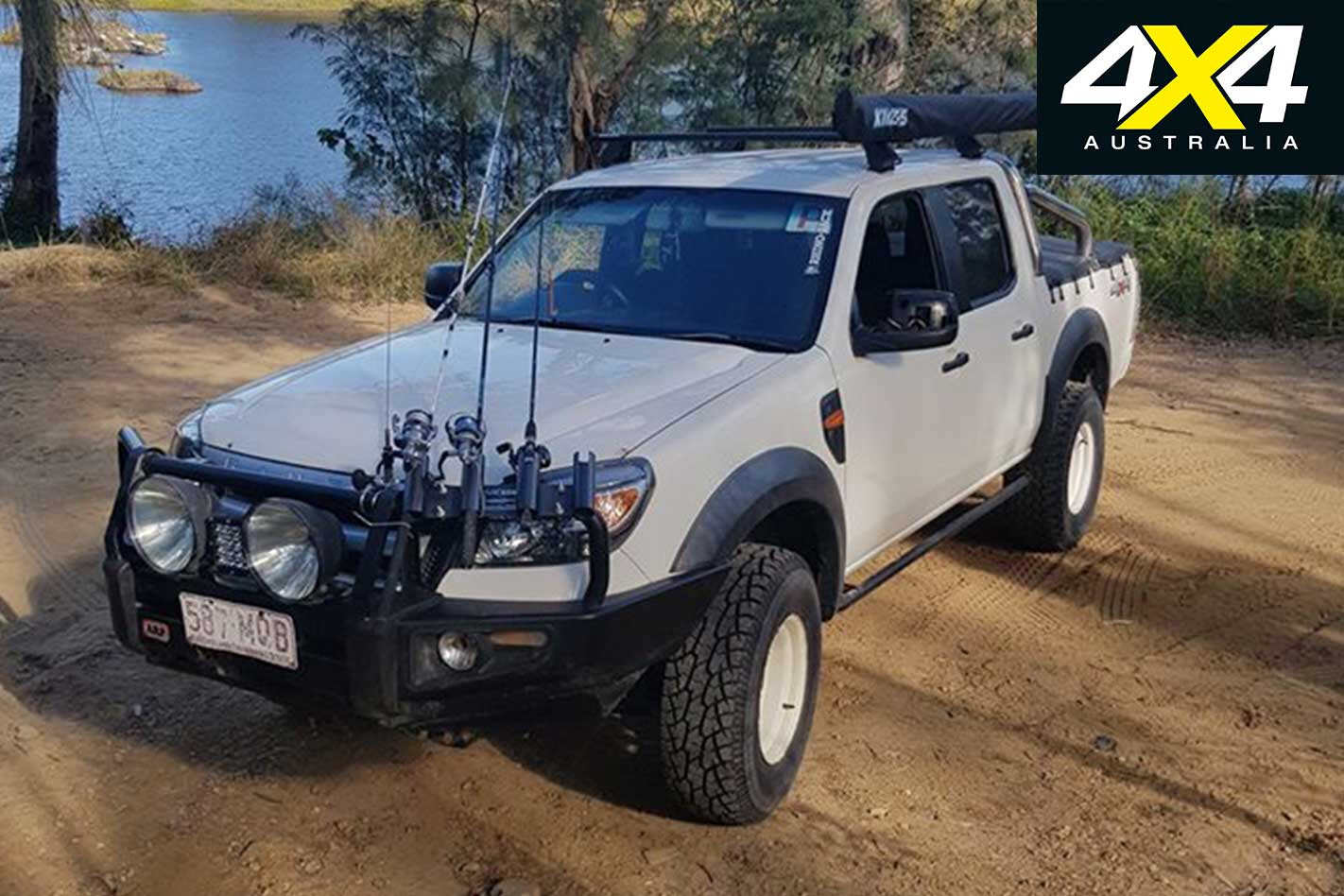
Features include a 2010 PJ tub tray, two-inch lift on 35-inch Hifly all-terrains, K28 turbocharger running 27psi, four-inch exhaust and custom rock sliders. I plan on lifting it to four inches, installing a better UHF and winch, and adding side bars and a rear bar. The best place I have been so far is Fraser Island, but my mates and I are planning a trip to the Cape in 2020.
1979 TOYOTA BJ40: MICHAEL BEARD
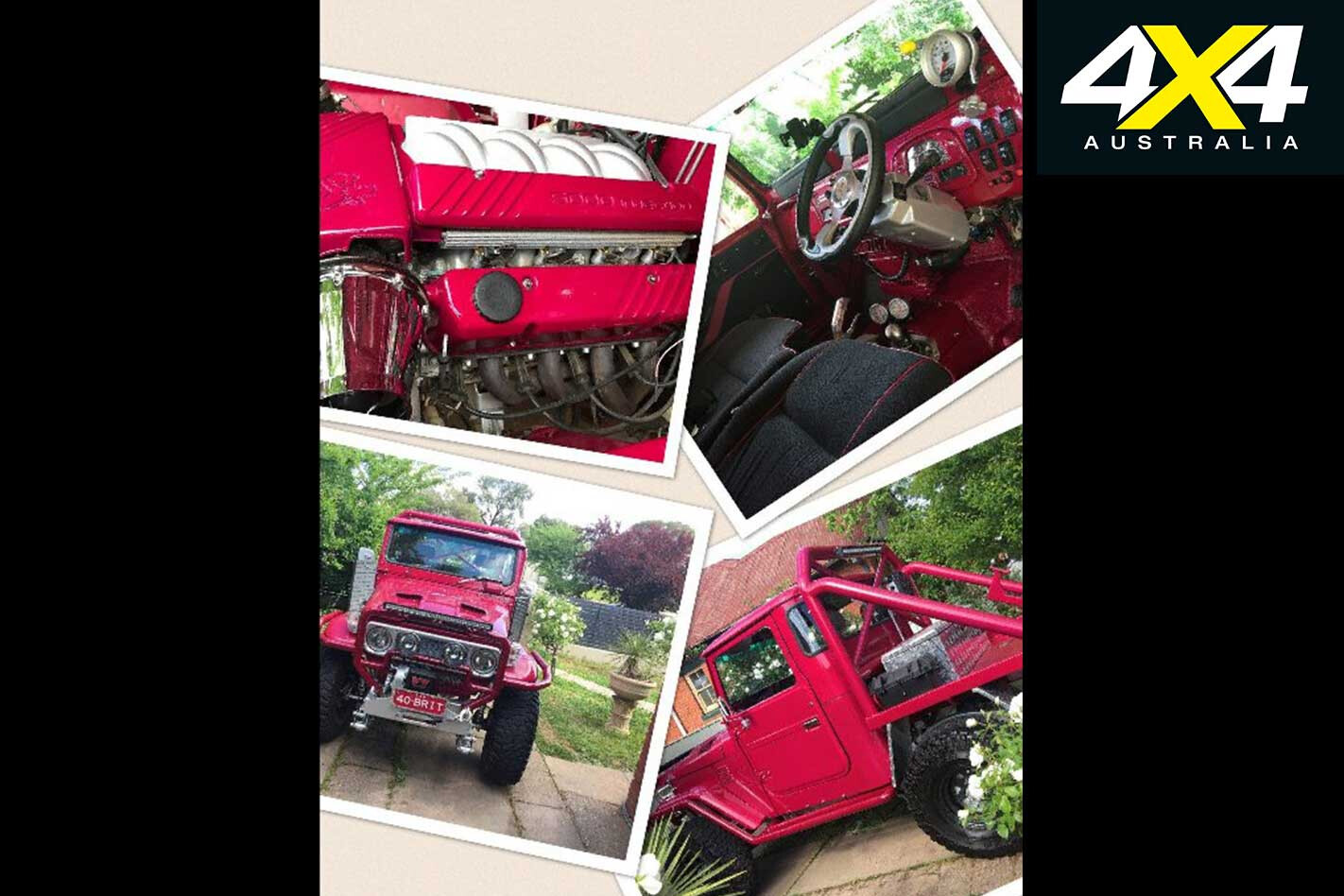
The chassis has been extended eight inches in the rear to fit 45 Series rear leaves for more flex. It features a 1981 model 45 Series cab; 35-inch tyres; injected 304 Holden Commodore motor; Turbo 400 shift-kitted auto with 55 per cent reduction low range and 8 per cent reduction in high-range crawler gears; a custom tray; custom fuel cell; custom bar work; custom interior; big stereo with two subs; and a Warn high-mount winch with in-cab controls.
All the work has been done by myself and my dad in the home shed. Plenty more to list. It’s also fully engineered!
2012 NISSAN NAVARA ST-X 550: BRYCE WILLIAMS
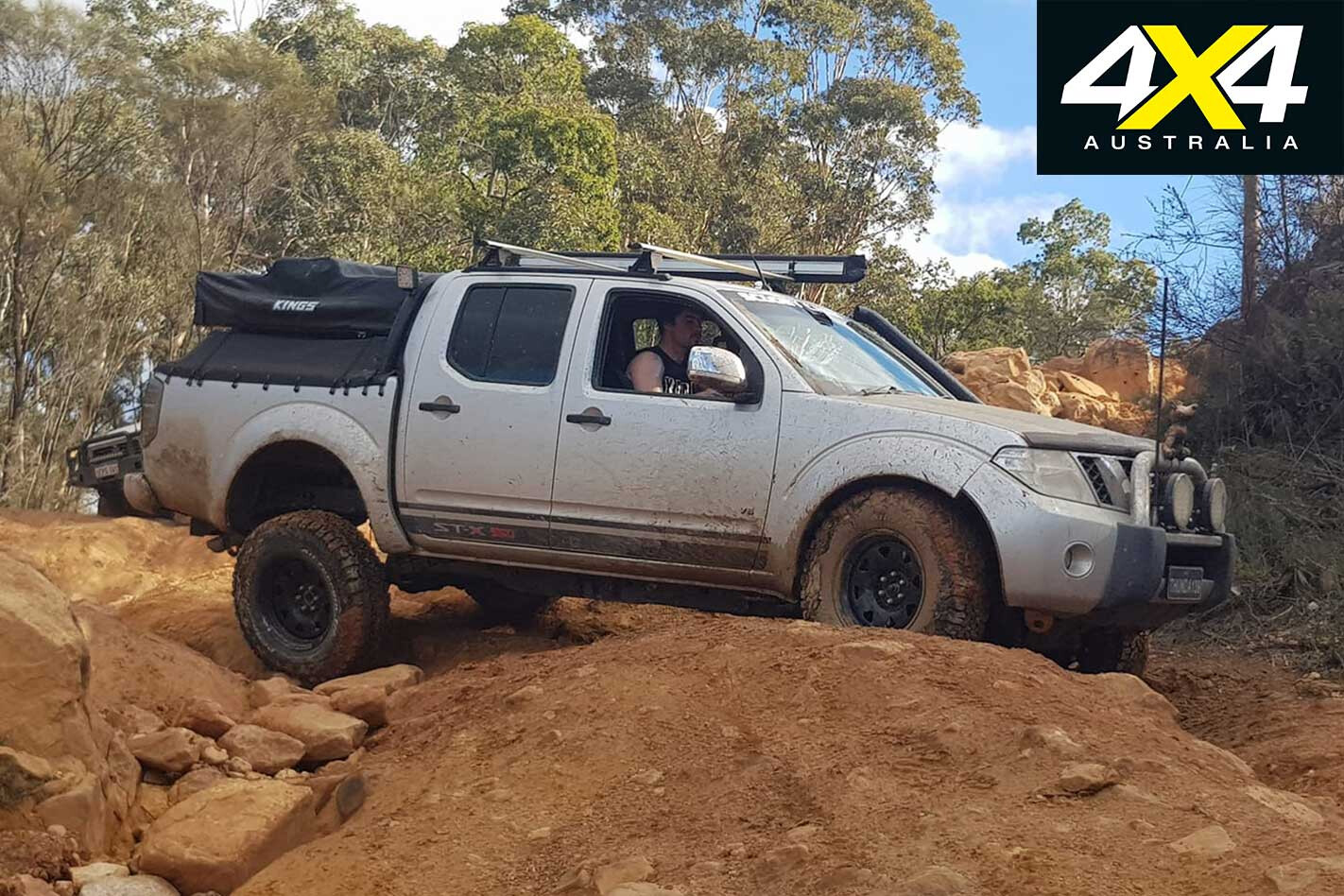
Mods include: 33-inch tyres (steel rims 0 offset); three-inch stainless steel snorkel; three-inch stainless steel Manta exhaust; custom airbox with K&N pod filter; phone booster aerial; rooftop tent; awning; drawers in back; canvassed back; roof racks; rear LED lights; lights in canopy; dual batteries; 40L fridge in cab; Hi-Lift jack in canopy; DVD head unit, with 6×9 speakers in the back; nine-inch spotlights on the front; and rear lights. The best places I’ve taken it would be Wedge and Lancelin.
TOYOTA LAND CRUISER 100: ERIC MOLENAAR
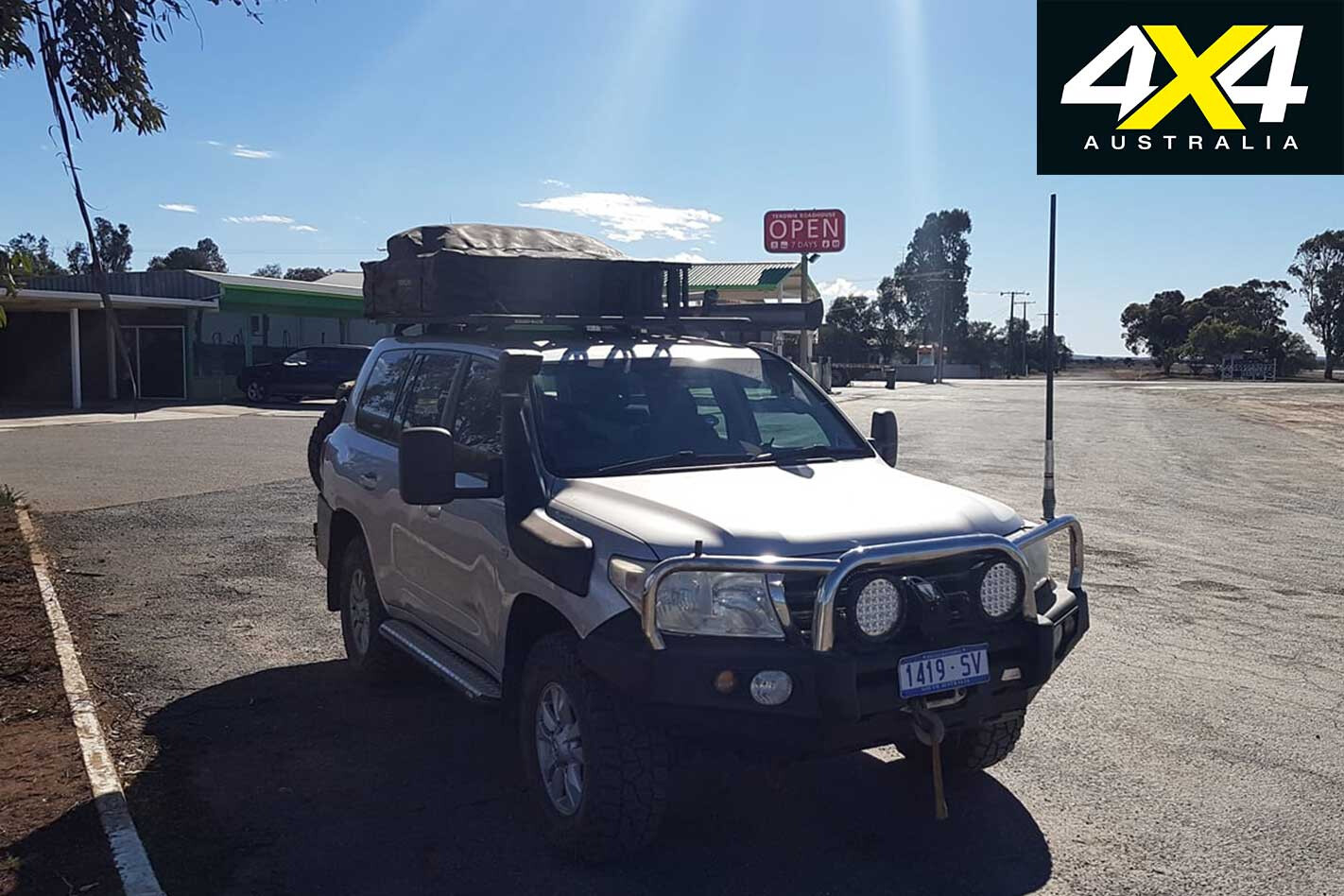
Features include a two-inch lift, Mickey Thompson ATZP3s, Darche awning and rooftop tent, MCC front and rear bar as well as side-steps, and a 1200lb Dominator winch.
2009 TOYOTA HILUX SR5: LINDSAY WATTERS
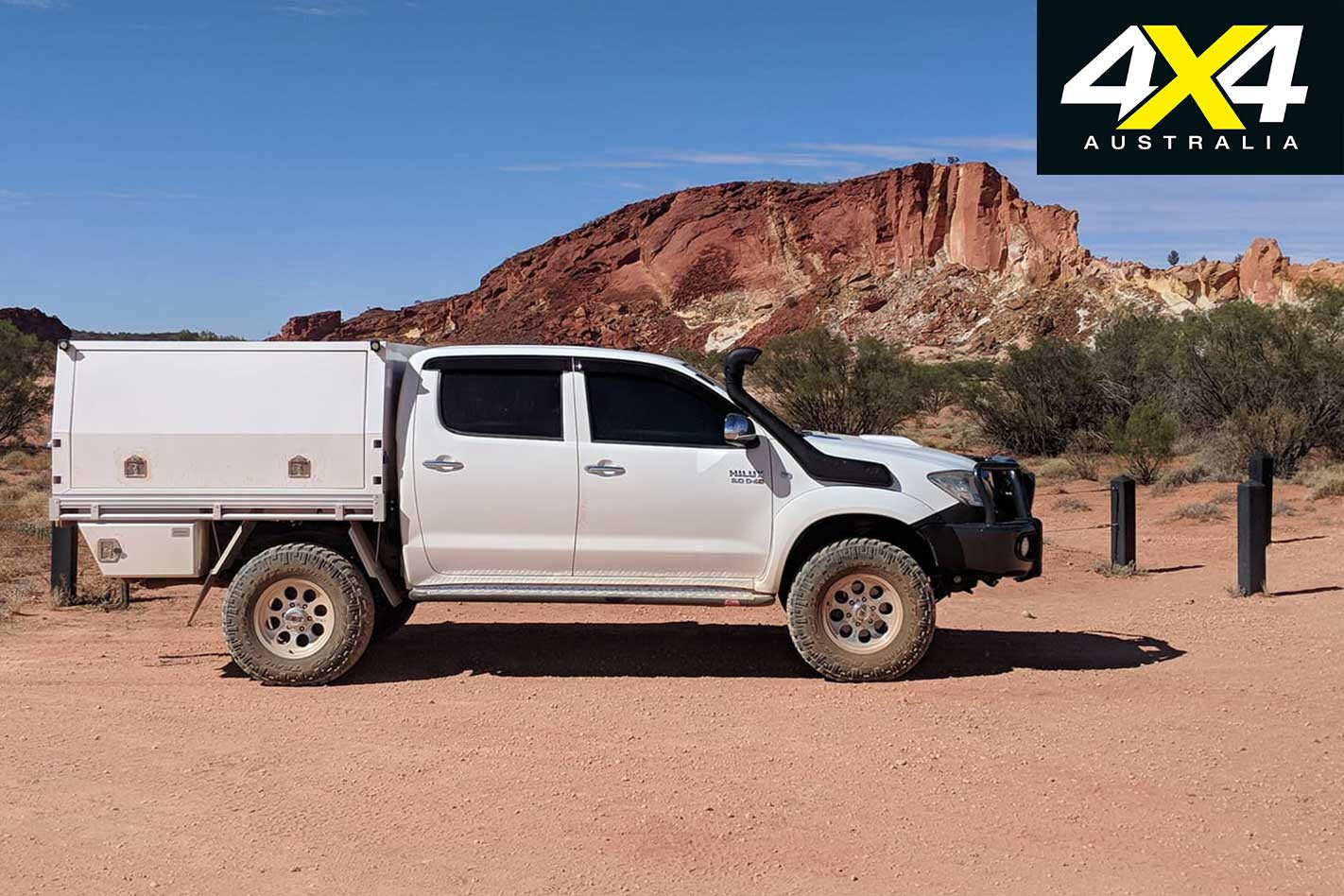
Mods include: a two-inch lift all ’round; a snorkel; Mickey Thompson rims; MCC side-steps; and the tub has been replaced with an alloy tray and canopy. It’s decked out with two batteries; 150L Long Ranger fuel tank; Redarc 1215 S2 charging system; two fridges; 50L water tank; instant gas hot-water service for showers; two 10-inch LED spotlights; four internal strip lights; and four external camp lights.
We purchased it in January this year and took six months to build it up, and we only finished in June and headed straight to the NT to test it out. Ayers Rock is the best place it’s seen so far, but looking forward to plenty of touring in it. Rooftop tent and awning to come.
It’s early on a Monday morning and the sun is rising over the distant reaches of the Mexican desert. On the horizon, the dirt two-track I am parked on fades into the distance like a thin ribbon of chocolate over the carroty foothills. The far-off mountains beckon.
This feature was originally published in 4×4 Australia’s July 2009 issue
I’m not really sure of my exact drive route today, but I know my destination, and it’s nowhere near the frenzied and chaotic disorder of the freeways near my home town.
Today, I won’t have to dodge any SUV-wielding soccer-mums who drift into my lane, I won’t be jockeying for a parking spot near the office, and I won’t be standing 20-deep in the queue at Starbucks. In fact, I won’t be dealing with any of that crap for months to come.
The air is crisp and a cool breeze heightens my senses and awareness of my surroundings. I’m in the middle of nowhere and heading south to Central America, Belize, Guatemala and points south.
Breaking camp is never more than a 10-minute affair. Just hit the button to close the electric top and snap down a few latches. Clicking on the GPS, I turn the key and slide the transmission into drive. But something is still wrong … it’s a persistent and blaring noise coming from outside my door. Crap, it’s my alarm clock, and I hastily reach over and hit the snooze button.
It is still Monday, but the time clock and traffic await, not my dream expedition rig and a year-long kitchen pass. I want to go back to my dream, to that road less travelled, the distant horizon and what lay beyond.
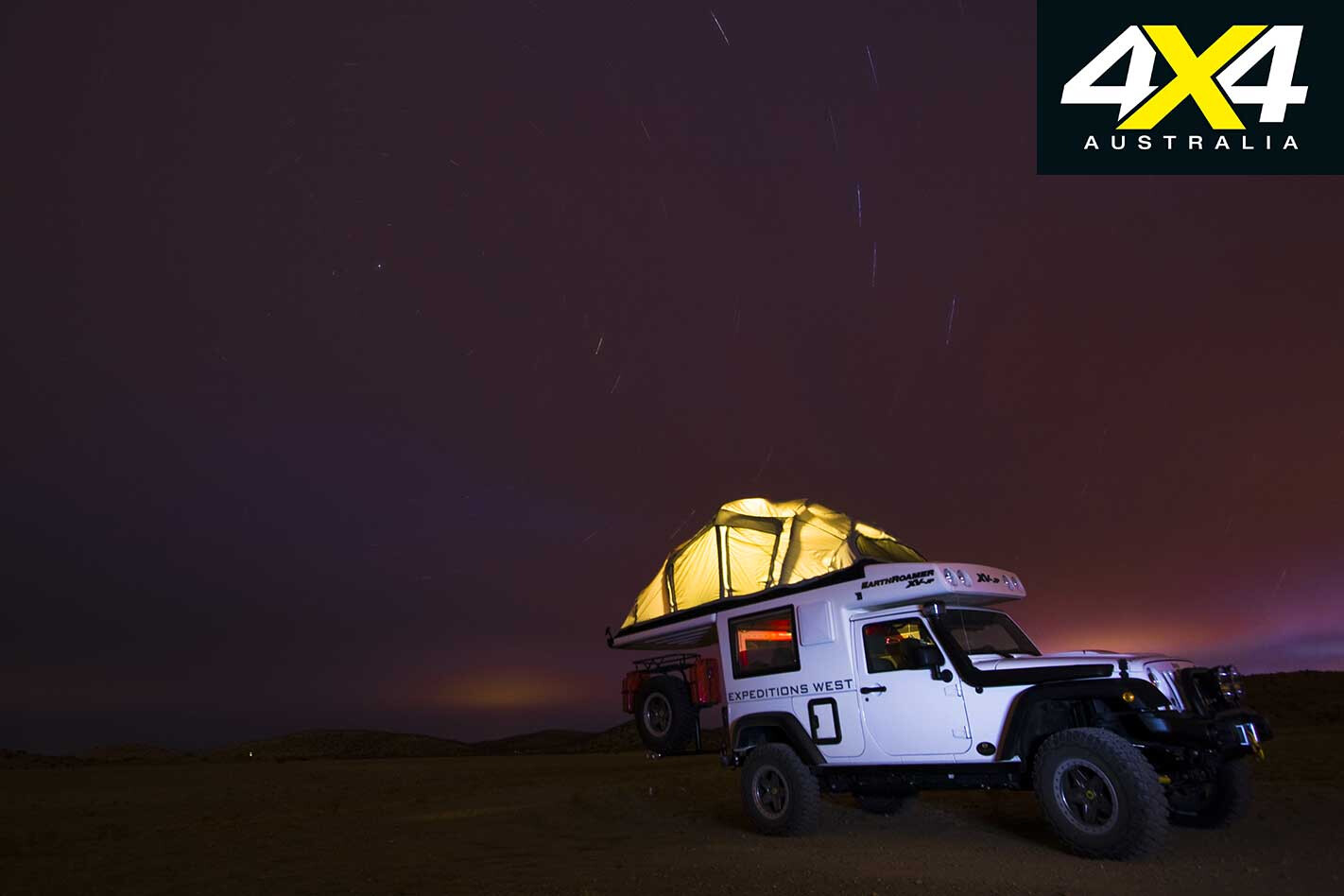
We’ve participated in numerous campfire debates about the perfect expedition rig. Should it be a behemoth lux-machine such as a Unimog or Unicat, or something smaller with a few less amenities but more manoeuvrable? And what are the must-have features: solar power, a navigation system, hot water, shower, comfortable bed for two, a potty, fridge and room for gear? And lastly, what platform do you build it on?
Following the 2008 SEMA show in Las Vegas, we headed to Prescott, Arizona, to check-out what one man, Scott Brady, thinks is the perfect world travel rig. As an ex-technology executive and now publisher of Overland Journal magazine, a book dedicated to vehicle-dependant overland travel, Brady found everything he needs in the EarthRoamer XV-JP. We think he might be right.
It is clear that attention to detail was a priority when designing the Earth Roamer. Security and safety are addressed with an on-board GPS, Tuffy Security centre console and lockable glovebox, and a Spot global emergency transponder.
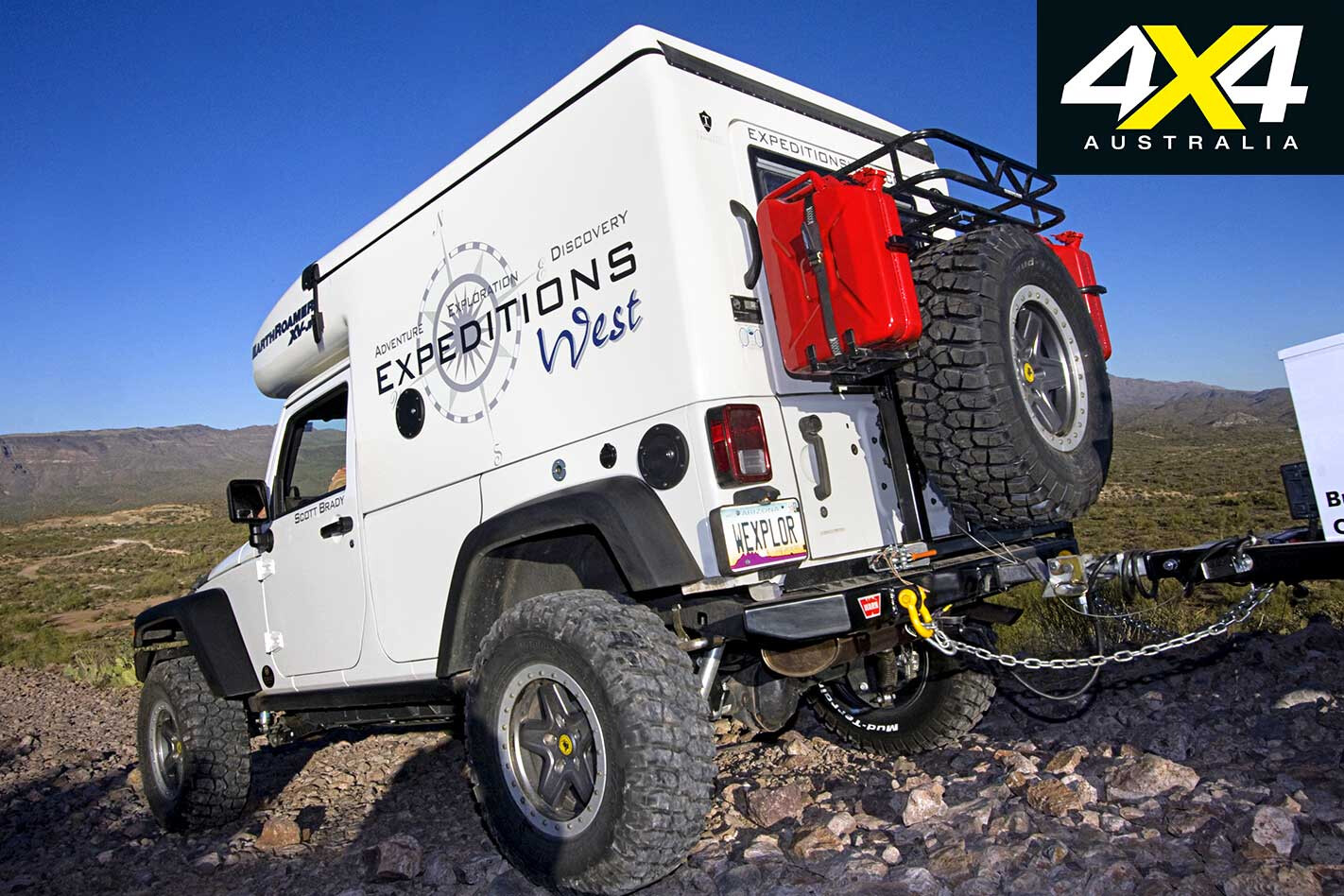
Everything from the Isotherm DC cold-plate fridge/freezer and Espar heating system, to the solar panels, Loftop air-frame and heat exchanger hot water, is designed with weight, function and efficiency in mind.
We took the Earth Roamer out for a spin and even tried to talk Scott out of the keys for a month. He wasn’t too keen as he and wife Stephanie are heading south towards Panama. From there they will ship the EarthRoamer to Ecuador and traverse the spine of the Americas all the way south to the tip of South America. So, it’s back to the office to keep dreaming of the day when we can build the ultimate overlander and check out of the rat-race for a year … or more.
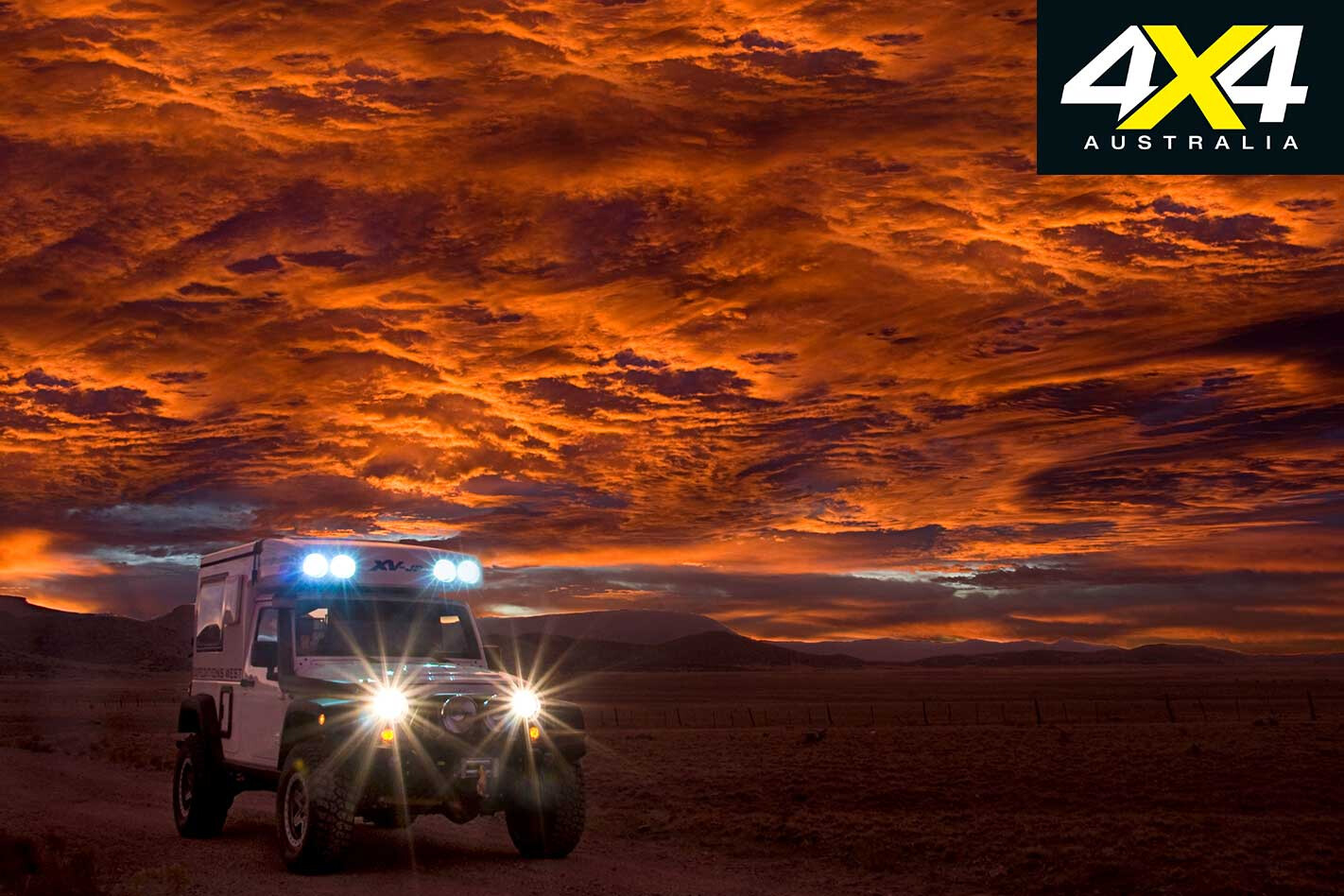
More info – EarthRoamer: earthroamer.com – Adventure Trailers: adventuretrailers.com
Base metal
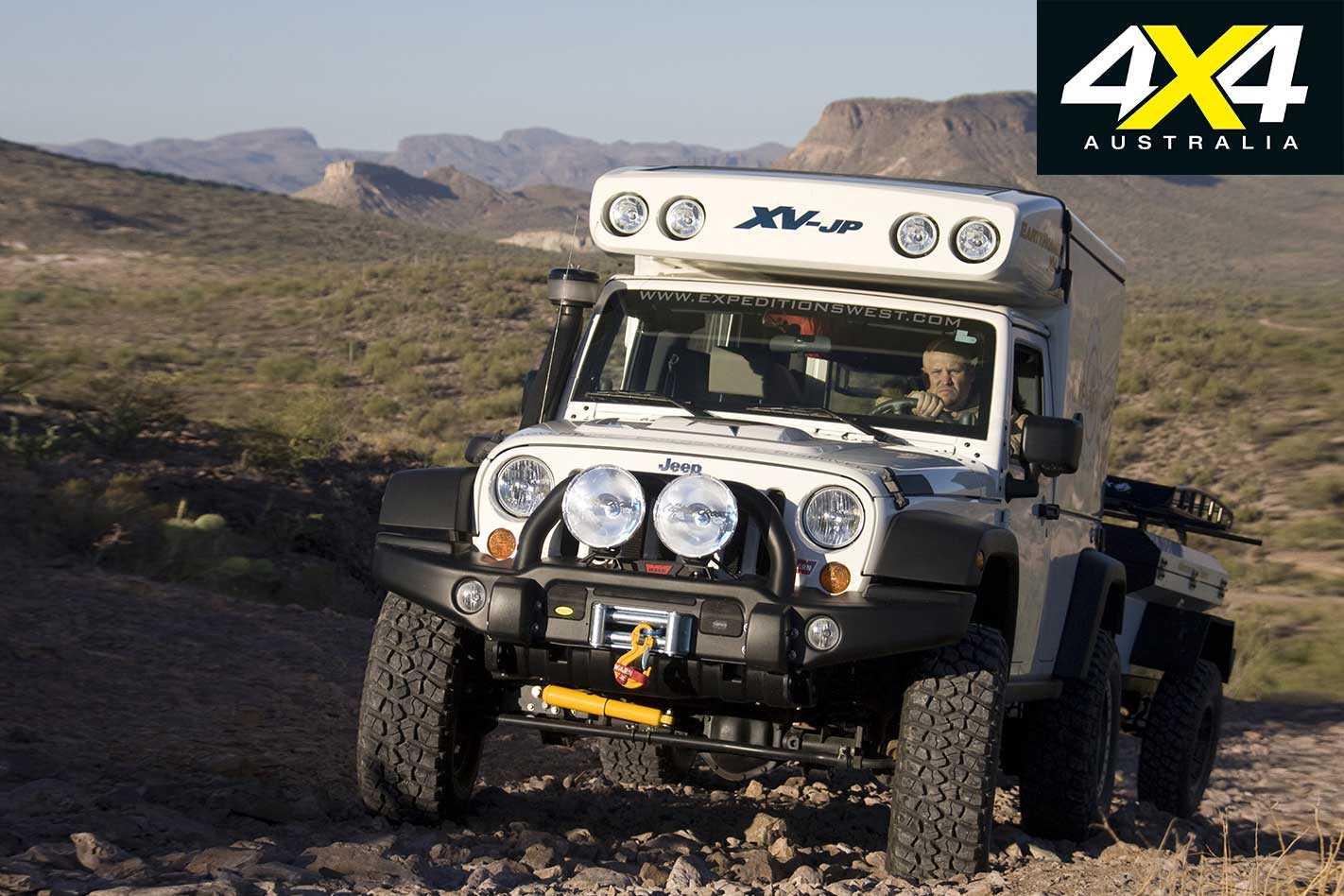
In typical Yankee style, the base platform for the EarthRoamer is a Jeep Wrangler Rubicon Unlimited. It rolls from the factory with Dana 44 axles and electric lockers, an NV241 4-to-1 transfer case, electronic swaybar disconnect and a 3.8-litre V6.
From there the Jeep was fitted with an Nth Degree three-inch suspension lift from American Expedition Vehicles (AEV), heavy-duty rear springs, and BFG KM2 Muddies on 17-inch AEV beadlocked rims.
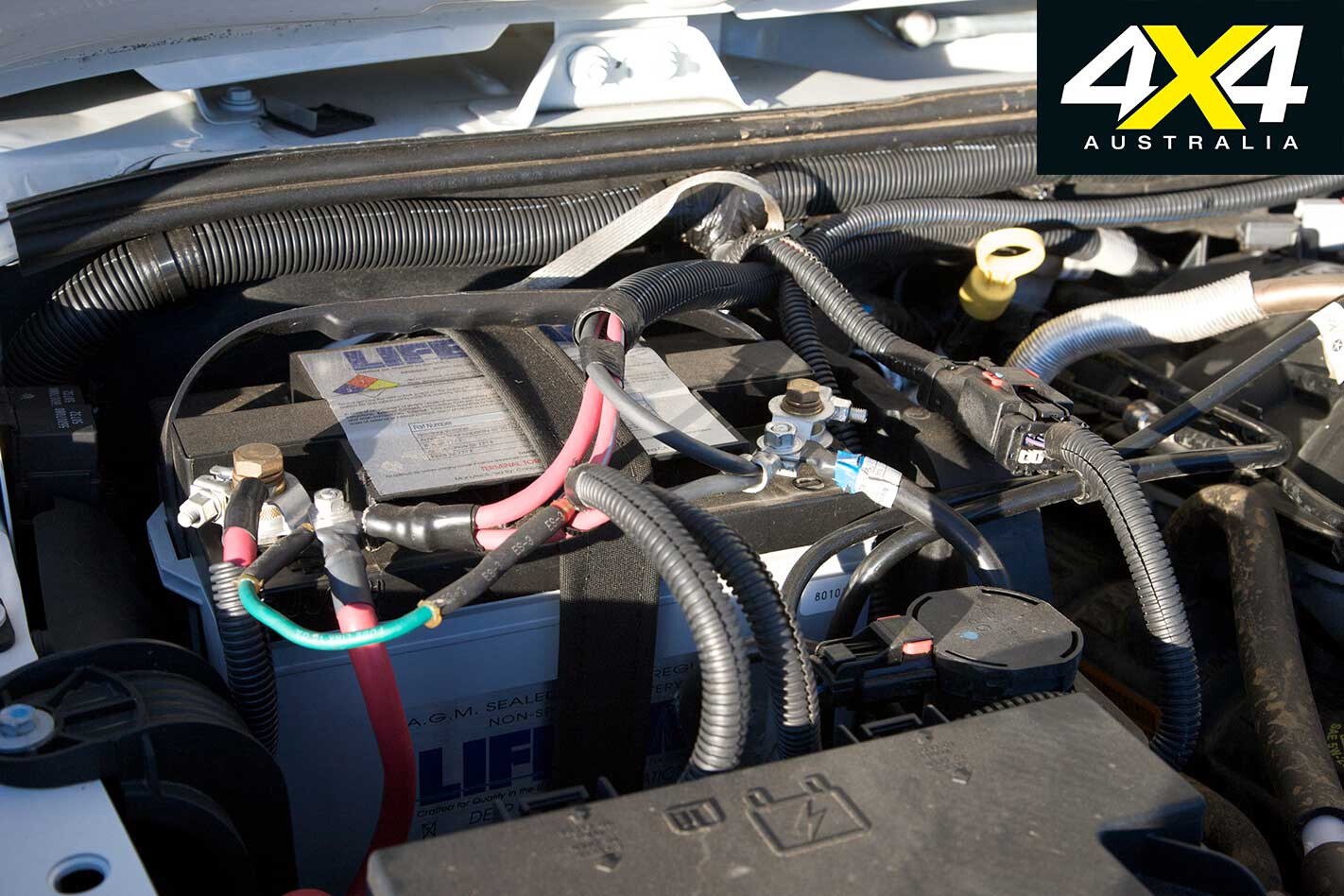
Up front, an AEV front bumper cradles a Warn 9000i winch spun with Viking synthetic winch line. And when the sun goes down, Lightforce HID 240 driving lights provide plenty of illumination. Out back, a Wilderness rear bumper carries the spare tyre, a pair of jerry cans and shovel. Rounding out the upgrades are a Kilby compressor, AEV snorkel and three AGM Lifeline batteries.
Room to manoeuvre
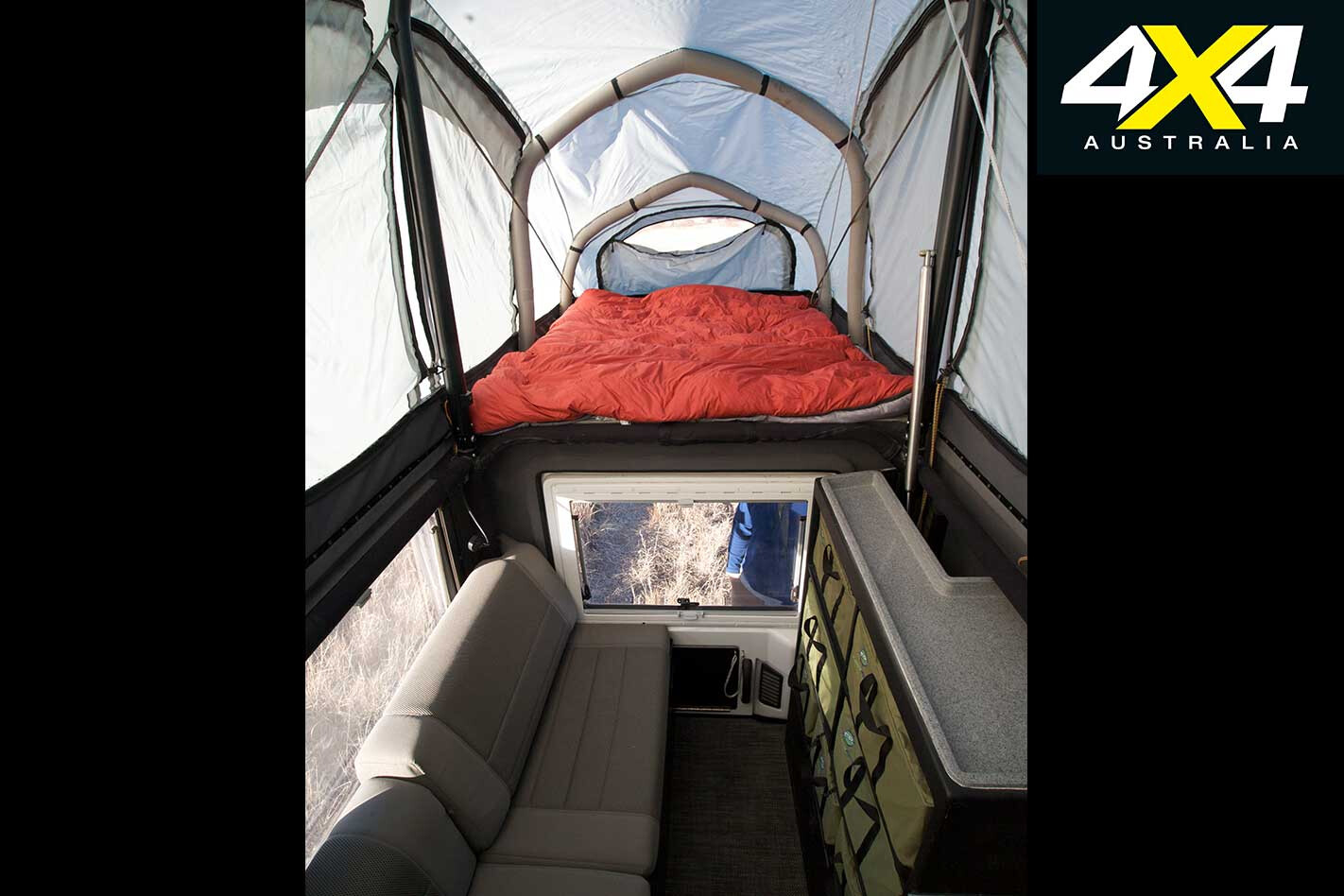
The interior is nothing short of luxurious; with the camper’s top up, there’s enough headroom for even the loftiest of basketball players, and the innovative plastic-spring, queen-size bed is lightweight and long enough to stretch out on after a tiring day.
The passenger side sports a comfortable bench seat that conceals an Isotemp solar-powered fridge, toilet and shower. To starboard is a sink with hot/cold water and a flip-down counter, and a bank of canvas storage bins for sundries, clothing and gear.
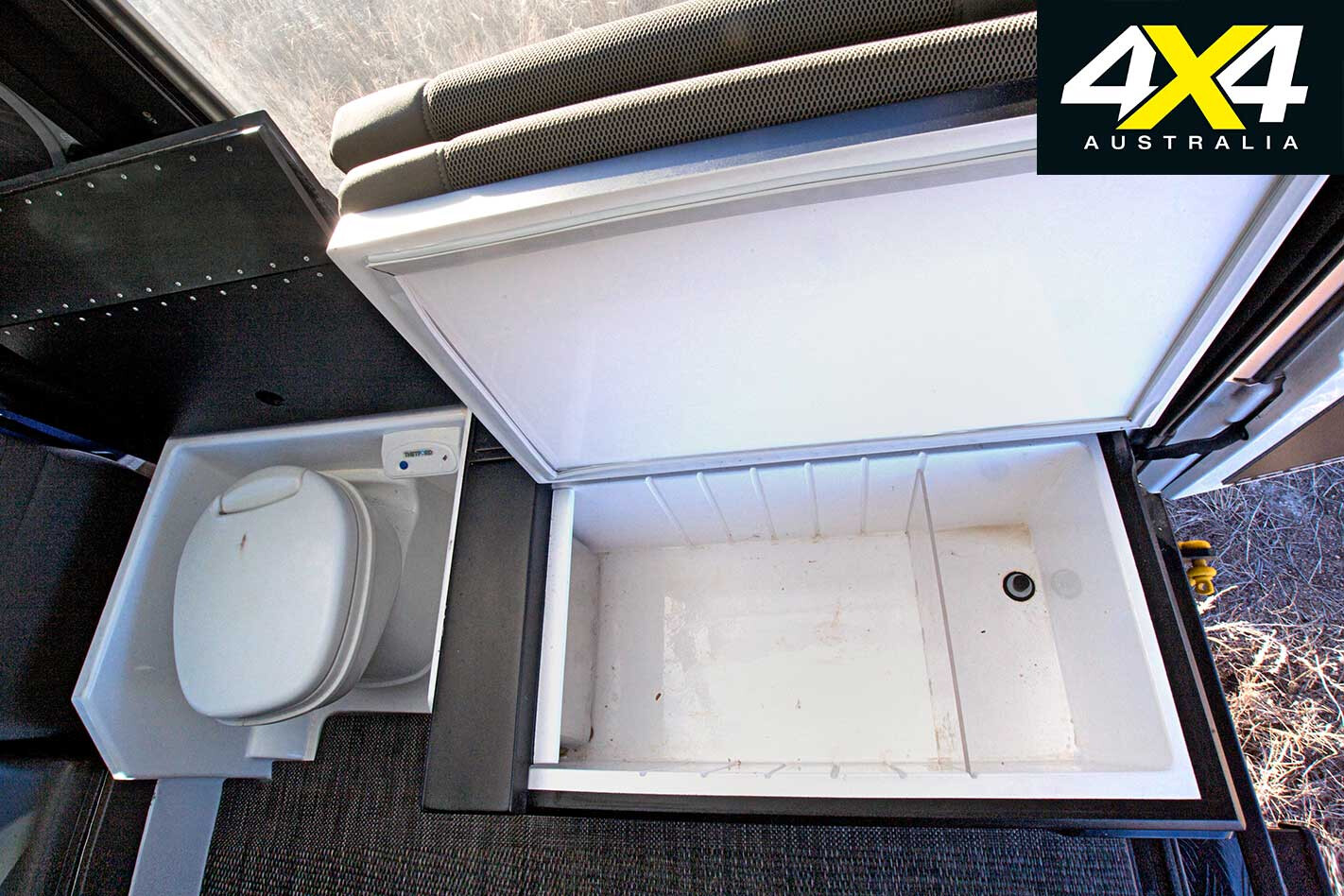
With a 95-litre fresh water, 38-litre grey water and 17-litre black water tanks, setting up camp for a few days should not be an issue. For cooking, or that weekly shower, hot water is provided via a 15-litre heat exchanger hot water system (you’ll need to run the motor for four minutes to get it hot). When it’s cold, the shower sets up inside, but when there’s no frost on the pumpkin, it can be routed outside for an open-air affair.
The extra weight and noise of a generator is dispensed with by the addition of an 80-watt solar panel and a 160-amp alternator which charges a bank of three Group-31 AGM Lifeline batteries. To insure against running your batteries flat, a 200-amp relay connects the auxiliary units when the engine is on, and isolates them when it is off. On chilly nights, the Espar 6100btu ultra-efficient forced-air unit, which draws from the main fuel cell, will keep things warm.
The shell of the Earth Roamer is crafted from a composite material and built in sandwiched layers to maximise structural integrity while keeping weight in check. The top opens via a 2.5hp Leeson electric winch with the push of a button, and the Loftop tent assembly is supported by a featherweight airframe (which automatically inflates via the Kilby engine-mounted air compressor).
If all this isn’t enough, Brady added an Adventure Trailer Chaser fitted with matching BFG tyres and air suspension, a Baja rack, an Eezi-Awn awning and additional work lights.
Amazingly, the Earth Roamer measures just 4.7 metres in length, about 2.2 metres tall and less than two metres wide.
Take a break from hitting the tracks, make yourself a good cup of coffee, put your 4×4 rig on the charger, pull up a book, and cool your heels.
These 4×4 Gear aren’t what you need to get you places, but it certainly makes the trip all the more worthwhile when you get there.
Thunder espresso machine and coffee grounds adaptor
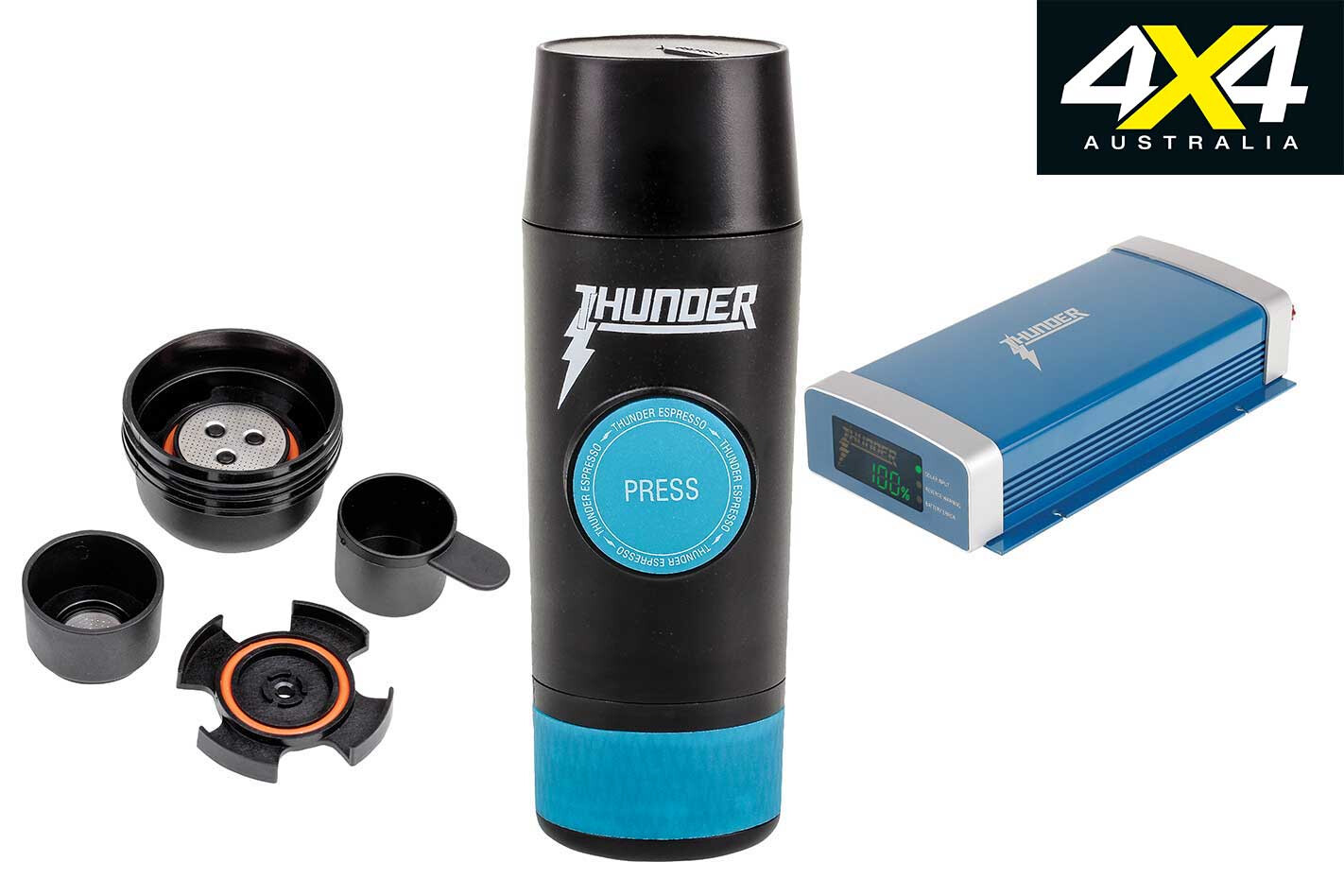
Yep, coffee is great, which makes this new portable espresso machine from Thunder even greater, allowing you to brew your morning cuppas with minimal fuss.
The Thunder portable espresso machine is compatible with pod-style coffee and can produce up to 50 cups when the unit is fully charged (it is USB-chargeable and takes three hours to attain full charge). As well as being pod compatible, there is a grounds adaptor available that allows you to use your favourite pre-ground coffee.
The espresso machine is compact – 310mm tall, 95mm wide and weighs 720g – making it easy to pack for that camping adventure, with the coffee grounds adaptor only 70mm wide and 100mm tall (and only 100g in weight).
RRP: $128 (espresso machine); $15.50 (grounds adaptor) Website: www.quantumpro.com.au
Schumacher Electric SPI10 battery charger
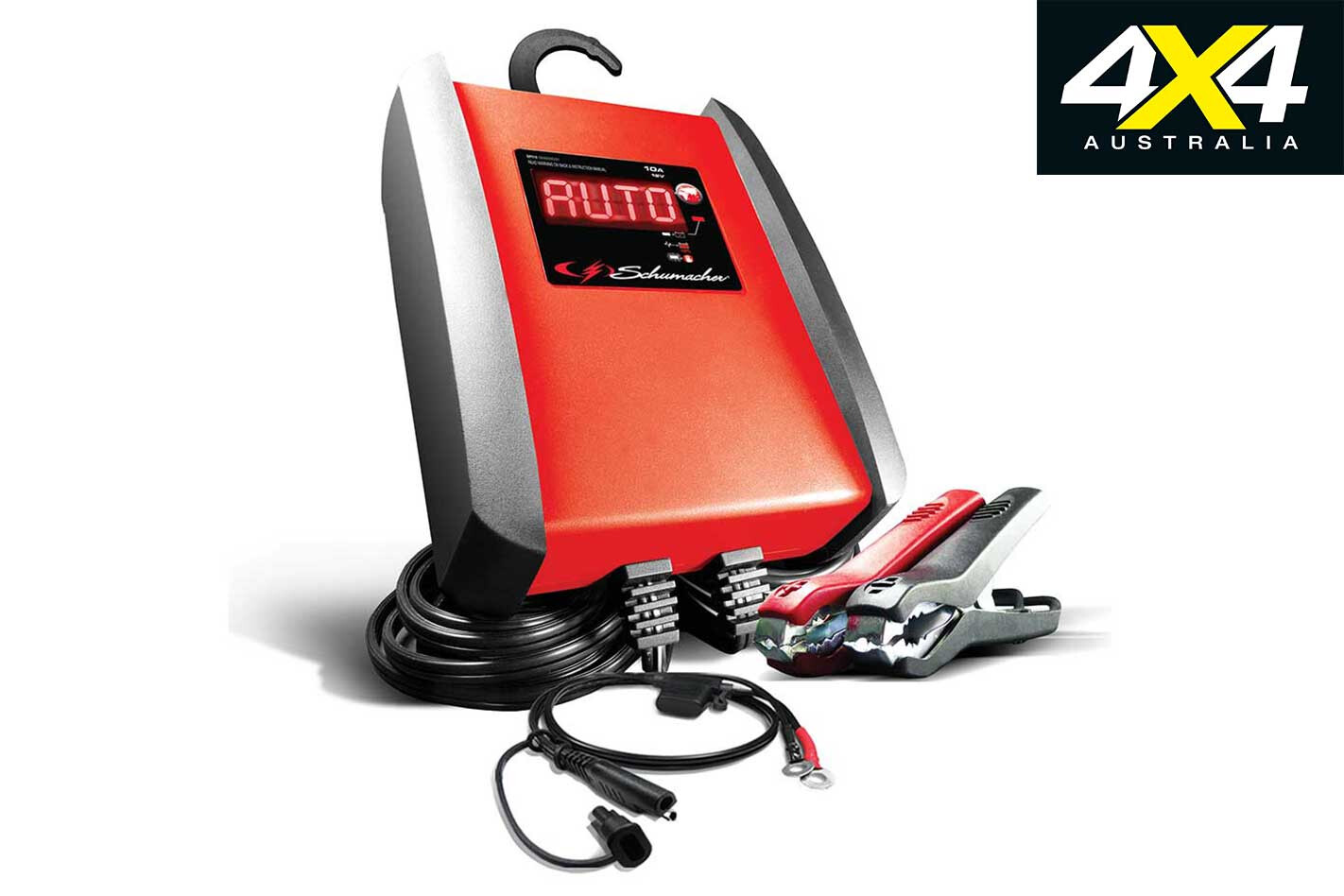
This fully automatic 12V 10amp battery charger ensures stored batteries stay charged, whether AGM, standard, gel, calcium or start-stop variants. The charger is microprocessor-controlled and offers multi-stage charging for additional precision, battery life and safety.
The charge includes an easy-to-read display that offers step-by-step instruction to ensure proper charging of the battery, and there is even a hook attachment for hanging the unit in your garage, on your motorcycle’s handlebars or via the bonnet of your 4×4 (there’s a set of protective bumpers on it as well).
The unit is compact, measuring 190mm long, 140mm wide and 65mm high, and it weighs in at 1.2kg.
RRP: $199 Website: www.batterychargers.com
Power of the pedal
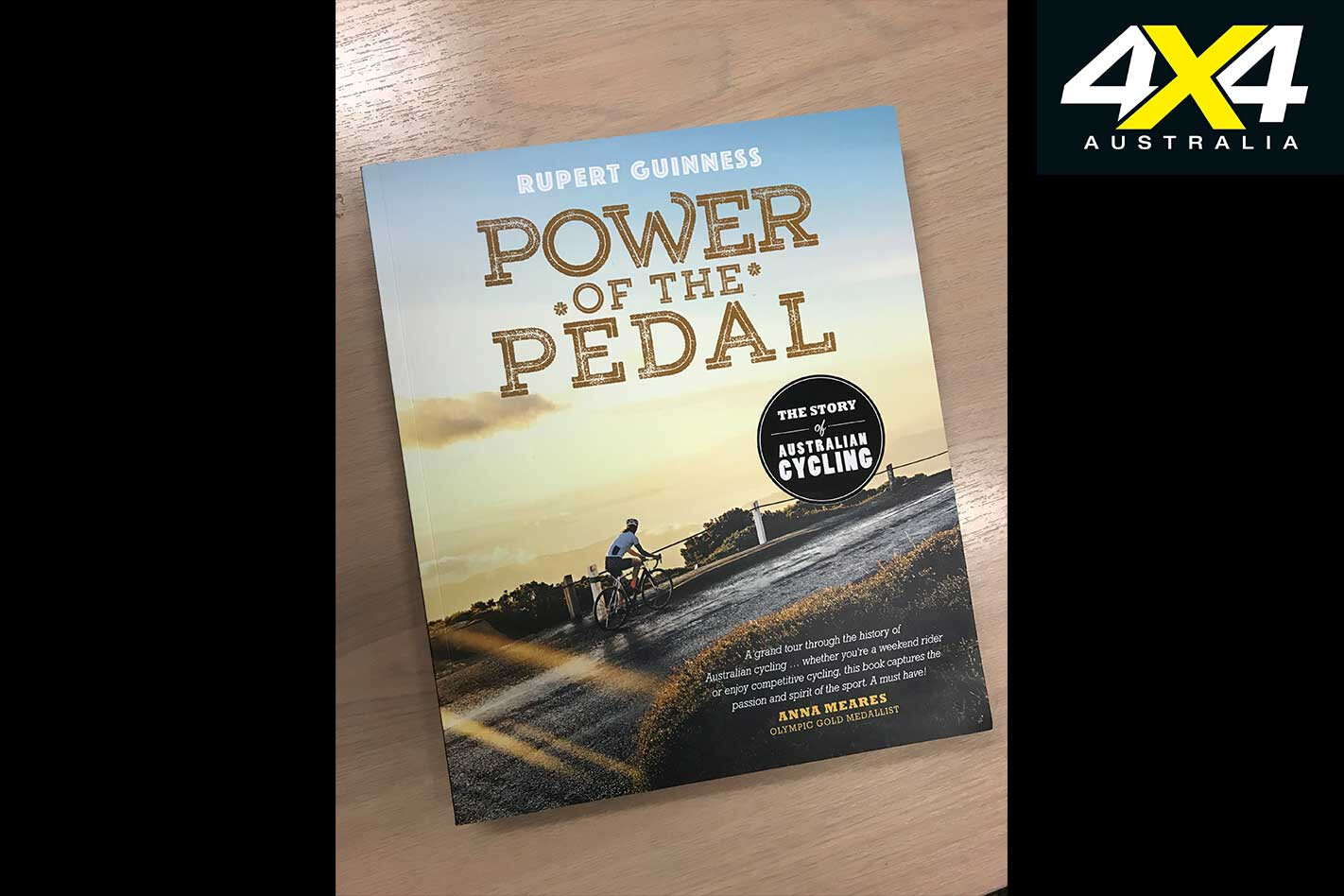
The humble ‘pushy’ has been a part of Aussie history for 200 years now. As well as being a popular outdoor activity and sport, the bicycle in Australia was the go-to for early overlanders in this country, with a number of first traverses on two wheels undertaken in the late 19th and early 20th century. It was also key for the military, especially during the Boer War and World War I.
All this forms part of this book written by highly regarded Aussie cycle journo, Rupert Guinness. The sections on the overlanders in particular are entertaining. There’s the story of Aussie George Burston who, with Harry Stokes, rode penny-farthings around the world. An entertaining read.
RRP: $40 Website: bookshop.nla.gov.au
“In the beginning, back in 1955, man didn’t know about a rock ‘n’ roll show, and all that jive”… Whoa, that’s one of AC/DC’s legendary riffs.
Take a leap forward a couple of decades, to the mid 1970s when GMH let loose the Holden Overlander, albeit at the hands of a privateer combined with factory manufacturing. In this beginning, we had the option of not only plastic seat covers, grandpa sun visors and rear window venetians, but we could tick the 4×4 options box which provided a fair dinkum 4×4 with high and low range via a Dana transfer case, Dana diffs and the venerable 308 V8. “He said, let there be sound” (AC/DC)… yeehaaa… my kinda rock ‘n’ roll; simple, loud and go hard.
From a young age, I’d dreamt of owning a real Holden Overlander, but had never quite taken my dreams seriously until a couple of short years ago, only to find the rarity of these beasts meant they were hard to find in good condition and prices had skyrocketed.
While full credit must be given to Arthur Hayward for the design and build of the Overlanders, in this day and age, there is, I reckon, a better way to build ’em that didn’t see you riding on leaf springs. After a few talks to engineers and mechanics, I set about sourcing the three amigos of which would become my dream 4×4 – my Mutant Tonner.
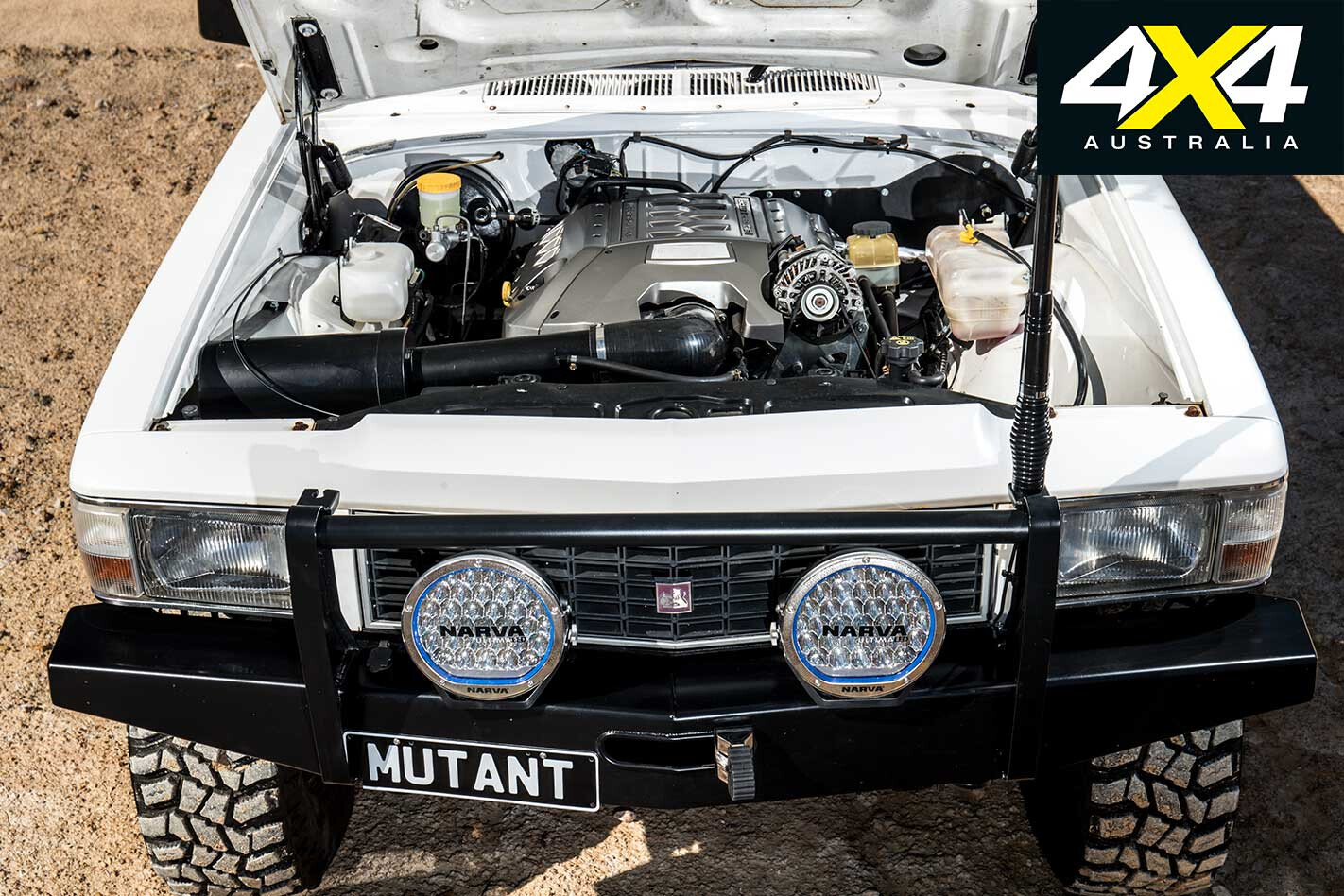
I’ll admit to wanting nothing short of a petrol V8 for this build. I would have been happy with an LS1, LS2 or even the old 308, but a phone call from my mechanic, Jason Dymock of Total Care 4WD saw my project jump into the fast lane with the purchase of a statuary write-off VE Maloo R8 Commodore Ute jammed packed with an LS3 (6.2-litre) and 6L80E auto gearbox (six-speed, with tiptronic style shifting).
Holy shittin’ dawgs; I was shakin’ at the knees even thinking about how hard my project would pedal and I hadn’t even heard the deep-throated rumble of the LS engine. What had I bitten off?
Next vehicle procured was a 1990 GQ Nissan Patrol wagon. It seemed there was a glut of cheap GQ wagons up for grabs – and mine was no exception – but I did hold out for one with a 4.2-litre petrol donk, to ensure the preferred diff ratios of 4.11:1 were included. Mine had LPG installed, offering a mid-mounted extra petrol tank that I could utilise as my reserve fuel, while the rear mounted LPG tank would be turfed in favour of a Long Ranger unit.
Extra accessories on the Patrol were simply incidental, as not much would be kept or used, provided the chassis was straight, steering was true and axles weren’t banana shaped. Mine came with two weeks rego allowing me to drive the 400km to Total Care 4WD and before it was deregistered.
Vehicle number three wasn’t so easy. I wanted a Holden 1-Tonner cab and nothing else, no wagons, panel vans or sedans, not even a Statesman. Searching the online sales outlets, asking mates to keep an eye out and even checking out a few car shows returned zero for well over nine months.
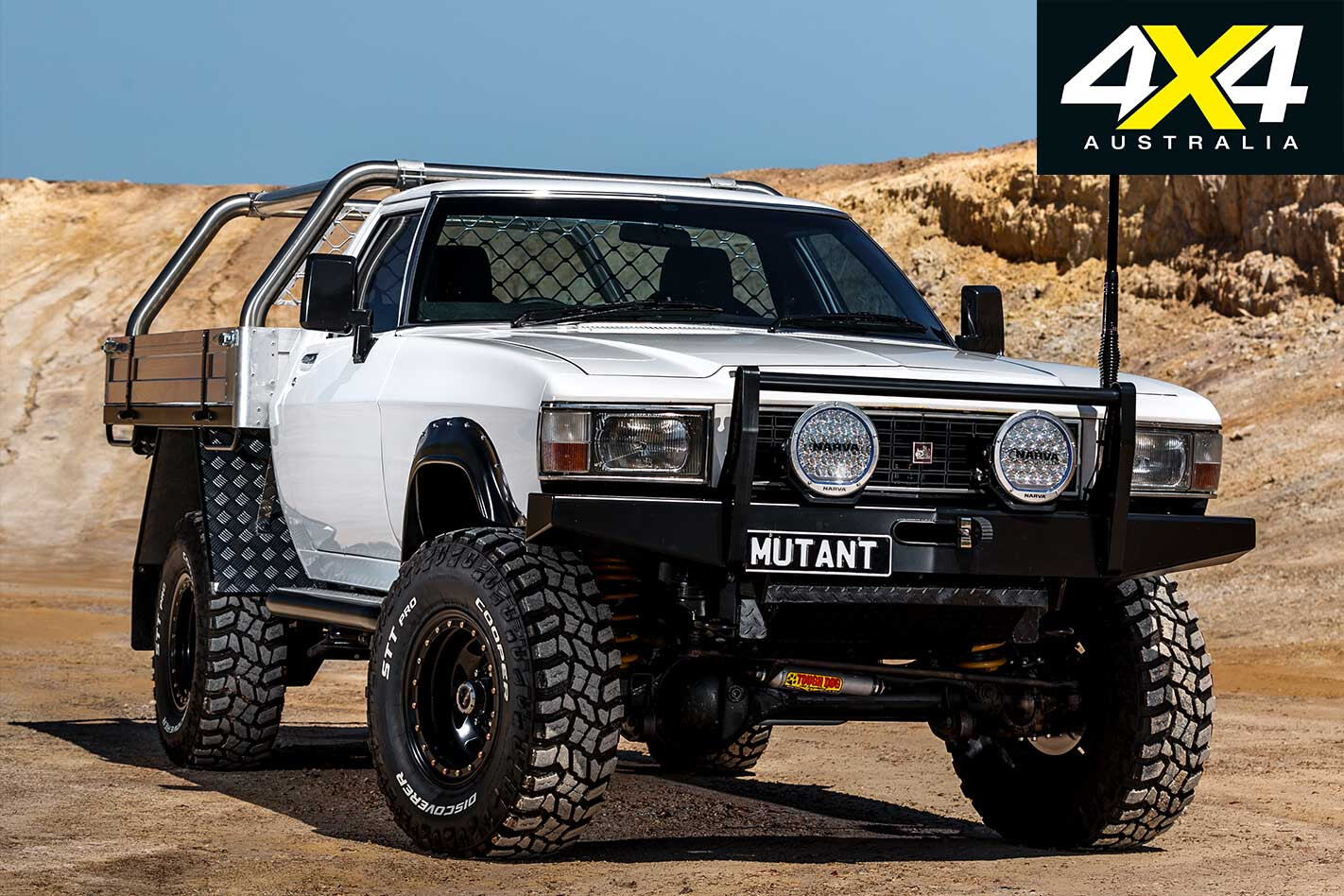
I wasn’t prepared to shell out, or pull apart, a big-buck restored vehicle, nor did I want to buy a bare shell from the wreckers, which would return more headaches than it was worth trying to source all the bits and pieces to make it complete.
Persistence certainly paid off; during a visit to the big smoke of Sydney, I again searched through all the online classifieds to find what was to become my donor Tonner. It had been bastardised; originally a HZ chassis, it now sported a HX body and WB front grille and headlights. Even the running gear had been swapped from a straight six with four-speed manual, to a 308 V8 and Trimatic auto box.
The body had been resprayed; it showed only minor signs of rust and it looked perfect with those rectangular WB headlights, albeit dull as candles. After laying my money down, it was driven home and used as a daily driver for six months, while the Maloo and Nissan were stripped and mated together. I lifted the Tonner cab in my side paddock, laid it onto my trailer and delivered it to Total Care 4WD in Sydney for the rest of the custom grafting.
Parts Galore
HAVING the three cars to strip was one thing; keeping and selling parts to get the most from my investment was another.
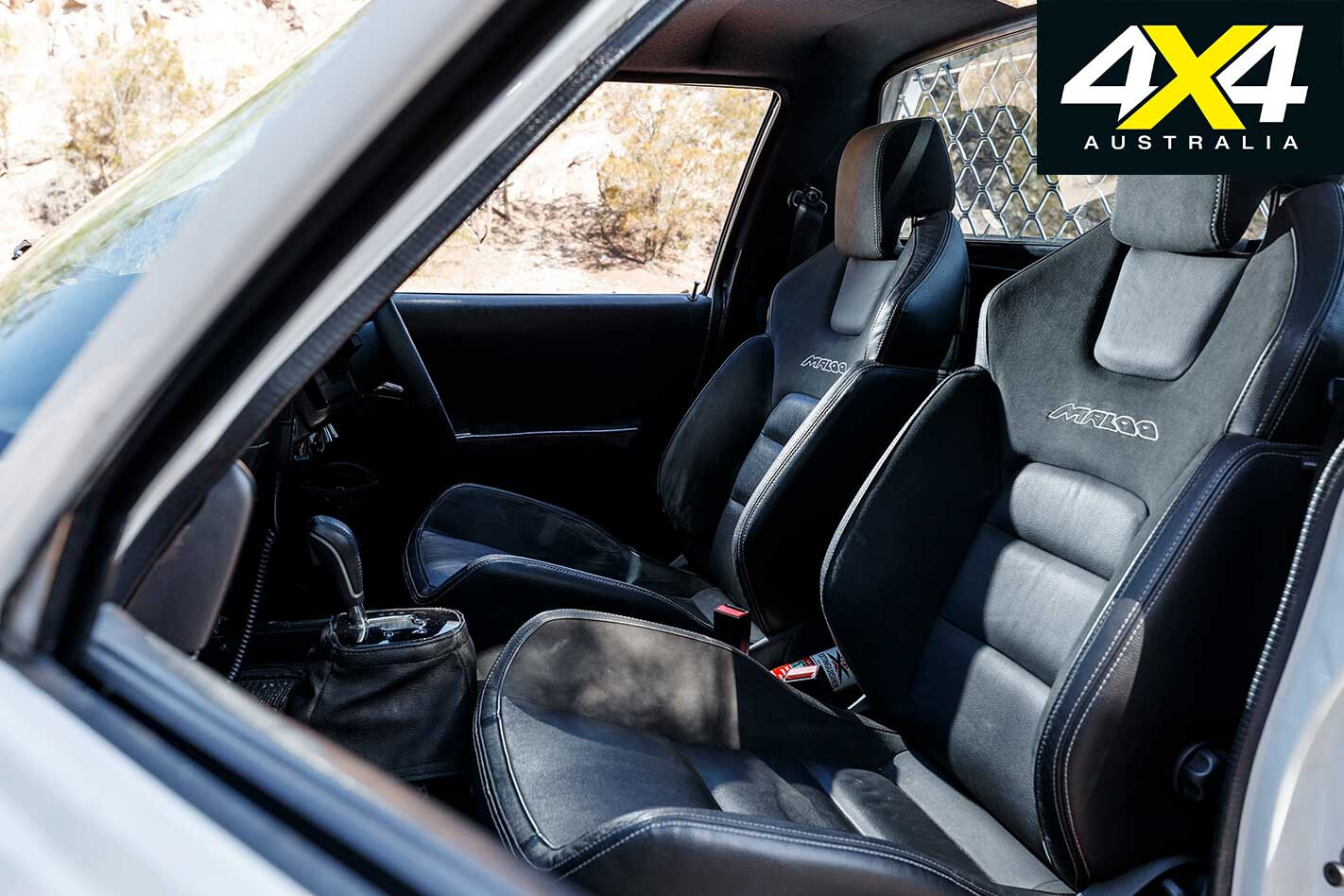
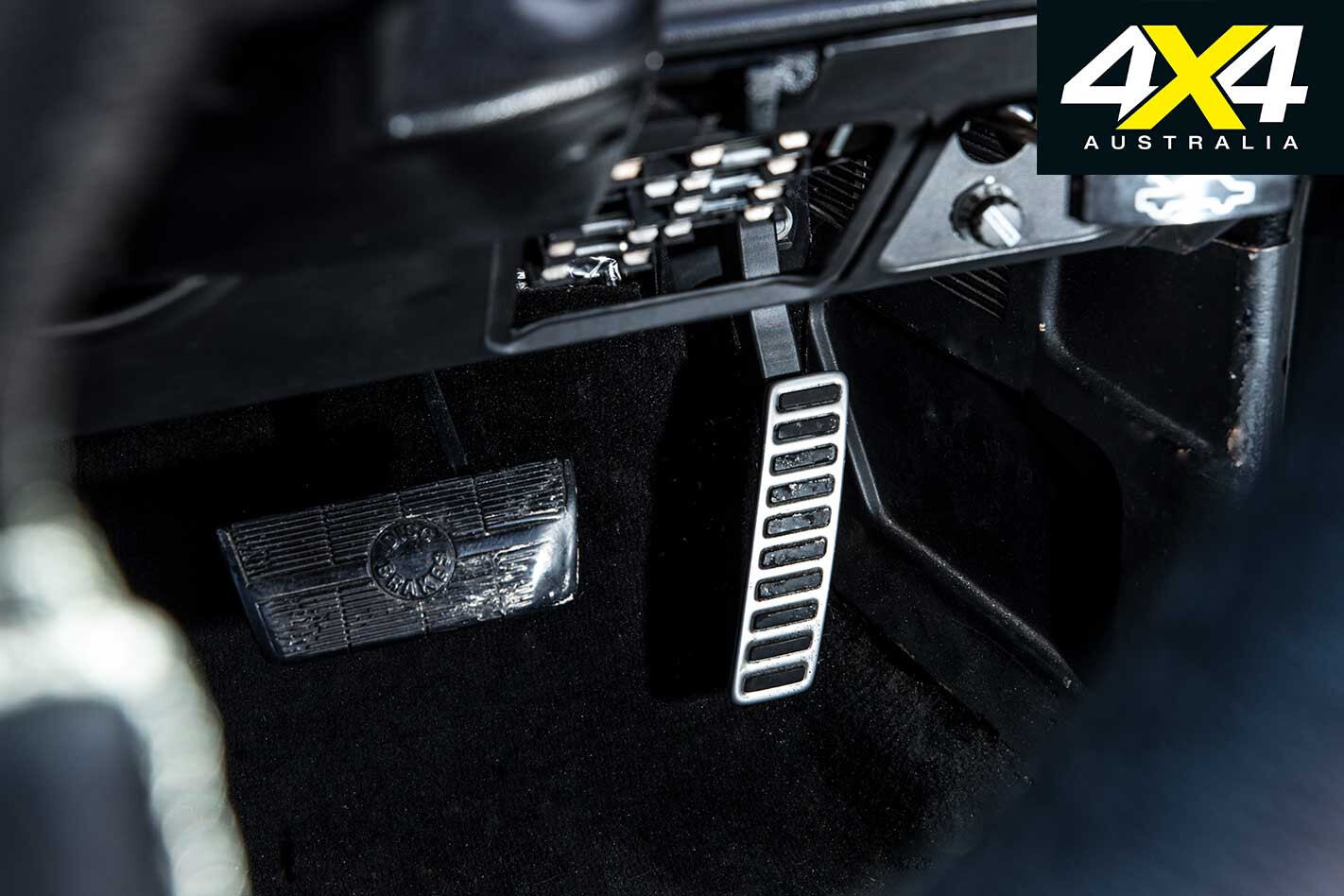
The Maloo ended up donating not only the 6.2-litre V8 and six-speed auto, but also the leather seats, shifter, seat belts, accelerator pedal, radiator with dual thermo fans and complete wiring loom – although, that had to be modified. All the rest – hard lid, HSV brakes, side skirts, bonnet, guards and all manner of smaller parts – were sold off returning about three-quarters of my outlay. Not bad, eh!
The Patrol chassis was the underpinning of the whole project, along with suspension, steering, brakes and a couple of smaller items. Everything else was either binned or sold, returning almost 100 per cent of the outlay.
The Tonner cab; wow, haven’t old Holden parts prices skyrocketed of late! Obviously, I wanted the complete cab, along with the whole interior minus the seats. Not more than a couple of days advertising the complete rolling chassis with steering, brakes, suspension, fuel tank, the 308 V8 with Trimatic gearbox and radiator, it sold for my full asking price.
Separate sales saw the centre console, bucket seats, front bumper bar along with a few other odds and ends sell with an overall recouping of three-quarters of my outlay.
Yeah, I know some will think it’s a sin for pulling apart a seemingly good Tonner … but it wasn’t original, wasn’t a whole car and was made up of a few separate old Tonners – a bastard at best. Plus, in a roundabout way, my sold parts have kept at least three other Tonners on the road.
That engine
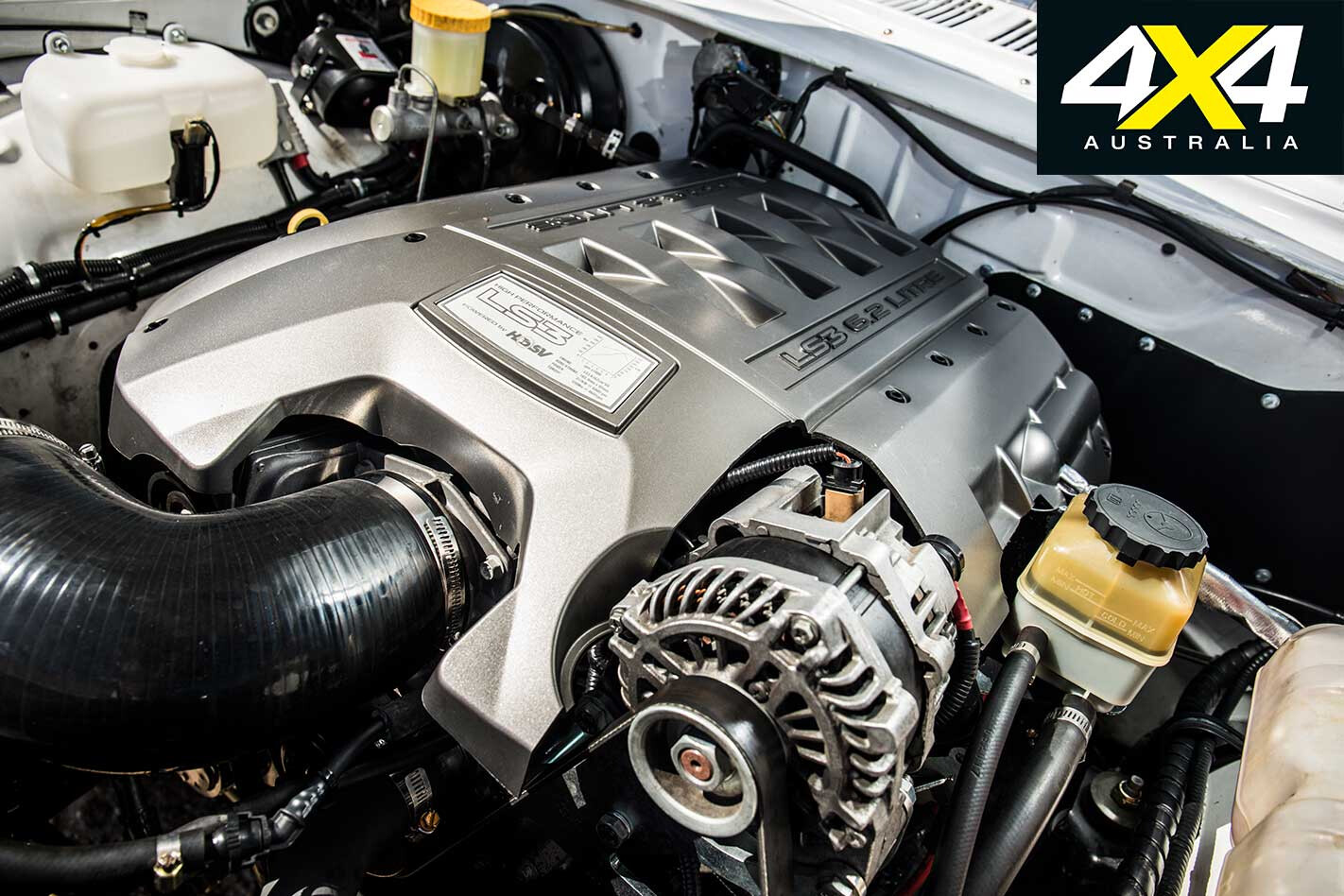
Why did I choose an LS3? Yes, there have been a few knockers! There’s a well-worn saying “LS the world” and for good reason. Sure there are other, perhaps, more adept 4×4 engines that could be used – think large capacity, low revving diesels, old school big blocks “if ya want to rev it, Chev it”, or even stick with the ol’ “308, don’t be late”. But, simply, no other engine provides as much bang for ya’ buck as an LS power plant.
They are plentiful, powerful and offer relatively easy fitment given the number of off-the-shelf kits available. While I would have been happy with an LS1 or 2, I got lucky finding and buying a complete written-off Maloo R8 with the 6.2-litre LS3 and six-speed auto.
Camper, Tourer and Daily Driver
WHILE the Tonner will get used to drop into the local shops, pick kids up from school and weekend playing in the bush and beach, I also want to go camping and do longer distance touring with it.
Fuel storage was obviously a high priority, so I looked to The Long Ranger in Newcastle which modified its existing GQ Patrol long-range unit to allow for a flat top on which my spare wheel would rest. That gave me 145L, plus the existing mid-mounted tank a further 45L which is transferred via a pump to the rear tank when needed. All engine-used fuel is sourced from the rear tank only.
Every man and his dog are asking: “How much fuel does she use mate?” To date, I’ve not had it long enough to give accurate litres per hundred figures, but can positively say it’s returning 257.5 smiles per gallon – yep, I can’t wipe the smile from my dial. Every time I strap myself in and crank over that engine, my face cracks a grin a mile wide, so, I reckon it’s mission accomplished.
The aluminium checker plate tray with removable drop-sides also incorporates two 3.5-inch stainless steel hoops, of which the rear is removable. Two front-to-rear 3.5-inch aluminium braces (also removable) double as roof rack rails to which my rooftop tent can be mounted, or even a full-length flat tray roof rack.
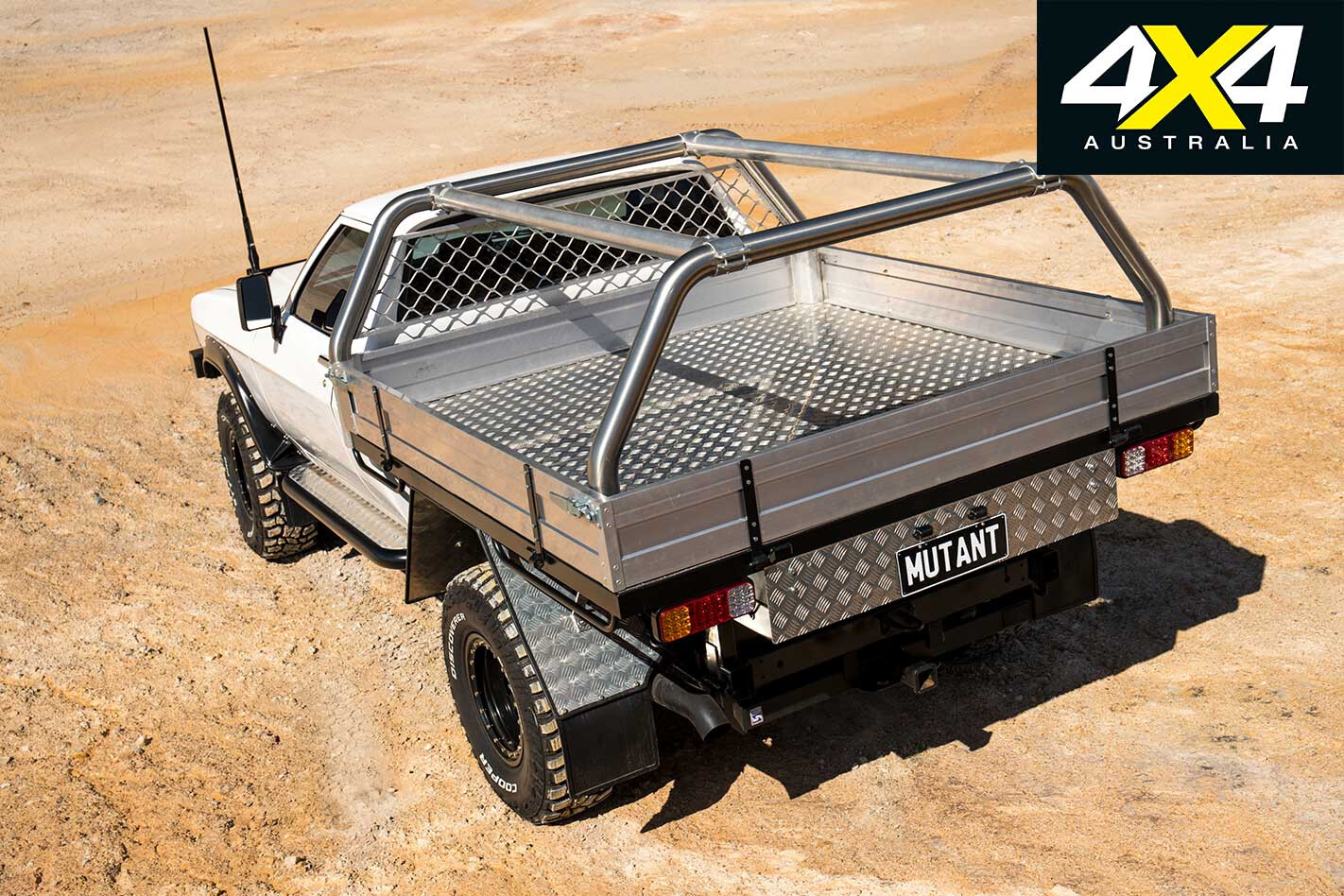
Initially, I’ll mount a couple of tool boxes into the tray for a little security, but the future may see a canopy or slide-on camper module built. In the meantime, given the tray is so modular and easy to change, I’m expecting plenty of mates to ask for help moving gear around; no problems with me, every chance to take the Tonner for a spin is welcomed!
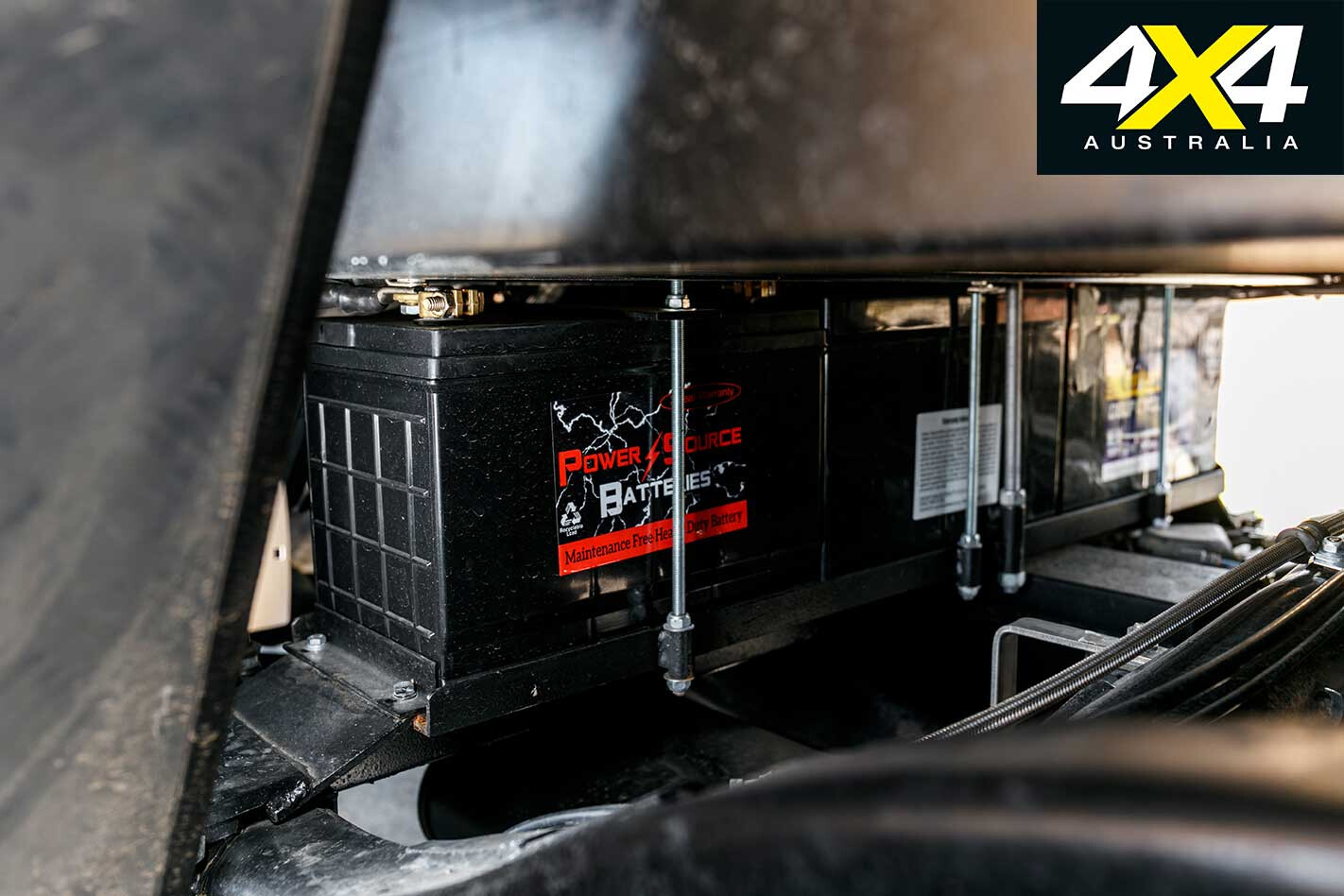
The starter battery was removed from under the bonnet (a long story of the engineer vetoing my want for twin air cleaners leading into twin snorkels up the A-pillars) and relocated to a chassis-mounted tray behind the cabin.
An additional two Century deep-cycle batteries have been added to the power bank and all controlled by a Projecta DC / Solar charger. This unit monitors and keeps all three batteries topped-up via the alternator while driving and my solar panels while at camp via a 50-amp Anderson plug. The two Century deep-cycles are joined, effectively behaving as one large 200-amp deep-cycle battery.
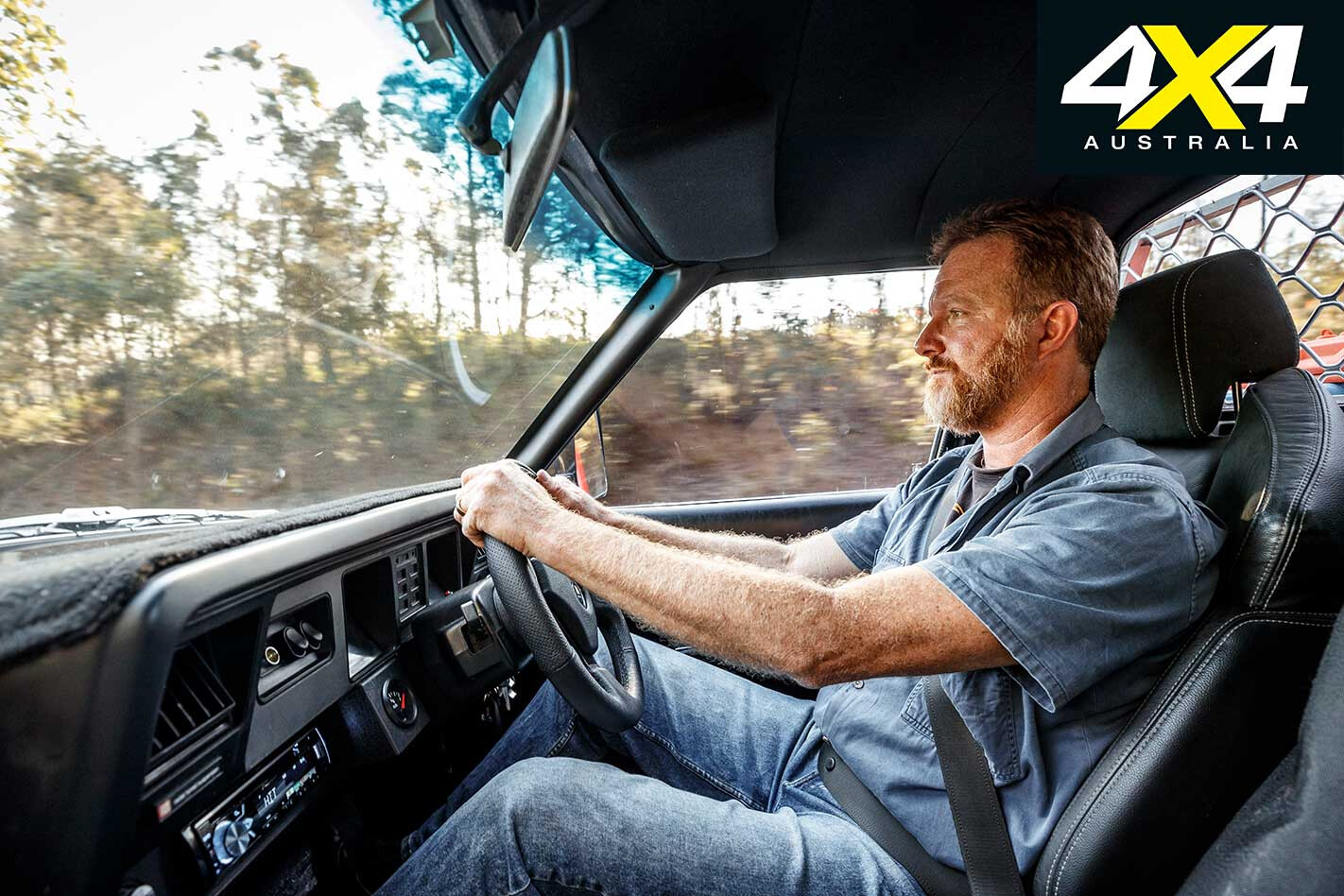
Driver and passenger comfort is top notch, given the Maloo buckets that have been grafted to the cab. I’ve also used a flat-dish Autotecnica steering wheel on the GQ Patrol steering column to return improved arm reach and comfort.
Keeping me in contact with fellow track users far and wide, a Uniden UH9080 UHF radio mic has been hung on the dash, while the main head unit is tucked away under the dash.
Engineering
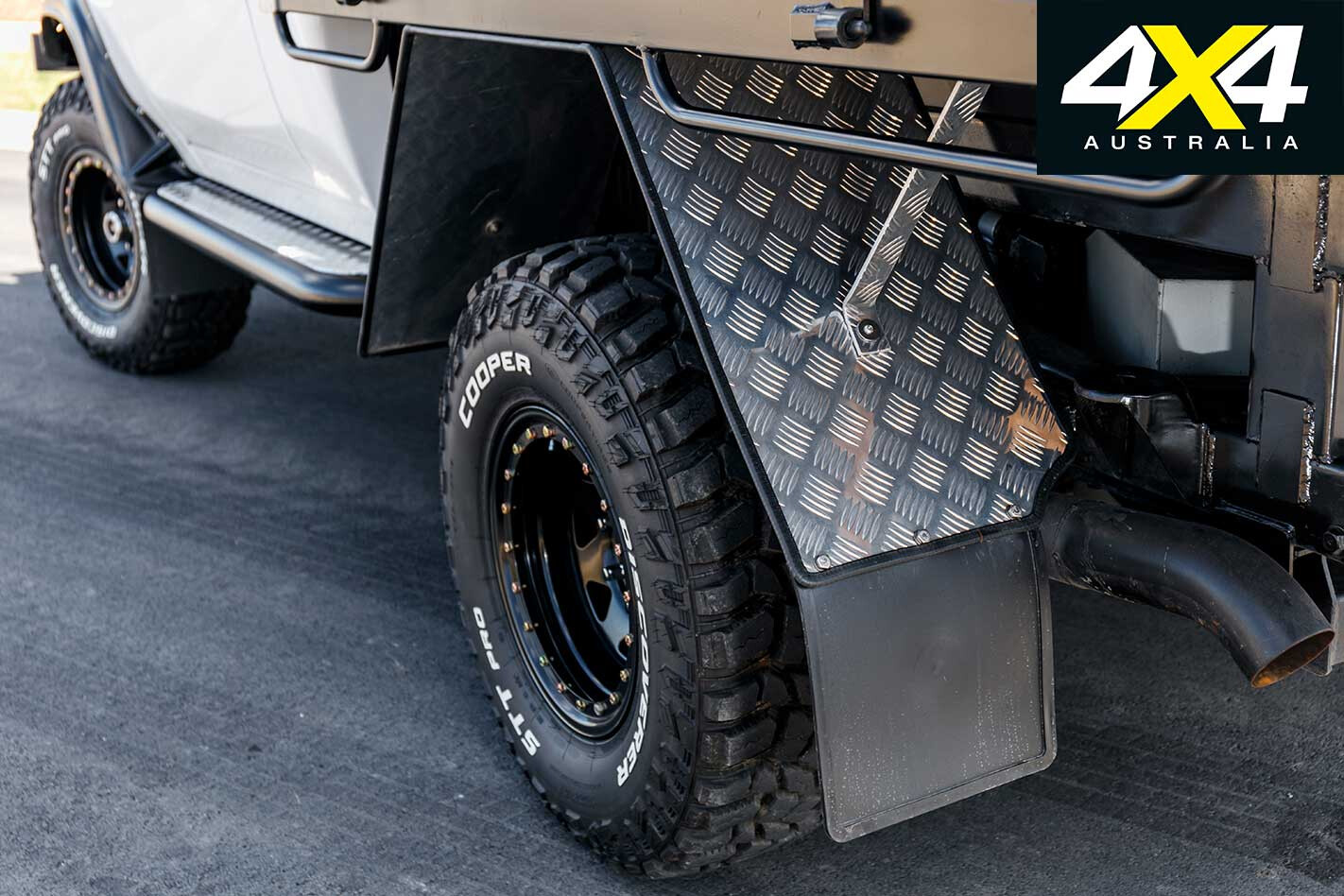
My number one want for this project was for it to be 100 per cent engineered, legal and insurable – no compromises.
Consulting with my engineer from day one saw positive outcomes, provided I stick to his rules: no tyre diameter larger than 33-inch, no higher than two-inch suspension and, after some consultation, no twin snorkel.
There is a swag of technical, mechanical and hardware related wishes we conformed to, to allow this project to be ticked off. If you are contemplating anything beyond simple accessories, consult an engineer first and have it all signed off to allow stress-free and safe driving on our roads.
How’s it Flex ‘N’ Crawl?
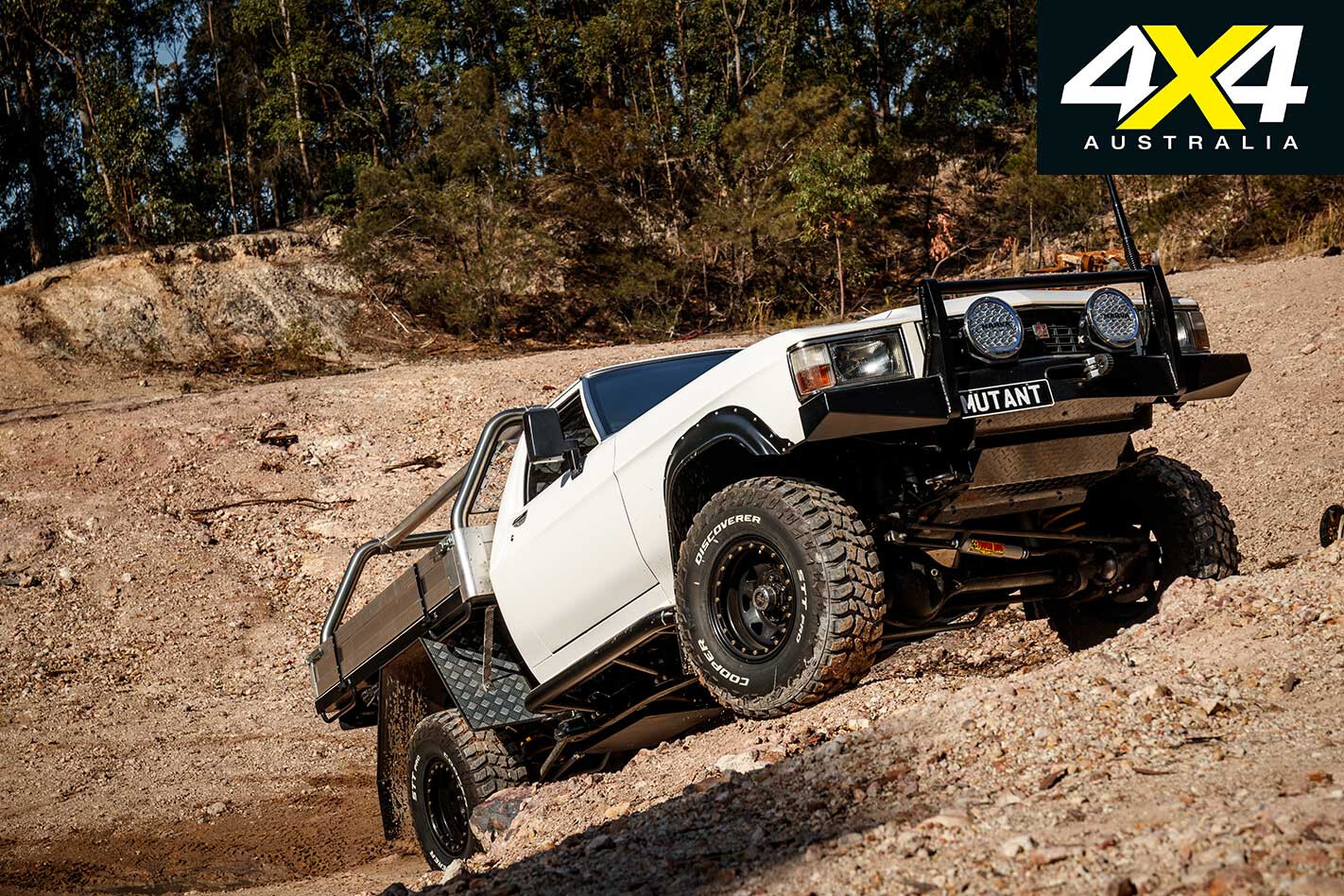
PATROLS are renowned for huge flex right outta the box. Some delete the sway bars altogether or utilise disconnects to further the axle drop while off-road; both ways improve off-road flexibility, but do little for on-road handling or necessitate stopping to reconnect.
I’ve included a set of Superior Engineering Superflex sway bars, which claim to offer exceptional on-road handling given the larger diameter heavy-duty bar, combined with extraordinary off-road flex with the longer than OE arms.
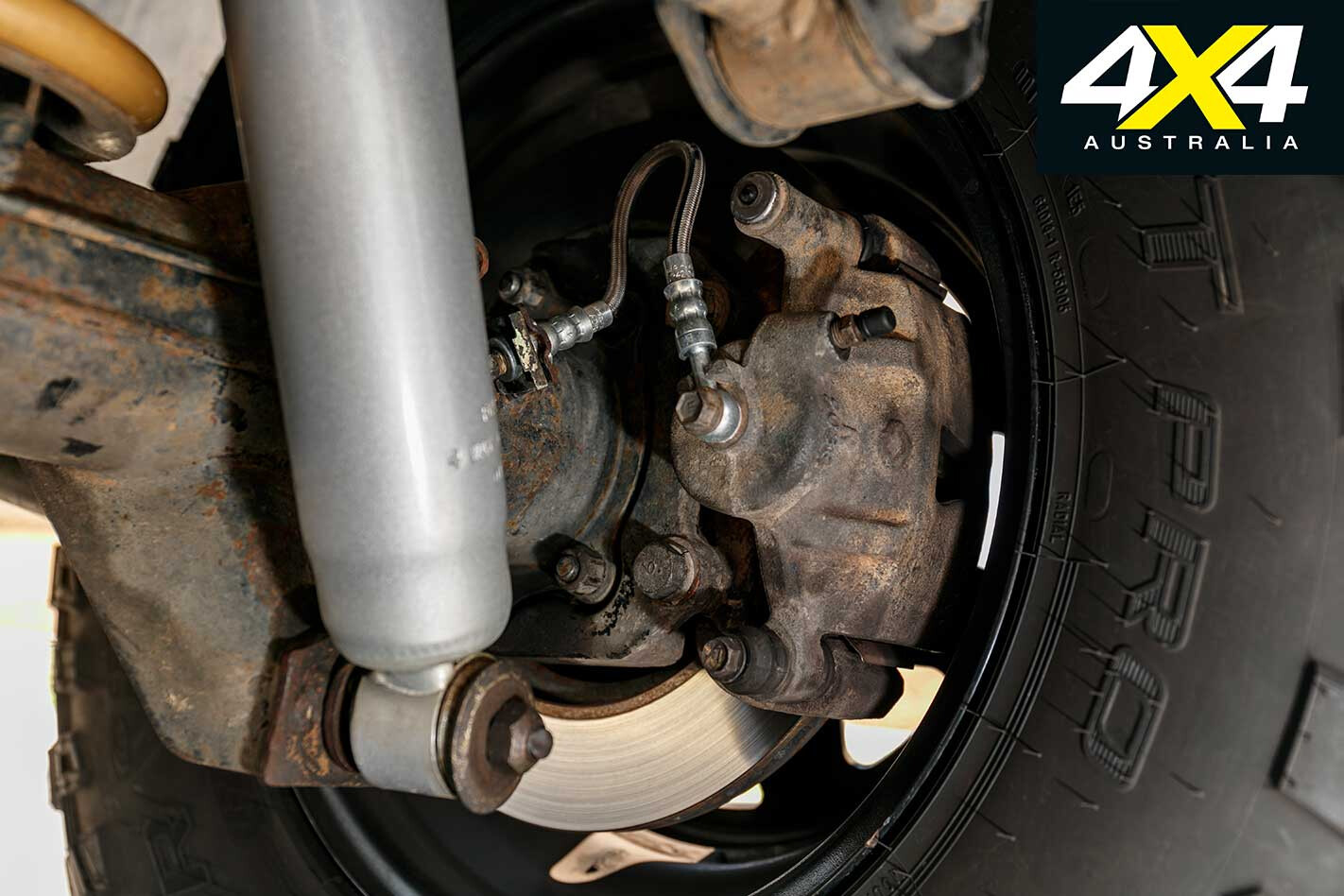
To say my Tonner drives like a lowered sports car around tight, twisty bends is certainly stretching the truth; but, hell, it handles amazing on the corners! The sway bars are doing their job, but also the low centre of gravity helps to return a fun driving machine; plus the new Terrain Tamer four-wheel disc brakes, callipers, pads and braided brake lines provide amazing stopping power.
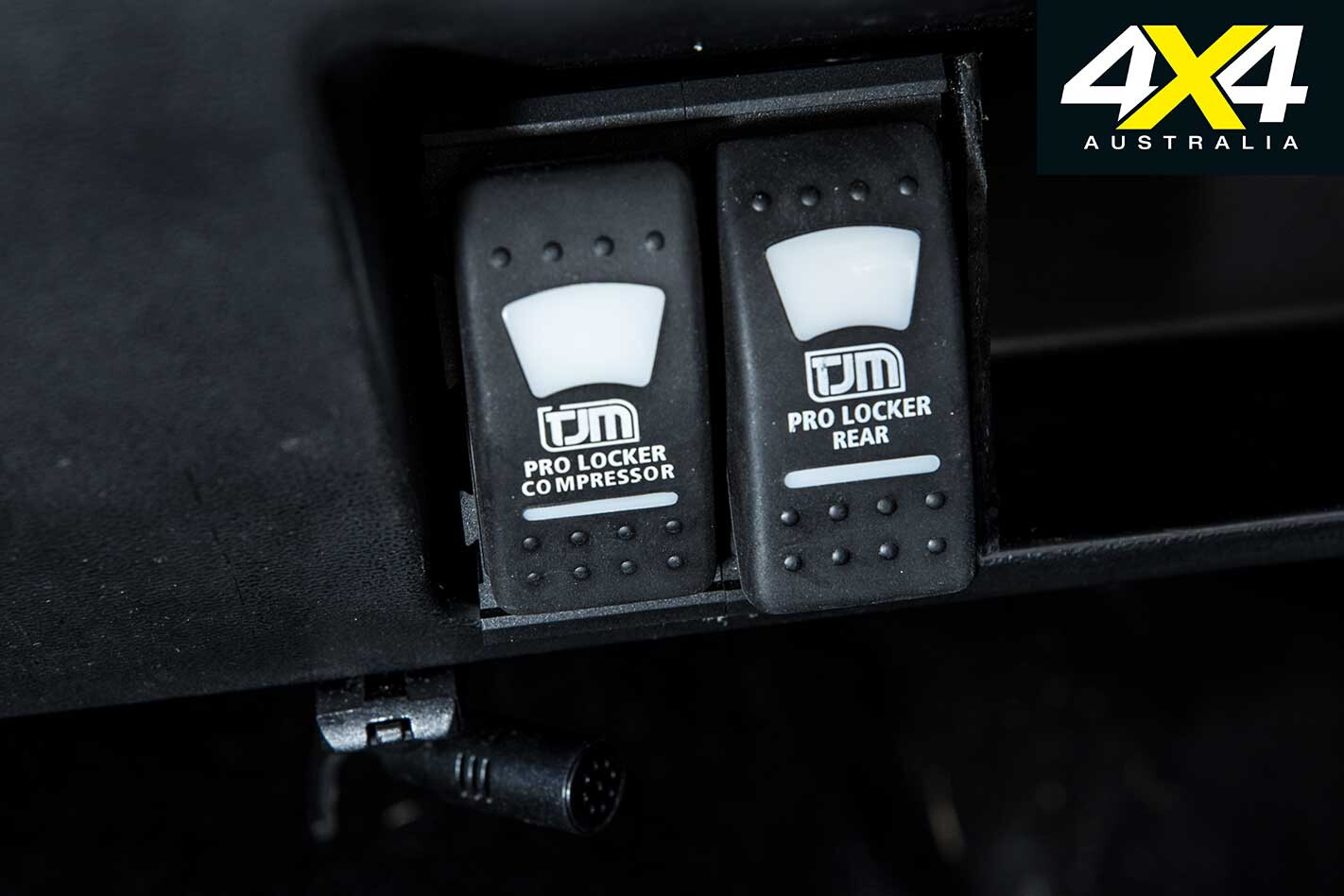
Off-road, the Tonner flexes with the best of them, and even when the limits of wheel travel are reached, the front and rear lockers push it farther onwards. Yep, she’s twin-locked, using a manually activated TJM ProLocker in the rear diff, combined with an automatic 4WD Systems Lokka in the front diff.
Of course, having 33-inch Cooper Muddies help with traction off-road by grabbing onto pretty much everything in sight, plus they are not overly noisy on-road for a serious mud tyre pattern and offer reasonable handling on the blacktop.
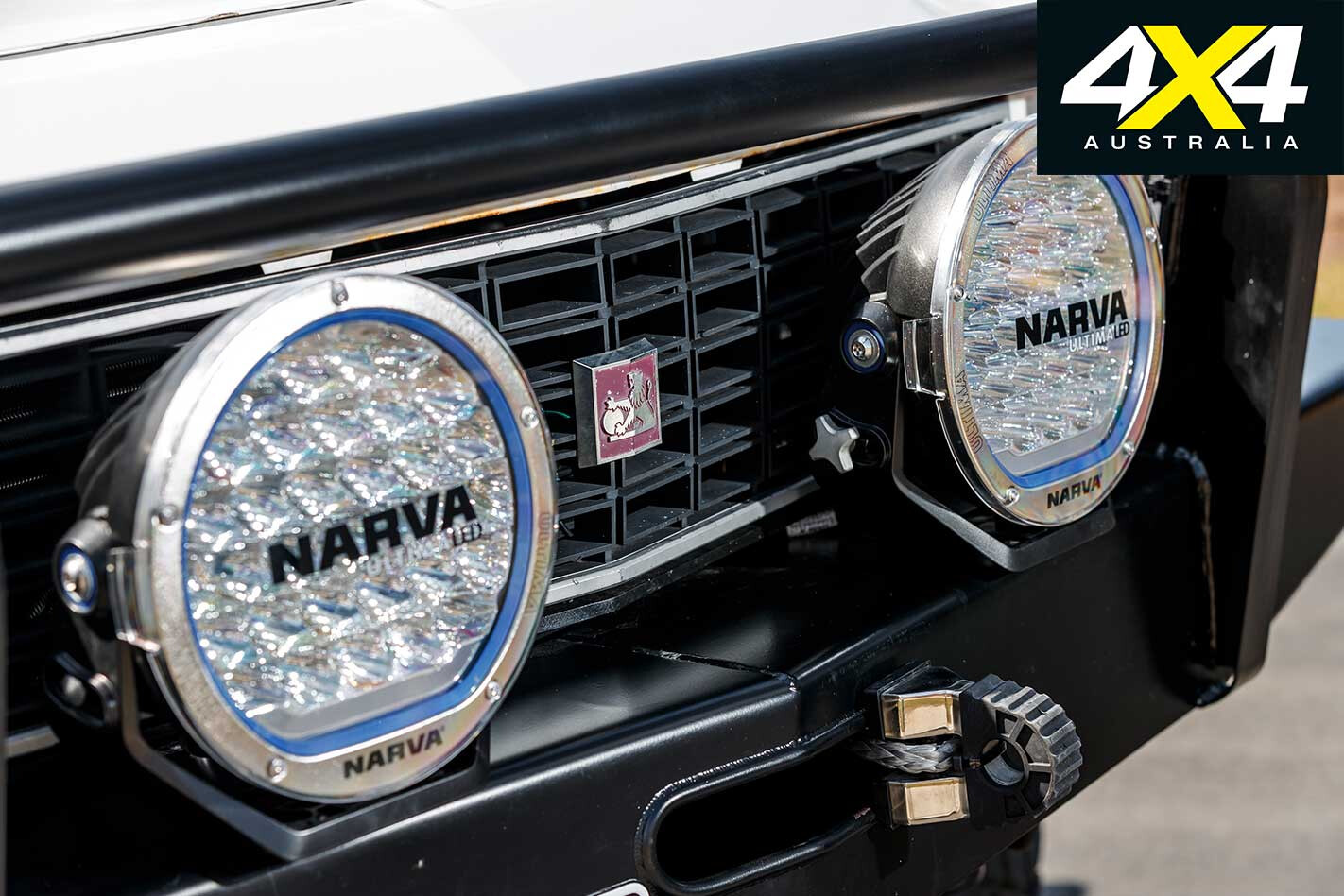
Should things go pear-shaped, a RUNVA 11,000-pound winch has been grafted into a custom-made cradle hidden behind the ol’ Holden grille. I didn’t want to butcher the grille and we’ve manufactured our own fairlead which is incorporated into the custom-made steel bullbar, which also houses NARVA 215 LED driving lights and wiring loom. The NARVA LEDs were chosen because of the overall slim dimensions to allow fitting the custom bar – plus, they’re damn bright.
Low-range gearing is well suited via the 4.11:1 GQ diff ratios and the 6L80E auto combined with the 33-inch tyres. While not the lowest gearing around, it’s adequate for most uses, although it does tend to need a dab on the brakes while crawling downhill. That’s more the auto box not holding and lack of electronic downhill decent control … bwahaa, who wants that in an old Tonner!
Ultra-slow rock hopping could do with a set of transfer case gears to return lower low-range gearing but all up, it’s a pearler to handle in the slow stuff.
Suspension-wise, I’ve gone simple, reliable, legal and all-round dependable with a set of two-inch raised Tough Dog coils matched to the Tonner’s weight, combined with Tough Dog foam cell, long-travel shocks. While chassis, diff and suspension components clearance is no different to any other GQ Patrol, the way the body has been fitted returns hugely superior approach angles.
How did it all fit together?
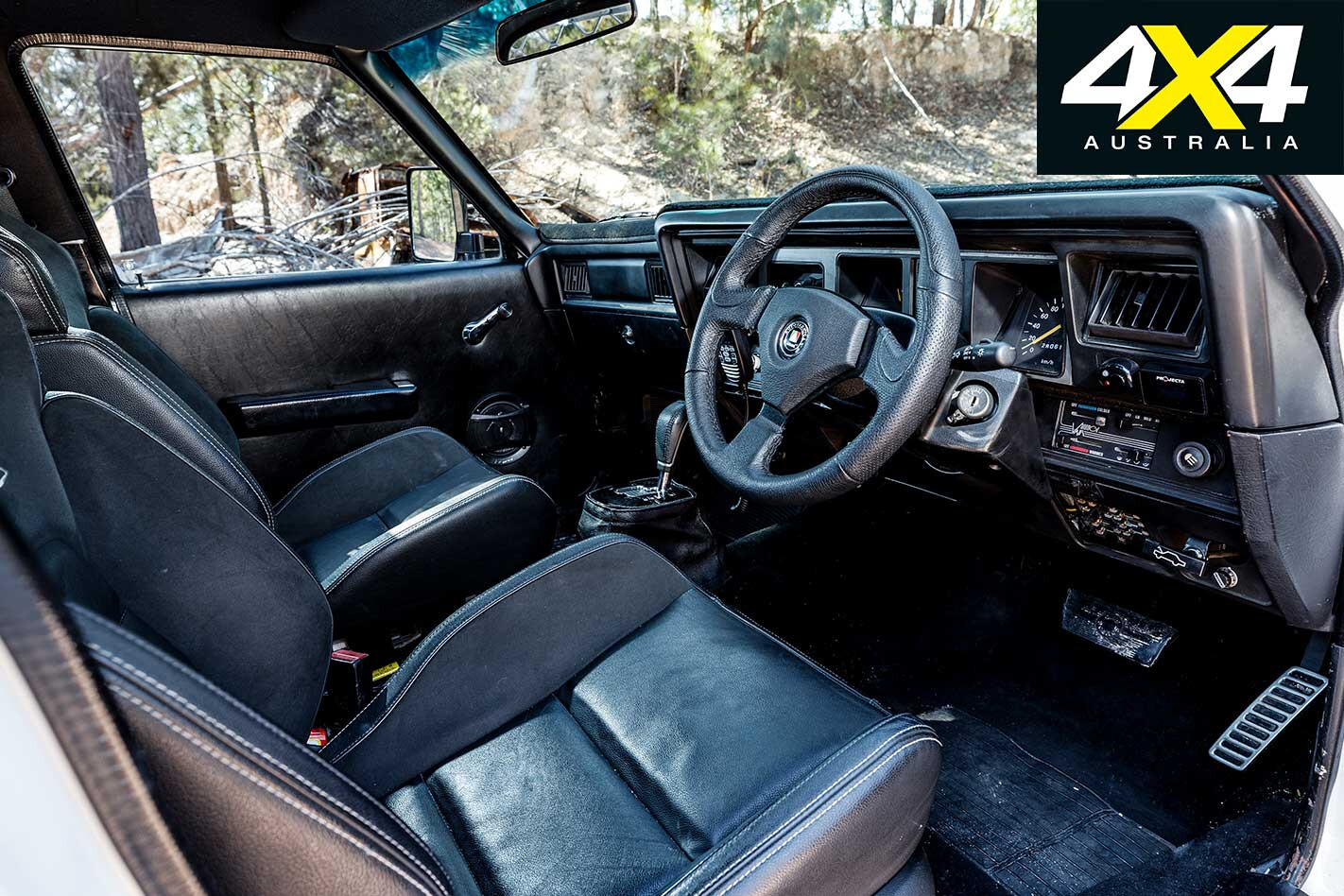
SOME parts of this project were ridiculously easy to piece together and we saw massive gains overnight. Other parts however, seemed to take an age of research, trialling and swapping for seemingly no change over weeks and months.
The easy bits were with the aid of a Marks 4WD Adaptor kit. A phone call, a few days wait and the whole shebang was sitting on the garage floor ready for attaching a GU transfer case to the 6L80E six-speed auto, a reverse oil pan to clear the Patrol front axle and diff, engine mounts to fit the LS3 into the GQ chassis, high-mount relocation bracket for the alternator, extractors to clear the chassis rails, cables, pipes and all ancillary gear to make it work, all wrapped into one easy kit.
While initially I opted for a viscous coupling fan setup to be included in the kit, which was designed to fit with a GQ body, we ended up reverting to using the standard Maloo radiator with twin thermo fans because we couldn’t fit the viscous fans in without a custom radiator. Utilising a standard radiator makes an easy replacement if the need ever arises.
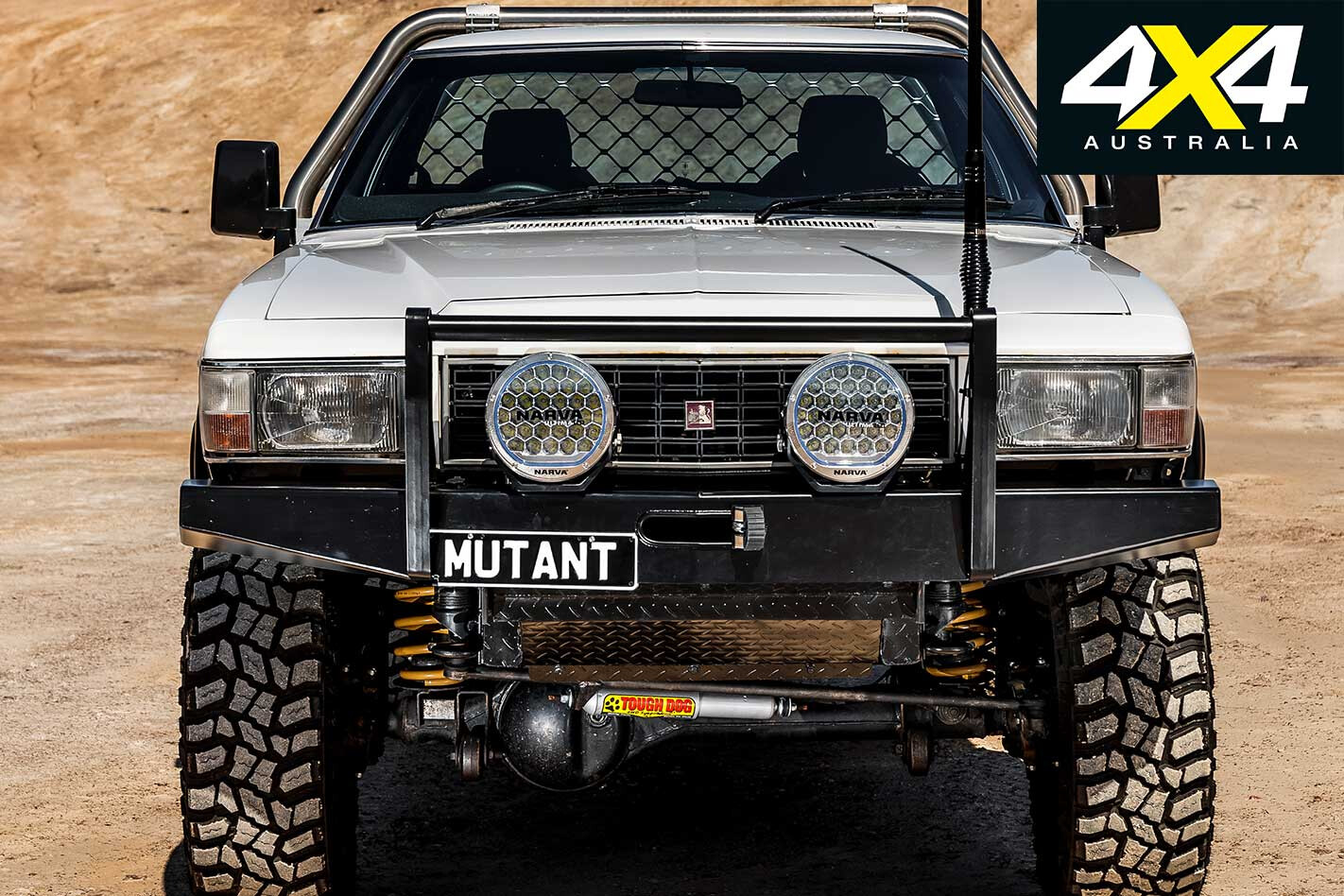
Even fitting the Tonner cab onto the Patrol chassis was relatively easy. With complete driveline in place, the cab was lowered down until it touched something, then raised a little and bingo, that’s where it stayed. Standard GQ chassis to body mounts were removed and repositioned to suit the Tonner cab, plus a couple of extras added for good luck and to appease the engineer.
The wiring was pretty straightforward; not to me, but to Sideshows Performance Wiring up in QLD. We sent the Maloo loom to him, he weaved his magic, and retuned it for a (almost) plug-and-play system.
The Maloo Holden traction control, speed sensors, anti-lock brakes and other high-tech wiring has been deleted or blanked off leaving the basics to manage the vehicle. The Maloo accelerator pedal has been incorporated into the system, given it’s a drive-by-wire setup compared to the mechanical cable system of the Tonner.
The hard, fiddly, time-consuming parts to this project are mostly the bits you’ll never see; hidden deep in the guts under the dash for example is a tiny box that converts the electronic speed inputs from the GU transfer case into a mechanical output that spins a cable to drive the original old speedo in the Holden dash.
The output is adjustable to ensure final speed readouts are accurate, which was done on Total Care’s in-house dyno. Might sound easy, but that took an age to sort out given I didn’t want a fandangled digital speedo readout mixed into the rest of the old-style dash.
Bar work
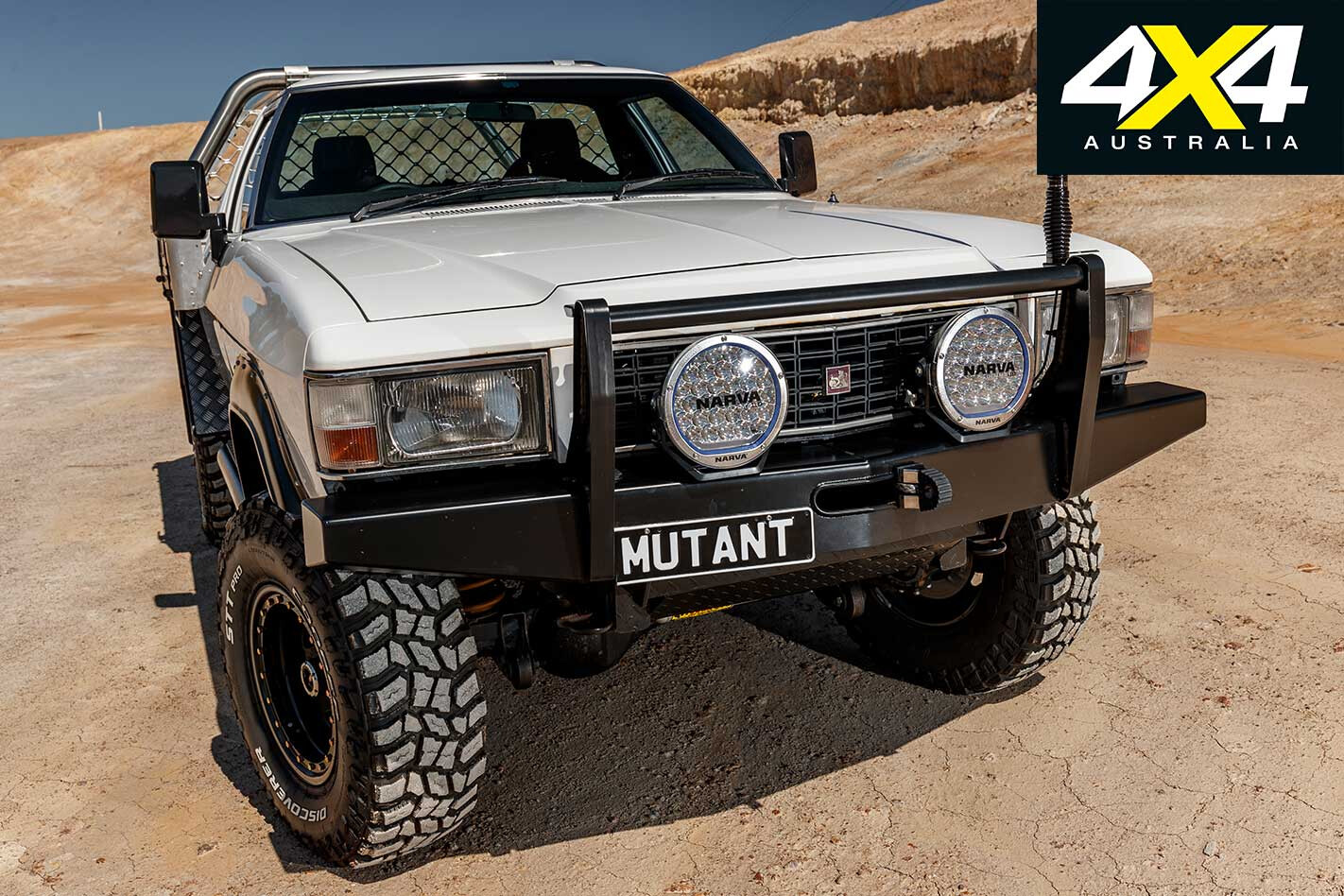
There were no two ways about it; my Tonner was going to sport a bullbar. I didn’t want a huge four- or five-poster job, and it had to be legal. Doodling with pencil and paper saw this final creation of which Total Care 4WD knocked-up from scratch. It also houses the RUNVA winch in a separate cradle, antennae and spottie mounts, recovery hooks, plus incorporates its own fairlead.
Side-steps are three-inch mild steel with alloy checker plate, while rear hoops are stainless steel. Underneath, a steel checker plate bash plate protects radiator and steering arms, as well as helping to prevent water splashing up under the bonnet.
How’s it Hammer?
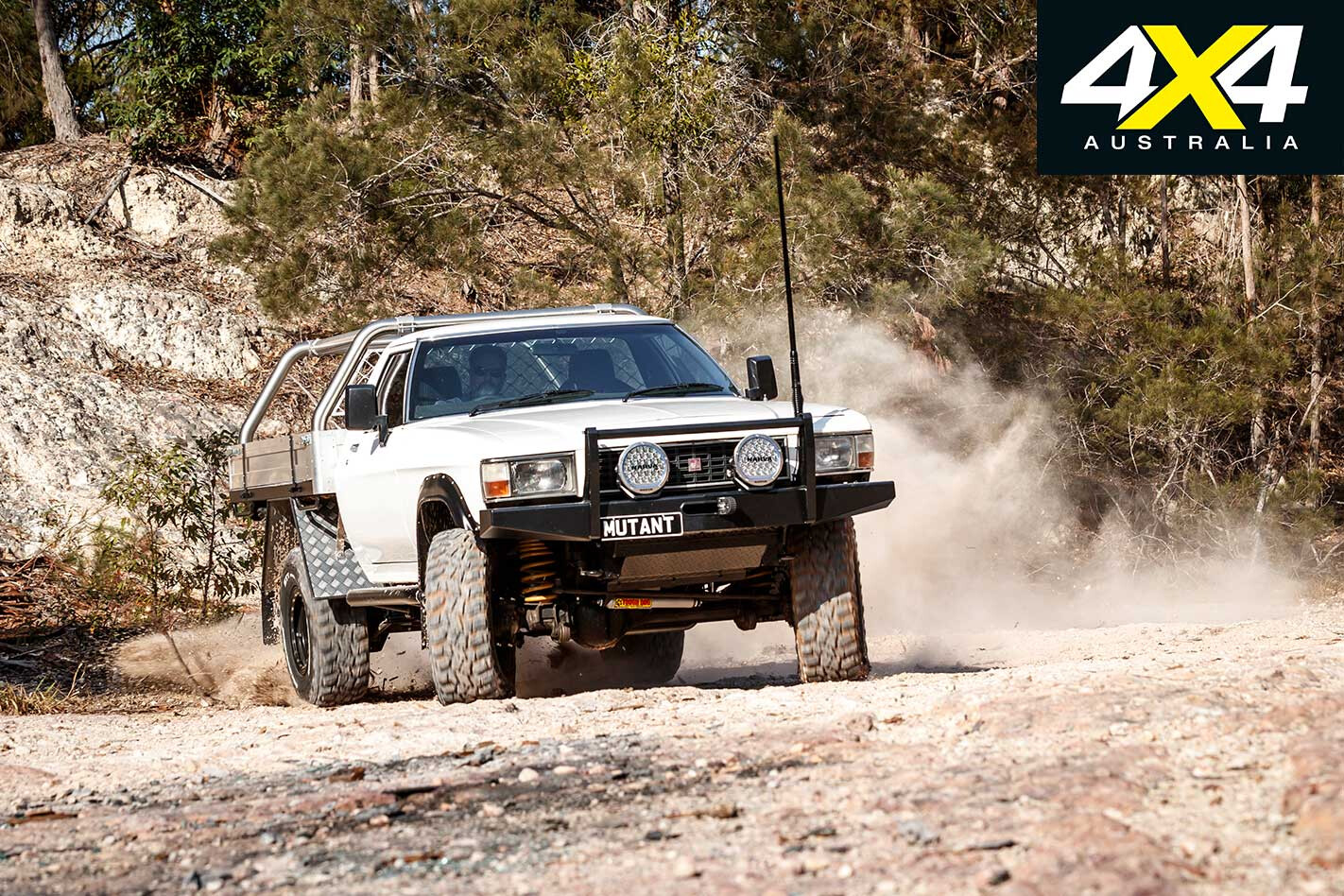
ON and off-road, it’s fast … bloody fast … dangerously fast, if you don’t control that right hoof. But, driven sensibly, the Tonner is easily used as an everyday driver, along with touring and playing in the dirt, rocks, mud, snow and sand.
My Tonner is the Swiss Army knife of the 4×4 world – the ‘Allterrain Tonner’. While it’s not a comp truck and can never emulate the off-road ability of such, it’s capable of tackling any terrain regardless if it needs to be done at a snail’s pace, ala rock hopping, or with a bit of gusto like in the sand, especially given it’s twin locked and has reasonably good articulation to keep those big Coopers on Terra Firma.
This project has been all-consuming over the last 18 months, caused a few headaches and taken longer than planned or hoped. But, in the end, I reckon I’ve hit the nail on the head in achieving all my goals in style and function, of which I can’t thank Total Care 4WD enough.
After driving this angry, mutant Tonner for the last few weeks, I say again, “LS the world”. To those that claim their 4×4 can go anywhere, I say to you: “So can mine … just f#*kin’ faster.”
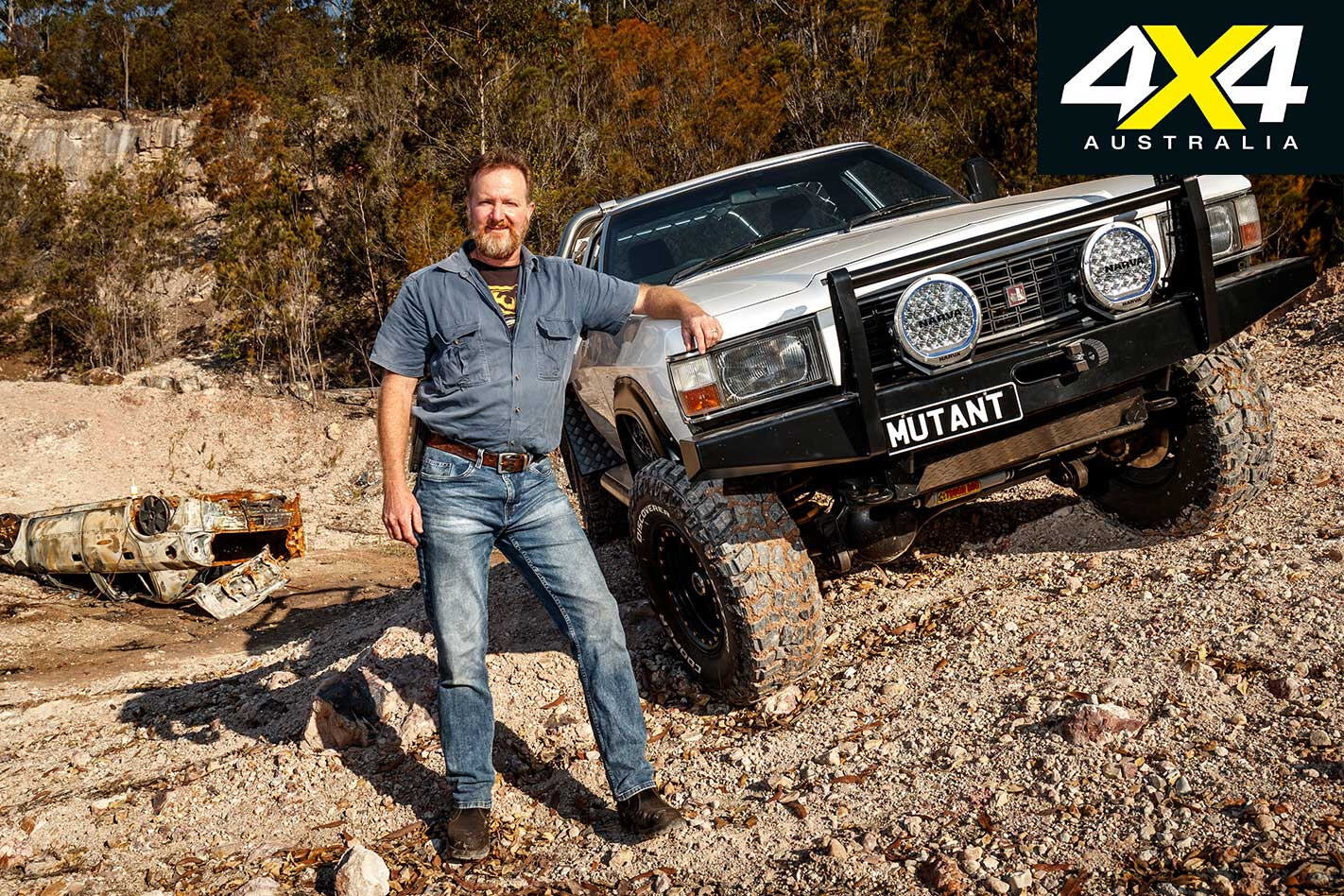
Follow the journey of Mark Allen’s custom Holden Overlander 1 Tonner – Part 1 – Part 2 – Part 3 – Part 4 – Part 5 – Part 6 – Part 7 – Part 8
A RECALL has been issued by the ACCC for 107 Chevrolet Silverado 2500HDs that were purchased through HSV dealers nationally.
The problem? A faulty park brake cable assembly may have been incorrectly manufactured, which means the “fitting at the end of the cable may become detached during use, posing a risk of the park brake releasing unexpectedly”.
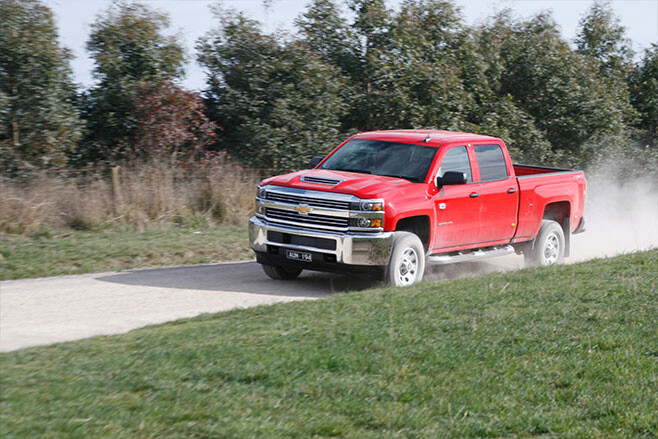
The full list of affected vehicles can be found here: https://www.productsafety.gov.au/system/files/VIN%20List_32.xlsx
The recall report says HSV will directly contact all owners of affected vehicles, who will be advised to take their pick-ups to their nearest HSV dealer for inspection and reparation.
Back in July, six Silverado 2500HDs were also recalled due to incorrectly fitted rear belt buckles.
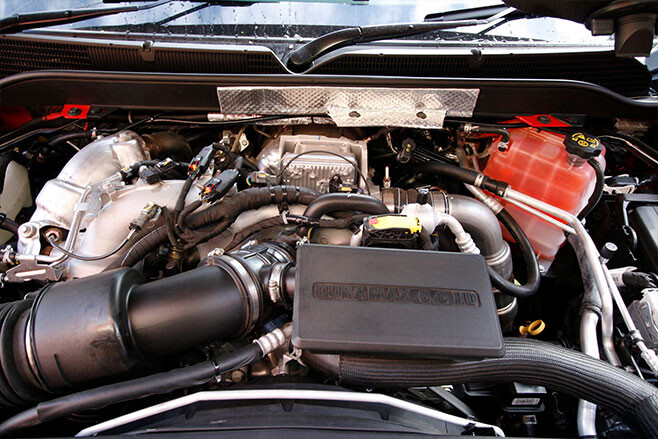
The massive Silverado 2500HD is powered by a 6.6-litre V8 turbo-diesel that delivers 332kW and plenty of newton-metres … 1234Nm, in fact. Road-test editor Fraser Stronach got behind the wheel of 2500HD WT recently and his review is in the December magazine, in stores now.
HSV imports the Silverado into Australia and converts them to RHD for the Australian market.
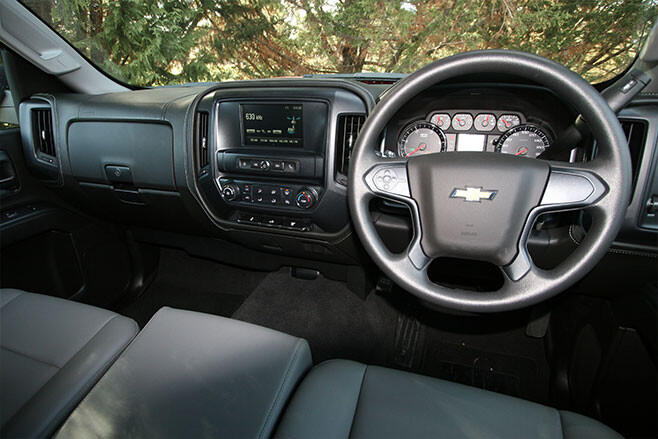
CHEVROLET SILVERADO PRICING Chevrolet Silverado 2500HD WT (automatic): $114,990 Chevrolet Silverado 2500HD LTZ (automatic): $134,990 Chevrolet Silverado 2500HD LTZ Midnight Edition (automatic): $139,990 Chevrolet Silverado 2500HD LTZ Custom Sport Edition (automatic): $139,990 Chevrolet Silverado 3500HD LTZ (automatic): $147,990
THE FUTURE of Mitsubishi’s Pajero wagon remains in limbo, with the ageing model set to soldier on for some years to come.
The current Pajero platform has been around for close to 19 years – with various upgrades along the way – since the NM Pajero debuted back in 1999.
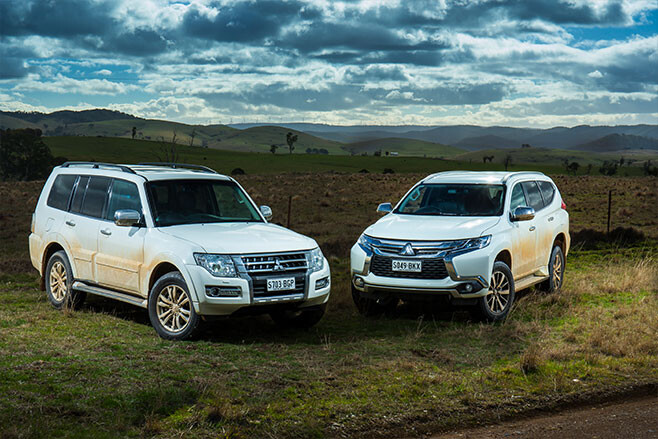
Speaking at the launch of the 2019 Triton in Thailand, Mitsubishi CEO Trevor Mann dispelled rumours that a new Pajero could be developed on the Nissan Y62 Patrol chassis, saying that the Patrol/Armada is a bigger vehicle than the Pajero. Mitsubishi is part of an alliance with Nissan/Renault, so the Patrol link-up was considered a possibility by many pundits.
Noting the Pajero’s strong heritage and Dakar successes, Mann said a new model is still something Mitsubishi would like to do as the company builds its SUV arsenal, but the brand has not yet made a decision.
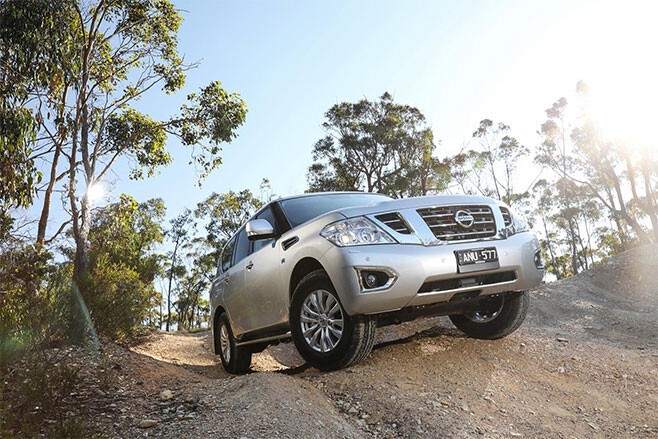
He also noted that sales of large 4×4 SUVs are in decline, making it harder to make a case to develop a new model; meeting global emissions regulations for such vehicles is also getting harder.
In Australia, Mitsubishi continues to sell the full-size Pajero wagon, which is built on a unique monocoque chassis with independent suspension, and the smaller, Triton-based Pajero Sport. While both vehicles are seven-seat wagons, the Pajero Sport is smaller and doesn’t offer the rear seat space or cargo capacity of the Pajero proper. The Pajero remains popular with outback travellers and those who need to tow.
MITSUBISHI Australia (MMAL) will see in the New Year with a thorough re-skinning of its best-selling model, the Triton mid-size ute.
As well as fresh sheetmetal the 2019 Triton comes with new driver assistance and safety tech including AEB, to bring it in line with the class-leaders – X-Class and Ranger – which are currently the only utes to offer it.
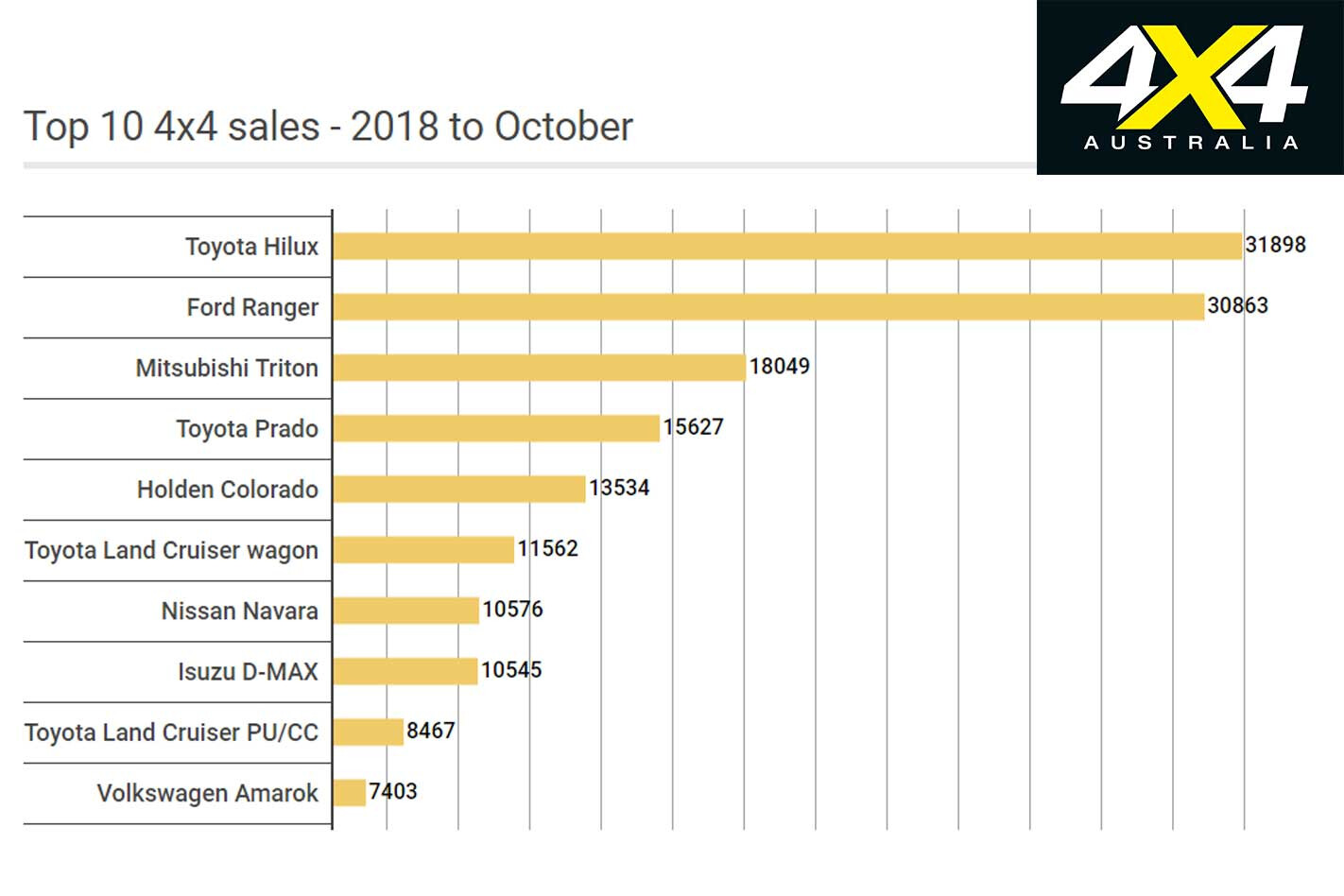
The Triton sits solidly in third place in the 2018 sales race for new 4×4 utes, trailing only the Toyota Hilux and Ford Ranger; while it’s ahead of other popular models such as the Holden Colorado, Nissan Navara and Isuzu D-Max. Globally, Australia is the second biggest market after Thailand for Triton sales.
As it is such an important model for MMAL, it’s no surprise the South Australian-based company can’t get the new model here fast enough. It will appear in Mitsubishi showrooms from late-December before its official launch date early in 2019.
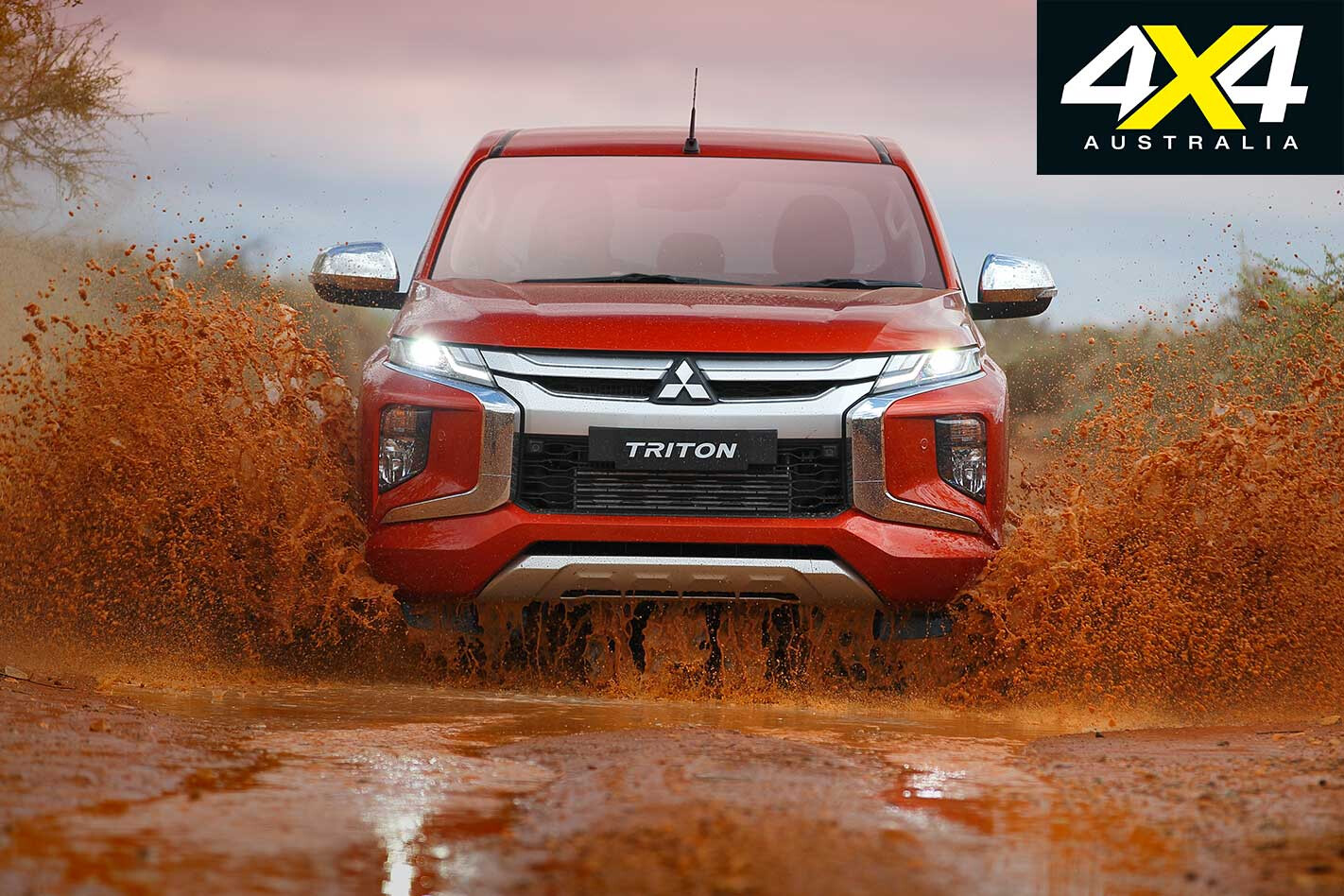
The 2019 model has a bigger and bolder look than its predecessors, despite remaining a smaller vehicle than some of its competitors. That size isn’t a bad thing, as not everyone wants a bigger ute, and the shorter wheelbase gives the Triton a tighter turning circle and better maneuverability.
The bigger appearance comes from a bold, new front end with tough lines and high-mounted headlights, while, down the side of the ute, squarer wheel arches and a new styling line give it a stronger appearance. A deeper cargo tub also emphasises the bigger look. Mitsubishi calls the front-end look Dynamic Shield face, and it is in keeping with other recent vehicles in the Mitsubishi range.
Aside from the new look, the other big news is the addition of driver aid technologies including Forward Collision Mitigation (FCM/AEB), Blind Spot Warning and Ultrasonic misacceleration Mitigation System (UMS). UMS guards against accidental hard acceleration in both forward and reverse gears during slow manoeuvres such as parking.
The electronic tech flows through to the four-wheel drive system, where a Terrain Response-like Off-Road mode offers specific Gravel, Mud/Snow, Sand and Rock modes to maximise all-terrain and grip performance through the integrated control of engine power, auto transmission and electronic stability control settings.
The Triton remains the only ute in this class to offer a transfer case with the choice of 2WD (rear), full-time 4WD for on-road use, locked 4WD for off-road use, and locked low range 4WD for serious off-road terrain. A rear diff lock is offered on some variants, but it’s unclear yet as to which variants that will be when it lands in Australia.
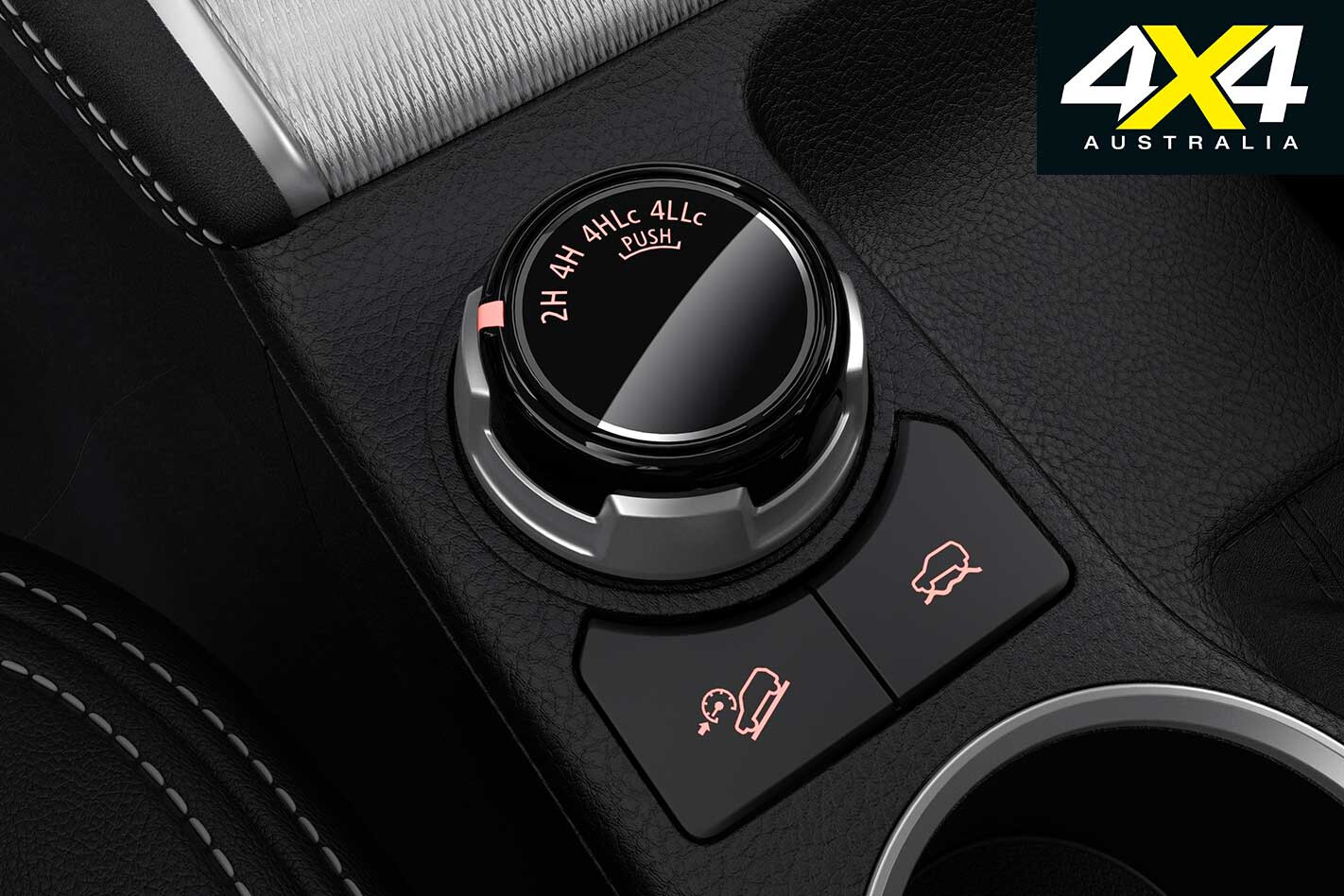
The Super-Select II 4WD system will come on upper-spec 4×4 variants; while the lower grades will come standard with conventional part-time 4WD, which doesn’t give the driver the benefit of an on-road AWD setting.
Elsewhere in the driveline a new six-speed automatic transmission replaces the old five-speeder, while a six-speed manual is still offered. The 2.4-litre, four-cylinder diesel engine is carried over with some refinements including higher injection pressure, but there are no significant leaps in performance or economy. The turbocharged engine makes a modest 133kW at 3500rpm and 430Nm at 2500rpm, which has proven to be capable enough in the previous model, and we see no reason why this will change.
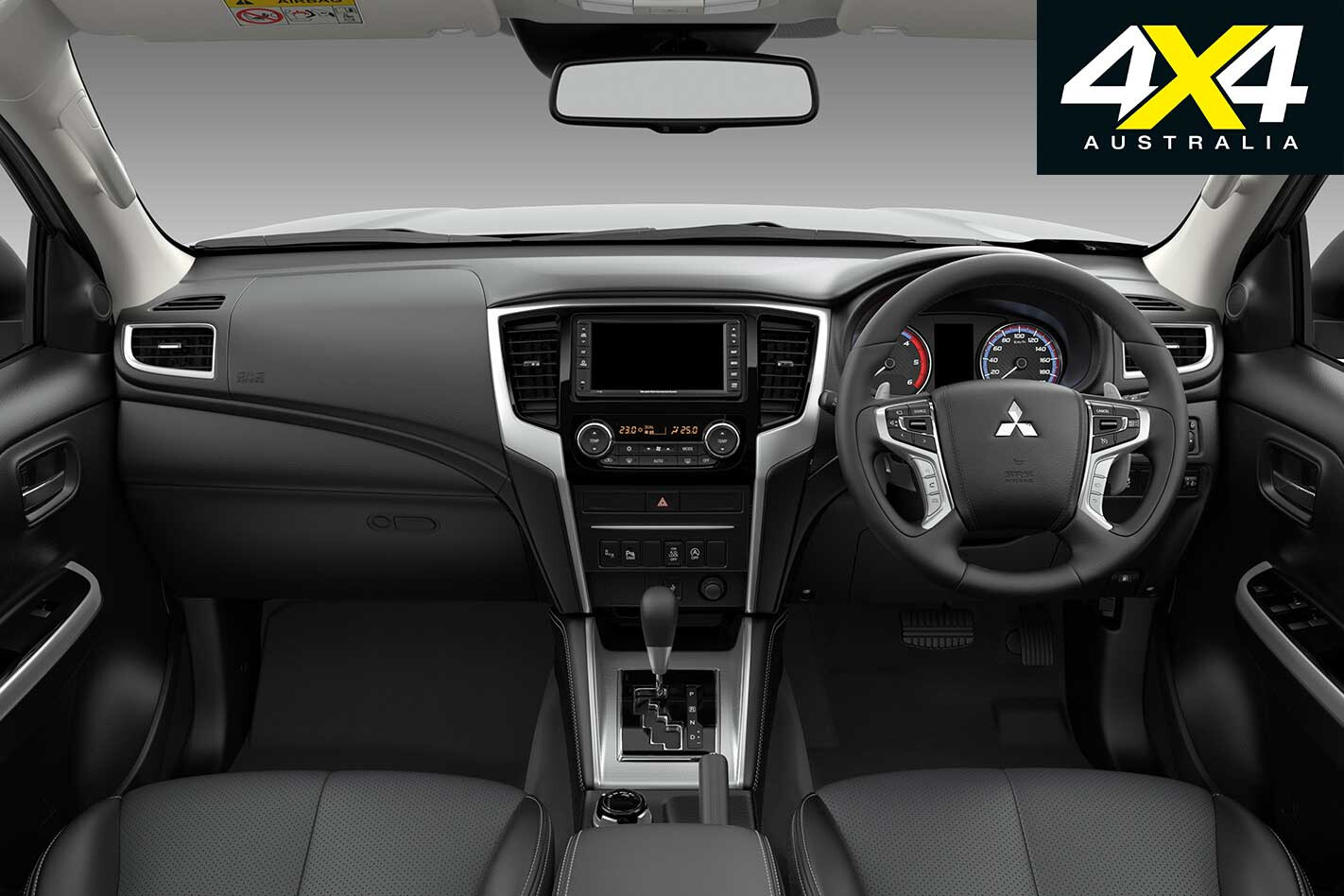
The ladder-frame chassis remains unchanged for the most part, aside from some strengthening, and it still employs the same independent coil-sprung front end and a leaf-sprung live rear axle. There is no word yet on load and towing capacities, but expect little if any increases there.
The Triton will continue to be available in 4×2 and 4×4 models, with a choice of single-, double- and extra-cabs, and at least three trim grades. More details on trim grades and specifications for Australian Tritons will be revealed closer to the local launch.
We’ll be driving the Thai-spec Triton on tracks near Bangkok in the country where it is made, and we’ll have a review of how it performs on Tuesday night. Stay tuned!
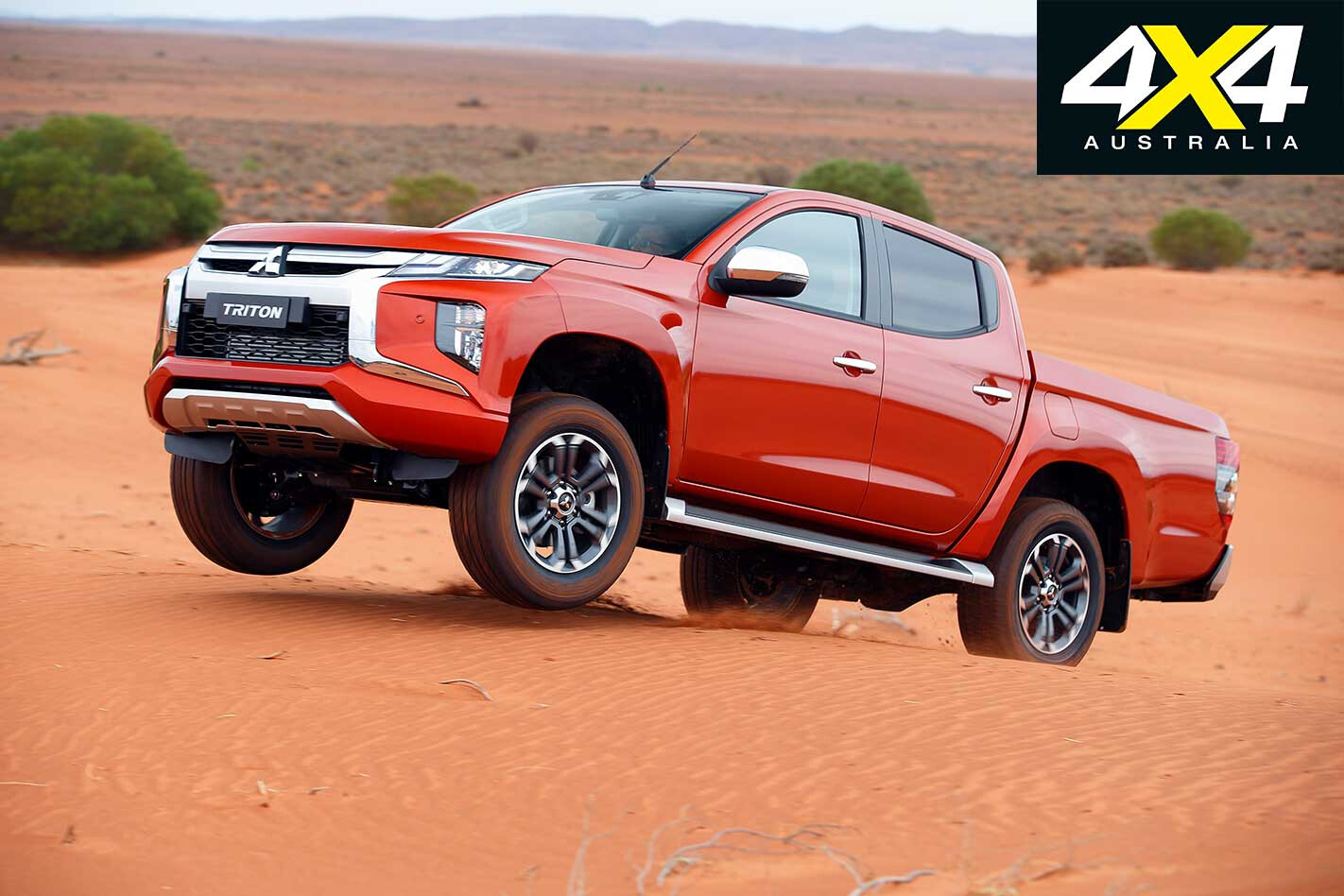
MORE: Mitsubishi Triton Range Review MORE: Mitsubishi Triton Specs, Range & Price
WITH only two calendar months remaining until 2019 arrives, Toyota’s Hilux has all but stitched up first place on the 4×4 year-to-date sales charts after outselling the Ford Ranger by 362 units in October.
Not only is it a two-horse race atop the 4×4 charts – and has been all year – the duo have repeatedly led all-comers on the overall monthly sales charts. A feat again achieved in October, with the Hilux 4×4/4×2 (4338 sales) and Ranger 4×4/4×2 (3228) ramping it home ahead of the Toyota Corolla (2917), Hyundai i30 (2508) and Mitsubishi ASX (2138).
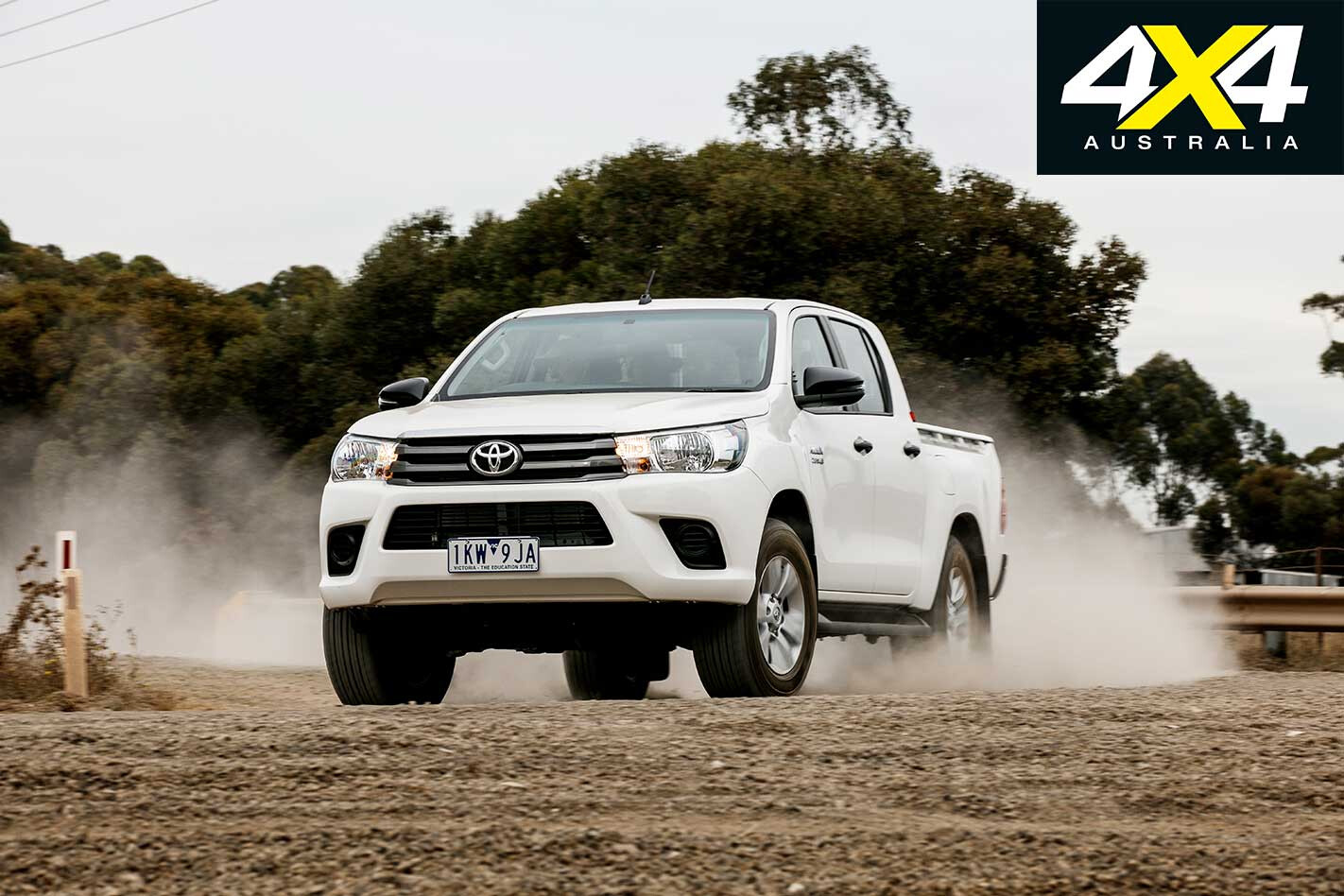
Despite the ongoing success of these two dual-cabs, light commercial vehicle sales fell by 2.3 per cent compared to 2017 – reflecting both the strong year for sales in 2017, and the overall market decline.
National vehicle sales dropped 5.5 per cent compared to September 2017, and this was most evident with a drastic decline in private purchases compared to September last year (-15.8 per cent). Government fleet sales were also down (-2.6 per cent).
“What we are seeing is a slightly slowing market, after the industry has produced five years of record sales over the past six years,” Tony Weber, the Chief Executive of the Federal Chamber of Automotive Industries, said.
“After a record 2017, year-to-date sales in 2018 are sitting just 0.9 per cent below last year’s numbers.
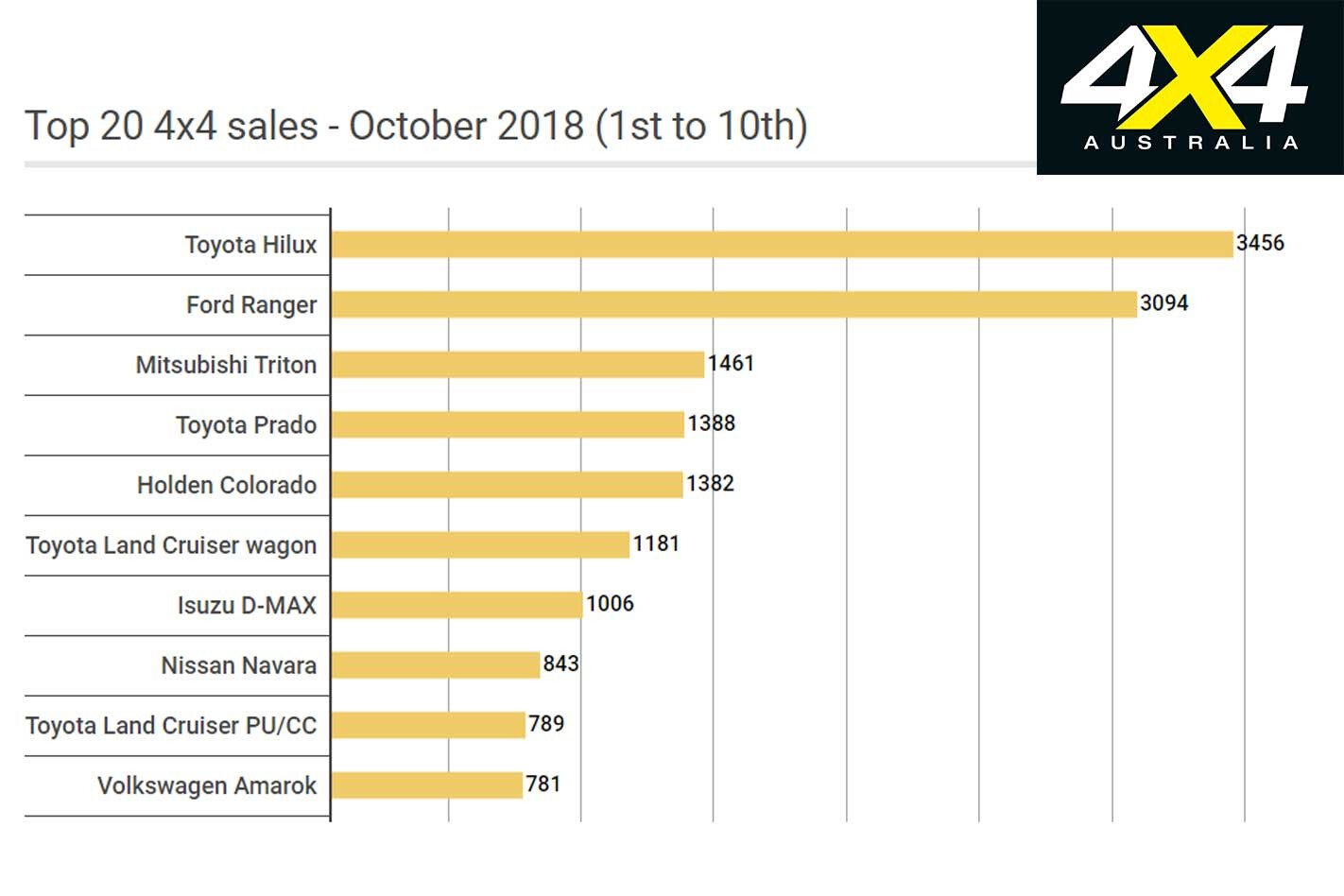
In other 4×4 news LDV enjoyed a stronger month in October by shifting 342 T60 pick-ups; while Mercedes-Benz could only entice 101 customers to purchase a 4×4 X-Class. Perhaps that’ll strengthen with the arrival of the V6-powered version?
ICOM Australia has announced its sponsorship of Four Wheel Drive Victoria, the Garden State’s governing body for Victorian 4×4 clubs.
Icom Australia’s Managing Director, Masahiko Komoda, holds Four Wheel Drive Victoria’s continued representation of recreational four-wheel drivers, along with its extensive training programs and push for responsible recreation, in very high regard.
“The whole team here at Icom (Australia) sees the importance of four-wheel drive training for safety and growing the four-wheel drive clubs, for responsible off-roading in the community,” he said.
Mr Komoda added that the other governing factor was Four Wheel Drive Victoria’s focus on not only representing the state’s 88 affiliated clubs (totaling more than 6000 members) but the conservation of 4WD playgrounds such as state forests and national parks, tracks and campgrounds, so that access remains and the areas are preserved for the next generation of off-road tourers to enjoy responsibly.
Wayne Hevey, Four Wheel Drive Victoria’s CEO, was equally stoked with the announcement: “We are proud to be both associated and sponsored by Icom (Australia),” he said.
It’s great news and also a fitting reward – and recognition – for Four Wheel Drive Victoria. The organisation’s ongoing work to ensure access to bush tracks is retained for off-roaders, and that those who head into these remote areas are properly equipped, is much appreciated by the thousands of Victorians who do just that.
The close work it does with government bodies and the media to educate the larger public as to the benefits of exploring the country in a 4WD is also highly valued.
For information on Four Wheel Drive Victoria’s training and education options, check out: 4wdvictoria.org.au/index.php/vic-4wd-clubs-available. For info on Icom (Australia) and its off-road communications products, check out: www.icom.net.au.
*Main picture: (From left) – Masahiko Komoda, MD Icom (Australia) and Wayne Hevey (Four Wheel Drive Victoria CEO, celebrate the Icom (Australia) sponsorship.
IN A BIG WIN against cheap overseas copies of Aussie-made products, Queensland-based MSA 4X4 Accessories has been granted a United States Patent (Patent No. US 10,076188 B2) for its Explorer Aluminium Storage Drawer System.
Being awarded this patent ensures no other company can make, use or offer for sale the invention (the Explorer Aluminium Storage Drawer System), or import the invention into the USA.
In this age of copycat manufacturing it’s amazing how much behind-the-scenes work goes into something like this. MSA 4×4’s Explorer system is fully protected in patented features, with this new patent comprising 42 claims supported by 22 pages of detailed diagrams.
Some of these patented features include the Pro-Glide system, which utilises the side for the drawers and the frame as the slide unit, ensuring no storage space is sacrificed as it is with traditional side slide runners. There are numerous other examples of patented components in the Explorer System, including the ‘stay-open block’.
Shane Miles, the brains behind MSA 4×4 products, is understandably stoked at this patent. “This patent validates the years of R&D that have gone into our drawer system,” he said, “as well as enhances our intellectual property position in one of the largest markets in the world.
“We are now in a position where we can defend our IP and secure our position in a global market.”
It is fantastic news for one of the Aussie aftermarket’s most professional brands when it comes to innovative design and vehicle/occupant safety standards, with MSA 4×4 a big believer in ADR testing of all accessories fitted to vehicles.
Being able to sell its award-winning product into the huge USA market without fear of cheap – and dangerous – copycat products in that same market means MSA 4×4 gains the full benefit of all its long development work.
MSA 4X4 products are available through its USA distributor, Adventure Imports, as well as in Canada through Kakadu Camping.