
WHETHER you’re loading 4×4 kit on top, in or behind your four-wheel drive, we’ve got you covered.
Yakima Backswing
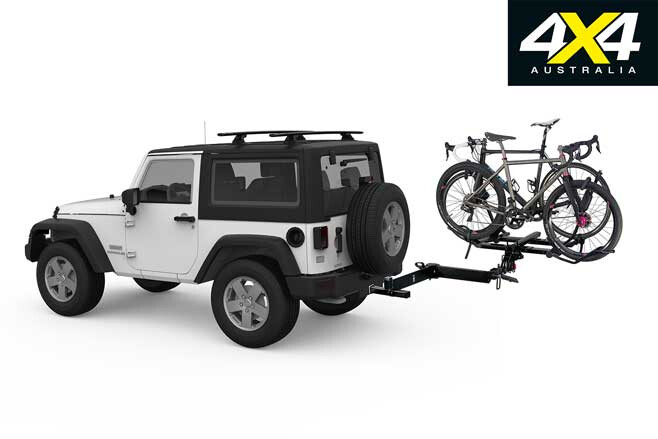
Lugging a pile of bikes on a hitch-mount bike carrier often means you then can’t access the tailgate of your rig. Yakima has solved this problem in relation to some of its most popular hitch-mount bike carriers with the release of the new BackSwing.
The BackSwing hitch adapter converts a number of Yakima’s hitch-mount carriers into swing-away versions. This means that owners of some of Yakima’s 50mm hitch bike carriers – the HoldUp (and HoldUp+2), SingleSpeed, FourTimer, TwoTimer, Dr Tray (but without the EZ+1) and LongHaul – can now convert them to a swing-away variant, by fitment of the BackSwing.
The BackSwing then allows you to swing the carrier open 90 degrees (it then locks in place; it’s easily unlocked via the release lever) for access to your vehicle without having to remove the bikes. The BackSwing has 113kg load capacity (this includes rack plus gear) and weighs 16kg.
RRP: $369 Website: www.yakima.com.au
Front Runner Outfitters’ Slimline II rack kit – Suzuki Jimny
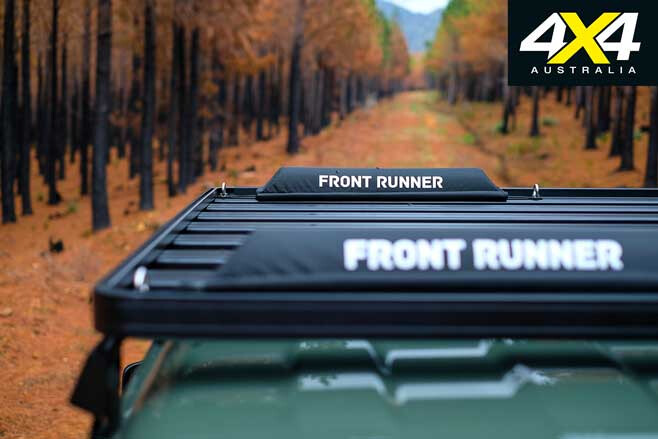
Front Runner’s new roof rack for Suzuki’s pint-sized off-roader requires no drilling or specialist tools to be fitted; the simple gutter-mount setup means installation takes barely an hour. The all-aluminium (black epoxy powder-coated) rack allows fitment of more than 55 Front Runner accessories, too, thanks to the modular slats on the rack, so you can load up the surfboards, bikes, fishing gear, watercraft (canoe, kayak, SUP), extra water and plenty more (within the roof-load limit, of course).
You can even install one of Front Runner’s clever camping tables underneath if you opt for the taller fitment kit. The Slimline II for the Jimny is affixed via six gutter leg-mounts and measures 1560mm long and 1345mm wide. Also included in the kit is a wind deflector.
Website: www.frontrunneroutfitters.com
TJM Mod X drawer system
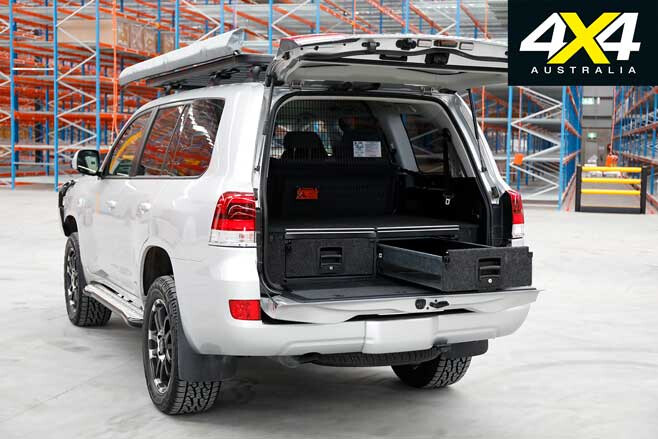
TJM 4×4 Equipped has released an innovative new drawer system that it says offers a ‘sleek design with market-leading features’. The Mod X drawer system includes a flush front face design (eliminating any protruding edges), a 150kg load rating for each drawer, a neat low-pile marine carpet finish and a tough galvanised steel frame.
The drawers also include other hard-wear components that incorporate UV and water-resistant materials, and the rattle-free steel runners and housings are coated for additional durability. The drawer is opened and closed via a single-handed positional brake and this brake setup means you can open each drawer to whatever position is required and it will stay there. The Mod X drawer system is ADR-compliant for seats and anchorages, and child restraint anchorages.
Available for 12 4x4s, including Toyota LC200 and Prado, Ford Ranger (PXII and PXIII), Holden Colorado (2015+), Isuzu D-MAX (2015+), Mazda BT-50 (2015+), Mitsubishi Triton (MQ/MR 2015+), Nissan Navara D40 (2005-2015) and NP300, plus the Toyota HiLux (2015+). Accessories include a stainless steel tray that converts to an external table, high capacity screw-in tie-downs and secure space divider panels.
Website: www.tjm.com.au
The North Face Base Camp duffel bag
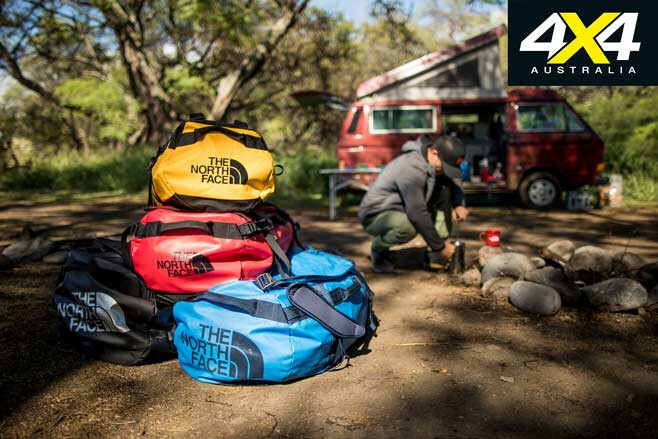
Probably one of The North Face’s most famous products, the company’s Base Camp duffel bag has, over its 33 years of production, garnered a reputation for bombproof construction and is an ideal carry-all. Available in a number of sizes – XS (31 litres); S (50L); M (70L); L (95L); XL (132L); XXL (150L) – to suit any requirements, the Base Camp duffel is built super tough.
The water-resistant outer fabric is robust 1000-denier laminate/840D ballistic nylon, the handles are bar-tacked and it also features double stitching for additional strength. There are lash-down/carry handles on each end and both sides, plus detachable shoulder straps and ‘regular’ carry handles. The zips are oversized YKK variants and are covered by a weather-resistant flap.
Inside, the main compartment includes a zippered mesh pocket and there’s another zippered wet/dirty gear compartment on one end.
Website: www.thenorthface.com.au
WHEN IT comes to building a competent custom 4×4 tourer, an old 2006 Toyota N70 Hilux is a pretty good place to start. There are thousands of them available out there for respectable prices, they offer the option of petrol or diesel engines, and there’s an endless supply of aftermarket equipment available to kit them out to your specifications and requirements.
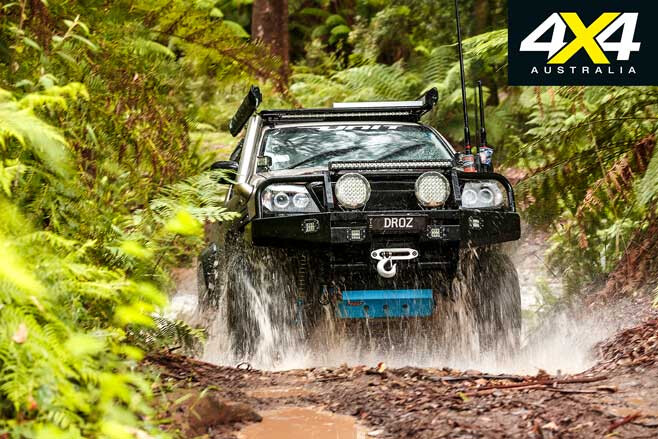
Melbourne’s Brandon Droessler thought as much when he went looking for the right 4×4 for him. This 2005 dual-cab V6 Hilux was stock as a rock when he found it, and he applied his alchemist skills to transform the rock into a gold nugget.
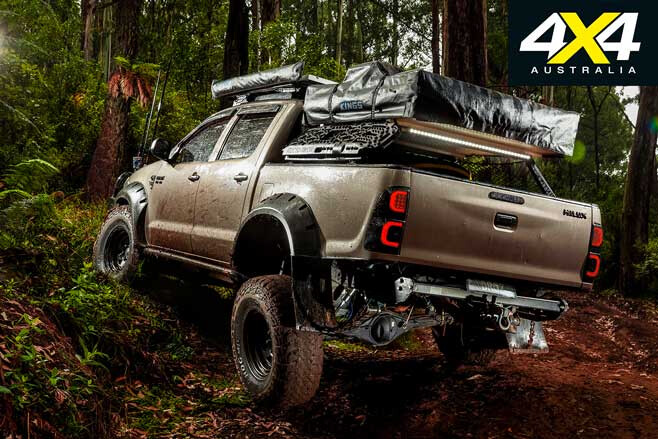
“A lot of little things changed pretty quickly,” Brandon recalls of his first months with the Hilux. “Lift, tyres, bar work, body lift, winch, basic lighting and a plastic snorkel all went straight on. I installed my own custom-made overhead console with gauges and UHF.”
As is often the case, Brandon’s project snowballed and one mod led to another as the Hilux was totally transformed.
“Then things really changed and I spent some good money on it, redoing all the suspension, from inverted shocks and Colorado leaf springs to whole new front coils and hydro bumps,” he says.
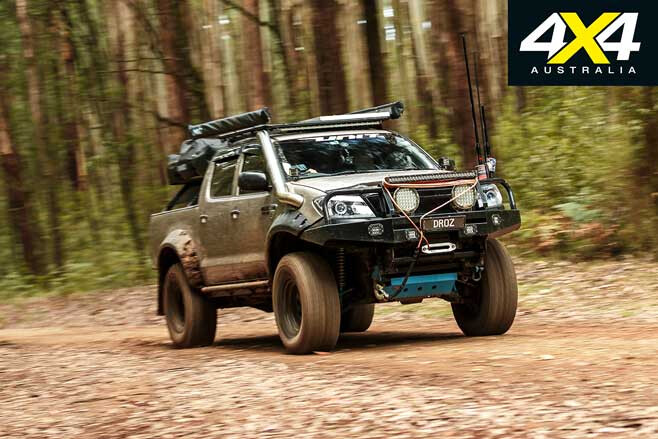
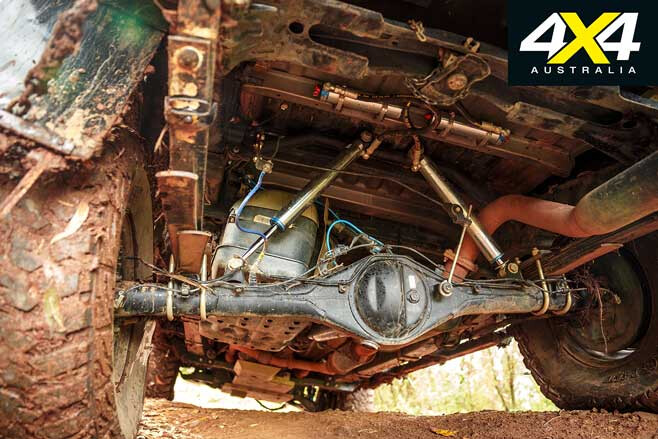
Turning this Hilux into the mud monster Brandon wanted required some serious suspension updates. Up front it starts with a set of Profender coilovers wearing 16-inch travel Eibach springs. They are fitted using adjustable upper control arms (UCA) from PSA, while a diff-drop kit from Phat Bars keeps the geometry in check with the raised height. Hydraulic bump-stops help with heavy landings when Brandon gets a bit overly keen with the jumps and bumps.
The rear leaf springs have been swapped out for longer units from a Holden Colorado on extended shackles, and they are controlled by remote reservoir shocks from Superior Engineering. They are canted inwards to allow for the longer shock length. The suspension provides around 75mm of lift, while a body lift adds another 50mm of clearance.
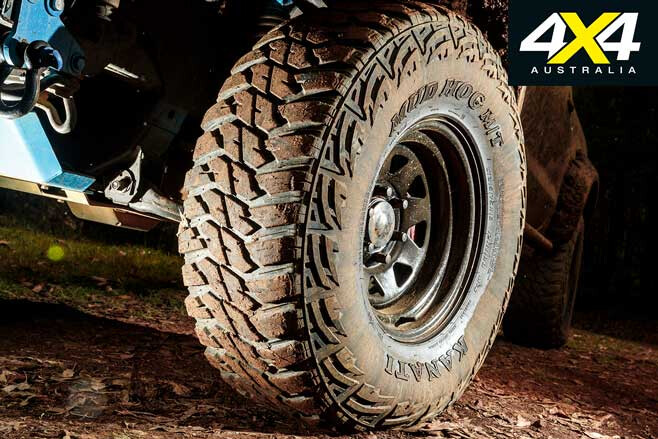
Additional height comes courtesy of larger tyres. For off-road use Brandon fits a set of 315/75 16 Mud Hogs on steelies, while 285/75 16 BFG KO2s do the job for daily use. “They have good wear and are a good all-terrain tyre,” Brandon says of the popular BFGs.
The bright blue underbody protection peeking out beneath the front end is also from Phat Bars, as are the rock sliders running down the flanks. The bullbar is an Ironman 4×4 piece that has been modified to give further clearance and includes LED lights. The lower rear section of the tub has been removed to improve the departure angle, and Brandon says future bar work that’s yet to be fabricated will better protect this area.
Lights? Brandon has fitted a few. Some might say he’s afraid of the dark, but, if he is, then a night drive in the gold ’Lux shouldn’t be frightening. Up front is a pair of nine-inch LED spotties on the bar and four flush-mount lights in the bar.
On the roof rack is a 32-inch light bar on top of the platform and a 39-incher beneath it, facing forward with a pair of seven-inch light bars on each side of the rack. If that’s not enough there’s a pair of LED cube lights mounted to the cowl and another 39-inch bar facing rearward under the tub rack. When they are all switched on at once you should be able to spot Brandon’s Hilux from the International Space Station.
Keeping them all powered is an auxiliary AGM battery mounted in a custom enclosure in the tub, which is managed by a full Redarc BCDC 1240 charging system, while a 1000-watt inverter is used for charging other gadgets.
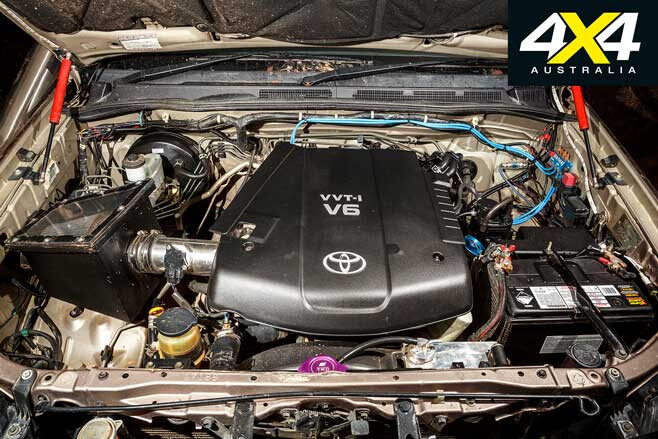
An interesting point of difference between this and most other modified Hiluxes we see is that this one is powered by the 4.0-litre V6 petrol engine and not a diesel.
“The main reason I went petrol over diesel was that I wanted the power as well as knowing the 1GR-FE motor in the Hilux was super reliable and pretty watertight,” Brandon says. “The parts are cheaper, too. I originally planned on supercharging it but I have decided I will LS3-swap it instead.”
As it stands, the V6 breathes easier through a stainless steel snorkel and custom airbox, extractors and a three-inch Hurricane exhaust system, prompted from an ECU flash and dyno tune.
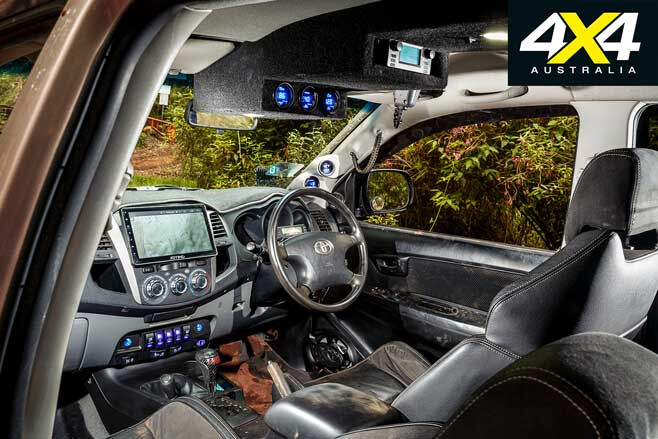
Any tradie status this Hilux once had has been softened with the interior refit, which is now focused more on adventures in comfort. A set of HSV Maloo bucket seats replace the old Toyota ones and provide more comfort and support for Brandon and his passenger. The rear seat has been done away with altogether and in its place a flat floor was fabricated to mount the Engel fridge for easy access to cold drinks.
A touchscreen head unit controls the audio and mapping display and there’s myriad switch gear scattered throughout the dash to control the lights, winch and other accessories. Vital functions are monitored by gauges in both the pillar pods and roof console, as well as an OBD scan gauge on the steering column.
While it might look like Brandon has done just about everything he possibly could to create his ultimate off-road tourer, there’s always more that can go on. For a start there’s a pair of e-lockers sitting on the workshop bench which should be fitted by the time you’re reading this, as well as that V8 engine swap he mentioned earlier.
“Expensive plans would be an LS3 engine, four-link the rear end, and a solid axle swap for the front end,” he admits. It seems an alchemist’s work is never done when it comes to transforming trash to treasure.
WHILE most of us casually tour around the outback taking in the sights and sounds, there’s a breed of person who like to do it as fast as mechanically possible.
Off-road racing might not be everyone’s cup of tea, but there’s no denying it’s one hell of a spectacle. An event like the Finke Desert race makes a great stop-over if you’re in the red centre around the Queen’s Birthday long weekend. You can camp in the red dirt and witness the cream of Australia’s off-road racing teams fly by at speeds you would not believe.
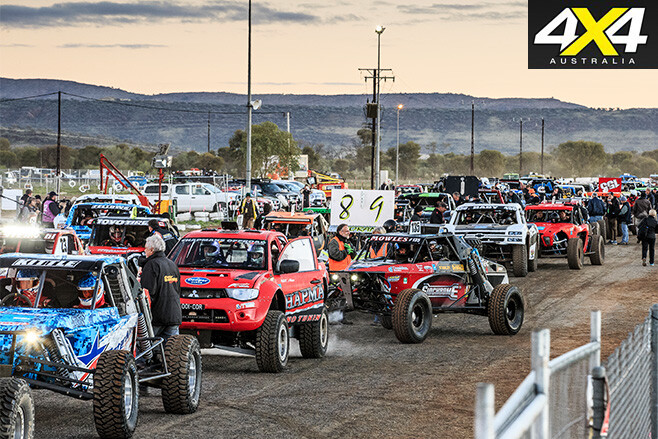
The 2019 Finke race was won by Jack Rhodes in his Class 1 buggy after a stellar performance on Day One to climb from 14th place to second on the run to Finke, and then climb to the front on the race back to Alice Springs.
Most of the attention was on two-time Dakar winner, Cross Country World Champion and multiple Finke winner, Toby Price, who this year parked his KTM motorcycle and concentrated on adding a Trophy Truck win to his tally.
Toby nailed the qualifying prologue, was first to Finke by seven minutes and was holding that lead on the return leg when his diff let go, ending his race. It just shows that you can have all the best gear and the biggest sponsors, but anything can go wrong in the outback.
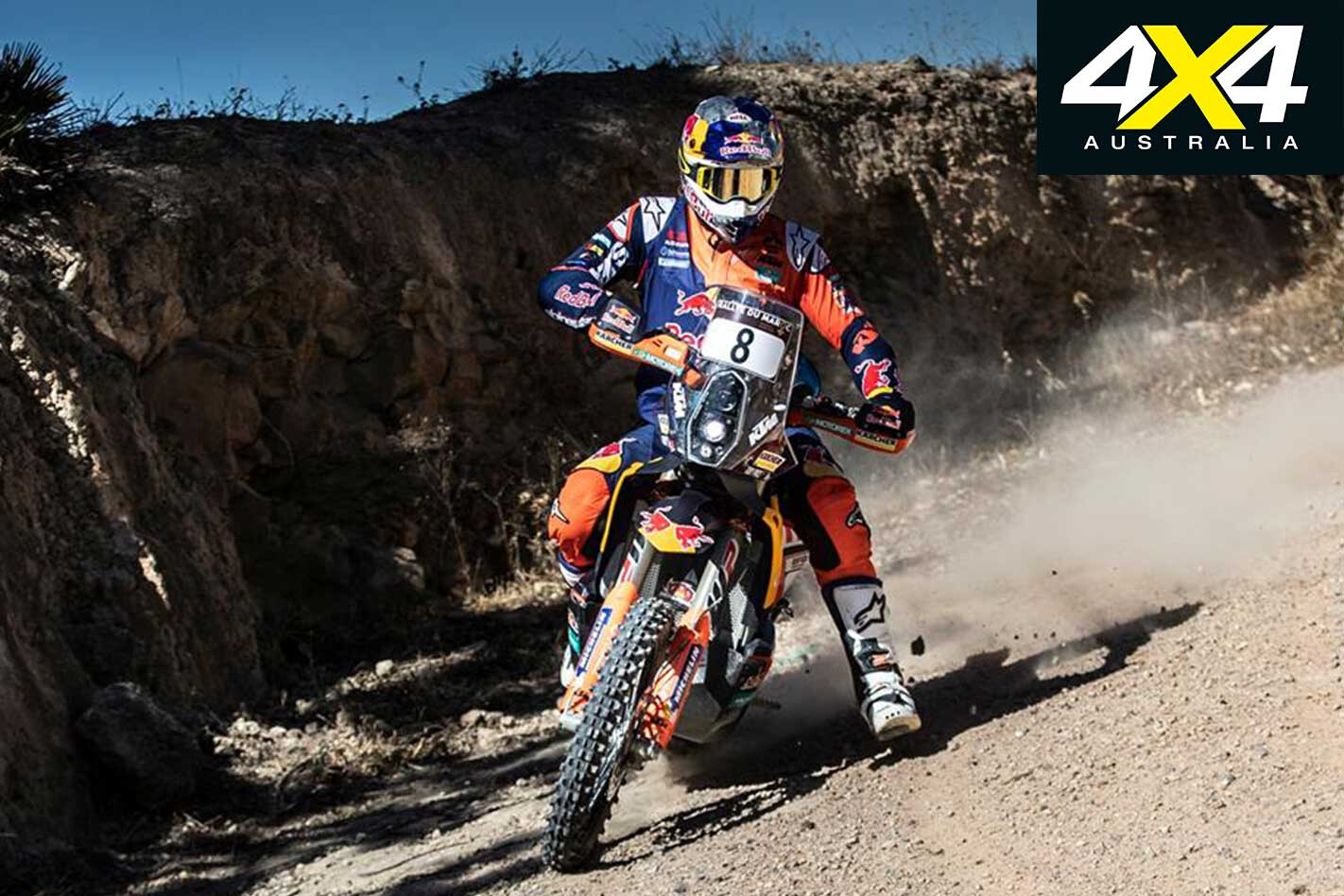
You don’t need a million-dollar trophy truck to have fun off-road racing. There are classes for all sorts of vehicle racing in Australia (even at the Finke), and a well-maintained 4×4 race truck can be a lot more affordable and fun than you think. Then there are the UTVs which are booming in popularity.
I’ve just come back from a holiday in Mexico where I followed the Mexican 1000 off-road race. Run by the National Off-Road Racing Association (NORRA), the 1000 follows the tracks of the iconic Baja 1000 and celebrates past races with many vintage and oddball race cars competing. I was following a near stock Mahindra Roxor for much of the way, as well as a bunch of guys who compete every year in a VW Bus. These guys finish the 1000 every year and have a lot of fun along the way.
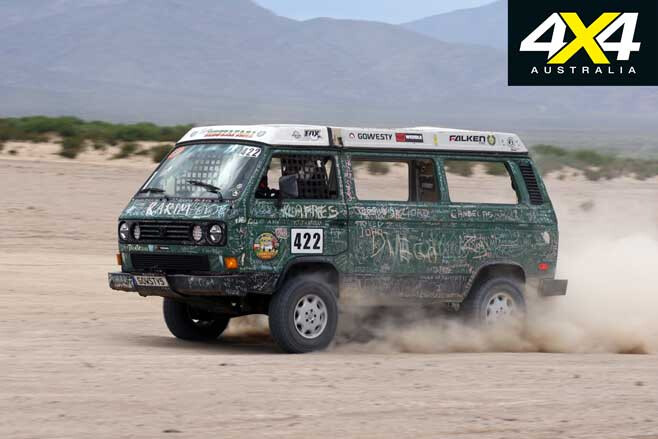
They’re enjoying off-road racing by a means they can afford and not letting cost hold them back. It sure looks like fun to me.
So you want to deck out your 4×4 for outback travel and aren’t sure where to start?
With different products available from a range of suppliers, it’s often difficult to distinguish what you actually need from what’s an unnecessary add-on.
Modifying your vehicle for outback travel shouldn’t be taken lightly, and you need to ensure you install the best 4×4 modifications for outback travel. You’re re-engineering your vehicle for a role that it wasn’t specifically intended for when it rolled off the factory assembly line.
By the time you change the tyres and suspension and add things like a bullbar, long-range tank, roof rack and a spare-wheel carrier, you will have changed your vehicle’s weight, weight distribution, height and aerodynamics.
In turn, these changes will affect steering response, stability, ride comfort, noise levels, fuel economy and fuel range.
Given that changing one thing will often affect other aspects of your vehicle, it’s a good idea to work out exactly what you need beforehand so the modifications can be done as a whole.
And, if possible, have one aftermarket supplier do the complete job. Hopefully this way the modifications and accessories will work in harmony to produce exactly the sort of functionality and performance you require.
TYRES
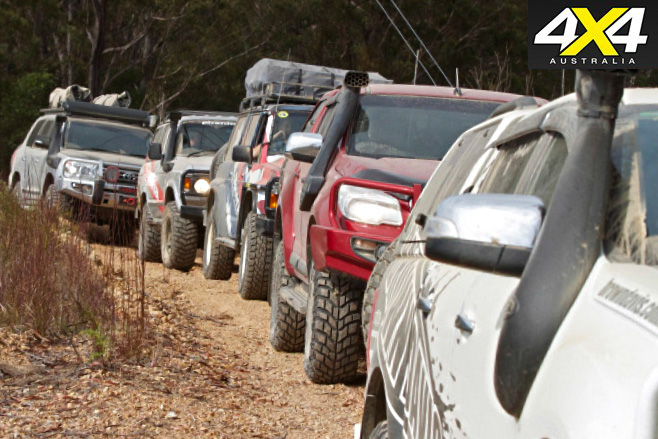
If you could change one thing on a standard 4×4 before heading to the outback, it would have to be tyres. Standard tyres on just about all new 4x4s aren’t intended for serious remote-area travel and will most likely be the first thing to fail on an arduous outback trip.
Most people concentrate on tread pattern when selecting new tyres, but there are more important attributes. Ideally you want a tyre that is more robust and less susceptible to damage. You can achieve this by selecting a tyre with ‘Light Truck’ construction, instead of the usual ‘Passenger’ construction.
Light Truck tyres are designed to carry more weight and operate at higher pressures. They have a stronger carcass than passenger tyres and have thicker and straighter sidewalls that are less prone to damage. In comparison, passenger tyres have lighter, more rounded sidewalls that are easily damaged off road. There is a downside to Light Truck tyres; the ride is harsher than passenger tyres, they can be easily upset by road irregularities, they generally don’t steer as well and they can be noisy. Still, these shortcomings are nothing in the big scheme of things if it means less punctures and tyre failures.
While it might seem odd, tyres with a higher speed rating are built more lightly than tyres with a lower speed rating. This is to avoid heat build up at higher speeds. By fitting a tyre with a lower speed rating (down to 140km/h or ‘N’ rating is legal in most states for 4x4s), you have a stronger, more robust tyre.
The amount of sidewall is also important — the more sidewall, the better. With higher sidewalls there’s less chance of the sidewall being ‘pinched’, and it will respond more favourably to ‘airing’ down for sand or mud driving.
Given that increasing the overall diameter of the tyre and wheel combination brings both technical (fouling of other components) and legal problems (a 15mm increase in overall diameter is the current legal limit), to maintain the same overall diameter but still gain sidewall, you need to use a smaller diameter wheel. This is often possible by using an OEM wheel as many manufacturers fit smaller diameter wheels to low-spec models.
While it’s important to maintain close to the overall diameter of the original wheel/tyre package, it doesn’t mean you have to fit the exact original size. A 265/60R17, for example, while a little wider than a 245/65R17, is very close to the same overall diameter. The same goes for any number of different combinations where a slight increase in tyre width is offset by a lower aspect ratio and therefore produces the same overall diameter.
Just be aware that if you deviate from a standard tyre size you may have a problem fitting the spare to its original location.
Most new 4x4s come with ‘Highway Terrain’ (HT) tyres, which should be replaced with ‘All Terrain’ (AT) tyres for outback travel. While you may be tempted to fit a more aggressive ‘Mud Terrain’ (MT) tyre, they don’t always cope all that well with long-distance travel on sealed roads.
BULLBARS
In many ways bullbars are a necessary evil of outback travel. They place a lot of weight (especially with a steel bar) forward of the centre of mass of the vehicle and of the front axle line. They also have a negative affect on your vehicle’s aerodynamics.
But, next to more robust tyres, they are the most important modification you’ll need to make. Not only will they protect the front of your vehicle, especially the cooling system, from animal strikes and the like, but they also serve as a handy place to mount lights, aerials and, of course, a winch.
While aluminium-alloy bars are lighter than steel bars, steel will be more robust and stronger when you need it most.
You’ll also have to decide between a standard bar and a winch-compatible bar. While front-mounted electric winches can be very handy, they are not an essential item for outback travel. A simple hand winch will do the same job and is more versatile. However, even if you don’t want to initially fit a winch, by purchasing a winch-compatible bar, the option is left open if you change your mind down the track.
When buying a bullbar don’t be limited by price. A good bullbar is a sophisticated bit of engineering and you’ll have to pay for quality. And of course, you’ll need a bar that is airbag compatible — except in the rare case of older vehicles not fitted with airbags.
LONG-RANGE FUEL TANKS
Obviously, fuel is essential for outback travel. Unfortunately extra fuel can be difficult to carry safely and effectively. The last thing you want to do is carry fuel inside your rig, or on a roof rack, given its weight.
Long-range tanks place the fuel where you want it (under the vehicle) and can normally provide the volume of several jerry cans. Travelling in remote areas, a heavily laden 4×4 working hard on soft sand or mud will use a whole lot more fuel. So, when estimating fuel requirements for a long trip always factor in an extra 20 per cent.
SPARE-WHEEL CARRIERS
It’s a good idea to have a few spare tyres when trekking away from civilisation. And while simple tread penetrations can be relatively easy to repair, sidewall damage is usually terminal. Rear mounted spare-wheel carriers, usually incorporated into a rear bar can carry one or two spares.
If you are using an oversizedtyre that doesn’t fit to the spare location, or have a fuel tank under the car where the spare normally sits, then a spare wheel carrier is the answer — and certainly a better idea than carrying spares on a roof rack.
COMMUNICATIONS
Satellite phones have made outback and remote area communications far simpler. And if you don’t wish to fork out the cash for a sat phone — or take out a long-term plan for a one-off trip — they can be hired out.
It’s vital to keep a sat phone charged and secured within your vehicle so that it won’t be damaged during an accident. For local communication, a good quality, vehicle-mounted, 5-watt (narrow-band 80-channel) UHF radio is essential.
CARGO BARRIERS
Cargo barriers may not seem like an essential part of an outback touring kit but they make your 4×4 wagon safer and more functional. In the event of an accident, the last thing you want is recovery gear and tools flying around like missiles inside the cabin.
A cargo barrier will stop that but it’ll also allow you to load the luggage area of your wagon far higher than you otherwise would.
DRIVING LIGHTS
In an ideal world, you should never drive in remote areas after dark but sometimes that’s unavoidable. If caught out after sunset, you’ll need extra lights, with a combination of wide and pencil beams. It’s best to avoid the cheap option and spend some cash on a light that’s vibration resistant, and dust and waterproof.
Perhaps more important than the light, is the mounting system. Even the best lights are useless unless they are aimed correctly, so make sure you buy lights with a robust, easily adjustable and vibration-resistant mounting system.
SNORKELS
You may not plan on attempting any deep water crossings, but you never know what affect local rain may have on a particular crossing. Getting water into an internal combustion engine is catastrophic so it’s not worth taking the chance.
Even if you never use the snorkel for crossing water, they help provide the engine with cleaner, dust-free air. Just be aware that snorkels generally produce wind noise and have some negative aerodynamic effects.
DUAL BATTERY SYSTEMS
If planning to run fridges, camping lights and other accessories then a dual-battery system is essential to protect the starting battery. Dual battery systems can be wired up in several different ways so it best to talk to a specialist regarding the options.
ROOF RACKS AND TRAILERS
Towing a trailer isn’t ideal but having a whole lot of stuff piled up on a roof rack has its problems too. Unfortunately, using either measure is often unavoidable — sometimes you even need both.
What’s important to remember is that for constant speed touring a trailer will be more fuel-efficient than having gear piled up on a roof rack, due to aerodynamics. Conversely, when you are constantly slowing down and accelerating again, on a typical 4×4 track, the extra weight of the trailer will make it less fuel-efficient.
SUSPENSION UPGRADES
This may be the last upgrade mentioned here but it’s certainly not the least important. Suspension upgrades should be administered once you’ve finalised the full list of accessories for your vehicle. There’s no point upgrading the suspension and then adding extra weight, you’ll be back where you started.
Suspension upgrades are done for three reasons. To compensate for the extra weight and altered weight distribution of a modified vehicle; to provide a better ride, better control and more fade-free damping; and to provide extra ground clearance.
You should always buy the very best suspension as poor quality suspension can make long-distance travel a real pain (literally) and unsafe. Ideally, you want the suspension to be as compliant as possible, as supple suspension places less strain on your vehicle and its occupants.
The amount of suspension lift is also a vexed question as the more lift you have the more your on road handling and aerodynamic drag (and hence fuel consumption) will be effected. Ideally you want the least amount of lift you can get away with.
Depending on the vehicle you start with, around 35mm to 50mm will do the trick in most cases.
EACH YEAR as the Easter Jeep Safari rolls around we head to Moab, Utah, to not only take in the beauty of the area, but to check out Jeep’s new crop of concept vehicles. If we are lucky, we sneak one away from the corral for some “quality time” in the region’s spectacular backcountry.
The concepts typically range from mild to wild, and as much as we like carving crescents through sand dunes in 522kW HEMI-powered Wranglers, this year our thoughts gravitated toward what we aspire to the most: a mobile abode that is not only capable, but one that will make off-piste life more comfortable. Meet the Gladiator JT Wayout.
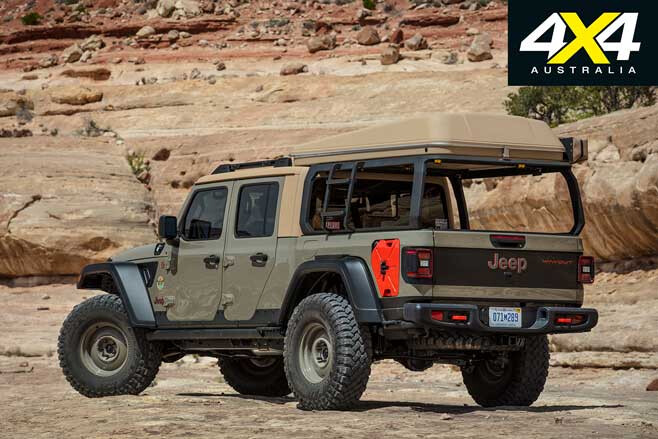
The Wayout may appear to be a one-off creation, but its heritage reaches back more than a decade to one of Jeep’s first concepts, the Overland JK. Back in the day, we borrowed the Overland for a three-week, 5000km all-dirt undertaking from the Mexican border to the Canadian border (see May 2011 issue of 4X4 Australia).
Before we get into details on the Wayout, feel secure in knowing we’re at the bargaining table to take it off Jeep’s hands for another extended end-of-the-earth adventure.
From the built-in compressor and air station to refined touches in the rooftop tent, Jeep’s Design Operations team addressed every minute detail. Looking from the bulldust up, we find a set of 37-inch Falken Wildpeak mud-terrains wrapped around fix-em-with-a-hammer 17-inch steel wheels. Articulation is managed by a two-inch Jeep Performance Parts (JPP) lift, and Fox shocks keep your teeth from rattling out of your jaw on corrugated roads.
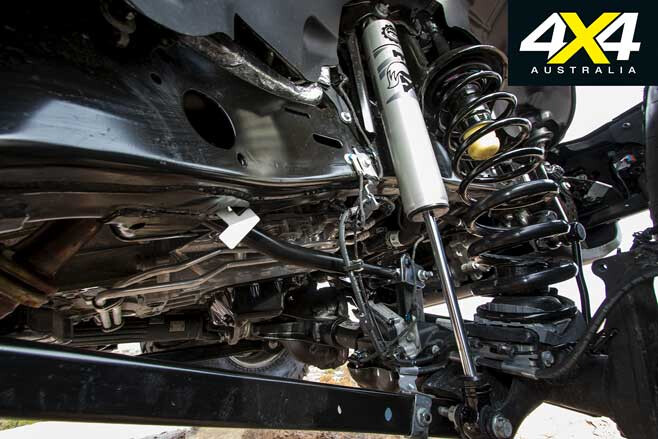
With reliability at the top of the list, the drivetrain remains bone stock. Axles are Dana’s new Gen III 44 fitted with 4.10:1 gears and Tru-Lok electronically actuated diffs. They receive power from an NVOR 241 transfer case (4:1 low range) and 850RE eight-speed auto – the aggregate providing an impressive 72:1 crawl ratio.
Generating 213kW and 353Nm the 3.6L Pentastar V6 not only provides power for nearly any scenario, but impressive economy for a petrol mill. The JT’s 83-litre fuel tank, along with two auxiliary cans recessed in the bed, should give a range of 650-plus backcountry kays. The only mods behind the radiator are a JPP cold-air intake, snorkel, and a Black Forest burrito oven – not many rigs have a built-in kitchen.
Walkaround & Amenities
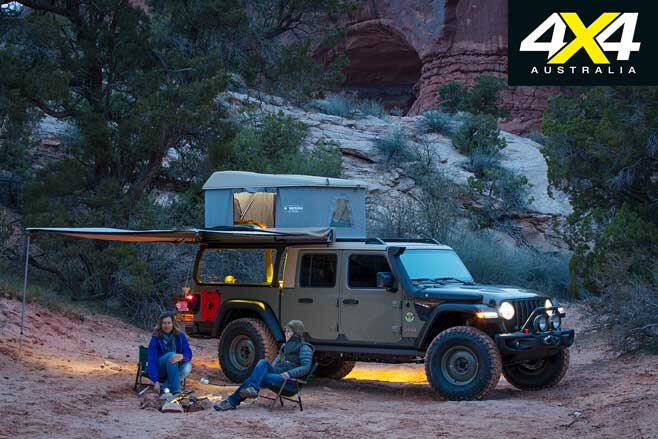
WALKING around the Wayout reveals the accoutrements that make us drool. Up front is a Warn Zeon 12 winch spun with synthetic rope and a Factor 55 Ultrahook. A pair of IPF 800 Xtreme HID auxiliary lights ride on the stock Rubicon bumper and offer plenty of lumens for late nights on the trail. A factory rear bumper, along with custom rock rails and sheetmetal protection, round out body armour. The aforementioned fuel storage graces both sides of the bed, and a hidden ARB compressor supplies air to a port-side quick-release valve and gauge.
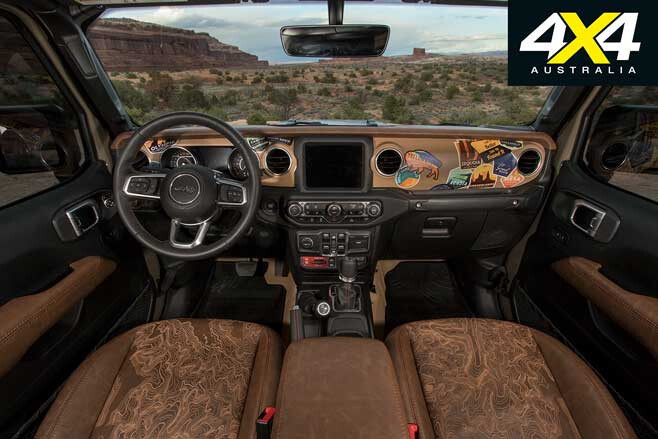
Moving inside, the Wayout is inviting and rugged. Front and rear seats are crafted from high-grade leather and sport laser-etched topographical maps (in case we lose our way). The view from the driver’s seat is all Rubicon: 4WD, locker controls and auxiliary switches are just fore of the shifter. The eight-inch touchscreen features Apple CarPlay and Android Auto, but SiriusXM kept the tunes flowing through the evening.
We like to be comfortable, even when we are “roughing it”. We set up camp in one of Moab’s red rock canyons, and the Wayout checked all the opulence boxes. Resting on a custom bed rack is an Autohome Maggiolina rooftop tent, replete with interior LED mood lighting.
Deploying the Alu-Cab Shadow awning, which provides 270-degree shade, will ease life during the warm days of summer. If things get really bad there is a cocktail bar out back. Yes, one side of the Decked drawer system was converted into a full-service bar with a cooler, electric blender and all the trimmings. We clicked on the amber Baja Designs LED camp lights, pulled out a few chairs, and relaxed while the twilight yielded to a million constellations.
As Easter Jeep Safari came to a close, we tried to steal away with the Wayout for an upcoming two-week trek into Baja, Mexico. Unfortunately, the Jeep boys caught us at the edge of town and we had to give her back. But we’re pretty sure we’ll meet again, as this backcountry Gladiator has the right stuff for a proper “way out” adventure.
THE drip-feed of 2020 Land Rover Defender content continues, with an image of what could be the new Defender – illuminated on the vehicle’s display cluster – surfacing on Instagram.
Posted to the ‘landroverphotoalbum’ Instagram page, the sneaky photo closely resembles the leaked ‘LEGO Defender’ that was unofficially revealed earlier this week.
https://www.instagram.com/p/BzFnqgVBK4E/
Both images reveal a white roof, a raised hood, boxy elements to its design and a spare wheel on the rear door. The digital cluster image then indicates the vehicle may hark back to its ancestors and include a roof window above rear-seat passengers.
A spy shot of the upcoming Defender’s interior did the rounds back in February, 2019. More interior shots have now found their way onto the web, indicating the original shot was bang on the money.
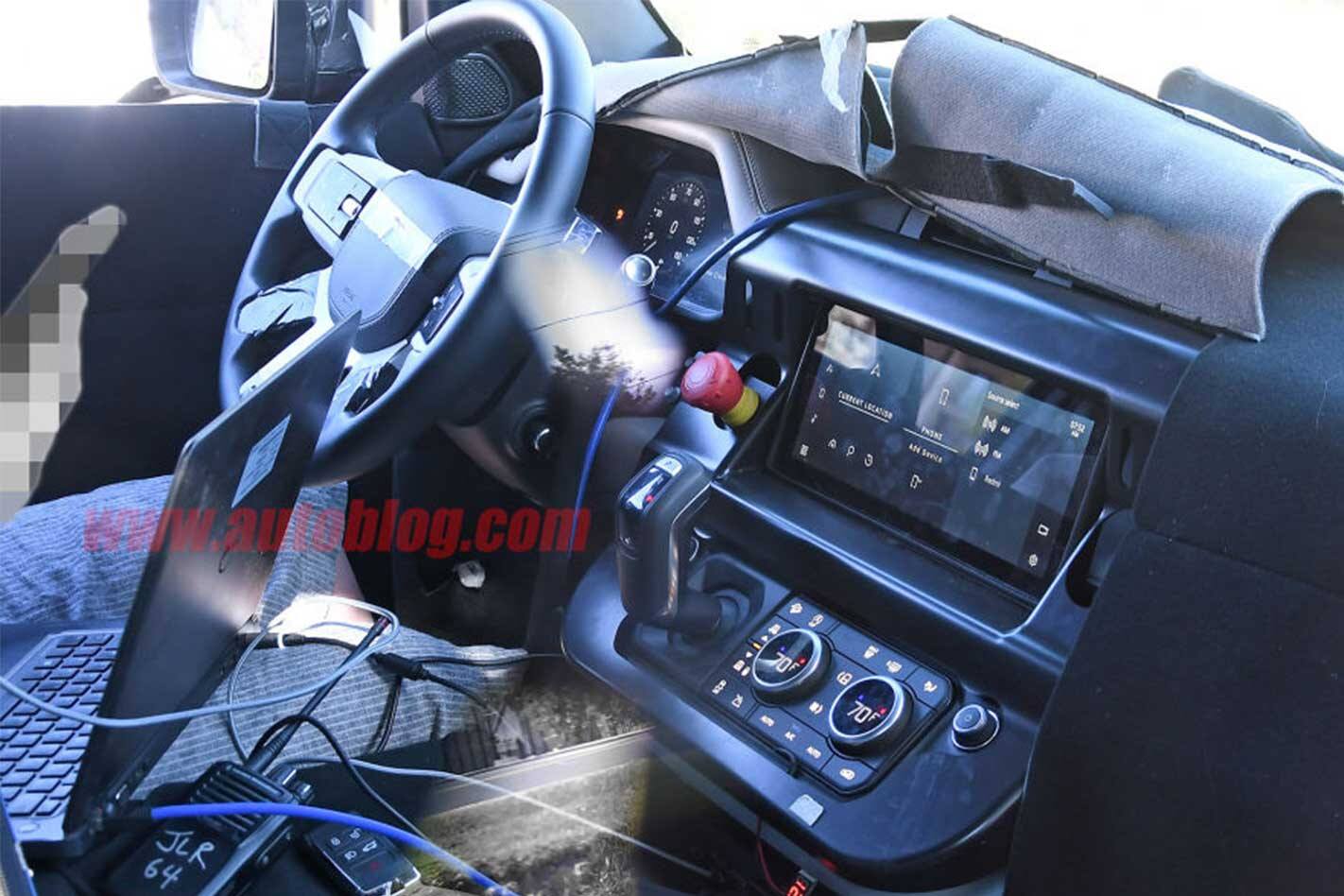
The recent images confirm that the transmission shifter resides on the centre stack to free up space for storage. It sits alongside climate control dials and terrain/drive management buttons and below a large touchscreen, while hard-edged, boxy design elements remain throughout.
Earlier spy shots indicate the Defender will share its underpinnings with the Range Rover and Discover and run height-adjustable independent front and rear air suspension. A 2020 Defender test mule was also spotted in Africa, wearing a unique camouflage and a fitted with an integrated raised-air intake.
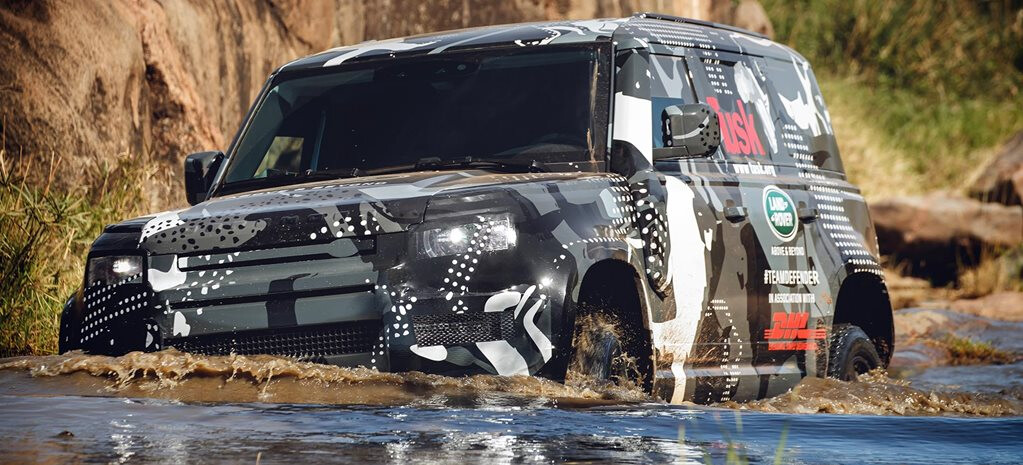
There’s been a barrage of ‘leaks’ of the 2020 Defender in anticipation of its end-of-year reveal, set to take place in September.
Interior image credit: Autoblog
TOYOTA is taking the fight to its main sales rival, Ford’s Ranger, by updating the Hilux to include the company’s Safety Sense suite of driver assistance technology – in turn, making autonomous emergency braking (AEB) standard across the range.
The Safety Sense package comprises a pre-collision safety system that includes day/night pedestrian detection, cyclist (day) protection, lane departure alert (with steering assist), high-speed active cruise control and road sign assist.
This makes the Hilux one of only a handful of 4×4 utes (the safety tech is also standard on the 2WD Hilux) to offer this high level of safety tech –other models include the aforementioned Ranger, Mitsubishi’s latest Triton, the SsangYong Musso and Mercedes-Benz’s X-Class (oddly, the just updated Holden Colorado still does not offer this level of safety). Impressively, this significant update only brings with it a small price increase of between $800 and $875.
The addition of Safety Sense means Toyota is expecting the upgraded Hilux to be awarded a five-star 2019 ANCAP safety rating – itself something worth spruiking, as the latest ANCAP tests are far more stringent than, say, those of even five years ago. In fact, a number of competitor vehicles boasting ‘five-star ANCAP’ would not be awarded the same rating today.
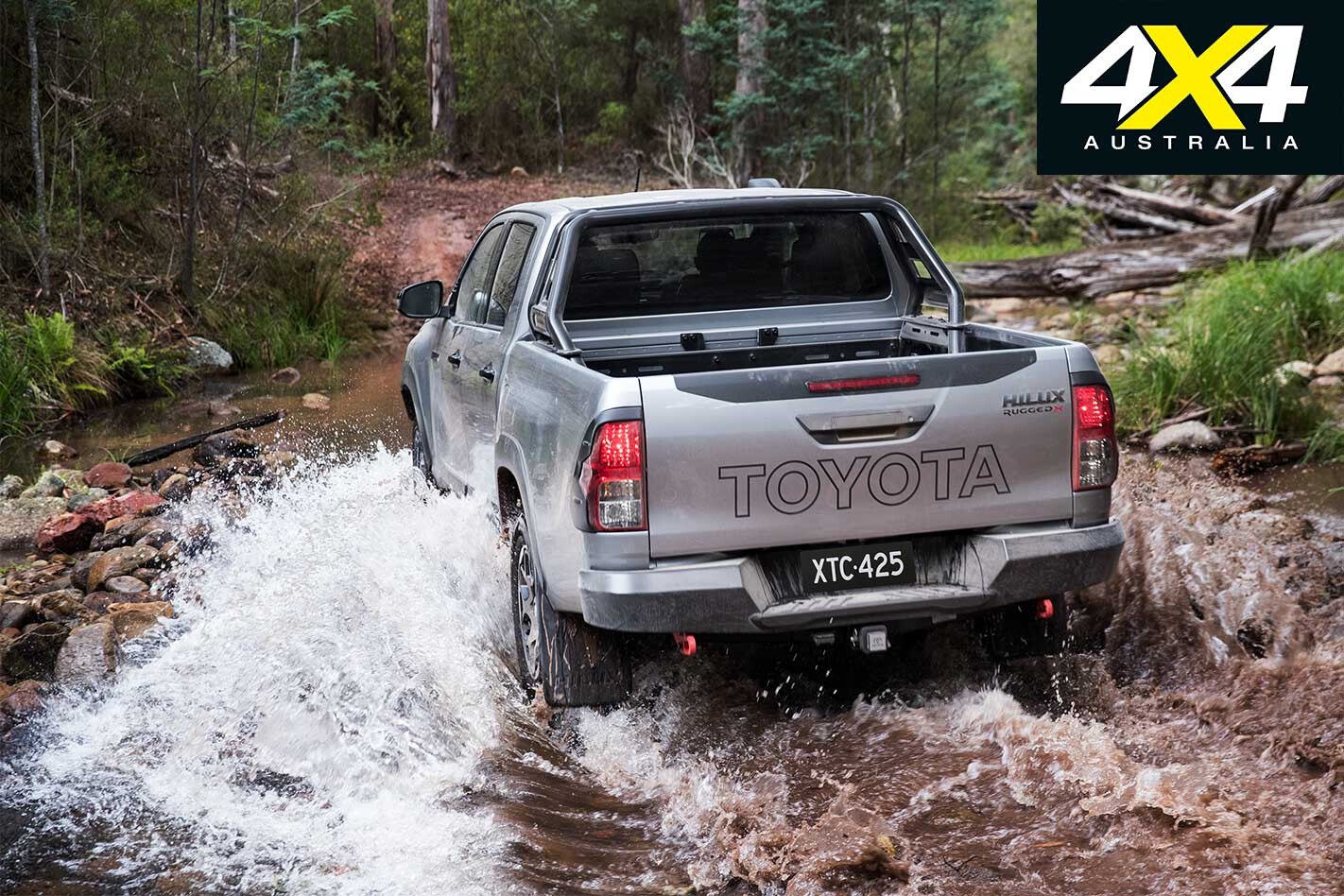
Hilux 4×4 single- and dual-cab variants with the enhanced safety features will be available from July 8, and the ‘halo’ models – Rugged, Rugged X and Rogue – will hit showrooms from August 1. Extra-cab buyers will have to wait until August 26.
The Safety Sense’s pre-collision system utilises radar and camera sensors to detect potential impacts and notifies the driver via braking assistance, autonomous emergency braking (if there’s no reaction from the driver) and with audible and visual warnings. The lane departure function adds steering wheel vibration and steering assistance, which itself is initiated via the vehicle’s brakes.
As expected, the high-speed active cruise control provides a safe distance between yours and the preceding vehicle, and it is active only above 40km/h (below 40 it disables automatically). The inclusion of road sign assist – and how it is delivered via the multi-information display (MID) in the HiLux instrument panel – also means WorkMate models cop a ‘new’ 4.2-inch MID to cater for that tech.
Toyota Australia’s Vice President of Sales and Marketing, Sean Hanley, is confident it brings extra buyer appeal to the Hilux.
“With the addition of these advanced safety technologies, customers can be assured they are behind the wheel of a vehicle that delivers the latest driver assistance features, whether that’s a light commercial vehicle like a Hilux … or a passenger car such as Corolla or Camry.”
We reckon the fact it brings Hilux back level with Ford’s Ranger in terms of safety tech, in what is shaping up to be yet another neck-and-neck tussle for sales glory in 2019, doesn’t hurt either.
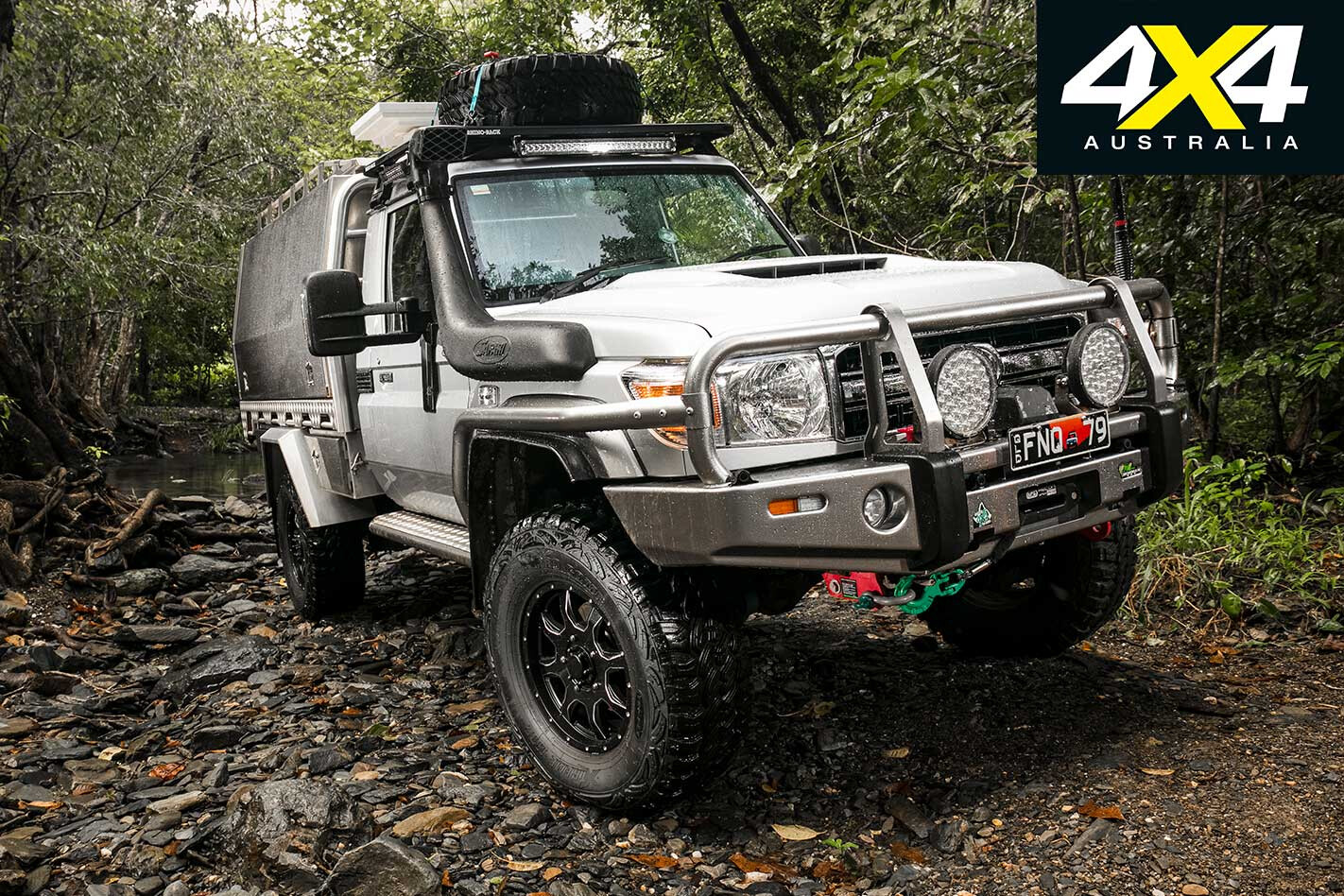
THE 79 Series Land Cruiser on the cover of this month’s mag is a portal-axled beast built to tackle tracks for weeks – and even months – on end. Loaded with off-road kit, the Cruiser allows its owner to enjoy the wild side of Australia.
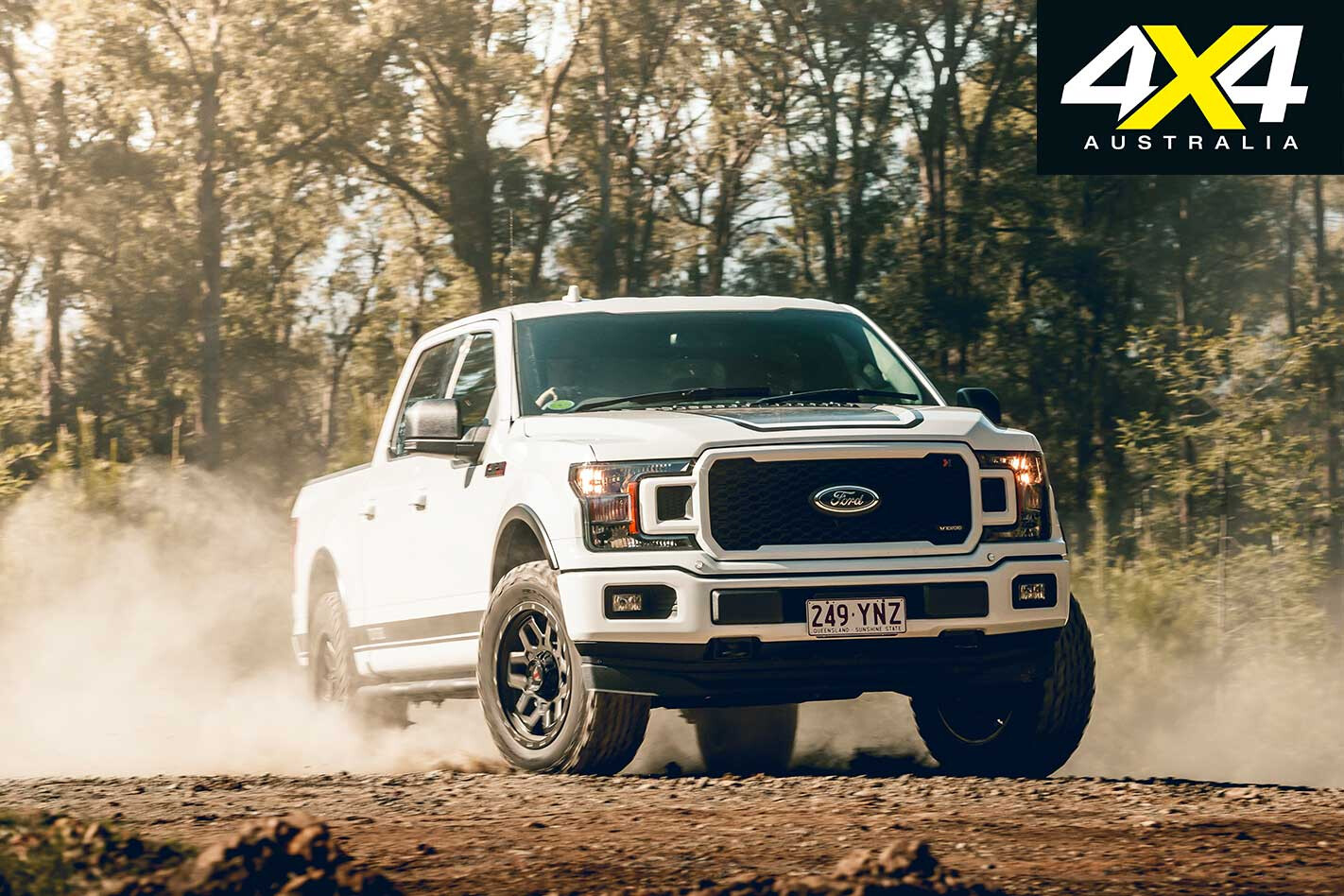
Tickford has given the mighty F150 a tickle and it’s enough to raise any heart rate, but how does the burly, expensive pick-up perform off the tarmac?
SsangYong introduced a long-wheelbase version of its Musso ute called the XLV, boasting the segment’s longest tray and the industry’s longest warranty – we drove it on and off the bitumen. Plus, we drove Range Rover’s lavish P400e PHEV.
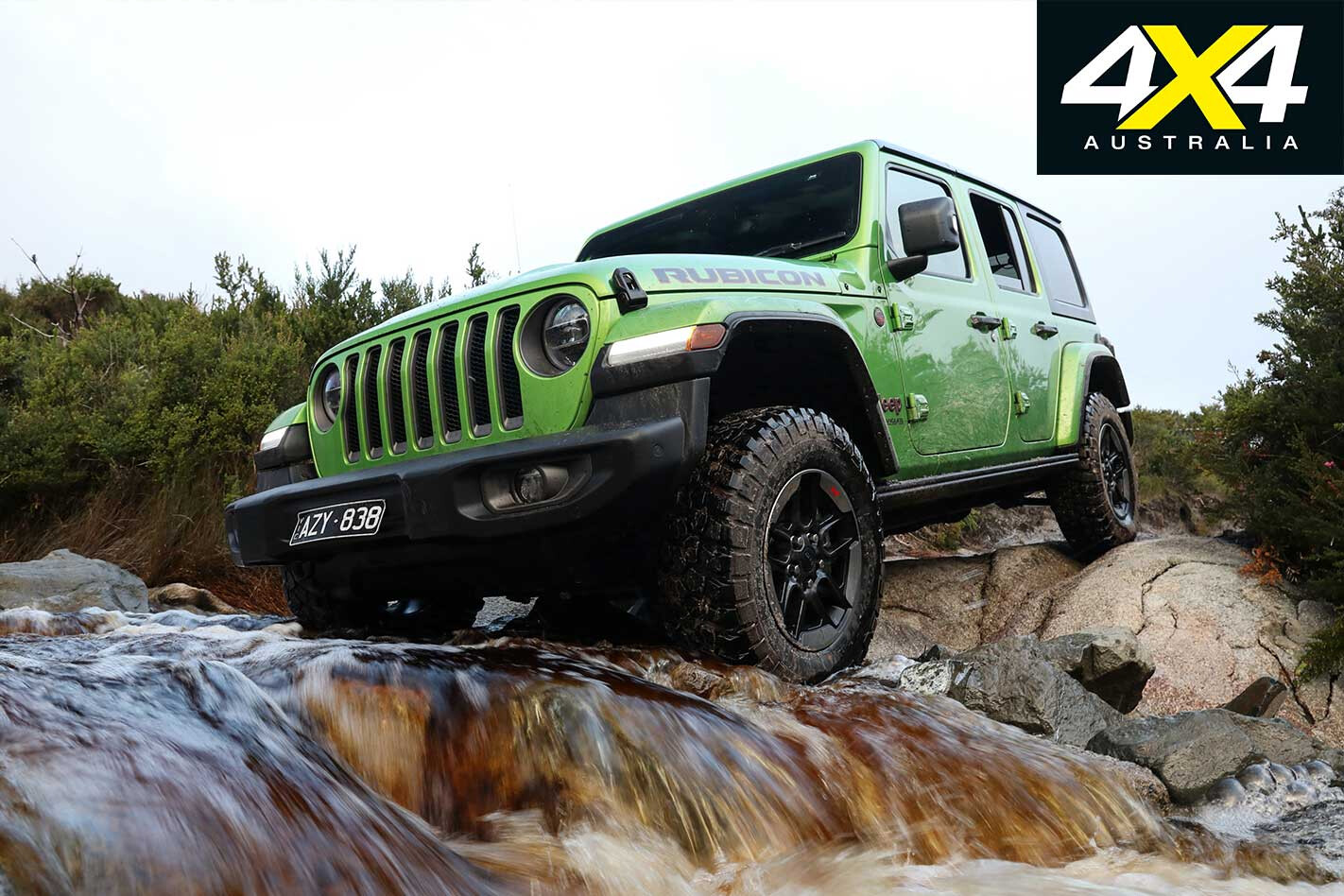
The Wrangler finally arrived on local dirt, with no manual transmissions among the six models available to Aussie buyers. We drove the range-topping Rubicon, the only model in the local line-up to utilise the 2.2-litre turbo-diesel engine.
In this issue we continue to follow the build of MSA 4×4’s epic ‘Super Cruiser’, a stretched 6×6 Land Cruiser.
Plus, before we hand back the keys to our long-term Discovery SD4 we head bush for last one last off-road adventure in our resident Disco.
Also included with this issue is the 4X4 Adventure Series’ Season 4 finale. In this episode we wrap up our journey in NSW’s South-East Forests by touring Eden and its surrounding hills.
WHAT ELSE IS THERE? – Dangerous and daring Arnhem Land adventures. – Drive 4 Life 2019 and Eldee Easter coverage. – Touring Wandiligong, Victoria, and Nundle, NSW. – Roof rack buyers’ guide. – Snow driving in portaled Cruisers. – Product tests, regular columns and heaps more.
The July 2019 issue of 4X4 Australia will be available in stores from June 27.
WAY BACK when I started, my role was hands-on. I built all the cab-mount suspensions for International and Iveco trucks. We were an OEM supplier to International Trucks, and my role was to supply them with the product they required.
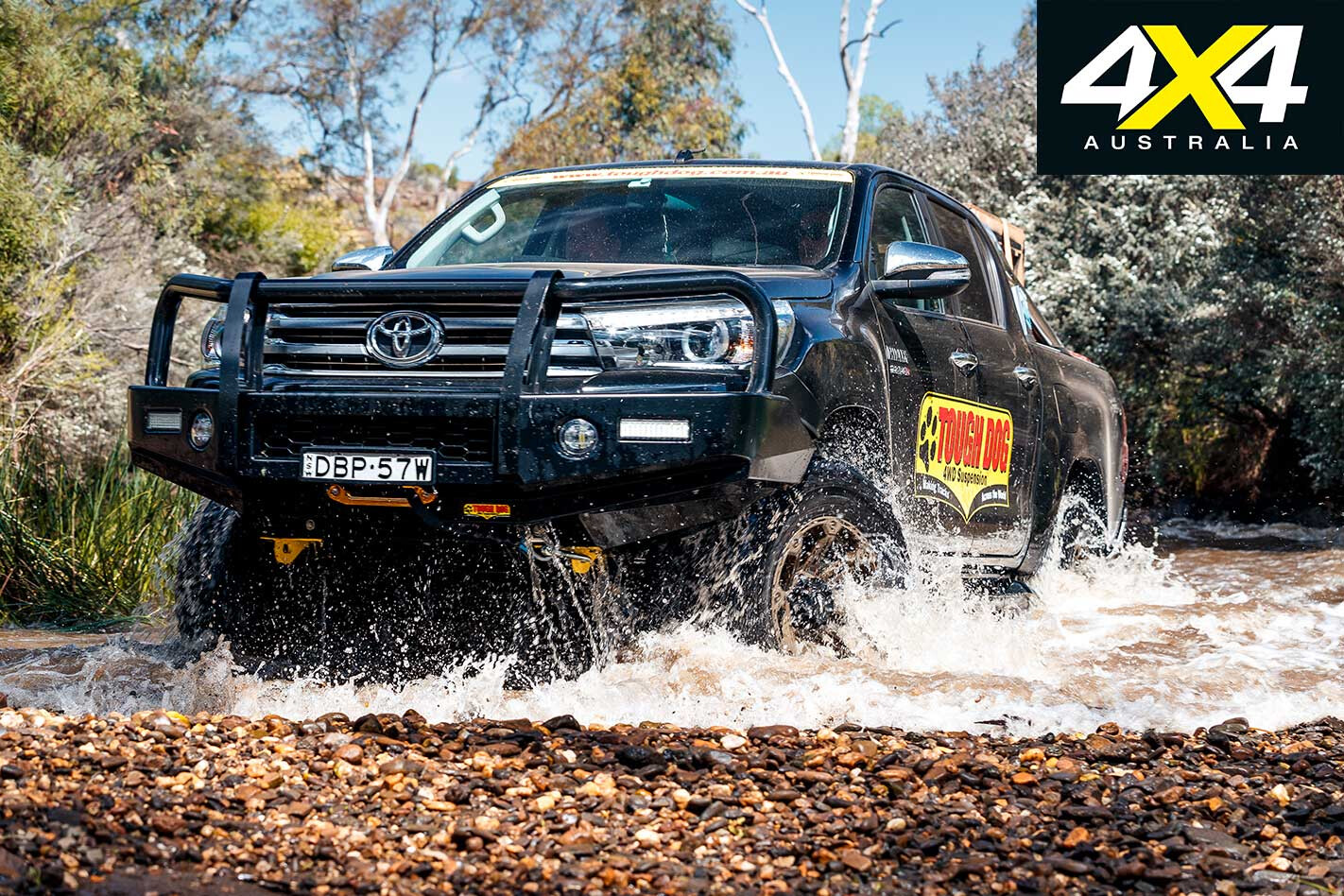
At the same time, John Agostino (4 Way Suspension’s founder) was running the 4×4 program and developing product for the 80 Series LandCruiser under the Tough Dog brand name. At that time, the 80 series was a
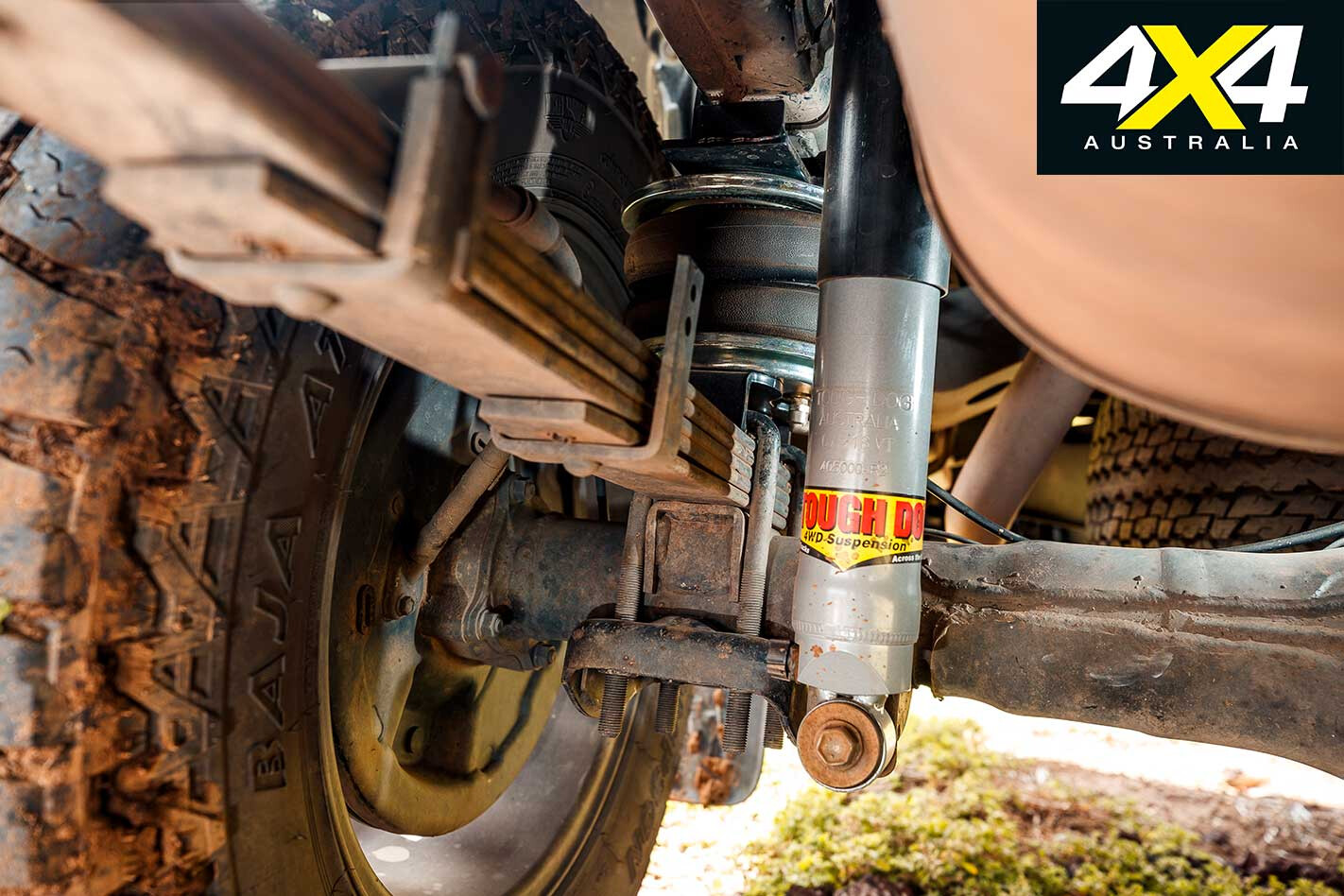
As a company, 4 Way experienced far more growth in four-wheel drive suspension than cab mounts and I came across to the four-wheel drive division of the business. In 1997 I became production manager for the business. I spent at least 10 years running day-to-day activities. Like any small business, there was much more going on for everyone than just their core job.
We might act like a corporate company – and I’m proud of the growth we’ve achieved as a brand – but at the bones of what we do here we’re still a family business, which I really like. My role grew with the needs of the business, and I was taking care of staffing and HR, daily operations and production as well as getting involved in sales and marketing. In 2000 I formally took on the role of General Manager.
Tough Dog’s international sales also saw me flying around the world to bring on new dealers. There’s so much going on in a family business you need to be a jack-of-all trades, and more importantly, passionate about getting the job done.
That ‘get the job done’ mentality has helped us over the years, and its also the reason I joined the guys on the 4×4 Of the Year testing. We had a marketing job to do, I wanted to see the new vehicles on the market in the field and on top of that, we had new product to torture test as well!
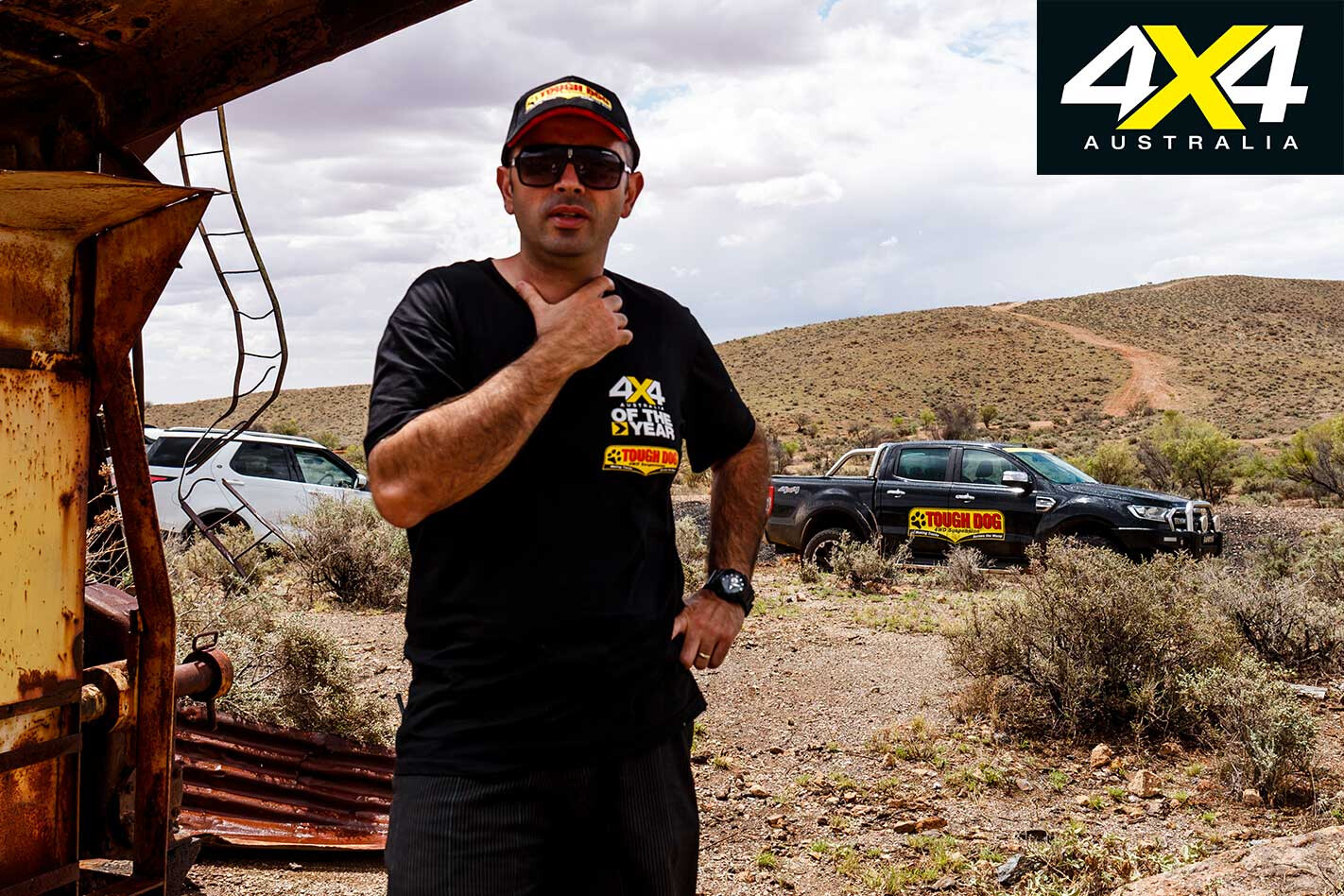
We want to take the next step as a business but at the same time, I don’t want to lose touch with the hands-on connection with the product that I’ve spent so long with. With that in mind, I’ve transitioned into my new role as Director of Product Development and we’ve brought on a new General Manager. Moving forward, you’ll see this brand grow substantially in the next five years.
As far as product development goes, there’s been a lot of interesting stuff. We’ve spent time in the UAE developing solutions for armoured-plated suspensions for military vehicles that are built on the 200 series and 79 series Land Cruisers. These vehicles have 12mm plate steel floors, and are rated to withstand 7.62mm rifle fire and IED explosives.
These projects are really important because you’re exposed to the gravity of the situation. As in, there are very serious consequences if the product fails in the field – so you’ve got to take what you do very seriously because lives are at risk.
We also had a project about 10 years ago that was equally interesting – and funny. I went to South Africa and met with the client. They’d heard good things about the Tough Dog range, and they were suffering from inadequate suspension in their safari vehicles.
But they made one thing very clear; If our product failed, the customers would be eaten by lions. Yes… Eaten! Here in Australia we’re used to dangerous animals, but nothing here is really planning on eating you! We ended up winning the contract and they’ve been an ongoing customer ever since.
Battery powered four-wheel drives are going to be here a lot sooner than you think, and that’s where our development will likely be focused in the future. As battery vehicles improve, manufacturers will be harvesting energy from anything they can on and around the vehicle; the shock absorber is a perfect example. The kinetic and heat energy generated is wasted at the moment. 4 Way Suspension will most likely be a lot more electronically focused moving forward to cater to the advances in the market.
People get worried when advances mean big changes to their vehicle. In the last 30 years of suspension development alone, we’ve seen a perception change from ‘real’ 4x4s only having a live axle configuration to the current perception that embraces independent suspension. Some people went so far as to say the torsion bar 100 series LandCruiser meant that Toyota probably wouldn’t sell another one! Today’s issue is all around engine displacement, efficiency and emissions.
These days, smaller technology driven engines with DPFs fitted and AdBlue tanks rule the roost; those cast-iron boat anchors of the past are waning. The natural next step is to develop hybrid and electric technology to the point where it can withstand harsh environments. That’s an evolution that personally, I support; it’s the next big thing and we’re excited to see what the future holds.
Meet the Expert Name: Simon Vella Role: Director of Product Development, Tough Dog Experience: 26 years
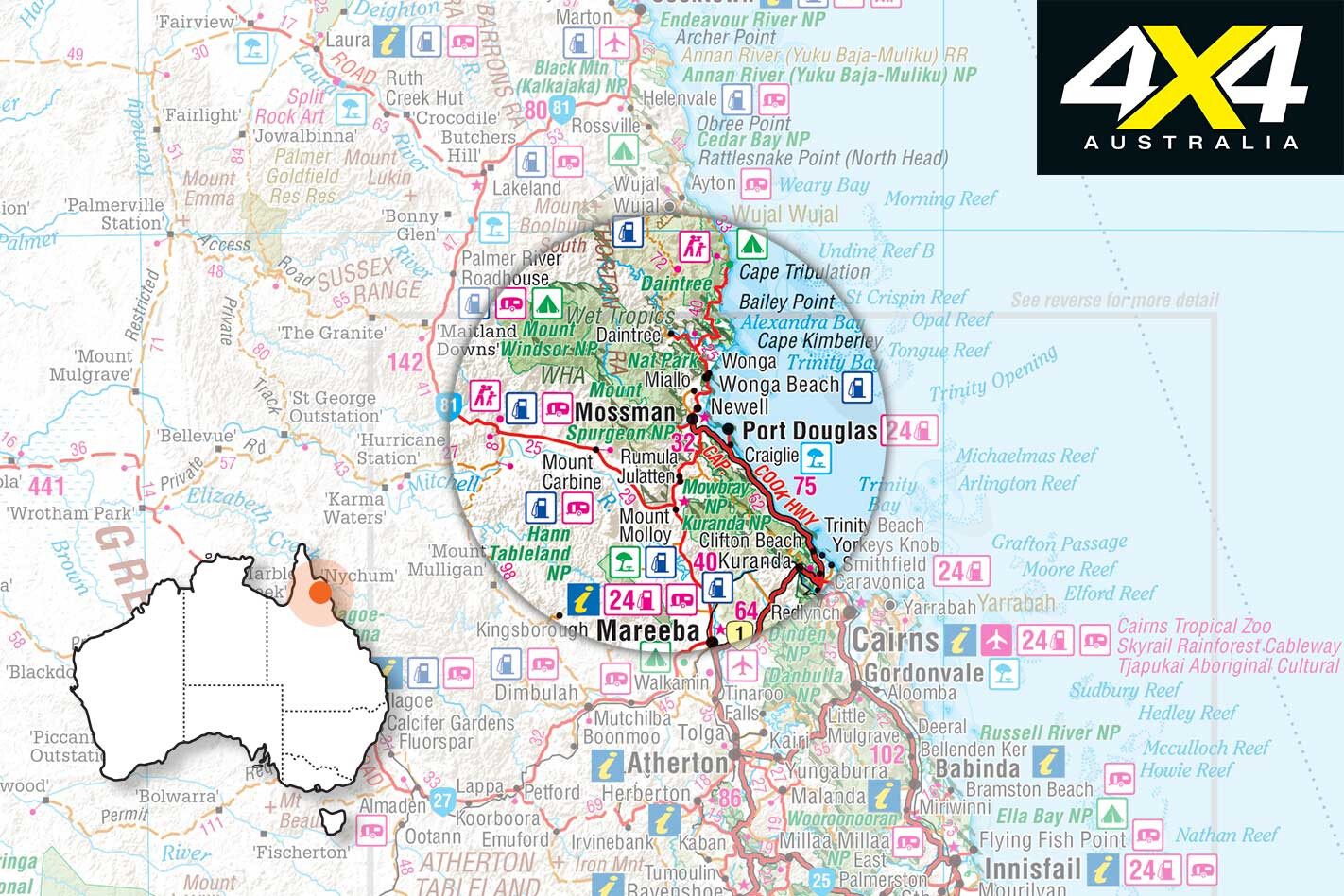
THE WET Tropics World Heritage Region commences at Paluma National Park (NP), north of Townsville, and terminates at Black Mountain NP, south of Cooktown, an unbroken chain of national parks and reserves totalling more than 9000km² of tropical mountains and lowland rainforest.
There are many rare jewels in the Wet Tropics including the Daintree Rainforest and Paluma Range NP, but nothing equals the hidden Mount Lewis National Park on the Julatten Tableland, west of Mossman.
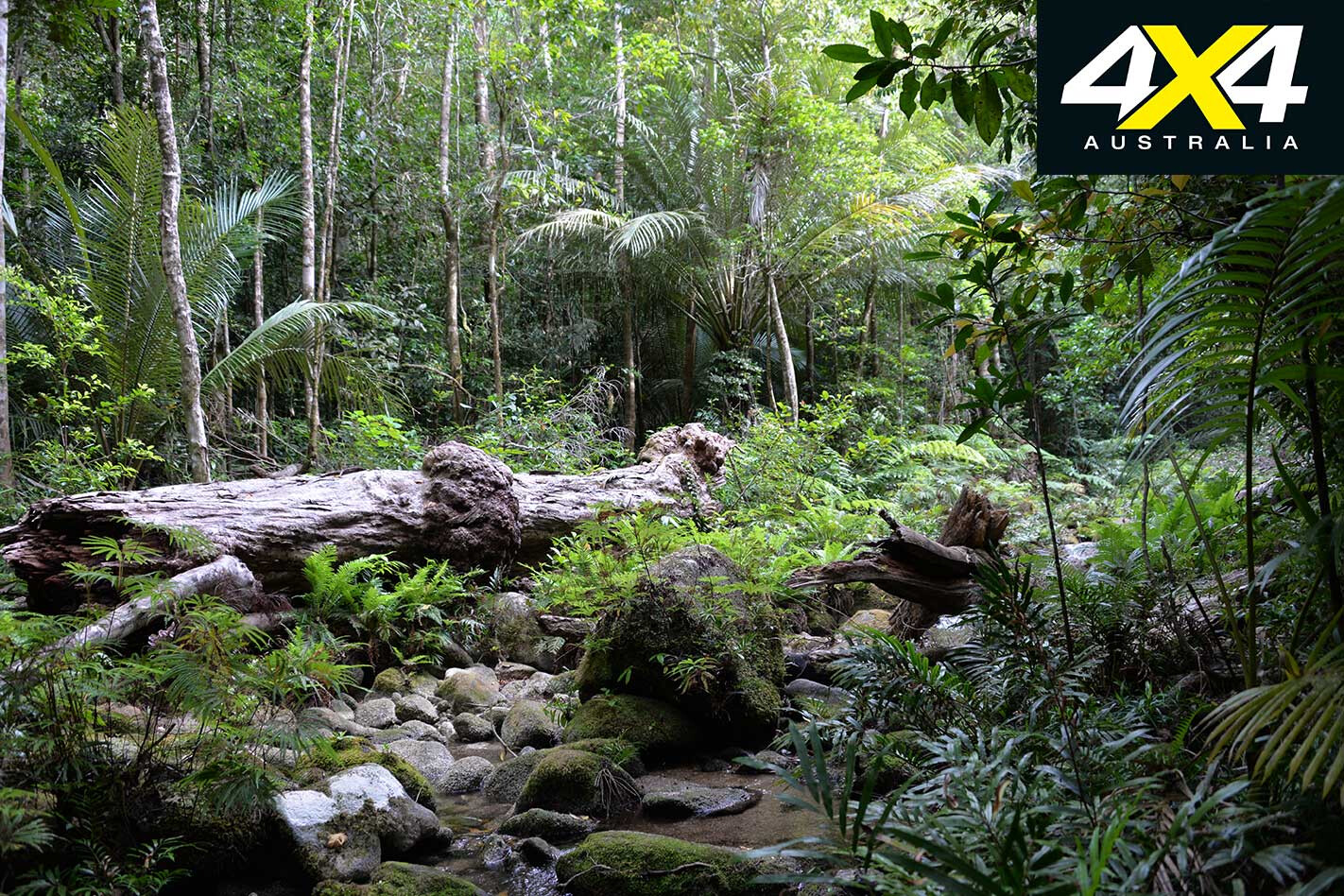
It’s unique; unlike other parts of the ‘rainforests in the clouds’, which includes the third highest mountain range in Australia, the 28km-long Mount Lewis Track is accessible for most of the year.
Including Round Mountain and Lyons Lookout the park is 273.55km² in size, all of it pure wilderness, where only a couple of tracks provide access. One is Mount Lewis Track which ascends some 1200m above sea level, making it the highest vehicle access track in Queensland.
Not that you will see panoramic scenery, because it mostly runs under the canopy of verdant rainforest. The Mount Lewis Track follows the contours of the watershed that gives birth to the Mossman and Daintree rivers to the east and the Mitchell and McLeod rivers to the west. They form about a kilometre from each other, all spring-fed from perennial creeks.
The Mount Lewis Track is only 28km in length and it ends at an old galvanised logging hut, where it continues down the mountain as an overgrown walking track. There used to be a tin mine on the end of it, and years ago the track was well used, but for some reason it appears that few bother to walk it these days.
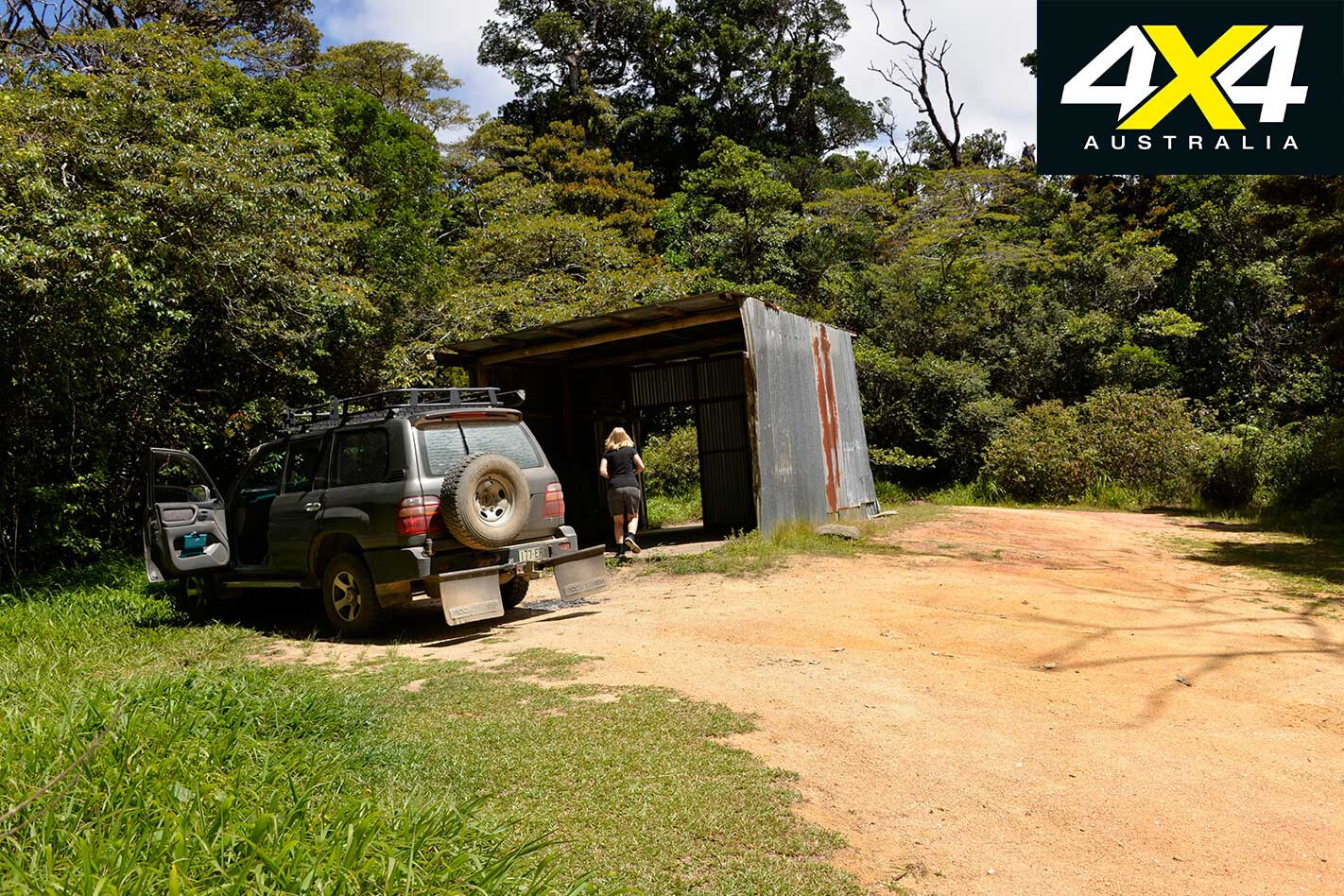
The Mount Lewis Track commences at the Highland Tavern on the Mossman-Mount Molly Road – the sealed road junctions about a kilometre past the tavern. The right turn ends at a lovely swimming spot in Bushy Creek, while the left turn swings up the mountain after crossing the creek. Pull over and see if there are any platypuses swimming below the bridge.
Keep right after crossing the bridge and head straight up the mountain for about 7km before it levels out. The track commences about 500m above sea level through a dense upland forest that drops down into deep valleys and gorges.
The track is recommended 4WD only, but in recent years a lot of work – culverts, bridges and gravel – has made it more user-friendly. The track is closed during the wet season, when up to four metres of rain may fall on the mountains.
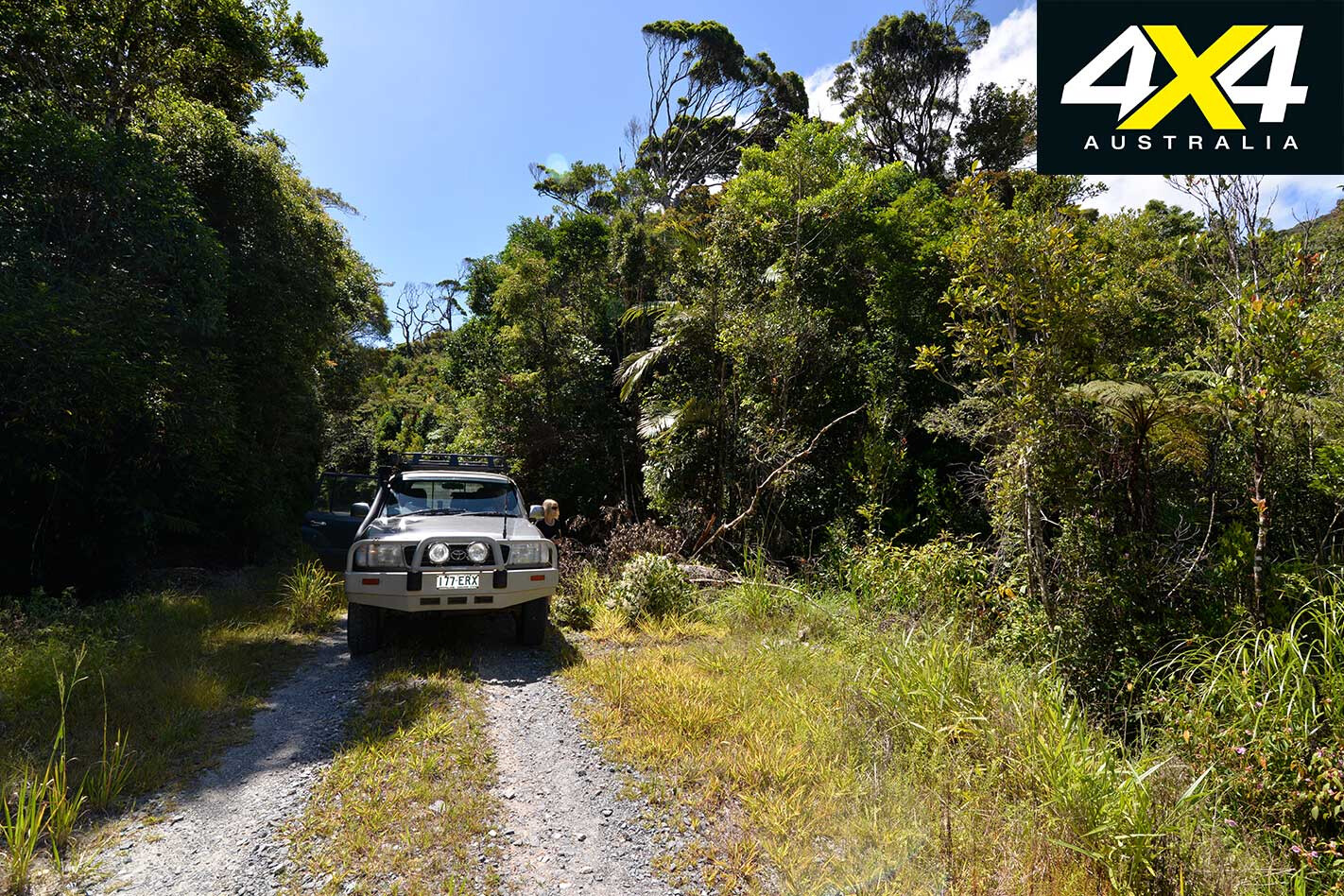
There is no through access and you must return the way you came in, and expect about a three- to five-hour drive; although it’s easy to spend a full day on the mountain, especially during the build-up season when the low country swelters and the high country is cool.
The first 8km of the ever-climbing track traverses parts of Brooklyn Station, owned by the Australian Wildlife Conservancy, which promptly shut the gates to keep us out. The park boundary commences at the national park entrance gate, which is sited at a grassy clearing, 8km from the start.
It was once a logging and tin-mining camp. A walking track heads west from here to a small dam and a Telstra communication tower. Ensure you wear sturdy walking boots, while knee-high gaiters are recommended against snakes, prickly wait-a-while vines and stinging trees.
The track is narrow along its entire route and commonsense is needed when passing other vehicles, and beware of trail bikes and bird watchers who will hit the brakes without warning when they see a bird.
The first 8km of the track’s flora consist of tall trees and vast impregnable tickets of wait-a-while vines, a climbing palm used in the production of cane furnishing. Avoid its prickly thorns. The most poisonous plant in the world, the stinging tree, is also common along this section.
Tiny hair-like harpoons sited on the leaves, filled with poison, are injected into the skin, and the pain is akin to being scolded with hot sticky liquid. Contact its leaves and you will endure extreme pain for several days – it will last for six weeks before waning, but pangs of it will reoccur during cool weather for up to two years.
If you get stung spray some self-sealing spray bandage on the area to prevent air from contacting it. Another common “cure” is to wax the injured area and pull all the hair off, which is supposed to also pull the “harpoons” off, but I only did that once and it gave me more pain than I had ever experienced before.
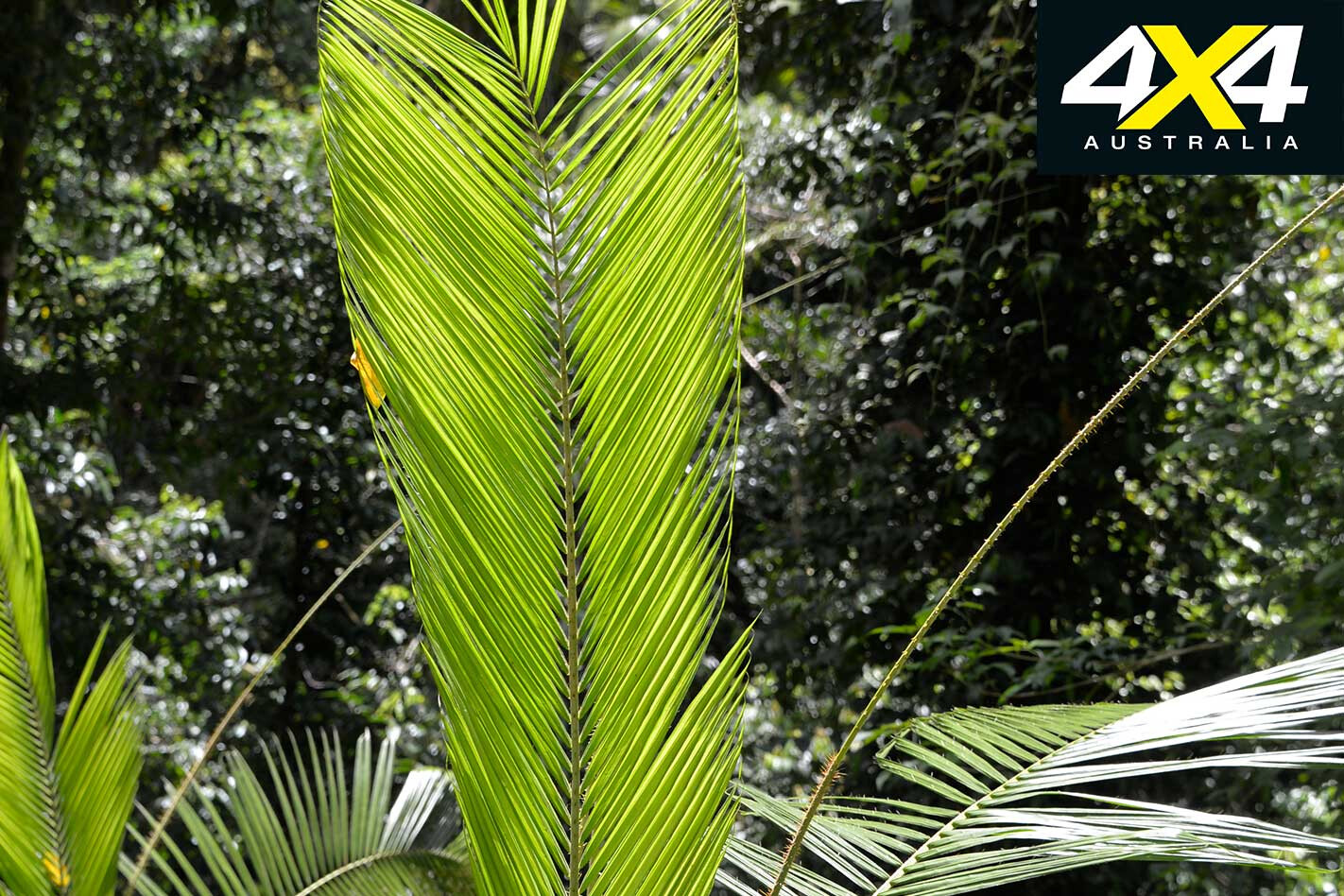
As you pass the gate and enter the park proper, the track glides precariously along steep slopes. The vegetation changes the higher you climb, with Atherton Mist, purple-crowned Alexandra palms and fern trees common.
Huge trees rising from deep gorges are festooned with ferns and orchids, while mosses and colourful fungi dominate. In sections, rays of sunlight shine through gaps in the trees overhead, creating mini-environments where rare plants grow. These tiny hotspots are favoured by reptiles.
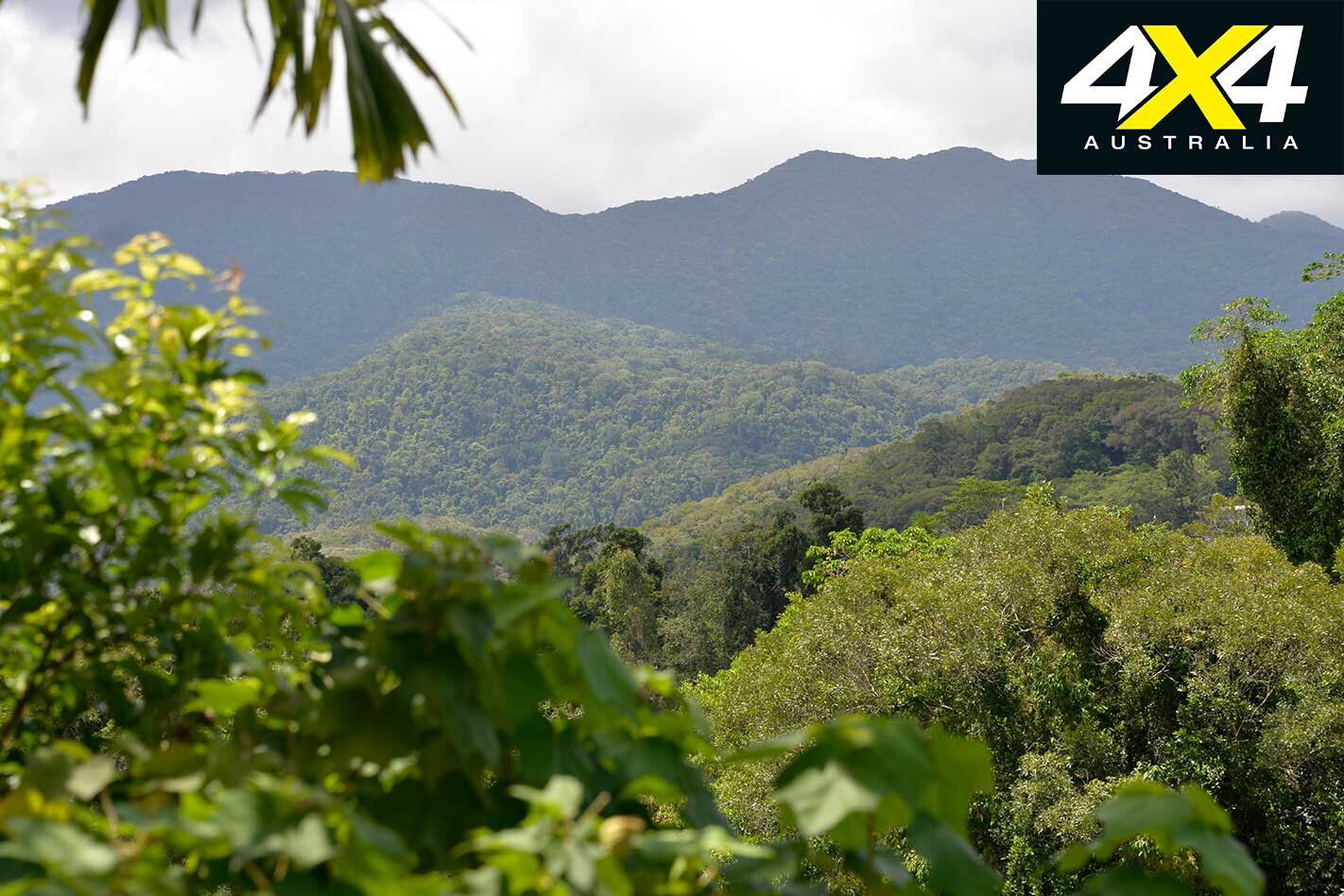
The farther the track ascends, the cooler it becomes. The cloud forest proper begins at about 900m, where it is often shrouded in mist and scudding clouds, especially in the early morning. These forests are unique, harvesting water directly from the clouds, like a sponge sucks up water. Thus, the forest captures the water that is released throughout the year and keeps the springs bubbling.
Near the end of the track is a highland lake covered with reeds. You may encounter a tree kangaroo here, while huge basalt boulders are a feature when you reach the track’s summit.
Travel Planner
WHEN During winter temps can drop to -10°C on the mountain and -5°C on the Julatten and Atherton Tablelands. Warm clothing is recommended, as is a raincoat at times.
TRACK CONDITION The Mount Lewis Track is unsealed and has many bends and steep grades. Keep left to avoid oncoming vehicles and trail bikes. The track is closed at the gate in the wet season.
WHAT TO BRING Take drinking water or boil it. If hiking into the forest tell someone what you are doing, or at least leave a note in your vehicle, and carry a PLB. Mobile phone coverage is unreliable.
No dogs or other domestic animals are permitted in any Qld NP, nor are firearms and chainsaws; although, you can clear fallen trees from tracks in an emergency. Take all rubbish out!
CAMPING There are no dedicated day-use areas and no camping is allowed. Many of the creek crossings, the clearing, and the hut at the end of the track are great spots to pull up and boil the billy.
Travel notes: Wandering wildlife
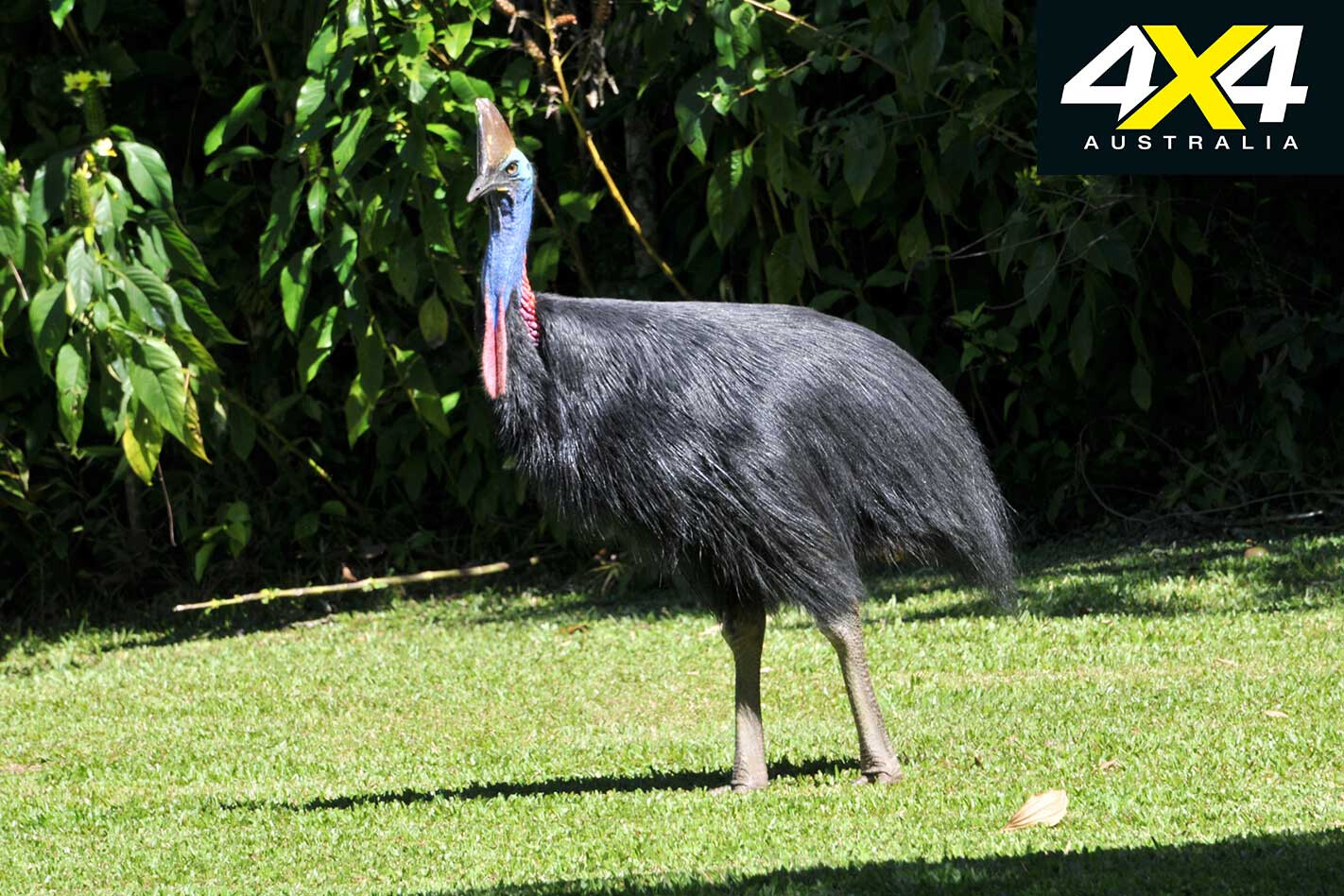
The region is a treasure trove of endemic wildlife. The Mount Lewis upland rain and cloud forests date back to the evolution of flowering plants on earth, when Australia was part of Gondwana.
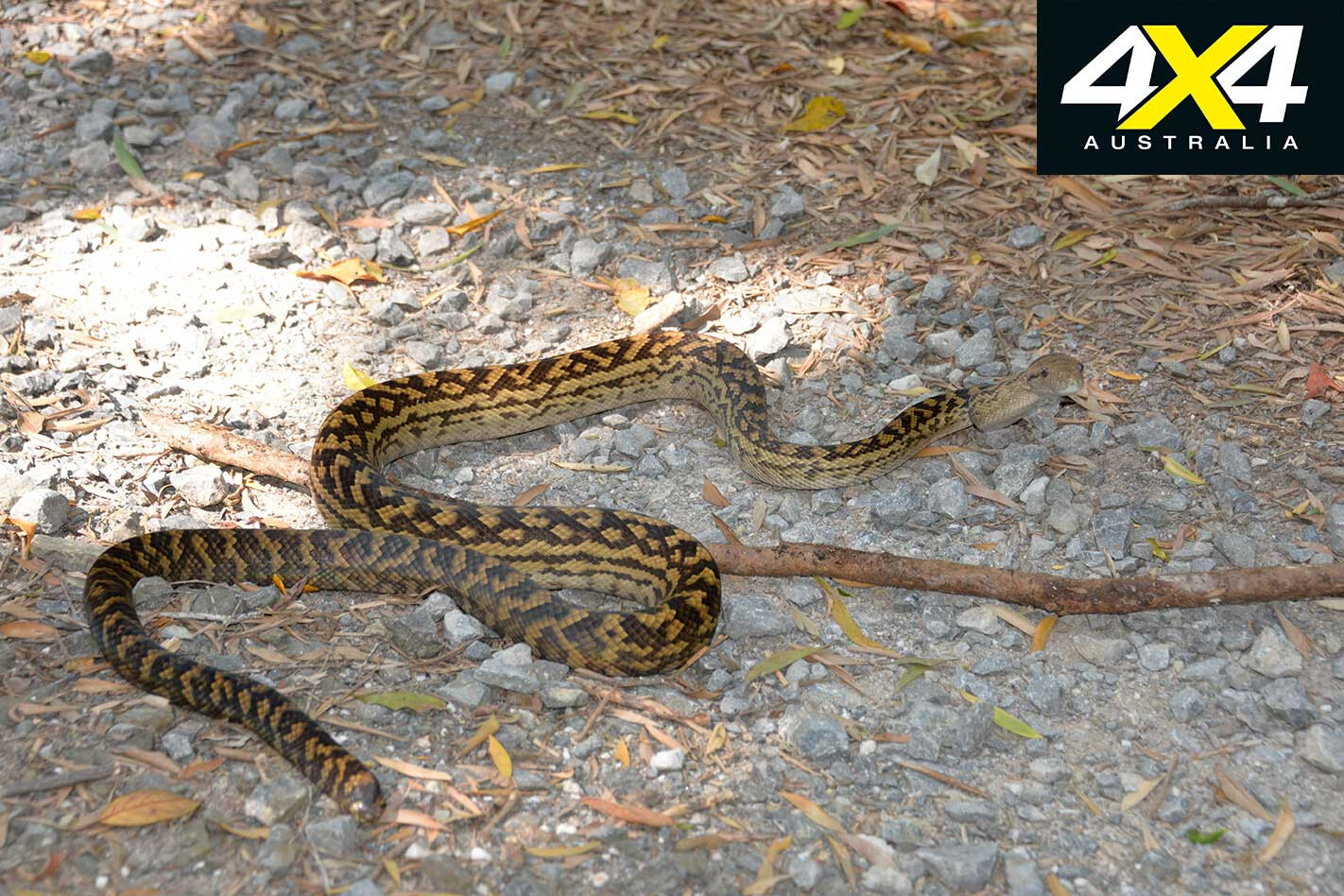
The road fringes and grassy areas are favoured by red-bellied black snakes and seed-eating birds. Carpet and scrub pythons may also be seen. Also keep an eye out for rainforest dragons, eastern water dragons, wild pigs, many species of frogs, and spiny crayfish.
There is a large bubbling stream past the gate that feeds Mary Creek, some 1000m below in the Mount Carbine valley. It’s deep enough to wade in and a great spot for a splash, though the water is icy cold, and to see crayfish.

After heavy SE trade-wind rains, common in the high cloud forests of the Wet Tropics during the dry season, crayfish can be seen “walking” up table drains. Sometimes, if you are lucky, you may also see one of the largest earth worms in the world, the blue worm, which can grow to two metres. It’s generally seen after rains flush it out of its burrow.
The clearing before the park entrance is home to one of the rarest and most regionally restricted birds in Australia, the blue-faced finch. It and red-nape finches are seen only when the grass is seeding, between November and April.
Fruit-eating doves, parrots and lorikeets are common, as are wrens, honey and insect-eaters, along with ground-dwelling scrub fowl, chowchillas, whip and bower birds. You may also spot a masked white-tailed rat, a kangaroo rat, tree kangaroo, a Daintree River possum, or even a cassowary.
Travel notes: History
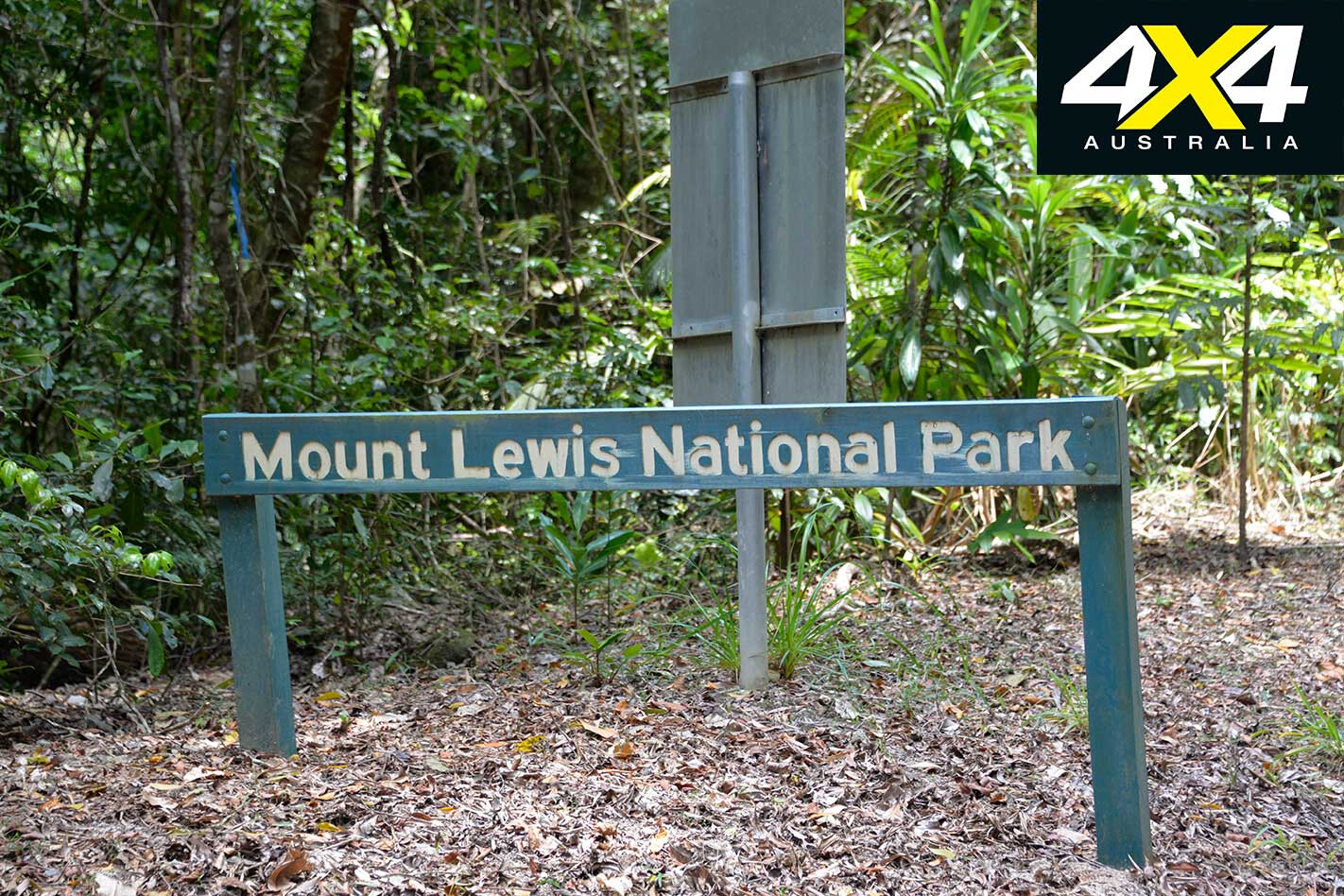
THE TRACK was first pushed in by miners and loggers, with tin and wolfram mining common in these parts. Most was alluvial and collected directly from the many perennial streams, though some rock-mining took place. Pack horses were used to transport goods in and ore out.
The grassy clearing near the park entrance was once a mini-village of galvanised iron huts and bush timber. Tin-mining evidence is in the forest up and downstream from the small creek, just before the clearing.
Logging Kauri pine and red cedar trees was another industry that made the track an important source of income for the Mount Molloy Mill. The track as we now know it was pushed in with a dozer during the late 1940s and closely follows the historic pack-horse trail.
It was extended to the upper slopes in the 1970s, but all mining activity and logging came to a sudden end when the area became part of the Wet Tropics World Heritage Region in 1988.
Travel notes: Plane crash mystery
IN JULY 1967 a plane crashed on Mount Lewis. The area was searched for weeks with no results and the mystery of its disappearance was long forgotten until 12 months later when bushwalkers stumbled across the wreck close to near the upper track. The impact had left a one-metre-deep crater yet there was no damage to the forest.