
THE emissions-free Volkswagen ID.BUGGY has been let loose in its natural habitat, a sun-soaked beach in California, USA.
Doing what it has been designed to do best, the door-less and roof-less ID.BUGGY was on show carving up sand in the lead up to the 2019 Pebble Beach Concours d’Elegance.
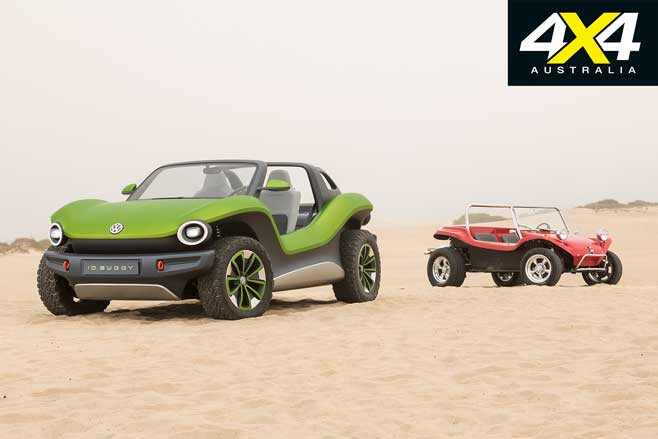
Revealed at the 2019 Geneva Motor Show in March this year, the ID.BUGGY concept sits on Volkswagen Group’s MEB (modular electric drive matrix) platform and is powered by an electric motor integrated into the rear axle.
That motor provides enough oomph – 150kW and 310Nm – to send the ID.BUGGY from 0-100km/h in 7.2 seconds. It’s mated to a single-speed gearbox, while a 62kw/h lithium-ion, rechargeable battery is embedded into the vehicle’s floor to save space.
The vehicle’s composite body is made using a mixture of aluminium, steel and plastic, and it can be detached from the MEB platform.

When it was revealed at the Geneva Show launch earlier this year, VW stated that the MEB platform will be the key to an ‘electric car for all’: “The ID BUGGY demonstrates the broad spectrum of emission-free mobility that can be achieved with the MEB within the Volkswagen brand,” said Ralf Brandstätter, COO of the Volkswagen brand.
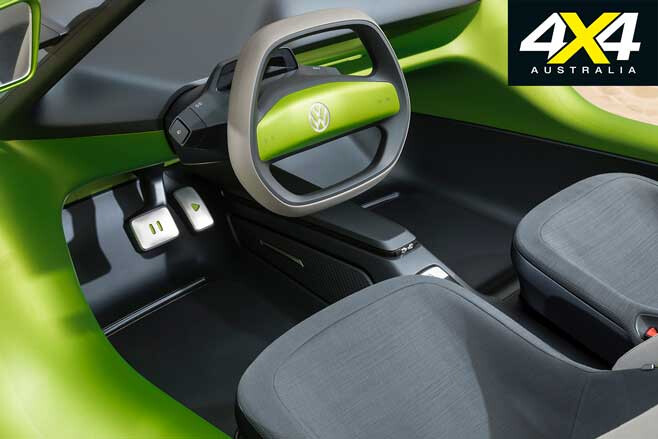
As can be seen, the designers opted for a less-is-better approach with the vehicle’s interior. The minimalist aesthetic includes a hexagonal wheel devoid of myriad controls, and a digital instrument cluster unclutters the dash. Waterproof materials are utilised within the cabin, with the steering wheel wrapped in water-repellent Nappa leather.
18-inch wheels are wrapped in BFGoodrich All-Terrain rubber (255/55 at front and 285/60 at rear); two steel eyelets are there for support should the BUGGY bite off more than it can chew; and a Targe bar provides rollover support.
A ONE-OF-A-KIND N80 Hilux headlines a smorgasbord of off-road content in the September 2019 issue of 4×4 Australia, with the cutting-edge Toyota proving that the ‘right’ modifications are more important than ‘all’ the modifications.
If that doesn’t tick your boxes, perhaps a chopped GU Patrol does? The tidy unit may look clean-cut, but a massive Cummins V8 and trick aftermarket componentry give it plenty of go-anywhere brashness.
Another custom not for the faint-hearted is a purpose-built RAM 2500 that proves bigger is better. The track-belting American pick-up, pieced together by Trucks ’N’ Toys, is packed head-to-toe with quality aftermarket gear including a killer suspension set-up.
We also took the second-gen HSV SportsCat for a quick spin at the Lang Lang Proving Ground. Boasting upgraded suspension to improve both on- and off-road performance, is the SportsCat 2 a worthy successor?
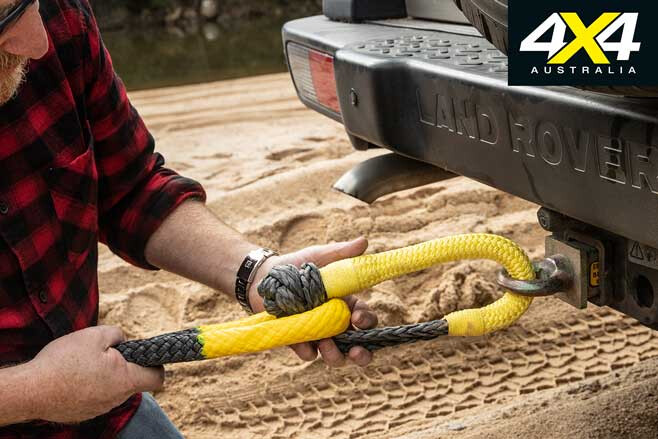
We delve in to learn the positives and negatives of 4×4 batteries, by chatting to the industry experts. Plus, we also dissect kinetic recovery ropes and explain why they’re becoming a safer recovery solution.
Got the travel bug? We’ve put some miles on our 4×4 tyres and ventured to some amazing towns and outback locales, including Rawson in Victoria and Wollemi NP in NSW. Keen on a bigger trip? In this issue we also explore WA’s Great Sandy Desert, as well as a few back tracks to Cape York.
WHAT ELSE IS THERE? – MSA 4×4’s epic 6×6 build rolls on. – Ranger and JL Wrangler shed updates. – Terre Trek camper tested. – Readers rigs, product tests and monthly columns. – News, 4×4 events and plenty more.
The September 2019 issue of 4X4 Australia will be in stores from August 22.
THE organisers of the Birdsville Races have issued a call-out to volunteers to assist with the running of the 2019 event.
There are a number of vacant volunteer positions to be filled in a number of fields, including hospitality, information, marshalling and gates, set-up and pack-down, and minibus driving. For their help, volunteers will receive a polo shirt and a complementary two-day racing pass. Plus, before and after shifts, they will be able to participate in a range of fun activities held in the small town.
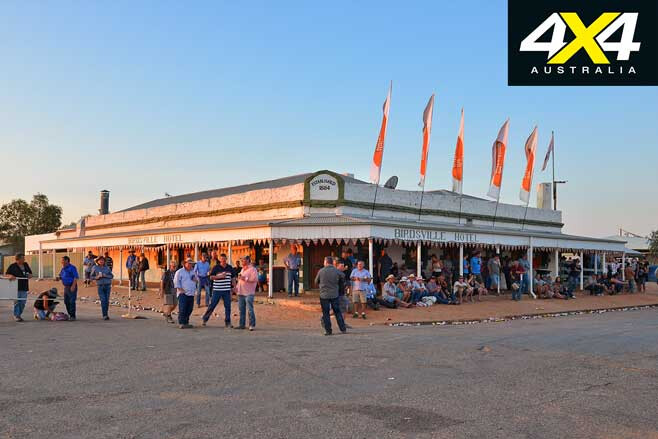
In addition to the two-day, 13-race program, the town will be abuzz with film screenings, live music, cocktail parties and Fred Brophy’s famous travelling boxing troupe.
Held in the outback Queensland town on September 6 and 7, the Birdsville Races – widely known as the ‘Melbourne Cup of the Outback’ – brings a flurry of activity to the normally subdued town, with the population booming from 115 to more than 6000 visitors every year.
The Races not only boosts tourism to the region, but each year it also raises money for the Royal Flying Doctor Services of Australia.

“So much of the appeal of the Birdsville Races comes from the sense of community that overtakes this tiny little town in the middle of the Outback each September – and there’s no better way to experience it than to get involved behind-the-scenes as one of our valued volunteers,” said Gary Brook, Vice President, Birdsville Race Club.
“The Races are steeped more than a century in tradition, and it’s amazing to see volunteers old and new make the trip out to Birdsville each year to keep the event alive for further generations of Australian and international travellers and punters.
“While many volunteers trek to the Races to help out as part of a group, solo volunteers can also be sure they’ll leave with loads of new friendships and experiences to remember. Volunteering at the Races has a very social element to it – before, during and after shifts. It doesn’t matter who you are or where you’re from, you’ll be welcomed with open arms into the event team and the broader Birdsville Races community” added Brook.
If you’re over 18 years of age and you wish to volunteer, register here: www.birdsvilleraces.com/Volunteer
THERE’S no denying just how useful a dash cam can be in the event of an incident, providing video evidence of exactly what transpired in case there’s a dispute with another road user. Of course, dash cams can also be fun for uploading footage to social media, especially if you capture an unusual and/or funny event.
GPS navigation devices are also useful, offering features such as route guidance, live traffic updates, speed-zone information and speed camera locations. But mount a dashcam and a GPS device on your dash, as well as other electronic devices such as your phone, and before you know it will be cluttered with technology that can be more distracting than helpful.
The Navman DRIVEDUO SUV goes some way towards minimising dash clutter by combining a dash cam and GPS navigation in the one device. We’re talking a high-end dashcam here, with high-definition 2K video recording, an Advance Driver Assistance System (ADAS) and GPS-tagged video. We’re also talking high-end GPS navigation, a six-inch touchscreen, lifetime built-in maps, lifetime inbuilt traffic subscription, spoken safety alerts and preloaded 4WD tracks and information.
The DRIVEDUO SUV isn’t particularly cheap at $479, but when you consider it combines dashcam and GPS navigation in the one unit, it’s like killing two birds with one stone.
The Device
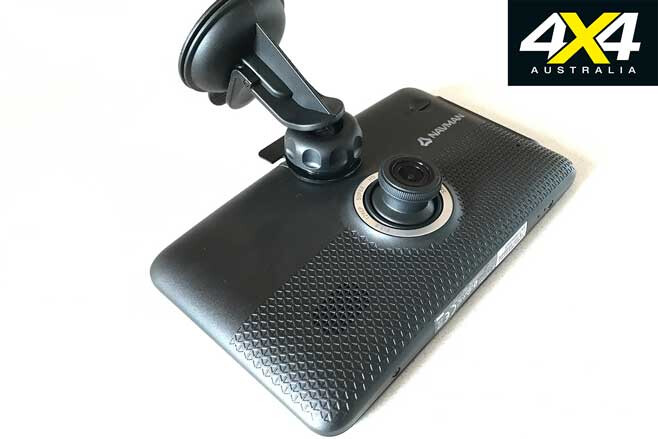
THE DRIVEDUO SUV has a generous six-inch colour touchscreen with a bright and vivid display. It’s supplied with both 240V AC and 12V DC charging cables, the latter with a 12V accessory plug that includes a USB outlet. There are two Micro SD card slots; one for data and the other for video recording.
The wide-angle camera on the front of the unit can be angled to suit the mounting position in the vehicle, and the supplied windscreen mount sticks well with minimal vibration to enable a nice, sharp picture.
Once mounted, you need to adjust the device so the ground:sky ratio is close to 6:4, which allows the ADAS features to work at their optimum. ADAS includes Lane Departure Warning System (LDWS) and Forward Collision Warning System (FCWS), both of which rely on the device’s camera, which also needs to be calibrated by setting the device height and position.
The Dash Cam
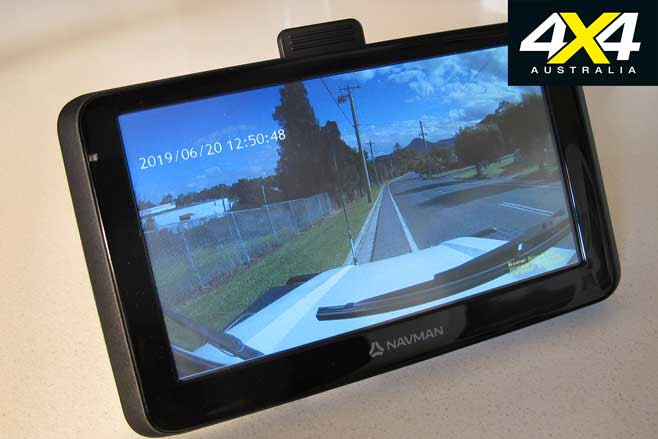
ONCE correctly mounted and calibrated, the dash cam automatically records footage to the micro SD card. The length of video clips can be adjusted between one, three and five minutes, and video resolution can also be selected.
The DRIVEDUO SUV includes a G-shock sensor and, in the event of a collision, it will automatically log the impact location and video footage in an emergency folder, while the inbuilt GPS will record the direction of travel and vehicle speed. This information can prove invaluable when making an insurance claim.
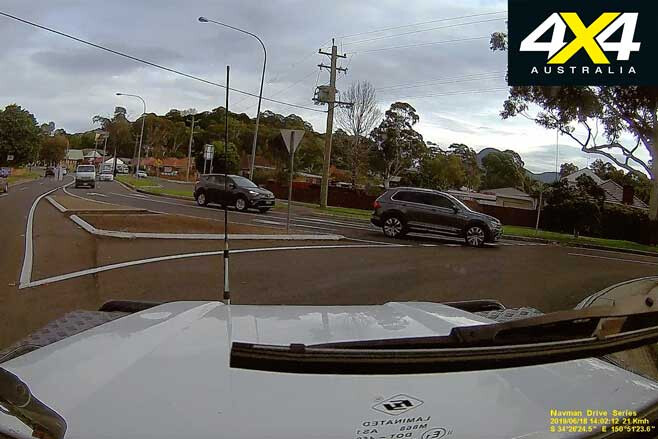
You can also manually record and save ‘events’ by hitting the ‘!’ button on the screen, and these can be played back on the device or on a computer using the Navman MiVUE Manager software, or simply by plugging in the micro USB and selecting the relevant MP4 files. The video footage is accompanied by high-quality audio, is date and time stamped, and includes GPS co-ordinates and vehicle speed.
The device’s LDWS displays easily visible on-screen warnings if you start to drift out of your lane, and it can be set to provide voice or beep warnings, or no audible warnings at all. If you take the time to calibrate the device properly, the LDWS works effectively.
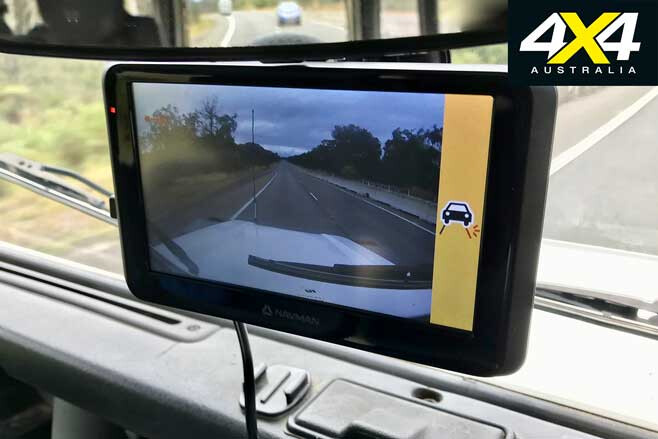
I wouldn’t recommend relying too heavily on the device’s FCWS to help prevent an impact with a vehicle in front at highway speeds, because it doesn’t give a lot of warning, but it could potentially prevent some low-speed incidents.
Overall video quality is good, as is sound quality, and the wide-angle lens provides a good view. A second, rear-facing camera can also be plugged into the DRIVEDUO SUV via a Mini USB port.
The Sat-Nav
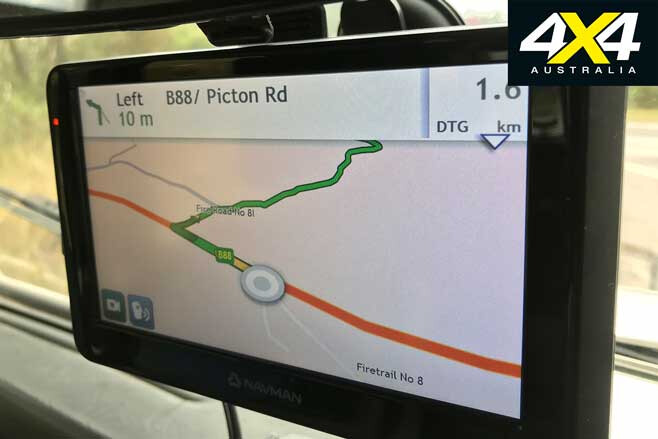
ANYONE familiar with Navman GPS devices will have no problems navigating with the DRIVEDUO SUV. Setting a destination simply requires you to input the suburb, the street and the house number, and then hit ‘Go’.
Alternatively, you can use the ‘Voice Command’ function and just say the address out loud. You can then choose whether to record the route to the trip log or not, then the device will display 3D mapping and provide audio directions, along with projected route time, ETA and vehicle speed.
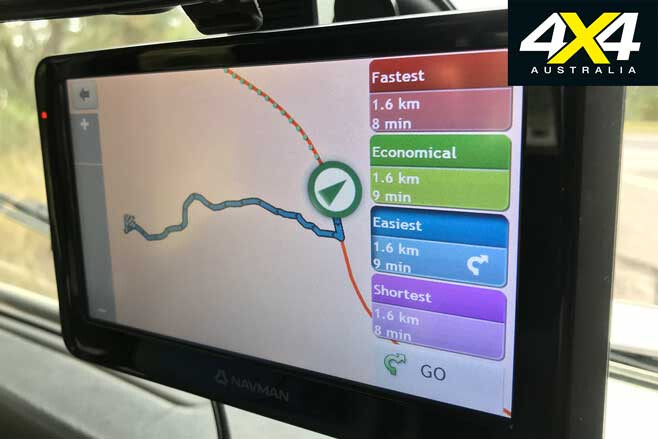
While you’re driving, the device will also show ADAS information with visible and audible warnings if you drift out of your lane or it appears as though you’re about to hit the car in front. It also displays the current speed zone and warns if you’re exceeding it. The device will also warn of upcoming speed cameras, red light cameras and safety cameras. There’s a ‘camera’ button on the screen at all times that allows you to record events quickly and easily.
You can set navigation preferences such as language, units, volume, brightness, speed and fatigue alerts, speed cameras, red light cameras, black spots, school zones, railway crossings, and more. You can also set route options such as types of roads, custom avoidance, POIs and mileage recorder, and the map can be set to display in 2D or 3D, with or without still junction views.
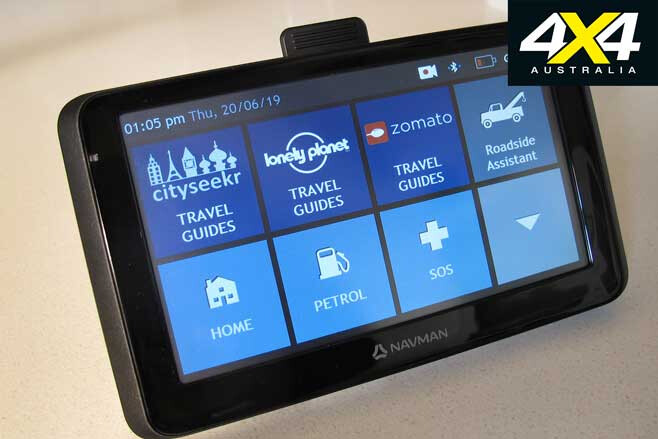
Other satnav features include real-time traffic information, Large Vehicle Assist (so you can avoid narrow laneways when towing or low overhead passes when you have a load on the roof), fuel type search, roadside assist (to pinpoint your location and allow you to make a call when your phone is connected), Lonely Planet Travel Guides and Zomato Restaurant Guide.
The DRIVEDUO SUV also has a ‘4WD Tracks’ button, which provides access to a wealth of track information provided by HERE maps. Unlike devices such as the HEMA Navigator, which allow you to plan and navigate just about any off-road route, off-road navigation on the DRIVEDUO SUV is limited to a list of nearby tracks that allows you to navigate to and from known POIs, camp spots and the like.
Other Features
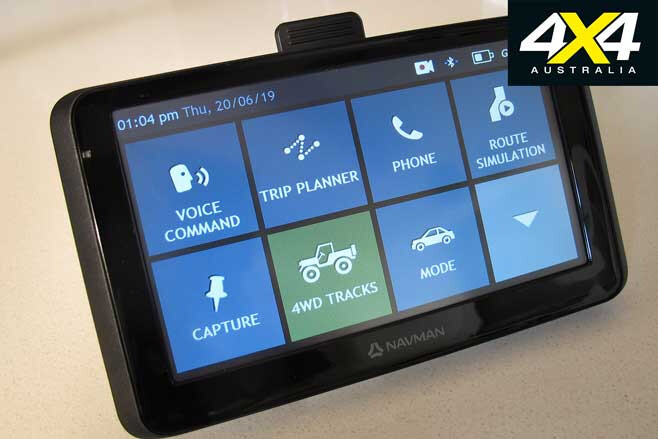
THE DRIVEDUO SUV can be connected to your phone via Bluetooth and used as a hands-free device. Video footage can be shared on Facebook or YouTube using the aforementioned Navman MiVUE Manager software, or you can just upload the MP4 files.
The Wrap-up
AFTER using the DRIVEDUO SUV for several weeks, combining the functionality of a dash cam with a GPS navigator seems like a no-brainer. Adding a modicum of off-road navigation along with the safety advantages of ADAS and spoken alerts, as well as Bluetooth phone connectivity, simply adds more value.
The DRIVEDUO SUV is by no means perfect, especially when it comes to off-road navigation, but it’s still a very handy device that could quickly pay for itself if you’re unfortunate enough to have a bingle with another road user.
RATED Available from: www.navman.com.au RRP: $479 We Say: Declutters dash; pricey; limited 4×4 coverage
THE term Frontier conjures up ideas of America’s Wild West; a vast untamed opportunity waiting beyond the horizon.
In more recent times it has been applied to the endless reaches of the cosmos, the farthest we’ve reached and something we’ll continue to push. It’s fitting then that, after 51 years of designing and manufacturing camper trailers in Australia, Cub Campers would name its latest development the Frontier.
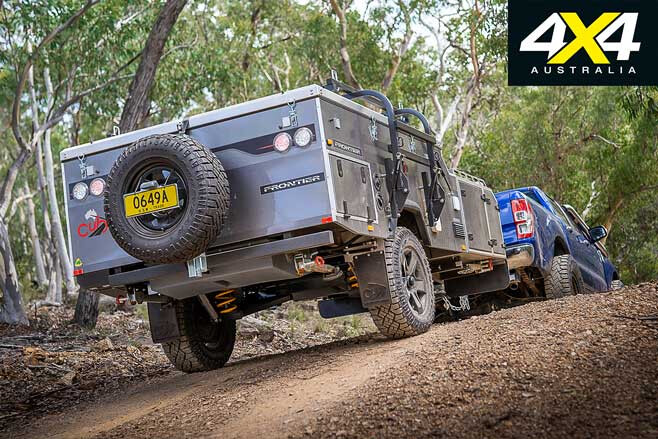
The Frontier, like most of Cub’s line-up, is designed and manufactured in Australia, meaning things can be rapidly prototyped and ideas developed and evolved, rather than the ‘take it or leave it’ mentality many importers are forced to deal with.
Forward-fold campers are almost the standard in camper trailers these days; they offer a comfortable night’s sleep, ample storage for all the odds and ends required to head bush, a dining area that’s up and out of the elements, and they’re all (with very few exceptions) an absolute pain in the arse to set up.
Complicated pole setups, spreader bars and weird sliding contraptions? The Frontier has none of that. What it does have is the quickest set-up time of any forward-fold on the market; the kind of camper you can pull up in the rain and be out of the elements in three minutes. Let us explain.
The Set-Up
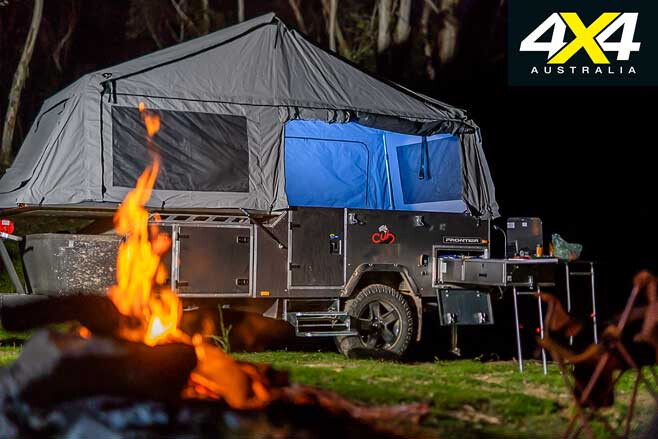
BEFORE we get bogged down in the details, let’s address the secret weapon in the Frontier’s arsenal: the quickest set-up time on the market. A typical forward-fold camper trailer has a set-up time of around 15 minutes or up to about an hour if you’re adding the awning. The Frontier takes 15 minutes with the awning or three minutes without it.
In typical Cub fashion, the way it achieves this is unbelievably simple. The tent and pole structure have been designed in such a way that it pulls itself tight, without the need for spreader bars and additional poles. Six clasps along the flanks pop open, the silent winch up front cranks the lid over, and you’re done. Inside, a pair of gas struts automatically push the tent into place at the rear, while the section above the bed head is angled just enough to pull tight without additional poles.
By comparison, a typical forward-fold requires two upright poles above the bed head, four spreader poles along the roof and another two upright poles at the rear, all manually adjusted with plenty of trial and error to find which pole goes where.
The awning is a similar clever-yet-simple design. A typical awning has hooks on the roof poles that need to be fed through holes in the canvas and attached to the poles inside the camper, and it usually requires two people and a whole heap of yelling.
The Frontier features Velcro on the outside. Even the upright poles at the end have wing-nuts on top to stop the canvas flopping off while you’re trying to position it all. If it sounds like basic stuff, that’s because it is, and it’s something you can’t fully appreciate unless you’ve been close to divorce setting up an imported forward-fold. The Frontier shows how easy set-up can be.
Welter Weight
A TOTAL of 400kg might not sound like a lot; it’s less than half of the payload of most common dual-cab utes and slightly more than a middle-aged American on a mobility scooter.
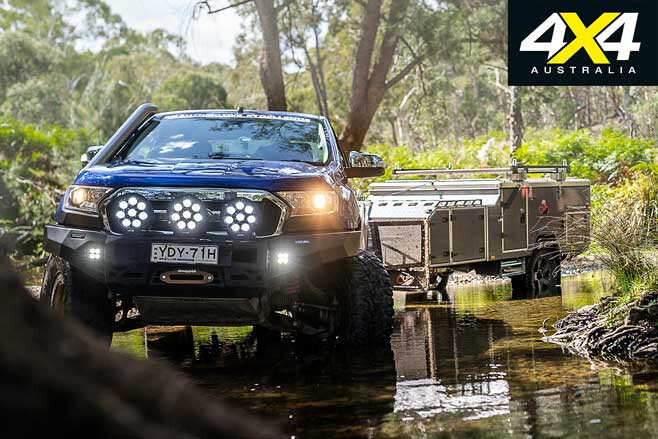
However, the reality in off-road land is it’s a huge amount to lug around – think: a steel bullbar with a winch, storage drawers, fridge, long-range fuel tank and a set of 33-inch tyres. It’s coincidentally also the weight difference between the featherweight Cub Frontier and some of its more portly competitors. The cub weighs just 1222kg, with some of its rivals weighing up to 1600kg.
How have they done it? Simple: engineering. Things are exactly as stout as they need to be to last the distance, and as a direct result the weight savings are huge.
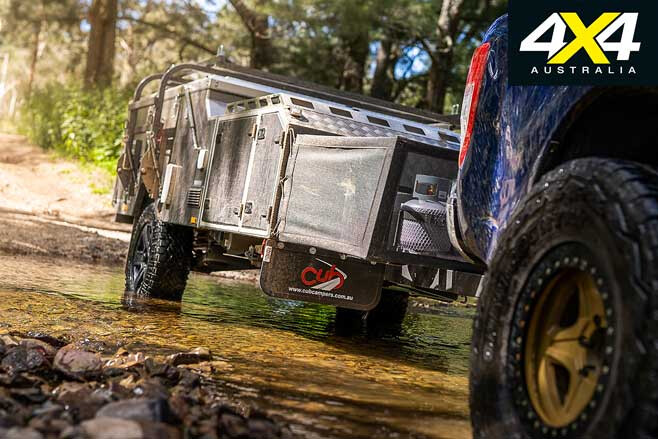
What does that mean for you? Well, that’s 400kg less holding you back while your right foot buries you in sand and hundreds of wide-eyed mouth-breathers upload your photo to ‘I got bogged at Inskip Point’. It’s also 400kg less weight that your CVs have to pull up a near vertical High Country track into camp … and 400kg less sliding you into a Cape York riverbank.
Ground clearance isn’t huge and the width is noticeable in tight tracks, but all of that pales in comparison to the huge benefits a light overall weight has to off-road ability, especially when you factor in the towball weight only adds 137kg to the rear of your tow-tug – we’ve seen north of 200kg from some competitors.
Are you going to be the tip of the spear forging a new track in Arnhem Land? Probably not, but if you want to confidently cross a desert, the Frontier will be more than up to the task.
Storage and Practicality
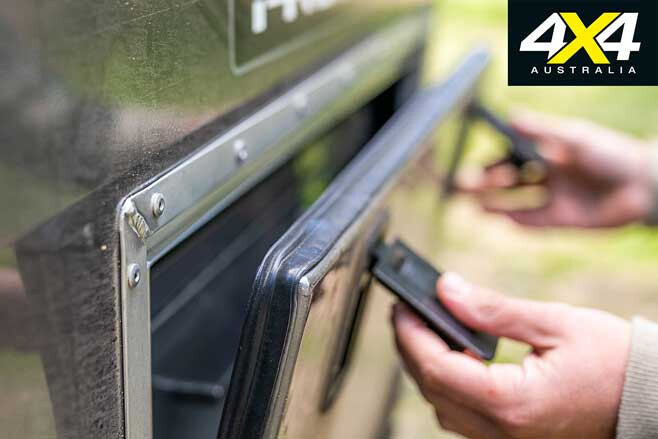
PRACTICALITY means more than just how fast a camper sets up; it’s how all of the individual components work together. After all, a camper that sets up in 30 seconds but requires you to disconnect it from the 4×4 to turn on the water might not be that appealing.
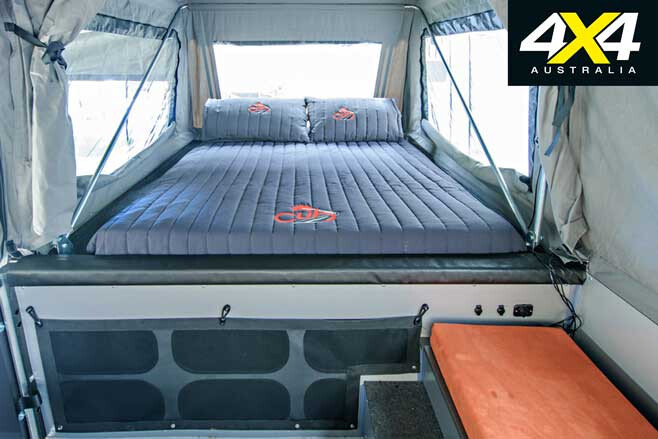
Without a doubt the Frontier’s big selling point is the interior, and it doesn’t disappoint in either storage or practicality. The second bed quickly converts back and forth into a dining area. Where competitors have tables more rickety than a politician’s promises, the Frontier unit is sturdy, bolted to the floor and gas-assisted to easily spring into place with the push of a button.
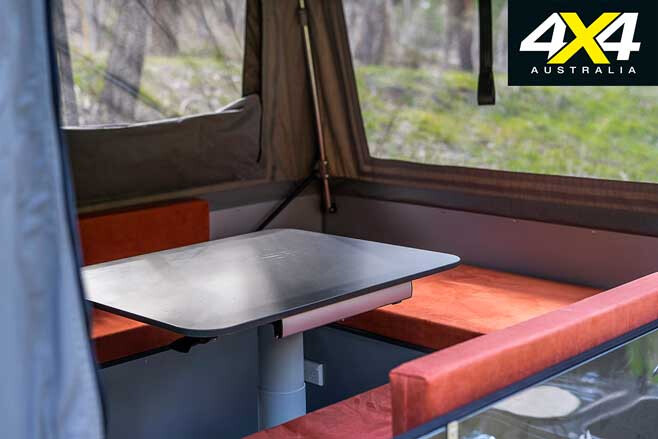
There’s ample storage along the flanks, too, to stuff items you need to carry but never want to see again, like bearings and belts, and a unique cubby hole storage set-up along the foot of the bed is the perfect place to stash clothing and cooking gear.
The Frontier’s kitchen is extensive and well-equipped. The focal point is the Dometic three-burner stove, but the real winner is the optional-to-the-kitchen Truma hot-water system which also feeds into an external hot shower. There’s a knurled texture to both the base kitchen and the fold-out table, keeping it looking tip-top without the usual scratches stainless steel kitchens are prone to.
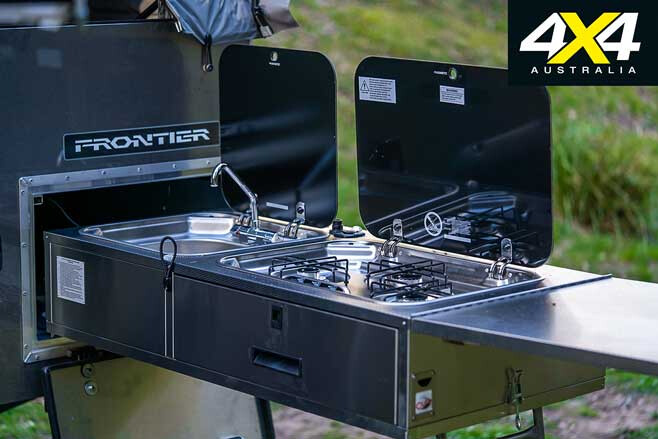
The base camper is equipped with both a DC to DC Projecta charger as well as a 240V Projecta unit with an external input, so you don’t need to open the camper to plug a lead in. There’s also solar input, so if you’re parked on the west coast of the Cape for weeks at a time you can trickle charge the batteries without needing to jerry-rig anything. Our demo unit was fitted with the aptly named Frontier Pack, which adds an additional 100amp/h battery to provide an expected fridge (95-litre) run-time of roughly five days in summer.
The pack also expands water storage to 180 litres from the stock 100 litres, as well as adding a stainless steel pull-out pantry; although, in all fairness, pantry space is still limited, so some items may end up in the back of your 4×4. The drawer bar stores a hand water pump for trackside washing, two 4kg gas bottles with internal plumbing, and room for two 20-litre jerry cans.
Front of the pack
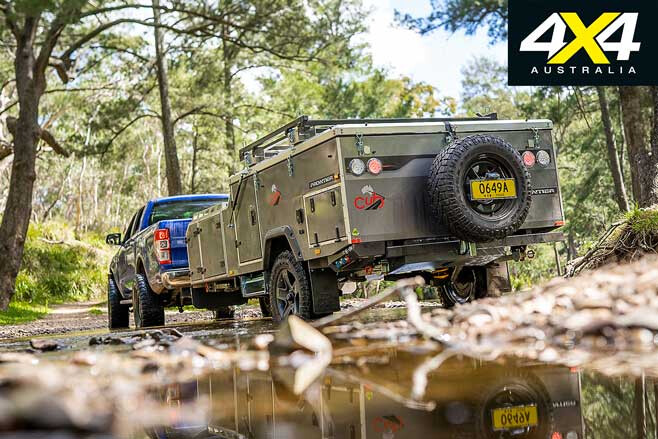
LIKE 4x4s, camper trailers are uniquely designed to suit specific uses. You wouldn’t spend a year living out of a box trailer with a rooftop tent, and you wouldn’t go pulling a caravan through Gun Shot – not unless you’re chasing internet fame. With that in mind, the Frontier needs to be viewed and judged through the needs it actually does suit, not the ones it doesn’t.
If you’re on the road for weeks at a time or you need to quickly set up the camper before the kids start destroying the back of your 4×4, the fast set-up times will no doubt put huge ticks in the yes column for you. Likewise, the light weight makes for easy towing in soft sand, perfect for island hopping in south-east Queensland or traversing many of the endless red sand deserts throughout outback Australia.
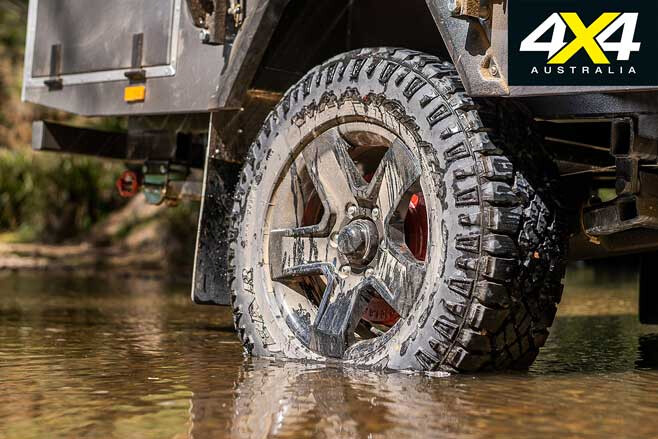
Storage is light-on compared to some other offerings, but if paired with a well-equipped 4×4 it should pose no issue (we simply used a space case in the back of the tow-tug as a pantry). You’ll also need to consider that the Frontier is wide and has relatively exposed flanks, so if you’re punting your camper through ruts and riverbanks you might be better off trading comfort for capability.
At around 30 per cent more than comparable imported campers, the Frontier gives away very little in off-road ability of affordability, and what you get in return is comfort, quick set-up times and quality you simply won’t find anywhere else.
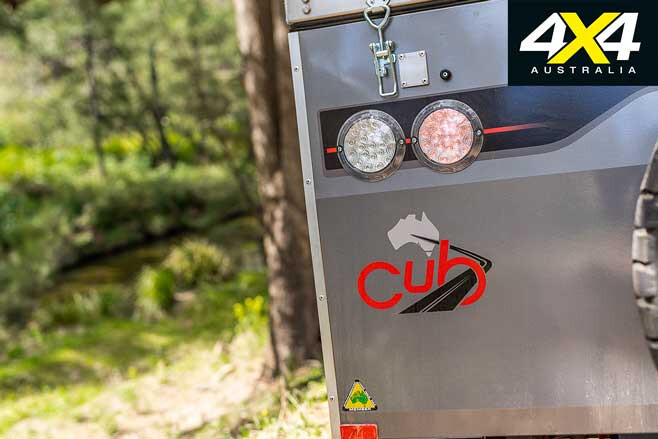
Cub Frontier camper trailer specifications TARE: 1222kg ATM: 1750kg SUSPENSION: Independent coil spring BRAKES: 12-inch electric COUPLING: AL-KO off-road ball coupling CHASSIS: Galvanised RHS 100x50x3mm DRAWBAR: Galvanised RHS 100x50x3mm BODY: Steel and aluminium baked enamel WHEEL/TYRE: 17-inch alloy/ 285/65 Goodyear Duratrac BOX SIZE (L/W/h): 3680/1950/1550mm LENGTH: 5500mm TENT SIZE (L/W): 3680/1950mm GAS CYLINDERS: 2x4kg gas bottles included WATER: 1x100L + 1x80L with hand pump and 12V pump COOKTOP: Three-burner gas KITCHEN: Stainless steel slide-out BATTERY: 2x100amp/h AGM deep-cycle PRICE: $42,496
HITS: Fastest set-up time on the market; Light weight; Aussie built; Simple design; Packed with creature comforts MISSES: Large off-road footprint
RATINGS Off-road ability: 7/10 Fit for purpose: 10/10 Comforts: 10/10 Self-sufficiency: 9/10 Value for money: 8/10 Ease of use: 10/10 Build quality: 8/10 Innovation: 9/10 Fit & Finish: 8/10 X-Factor: 8/10
KEEN TO plug the co-ordinates into your sat-nav unit, escape the concrete jungle and unwind at a campsite with a good book? These new maps and books for the avid 4×4 traveller will make life easier.
Garmin RV 775 MT-S with Hema Maps
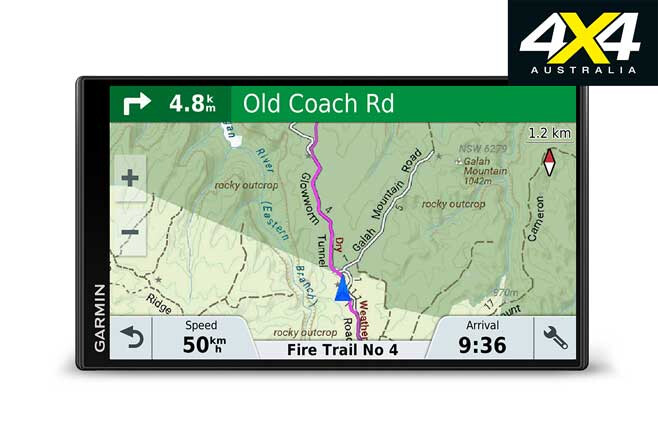
Navigational gurus Garmin have teamed up with mapping legends Hema Maps for this new RV-dedicated GPS unit. This new model features a 6.95-inch edge-to-edge display, pre-loaded Hema 150k topo maps of Australia, RV-specific navigation features (including road warning and custom routing for the size and weight of your RV or trailer/van), and Hema Maps’ extensive Points of Interest, numbering more than 40,000.
Other features include driver alerts for any upcoming steep climbs or sharp curves, voice-activated navigation, Bluetooth hands-free phone call and the capacity to work in conjunction with Garmin’s BC 30 wireless backup camera (sold separately).
And, there’s more, including a Suggested Attractions feature that informs you of what is worth checking out during your journey, and a LiveTrack feature, where friends and family can follow your journey.
Website: www.garmin.com
ExplorOz EOTopo 2019
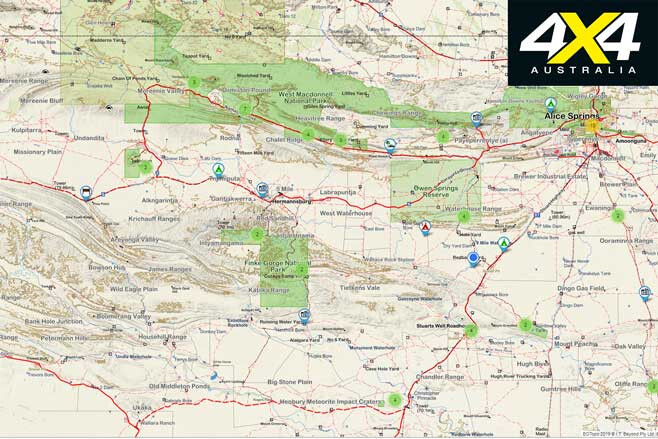
ExplorOz has released its latest version of the excellent EOTopo mapping. EOTopo covers the entire area of Australia and is suited to anyone from adventurers and campers to off-road tourers. It covers the country via high resolution mapping that also displays natural land forms and man-made structures in topographic details. It also shows land boundaries and localities as well as – of course – roads, tracks and Points of Interest (POI).
This latest version is the result of extensive cross-referencing all changes since the 2018 data extraction, such as OSM data, the latest parks and forestry data, and updated ExplorOz Places database. The resultant data covers roads, parks, airports, state forests, national parks, all waterways, hiking tracks, etc.
The symbols now displayed are cleaner and offer a crisper, more easily discernible appearance. It is available as a Raster version for use in raster-based mapping software and an App version for use in the ExplorOz Traveller App.
Website: www.exploroz.com
100 Things to see in the Kimberley

Available as an e-book or printed version, this guidebook to the mighty Kimberley region of WA has been written by a born-and-bred local guide, Scotty Connell. The book is chock-full of info, advice and plenty of secret destinations visitors will find in this touring bucket-list destination, with Scotty drawing on his many years as a guide in the region.
The book, aimed at campers, adventurers, water-based explorers and off-road tourers, is divided into chapters that extensively cover a number of the Kimberley’s must-visit locations such as the Gibb River Road, the Kimberley Coast, Broome, Mitchell Plateau and plenty more.
Even more impressive, the publisher, Exploring Eden Media, is donating $4 from every copy sold to Feed The Little Children Inc., a Broome-based charity that provides meals to children in need.
Website: www.exploringedenbooks.com
Four-by-Four Driving, Edition 5
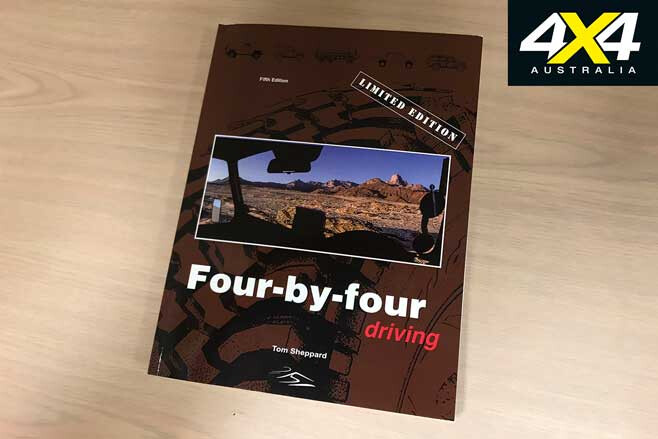
This hefty tome contains an enormous amount of information on off-roading skills, techniques and technology. Whether you’re a beginner in your first 4×4, or view yourself as an experienced tourer, this book, written by Tom Sheppard, is a great addition to your library – and to your driving knowledge.
The book, now in its fifth edition, covers every single aspect of off-road touring, from the reasons why people find off-roading so appealing, through to the different four-wheel drive systems on the market, and how to prep for either a short escape or a true expeditionary adventure.
Sheppard draws on his decades of extensive off-road exploration and adventure to delve deep into the essential skills needed for each terrain type, the different recovery scenarios you may encounter, and also advanced skills that may get you out of a seemingly impossible bind. A treasure-trove of info for off-road tourers.
Website: www.desertwinds.co.uk
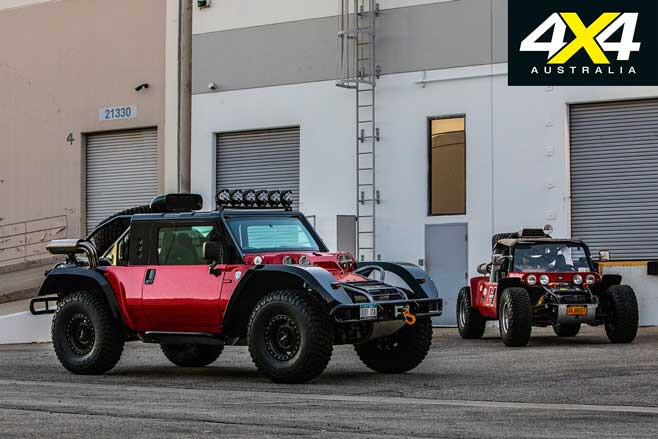
AFTER MORE than a year since the idea was first mooted by film director and avid car collector James Glickenhaus, the Scuderia Cameron Glickenhaus Boot has been fired up and left the workshop floor.
Destined for its public debut at this weekend’s The Quail at the Monterey Car Week, the SCG Boot was envisioned as a modern day interpretation of Steve McQueen’s Hurst Baja Boot, a custom Baja-ready 4×4 that was built in secret by GM designer, Vic Hickey.
Said to have been built in less than a month, the Hurst Baja Boot was built from steel tubing and was cobbled together with a 350ci small-block V8 that was mounted between the passenger cell and rear axle, Corvette rear-drive assemblies, Oldsmobile Toronado axle shafts, and a Dana transfer case.
McQueen used the Baja Boot in several off-road events including the famous and gruelling Baja 1000 in 1969, of which the actor managed 237 miles of the 1000-mile race before the transmission gave up.
The SCG Boot takes after the original’s minimalist design ethos, with almost no front or rear overhangs, a mid-mounted 340kW LT1 V8 engine and suspension travel of 19 inches. Plus, it’s fully capable of taking on the full Baja 1000.
While the first production Boot to emerge is a two-door model with a soft top, SCG also previously mooted the idea of producing four-door variants with air-conditioned cockpits – just in case alfresco driving on the tracks isn’t one’s idea of a relaxing weekend.
Glickenhaus, who is best known for commissioning a one-off Pininfarina tribute to Ferrari’s P-Series Le Mans racers – and built and raced several Le Mans racers under the SCG banner – is the current owner of the original Baja Boot, which he bought at an auction in 2010.
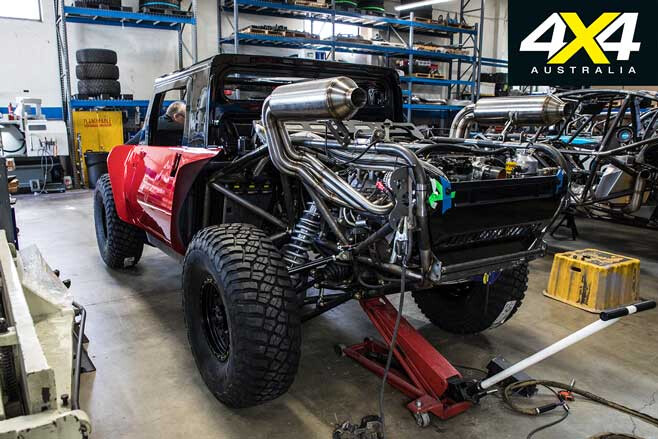
Glickenhaus’ decision to make a modern day interpretation of the Baja Boot is not all that surprising considering he owns an original P-series race car and has been basing his racing and road cars around the many classic cars he owns.
Like his previous endeavours, Glickenhaus has big plans for the Boot. Not only does he have plans to put the Boot to the test on some of the world’s most challenging off-road tracks, he has already gotten the NHTSA Low Volume Compliance approval for low volume production.
THE 2020 Ford Ranger has been announced, with the entire Blue Oval ute line-up benefiting from a range of equipment tweaks.
The biggest update of the 2020 refresh is that the base-model Ranger XL will be available with the option of a factory-fitted Heavy Duty Suspension (HDS) system, a segment first.
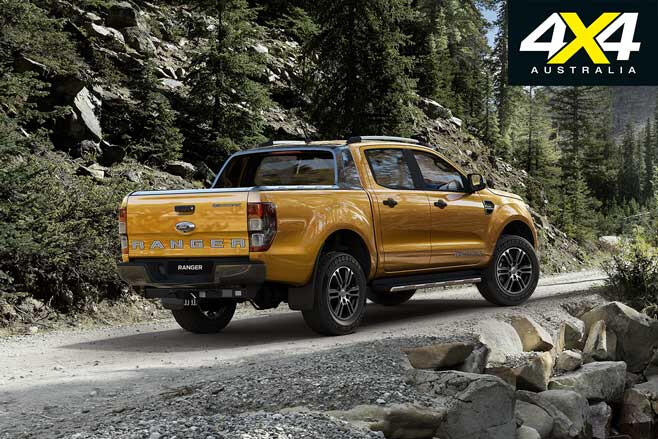
The upgraded suspension system – specifically catering for those who regularly lug heavy loads – improves the Ranger XL’s bump-stop clearance (by 25mm when carrying 550kg, for example), in the process upping departure angles.
The HDS system has been calibrated to work with the Ranger’s ABS and ESC systems and comprises of new, thicker rear springs (with a revised spring rate) and new front and rear dampers (with a revised damper tune). XL owners lured by the upgraded suspension only need to fork out $500 for the privilege.
In further good news, both the Ranger XL and XLS will get Ford’s SYNC3 tech and the 8.0-inch touchscreen already found on the upper-spec models. The tech features Apple CarPlay and Android Auto.
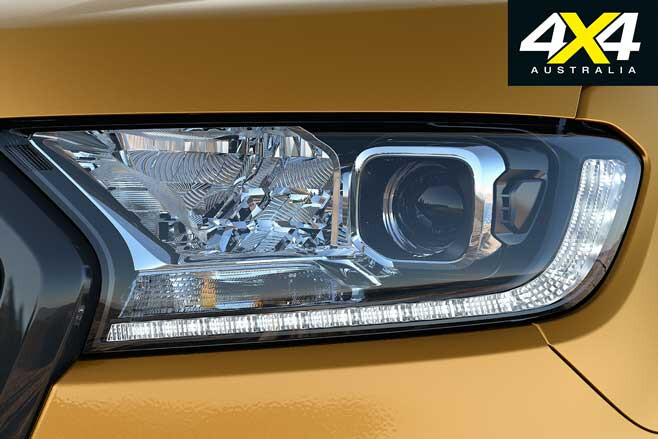
The XLT, Wildtrak and Raptor have been fitted with new high-performance Bi-LED headlights that are said to “bring a significant gain in forward vision” – 17 per cent greater lighting penetration on the road ahead, in fact.
The Wildtrak has also been upgraded with new machine-finished 18-inch alloys as standard, with the black-finish six-spoke alloys – offered as an option for XLT and Wildtrak models – still available if desired.
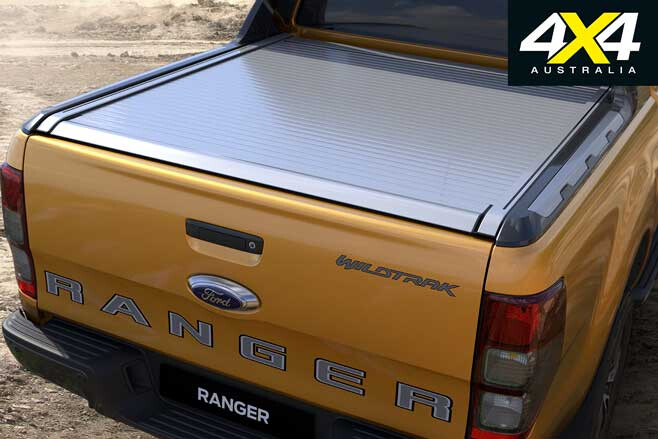
A remote-controlled roller shutter will grace the top of the Wildtrak’s tub, and it can be operated via a key fob, a dash-mounted switch, or a button located in the tub. Not only convenient, the new shutter increases the length between the canister and tailgate by 80mm and raises the height clearance by a further 20mm (above the current-model shutter).
Another neat little addition is the installation of a USB port behind the rear-view mirror. Why? It’s there to support the growing trend of dash-cam usage.
In addition to new Bi-LEDs and a USB port behind the rear-view mirror, the range-topping Raptor will get a new hue of blue – Ford Performance Blue – to separate it from the Blue Lightning paintjob the rest of the range will wear.
“Feedback from Australian and New Zealand customers has driven upgrades across the Ranger line-up, from heavy duty suspension in the XL, to a remote control powered roller-shutter on Wildtrak, and new Bi-LED projector headlights on the XLT, Wildtrak and Ranger Raptor,” said Kay Hart, President and CEO of Ford Australia and New Zealand. “Customers also told us they want the convenience of a windshield-mounted USB to power accessories, so we will now make this available across the Ranger line-up.”
Earlier this year, all models in the Ranger line-up received AEB with Pedestrian Detection as standard.
The 2020 Ford Ranger will be available from December, 2019.
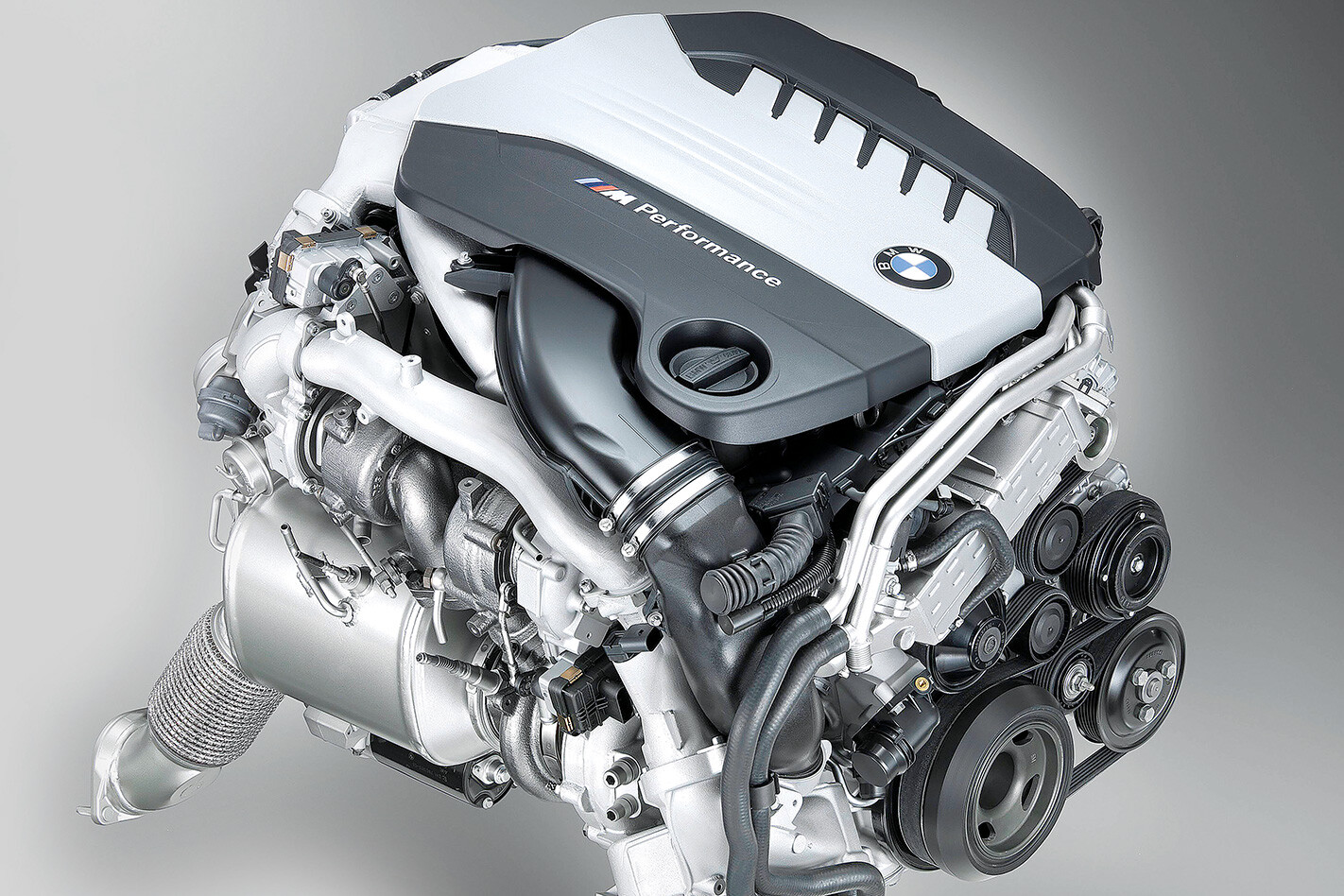
LOOK at the specifications of a modern turbo-diesel engine and one thing you can’t miss is the large amount of torque they produce.
*This was first published in 4X4 Australia’s September 2015 issue
The 2.3-litre turbo-diesel in the Nissan NP300 Navara claims 450 Newton-metre (Nm), an unheard of figure for a relatively small four-cylinder diesel a few years back, while a good 3.0-litre diesel these days makes 600Nm or more. And if that’s not enough, something like the 4.4-litre V8 turbodiesel in a Range Rover claims 740Nm!
But what does 450Nm, 600Nm or even 740Nm really mean? And is having a huge torque figure like that more important than having a decent amount of power?
Simple laws of physics actually tie power and torque inextricably together, because power is simply the mathematical product of torque multiplied by engine speed. So where torque is a rotation force, power is the rate at which that force can be applied.
Consider this simple analogy: You have an old 4×4 with a wheel nut badly rusted onto its stud. Thankfully you have a huge wheel brace that’s a metre long and an even bigger mate, whose pizza and beer diet sees him topping out at 100kg, to help get the wheel nut off.
To get the nut turning you need to overcome the friction between the nut and the stud by applying sufficient force to the end of the wheel brace.
If your mate puts all of his 100kg weight on the end of the wheel brace when it’s in a horizontal position, that 100kg weight equates to a downward (linear) force of 980 Newton; Newton being the standard measurement of force in the metric system. That 980-Newton force comes from multiplying your mate’s 100kg mass by 9.8 metre/second, the acceleration due to gravity.
That 980-Newton force on the end of a lever (the wheel brace) that’s a metre away from the nut, then produces a torque on the nut of 980 Newton-metres (Nm), calculated by multiplying 980 (Newtons) by one (metre).
The torque on the wheel nut is being applied regardless of whether the nut moves or not. If the nut doesn’t move, no power is being produced. But once the nut starts to move your mate also starts to produce power.
Assume the 980Nm is just sufficient to start moving the nut and that the friction remains constant all along the rusted stud. Also assume (by some sort of magical dexterity) that your mate can maintain the 980Nm torque on the nut as it rotates, regardless of the position of the wheel brace.
If he turns the wheel nut at one revolution per minute, a simple formula (see ‘Magic Formula’ below) determines how much power he is producing. In this scenario he would be producing just over a tenth of a kilowatt.
If he could rotate the nut 10 times a minute he would produce just over 1kW. So lots of torque in this case does not translate to much power production.
The lesson to learn here is that big torque numbers are worthless unless your ‘mate’ or engine in question can produce that torque at a decent rate or speed. Even if your mate could turn the nut at typical engine idle speed of 800rpm, his power output would be up to a far more useful 82kW.
In the real world, power is what you want, because power, rather than torque, is what you need to overcome the weight of your 4×4, its aerodynamic drag, and other minor factors such as its wheels’ rolling resistance. Everything else being equal, more power will give you more acceleration, faster hill climbing and a higher top speed, regardless of engine torque.
So is torque overrated?
Far from it, as the more torque you have, the less engine speed you need to generate good power.
When it comes to engines, the simplest way to get more torque is to build a bigger engine. With a big engine that produces lots of torque, you don’t need high engine speeds to make decent power. If you combine a big engine with lots of revs then you will produce big power numbers.
Smaller engines struggle to make lots of torque so therefore need more revs to produce decent power. The other simple way to increase engine torque is to use forced aspiration, namely supercharging or turbocharging.
The simple relationship that power equals torque multiplied by engine speed holds true for all engines, diesel or petrol, of any capacity and with any number of cylinders, and with or without turbocharging or supercharging.
MAGIC FORMULA
THE relationship between power and torque comes down to a simple formula of power equals torque multiplied by engine speed.
The formula also contains a ‘constant’ to adjust to the units being used. For example, in the metric system, Power (in kW) equals Torque (in Nm) multiplied by engine speed (in rpm), divided by 9549.
In the imperial system, once used in Australia and still used in some parts of the world, where power is measured in horsepower (hp) and torque in pound-foot (lb-ft), this formula applies: hp equals lb-ft multiplied by rpm, divided by 5252.
In the metric system, the standard unit of torque (Nm) pays homage to the great English physicist and mathematician Isaac Newton, as Nm stands for Newton-metre. Newton fathered the understanding of gravity and the basic physics of movement.
The standard unit of power in the metric system is kW, or kilowatt, and refers to the Scottish inventor and engineer James Watt. Watt developed the steam engine that was pivotal in the so-called Industrial Revolution. The ‘kilo’ prefix is used in the metric system to signify multiplication by 1000. So an engine producing 50kW actually produces 50,000 watts.
MAINTAINING your engine, transmission and battery will ensure your 4×4 works at its maximum capacity. Here’s some new kit on the market to keep the essentials running smoothly.
JLM Turbo Cleaner (July)
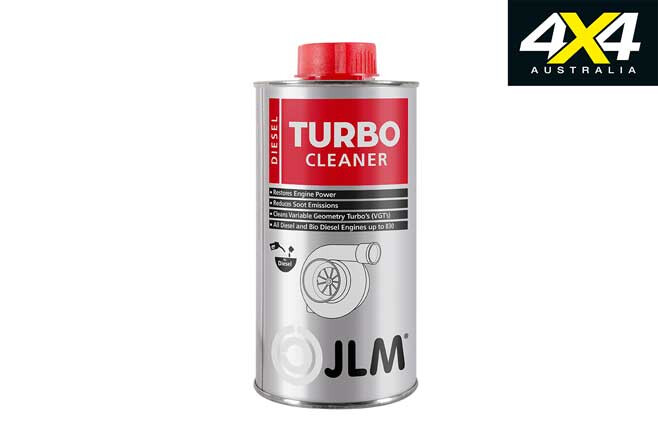
Put an end to the problem of dirt and soot in a turbo with this new cleaner from JLM. Dirt, grit, grime and soot are all enemies of a smooth-running turbo. A dirty turbocharger increases wear and tear and also increases risk of a failure of the VGT turbine wheel.
The JLM Turbo Cleaner has been designed to reduce soot emission and maintain performance and is as simple as adding the liquid to the diesel in your rig’s fuel tank. Adding the cleaner eliminates dirt and soot, thus ensuring the air-fuel ratio is ideal and your turbo is pushing nothing but clean air.
JLM reckons for the best results owners should add 500ml of Turbo Cleaner every 5000km – or if/when you notice you’re not getting optimum performance out of your donk. It sure looks like a small price (both monetary and in terms of time) to pay for a smooth-running engine. Suitable for use with all turbo-diesel engines.
RRP: $39.95 (500ml bottle) Website: www.jlmlubricants.com.au
Nulon EZY-SQUEEZE (July)
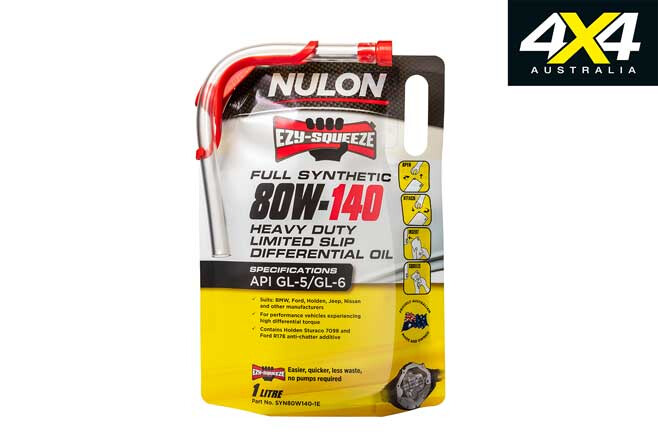
Changing the diff, gearbox and/or transmission oil in your 4×4 is never a fun job, no matter how much you convince yourself you’re saving some money going the DIY approach. Nulon is aiming to make the process at least a lot quicker, with the release of its innovative – and award-winning – EZY-SQUEEZE, which is a super-simple but very clever way of servicing the abovementioned parts of your rig.
The EZY-SQUEEZE is, as its name suggests, a flexible one-litre container (patent pending) and applicator tube that makes it easy to get into those awkward places and get the oil change done. Nulon is claiming it is 50 per cent quicker than a pump- or syringe-based system and there’s far less waste.
Plus, you don’t need a pump; just a ‘squeeze’ and the oil is pushed into the component’s reservoir and it is all done. Nulon claims the EZY-SQUEEZE can be used on more than 95 per cent of the Aus/NZ vehicle fleet.
Website: www.ezysqueeze.com.au
WaterWatch
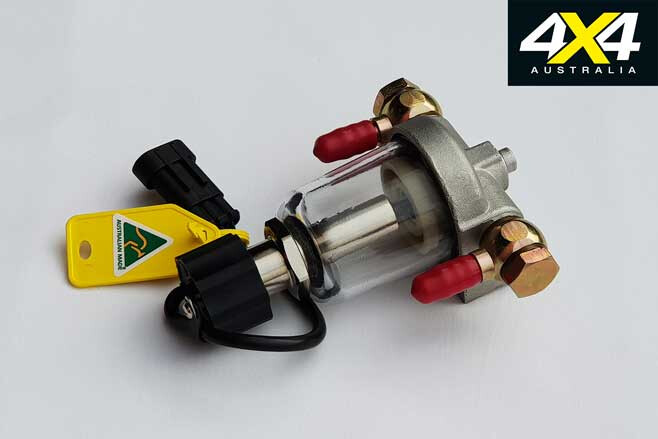
This patented water detection and warning device is the only system of its type on the market globally, and it’s an Aussie invention that has been doing this important job for the past decade. The WaterWatch is designed to separate water from diesel and emit an alarm before water enters a vehicle’s fuel system, eliminating what can be serious (read: engine killing) and expensive damage to your rig’s powerplant.
The unit detects the presence of water in the fuel supply by first separating and then trapping the water away from the fuel flow, while emitting both a visual and audible warning. It’s worth noting it is not a filter (these are for particle control and don’t stop water and fuel mixing due to the high pressure/flow rates found in common-rail donks, which results in the water forcing its way through the filters and into the fuel system).
The WaterWatch has no filter to restrict the flow of fuel. It has an impressive lifetime warranty and is currently available as a DIY kit for more than 50 vehicles.
Website: www.waterindiesel.com
REDARC Showroom AC Battery Charger (September)
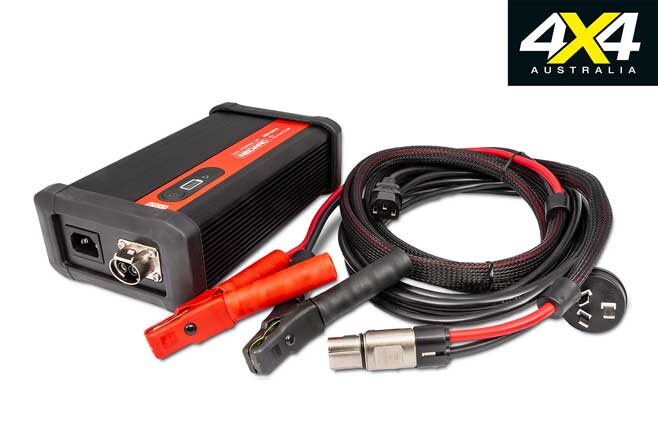
REDARC has released its latest model in the co-branded DEFA AC Battery Charger range: a 12-volt, 30-amp Showroom Charger. This charger is designed for long-term battery maintenance charging and can provide a fast battery charge if/when needed. This makes it ideal for those tourers who need to keep infrequently used vehicles, campers/caravans and boats charged.
The charger has a detachable clamping cable that has no fan, meaning it is noise-free, so even when in use in your garage or shed it is not intrusive in terms of noise. The Showroom Charger uses a seven-step charging process to optimise battery performance and longevity and is designed for use with 12V Lead Acid, AGM, EFB and GEL battery compositions.
It will initially deliver 14.4V to achieve maximum charge, before dropping down to 13.6V at a maximum of 30A during the long-term charge phase. It is easy to use thanks to its one-button operation and battery-monitoring display. It is also compact and housed in a tough anodised black aluminium finish.
Website: www.redarc.com.au