
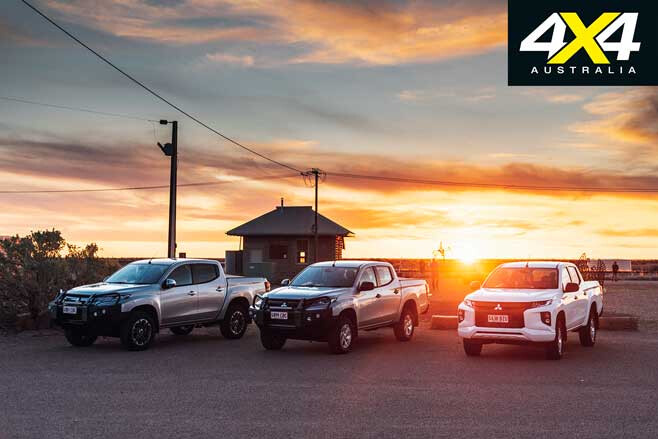
KEEN TO highlight the Triton’s off-road capability, Mitsubishi recently held the launch for the 2020 version of its popular Triton 4×4 ute at Warraweena Station in the spectacular Flinders Ranges of South Australia.
If you like scrabbling up steep rocky inclines and forging through creek beds and deep gorges, then Warraweena is the place for you, with a number of drive loops graded from ‘easy’ to ‘hard’. No matter which you decide to tackle, you’ll need a 4×4 with high ground clearance to traverse most of the 4×4 tracks on Warraweena, so it wasn’t surprising that Mitsubishi removed the sidesteps from the Tritons we sampled prior to letting us loose in the demanding conditions.
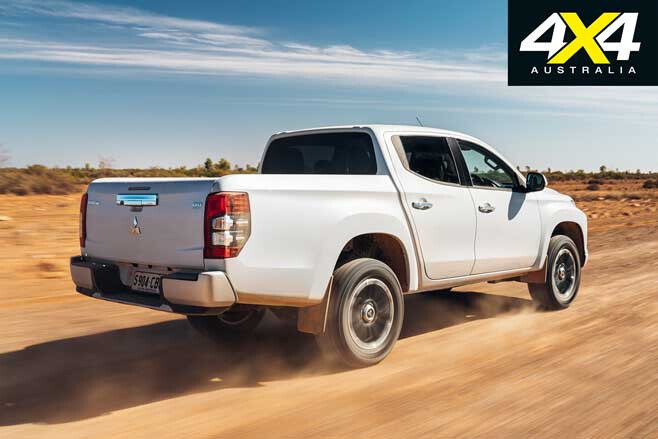
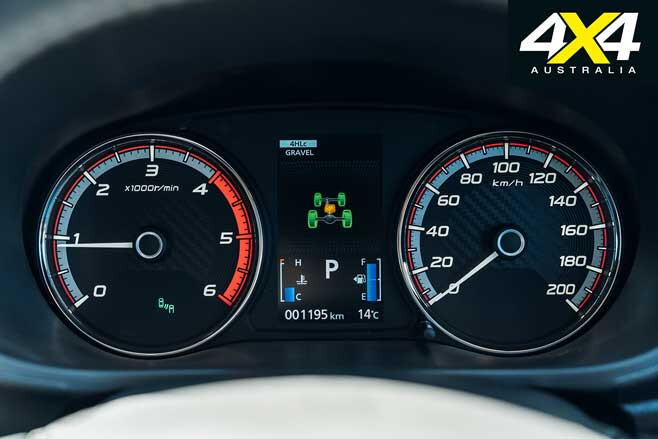
New features for MY20 Triton GLX and GLX+ models include the fitment of 245/70R16 Bridgestone Dueler all-terrain tyres, while the GLX+ also scores a standard rear diff lock (previously exclusive to the top-spec GLS Premium) and the fitment of a roof-mounted rear air circulator for better airflow inside the cabin. Both GLX and GLX+ retain Mitsubishi’s Easy-Select 4WD (essentially a fancy name for a two-speed, part-time 4×4 system).
The GLS model grade scores a standard rear diff lock for 2020, and GLS and GLS Premium models are equipped with 265/60R18 Dunlop Grandtrek highway tyres and Mitsubishi’s Super-Select 4WD-II (selectable on-demand 4×4) system. Super-Select 4WD-II incorporates an ‘Off-Road Mode’ system (available on both manual and auto variants) with ‘Gravel’, ‘Mud/Snow’, ‘Sand’ and ‘Rock’ settings, which tailors engine power delivery, automatic transmission response, traction control response and stability control reaction, to suit different driving environments. Both GLS and GLS Premium are also now equipped with keyless entry and push-button start.
The interior is unchanged, and it’s slightly narrower in the body than the competition but with reasonable leg room front and rear and good fit and finish. Tilt-and-reach steering wheel adjustment makes it easy to get comfortable behind the wheel and, while fitting three adults across the rear seat is a squeeze, the seat back has good rake. As for the roof-mounted air circulator, it works surprisingly well, pumping cool air from the front vents and moving it around the cabin efficiently.
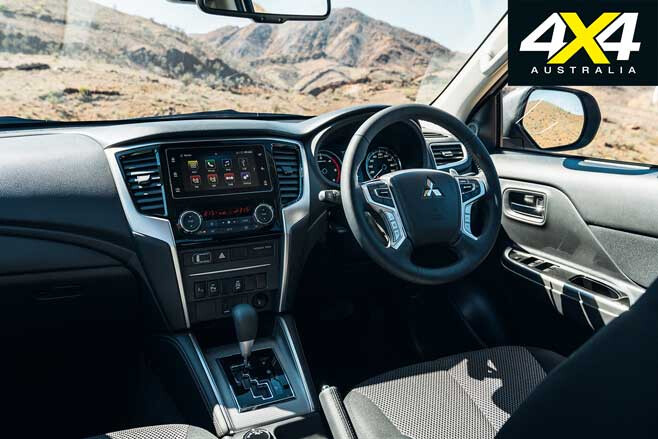
On the road the Triton offers a more dynamic driving experience than many of its competitors and, although ride quality is on the firm side when unladen, it’s reasonably compliant. The GLX+ felt marginally smoother over bumpy gravel roads no doubt thanks to its higher profile 245/70R16 rubber, but there’s not much in it. The GLS models have the advantage of selectable full-time 4WD, which is handy when roads change from sealed to gravel to sealed again, but with effective traction and stability control systems the part-time only set-up in the lower grade models is not a deal breaker.
The Triton’s 2.4-litre turbo-diesel (133kW at 3500rpm and 430Nm at 2500rpm) is not as potent as many of its four-cylinder competitors, but on-road performance is still impressive, thanks in part to its smooth-shifting close-ratio six-speed auto (the only transmission option on test). The engine is also relatively smooth and quiet, and in-cabin noise insulation is effective.
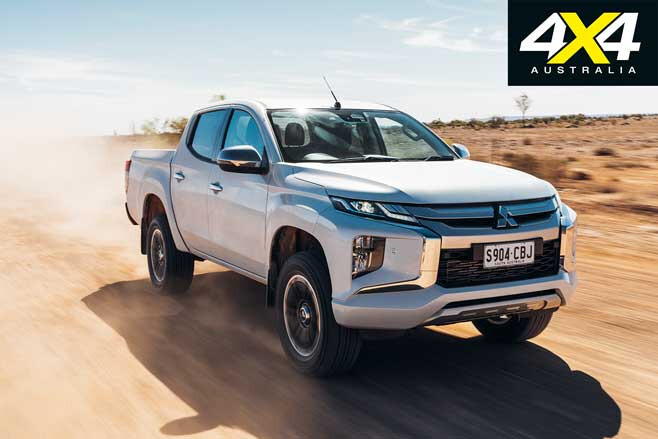
GLX+ models (and up) certainly benefit from the fitment of the standard rear diff lock, especially in steep and slippery terrain with ruts that see suspension travel pushed to its limits. Having said that, the traction control system is rendered inactive when the rear diff is locked, so in some off-road scenarios the Triton will actually go further with the rear diff lock disengaged. Rear axle articulation is acceptable, but it doesn’t take much for the Triton to lift a front wheel into the air in undulating terrain.
Low range gearing is respectable, with an overall reduction in first gear of 39.5:1 combining with the auto’s torque multiplying effect to make light work of most inclines. On steep downhill runs, however, lower gearing would certainly come in handy.
Hill Descent Control helps in this respect, but this is part of the ‘Off-Road Mode’ package that’s only available on GLS and GLS Premium models; so if you’re driving a GLX or GLX+ you’ll need to rely on the brakes to arrest speed. We sampled the GLS’s various ‘Off-Road Mode’ settings on the tracks around Warraweena, but other than slightly altered throttle response it was difficult to pick much of a difference.
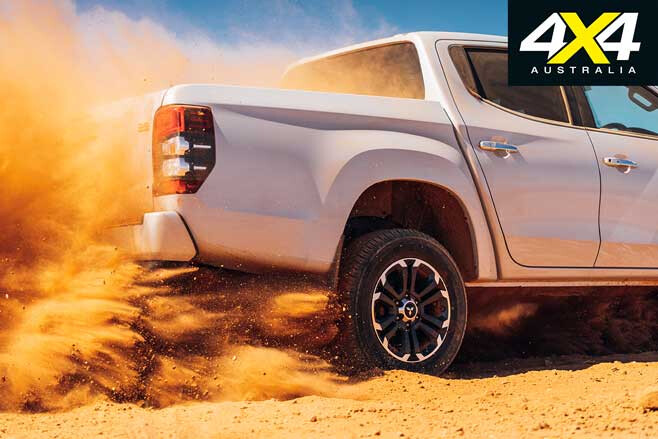
With sidesteps removed and a claimed 205mm of ground clearance on GLX+ and 220mm on GLS models, the Tritons we sampled at Warraweena only scraped their bellies a couple of times. The biggest hits occurred when the rear bumper grounded when exiting creek beds, but this is common among dual-cab utes with their long rear overhangs.
The Triton’s payload varies from 845kg to 1095kg depending on model grade and its towing capacity is 750kg/3100kg (unbraked/braked), the latter figure down slightly on most class competitors. There are six tie-down points in the tub.
The Triton safety package is comprehensive, and all models are now available with Forward Collision Mitigation (FCM) with pedestrian detection and Lane Departure Warning (LDW), so long as you tick the ADAS box when ordering a GLX. Other safety kit across the range includes seven airbags, Adjustable Speed Limiter, Emergency Stop Signal function (ESS), Emergency Brake Assist system (EBA), Hill Start Assist (HSA), Active Stability Control (ASC), and Trailer Stability Assist (TSA).
Mitsubishi has managed to keep a lid on pricing which is vitally important on a vehicle such as Triton, which many buy mainly because you get a lot of standard equipment for the money. This is the reason Triton is the third best-selling 4×4 ute in the country.
While the MY20 Triton might look the same as the MY19 model, the few upgrades made across the range are certainly beneficial, especially the addition of a rear diff lock on GLX+ and up, further enhancing the vehicle’s off-road capability.
2020 MITSUBISHI TRITON 4×4 VARIANTS (AUTO) SPECS: Engine: 2.4-litre I4 turbo diesel Power/Torque: 133kW/430Nm Gearbox: six-speed man/auto 4×4 System: part-time 4×4 (GLX-GLX+); selectable full-time 4×4 (GLS-GLS Premium) Crawl Ratio: 39.5 (auto) Kerb Weight: 1780-2045kg GVM: 2900kg Towing Capacity: 3100kg GCM: 5885kg Departure angle: 22° (GLX+); 23° (GLS) Rampover angle: 24° (GLX+); 25° (GLS) Approach angle: 30° (GLX+); 31° (GLS) Wading depth: 600mm Ground clearance: 205mm (GLX+); 220mm (GLS) Fuel Tank Capacity: 75 litres ADR Fuel Claim: 8.6L/100km (auto)
| 2020 Mitsubishi Triton pricing | |
| Single-cab | |
| 4×4 GLX Cab Chassis 2.4L Man Diesel | $32,990 |
| 4×4 GLX Cab Chassis 2.4L Auto Diesel | $34,590 |
| Club-cab | |
| 4×4 GLX Cab Chassis 2.4L Man Diesel | $35,490 |
| 4×4 GLX ADAS Cab Chassis 2.4L Auto Diesel | $38,790 |
| 4×4 GLX+ Cab Chassis 2.4L Auto Diesel | $41,490 |
| Dual-cab | |
| 4×4 GLX Cab Chassis 2.4L Man Diesel | $36,240 |
| 4×4 GLX ADAS Cab Chassis 2.4L Auto Diesel | $39,540 |
| 4×4 GLX 2.4L Pick Up Man Diesel | $37,490 |
| 4×4 GLX 2.4L Pick Up Auto Diesel | $39,990 |
| u00a04x4 GLX ADAS 2.4L Pick Up Man Diesel | $38,290 |
| 4×4 GLX ADAS 2.4L Pick Up Auto Dieselu00a0 | $40,790 |
| u00a04x4 GLX+ 2.4L Pick Up Man Diesel | $40,990 |
| 4×4 GLX+ 2.4L Pick Up Auto Dieselu00a0 | $43,490 |
| 4×4 GLS 2.4L Pick Up Man Dieselu00a0 | $45,140 |
| 4×4 Toby Price Edition Pick Up Man Dieselu00a0 | $48,140 |
| 4×4 GLS 2.4L Pick Up Auto Dieselu00a0 | $46,990 |
| u00a04x4 Toby Price Edition Pick Up Auto Diesel | $50,640 |
| 4×4 GLS Premium 2.4L Pick Up Auto Dieselu00a0 | $51,990 |
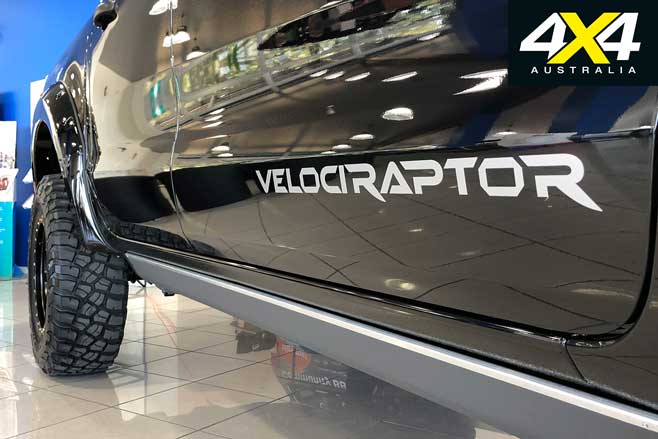
Sink your claws into this! A Hennessey VelociRaptor Ford Ranger is now available exclusively to the Australian and New Zealand markets, but a limited run of just 25 units are being built.
Built at KPM Motorsport in Adelaide, the VelociRaptor Ranger is based on the 2019-2020 Ford Ranger XLS dual-cab models that utilise the 3.2-litre turbo-diesel engine and six-speed auto/manual transmissions (capable of 147kW and 470Nm in standard trim).
Expert tuning house Hennessey Performance then upgrades the engine management software and throws in a performance exhaust system and high-flow intercooler, bumping output up to 181kW (at 3300rpm) and 590Nm (at 2200rpm) in the process.
Ensuring it has the infrastructure to match the power hike, a Stage 1 ICON coil-over suspension upgrade is utilised, providing the vehicle with four inches of lift. This is balanced by 18-inch alloys wrapped in BFGoodrich KM2 285/70R18 rubber.
The rig also has the show to match the go courtesy of front and rear bumper upgrades, a Ranger Raptor grille insert, colour-coded fender flares, and Hennessey and VelociRaptor exterior badges.
Earlier this year, tuning expert Hennessey released its VelociRaptor Ranger to the US market, which differs from the Aussie offering as it uses a different trim level and the US-spec 2.3-litre EcoBoost petrol engine amped up to produce 260kW and 521Nm.
The complete turn-key cost of the Aussie VelociRaptor Ranger is estimated to be from $90,000-$100,000, and it comes with a three-year/60,000km limited warranty.
Stay tuned for official pricing.
THESE two products to recently land in ARB catalogues would make great additions to your 4×4 in time for the end-of-year retreat.
ARB Tailgate Assist – 2015+ Hilux SR & SR5
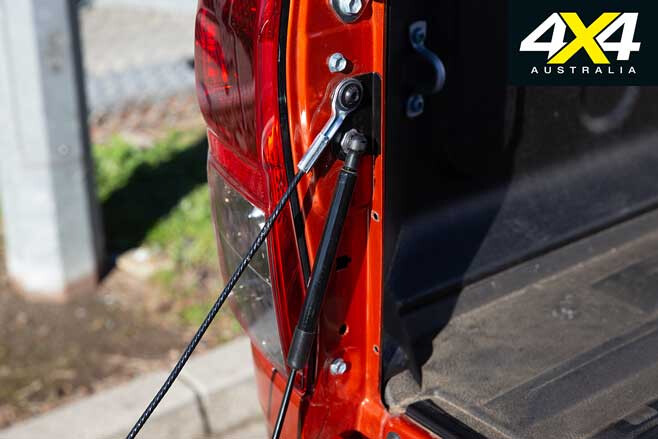
The innovative ARB Tailgate Assist is now available to suit 2015-on Toyota HiLux SR and SR5 models. The Tailgate Assist safely controls the opening speed of the tailgate and reduces the closing effort by more than 50 per cent, allowing for easy one-handed operation of the tailgate, which has obvious benefits when a driver is carrying something in the other hand.
ARB Tailgate Assist systems are model specific and, in the case of the 2015-on HiLux consists a gas strut and a torsion spring, along with vehicle-specific hardware including mounting brackets and tailgate cables.
RRP: $299 (Australian East Coast Metro) Website: www.arb.com.au
ARB Summit Sahara Bull Bar for Ford Everest
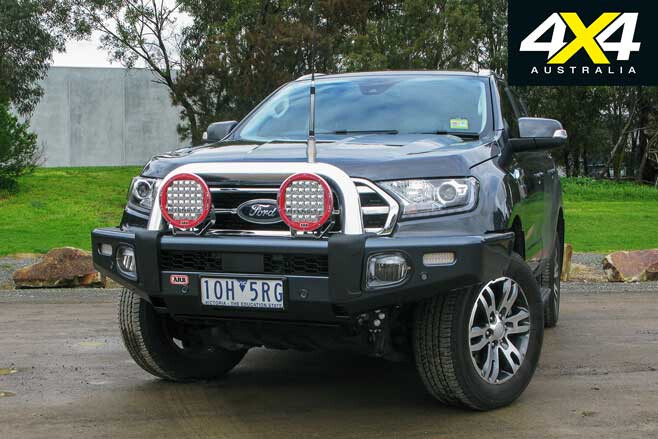
ARB’s Summit Sahara Bull Bar is now available to suit Ford Everest Ambiente, Trend and Titanium models, including those equipped with adaptive cruise control and semi-auto active park assist.
The winch compatible Sahara Summit Bar features durable steel construction with a multi-fold upswept and tapered wing design for strength and maximum approach angle, a 30mm radius on the wings and centre section, a split pan for airflow to the vehicle’s cooling system, two-piece buffers, LED indicator and clearance lights and provision for fitment of fog lights.
The bar can be supplied with or without the polished or painted centre tube, and the Summit Sahara also has provision for fitment of a range of driving lights and antennas, and twin Hi-Lift jack points. It’s finished in a hard-wearing black powder coat or can be optionally colour coded to suit individual vehicles.
RRP: $2262 (Aust. East Coast Metro) Website: www.arb.com.au
NEED some fresh reading material? These two books – Islands of Australia and The Camping Cookbook – are great additions to your off-road library.
Islands of Australia
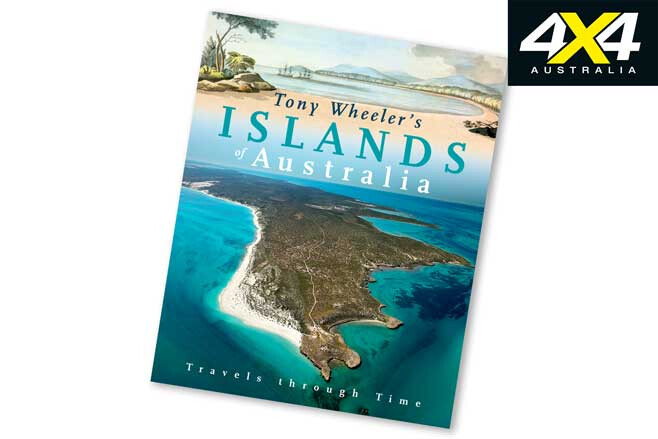
Australia is not just an island continent; it’s a continent of more than 8000 islands.
In this new photographic travel/history book, Islands of Australia: Travels through Time, travel writer Tony Wheeler (Lonely Planet co-founder) takes readers on a journey around the Australian coast and beyond to discover the stunning natural features, unique wildlife and chequered histories of our remarkably diverse islets, cays, atolls and archipelagos.
Islands of Australia takes you on a visual journey around the coast from eco-resorts, pristine beaches and dive sites to guano mines, prisons and subantarctic volcanoes. Discover why the Whitsundays should have been called the Whitmondays, encounter Australia’s only known pirate, witness mutiny and murder on the Bounty and Batavia, meet giant lizards and friendly quokkas, and discover rich Indigenous cultures.
Islands of Australia takes you behind the tourist brochures to discover our islands’ fascinating, complex and sometimes dark histories, and it will leave you itching to visit and discover more about our history and natural heritage.
RRP: $39.99 Website: tonywheeler.com.au
The Camping Cookbook
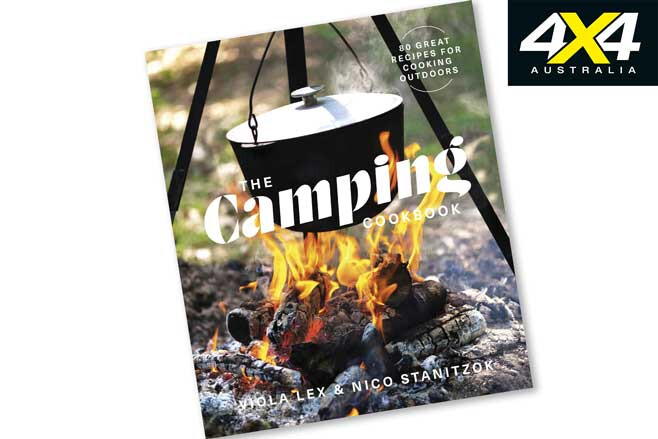
The Camping Cookbook will inspire you to light a fire and enjoy delicious recipes you can rustle up when camping.
Penned by chef Nico Stanitzok and lifelong camper Viola Lex, The Camping Cookbook includes more than 80 sweet and savoury camping recipes, each with a symbol that tells you which is the best way to cook the dish (open fire, grill or camping stove). As well as traditional campfire favourites such as barbecue chicken, grilled corn on the cob and kebab skewers, there are recipes for campfire breads, grilled camembert, quick pancakes and even chocolate cakes baked inside oranges.
As well as outdoor cooking hacks and clever tips, you’ll find checklists of camping essentials and must-haves such as barbecue sauce, ketchup and dukkah.
THE centre of Australia contains plenty of quintessential outback roads, vistas and trails, and it’s the setting for Season 5 of 4X4 Australia’s Adventure Series.
Our Red Centre Adventure begins in Alice Springs and cuts east through the MacDonnell Ranges, where the crew stretches their legs at Trephina Gorge before continuing on to Ross River Homestead.
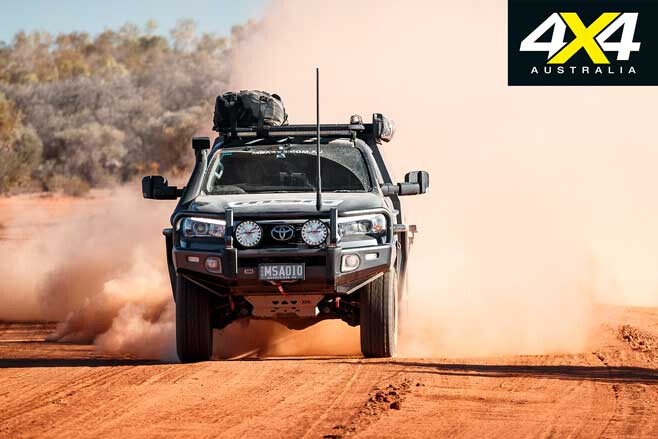
An issue with Ron’s Patrol forces him to make a sudden diversion to Alice Springs for some mechanical aid, but it’s not long before he re-joins the group.
Following a good night’s rest, the next destination is the iconic gold-mining town of Altunga, where group leader Ron Moon will spin a yarn or two on the area’s rich history.
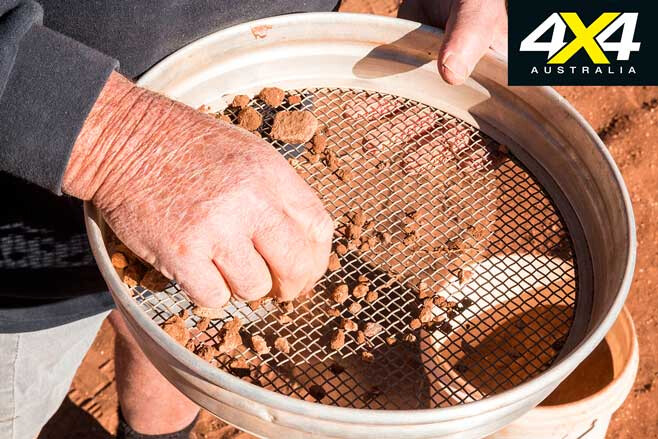
The beautiful Ruby Gap National Park is next on the itinerary, followed by a stopover at the Hale River Homestead for a quiet brew or two. The episode wraps at picturesque fossicking fields of Gemtree, 140km north-east of Alice Springs.
Stopping at a number of hidden secrets along the route, our journey through the red and dusty centre of Australia should hopefully inspire you to do the same.
In episode 2, the crew departs Gemtree in pursuit of Tower Rock, before heading east into the Simpson Desert. Stay tuned!
WITH THANKS MSA 4X4: www.msa4x4.com.au
WITH most modern camper trailers you have to give up a modicum of home comforts when hitting the tracks, but if you have a big family and a big budget, no luxury is too difficult to have in your overland rig.
That was the thinking behind an Australian family of eight, who commissioned Queensland-based SLRV Expedition Vehicles to build an 8×8, two-storey luxury motorhome version of its Commander vehicle.
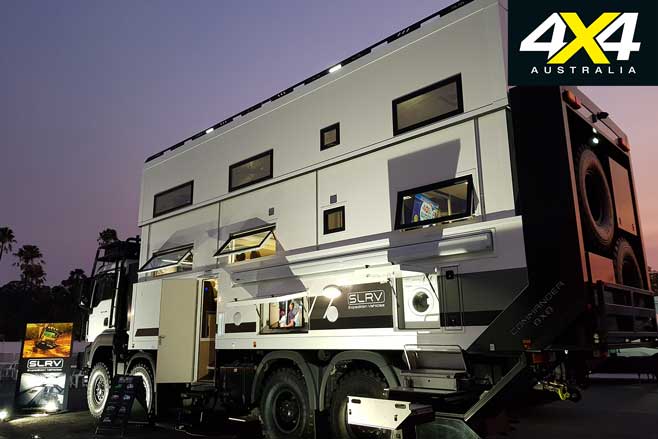
According to SLRV, the Commander 8×8 2 storey is its largest creation to date. Built on a MAN TGS 8×8 truck with a torsion free-mounted body to eliminate the flex between the body and the truck frame when going off-road, the 12-metre long behemoth features a custom actuator lifting system that can lower or raise the upper level of the cabin.
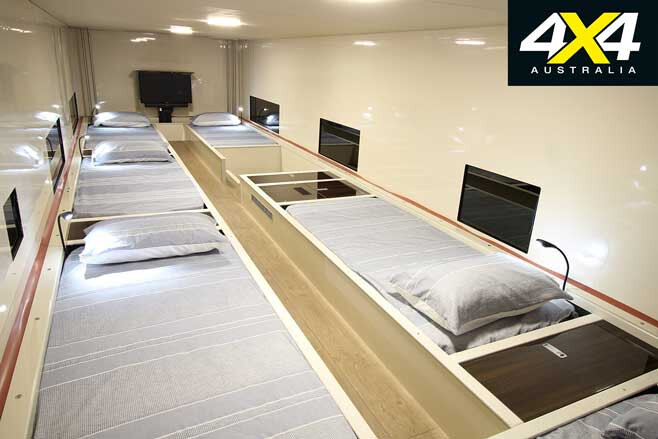
Inside, the Commander 8×8 is outfitted with double-glazed windows, 10 beds with a main bedroom and an electric drop-down guest bed, a 10-person lounge, ducted heating and cooling, a separate en-suite bathroom, four 32-inch TVs, and satellite TV and internet.
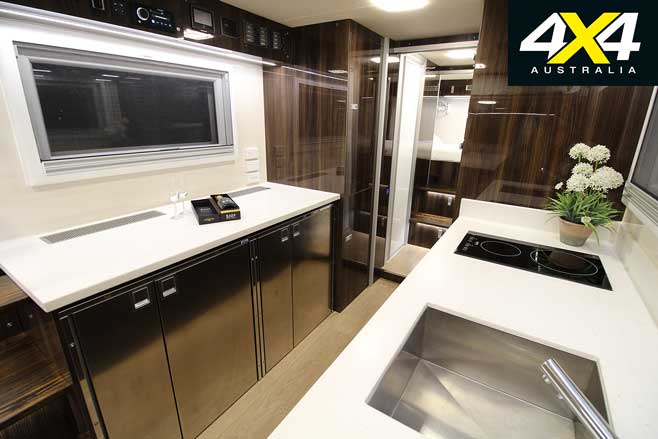
The kitchen features two convection microwaves, two induction cooking tops, two 200-litre under-bench fridge/freezers, and a 75-litre drawer fridge/freezer. The Commander 8×8 also features an external kitchen with a slide out-induction cooktop, complete with an attached sink.
“The owner [of the Commander 8×8] wanted it to be like a luxury unit with all the mod cons. A massive challenge out in the arid regions of Australia,” said SLRV Expedition Vehicles’ Warwick Boswerger.
With the number of on-board amenities – and intended to be (almost) fully self-sufficient when out in the middle of nowhere – keeping the Commander 8×8 powered was a challenge for the off-road RV specialist. To keep the lights on and appliances running, the motorhome is equipped with an array of Mastervolt lithium-ion batteries that are recharged by a 2kW solar panel system, a Cummins Onan 9.5kW on-board diesel generator, and what SLRV claims is a world-first with an RV 9.5kVA alternator.
“Powering this vehicle forced us to think outside the box,” said Boswerger. “We had to design an electrical system that not only powered all the appliances, it had to recharge and keep powering over and over out in the remote wilderness.”
The plumbing uses two separate systems that can store up to 1000 litres of water, with tanks for grey and black water, and an isolated plumbing system to dispense drinking water.
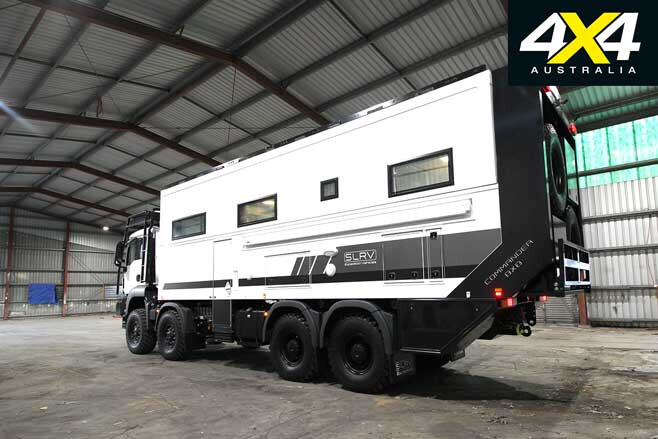
Built to traverse Australia’s remote wilderness, SLRV fitted the Commander 8×8 with a host of off-road gear including a Bozcrome front bar with a 30,000lb hydraulic winch, Bozcrome rear winch receiver with a 20,000lb hydraulic winch, Bozcrome radiator and sump guard, GME 80-channel UHF Plus antenna, four Narva LED spotlights, a Narva 812mm LED light bar kit, roof rack and windscreen bars, and a Tow-Pro brake controller.
While the company builds a wide range of specialty 4×4 expedition vehicles, the Commander 8×8 is by far its largest and most advanced commission, taking 13 months to design and build.
“We never shy away from a challenge. It keeps us at the forefront of expedition vehicle design and this build stepped it up again with a couple of world firsts,” said Boswerger.
WE LOVE BEING able to feature some of the best and most interesting modified 4×4 vehicles from around Australia and the world each month in 4X4 Australia.
These vehicles show there’s no end to the ingenuity and imagination of 4×4 owners and drivers. All sorts of vehicles are covered, from vintage Jeeps to diminutive Suzukis and the latest LandCruisers and Patrols, and nothing is off limits when it comes to the modifications performed.
Whether you’re simply adding a set of all-terrain tyres, a long range tank and a bullbar for long-distance touring with the family, or going all-out with 44-inch tyres, a V8 conversion, competition suspension and a roll cage for a rock crawler, the way you kit your fourby is a reflection of you and what you do. Everyone is different and has unique tastes and requirements, and the next bloke will probably do things differently to you; but it’s always interesting to see what others are doing.
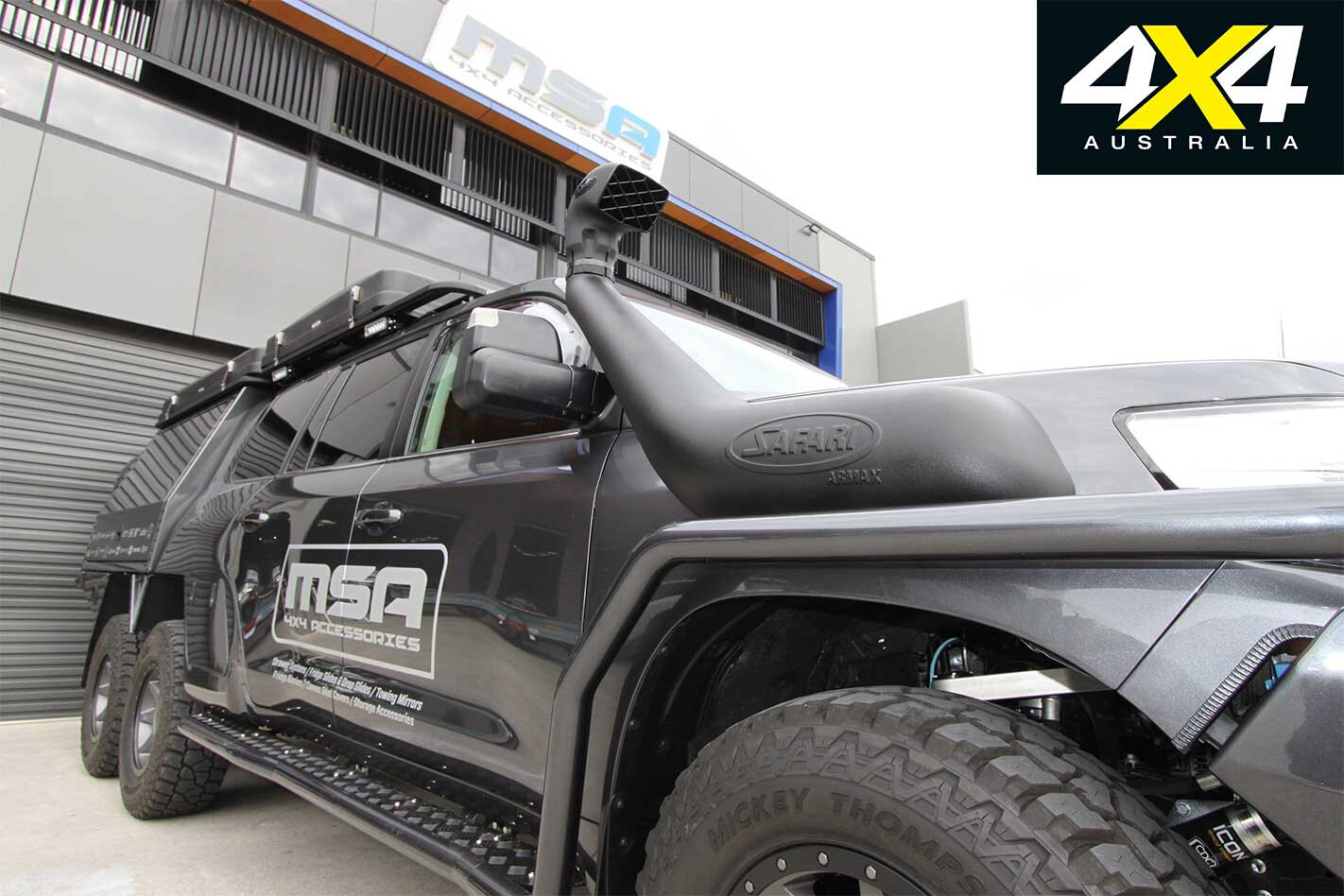
How about the insane 6×6 LandCruiser build by MSA 4×4 Accessories, which we’ve been following this year? We have that completed truck in the December 2019 issue (in stores now). Or the sweet, black Jeep Gladiator on 37s we saw last month in the November issue? Two very different builds for different people and probably not to everyone’s liking, but interesting all the same. There are elements and accessories on each of them that we could adapt to our own builds.
It’s always fun to look back and compile our favourite Custom 4x4s of the Year, and that’s just what we’ve done in the December issue. Now it’s over to you to vote for your favourite rig and, in turn, go in to the draw to win a Maxxis tyres voucher valued at up to $2000.
Speaking of Maxxis, I’ve been mighty impressed with the Maxxis RAZR muddies fitted to our Ford Ranger. The Ranger is my interpretation of how a modern 4×4 ute can be built-for-purpose using some of the best products on the planet, to tour over any terrain. The Ranger is now more capable, functional and enjoyable to drive, so it has achieved its goals so far. However, it’s not finished yet and there are more goodies to come. Stay tuned!
THE heart of our great country is home to an abundance of quintessential outback tracks, dispersed with rock holes, rivers and gorges, and it’s often referred to as a ‘real’ 4WD destination.
The 4×4 Adventure Series team begins their journey of the MacDonnell Ranges at Alice Springs, before stopping by a number of iconic landmarks including Trephina Gorge, John Hayes Rockhole, Ross River Homestead, the gold-mining town of Artlunga and Tower Rock.
We then tracked the Hay River south through the Simpson Desert, one of Australia’s great desert journeys. Follow the journey here.
Season 5 Episodes
- Episode 1: Season 5 of the 4X4 Adventure Series has the crew kicking up red dust in Central Australia.
- Episode 2: From the fossicking fields of Gemtree to the relentless sand of the Simpson.
- Episode 3: The crew head along the Hay River Track to the Simpson Desert proper.
Season 5 Articles
- Part 1: The more remote gorges and ranges of the rocky heart of the country, east of Alice Springs, are the most welcome highlights of a Central Australia trip.
- Part 2: Following the Hay River through the Simpson Desert is one of the great desert journeys in Australia. Join us as we head south along the ephemeral river.
- Introduction: The concept behind Project Super Cruiser
- Update #1: The Super Cruiser starts to take shape
- Update #2: Team meets some build challenges
- Update #3: The Super Cruiser comes together
- Update #4: Project Super Cruiser hits the road
- Update #5: The Final Cut
Introduction: The concept behind Project Super Cruiser
Published 17th June 2019
WHAT DOES a family of seven do when they want to go on extended off-road adventures without a trailer in tow? Build a monster off-road rig with three axles and three rows of seats, and a decent-size service body on the back, of course. That’s the off-road freedom plan of MSA 4×4 proprietor Shane Miles and his clan.
“Between Tameka, my fiancée, and myself, we have five kids, so there’s not really any sort of vehicle where I can put drawers, fridge slide and all our camping gear in,” Shane explains. “The only way we can tour anywhere is to travel with a very large trailer or a caravan; and being a bit more of a four-wheel driver I don’t really want to tow a trailer when we go to places like Cape York or across the Simpson Desert … and finding something that’s got six or seven seats, and also some sort of ute or tray-back, it just doesn’t exist.”
Shane has been searching for a solution to his dilemma for some time now and he’s done plenty of research into six-wheelers, but most vehicles with a third axle added are dual cabs – and five seats just won’t cut it (pun intended).
“There’s no use in me cutting a vehicle behind the second row of seats because I’d have to leave two kids at home,” Shane says of the traditional process of chopping the back off a standard 4×4 wagon and converting it into an extended 6×6. “The standard dual cab conversions, there’s a whole heap of companies that do them … but no one would do the third row.”
Then Shane met Mick McMillan from Australian Expedition Vehicles (AEV), and the two began to hatch a plan.
“I spent a lot of time talking to Mick at AEV, discussing whether we could do this; cut a wagon and keep the third row,” Shane says. “Mick’s was the only company that said ‘yes, we can do this, and it will be legal’.”
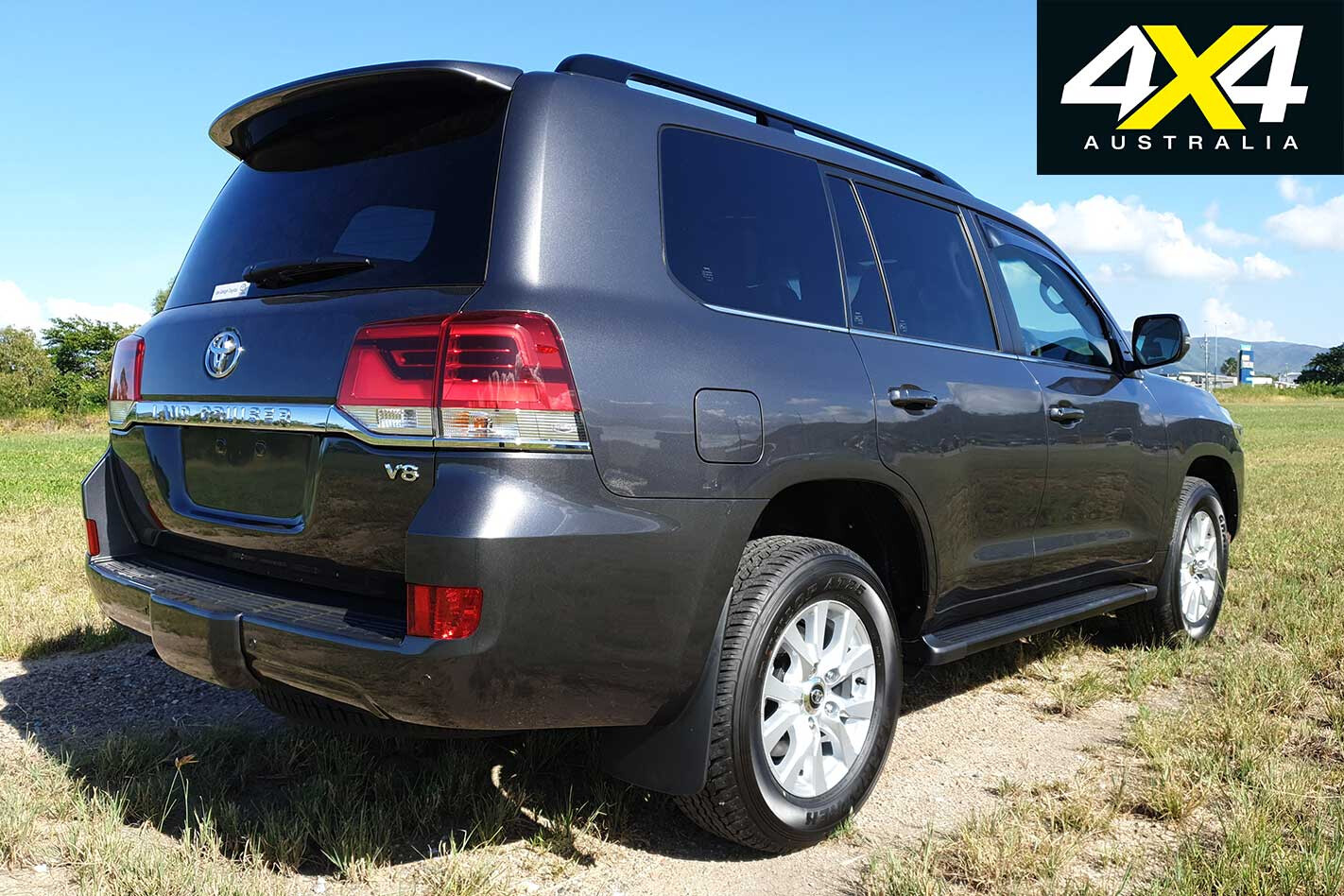
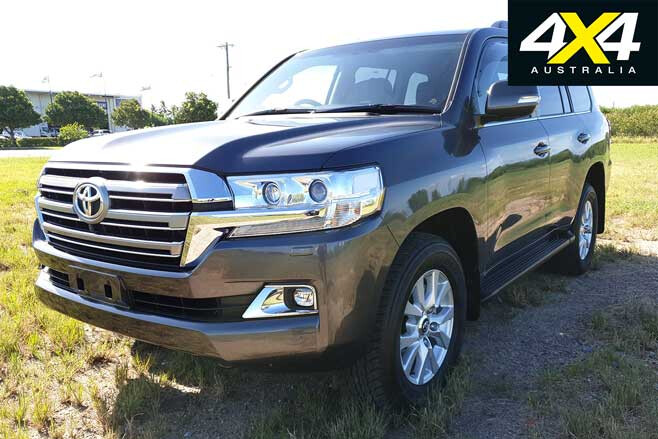
Shane initially considered using a Nissan Y62 Patrol as the basis for his six-wheel drive project, but eventually settled on a new 200 Series Land Cruiser VX. “The Land Cruiser is a really good touring car, with enough power to do what I want to do; and to tow … and they’re just so reliable, so that’s why I chose the 200,” he says.
From Mick McMillan’s perspective, Shane’s 200 Series Cruiser would be quite a unique project. “The brief that Shane gave us originally, he obviously wanted to maintain it as a family car, so maintaining the third-row seats would be a high priority, which is not normally what we do,” explains Mick.
“Normally people are going more for the load carriage, so we’re trying to make a small compromise here, which is he wants to carry the personnel, the people, but still maintain why people go for the 6WD, and that is load carriage and enhanced off-road capability.”
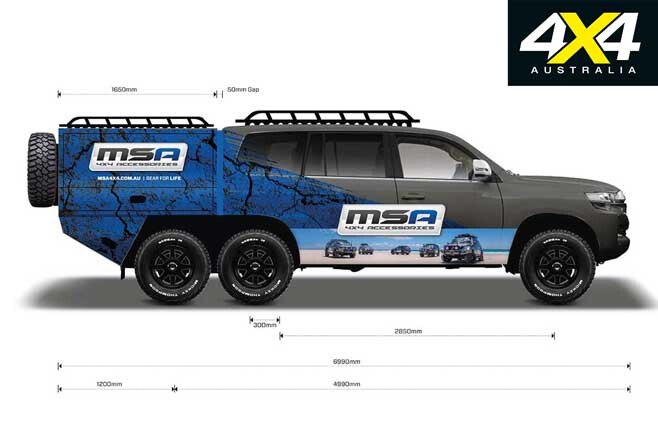
In addition to its three-row seating capacity, Shane and Mick have come up with a solution that will allow for fitment of a 1.9m Trig Point canopy on the back, as well as significantly increased load-carrying capacity thanks to either a 4450kg or 6000kg GVM upgrade, to be confirmed as the project progresses.
“Basically, I’ve got my three rows of seats, and I’ve got enough space for four drawers in the back and two fridges, as well as all our camping gear,” says Shane.
As well as practicalities, Shane is also intent on ensuring the Cruiser looks “just right”, and he has asked Mick for a shorter wheelbase extension than is normally the case with an AEV 200 Series 6X6 conversion. This will involve additional fabrication and other work.
As well as lengthening Land Cruisers and developing military-spec vehicles, Mick was involved in development of the JMACX 6WD system that will be fitted to Shane’s 200 Series. “We developed it with JMACX,” says Mick. “JMACX was doing heavy-duty single-axle Land Cruiser 79s at the time and I had just got out of (the ADF), where I was an engineer working on an acquisition programme that had six-wheel drives … and I helped (Jason McIntosh at JMACX) develop (the 6WD system) with his axle housing.
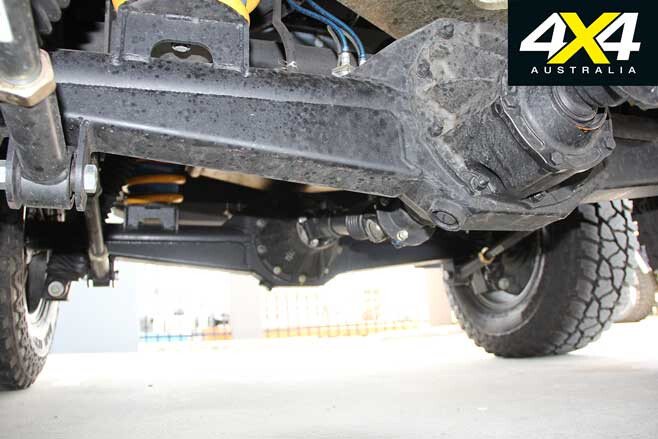
“Essentially it’s two JMACX coil-sprung axle housings on the same cradle. It’s a fairly standard geometry; there’s nothing difficult about it from an aftermarket point of view. It’s all either 80 Series, 100 Series or 200 Series coils and shock absorber-type setup.
“The only variation is the centre diff housing, which is a Ford nine-inch diff, because with the Ford nine-inch, a commercial off-the-shelf product, you can buy a drive-through component, so you’re able to have 1:1 drive to the rear axle.”
Importantly, when completed, Shane’s triple-row, triple-axle LC200 will be legal in all states of Australia. “We have Federal Second Stage of Manufacture (SSM) approval, for both six-wheel drive in heavy and in a light-vehicle configuration,” confirms Mick.
So far Shane’s Super Cruiser, as he’s dubbed it, is in the early stages of its transformation from 4×4 to 6×6, and Mick McMillan has devised a precise workflow plan that recently began with the removal of the brand-new vehicle’s tailgate prior to undertaking more significant modifications.
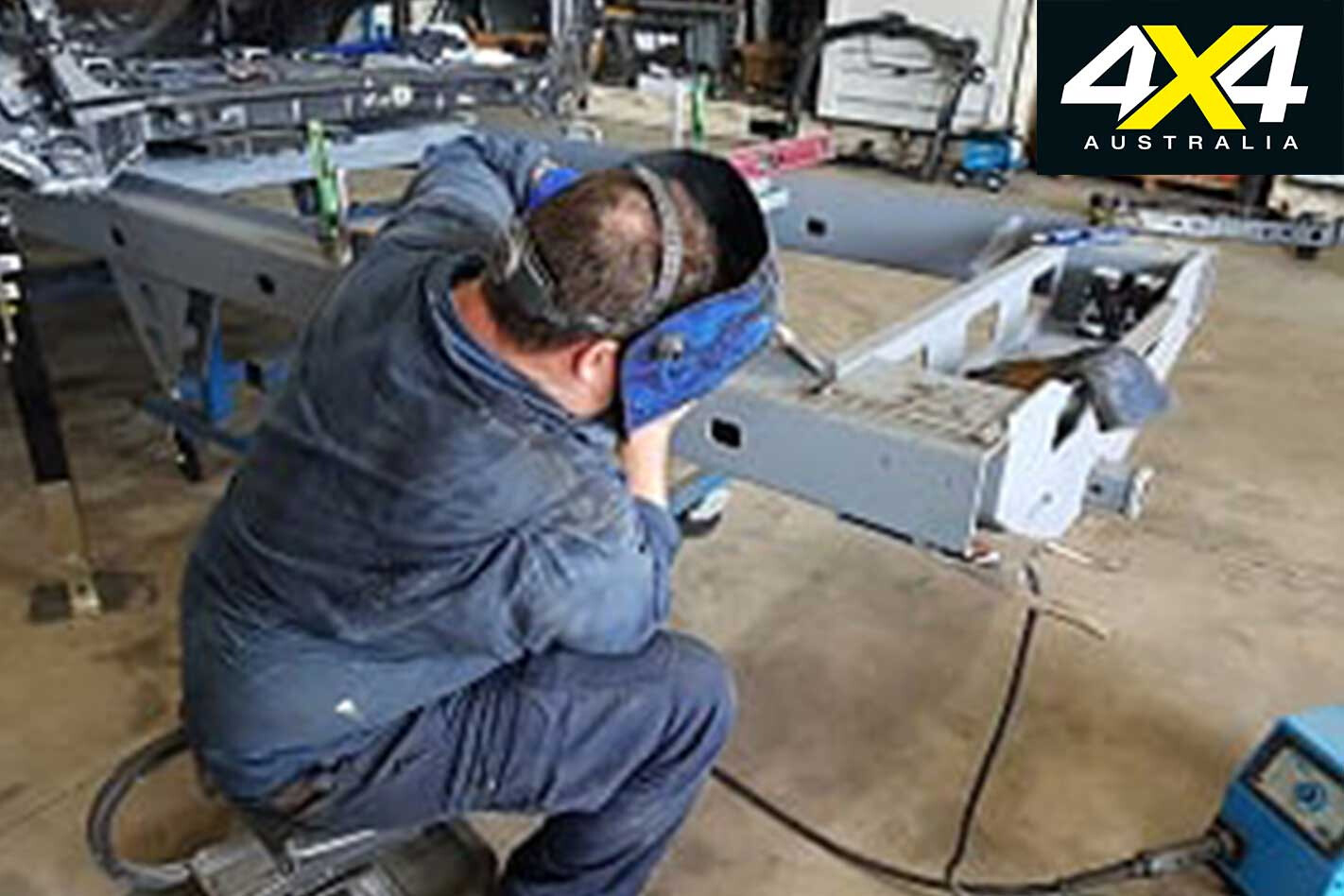
“The rear wheel arches have already been removed, internally, from the vehicle so we can start to access the rear of the car,” explains Mick. “We’ll now lift the cab – undo all the body bolts and jack the cab up – and that’s when we’ll start to cut the chassis off. There’s a reasonable amount of underbody prep as well, so we’ve got to prep the chassis, remove the coil tower supports and a few other bits and pieces.”
There’s a long way to go in the build process of what will undoubtedly become one of the most spectacular 6×6 Land Cruiser conversions ever undertaken, and it’s Shane’s intention to share the result as far and wide as possible.
“It will be doing 4×4 shows and I think the attention around it is going to be incredible,” predicts Shane. “We’re going to have some small catalogues printed up as well, with all of the people that have helped us along with this, and what it’s got on the vehicle.”
After the vehicle has toured Australia, Shane hopes it will garner some international attention as well. “It will definitely be at Overland Expo in Arizona next year … and possibly at the SEMA Show, either this year or next year, and then the plan is to take it to Africa at some stage.
“It’s going to be an internationally renowned vehicle!” says an understandably excited Shane.
Update #1: The Super Cruiser starts to take shape
Published 17th July 2019
When we last visited Project Super Cruiser, MSA 4×4’s new Land Cruiser VX was at Australian Expedition Vehicles (AEV) in Townsville with its tailgate removed, body lifted off its chassis and rear wheel arches cut out.
In the past month the project has moved along at brisk pace, with the rear of the Cruiser’s chassis cut off and a new extended section slipped over the top. A new JMACX coil-spring rear axle was fitted to the 6×6 cradle so the vehicle could be moved around (the centre axle will be fitted at a later date), and then the Cruiser was put on a flatbed and shipped off to David Taylor Spray Painting & Panel Beating, where major fabrication of the rear end’s bodywork started to take place.
The Super Cruiser is the first project of its type undertaken by AEV (most customers opt for a dual-cab conversion, not a full wagon with a service body on the back) and, as such, there has been a lot more fabrication work than had initially been anticipated, pushing the build schedule out further than planned.
“It’s not our normal conversion, as you can appreciate,” says Mick McMillan from AEV. “There’s a lot more (custom manufacturing) in panel beating than we initially anticipated. To make it look like a factory finish, we can normally achieve that with standard Toyota parts, but with this vehicle we’ve had to rely on the skill of a tradesman to put the bits and pieces together.”
MSA 4×4’s Shane Miles has spent a fair bit of time personally overseeing the panel work and, despite (or because of) the timeframe blowout, he’s impressed with how the job is progressing so far.
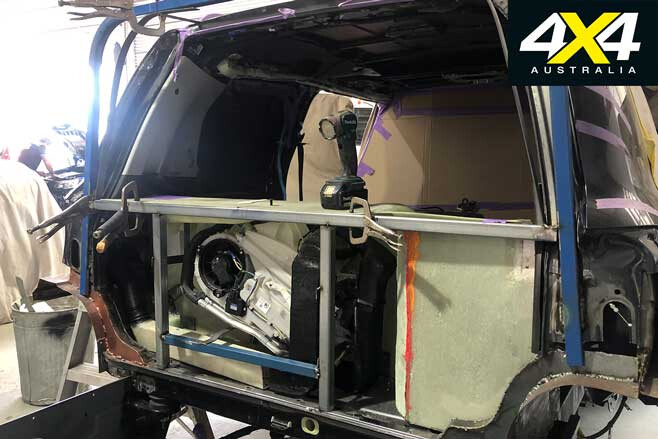
“They were going to put a Land Cruiser 79 rear panel in, which is what they usually do on a dual cab conversion, but the LC200’s body tapers in the further back it goes, so the 79 panel was too wide for it,” explains Shane. “They’ve got a custom-shaped glass section instead and they’re going to custom-fabricate the rear body section around that.”
Another component that has added to the overall build time is the Land Cruiser VX’s massive rear air-conditioning unit, which used to be housed in the passenger-side rear quarter panel. “They’ve flipped it around and laid it down (behind the third-row seat) and then they’ve made up about half a dozen ducts to redirect all the air everywhere,” says Shane. “They’ve also made a panel that goes around the whole thing, and then that’s going to be trimmed in matching leather.”
To ensure the back of the Land Cruiser’s body has a factory look, the body fabrication team has made a wide-radius curve where the roof and the sides of the Land Cruiser meet up with the new rear panel. “It’s not just a square panel welded on there; it’s all shaped with a wide radius so it all looks factory,” says Shane.
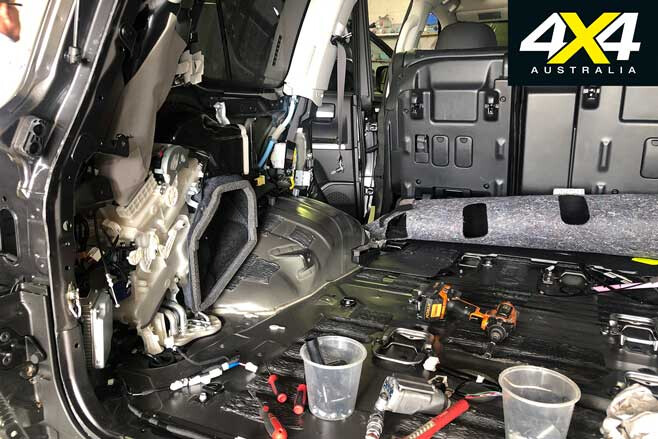
Another detail that will ensure the vehicle has a completely cohesive look when finished is the reshaping of the Super Cruiser’s rear wheel arches to match those of the Trig Point canopy.
“Instead of just moving the Cruiser’s curved rear wheel arches back about 700mm (to account for the extended wheelbase), they’re actually shaping those wheel arches to match the Trig Point body at the back, so it looks really cool,” says an excited Shane.
“Where the wheels have been moved back, they’re also going to put two nicely shaped tool boxes in there – that’s a week-and-a-half’s work for those two boxes alone – and then they’ve got to finish off the body and then spray the whole car.
“It looks a bit ugly at the moment, with all the rough edges, and the body has got to be blasted to get all the surface rust off it, but it’s still got about six weeks more work before the bodywork is complete and it gets sent back to AEV.”
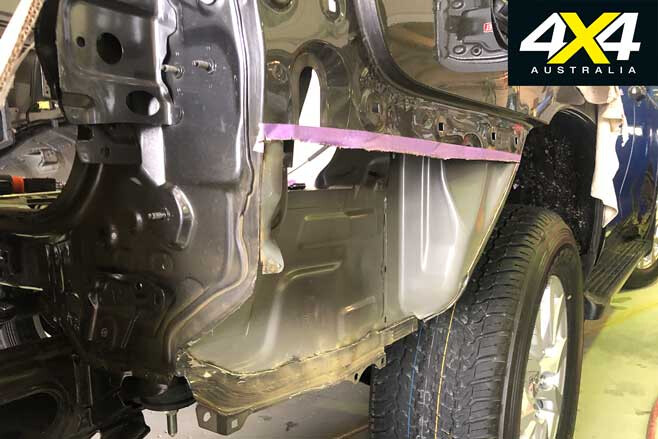
The good news is that once back at AEV, Mick McMillan reckons the Land Cruiser shouldn’t take too long to complete. “For us to finish what we’ve got to do, we’re looking at probably one-and-a-half days to have it finally driving out the gate as a six-wheel drive,” he says.
The Super Cruiser will then be sent to TJM Townsville for fitment of a bullbar before it lands back at AEV where the side-steps will be extended and fitted, and then the Trig Point canopy will go on. “Shane has got some additional products provided by Icon, Rugged Brake Systems and all these other accessories that aren’t standard factory stuff that we’re going to fit, so we’ll probably add another day and a half for that,” says Mick.
Shane initially hoped to have the Super Cruiser finished by July for a trip across the Simpson Desert, but due to the extra fabrication work the expected completion date has been pushed back a couple of months.
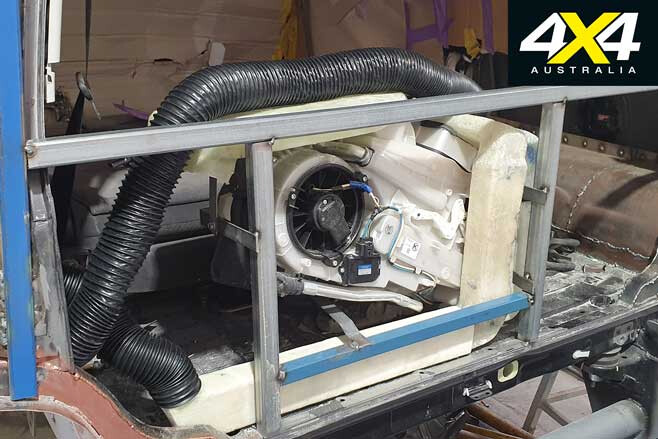
“We’re going to miss the first trip I was going to do,” says Shane. “It’s now looking like we’ll get the vehicle back in September, which will still give us heaps of breathing space. I was going to try to get it into the Melbourne 4×4 Show – if it’s done by then there’s a stand that we’ll put it on there – but I’m just not sure.
“We have got a fair bit of stuff to do once I get it back here to MSA 4×4; I have got about a month’s worth of work to do on it, and there are people coming from all over the place to do other stuff on it,” adds Shane.
As they say, good things take time, and this Super Cruiser is certainly shaping up to be a good thing. Keep an eye out for the next issue of 4X4 Australia to see how Project Super Cruiser is progressing.
Update #2: Team meets some build challenges
Published 16th August 2019
WHEN WE asked Shane Miles from MSA 4×4 how Project Super Cruiser was coming along, he was about to board a plane back to the Gold Coast after spending the morning at David Taylor Spray Painting & Panel Beating in Townsville, where his six-wheel drive 200 Series Land Cruiser VX was still far from finished.
By now, all the bodywork should have been completed and the vehicle should have been back in the Australian Expedition Vehicles workshop having its Trig Point Canopy fitted … but there have been several unexpected delays, as is often the case with a first-of-its-kind build.
Sure, Shane sounded a little disappointed his Super Cruiser was taking longer than expected, but he was still very upbeat about what he had seen. And he now had a firm grasp of why the completion date had been pushed back.
“The bodywork has taken six, seven weeks longer than we predicted,” explains Shane. “They’ve come up against a heap of different obstacles, from unexpected things like the drainage channels from the sunroof and all sorts of other detail stuff.”
Of course, it’s not really all that surprising that there have been a few setbacks; after all, this vehicle is a bespoke one-off, and the artisans at David Taylor’s have not been cutting any corners … well, not figuratively. In fact, they have resorted to some old-school coach-building and have had to fabricate a lot of custom parts to turn this seven-seat 6WD Cruiser into a reality.
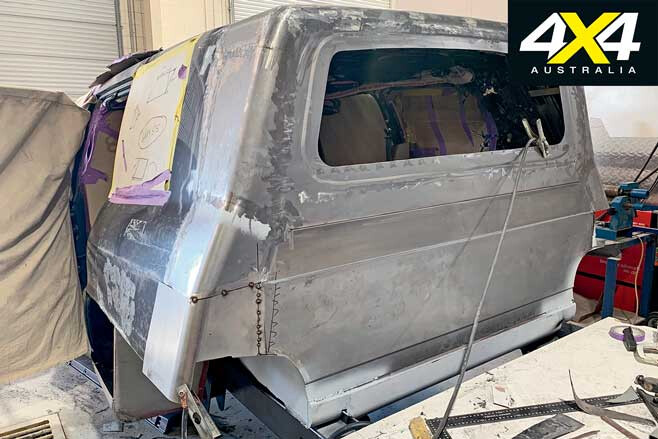
“There have been no shortcuts taken,” says Shane. “They could have done things easier; they could have just welded a square panel on the back, for example, and butted it up to where they’ve cut the rear of the vehicle, but that would have just looked like a square panel welded on there.”
Instead, they’ve fabricated a one-off rear panel and fitted a custom-made rear window to it, and then ensured it neatly matches up to the rest of the Cruiser’s bodywork.
“They’ve radiused every single join,” adds Shane, “and not a small amount; I’m talking probably a 70mm radius, so it looks like a factory finish … or as factory as it can.”
Shane wants the LC200 wagon’s body to mate up to its new canopy as neatly as possible, and to that end the team at David Taylor’s have not only fabricated those radiused rear corners but have also reshaped the rear wheel arches with a straight edge that matches those on the canopy. In addition, they’ve even widened the Land Cruiser’s rear bodywork where it used to taper in towards the tailgate.
“The body lines that tapered in towards the tailgate just didn’t look right, because there’s no longer a tailgate on the vehicle,” says Shane. “To make the vehicle match better with the canopy, they’ve had to widen those body lines to give it a factory look, which has all been achieved through meticulous custom fabrication.”
A further delay at the body shop is a result of a practical rather than a cosmetic reason. “We’ve added tool boxes in the area between the Cruiser’s rear door and the reshaped wheel arch,” says Shane.
“This means I’ll have two toolboxes that I can use to stow items. Originally they were just going to fill in that panel, but they thought that would be a waste of space … so these tool boxes, although they’ve added another two weeks to the project, they’re big enough that I’ll be able to put gas bottles down there, or even a generator.”
As well as all of the custom fabrication and bodywork, there have been several small hiccups such as the aforementioned drain channels for the sunroof.
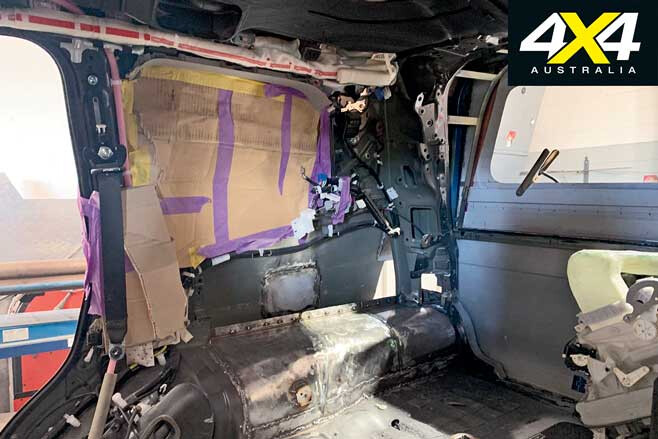
“There are all the little fiddly things like drainage lines, which we didn’t even know about,” says Shane. “There are two drainage channels so the water that gets into the rim around the sunroof can drain out; they run along inside the roof and down the back of the vehicle, and these have had to be rerouted. It’s all of this stuff, not huge things but a number of extra things that they’re finding along the way.”
Once the bodywork is complete the Cruiser will head back to AEV, where the Trig Point canopy will be test fitted before the Land Cruiser is sent off to be painted.
The paintjob is also unlikely to be a straightforward process. “What I’ve been told is, the Cruiser’s metallic paint, if you just undercoat it and paint it, the new paint will fade at a slightly different rate to the factory paint,” says Shane. “So, what they’re going to do is black the bodywork first … well, undercoat it and then black it, and then undercoat it again, then get it smooth and then paint it … that will prevent uneven fading over time.
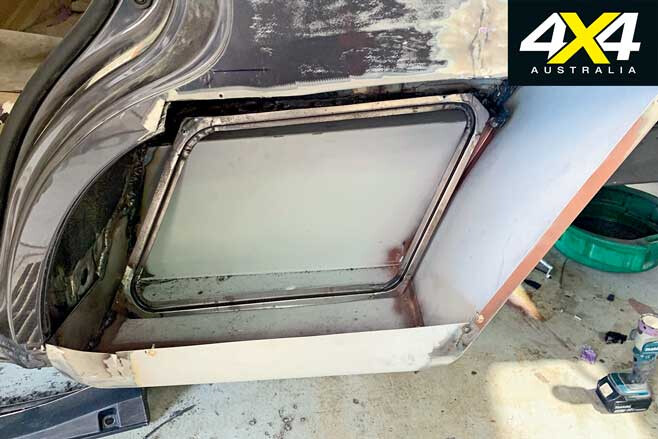
“Mick McMillan at AEV will then go through and put all his stuff on it. Hopefully it will only be about three weeks before it’s got its canopy on, and its new Icon suspension and wheels, and Mickey Thompson tyres … and then there’s the TJM bar that’s going on, and the side rails extended side-steps, the exhaust, two Brown Davis long-range fuel tanks, a Trig Point water tank, an air tank … all that stuff will go on in a few weeks.”
Update #3: The Super Cruiser comes together
Published 21st September 2019
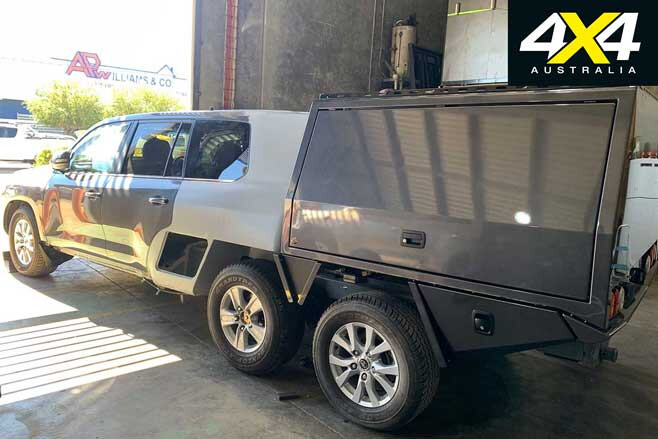
TAKE A look at these photos and you could be forgiven for thinking that Project SuperCruiser is, well, pretty bloody ‘big’? Yep, this six-wheel drive beast is like no other 200 Series Land Cruiser on the planet, and now that it’s starting to take shape there’s absolutely no doubt it’s going to cause a sensation when it hits the 4×4 tracks around Australia, as well as local and international show circuits.
While the bodywork has taken longer than expected, by the time you read this the SuperCruiser will have been spray painted, had its interior fit-out, had an extra axle added, and its Trig Point canopy mounted to the chassis. After these steps, though, there’s still a fair way to go before it will be complete.
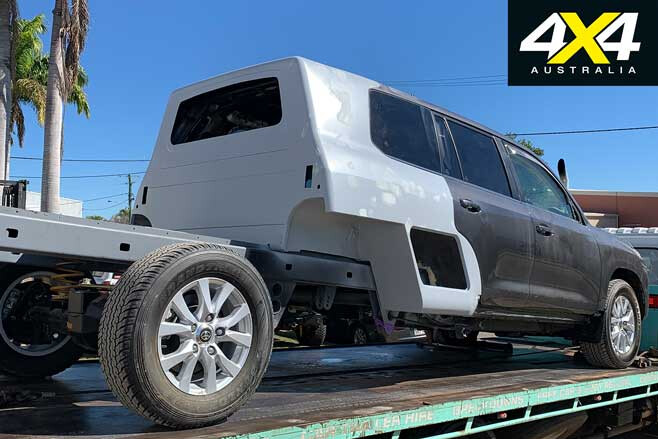
Last month we outlined why the SuperCruiser was taking longer to finish than anticipated, with lots of detailed bodywork required to ensure the vehicle ended up with a factory look. This involved reshaping the rear corners with neat, wide-radius curves, custom fabricating the rear wall and fitting a custom rear window, as well as adding toolboxes ahead of the centre axle.
There were other unforeseen issues inside, including relocation of the rear air-con unit and rerouting of wiring looms and plumbing. As you can see from these latest photos, even with the body still in primer it’s obvious the extra effort has paid dividends.
“In the last month they’ve done a lot more panel beating to ensure all the panels will line up with the Trig Point canopy,” explains the vehicle’s owner and proprietor of MSA 4×4, Shane Miles. “They’ve undercoated it and sent it around to AEV (Australian Expedition Vehicles), where they test fitted and mounted the Trig Point canopy. With that in place they had to line it up with the sides of the vehicle and ensure that the roofline and all the heights were perfect. They also had to line up the guards, so they aligned properly with the Trig Point.”
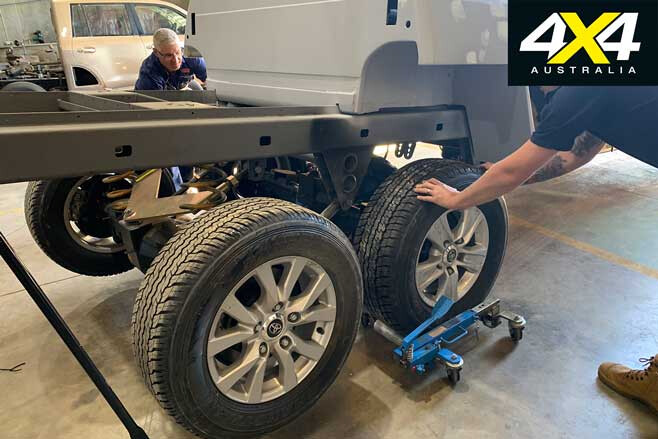
Mick McMillan from AEV was impressed with how the test fitting of the Trig Point canopy went – after all, this is a one-off vehicle, and the canopy was manufactured off-site. “As far as the fitting of the rear canopy goes, that was a day’s activity where Trig Point came to Townsville,” explains Mick.
“We levelled it off and made sure the length and fit was right, and it was probably one of the more seamless parts of what we’ve had to do on this vehicle, which is a testament of the ability of CAD to do what you want it to do. Our design process is quite robust, which means we were able to supply accurate information so the canopy could be manufactured off-site, without the vehicle, and the first fit proved it was a success.”
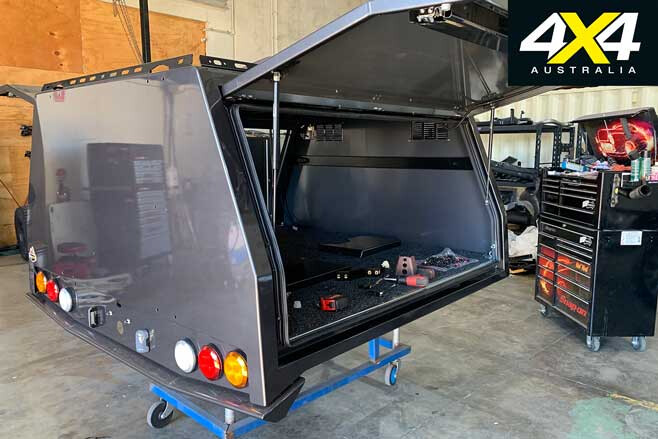
With the canopy on, everyone got an idea of what the project would look like. “When you see the photos you think, ‘wow, it’s a bloody road train’, but when you see it in person it’s pretty cool, and it’s really good to see all the body with the rear window in and the toolboxes, and where it’s cut and all the radiuses and stuff, it looks really good, it looks factory … as much as a six-wheel drive 200 Series can look factory, that is,” laughs Shane.
“It looks extremely long, but in fact it’s only seven metres long,” adds Shane. “It’s not that much longer than a HiLux with a body on it – it’s only about a metre longer.”
Picture: Lifting the Trig Point canopy into place
The six-wheel drive axle was also test-fitted to ensure everything fitted with the canopy in place, but this was removed once more before the SuperCruiser was sent back to the paint booth. “We’ve done the six-wheel drive axle, it’s already been test fitted, but we removed it so we didn’t cover it in overspray,” explains Mick McMillan. “So that will go back in and then we just have to do the final fit-out.”
In addition to relocating the rear air-conditioning unit and rerouting all of the associated plumbing, there was a lot of work for the auto electrician. “All the air-con has been fired up and is all working in the back, and all the electronics inside have been done,” says Shane.
“There was a lot of wiring that had to be removed – it was like spaghetti in there – so the auto sparky rewired everything. And an electronic rust prevention system has been installed; we put in a 10-pad ERPS, so that’s all been wired inside and outside, around the parts where there have been modifications and cuts, so that will keep any potential rust issues at bay into the future.”
Picture: Read air-conditioning unit
With the job taking longer than expected, Mick McMillan is keen to make up time in the next stage of the build. “The process now, we need to compress the timeline, because it’s taken longer than expected,” he says. “Once it’s back from the paint shop, the upholsterer will come through and do what he needs to do, and then we’ll fit up the door cards and the seats, and at the same time we’ll fit up the rear section with its brake lines, diffs, fuel tank and all the other components, and then once all that’s complete the rear module will just pop on.”
“We’ll get it to the point where it’s registerable, so it will drive out of here fully finished, and it will have a Federal sticker on it and a Queensland sticker,” says Mick. “This is because the vehicle is not in accordance with our Second Stage of Manufacture approval; it’s federally approved as a six-wheel drive, but the other components that are on the vehicle are not as per our Second Stage of approval, so we still need to put some Queensland modification codes on it.
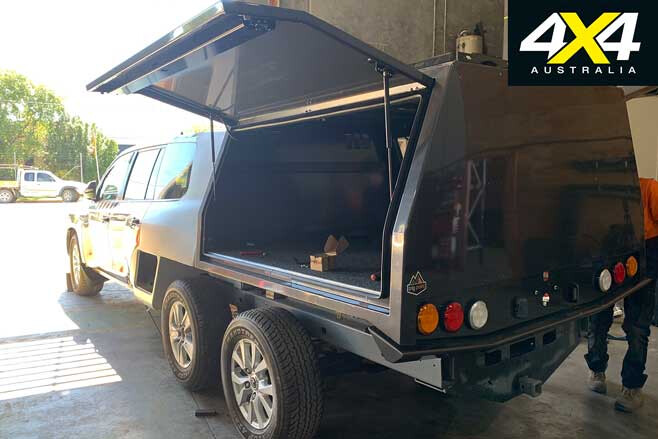
“At this stage the Cruiser will be in the heavy vehicle category, which means it will be under the National Heavy Vehicle Regulations VSB6 Version 3. While it will have an SSM (Second Stage Manufacturer’s approval) for the six-wheel drive system, there are still additional codes that need to be put on it, because it’s a one-off vehicle. We need to ensure that we comply with all the requirements to make sure that this vehicle is legal in every state of Australia.”
How long will this take? Not long at all, says Mick: “Once we get it back after painting, we’ve got five to seven days of work on it, maximum, and I’m going to put the manpower on it to get it knocked over as quick as we can.”
With bar work, suspension, brakes and much more still to go, hopefully the boys aren’t being too optimistic, but as you can see from the pics much of the hard work on Project SuperCruiser has now been sorted.
Update #4: Project Super Cruiser hits the road
Published 22nd October 2019
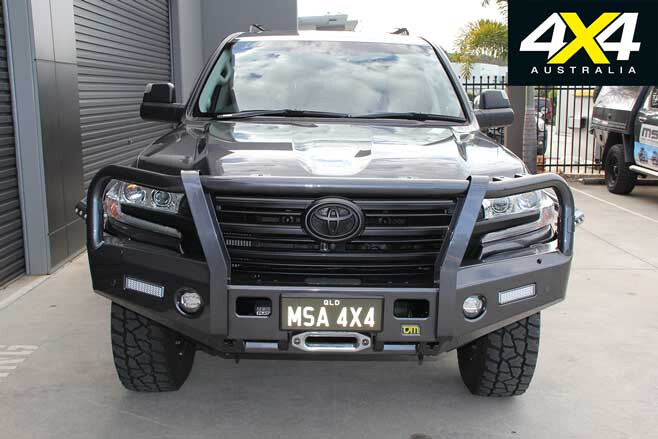
AFTER significant delays at the body shop, Project Super Cruiser has been signed off and is fully registered, and the massively stretched 6WD Land Cruiser triple-cab is now an imposing sight on Queensland’s roads.
MSA 4×4’s Shane Miles bought the brand-new 200 Series Land Cruiser VX around five months ago and immediately shipped it off to Mick McMillan at Australian Expedition Vehicles (AEV), where its transformation into one of the country’s most impressive custom vehicles began.
AEV removed the rear of the wagon, stretched the chassis, installed a JMACX 6WD system and sent the Cruiser off to David Taylor Spray Painting & Panel Beating, where all the major body fabrication took place. It was this body fabrication stage of the project that took significantly longer than expected; after all, no-one has ever built a triple-cab Land Cruiser before.
In the last Project Super Cruiser update, the craftsmen at David Taylor’s had finished fabricating the Land Cruiser’s new rear wall, and AEV had test-fitted the Trig Point Canopy and JMACX middle axle before the vehicle was shipped back to the body shop for painting. The next step was to put the whole thing back together.
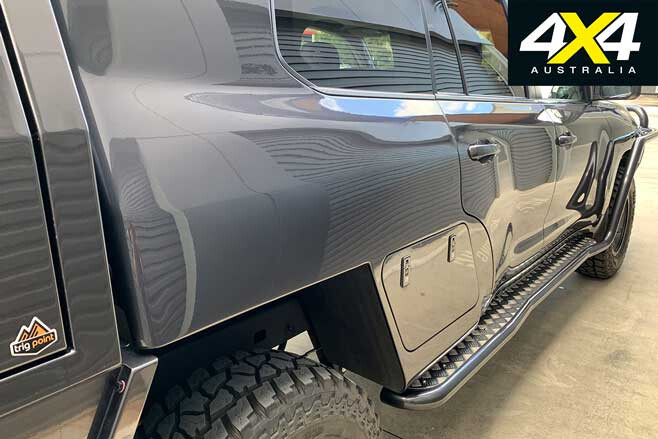
“Because it’s a process we’re familiar with, it’s not a difficult one, and we can manage it quite quickly,” says Mick McMillan. “Apart from being slightly bigger in the body, it’s exactly the same process as our dual-cab builds.”
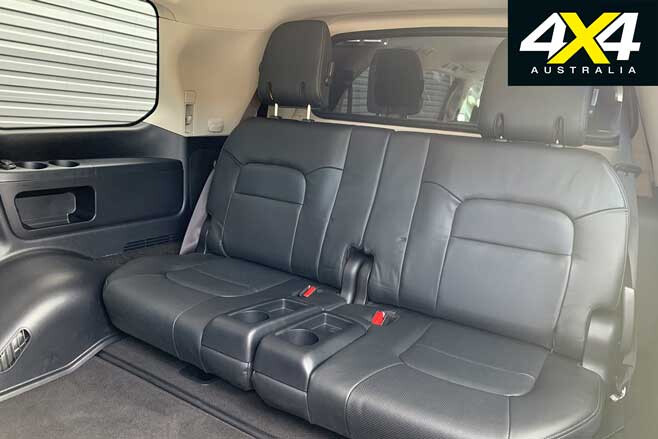
Having said that, Mick admitted reassembling the interior was far more complicated than usual, “because of the extra air-conditioning unit (in the rear), how it was installed, and the extra covers and cowlings that have been custom fabricated for the system”.
All of the effort and hard work put into the interior is reflected in its factory-like finish, and Shane Miles is more than happy with how it has turned out. “The finish inside looks incredible,” he says. “If it was done in the factory, that’s how it would have looked. It’s just unreal. They have used matching leather to trim the air-conditioning box, and have laid matching carpet over the wheel arches, and they’ve matched the roof-liner with the infill piece at the back … it’s just incredible the way they’ve trimmed it.”
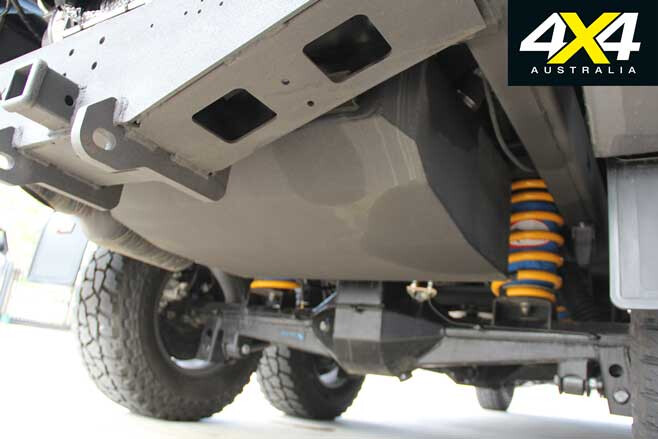
As well as refitting the third axle and the Trig Point canopy, the team at AEV installed a 180-litre Brown Davis long-range fuel tank; Icon suspension kit in the front, middle and rear; Airbag Man air bags; an ARB twin-compressor; an Air On Board 18-litre air tank; Icon alloy wheels with Mickey Thompson ATZ P3 rubber; TJM bar work; and Warn winches front and rear.
“The Trig Point canopy fitting went smoothly,” says Mick. “We’ve had to make custom fuel fillers, so we’ve custom-manufactured the bracket in there, powdercoated it and fitted it. Normally it would be a single entry, but we’ve fitted two individual ones so Shane can fill the front and rear tanks in isolation.”
“The long-range tank, it’s a custom tank that we have developed with Brown Davis, so it has an AEV part number, but it’s essentially an LC79 long-range tank with some different brackets on it,” adds Mick. “It fits in the 200 perfectly and fuel capacity is 180 litres, so with the standard 90-litre tank Shane now has a total fuel capacity of 270 litres.”
While the TJM Outback bullbar and side rails are standard 200 Series parts, AEV had to modify the TJM side steps due to the Super Cruiser’s extended wheelbase. “The side steps have been custom-made by us to Shane’s specifications,” says Mick.
“Shane actually sourced two sets of side-steps, and out of those two sets we’ve made one set to fit the vehicle. We’ve CNC-laser cut the top tread plate as a custom item, and we’re happy with the outcome.”
With reassembly complete, the next step was for AEV to fit the compliance plates before Mick and Shane headed down to a Queensland transport and motoring service centre to register the beast.
“Rego was awesome,” says Shane. “Mick McMillan had all of the documents ready – it was like he was talking in another language with the transit people – and at the end of the day it got stamped and I gave them my credit card and it’s all fully registered as a heavy vehicle.”
Yep, at around 5000kg (and with a 6000kg GVM) the SuperCruiser is no lightweight, and Shane had to get an HR (Heavy Rigid) licence to drive it. “It’s only a one-day test to do it; it’s a small practical and a small theory test,” says Shane. “You do instruction for about three hours and then you go and do the test, which is about an hour drive with a testing instructor, and a small theory test, and that’s it.”
So, what is the 6WD Cruiser like to drive on the road? “It’s just so nice to drive, it feels better than the ‘normal’ 200 Series that I had before,” says an obviously excited Shane. “It turns, it stops, it goes … it’s just so smooth, it’s unbelievably smooth; and it’s quiet.”
Once registered, Shane waved goodbye to Mick and pointed his Super Cruiser south from AEV’s HQ in Townsville towards MSA 4×4’s home base on the Gold Coast.
“I don’t know if it’s the Icon dampers or the progressive rate coils working together, but it is so damn smooth,” continues Shane. “Driving down the freeway, it feels just like a luxury car. I was expecting it to be military-like and vibrating and shaking, but I’ve never been so happy driving a car.
“With the windows up you barely notice an increase in road or wind noise; it’s similar to any other standard 200 Series wagon fitted with all-terrain tyres. The Mickey Thompson ATZ P3 tyres are really quiet considering their quite aggressive tread pattern.”
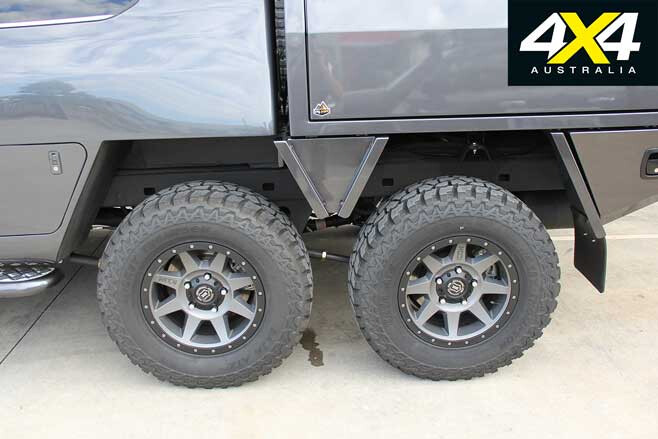
Of course, the SuperCruiser is now a fair bit heavier than a standard 200 Series wagon, and it has six wheels instead of four, which obviously has an affect on on-road performance, but Shane is more than content with how it went on its freeway shakedown.
“It’s really good,” he says. “You just need to push the ECT power button if you need a little bit more, but it’s really good.” While the ECT power mode doesn’t result in the Cruiser’s V8 producing more power, it speeds up the automatic transmission’s shift response, so it will drop a cog or two more readily when confronted with an incline, or when asked to provide more acceleration with a prod on the accelerator.
The Super Cruiser will be subjected to towing duties down the track, so the engine will soon score a few upgrades. “I’m possibly going to get a bit of exhaust work done, and there’s a PWR intercooler going on,” says Shane. “And Safari 4×4 are sending their head engineer up here to fit an ARMAX snorkel and ECU to it, so hopefully that will result in more than enough towing power. But just cruising back from Townsville to the Gold Coast, it had more than enough power.”
You might think a vehicle that measures a tad over seven metres long – with six wheels – would not be the most manoeuvrable thing on the road, and while Shane is unlikely to ever park it at the local Westfield shopping centre, he is surprised with how easy it is to drive. “Up here (in Queensland), you’re allowed to do U-turns at the lights where posted, and I can do U-turns at the lights,” he says. “If I have two lanes on the other side, I’m more than fine; the turning circle is incredible, not as good as standard, but still good.
“At roundabouts, you just drive it like a normal car. You don’t realise that there’s all this extra stuff (the extra length and extra axle) behind you. And visibility is good, too, because we have our new MSA 4×4 towing mirrors on there, you can see right to the back of the vehicle. And the reversing camera and the OE sensors and all that sort of stuff still work as they should.”
Of course, this is one Cruiser that won’t be confined to on-road duties, as Shane has big plans to take his family touring in the 6WD monster. It’s already fitted with Warn Zeon Platinum winches (front and rear) running synthetic rope, and two ARB Air Lockers (one in the front diff and one in the rear) are set to join the OE Toyota locker in the middle diff. And while the Rhino-Rack Backbone system is in place, other items still to be fitted include the Rhino-Rack roof trays for the cabin and the canopy, two rooftop tents, driving lights and more.
“The Rhino-Rack Backbone mount is installed but we still have to put the trays on, and then we can put the two iKampers on,” says Shane. “After that, all of the Lightforce products will go on – front driving lights, roof light bar, side lights and rear lights – and then we get to the electrical stage. We have five 60amp/h Revolution Power Australia Lithium batteries to go in the back, and a custom water tank in the back as well, and then we have four MSA 4×4 drawers and three MSA drop slides (one for the kitchen and two for fridges) to go in, and then it will be ready for the electrical fit-out.”
“The electrical fit-out will be huge,” adds Shane. “A Redarc RedVision system will be installed to control all the electrical items including the air compressors, water pumps, GME communications gear and all of the other electrical gear around the vehicle.”
While the Super Cruiser is still far from finished, Shane is already impressed by the way it looks, from the reshaped bodywork through to the Trig Point canopy. “The Trig Point canopy, I like the look of it,” says Shane. “It just looks like it’s supposed to be there. All the body lines look really good and the canopy fits really well with the body of the car. Before settling on the Trig Point, I spoke to Michael Ellem (Offroad Images), who has one fitted to his Land Cruiser 79, and it’s amazing that, considering where he’s taken it, it has been completely dust-free. The quality of the Trig Point is just next level, and I really like the profile from the rear, too.”
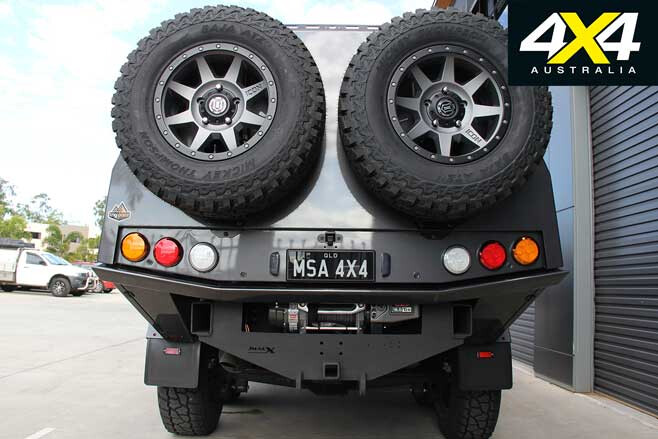
Shane is also impressed with the overall stance of the stretched Land Cruiser. “Most 200 Series Cruisers look too nose down, but with the Icon coil-overs, Mick McMillan wound them up 30mm and the vehicle sits reasonably level,” says Shane. “The rear is fitted out with Icon remote reservoir shocks and the JMACX variable-rate coils. JMACX offers a heap of suspension options depending on your requirements, but I wanted the variable rate springs so it would be a bit softer at the start of compression but still have good carrying ability when it’s loaded right up.”
“I can’t speak highly enough about the work that AEV has done,” says Shane. “I’ve watched over the whole project and it’s incredible, what they have done. I was concerned that it would look out of proportion and a bit odd, but once it has its roof racks on and all the other gear it’s going to look awesome. And it’s really cool that it drives so well; I was expecting a rough, horrible thing … something very military.”
ICON suspension and wheels
IN ADDITION to its trick JMACX 6WD system, the MSA 4×4 Super Cruiser has been equipped with top-shelf suspension components from US specialist Icon Vehicle Dynamics, which is distributed in Australia by Tough Vehicle Accessories. It also wears eight (six plus two canopy-mounted spares) Icon Alloys Rebound Satin Black 8.5 x 17 rims with a 25mm offset and a 1250kg load rating.
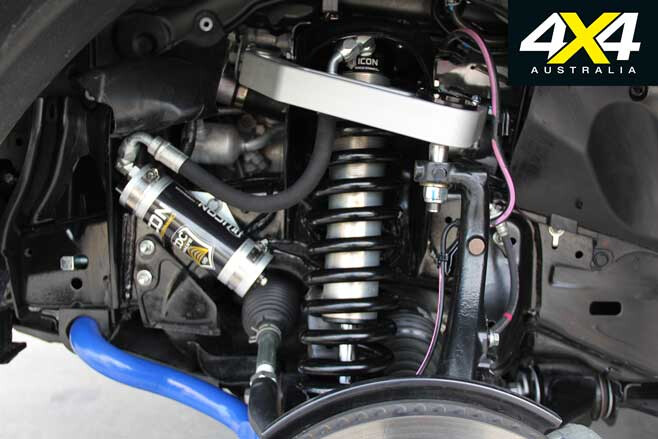
The front of the Super Cruiser sports a pair of Icon 3.0 Remote Reservoir CDCV (Compression Damping Conrol Valve) coil-overs and Icon billet aluminium control arms, while the rear has JMACX’s progressive-rate springs mated to Icon 2.5 Remote Reservoir CDCV shocks.
The Icon shocks feature corrosion-resistant plated bodies with one-inch shafts in the 3.0 Series and 7/8-inch shafts in the 2.5 Series, and they are fully rebuildable and re-valveable. A bolt-on design means they can be fitted without welding or cutting.
“The kit on Shane’s Cruiser consists of off-the-shelf items, but with three axles it’s obviously not what a standard kit would be,” explains Ashley Gibbons, director at Tough Vehicle Accessories. “It’s got the Icon 3.0 coil-overs in the front, so a much larger bore and piston size than what you would usually run on a 200 Series – you’d normally be running a 2.0 or a 2.5 – whereas because this is a very heavy vehicle we’ve gone with the 3.0 up front. It has remote reservoirs and compression adjustment, so Shane can really fine-tune it the way he wants it to be in terms of comfort and compliance.”
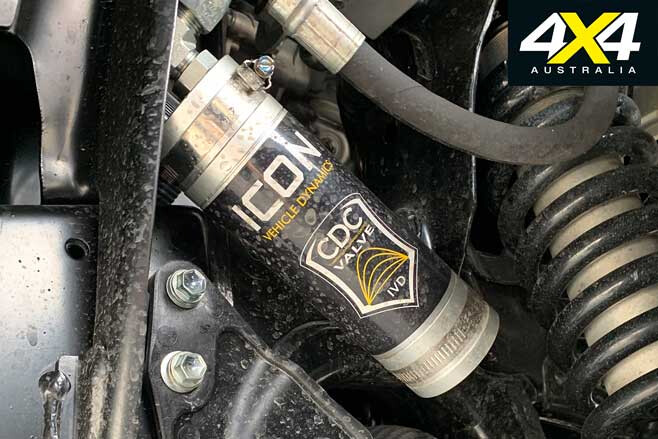
The compression damping adjustment is by way of a dial, so no tools are needed to make damping changes. The front coil-overs are also adjustable for height, but that is generally set prior to installation and then left alone. According to Shane, Mick McMillan set up the Super Cruiser’s front-end with 30mm of lift for a level stance.
“As well as the shocks, we’ve fitted Icon billet aluminium control arms at the front, which are adjustable at the mount so you can get the camber and castor correct,” continues Ashley. “And down the back-end it’s running 2.5 remote reservoir shocks – it’s got four of them being a dual-axle in the back – and all those shocks have compression adjustment as well.”
“It will take a little bit of tweaking once he plays with his loads to find the setting that he likes, or he might have two ‘go to’ settings, where he’s got one when the vehicle is loaded and one when the vehicle is empty,” adds Ashley.
The overall aim of the Icon setup is to provide the Land Cruiser with increased wheel travel and ride quality over stock, along with improved vehicle handling and decreased body roll. Going by Shane’s first drive impressions, it’s mission accomplished.
Update #5: The Final Cut
MSA 4×4’s stretched six-wheel drive ‘SuperCruiser’ is close to making its on- and off-road debut.
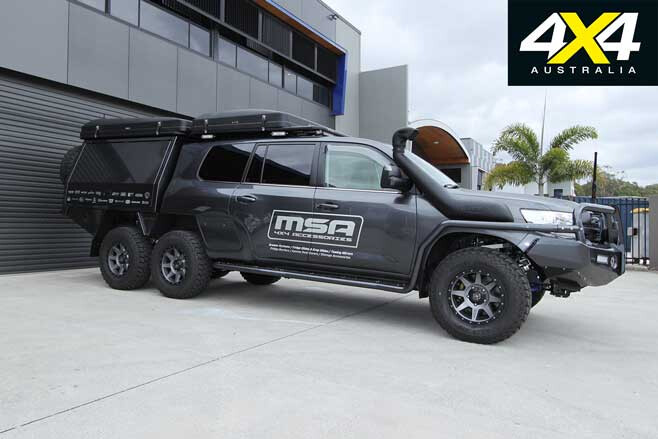
AFTER MORE than six months of hard slog, the finish line is almost in sight for completion of this epic 6×6 LandCruiser 200 build dubbed Project SuperCruiser by the bloke who dreamed it up, Shane Miles, proprietor of MSA 4×4.
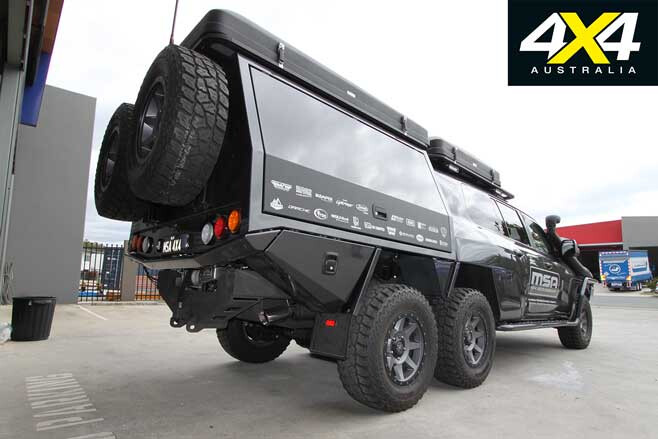
Based on a brand-new 200 Series LandCruiser VX, the SuperCruiser has been stretched by Mick McMillan at Australian Expedition Vehicles (AEV), kitted out with a JMACX 6WD system, crafted by the bodywork specialists at David Taylor Spray Painting & Panel Beating, equipped with top-shelf Icon suspension and wheels, fitted with TJM protection equipment and a Trig Point canopy, had Warn winches mounted front and rear and a Brown Davis long-range fuel tank underneath, been tagged with new compliance plates, and registered as a heavy vehicle that can legally seat up to seven occupants.
Once the vehicle was registered Shane picked it up from AEV in Townsville and drove it down to MSA 4×4’s HQ on the Gold Coast, where the next (and final) complicated stage of the build recently commenced.
UNDER THE BONNET
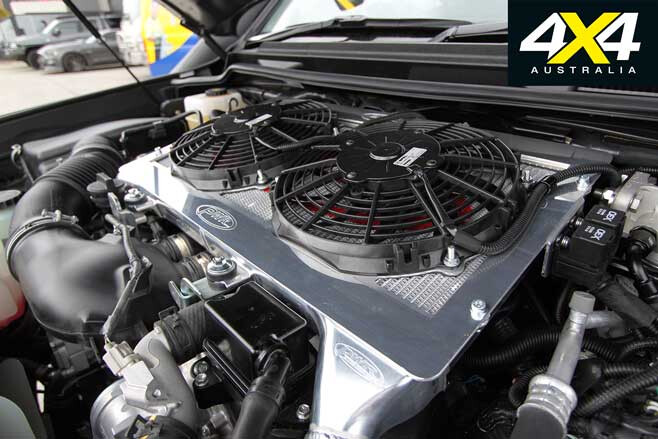
IN A QUEST for longevity, engine modifications have been limited at this stage to fitment of a PWR intercooler and a Safari ARMAX ECU system. The 4.5-litre twin-turbo-diesel V8 breathes through a Safari ARMAX snorkel and exhaust gases exit through a custom exhaust system.
“We ran twin 2.5-inch pipes back from the DPFs and they have nice, quiet resonators on there,” says Shane Miles. “It’s got the standard twin mufflers at the front and then twin 2.5-inch pipes all the way back to the twin resonators, and both DPFs have been retained.”
Take one look at the seven-metre-long SuperCruiser and you can imagine there’s a fair bit of added weight, but Shane says he’s quite happy with the performance it delivers, especially after fitment of the ARMAX ECU.
“We’re going to be around the five-tonne GVM mark when we’re full so, in a way, it will be like towing a ’van. So we’ve dropped a little bit of performance, but with the intercooler, the Safari ARMAX and the snorkel, it brings the performance right back up,” he says.
The ARMAX has several user-selectable modes to suit different driving conditions including towing and off-road driving, but perhaps of more importance are the built-in protection systems designed to prevent engine and driveline damage – the system constantly monitors the vehicle’s exhaust gas temperature (EGT) and if abnormally high the ECU decreases the amount of fuel injected into the engine, reducing load until a return to normal EGT levels.
The LandCruiser’s standard alternator has been flicked in favour of a fully sealed 220amp Rapid-Power alternator. This not only provides much more output than the OE 3094 unit, but, because it is fully sealed, it’s not prone to damage when driving in wet and muddy conditions as is the case with the vehicle’s original alternator, located in a vulnerable position at the bottom of the Cruiser’s engine.
Further engine protection is provided by Direction-Plus, which fitted a ProVent oil separator kit (catch can) and a ProVent fuel/water separator, the latter equipped with an alarm to prevent potentially costly engine problems.
UP TOP
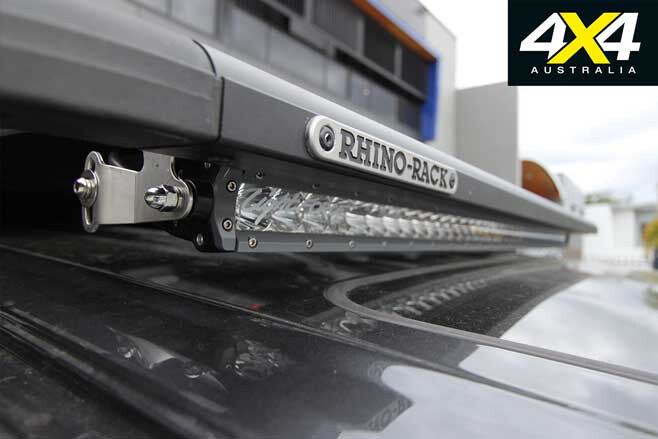
THE Rhino-Rack Pioneer Platform over the vehicle’s cab is affixed via a Backbone mounting system, and it sits close to the vehicle’s roofline for a low-profile look. There is, however, enough room for the Lightforce LED work lights on either side, as well as a Lightforce LED light bar up front.
The platform is also home to an iKamper Mini, which is a new pop-up tent from the manufacturer that’s still to be released to market, and it will be home to Shane and his partner Tameka when on big trips. It should be noted that all of this kit fits above the cabin without interfering with operation of the vehicle’s sunroof.
A much bigger iKamper Skycamp 4X is mounted to another Pioneer platform that’s bolted to the Trig Point canopy, and this will be home to the couple’s kids.
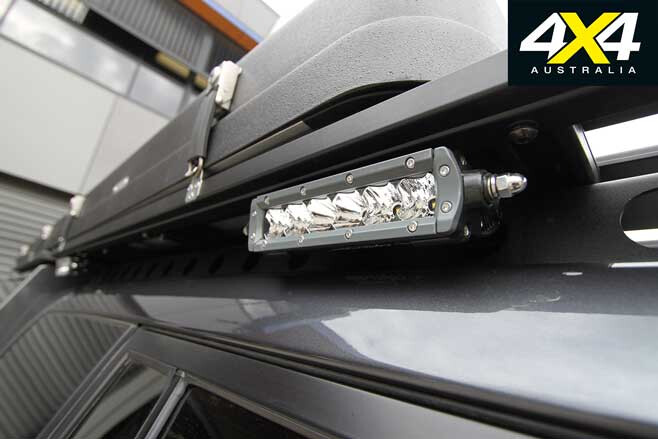
“When it’s open, it’s slightly larger than a king-size bed, so the kids, still being reasonably small, should all fit up there (they range in age from nine to 13),” says Shane, adding that if the oldest 19-year-old wanted to tag along on family trips he would these days likely do it in his own vehicle.
The rear Pioneer platform also provides a fitment point for a rear-facing Lightforce LED work light, a reversing camera and a Cel-Fi Smart Repeater Booster antenna on a neat ‘n’ tidy GME fold-down bracket.
UNDERNEATH
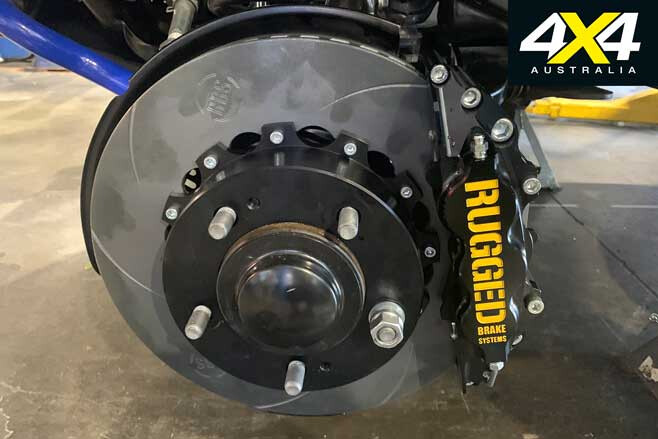
HAULING up the hefty SuperCruiser is a new brake package from Rugged Brake Systems. The standard front brakes have been replaced with the company’s Extreme Big Brake Kit which consists of slotted rotors designed specifically for four-wheel drive use and big six-piston calipers manufactured from lightweight aircraft-grade aluminium. The four brakes at the back have been upgraded with Rugged’s Blackline pad-and-rotor kit.
Traction comes courtesy of the Cruiser’s Mickey Thompson ATZ P3 tyres and locking diffs are fitted in all three axles.
“ARB Jindalee fitted a pair of Air Lockers,” says Shane. “They go in the front and the third diffs, because the centre diff (in the JMACX 6WD system) is already fitted with an Eaton mechanical soft-locker.” To prevent corrosion to the SuperCruiser, two ERPS (Electronic Rust Prevention Systems) have been fitted. “One runs around the chassis and there’s a separate one running around the vehicle’s cab,” explains Shane.
ELECTRICAL PACKAGE
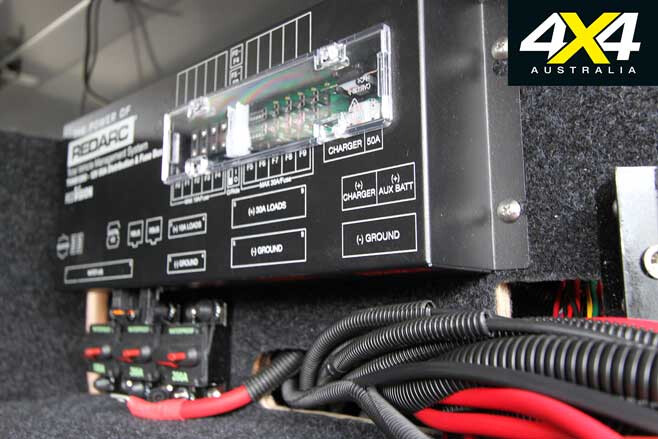
THE MSA 4×4 SuperCruiser will never run short of electrical power thanks to the fitment of six Revolution Power Australia 60amp/h slim lithium batteries, DC to DC charging and a Redarc RedVision system. “That gives us 360amp/h to run the two fridges, the lights and all the other stuff,” says Shane.
“We also put a second starting battery in – the newer 200 Series only has one starting battery where the earlier 200s had two – so we put the second battery back in there, and then the alternator leads to two BCDC1250 battery chargers to charge the six lithium batteries, and then there’s a Redarc Battery Management System (BMS) and the RedVision system, which is controlled via a touchscreen at the rear left of the canopy at a nice height and a nice angle.
“There’s also a 1000W Redarc inverter that leads to a double 240V power outlet just under the RedVision screen, and another double power outlet inside the cab, so we can charge camera batteries and stuff.”
OUT BACK
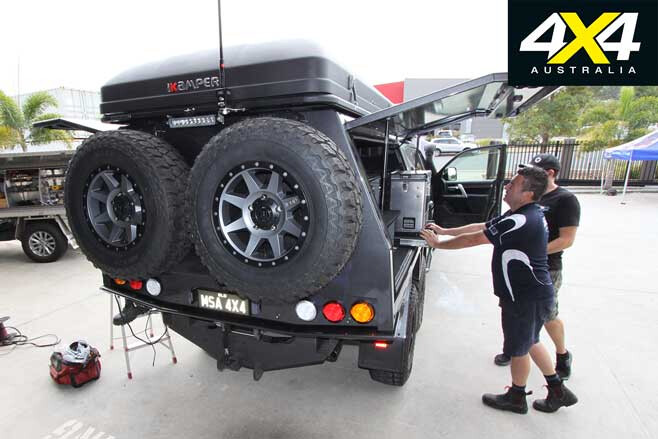
AS YOU’D expect, the attention-grabbing MSA 4×4 SuperCruiser’s Trig Point canopy has been kitted out with, you guessed it, a top-notch MSA 4×4 drawer system, and the company’s innovative drop-down fridge slides and fridge barriers.
“We put 1170mm drawers on the bottom and stacked 1030mm drawers on top of them,” says Shane. “On the driver’s side there are four drawers and a DS50 Fridge Drop Slide that will hold a SnoMaster 60L fridge, and this has one of our new Fridge Barriers that lines up perfectly with the top of the stacked drawers.”
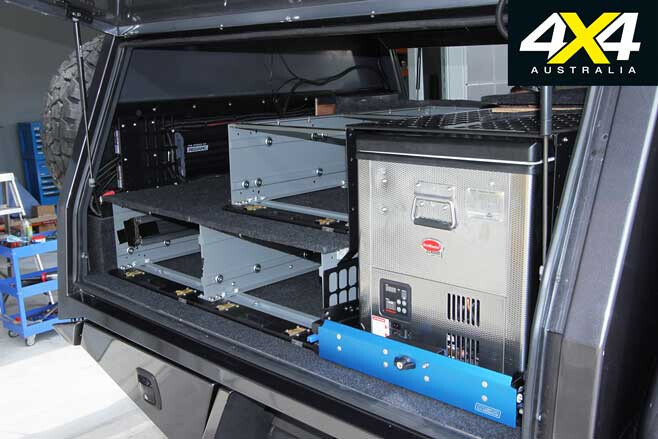
On the other side of the vehicle, there’s another Drop Slide, back-to-back with the other one, so the two Fridge Barriers line up at the front of the Trig Point … and then next to that is a Side Drop Slide, which houses a gas cooker with a barbecue plate on top. The cooker’s two gas bottles will be housed in a specially made storage box, and will be installed by a gas fitter, tested and signed-off.
“Across the top of the whole lot (the drawers and Fridge Barriers) is one big, flat deck for storing stuff, like bags and chairs and things like that,” adds Shane.
DONE AND DUSTED
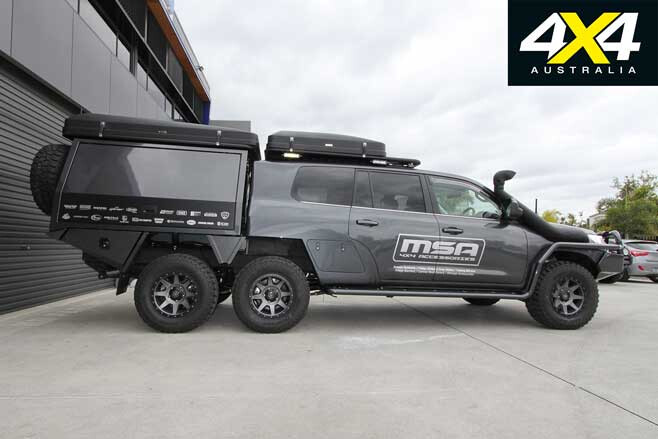
PROJECT SuperCruiser has taken significantly longer than expected but Shane Miles says he can now see light at the end of the tunnel, and can hardly wait to hit the road to get down and dirty in his new rig. His family is no doubt looking forward to getting away in their awesome new six-wheeler as well.
We’ve lined up a photo shoot with Shane and his mighty Toyota/AEV SuperCruiser in a few weeks’ time, so we’ll finally get to see how this six-wheeled beast performs on and off the road. Make sure you keep an eye out for a full feature in the next issue of 4X4 Australia.
The Readers’ Rigs feature in the November 2019 issue of 4X4 Australia features a several customised raised adventure-ready 4×4 rigs from our enthusiastic readers.
To get involved, post a pic and a description of your rig on our special site here or post it to our Facebook page and stand a chance to win an ARB High Output Air compressor valued at $335.
TOYOTA LC79 SERIES: MURAT HUSSEIN (4×4 Australia Readers’ Rigs Winner of the Month)
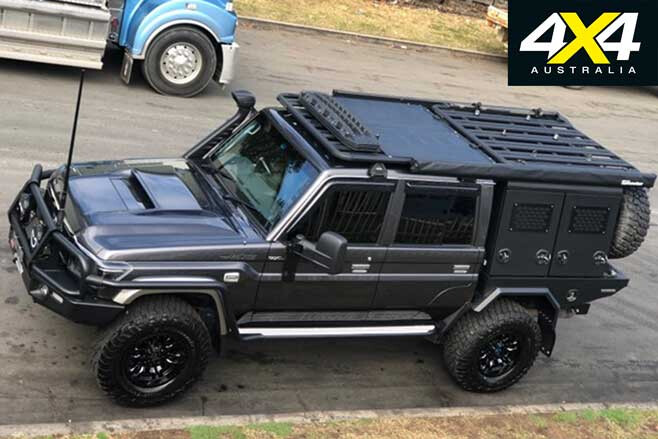
Mods include 2in OME suspension with GVM upgrade, rear JMACX diff housing with billet axles, rear JMACX high-clearance diff plates, Exedy heavy-duty clutch, JMACX upgraded brake booster, dual-battery setup, TJM winch, Outback Customs canopy and tray, ARB fridge on MSA 4×4 slide, two 100amp/h Revolution lithium batteries, two Rhino-Rack platforms w/ solar panels, and Sunseeker awnings. Future plans include engine work and a portal kit.
2003 NISSAN PATROL: PAUL THOMPSON
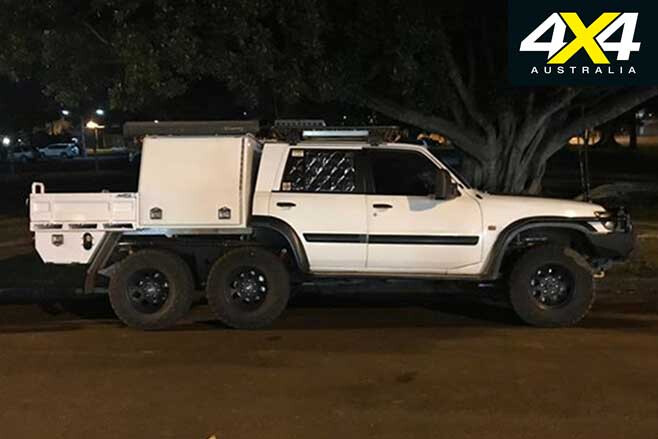
The Patrol has a five-tonne GVM and often tows a Bruder EXP-6 camper. Kit includes ARB Air Lockers, an Allison six-speed auto, Enerdrive lithium 200amp/h system, 60L SS water tank, 50L and 19L fridges, 3in Superior suspension gear, King front shocks, Wilwood front brakes, 10,000lb Warn winch (front), and 9500lb Warn winch (rear). I’m retired and travel full-time.
2014 CHEVROLET RG COLORADO: MARK ALBANS
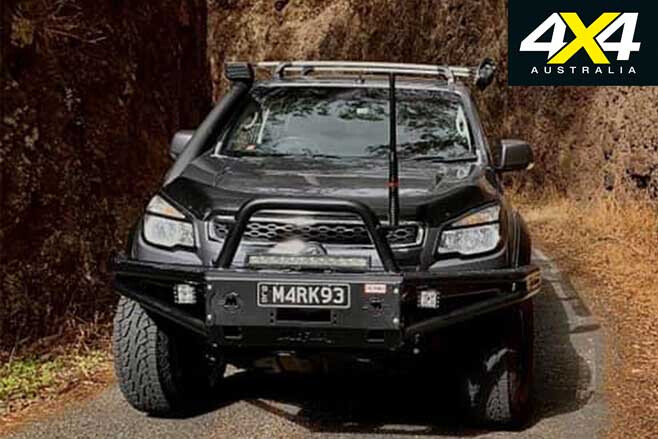
Tuned by WSM in Brisbane for 200hp and 656Nm, it features a three-inch exhaust, McArmor Fox Bar, STEDI C4 floodlights, a Hard Korr light bar, two-inch Outback Armor lift in the front with stock leaf springs in the rear, a dual-battery setup, a CFX50 fridge/freezer, and a Titan ute drawer in the tub. The best place I’ve taken it is Swan Gully.
TOYOTA PRADO: SEAN BOWDEN
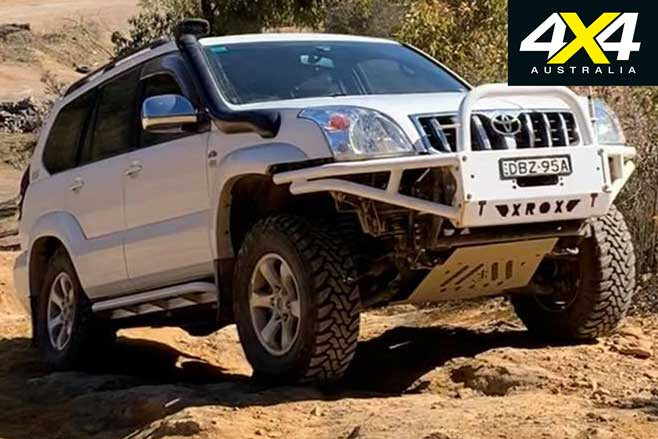
Picked up with 130,000km on the clock. Mods include BushSkinz bash plates, Southern Cross FabWorks rock sliders, Toyo Open Country M/Ts, Xrox winch bar and a GME UHF. I also have a Carbon winch and STEDI Type X Pro LED driving lights to be installed. Future mods include a Drifta drawer with EvaKool fridge, a Supa-Peg awning, and a Detroit auto-locker for the rear axle. Favourite spots include Abercrombie NP, Lithgow, Gardens of Stone/Baal Bone Gap, and many more.
NISSAN GU PATROL: TOMMY DELINAC
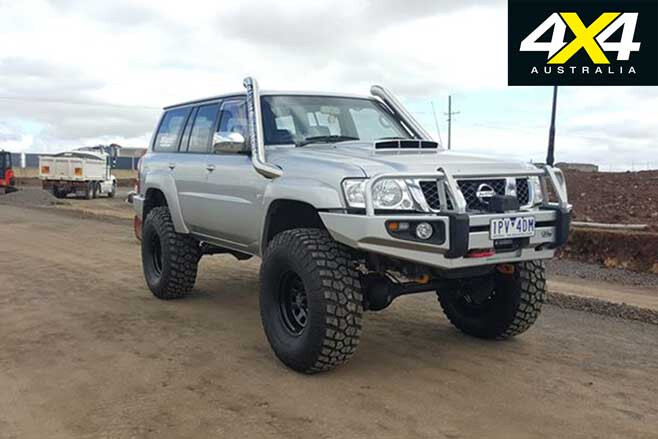
It’s running a six-inch lift with Dobinsons flexi-coils, six-inch Tough Dog big bore adjustable shocks, PSR upper control arms, BFGoodrich 40×14.5R17 KM2s on 17×9-30 Dynamics, Fairline Fibreglass bonnet scoop, and Fabwitz Industries twin four-inch stainless steel snorkels. It’s about to have a heart transplant to a stroked 6.0L turbo.
TOYOTA N70 HILUX: MATT APPLEBY
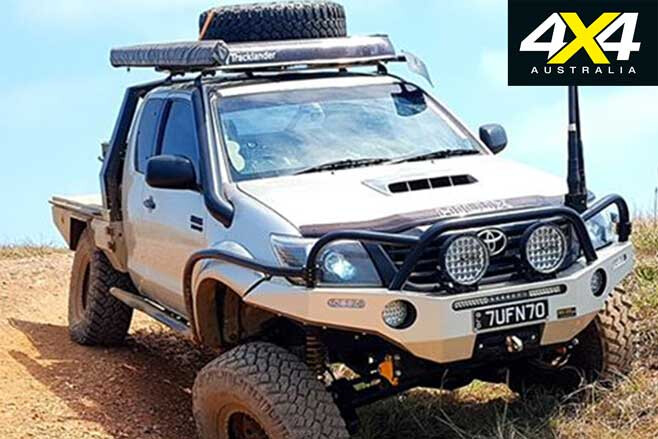
Kit includes Fox 2.0 10-inch RR coilovers with King springs (front), Aisin manual-locking hubs, TJM Pro Lockers, 4-link (adjustable custom links), Design Fab swaybar, 13-inch Airbag Man airbags, Fox 2.0 12-inch RR adjustable shocks (rear), and GQ disc brake rear conversion, four-inch Phat Bars snorkel, transfer box bash guard by PSR, engine tuned to 187rwhp/610Nm, Scott’s Rods three-inch exhaust, Forefront Industries top-mount intercooler, and a Runva 11XP premium winch. The Muzzbar, custom tray, front scrub rails and sliders are by SEQ Fabrication.