
WHEN I first started in this four-wheel driving caper some 30-odd years ago, we used to deflate tyres by finding an appropriate-size twig and pushing it down on the tyre’s valve.
Then, if we’d forgotten to throw in a gauge, we’d guesstimate tyre pressure by counting to 30, 60 or 90 seconds, screw the valve cap back on and hope for the best.
This was a long and tedious process, so it was little wonder various clever people came up with better alternatives.
First up was the innovative Staun Valve that could be set to a predetermined pressure and simply screwed on to the valve stem. Because there were four of them in a set, this significantly sped up deflation time.
Then along came the ARB E-Z Deflator (and other similar products) that allowed the valve itself to be removed from the valve stem but in a captive state for super-fast yet safe deflation.
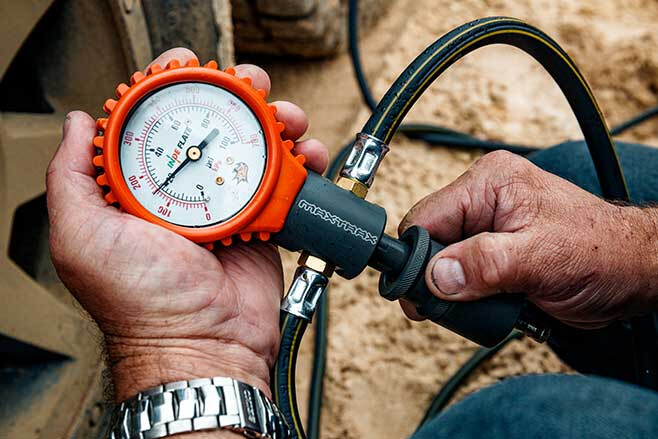
The latest in tyre-deflation technology is being distributed in Australia by MaxTrax and is called Indeflate. It’s called Indeflate because as well as allowing for easy tyre deflation, it allows for easy tyre inflation… and two tyres at a time.
Indeflate is attached to two tyre valve stems at a time with clip-on chucks, and it features a dump valve that allows for equal deflation of those two tyres simultaneously. It also has a built-in pressure gauge so you can quickly and easily monitor deflation, and it has two 3m-long hoses so you can easily reach all tyres on a vehicle.
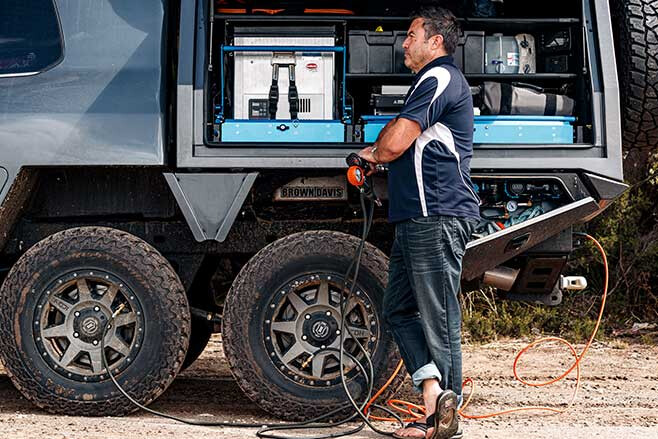
Deflation is not as fast as an E-Z Deflator that removes the actual valve from the stem, but as it fits so quickly via the clip-on chucks, and as you’re deflating two tyres at a time, there’s not much in it.
However, the best thing about using the Indeflate is you can stand upright while using it rather than crouching down near your tyres. If your knees are a bit buggered like mine, this makes a helluva difference!
When it’s time to pump your tyres back up again, simply refit the clip-on chucks to two tyres, attach your air compressor hose to the base of the dump valve, open said valve and two tyres will be inflated at once. Again, you can stand while doing this rather than crouch, the pressure gauge is easy to read, and you’re guaranteed that both tyres will be inflated to the same pressure.
Indeflate is well made with quality components and is supplied in a durable carry bag. It’s bloody brilliant!
ESSENTIAL INFORMATION
AVAILABLE FROM: maxtrax.com.au RRP: $215 WE SAY: Easy deflation, easy inflation and easy on the knees.
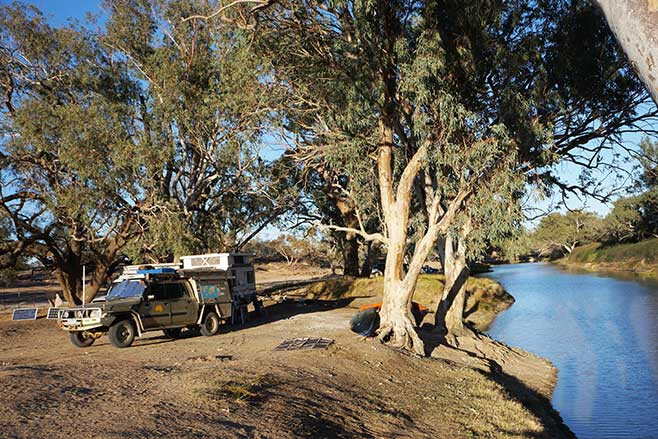
THE TRACK ends quite suddenly, the line of trees marking the channel of the north-west branch of the Cooper Creek barring progress any further northwards.
To the east a low ridge of sand blocks any expansive view while behind the screen of trees to the north and west there’s often a duct of muddy shallow water, a hangover from the last flood that had oozed down this outback waterway.
We were at the most northerly camping spot in what is now the Malkumba-Coongie Lakes National Park. The route to the park and the campground had only recently opened (September 2019) after being closed for some months after a flush of water had found its way down through the Channel Country of South West Queensland and into the Cooper Creek.
I had been at Arkaroola in the Flinders Ranges of SA when I heard the track to the lakes was finally open so without any further ado I headed across the flat plains that border the eastern edge of the ranges and onto the Strzelecki Track.
Montecollina Bore
I can’t travel this route without stopping at Montecollina Bore though, one of the rare permanent water spots, albeit manmade, along the way.
Surrounding this life sustaining waterhole, where huge flocks of white corellas sit under any shady spot aloof from any passing cars, are the Cobbler Sandhills where the dunes of the Strzelecki Desert have been replaced by steep-sided mounds that are topped with tough wiry vegetation.
In days gone by this area of the desert was extremely challenging for vehicles to get through, and the shearers, who were the main people to travel this route, gave it the name ‘Cobbler’, which referred to the most difficult sheep in a mob to be shorn.
Strzelecki Track
Crossing the dry bed of the Strzelecki Creek a little further north I shunned the main dirt road that is often dusty with the passing truck traffic and turned onto the original Strzelecki Track near Merty Merty homestead.
This lesser used route follows the creek northwards to Innamincka and while it’s no less dusty, maybe even more so, at least there are fewer trucks roaring past. Along here you’ll drive by the nodding arms of beam pumps drawing their liquid gold from deep underground.
Innamincka
It is at Innamincka that the Cooper splits into three main courses of braided channels, the main stream draining southwest towards a distant Lake Eyre (flows occasionally), the Strzelecki flowing south (flows rarely), while the north-west arm of the Cooper flows towards Coongie Lakes, the more common way for the water to flow.
Which way the water goes all depends on how deep the water is over the causeway at Innamincka and over the natural sandbars that are at each of the creek junctions.
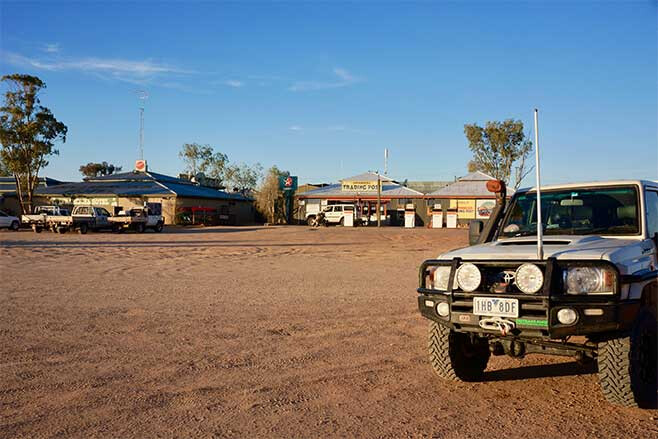
After a stopover at Innamincka to get some supplies and a camping permit I headed across the Cooper, the causeway now dry, and turned onto the road to the local racetrack and the Innamincka station trucking yard.
Innamincka Station was established in 1872, about 10 years after Burke and Wills had met their fate a little downstream along the Cooper. The homestead is just a few kilometres north of the present-day Innamincka township, while the property itself covers 13,800km² of the surrounding Innamincka Regional Reserve, which had been established in 1988.
Cattle grazing and gas and oil production are allowed in the reserve, so you’ll find fences, cattle, watering points, and a lot of signposted tracks leading to distant oil and gas wells and pumping stations (all closed to the public) as you head towards Coongie.
Coongie Lakes NP
In 1996, Coongie Lakes and the popular Cullyamurra Waterhole, the latter just a short distance from the township, were fenced and cattle excluded from these areas. In 2005 the Coongie Lakes NP was proclaimed, its name changing to its current moniker in 2014.
The national park covers an area of 26,661ha, and while there are a number of ephemeral lakes in the area, Coongie Lake itself is the largest and the first one to receive water flowing down the NW branch of the Cooper.
When water flows this far north the internationally significant wetlands, listed under the Ramsar Convention, not only includes the lakes but also interdunal swamps, billabongs, channels and shallow floodplains that border the creek and major lakes.
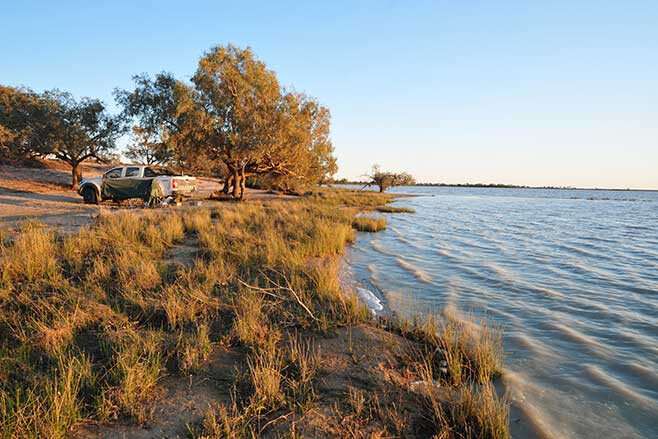
Just as you get to the park you’ll come to Kudriemitchie Outstation which now operates as a base for researchers and has been restored with help from the Toyota Landcruiser Club of SA; well done guys. Nearby along the north-west arm of the Cooper you’ll find a few shady spots to camp under a crowd of old river red gums close to the water.
The lakes and waterways you find here are a wildlife haven with more than 200 species of birds reported from the region. At times, like now when the lakes are brimming with water, the sheer number of birds is fantastic, with a figure of more than 100,000 birds being present on a number of occasions. At peak times up to 50,000 pelicans nest here while up to 20,000 grey teal and pink-eared ducks come here to breed.
Numerous species of native animals can also be found here including red kangaroos, dingos and even the Rakali, which we once knew as the native water rat. Reptiles include turtles, numerous snakes (luckily rarely seen) and lizards of all shapes and form.
I backtracked a short distance from the formal campground and took the track around the southern shores of the lake. Here you’ll find more secluded camps close to the lake’s edge which I reckon make for a whole better experience.
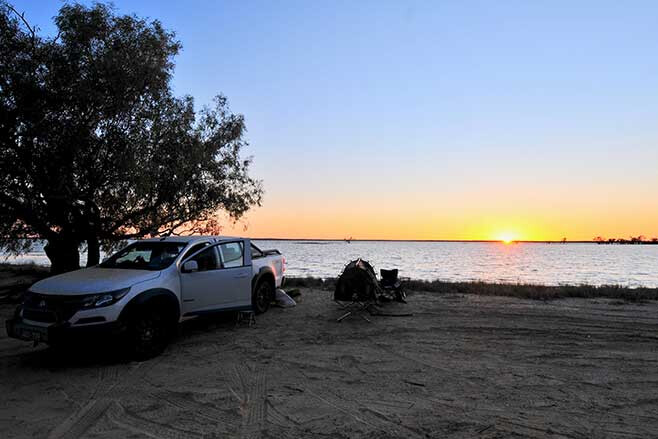
There were a few birds around but nowhere near as many as there will be when the Cooper and its adjoining floodplain and pans dry out over the coming months. Then they will come together at this near-permanent spread of water in one of the great wildlife congregations you’ll see in Oz.
While there weren’t many birds on my recent visit, a couple of birds of prey circled overhead. Sitting under a shady tree in a parched desert with water lapping at my feet though was bloody enjoyable … and a little surreal and a whole lot magical.
Make sure you get to experience it while you can!
Essential information
Malkumba-Coongie Lakes National Park is located 100km northwest of Innamincka.
A campground with toilet facilities is located at the creek at the end of the track. Camping is also available around the lake’s edge.
Kudriemitchie campground is located on the southern edge of the park and campfires and generators are permitted here.
Elsewhere in the park, wood and solid fuel fires are banned, as are generators and chainsaws. Motorboats and fishing are not allowed in Coongie Lakes.
Camping fees apply and you must book in advance HERE.
There is no mobile phone coverage in the park and no other facilities so be well prepared. And while there may be a lot of water, you’d probably prefer some cleaner stuff for drinking!
IT MIGHT look more at home on the set of The Walking Dead, but this impenetrable 2020 Toyota LandCruiser is perfect for cashed-up survivalists.Yep, not that’ll be much use to us in Australia, but, if you really wanted to, you could get yourself a bulletproof 200 Series.
Specced by Canadian mob, INKAS, the Land Cruiser GXR is equipped with a BR6 armour level, meaning it’ll survive a barrage of assault rifle ammo (7.62mm) and up to two hand grenade attacks (DM51).
The engine bay has been up-armoured; the suspension has been reinforced, as have door hinges and critical structure points; the entire perimeter of the passenger compartment has been strengthened; there’s added protection for the battery and electronics; and it utilises run-flats.
Let’s just hope it passes the “ball-bearing test”, unlike Elon’s Cybertruck.
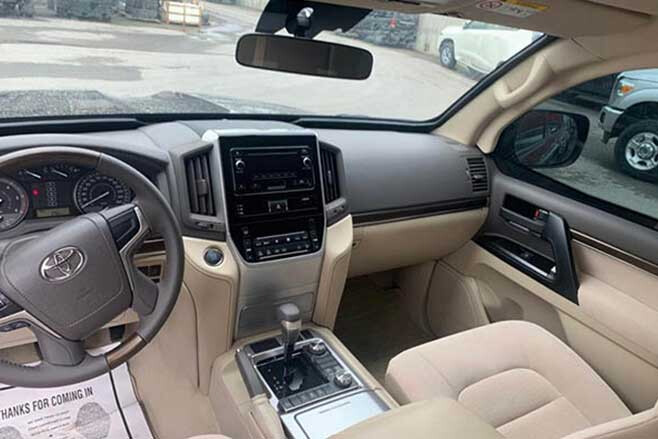
Tick some boxes on an optional equipment list and you can get a lightweight armouring package, a heavy duty brake system, heavy duty wheels, a siren/PA/intercom system, an emergency lights system, and/or a fire suppression system.
The guts of the seven-seat SUV remain unchanged, with the 4.5-litre V8 running through a six-speed automatic transmission and permanent AWD system.
There’s an information box on the INKAS website, specifically for Aussies, where you can request further info. Head here to check it out: inkasarmored.com
CHEVROLET IMPORTER and converter HSV has revised its range of Silverado pickups as it introduces the 1500 model and is running out of the heavy-duty 2500 models.
With the cessation of Holden and its supply of Commodore and Colorado vehicles and the end of the Chevrolet Camaro muscle car, the Silverado 1500 will, for the time being, be the only vehicle in the HSV line-up.
The Chevy joins the Ram 1500 truck in Australia which has been a popular model for importers Ateco Automotive/Ram Trucks Australia (RTA). While there are many companies importing and converting American vehicles in Australia, HSV and RTA are unique in that they are semi-factory operations and the conversions are approved by the head offices back in Detroit.
SALVAGED: The curious case of the sunken Silverados
Of note is the fact that both the HSV and RTA trucks have their left- to right-hand drive re-engineering carried out at Walkinshaw’s Clayton, Victoria facility for the respective companies.
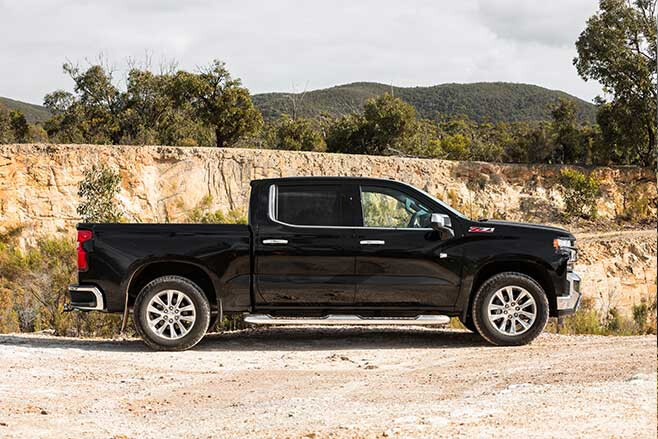
The 1500 pickups are what the Americans call half-ton trucks in reference to their load ratings. The heavy-duty 2500 and 3500 models are three-quarter-ton and one-ton trucks respectively, and when you’re looking at Ford trucks they are designated F150, F250 and F350 as you go up in capacity. They are generally the same trucks in size, it’s just the increased parameters of the chassis, axles and suspension that give them the added capacity.
The 2020 Silverado 1500 differs from the 2500 previously offered by HSV as it is the latest generation vehicle while the 2500 was the older model and hence why it has now left the HSV range.
HSV is only offering the Silverado 1500 in a single model and specification with a range of factory options available and more being locally developed by HSV. That LTZ spec is relatively high and it is loaded with features and hence wears a $113,000 (+ORC) sticker price.
POWERTRAIN AND PERFORMANCE
THE 1500 IS only available with one powertrain option comprising a petrol-fuelled V8 engine backed by a 10-speed automatic transmission and part-time, dual-range 4×4. The mill is the latest 6.2-litre GM LT1 V8 that pumps out a healthy 313kW of power and 624Nm of torque. While those numbers might suggest a brute of an engine, nothing could be further from the truth as the V8 delivers smooth, refined performance under most throttle applications and opens up to a mild roar when you plant the right boot.
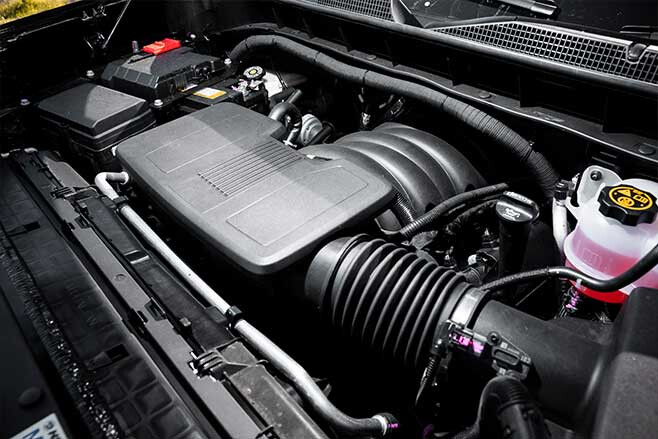
HSV does offer an intake and exhaust package for the 1500 that delivers a mild performance upgrade and a bellowing exhaust note that most enthusiasts would appreciate.
DRESSED-UP ‘RADO: Tuned PaxPower Jackal
The LT1 features fuel-saving cylinder deactivation and stop-start functions and delivers a claimed 12.23lt/100km. Over the course of our testing, which including highway driving and a bit of mild off-roading, the Chev returned 12.4lt/100km
The column-shifted automatic transmission is also smooth and refined, slipping unnoticed through its ratios. Manual shifting of the gears is via up/down buttons on the shift stalk while 4×4 and low-range selection are via buttons on the dash.
ON-ROAD TEST
AS IS THE case with the powertrain, driving the Silverado is a refined surprise. The cabin is massive and luxurious with its leather-covered, heated and cooled power seats and all the trimming, with the chassis and suspension delivering better than expected ride and dynamics.
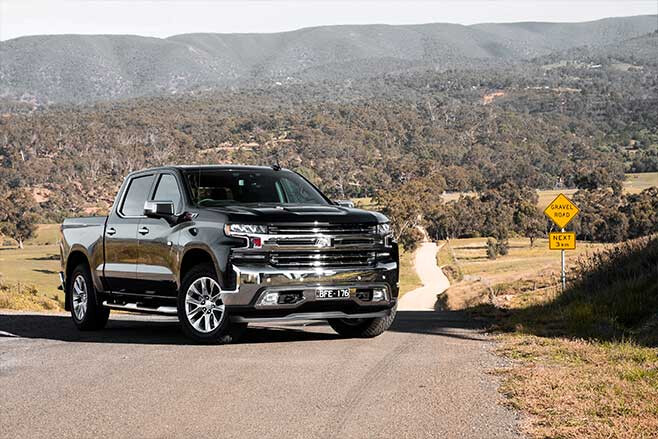
The 1500 uses an independent front suspension with coil-over shocks using Rancho dampeners in Z71 pack-equipped models which all the Aussie ones are, and electric-assist power rack and pinion steering. It might be a pickup but the 1500 doesn’t steer like a truck, instead proving precise and easy to place on the road.
In true load-hauling fashion, the rear end uses a live axle on leaf springs and it is firm and does feel a bit jittery when unladen as it was on our drive. A bit of weight in the tray or on the ball should address this.
OFF-ROAD TEST
IN STANDARD trim the Silverado would make a great all-road tourer while it’s not such a great off-roader. It’s just too long and low and it touches down the front bumper and side-steps way too easily on even mild off-road terrain. Thankfully there’s an endless supply of suspension kits available from the USA to accommodate everything from a sensible lift right up to nosebleed material. HSV is also working on a suspension kit it will offer soon.
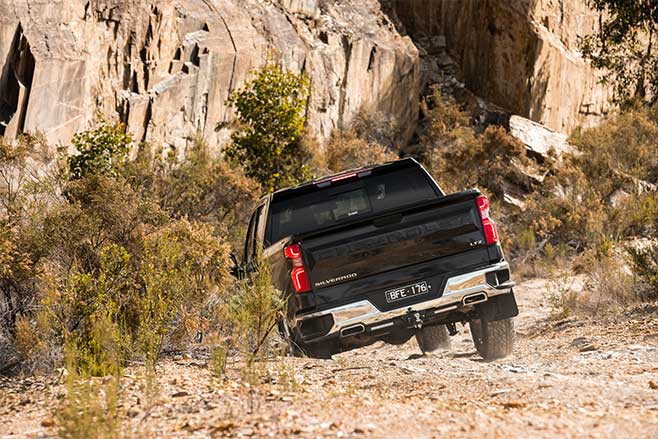
All of the HSV delivered 1500s come with the Z71 Off-Road Equipment Package which includes the previously mentioned Rancho shocks, Electronic Hill Descent Control, two-speed transfer case, an auto-locking rear differential, front skid plates and a heavy-duty air filter.
The rear diff works well but comes on pretty hard whenever there’s any wheelspin at the back. It takes a second or two to kick in but when it does, it propels the truck forward with gusto; you’ll want to be ready for it! The stock suspension doesn’t offer much travel, so lifting wheels and loosing traction comes easy and that rear locker is needed.
INTERIOR
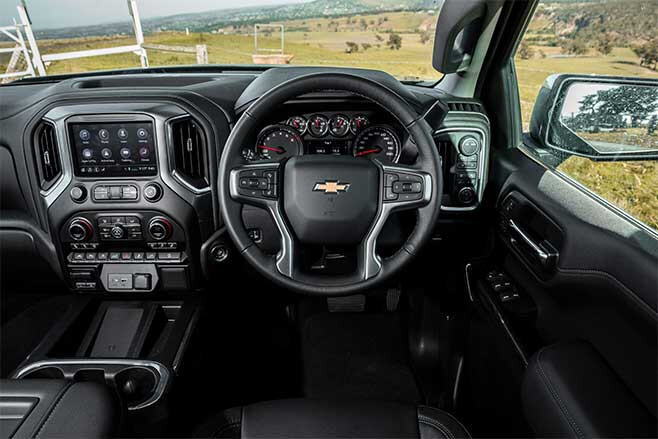
As mentioned, the cabin in the Silverado is huge and well-appointed. The console in between the two front seats is massive and could easily accommodate another passenger while the rear seat is similarly spacious for three passengers.
The LTZ is the second highest specification of six specs available in the USA but is the only spec offered by HSV. As such it includes all the features and comforts you would expect in a luxury vehicle and when you match that the space inside, it becomes a perfect mile eating machine.
Nothing is lost in the left- to right-hand drive conversion carried out by HSV and you would be hard-pressed to find any indication that things are not as they were when the vehicle left its original factory on the other side of the Pacific.
BORN IN THE USA: Chevy versus RAM
UTES OR PICKUP trucks, call them what you like but they offer unrivalled practicality with the ability to carry a load, haul a trailer and carry the family all in one vehicle. US trucks like the Silverado amplify this ability over any of the popular one-tonne utes here with more space and towing ability, however the general payload is usually lower than or on par with the one-tonners.
Key numbers for the Silverado 1500 include 3500kg towing on a 50mm ball or 4500kg on a 70mm ball, a 7160kg GCM and a 712kg payload. Unless you’re hauling cotton wool, you won’t even start to fill that massive cargo tray before you reach that payload capacity especially if you’re towing with some weight on the ball.
The standard 91-litre fuel tank is a handy size but we reckon you’d start to eat into it pretty quickly if you were towing or carrying a load on the V8 1500. The US market gets V6 petrol and an inline diesel six-cylinder engines among its many Silverado 1500 variants and the diesel could be preferred by Australian buyers. There’s even a 2.7L four-cylinder turbocharged petrol engine offer in the lower spec trucks in the States. Interestingly, the inline-six diesel and the LT1 are both rated to the same 623nm of torque, with the diesel bringing its peak grunt in at 1500rpm.
PRACTICALITIES
UTES OR PICKUP trucks, call them what you like but they offer unrivalled practicality with the ability to carry a load, haul a trailer and carry the family all in one vehicle. US trucks like the Silverado amplify this ability over any of the popular one-tonne utes here with more space and towing ability, however the general payload is usually lower than or on par with the one-tonners.
Key numbers for the Silverado 1500 include 3500kg towing on a 50mm ball or 4500kg on a 70mm ball, a 7160kg GCM and a 712kg payload. Unless you’re hauling cotton wool, you won’t even start to fill that massive cargo tray before you reach that payload capacity especially if you’re towing with some weight on the ball.
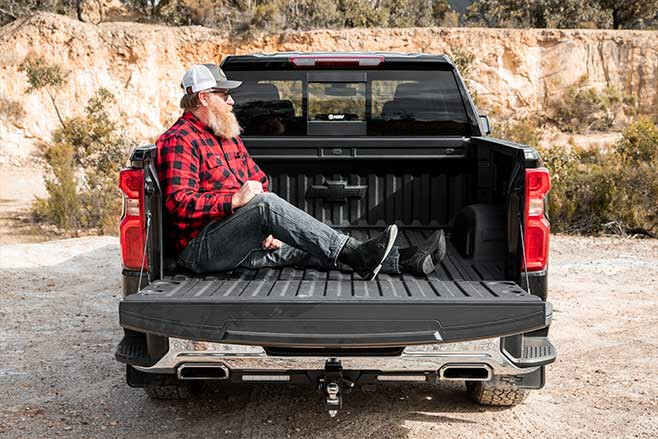
The standard 91-litre fuel tank is a handy size but we reckon you’d start to eat into it pretty quickly if you were towing or carrying a load on the V8 1500. The US market gets V6 petrol and an inline diesel six-cylinder engines among its many Silverado 1500 variants and the diesel could be preferred by Australian buyers. There’s even a 2.7L four-cylinder turbocharged petrol engine offer in the lower spec trucks in the States. Interestingly, the inline-six diesel and the LT1 are both rated to the same 623nm of torque, with the diesel bringing its peak grunt in at 1500rpm.
FINAL SAY
THE 1500 IS a beautiful truck to spend time in. Big, spacious and comfortable and with a V8 engine that will appeal to those that like a bit of performance or tow. But serious long-haul towers in Australia will prefer the torque capability and efficiency of a diesel engine which, at this point, HSV doesn’t offer in the Silverado. That’s not to say the petrol Chevy won’t do that job well, but a diesel will do it more efficiently.
The 1500 is a great truck for around down, towing the boat and general duties, is a step up from the small diesel one-tonne 4×4 utes and a worthy replacement for the old Ford and Holden 2WD utes.
CHEVROLET SILVERADO 1500 LTZ SPECS
ENGINE: 6.2L OHV direct-injection petrol V8 MAX POWER: 313kW at 5600rpm MAX TORQUE: 623Nm at 4100rpm TRANSMISSION: 10-speed auto CRAWL RATIO: 40.69:1 4X4 SYSTEM: Dual-range part-time CONSTRUCTION: 4-door cab and tub on ladder chassis FRONT SUSPENSION: IFS with wishbones & coil springs REAR SUSPENSION: Live axle with leaf springs WHEEL AND TYRE: 20-inch alloys with 275/60R20 AT tyres WEIGHT: 2588kg GVM: 3300kg PAYLOAD: 712kg TOWING CAPACITY: 4500kg GCM: 7160kg SEATING CAPACITY: 5 FUEL TANK CAPACITY: 91L ADR FUEL CLAIM: 12.23L/100km TEST FUEL USE: 12.4L/100km GROUND CLEARANCE: 235mm APPROACH ANGLE: 21 degrees DEPARTURE ANGLE: 23 degrees RAMPOVER ANGLE: 20 degrees
PRICING
BASE PRICE: $113,000
TOYOTA has issued a recall notice for MY2016-2018 LandCruiser VDJ76, VDJ78 and VDJ79 models, to have a modified heat shield fitted to the exhaust to prevent the build-up of dry grasses that could ignite and cause a vehicle fire.
The recall covers some 22,971 vehicles fitted with Diesel Particulate filters (DPF), with build dates between June 2016 and November 2018.
OPINION:
The potential fire risk occurs when these vehicles are driven in conditions where dry grass, bushes or seeds come into contact with the underside of the vehicle and could create a build-up of dry mass around the exhaust system. The exhaust system in vehicles equipped with a DPF runs at a very high temperature when it conducts a DPF burn–off, and this has the potential to ignite any build-up of dry matter and cause a serious vehicle fire.
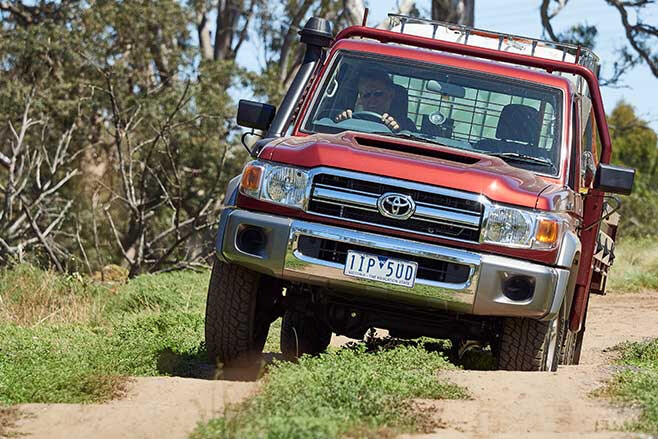
The rectification for the recall is to fit a modified heat shield to the area of the exhaust system, and also enable the DPF manual regeneration customisation mode, which allows owners to conduct manual regeneration in a safe location prior to entering off-road environments with dry vegetation.
Instructions on removal of accumulated vegetation will also be placed in vehicles with a revised DPF information label affixed to the interior of the driver’s door.
Toyota acknowledges that many owners of VDJ Cruisers will have fitted aftermarket or modified exhausts systems to their vehicles and suggest that these vehicles should also be presented for inspection, but say that in order to complete the recall, the complete exhaust system must be returned to original manufacturer condition.
Toyota Australia will be contacting owners of affected vehicles to advise them that their vehicles need to be looked at, but should you own a LandCruiser 70 produced within the date range, you should contact your Toyota dealer for advice.
The LandCruiser isn’t the first vehicle to have had such issues with hot DPFs potentially igniting dry grass under the vehicle. This is a timely reminder to anyone driving any vehicle, but particularly those using hot DPF-equipped exhaust systems, to never pull the vehicle to a standstill over tall dry grass that could be in contact or close to the exhaust system. Also, if driving through long grasses, regularly stop, get under the vehicle and check for any build-up of grasses around the exhaust and DPF. A piece of fencing wire or a coat hanger can be used to clear away any build-up of grass and debris.
Some grasses, such as spinifex, commonly found in the Australian outback, contain seeds with ahigh content of oil, which is particularly flammable and easily ignites when near a hot exhaust, and your vehicle could be well alight by the time you smell it burning and it’s too late to save.
Toyota LandCruiser owners can contact the Toyota Recall Campaign Helpline on 1800 987 366 (Mon-Fri 8.00-7.00pm AEST) for more information, and it’ll help if you have your Vehicle Identification Number (VIN) handy when you do.
Ford has announced a new Tradesman option package for the Ford Ranger, which sees it receive more than $5500 in extras for just $1000.
The Ford Ranger Tradesman is listed officially as a ‘Special Edition’ on Ford’s website, but the option pack is only available on the Ranger 4×4 XL dual-cab variant with the 3.2-litre five-cylinder engine.
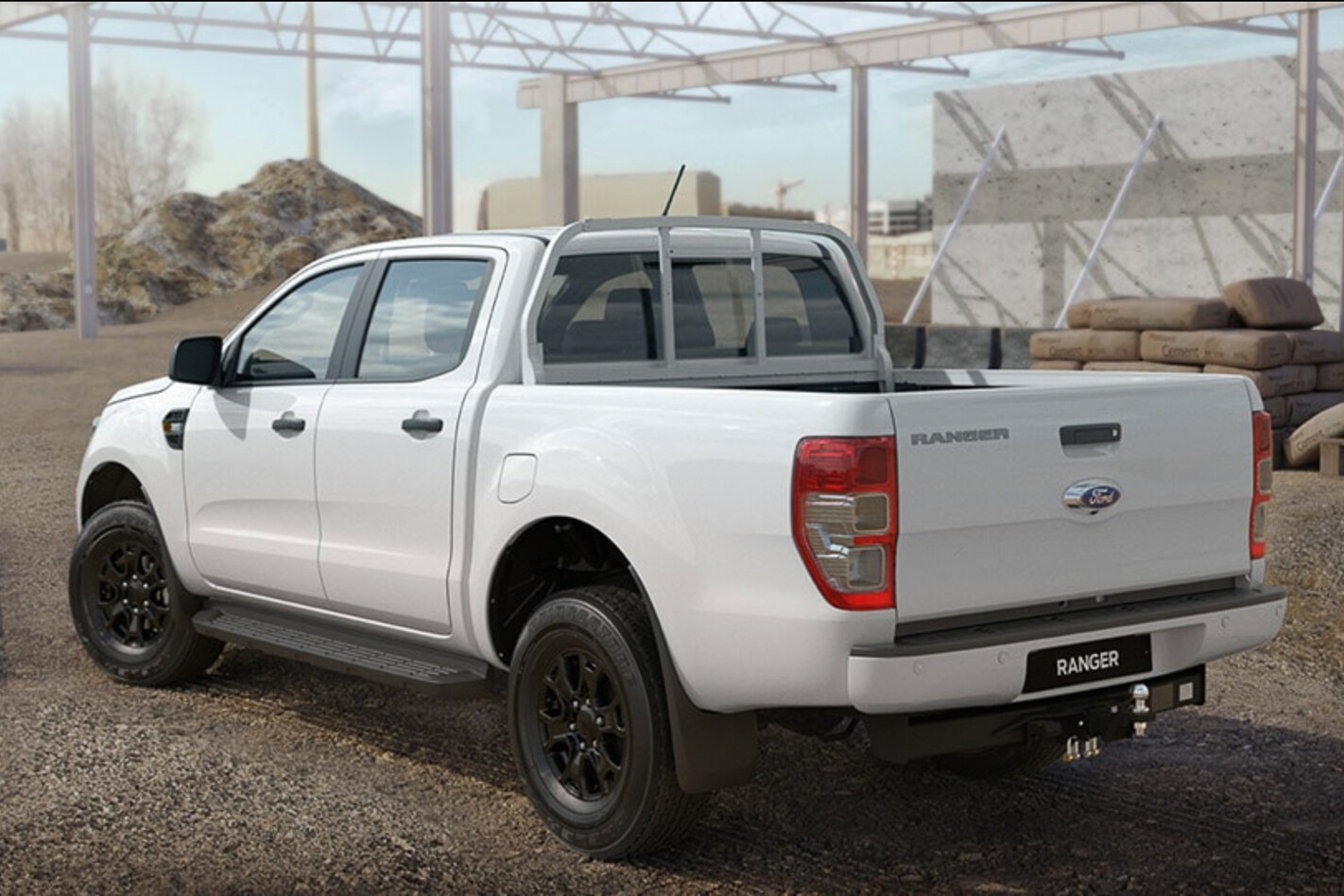
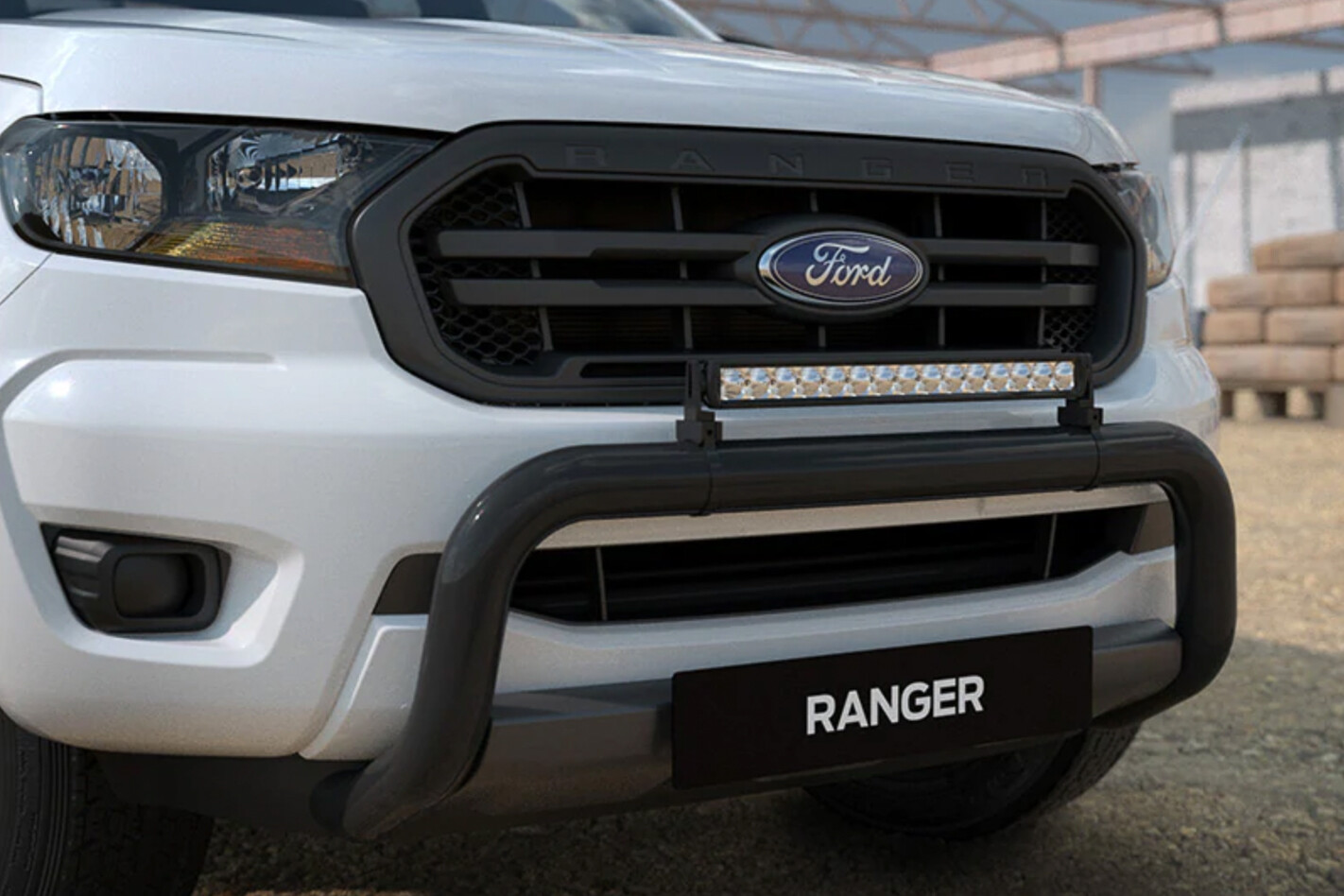
The $1000 package includes a black nudge bar with integrated LED light, a black plastic bedliner, tow bar, black side steps and a set of 16-inch alloy wheels.
Ford’s Tradesman pack builds on equipment that already includes lane-keep aid, AEB with pedestrian detection, infotainment with smartphone-mirroring capability and part-time 4×4 with an electrically-locking rear differential.
4×4 ute sales continue to slide during the coronavirus pandemic, so this option pack may be a way for Ford to entice new buyers into a Ranger to arrest the sales downturn.
It is available now, with the option pack taking the price of the 2020 Ford Ranger 4×4 3.2L dual-cab automatic to $51,790 (before on-road costs).
NESTLED in the quiet rural village of Pyengana, around two hours’ drive from Launceston or just one hour from St Helens, the Pub in the Paddock is a great place to wash away the dust (or mud) after a day’s four-wheel driving in some of Tassie’s most spectacular country.
The Pub in the Paddock has been licenced since 1880, and today it’s managed by the friendly and entertaining Rowena and Scott Codyre. On the day we showed up at the front door the pub was locked, as Rowena and Scott were attending a special function, but they showed up some 10 minutes after us, opened the doors and welcomed us in.
ISUZU I-VENTURE: Takes on Climies Track
The walls of the pub are adorned with memorabilia that tells some of the stories of the area’s rich local history, while the friendly locals love nothing more than to have a chat with visitors. And then there’s Priscilla…
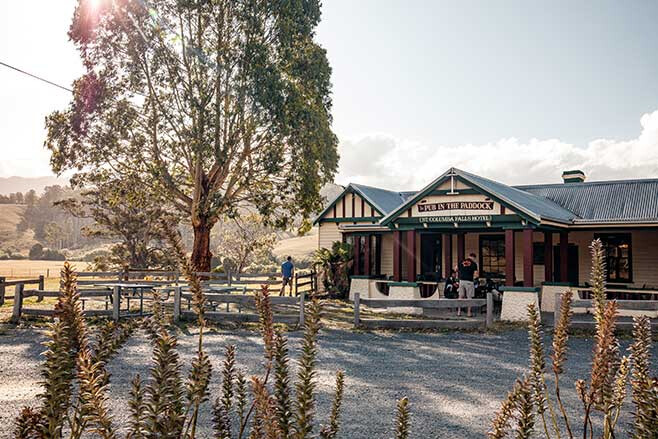
Priscilla resides in a paddock out the front of the pub and is famous for her drinking habits. Yep, Priscilla is the pub’s beer-drinking pig, and she has become quite the celebrity over the years. These days Priscilla sticks strictly to the light stuff – her preference is to guzzle only specially watered-down beer, but she does so with enthusiasm!
As well as tap beers (James Boag’s Draught and Iron Jack), the Pub in the Paddock has a restaurant that offers a classic menu of home-cooked pub food including chips, wedges and pies, ranging through to fish and chips, chicken Parmigiana, pork sausages, Scotch fillets and more. And much of the menu relies on local produce.
For those who want to stay the night, the pub has six rooms with shared facilities. Alternatively, there’s plenty of camping space over the road in the Pyengana Recreation Area, which has toilets and hot showers.
Pyengana is the ideal base to set out and explore the surrounding area and is not far from the coastal town of St Helens, which boasts some of Tasmania’s best beaches, as well as Binalong Bay and The Bay of Fires.
The Pub in the Paddock is a top country pub.
PUB ESSENTIALS
HOURS: 10.30am until late (Tue to Thu); 10.30am to 4pm (Sun to Mon) BEERS: Iron Jack $6.30 a schooner; Boags Draught : $6.30 a schooner MEALS: Light $9 to $16; Mains $20.50 to $33; Desserts $7 to $9.50
ACCOMMODATION
ROOMS/PRICES:Single $65; Double $95; Twin $95; Family $125
CONTACT INFO
- MANAGERS/OWNERS: Scott and Rowena Codyre
- ADDRESS: 250 St Columbafalls Road, Pyengana, Tasmania
- PHONE: (03) 6373 6121
- WEBSITE: pubinthepaddocktas.com.au
The yearning for freedom isn’t something you can buy. It doesn’t come free with a Chinese swag, you won’t find a subscription for it online, and you certainly can’t download it on the app store.
2020 CUSTOM 4X4OTY: Vote now for a chance to win
It’s engrained in us, an all-consuming hunger deep within. Those endless outback plains, the morning mist rolling in through the high-country valleys, the setting sun bathing the inland lakes of Fraser Island in pinks and oranges while the campfire cackles behind us.
That call of the wild was something Jamie couldn’t pass up. The idea of loading his family into their very own adventure machine, setting off for the horizon and never looking back held more appeal than a thick wallet.
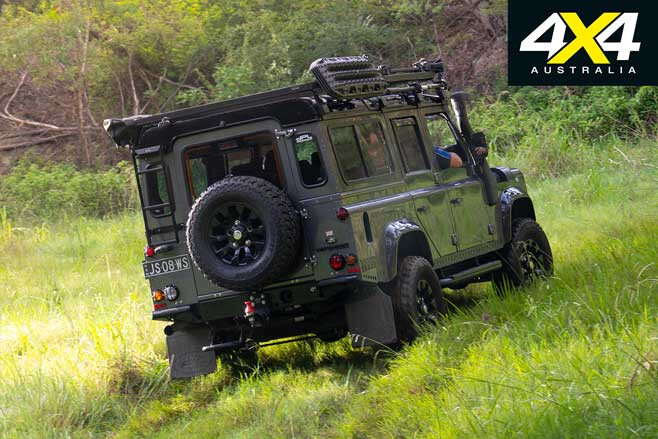
The build was meticulously planned. The starting platform, one of the most iconic 4x4s ever built and the very embodiment of continent conquering adventure, the Land Rover Defender. Starting with one of the last models rolling off the production line came with a bunch of positives. It’s one of the most customisable vehicles on the planet, with a huge aftermarket helping you produce the Defender of your dreams. It’s also one of the newest vehicles you can buy with live axles at each end, and coil springs holding them in. Of course, it also came with a few negatives.
The utilitarian nature of the green oval meant the only transmission option available is a manual cog-swapper. With poor health seeing Jamie unable to dance three pedals at once, the call was made to Sydney outfit Davis Performance Landys (DPL) to not only get the Land Rover ready to take on the ends of the earth, but remove the clutch pedal in the process.
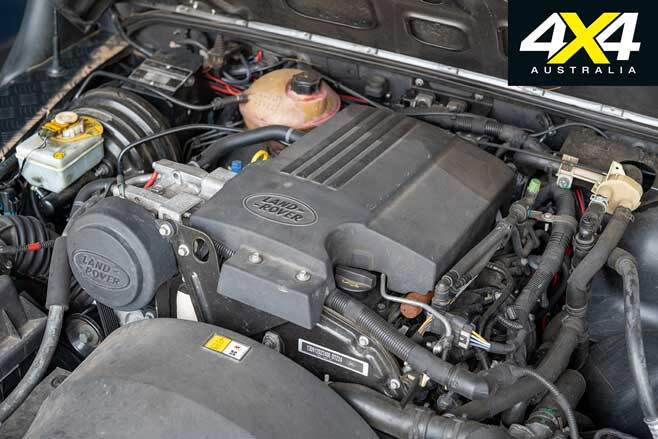
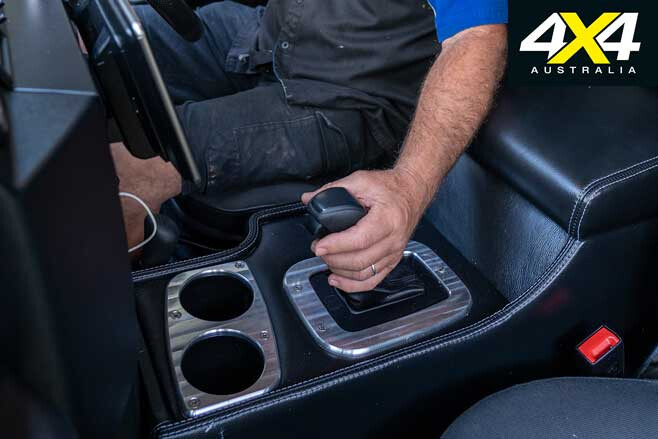
With the Defender on the hoist, the first task was to yank the old manual cog-swapper and replace it with an automatic trans. The factory 2.2L turbo-diesel engine rattling away under the bonnet is the same unit found in Ford’s PX line of Rangers, making an auto conversion a reasonably straightforward affair. DPL lined up a Ford 6R80 transmission (the same unit found in Rangers, Mustangs and F150s), and with a host of custom parts slotted it in between the 2.2L motor and the factory transfer case.
Custom front and rear driveshafts were required to connect the heavy parts together, and a stand-alone ECU controls the trans through a Ranger shifter on the inside. The new auto trans-friendly centre console also did away with the old cable handbrake, with a new electronic unit replacing it.
The new auto not only has a lower first gear, it has a taller final gear, making it better in stop-start traffic as well as highway cruising. That constant power delivery makes it smooth as butter in technical terrain as well.
While the spanners were out under the bonnet, the team got to work getting more power to the ground out of the Duratorq motor with an ECU remap to suit the new exhaust system. An upgraded intercooler and set of Samco intercooler pipes allowed them to wind the wick up even further. While the auto trans was getting its own oil-cooling system fitted, an engine oil cooler and fan was also installed, further lowering temps.
With drivetrain sorted it was time to turn their attention to the suspension. Those coil springs mentioned before? They’re sitting in the skip bin next to the manual shifter. In their place, DPL has fitted a full air-ride suspension.
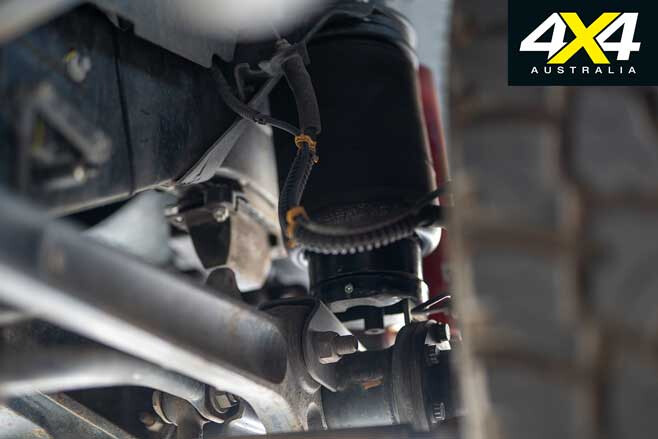
The onboard air system allows the Defender to be dropped lower than stock for ease of access, then lifted sky high to clear challenging terrain all at the press of a button. A full suite of KONI Raid shocks have been paired to match, with the front shock mounts requiring a little custom work to suit the huge range of suspension travel now available. A set of heavy-duty steering arms have also been installed.
Moving outside and the front of the Defender has had a serious attitude adjustment. Leading the way is a stout bullbar sourced from the UK and customised within an inch of its life by DPL; it not only helps improve approach angles, it also serves as a permanent home to Jamie’s get-out-of-gaol free card, the Warn Zeon 10-S Platinum 12V winch.
Mounted underneath is a 6mm-thick alloy sump guard from Front Runner, ensuring the oil stays in the engine no matter how rocky the terrain. A pair of headlight guards have also been fitted, allowing the Defender to push through dense scrub knowing it’ll come out the other side in one piece.
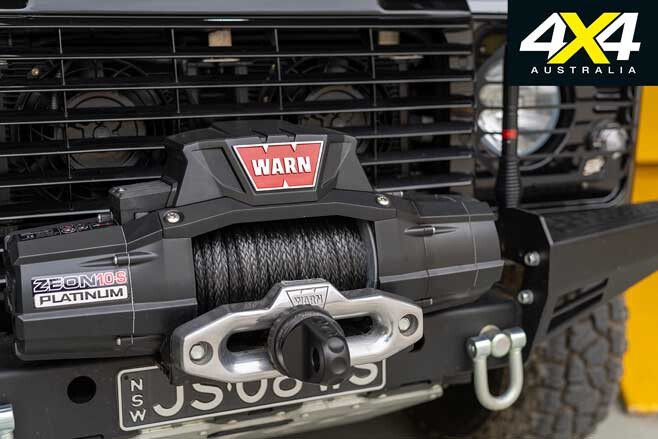
Moving back, the flanks of the Defender have been up-armoured from front to rear. Starting at the front, Front Runner fender guards give the signature checkerplate look on either side of the bonnet, with matching pieces along both sills and rear quarters.
The rear tail-light lenses also have sturdy shielding, with the rear bumper high and tight thanks to Terrafirma bumperettes attached to the rear crossmember. Above that, a lightweight alloy ladder gives easy access up onto the full platform roof rack for ease of storage. It also houses a set of black MaxTrax, as well as huge wrap-around awning, shovel and high-lift jack.
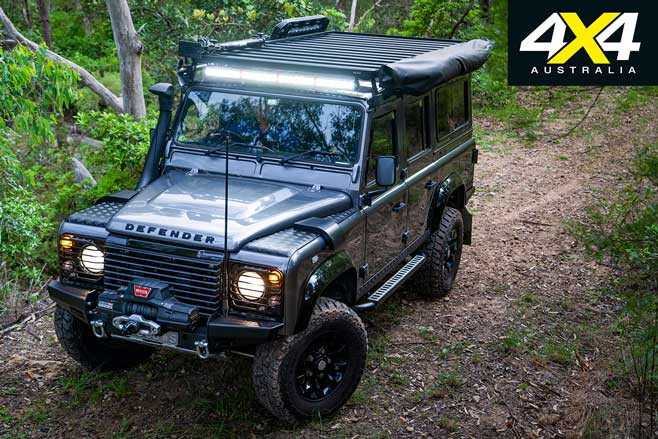
On the inside, the adventure-in-comfort theme has been continued. Taking pride of place on the dash is a monster Alpine Halo 9 floating touchscreen unit, giving Jamie access to everything from mapping software to digital radio and Apple CarPlay. It’s parked next to the similarly tech-spec’d GME XRS Connect unit, fitting out the old-school styled Defender with cutting-edge technology. Finally, moving all the way to the rear and the cargo space has been decked out with a full drawer storage setup, giving convenient access to everything required for the long haul.
While the team at Davis Performance Landys has unarguably built one of the most capable and comfortable tourers in the country, sadly Jamie’s health declined before he’d had a chance to truly head off into the great unknown with it. Time waits for no man, if you’re dreaming of adventure big or small, lay out a plan, build the vehicle, and live one hell of a life.
They drive like a tractor
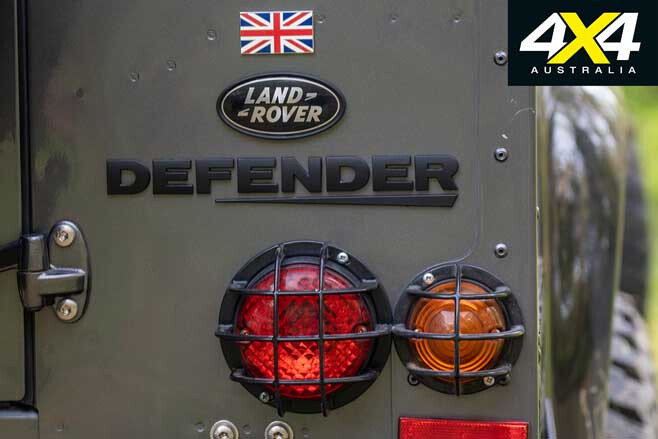
While the Land Rover Defender is unarguably the symbol for serious overland travel, they’re often bad-mouthed for their odd ergonomics.
There’s a pretty good reason why they feel like a tractor … they kind of are tractors. You see, post WWII England was a bit of a bleak place, and there was no financially viable way for the Rover company to continue producing luxury cars. Instead, it raided the parts bin looking for something that’d help the largely agricultural island rebuild, and give people much needed affordable transport.
The original prototype Land Rover was based on a Jeep frame, with a Rover drivetrain, and handmade aluminium body (as steel was heavily rationed at the time). Complete with a centre-steer configuration and power take-offs to run farming equipment it was intended to plough the fields through the week and drive into town on the weekend.
FOLLOWING in the footsteps of the recently revealed bi-turbo diesel-powered D90, LDV has launched the next-generation T60 Trailrider 2.
The T60 Trailrider 2 is the second vehicle in the Chinese brand’s shed to utilise SAIC’s in-house-designed 2.0-litre D20 diesel engine; however, this variant features a single-scroll turbocharger rather than the D90’s bi-turbo arrangement.
This means the Trailrider 2 puts 120kW and 375Nm through either a six-speed manual or six-speed automatic transmission – up from the first-gen 2.8-litre’s 110kW and 360Nm. For comparison’s sake, the all-new bi-turbo engine in the D90 generates 160kW and 480Nm.
“We continue to develop our product offering throughout our fast-growing range, so we’re delighted to announce the arrival of the next-gen Trailrider,” said Dinesh Chinnappa, General Manager, LDV Automotive.
“With the addition of the lighter and more efficient 120kW diesel engine, Trailrider 2 is a formidable ute, as comfortable on the worksite during the week as it is towing jet skis at the weekend.”
Off-road specs for the Trailrider 2 include a 27-degree approach angle, 24.2-degree departure angle, 215mm of ground clearance, 21.3-degree rampover angle, a wading depth of 550mm, payloads of 895kg (manual) and 865kg (auto), and a towing capacity of 3000kg.
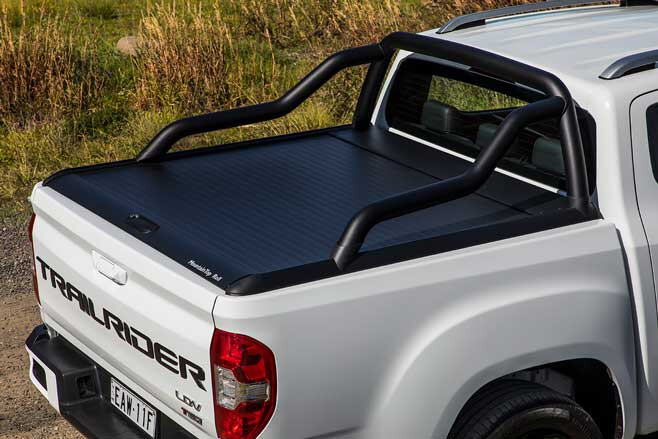
Despite its sub-$40K price tag, the Trailrider is equipped with a bunch of advanced safety tech, sans AEB – including a 360-degree rear view camera, lane departure warning and tyre pressure monitoring – to give the budget-friendly offering a five-star ANCAP safety rating.
LDV T60 Trailrider 2 pricing (ABN holders)
– LDV T60 TRAILRIDER 2 (manual): $37,990 – LDV T60 TRAILRIDER 2 (auto): $39,990
If you were to go to the Means dry lakebed east of Los Angeles, California, at Christmas time you would find a desolate, cold and lonely desert. It’s either complete silence or a howling windstorm around the rocky outcrops. You may spot a couple of four-wheel drivers picking their way across the remains of the WWII bombing range still faintly etched into the lakebed, a reminder of the intensity of the bombs exploding as men prepared for war.
In contrast, if you went in early February you would have found ‘Hammer Town’ had risen from the desert floor, with its population peaking at more than 50,000 people from across the world in preparation for a modern form of war. A town has risen but its life will be fleeting, as it will be returned to the desert within a few short days.
Those eight days will be epic, as the faithful prepare to destroy the desert trails in the main event with extravagantly expensive Ultra4 race cars. Welcome to the King Of The Hammers … the world’s toughest one-day off-road race held each year in the Johnson Valley.
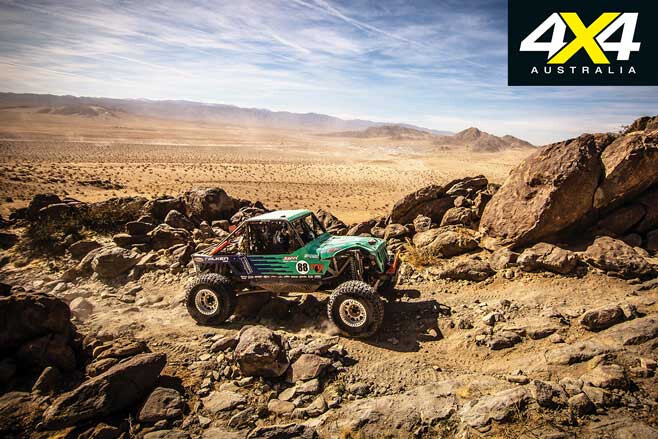
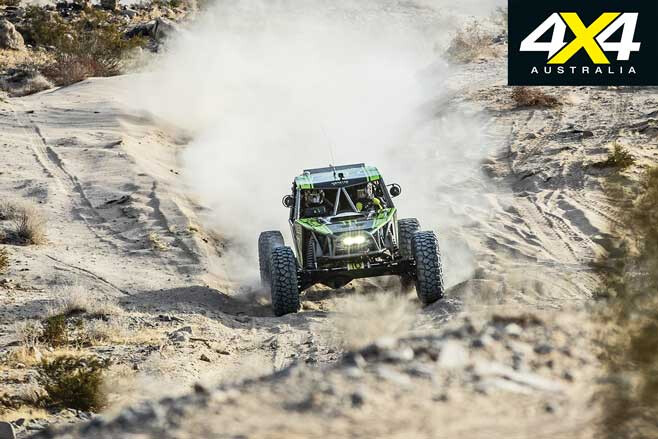
The line-up consists of multiple forms of racing vehicles, including motorbikes, ATVs, trophy trucks, tuff trucks, and Ultra4 race cars that are custom-built with no rules around their specifications other than a few safety details.
If you want 1100hp, do it and show us on race day how that works, while most will run from 600 to 900hp on 40- to 42-inch tyres. The vehicles can traverse rock trails that you’re hard-pressed to walk and then hit the open desert and do nearly 200km/h. The main race held on the Friday of Hammers week is 340km and takes the winners more than seven hours to complete.
The Aussies
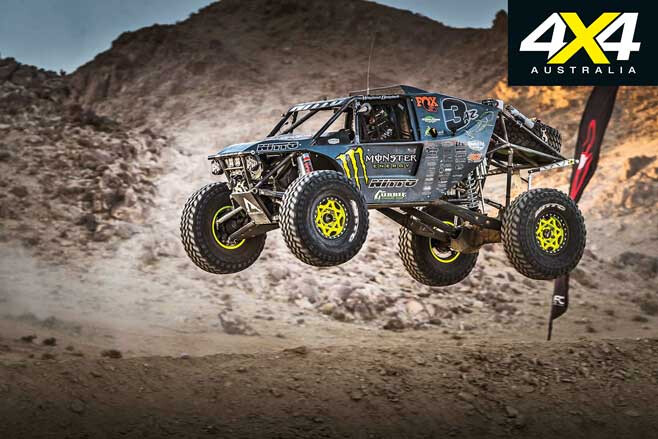
Hammers has run for 14 years now and many Australian teams have competed with varying degrees of success. In 2020, there were two Australian teams in Hammertown and this is their story.
Pip Justice and Tim Nolan are seasoned competitors having won Australia’s premier competitive four-wheel driving event the Tuff Truck Challenge four times, and they were looking for what’s next. To compete in the world’s hardest one-day off-road race seemed like a logical next step and, over a period of two months, the Texas-based crew at Rufus Racing helped secure an Ultra4 buggy with race pedigree, including a win in the 2014 King of The Hammers at the hands of Loren Healey.
The car was prepared by Rufus Racing and was ready on the lakebed when Pip and Tim arrived at Hammer Town in late January. A few days were spent putting the final touches on the car, and this is when they found that the power steering system needed a new pump. After that and during one of the test runs, the left front stub axle broke.
Made of 300M steel it broke in a way that had the team baffled as to how it failed. Fortunately, a new part was available in Hammer Town. The winch too was certainly not the latest piece of recovery equipment fitted, so Warn Industries donated its latest winch offering to the cause and on race day it proved invaluable according to Tim, the team string-puller (aka co-driver).
On race day the boys started 38th off the line and within the first 80km had been overtaken by at least 10 other cars, but their plan was to run their own race.
Love Tap
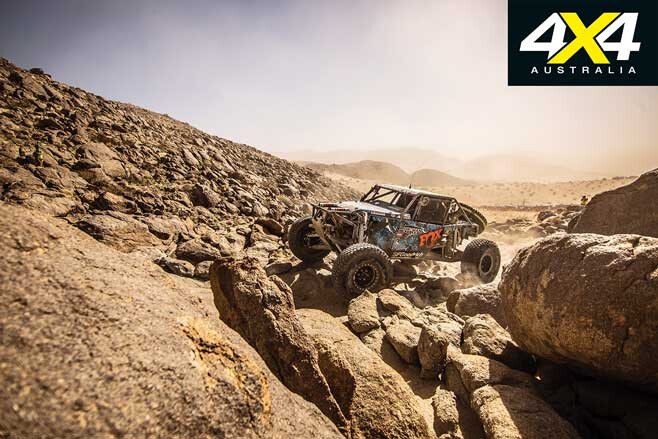
Hammers is a race of attrition, where finishing beats most competitors. At the 100km mark, doing 140km/h, the boys got a love tap in the rear from the car’s previous owner to tell them to get out of his way. A couple of times they bicycled up on to two wheels, so-much-so that gravel was flying in through the front window. Completing the race in 14th place, with a time of 9:35:48, without any mechanical dramas or punctures, is a testament to the vehicle prep from the team at Rufus Racing, and Pip and Tim’s skills.
Barry Smethurst and Cam Stewart from Victoria’s Road Runner Offroad attended Hammers for the second time, having received a real hiding in their 2019 campaign. Barry is well-known in the Aussie competition scene having competed in many premier events over the years, and he had taken the big step of purchasing an Ultra4 to keep based in Texas at Twisted Fabrications Inc.
The new car was only secured two months prior to the race and required an extensive amount of race prep involving a full strip-down and rebuild. The car arrived on the lakebed requiring the Road Runner vehicle wrap to give it the Aussie flavour and turn it into Barry’s pride and joy.
No Hands
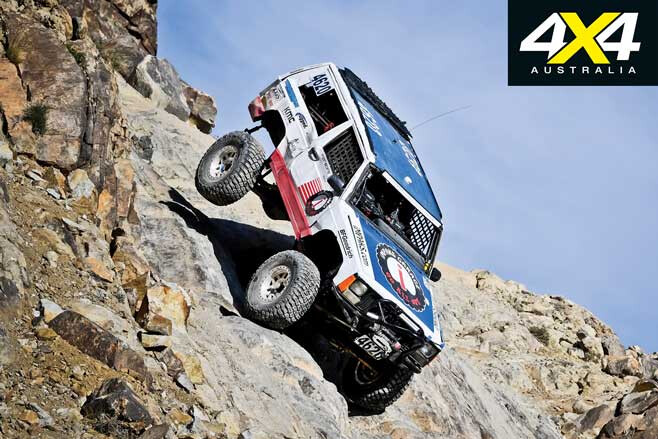
Barry’s race plan was to compete in two classes, the first being the Every Man Challenge (EMC) 4800 class and the Main Ultra4 race 4400 class. The EMC qualifying race was the first time they got to really give the car the berries, but not far into the lap the steering wheel came off in Barry’s hands because he hadn’t clipped the quick-connect properly. This led to a hectic few moments as they avoided a cameraman while Barry steered by holding the steering shaft until he brought the car to a stop. After correctly refitting the steering wheel they qualified 20th.
The EMC race went great until after the first pit when a number of issues reared their heads: firstly, cylinder number one was not getting fuel due to a blocked injector filter; and the second was overheating issues caused by vapour locks in the heads. These would plague the boys for the rest of their week.
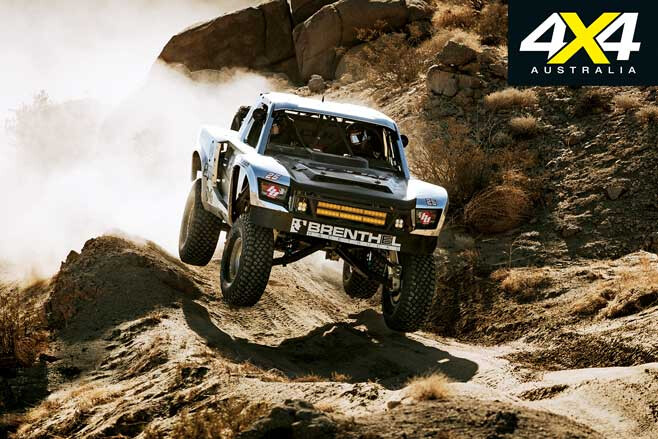
The third issue was an earth wire breaking on one of the cooling fans and needed a trail fix. But what finished them off was the alternator failing and the battery going flat leaving the boys with a DNF. Naturally, the team was gutted by this result, but in true Aussie spirit they got to work prepping the car for the 4400 race. This prep led the team’s sponsor Maxxis to upgrade the tyres from the 37-inch to the larger 40-inch sticky Trepador hoops.
Race day was a fight with the team only able to finish two of the three laps before timing out. At one point the throttle spring broke requiring Barry to manually pull the throttle back with his foot until the next pit stop where it was repaired. The brakes were also sticking on and boiling the brake fluid, and the cooling system continued to have issues with airlocks, leaving the team feeling rather defeated by the end of the week.
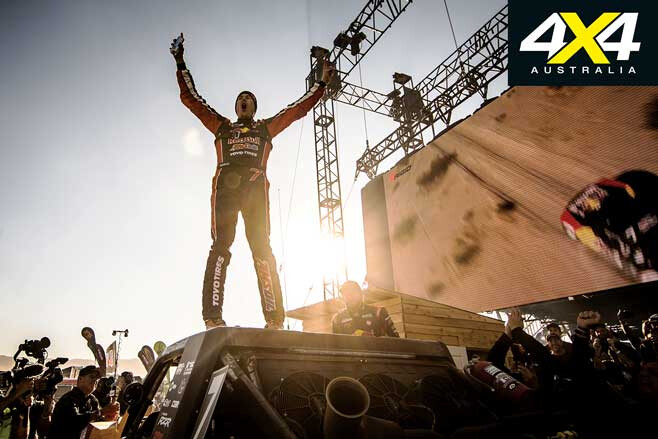
To race at Hammers is always going to hurt, it’s just a question of how much and what you do with the pain.
For 2020 the win went to Josh Blyler with a time of 07:06:32.488. As for Pip, Tim, Barry and Cam, they plan to return in 2021 to again attempt to tame the beast called King of The Hammers.
More Hammertime
To enjoy more in-depth content head to the Facebook page ’Aussies at the Hammers’ or follow these links:
– Aussies at the Hammers Facebook page – Interview with Pip and Tim of Justice Motorsports – Interview with Barry and Cam of Road Runner Offroad