WITH the imminent release of the JL Jeep Wrangler, and its double-cab pick-up variant in 2018, American Expedition Vehicles (AEV) is calling last drinks on its bespoke JK Brute pick-ups.
AEV’s JK Brute double-cab was first seen back in 2011 following on from single-cab Brutes from the previous TJ Series Wrangler. These special vehicles had all manner of series off-road hardware including V8 Hemi engine conversions, high quality suspension components and AEV’s own bars and protection parts. As such they have commanded high prices yet remain much sought-after vehicles.
These matched components work in harmony with each other, as we found when we drove the 20th Anniversary AEV JK350 recently.
AEV said it expects a high demand of orders for new Brute double-cabs in the coming weeks leading up to March 31, when it will stop taking orders for them. In other words, if you want one, get in now. A right-hand drive JK Brute built by AEV would be a first, as the company has yet to do one.
An AEV Brute double-cab build starts at around US$42,000 over the price of your donor Jeep Wrangler, but accessories such as Hemi engine conversions and specific suspension components soon see the price skyrocket towards the US$100,000 mark and above. Used, low-mileage, ready-to-go Brutes command very high prices, signifying their exclusivity.
Jeep’s own JL pick-up will be a very different vehicle to the AEV Brute, with none of the bespoke vehicle’s unique values. Claimed to be very similar in size and style to the Brute, the as yet unseen Jeep won’t benefit from the same package of quality components and hardware that has made the AEVs so capable and sought after. One thing’s for sure, the Jeep pick-up won’t get a V8 engine and instead will be powered by a choice of V6 petrol and diesel engines, and possibly a turbocharged petrol four-cylinder mill.
The JL Wrangler wagon goes in to production at the end of 2017 with the pick-up to follow in 2018, along with Australian deliveries. We expect AEV will continue to offer its quality parts and packages for the new variants as well as JK models, but will not need to custom-build its own truck.
THE market is jam-packed full of new and innovative aftermarket accessories that’ll make your next outback experience more enjoyable, more comfortable, and more safe.
Dip into your savings and spoil yourself with a new set of wheels, a new bullbar, a new set of lights, or even underbody protection for your 4×4!
To get you started, here’s a list of some fresh items on the 4×4 market.
SLIP AND SLIDE IRONMAN 4X4 has launched the premium underbody protection solution to safeguard against off-road damage from rocks, stumps and ground strike. The new underbody protection kit for the Nissan Navara NP300 (coil spring models) is constructed from 4mm steel, with the design providing strength in most common strike zones. The protection plate protects the radiator, steering, engine and transmission components, and it features fully recessed high-tensile mounting hardware. Clever surface inspection holes allow for easy examination during routine maintenance. It comes with a two-year warranty. Website: www.ironman4x4.com RRP: $594 (incl. GST)
WHEELS FOR WEIGHT ROH has confirmed that it can extend its Lifetime Structural Warranty on a selection of heavy duty alloy and steel wheels for selected vehicles when fitted with a GVM suspension upgrade kit. There are heavy duty ROH wheels suitable for various models of the Ranger, Colorado, D-Max, BT-50, Triton MQ Series, GU Patrol, Hilux and Land Cruiser. Wheel styles available include Octagon, RTX, Terrain and Trojan. Website: www.roh.com.au
POWER SURGE REDARC has released its next-gen BCDC in-vehicle battery charger. The charger’s unique multi-stage charging algorithm means it’ll keep fridges and laptops firing when at a campsite. The in-vehicle battery chargers are well protected, incorporating dual battery isolation functionality as well as fault recognition. The compact chargers are also fully sealed for protection against water, dust and vibration. The Australian-made chargers can operate in conditions up to 80°C. Redarc products come with a two-year warranty. Website: www.redarc.com.au
BAR NONE A NEW range Opposite Lock bullbars have been launched. Opposite Lock’s No Loop Premium Channel Bar has been designed to offer functional protection with aggressive styling. They’re available for the PXII Ford Ranger, Holden Colorado, Isuzu D-Max, eighth-generation Toyota Hilux, Toyota 200 Series Land Cruiser, Toyota 150 Series Prado and VW Amarok. A premium- and fleet-protection range for the Ford Everest and a premium-protection range for the Toyota Fortuner are available. Head to Opposite Lock’s website to find out what each range includes. Website: www.oppositelock.com.au
CHIP DIP DIESEL POWER, the performance-chip-module specialists, has developed a range of performance modules specifically for the Australian 4WD. The simple plug-and-play chips increase low-end torque through active software power programming to provide more usable power and torque. The chips utilise a fast, high quality 64MHz V2 processor for smooth power delivery. Also featuring are waterproof plugs and a high-impact case coated in military-grade resin. All come with a three-year warranty. Website: www.diesel-power.com.au
ADAPTION NARVA has introduced six heavy-duty adaptors with battery connectors to its heavy-duty RV (HDRV) accessory range. The latest additions include adaptors with cigarette lighter plug to battery connector, accessory socket to battery connector, Merit plug to battery connector, battery clips to battery connector, 8mm ring terminals to battery connector, and battery connector to twin battery connectors. Website: www.narva.com.au
GOING DOWN IF YOUR tailgate doesn’t have an EZDown fitted, then you’re missing out on real outback convenience. This product is an absolute must for those with little kids who are just tall enough to reach the tailgate handle. With the EZDown fitted, there is zero chance of them getting knocked on the noggin by a dropping tailgate. No more banging, crashing or dented tailgates (or heads). Website: www.ezdown.com.au
For the latest kit and 4×4 product tests check out our GEAR.
The Rebelle Rally is peculiar among off-road motorsports.
For starters, as America’s longest off-road rally, travelling nearly 1930km from Northern Nevada to within a stone’s throw of the Mexican border, it is open exclusively to female competitors.
It’s also a multi-stage, multi-day navigation rally, putting it more in line with the infamous Dakar Rally than the Baja 1000. Did we mention there’s no GPS? These women, called Rebelles, navigate old-school, with a map and compass.
THE RACE Running between Lake Tahoe and Southern California, USA, the Rebelle Rally is advertised as “the ultimate road trip for adventurous and competitive women”. However, crossing almost 2000km of sand dunes and deserts, this isn’t your run-of-the-mill highway adventure.
It isn’t enough to simply finish this course; competitors are tasked with locating a series of checkpoints with nothing but a map and compass. Phones and anything else with a GPS are sealed at the start, ensuring this remains a challenge of old-school navi skills.
Actually locating checkpoints, however, becomes harder as the course progresses. Green checkpoints are marked and staffed, blue checkpoints have minor markings, and black checkpoints, which have no markings at all, are the most difficult to find.
Given teams have to be within 50-100 metres of a checkpoint for it to count towards their points, it’s an incredible feat to take pure latitudinal and longitudinal data and turn it into a physical location in the middle of nowhere. Competitors carry a handheld tracker that contains two important functions, an SOS ability and a button to press when the team thinks they’re at a checkpoint, which makes accurate navigation even more important.
The drivers have the easy part – relatively speaking – as the race is won or lost on the ability of the navigator. The 2016 winner, Charlene Bower, said: “It’s pretty typical for the navigator to be taking care of the driver, but we planned the entire time that it was the driver who needed to take care of the navigator. The less Kaleigh had to deal with, the better we could perform as a team”.
Some checkpoints are located in pretty desolate areas, so some off-road-driving experience certainly doesn’t go astray. Vehicles are outfitted with a satellite phone for emergencies and trackers which allow the audience to follow the progress of the event online.
NO WALK IN THE PARK I was lucky enough to be able to chase the rally, driving the course alongside 33 teams from all over the world. I’ve done my fair share of off-road adventuring and thought I knew a thing or two about navigation. That being said I missed a few turns, despite being equipped with a GPS – it really made me appreciate the skill of the competitors given I had modern tech.
The Rebelle Rally really pushes the definition of ‘official roads and trails’ to the limit, with the routes frequently overgrown and rained out. Simply navigating the course was hard enough, but finding checkpoints – particularly the ‘black’ unmarked points – would be enough to make me pull my hair out.
My respect for these women grew day by day. With a GPS to guide my route, I had it easy. Nevertheless, I was exhausted. I can only imagine how the ladies managed it; up before sunrise, returning after sunset, dragging gear from the vehicle impound to the designated camping areas, planning and mapping out the routes for the next day’s race, and attempting to get some sleep. Only to repeat the whole process day after day!
THE COURSE The difficulty of the course increased each day. Routes became more challenging with numerous checkpoints that were increasingly difficult to locate. The brainchild of Jimmy Lewis, who has won his class in the Dakar, the Baja 1000, and the Dubai Rally – all on a motorcycle – presented competitors with a complex but fair route which was as psychologically demanding as it was physically. As each layer of the route was peeled back, new challenges kept competitors on their toes.
During the rare moments where you can take the time to enjoy the view, the route reveals its stunning beauty. It allows competitors to explore seldom-seen regions of Nevada, a beautiful state that is regularly outshone by the gaudy tourist city of Las Vegas. As we made our way through the remote tracks, I was often taken aback by the frequently changing scenery – an eclectic mix of deserts, dunes and mesas.
I particularly remember a trail that ran through a dry river wash, a typical thing on the west coast. Washes are usually quite easy to navigate and, while they may branch off, the general rule is to follow the most-travelled path. Except when they’ve recently run, leaving competitors to learn the hard way as to which is the correct path. We spent an hour trying to travel that section of the course – although with a GPS, mind you – and once again it gave us an immense appreciation and respect for what the Rebelles were doing with only a map and compass.
Whilst the days might have been filled with exhausting challenges, the nights offered some respite with a wonderful community base camp equipped with showers, bathrooms and food prepared each night by Michelin-star recipient, Chef Drew Deckman. The healthy gourmet meals were a welcome change after the day’s trials and put a smile on the faces of the competitors, especially those who may not have had the best day out on the tracks.
EMERGENCY CALL Just in case the thought of showers each night lulled you into a false sense of security, emergencies can and do happen. We were in the Dumont Dunes, just about ready to leave base camp to start the fifth day of the rally, when a call came over the radio that a vehicle had gone off a dune and there was the potential for head and spinal injuries. As we had a vehicle ready, one of Team 5 Foundation’s medics, Jon Wayne Taylor, commandeered our vehicle to respond as quickly as possible.
As we got closer to the accident, details started coming in. Andrea Shaffer and Michelle Davis of Team Sugar High had crested a seemingly innocuous dune only to find it was a dangerous razorback and had dropped at least 10 feet to the sand below. As we approached the scene, we counted eight feet from the start of the dune to where their tyres first made contact with the sand. The heavy impact had bent the front axle of their modified Jeep Rubicon, smashed their rear window and, most concerning, slammed Michelle’s head straight into the steering wheel.
Immediately following the accident, Andrea checked Michelle wasn’t in any serious danger and then ran the last mile to the green checkpoint to ensure that help would be on the way for her teammate. Jon acted brilliantly and efficiently, assessing both team members before deciding that Michelle was okay. She was shaken up with a possible concussion – nothing a good rest wouldn’t fix.
As we transported the two women back to the checkpoint, a group of Rebelles gathered to check on their fellow competitors. Moments later, another damaged vehicle – Nena Barlow and Kande Jacobsen of Team Squirrel Girls launched their Ram Rebel off a dune – arrived. Luckily for them, there were no injuries and they were able to repair the vehicle and finish the day’s competition.
Nena Barlow is one of the finest off-road drivers in the country, which really reinforces the unpredictable nature of the Rebelle Rally. Both amateurs and professionals can make the same mistakes due to the terrain, which really levels the playing field for all the women who bravely entered the competition.
THE ENVIRONMENT Off-road racing doesn’t conjure images of environmental stewardship. However, founder of the Rebelle Rally, Emily Miller, wants to change that. She worked closely with the Bureau of Land Management (BLM) to ensure the rally had a minimal impact on the environment. Base camps were left spotless and cleaner than they were before the competitors arrived.
Biologists were even hired by the event to ensure that the threatened Desert Tortoise wasn’t placed in harm’s way. At one stage the competition was delayed by almost an hour as one of the large testudines made its way, slowly but surely, across the course.
Regulations set by the BLM stated that the animal couldn’t be moved unless it was in grave danger, and that it had to progress on its own accord – competitors couldn’t pass until it was 100 feet from the road.
“I didn’t even know the Desert Tortoise was threatened,” said Rhonda Cahill, navigator for the X-Elles, a team of two Montana mums that have done similar events in Morocco.
“But it really opened our eyes to how sensitive these environments are, and how unique of a species it is; though we were lucky to pass through just before the tortoise blocked the trail.”
THE RESULTS The first Rebelle Rally came down to a nail-biting finish as the final contestants jockeyed for pole position until the very last moment. In the end, Charlene Bower and Kaleigh Hotchkiss of Team Ladies Co-Driver Challenge won the event by a small margin, picking up much-needed points in the last day of competition at the Glamis sand dunes.
“The Rebelle Rally felt like it was too big to win, so we went in with the mindset of just doing the best we could and, without having owned a compass until six months ago, we ended up at the finish line with the win. Now I believe that every woman has the opportunity to learn and be successful at this event, thanks to the way it’s organised” said Bower, who works with several well-known off-road brands as a marketing specialist and had the connections to make this happen.
Kaleigh Hotchkiss also hardly picked up a compass before the win. “We weren’t perfect, we missed some of the hard black checkpoints every day. We knew the event would be this tough. We won the event based on commitment and our strategy, which was to watch our time, use mind over muscle, get no penalties, and listen intently to the morning briefing for key information”.
GET INVOLVED The Rebelle Rally is open to all women across the globe, and you don’t even have to be a professional rally car driver to take part. As long as you have some basic four-wheel driving skills and know how to use a map and a compass (the most important part, really), competing in the rally is a fun, challenging and often exciting adventure.
There are two vehicle classes available: 4×4 (low range) and Crossover (no low range). Registration is currently open and competitors are able to bring their own vehicles. For those without suitable vehicles, Barlow Adventures offers well-prepared rental Jeep Rubicons for the event.
Also included in the entry are a series of online training sessions and recommendations designed to bring your off-road and navigational skills up a notch – finding those pesky, hard-to-find black checkpoints will quickly become a breeze.
The next Rebelle Rally runs from October 12 until October 21, 2017, and includes approximately 2000km of amazing desert driving across dirt roads, double tracks, trails and sand dunes, with a final awards gala on the water overlooking the sparkling San Diego skyline.
Let’s see an Australian team in the 2017 rally! Grab your map, your compass and your mates and come to the Rebelle Rally; you might surprise yourself!
What’s your off-road destination? Find out and explore.
This is a great way to use up bananas that are overripe.
It’s nice and easy to put together, and comes out lovely and moist – a good keeper for camping. Store it in an airtight container so it will keep – if it survives people’s greed.
INGREDIENTS
- ½ cup (125g) butter (softened, not melted)
- ¾ cup sugar
- 2 eggs – beaten
- 3 ripe bananas (medium size) – mashed
- Prepare your cake tin or loaf pan by lining with baking paper.
- Preheat your oven or camp oven to 180°C (350°F).
- Place the butter and sugar in a bowl and mix until creamy.
- Add the eggs to the creamed mixture a little at a time and mix until well combined.
- Add the mashed bananas and mix to combine.
- Add the flour and salt and fold through.
- In a separate bowl mix the milk and bi-carb soda, and stir to dissolve the soda. Then pour into the cake batter and fold through until mixed well.
- Spoon evenly into the prepared cake pan or loaf tin and bake in a moderate oven 180°C (350°F).
- Or place on a trivet in a preheated camp oven. I’ve also found a ‘heat diffusing mat’ placed on top of the trivet works well to help stop the bottom of cakes, scones, etc, burning.
- Bake for approx. 45 mins or until cooked and then remove from the tin and cool on a wire rack.
- Can be iced if you like.
VOLKSWAGEN’S Amarok has long been criticised for its 2.0-litre engine being too small despite its bi-turbo design producing class-competitive performance figures.
Now VW has answered that criticism by removing the ‘little’ four-pot diesel and slotting in a 3.0-litre V6 diesel. The unit is similar to that used in the Touareg and other VW family vehicles such as the Porsche Cayenne, but is built a bit tougher – stronger pistons and extra oil capacity – for its ‘working’ life in the Amarok.
The Porsche connection is a clue as to what this is all about, as the V6 lurking under the bonnet of the Amarok adds 180kW (at least on overboost) and 550Nm. Numbers like this haven’t been seen in this class of ute since the 170kW/550Nm Renault V6 was available in Nissan’s Navara D40 a couple of years back.
VIDEO: see how the Amarok V6 compares to the Ranger Wildtrak
The Amarok V6 is offered in two (automatic only) models and they sit above the current four-cylinder Amarok range. The Highline is $59,990 while the Ultimate, as tested here, tops out at $67,990.
To see how this ‘new’ Amarok stacks up we have pitted it against what is the class benchmark among the popular utes, the Ford Ranger. A ute that sports a bigger engine (despite less cylinders) than this up-engined Amarok.
What about the Holden Colorado? It claims 500Nm, 30Nm more than the Ranger, and the same 147kW? True. And the Colorado will match, and marginally edge out, the Ranger when pushed. However, its 2.8-litre four-cylinder diesel has to rev harder to do so and is well short of the Ranger’s low-rpm urge and general flexibility. The Ranger also betters the Mazda BT-50’s closely related 3.2-litre five-cylinder engine for low-rpm response, thanks to significant engine upgrades in 2015 not undertaken by Mazda.
The Ranger we have on test here is a top-spec Wildtrak, priced at $61,590.
POWERTRAINS AND PERFORMANCE THE Amarok’s 3.0-litre (single) turbo 90-degree V6 claims 165kW and, as mentioned, 180kW on overboost. Overboost kicks in at 70 per cent throttle or more – when you’re putting the boot in, so to speak. The overboost is available for up to 10 seconds at a time. Count it on your watch to be sure and you’ll find that 10 seconds is in fact a long time to have the throttle mashed to the floor on anywhere but a racetrack.
Overboost is effectively for overtaking, or other times when you feel the need for more power. If ever used for the full 10 seconds, the overboost can regenerate after five seconds. Other versions of this engine, as in the Cayenne, just claim 180kW regardless. There’s no sensation of the overboost being either on or off, it just drives like any other engine – just one that gets up and goes with urgency when you want but is still more than happy just to waft along on light throttle.
The Ranger’s engine is also comfortable to lope along on light throttle, but when urged into action it can’t match the punch or flexibility of the Amarok. The Ranger does well with its beefy 470Nm coming on tap as low as 1500rpm, but the Amarok’s 550Nm is also on tap by 1500rpm; so right from the get-go it’s more willing.
The Amarok will sprint to 100km/h from a standstill in less than eight seconds, while the Ranger takes more than 10 seconds. And don’t for a minute think the Amarok is lighter than the Ranger. In fact, the top-spec V6 we have here is slightly heavier than the top-spec Ranger Wildtrak, or it would be if it still had sidesteps fitted. VW removed the sidesteps when it fitted the optional 17-inch wheels and all-terrain tyres upon our request.
The Amarok’s V6 carries the same final-drive gearing as the four-cylinder models and, while it never feels under-geared, this helps with pick-up and general response. Compared to the Ranger it has also a lower first gear and has two more ratios to play with across the board, courtesy of its eight-speed automatic.
If the Amarok’s flexibility and performance superiority isn’t enough, it comfortably betters the Ranger for refinement and noise control as well. Despite the 2015 improvements to the Ranger’s engine it still sounds like a diesel with commercial-vehicle origins, whereas the Amarok V6 offers passenger-car levels of refinement and noise control… just what you’d expect of an engine also used in a Porsche.
This refinement difference is also mirrored with the two automatics. The Ranger’s six-speed is an agreeable gearbox but it’s not as sweet, slick or smart as the Amarok’s eight-speed ZF.
So, round one to the Amarok… and almost a knockout blow.
ON-ROAD THE Amarok’s full-time 4×4 brings a considerable advantage over the Ranger, its part-time 4×4 means rear-drive only on sealed roads. While this isn’t generally a disadvantage for the Ranger, it quickly becomes so on wet roads and in changing road conditions.
Unlike the Amarok, you need to think about whether it’s worth selecting 4WD when you swap from a sealed road onto a slippery unsealed road. It can be even more vexing knowing that you have to go back to 2WD once you’re back on tarmac. The Amarok’s never-have-to-touch-it drive system provides a nominal 40/60 front/rear torque split on high-traction surfaces, but it will vary the split automatically and near instantaneously via its electronic centre diff.
Despite being a big ute like the Ranger – although, not quite as long in the wheelbase – and every bit as heavy, the Amarok V6 feels far smaller and much more nimble on a tight, winding road. This is despite our test Amarok V6 wearing 17-inch all-terrain rubber as opposed to the Ranger’s 18-inch highway terrain rubber. The Amarok also has much better front-to-rear suspension balance, even if both ride a bit hard at the rear when unladen.
On that count the Amarok V6 will get the option of ‘Comfort’ rear springs in the near future, just like what’s currently available on the higher-spec four-cylinder models. The Comfort springs take approximately 200kg out of the allowable payload, but give a more compliant ride when the vehicle is unladen.
So, round two goes to the Amarok. Again, not a knockout blow, but the Ranger’s looking dazed.
OFF-ROAD OFF-ROAD is where the Ranger has a chance to get back into this fight. It has low-range gearing, while the Amarok doesn’t. That doesn’t seem to worry the Amarok – nor did it seem to worry the four-cylinder automatic Amarok’s single-range 4×4 systems.
Even though the eight-speed automatic has a low first gear, the lack of low-range reduction means the overall crawl ratio is a very modest 17.4:1. Given the VW doesn’t lack in climbing ability on steep tracks we can only assume the torque converter has a very high stall ratio and therefore does the work to keep things moving forward. The Ranger, on the other hand, has the benefit of its low-range reduction, so that means less work for the torque convertor in steep going, especially on hot days and when towing something like an off-road trailer.
The Ranger and the Amarok have rear lockers and, in both cases, activating the rear locker keeps the electronic traction control active on the front axle. The more common set-up with most competitor utes with rear lockers is that the traction control is cancelled on both axles when the locker is engaged, so it doesn’t always bring an advantage.
Thanks to this, as well as decent wheel travel and clearance, both these utes are very good off-road, but there’s some devil in the detail for the VW beyond its lack of dual-range gearing. It only claims a 500mm wading depth against the Ranger’s 800mm, as the engine in the Ranger sources its intake air from the inner mudguard whereas the Amarok’s intake is situated adjacent to the right-side headlight behind the grille.
The Amarok also doesn’t have in-situ recovery hooks up front, just a screw-in recovery eye; although, both this and the air-intake arrangement can be fixed as it doesn’t look difficult to re-route the intake to the inner guard.
As mentioned, our test Amarok was fitted with 17s with all-terrains rather than the Ultimate’s 255/55 19-inch high-speed (V-rated) road tyres. The replacement Pirelli Scorpion ATs are 245/65R17s, so a smaller nominal size than the 255/55R19s and even smaller again (by a good 20mm in overall diameter) when measured against the 19s. All this means a bigger 245/70R17 – or even a 265/65R17, a widely popular size – could be fitted.
For its part, the Wildtrak’s 18-inch wheels can be fitted with more off-road-suitable tyres or swapped for smaller wheels right down to 16s. 17s are as small as you can go with the Amarok, as the V6’s bigger front brakes rule out the 16s that can be fitted to four-cylinder Amaroks.
CABIN, ACCOMMODATION AND SAFETY BOTH the Ranger and Amarok have big and spacious cabins – in fact, the biggest in the class. At this spec level both bring lots of luxury and leather and offer driver comfort aplenty. However, the Amarok has the advantage of tilt-and-reach steering wheel adjustment, whereas the Ranger is sadly tilt only.
The Amarok offers a bit more shoulder room across the back seat for three adults, but the Ranger counters with more combined front and rear leg room via its longer cabin. So that means there’s more leg room in the Ranger for rear-seat passengers if sitting behind a tall driver or front-seat passenger.
Rear-seat passengers in the Ranger also get the benefit of curtain airbags, whereas the Amarok, as with the four-cylinder models, misses out and has no airbags in the rear, offering just the four up front.
On the subject of safety, there’s an optional Tech pack for the Wildtrak and lower-spec XLT, which includes radar cruise control and forward-collision warning, features that the Amarok can’t match.
One thing the Ranger could do without is the maddening warning chime that sounds relentlessly when the door is open and key is in the ignition. It even chimes if the engine isn’t running and gearbox is in ‘Park’. It’s by far the worst feature of any Ranger.
TOWING AND LOAD CARRYING THE Ranger’s off the canvas and back in the fight, and there’s more encouraging news here. It can legally tow more than the Amarok V6 via its 3500kg tow limit. The Amarok V6 is rated at 3000kg, the same as the four-cylinder models. We also know the Ranger tows its 3500kg max with aplomb.
We suspect the Amarok would also tow well and, with the extra power, potentially better than the Ranger for any given weight trailer up to 3000kg. While the Amarok also has a slightly wider tub than the Ranger, it still falls short in payload – around 140kg at this spec level.
The Amarok V6 has a higher gross combined mass (GCM) than the four-cylinder models and now matches the Ranger at 6000kg. So effectively it can match the Ranger in what it can tow and carry at the same time. The Amarok also has disc brakes at the rear, which gives it a potential towing advantage over the Ranger.
SUM UP IF THE Ranger has managed to score points thanks to its dual-range gearing, safety highlights, as well as a bit more legal towing and carry capacity, where it really gets back into the fight is on price.
Despite the Amarok V6 being just $3000 and $4000 more expensive than the equivalent four-cylinder models, it’s a high-priced ute. Not so much compared to the Wildtrak, but where the Ranger’s 3.2-litre engine and six-speed automatic powertrain is available right down to the $50,000 XL, the least-expensive V6 Amarok is at Wildtrak pricing once you add leather. And the more expensive Amarok V6 Ultimate will be $70,000-plus once you get it on the road – although, it’s hard to see the value here compared to the Highline.
However, what you get in both Amarok V6s is a whole new world of performance and refinement; all in a chassis that was always a cut above the best of the rest on-road and as good as it effectively gets off-road.
If you want the closest thing you can get to a sports car in a 4×4 ute, then this Amarok is it. If that’s not what you want there’s nothing wrong with the Ranger. And if you happen to want a manual gearbox and/or dual-range gearing then the Ranger’s the only choice between these two; although, VW has promised a manual V6 with dual-range gearing by late 2017.
SPECS: VOLKSWAGEN AMAROK V6
Engine 3.0-litre V6 turbo-diesel Max power 165kW* @ 2500-4500rpm Max torque 550Nm @ 1500-2500rpm Gearbox eight-speed automatic 4X4 system single-range full-time Crawl ratio 17.4:1 Construction separate-chassis Front suspension independent/coil springs Rear suspension live axle/leaf springs Kerb weight 2169-2216kg GVM 3080kg Payload 864-911kg Towing capacity 3000kg Towball download 300kg GCM 6000kg Fuel tank capacity 80 litres ADR fuel claim 7.8L/100km Test fuel use 11.5L/100km Touring range** 655km *180kW with overboost function (see text) **Based on test fuel use, claimed fuel capacity and a 50km ‘safety’ margin.
SPECS: FORD RANGER WILDTRAK*
Engine 3.2-litre five-cylinder turbo-diesel Max power 147kW @ 3000rpm Max torque 470Nm @ 1500-2750rpm Gearbox six-speed automatic 4X4 system dual-range part-time Crawl ratio 42.3:1 Construction separate-chassis Front suspension independent/coil springs Rear suspension live axle/leaf springs Kerb weight 2068-2200kg GVM 3200kg Payload 1000-1132kg Towing capacity 3500kg Towball download 350kg GCM 6000kg Fuel tank capacity 80 litres ADR fuel claim 9.2L/100km Test fuel use 12.5L/100km Touring range** 590km *4×4 dual-cab pick-up autos only. **Based on test fuel use, claimed fuel capacity and a 50km ‘safety’ margin.
THERE are many things I love about four-wheel driving and outback travel.
I love the outback itself, the big blue skies over contrasting red earth, the unpredictable weather ranging from scorching days to freezing nights, the incredible variety of wildlife from native ’roos, dingoes and wedgies to thorny devils, barking spiders and brown snakes, and the serene solitude you can only find in extremely remote places.
I also love the camaraderie you can only really experience on an outback adventure. Faced with challenges, whether they be weather conditions, mechanical problems, track obstacles or navigational issues, it’s always amazing how a group of people, whether old mates or first-time acquaintances, can band together to overcome whatever is thrown at them, successfully finding their way out of the environment into which they travelled.
And then there’s the camping. Rain, hail or shine, I love having to make do with what’s available to me, whether that means sitting on a log or a rock instead of a camp chair, or sleeping in a leaky old tent rather than curling up in a cosy new swag. I also love cooking dinner on a fire and sitting around it with a couple of coldies talking rubbish with mates into the wee hours.
Of course, I also love the actual four-wheel-driving component. In fact, the more challenging the conditions the more I get out of it, whether it’s picking my way up a difficult climb, teetering on the edge of a precipice on a seemingly impossible steep descent, or scrabbling for a lower gear to forge out of a muddy salt lake, getting to the other side is reward enough. Especially if I’m driving a vehicle I’m passionate about.
Getting to the other side, however, is not always a given. In which case I also enjoy the careful consideration that goes into a successful and safe vehicle-recovery operation, whether it’s performed using a shovel, sand tracks, a winch, snatch blocks, snatch straps or a combination of all the above. And if it’s particularly challenging, I also get a buzz out of the deliberations that go into the operation well before the gloves are slipped on.
Of all these great things about outback travel, my favourites are travelling with mates and meeting (sometimes eccentric) outback characters. On my most recent Simpson Desert trip, I met a bloke at the Mount Dare Hotel who goes by the name of Cobby Bob. He’s the summer caretaker at Old Andado Homestead, and when I say he’s ‘out there’ I’m not referring to his geographical location. Cobby Bob is, among other things, a bush bard, and he’ll happily entertain you with his rhyming poems, stories of solitude and anything else that comes to mind… until the cows come home, or you’re thrown out of the pub.
On that same trip, halfway down the Birdsville Track, a mate and I spent a big night with Phil at the Mungerannie Hotel. Phil has been running this iconic and remote hotel for more than a decade now and, although I reckon it’s beginning to show, a friendlier and more hospitable publican you could not hope to meet. Phil will ply you full of beer while merrily imbibing himself and then crank the sound system and put on a behind-the-bar show that he’ll insist you get involved in, and one that you’ll never forget.
Of course, not all outback characters are a laugh a minute, but there certainly must be something about living in an inhospitable and remote location that gives people a somewhat ‘interesting’ persona.
As for Phil, he says he’s had enough and that the Mungerannie Hotel is on the market, but he said that the last time I was there several years ago. As I waved goodbye after our big night on the cans, with a cracking hangover, I shouted out: “I’ll see you in a couple of years mate.” He did not look impressed.
With summer well and truly upon us, I won’t be heading outback again anytime soon, but fortunately you don’t have to travel too far out of town to find ‘interesting’ characters and 4WD adventures.
WHEN was the last time you checked the fluid level in your 4×4’s battery or batteries?
Not recently, I’m sure. Do your batteries even need the electrolyte level checked? Most modern batteries are sealed lead-acid, AGM, Li-Ion, or other high-tech construction that doesn’t require any regular maintenance.
Interestingly, Australia’s only manufacturer of automotive batteries, Century Batteries, has just made the switch to maintenance-free construction at its Brisbane manufacturing plant. Why should this be of interest if maintenance-free is nothing new to the market?
Well, as Australia’s sole manufacturer of batteries, Century is the only company that makes batteries for Australian conditions, and for Century Yuasa Batteries (CYB), that requires lead-acid batteries.
Take a Land Cruiser 70 Series as an example – it’s the favourite heavy-duty workhorse Australia-wide. That means that a 79 Series ute operating at low speeds in 45°C ambient conditions in a Kimberley mine needs a reliable 12-volt supply, just as much as a 78 Troop Carrier serving as an ambulance in the southern ski-fields at -10°C has to start first time, every time when responding to an emergency. That’s a massive variation in conditions and your touring 4×4 is a vehicle that, if you’re lucky, will experience both ends of the spectrum.
The sealed maintenance free (SMF) batteries include Century’s High Performance, Ultra-High Performance and Overlander 4×4 lead-acid batteries. Clever design elements include a unique ‘labyrinth’ battery top, added electrolyte capacity and improved plate construction. All this creates a longer-lasting, better-performing battery ideally suited for harsh Australian conditions.
The Century Overlander 4×4 battery has been tested at 75°C, which is hotter than the battery standard of 40°C and more indicative of the under-bonnet temperatures experienced here. The new batteries have also been found to provide superior cranking amperage (CCA) than equivalent-size old design units.
“Our new (SMF) batteries incorporate design enhancements and internal improvements to maximise performance, improve overall battery life and, in the majority of cases, deliver improved performance ratings,” Century’s training and development manager Johnny Kennedy said.
Batteries in 4×4 vehicles cope with a lot more than extreme temperature variations and a lack of maintenance. The roads they travel over can be incredibly punishing with bone-shaking corrugations, massive under-bonnet temperatures and regular discharging cycles as they are called on to power a range of 12-volt accessories commonly used by four-wheel drivers. While most of us use a dual battery system employing a starting battery and a deep-cycle battery for accessories in our 4x4s, CYB has taken its Overlander 4×4 battery to the next level with hybrid technology.
The new dual-purpose Overlander 4×4 battery uses calcium and antinomy plates to produce both reliable starting power and semi-cycling capabilities required for high accessory usage. This allows the battery to handle the discharge from additional accessories without damaging the internal components and harming the overall life of the battery.
The plates themselves are thicker full-frame cast plates for improved strength and durability and use Century’s exclusive Platelock Technology, an adhesive that binds the battery plates securely together to provide superior vibration and impact resistance. Just the stuff you need in your rough-and-tumble 4×4.
CYB makes its battery plates in-house at its Brisbane factory – 360,000 plates a day, or almost two million per week, using 55 tonnes of lead per week. That’s enough to make more than 1.5 million Aussie-made batteries per year.
The company has been making batteries in Australia for 88 years and has invested more than $3 million into upgrading the factory to manufacture the new SMF batteries.
“Century has a long history of manufacturing in Australia, starting in New South Wales 88 years ago,” Century’s Australasian automotive general manager Stu Stanners said.
“While a Reserve Bank study suggests the future for Australian manufacturing lies in conducting research, development and design at home while doing production offshore, we have invested millions of dollars to ensure we continue to be operational in Australia for years to come. Not to mention this is a damn good battery.”
While CYB imports some batteries for specialist applications such as motorcycles and AGM batteries, its core products are its Australian-made units. Yet it sees further changes ahead as vehicle technology evolves. Many vehicles are employing idle stop-start systems to reduce fuel consumption and emissions, and these require special heavy duty batteries not yet made here. Then there are the hybrid and full-electric vehicles that are also increasing in numbers, which again have specific needs.
Further investment will be required in the near future to produce these products locally and retain Century’s 600-strong workforce in Australia. Improved products and a vision of what lies ahead point to a strong future for Century Batteries and its Australian workers, so think of that the next time you go to buy a battery for your 4×4. CYB has a range of Australian-made batteries to suit most popular 4×4 vehicles.
For more details and to view the full range of batteries available, go to the company website.
CONTACT
CENTURY YUASA BATTERIES (head office) Phone: (07) 3361 6161 Email: [email protected] Web: www.cyb.com.au Address: 49-65 Cobalt Street, Brisbane
Four nights of camping in cold, wet and blustery winter conditions in WA’s great south might have some people questioning their sanity. Especially when you find out that these crazy campers drove halfway across the country for the event.
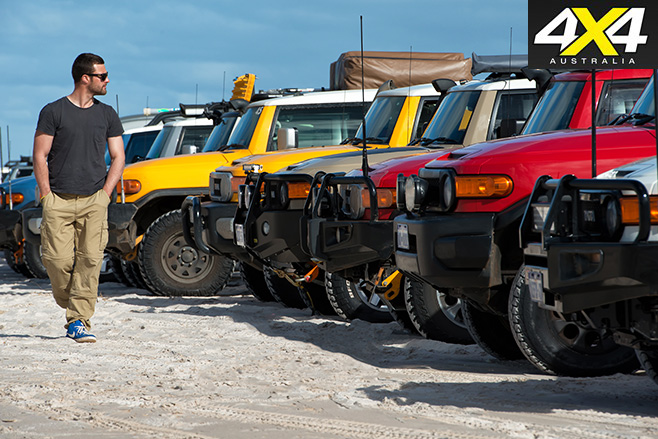
Allow me to introduce the FJ Cruiser Club of Australia, where common sense may be lacking but passion and determination certainly aren’t. When it comes to can-do attitude and a real sense of community spirit, these guys have it in spades.
While the eclectic bunch of singles, couples and families all own FJ Cruisers, each vehicle is as individual and unique as their owners. Their hardcore love of the outdoors and respect for the Aussie bush is a common bond. This is a club with a family-friendly atmosphere, camaraderie and genuine desire to simply have fun. And neither rain, hail or shine, freezing temperatures, mud or burning heat could dampen the enthusiasm of these members for their National FJ Cruiser Summit.
This year’s bi-annual national summit was held on the Rainbow Coast. During winter, when the sun is just 42 degrees above the horizon, rays stream in from the north and refract through raindrops in the air off the vast southern ocean to produce an idyllic array of rainbows. It’s a mix of spectacular sandy beaches and harsh, rugged, rocky coastline set against a backdrop of timeless karri and tingle forests on WA’s southern coast; ranging eastwards from old timber town Walpole in to historic Albany, Western Australia’s first settlement.
When planning the summit for September, the organisers – James Mandy, Troy Shortland and Gavin Gillet – were expecting typical clear balmy days and cool but comfortable nights. Certainly not what you’d consider to be a particularly testing experience. However, the weather gods had other ideas.
Halfway between Walpole and Denmark (the Australian town, not the European destination), Ayr Sailean was the perfect base for the summit, offering onsite chalets, 52 campsites and a fully enclosed camp kitchen.
As James explained: “Club members had the opportunity to explore incredible karri forests, beautiful beaches and magnificent dunes; do a spot of fishing, great 4WDing or kayaking and could plan their trip via winery regions or other scenic destinations.”
The organisers planned thoroughly, including a couple of recce trips to plot out the weekend. “All destinations had to be accessible by a factory standard FJ,” Troy confirmed.
The day trips provided every club member with the opportunity to experience the best the WA south coast has to offer, with varying degrees of difficulty and expert assistance for any less experienced 4WD jockeys.
There were plenty of activities to entertain the family, starting with a group sausage sizzle at base camp where Richard Nicholls from Adventure Offroad Training provided some handy tips on driving techniques, safety and vehicle recovery. A fun-filled quiz night on Sunday evening with awesome prizes kept everyone happy. For those who needed a rest day between 4WD adventures there were options to explore local tourist destinations, restaurants and wineries.
Despite being unable to control the weather, no-one could deny Troy, James and Gavin made a herculean effort to provide something for everyone, including plenty of 4WDing.
On Sunday, Troy Shortland led a convoy of some 30 FJ Cruisers through the Yeagarup Dunes, the largest land-locked mobile sand dune system in the southern hemisphere, approximately 20km from Pemberton.
Yeagarup Lake, at the end of Ritter Road in the Warren National Park, provided the perfect opportunity for everyone to air down and extend their tyre footprints before following a 4WD track to the constantly moving entry point of the dunes. This time it was a straight hill/dune climb up around 50m high. By airing down, the vehicle’s weight was distributed over a larger surface area, allowing the Cruisers to be driven on soft sand with little compaction.
The need to air down became apparent when a family was found with their Grand Jeep Cherokee precariously resting on its chassis rails halfway up the climb. Troy was quick to respond to the father’s distress; unstrapping the MaxTrax, a long-handled shovel and a snatch strap. Within minutes the Jeep was out and Troy provided the grateful driver with some helpful advice on tyre pressures and techniques for negotiating the troublesome soft sand.
Richard’s advice on how to correctly set up vehicles for dune driving immediately paid dividends. With tyres correctly set and controlled to moderate momentum, almost all the FJs successfully conquered the dunes on their first attempt to the cheers of supportive onlookers.
After negotiating the entry, the drive through the dunes to the Warren River is well marked and easy to follow. It’s not only safer to follow the marked route, it avoids any unnecessary vehicle access to sensitive areas. Fortunately the majority of the 4WD community respects the guidelines.
On a good day it’s possible to cross the Warren where it meets the ocean and enjoy a further drive along the beach before tackling the very long and challenging climb back out via the steep gradient of Calcup Hill, which is guaranteed to test any traction control system due to the steep, soft and deep-shifting sand.
However, the Warren River is unpredictable and, depending on the weather conditions, it can be a calm stream or a raging torrent. After several days of rain and hail the Warren looked dark and ominous, flowing at such a speed that large plumes of sand erupted through the water and carved a deep channel through the beach.
Luckily, saner heads prevailed and the team leaders put the safety of every club member first, deciding not to indulge the curiosity of those who hadn’t experienced how a sandy base can rapidly and disastrously turn into the consistency of quicksand. Unsurprisingly, the Warren crossing was a no-go zone.
The following day club members chose from a range of smaller excursions. Troy invited me to ride shotgun on the Peaceful Bay excursion. Only a few kilometres from base camp the scenery was spectacular with lots of twists, turns, climbs and dips as we followed the many 4WD trails through an ancient landscape.
Some of the sandy climbs had rubber mats (and there’s the odd wooden section), which have been installed due to track damage. With the rubber mats offering good traction, it’s unlikely you’d have any trouble traversing even some of the steeper sections.
Mother Nature had kindly topped up some of the larger hollows with long, deep puddles as we made our way down to Rame Head beach. This was nothing the FJs couldn’t take in their stride, and it provided a perfect opportunity to soak the photographer. Down on the beach, members sat back to enjoy a little sunshine after another cold, wet night, while drivers tested their skills by reading the cyclic pattern of the waves and running the gauntlet of a small beach crossing to a rocky outcrop on the other side.
James Mandy took another group to Bornholm Beach. As James explained: “This drive wasn’t for the faint-hearted, while the trails are basic and easy-going, the incredible descent to the beach is the only way in and out. Coming out of this beach will test a driver’s skill, vehicle set-up and patience. It may require tyre pressures as low as 5psi, and it has earned a position on the bucket list for most difficult beach exits in Australia.”
Gavin Gillet headed a group out to Boat Harbour. Gavin told me: “It’s an enjoyable drive, as you travel easy sandy trails lined by shady peppermint trees to make your way to the stunning location of Boat Harbour. A simply beautiful bay lined by rocky outcrops. A perfect place to enjoy a cool dip or cast a line.” Spoiler alert: keep an eye out for Gav’s rig in an upcoming edition. It’s well worth the look.
Despite very cold overnight conditions, including hail and rain that turned base camp into something of a mud pit, it was an excellent weekend with every attendee having nothing but praise for the event.
There’s also a serious side to the FJ Cruiser Club of Australia, and special mention has to go to hard-working club administrators Walter Meerza and Robert Hardpan. This is a club where members don’t take their personal good fortune, the environment, or the privilege to explore it for granted.
They work hard to engage with local businesses who donated products for auction and prizes – all to raise funds for a very worthy charity. Over the course of the summit the club raised a very impressive $9243 for the Starlight Children’s Foundation to help grant a special wish for a seriously ill child.
A huge thanks for the community-minded spirit of the many sponsors involved: ARB Wangara, Rhino Rack, Camera Electronic, Adventure Offroad Training, Spotters Sunglasses, BA Mufflers, Pussyfoot Socks, Pure FJ Cruiser, Ellis Precision, Drifta Camping & 4WD, Getaway Outdoors, Vasse Felix Wines, Toyota Insurance, Ayr Sailean, Vanos Personalised Gifts, and Redarc.
And my thanks to Troy Shortland who invited me along and allowed me the opportunity to contribute to the fundraising by donating the photographs for attendees to ‘purchase’ via contribution to Starlight.
SWAG OF PRIZES
Check out these awesome prizes and giveaways members were awarded during the summit – talk about setting the bar high for future summit meetings!
FIRST PRIZE: J. Fitzpatrick, WA ARB 60L Fridge, one year of Toyota full comprehensive insurance, BA Mufflers cat-back exhaust system for FJ Cruiser, Bushranger Nighthawk spotlights, ARB air compressor in case CKMP12, Spotters Sunglasses prize pack, MaxTrax, Vehicle Recovery Device, $300 Online Voucher from Pussyfoot Socks, and an ARB Ezy Deflator tool. TOTAL VALUE: $5301
SECOND PRIZE: B. Jacobs, WA ARB Skydive Double Swag, ARB air compressor in case CKMP12, Spotters Sunglasses prize pack, MaxTrax, Vehicle Recovery Device, $300 Online Voucher from Pussyfoot Socks, Fenix Titan XT LED light bar, and an ARB Ezy Deflator. TOTAL VALUE: $2405
THIRD PRIZE: S. Brown, SA ARB Premium Recovery Kit RK9, $300 Online Voucher from Pussyfoot Socks, Fenix Titan XT LED light bar and an ARB Ezy Deflator. TOTAL VALUE: $1156
Rhino Rack donated a Rhino Rack platform and backbone set-up specifically for an FJ Cruiser. The winning bid was C. Cheetham of Victoria for $1370.
N. Lambert of WA secured an impressive Redarc Tow Pro for a cool $220.
Ron and Viv Moon’s latest news and info from Australia’s treks and tracks
BIG BILLY BORE CAMPING AREA (VIC) The area around this historic bore and watering place has been made into a pleasant remote camping area by the Department of Environment, Land, Water and Planning (DELWP). Located on Nhill-Murrayville Road in the Big Desert State Forest, it’s a great spot for an overnight camp or as a base to explore the many 4WD tracks in the area. More info can be found at www.depi.vic.gov.au
THE MAN FROM SNOWY RIVER FESTIVAL (VIC) Held on the edge of the Australian Alps in Corryong, the Man from Snowy River Festival is a fantastic few days celebrating everything High Country. There will be plenty of horse-riding action, with cross-country races commemorating ‘The Man’. There will also be an action-packed rodeo on the Saturday night and a heap more entertainment including bush poetry, dog high-jump events and a ute muster. Held from March 30 to April 2, you can find out more at www.bushfestival.com.au
SIMPSON DESERT RE-OPENS (SA/QLD) The Simpson Desert will re-open to travellers on March 15 at 6pm. All vehicles crossing the desert must be fitted with a safety flag. It is mandatory to purchase a Desert Parks Pass to enter and camp in the Simpson Desert Conservation Park and Simpson Desert Regional Reserve. For permits go to www.environment.sa.gov.au
DEVONPORT MOTOR SHOW (TAS) Want to check out some nice cars in Tassie? Then visit the Devonport Motor Show, where a wide range of vehicles will be on display. The event will showcase hot rods, vintage and classic cars, modern and modified vehicles, and motorbikes. The show will be held on the foreshore of the Mersey River on March 26.
SAVE NINGALOO STATION (WA) The property owners who have been managing camping at Ningaloo Station for decades are still fighting with the Western Australian Department of Parks and Wildlife (DPaW), who wish to take over management of camping and implement significant changes including a very big resort-type development. To find out what is happening on this great piece of coast, go to www.facebook.com/ningaloostation
ST PATRICK’S RACES (NSW) One of the biggest and richest outback racing meets on the calendar, the St Patrick’s Day races in Broken Hill is an event you should experience at least once. This year the races will be held on March 18, but there will be plenty of fun and activities in this charismatic outback town throughout the entire week. For more details visit www.stpatricks.org.au
BURKETOWN BARRA FISHING COMPETITION (QLD) With more than $20,000 in cash, prizes and trophies up for grabs, the Burketown Barra Fishing Championships is one of the most popular in Australia, and this year’s event is the 39th annual running of the competition. Held on the Easter weekend (April 14-17) the not-to-be-missed competition will feature nice fishing and great prizes. For more details visit www.burke.qld.gov.au
LAST WEEK, Mercedes-Benz released a teaser pic of its all-new G650 Landaulet. A smartphone video soon made its way online, teasing the salivating public further. Yet, at the time, details remained scarce and questions lingered.
Now Mercedes-Benz has put some of those questions to bed by outlining specific details surrounding the open-air off-roader, as well as releasing official footage of the beast in water-crossing action.
We already knew the G650 utilises Merc-AMG’s 6.0-litre twin-turbo V12, which pumps out 463kW and has a peak torque of 1000Nm.
However, we’ve now learnt the Maybach Merc measures in at 5345mm long and 2235mm high. It has a wheelbase of 3428mm and a ground clearance of 450mm thanks to those portal axles that are familiar from the AMG G63 6×6 and G500 4×42 variants.
On the inside, the Merc features active multi-contour seats with massage functions, thermal cup holders and high-grade design upholstery with diamond stitching (two-tone and available in four trim colours).
The folding top covering the rear, single-seat passengers is electronically operated via the press of a button, while a glass partition (also button-operated) separates the front and rear seats. This glass can be changed from transparent to opaque also by the press of a button.
The G650’s aggressive appearance is enhanced via 22-inch five-twin-spoke light alloy wheels, front and rear under-ride guards and large carbonfibre wheel-arch flares. A spare wheel with integral holder for the third brake light is fixed on the right rear quarter.
Typical of all G-Class vehicles, the G650 will be produced by Magna Steyr in Graz, Austria. A limited run of 99 units has been confirmed.
The open-top off-roader will make its worldwide debut at the Geneva Motor Show, which runs from March 9-19, 2017.