
A CAMPFIRE in the million-star hotel, a good meal and comfortable bed, like-minded travellers for company, and another day ahead of good touring on rarely travelled tracks. Sound like a grand idea? Of course it does.
While some folk have nearly as much fun researching and planning the route, there are plenty of others who’d rather pack up and drive without the hassle of organising permits, working out fuel stops, and ensuring a big group travels harmoniously.
Not to mention setting up and pulling down overnight campsites, digging latrine holes, cooking meals after a tiring day, and attending to rigs that require urgent bush mechanics. On balance, the highs of a trip away far outweigh the lows, but there is a better way to organise it: get someone else to do all the hard work.
Joining a 4WD club means you can depend on a trip leader to do the heavy lifting of planning a getaway, but you’d need a fully catered tagalong tour to take care of some of the other hassles. Even then, chances are you’ll be asked to help with all the chores, as the crew will be a small group to keep costs down.
There is a third alternative: the Variety 4WD Challenge, a charity motoring event that raises money for children in need. The 2017 Variety getaway included 880km of travel in seven days through the Southern Flinders, with only about 40km on bitumen.
The route passed from Port Pirie to Spear Creek, Horseshoe Top End, down through the Clare Valley to Marrabel, and finished up in the Barossa Valley. It was designed to test the limits of a standard 4WD and provide even experienced 4WDers with some challenging sections.
Newbies need not be concerned, though, with trip leaders providing expert coaching when required and planned workarounds for the tougher terrain. There’s no need to modify your fourbie to tackle a Variety trek, but the one strict requirement is that strong all-terrain tyres be fitted.
The event not only travels with a mobile tyre support vehicle to fix and repair damaged tyres and keep your vehicle mobile, but also a fully equipped mobile workshop to tackle any mechanical issues that may arise, including dealing with damage from encounters with unfortunate ’roos.
The amazing levels of professionalism and support the officials bring to a Variety Challenge make it a smooth adventure and enable the convoy to travel through normally inaccessible terrain.
Gavin Gillett of Summit eXpeditions said, “What really impressed me was how well the organisers managed the tricky tracks. With 55 cars, I would have deliberately lowered the difficulty of the tracks to ensure we didn’t have massive delays. I break up my tours to 10 or 15 cars per trip leader and spread the load on the track out.
Variety is so well-organised they can send all 55 cars down the same track without bottlenecking, without disturbing other track users. And when there is a recovery of some kind to be made, they are very quick at getting the convoy moving again. I think the longest we were ever delayed might have been one hour for the whole trip.”
All of this sensible business acumen and professionalism means Variety has the credibility to gain access to areas that a single tourer, or even a well-organised club, simply couldn’t drive through. For this trip, Variety worked with SA Water, SA National Parks and Forestry SA, as well as private land owners, resulting in plenty of tracks that had rarely seen a tyre, let alone a convoy, before.
Guests traversed the rocky slopes of Spear Creek Station and experienced spectacular views as they scrambled up Mount Horrocks, stopping for an ice cream at a spectacular waterfall hidden away on private property. The unique route through Mambray Creek to Horrocks Pass along locked fire tracks provided a once-in-a-lifetime opportunity to enjoy breathtaking views across the Spencer Gulf.
So, the Variety Challenge entails unique terrain and a well-equipped convoy, but what else makes it an ideal camping trip? Firstly, let’s deal with the camp set-up. Not only is the campsite fully set up by the service teams, who erect huge marquee tents and arrange dining tables and chairs, but it’s complete with mobile off-road trailers with hot-water showers and flushing toilets.
Every night kicked off with a complimentary happy hour of drinks provided by sponsors, followed by gourmet food prepared by expert chefs – think crayfish, oysters, giant prawns and succulent 600g rib-eye steaks.
Given guests were similarly well fed at breakfast and lunch – as well as morning and afternoon tea – it’s a good thing most nights included dancing to the live tunes of John O’Dea, Antonio Villano and Kate Lara. Side-splitting laughter, thanks to comedy acts like the cheeky Mikey D, also helped burn off calories.
It’s no wonder plenty of guests are repeat offenders – some had even participated in up to 20 similar events! Entire families get involved, and multiple generations come along with two goals: to have a great time and to raise as much money as possible.
Variety does plenty of work to make fundraising as easy as possible: they organise an army of volunteers to act as the service teams to manage campsites; most of the professional folk donate their time and expertise; sponsors provide food and drinks; and landowners, like Jim and Terese Connell of Horsehoe Top End, donate the usage of their property for campsites.
Auctions offer everything from wine, helicopter rides and luxury holidays, to a cardboard tube turned into a “didgeridoo” and signed by all participants.
When the Barossa/Gawler Historic Car Clubs chauffeured everyone to a final dinner, it was announced this year’s event raised $577,000 (net) for children in need – the second highest amount in the event’s 23-year history.
FOR the first time ever, you can buy a Range Rover Sport with a four-cylinder engine – a diesel in this case.
Up until now, it’s been all V6 and V8 turbocharged diesels and supercharged petrol engines, and never a four of any description.
The four-cylinder diesel in question is an Ingenium, one of a new family of high-tech diesel and petrol engines developed for Land Rover, Range Rover and Jaguar vehicles. This four-cylinder diesel is just two litres in capacity, but claims 177kW and 500Nm.
Those numbers better the 147kW/470Nm of the 3.2-litre five-cylinder diesel in the Ford Ranger – an engine that’s more than 50 per cent bigger – and even the 151kW/430Nm of the 4.5-litre V8 diesel used in Toyota’s 70 Series – an engine that’s well over twice the capacity.
Part of its secret is the use of two sequentially deployed turbochargers; although, the VW Amarok also has a 2.0-litre four with two turbos and it claims 132kW/420Nm, still well short of the Ingenium.
What’s also surprising is that this little four doesn’t need extreme engine speeds to make those strong numbers, with its maximum torque already on tap by 1500rpm and peak power achieved by 4000rpm.
More pertinent than the question of how successful it will be in the Range Rover Sport is its effectiveness or otherwise in powering the all-new Land Rover Discovery. This 2.0-litre four will be the new Discovery’s default engine, at least if you want dual-range gearing, with the 3.0-litre V6 diesel being moved up to premium duties.
So, the power and torque numbers look great on paper, but how does it all stack up? Well, in a word, this engine’s a ripper. Asked to give its best, it’s keen and energetic and has a growl quite unlike a four, especially at wider throttle openings. Unless you were forewarned, you wouldn’t know you were driving a four on performance, feel or sound.
Aided by its eight-speed automatic, it will propel the 2100kg RRS from a standstill to 100km/h in just over eight seconds. That’s pretty brisk. More importantly, it provides handy highway overtaking power, even if it doesn’t quite have the shove in the back of the 190kW/600Nm 3.0-litre V6 diesel it replaces at the bottom end of the RRS range.
In general driving, it’s effortless and quiet; although, it will pick up a lower gear under load a bit more readily than the V6, and it generally likes to have more revs on board to do the same job. Thankfully the eight-speed automatic offers slick and quick changes and the engine remains super smooth regardless of rpm, one of the benefits of a small-capacity four fitted with balance shafts.
Of course, many people won’t like the idea of a smaller capacity engine doing the job of a bigger capacity engine, but that’s the way of the future. Will longevity and reliability be compromised? Perhaps, but that will depend on how strongly these engines are built.
DOLLARS AND SENSE
AT $90,990 (plus on-roads) the SD4 S is the least costly of the 13 Range Rover Sport models. However, our test vehicle came with $20K of options, the most useful being the $5500 Off Road Pack comprising dual-range gearing, height-adjustable air suspension and active dampers.
Numerous convenience features such as keyless entry and a panoramic sunroof account for another $9K, while the 21-inch wheel/tyre package (in place of the standard 19s, and the least useful option) adds just over $4K.
RANGE ROVER SPORT SD4 SPECS Engine: 2.0-litre 4-cyl bi-turbo-diesel Max power/torque: 177kW/500Nm Gearbox: eight-speed automatic 4×4 system: dual-range full-time Kerb weight: 2115kg Towing capacity: 3500kg Fuel tank capacity: 74 litres ADR fuel claim: 6.2L/100km Test fuel use: 8.5L/100km
OLD Andado Homestead is a great spot right on the very edge of the Simpson Desert, where you’ll find big dunes to the west and east.
Part 4: Old Andado Homestead
If you are heading to Central Australia from the south (or heading that way home), you can head to the remote Old Andado Homestead from Coober Pedy via Oodnadatta and the friendly M Dare Hotel, which is quite an adventure in itself.
Or, if you are already in Alice Springs you can do a great loop drive of a few days taking in the delights of the desert to the south-east of the ‘big smoke’.
At Mt Dare and nearby delightful Dalhousie Springs (you’ll need a permit to visit the latter) you start on the Binns Track as you head north.
From Mount Dare, the 105km route is easy enough to follow but sections can be deep in bulldust – this is remote country, so you need to be prepared. Once at Old Andado, throw down the swag or set up the camper.
There’s a lot of history here dating back to the 1920s when the homestead was first built. But it is the story of the legendary and late ‘Molly’ Clark that the homestead is best known for.
And once you’ve been there, you will be enthralled by the story and the heritage of this unique place.
From the old homestead, you head north paralleling a great dune of the desert for quite some way; it’s a memorable drive. It’s over 300km to Alice Springs from here, passing the Aboriginal settlement of Santa Teresa; a community renowned for its dynamic artwork.
More info: www.mtdare.com.au; www.oldandado.com.au
The Davenport Ranges and the national park of the same name are located east of the Stuart Highway, 380km north of Alice Springs.
Part 3: Davenport Ranges
The main access road to the ranges, just north of the small hamlet of Wauchope (Northern Territory), is pretty good gravel for the first 120km or so. However, as it swings south and begins to pass through the Davenport Ranges, it degenerates to a rocky, sometimes eroded route which is part of the more adventurous Binns 4WD Track.
The ranges form the transitional zone between the wet Top End and the drier region of Central Australia and are an important refuge for animals, especially waterbirds and the seven species of fish that inhabit the numerous waterholes found here.
Aboriginals have long lived here and depended on the region for water and food. Europeans first came to the area in the 1860s but it wasn’t until 30 years later that any pioneers tried to settle the region – resistance from the local Aboriginal clans drove them out.
Miners came to this area in the early 1900s and by 1914 the Hatches Creek wolfram mining area was the most important with a short lived police post being established in 1919. The miners left as the price of wolfram plummeted after the end of World War One, only to be revived by World War Two.
By then, pastoral development had seen a number of cattle stations established in the region. Today, the four Aboriginal groups that have long called this region home help manage the park as well as operate some of the cattle stations surrounding the reserve.
About 70km from the Stuart, a track heads south from the access road into the northern edge of the mountains at Whistelduck Creek. There’s a camping area close to the creek while a short distance away, Irrmweng Rockhole is an enjoyable day-use area that often abounds with waterbirds. Wandering around the creek, you are bound to see red kangaroos and euros as well as wild donkeys and horses.
The most popular camping area in the park can be found at Old Police Station Waterhole on the Frew River. To get away from the crowds along this delightful stretch of water you can take the Frew River 4WD loop track and while rough, this leads to a number of small bush camps along the water-hole studded stream.
Further south along the main track (part of the Binns Track) you will approach Wolfram Hill and the original settlement of Hatches Creek. The Pioneer Wolfram Mine – the biggest mining concern in the area – litters the area with its big obvious steel headframe complete with cables and cages, winch winding gear, ore dumps, settling pits and debris from the crushers and refining process.
The Binns Track skirts alongside the headwaters of the Frew River and before leaving the ranges, passes close to a small waterhole which makes for a good camp often missed by travellers. From here the track swings west, skirting the southern ramparts of the ranges and passing Murray Downs homestead before reaching the Stuart Highway, south of Wycliffe Well.
FOR THE control freaks among us who like to select our own gears rather than let a computer do the thinking, there is one extremely important driveline component that needs to be treated with a great deal of respect and mechanical sympathy: the clutch.
Your vehicle’s clutch not only allows for engagement (and disengagement) between the engine and the gearbox, but it also dampens engine pulses to provide a smooth and consistent power delivery throughout the driveline.
If your vehicle’s OE (original equipment) clutch starts slipping or wears out prematurely, chances are you’re not treating it right or it’s simply not up to the job you’ve assigned to it.
In most cases (although, not always), vehicle manufacturers equip four-wheel drives with a clutch that’s adequate for said vehicle’s intended function, such as day-to-day driving, some off-road driving and some towing.
But manufacturers rarely take into account that off-roading enthusiasts usually take things to the next level: fitting bigger tyres, carrying accessories and gear, chipping the engine and fitting an exhaust, and dragging around a trailer that’s within a few grams of maximum stated towing capacity.
Do any of the above and you’ll soon find your vehicle’s standard clutch is left wanting, and whether it’s slipping, smelling or squeaking, it’ll need to be replaced before it fails completely. Rather than source another OE clutch, you’ll need to fit a heavy-duty aftermarket unit to cope with the additional demands that are a by-product of heavy loads, more torque or -towing.
AFTERMARKET ALTERNATIVE
ADELAIDE-BASED company Australian Clutch Services (ACS) has been supplying clutch kits and components for more than 25 years, and it offers a wide range of aftermarket heavy-duty clutch kits to suit most four-wheel drive vehicles on the market, under the Xtreme Outback banner.
“There are several advantages of fitting a heavy-duty aftermarket clutch over an OEM clutch,” said Stewart Furze, mechanical engineer at ACS. “In 4×4 applications – where you may be modifying the vehicle, you may be increasing power, you may be adding a lot of extra weight or towing – most of those users are going to be using the engine to its peak performance a lot of the time.
For example, when you’re towing, you’re going to be using the peak torque of the engine a lot more than you would be if you were just driving the kids to school. So, in those situations, that’s when the OE clutch may not last as long as you would expect.”
In those situations you’re likely to experience an accelerated rate of wear and the clutch will begin to slip. “A good example is the VDJ79 [Land Cruiser]. As soon as owners chip or tune them, the factory clutch just doesn’t hold the extra torque… so it’ll just slip straight away. In other instances, owners might just see an accelerated rate of wear to the point where it starts to slip after a couple of thousand kilometres after doing modifications.”
So why can’t an OE clutch cope with the demands of increased torque output or heavier loads?
“Generally it’s a lack of clamping force,” he said. “It’s also the extra heat that’s generated, which will accelerate wear. Any excessive heat, or harder engagement, or even riding a clutch because you’ve got more weight, that all generates heat, which will accelerate how quickly the clutch will wear.
“And if it starts to slip, that means that basically the clutch is either completely worn or it just does not have the clamp load required to carry the torque.”
CLUTCH DEVELOPMENT
AUSTRALIAN Clutch Services has an in-house R&D facility that provides it with the resources to analyse new friction materials and evaluate spring rates to obtain the optimal combination of performance, noise suppression and durability. When ACS sets about developing a range of heavy-duty clutch kits to suit a specific vehicle, its engineers first examine the specifications of the OE clutch.
“Our first port of call is making sure we know exactly what’s supplied by the factory,” said Stewart. “So we have a look at the specifications… to ascertain exactly what it will have. For example, 800kg of clamping force.
“As a general guide, most of our first stage [heavy-duty] kits offer around a 20 to 30 per cent increase in clamping force. So that’s our first goal: how can we achieve a 20 to 30 per cent increase in clamping force? The majority of our customers are only going to go for that first level of modification.”
Despite this increase in clamping force – designed to handle the extra torque produced by a modified engine and the additional stresses imposed on the driveline by heavy towing or extreme off-roading – ACS strives to retain drivability by ensuring pedal effort is not excessive, as well as ensuring the clutch has a nice, progressive feel.
“We try to optimise the operation effort,” Stewart continued. “We try to keep it as close to factory as possible. We also look at different friction materials and flywheel options. A lot of 4x4s have dual-mass flywheels, and in order to create heavy-duty options we need to create a single-mass flywheel conversion at the same time.
“Dual-mass flywheels are put into vehicles for a few reasons,” he said. “The main reason is noise suppression, and the other key one is driveability. More and more, the manufacturers are being pushed to offer smoother, quieter, more efficient cars that pretty much anyone can get into and drive without stalling them.
“A dual-mass flywheel does a very good job of softening up all of those factors… but as soon as you start to modify a vehicle, in ways that 4×4 owners do, that’s one of the components that doesn’t tend to last with extra power and extra towing.
“So every time we look at a single-mass flywheel conversion for any vehicle, we have to look at all of the parameters: the type of engine, the mass of the OE flywheel and pressure plate, and assembly, and we try to match that, because the mass of those components plays a significant part in noise suppression. But probably one of the key factors is the actual friction disc that we supply.
“We always try to have an idle rate, wide angle damper disc. That’s the best way of absorbing the noise and vibration that you get from the engine and transmission, which would normally be absorbed by the dual-mass flywheel,” Stewart explained.
“With any modification, whether it’s a suspension lift, whether it’s big tyres, whether it’s adding racks and bullbars and things like that, there’s always going to be something to counteract that modification…
“So if you’re fitting bigger tyres that have a mud pattern, they’re going to be noisy; if you’re lifting the car then it’s potentially not going to be as stable or smooth as it was from factory… So there’s always a compromise.
“And with clutches, if you’re adding a heavy-duty clutch, sometimes that compromise is as simple as a 10 per cent increase in pedal effort, and with a single-mass flywheel conversion sometimes that’s a small increase in NVH (noise, vibration and harshness) that can come through the cabin.
“But, generally, we always try to design the clutch in such a way that most people will hardly even notice a noise increase.”
CLUTCHES FOR COURSES
ACS OFFERS a variety of heavy-duty clutch kits to suit different applications, from those who drive unmodified vehicles through to those who want to go off-road racing.
“In four-wheel drive, we have several different levels depending on vehicle modifications and the type of use that the vehicle sees,” explained Stewart. “We cater for everything, from a person who might have a Nissan Navara or something similar and he’s a tradie who tows every day, to someone who’s actually going to go rock crawling.
“Generally, the first stage is just an increase in clamping force, with an original-style organic friction disc, and is something that will drive very similar to a stock clutch.
“The second stage is what we call an extra heavy-duty. So it’s a second increase in pressure plate camping force, still with an organic disc for drivability but a little more increase in pedal effort.
“And then you jump into the ceramic friction material. We have what we call a cushioned ceramic disc that still provides a small amount of drivability, but it can have a small increase in shudder and a small amount of pedal effort increase…
“Or we go straight to a button disc, which is normally something that guys who are doing a Dakar-type rally would be using,” Stewart said. A button disc is essentially a friction disc, which still has a sprung centre, but on which is riveted several sintered friction pads.
“Normally it’s five or six paddles in something like a 4×4, and we call that a button disc or a paddle disc. They’re normally used for competition-type stuff; it’s not the sort of thing that most people would find comfortable to drive every day.
“But if you’re in a competition or something like that, comfort is not one of the primary factors you’re looking for.”
COMPLETE KIT
WHEN you buy a new heavy-duty clutch kit from ACS, it comes with everything you’ll need to fit it to your vehicle.
“We pride ourselves on supplying all of the required components with every clutch kit; all of the hardware and data for most mechanics to be able to fit the clutch kit confidently, without having to go back and get extra components,” said Stewart.
“In our heavy-duty kits, we always try to supply an alignment tool, if required, to help centre the clutch when installing it. We always try to offer a pilot bearing, a new thrust bearing, and basically offer all of the components that are required to ensure the fitment of that kit goes right the first time ’round.”
“We also supply technical documents that specify any torque settings and anything like that which is critical to fitment. Even things like spline grease, we supply that to ensure people are actually lubricating the spline correctly on the gearbox, and also the release bearing.”
SERVICE LIFE
JUST because you’ve fitted a heavy-duty clutch to your vehicle doesn’t mean it will outlast an OE clutch, but it will still do a much better job.
“Every different product and every different vehicle is going to have a different service life, but I would say that if you’re some level of enthusiast and you have some level of mechanical sympathy, you should be able to achieve 40,000 to 50,000km out of a heavy-duty clutch when using it in a heavy-duty application,” advised Stewart.
“A heavy-duty clutch doesn’t necessarily mean the product will outlast an OEM product for service life; what it does mean, though, is that it will do the job that the OEM product hasn’t been able to do.
“If you put a factory clutch in and it doesn’t hold the torque, and then if you put in a heavy-duty clutch and it does hold the torque, that’s the job of the heavy-duty clutch, to actually outperform the OEM one but not necessarily outlast it.
“Most people understand they need a heavy-duty clutch when they’re going off-road, because the factory ones do fail, but they don’t necessarily understand why.
What we see more and more is the safety factor built into an OE clutch is not necessarily up to the aftermarket modifications that people are making on their vehicles, so that’s sometimes where our product comes into play, because the factory units just don’t last when owners put on all the extra weight and/or increase the torque.”
KEEPING IT COOL
STEWART said a small amount of mechanical sympathy is the best way to look after and extend the life of your vehicle’s clutch.
“You can really abuse the hell out of a vehicle, but if you take it back to 80 to 90 per cent when you’re off-road, and you’re not just ramming the vehicle over things, then you can save components,” he said.
“When you relate that to clutches, anything that generates a significant amount of heat is also going to generate a significant rate of wear. So if you’re riding the pedal trying to get up a hill, rather than engaging low-range and being completely off the pedal, that’s obviously a bad thing.
“Other things that can cause problems for 4×4 owners are dust or mud or moisture getting into the bellhousing. That can get into the clutch itself and can dry up the release bearing, the pilot bearing, the friction disc… and then you end up with squeaking, premature thrust bearing failure and things like that.
“So going through a creek and completely flooding the bellhousing; that can cause the clutch to slip and become contaminated with muddy river water. We have examples where people may not have put a boot back on to the clutch fork when they’ve reassembled everything inside the bellhousing, and now there’s dust and mud getting in there,” Stewart said.
“But anything like that where you get contamination inside the bellhousing, that’s definitely going to prematurely wear and damage the clutch.”
EVERY off-road tourer worth its salt should be fitted with a decent winch.
A winch is a non-negotiable recovery tool in any 4x4er’s arsenal, so we’ve assembled seven top-quality 12-volt winches and put them through a stringent testing process to find a winner.
The seven contenders are: Warn Zeon 10-S, Warn Magnum 10K-S, Sherpa Mustang 9500, TJM Torq Winch 9500, Thunder 9500, Bushranger Seal 9.5TH, Runva EWX 9500-Q.
Both of the Warn winches have on-paper ratings of 10,000lb, while the rest of the field have ratings of 9500lb. The winches range in prices from $815 to $2163.
Watch the video to get an insight into the method, process and strategies we utilised to thoroughly (and safely) test each winch.
Which winch is best? The winch comparison can be read in its entirety – specs, stats, processes and results – by picking up a copy of 4X4 Australia’s September 2017 issue, in stores now.
THIS instalment features a bunch of nicely modified metal, from weekend tourers to a few rock crawlers.
Send us photos of your 4×4 to our Facebook page – it could end up on the cover of 4X4 Australia one day!
2015 FORD PX RANGER – JOSH BARTLETT
It’s got TJM bar work, 285/70/17 Mickey Thompson ATZ tyres, and a drawer set-up in the tub with a second battery. Plus, it’s had a 2-2.5in suspension lift. Moreton Island would be the best trip I’ve done in it so far.
2014 VOLKSWAGEN AMAROK ULTIMATE – FELIX KO
I’ve had it since 2015. Mods are: ARB Sahara Bar; ARB Intensity AR32 and AR40 lights; STEDI fog lights on bar; Warn winch ZEON Platinum 10-S; ARB sidesteps; Kaymar rear bar with wheel carrier; ARB Ascent canopy; 55L water tank in tub; Outback Solutions’ drawers and fridge slide; Rhino Pioneer roof rack with four roof lights; ARB awning; PWR intercooler; HPD catch can; Crispmods intake; CouplerTec rustproofing; Delta 18in wheels; Cooper ST Maxx tyres (33s); 3in Manta exhaust; TJM snorkel; ARB bash plates; ECU tune by Euro Car Upgrades; GME XRS connect; chopping board on tailgate; ARB twin air compressor; Redarc BMS; Long Ranger auxillary tank; Outback Armour Expedition coils (front suspension); diff drop kit by Roadsafe; Marks 4WD upper control arms; OME rear leaf springs rated to 400kg; recovery point by Net 4×4; and a Diesel Care fuel filter. I’ve taken it to Bribie Island, Moreton Island, Reedy Creek, Land Cruiser Mountain Park, Coffs Harbour, Glasshouse Mountains and Fraser Island. The best place is Fraser.
2012 TOYOTA FJ CRUISER – BRAD ASTELL
I bought the FJ brand new in 2012 with the intention of doing some 4×4 touring. Mods include Old Man Emu suspension, long range fuel tank, dual batteries, rock rails, bullbar, light bar and a 12,000pound winch. We took this picture in outback NT in Albert Namatjira’s backyard.
2012 NISSAN GU PATROL ZD30 – KEVIN COOKE
I’ve had it for 2.5 years and it was stock when I bought it. I’ve added a 2in Old Man Emu lift, 3in Manta exhaust from Turbo Back. ECU tune, Kings winch, rear drawers, Redarc DC/DC charger, dual batteries, roof rack, and BFG KO2 tyres. The best thing about living in the Pilbara is that there are plenty of nice places to take it.
2003 JEEP TJ WRANGLER – LIAM KELLY
I’ve had it around a year now and it’s fairly standard. It has a 2in lift, 31in all-terrains, an upgraded aluminium radiator, a snorkel and a UHF radio. I haven’t had it out as much as I’d like, but Wilbinga just north of Perth is my favourite location. It has twisty tracks, hill climbs and decent fishing if there’s not much seaweed around.
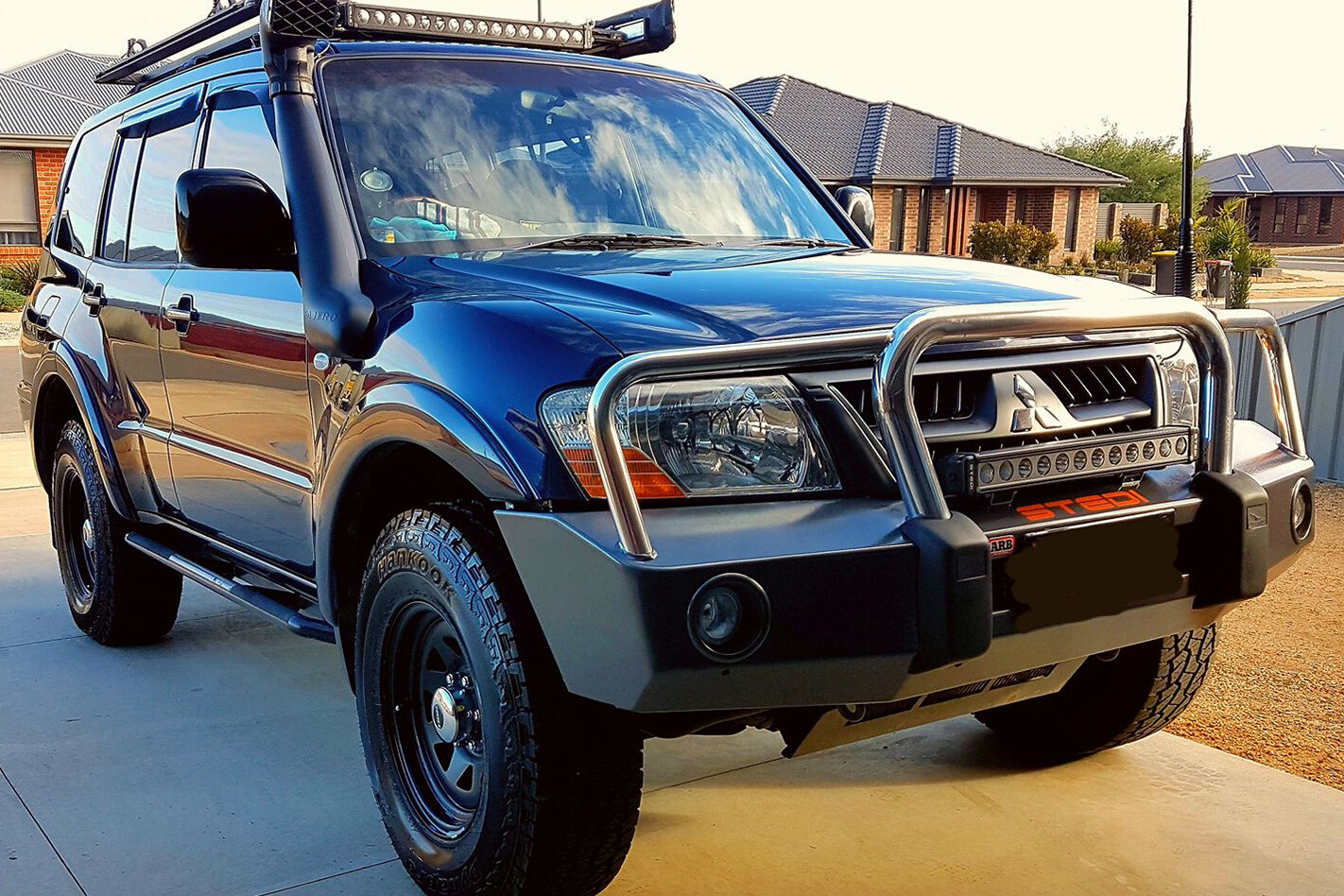
2005 MITSUBISHI PAJERO GLX 3.8 – TIM WRIGHT
I’ve had it for 2.5 years now. Mods are: 2in lift, 32in all-terrains on ROH steelies, rear airbags, drawers, fridge, cargo barrier, snorkel, bash plates, Rhino Roof tray, light bars, awning, rock sliders, DVD screen, and AutoMeter gauges. The best place I’ve taken it is from Buckland Spur Track in the Vic High Country down to Tomahawk hut.
THE next instalment to Ron Moon’s must-see spots of the Red Centre is a four-wheeler’s paradise: Owen Springs Reserve.
Part 2: Owen Springs Reserve
THE 1570km² Owen Springs Reserve is located south and west of Alice Springs and is a favourite for four-wheelers wanting to get away from the crowds.
Surprisingly, considering how easy it is to access, we’ve always found it pretty quiet with few other travellers around.
The southern access is off the Stuart Highway about 65km from Alice, while the western access is 50km from Alice along Larapinta Drive.
The main 4WD track through the reserve closely follows the original route of John McDouall Stuart’s explorations through this region in 1860-1862, which opened the area up to European pastoral settlement. His route and today’s 4WD track skirts along the edge of the Hugh River, which is one of the major but still ephemeral streams of Central Australia.
From the southern access point, the Hugh is met just four kilometres from the blacktop while Redbank Waterhole, probably the most popular camping spot in the reserve, is found just two kilometres south. The main track crosses the Hugh and wanders north via 8 Mile Yard before passing through Lawrence Gorge, a convoluted gap in the Waterhouse Ranges. Camping is allowed along the river through Lawrence Gorge but don’t expect any facilities.
On the northern edge of the Waterhouse Ranges are the ruins of the old Owen Springs Homestead. Originally built in 1873, the building here was the first homestead built in Central Australia. Some of the great pastoral pioneers who owned this property include Sir Thomas Elder (late 1880s), Sir Sidney Kidman (1896-1901) and the Hayes family, who first bought the property in 1907, sold it in 1930 and re-purchased it again in 1936.
The property was taken over by the Northern Territory parks service in 2002.
The track to the north crosses the Hugh River once again and then wanders across the plain before re-crossing the dry river and soon reaching the bitumen of Larapinta Drive. Along the way you’ll see ’roos and the occasional dingo, while birdlife of all sorts commonly hang around the waterholes. Bushwalking near Haunted Tree Bore and among the Waterhouse Ranges is particularly enjoyable but remember this is a hot, dry region so be prepared.
More info: https://nt.gov.au/leisure/parks-reserves/find-a-park-to-visit/owen-springs-reserve
THE Toyota Hilux has bucked the monthly 4×4 sales trend by knocking the Ranger from the throne it has occupied since January, 2017.
The last time the Hilux was atop the monthly 4×4 sales charts was in December, 2016, highlighting the dominance the all-new Ranger has had on the 4×4 market.
With five months left, there’s plenty of time left for the Hilux to reclaim top spot in the year-to-date race (it trails the Ranger 4×4 in YTD sales by 1248 units).
The Mitsubishi Triton has solidified its position on the 4×4 sales chart podium and remains the third best-selling 4×4 on the market, a position it has held for two consecutive months. While the Toyota Prado and Holden Colorado round out the top five.
According to the VFACTS report, the 4×4 LCV market was up 2.2 per cent compared to July 2016, while overall LCV sales have shown a 4.8 per cent year-to-date increase.
Overall, it seems Australians can’t get enough fresh metal, with July 2017 the third successive month of record gains. And the July result means the industry is on track for another record-breaking year.
Tony Weber, Chief Executive of the Federal Chamber of Automotive Industries, said: “This July figure demonstrates the industry’s ability to deliver products which are not only good value, but cater specifically for the changing needs of Australian customers.”
On the overall market, the Toyota Hilux (4×4 and 4×2) was the best-selling vehicle in July with 3742 sales. This was followed by the Corolla (3208), Ranger (4×4 and 4×2; 3076), Mazda3 (2466) and Camry (2385).
u00a0 | 4X4 | JULY 17 | JUNE 17 | YTD |
1 | Toyota Hilux | 2802 | 3938 | 19,942 |
2 | Ford Ranger | 2627 | 4449 | 21,190 |
3 | Mitsubishi Triton | 1324 | 2657 | 11,642 |
4 | Toyota Prado | 1217 | 1971 | 9874 |
5 | Holden Colorado | 1105 | 2180 | 10,708 |
6 | Toyota Land Cruiser Wagon | 1041 | 1255 | 7492 |
7 | Isuzu D-MAX | 854 | 1743 | 6981 |
8 | Nissan Navara | 725 | 1934 | 8098 |
9 | Mazda BT-50 | 707 | 1124 | 5453 |
10 | Toyota Land Cruiser PU/CC | 672 | 915 | 4814 |
IT’S THE last month of winter, and snow is still falling in most ski fields of the southern states.
So, before spring and warmer weather arrives, load up the fourbie for a winter retreat to Australia’s alpine regions. Whether it be Thredbo, Hotham or Buller, it’s imperative your 4×4 is ready to tackle snow and ice, as an ill-prepared vehicle can often result in a nasty accident.
“It is snow-chain season, and you have to have snow chains that fit your 4×4, not just chains,” Piranha Off Road said in a statement. Piranha Off Road has a range of snow/mud chains to suit a variety of four-wheel drives, catering for wheel sizes that range from 15 inches to 22.5 inches.
Piranha Off Road chains are made of nickel chromium manganese high strength steel to ensure the highest of qualities, and the diamond pattern of the chain is designed to maximise traction on highly slippery surfaces.
Fitment of the chains is a simple process, but be careful of suspension modifications that may alter clearance on front tyres or IFS models that limit clearance to a 4WD snow chain. It may mean the chain will not fit at all. With the chains fitted, a maximum speed limit of 40km/h is strongly advised.
VicRoads outlines the following rules regarding snow chains: 1. A person in charge of a vehicle who enters an alpine resort must at all times during the snow season, carry wheel chains suitable to be properly fitted to that vehicle 2. An authorised officer may, at any time, for reasons of safety or for the control or protection of an alpine resort, direct a person in charge of a vehicle to ensure that wheel chains are properly fitted to the drive wheels of that vehicle or, in the case of four wheel drive vehicle, to either the front or rear wheels of that vehicle. 3. A person in charge of a vehicle entering or in an alpine resort during the snow season must, when directed to do so by an authorised officer under sub-regulation (2), ensure that wheel chains are properly fitted to the vehicle in the manner directed by that officer.
A vehicle fitment guide is available from the Piranha Off Road website.
To view the complete range of snow chains, visit: http://www.piranhaoffroad.com.au/product/recovery/snow-mud-chains-4wd
Prices start for Piranha Off-Road’s range of snow/mud chains from $200.