GEAR! That one word gets every off-road tourer excited. It means many things to many people, but the end result is the same: driving a 4×4 with all the essential accessories fitted to it means there’s nowhere you can’t take yourself and your family on an adventure.
We are definitely spoilt for choice here in Australia, with some of the world’s best aftermarket companies based here and producing high quality kit for off-road vehicles.
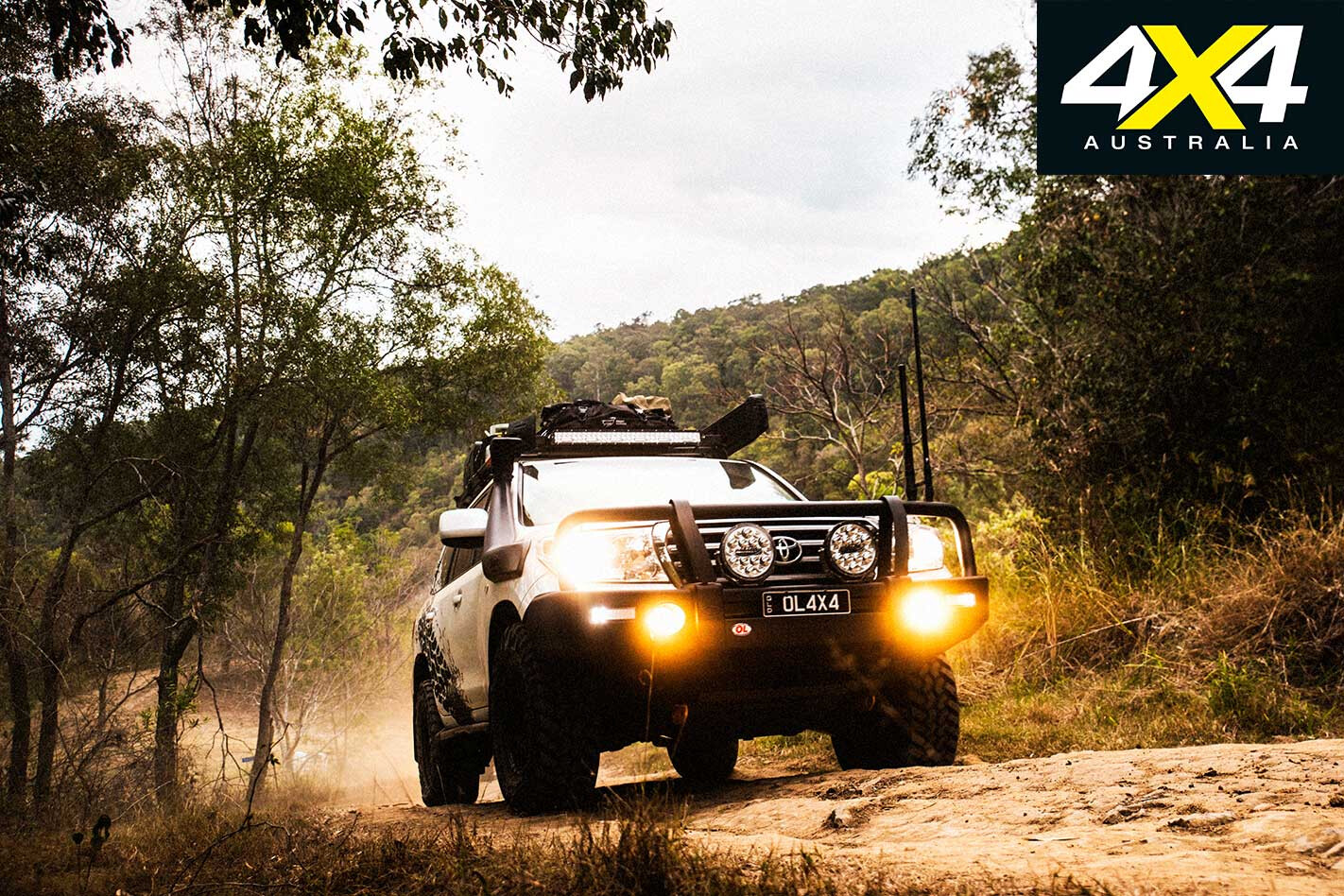
Not only do these companies build top-notch stuff, they ensure it is safe for the end user and it complies with the relevant regulations governing this – as we explain in this Gear Guide’s feature story on what goes into making gear that is legal and compliant with regulations.
For us here at 4X4 Australia, the sheer volume of gear available means plenty of real-world testing – itself a great excuse to get out in the bush. Our experts’ decades of extensive touring and testing experience has resulted in yet another cracking Gear Guide, with this one chock-full of expert advice and concise reviews as a result of all that time spent testing it out in the field.
For our readers, this Gear Guide is a veritable goldmine of info and allows you to then make the smartest decision possible as to what awesome piece of equipment gets fitted to your rig. Once that decision is made, the fun begins: kitting out a vehicle for that long-dreamed of adventure and then simply getting out there.
The 2019 Gear Guide is available just in time for Christmas, from December 17. Enjoy!
WHAT’S INSIDE?
– Top 10 touring essentials – Vehicle compliance guide – Off-road tyres buyers’ guide – LED lights buyers’ guide – Copped Y62 Patrol – Custom D-Max – Modified LC200 – Mega winch test – Best products of 2018 – Compressor comparison – Radiator tech explained – Product tests – Industry insights – Heaps more…
MITSUBISHI celebrates 40 years of its popular Triton ute, with its 2019 model featuring revised exterior styling, a tweaked 4×4 system, and equal best-in-segment safety and driver assist tech.
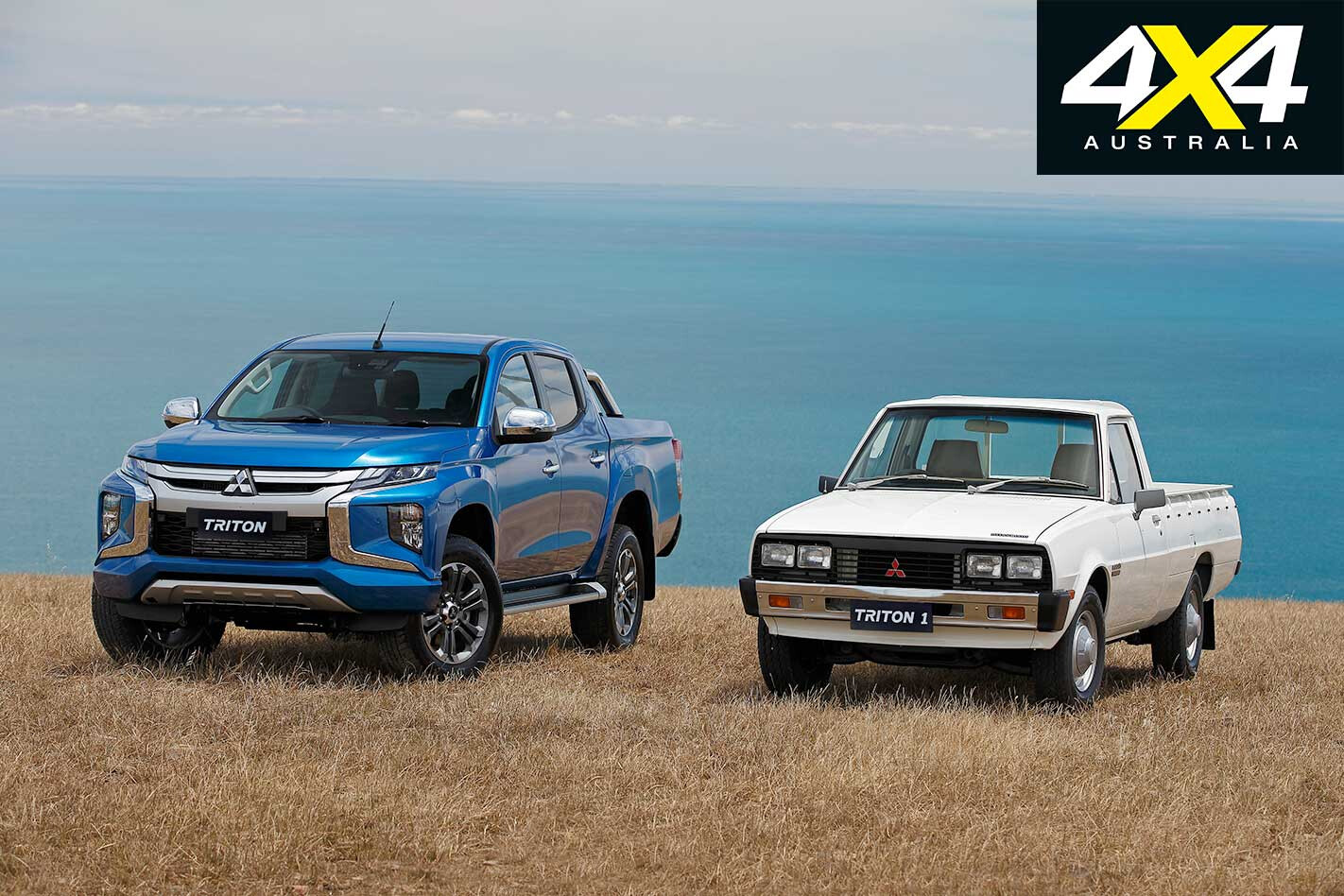
Alongside these updates the Triton carries over the 133kW/430Nm 2.4-litre turbo-diesel engine of the current model (with some weight savings, courtesy of a die-cast aluminium cylinder block) and the six-speed manual, but ups the ratio count by one for auto buyers, with a new six-speed self-shifter now available, complete with a taller final (sixth) gear ratio.
You can also still get a petrol Triton, in single-cab 2WD form, powered by Mitsi’s 94kW/194Nm 2.4-litre four. The MY19 Triton is spread over 19 models, with 16 of those 4×4 versions, and with three body variants: single-cab/chassis, club cab, and dual-cab.
Underneath, the same well-proved underpinnings can be found. Independent coil spring front suspension is matched with a live-axle leaf-sprung rear that now sports dampers of a larger diameter (coil spring settings have been revised for MY19 as well).
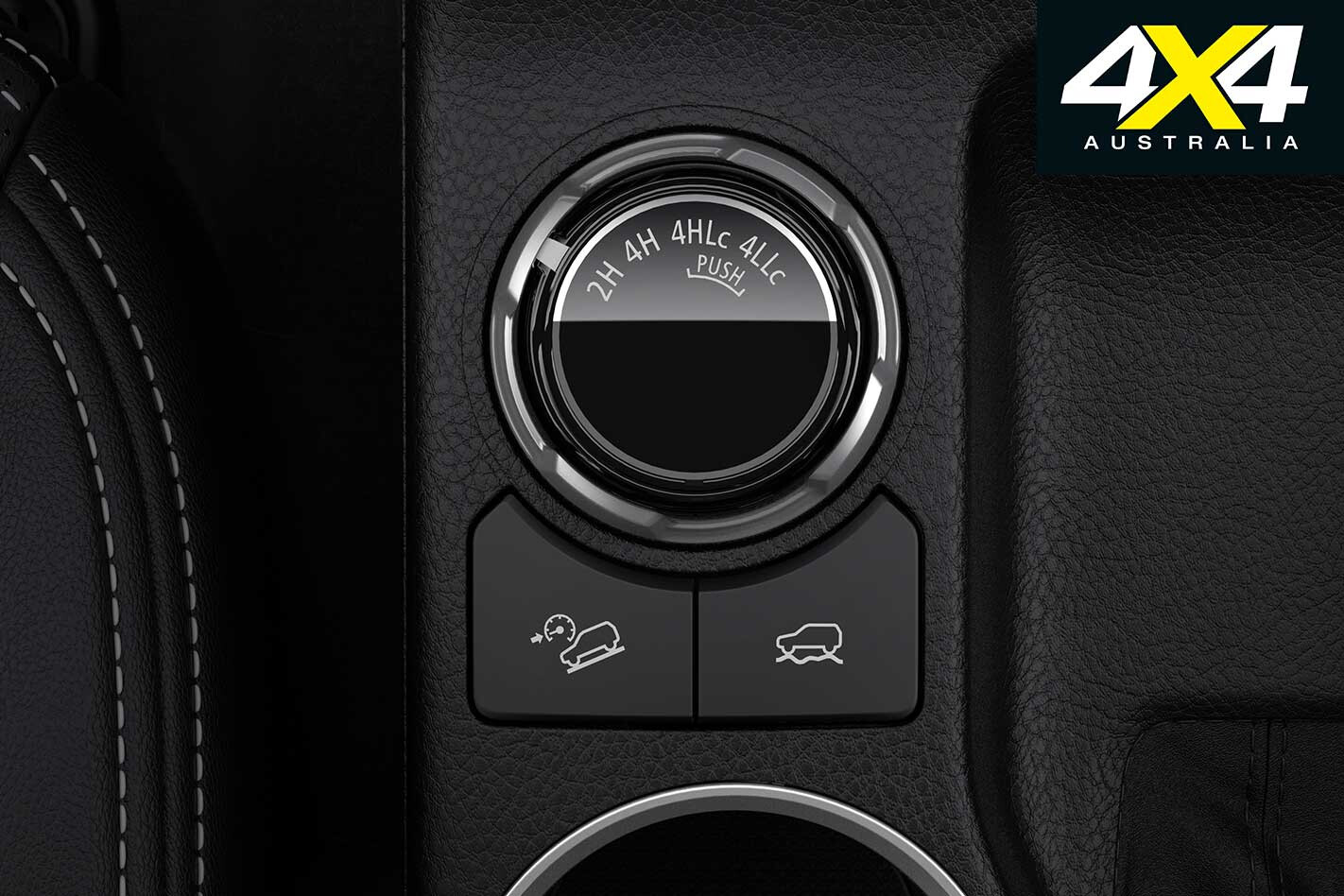
Triton’s unique offering of constant 4WD on sealed surfaces – via its Super Select II system – continues, albeit only in top-spec GLS and GLS Premium (other models make do with a part-time 4×4 system). Super Select 4WD II now features off-road drive ‘modes’ (gravel, sand, mud/snow and rock). The GLS Premium is the only Triton variant to offer a rear diff-lock as standard.
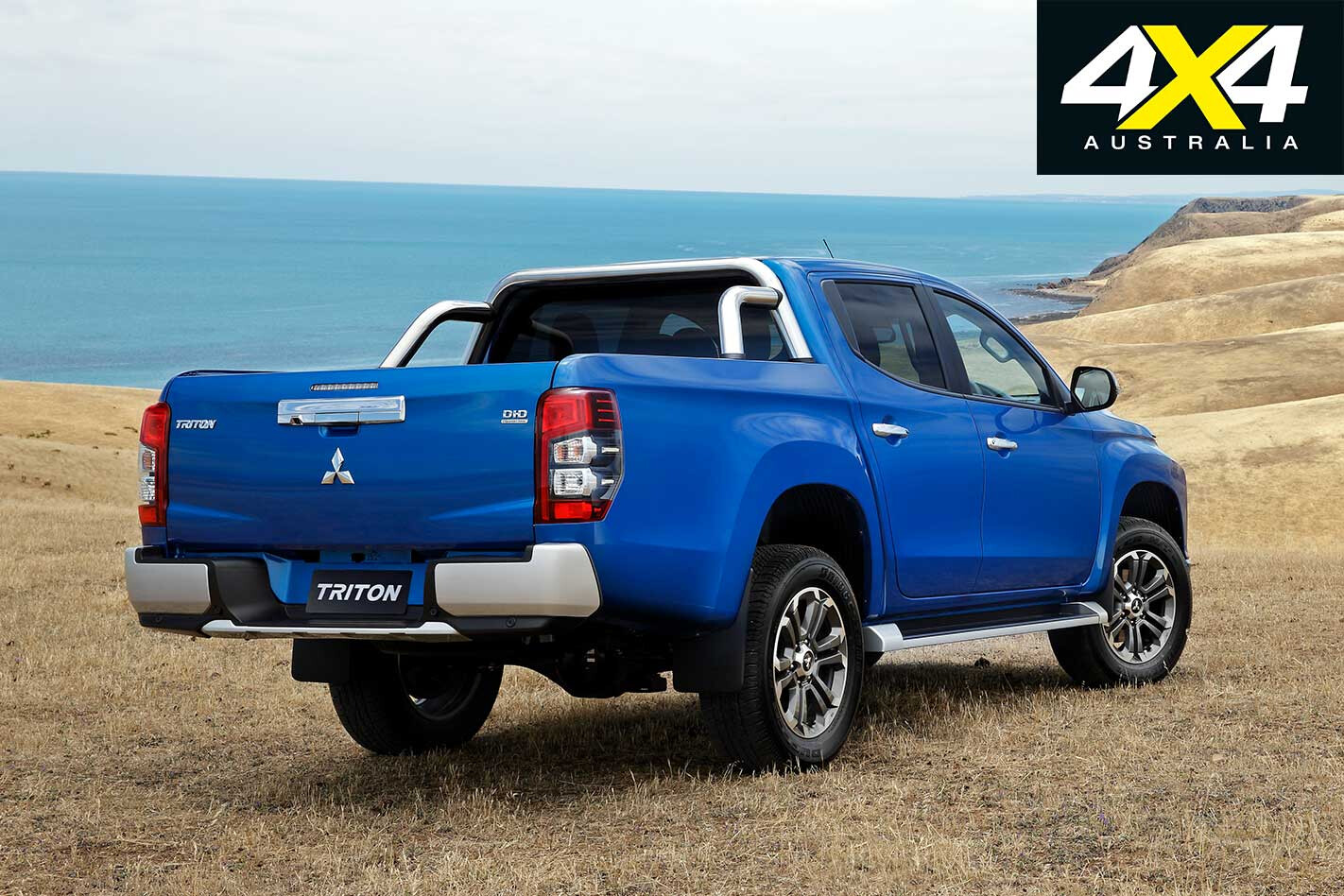
With a mix of smart upgrades and sticking to the tried and true – plus very competitive pricing (MY19 models have risen only slightly in price) that starts at $32,990 and tops out at $51,990 (see Pricing sidebar for full list) – it is easy to understand Mitsubishi’s confidence in its new “tougher truck”, especially when it comes to maintaining its current sales success (the Triton currently sits third in 4×4 ute sales).
Much more than a new face
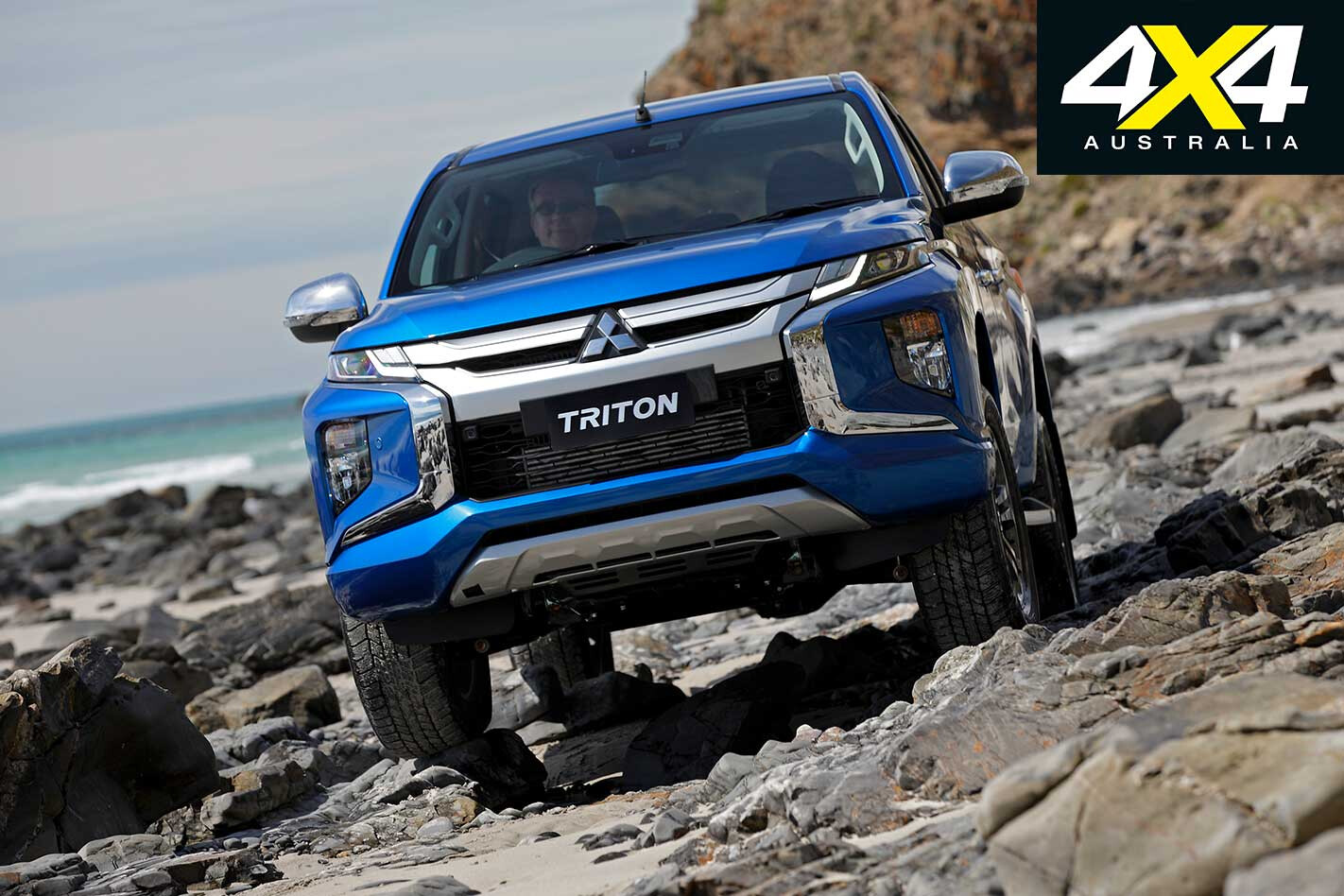
THE front-end styling of the MY19 Triton, dubbed ‘Dynamic Shield’ by Mitsubishi, is in line with the market segment trend of a more aggressive, tougher-looking ute, as well as offering a nod to its Pajero Sport stablemate.
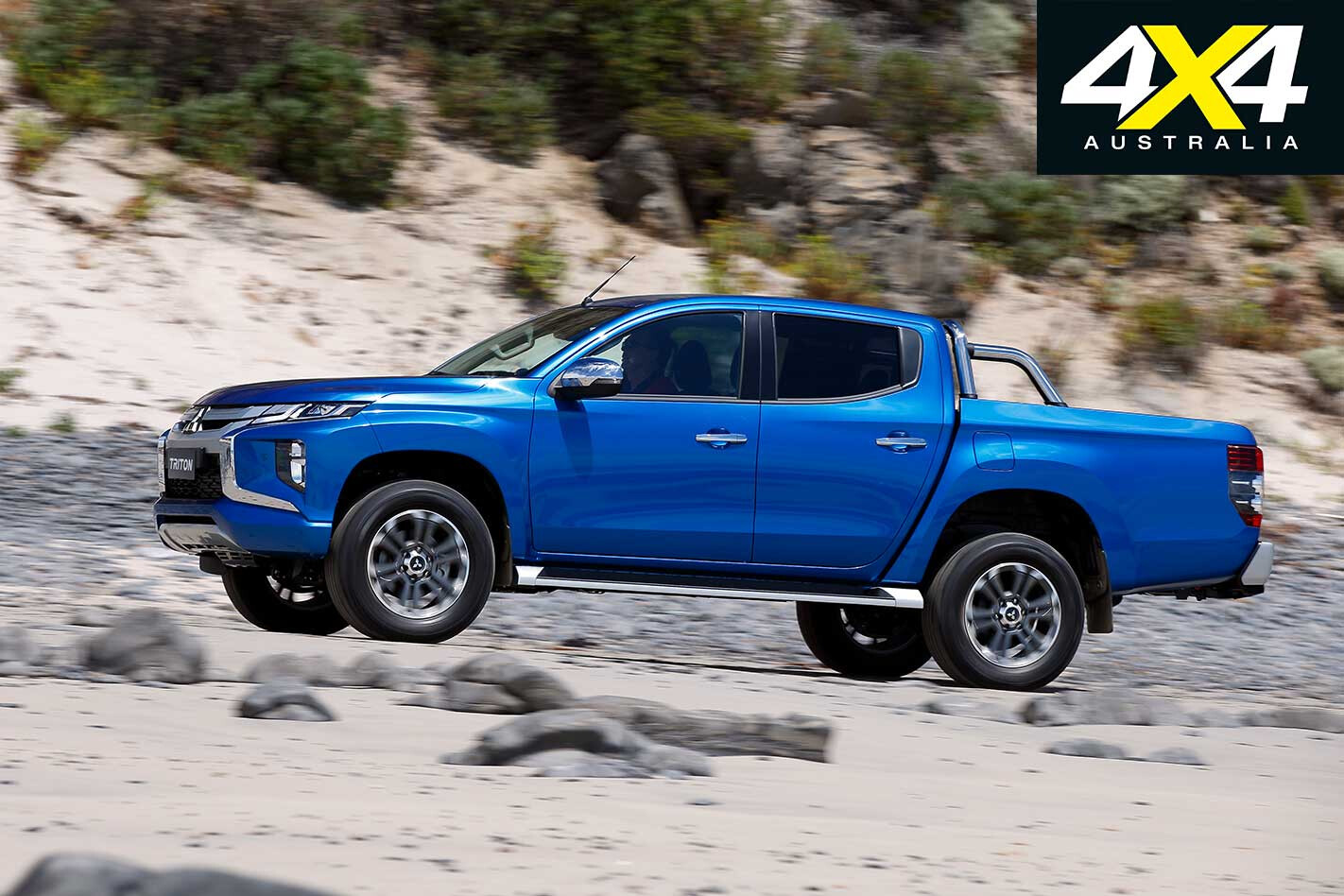
The styling may be polarising for buyers but it’s not just an artist’s whim gone wild; the high-set headlights are now more protected from frontal impact and when tackling a water crossing, and is one example of function with fashion. The Triton’s side profile is equally beefed up, with the tray’s bottom edge now running lower (rather than upswept, as in the previous model) and the sides of the tray taking on a deeper, more slab-sided appearance, with the squared-off rear-end finishing the muscling up of the Triton body.
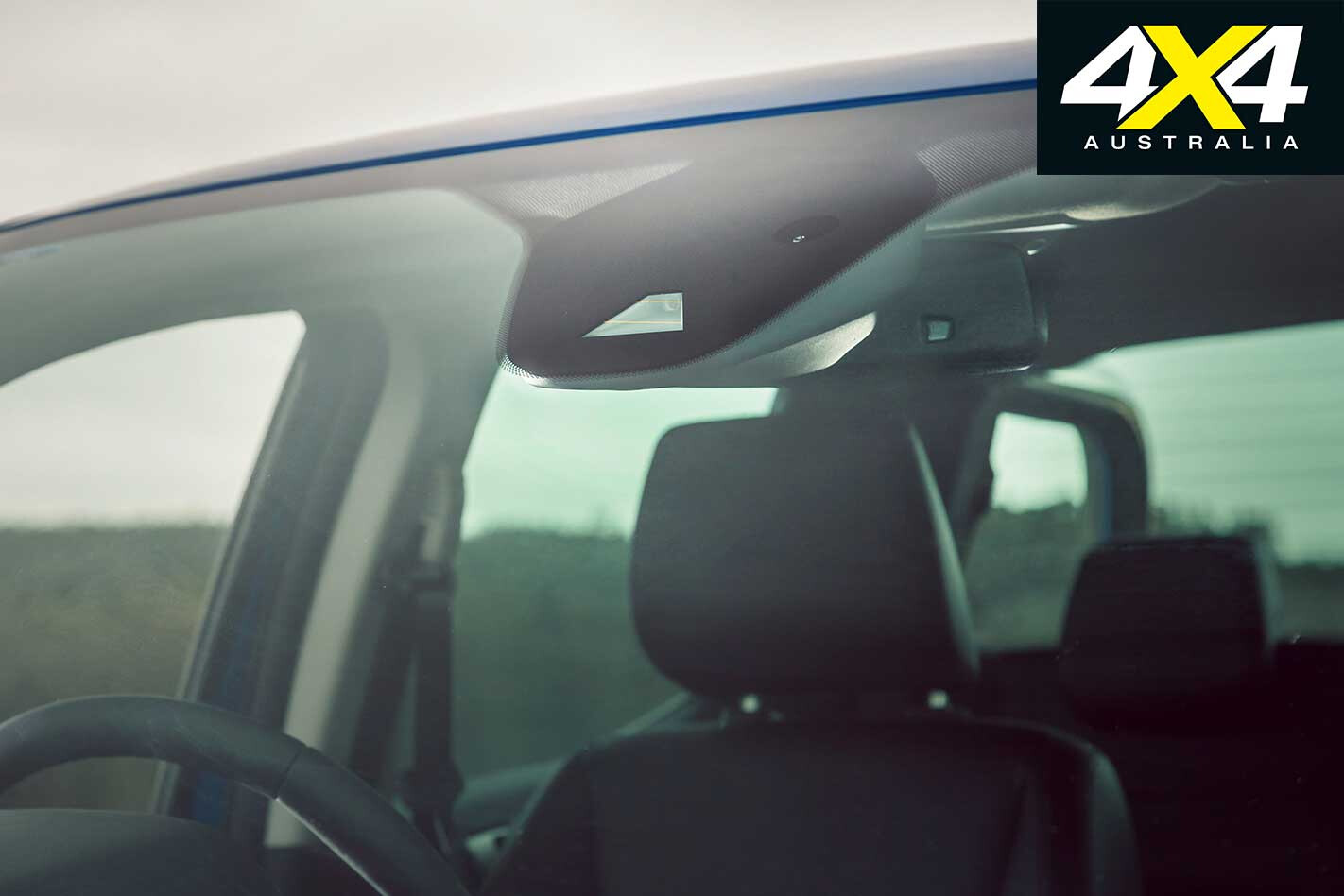
Continuing the ‘shield’ theme in a more direct way is the impressive array of advanced active safety tech upgrades (and their related acronyms). Joining a select few in its market segment (Ford Ranger and Mercedes-Benz X-Class), a number of Triton models include Forward Collision Mitigation (FCM) with pedestrian detection as standard.
FCM includes three ‘stages’ of control: an audible alert gives the driver an ‘early warning’ of a potential upcoming collision; when the likelihood of impact is higher there’s an audible alert and ‘firm automatic braking’; and when there’s a ‘very high risk of collision’ the FCM emits the audible alert and applies ‘emergency automatic braking’.
Oddly, in light of FCM being across a wide range of spec levels, Lane Departure Warning (LDW), Blind Spot Warning (BSW), Lane Change Assist (LCA), Rear Cross Traffic Alert (RCTA), Ultrasonic misacceleration Mitigation System (UMS; designed to modulate throttle response when in slow driving situations, such as parking), Automatic High Beam (AHB) and Hill Descent Control (HDC) are all only available on GLS and GLS Premium.
That doesn’t mean lower spec models miss out – brace yourself for more acronyms – with Hill Start Assist (HAS), Emergency Stop Signal function (ESS), Emergency Brake Assist (EBA), Active Stability Control (ASC), Trailer Stability Assist (TSA), Active Traction Control (ATC), ABS, EBD and Brake Override System (BOS) all standard across the range.
Add in myriad airbags (driver/passenger front and side, curtain airbags and driver knee), Multi Around Monitor (MAM; offering a birds-eye view of the vehicle when parking, for the GLS Premium only), a rear camera and front/rear parking sensors, and the new Triton has driver and safety tech pretty well covered.
Dynamically driven
MITSUBISHI is claiming improved off-road capability thanks to improved approach, ramp-over and departure angles (31, 25 and 23 degrees respectively). The chassis and engine bay, as well as the cab and cargo bed joins, have all been subject to reinforcement in key areas to improve overall rigidity.
The aforementioned suspension tweaks are claimed to improve on- and off-road comfort, courtesy of the increased oil capacity of those new, larger, rear dampers, while the 18-inch-wheel optioned models cop larger ventilated discs. (GLS and GLS Premium have 18-inch alloys as standard, the rest of the Triton range rolls on a mix of 16-inch steelies and alloys).
Off-road, the revised Super Select 4WD-II’s new mode selector options include Gravel, Mud/Snow, Sand and Rock. – Gravel matches throttle control to stability over loose-dirt roads – Mud/Snow controls wheel slip and directional stability and also adjusts ‘slip’ and dulls-down the amount of traction control when needed to maintain momentum – Sand minimises wheel slip and acts as a pseudo LSD and, like Mud/Snow, tweaks further slip and TC input when needed – Rock also resembles an LSD to minimise wheel slip when any wheel loses traction/contact with the ground. This mode also keeps the transmission in the most-suited gear to optimise torque delivery.
The previous-gen Triton, when the diff-lock was engaged, would turn off ETC totally – there’s no word from Mitsubishi on whether this is the same for MY19, or that the Triton now retains ETC when the rear diff is locked. The GLS and GLS Premium models also include HDC, which operates at a speed of up to 20km/h.
Inside and out
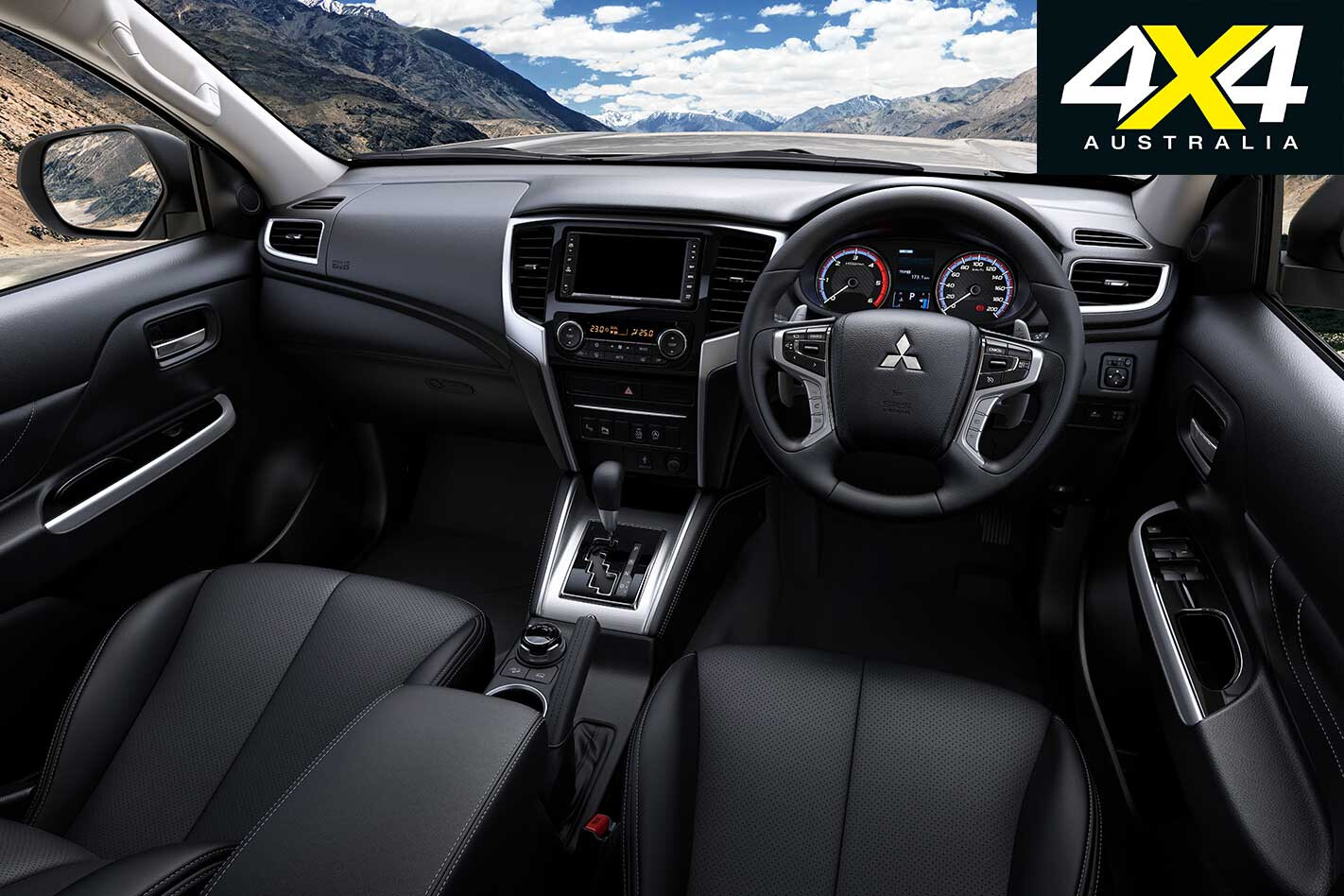
THE Triton cabin is relatively unchanged from the previous model, with a number of styling tweaks and a welcome addition in the form of roof-mounted air vents for rear passengers. Infotainment is taken care of through touchscreen set-ups ranging from 6.1- to 7-inch in size.
In this age of apps, surprisingly it is only the GLX+, GLS and GLS Premium that get Apple CarPlay and Android Auto. And, only those three models get two USB connections – the rest of the range only have one. Leather seats are confined to GLS Premium, with Premium acquiring power-assisted seat adjustment for the driver seat only; GLS gets a “premium fabric seat trim”, while the rest of the range cops regular fabric.
Triton headlights are halogen in all models bar the two GLS vehicles, and the same applies for Daylight Running Lights (DLR). The two top-spec models also get carpet flooring, while the rest make do with vinyl.
A big year
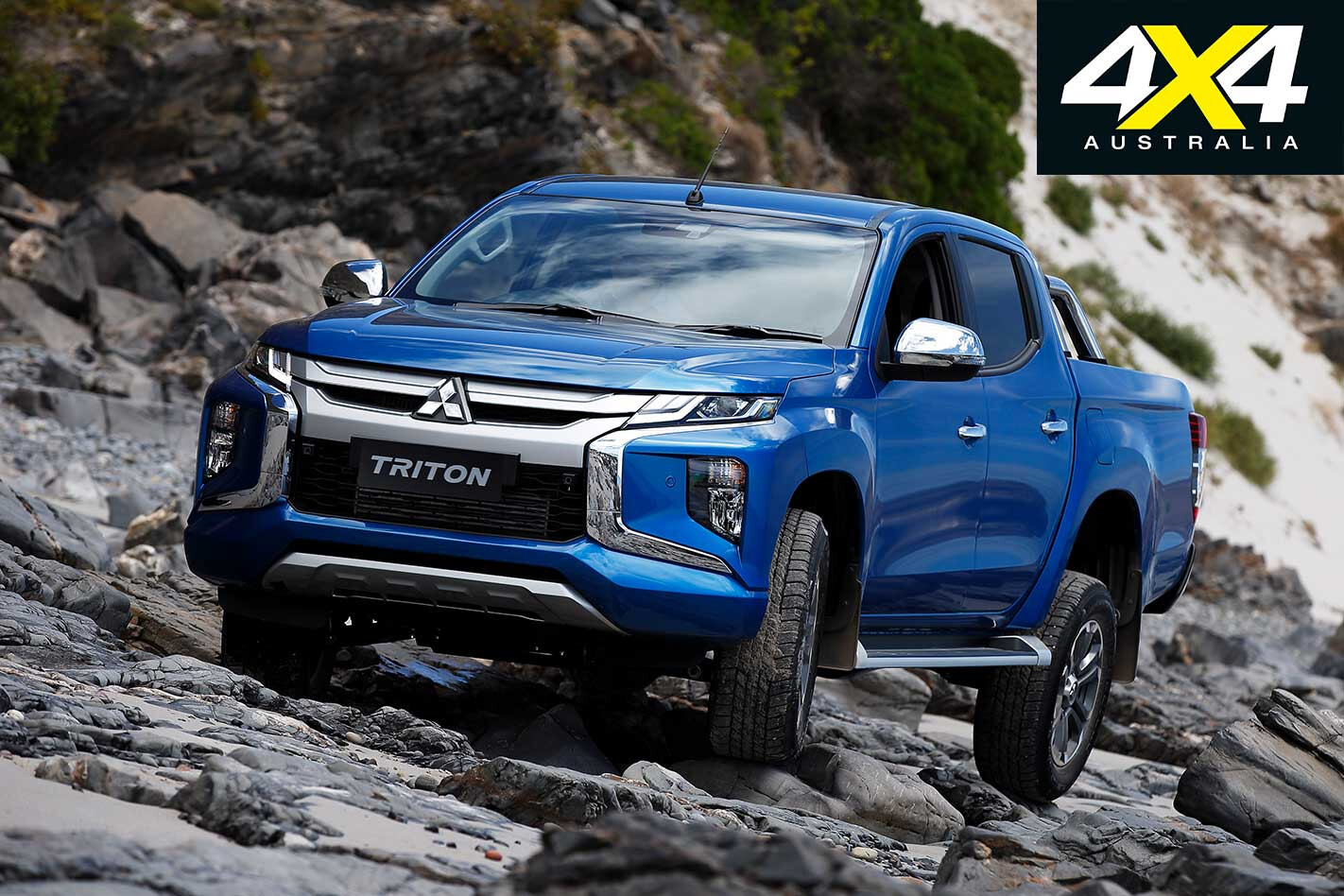
WITH its attractive pricing and a ton of models across that pricing range, the Triton should continue to sell well. Whether it will get any closer to the big two (Hilux and Ranger) remains to be seen, but for those 4×4 ute buyers on a tighter budget, the Triton’s well-proved mechanicals, manoeuvrable size, revised styling and overall bang for your bucks – not to mention the benefits of Super Select 4WD II – mean the Triton should continue to offer a compelling argument for buyers in the ever-more crowded 4×4 ute market.
Mitsubishi Triton 4×4 range pricing:
Triton Single Cab 4×4 GLX Cab Chassis 2.4L Man Diesel: $32,990 GLX Cab Chassis 2.4L Auto Diesel: $35,490
Triton Club Cab 4×4 GLX Cab Chassis 2.4l Man Diesel: $35,490 GLX Cab Chassis 2.4l Man Diesel: $38,790 GLX+ Cab Chassis 2.4l Man Diesel: $40,490
Triton Dual Cab 4×4 GLX Cab Chassis 2.4L Man Diesel: $36,240 GLX ADAS Cab Chassis 2.4L Auto Diesel: $39,540 GLX 2.4L Pick Up Man Diesel: $37,490 GLX 2.4L Pick Up Auto Diesel: $39,990 GLX ADAS 2.4L Pick Up Man Diesel: $38,290 GLX ADAS 2.4L Pick Up Auto Diesel: $40,790 GLX+2.4L Pick Up Man Diesel: $39,990 GLX+2.4L Pick Up Auto Diesel: $42,490 GLS2.4L Pick Up Man Diesel: $44,490 GLS2.4L Pick Up Auto Diesel: $46,990 GLS Premium2.4L Pick Up Auto Diesel: $51,990
MORE: Mitsubishi Triton Range Review MORE: Mitsubishi Triton Specs, Range & Price
OVER THE past quarter of a century there have been huge advances in 4×4 design and technology, and these advances can be clearly seen when looking at the once-humble and very basic 4×4 ute.
When I first started writing about 4x4s back in the mid-1990s, the Toyota Hilux 2.8D mustered a modest 60kW at 4000rpm and 183Nm at 2400rpm, and it had a 1500kg braked towing capacity. Today’s 2.8TD equivalent makes 130kW and 450Nm, an increase of 221 per cent and 245 per cent respectively, and it has a 3500kg braked towing capacity, which is up a whopping 233 per cent.
Sure, the cylinder count and capacity is the same, but that’s about it for similarities in engine design. The 1996 Hilux’s 3.0L was a naturally aspirated SOHC indirect injection diesel engine, whereas the current 1GD-FTV is a turbocharged DOHC common rail direct-injection diesel engine.
Back in 1996, standard equipment on the top-spec $41,750 Hilux Double Cab SR5 consisted of a five-speed manual gearbox (there was no auto option), auto-locking hubs, cloth trim, carpet, AM/FM radio/cassette player (remember them?) with two speakers, and oil temperature and voltmeter gauges. The wheels were 16-inch steelies, you had to stick your arm out the window to adjust the mirrors, and air conditioning was a $2268 option.
Today’s $54,440 HiLux Double Cab SR5 comes standard with a six-speed manual gearbox with intelligent-shift (or optional six-speed auto), premium fabric seat trim, carpet, climate control air-con with rear vents, power windows and mirrors, keyless entry and start, 220V power outlet, Multi Information Display, colour touchscreen with sat-nav, six-speaker sound system with Bluetooth connectivity and DAB+, and much more. The SR5 isn’t even the top-spec model these days; that honour goes to the better equipped and leather-trimmed Rogue and Rugged X models.
As well as the inclusion of comfort and convenience features that would easily outgun a 1996 luxury saloon, there have been incredible safety advances over the past 25 years. In 1996 the safety package of the Hilux Double Cab SR5 consisted of three-point seatbelts and head rests for front seat occupants, with disc brakes up front and drums at the rear.
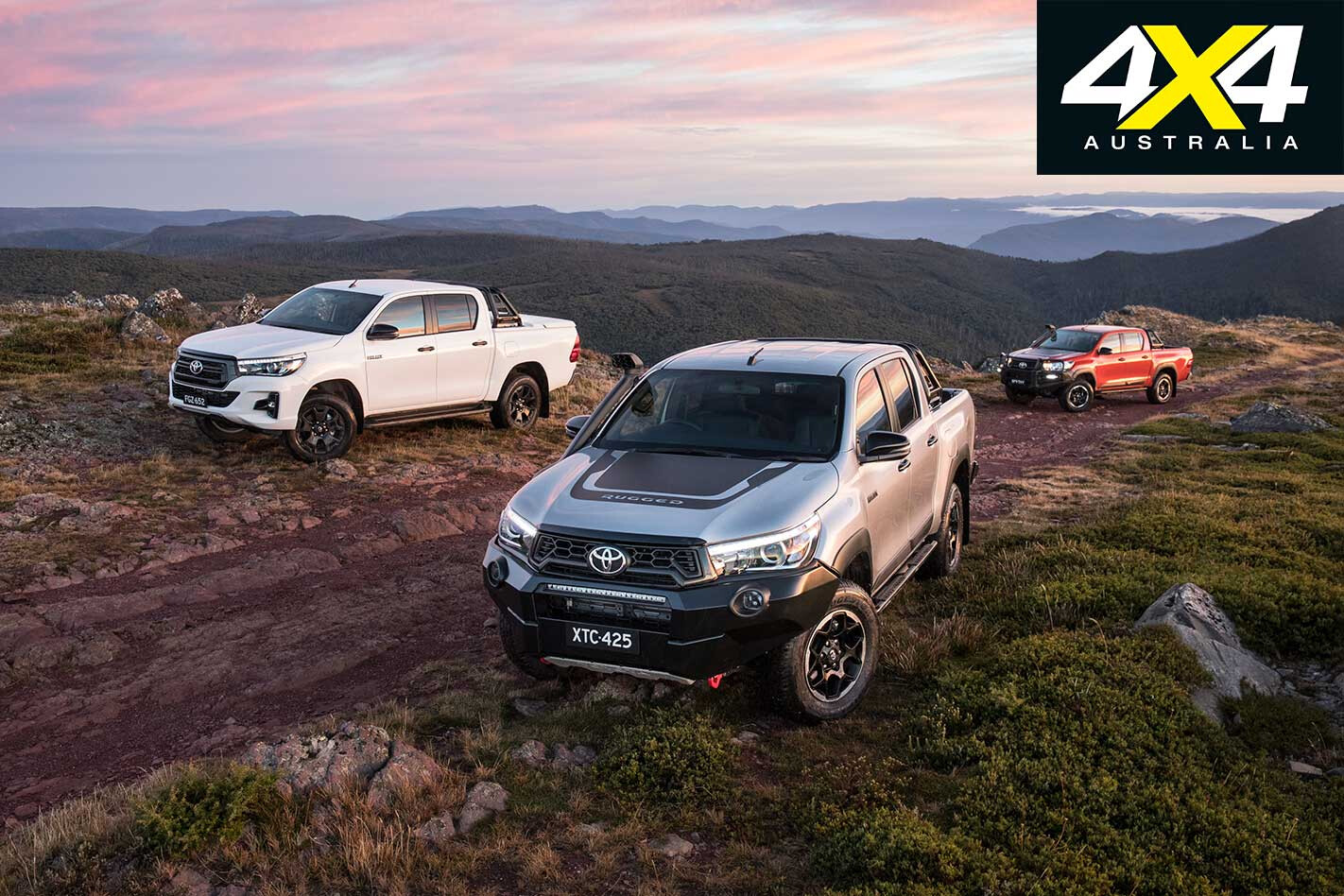
There was no ABS and no SRS airbag protection. Today’s Hilux Double Cab SR5 scores standard equipment such as ABS, Traction Control, Vehicle Stability Control, Reversing Camera, Hill-Start Assist Control, Downhill Assist Control, front-seat SRS airbags, three-point seatbelts and headrests for all positions, and more.
There are even better examples of advancement in ute offerings than the Hilux, such as the Ford Ranger, which now adds safety features including Inter-Urban Autonomous Emergency Braking (AEB) with Vehicle Detection and Pedestrian Detection, Adaptive Cruise Control with Forward Collision Alert and Lane Keep Assist/Lane Departure Warning. Features such of this were unheard of in any vehicle back in the 1990s, let alone a dual cab 4×4.
Then there are longer warranty periods. Back in 1996 Toyota offered a two-year/50,000km warranty on the Hilux; today it offers three-year/100,000km. Ford goes one better, offering a five-year/unlimited kilometre warranty on the Ranger.
There are some things that haven’t progressed very much, such as the basic vehicle architecture of the 4×4 ute, which still consists of a separate chassis, a live-axle rear-end with leaf springs (excluding coil-spring Navara/X-Class), independent front suspension (albeit now with coil struts instead of torsion bars) and a part-time 4×4 system (excluding Triton and Amarok).
Overall load capacity has not increased, either; in fact, it has decreased for many examples. In 1996 the Hilux Double Cab SR5 had a 1060kg payload, but in 2018 the equivalent vehicle has a 960kg payload capacity. The reason for this is a big increase in kerb weight (up from 1660kg to 2040kg) due to all of the added comfort, convenience and safety features.
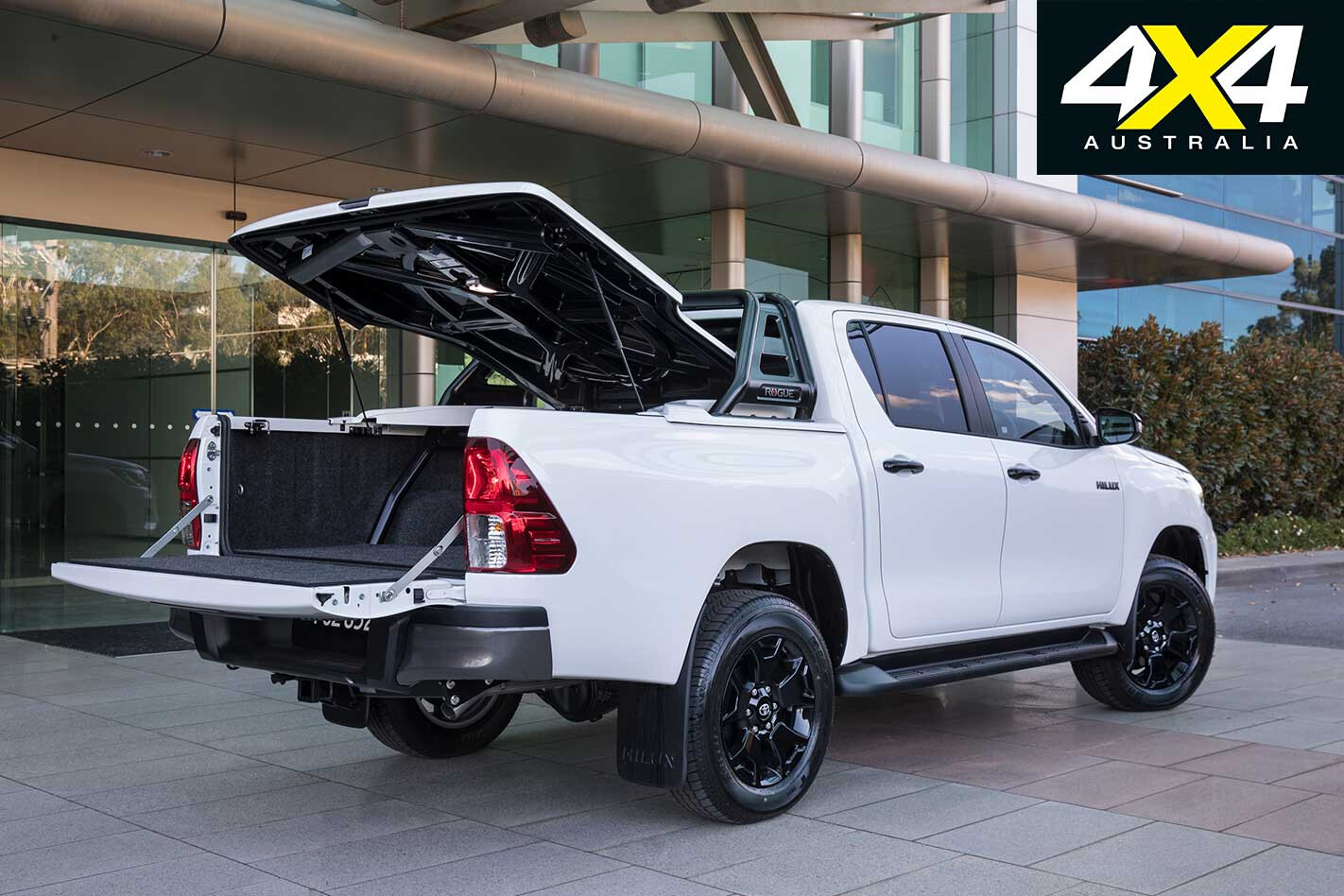
Another thing that hasn’t improved much over the years is fuel economy. Back in 1996 you’d get about 11.5L/100km from a Hilux Double Cab SR5; whereas the current model drinks at a rate of around 10.5L/100km, which is hardly a noteworthy improvement. But, again, the increased weight from all the extra inclusions, along with the vastly improved performance, goes a long way to explaining this.
All of the manufacturers are starting to think about their next-gen utes, some going it alone and others looking to collaborate. It will be interesting to see what the next big leap forward is for 4×4 utes. One can only imagine what they’ll be like in another 25 years.
David Moore is a self-confessed car nut. His mum got him out of the house and out of her hair by finding him a part-time job at a local garage back in the UK when he was 14. Since then, he’s probably run out of fingers and toes to count the number of classic cars he’s owned.
Dave fell in love with Australia on a trip with a mate back in 1999/00 and, fortunately, his girlfriend Tina was similarly impressed when he brought her for a holiday in 2002 – so he proposed to her while bungee jumping in Queenstown.
He moved out to Australia in 2005 with ever-patient Tina who let him squash her furniture into the corner of a container so he could squeeze in his 1966 VW Splitscreen Kombi, a 1951 Sunbeam S8 motorcycle and a 1953 Lambretta LD125. Today, he’s got five projects on the go in his (very big) shed north of Perth, including a MkI Ford Consul nearly ready to head over the pits. Yep, he’s a car nut.
Dave and Tina had a little Suzuki Sierra back in the UK to tow their 14ft speedboat and play in the mud flats when the tides meant boating lost its appeal. This saw him rapidly learn that important trick – a bit of a lift and decent knobbly tyres and you can go most anywhere. He also learned one of the worst things about four-wheel driving is cleaning the mud off when you get home.
Moving Down Under, he decided a big 4×4 was essential to tow a car trailer to ferry his beloved classic cars around while they were being restored. He made that fatal mistake of finding a very tidy 1997 NL Mitsubishi Pajero. Why a mistake? It was a pristine daily driver, all shiny and scratch-free, making the car nut inside him a little bit too precious about taking it off-road and getting it all dinged up.
The Pajero didn’t have a totally easy life – after a couple of hundred thousand kays it developed apparently unkillable wiring gremlins and the Moores decided to go back to playtime in a Suzuki – it was a lot bouncier than Dave remembered from his youth.
The daily driver and tow vehicle had been updated to a Land Rover Freelander 2 that, apart from being also nicely shiny, was a bit lightweight to get into the heavy stuff that was now beckoning Dave off the bitumen.
A Toyota Surf 3.0L turbo-diesel was purchased on the condition they joined a 4×4 club and started getting serious about their off-roading. The Surf was fun and the WA Mitsubishi Club were organised and active so, after plenty of trips away, Dave and Tina took the next plunge and upgraded to a LandCruiser 80 Series with plenty of inbuilt kit, including drawers and rooftop tent. The Mitsi Club, by the way, welcomes any flavour of fourbie.
Loving the extra power of the factory turbo 80 Series and the all-in-one driveability of a rooftop camper, but not enjoying the pack up and pack down to go out for the day, they started eyeing fellow club members Marie and Ivan who had an Alu-Cab roof-converted Troop Carrier. It was so darn quick to set-up.
Dave and Tina did some soul searching and concluded what they wanted was a 4×4 box on wheels. It would need plenty of room inside if the weather was bad, and include a permanently setup bed, cooking and eating spaces. And it had to be quick to set-up.
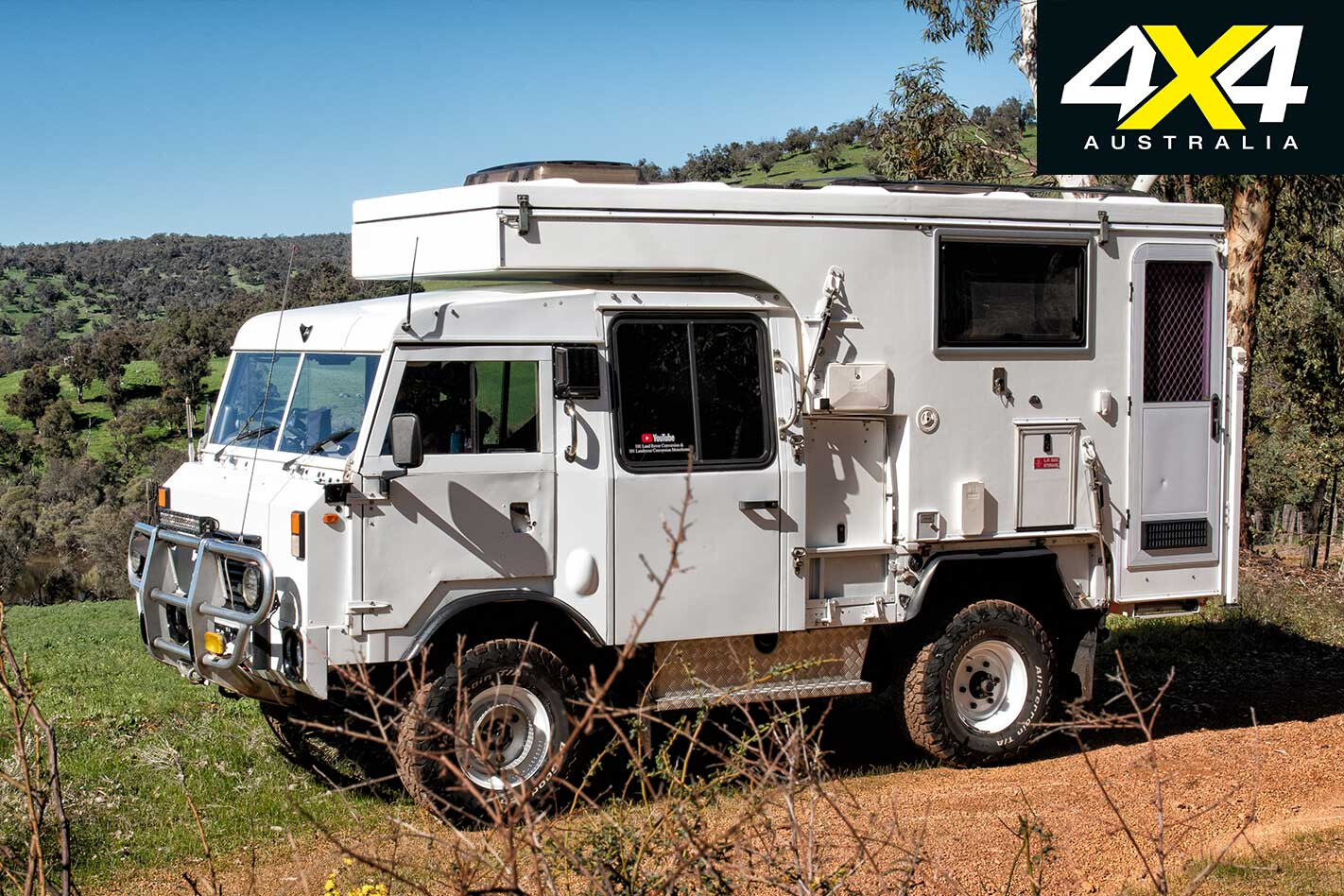
After plenty of research they concluded they’d have to build their own 4×4 dream machine – probably basing it on a solid military base like a Pinzgauer, Volvo C303 or a Land Rover Forward Control (FC) 101. Given these aren’t common everyday vehicles, it wasn’t going to be an easy project.
On a trip back to the UK, Dave test drove an FC101 and decided it was the preferred vehicle. Idly surfing home-based Gumtree while on that same trip, he was stunned to find an already converted FC101 that magically ticked most of the boxes he and Tina had defined – and it was for sale in Australia.
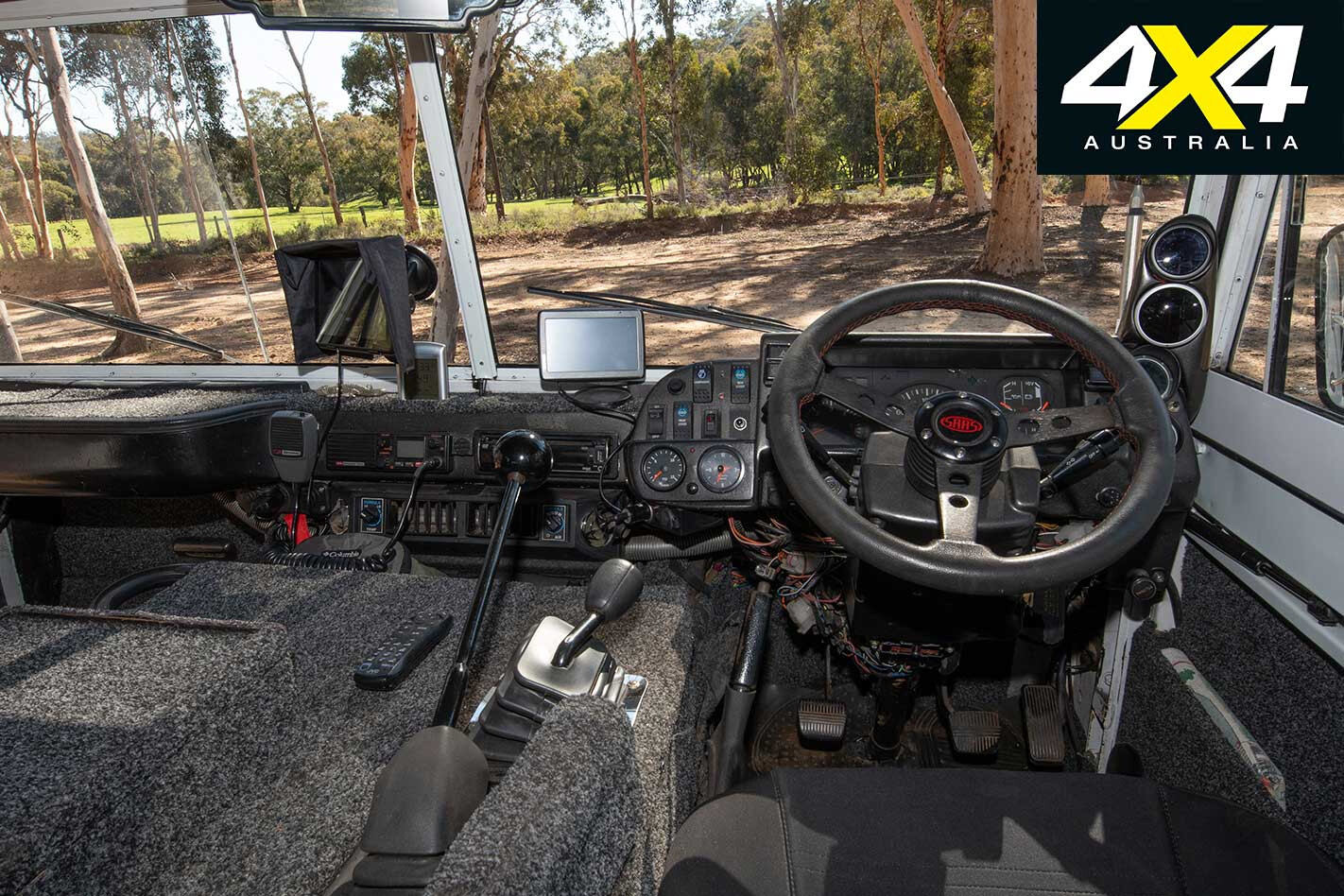
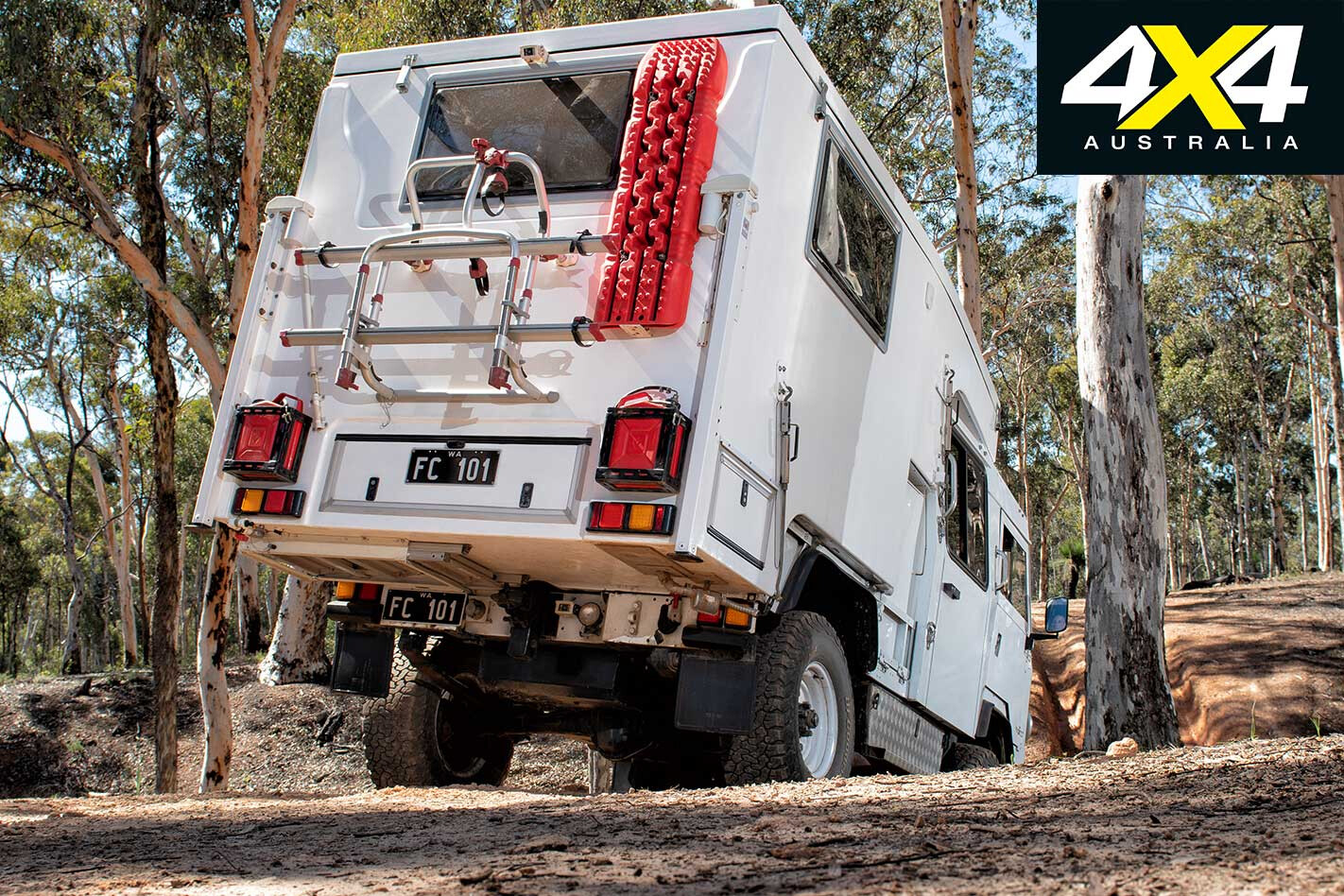
Dave and Tina count themselves incredibly fortunate that previous owner Gary Smithett spent six years restoring the 1976 Land Rover FC101 and custom building the camper on the back. As Dave acknowledged of Gary, “So much thought went into this build, you did a great job, Gary, and we are proud to be the new owners and promise to look after it!”
The conversion tale is one of dedication and persistence. A carpenter by trade, Gary decided he wanted to build a slide-on motorhome. His mechanic put him in touch with a friend in the UK who would ship out a mostly stripped FC101 for his base vehicle.
Starting in July 2004, Gary pulled out what was still movable on the cab over chassis, including motor and wiring harness, and then bead-blasted the fortunately rust-free body.
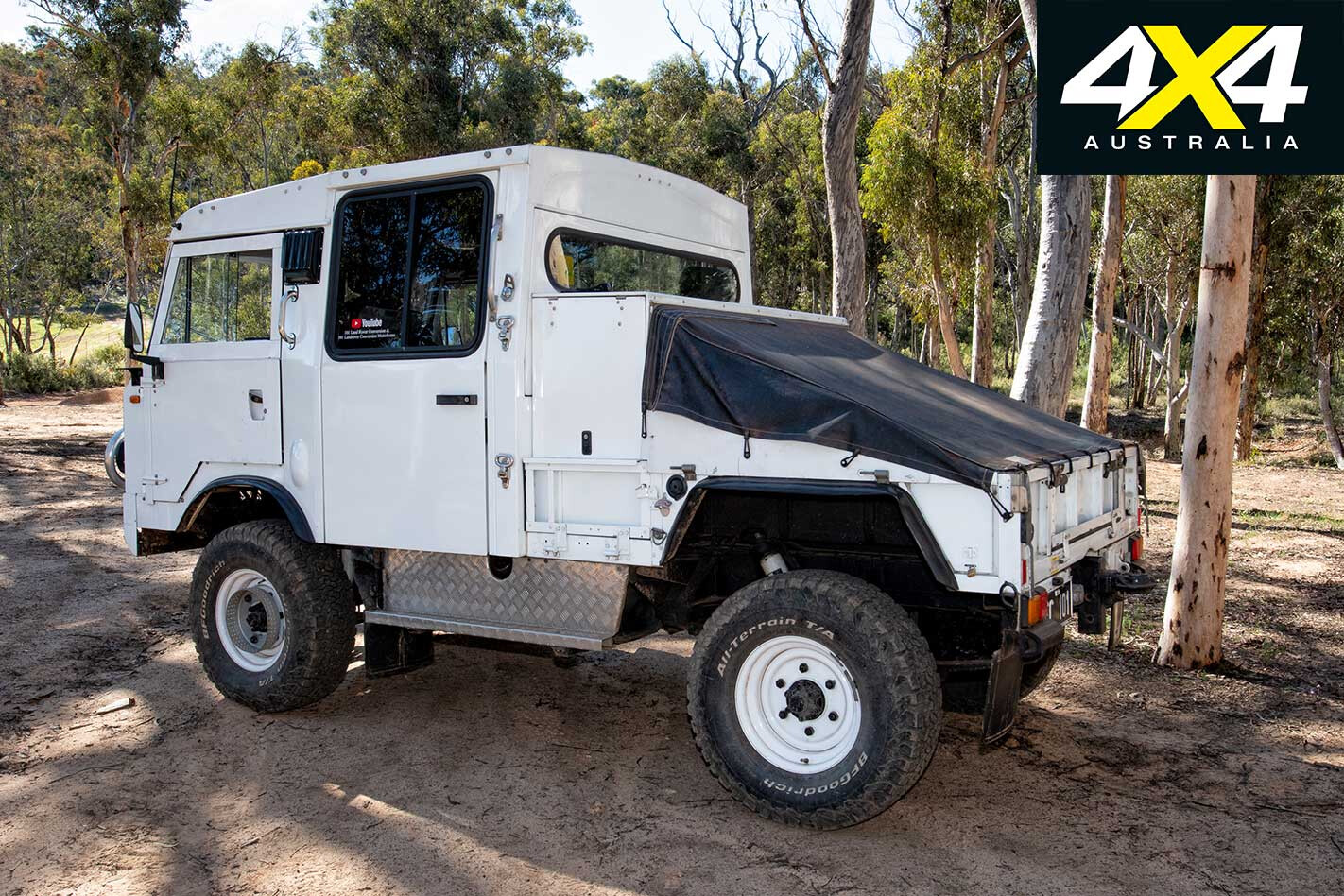
Gary’s more mechanically minded friends shook their heads, “Do you know how much work is involved in this?” Fortunately, Gary had no idea and just kept chipping away at his project – with plenty of help from fellow TAFE lecturers with all those useful skills like sheet metalwork and spray painting and body building.
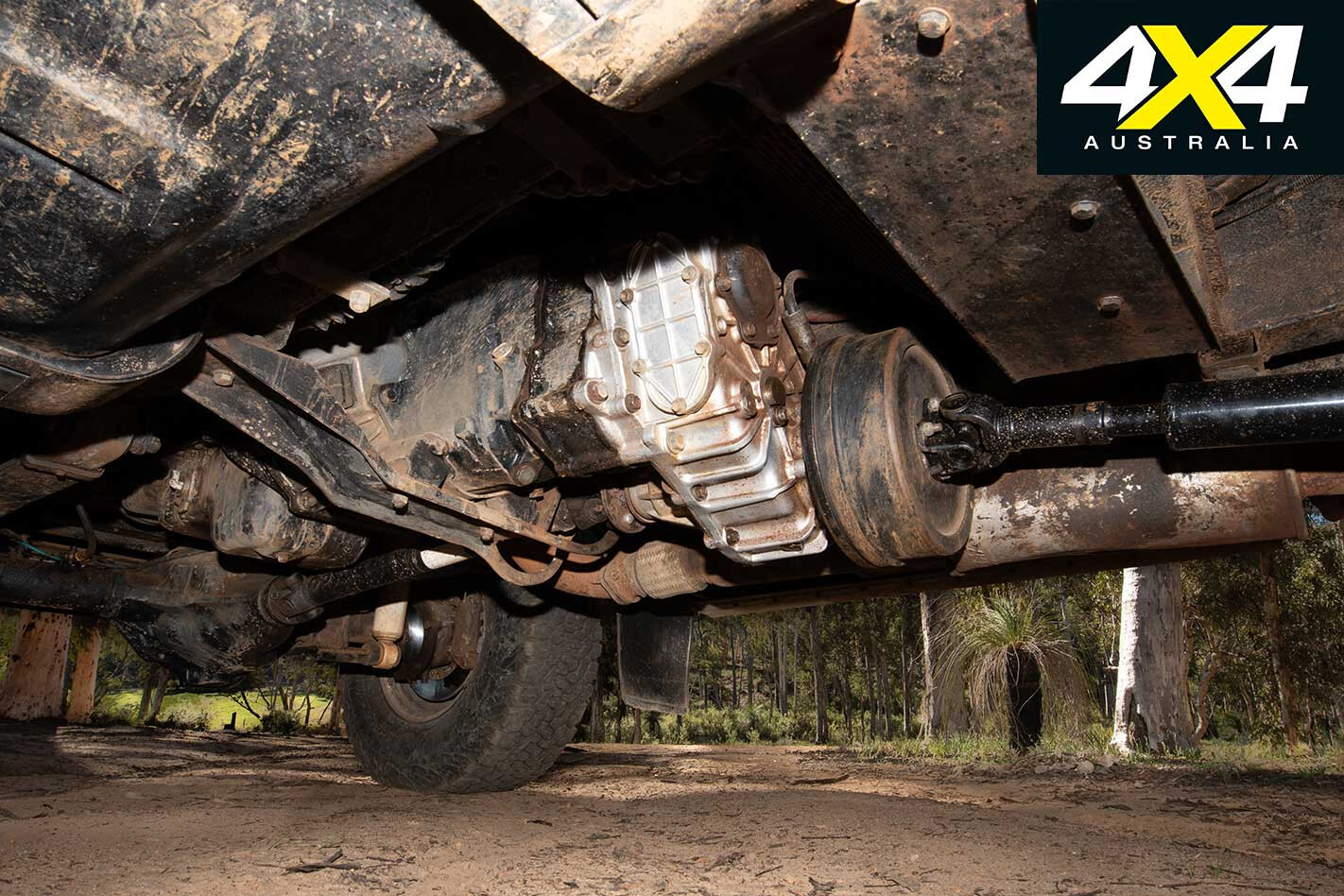
Gary’s newest best friends were motor wreckers, as he found the back of a cab off an OKA and turned the FC101 into a dual cab. He shoehorned in a Toyota 4.2-litre 1HZ diesel engine and ripped apart a rusted-out Troopy for heaps of components like gearbox and transfer case, steering column and power steering. A Nissan Urvan contributed brake and clutch pedals, master cylinder and oil reserves.
His mechanic and auto electrician were challenged with connecting all the bits together – a definite test that had them somewhat unamused but ultimately rightfully proud as the complete custom transformation eventually went off to be inspected by the engineer.
With only minor modifications required, the engineer was impressed that a chippie had so successfully pulled off a left- to right-hand drive transformation; converting a two-seater to a six-seater and completing a full engine/driveline replacement.
Even more impressive, from purchase to registration Gary spent only $22K; although, I suspect, if you costed in all the labour time and help from handy mates that would be a much bigger number.
After three years in the making, Gary’s maiden cross-Nullarbor trip was marred only by a blown fuse and the original 1976 shock rubbers melting (to be fair, it was so hot the bitumen on the road was also melting).
Gary’s extremely patient wife was then convinced to park her own car outside the garage for three months, while Gary spent about $10K building his slide-on camper. Three years and $25K later, Gary had built the camper that after ten years of happy travels he put up for sale and amazingly ticked almost all of Dave and Tina’s unique little boxes.
Dave’s planning a few changes – especially to the OKA cabin that he would rather repurpose for storage and no seats. The couple love the camper, but if they built their own they’d probably opt for a higher pop-top for room above the bed and see if they could work a way to direct access between the cab and the camper. But, truth be told, they can’t believe their luck as they know full well just how many hours are required to restore a classic car – or custom build such a unique setup.
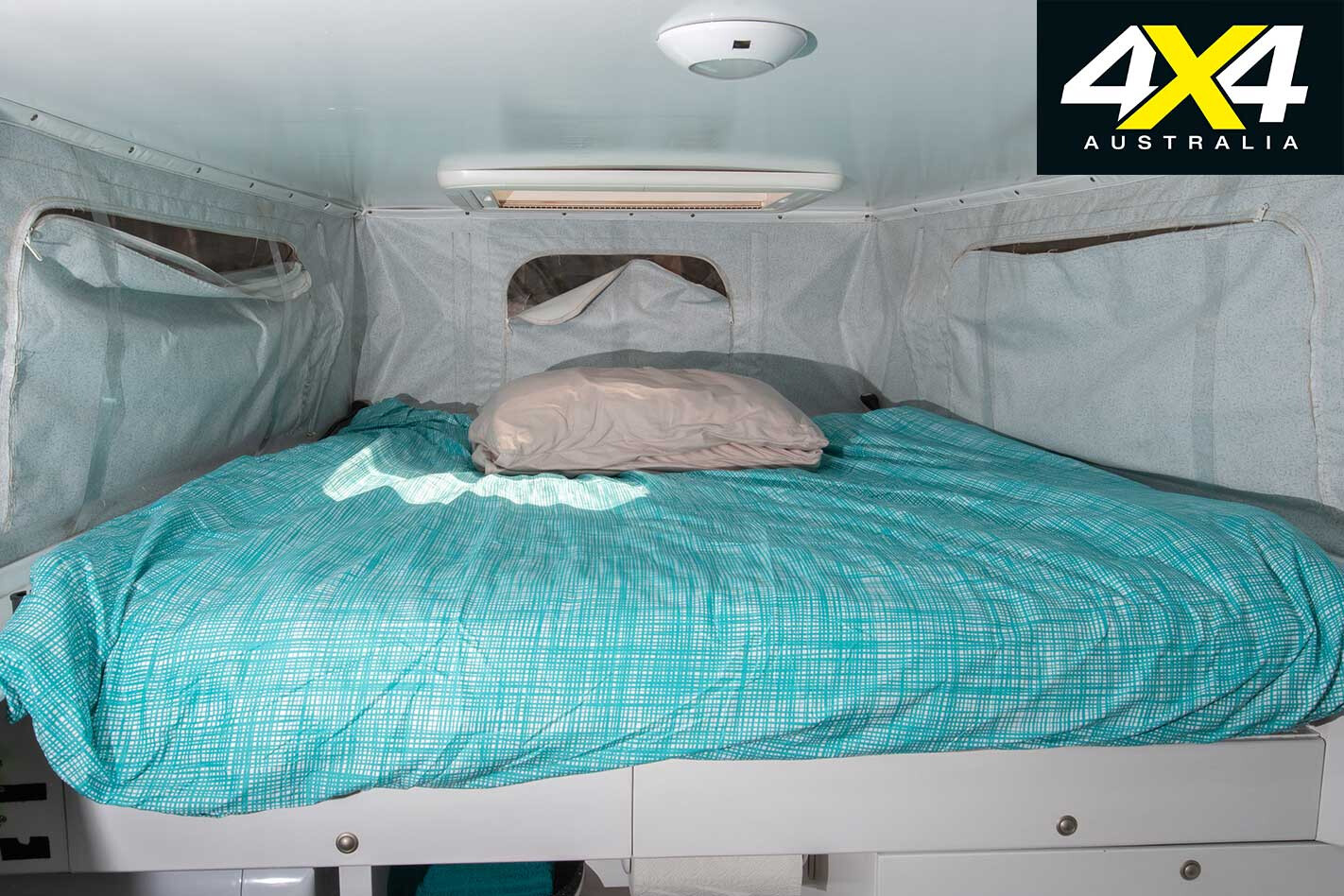
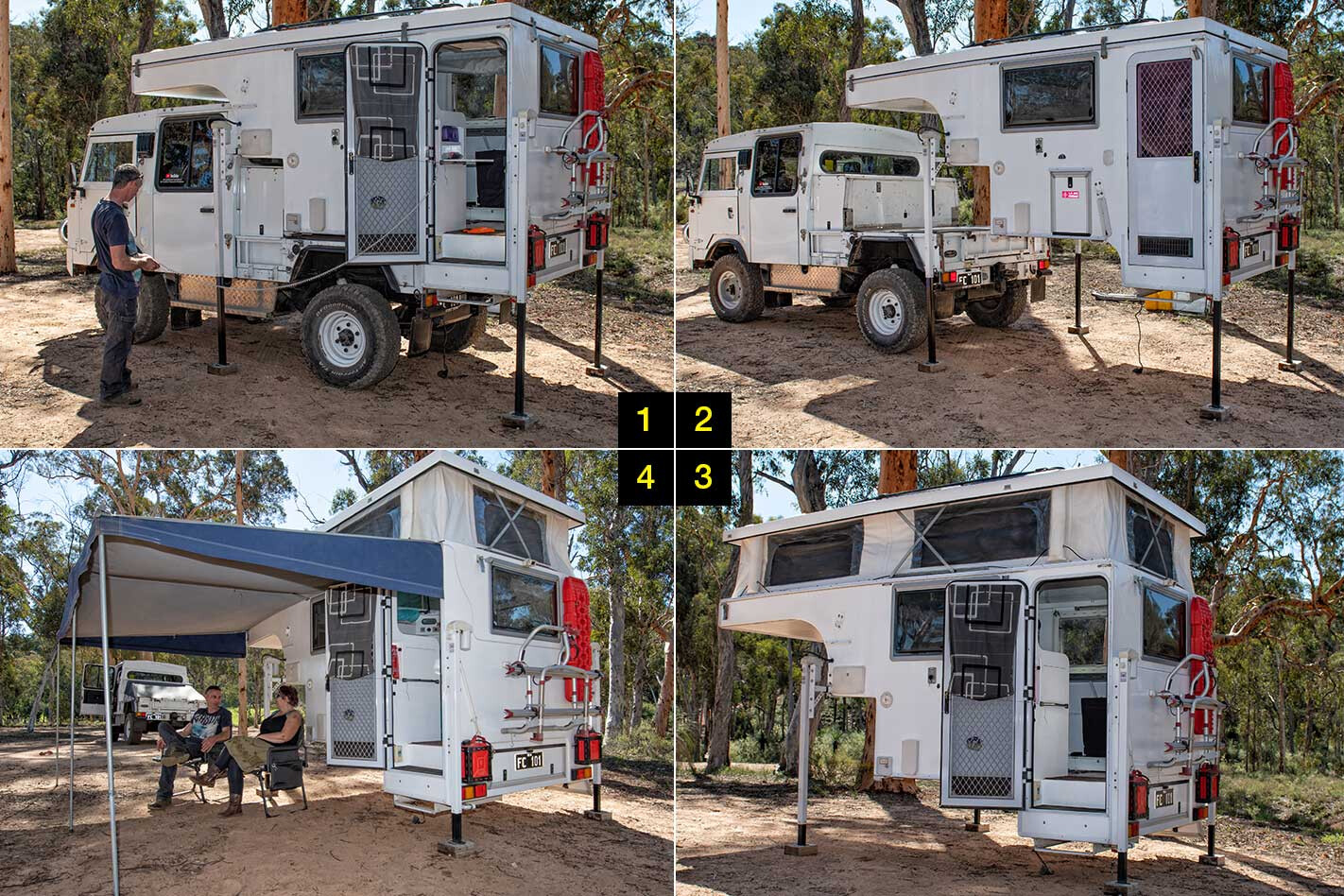
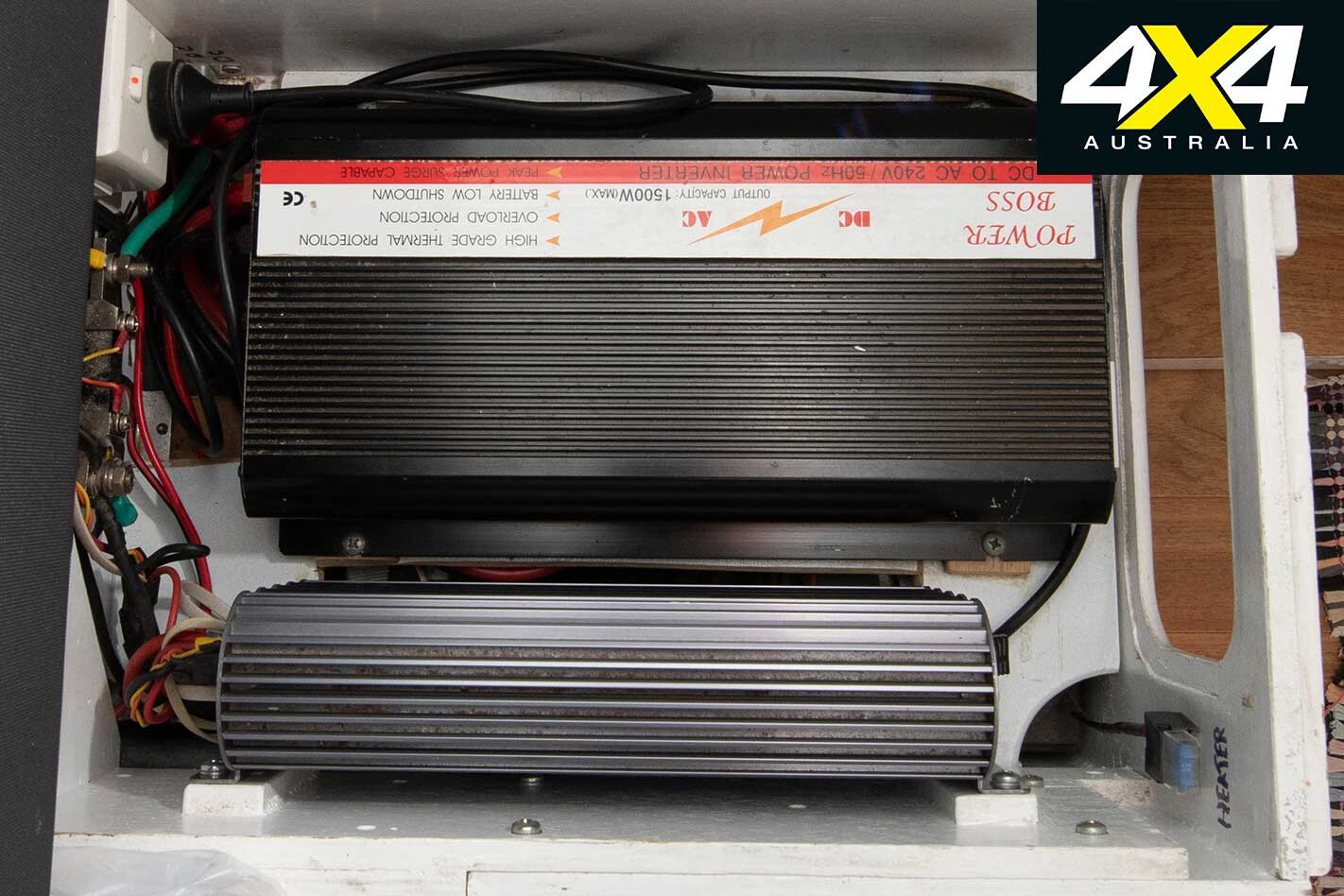
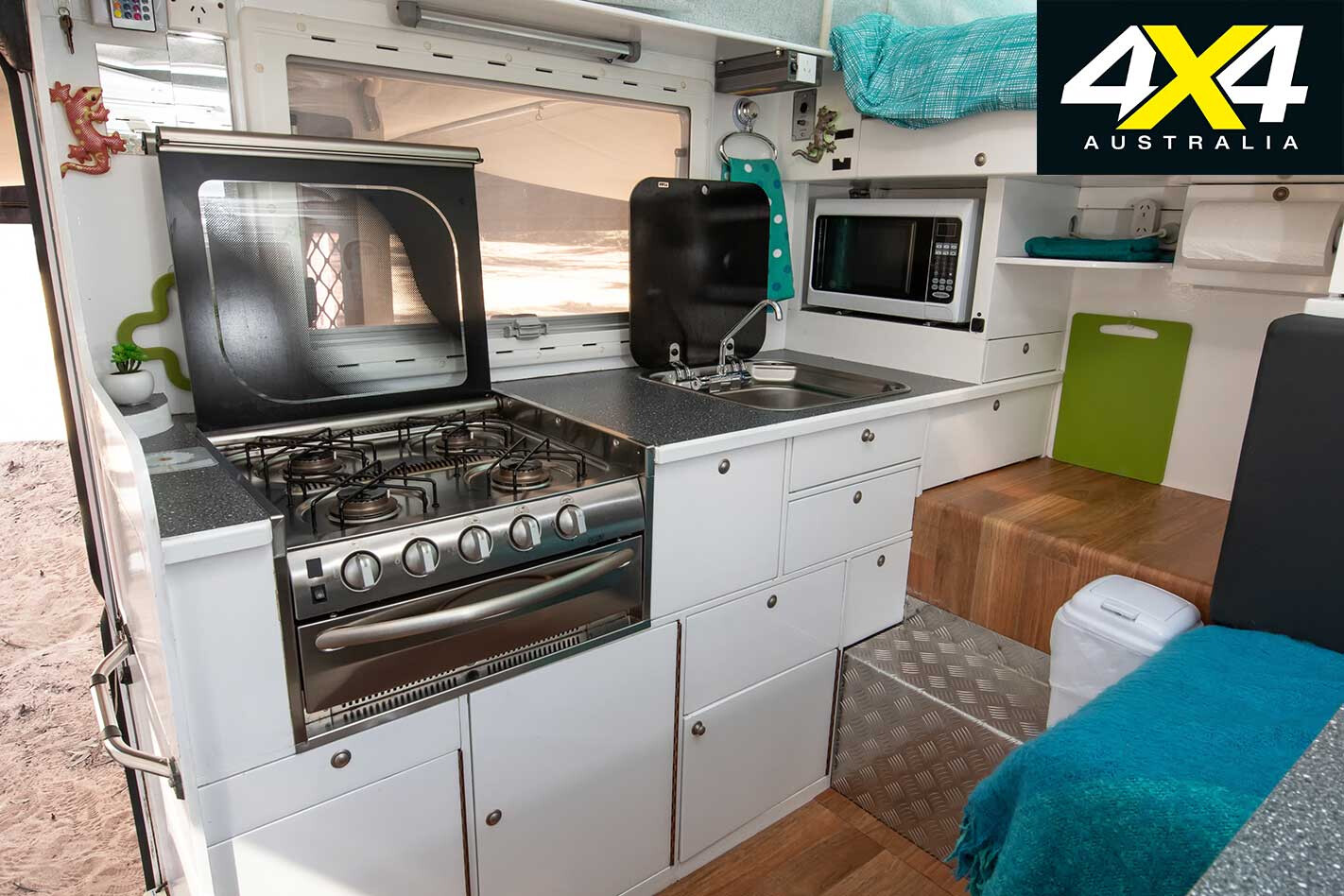
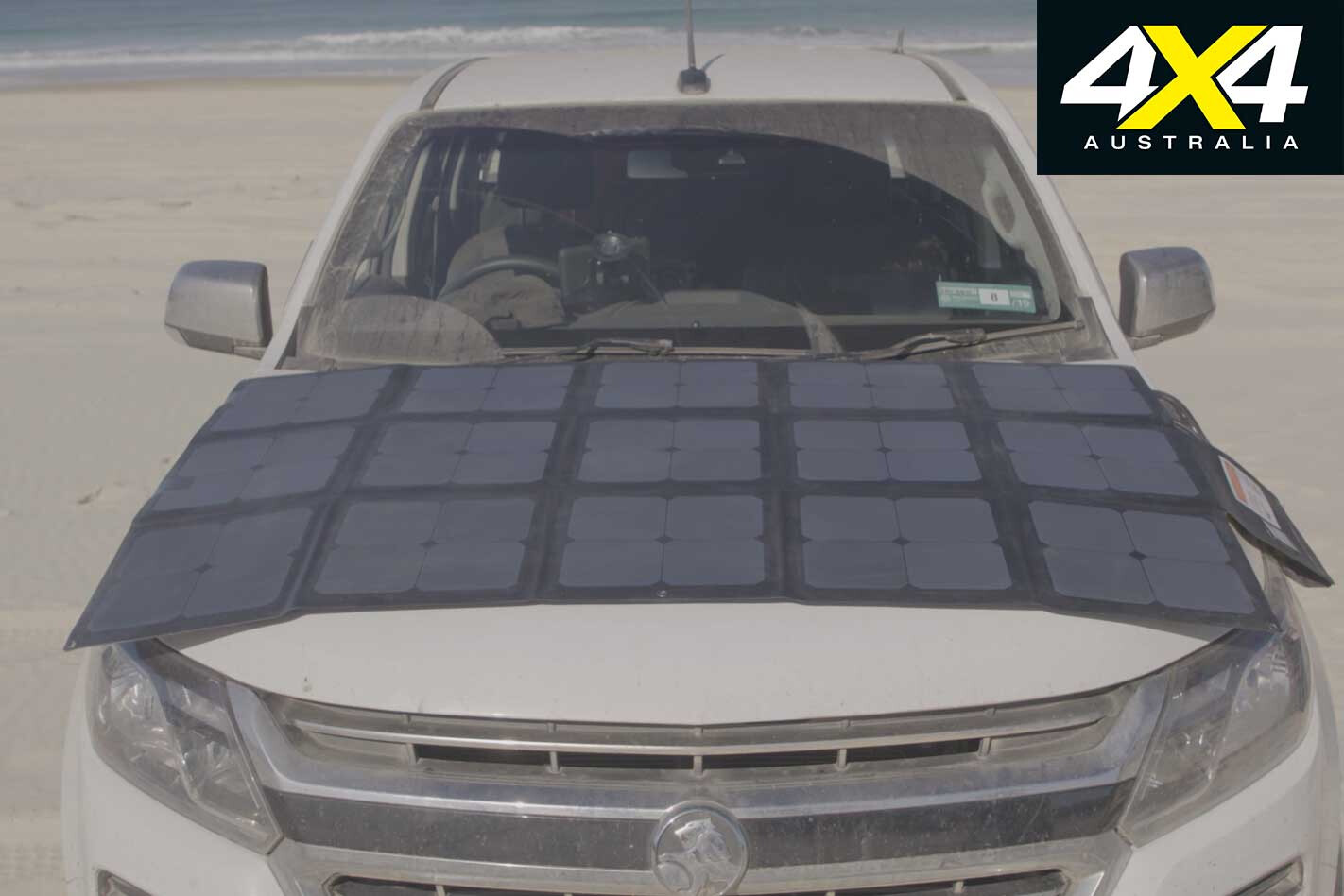
They love the fact that the 12V jacks simply lift the camper on and off their 4×4. They’ve got plenty of power with a 200W solar panel, dual batteries with Redarc controller, two Evacool fridges and a compact but highly functional kitchen including microwave and four-burner gas stove/grill. The cabin is well insulated with double-glazed windows and a diesel heater.
The permanent bed is comfortable and the two-seater dinette allows them to eat inside or kick back and watch television in bad weather or overnight stops. When they set-up camp for a few days, the canvas awning makes for a comfortable shaded area.
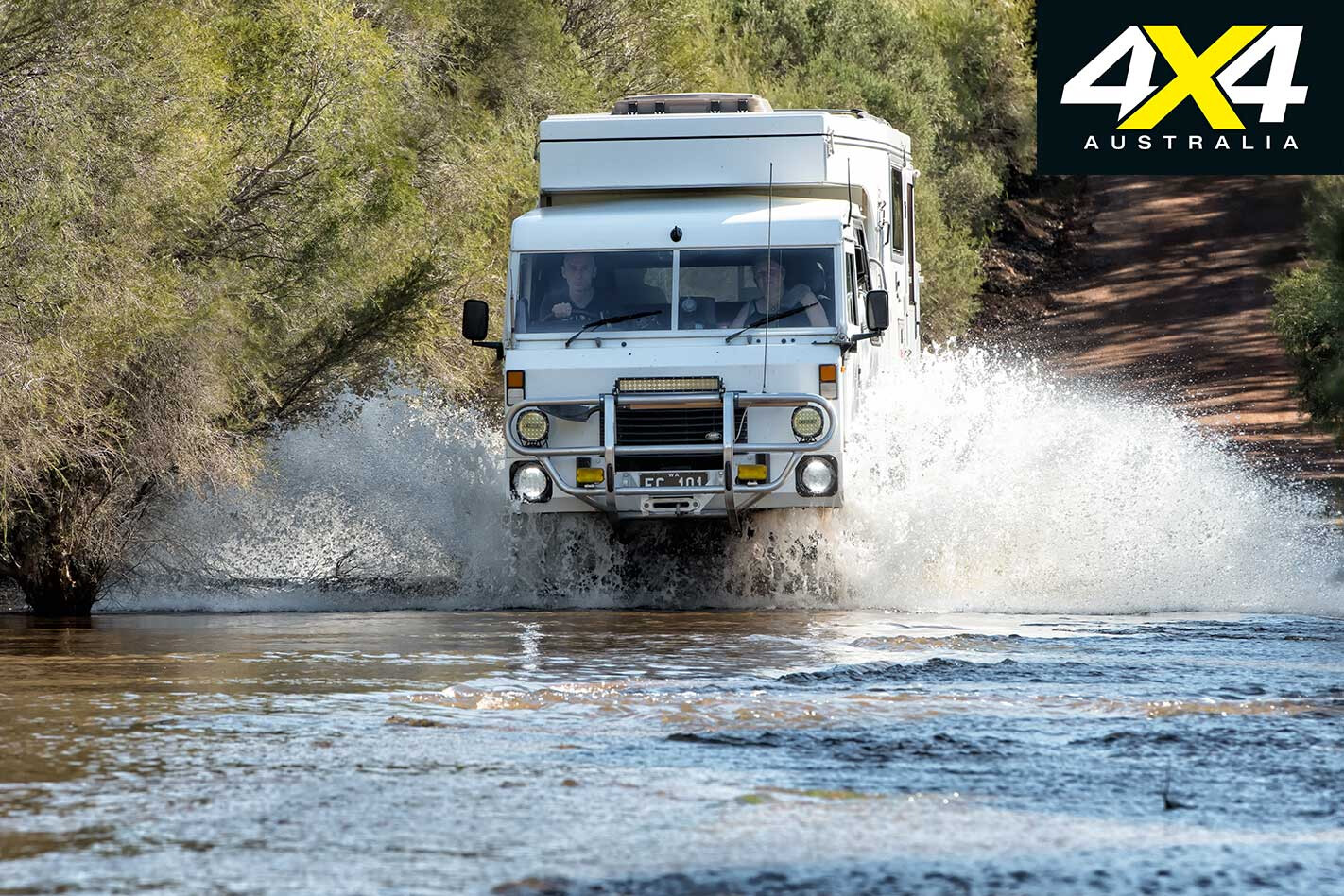
In fact, it’s not impossible that the FC101 will be the vehicle for the dream lap around the country. Before then, Dave and Tina will be tackling the Canning Stock Route, touring the Kimberley and are already getting set for next year’s four-week trip across the Great Central Road to Uluru with friends.
While many of us love tinkering in the shed to customise our fourbie; there’s a lot to be said for having someone else do all the hard work. Sure, you might want to tweak the edges – or wish that the builder had done something a little different – but even when you build it all yourself, there’s always room for improvement.
I’m off to check Gumtree to see if any of Gary’s mates were inspired to build a super camper.
AFFIX a pair of Lightforce Striker LEDs to the front of your 4×4 in time for the upcoming festive season and you’ll be able to explore from dusk ’til dawn.
The units may be compact, but they pack quite a punch: 754 metres at 1 lux and 1508 metres at 0.25 lux. The lights use the latest Luxeon Lumileds LEDS to provide a colour temperature of 5000 kelvin.
The rectangular lights are Australian-made and come with a complete wiring harness, plug-and-play adapters for the high-beam, a dashboard switch and all the consumables for the installation.
The LEDs have an ingress protection rating of IP68 and IP69K, which means you won’t have to worry about dust or water ingress.
RRP: $329 (single); $599 (pair) Website: www.lightforce.com
REDARC’S latest addition to its repertoire is the BCDC1250D, a 12-volt 50A in-vehicle DC to DC battery charger.
The Australian-made unit – it’s also Australian developed, engineered and tested – is perfect for dual battery systems that feature modern alternators with varying outputs, and the 1250D can charge from solar to DC inputs simultaneously. A ‘Green Power Priority’ setting means the unit automatically selects solar charging first, to lessen the load on the alternator.
The unit, suitable for 12- or 24-volt vehicle systems, also works with standard or variable/smart alternators, and it is compatible with AGM, Gel, standard lead acid, Calcium and LiFeP04 batteries.
The unit has been developed to provide a higher current output and features an additional charging stage known as SoftStart. It also features SmartStart tech.
As a reminder, the red racing stripe planted on the top of the unit indicates that this is a top-of-the-range system.
RRP: $777.56 Website: www.redarc.com.au
GATEWAY Broncos, an Illinois-based company founded in the States in 2016, was originally set up as a Bronco restoration and restomod business; however, the company recently reached a licensing agreement with Ford, allowing it to build a limited numbers of ‘as-new’ 1966-1977 Broncos.
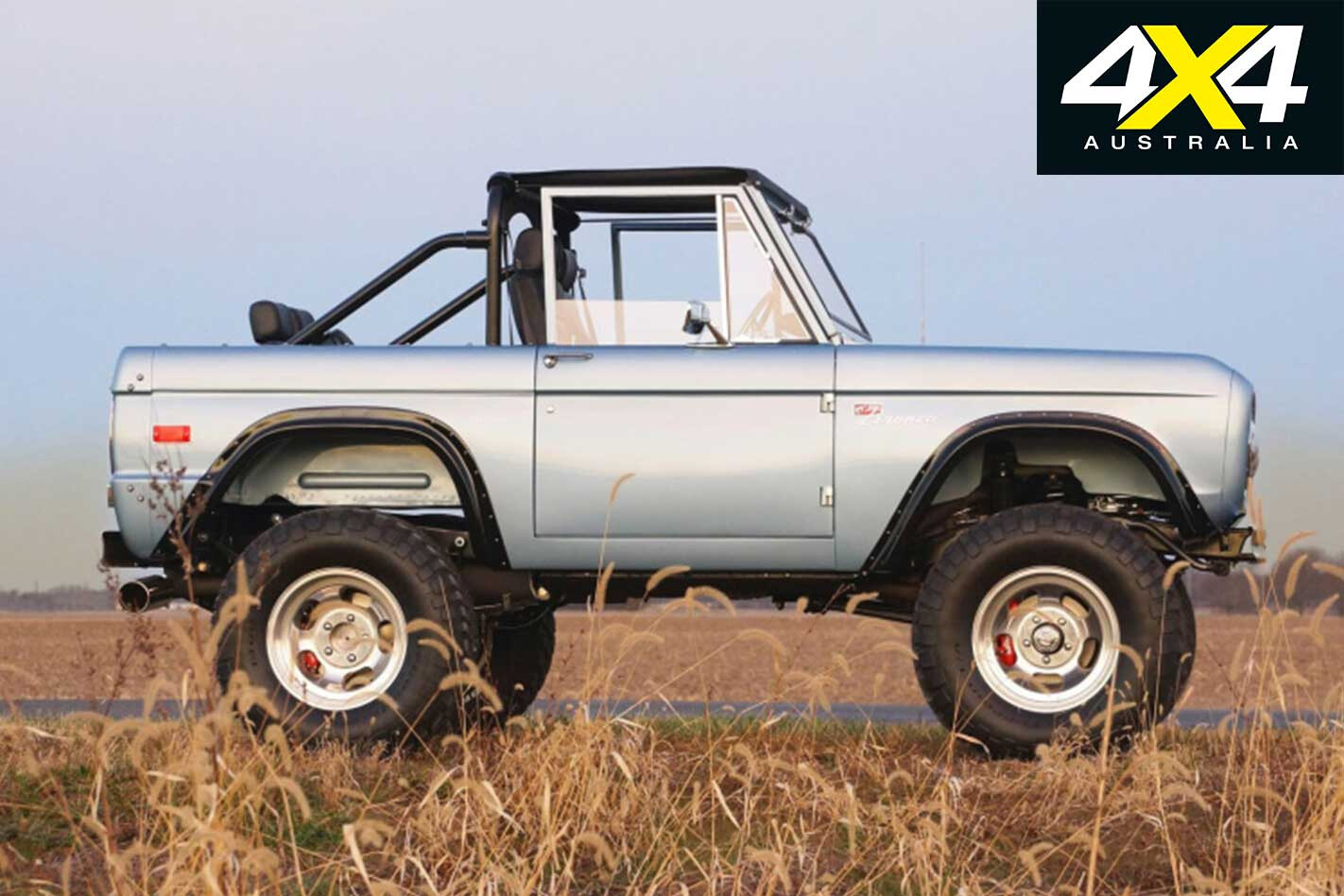
The agreement signed with Ford means Gateway can build these first-gen Broncos with new metal – body and frame – without resorting to scouring scrapyards and donor cars. This means the Gateway Broncos will be built from scratch and as Ford intended.
Three featured builds listed on Gateway Bronco’s website are: Fuelie (US$120,000), Coyote Edition (US$150,000) and Modern Day Warrior (US$180,000).
The Fuelie runs a fuel-injected 347 Stroker engine, mated with a four-speed auto or five-speed manual transmission. It features a leather “original” interior and Wilwood four-wheel disc brakes, and it comes with a two-year warranty.
The Coyote Edition gets a 2018 5.0-litre Coyote donk with either a four-speed auto or five-speed manual transmission. It also gets a leather “original” interior and Wilwood four-wheel disc brakes, but it comes with a three-year warranty.
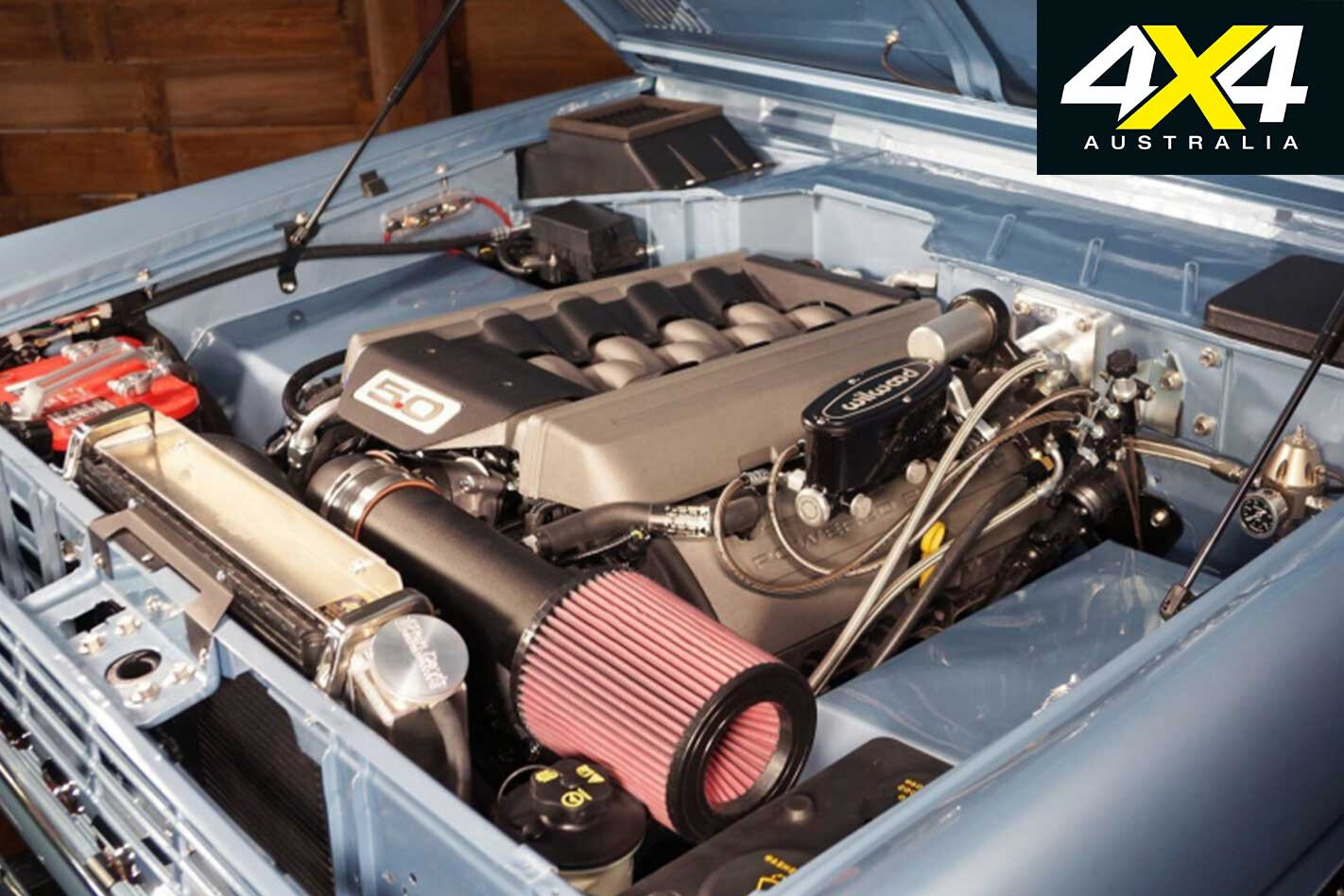
The premium Modern Day Warrior also runs the Coyote engine, but it’s mated to a six-speed Raptor transmission. It features genuine Porsche leather interior and Wilwood four-wheel disc brakes, and it comes with a five-year warranty and a lifetime warranty on select components.
The above video – ‘Building a Gateway Bronco’ – runs through to entire build process involved to bring an original Bronco back on the road. The Broncos are brought back to life on an assembly line within the 60,000 square foot “Bronco Factory”, with 100 per cent of the work completed in-house.
Gateway Broncos will still offer restorations of existing vehicles.
The Australian outback is as much a part of the Australian identity as it is a key geographical feature of this continent.
Though harsh and unforgiving as it is vast, the outback is still home to many and holds much of Australia’s early history as a nation. Sounds like the ingredients for an epic 4×4 trip then, and the Corner Country of NSW serves as the backdrop of the second season of our 4×4 Adventure Series.
Season 2 Episodes
- Episode 1: Kicking up outback dust from Broken Hill to Cameron Corner.
- Episode 2: Tracing the legendary Burke and Wills expedition, from Cameron Corner to the Strzelecki Track.
- Episode 3: Following the Paroo River from Eulo to Wentworth
Season 2 Articles
- Part 1: Following the dirt tracks that cross through Corner Country
- Part 2: Following ancient rivers from Noccundra to Wentworth and their final meeting point
THE Ford Ranger you’re currently drooling over is an example of what’s possible when you have an open-ended budget and a complete disregard for the rules.
Beneath the show-stopping Ranger reside the strongest axles in the game: a set of Ultimate Dana 60s. The disc-brake rear-end is aided by a custom 4-link and Panhard bar arrangement, and crazy articulation is confirmed courtesy of 2.5-inch body, 14-inch travel Fox coil-over shocks. The set-up also features a Currie Enterprises torsion bar-style Anti-Rock swaybar.
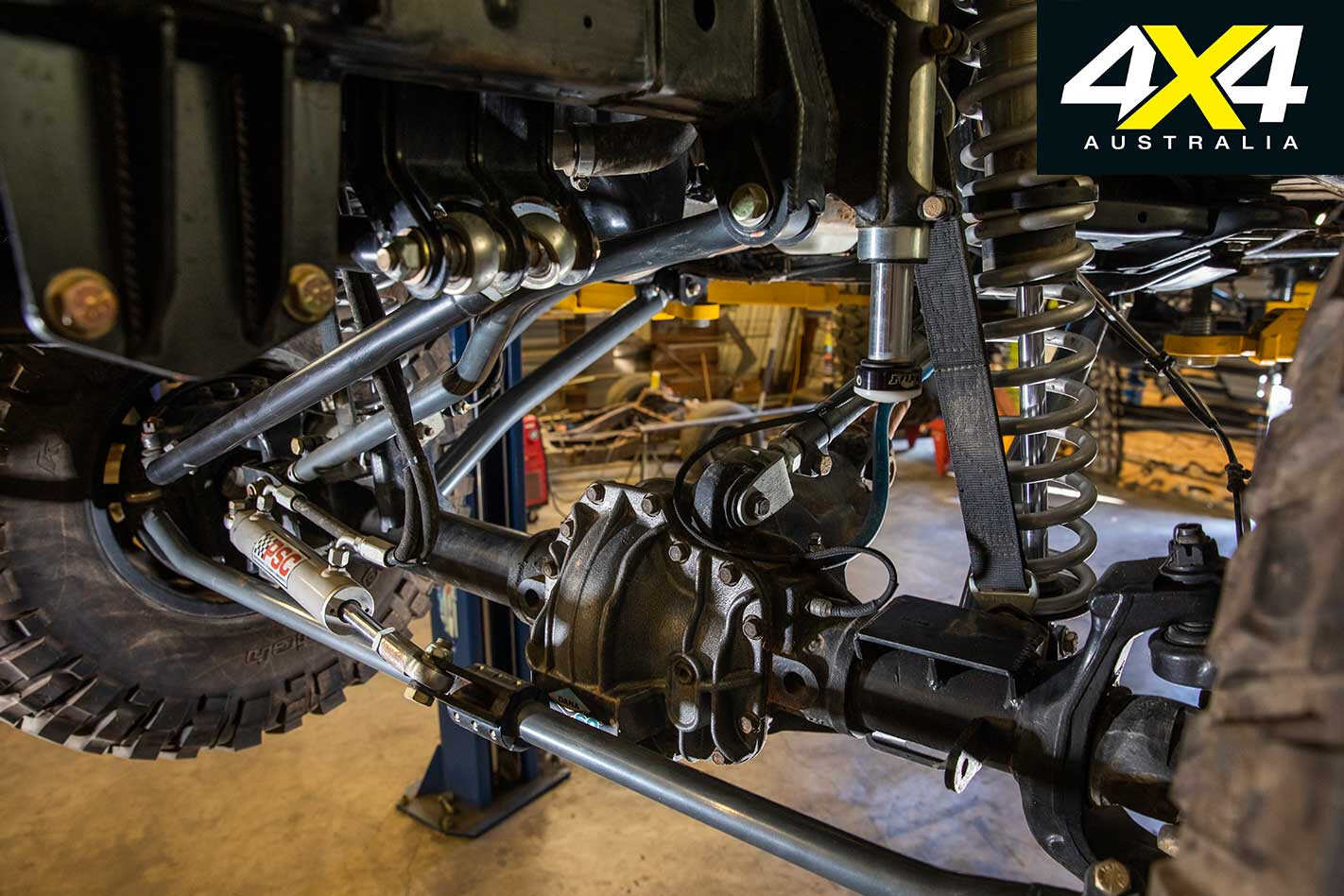
Up front, an Ultimate Dana 60 with an ARB Air Locker is held in place with a second set of 12-inch-travel 2.5-inch body Fox coilovers.
There’s a trayload more fancy kit installed on this beast including Fox 2.0-inch hydraulic bump stops, an hydraulic PSC steering box, 39-inch BFGoodrich Krawler tyres wrapped around 17-inch 103 Xtreme alloys from Ultra Wheel, a pre-runner-style bar, a Warn Zeon winch and 30-inch Rigid Industries Adapt LEDs.
However, for the full run-down on this rock crawler to end all rock crawlers, pick up a copy of the Summer 2018 issue of 4X4 Australia.
There are a few things that make working for this magazine bearable; driving cool cars and visiting some awesome places are two of the obvious ones.
But what makes it most interesting is working within an incredible industry that makes amazing off-road products considered the best in the world. Top gear with great people behind it is certainly a highlight of this game and, while most of the time it’s a business relationship, sometimes we like to get away for a bit of fun on the side. And fun for us means four-wheel driving.
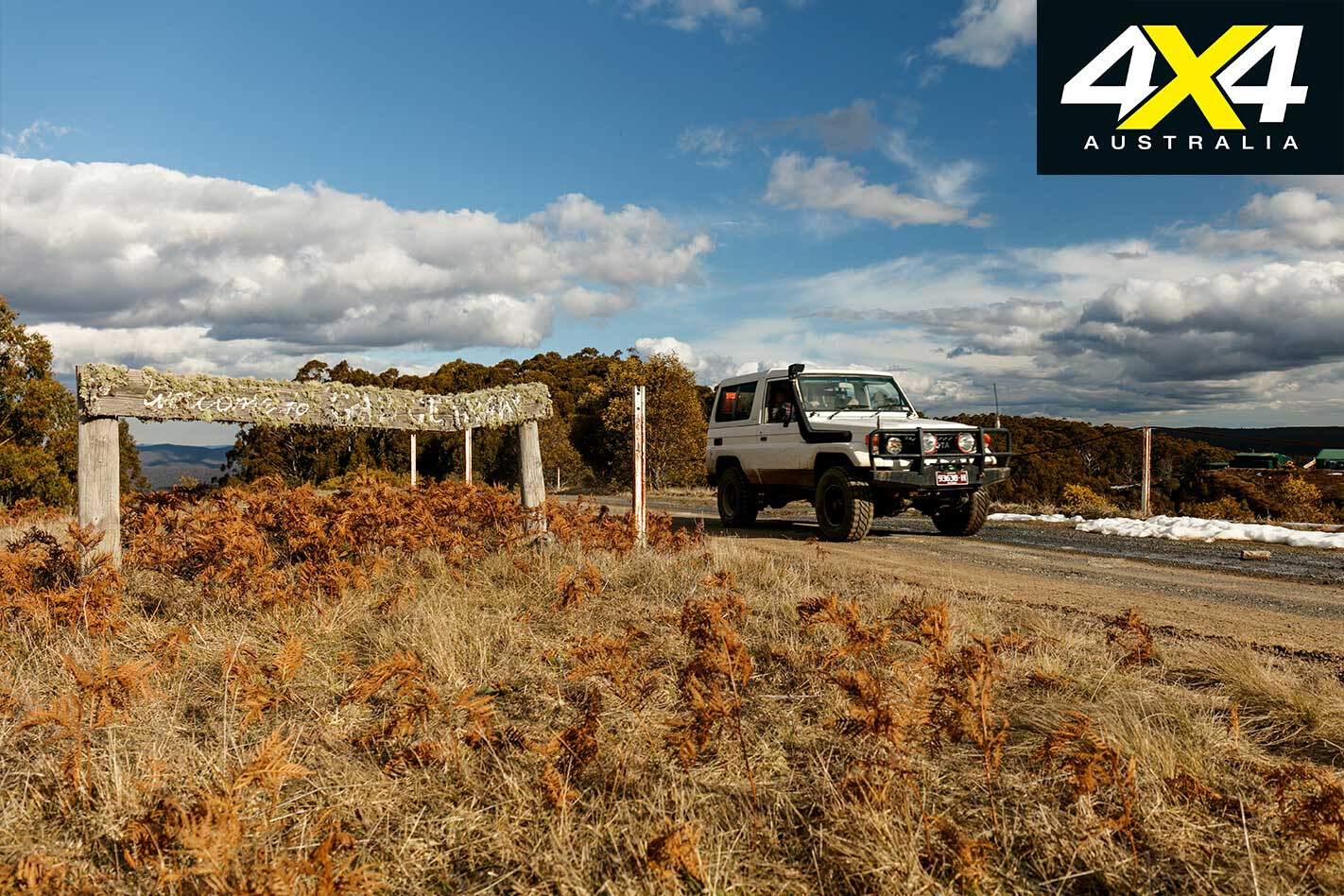
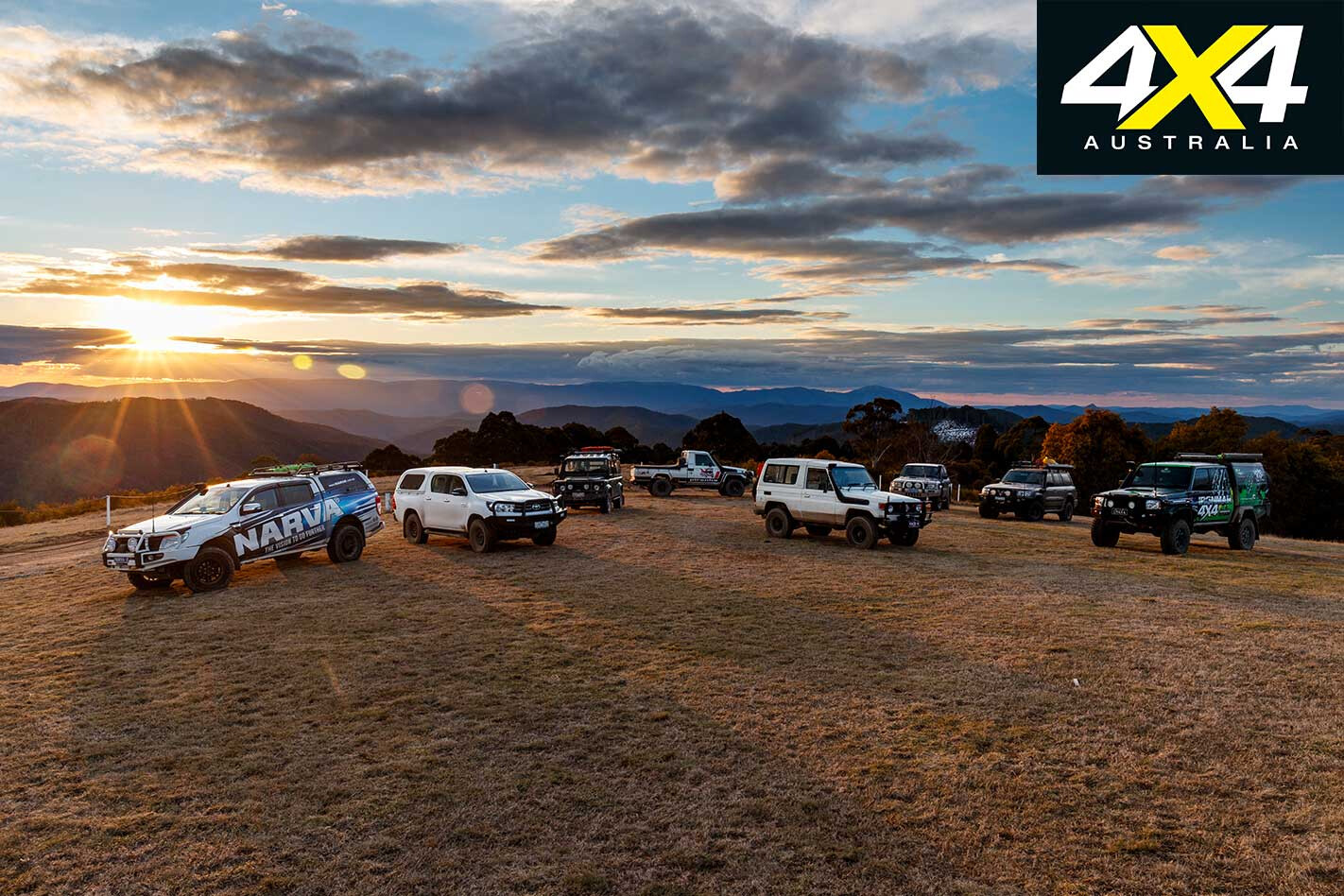
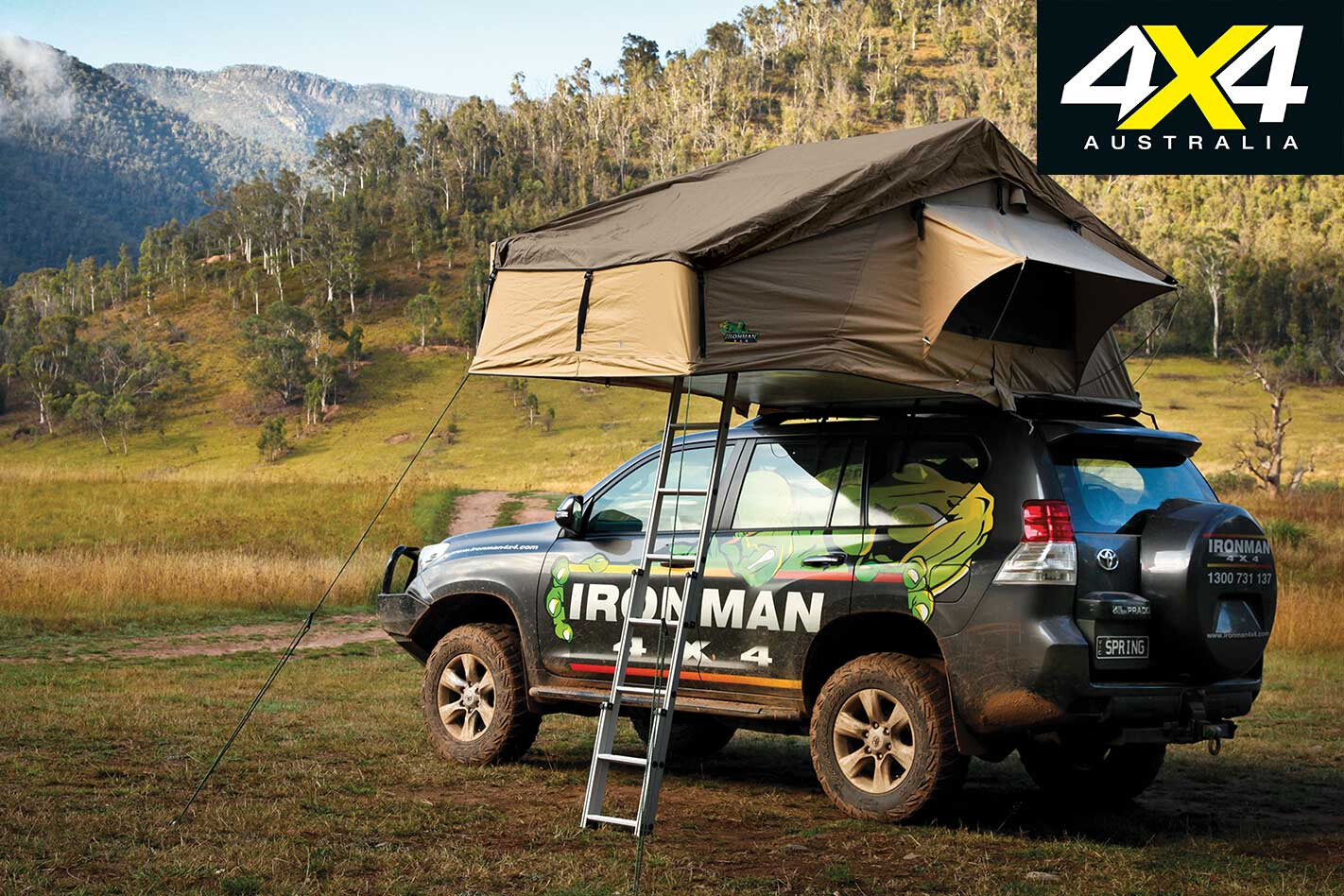
With spring upon us we took one last chance to experience the Victorian High Country in the colder months, and we invited a few of our friends in the industry along for a few days of off-roading. Alan and Michael from Piranha Off Road, Mark and Shannon from ARB 4×4, Jake from Narva, Adam, Kirstin and Samuel from Ironman 4×4, and Hayley and Ben from Hayman Reese joined us for a mid-week adventure.
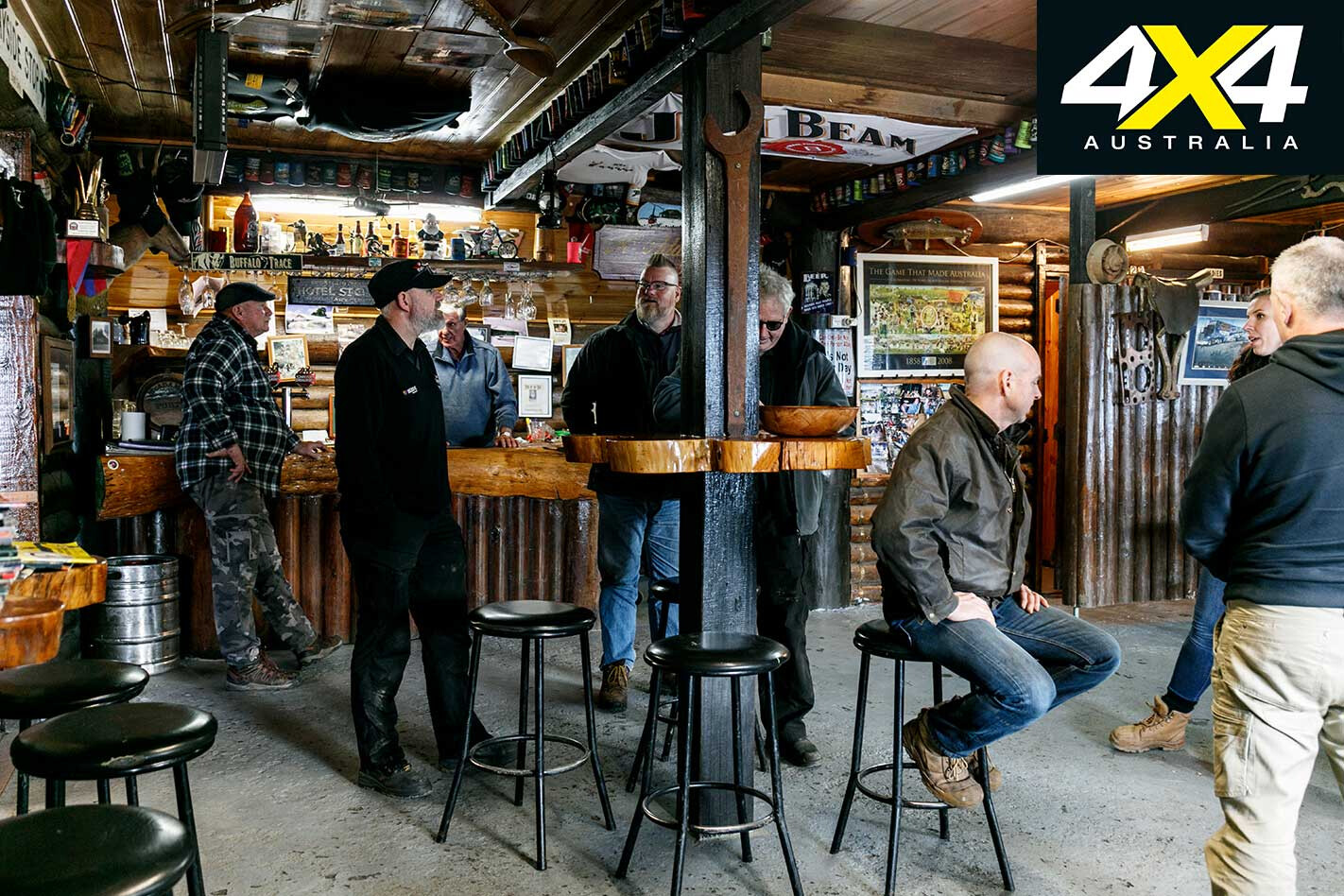
With The Gap Getaway at McAdams Gap near Matlock as home base, we explored a few steep tracks as our little convoy wound its way up into the hills. The Getaway is a rustic pub atop the range above Woods Point. It has accommodation, a cosy bar and serves hearty home-style meals to groups that book there. It’s not a public hotel but is ideal for four-wheel drive or dirt-biking groups.
After a big feed and a few beverages at the pub – followed by a warm night’s sleep – we ventured towards Mount Skene which, at 1500 metres, is one of the highest places you can drive in the High Country during winter.
The road is officially closed through the cold season, but you can get access permits via your 4WD club or association. It had been a bumper winter for snowfalls and we were told the top of Skene was near impassable, but figured we’d take a look anyway.
With enough drizzle falling to make the tracks wet – and some vehicles had all terrain tyres and no lockers, no less – we took a circuitous route to avoid some of the more challenging tracks. However, these still included steep climbs, river crossings and, when you could see through the clouds, great views. Eventually a steep, wet clay track brought the convoy to a standstill as most of the vehicles couldn’t drive up the slippery slope.
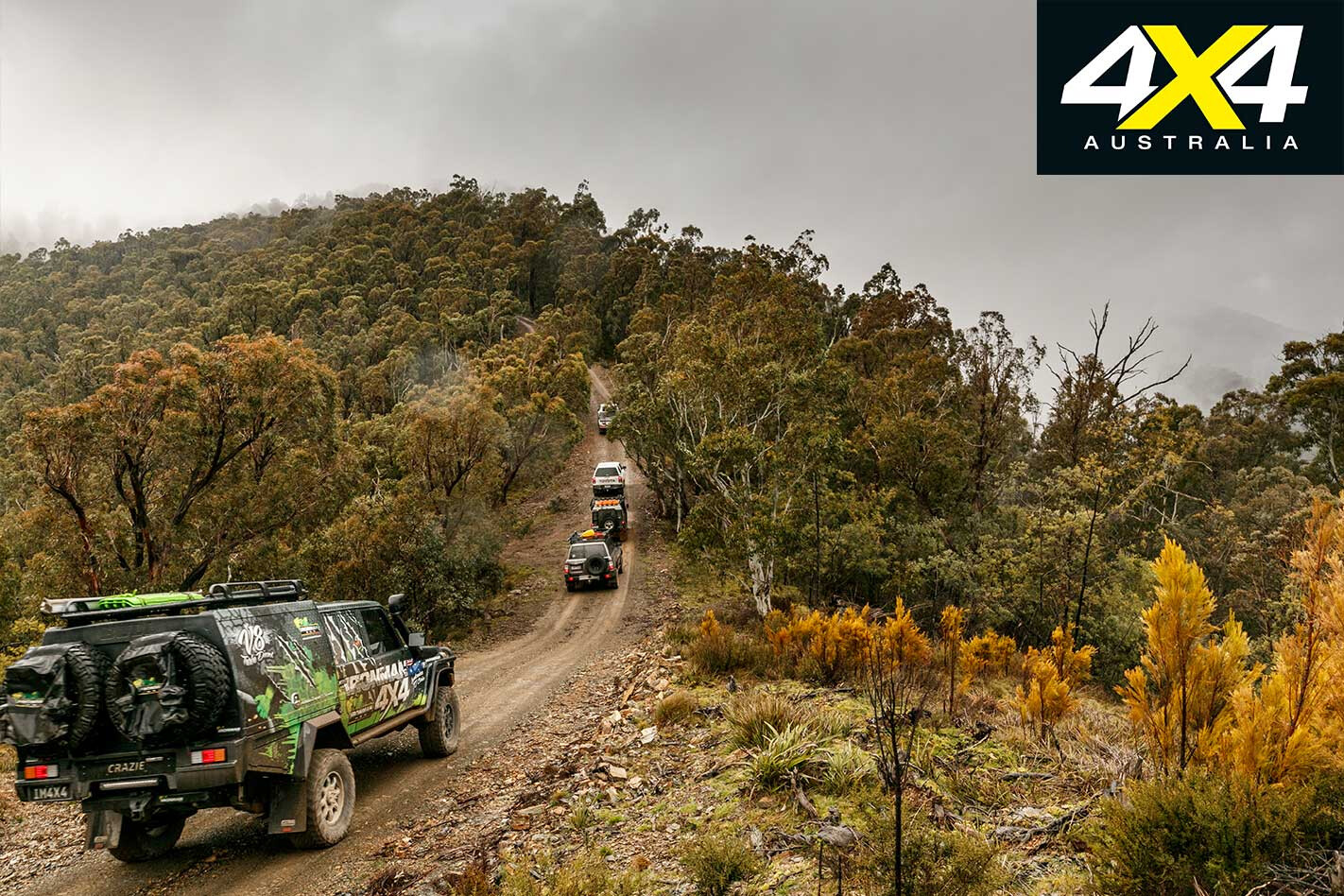
Alan had made it up in his double-locked HDJ79 on 35-inch muddies and he set-up at the top to winch the other vehicles through; his twin-motor Gigglepin winch making light work of the hauling. Adam’s portal axle-equipped VDJ79 was the only other truck to climb that hill.
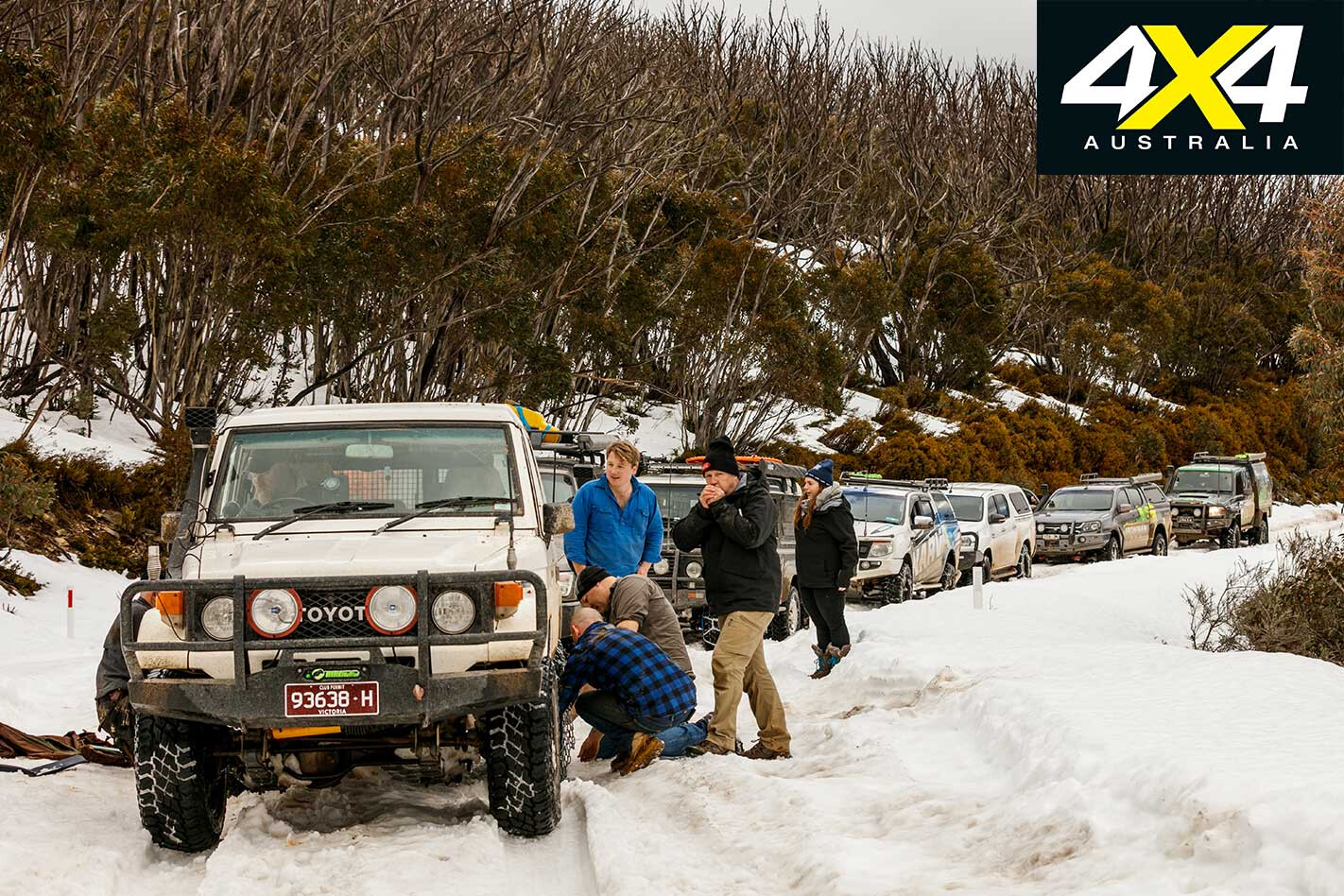
As our altitude increased the mud was replaced by snow on the tracks and, as we ventured up the Licola-Jamieson Road, it became heavier. Even the rigs on mud terrains and lockers were struggling, and it wasn’t long before we were pulling up to fit tyre chains.
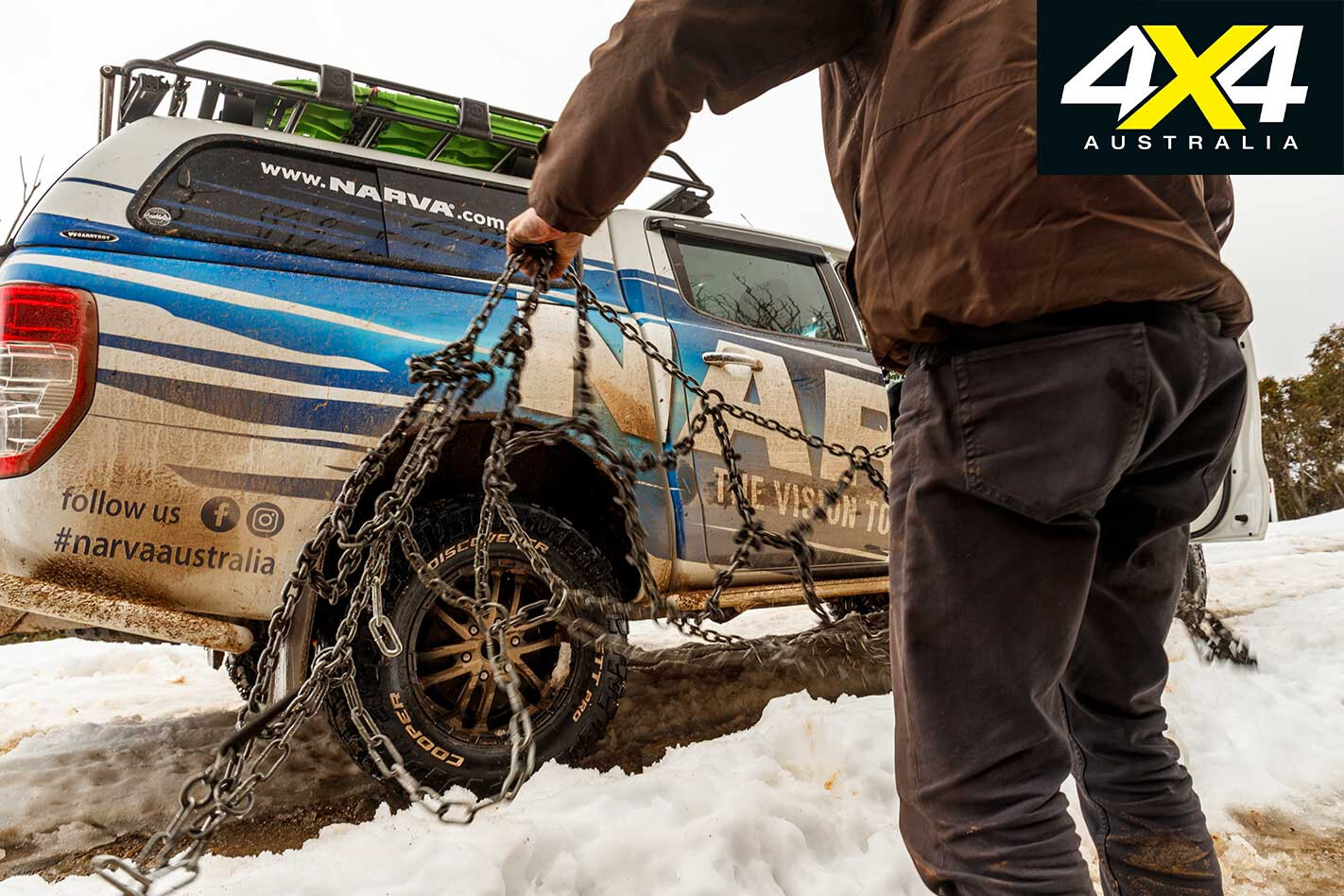
Piranha Off Road is one of Australia’s leading suppliers of snow chains and the only one that still custom-makes them to suit specific applications like 4x4s. Knowing where we were heading, Piranha was kind enough to loan chains to us and help fit them for those who hadn’t done it before. They certainly made a difference in this crunchy snow that was more ice than soft snow, but it was still deep and slippery.
It was a slow process of two steps forward and one step back, as each vehicle pushed ahead only to bog down and need dragging back over its own tracks. Even Alan’s Cruiser with chains on all four of his 35s was struggling.
We were approaching Mount Skene from the Licola end of the road and knew that once we reached the summit, it would be a relatively short drive back down the mountain to Jamieson. But it was tough going as we winched and pulled the vehicles through, and the navigator said we were still at least a kilometre from the top.
Michael donned a set of snow shoes and a heavy jacket and slogged on ahead to see how far it was and check the conditions while the rest of us continued to winch the vehicles. The afternoon was getting late and we soon got a call on the radio from Michael saying, “It doesn’t get any easier and if you guys are still struggling down there, it’s going to be a long night.”
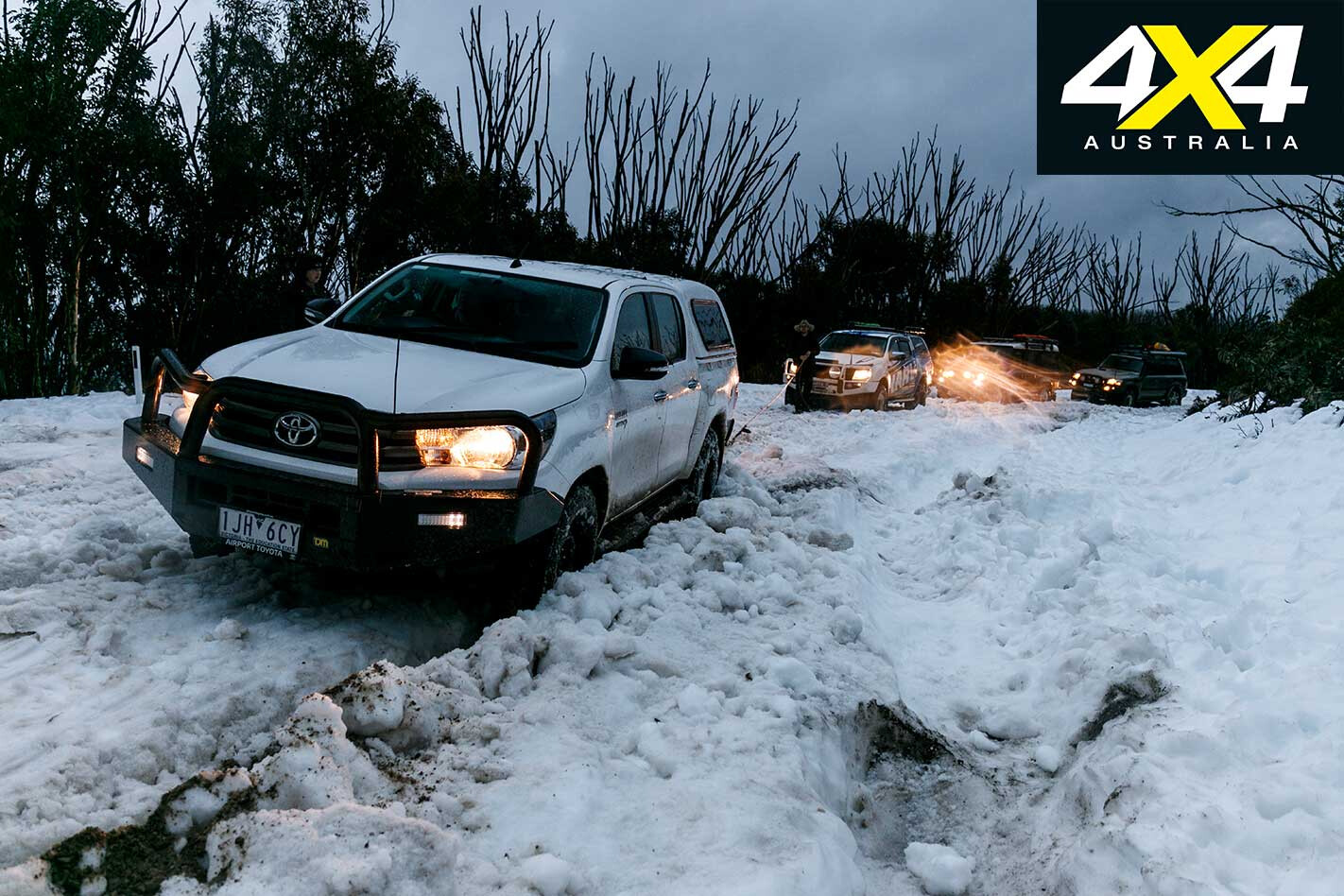
With the warm bar at McAdams Gap on our minds we admitted defeat and turned tail for the long run back. It was after midnight when we reached The Gap, yet Brian and Heather had kept the fire stoked and had dinner waiting for us. It had been a 14-hour day of driving and it only took a few drinks before the cabins called.
A more leisurely drive back to Melbourne via Mount Terrible still held more mud, snow and steep terrain for us all. There was even one instance when Ben’s Defender had to be helped over a hill on the end of a line.
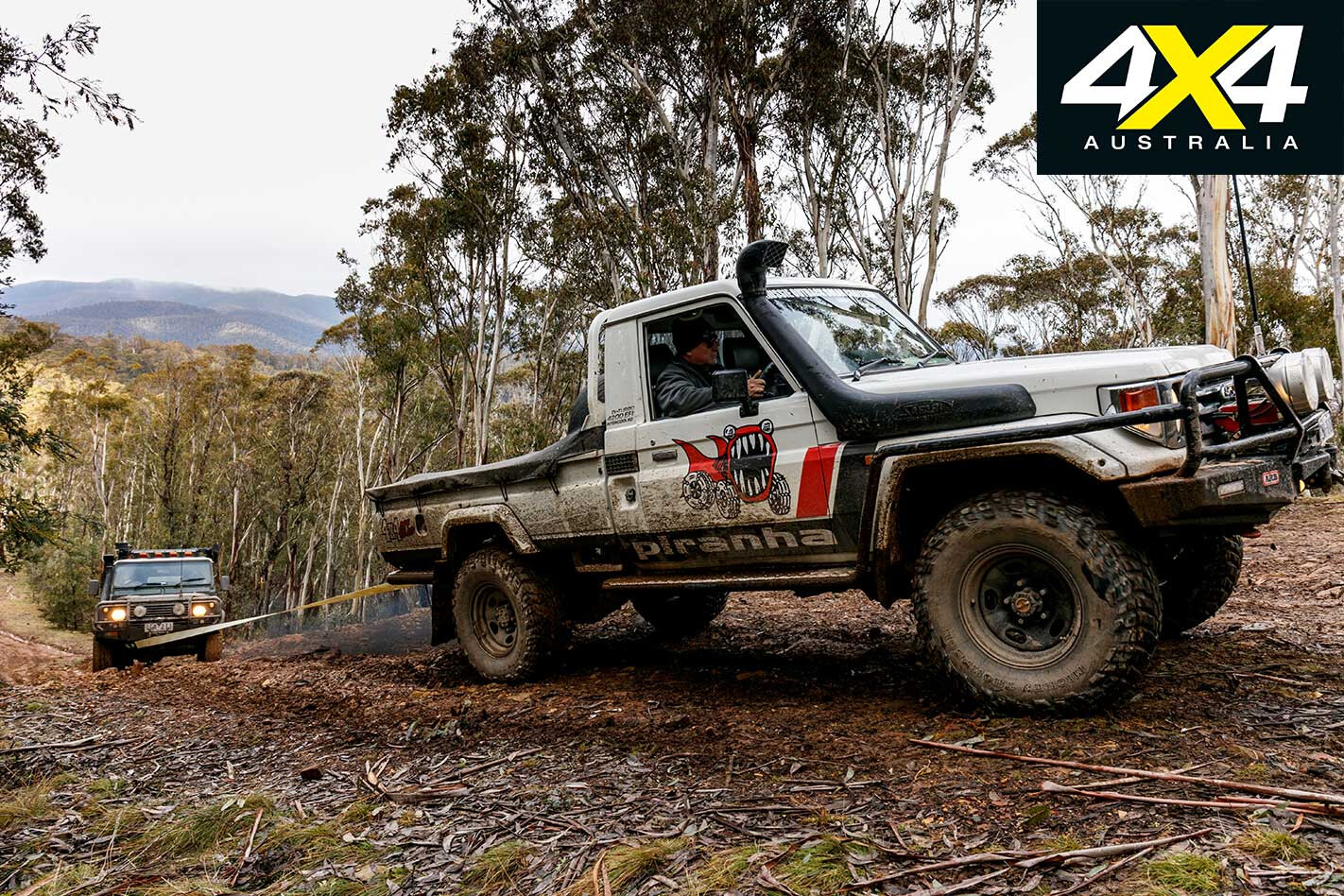
The old saying goes that any day in the bush is better than a day in the office, and our three days in the mountains when we’d otherwise be at work were certainly fantastic. Incredible country, brilliant people, great accommodation and hosts, competent 4x4s and the best accessories all made for a memorable occasion.
We had folks from a handful of companies with us, some of them competing brands, yet we were all mates when out on the tracks, with everyone pitching in to help each other out in the tough conditions. It’s trips like this that really make working in the four-wheel drive industry the best gig in the world.