
A RECALL has been issued for the Mercedes-Benz X-Class due to errors in the vehicle’s operating manual.
While it might seem like a strange reason for a recall, the incorrect or insufficient information provided to owners could “increase the risk of an accident”, according to the ACCC recall report.
A total of 5607 vehicles sold nationally between February 1, 2018 and May 30, 2019 have been affected by the recall, with the full VIN list to be found here: https://www.productsafety.gov.au/system/files/ACCC%20VIN%20list_0.xlsx
The three omissions or errors in the operator’s manual are: the maximum permissible combined roof load is stated incorrectly; the ESP function is incorrectly stated for certain circumstances; and some warning messages displayed in the “Pre safe” function are not described in the operator’s manual.
The recall report stipulates that owners need to contact an authorised Mercedes-Benz retailer to get a new physical operator’s manual and a software update to the electronic version of the manual installed in the vehicle.
Mercedes-Benz Vans has been contacted for more information.
THERE’S NO argument that 4WD differential lockers transform a 4×4’s capabilities, but the big argument is whether to put them in the front or rear diffs, or both. This depends greatly on the vehicle type and intended use, so there’s no correct answer.
The number one argument for not having a manually operated diff lock in the front of the Tonner – which sports a GQ Patrol chassis, suspension and diffs – is the loss of steering the instant the locker is engaged. Given that, a manual locker is in the rear diff and an auto locker (a LOKKA from 4WD Systems) is in the front diff, and I should get more use and superior workings from this combination.
The auto locker in the front diff can be used all the time without sacrificing steering ability, and it helps the Tonner crawl through pretty much any obstacle. For extra assistance I can flick the rear TJM Pro Locker into operation.
The LOKKA is mechanically (automatically) operated via cams, springs and pins to return an extremely sensitive unlocking system, and it needs no air or electrical lines, no switches to operate and no driver input as to when they can or should be used.
The two forces that automatically engage and disengage them are engine-driven forces and ground-driven forces. The former keeps it locked as you supply power to the wheels; the latter allows for unlocking and differentiation as you back off the power to allow unlocking, provided no wheel slippage is registered. They even work (stay locked, if needed) when traversing downhill under engine braking
There is, however, a slight loss of turning circle and slightly heavier steering that many users may not even notice, especially in this day of power steering. The advantages far outweigh this and it’s nothing like the losses a manually operated locker will induce.
The LOKKA has worked in all off-road situations by keeping both front wheels turning, with 50/50 power being delivered when a wheel lifts from the ground. Even when excessive power is causing potential wheelspin the LOKKA manages to keep both wheels supplying drive equally.
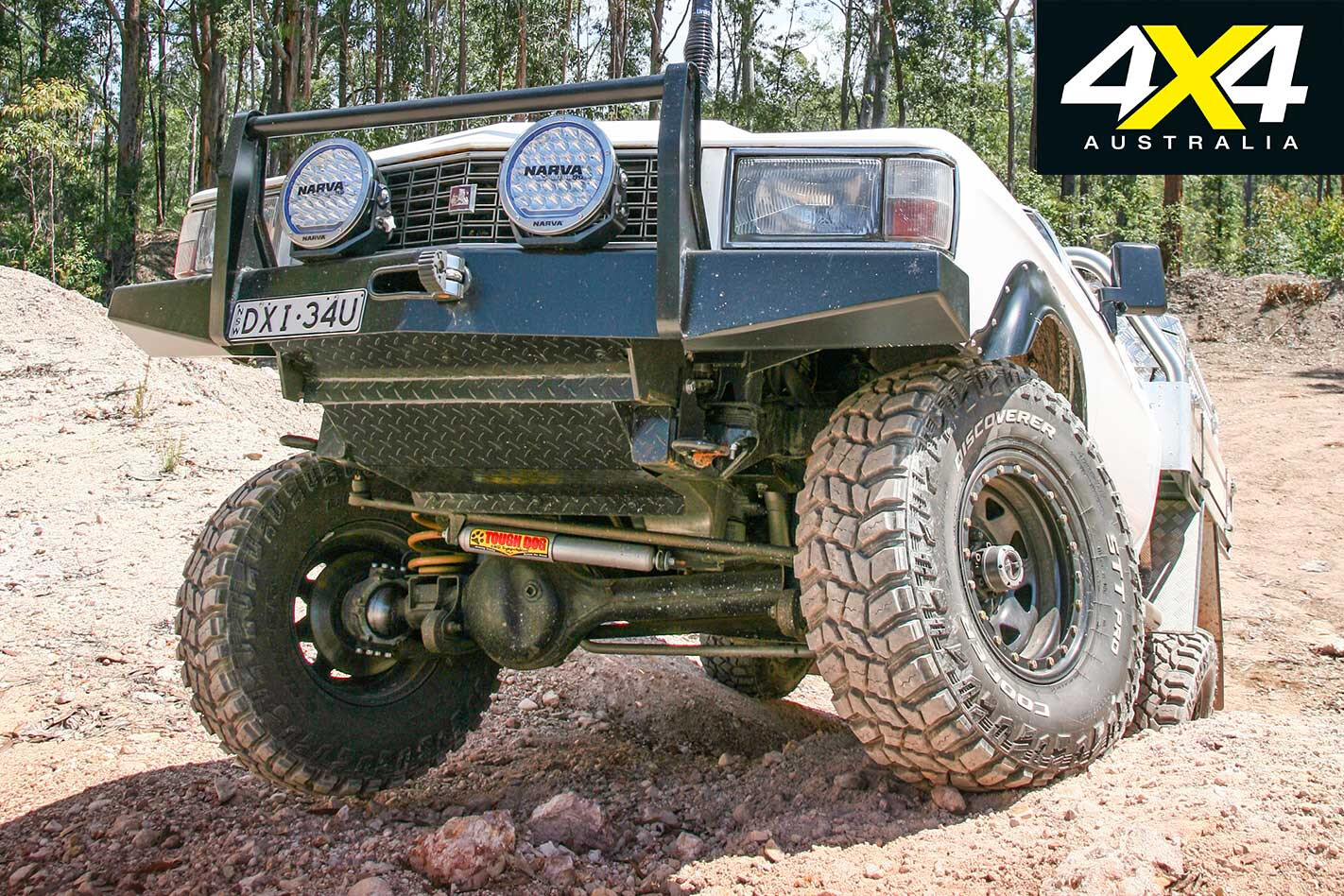
Instead of allowing the wheel with the least resistance (ala, an open diff) to spin, drive is delivered equally to both front wheels while keeping the Tonner moving; this is the ultimate goal, along with less track damage given less wheelspin.
Given it costs about a quarter the price of a manual locker (of any brand), is much easier and faster to install, doesn’t require an air compressor or electrical line, and requires zero maintenance, the LOKKA is a winner (almost) all around. It’s almost a winner as you lose a little turning circle (about one metre, in my case), there’s a slight cam noise at times, and you can’t turn it off … ever.
While that last point mightn’t be an issue for most drivers, you do lose the option of high-speed, long-distance gravel driving without the front locker engaged. Of course, I can still do that style of driving with the LOKKA. You need to ensure tyre pressures are equal and overall tyre diameters are the same, which can slightly upset the workings of the locker. No additional maintenance is required and standard diff oil is used. Plus, it comes complete with a three-year unconditional warranty in Australia.
The LOKKA is the best value-for-money diff-lock on the market and will transform how your vehicle tackles almost any off-road obstacle.
RATED Available from: www.4wdsystems.com.au RRP: $425 (plus $25 delivery Australia-wide) We Say: Great kit at a bargain price
Of the dozens of items we shoehorn into our vehicles before we hit the trail, few are more vital than a means of elevating a vehicle. Whether you get stuck in the sand or shred a tire, the often under-valued all-terrain jack will be your best friend. With regard to vehicle-dependent travel, there are many options: scissor jacks, bottle jacks, air jacks and post jacks.
The first need for raising a wagon was developed centuries ago, and inventors have been hard at work developing ways to make a better mouse trap. This month we are delving into products that will not only take your rig to new heights, but also a host of implements designed to make the task easier.
Testing and Considerations
Our evaluation methods for this review were quite simple, and 100 per cent subjective. We took a few vehicles out, buried them in the sand, and utilised each product as specified by the manufacturer.
We analysed their design, quality of construction from welds to hardware used, weight, storage requirements, cost, and ease of use. In the process we found alternate uses for some, which added value and increased their odds of finding a permanent home in our kit.
The scope of utility for some is very narrow, but in certain environments they would be worth their weight in gold. Not all of the items we tested are featured here, as some did not make the grade. Products reviewed are from Hi-Lift, Safe Jack, Slag Factory, Hard Core Trail Gear, and ARB.
Hi-Lift Jack Extreme 48-inch review
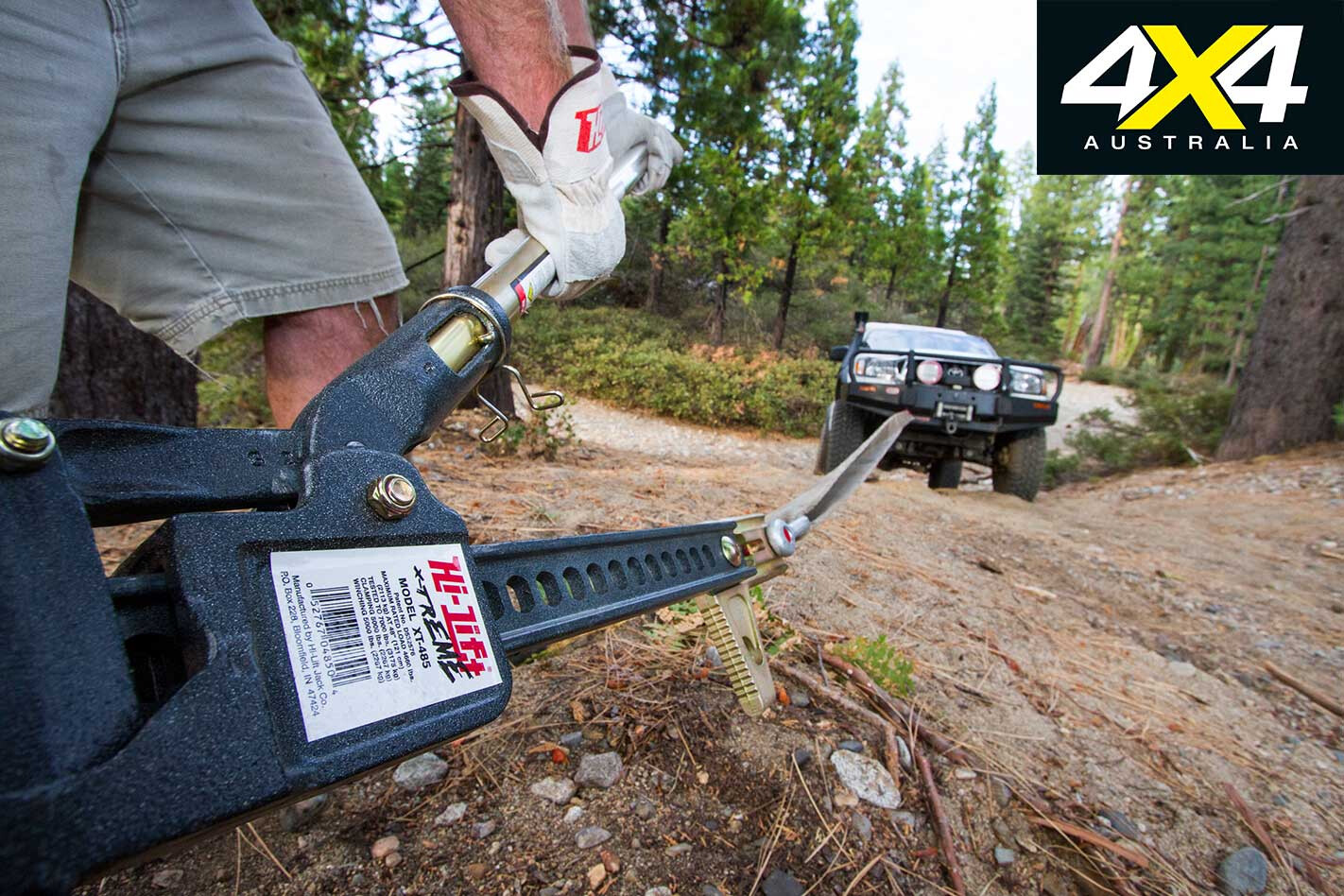
With roots dating back to 1905, before backcountry travel was vogue, the Hi-Lift began life as the Automatic Combination Tool. It was the brainchild of Phillip John Harrah, and would take on monikers such as Farmer’s Jack and Handyman.
During its tenure it would be put into service in World War I, accompany Allied troops during the invasion of Normandy, and be utilised in the most remote corners of the planet and by nearly every major expedition. The old Handyman is indisputably the granddaddy of the lifting genre. Harrah’s firm, Bloomfield Manufacturing Company, is still family run and has earned the right to say, “Don’t buy an imitation.”
During the past 100 years there have been various revisions, but basic design remains the same. The X-Treme, available in 48- and 60-inch models, has a cast steel base and riser unit, 14-gauge high-yield tube handle, and is rated at 4660lb/2113.7kg (tested to 7000lb/3175.1kg).
The riser bar is specially rolled extra-high-carbon steel (80,000lb/36,287.4kg minimum tensile strength), hardware and handle have a weather-resistant zinc coating, and the rest is protected by a charcoal metallic powder-coated finish. Internal pins have a 125,000psi tensile strength, up top is a winch-clamp-spreader tool, and minimum lift height is 4.5 inches.
The versatile tool can double as a winch, press, log splitter, or to reposition a broken spring perch or axle. Quality of construction is unmatched − I’m not sure how they stay in business, as I still have my original unit purchased in 1984. The Hi-Lift is heavy and can be dangerous if not used properly, but this is one tool you don’t want to leave home without. .
Pros: Exceptional versatility; Premium construction; High load rating Cons: Heavy; Dangerous if not used properly; Moving parts require lubrication Website: www.hi-lift.com
Bushranger X-Jack review
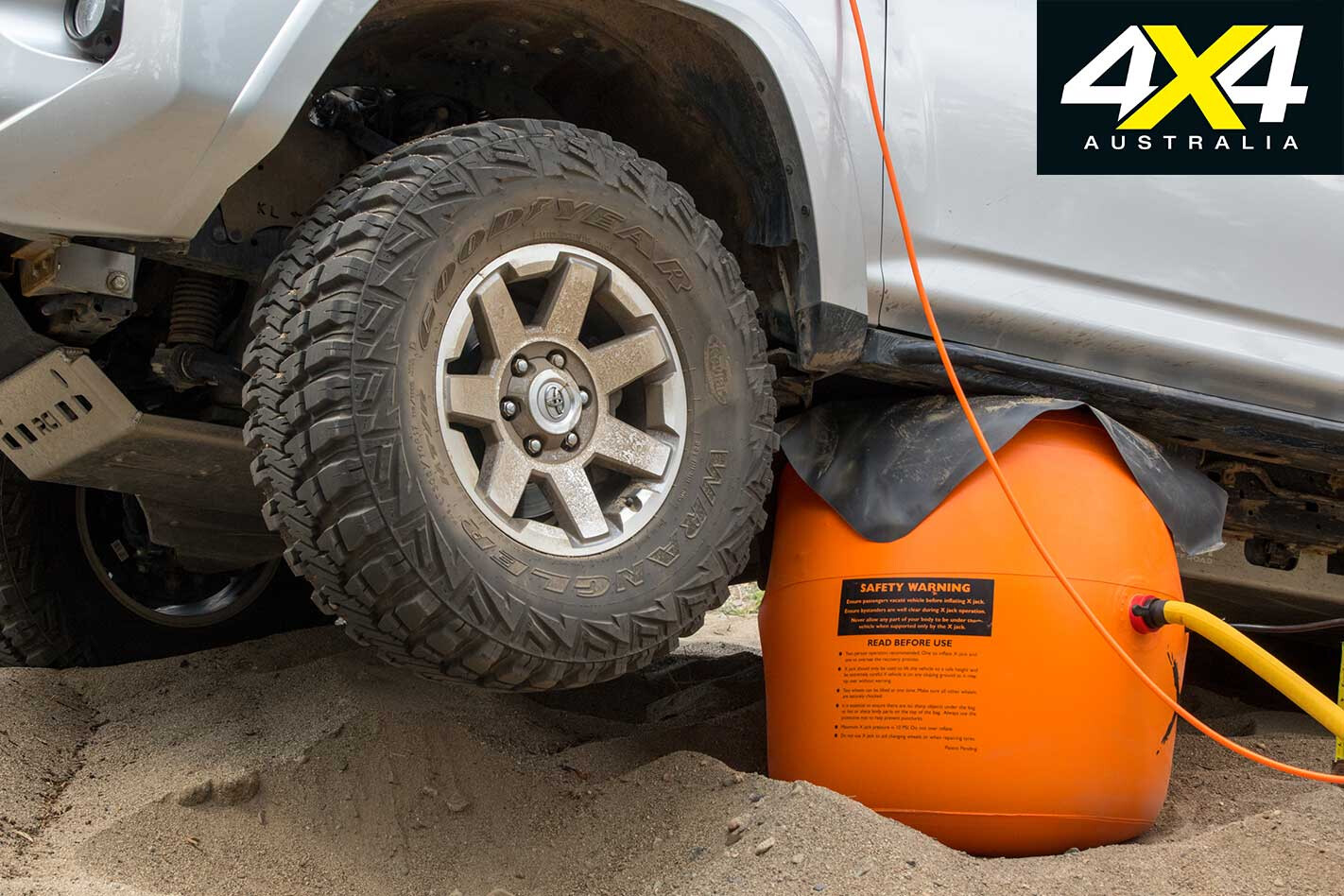
The aim of an exhaust jack is to raise a vehicle in very soft terrain. Place it under the car, attach the hose to the exhaust pipe, and turn on the engine. The exhaust fills the bag with enough pressure to raise the vehicle. There have been some options over the years, but the X-Jack has set the standard.
It is constructed of heavy-duty rubberised canvas with a triple-layer top. A sturdy core insert in the top provides a flat lifting surface, and a protective mat reduces the possibility of damage by irregularities on the undercarriage. It is fully operable at less than 10psi, which is good as engines don’t take kindly to excessive exhaust backpressure.
A mindful feature is the side-mounted valve stem, which allows for inflation via an air compressor. This was important, as the tailpipes on both our test platforms had been strafed on rocks and didn’t provide a good seal. This would also be preferred if the pipe is submerged in mud or water.
The 3628kg capacity is suitable for any medium-sized vehicle, but depending on chassis height, suspension, and how deep the tyres are buried, the 31-inch max lift may not be adequate. In any case, it will lift a tyre high enough to fit a traction mat.
In testing, the X-jack raised our 4Runner in about eight minutes with the engine at 2500rpm. Using an ARB twin compressor, it took less than two minutes. Final internal pressure was 3psi and jack extension was 18 inches, 58 per cent of available lift.
When you reach a lift height, disconnect the tailpipe hose or turn off the compressor. A one-way valve keeps the X-Jack from deflating. Bringing down tyres is as simple as slowly turning an intermediate valve.
Pros: Excellent for intended use; Unparalleled flotation; Quality construction Cons: Limited lift height; Bulky; Cost Website: www.bushranger.com.au
Safe Jack Bottle Jack Recovery Kit review
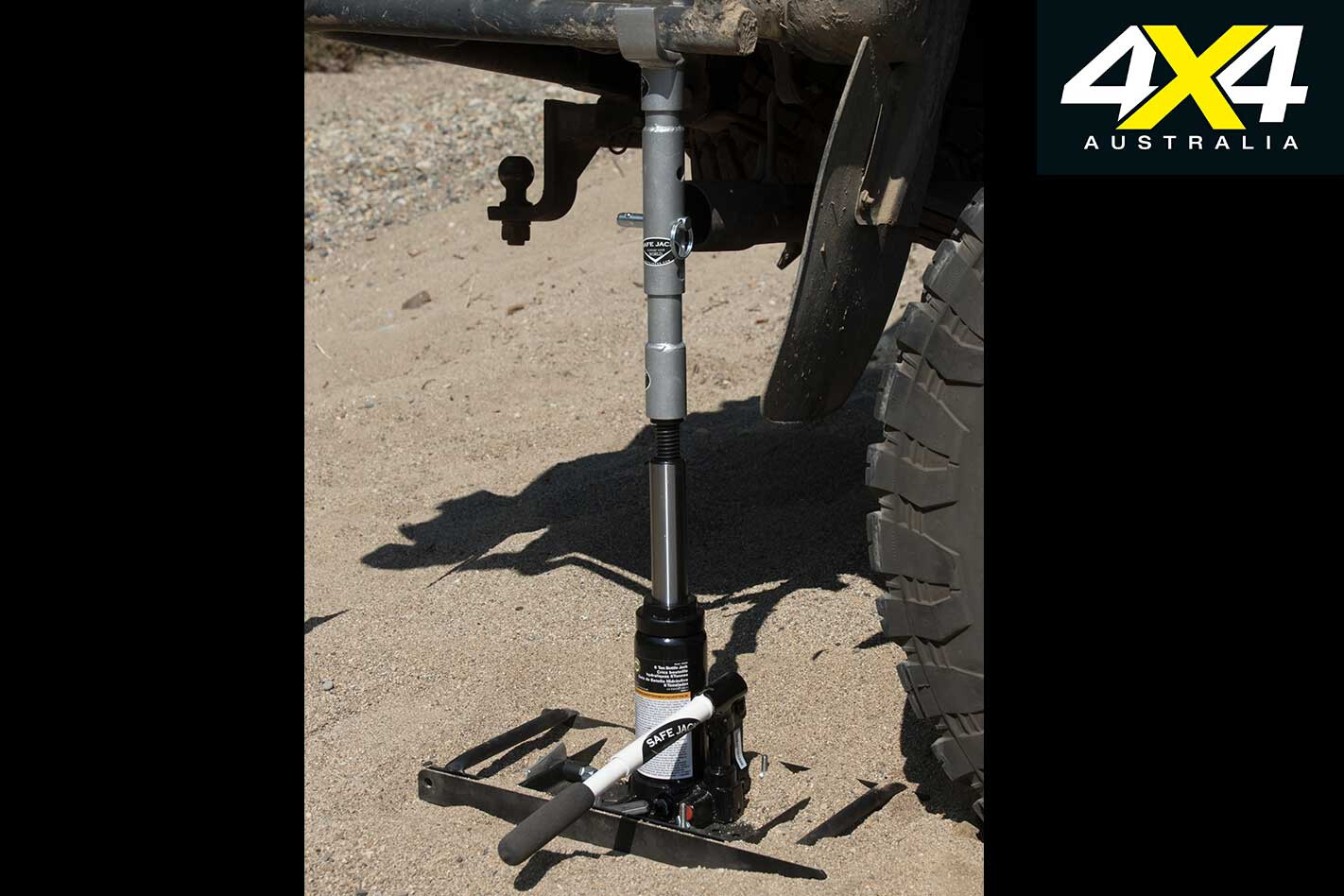
Besides the simple task of lifting a vehicle, I’ve used bottle jacks for everything from raising motors and coercing broken spring perches back in position, to straightening a bent driveline. The problem I’ve run into is that they are often too short to reach the intended target, resulting in adding makeshift piers and compromising safety.
The other issue is that the cap at the top of the riser shaft is usually small, round, and offers a fairly unstable contact patch. Safe Jack’s Bottle Jack Recovery Kit addresses these dilemmas with a number of innovative accessories.
It utilises a standard 5443kg bottle jack but adds three heavy-duty shaft extensions. The extensions slip over the jack’s cap and are kept stable by a tight-fitting collar. There are two top pads: a flat version for lifting a frame or similar surface, and a cupped pad for axle tubes, leaf springs and other curved objects. Construction of all components is excellent, and the kit includes a six-ton hydraulic jack, handle, 3-, 6- and 12-inch extensions, pads, and one of the best canvas carry bags we’ve seen.
The products exceeded expectations. In addition to conventional under-axle use, with the 12-inch extension attached we were able to raise the vehicle from the bumper. A drawback is the jack’s limited shaft stroke, which is about seven inches. I’ve slipped this gear into my rig and retired my well-used OE bottle jack.
Pros: Excellent construction; Increased stability and safety; Expands utility of conventional jack; Heavy-duty carry bag Cons: Cost Website: www.safejacks.com
The Jack Foot review
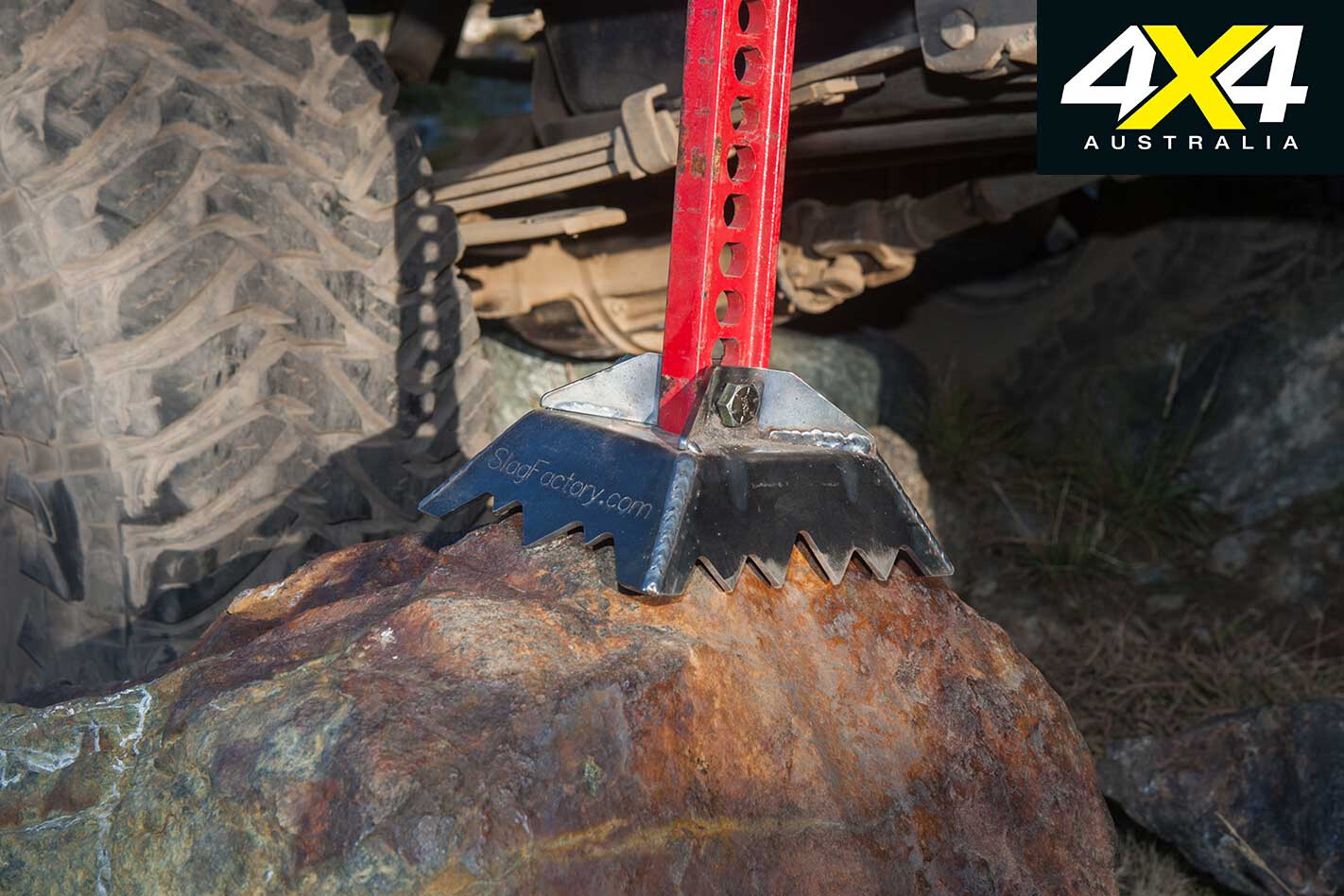
You don’t choose where you break down or get stuck. On uneven terrain, the Slag Factory’s Jack Foot will make the task of lifting a vehicle much easier and safer. Laser cut from 3/16th-inch steel and formed on a CNC bender, it features a wide, pyramid design with jagged teeth.
The teeth are strong enough to support the full weight of most vehicles, even if only a few are in contact with the ground. There are also teeth inside the pyramid, strategically positioned to grab the tops of rounded rocks. In soft dirt and sloped terrain, the teeth cut into the soil and hold firm.
Another advantage when working in sand, snow or mud, is that the base is wide enough to keep it from sinking in too far. The Jack Foot suits all soil types and is compact enough to be permanently mounted on your Hi-Lift.
Pros: Increased footprint and grip; Articulating mount; Excellent construction; Cost Cons: Weight Website: www.slagfactory.com
Safe Jack Universal Combination Stabilizer review
Anyone who has attempted to lift a vehicle from a soft surface will appreciate Safe Jack’s stabiliser system. The problem is that the jack base does not have enough surface area, thus the ground load exceeds what the soil can support and your lifting implement slowly sinks.
As we have discussed, the Hi-Lift is an indispensable tool, but herein resides a love-hate relationship. The base is quite small, and when extended and supporting a vehicle the assembly resembles an elephant on a pogo stick. Fortunately, the Universal Combination Stabilizer (UCS) addresses both issues.
Cut from powdercoated 10-gauge plate steel, its base measures 18×8-inch, thus increasing the footprint and adding what you might call a flotation property. The kit includes two insert plates, one for a bottle jack and another for a Hi-Lift, which fit into the base and are locked in position with a spring-loaded retainer pin. The former will accept hydraulic jacks up to 7 inches square, or 4.5 inches when using the provided clamp hardware. The latter accepts a Hi-Lift foot and features a 3/8th-inch steel rod on one end to keep it in place.
The initial setup for the bottle jack insert requires centreing the unit on its insert plate, then positioning the hardware and clamps. This is a bit fiddly and I highly suggest setting it up prior to hitting the trail. You will also want to mark how the jack sits on the insert plate to expedite future use.
The Hi-Lift insert works on the principal of triangulation. Two lengths of 5/32ths steel cable, one attached to each end of the base, are connected to a bracket near the top of the jack. When assembled it forms a triangle, the most stable geometric figure, and adds significant lateral stability.
During testing we lifted the both wheels of the Tacoma off the ground, which would normally send the elephant tumbling left or right. The UCS held tight, even when given a good shake to and fro.
It is available for 48- and 60-inch jacks, and construction, as with the other Safe Jack components in the review, is top notch. My only suggestions would be the addition of a traction surface on the bottom and enlarging the Bottle Jack Recovery kit carry bag to accommodate the stabiliser plate.
Pros: Expands use of conventional jacks; Large footprint; Heavy-duty construction; Improves safety Cons: Cost; Weight Website: www.safejacks.com
Hard Core Trail Gear Alien Base review
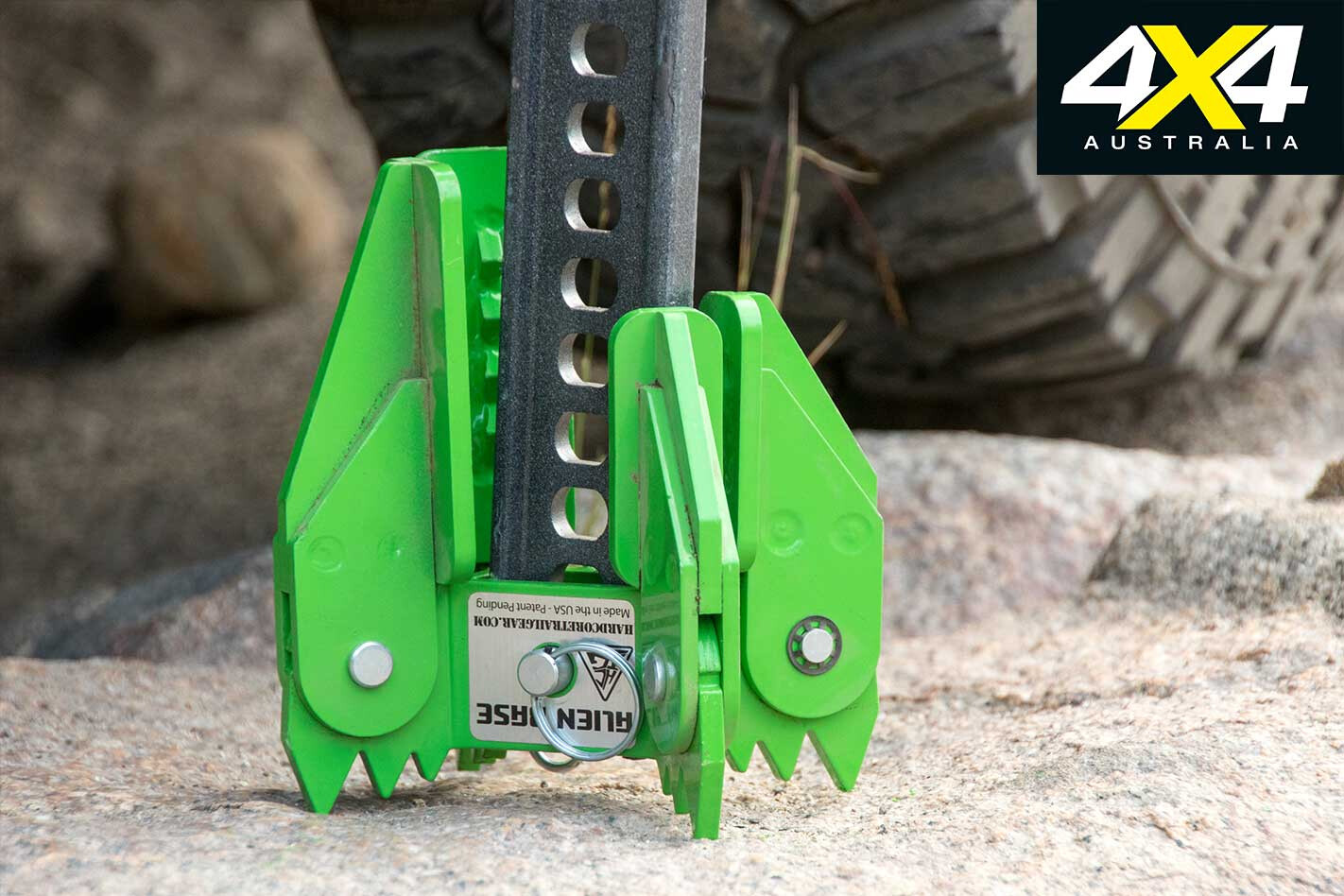
When using the Hi-Lift on a hill or rocky surfaces, the terrain has made for fairly sketchy operation; either the stock foot was too small or its semi-smooth surface could not gain purchase. Hard Core Trail Gear addresses these issues with the Alien Base.
Designed to replace the OE foot, it incorporates four foldout legs that nearly triple the overall footprint. The contact patches are serrated to grip the soil, and detent springs keep the legs in either the open or closed position.
A triangulated teeth unit on the top allows it to be mounted upside-down (which becomes right side up) when needed. CNC milled from ¼- and 3/8th-inch plate steel, the Alien Base impressed on soft sand, sinking just a few inches. On cambered granite it held tight with only two teeth in contact.
Pros: Versatile lifting options; Improved safety; Quality of construction Cons: Cost; Weight Website: www.hardcoretrailgear.com
Hi-Lift Off-Road Base review
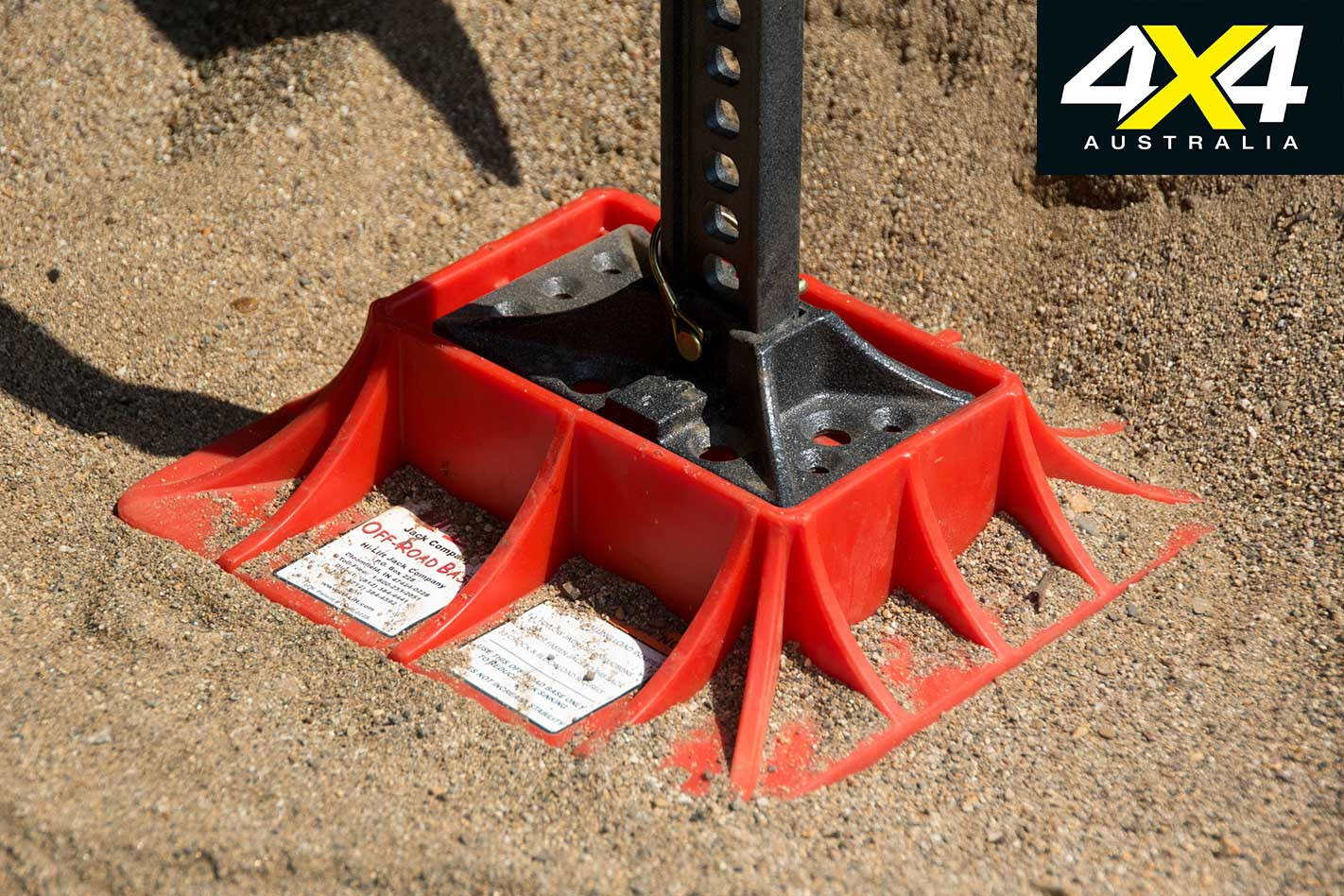
I have had an Off-road Base in my rig for decades and used it countless times. It has been around forever and is about as simple as it gets – just a big plastic platform for working in soft terrain. There have been times when it sank into oblivion (there is an attachment eyelet for a recovery tether), but in most sandy, snowy or muddy conditions it has worked like a charm. And, it won’t cost you a kidney and three pints of blood – love it!
Pros: Increased footprint; Durable; No moving parts; Lightweight; Cost Cons: Does not hard-mount to jack; Weight Website: www.hi-lift.com
Safe Jack Secure Lifter, Chain, and Lifting Sling review
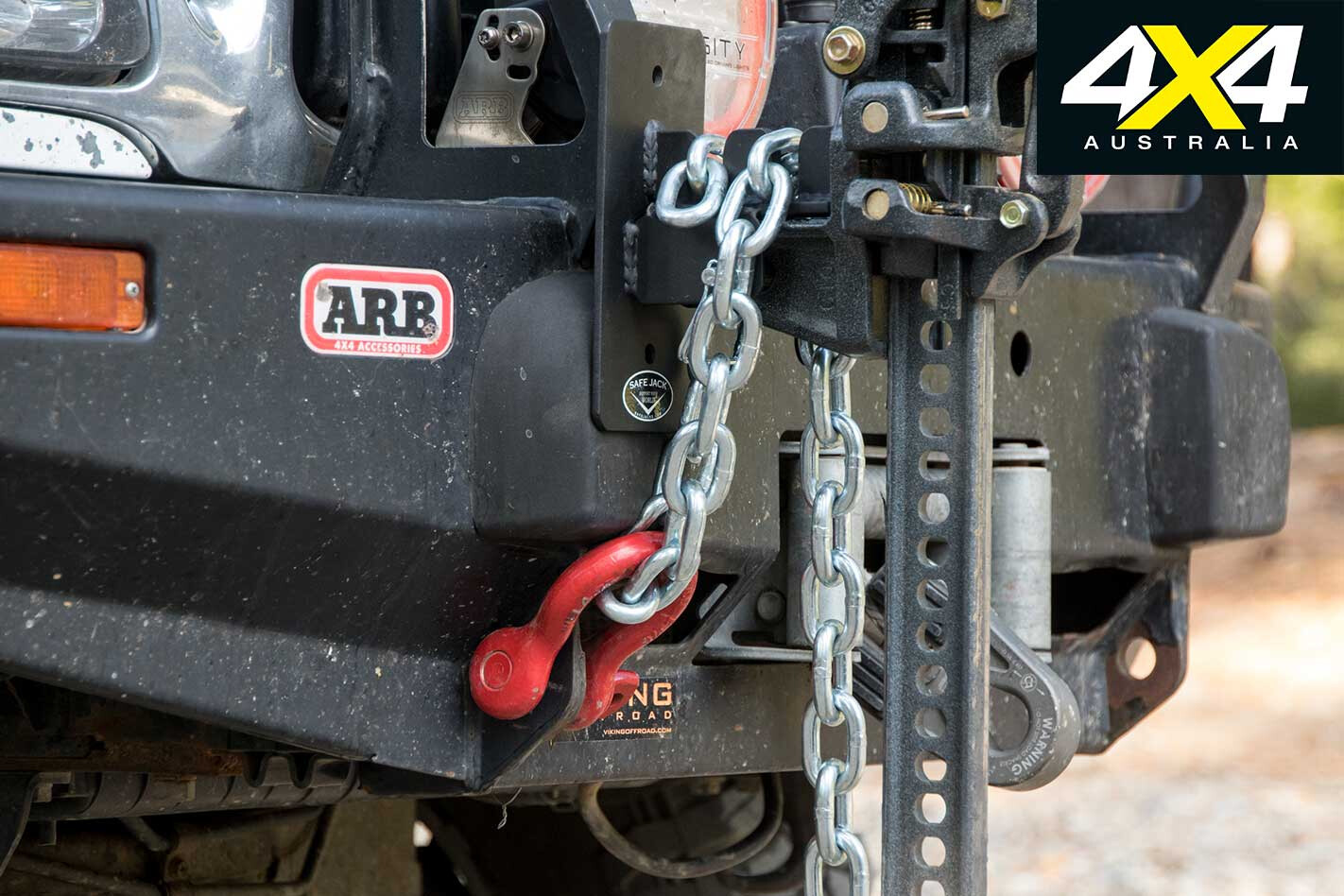
The Secure Lifter, which is designed to be used with a Hi-Lift jack, is a simple idea properly applied. Its purpose is multifold: raise items with odd surfaces or that are lower than a Hi-Lift’s minimum height, keep the jack post away from the subject being lifted, and to increase safety. As with the other Safe Jack products, construction is excellent, steel components are powdercoated black, and an instruction manual is provided.
The unit attaches to the jack’s lifting nose and is secured with a quick-release pin. The outer edge features an abutment plate that rests against a tyre or other object to avoid interaction. On its upper edge are two slots designed to accept and secure a chain. The 4-foot polyester sling, rated 12,400lb/5624.5kg in a basket configuration, is used to loop through spokes in a wheel and back to the Secure Lifter.
Used in the same arrangement, the 3/8th-inch Grade 30 chain (2650lb/1202kg; basket) is handy for attaching a bumper, rock slider, or other hardware. Testing both applications went without a hitch; my only suggestion would be the addition of a rubber pad on the abutment plate to protect painted surfaces. The combination of these three tools could be an asset when a suitable and safe lifting surface is unavailable.
Pros: Works well for intended use; Quality construction; Versatile lifting options Cons: Needs protective pad; Cost Website: www.safejacks.com
Hi-Lift Lift-Mate review
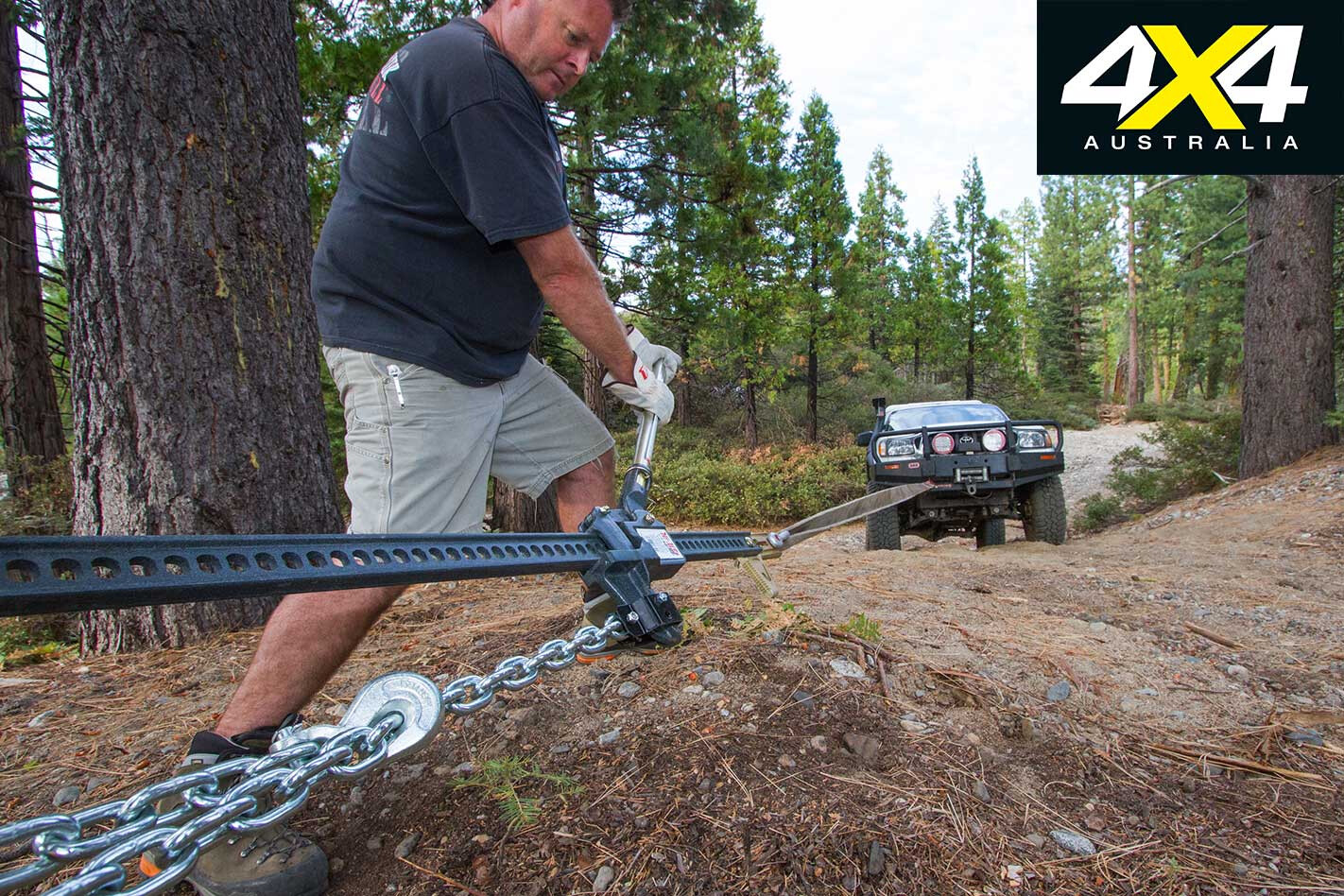
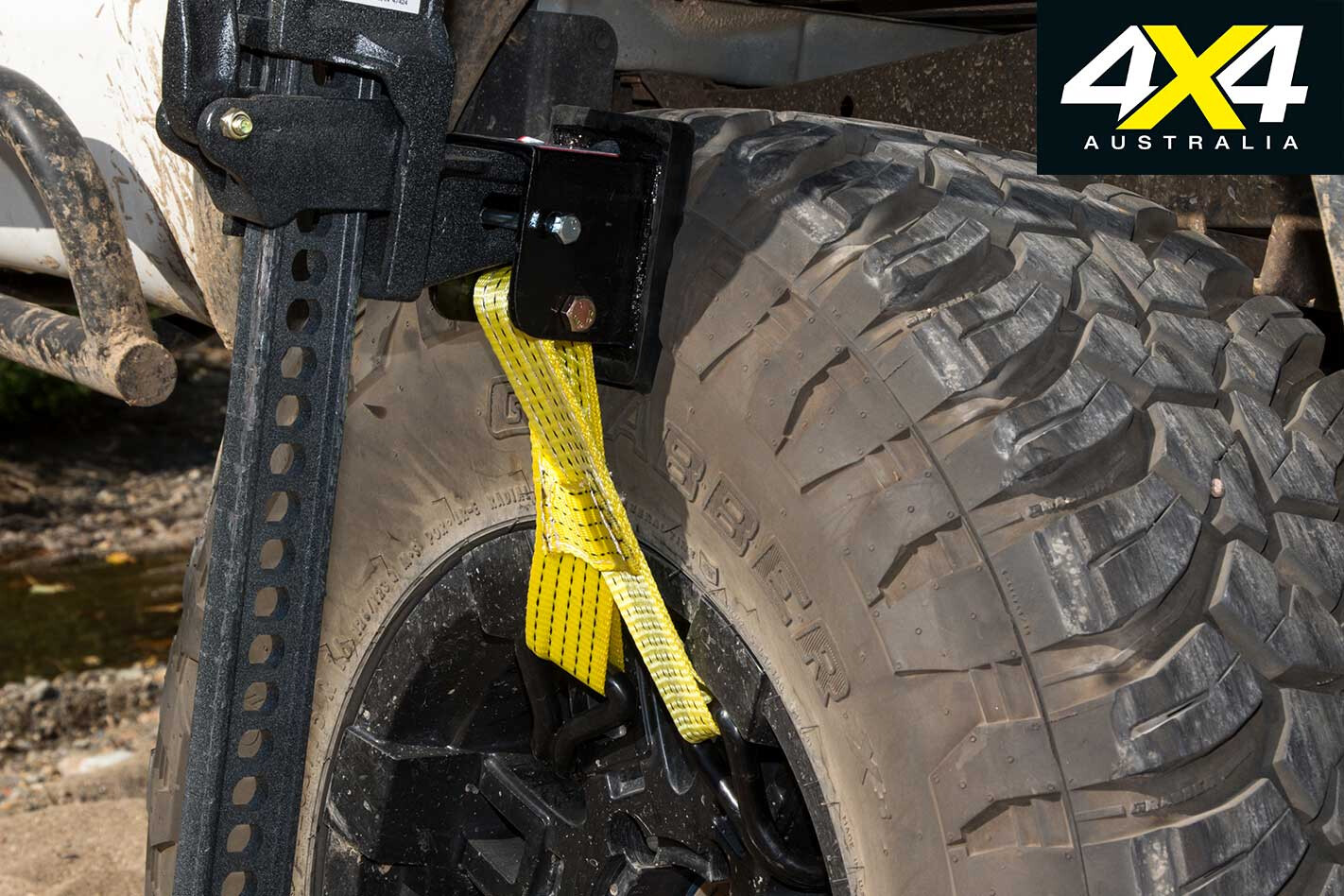
Handy for rigs that don’t have conventional attachment points for a Hi-Lift jack, the Lift-Mate consists of a heavy-duty steel bracket that fastens to the jack nose. Hanging from the bracket is a polyester web sling fitted with two rubberised steel hooks. Slip the hooks into two voids of a wheel and you’re ready for business. As you raise the jack, a large rubber pad on the bracket presses against the tire to stabilise the system.
Pros: Works well for intended use; Quality construction; Cost Cons: None we found Website: www.hi-lift.com
Hi-Lift Off-Road Kit review
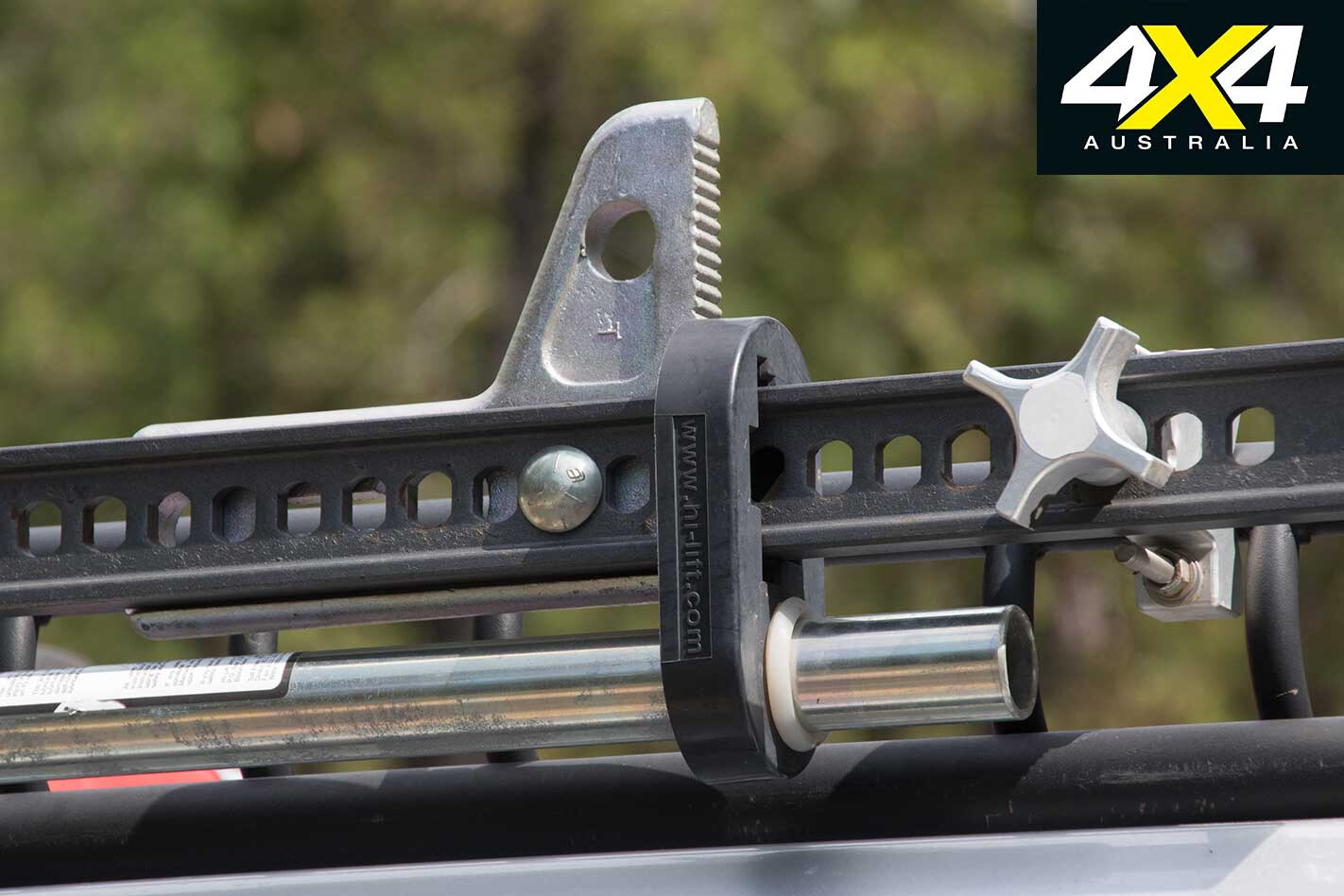
In the days before I could afford an electric winch I used various methods to extract my rig from a bog, the most common of which were a shovel and $30 come-along. The system was not rated for the loads we put it under, and often failed.
If you called the Off-Road Kit a poor man’s winch, you would be correct. But this thing works, and works well. When assembled with a Hi-Lift jack, concept is straightforward, portable, and does not rely on the engine or its electrical system.
There are multiple components: two brackets, two lengths of 3/8th-inch chain with hooks, bow shackle, nose bracket, and a 5000lb/2267.9kg WLL tree strap. Set-up is a four-step process: attach the nose bracket to your Hi-Lift and bow shackle to the top; wrap the strap around a deadman (tree or other fix object) and thread a chain and hook through the eyelets; attach the other chain and hook to a recovery strap attached to your vehicle; and attach loose ends of the chains to nose bracket and bow shackle.
In the same way that the jack will raise a vehicle, it will also pull one. It can also be used to move boulders or logs off the trail, reposition a wayward axle, or pull just about anything you can attach a strap to.
I must say that utilising a Hi-Lift in this manner is a complicated process, and as with any recovery scenario, the due diligence should be exercised (as if it were a live winch line) to ensure safety. Progress is in three-foot increments and in the interim a secondary safety chain must be used to stabilise the vehicle prior to setting up for another pull. Work gloves and canvas carry bag included.
Pros: Quality construction; Excellent for intended use; Cost Cons: Light-duty bag Website: www.hi-lift.com
KNOWN FOR its pristine and beautiful beaches, the South-East region of NSW also features exciting 4×4 tracks that cross over big mountain ranges and drop down into steep valleys.
The 4×4 Adventure Series team kicks off their journey from the river inlet at Moruya and head towards timber country, right through the stunning Bendethera Valley. Along the way the convoy visit the many natural wonders and historical treasures of NSW’s South-East region.
Season 4 Episodes
- Episode 1: Rolling through the white sand and red dirt of NSW’s stunning south-east coast.
- Episode 2: The rugged hinterland in the south-east of NSW is full of hidden gems and abandoned goldfields.
- Episode 3: Historic huts, dusty tracks, beautiful beaches and an enticing museum; all within cooee of Eden.
Season 4 Articles
- Part 1: We travel from the verdant ranges of north-east NSW to the white, wave-washed sands of Stradbroke Island.
- Part 2: The southern forests and parks of coastal NSW are filled with delightful surprises, as Ron Moon and the crew discovered on their latest foray into the region.
THERE’S no such thing as too much grunt, whether it’s that Pro Comp street machine you’re building, that ultimate off-roader you dream of, or something that combines the two like this fire-burnt orange, six-pawed custom brute of a Jeep JK Wrangler dual-cab ute.
There’s really no easy way to describe this thing. The end result of Russell Simpson and his team’s 1000-plus man hours (and close to 18 months) toiling in the Exotic Custom Motorsport (ECM) workshop is really in a world of its own when it comes to not only impressive engineering but also the fact that something so monstrous was even an idea to start with.
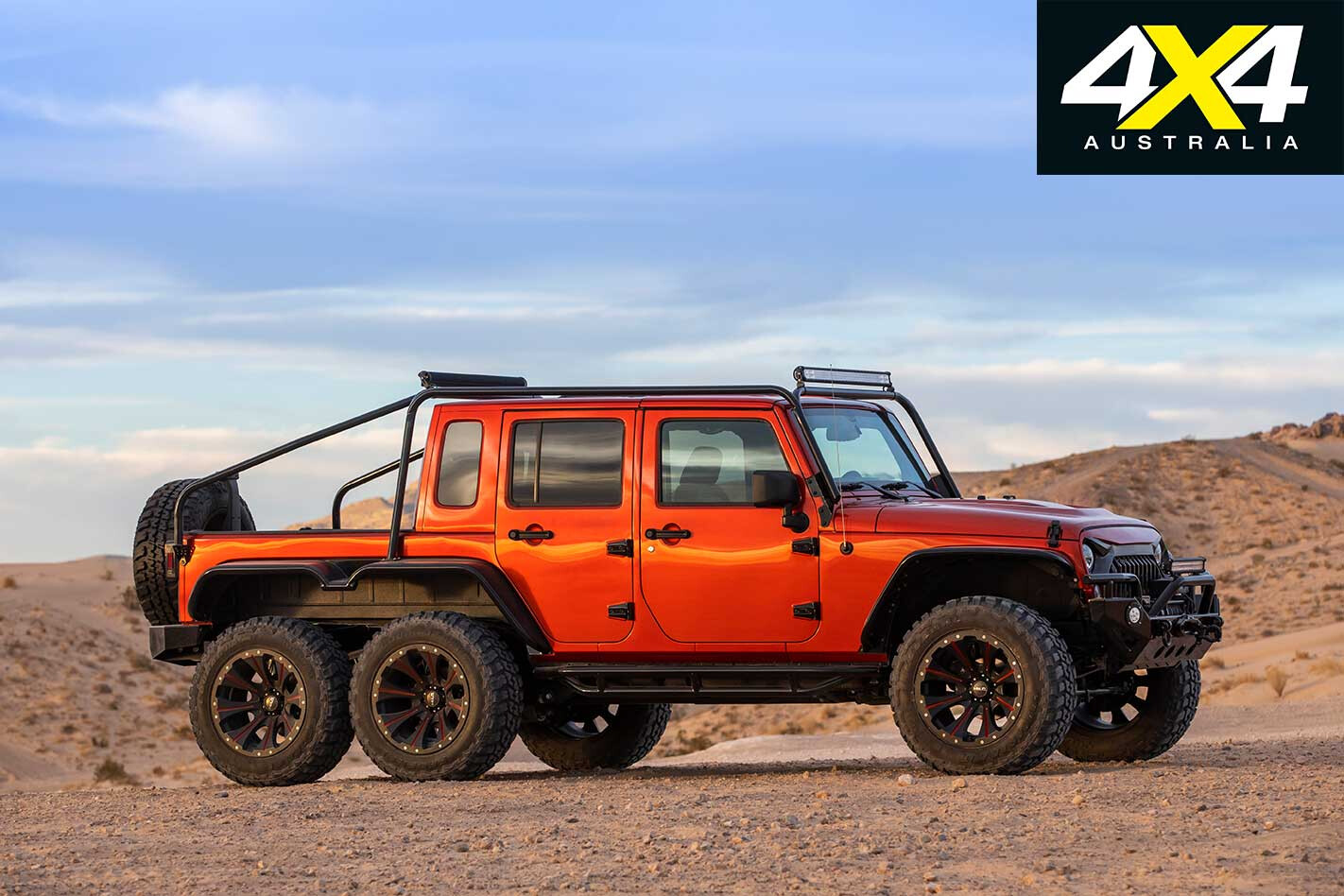
That’s not a complaint, either. Shoehorning a big-power engine into a 4×4 is not new – hell, we’ve featured more than a few in this mag – but all the rest of what comprises this simply brilliant example of 4×4 engineering art is what ups the admiration levels. That may be a lot of superlatives in one paragraph, but read on and you’ll understand why we don’t need an excuse to jabber and rave.
Not for us to question why
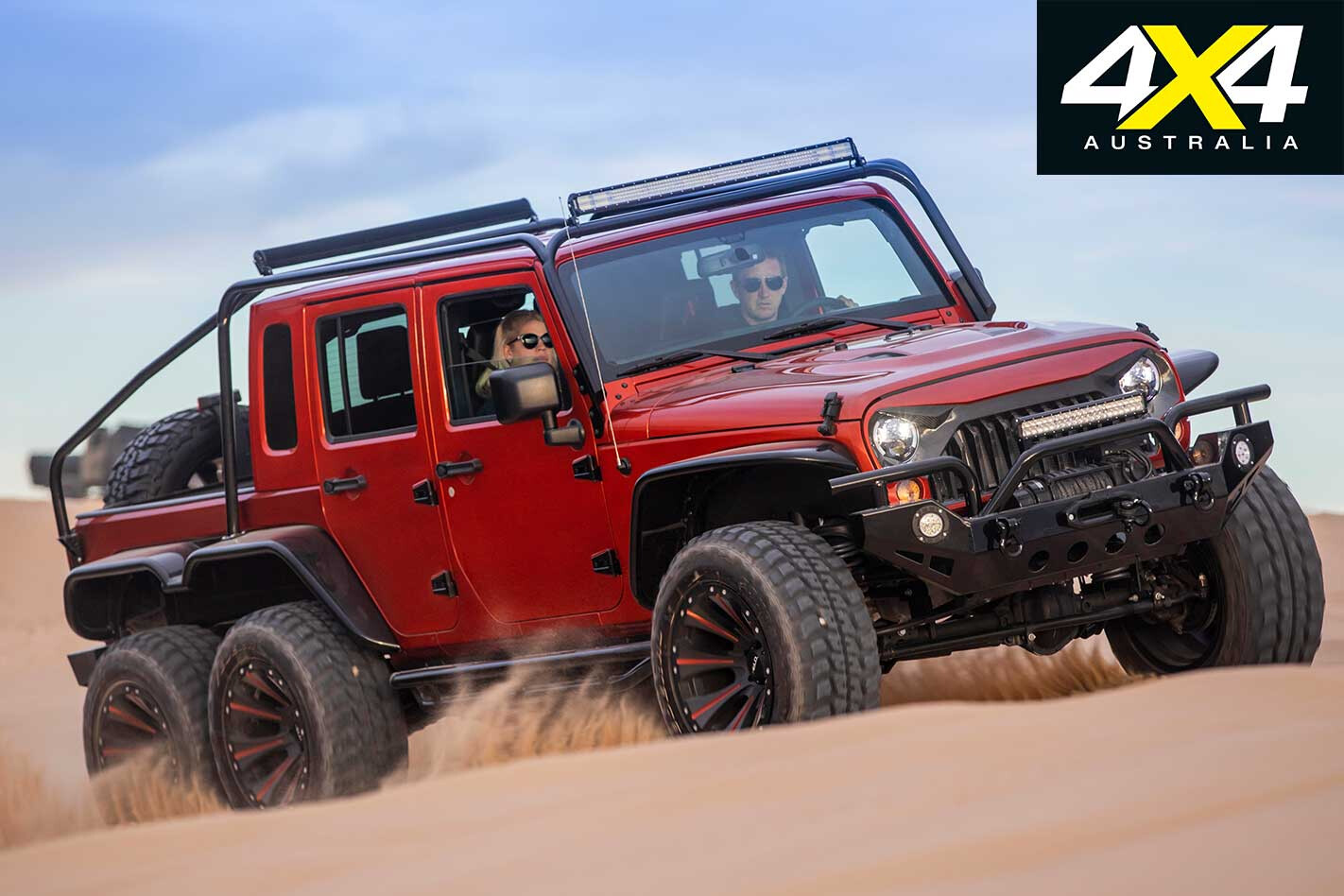
FOR YEARS Jeep fanatics have banged on about the potential for a Wrangler-based ute, with the iconic US brand having a history of producing workhorse vehicles way back in the 1960s with the J-Series (also known as Gladiator).
However, since that model finished production in 1988 Jeep has left any Jeep ute variant to the custom vehicle market. Well, until this year’s announcement of the new JL Wrangler-based Gladiator.
Why the history lesson? Well, when Russell started building this behemoth, there was no word on when the Gladiator would arrive – and there was certainly little chance it would be powered by a 6.2-litre Hemi ‘Hellcat’ supercharged V8, pulled from Chrysler’s Challenger muscle car. And doubly certain was the fact it wouldn’t be driven by six wheels.
However, the ‘fun’ part of this build really began with the – excuse the pun – big problem of how to go about shoving an oversized donk into the Wrangler’s relatively small engine bay (this six-wheeler is actually build number two; the ECM team had previously built up a Pentastar V6-powered version). Yeah, it presented more than a few problems that needed solving.
Looking under the Wrangler bonnet you would be forgiven for thinking this vehicle came stock with the Hellcat, as it looks so neat and factory-finished. The truth behind that under-bonnet tidiness is a lot of work dedicated to ensuring the engine was aligned (and balanced) correctly to fit, plus a number of components needed shifting around the engine bay.
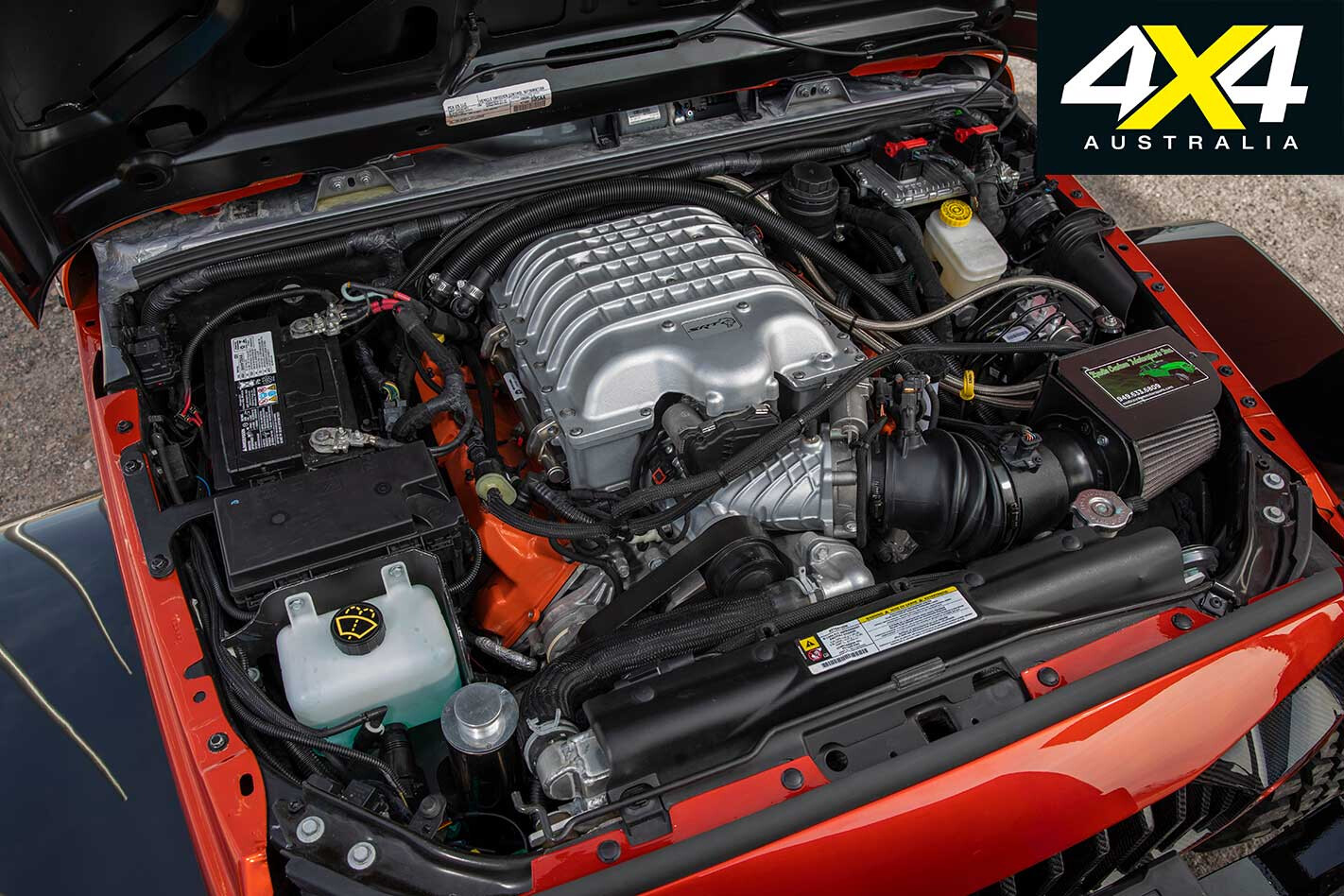
Then there was the rewiring that, combined with a custom-built transmission mount (the vehicle still runs the stock JK eight-speed auto), bell housing and custom engine mounts, left the mighty powerplant with the smallest of clearance margins all around it.
Compounding the headaches was the merger of engine management system and electricals – a key part to ensure a successful engine transplant. Complicating matters was the fact Russell was determined to keep all the functionality of the donor vehicle – think: electronic disconnect swaybar, diff-locks – which kept the team busy for many, many hours as they worked toward a solution. Again, the end result is an as-stock operational experience.
Stretching for six
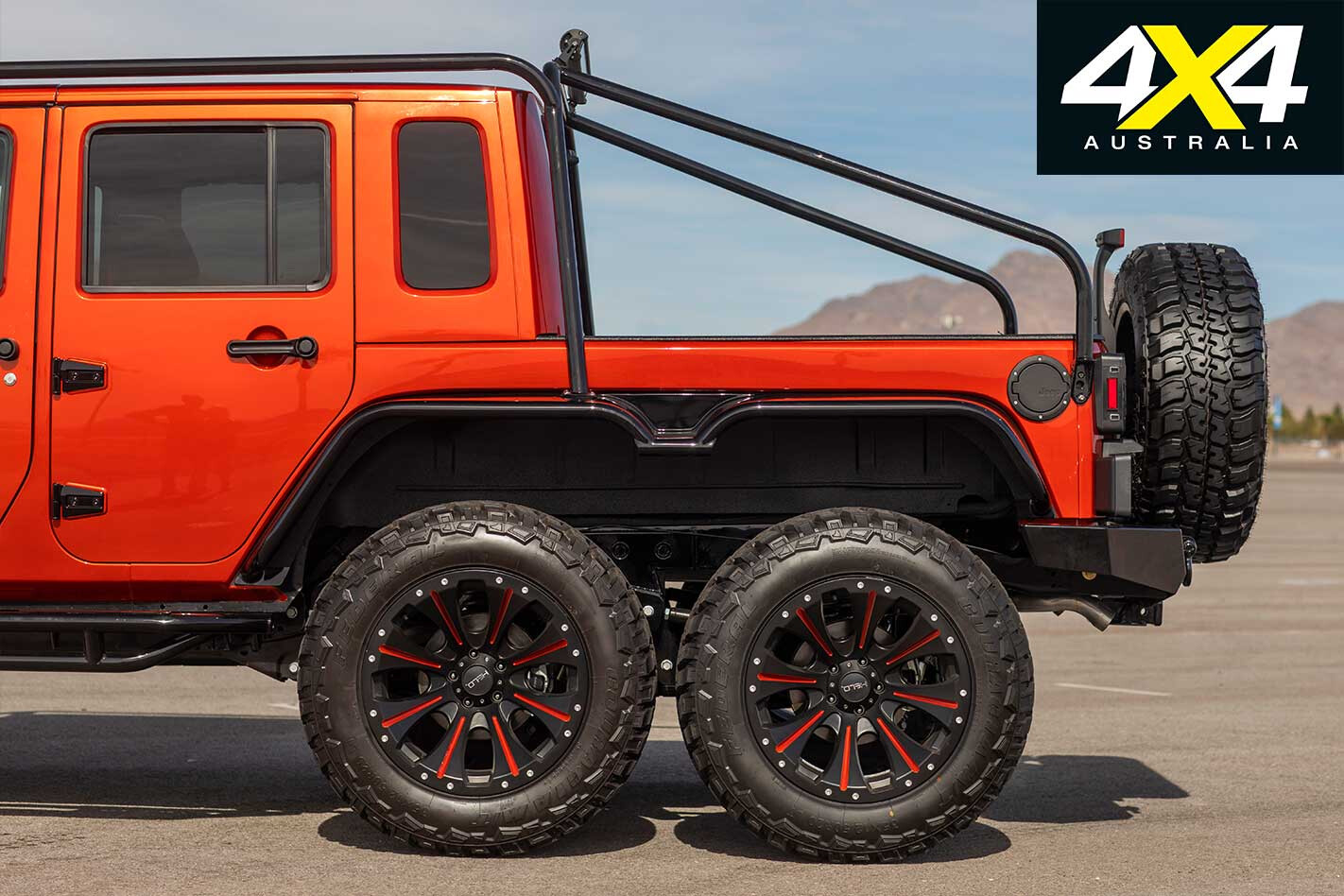
IN ANY other vehicle the mighty growl and thump from that big Hemi would be a main attraction, but even that mighty donk struggles to take attention away from the stretched chassis and six wheels rolling underneath.
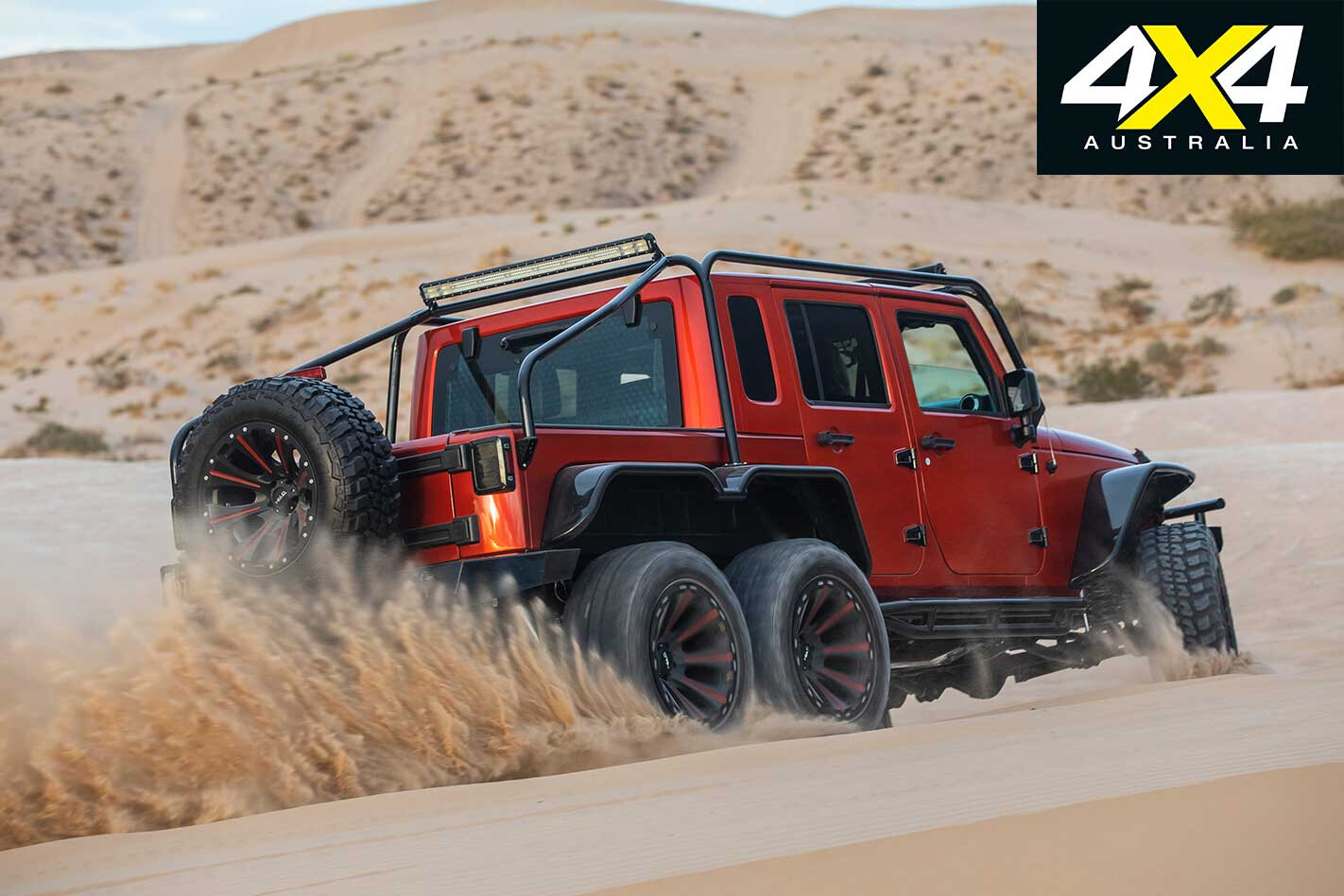
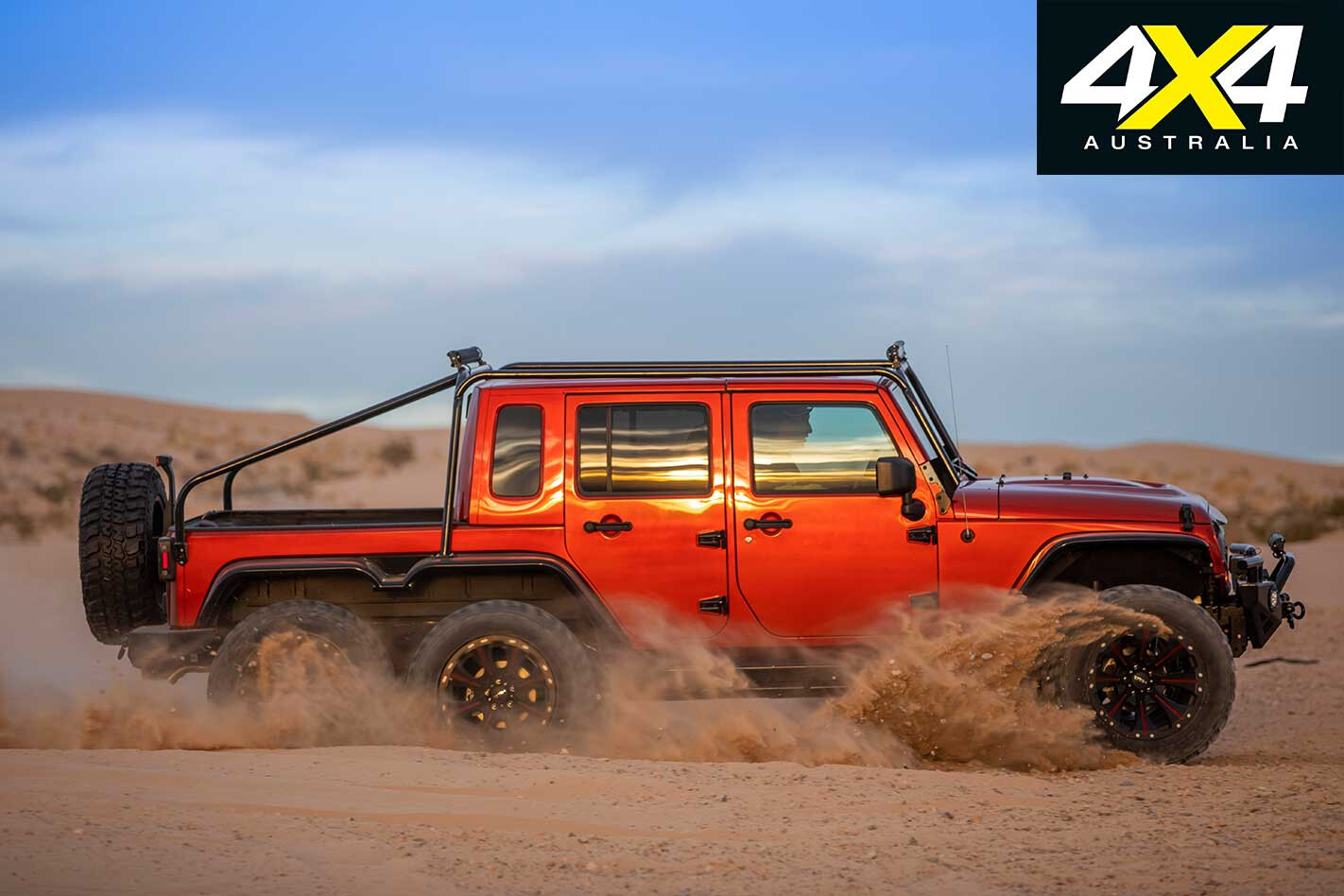
As with anything involved with this build, the stretch and additional wheels took time and started with the donor JK being totally pulled apart. From here the Exotic Custom Motorsport team chopped the chassis and added 910mm to the overall length, before adding in the custom fabricated rear window/C-pillar panelling (which includes keeping the donor vehicle’s rear-opening window) and the custom tray, all of which is fabricated in-house. Towing capacity is upped from standard and is now around 3500kg.
The 6×6 setup offers the best of many worlds. For one, it is a true six-wheel drive system that functions perfectly, thanks to the custom pass-through differential out back. The original Dana diffs (with 4:1 final drive) were kept and are supplemented by a custom-fabricated diff that acts as the pass-through unit, with a yoke on its front and another on its rear that ensures the pass-through shaft pushes the grunt to the rear Dana diff.
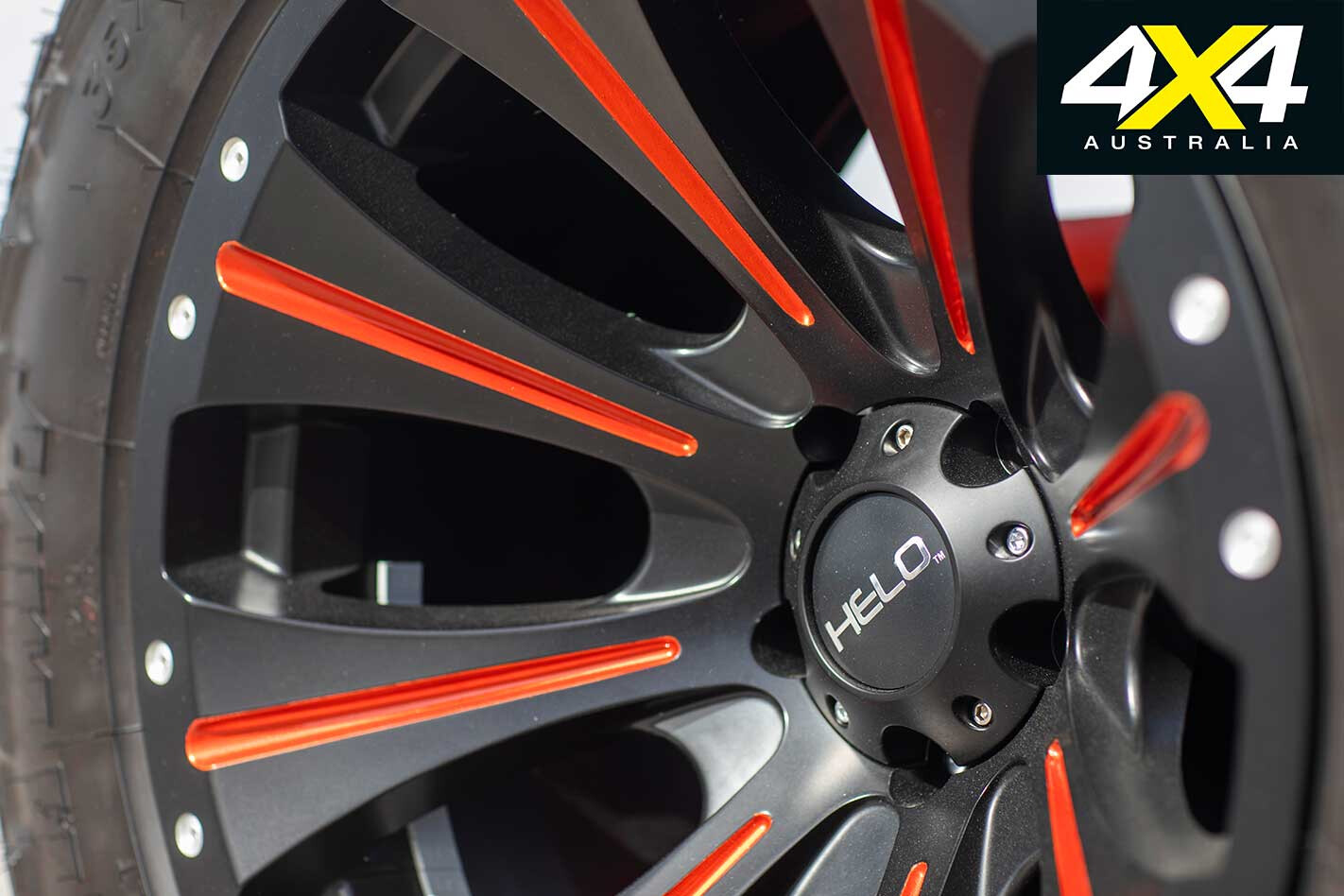
It’s a bit of mechanical black magic that ensures all the functionality of the Jeep’s axles is retained, including the diff locks (on all three diffs), with the result being you can have a fully locked-up six wheels if you ever need off-road tractive enhancement for the Federal Couragia M/T 35×12.5 R20LT rubber.
Reining it all in is a set of stock Jeep Wrangler brakes, with the addition of an extra set, of course, for that third axle. Keeping all this mechanical mayhem well clear of the ground is a sweet five-inch lift, courtesy of a set of Rough Country Vertex remote-reservoir adjustable shocks and springs.
Keeping up appearances
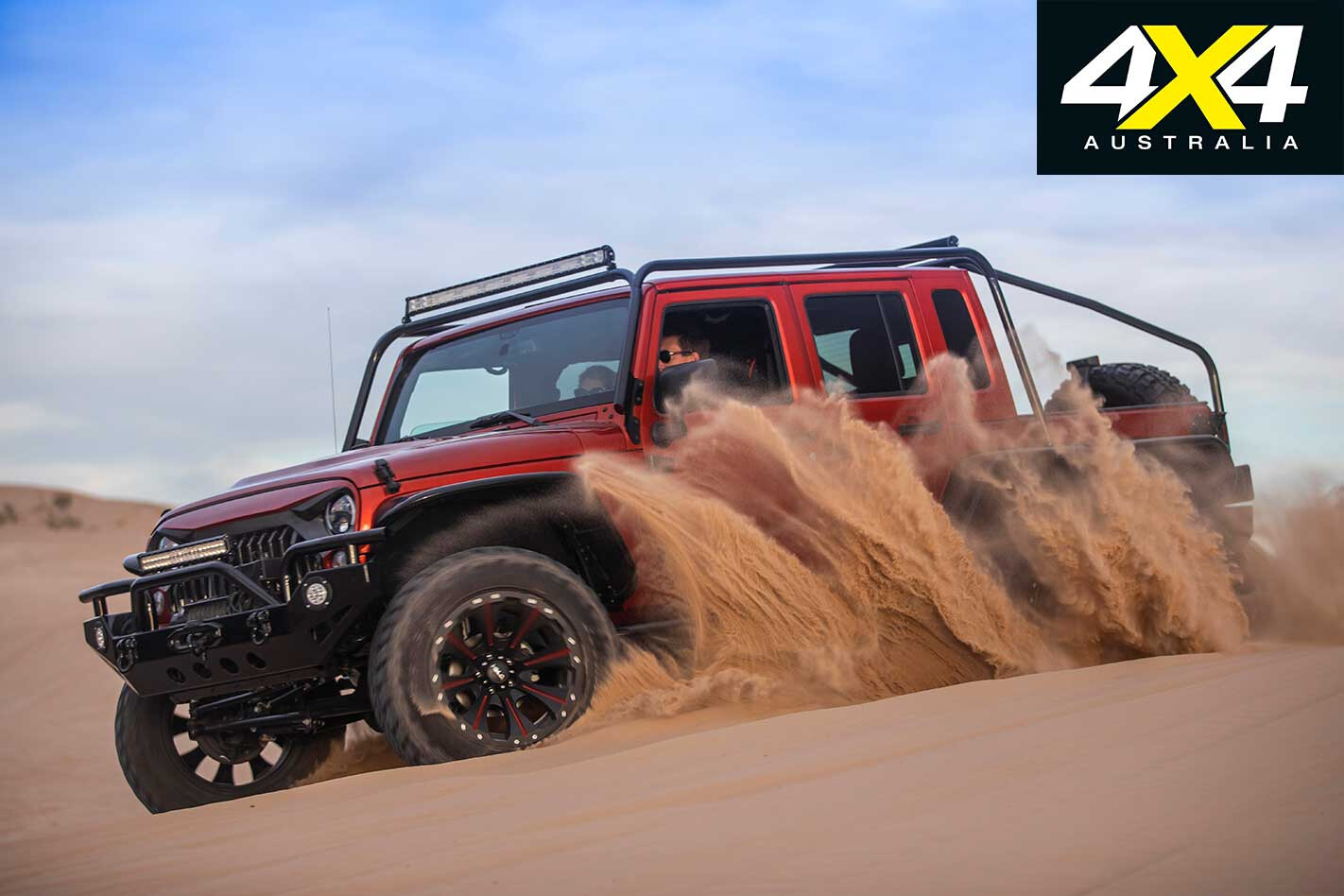
ALL OF THIS mechanical work and the attention to detail is impressive and it’d be quite easy to say ‘job done’ if you were the ECM team. To do so would be to ignore all the ‘smaller’ things (and we only say ‘smaller’ in relation to those engineering feats) that make this Jeep the complete package.
From the paint colour (a twist on a House of Kolor orange/red) to the fact that any and all fabrication – whether metal or carbon-fibre – has been done in-house, and the final outcome is of a ‘complete’ custom vehicle.
Custom rigs are often overtly focused on either the drivetrain, suspension or even the interior, but this six-wheeler combines it all very well. Starting up front, the front bar, fabricated by Russell and his team, houses a Warn 10,000lb winch and blends in brilliantly with the custom front guards and that schmick carbon-fibre grille (again, done in-house).
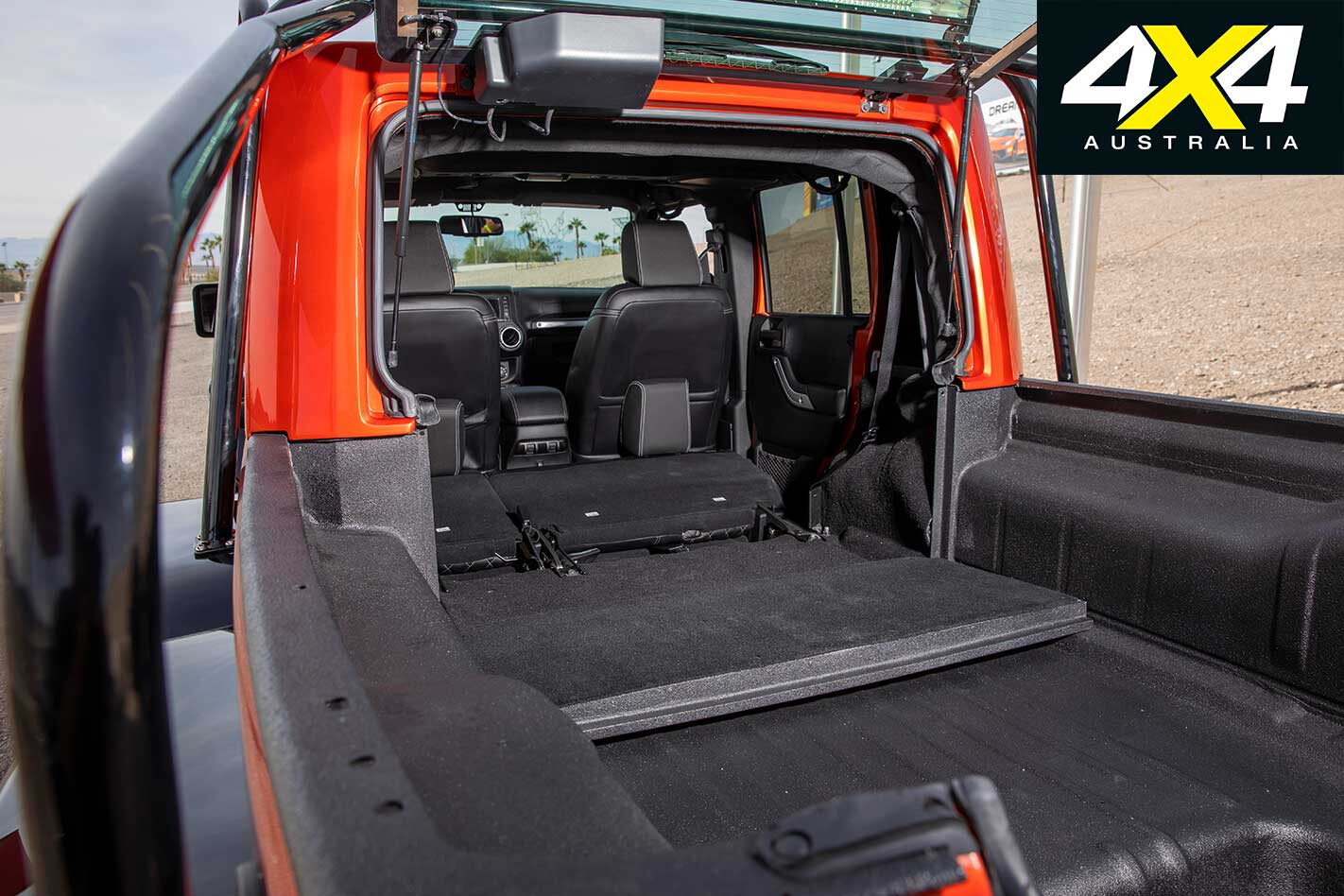
The cut-and-stretch job is seamless, as is the tub and roll bar at the rear, with the TIG-welded metalwork faultless. The nifty add-ins, such as the opening rear window that allows you to fold down the rear seats and create a long tray, are brilliant, as are the custom rear bar, tail-lights and bespoke leather interior that features diamond stitching and an overall understated but clean appearance.
The standout is that it all blends together to work – and work very well. Not only can this 6×6 Jeep light up the tyres on the bitumen, it can clamber up and over most off-road obstacles and do it in comfort thanks to that drivetrain/suspension combo.
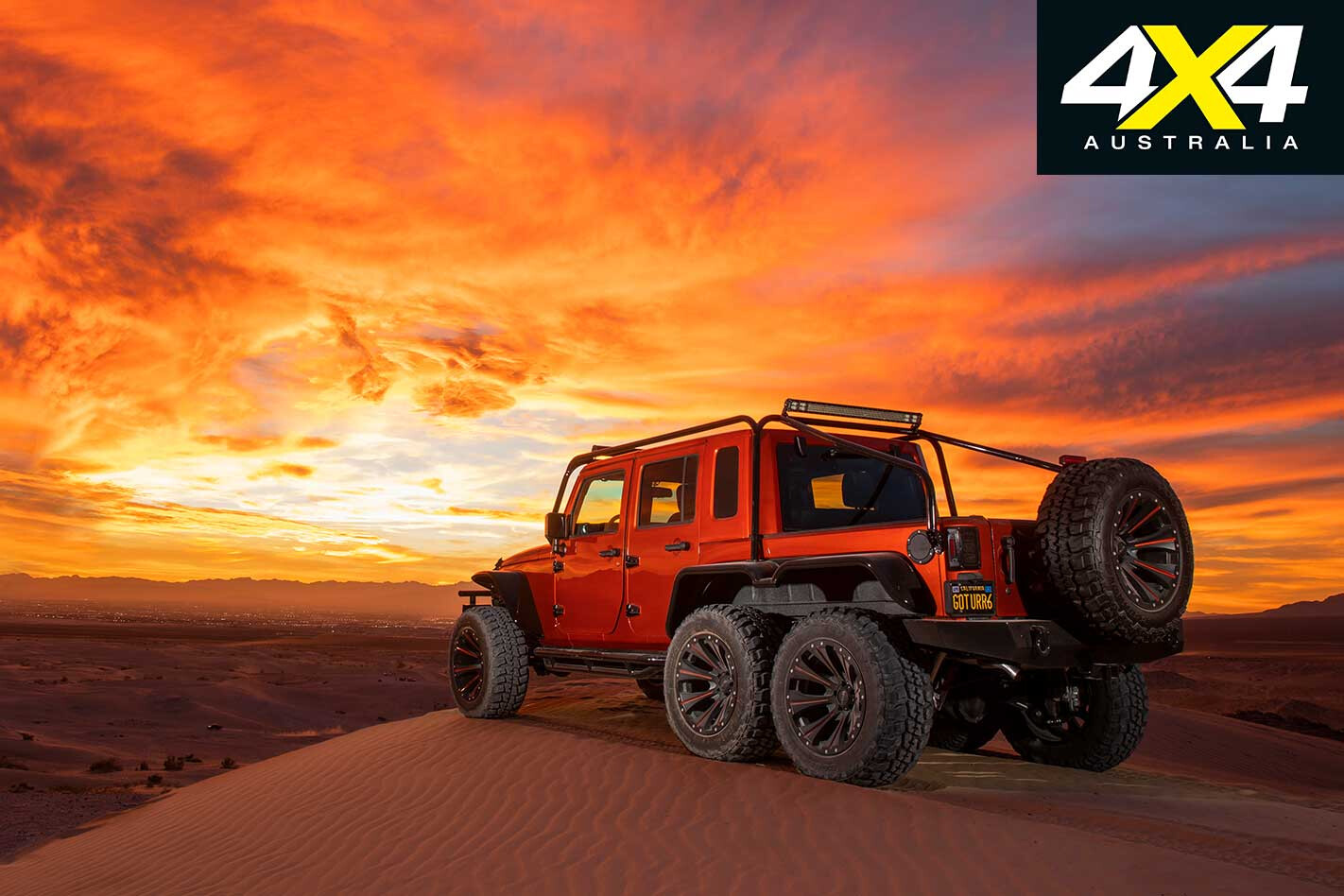
There’s little doubt the asking price for one of these monsters – a cool US$289K (AU$400K approx.) for this one; around US$150K (AUS210K approx.) for a Pentastar-powered variant – is way out of most of our leagues, but at least we can dream.
We can even dream in Australia. ECM has, oddly, built a right-hand drive 6×6 using a US Postal Service vehicle (they are RHD) as a donor rig. And no, we can’t think of a better way to deliver the Christmas mail, either.
DELTA 4×4, a tuning house based in Germany, has spun its spanners on the all-new Jimny to pay homage to the Dakar-conquering 1982 Suzuki LJ80.
That classic LJ80 was steered in the 1982 Paris-Dakar Rally by two Germans – Schneck and Loder – over 20 demanding days of desert racing, with the little Suzi successfully making it to the finish line on Lac Rose; although, the duo wasn’t recognised in the official rating due to a gear malfunction that required an overnight fix.
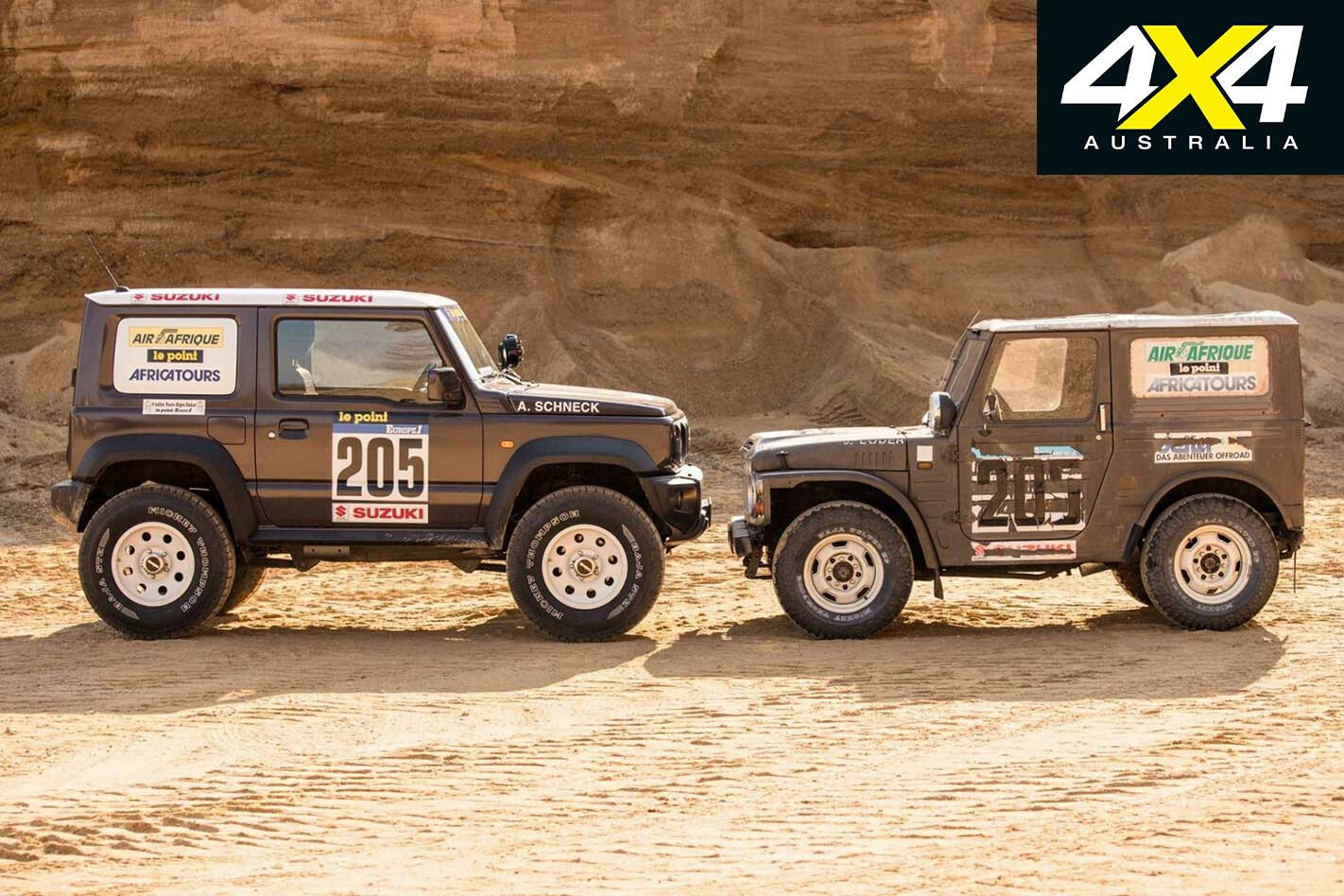
The current recreation of the 1982 Dakar rally car – wearing identical livery and sponsor logos – utilises a 2019 Suzuki Jimny which has been raised 30mm courtesy of added spaces and shock absorbers, while an additional 50mm of height is due to a specially developed body lift kit.
Fender flares guard 16×8-inch Legacy Forged one-piece alloy wheels wrapped with Mickey Thompson 285/70 R16 rubber, an additional headlight is mounted behind the driver’s side mirror, and additional kit available from Delta 4×4 will include a front bracket, headlamps, rock sliders and a roof rack.
The recreated Dakar rally car adds €8,500 ($14,000 approx.) worth of kit.
COULD GM revive the Hummer brand and apply it to its future flock of electric SUVs and trucks? That’s the question posed by a recent report by Bloomberg, which states GM is considering bringing the Hummer back to life and slapping the famous nameplate on its next-gen of battery-powered SUVs and pick-ups.
It’s an interesting ploy considering the Hummer was anything but an eco-friendly, zero-emissions vehicle back in its hey-day of the early 2000s, but with GM planning an all-electric assault in the future – in alliance with current emissions demands and regulations – the option isn’t as far-fetched as one would first think.
Picture: 2008 Hummer H3T
An all-electric Hummer would sit on the motoring landscape alongside electrified 4x4s Rivian and Bollinger.
Rivian’s R1T pick-up and R1S SUV are powered by four independent motors, with 200hp (149kW) delivered to each wheel.
The measurements that matter for the R1T include 34° approach, 30° departure and 26° breakover angles, with a ground clearance of 365mm, a water-fording depth of one metre, a 5000kg towing capacity and an 800kg payload.
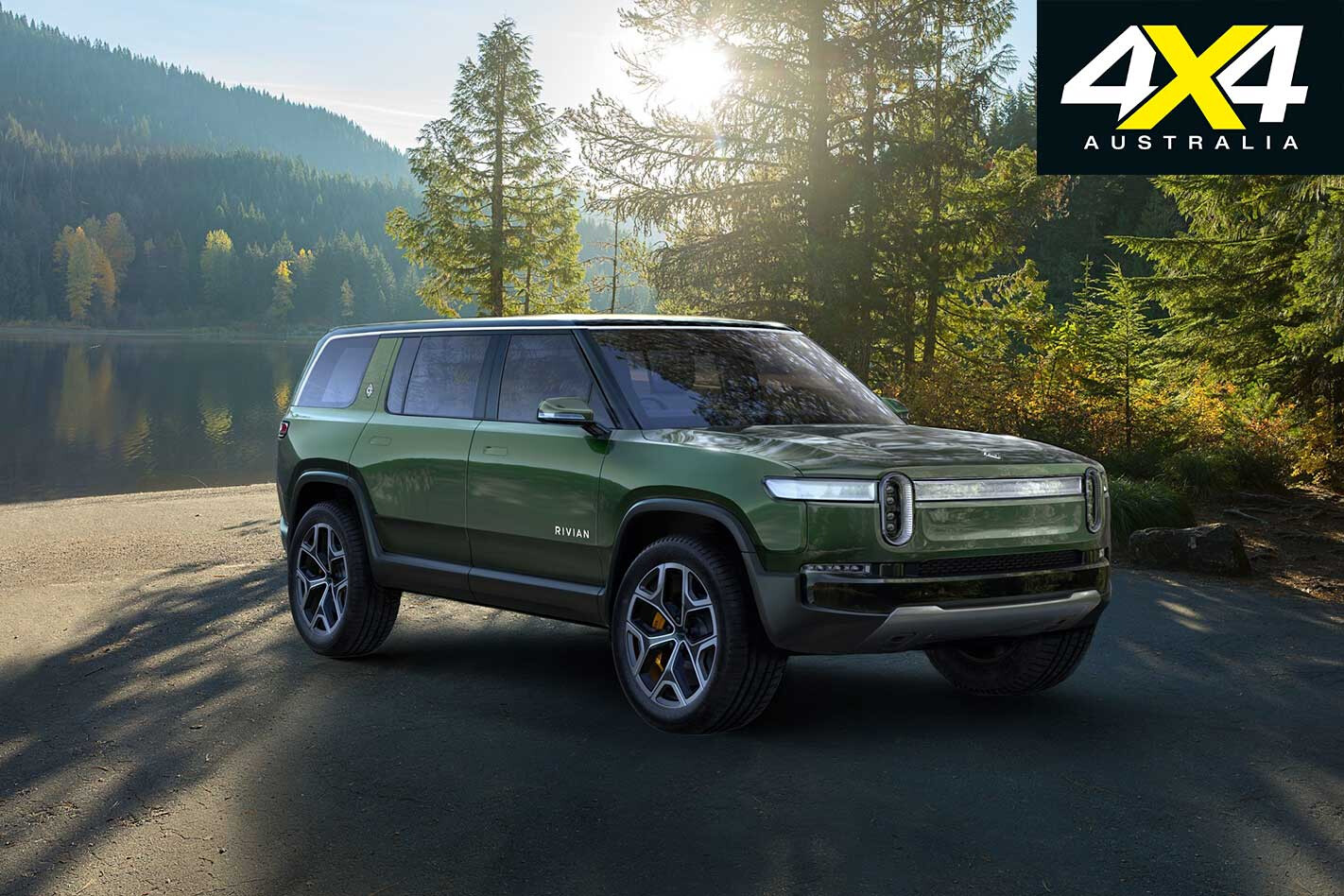
The R1S also has 34° approach and 30° departure angles, but it has a 30° breakover, a ground clearance of 365mm and a 3500kg towing capacity. Both vehicles have an 800kg payload and a range of up to 400+ miles (644km).
The Bollinger shed houses the B1 (Sport Utility Truck) and B2 (Pick-up Truck). The two electrified vehicles are powered by dual motors totalling 614hp and 668lb-ft (458kW and 906Nm) fed by a 120kWh battery pack.
Despite there being no concrete evidence yet, if GM were to bring back the Hummer brand in a CO2-conscious global landscape, would it make sense for it to be all-electrified?
KNOWN for its beautiful beaches and rugged coastline, the South Coast of New South Wales is a Mecca for anyone looking to escape the hustle and bustle of the cities and experience this little piece of paradise.
However, the area is known for much more than just the coast, with the hinterland behind it filled with off-road touring experiences, historical places and quaint villages, all just waiting to be explored.
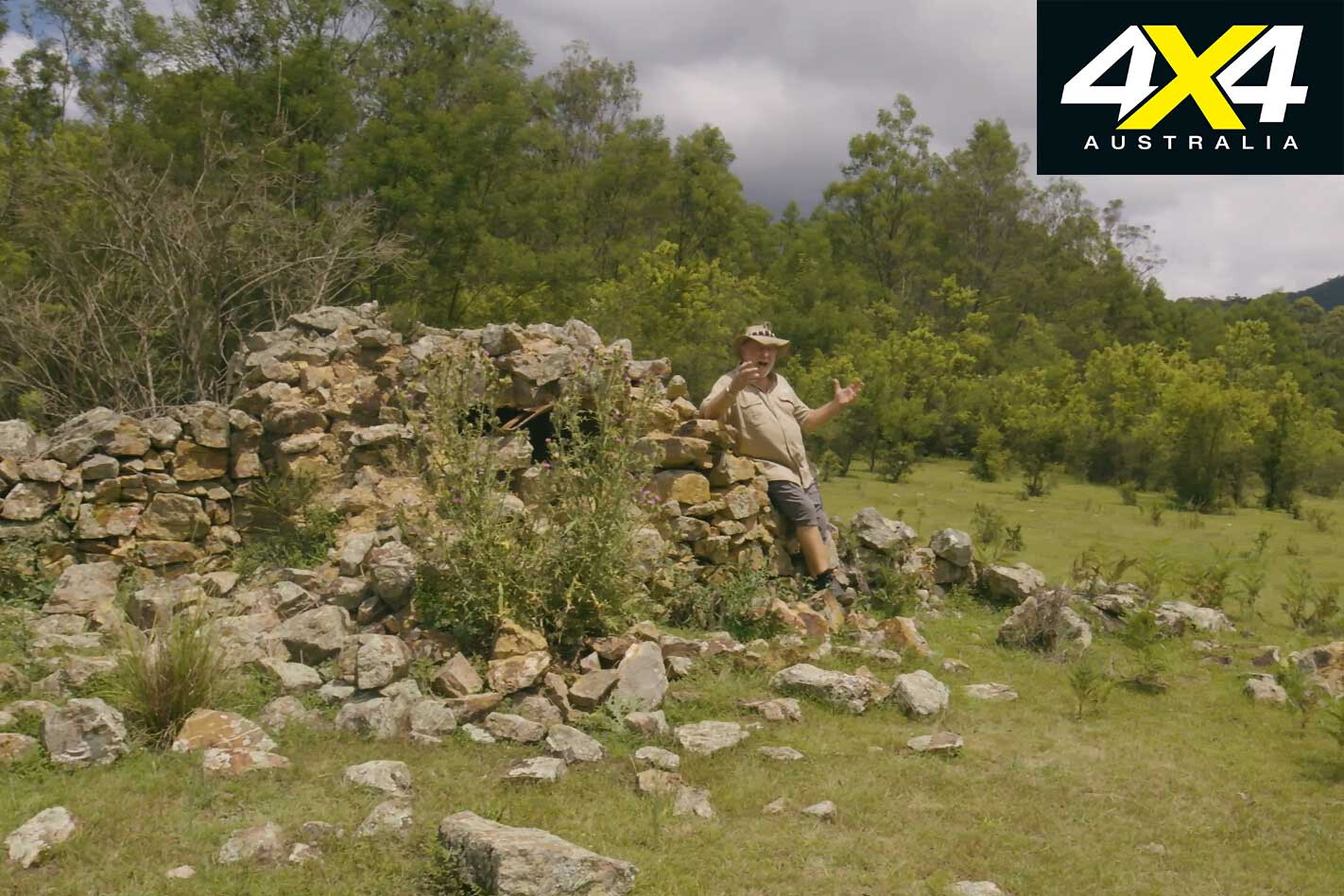
Ron, Matt and the 4X4 Australia team kicked off their South-East adventure at the river inlet at Moruya and headed for the hills through timber country and over magic mountains, before arriving at the stunning Bendethera Valley. Nestled within Deua National Park, Bendethera, with its rich history and abundant wildlife, it’s a must-visit camp.
Passing through coastal farmlands to mountain forests and semi-alpine scrub, back roads and bush tracks eventually lead the convoy back to the coast. This exquisite detour provides the perfect way to escape the highway and spend some time in the bush.
Keep an eye out for Episode 2, where the convoy strikes gold in Pambula.
THE ute-based half-brothers, Holden Trailblazer and Isuzu MU-X, as well as the ute-based Mitsubishi Pajero Sport, are joined here by a new face in the segment, the SsangYong Rexton; although ,one that’s not without some family connection in Australia.
SsangYong first appeared here in 1996 when its Musso wagon was sold out the side-door of Mercedes-Benz dealers, before Daewoo took over its fellow Korean carmaker shortly after. However, that ended when Daewoo went broke in 1999. SsangYong then came via third-party distributors, before evaporating locally a few years ago.
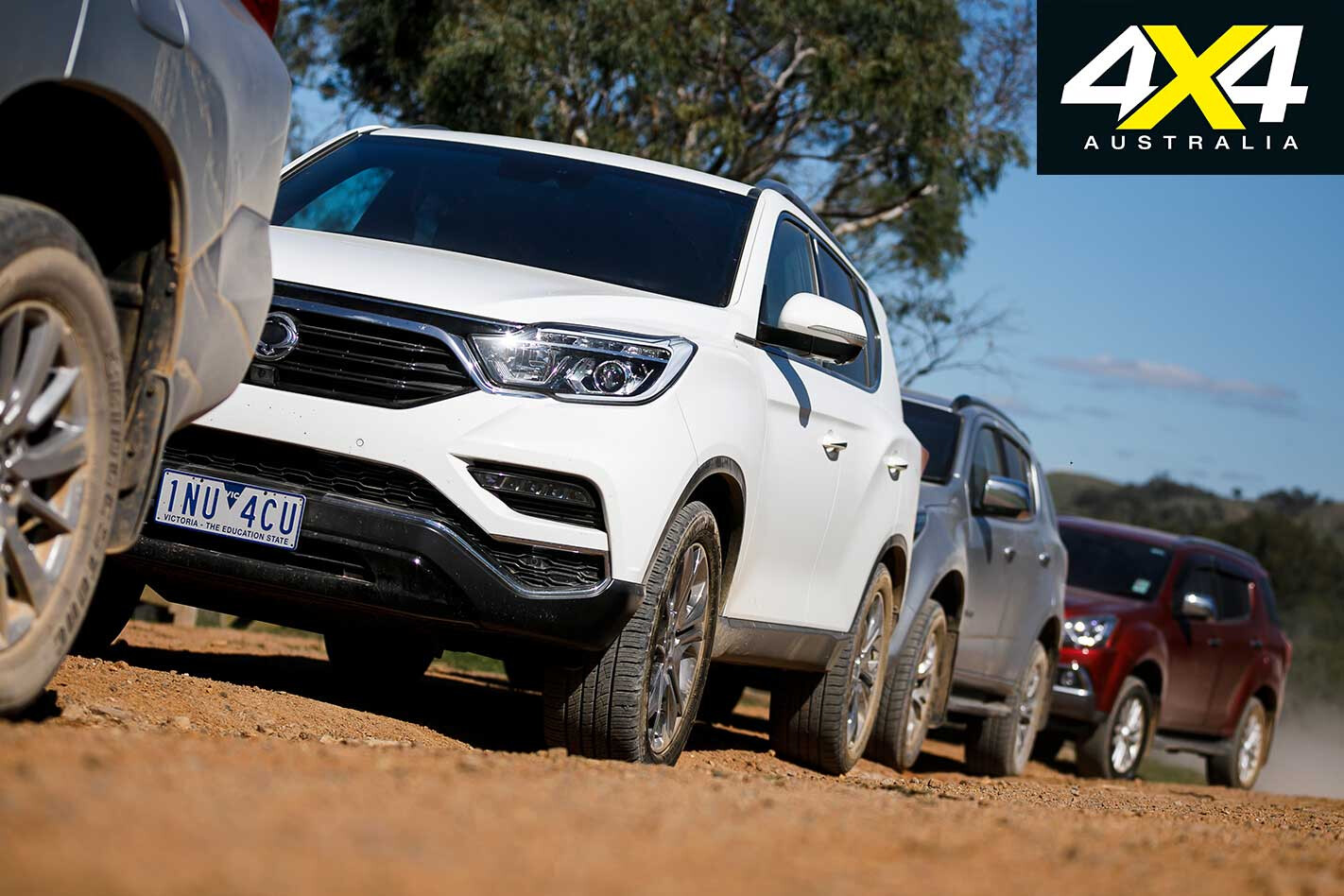
As of 2018, SsangYong has set up a factory-owned and backed distributor here in Australia, which is good news to potential buyers. The Rexton is one of a number of new SsangYong models and is pitched into a market where wagons built off utes are the norm – just like the Toyota Fortuner, Ford Everest and the other three vehicles here.
The Rexton also shares much with SsangYong’s own ute, the Musso, but it stands out in this company – and in the class in general – with independent rather than live-axle rear suspension. Perhaps, more importantly, the Rexton offers more equipment than anything in its class while costing less.
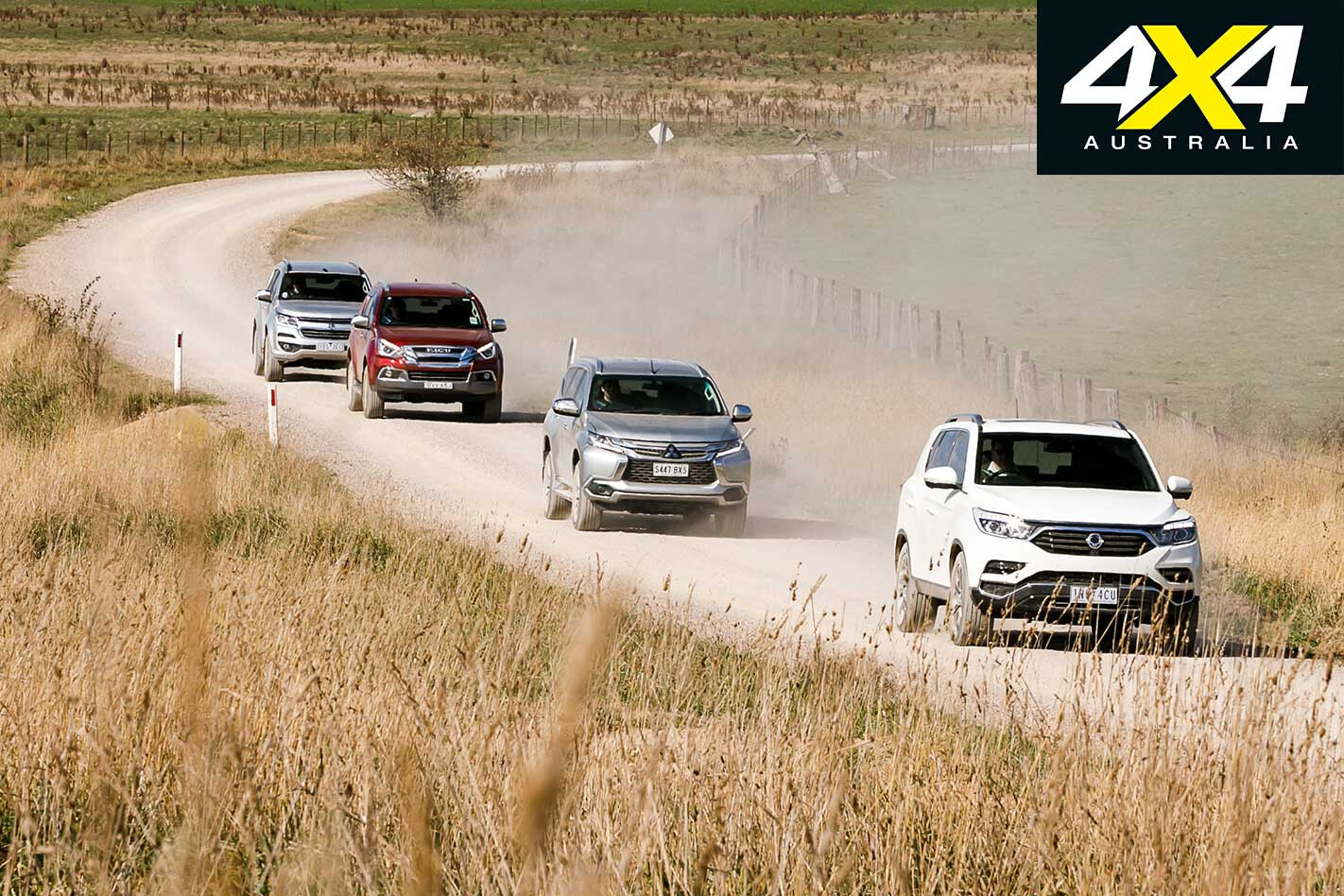
So how does the Rexton compare to the sales leaders in this class – MU-X and Pajero Sport – and to the somewhat underrated and much slower-selling Trailblazer? We test them off- and on-road to find out.
Holden Trailblazer LTZ – General Quarters
The Trailblazer may be a global GM design, but it still relies on a good deal of local engineering know-how.
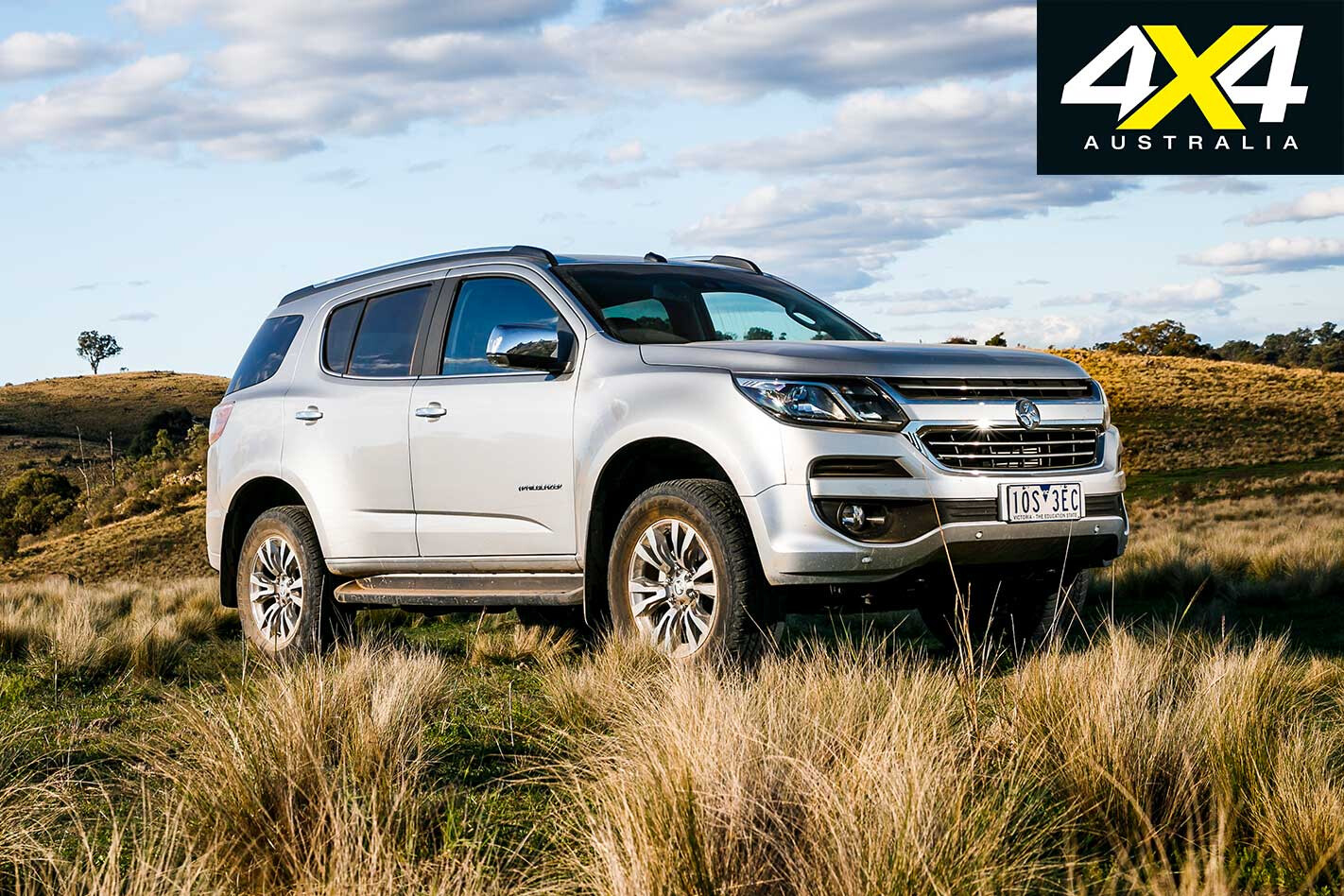
HOLDEN’S Trailblazer arrived in 2017 and was a top-to-bottom re-engineering of the Colorado 7, a wagon based off the all-new Colorado ute that arrived in 2012.
The Trailblazer, like the Colorado 7 and the current Colorado, is very much a global GM design, drawing in elements from Europe, North and South America, South-East Asia and Australia, but it has even more Australian input than the Colorado 7 and is better off for it.
As a wagon based on a ute, the predicable elements are there: a powertrain and front suspension carried over from the donor ute, essentially the same ladder frame but with a shorter wheelbase, and coil springs and disc brakes at the rear instead of leaf springs and drums.
Powertrain & Performance
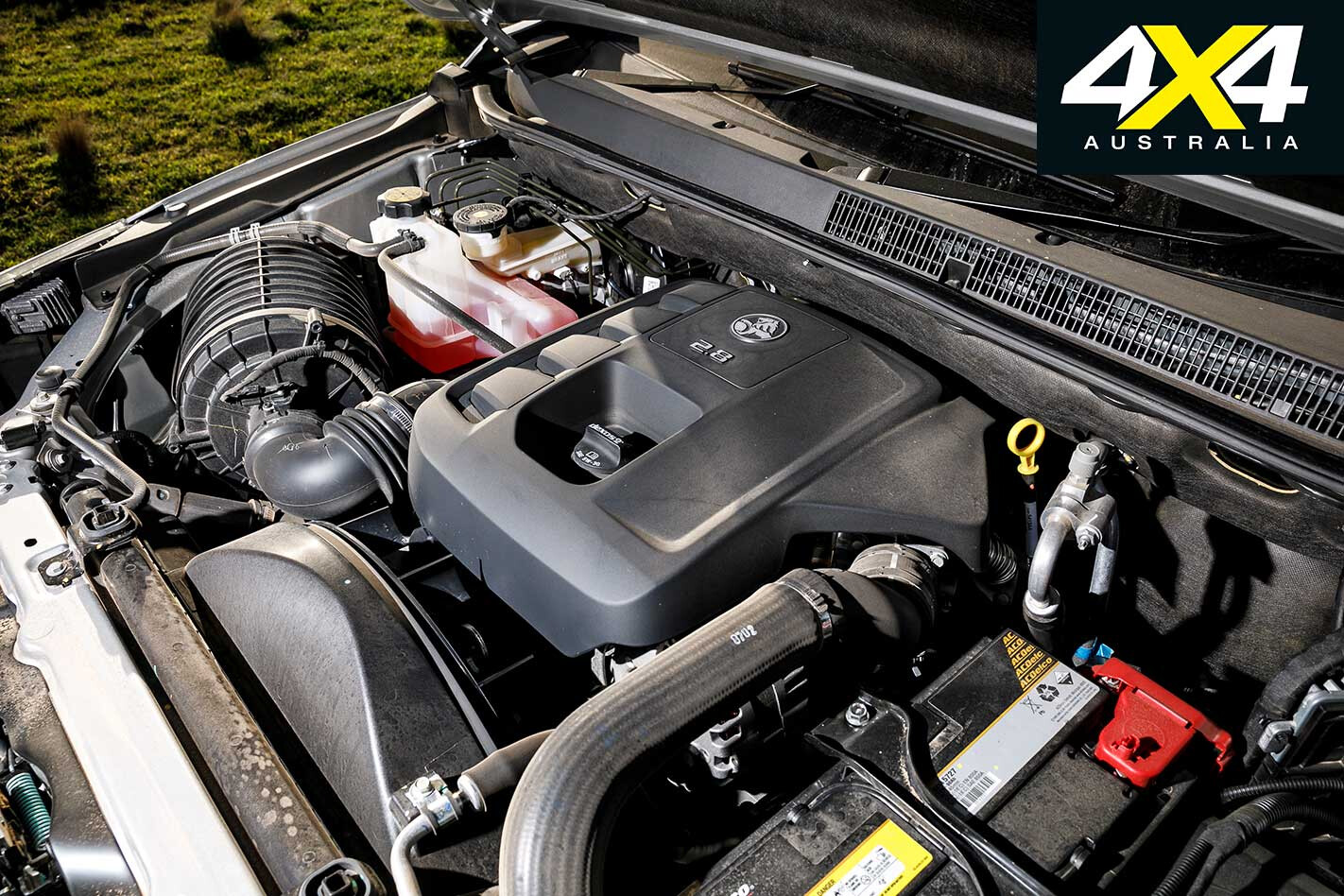
THE Trailblazer’s 2.8-litre four-cylinder diesel, the second biggest engine here, comes from Italian diesel specialist VM Motori, once part-owned by General Motors.
There’s now more GM input into the engine thanks to the 2017 (Colorado 7 to Trailblazer) upgrades that fattened out the power delivery and more importantly brought smoother and quieter running. In this company, though, the 2.8 is noisier than the Rexton and the Pajero Sport, and even noisier at times than the MU-X.
It’s also the strongest engine here and one that lives up to the promise of its on-paper 147kW/500Nm claim. Pedal-to-metal it will see off the other three and, while it thrives on revs more than the Isuzu’s bigger and lazier engine, it’s not as revvy as the smaller diesels in the Pajero Sport or the Rexton.
Top marks also to the Trailblazer’s responsive and pro-active six-speed GM automatic, the sportiest gearbox here even if others shift more smoothly.
On-road ride & handling
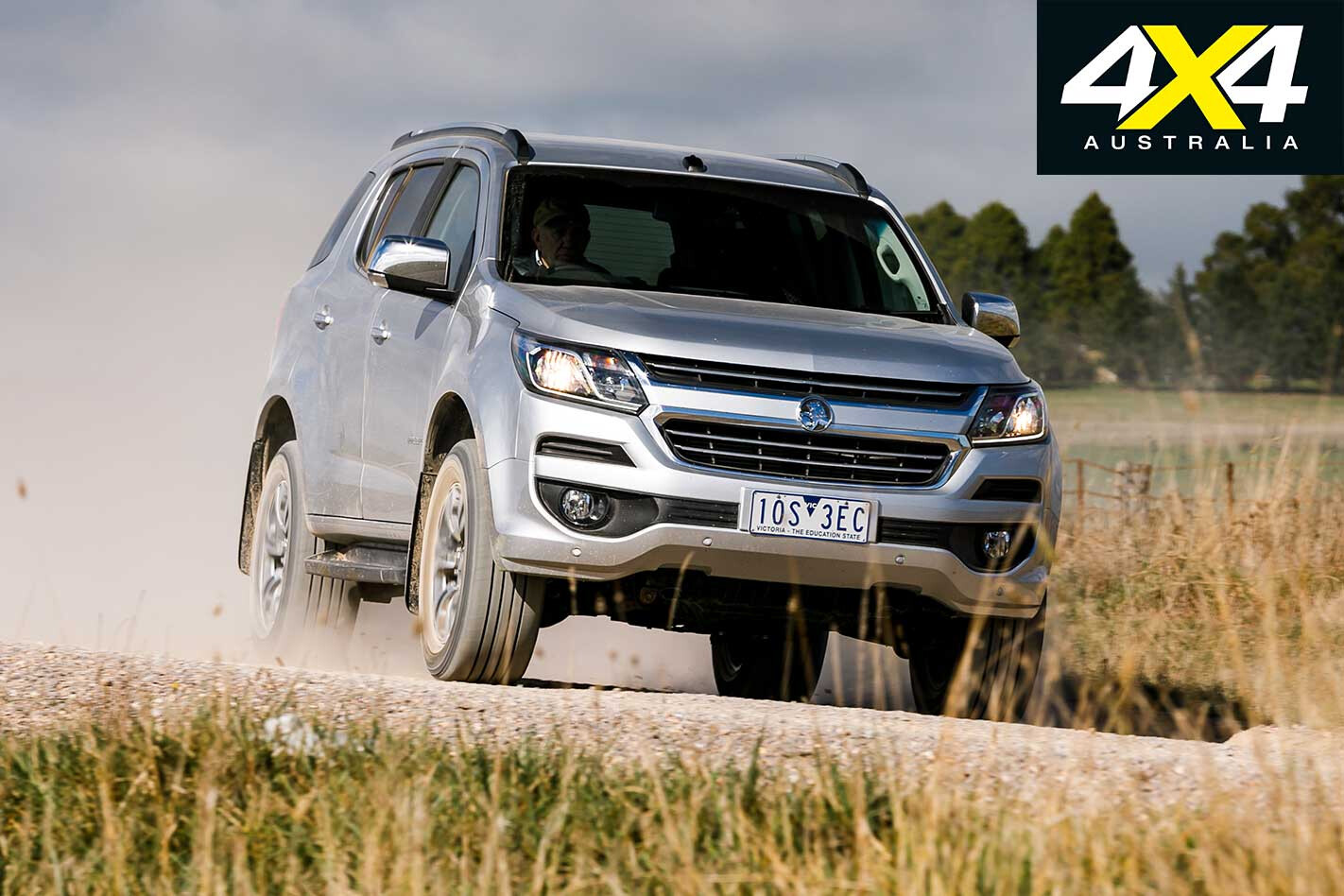
THE Trailblazer also stands out in this company with its electric power steering (EPS), another of the changes that came with the Colorado 7 to Trailblazer rebirth. Its EPS makes for very light wheel twirling when parking or manoeuvring, but firms up nicely at highway speeds and provides a positive feel that’s as good if not better than any other wagon here.
Handling is tidy, too, and there’s a generally smooth, quiet and compliant ride on most roads; another improvement over the Colorado 7. The suspension is certainly better sorted than the closely related MU-X and is well ahead of the Rexton.
Off-road
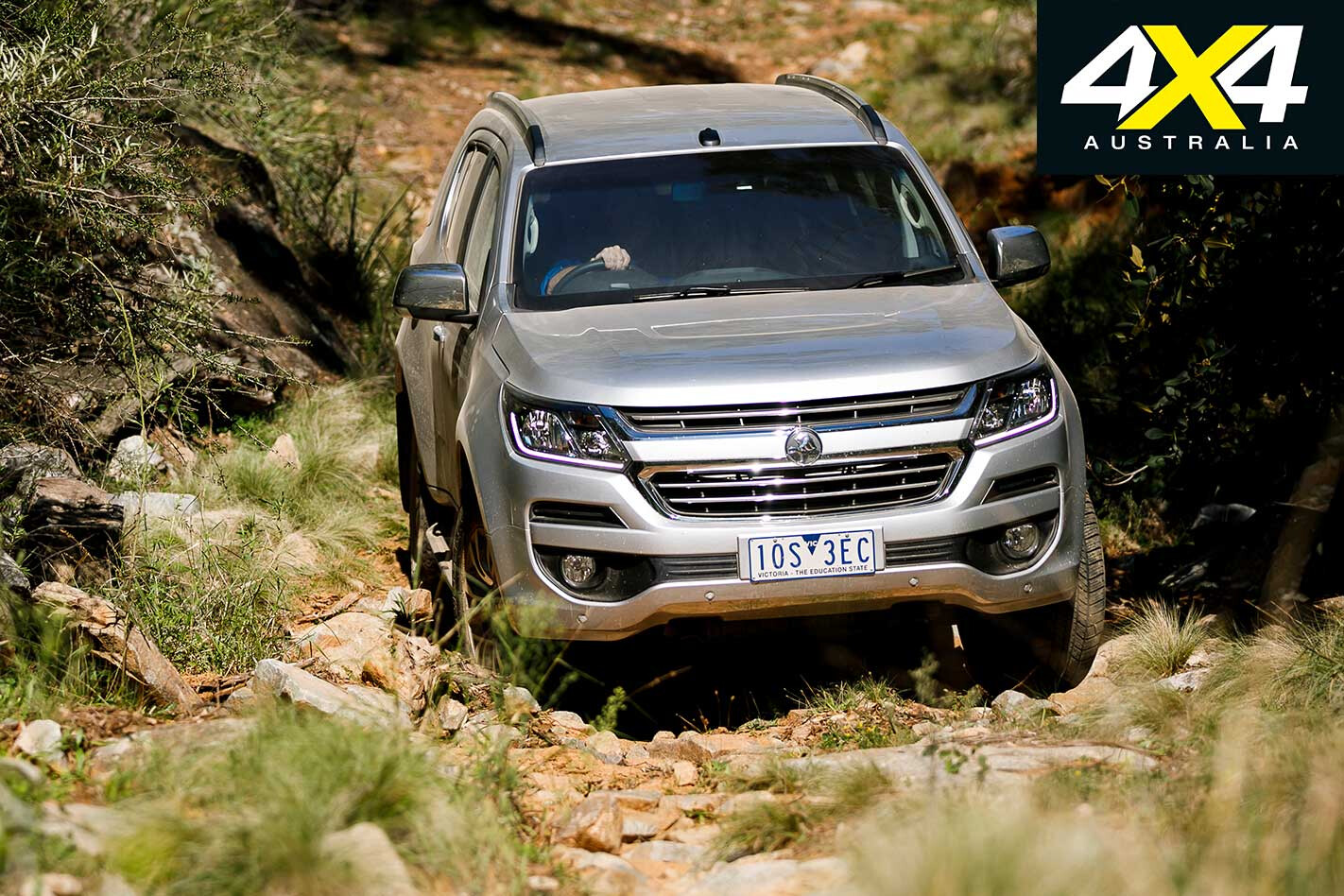
JUST AS the Trailblazer’s on-road demeanour is much improved, so too is its off-road ability thanks to an off-road specific recalibration of the electronic traction control that was part of the name-change re-engineering. This is the key point that makes the Trailblazer better than the otherwise similar MU-X, with which it shares most other things that define how they perform off-road (which for the both of them is generally better than the other two).
Even if it’s as good as it gets in this company off-road, the Trailblazer isn’t over endowed with suspension travel, nor does it have a rear locker; so its effective traction control system is the key element in getting it through difficult going that will strand the other three here.
Cabin, Accommodation & Safety
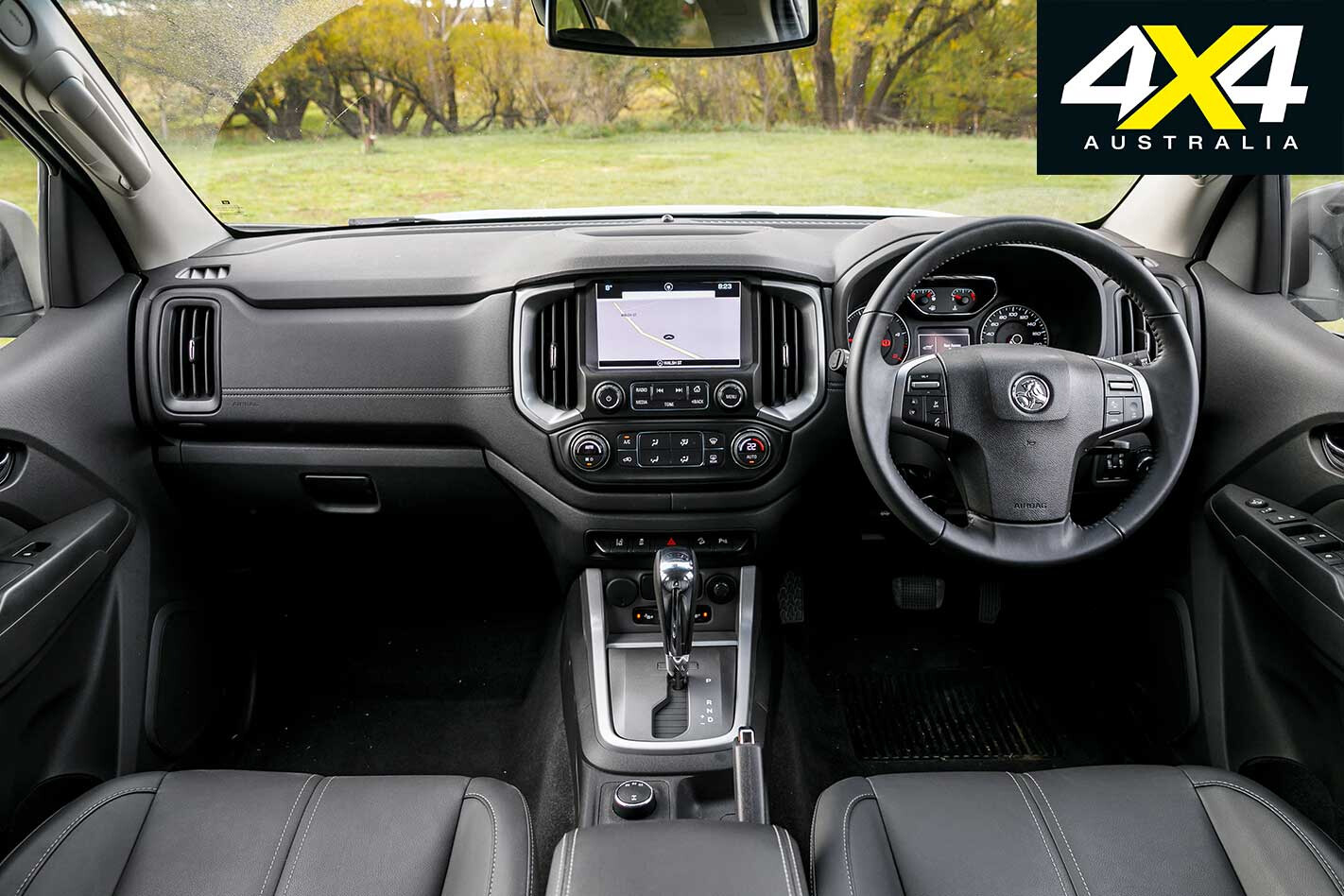
THE Trailblazer sits midfield in this class with its cabin space. It’s bigger than the Pajero Sport but smaller than the Rexton and, of course, matches the MU-X with which it shares the same basic body shell. It’s spacious and comfortable up front, but there’s no steering wheel reach adjustment for the driver.
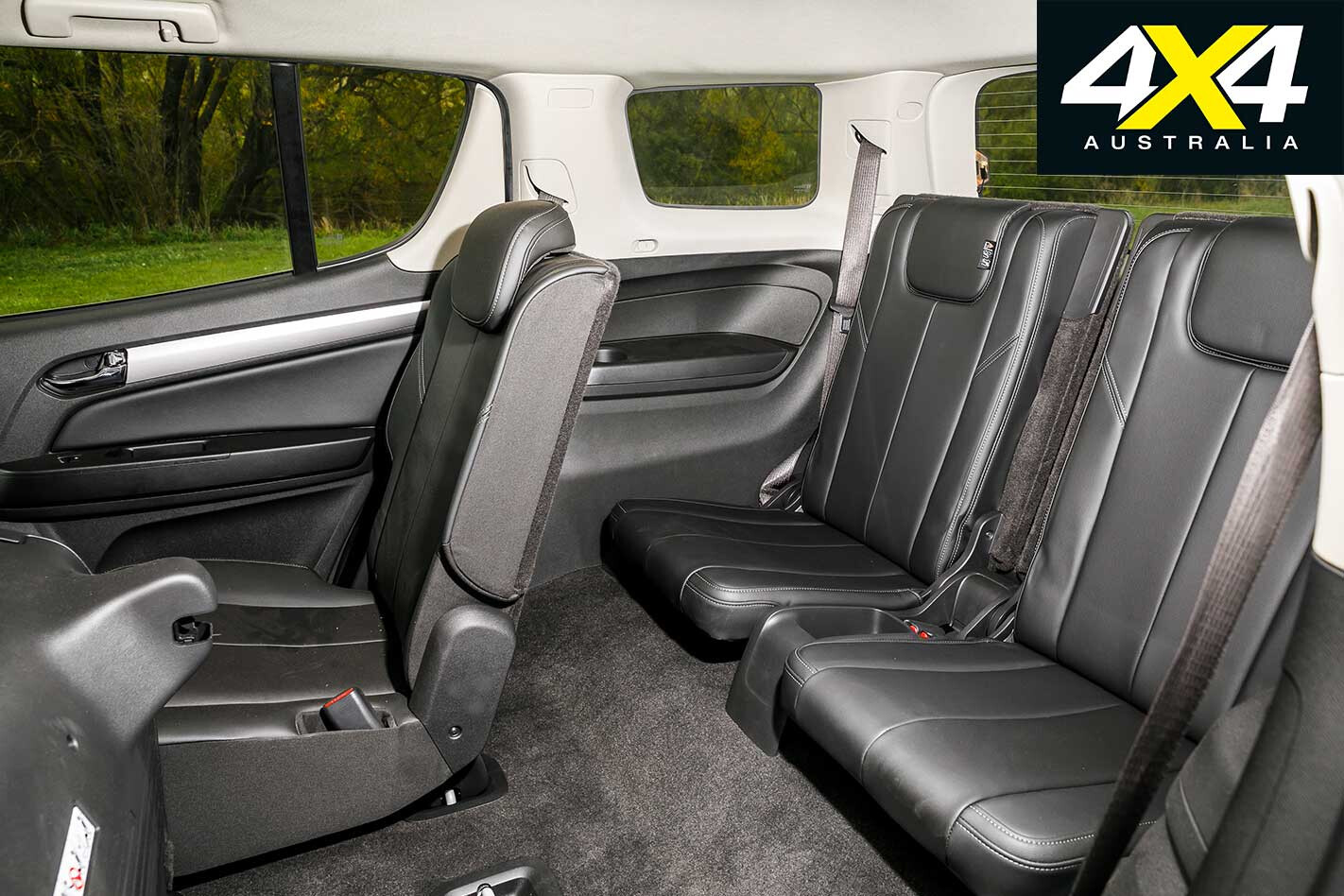
Second-row seat space also matches MU-X and betters the Pajero Sport, but it’s a bit tighter than the spacious Rexton. Access to the third-row is easy enough and there’s even room for adults at a squeeze.
The way the Trailblazer’s (and MU-X’s) third-row seats fold makes for a high cargo floor and, annoyingly, there are only two cargo hooks at the rear of the luggage space and none at the front. When the third-row seat is in place there’s also very little luggage space left, all of which mirrors the MU-X.
Being an LTZ our test vehicle had the luxury of leather and heated front seats, with electric adjustment for the driver. It comes with a five-star ANCAP safety rating, as well as a good deal of advanced safety kit on top of that.
Practicalities
THE Trailblazer has the biggest fuel tank here but isn’t quite as thrifty on fuel as the MU-X or the Rexton, which means it finishes second on range – around 600km, given our test fuel use (11.6L/100km) and a 50km ‘safety’ allowance.
The Trailblazer’s standard 265/60R18 wheel and tyre package is common to many new 4x4s (Hilux included) so there’s a wide aftermarket tyre choice. You can also fit the 17s off the LT for an even wider and more off-road practical tyre choice.
The Trailblazer’s 3000kg tow rating matches the others bar the 3100kg of the Pajero Sport, but heavy-duty towing experience with the Colorado would suggest the Trailblazer’s powertrain would be the best for towing performance in this company.
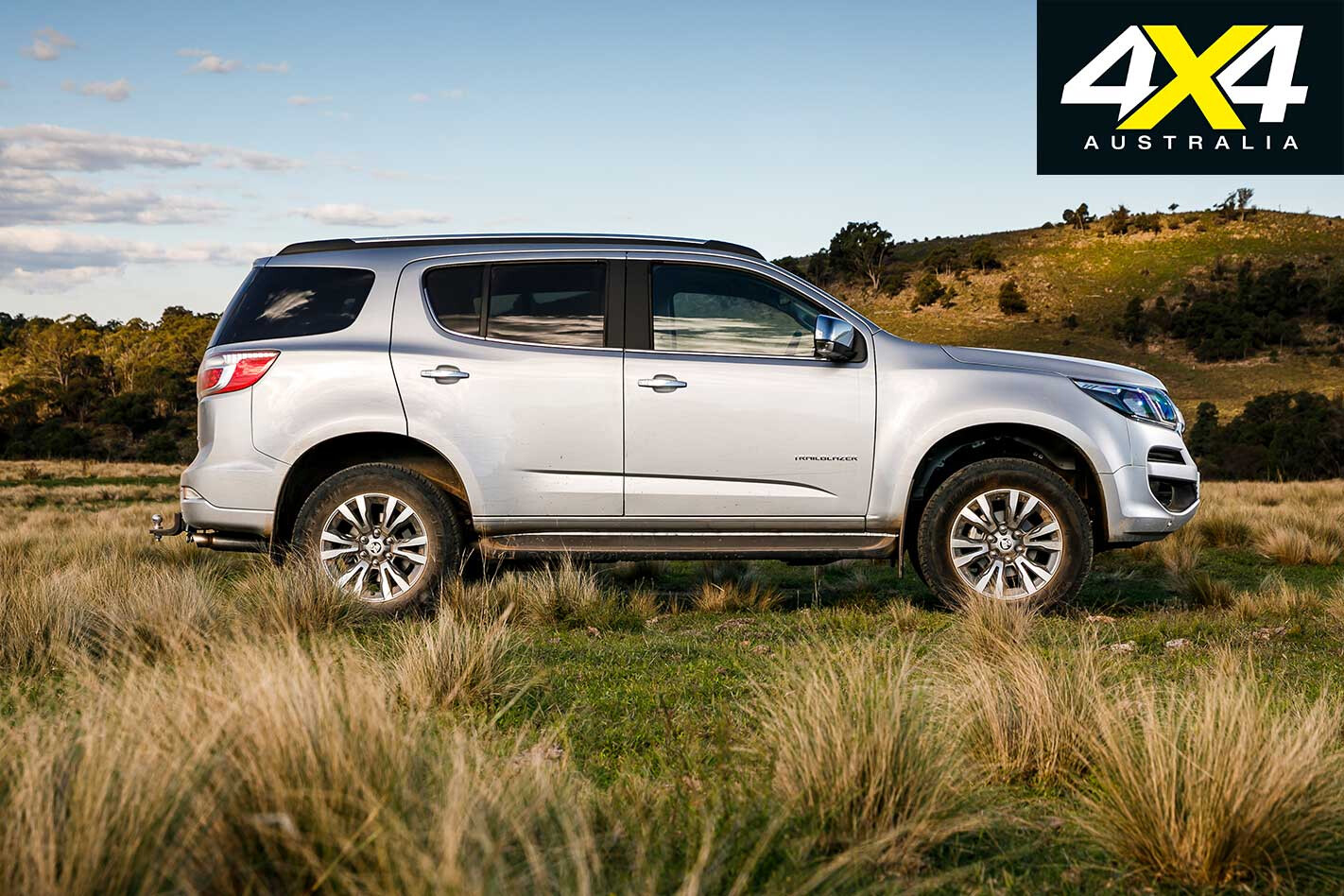
HOLDEN TRAILBLAZER LTZ SPECS: Engine: 2.8-litre 4-cyl turbo diesel Max Power: 147kW @ 3600rpm Max Torque: 500Nm @ 2000rpm Gearbox: Six-speed automatic 4×4 System: Dual-range part-time Crawl Ratio: 36.4:1 Construction: Separate-chassis Front Suspension: Independent/coil springs Rear Suspension: Live axle/coil springs Wheel/Tyre: 265/60R18 110T Kerb Weight: 2203kg GVM: 2820kg Payload: 617kg Towing Capacity: 3000kg Ground Clearance (claim): 218mm Approach Angle: 26.0° Ramp-over Angle: 22.0° Departure Angle: 25° Wading Depth: 600mm Fuel Tank Capacity: 76 litres ADR Fuel Claim: 8.2L/100km Test Fuel Use: 11.6L/100km
HOLDEN TRAILBLAZER PRICES* LT: $47,990 LTZ: $52,490 Z71: $53,490 *Prices do not include government or dealer charges.
What you get
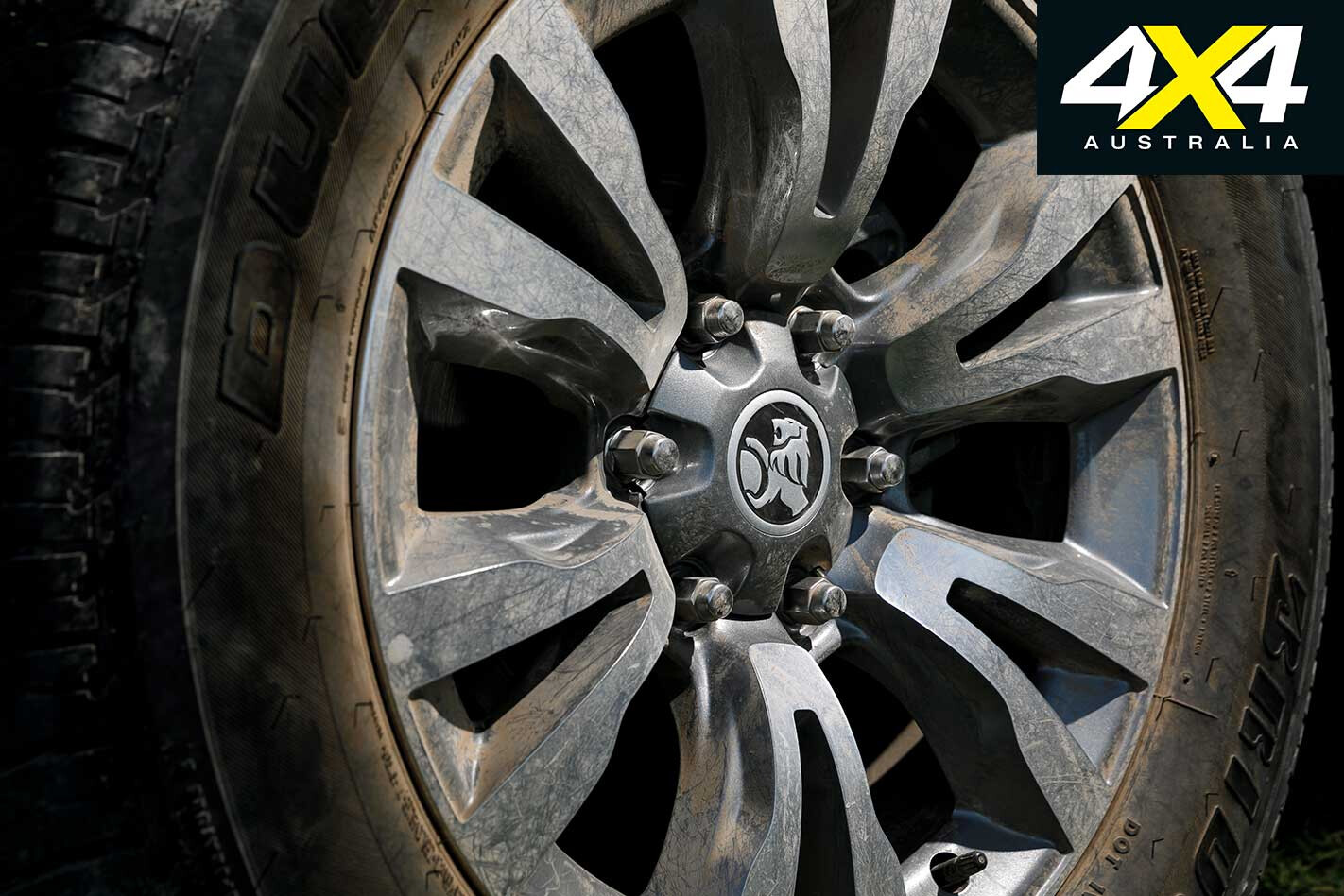
ALL Trailblazer models from the LT up get seven airbags, a reversing camera, rear-parking sensors, a seven-inch touchscreen, Apple CarPlay, Android Auto and LED DRLs. T
he LTZ adds to that with leather, sat-nav, front parking sensors, climate control air conditioning, rain-sensing wipers, tyre-pressure monitoring and a host of safety features including forward collision alert, blindspot monitoring, lane-departure warning and rear cross-traffic alert. The LTZ also swaps to an eight-inch touchcreen and 18s.
The Z71 then adds largely cosmetic enhancements including black-finished wheels, body mouldings, mirrors and door handles.
What’s in a name?
IN ITS first iteration the Trailblazer was called the Colorado 7, simply because it was a seven-seat wagon based on the Colorado ute. But in creating the Trailblazer, Holden did a lot more than changing the name, as the Colorado 7 was stripped right down to its last nut and bolt before being put back together again with a large number of new and revised parts.
The changes addressed engine NVH, the feel and response of the automatic gearbox, the steering, ride and handling, cabin noise, interior fit and finish, and off-road performance, effectively providing a whole new driving experience.
Isuzu MU-X LS-T – Tough Stuff
The MU-X’s class-leading sales are built on its reputation for reliability and low running costs.
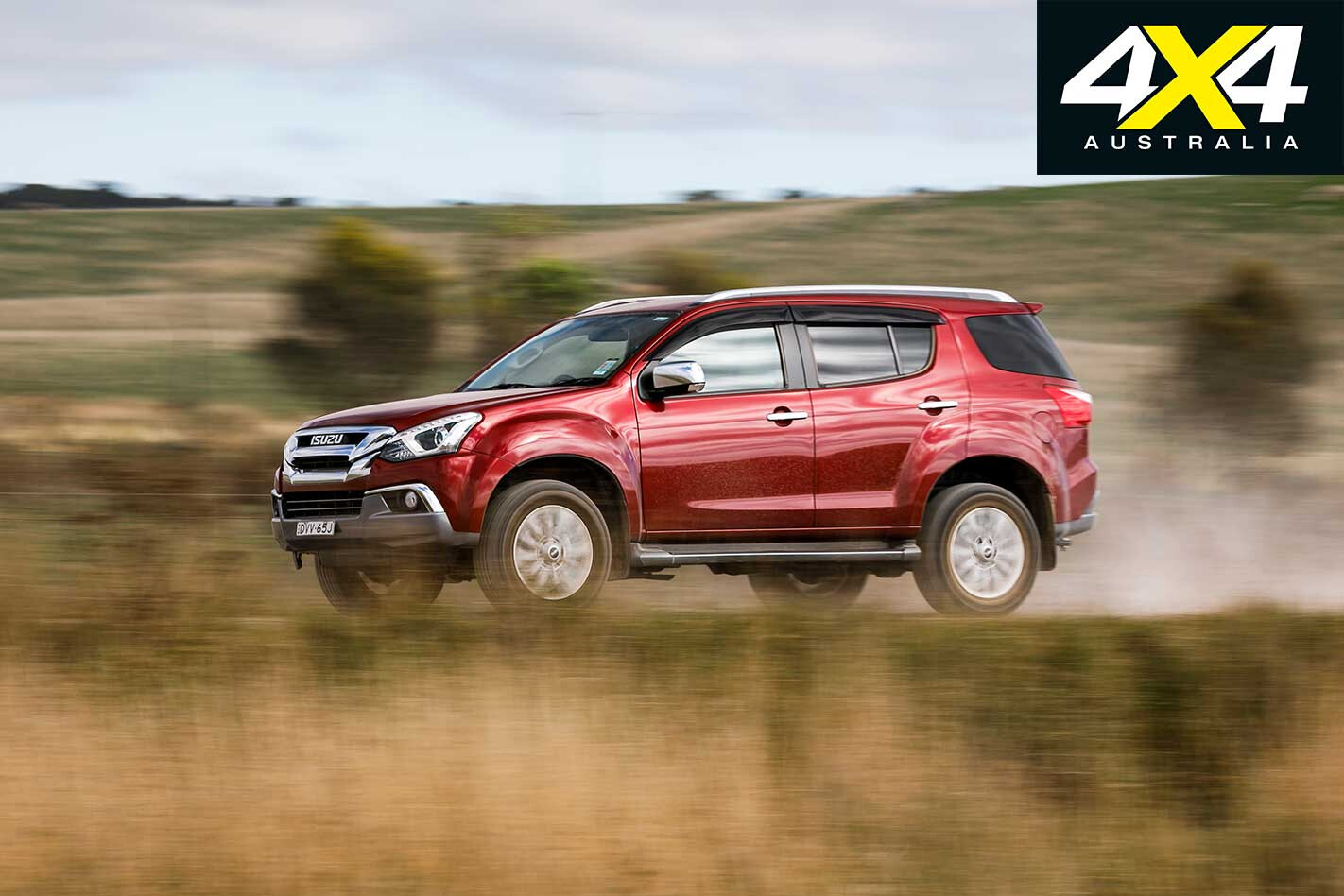
AS LUCK would have it, the MU-X you see here is the just-superseded 2018 MU-X, the new 2019 model being announced after we locked in this car for this comparison. Fortunately, there’s not much in it beyond a new grille, black-faced wheels and interior touches; although, Isuzu says the steering is tweaked to make it lighter at parking speeds.
This latest makeover follows close behind a number of upgrades to the MU-X in recent times. Arriving in Australia in late 2013 and remaining largely unchanged for three years, the MU-X gained a significantly updated engine, new six-speed automatic and manual gearboxes, NVH enhancements and additional equipment in early 2017.
A few months later there was a refreshed front-end styling, a new dash, more NVH control measures and additional equipment, while trailer-sway control was added for 2018.
Powertrain & Performance
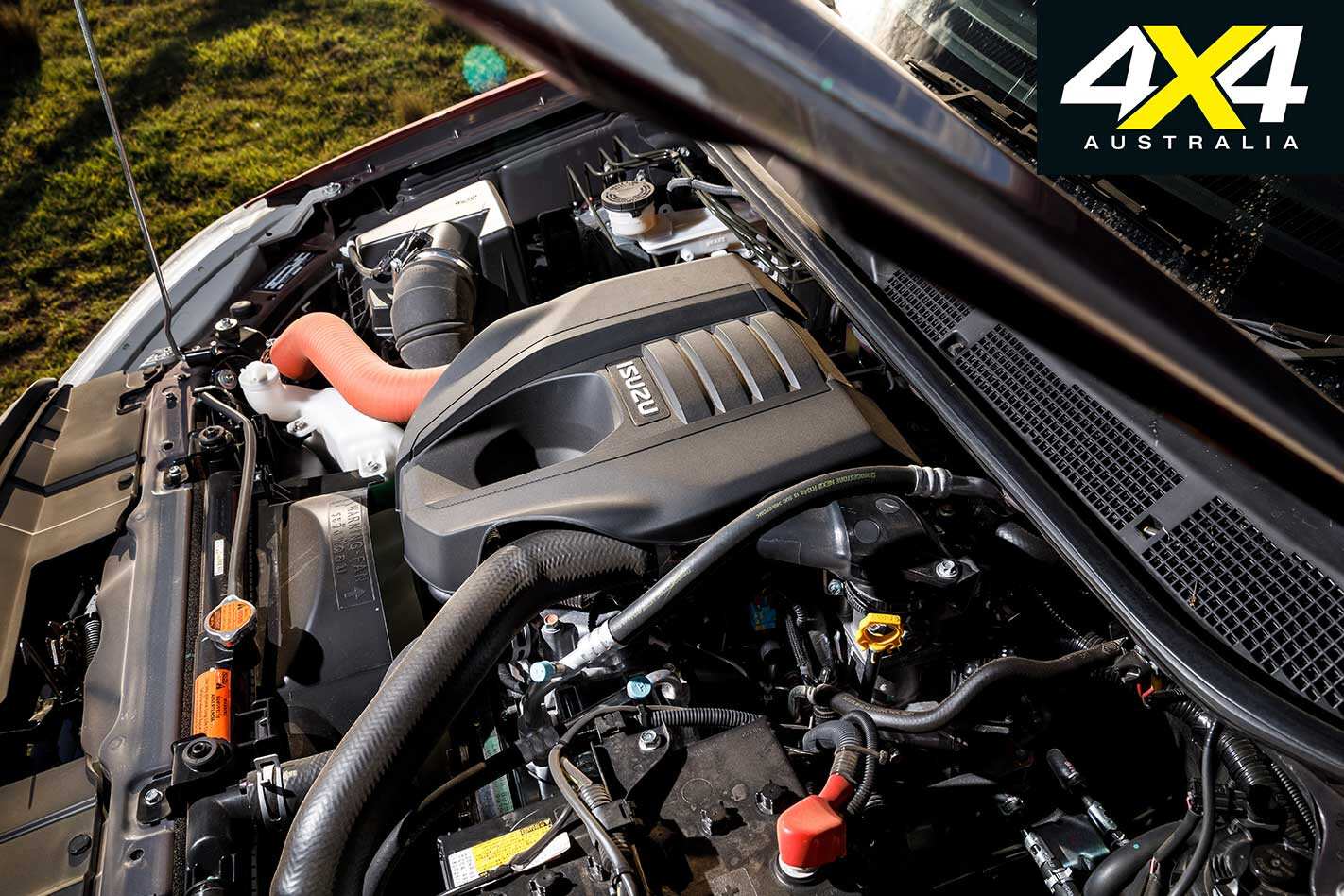
THE MU-X’s 3.0-litre four-cylinder diesel is the latest iteration of an engine that effectively dates back to 2005. The most recent upgrade to comply with Euro 5 emission standards in 2017 brought a variable-geometry turbocharger, higher pressure common rail injection, revised pistons and a diesel particulate filter. Fortunately the changes also bring more torque over a wider rpm range, even if maximum power remained at 130kW.
Despite having the biggest capacity engine the MU-X can’t match the Trailblazer for performance and is back with the Pajero Sport and Rexton performance-wise, both of which have notably smaller engines.
However, in general driving, the MU-X’s engine needs less revs to do the same job as these two smaller engines. Its general, light-throttle running refinement is also very good, but when worked hard it’s also the least refined engine here.
For its part the MU-X’s six-speed auto offers reasonably smooth and well-timed shifts but isn’t as slick as the Rexton’s seven-speed or the Pajero Sport’s eight-speed, or as proactive in its shifting as the Trailblazer.
The overall gearing is also the tallest here, thanks in part to the six-speed auto – an Aisin gearbox shared with Hilux and Prado – having two very tall overdrive gears, which can induce shuffling back and forth between fifth and sixth on undulating country roads.
On-road ride & handling
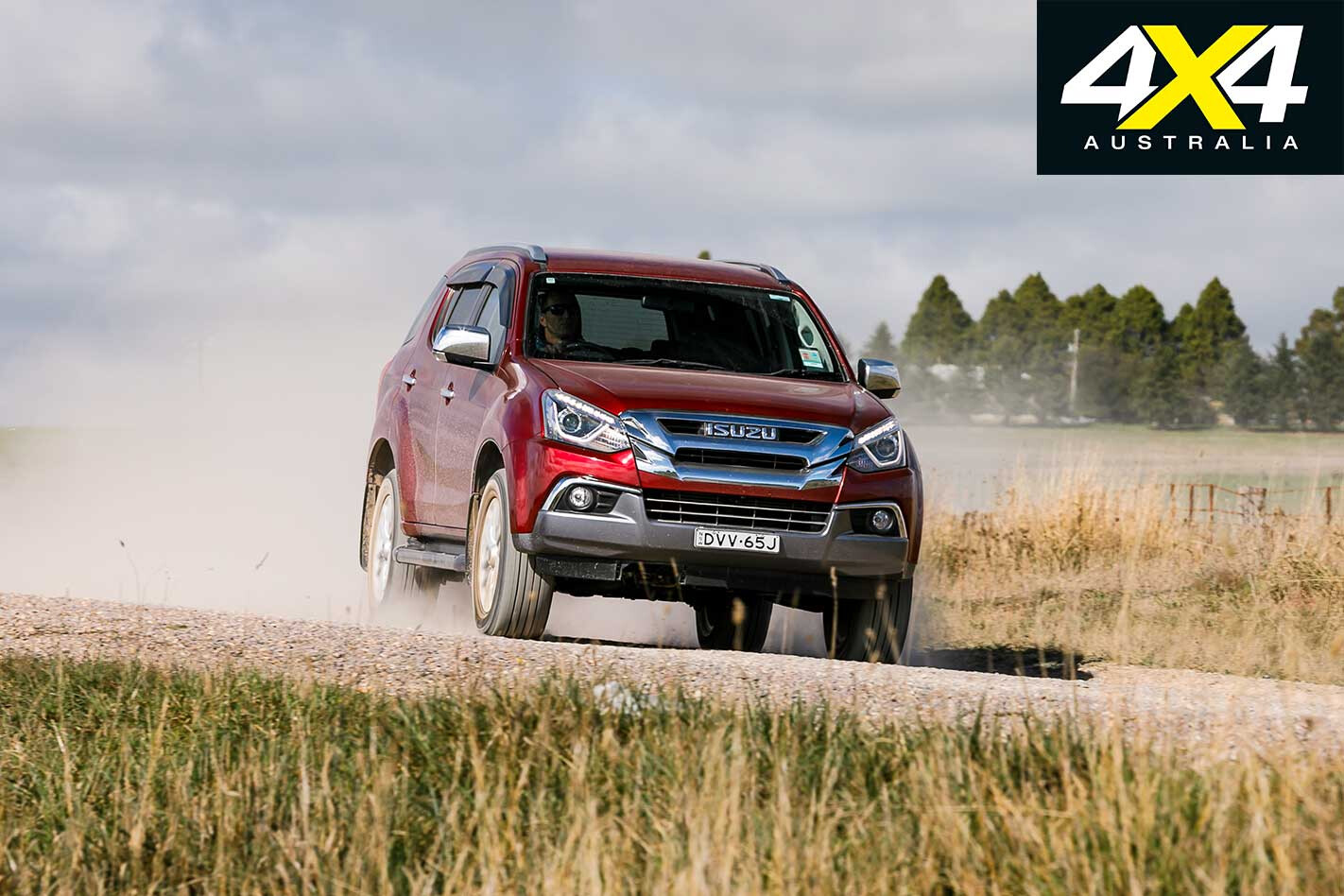
OUR test MU-X felt as if it had done a lot more than the 9500km on the odo in terms of suspension damping control. Perhaps this particular car had done something arduous in its short life? Still, the ride quality and compliance was good, as was general handling amongst this four.
However, the MU-X isn’t as nippy as the Pajero Sport nor as generally well sorted as the Trailblazer, especially with regards to steering feel. We know this from previous experience, so it’s not just a reflection of this particular MU-X.
The MU-X’s 2019 upgrade promises lighter steering at parking speeds, and a little bit more feel at highway speeds wouldn’t go astray either.
Off-road
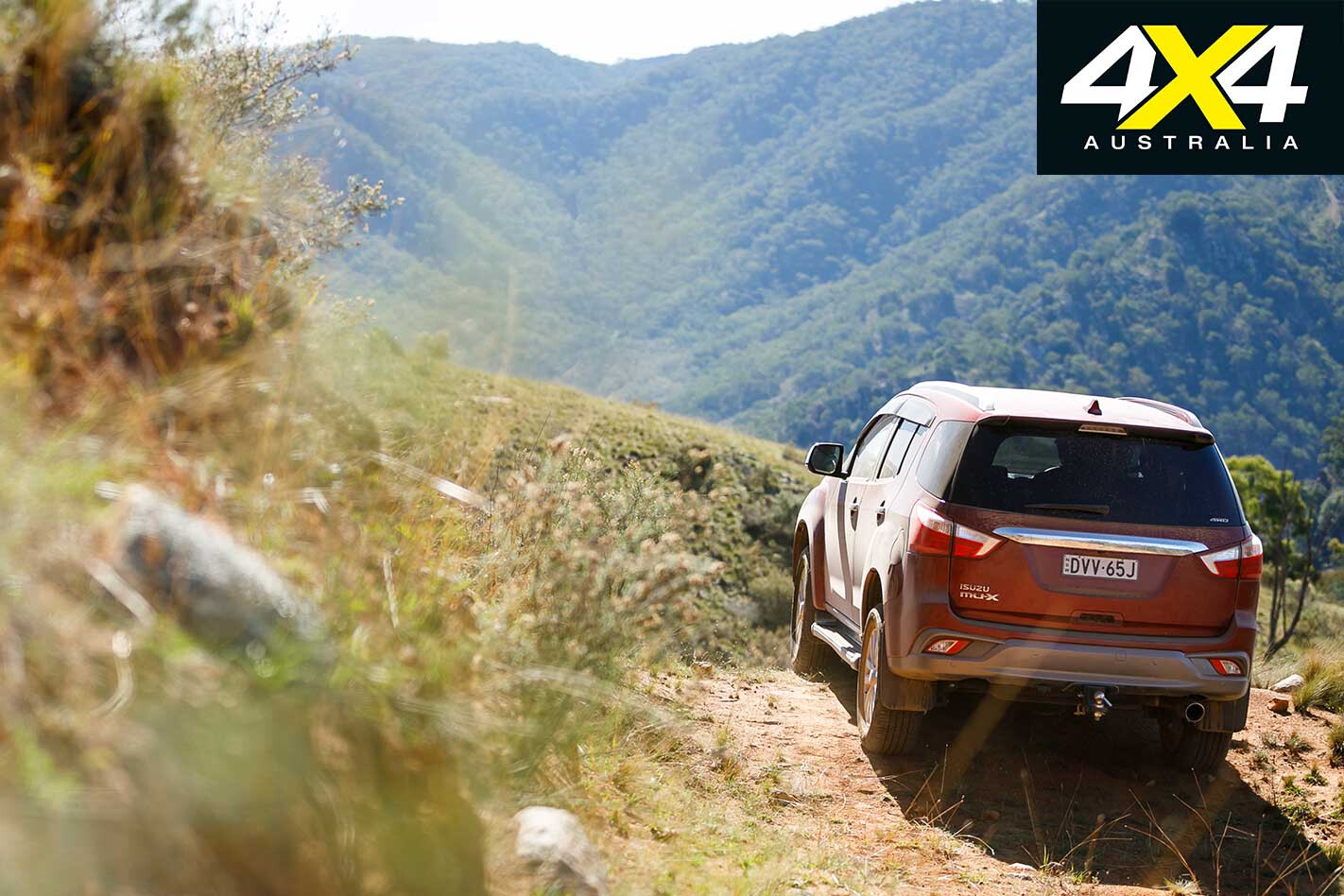
THE MU-X offers decent clearance and good vision for the driver when off-road, and it’s well protected underneath. In this company – which doesn’t set the bar too high as none have notably long-travel suspension – the MU-X does better than the Rexton and the Pajero Sport, even if the Trailblazer betters it thanks to its more effective traction control system which helps counter the modest amount of wheel travel of this shared platform.
While the MU-X is competent enough for most recreational off-road touring with nothing more than change of tyres, a rear locker would be a useful aftermarket upgrade, as would a rear recovery point. As is the case with Trailblazer, recovery points are only fitted at the front.
Cabin, Accommodation & Safety
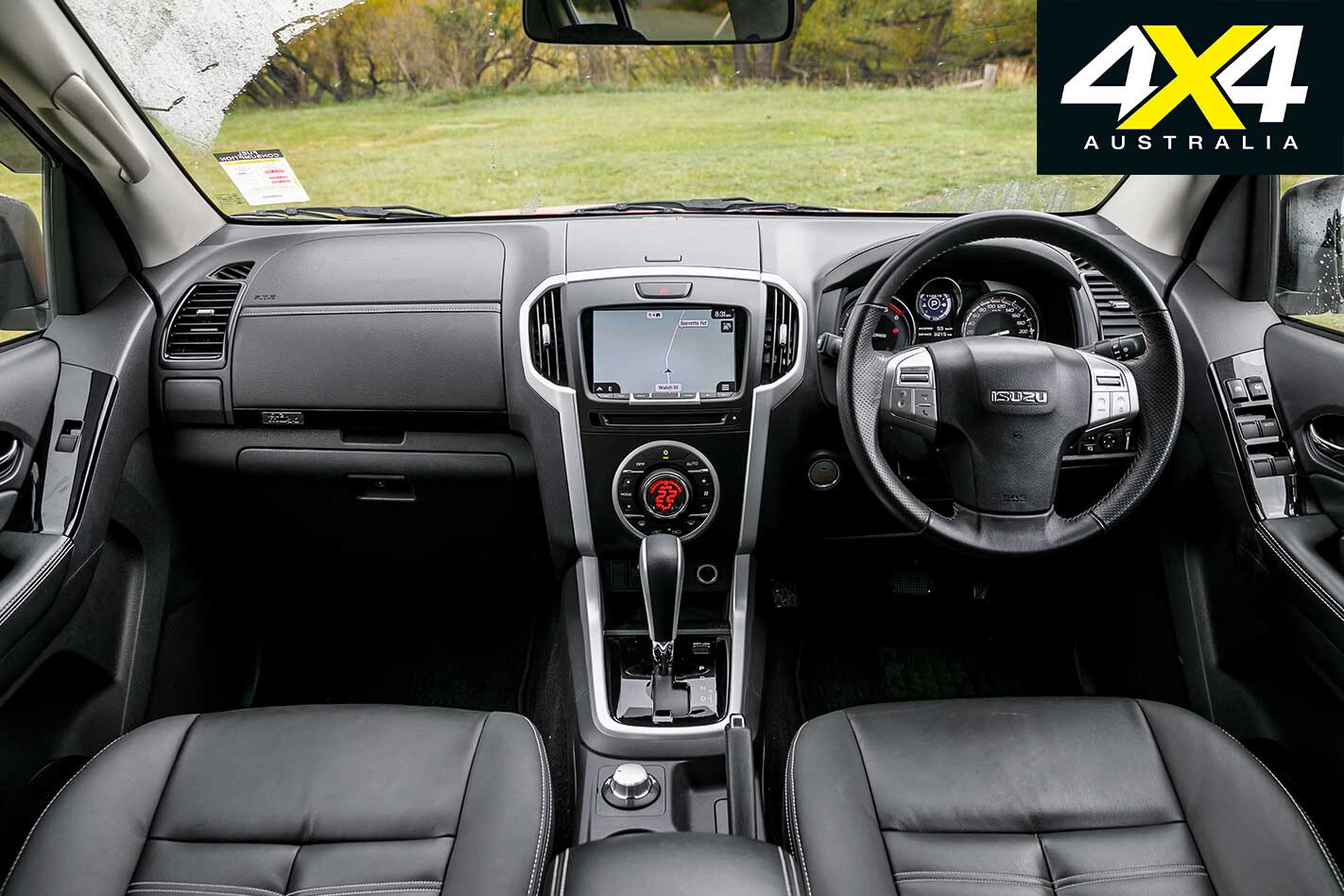
SMART-KEY entry (on this top-spec LS-T) and a conveniently placed grab handle make it easy to climb aboard to what is a generally comfortable and spacious driving position, electric-adjust leather seat and all. That said, our tallest test driver found it hard to get comfortable in both the MU-X and the Trailblazer, with which it shares cabin structure and lack of steering wheel reach adjustment.
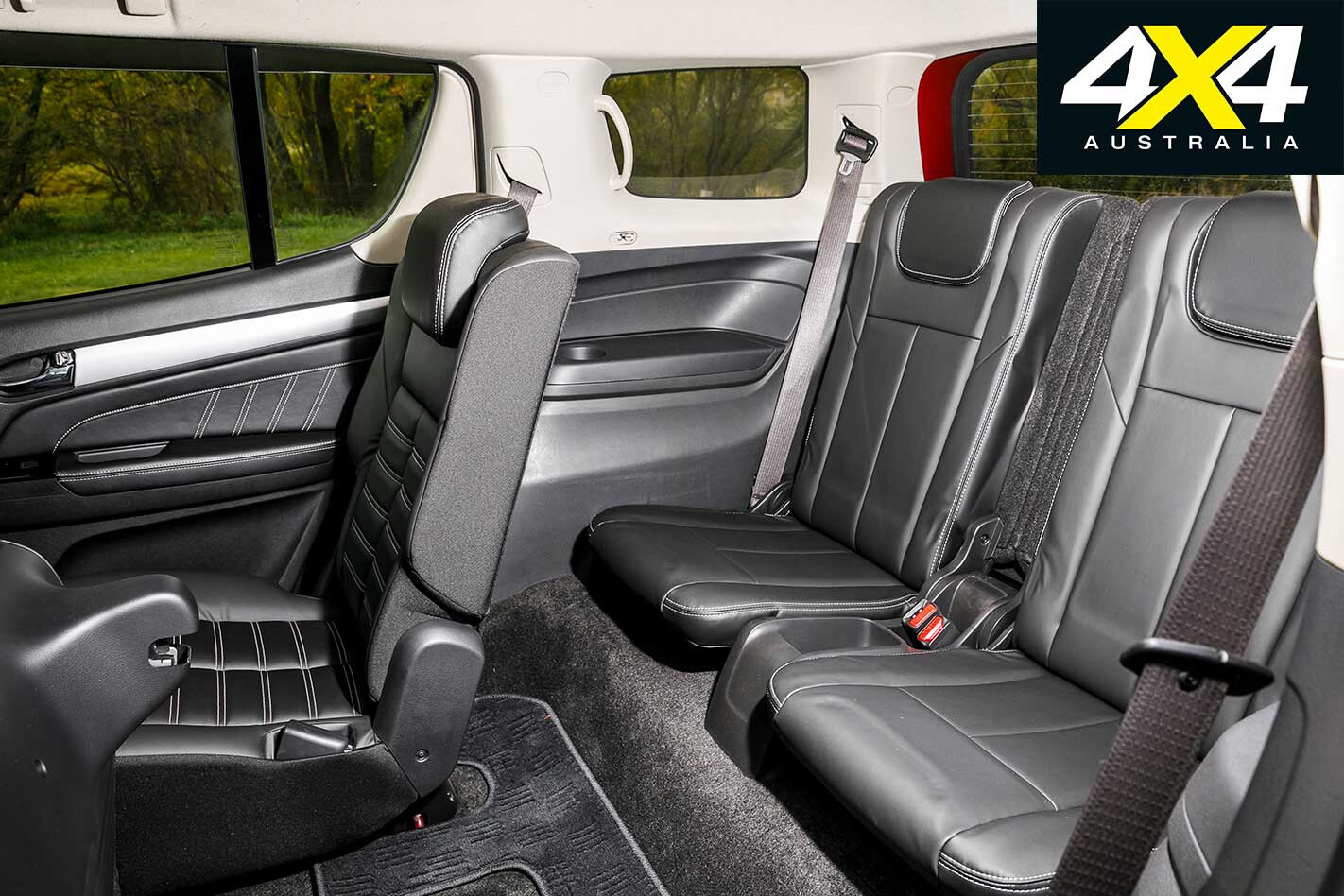
The back seat is a bit of a squeeze for three adults (two adults and a child is more ideal) but is more spacious than the Pajero Sport and matches the Trailblazer. The third-row seats are easy to deploy and can seat adults, even if foot room could be better.
As with the Trailblazer, the third-row seats come at the cost of reduced luggage space with the high floor they create. Like the Trailblazer, there aren’t any tie-down points located on the cargo floor.
The MU-X’s fit and finish and general cabin presentation is much improved by pre-2017 standards, but it isn’t up to the standard of the flashier Pajero Sport or even the Rexton.
Thanks in part to six airbags the MU-X offers five-star ANCAP safety, and as of 2019 comes with features such as blind-spot monitoring, rear cross-traffic alert and front parking assistance as extra-cost factory accessories.
Practicalities
THE MU-X has the smallest fuel tank here, its 65 litres being 11 litres shy of the 76 litres of the Trailblazer. However, as always with the MU-X (and the D-Max), the 3.0-litre engine is thrifty, so the overall fuel range is still competitive.
As part of the 2019 update the warranty was bumped up to six years (or 150,000km) the roadside assistance was increased to six years, and the fixed-price servicing stretched to seven years (or 105,000km).
The MU-X’s tow rating of 3000kg is typical of this class and, while we haven’t towed with the MU-X, the identical powertrain in the D-Max does a respectable job of heavy duty towing.
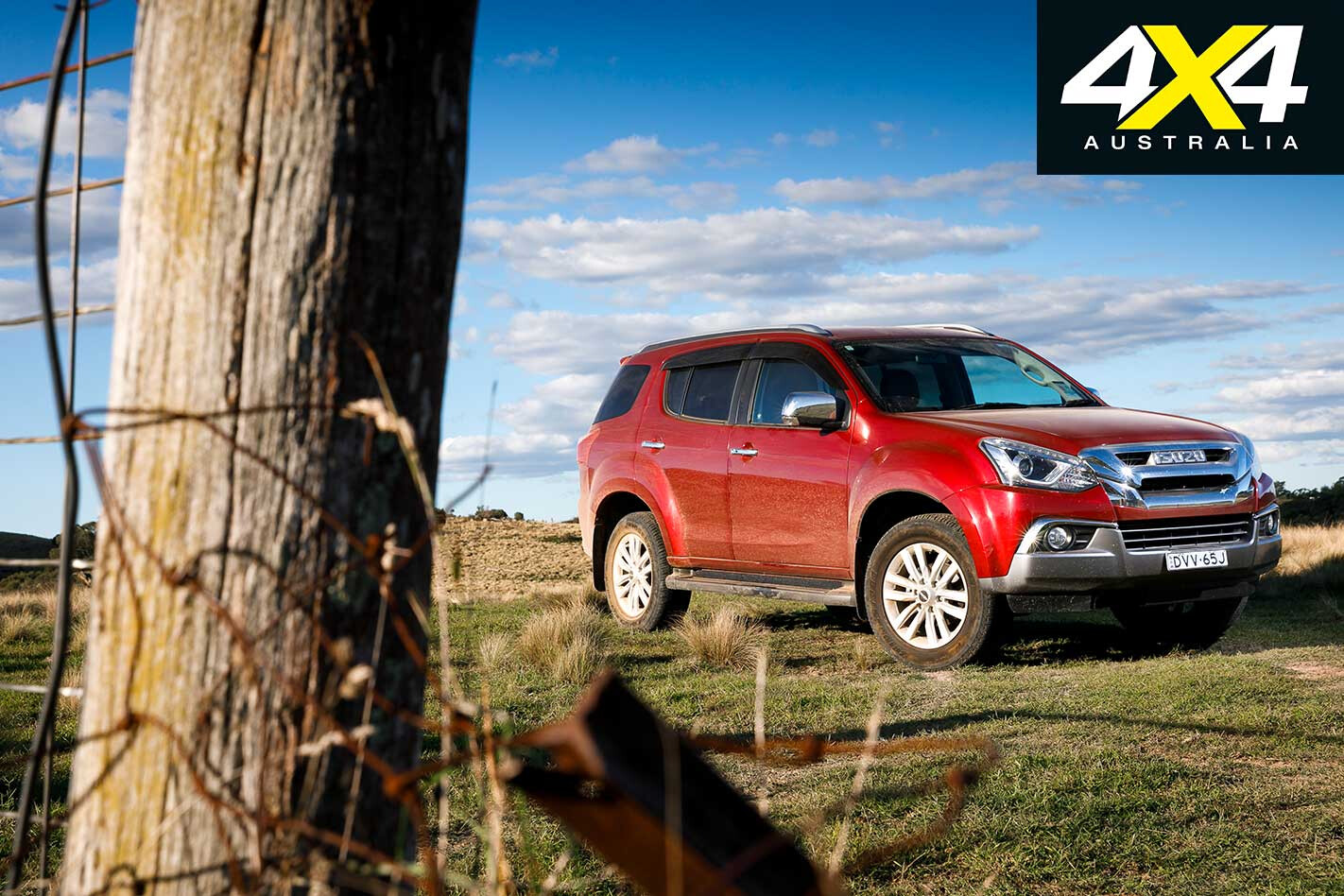
ISUZU MU-X LS-T SPECS: Engine: 3.0-litre 4-cyl turbo diesel Max Power: 130kW @ 3600rpm Max Torque: 430Nm @ 2000-2200rpm Gearbox: Six-speed automatic 4×4 System: Dual-range part-time Crawl Ratio: 33.3:1 Construction: Separate-chassis Front Suspension: Independent/coil springs Rear Suspension: Live axle/coil springs Wheel/Tyre: 255/60R18 108S Kerb Weight: 2157kg GVM: 2750kg Payload: 593kg Towing Capacity: 3000kg Ground Clearance (claim): 230mm Approach Angle: 24.0° Ramp-over Angle: 19.5° Departure Angle: 25.1° Wading Depth: 600mm Fuel Tank Capacity: 65 litres ADR Fuel Claim: 7.9L/100km Test Fuel Use: 10.4L/100km
ISUZU MU-X PRICES* LS-M: $50,200 LS-U (M/T): $50,400 LS-U (A/T): $52,400 LS-T: $56,200 *Prices do not include government or dealer charges.
What you get
ALL MU-X models from the LS-M up get six airbags, a seven-inch touchscreen, Bluetooth, USB input, a reversing camera, LED DRLs and headlights, and trailer-sway control. The LS-U then adds an eight-inch touchscreen, sat-nav, climate control, air-con outlets for the rear-seat passengers, fog lights, side-steps, rear privacy glass and 18s in place of the LS-M’s 16s.
The LS-U is also the only model that comes with the option of a manual gearbox. The LS-T then adds ‘smart-key’ entry and start, leather seats with electric-adjust for the driver, rear DVD entertainment, roof rails and tailgate spoiler. Isuzu also now offer blindspot monitoring, rear cross-traffic alert and front parking assistance as an extra-cost accessory on all MY17 and later MU-X models.
What’s in a name?
YOU might think Isuzu is relatively new to Australia as the brand only appeared here in its own right in 2008, but Isuzu vehicles have been around in Australia since the mid 1970s wearing Holden badges such as Gemini, Rodeo, Jackaroo and the now long-forgotten Frontera, sold elsewhere in the world as the Isuzu MU and the forebear of today’s MU-X.
Mitsubishi Pajero Sport – Triton Sport, anyone?
Despite the name, there’s no Pajero in the Pajero Sport … it’s all Triton.
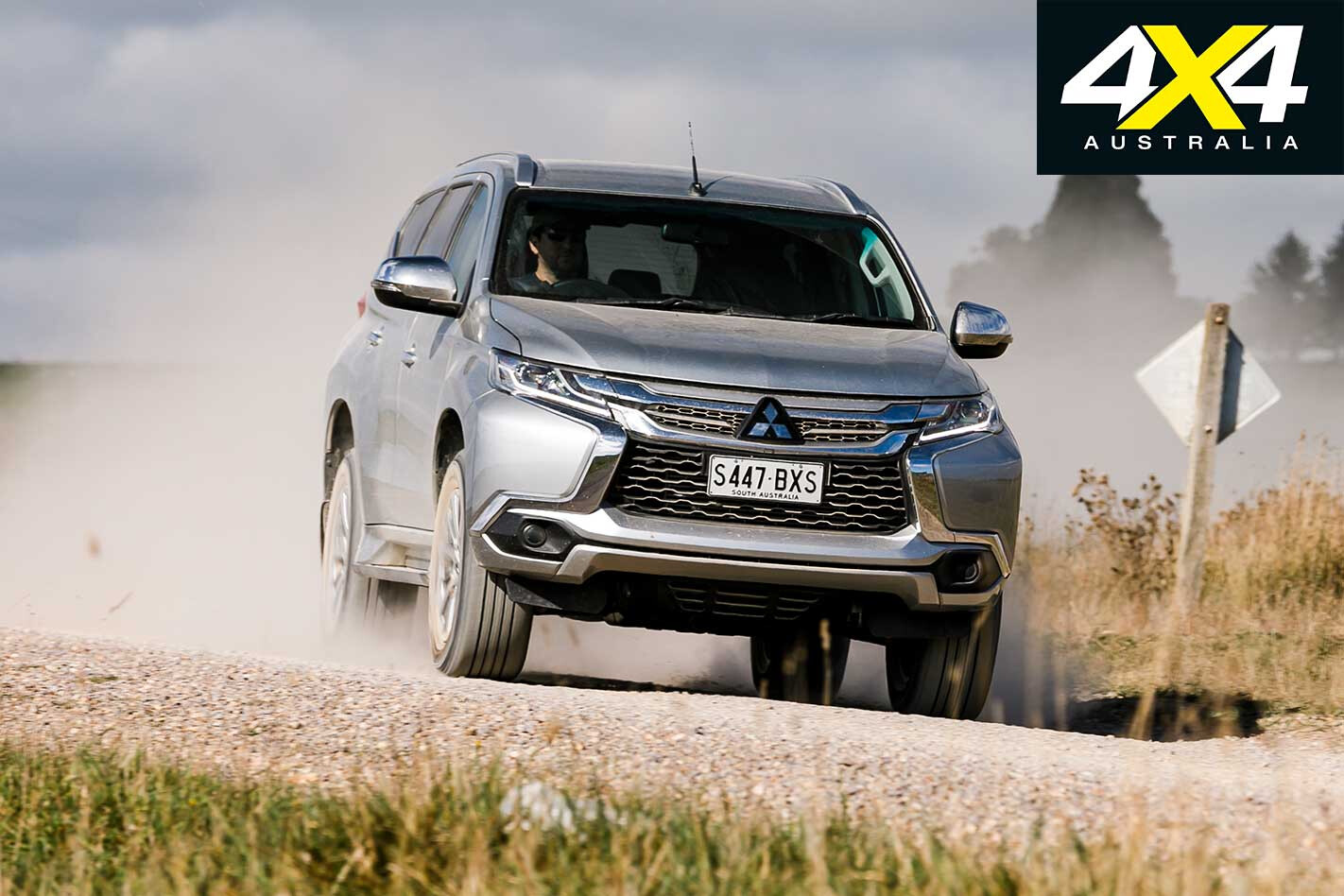
MITSUBISHI has been building a wagon based on a Triton ute since 1996, sold here as the Challenger. In some parts of the world it was called a Pajero Sport right from the get-go, but that name was only adopted here in 2015 when this model arrived off the back of the then-new Triton.
Initially the Pajero Sport was only available as a five-seater, but third-row seats were introduced on mid- and top-spec models the following year. The Pajero Sport’s latest update – for the 2018 model year – has seen automatic emergency braking and radar cruise control, features previously exclusive to the top-spec Exceed model, become standard across the range.
What we are driving here is a base-spec GLX; although, it doesn’t present as a ‘budget’ model, even if there’s no third-row seating, a unique feature of the class and possibly one reason behind its strong sales. Not everyone – especially older buyers with grown-up families – needs seven seats.
Powertrain & Performance
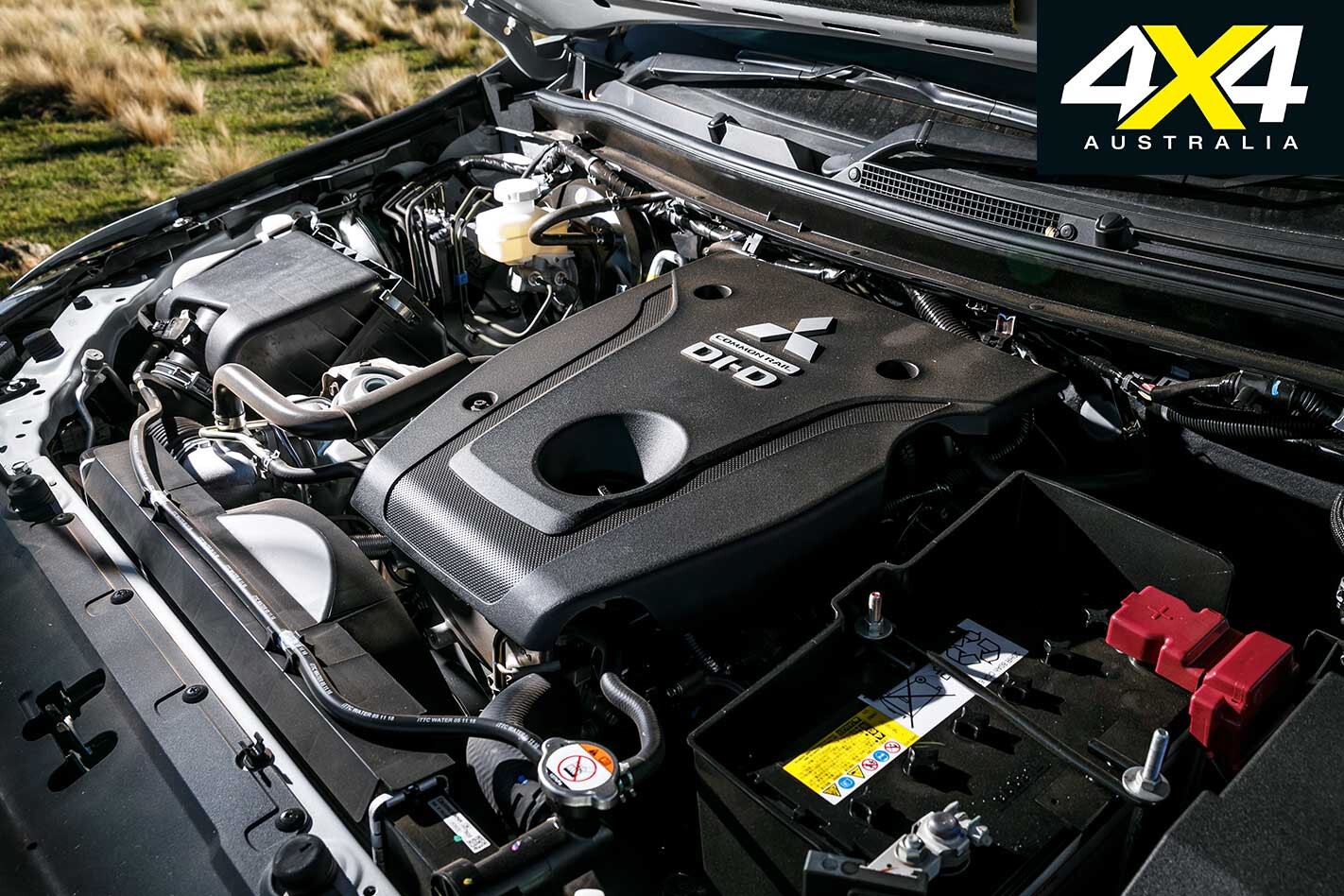
THE Pajero Sport shares the same 2.4-litre four-cylinder diesel as the Triton, an all-new engine in 2015. It boasts Euro 5 compliance and comes with the now ubiquitous diesel particulate filter, which is what’s generally needed to bridge the gap from Euro 4 to Euro 5.
The 2.4 is a modern design with relatively low compression ratio (for refinement and lower NOx) and, surprisingly for a relatively small capacity four, it employs counter-rotating balance shafts for improved smoothness. On the road the engine delivers on this promise of modernity and is quiet, smooth and refined, bettered only by the Rexton in this company in that regard.
Despite its smaller capacity it claims the same maximum torque (430Nm) as the 3.0-litre in the MU-X and a little more power (133kW v 130kW), but this doesn’t translate to any performance advantage. Nor does its 2.4-litre capacity make it any better off than the 2.2-litre engine in the Rexton, as it too claims 133kW.
Unlike the MU-X and the Trailblazer, the Pajero Sport doesn’t share the gearbox of its donor ute, previously a five-speed automatic but now a six-speed automatic. Instead the Pajero Sport gets a slick Aisin eight-speed automatic complete with paddle shifters, even on this base-spec GLX.
On-road ride & handling
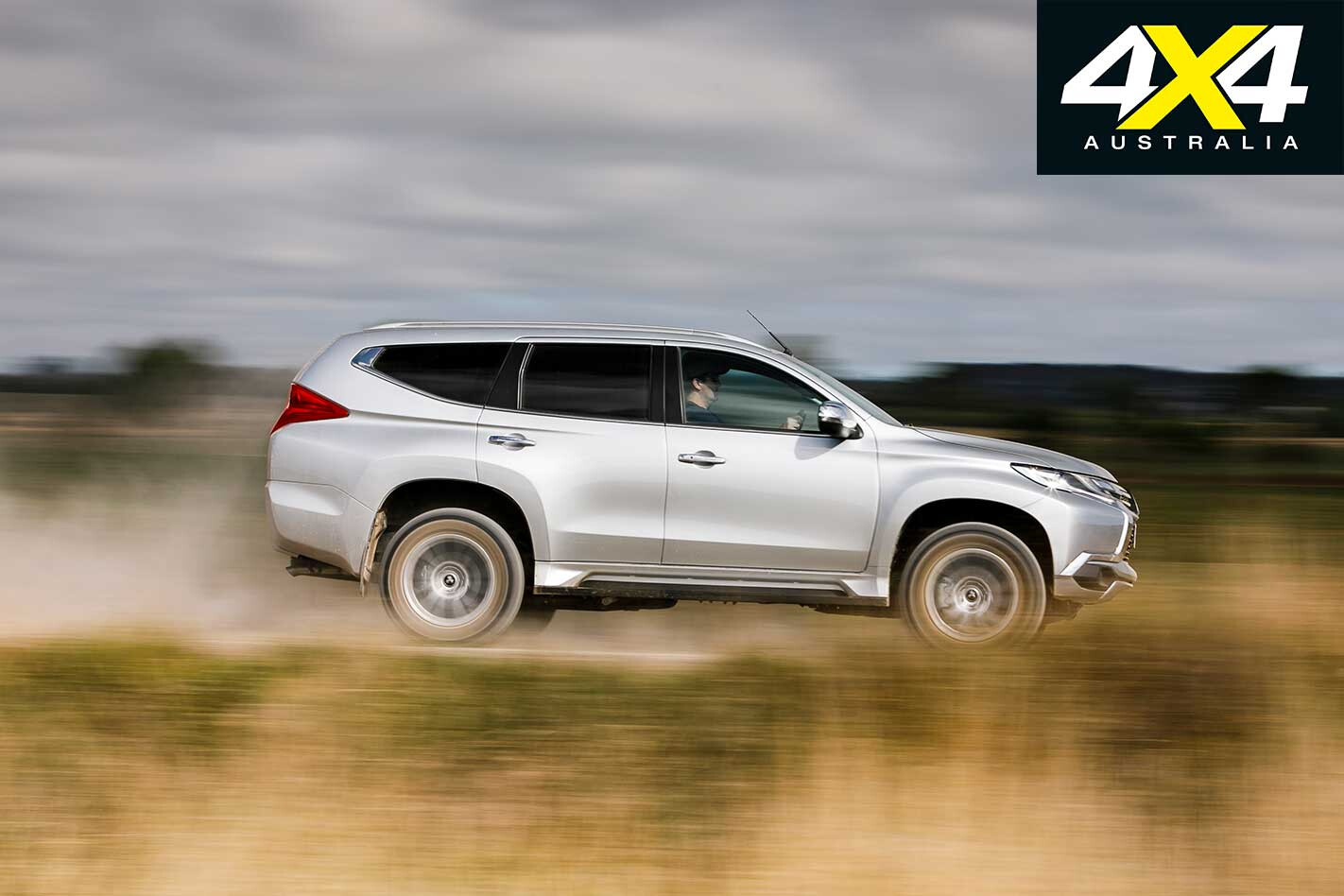
THE Pajero Sport stands alone in this company with its ‘Super Select’ 4×4 system that allows the driver to select 4×4 on any road surface, sealed or unsealed, wet or dry, and leave it there. It’s effectively a full-time 4×4 system but you still have the option of two-wheel drive. The other three wagons here have part-time 4×4, a relatively rudimentary, less convenient and less safe system.
This alone gives the Pajero Sport a ‘sporty’ edge in this company, also helped by the fact it’s the smallest vehicle here and generally feels more agile in the way it handles. A nicely connected feel to the steering also helps, especially in comparison to the MU-X and the Rexton.
Off-road
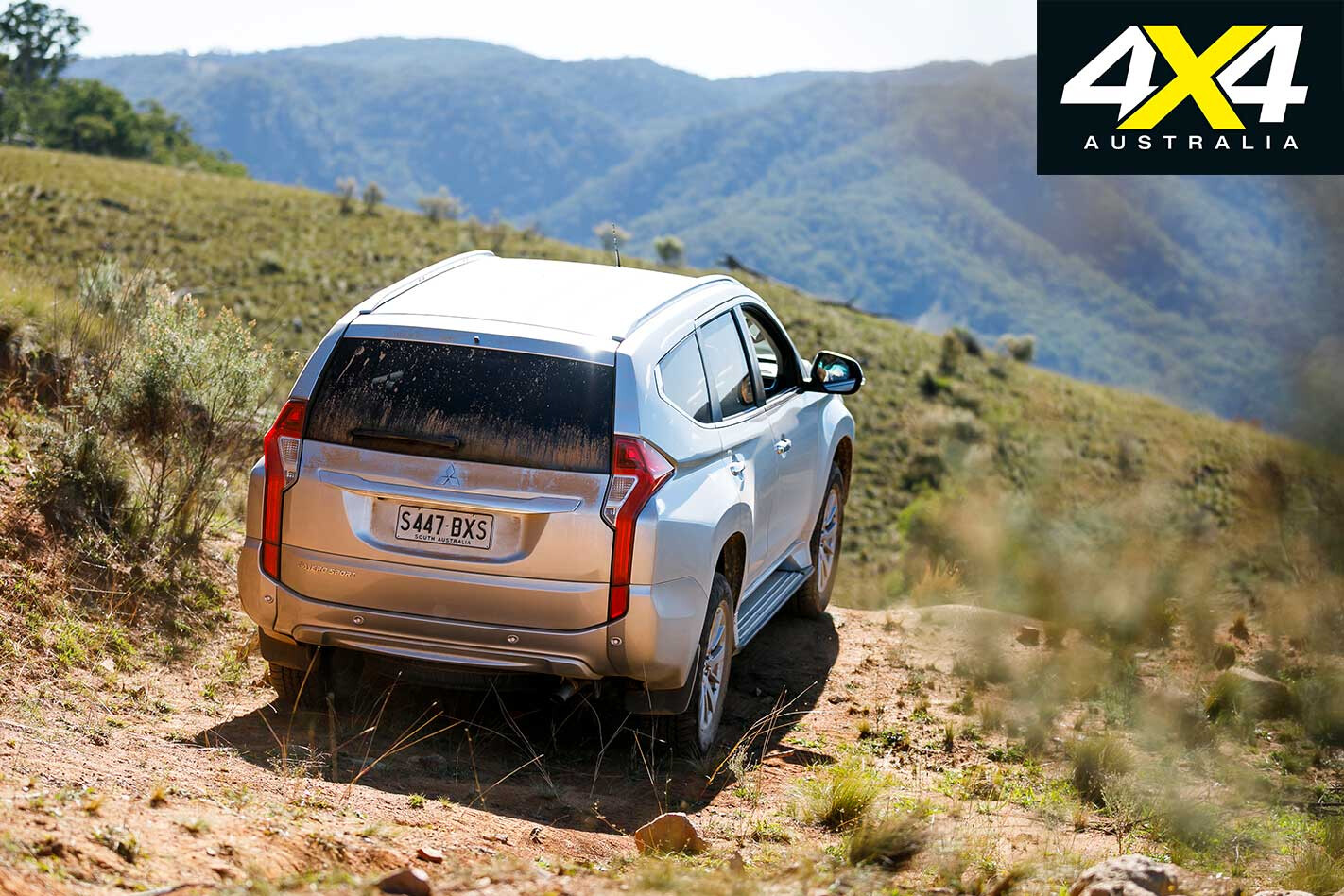
AS WITH the other three wagons here the Pajero Sport isn’t overly endowed with wheel travel and, while better than the Rexton, it can’t quite match the Trailblazer and MU-X half brothers, which still don’t have the wheel travel or the off-road ability of more sophisticated wagons such as Toyota’s Prado and Ford’s Everest.
The Pajero Sport’s electronic traction control isn’t notably effective, either, and while mid- and top-spec models have a driver-switched rear diff-lock, engaging the locker cancels the electronic traction control on both axles so it’s not always a benefit.
The Pajero Sport is still a bit more manoeuvrable and handy in tight spots than the bigger wagons here, and it’s the only one with front and rear recovery points.
Cabin, Accommodation & Safety
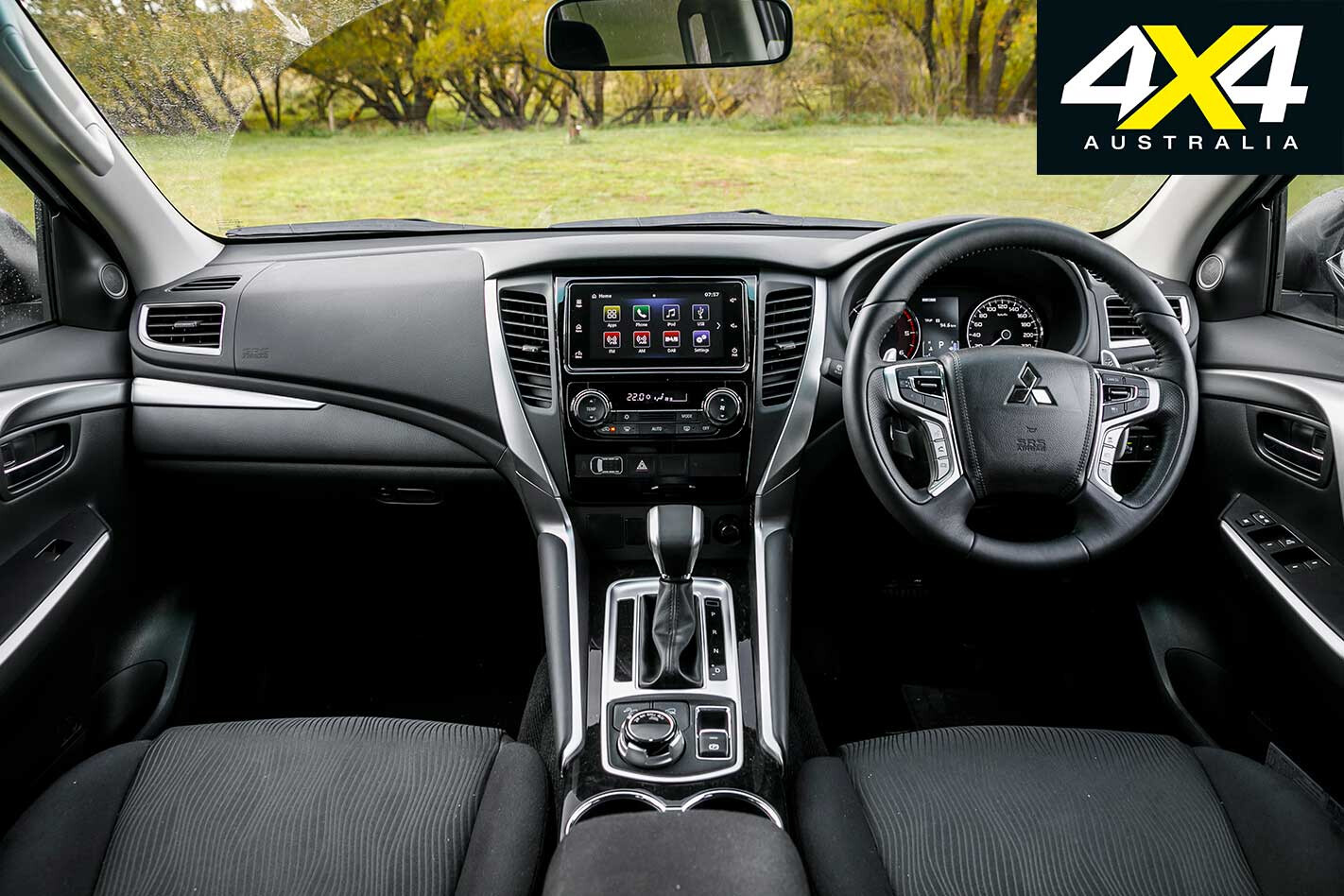
THE Pajero Sport’s cabin is smaller than the other three wagons, something you notice up front and in the second row. The GLX, as tested here, only has two rows of seats but comes out on top in terms of luggage space as a result. It’s also the only one of the three with floor-mounted cargo tie-downs.
Taller drivers may find the driving position a bit cramped, especially for lateral legroom given the wide centre console, but everyone benefits from the steering wheel’s tilt and reach adjustment, something missing in the MU-X and Trailblazer. Good front seats, too.
The Pajero Sport has a five-star ANCAP safety rating and all models have automatic emergency braking, while the Exceed gets blind-spot monitoring.
Practicalities
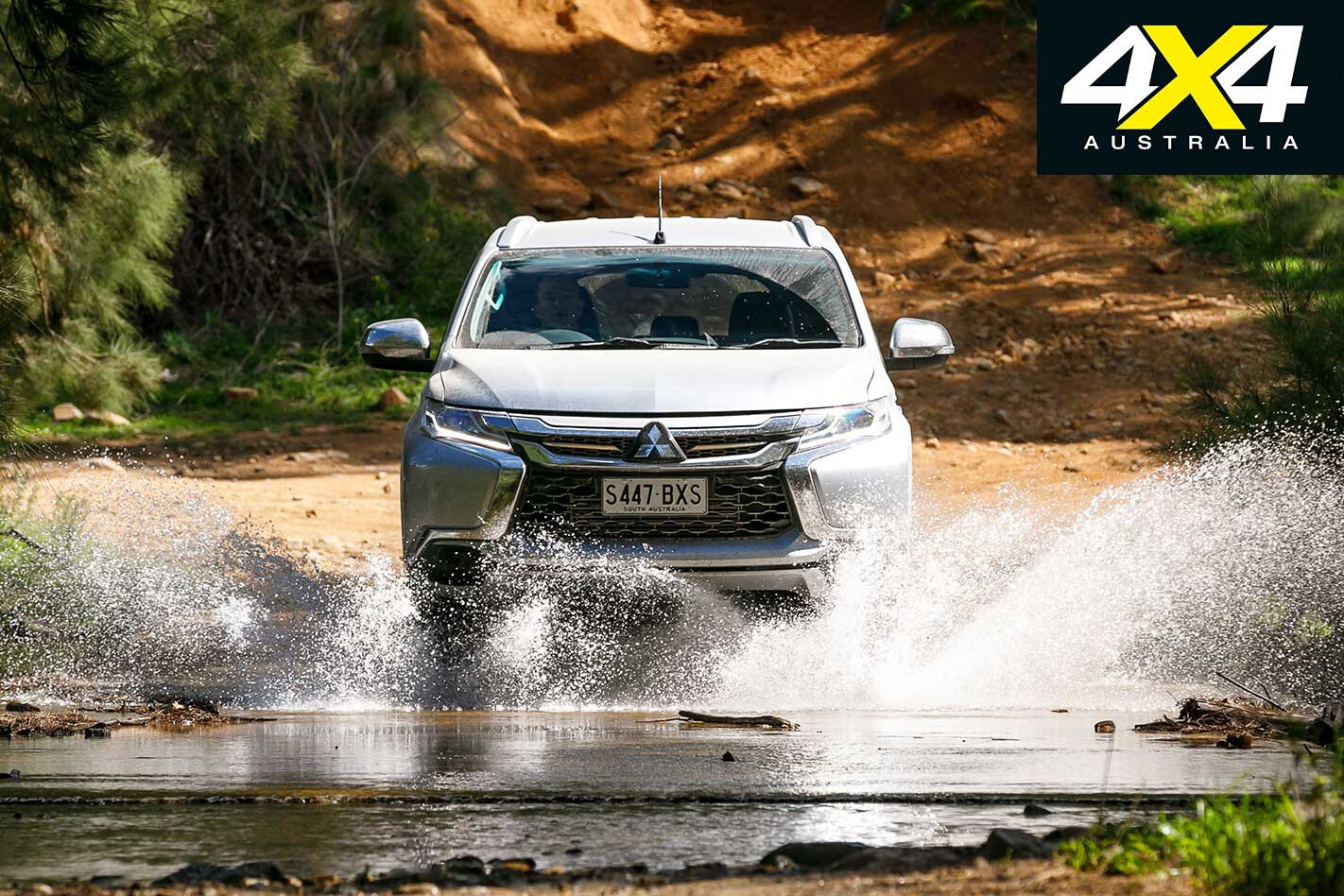
THE Pajero Sport has a 68-litre fuel tank, the second smallest tank here, but on test it had the shortest range given its higher fuel use.
The Pajero Sport has a nominally higher tow rating than the Trailblazer and the MU-X (by 100kg), but if experience with the same powertrain in the Triton is anything to go by that theoretical advantage would evaporate on the road.
The Pajero Sport offers a five-year warranty, four-year roadside assistance, three-year capped-price servicing and 15,000km/12-month service intervals.
MITSUBISHI PAJERO SPORT GLX SPECS: Engine: 2.4-litre 4-cyl turbo diesel Max Power: 133kW @ 3500rpm Max Torque: 430Nm @ 2500rpm Gearbox: Eight-speed automatic 4×4 System: Dual-range full-time (plus 2WD) Crawl Ratio: 45.9:1 Construction: Separate-chassis Front Suspension: Independent/coil springs Rear Suspension: Live axle/coil springs Wheel/Tyre: 265/60R18 110H Kerb Weight: 2045kg GVM: 2710kg Payload: 655kg Towing Capacity: 3100kg Ground Clearance (claim): 218mm Approach Angle: 30.0° Ramp-over Angle: 23.1° Departure Angle: 24.2° Wading Depth: 700mm Fuel Tank Capacity: 68 litres ADR Fuel Claim: 8.0L/100km Test Fuel Use: 11.7L/100km
MITSUBISHI PAJERO SPORT PRICES* GLX (five seat): $46,490 GLS (five seat): $49,990 GLS (seven seat): $50,990 Black Edition (seven seat): $52,240 Exceed (seven seat): $54,490 *Prices do not include government or dealer charges.
What you get
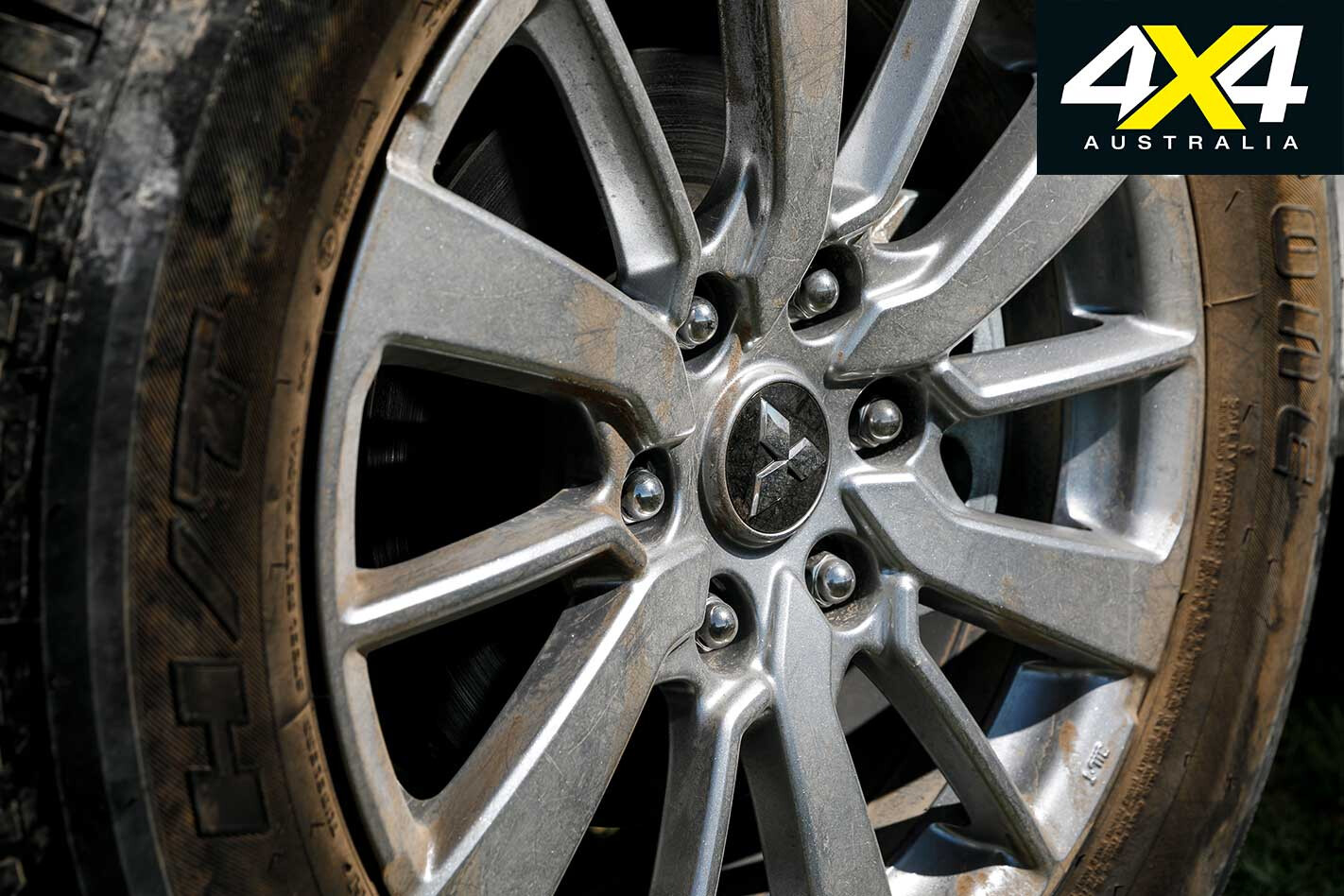
ALL Pajero Sport models get ‘smart’ key entry and start, seven airbags, tilt and reach steering wheel adjustment, digital radio, hill-descent control, a selectable ‘Off-Road’ mode, rear parking sensors, a reversing camera, trailer sway control, automatic emergency braking and adaptive cruise control, LED headlamps and DRLs, and ride on 18s.
The GLS adds dual-zone climate, leather, electric seat adjust for driver and passenger, six speakers (up from four), auto headlights and wipers, a rear locker and the option of third-row seats.
The top-spec Exceed then adds heated front seats, headlight washers, two additional audio speakers, blindspot monitoring, a tailgate spoiler and third-row seats as standard.
What’s in a name?
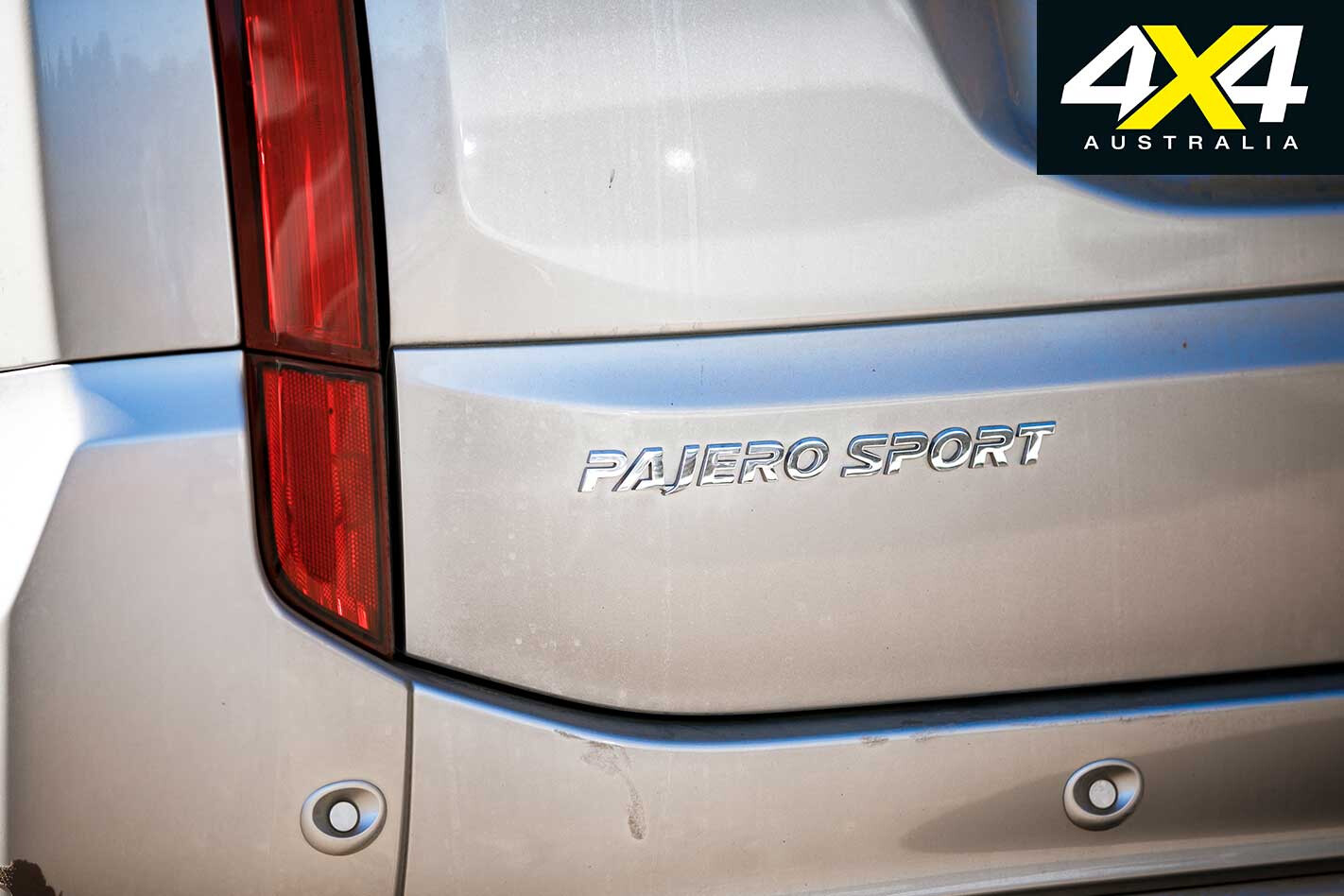
IT MAY be called a Pajero Sport, but Triton Sport would be a more accurate name given the Pajero Sport shares nothing with the Pajero and much with the Triton ute upon which it is based. Being ute-based the Pajero Sport has separate-chassis construction and a rear live axle whereas the Pajero is a world away with its monocoque construction and fully independent suspension.
Ironically, the Pajero Sport is less sporty to drive than the Pajero with its Dakar Rally DNA.
Ssangyong Rexton Ultimate – Left Field
The SsangYong Rexton stands out in this company in more ways than one…
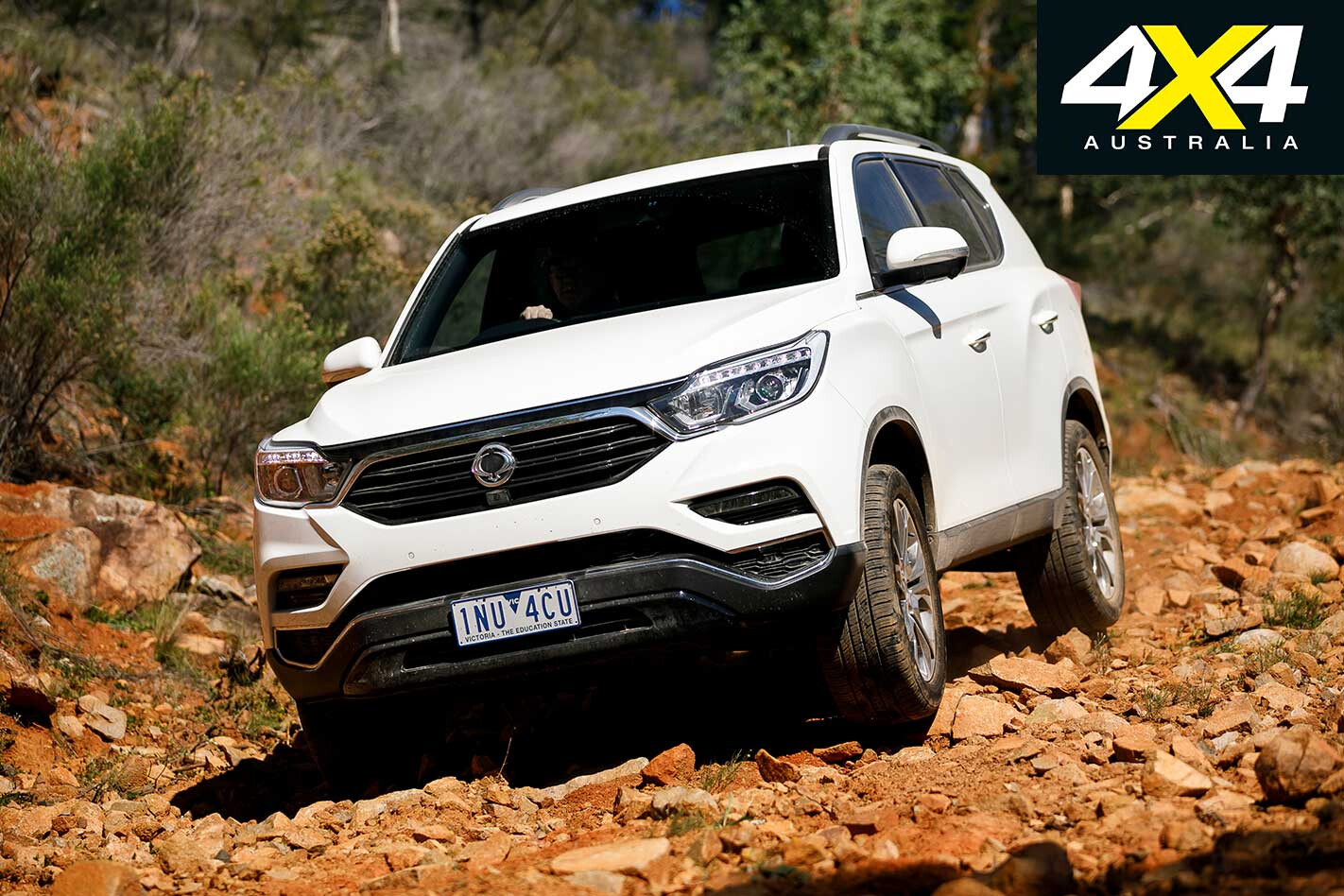
THE Rexton is one of several models introduced into Australia by a born-again SsangYong, but it shares little with the Rexton that was sold here from 2003 to 2012 and elsewhere up to 2017 before being replaced by the all-new model you see here.
This new Rexton comes off the back of investment in SsangYong by Mahindra, who has owned SsangYong since 2011. This new model will be also rebadged as Mahindra Alturas G4 for the Indian market.
Like the other three vehicles here it is built off a separate chassis (it shares a platform with SsangYong’s Musso ute) but unusually features coil-sprung independent suspension at the rear rather than a coil-sprung live axle you’ll find beneath all the other vehicles in this class, including the other three here.
The Rexton also shares the Musso’s 2.2-litre diesel but in a slightly higher state of tune, swaps the Musso’s six-speed automatic for a seven-speed auto, and retains the Musso’s dual-range part-time 4×4 system. What we have here is top-spec Ultimate, which sells for $52,990 driveaway despite lavish standard equipment. That means a good deal less money for a vehicle that’s better equipped than the others here.
Powertrain & Performance
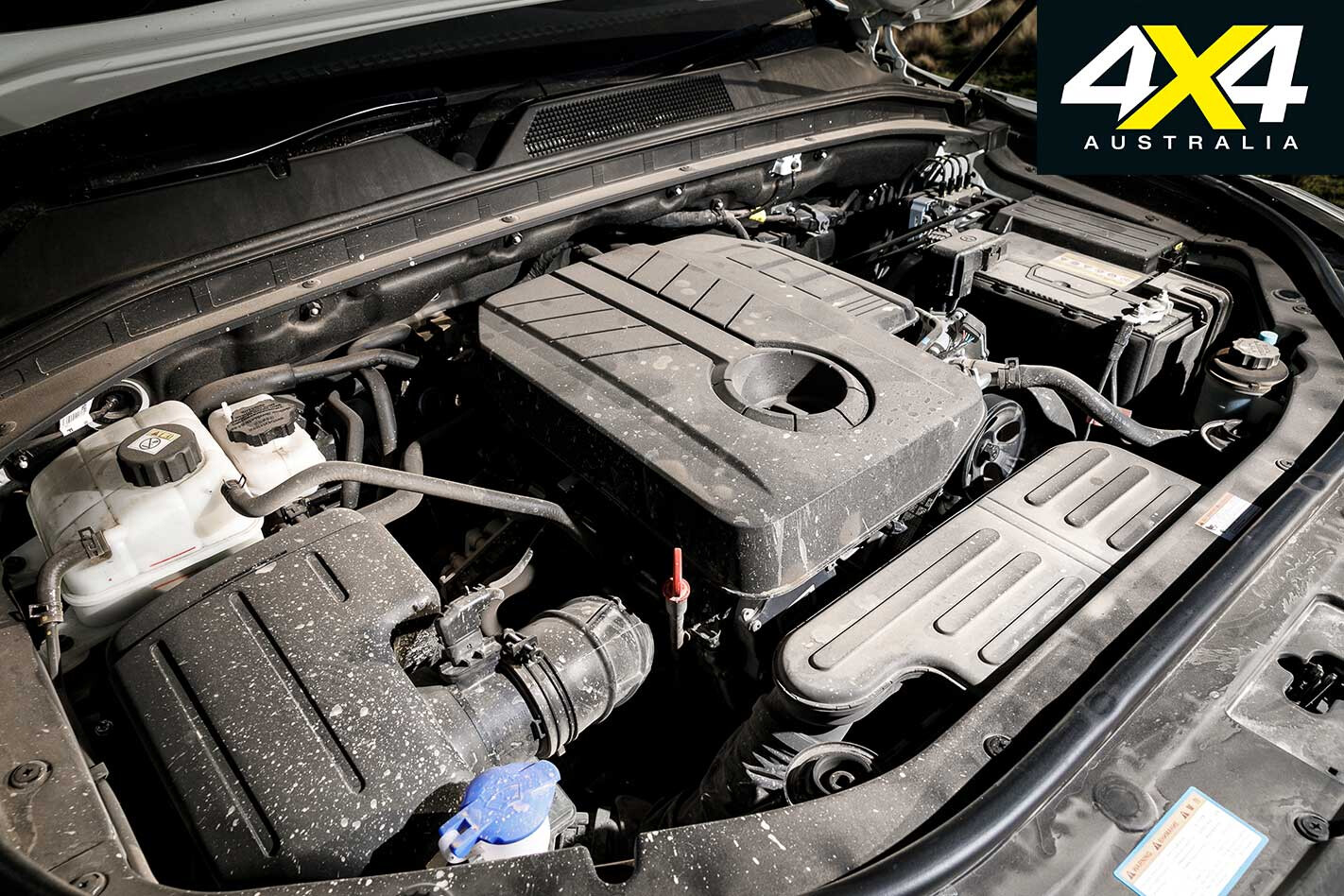
THE Rexton’s 133kW/420Nm 2.2-litre diesel is the smallest here but makes more power – on paper at least – than the biggest engine here, the MU-X’s 3.0-litre. It does this without the benefit of multiple turbos as it’s a single-turbo design.
Its 420Nm figure is also good for the engine capacity and is available from just 1400rpm. By comparison, the next smallest engine here, the 2.4 on the Pajero Sport, makes just 10Nm more but needs another 1100rpm to do so.
On the road the Rexton’s ‘little’ engine lives up to this on-paper promise and overcomes the burden of powering the heaviest vehicle here to produce performance that’s competitive with the MU-X and the Pajero Sport. It’s still outdone by the Trailblazer, but so too are the two others.
The Rexton’s engine is a clear winner in this company for refinement. It’s quieter and smoother than either the MU-X or the Trailblazer engines and even betters the reasonably refined Pajero Sport engine. Very good economy, too – the best on test, even if there wasn’t much between it and the MU-X.
The seven-speed auto, a Mercedes-Benz design, is also an impressively smooth and slick-shifting gearbox that’s as good if not better than any here in terms of shift quality. Not so good is the ‘manual shift’ via the fiddly flick-switch on the side lever.
On-road ride & handling
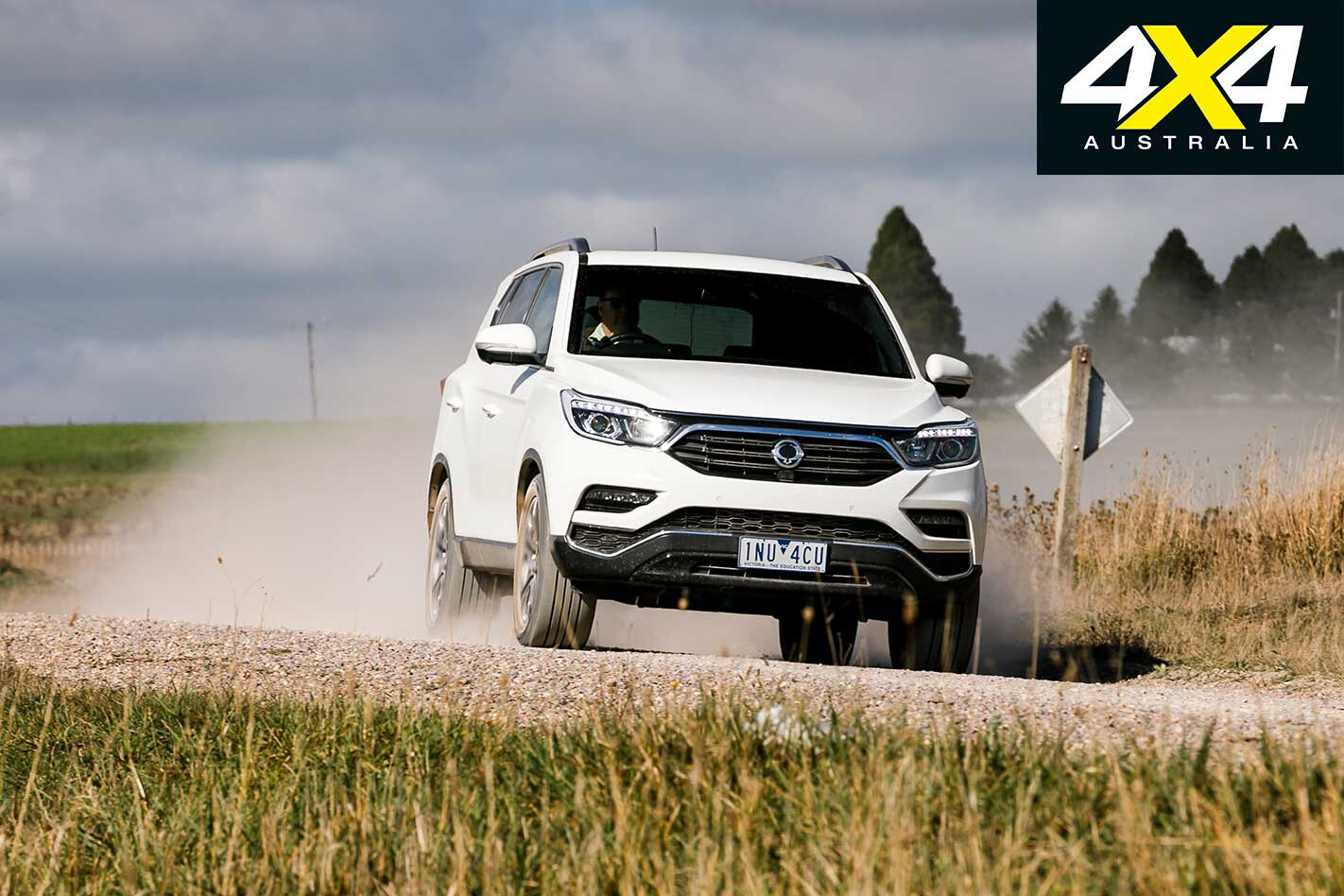
YOU’D expect the Rexton to ride and handle differently to the three live-axle vehicles here given its independent rear suspension (IRS), and it does. On paper the IRS gives a significant advantage over a live-axle design, and on most roads at modest speeds the Rexton feels more composed and compliant than the others here, thanks not only to its IRS but also the fact its more softly sprung and dampened.
Not so good is the sharp edge to the ride on some surfaces due to the 20-inch wheels and low-profile tyres fitted to this top-spec Ultimate. We have previously tested an ELX model (2019 4x4OTY) and found it rode much better on the 18s with their taller tyres.
Push the Rexton harder on bumpier roads and the soft springing and dampening sees handling start to unravel, while the very light steering lacks precision and feel at higher speeds on poor roads.
Off-road
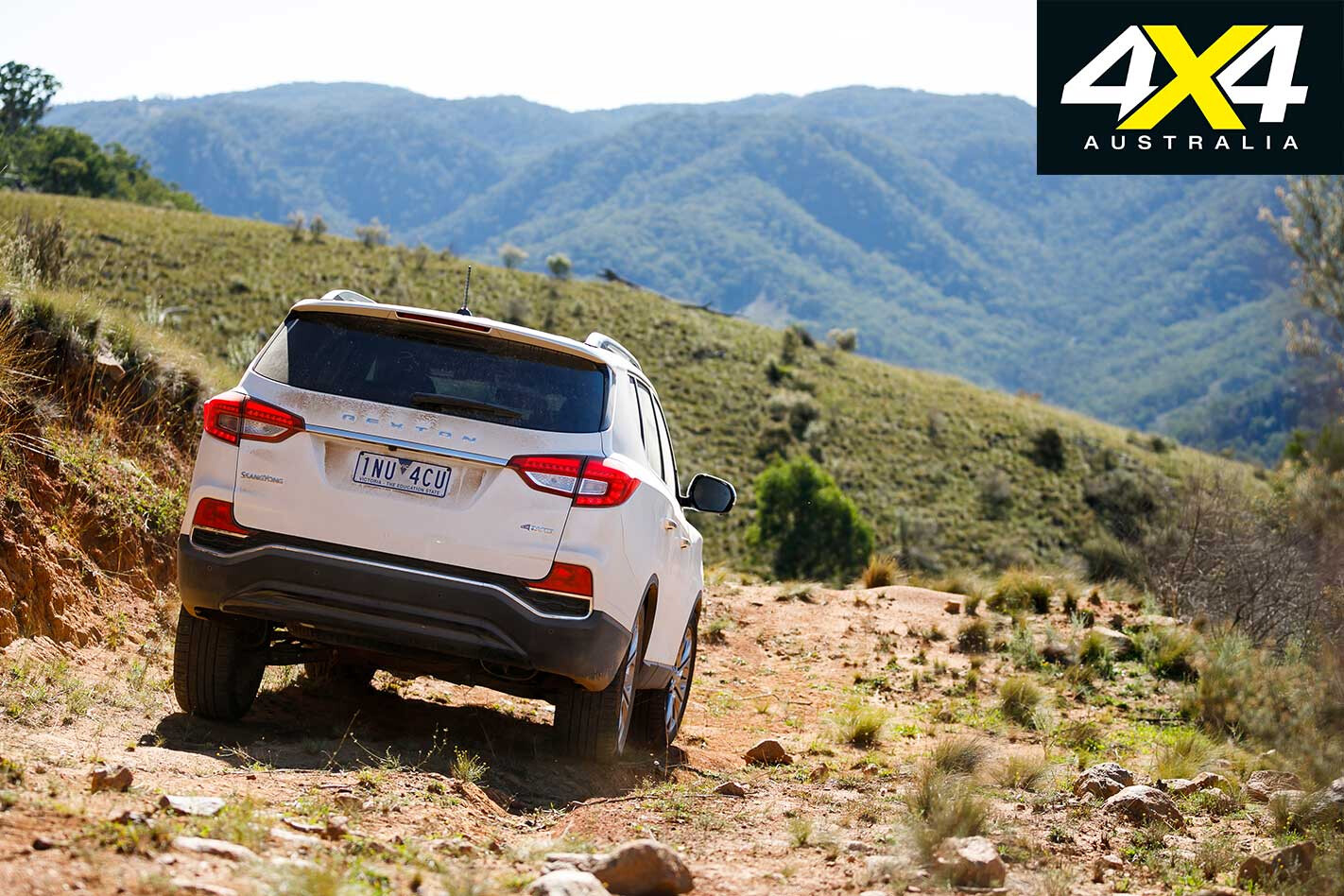
THE Rexton’s independent rear suspension, which is a theoretical advantage on-road, is also an off-road negative. Add in the fact there’s not much travel at either end and that electronic traction control isn’t notably effective, and the Rexton works harder than the other vehicles on more difficult off-road tracks.
Further compounding the Rexton’s off-road limitations is that it has the least ground clearance and the poorest over-bonnet visibility of the four. The all-or-nothing throttle calibration in low range can also be a problem.
The Rexton is the only vehicle here that doesn’t draw its engine intake air from the inner mudguard (not so good for deeper water crossings) and the only one without fixed recovery points; although, it does have a screw-in towing eye that can be mounted front or rear. While it goes without saying, the Ultimate’s 20s aren’t what you want off-road.
Cabin, Accommodation & Safety
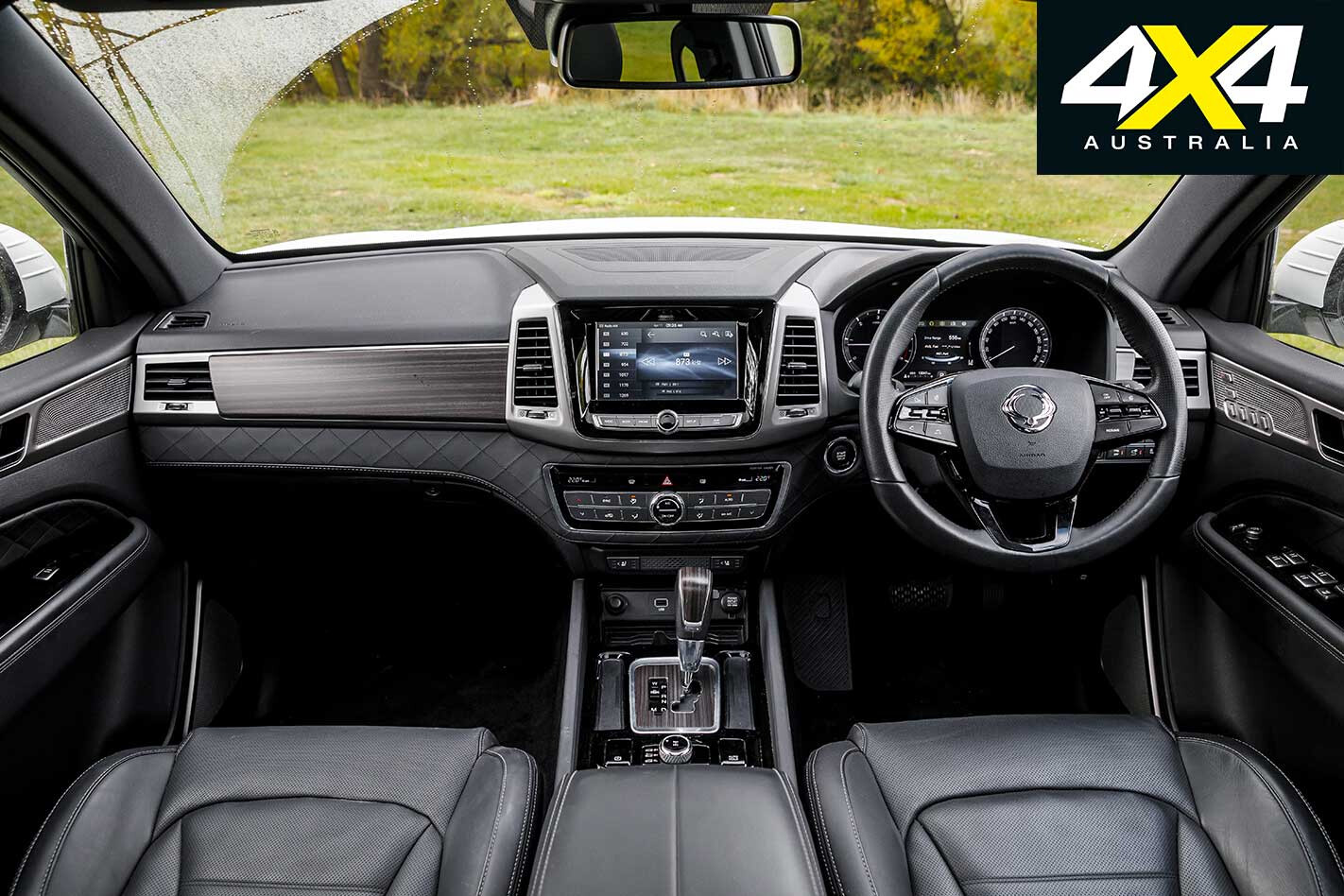
THE Rexton has the biggest cabin here and a roomy and comfortable driving position, which is arguably the best here too thanks in part to its tilt and reach steering wheel adjustment.
The cabin looks to come from a much more expensive vehicle, with features such as heated and cooled front seats and heated second-row seats. It’s definitely the most lavishly equipped here, and the general fit and finish is also good even if the presentation is busy.
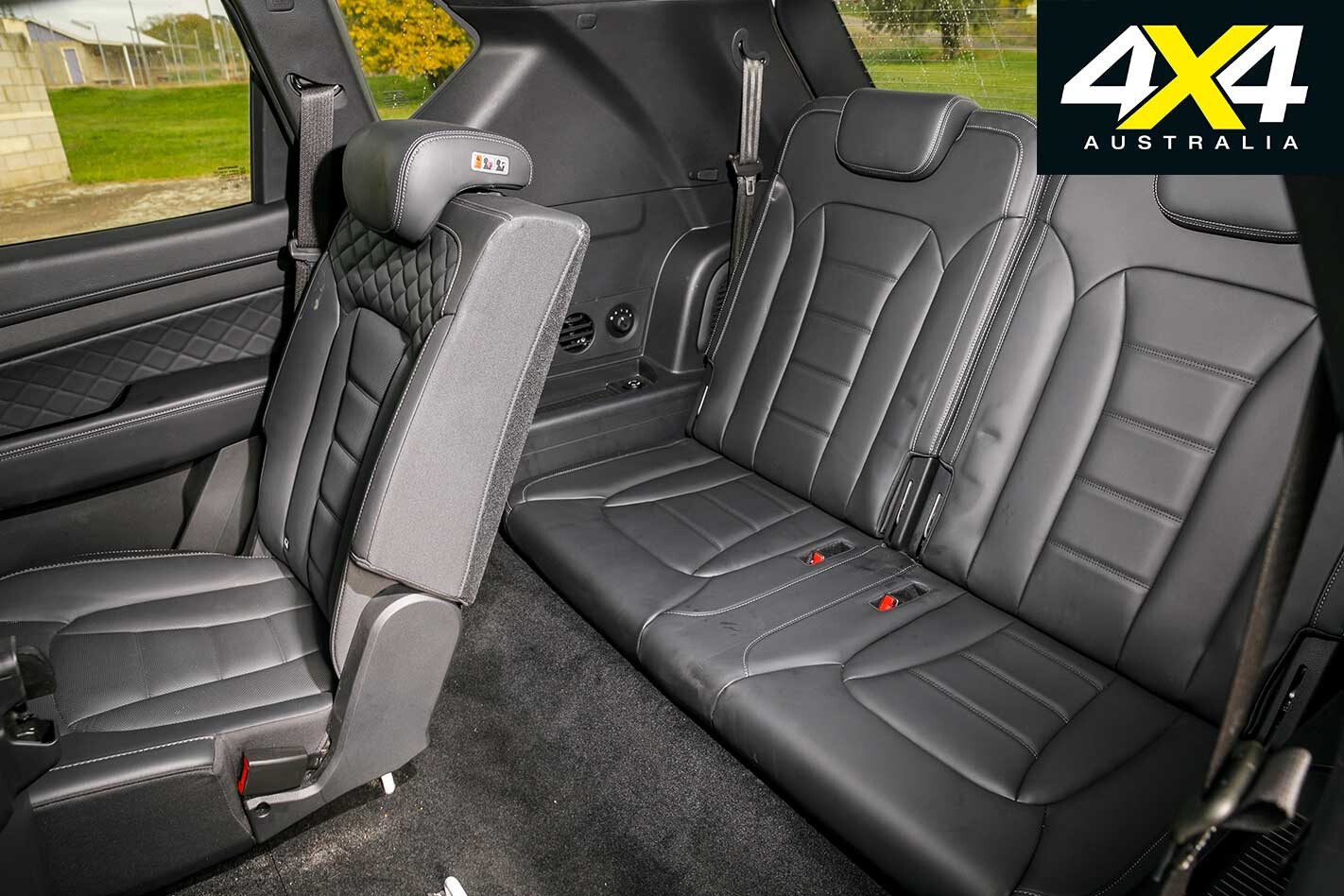
The Rexton has the roomiest rear seat with plenty of room for tall adults sitting behind a tall driver or front-seat passenger. There’s less joy in the third row, which lacks leg and foot room.
The Rexton hasn’t been ANCAP tested at this stage but has received a five-star rating in the equivalent Korean crash testing. All models get autonomous braking, tyre pressure monitoring, lane-departure, blind-spot warning and rear cross-traffic alert, which puts it at the front of the pack in terms of safety kit.
Practicalities
THE Rexton has a 70-litre tank, more than the MU-X or Pajero Sport but less than the Trailblazer. However, with the consumption recorded on this test, it has the longest fuel range.
The Rexton is rated to tow 3000kg, which is on par with the others, but its smaller engine and IRS may work against it when asked to tow that much. It also has the highest GVM, which helps give it the best on-paper payload of 727kg.
The standard 18-inch wheels carry a 255/60 tyre, but moving to a one-size-bigger 265/60s would open up a wide choice in all-terrain rubber in this common (Hilux, Prado, Ranger, etc.) size.
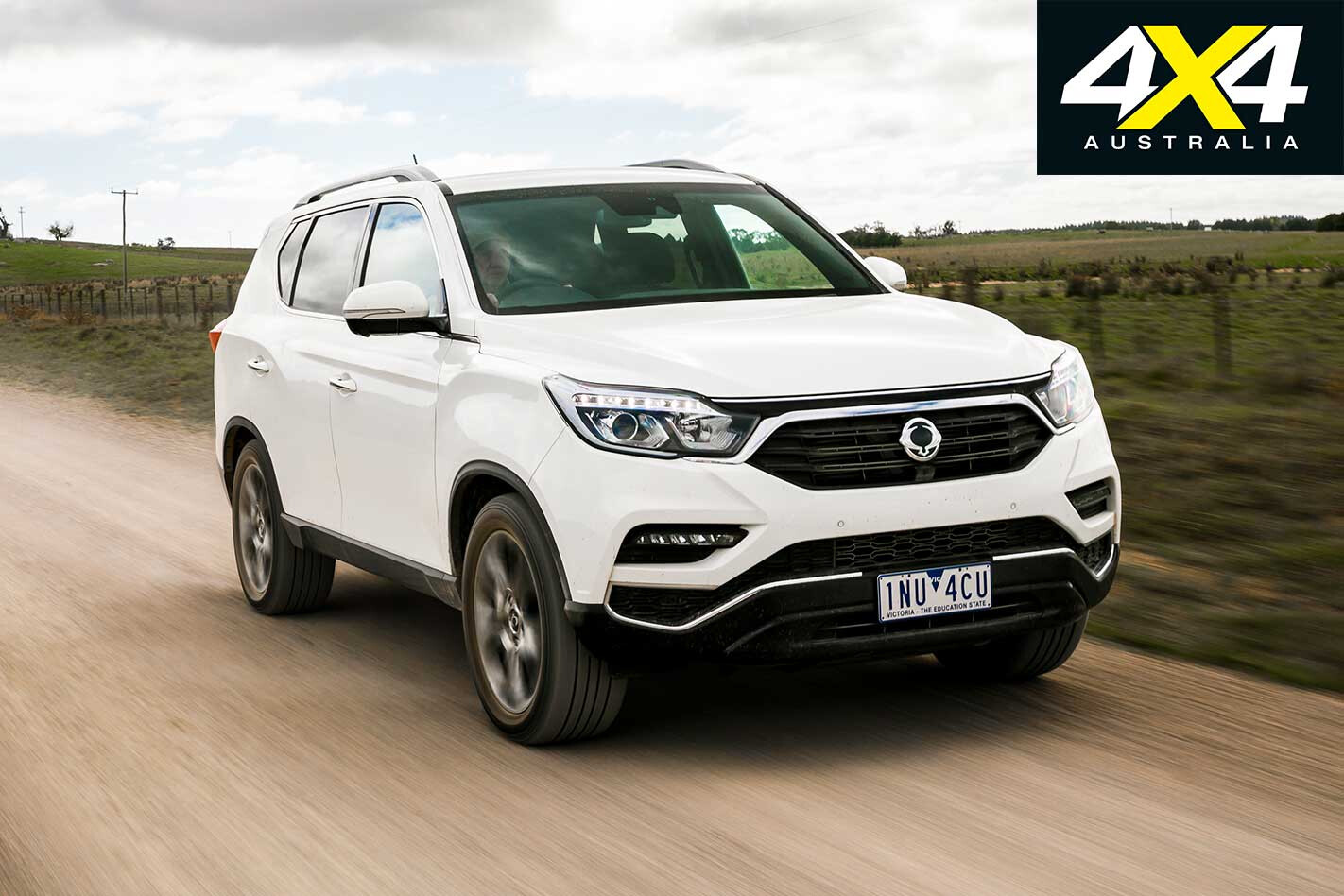
SSANGYONG REXTON ULTIMATE SPECS: Engine: 2.2-litre 4-cyl turbo diesel Max Power: 133kW @ 4000rpm Max Torque: 420Nm @ 1400-2800rpm Gearbox: Seven-speed automatic 4×4 System: Dual-range part-time Crawl Ratio: N/A Construction: Separate-chassis Front Suspension: Independent/coil springs Rear Suspension: Independent/coil springs Wheel/Tyre: 255/50R20 105H Kerb Weight: 2233kg GVM: 2960kg Payload: 727kg Towing Capacity: 3000kg Ground Clearance (claim): 224mm Approach Angle: 20.5° Ramp-over Angle: 20.0° Departure Angle: 22.0° Wading Depth: N/A Fuel Tank Capacity: 70 litres ADR Fuel Claim: 8.3L/100km Test Fuel Use: 10.3L/100km
SSANGYONG REXTON PRICES* ELX: $46,990 Ultimate: $52,990 *Prices are drive-away
What you get
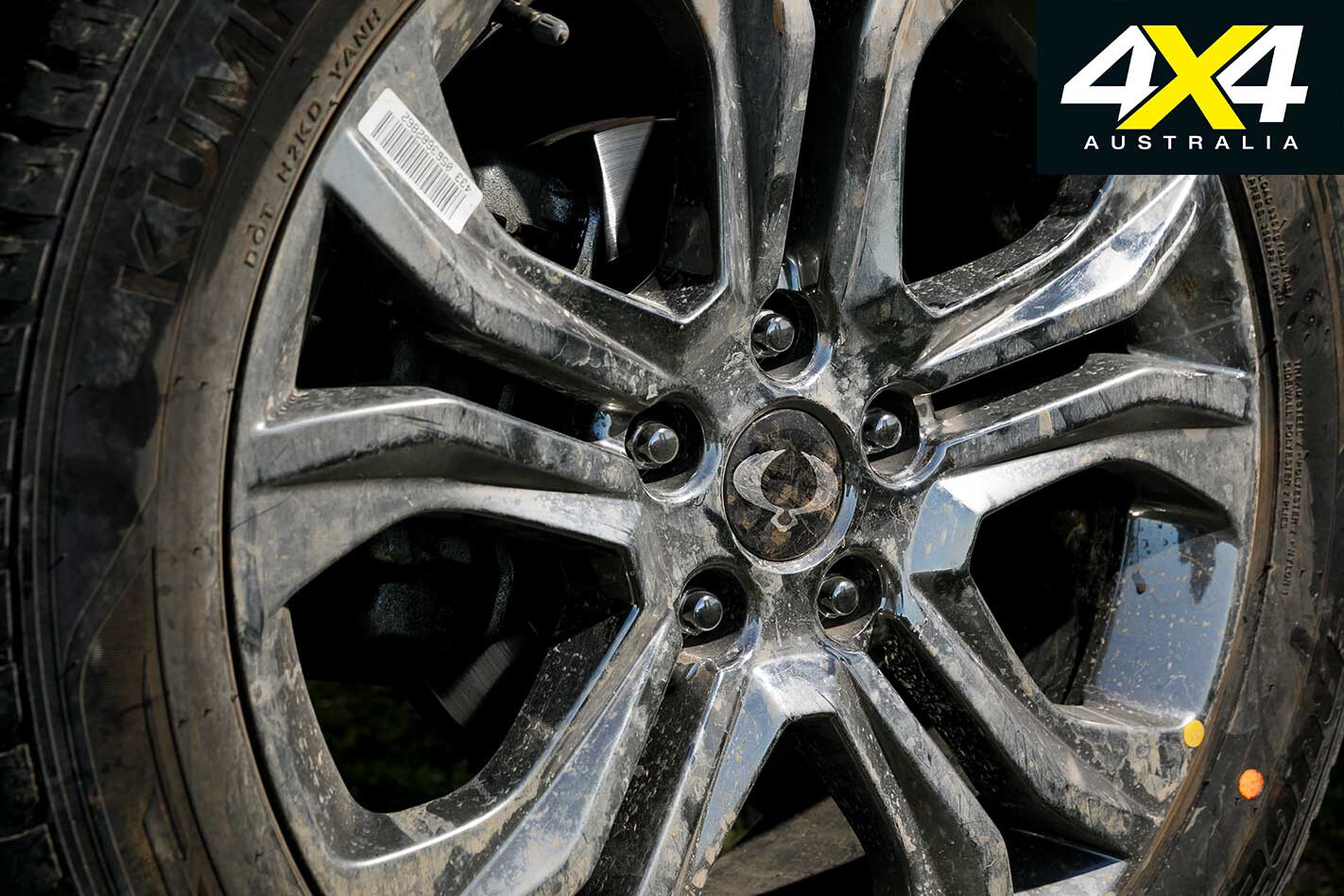
THE Rexton comes in three models but only two are diesel 4x4s, the third model being an entry-level petrol 4×2 ‘EX’ model. Both diesel models, starting with the ELX, come with autonomous braking, no fewer than nine airbags, heated and cooled seats, front seats with electric adjust, heated rear seats, third-row seats, tyre pressure monitoring, lane-departure, blind-spot warning and rear cross-traffic alert, an eight-inch touchscreen and smartphone connectivity.
The Ultimate than swaps the ELX’s 18s for 20s and adds a sunroof, power tailgate, rear A/C controls, a 360-degree camera and HID headlights.
What’s in a name?
THE SsangYong name dates back to 1986, but SsangYong’s beginnings are in 1954. A merger of two smaller companies, it built trucks, buses, and military Jeeps under licence for the US Army during the 1960s.
With production expanding to fire-fighting equipment and specialist vehicles, the company was named Dong-A Motor in 1977 and acquired Keowha, which had been making Jeep CJ look-a-likes (the Korando) under licence.
The financial takeover by SsangYong Business Group in 1986 brought the current name and since then SsangYong has been acquired by Daewoo in 1977 (before it went bust) and then in 2004 by Chinese carmaker SAIC who sold it to India’s Mahindra in 2011, where it has since flourished.
The Verdict
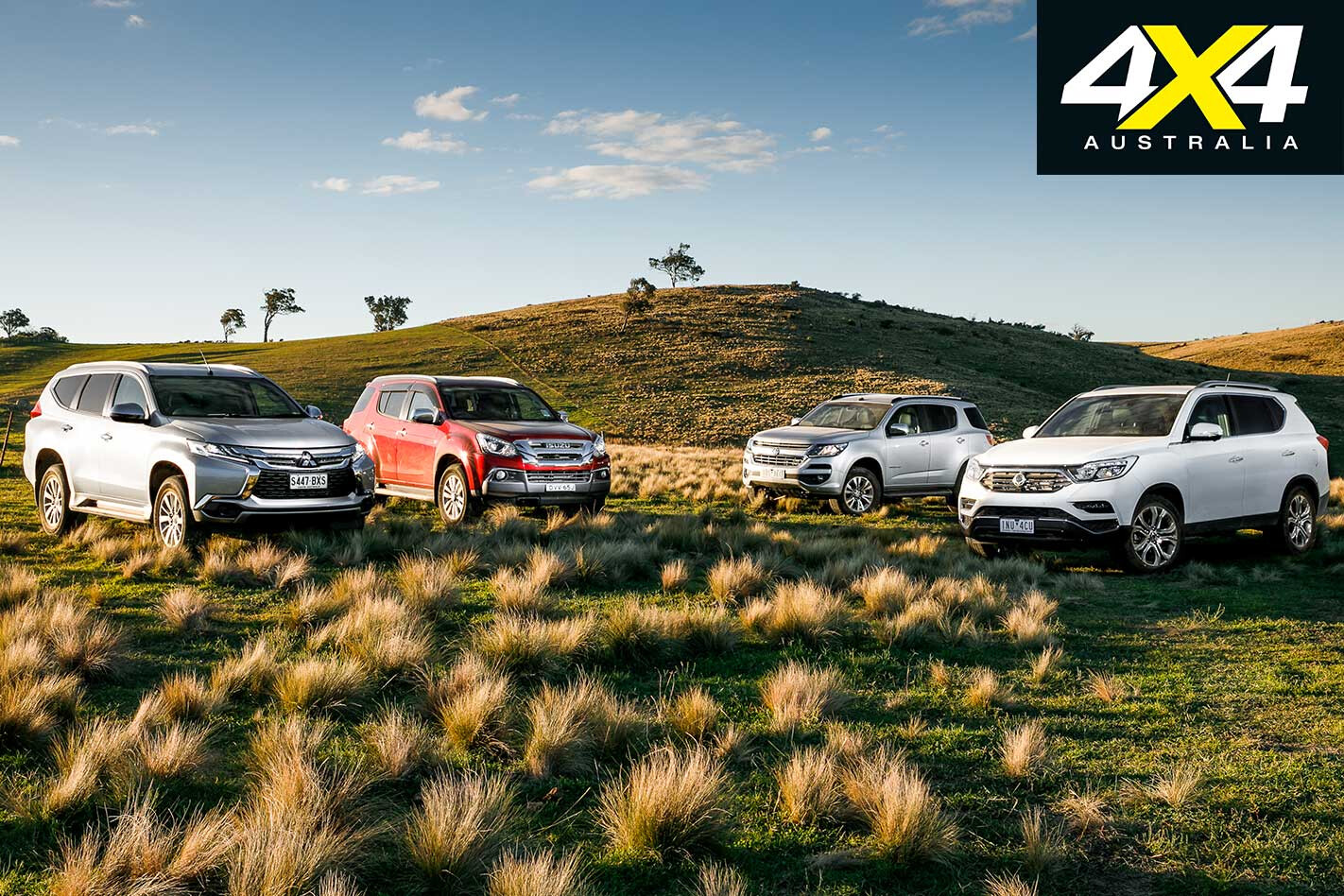
WITH THE testing completed and the dust settled, how do these four family 4×4 wagons shape up? Well, very closely. So close that it’s hard to pick a winner, even though the four are all very different and have contrasting pros and cons. What wins all depends on your priorities.
The Rexton offers the most kit for the least money by a good margin, as you can drive away in very well-equipped ELX for $46,990, which is what you pay for the base-spec five-seat Pajero Sport (the least expensive of the others) before stamp duty, registration and any dealer charges.
The Rexton is also the most spacious vehicle (it almost feels as if it’s in a bigger class), offers competitive performance and has the most refined engine. On many roads it’s also the most comfortable and the quietest. Not so good is its chassis performance on poor quality roads, or indeed the performance of the whole vehicle off-road. If you value 4×4 performance the Rexton is not what you want.
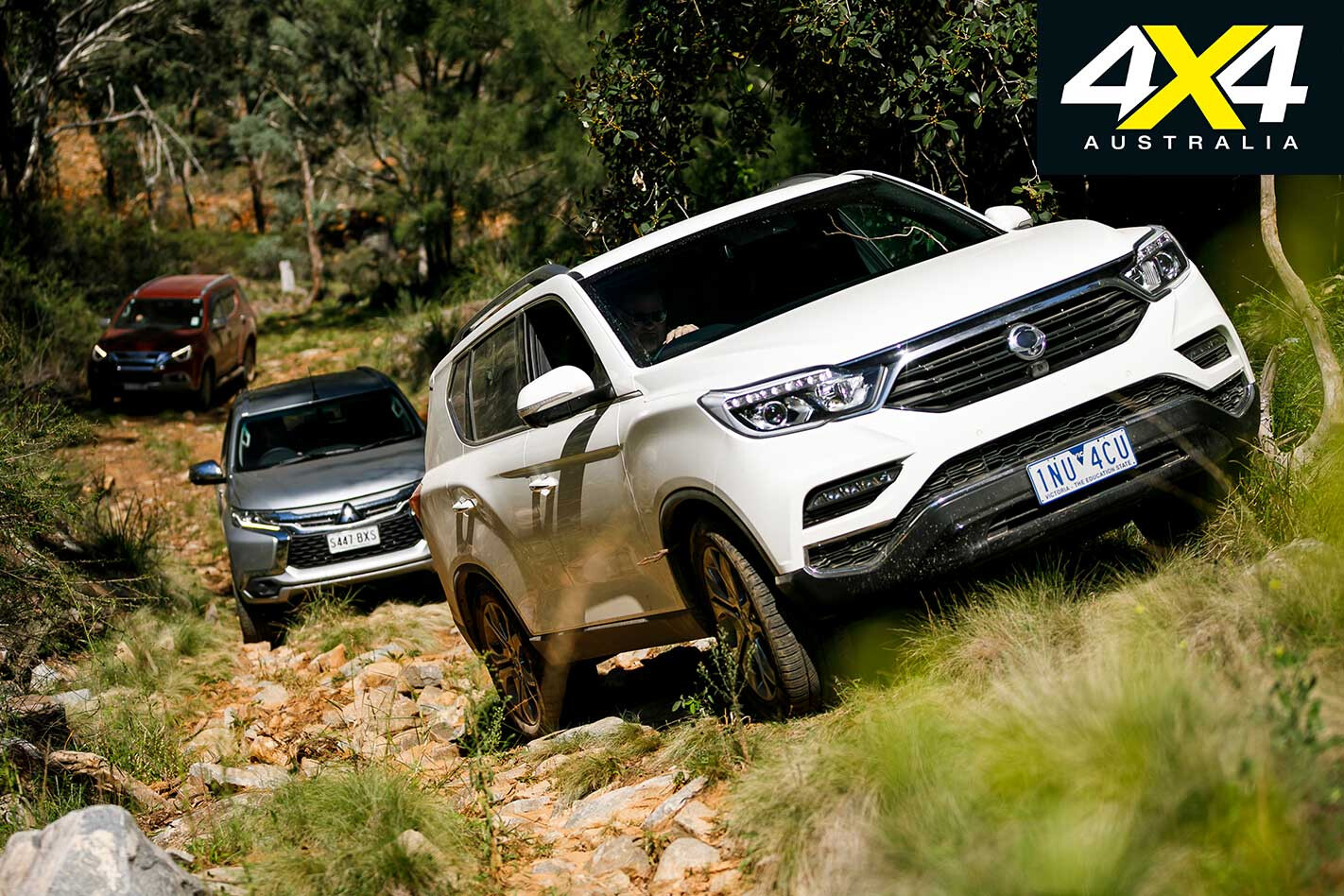
Nor would you buy the Pajero Sport for its off-road ability, for while it’s notably better than the Rexton its off-road prowess is still modest. Countering is the fact that it’s the sportiest drive on-road and comes with the convenience and safety of full-time 4×4, a game changer in mixed road and mixed weather touring conditions. If you don’t want third-row seats, the Pajero Sport is the only option.
You’ll be better off again off-road in the MU-X as it’s more than useful for general 4×4 recreational duties; although, it still isn’t as off-road capable out of the box as it could be. Best of all the MU-X offers a well-proven powertrain with low service and fuel costs that’s also happy to take on towing duties.
If off-road ability is your key criteria then the Trailblazer is the pick. It also offers the best engine performance and the chassis works nicely on the road. That’s probably enough to crown it the winner here, but that’s up to you.
Specifications
| u00a0 | Holden Trailblazer LTZ | Isuzu MU-X LS-T | Mitsubishi Pajero Sport GLX | Ssangyong Rexton Ultimate |
| Engine | 2.8-litre 4-cyl turbo diesel | 3.0-litre 4-cyl turbo diesel | 2.4-litre 4-cyl turbo diesel | 2.2-litre 4-cyl turbo diesel |
| Power | 147kW @ 3600rpm | 130kW @ 3600rpm | 133kW @ 3500rpm | 133kW @ 4000rpm |
| Torque | 500Nm @ 2000rpm | 430Nm @ 2000-2200rpm | 430Nm @ 2500rpm | 420Nm @ 1400-2800rpm |
| Gearbox | 6-speed automatic | 8-speed automatic | 7-speed automatic | |
| 4×4 System | Dual-range part-time | Dual-range full-time (plus 2WD) | Dual-range part-time | |
| Crawl Ratio | 36.4:1 | 33.3:1 | 45.9:1 | N/A |
| Construction | Separate-chassis | |||
| Suspension (f) | Independent, coil springs | |||
| Suspension (r) | Live axle, coil springs | Independent, coil spring | ||
| Kerb Weight | 2203kg | 2157kg | 2045kg | 2233kg |
| GVM | 2820kg | 2750kg | 2710kg | 2960kg |
| Payload | 617kg | 593kg | 655kg | 727kg |
| Towing capacity | 3000kg | 3100kg | 3000kg | |
| Departure angle | 25.0u00b0 | 25.1u00b0 | 24.2u00b0 | 22.0u00b0 |
| Rampover angle | 22.0u00b0 | 19.5u00b0 | 23.1u00b0 | 20.0u00b0 |
| Approach angle | 26.0u00b0 | 24.0u00b0 | 30.0u00b0 | 20.5u00b0 |
| Wading depth | 600mm | 700mm | N/A | |
| Ground clearance | 218mm | 230mm | 218mm | 224mm |
| Fuel capacity | 76 litres | 65 litres | 68 litres | 70 litres |
| ADR fuel claim | 8.2L/100km | 7.9L/100km | 8.0L/100km | 8.3L/100km |
| Test fuel claim | 11.6L/100km | 10.4L/100km | 11.7L/100km | 10.3L/100km |
| Price | $52,490 | $56,200 | $46,490 | $52,990 |
FOUR-WHEELING is a great way to get away from it all, and books are a fine companion on any 4×4 trip to enrich yourself with tales, real-life accounts and essential travel guides.
Here are some book recommendations to consider packing for your next outing.
Driven, Francis Edwin Birtles
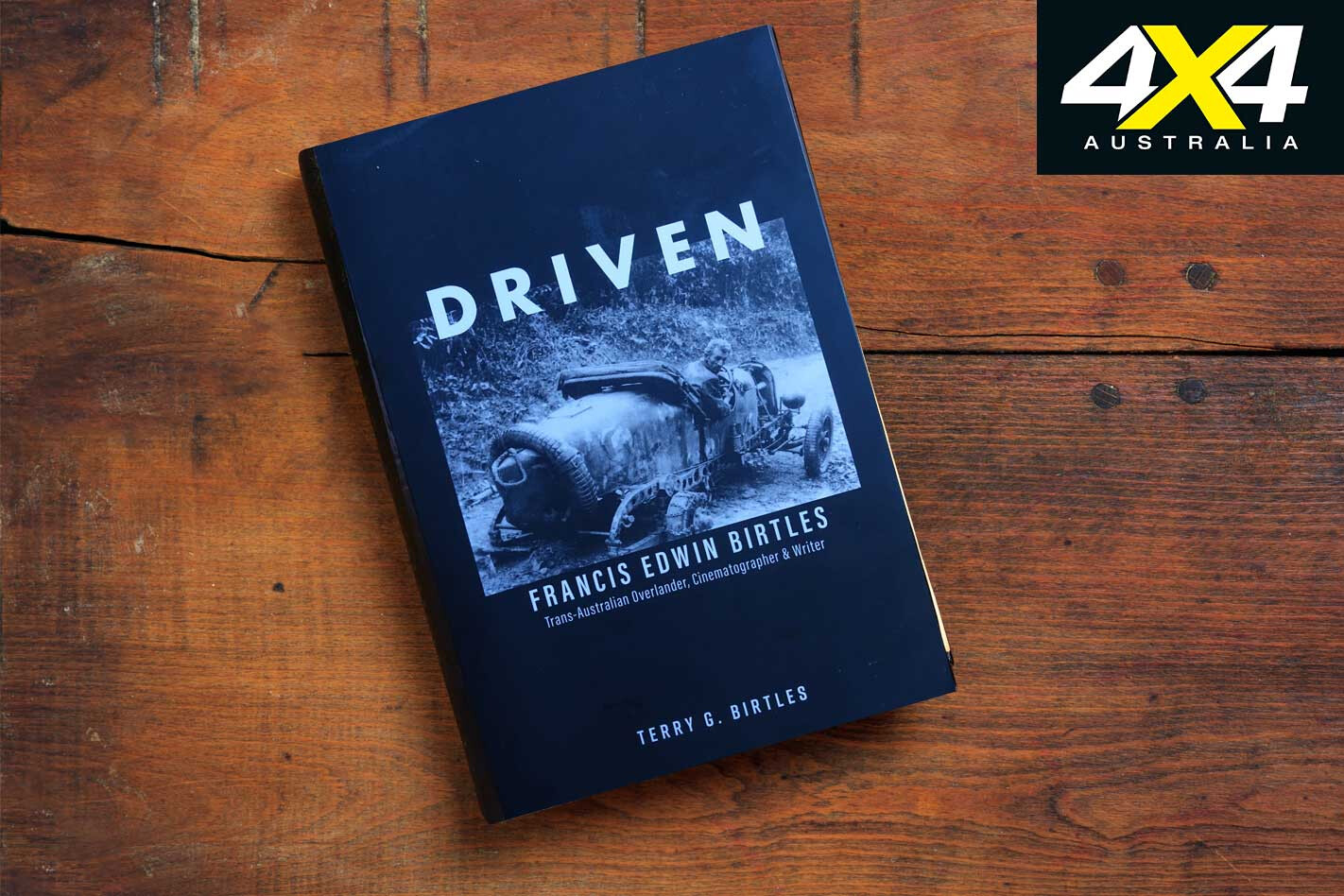
FRANCIS Birtles was, in the first half of the 20th Century, one of Australia’s most well-known adventurers, writers and photographers, with his exploits in outback Australia being documented in hundreds of magazine and newspaper articles, numerous movies and a couple of books.
He crossed Australia 80 odd times, but his greatest feat was being the first to drive a motor vehicle from London to Melbourne in 1928, way before anyone else. The vehicle with which he did some of his most extensive and gruelling travels in, ‘The Sundowner’, as he called it, is now displayed at the Australian National Museum in Canberra.
This book is by far the most comprehensive biography of Birtles’ life and adventures. It is backed up by in-depth research, with access to family members and obscure records spread across archives and libraries Australia-wide. A host of photos are also included to illustrate his many travels and experiences.
The book shows the lengths he went to (some a little illegal) to achieve his goals, but most of all it illustrates his toughness and his perseverance to get a job done, no matter the odds. – Ron Moon
Available from: https://scholarly.info RRP: $49.95 We say: Inspiring and well worth a read. Author: Terry G Birtles Publisher: Australian Scholarly Publishing
The Beadell Roads
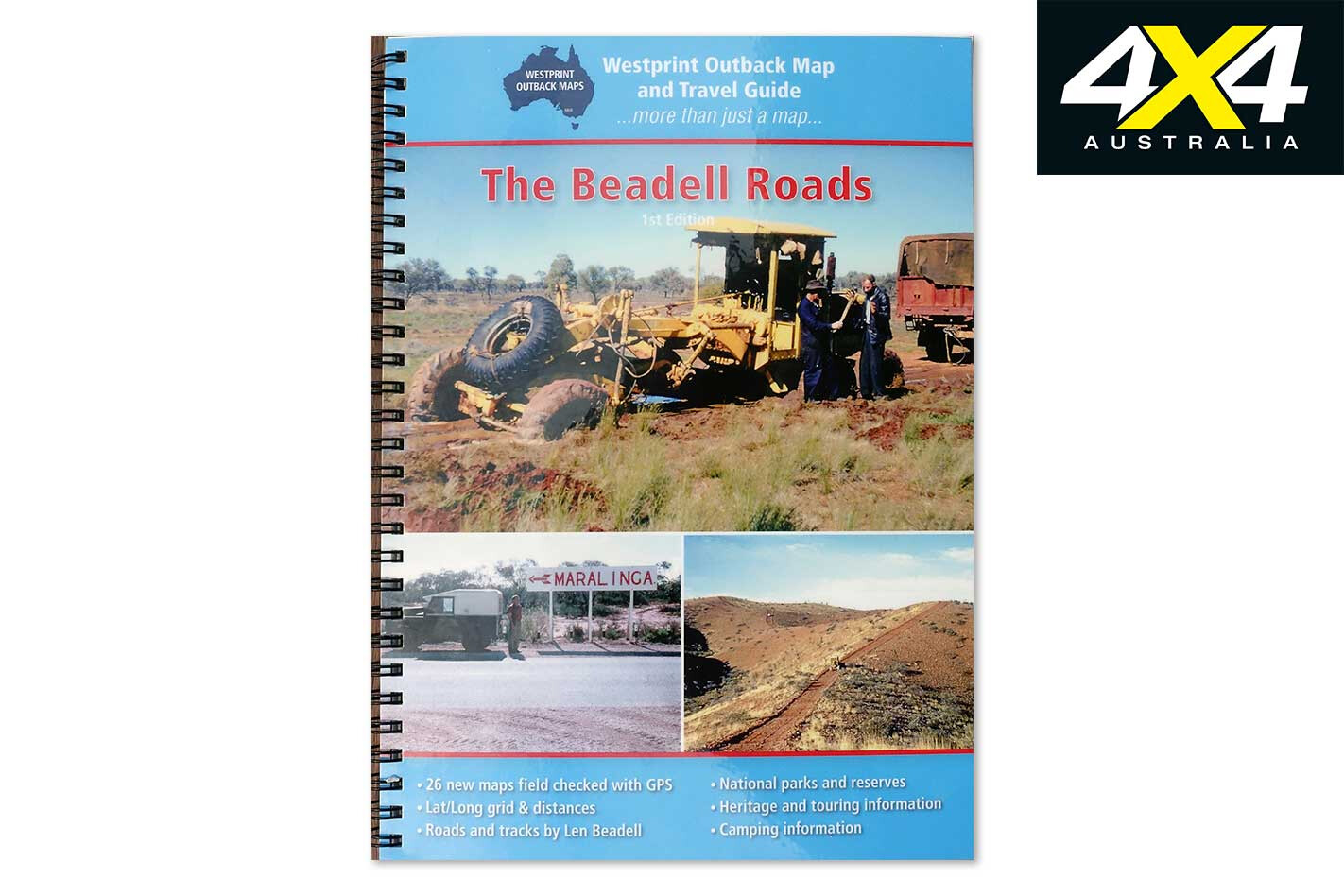
THIS is an excellent publication for anyone who wants to travel the rich and varied desert country west of the Stuart Highway and north of the Eyre Highway. From Coober Pedy and Alice Springs west to Kalgoorlie, Wiluna and Marble Bar the book covers large areas of the Great Victoria, Great Sandy, Little Sandy and Gibson Deserts.
Many of the roads through this vastness were put in by Len Beadell and his Gunbarrel Road Construction Party during the 1950s and ’60s, opening up the country for others to follow.
The book also covers the early exploration of this vast desert region, as well as each of the main roads and highways surveyed and constructed by Len and his team. There are some great old pics included, which I hadn’t seen before. Half of the book is taken up with a series of excellent maps in the Westprint style that not only shows the tracks but also points of interest, camping spots and the routes of the early explorers. – Ron Moon
Available from: www.westprint.com.au RRP: $39.95 We say: Greatly detailed Publisher: Westprint
Hell of a Time

Go back in time to the start of the Great War of 1914-18 with this publishing of a Digger’s personal diaries. Philip Owen Ayton was a Sydney tram worker at the time, but answered the call and joined the Australian Imperial Force (AIF) in August 1914.
Ayton experienced Gallipoli first hand as part of the AIF’s First Division where he was badly injured. He subsequently recovered and rejoined the AIF in the mud and misery of the Western Front in France until war’s end.
From the very beginning Ayton kept notes and then would transfer these to his diaries that record not only the hardship and heartbreak of the battlefield, but also the off-duty shenanigans of the Diggers and their allies. It’s a brilliant read filled with Ayton’s thoughts and unique archival images, as well as a postscript written by one of Ayton’s sons. – Justin Walker
Available from: www.textpublishing.com.au RRP: $35