
CARBON-FIBRE isn’t commonly used in 4x4s, partly due to its price and that it doesn’t take dents very well – not ideal when it comes to trail-bashing.
However, if tackling empty desert tracks is high on the agenda, the exotic material becomes a suitable fit for a 4×4 rig like the APG Prorunner Series 1 conversion for the US-market Ford Ranger.
The product of California-based Automotive Performance Group, the Prorunner Series 1 conversion comprises of widebody panels made from hand-laid and vacuum-infused carbon-fibre that widens the Ranger’s body by 254mm, coupled with adjustable long travel suspension and an all-aluminium front bar.
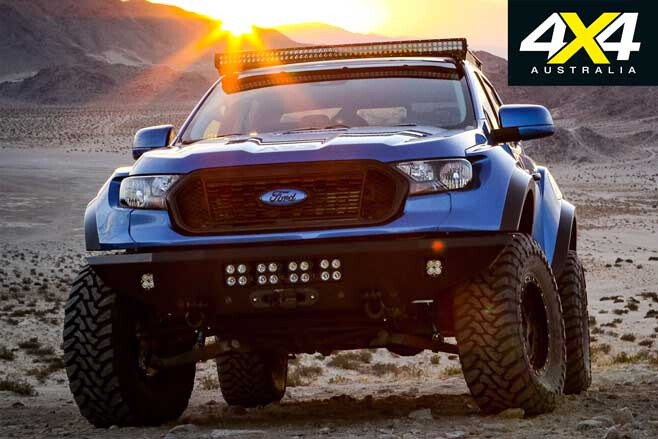
To complement the wider body, the conversion includes a thoroughly revised suspension, with wider upper and lower control arms, a tie-rod extension kit with FK rod ends, extended front axle shafts, spacers and hub-centric wheel rings for the front, and CNC-machined rear-wheel adapter and spacers.
With the raised ride height, APG says the Prorunner Series 1 conversion allows up to 318mm of wheel travel and an ability to run large 35-inch tyres, lending it the appearance of a proper Baja-basher.
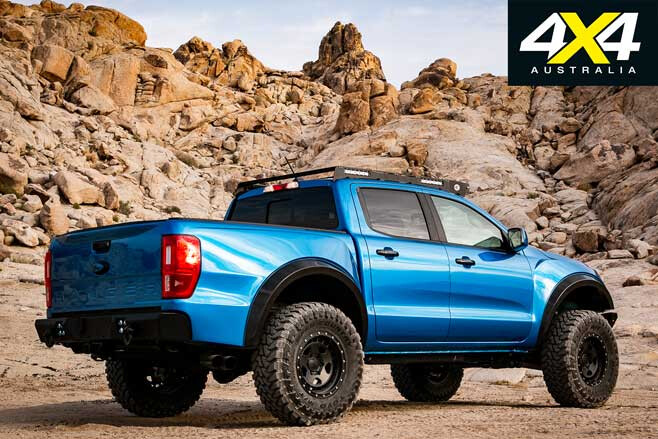
Up front the powder-coated aluminium front bar is designed to accommodate a winch and tow hooks, with cut-outs included for the front parking sensors and the OEM fog lights.
THE NSW Police Marine Command has a new vehicle to tow its toys to the coast, with the division acquiring a V8 Hemi-powered RAM 1500 to transport its range of jet skis and “rigid inflatables”.
The vehicle’s class-leading towing capacity, facilitated by the 291kW/556Nm 5.7-litre Hemi V8, was a cornerstone in the decision to allow the 1500 to clock on for duty, as NSW Police Marine Command Superintendent, Stephen Hegarty, explained.
“These trucks go everywhere in NSW with the MAC enforcement team, from Tweed Heads down to the Murray,” he said. “The 4.5 tonne max brake towing is incredibly useful as it allows us to easily tow up to four jet skis at a time –or one of our bigger rigid inflatables –out to Dubbo, for example, for the Commissioner’s Rise Up youth program, compliance around boat safety on the water, or the South Coast to assist in the recent bushfire evacuations.”
As well as the substantial 4500kg towing capacity, the fit-for-purpose vehicles also feature RAM’s RamBoxCargo Management System, tweaked to include a lockable gun box.
“The MAC vehicles are taken to some pretty remote locations, so there’s a requirement to be self-sufficient on the road,” said Jeff Barber, RAM Trucks Australia National Manager. “In addition to our unrivalled towing capabilities, features like our innovative RamBoxCargo Management System have been fully utilised to include a lockable gun box –a pre-requisite for police work – so we have the flexibility to adapt to differing requirements.”
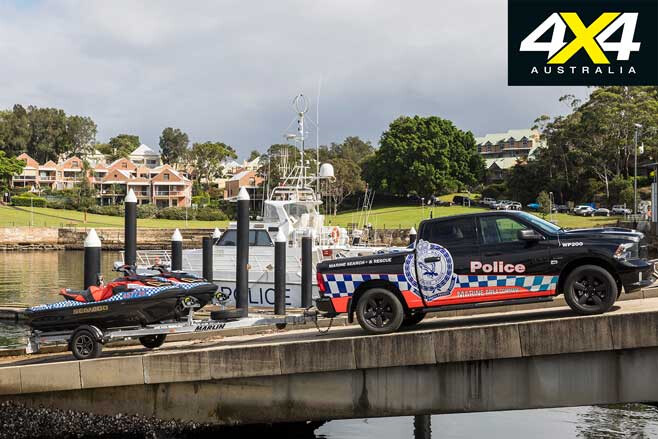
All imported RAM vehicles are re-engineered from left-hand drive to right-hand drive – using 400 locally sourced remanufactured parts – by RAM Trucks Australia at the brand’s Melbourne Manufacturing Plant, and it was this local operation that influenced Superintendent Hegarty’s decision.
“That we’re able to support local manufacturing is certainly a factor in our decision-making process,” he said. “The requirements we need to operate within means we have to be on top of our game when it comes to towing capacity and how we enforce the law –we can’t be underweighted on tows, so the RAM 1500 fits the bill perfectly.”
Expect to see more fit-for-purpose vehicles arriving on fleet for other law enforcenment agencies across the country, with conversations ongoing.
IT WAS a pleasant surprise to become associated with the Lumberjack brand.
Based in Geelong, Victoria, the family-owned business has been in existence for more than six years, growing from very humble beginnings to now housing a fine showroom showcasing the 17 models of camper trailers in its range. Varying in price from $22,000 to $60,000 (for its 17-foot dual-axle pop-top hybrid ’van) there is something that will suit the most ardent 4WD camper and caravanner.
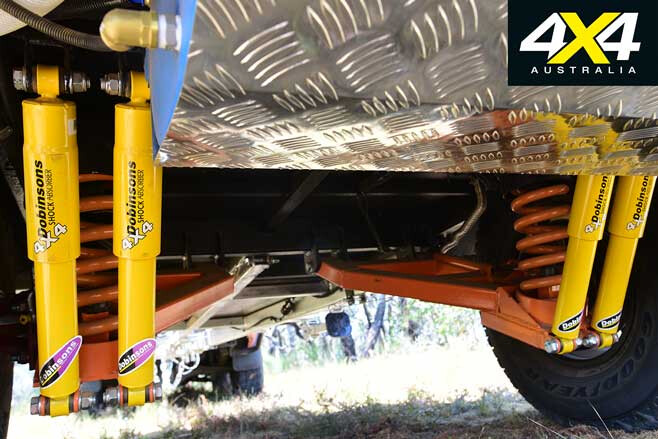
I checked out the workshop and factory where the campers and ’vans are first taken when shipped in from China. Here they are checked over, wired and plumbed to Australian standards, while the all-important A-frame is welded and bolted into place. The suspension is given the once-over with Aussie-sourced Dobinsons shocks fitted, and the tyres are upgraded to Goodyear Wranglers.
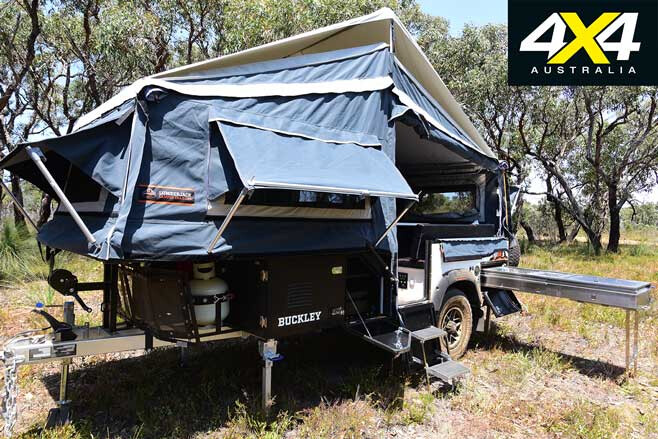
From its vast range we took the latest Lumberjack Buckley ‘Ultra Light’ for a spin, to see how it fared on some tracks in the northern part of the Otways. However, instead of the mud and bog holes the Otways are known for, we got dust and dust baths.
Like most of the campers in the Lumberjack range – apart from the bigger Birdsville model, which is a double-fold unit, and the somewhat quirky Sheoak, which is a pod-style camper – the Buckley is a forward-fold camper.
The lightweight Buckley features fibreglass-foam composite panels, which saves an impressive 200kg in tare weight and an equally important 100kg in ball weight over the standard Buckley model. Tare weight is 1120kg and the ATM is 1600kg, proving a healthy payload of just less than half a tonne.
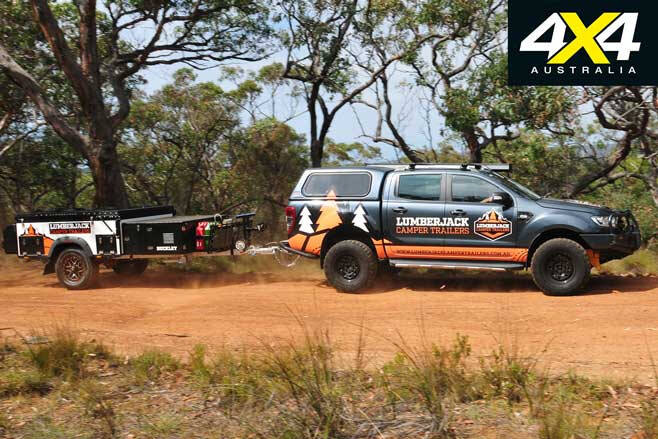
The chassis is hot-dipped galvanised steel, and the drawbar is made from 100 x 50mm 4mm-thick steel tube. The camper rides on an independent coil, trailing arm suspension, with dual Dobinson shock absorbers and 16-inch alloy wheels fitted with 285/75R16 Goodyear Wrangler MTR tyres. Axles are rated at 1600kg, while 12-inch electric drum brakes add ample stopping power and complete the wheel and suspension package.
The camper body is 2.1 metres long and sits essentially over the axle. This main box unit, where the tent, bed and living area are located (and is sealed away during travel) contains a slide-out kitchen on the near-side rear of the camper.
At the far end of the chassis is a spare-tyre carrier complete with a Wrangler tyre and a large storage box, which can store a host of wet, muddy equipment. A small hand winch for winding the camper closed is also included.
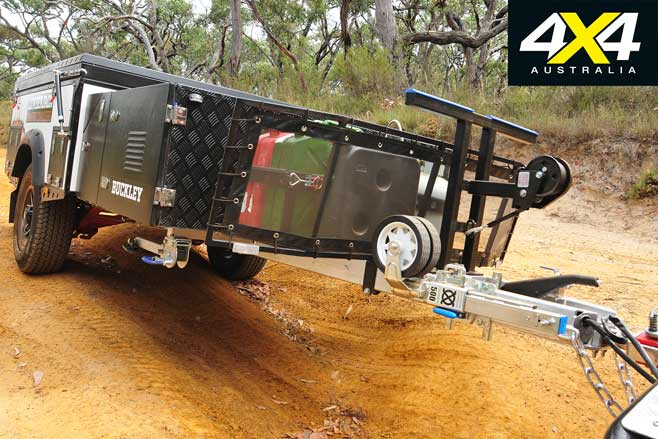
Another storage box is located in front of the main body of the unit, which is big enough to store a fridge or other similar items. In front of that again is an area for two 20-litre jerry can holders, two 9kg gas-bottle holders and a fuel tank for the standard-fitted diesel tent heater.
At the very front of the A-frame you’ll find a stone mesh guard to help protect all the stuff behind it, an Ark heavy-duty jockey wheel, a hand winch to help open the camper (rarely required) and a TREG-like off-road hitch; along with all the normal paraphernalia of chains and connection cables including an Anderson plug hookup.
Like most forward-fold campers – certainly all the ones I have seen – that A-frame is pretty long, giving an axle-to-ball length that can be an issue on tight 4WD tracks that dodge between trees, drop through steep creek gullies or climb over sharp knolls where the rampover angle can be a hindrance. Still, most people don’t take their camper into this sort of rugged terrain.
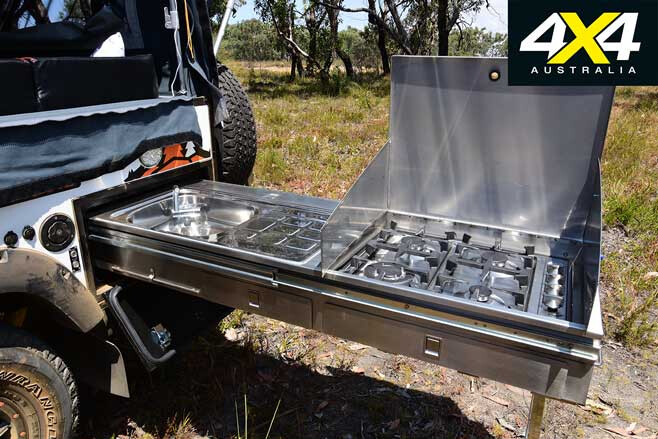
The slide-out kitchen is readily accessible for the shortest of stops, whether for a brew or an overnight stay. Once in position the kitchen has a large four-burner stove with some great windshields, which quickly fold up into place. Right beside it is a sink with a hot and cold water tap.
This slide-out kitchen has a couple of drawers for cutlery, cups and plates, with a storage area for items such as coffee and tea located behind the sink. Both the gas and hot and cold water hoses are attached by colour-coded, quick-and-easy connections.
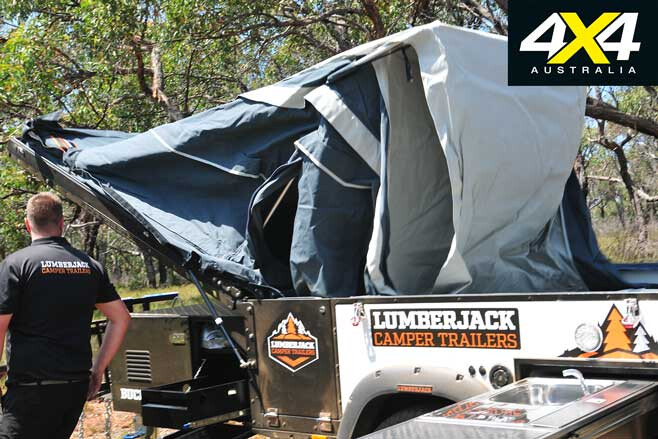
To open the tent and living area of the camper simply unclip a few latches and give the lid of the main box a gentle lift, and the hydraulic rams will do most of the rest. This means the front winch gets very little use as the tent opens and the lid lifts over, becoming the floor and bed area of the set-up camper. Then open the door, unfold the step ladder and step into the camper. A few adjustments of the canvas and quick-release alloy tent poles from both inside and out, and the camper is ready for an overnight stop.
All the material in the tent area is 14oz waterproof canvas, with internal and external window covers in the main cabin area. Plus, all the mesh is midge-proof. In all, the canvas, mesh, zips and the sowing of the seams are pretty good, and while it isn’t Aussie-made or proofed canvas you would be paying a lot more for that privilege. Included in the canvas package is an outside awning, walls and a ‘tropical roof’, the latter being a godsend when it is hot, cold and/or raining.
As with many forward-fold campers, the canvas on the near side at the lounge end opens completely to provide a great airy feel and a fabulous place to sit inside while studying the view outside. The kitchen area includes a large U-shaped lounge around a sturdy drop-down table, giving ample room for four.
The lounge/table can be converted into another double bed, but I’d be sending kids or visitors to sleep in swags. The bed, which you need to step up into, is a full queen-size unit and comfy. With all the windows open the camper has a very light and open feel to it.
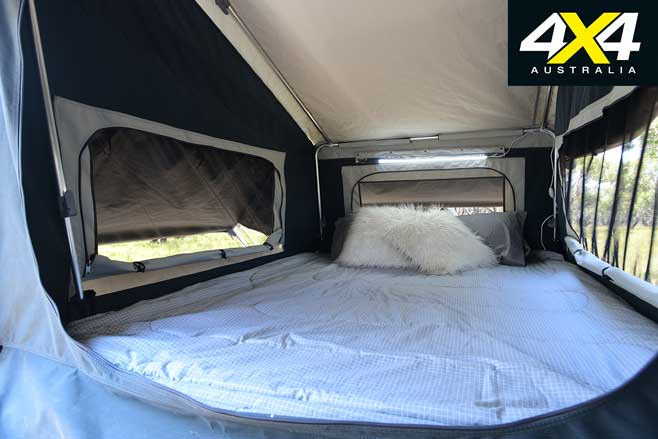
We didn’t set up the awning and walls but it’s a relatively easy zip-on job; although, it takes five to ten minutes longer and you wouldn’t bother if you were stopping overnight and the weather was fine. The walls and floor take longer again but make for an ideal setup for those longer beach or lakeside stays. Packing down the camper takes a little longer, but 10 to 15 minutes from the basic set-up should see you back on the road.
The camper’s electrics are pretty basic – the way I like my electrics, to be honest. You have 240-volt power input and a battery charger, which keeps the single 12-volt deep-cycle battery charged when it’s not getting fed by the tow vehicle or by an optional solar panel. The battery runs the lights, water pump, 12-volt power outlets, USB outlets and the multi-media player. There’s a control panel and water and battery monitor inside the camper, while inside the battery box is a circuit breaker and master switch accessed from either inside or out.
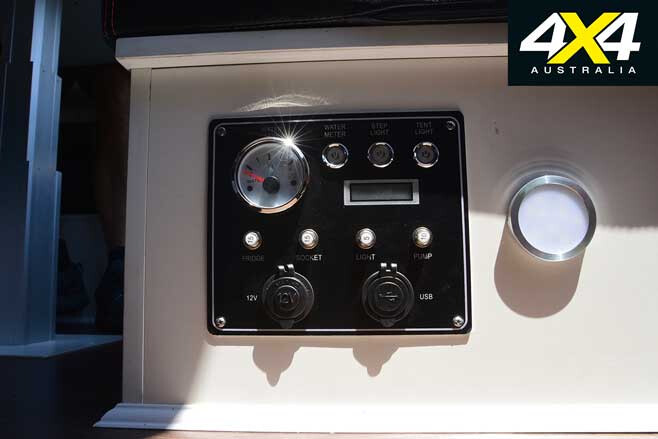
There are the two gas-bottle holders up the front, and the camper trailer is plumbed in to Australian Standards, with gas connections for the gas stove and the gas hot-water system. A diesel heater is also located in one of the storage bins below the lounge seat, and it is just the thing for wintery camps.
We took the camper along a variety of highways, second-class bitumen roads, gravel-graded roads and dirt tracks, and the camper towed easily and effortlessly uphill and down dale. The camper was hardly felt on the open road, due to its light weight and low profile. In the rougher stuff, where dirt tracks turned lumpy and were chewed up, the trailer followed very well, with the independent suspension keeping all wheels on the ground and the ride as smooth as possible.
Only once did the rampover angle, due to the long draw bar, cause the A-frame to drag as the camper mounted a particularly steep pinch. Most camper trailers would exhibit the same characteristic, with only those with very short A-frames capable of negotiating such obstacles with aplomb.
I’m a fan of this style of camper; the way it works and the features it offers … for what is a very good price. That being said, this price range and style of camper is now dominated by Chinese-sourced products, with the only variation being how well it is built in the particular Chinese factory it comes from, and how much Aussie input and accessories goes into the finished product.
The Lumberjack brand seems to be better built and better thought-out than many you’ll find on the Aussie market, with its Geelong factory, where much of the assembly takes place, adding another positive to the equation.
At $24,000, this unit should definitely be on your ‘go to’ list if you’re in the market for a forward-fold camper trailer. You’d be pretty pleased with the choice, I reckon.
Lumberjack Buckley Ultra Light specifications
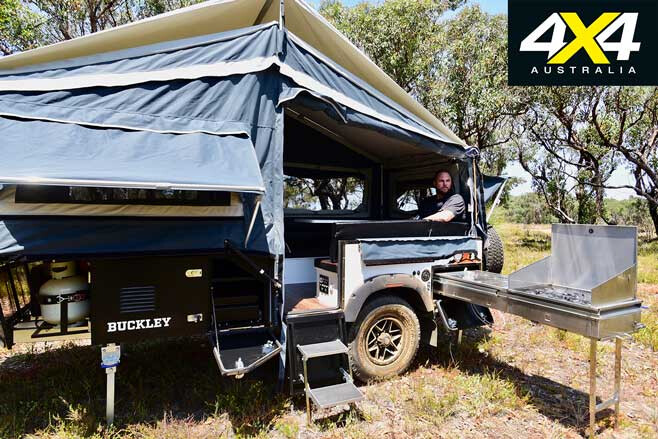
HEIGHT (AT TRAVEL): 1500mm WIDTH (EXTERNAL): 1850mm LENGTH (OVERALL): 5400mm TARE: 1120kg ATM: 1600kg BALL WEIGHT: 120kg (unloaded) STORAGE: 7 external storage areas; 2 internal compartments under seats BODY: Fibreglass-foam composite CHASSIS: Steel, drawbar 100x50x4mm tube; all hot-dipped galvanised ROOF: 14oz canvas with tropical roof TENT: 14oz canvas and midge-proof mesh. Awning, tropical roof & annex flooring SUSPENSION: Independent coil, trailing arm suspension with dual Dobinson shock absorbers BRAKES: 12-inch electric drum brakes WHEEL/TYRE: 16-inch alloy with 285/75R16 Goodyear Wrangler MTR tyres FRESH WATER: 100L BATTERY: 12V deep-cycle lead acid ELECTRIC: 240V input; 12V power and USB outlets; LED lighting strips inside and out, multi-media stereo player, power and water monitors. 240-volt Firefly battery charger included SOLAR: Optional HOT WATER: Firefly instantaneous hot water GAS CYLINDERS: Two 9kg gas bottle holders (gas bottles extra) COOKTOP: Four-burner gas stove FRIDGE: Optional LIGHTING: 12V LED PRICE: $23,999
Contact
Lumberjack Campers: 1300 30 40 45; www.lumberjackcampertrailers.com.au
Showrooms locations: – Geelong, Vic – Slacks Creek, Qld – Newcastle, NSW – Cameron Caravans of Edwardstown, South Australia
WITH THE plethora of electrical gear we carry on 4WD trips demanding 240-volt power, or at least to be charged from 240-volt power, you need a 12-volt DC to 240-volt AC inverter somewhere in your kit.
You can get a modified sine-wave inverter or a full or pure sine-wave unit; the modified sine-wave units are cheaper and less hungry for 12V power, but I’ve found they don’t run electronically controlled power tools well and they can damage delicate camera and computer batteries. It’s even worse if you charge batteries more than once from a modified sine-wave inverter.
So, my advice is to always go for a pure sine-wave inverter. The next question then is, ‘how big?’ For many years I’ve made do with a 150-watt unit, but it struggled at times and was downright inadequate if I wanted to charge more than one laptop battery at the same time.
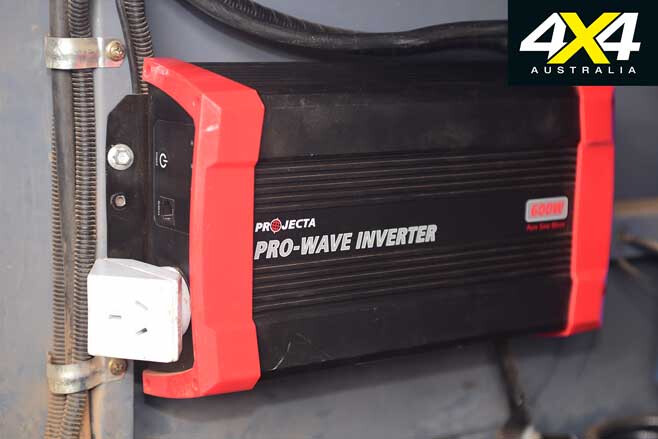
Projecta produce a wide range of inverters including modified sine-wave units, Intelli-Wave inverters and Pro-Wave models – the latter two are full sine-wave inverters. In the Pro-Wave line-up there are four units ranging in power from 350- to 1800-watt, while in the Intelli-Wave range there are four 12-volt inverters between 300- and 2000-watt and two 24-volt units producing 2000 and 3000 watts respectively.
This time around we went for a couple of Pro-Wave units, fitting a 350-watt unit to the Hilux and a 600-watt unit to the ol’ Patrol. Check out the selection guide and the equipment you want to power to obtain the best inverter for your needs.
Each unit comes with a short cable to connect to the vehicle’s wiring, but you really need to run some good, thick wires to power these units, especially if you’re running the bigger inverters at full power. For example, the 600-watt unit fitted to my Patrol will, at full output, draw at least 50-amp from the battery. Projecta recommends a 49mm² cable and a 60-amp fuse or circuit breaker for the 600-watt unit.
The 600-watt unit comes with an LED status indicator and a digital display that alternates between showing input voltage and power output in watts/kilowatts. In the event of a fault an alarm will sound and the LED screen will display one of several fault codes.
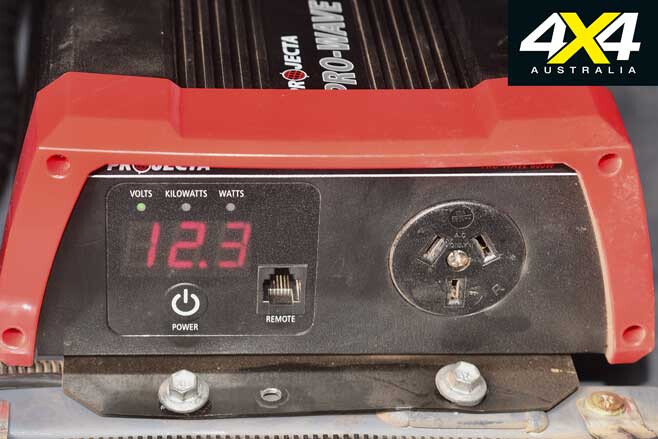
A press-button power switch, an approved three-pin output socket and a receptacle for a remote control cable/switch (optional) is also included on the front panel. The rear panel has the connections for the 12-volt cable and is where the thermostatically controlled cooling fan is located, so don’t enclose it.
The units are designed to run at 120 per cent of full power for up to eight minutes and will even handle 200 per cent of full power for half a second. These units also produce ultra-clean AC power, which prevents any electrical noise or static affecting any sensitive equipment.
We’ve had these units fitted to the respective vehicles for well over a year and in both cases they have performed faultlessly and proved easy to use and reliable. Due to the current draw, especially on power-hungry appliances, I tend to charge battery equipment while mobile, with the vehicle alternator keeping up with the battery demand.
The RRP is listed here, but you’ll find them cheaper with a bit of searching. We can’t recommend them highly enough.
RATED Available from: www.projecta.com.au RRP: $350 (350W); $530 (600W) We Say: Easy to use, reliable and provides good, clean power
It was one of the best ridgeline drives I’ve ever done. The long, relatively easy drive up the wide crest of the mountain we were on was interspersed with lumpy, rocky steps that demanded you tear your eyes from the view and concentrate on the wheel marks wandering between the rocks and boulders on the little-used track. At the crest it was just a short walk to the lip of the cliff that made for one hell of a viewing point.
To the west was the shiny white expanse of a distant Lake Torrens, while closer to our eerie-like vantage point, and in much the same direction, were the low peaks of Mt Deception, Termination Hill and Mt North-West. These were all named by Edward John Eyre on his attempt in 1840 to break through what he thought was a continuous ring of salt lakes that encircled the northern end of the Flinders Ranges.
Looking south you could see the sawtooth ramparts of Wilpena Pound and, a little nearer, the shark-fang peak of Patawarta Hill poked above a closer line of lower, less dominant but still quite rugged hills.
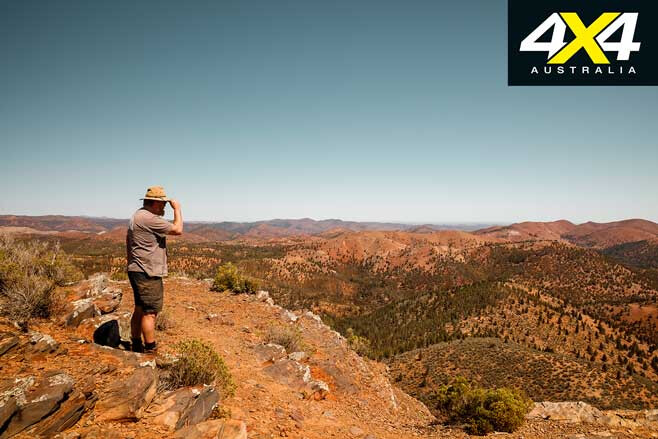
To the north-east Mt Hack obscured the craggy ranges farther north, while to the east the outlook was one of jagged country between the peaks of the Cocks Comb and Ben-Lomond. It was a grand view, while at our feet the ridgeline dropped away in a series of sheer, dizzying high steps to the valley below.
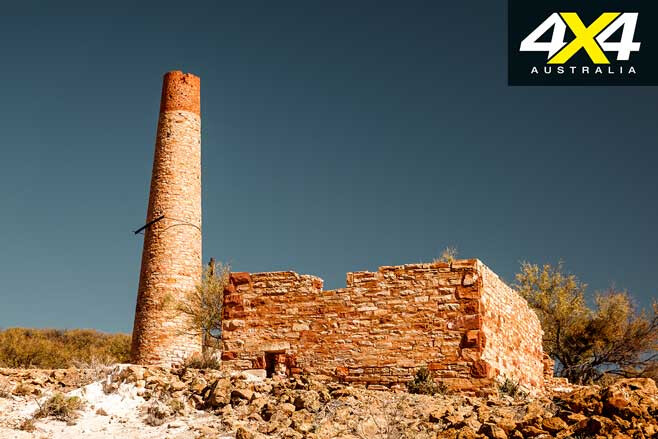
We were on top of Mt Gill, which at 914m is the second-highest peak you can drive to in the Flinders Ranges. Located in the Warraweena Private Conservation Reserve, the property offers some great camping, and we had thrown down our swags the night before not far from the ruins of the Sliding Rock mine on the edge of Sliding Rock Creek.
From our high vantage point we had returned to the homestead and then headed out via the near-deserted township of Beltana through Puttapa Gap to Copley, where we propped for the night enjoying the amenities of the camping ground and the pub next door.
From Copley our route took us east and into the Nantawarrina Indigenous Protected Area (IPA), which offers a couple of camping places and a couple of 4×4 tracks that essentially lead through the park and/or to Moro Gorge on the eastern extremity of the reserve.
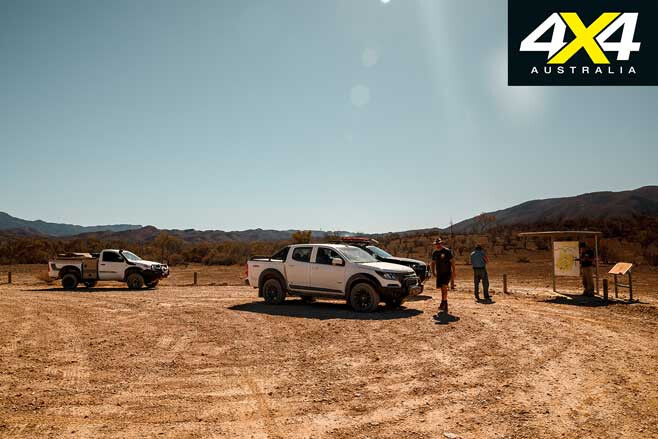
At the gorge we took to shank’s pony and wandered down the creek, which was surprisingly trickling with water – a rare sight indeed in these dry times and, in fact, it was the only water we saw in a creek while in the northern Flinders on this trip. Yellow-footed rock-wallabies can be seen here, and while their scats were everywhere it was way too warm in the middle of the day for animals to be out and about – except crazy four-wheel drive animals.
After a night camped at Irish Well Hut on the southern boundary of the reserve – it has a good shelter shed, firepit and even a flushing dunny, but it’s not high on my list of camping recommendations – we headed for Chambers Gorge.
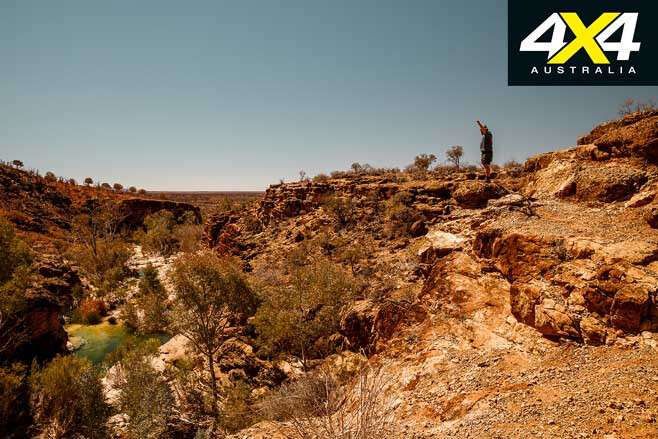
The gorge, running through the Wearing Hills, an outlier of the main range, rarely has water in it and, while it offers pleasant enough camping along its wide sandy creek, its major attraction is the Aboriginal rock art that can be found here.
Located in a side canyon a few hundred metres from the carpark, the art adorns a large sheer rockface with hundreds of chipped engravings spread over it. A sign at the start of the side gorge told us what the symbols meant, or could mean; the pecked circle being a symbol for a camp. Certainly the engravings of animal tracks were easier to relate to, with emu and kangaroo tracks dominating.
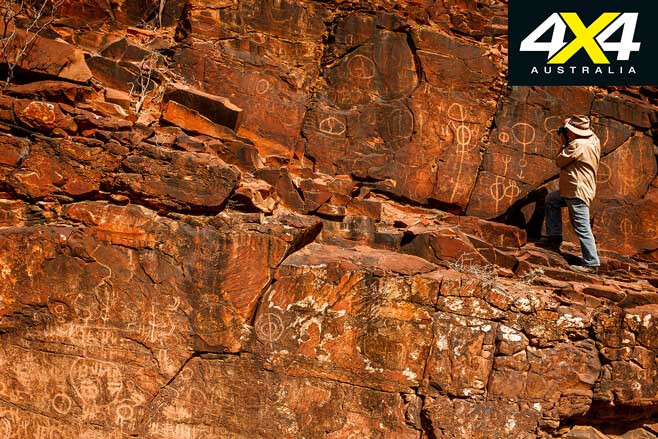
Elsewhere other rock canvases carry more art, but it is this large rockface that is the main attraction. Such petroglyphs, as they are called, are extremely hard to date, but many people believe they are at least 20,000 years old. Certainly they point to a time when these people who probably predated the current Aboriginal peoples had time on their hands to partake in such time-consuming art.
From Chambers Gorge we headed to the Gammon Ranges NP, and once at the park headquarters at Balcanoona we turned towards the great salt expanse of Lake Frome. Once there we were a little disappointed as there was no great white expanse, instead just a mud-covered pan stretching away to the horizon.
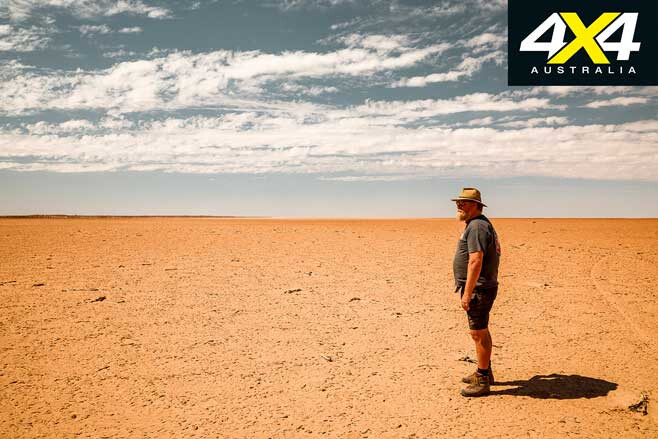
Soil and minerals have washed down from the nearby mountains and carried out on to the plain and into the lake; this is one reason why this lake bed is a regional reserve (where mining is allowed) while all the other salt lakes in SA are national parks. Just up the road from here is the Beverley Uranium Mine, its operation vastly different to most mines, as the uranium oxide is recovered by an in situ leaching process.
Disappointed, we hurried back to Balcanoona and then onto Grindell’s Hut, which lies in the heart of the Gammons and is a top spot to camp. The hut and associated buildings are on a low rise above the Balcanoona Creek, and the campsite is on the edge of the creek shaded by big red gums. Here we had a couple of yellow-footed rock-wallabies pay us a visit – something these normally shy animals don’t do. However, the ravages of drought here have seen waterholes dry up and food become far less plentiful. Now they scrounge around the campsites looking for any edible scraps.
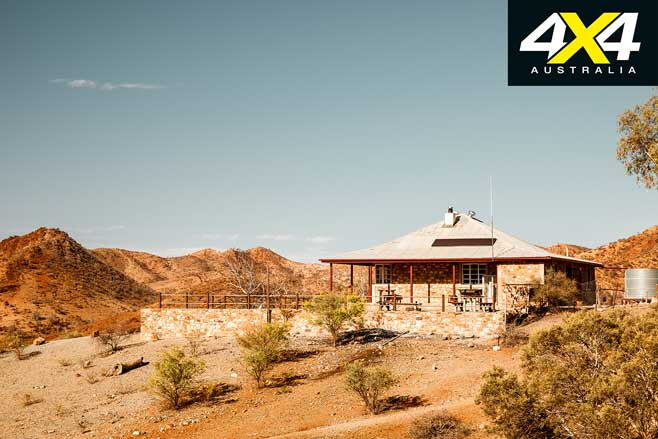
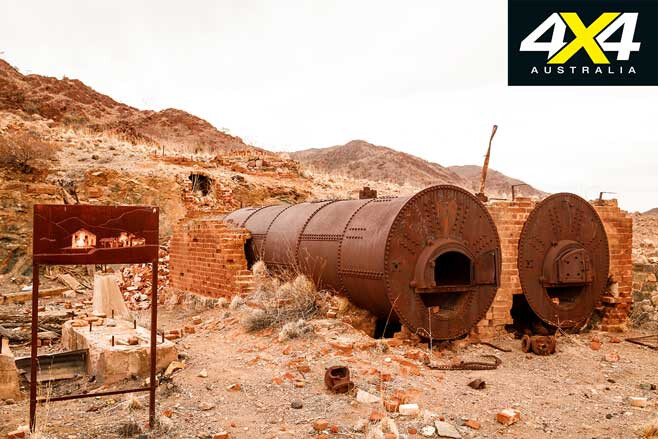
The next morning we headed north through Illinawortina Pound to Mainwater Well and onto the deserted homestead of Idninha, the track through the park breaking up into some long sections of bulldust. From the homestead we took a recently opened and slow track through to the Bolla Bollana Smelters which lies right on the northern boundary of the park.
Stopping briefly at the ruins we continued on to the ruins of the old copper smelter at Yudnamutana, along the way passing some of the old mines that once fed the processing works with ore. Just down from the mine is a small, poignant cemetery with one of the graves here belonging to a woman who was shot by her husband on Boxing Day. This is an incredible spot surrounded by rugged hills, and it’s a favourite of mine. You can camp here but need permission from Mt Freeling Station to do so.
That night we threw down our swags at the well-established Arkaroola Resort, one of the places not to miss when in the northern Flinders. With good facilities and all the supplies a traveller needs, Arkaroola offers some great tracks to drive, tours to do and a couple of amazing star-gazing experiences which will blow you away.
With a full timetable planned for our all-too-short stay, we headed out on the Echo Camp Backtrack early the following morning. This self-drive track is just 41km long and will take you approximately four to six hours, and it is worth it to take your time as there are plenty of impressive places to stop, admire and enjoy.
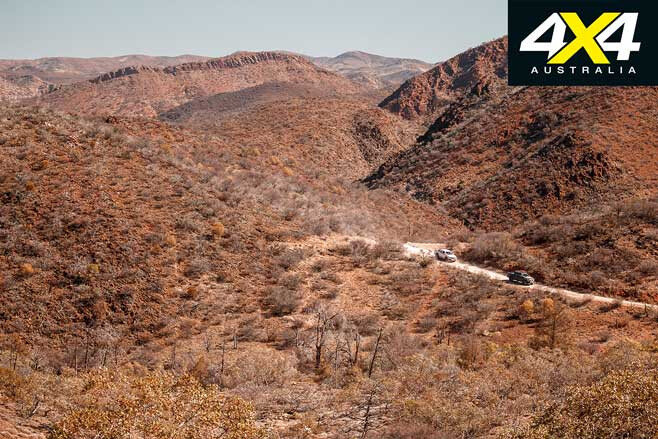
Once again, waterholes that not so long ago were considered permanent (or near so) were as dry as a crisp, and as such the owners, the legendary Sprigg family, have instigated water points and feeding locations to help keep the yellow-footed rock-wallabies alive. It wasn’t something that was undertaken lightly, as current owner Doug Sprigg explained: “We’ve spent the last 50 years bringing these animals back from the brink of extinction,” he said. “Now in these exceptional circumstances, we must do something to keep them surviving.”
I could only agree.
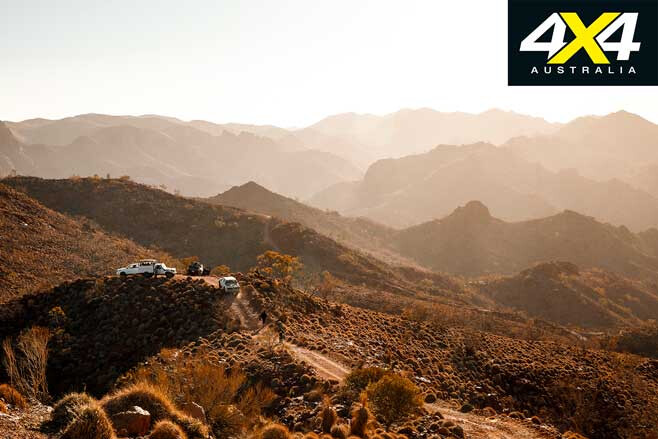
That afternoon we headed out on the Sillers Lookout Track, which is where the resort runs its famous Ridgetop Tour. We were privileged to be able to drive it ourselves, but the narrow track, steep grades and sheer roughness of the route, along with the expense of the continual maintenance, means that traffic is kept to a minimum. But whatever you do, take the guided trip out to the lookout which is arguably the most spectacular in the whole country.
It was late when we got back to the resort, where a cold beer and a hot meal from the restaurant beckoned. We had been in a rush to fit everything in and it had been a long day, but it had been worth it. Once again we had sampled some of the best country in all of Australia and, while I have been here numerous times, this trip won’t be my last!
Warraweena
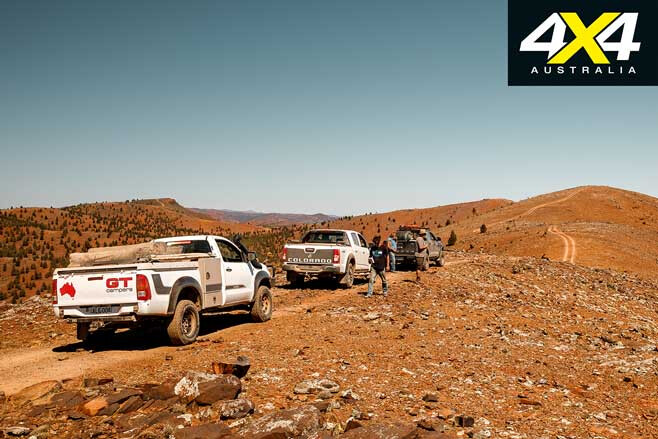
A private conservation reserve, established in 1996 when Wetlands & Wildlife acquired the property, it has been run and managed by Stony Steiner since. Covering 35,500ha the property is beautifully diverse and rugged, with 10 peaks over 1000m in height and Mt Hack at 1086m being the highest.
Wildlife is common, while yellow-footed rock-wallabies can be seen at certain places. Many historic sites are dotted across the landscape including the impressive ruins of the Sliding Rock mine, smelter and townsite.
Accommodation includes the shearers’ quarters, the homestead and a number of bush huts set in remote and idyllic settings. For those wanting a bush camp, there is a wide choice of well set-up sites dotted along the creek.
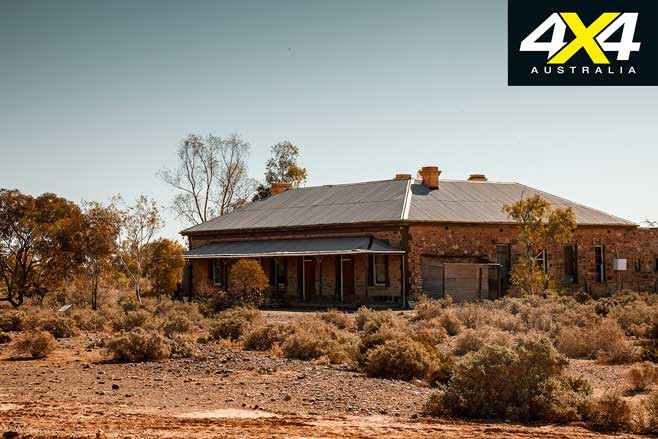
The property offers mountain biking, bushwalking and three excellent 4×4 tracks, as well as a Public Access Route (PAR) to Mt Hack. While the Mt Gill track is one of the most spectacular routes in the whole of the Flinders, the Copper Track takes you from the ruins of Sliding Rock to the equally impressive ruins of Nuccaleena.
For pricing and more information visit www.warraweena.com, or contact Stony on (08) 8675 2770.
Nantawarrina IPA
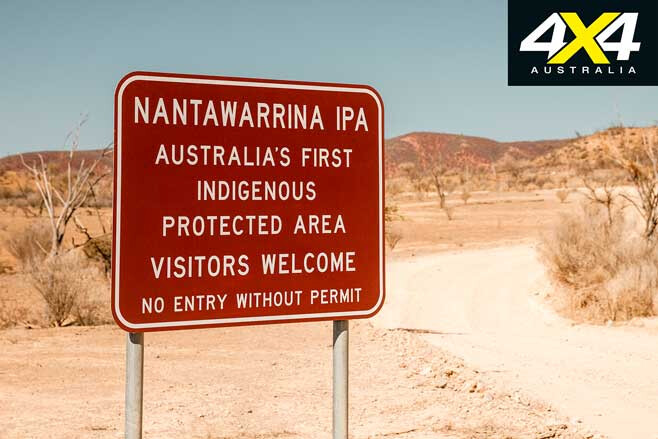
The Nantawarrina Indigenous Protected Area (IPA) in northern South Australia covers more than 58,000ha of Adnyamathanha Aboriginal ancestral land. It was the first IPA established in Australia and has been copied all over the country. A couple of 4×4 tracks give access to some pleasant camping areas and Moro Gorge, which is the highlight of the area, generally sports some water flowing through it. Self registration pay stations give you a permit for access.
For more information and costs visit https://nepabunna.com.au/nantawarrina
Arkaroola Wilderness Sanctuary
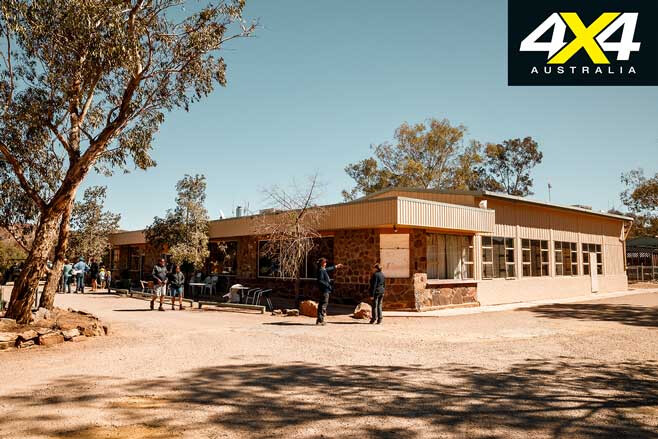
Established as a private wildlife reserve in the late 1960s by the Sprigg family, the sanctuary is run by Doug and Vicki. It is the pièce de résistance of the northern Flinders Ranges, offering good accommodation and camping along with a restaurant, bar, swimming pool, store and fuel.
Located 600km north of Adelaide and 130km north-east of Copley, the reserve joins the Gammon Ranges NP which in turn connects with the Nantawarrina IPA, securing more than 610,000 acres of contiguous protected land. Arkaroola covers 61,000ha of rugged mountain country strewn with granite peaks and cut by magnificent gorges sheltering hidden waterholes. Geologically it is a unique masterpiece, so much so that in 2012, under a government-declared special act, it now lies at the heart of the Arkaroola Protection Area where mining and fossicking have been banned.
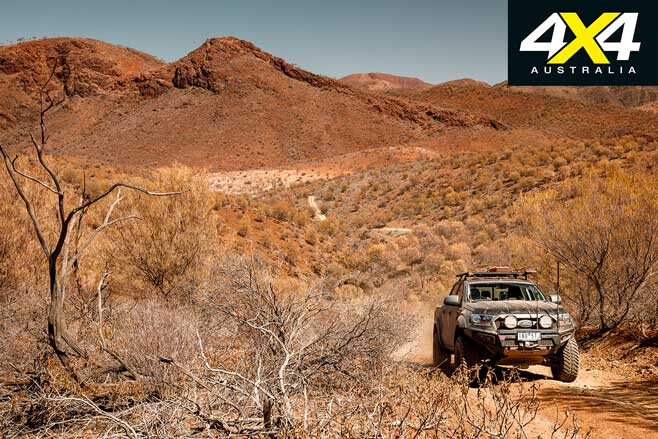
Bushwalkers will revel in the area’s remoteness while 4×4 drivers will love the tracks, such as the Echo Camp Backtrack and the route to the ruins of the Yudnamutana mines and smelter. The Ridgetop Tour to Sillers Lookout is a trip everybody should do and, while a guided tour, it is well worth it. Three astronomical observatories also make Arkaroola one of Australia’s largest privately owned space observatories, offering some of the best viewing conditions in Australia to tour the universe and to check out the stars.
For more info and bookings visit www.arkaroola.com.au
THE CREW at Berrima Diesel, located 130km south of Sydney in the southern highlands, has a reputation in the 4×4 industry for knowing their stuff, so I thought it was time to take my old 80 Series down for a tune while in the area, as I’d previously had the motor rebuilt just before heading off on a trip around Australia.
Berrima Diesel can trace its roots back to 1956, when Reinhard Leimroth completed his apprenticeship with Bosch. He was then sent to Australia to troubleshoot and was soon working on ships and massive trucks, before running a large workshop in western Sydney.
His son Andrew followed in his footsteps, and now Andrew’s son Trent is learning the ropes. From the moment you arrive at Berrima Diesel you are made to feel welcome, but what makes them stand out is that they listen to you and your concerns and problems.
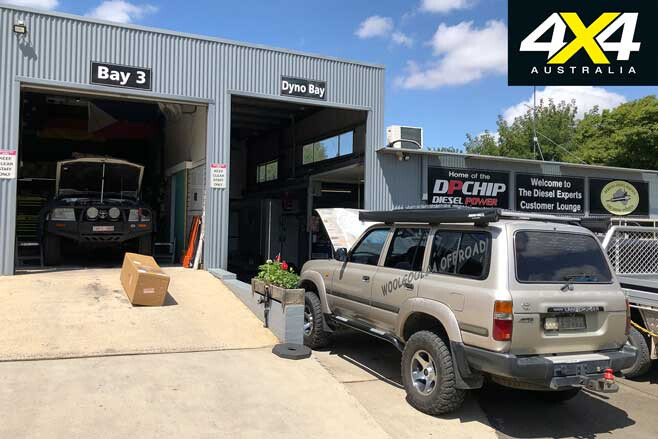
The first thing the crew at Berrima did was take the old Land Cruiser for a quick road test, before putting it on the dyno for some troubleshooting. After several runs on the dyno they explained what they found, how they’ll fix it and why they’re doing it. By explaining how they will safely tune your diesel engine, it made me, as the customer, feel comfortable knowing that my vehicle was in safe hands.
Even if you don’t understand the intricacies of diesel engines, the boys take their time to explain everything including air fuel ratios, turbo boost, exhaust size, over-fueling and fuel filter micron size. The explanations continue when you get the dyno results, and Andrew was more than happy to explain to me the outcome and where the gains were found in the 80.
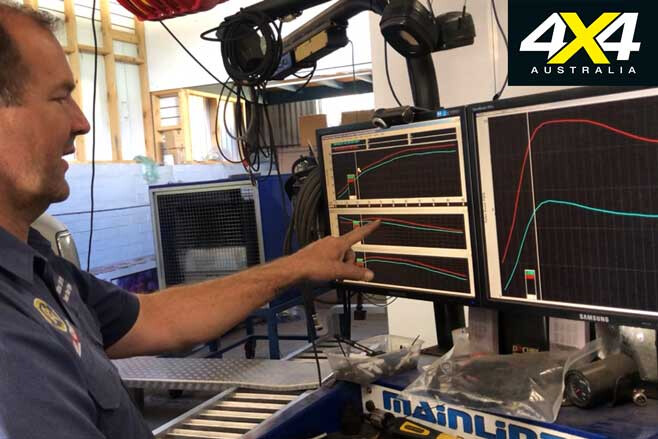
I have done 50,000km since the engine rebuild, and on this visit to Berrima I was expecting some minor adjustments for only a few more kilowatts. The basic tune takes half a day, but the difference is bloody amazing. Andrew gained of a full 10kW and found turbo boost was down 3psi and the AFR (air fuel ratio) was out.
After the tune the 80 now comes on boost sooner at 1800rpm, the gears are holding longer, and it generally gets on the power band sooner and stays there. Torque has also increased immensely, which makes all the difference when towing with a diesel. What this means is that the fuel pump, injectors and the turbo are all working in sync, which in theory is more efficient as it’s using less fuel and there are less gasses going out the back.
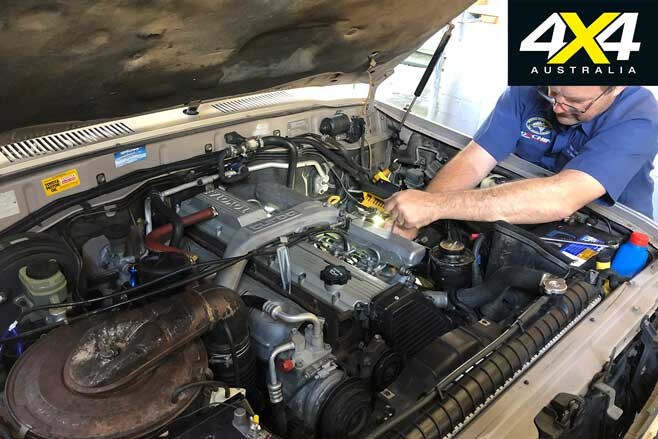
The team at Berrima Diesel is known right across the country. In fact, they were telling me that customers come from all over Australia as Berrima can fix problems others can’t. From basic old-school diesel engines right through to CRD and D4D engines on 4WDs, motorhomes, trucks and cars, these guys know diesels. To say I’m impressed is an understatement!
“THEY don’t make them like they used to.” It’s a phrase repeated day after day, year after year, through countless country pubs, 4×4 workshops, and the comments section every time we post a review of a new 4×4. People gripe about the youth of today, the vehicles and the music, and why all three were better back in the day.
2020 CUSTOM 4X4OTY: Vote now for a chance to win!
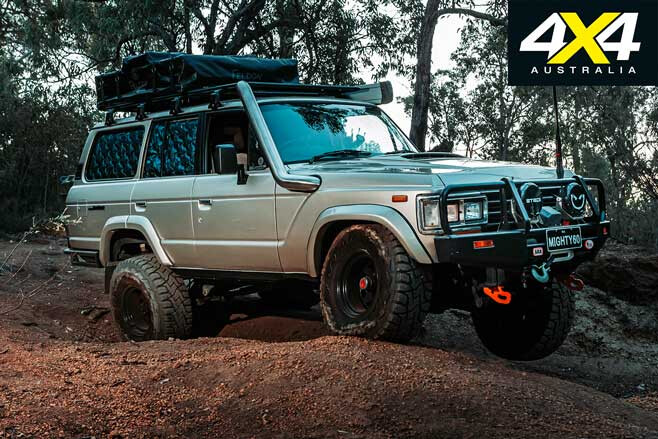
But the future ain’t all doom and gloom, especially if Perth-based 20-year-old Sivan is anything to go by. On any given weekend you won’t find Sivan strapped to YouTube or tweeting his life away; he’ll be out in the hills, exploring the best parts of Australia’s West Coast in one of the neatest 60 Series LandCruisers we’ve seen in the past 30 years.
“I was originally looking for a 105 or 80,” Sivan told us. “Eventually I found the 60 and just loved the old-school design.”
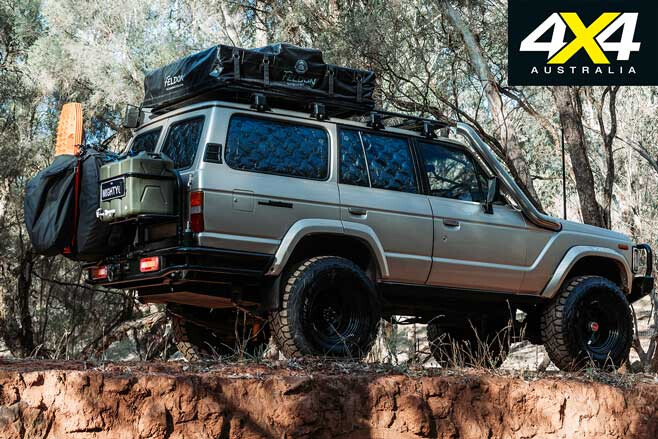
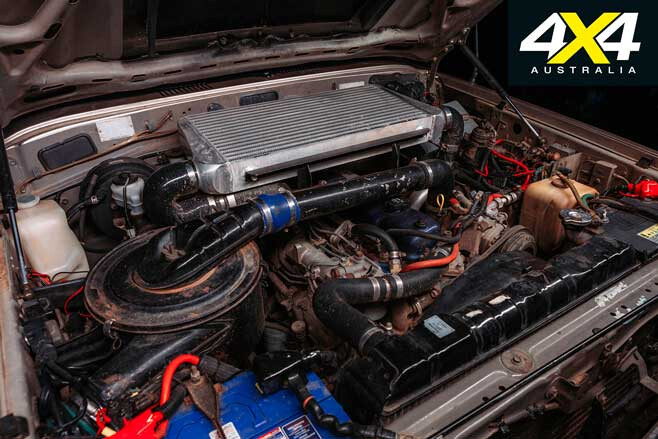
Despite being commonly mistaken for a 61 or 62 due to the rectangle headlights, it’s actually a clean-as-a-whistle HJ60 complete with a pushrod non-turbo 4.0-litre diesel under the bonnet. From here, Sivan tweaked and tuned the oil-burner to make it far more liveable with the higher speeds of the new millennium.
Starting from the intake there’s now a four-inch straight shot into the engine bay, thanks to the one-off stainless-steel snorkel handbuilt by the guys at Craftsmen Metal Works. At the business end you’ll find none other than a CT26 turbo, donated to the build from a later model factory turbo-diesel LC80. It’s pumping a respectable 15psi out the other end, before a monster 600×300 top-mount intercooler reigns in the intake temperatures.
The Holden Colorado bonnet scoop is the only external clue of the significant power upgrades to the old girl. Spent exhaust gases make their way rearwards through a three-inch turbo-back exhaust system, and a heavy-duty clutch mates the whole lot up to the OEM five-speed cog-swapper.
Sivan’s ’Cruiser earns its aggressive stance thanks to a combination of suspension tweaks and a body lift. Up front, the live axle is held in place by a pair of heavy-duty Pedders leaf springs. They’re raised two inches over stock and rated for the additional weight of the diesel, nearly 60kg heavier than the petrol offerings. In the rear, two-inch-lifted Dobinson leaf springs are rated at 300kg constant load to cope with the extensive camping setup, while an Airbag Man load-carrying setup helps to level the load when towing.
Dobinsons got the nod again when it came time to get the whole show in order, with its twin-tube big-bore nitro gas shocks finding a home at each corner. They’re paired with new shackles, bushes and a return-to-centre steering damper.
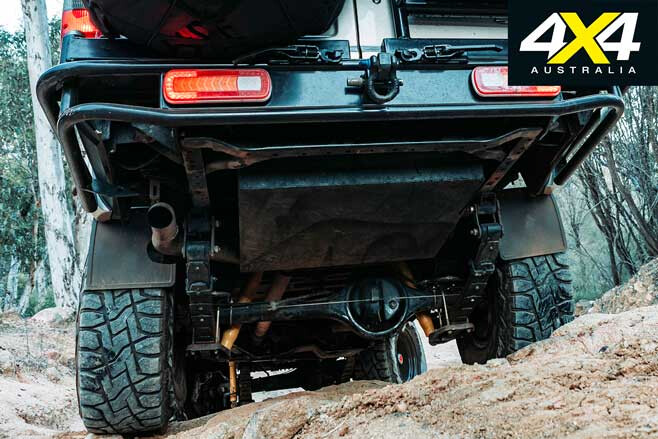
For those doing maths at home, that’s still only a two-inch lift over stock. The remaining two inches of vertical growth comes from body lift blocks pushing the cab higher than the frame, freeing up valuable real estate in the wheel arches.
While the ’Cruiser might look as clean as a whistle, it’s no mall crawler. Shoved in to each corner are massive (for a 60) 315/75 R16 Toyo Open Country R/Ts. That’s a little less than 35 inches in the old money. The aggressive rugged-terrains straddle the divide between M/Ts and A/Ts (see breakout below).
The meaty rubber is wrapped around 16×10 steel wheels, with a -44 offset punching the 60s track width out nearly four inches over stock. Ensuring all four tyres get equal drive when the stubby lever gets pushed into low range are a pair of locking diff centres. Up front, a Harrop ELocker provides positive drive with the flick of a switch, while at the back an air locker from TRE keeps Sivan moving when the going gets tough.
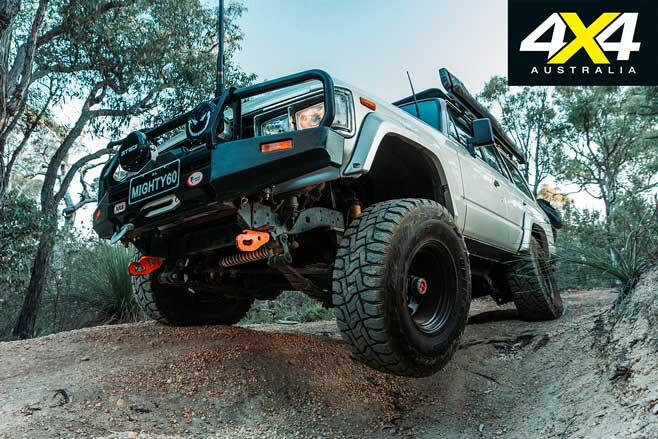
Keeping the 60 in one piece on tough tracks and giving it that unique look is some seriously cool bar work at both ends. Up front, Sivan’s gone for a retro-styled ARB ‘Dakar’ winch bar, which not only provides a decent approach angle off-road but incorporates serious radiator and headlight protection. Sivan also mixed old and new by slotting in a set of high-powered 8.5-inch Stedi Type-X LED driving lights in the bar. Beneath them lies a Domin8r X 12V winch.
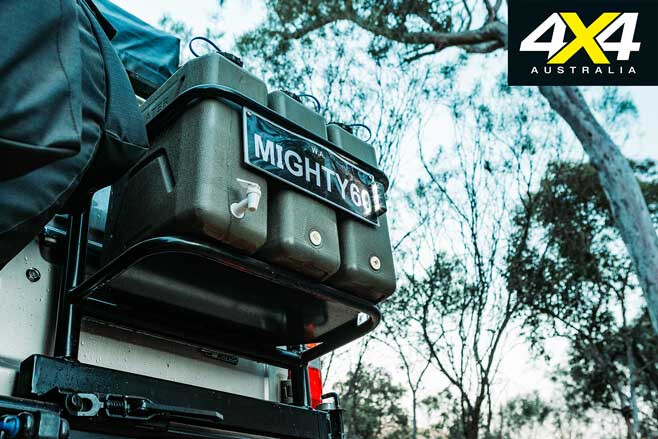
Moving rearwards and the ’Cruiser cops a dose of custom. The normally vulnerable quarter panels are now the strongest part of the rig. The custom tube bar armours up the rear-end and provides a mounting point for dual swing-out carriers; plus it mounts 66 litres of water storage, with three jerry cans on the driver’s side. The passenger side swing-out houses the spare tyre, MaxTrax and a canvas trash bag. Road Vision’s sequential tail-lights have been built in, a vast improvement over the stock offerings.
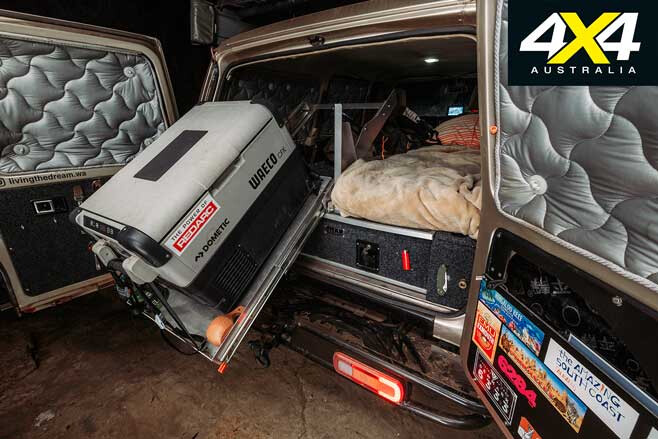
Swinging open the rear bar reveals a seriously impressive camping setup. The first thing you’ll notice is the twin-drawer system and Dometic CFX-50 fridge/freezer on the tilt-down slide, but that’s just the start. Sivan has customised both barn-door internal door cards. On the driver’s side a drop-down table gives a hand-prep area for meals, while the passenger side incorporates recesses for everything from barbecue tongs to spices and cutlery, all within arm’s length. Underneath there’s a trick triple-battery setup ensuring Sivan is never left wanting.
The start battery takes care of starting and winching, a second battery runs all camp lighting and the sound system, while a 120amp/h AGM battery right up the back keeps the fridge and inverter running. The whole affair is powered by a Redarc 50amp BCDC charger, with a 200W solar panel on the roof keeping it topped up. Insulation panels from Solarscreen keep internal temps down, while a full steel rack houses the Foxwing 270-degree awning and a Feldon Shelter Crow’s Nest rooftop tent.
Sivan also fully overhauled the interior. Smart tech comes in the form of GME’s XRS Connect UHF and a Hema HX1 GPS, while a full interior swap has netted a pair of factory turbo bucket seats and a Deluxe centre console. He home-brewed a false floor in the back, replaced the back seats and opened up storage for bulky items, making for one serious usable setup.
They might not make them like they used to; but if the new way of doing things means taking to the hills in classic 4x4s packed full of DIY modifications, maybe that’s not such a bad thing.
Hybrid Theory
YOU MIGHT be staring at the meaty rubber beneath Sivan’s ’Cruiser, trying to work out if they’re an all-terrain or a mud-terrain. Well, they’re kinda both. You see, 4x4ing isn’t as simple as mud trucks or big trips anymore. People want their cake, and want to take it on a 5000km outback road trip too. It’s brought about a revolution of ‘hybrid’ tyres, something that falls between a mud- and all-terrain tyre.
They’re typically based on the same carcass as their M/T brethren, with a slightly less aggressive tread pattern, more focused on-road noise, and improved handling and braking rather than outright traction off-road. If you live in a mud pit they might not be your first choice, but if you’re doing a combination of touring, daily driving and mild wheeling they’re well worth a look.
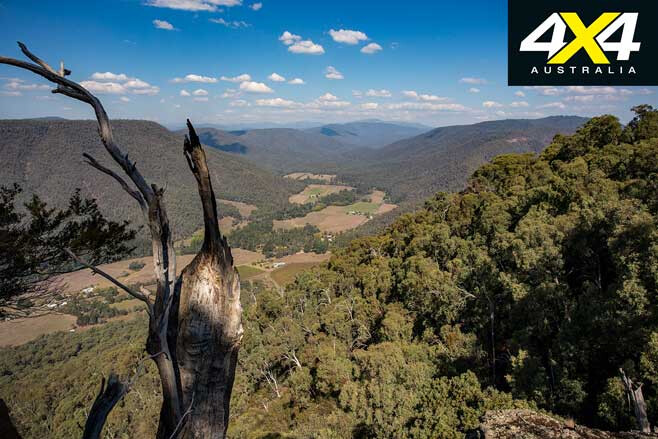
STARTING your day with a lung-full of fresh mountain air scented with peppermint gum, while admiring a vista out over treetops and valleys to the rocky peak of Mt Buller, takes some topping. It’s the sort of view you could lose yourself in for hours, but my photographer mate Bill has other ideas and is already nudging me to get out of my swag and rattle some pots and pans.
We’d driven the two-and-a-half hours from Melbourne the afternoon before and spent the night yarning around a crackling log fire in his rustic bush cabin, set in a secluded location just a short hop from the village of Merrijig.
Best known as a jump-off point to the Mount Buller ski slopes, Merrijig hosts a popular annual rodeo each March and is home to the Hunt Club Hotel, a landmark watering hole renowned for its generous steaks, friendly atmosphere, and walls decorated with memorabilia from George Miller’s The Man from Snowy River, which was filmed on location nearby.
Some 23km west of this horsey hamlet is the thriving rural hub of Mansfield, well-known to many Victorians as the centre for all manner of outdoor adventure activities. The picturesque hills and valleys surrounding the township are crisscrossed with tracks and trails that draw hunters, trail bikers, trout fisherman, horse riders, mountain bikers and 4×4 enthusiasts like bush flies to a sweaty shirt-back. Rock up here on any given holiday weekend and you’ll find the streets abuzz with activity, as mud-splattered, swag-laden 4x4s restock fridges and fuel tanks before going bush.
It was a love of the bush and outdoor adventure that also led Bill and his wife Sally to build their bush cabin here, on a timbered ridge overlooking Buttercup Creek, some 30 years ago. Ready easy access to a vast sprawling wilderness was the bonus for Bill, a former Australian Geographic photographer of the year whose passion for trout fishing and outdoor photography has since led him and his trusty 60 Series LandCruiser (aka the Snow Leopard) to traverse many of the rugged tracks through the surrounding hills and valleys.
There’s no sign of the Snow Leopard today, however, as editor Raudonikis has asked us to put some miles on a schmick Mercedes-Benz X-Class, which we’re soon piling swags and kit into before heading to our appointment with one of this country’s most infamous bush locations.
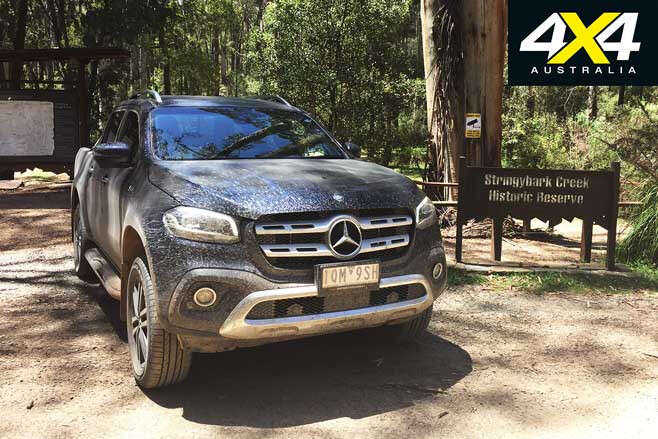
The name Stringybark Creek will resonate with even casual students of Australian history as the site where notorious bushranger Ned Kelly and his gang bailed up a party of mounted police, shooting and killing three of them in the ensuing melee.
These days, historians consider those events as the catalyst for the ramping up of police efforts to catch the Kelly Gang, leading to the final confrontation with police at Glenrowan on June 28, 1880. Ned was famously captured during the siege there and was later tried and hanged for the murder of Constable Lonigan, while his brother Dan and associates Joe Byrne and Steve Hart perished in the ensuing hotel fire.
Despite this, Stringybark Creek hasn’t always been afforded the prominence in our national folklore it deserves. In fact, a few years ago I took some visitors there and it was only after much thrashing about through waist-deep grass that we eventually located a tin marker riveted to the so-called Kelly Tree, marking the spot where the shootout was said to have occurred.
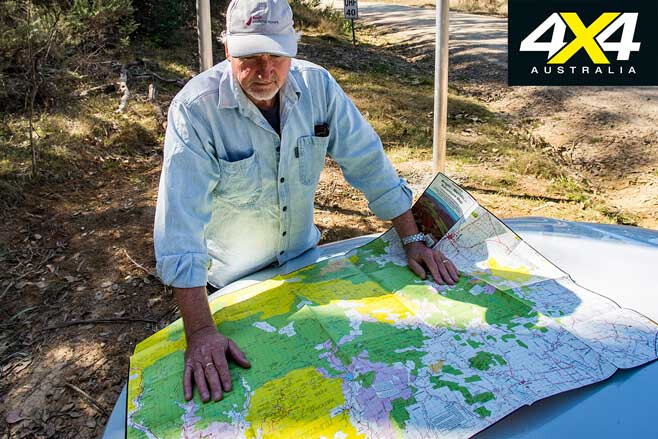
However, the site scored a major Heritage Victoria-approved overhaul in late 2018, following collaboration between Forest Fire Management Victoria, the Department of Environment, Water, Land and Planning, and Victoria Police. So, with a couple of days up our sleeve, and Bill’s ever-present trout rod stowed in the tray, we decided to go and see firsthand how our tax dollars had been spent.
Heading back into Mansfield via dusty Buttercup Road, we pass a group of early morning horse riders, out for a canter in the bracing mountain air. Drizabones give way to Lycra out on the main road, as colourfully-attired cyclists pant their way to the start of the 17km climb up the flank of Mt Buller. The bitumen leads us back to Mansfield and we circle the main roundabout, where a handsome monument memorialises the fallen policemen – Constables Thomas Lonigan and Michael Scanlan, and Sergeant Michael Kennedy – killed at Stringybark Creek.
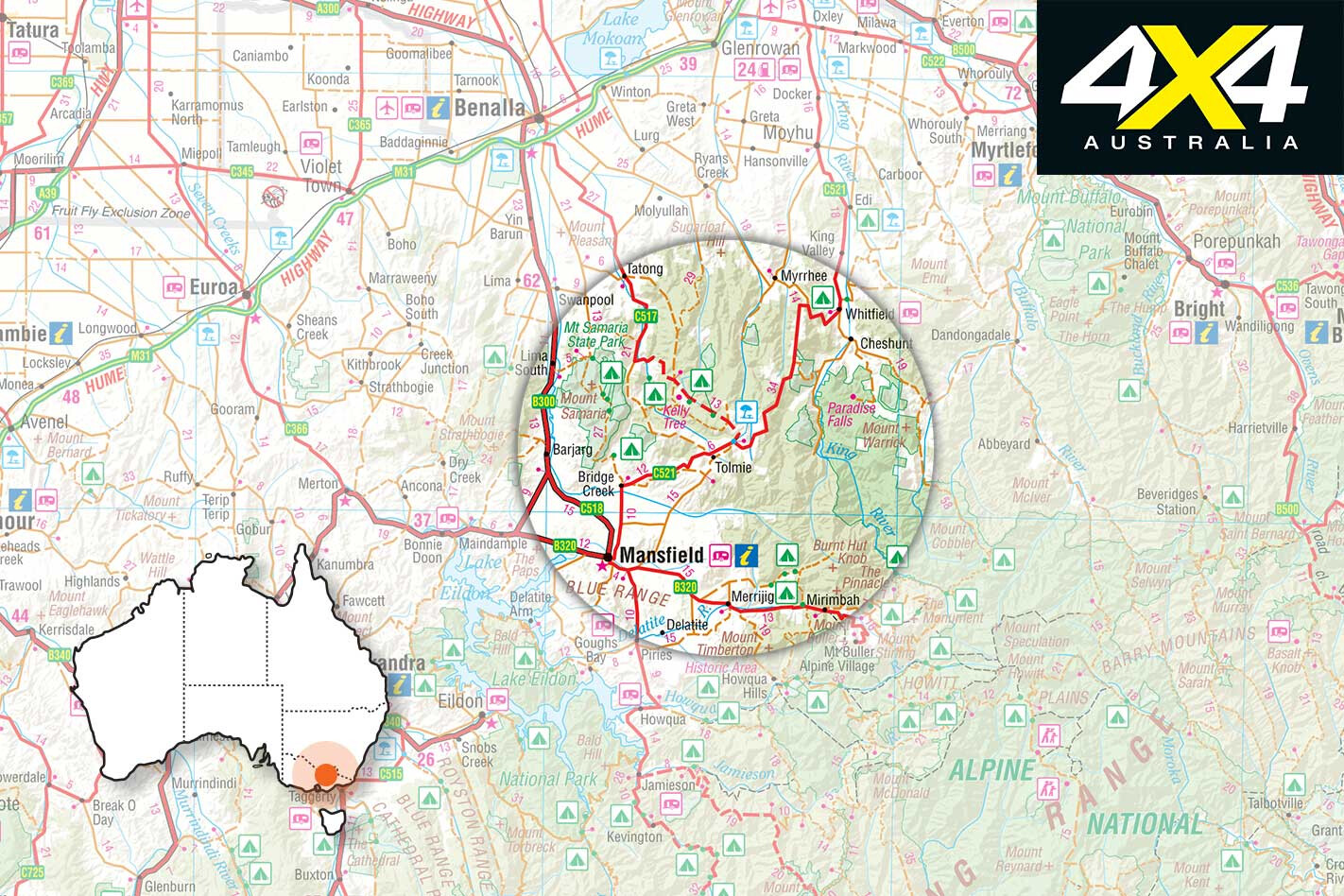
After grabbing a shot of locally roasted coffee at the Mansfield Coffee Merchant, we head out of town on the Mansfield-Whitfield Road (C521) destined for Stringybark Creek Historic Reserve. The reserve sits in the foothills of what was once known as the Wombat Ranges, near a crossroads of back country stock routes formerly used by horse and cattle thieves.
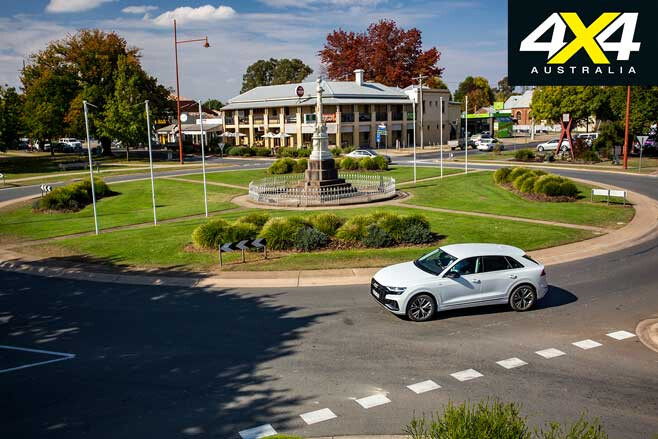
The isolated spot is these days part of the Toombullup State Forest and easily accessed by vehicle from either Benalla (50km) or Mansfield (40km). This is the epicentre of ‘Kelly Country’, described in the 1881 Royal Commission on the Police Force of Victoria as being that portion of north-east Victoria where, “… the peculiar characteristics of the country afforded special facilities for the operations of such lawless characters as the Quinns, the Lloyds and the Kellys, who, if pursued by the police, could seek refuge in the vastness of the mountains and defy all the attempts of the authorities to arrest them.”
It’s an apt description for Stringybark Creek, which wends through a forest of thick-trunked eucalypts, hemmed by dense bracken and wattle that forms an almost impenetrable screen. It’s overgrown and inhospitable, which is likely what drew the Kelly Gang here.
It’s also a strangely beautiful place and, as you wander about with birdsong ringing through the towering gums, you get a sense of the panic and terror that must have ensued when the bush quiet was interrupted on that fateful day by the shattering boom of Ned’s Snider-Enfield carbine.
In the space of a few hours on Saturday, October 26, 1878, the Kelly Gang went from being horse thieves and brigands to murderers and cop-killers, an event that sealed their fate and eventually led to the killing or capture of the entire gang. Constables Lonigan and Scanlan died where they were shot, near their tent, while Sergeant Kennedy was killed a quarter mile north-west while trying to flee. A fourth, Constable Thomas McIntyre, escaped and made it back to Mansfield, and it was his evidence that eventually saw Ned hanged at Melbourne Gaol in 1880.
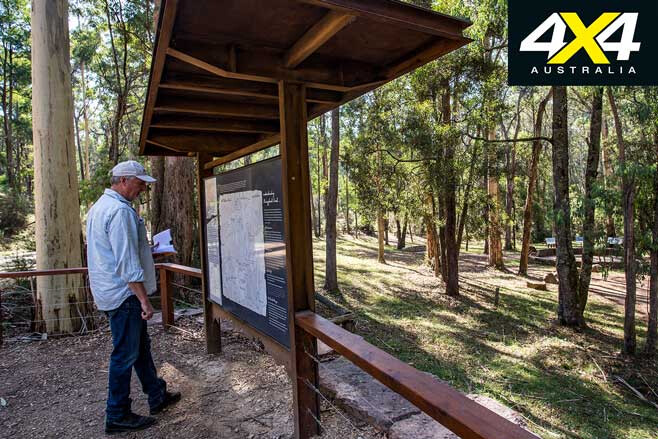
While there has been a marked tree of some sort – variously known as the Police Tree, the Brond Tree, the Lonigan Tree and more commonly the Kelly Tree – at Stringybark Creek since soon after the tragedy occurred, the story has never been told with the rich level of historical detail that’s now on display. The entire fascinating but tragic story, including events leading up to and following the attack, is told via a series of memorial plinths and detailed interpretive signage within the Historic Reserve.
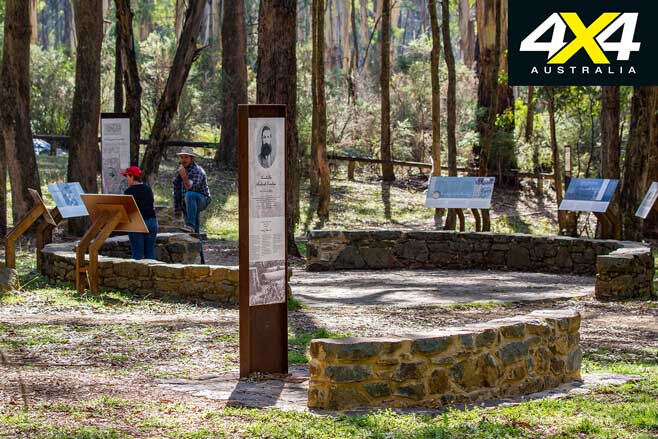
It’s a trove of historical information that’s bound to satisfy even the most ardent of Kelly Gang aficionados, but for those still curious as to why and how Ned took the wayward path he did, some of the answers lie not far away at the former hideout of another notorious bushranger, Harry Power, whom Ned was a keen understudy of in his own early days.
Long before Ned and his gang had their encounter at Stringybark Creek, Harry Power, convict and career criminal, had identified these craggy, eroded hills, with their caves and commanding views over the King Valley, as the perfect place for an outlaw’s camp. From his bush eyrie the expert bushman could see everyone and everything that came and went in the valley below.
He reportedly relied on dogs and a noisy peacock at nearby Glenmore Station – home of Ned Kelly’s grandparents – as part of his early warning system. But the critters failed Harry one stormy morning in June 1870 when police raided his well-stocked camp, helping themselves to breakfast before hauling the notorious horse thief and cattle duffer away. Ironically, Harry believed his young student Ned had dobbed him in for the 500-pound reward on his head, when in fact the culprit was Ned’s uncle, Jack Lloyd.
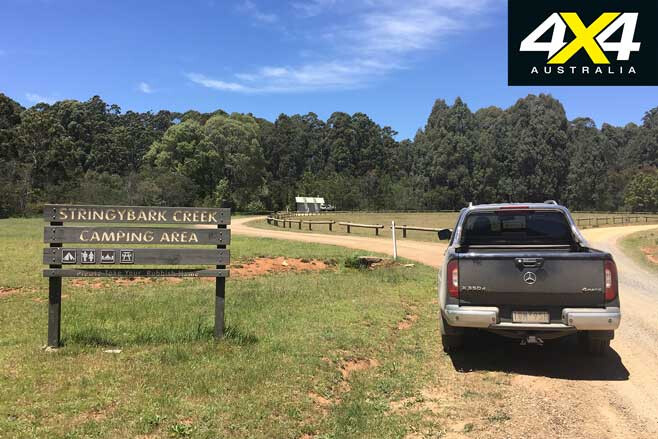
While the legend of Harry’s erstwhile apprentice eventually far outshone that of the crafty old teacher, Ned failed to outlive his criminal mentor, swinging from a rope at Old Melbourne Gaol in 1880 for the murder of Constable Lonigan. Harry, for his part, was eventually released from gaol in 1885, but met his end by drowning while drunk in the Murray River in 1891.
Kelly Country is laced with the fascinating histories of bushrangers like Harry Power and the Kelly Gang, but of the many sites of significance throughout the region, perhaps none are more poignant than that main street memorial in Mansfield.
Erected in 1880 while the Gang was still at large, it symbolises the momentous impact the Stringybark Creek murders had on the broader Victorian community. It was a time of such fear and community outrage that the Kelly Gang became the first and only persons in the state’s history to ever be declared outlaws. As Ned himself said in his famous Jerilderie Letter, “I am a Widows Son, outlawed and my orders must be obeyed.”
While out on a drive of Land Rover’s new Defender in north-west Namibia, the crew came across this 20-tonne semi-truck bogged in a river bed. The gravel road heading north from the town of Opuwo had been washed away in a flash flood forcing a detour along the bank, in to the sandy river bed and back up to re-join the road.
MORE DEFENDER NEWS
The soft sand in the river bed was too much for the heavily loaded truck and when the Land Rover crew came across it, the driver had been stranded there for three days.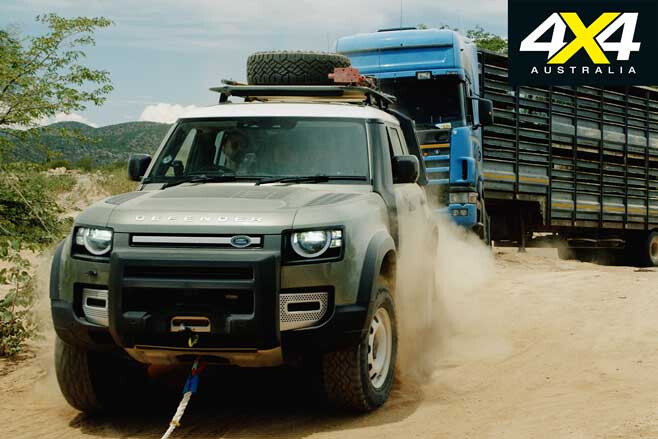
Not a problem for the team from Land Rover Experience which swung in to action hooking up two of the yet to be launched new Defender 110s -– a D240 diesel and a P400 petrol model. While the towing capacity of the new Defender is rated to 3500kg the duo punched well above their weight, using their combined 844Nm of torque, low range gearing and 4-wheel drive to pull the heavy rig out of the sand and back up on to the road.
The new Land Rover Defender goes on sale in Australia in August this year priced from $69,990 (plus on-road costs) for the D200 110 long wheel base. It will be joined by the short wheelbase, 3-door Defender 90 later in the year.
Stay tuned to Which Car next week as we bring you our first driving experience of the new vehicle from Namibia.
Bushranger 4×4 is giving you the opportunity to gear up for your next 4×4 adventure with its giveaway competition.
Head over to the competition website here, answer a question and be in the running to win an awesome prize pack for the 4WD Owner, Win a REVO 10S Winch, Night Hawk VLI Driving Lights & Light Bars, Recovery Gear, Compressor, Wheelie Bin, Diggar Shovel, Tyre Repair & Merchandise kit!
The competition is simple to enter, and grab an extra entry for any friends that you refer that enter. What are you waiting for?