
Jeep has officially pulled the wraps off its latest Grand Cherokee SUV, and the previously five-seat wagon has grown to three rows on a new platform.
The Grand Cherokee has ditched the Mercedes-Benz-derived monocoque chassis of the WK/WK2 model for a platform from the FCA stable, said to be that used under the Alfa Romeo Giulia sedan.
Despite the origins of the chassis the GC will retain its modest off-road capabilities, offering the choice of single- and dual-range 4×4 systems and the option of Quadra-Lift height-adjustable air suspension.
UPDATE, May 12 2022: The new Jeep Grand Cherokee L is now in Australia, and we’ve driven it. Read and watch our review at the link below.
The story to here
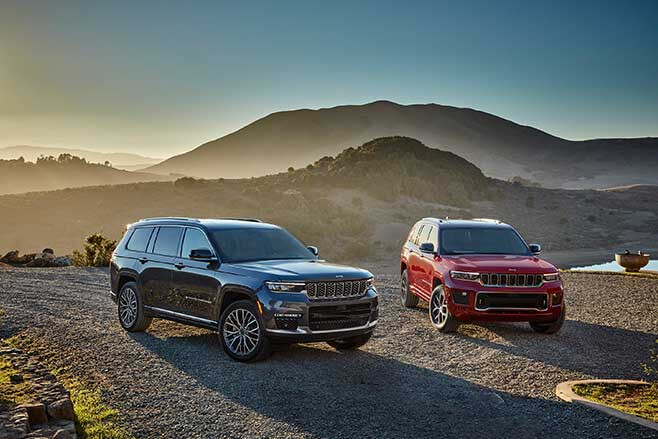
The new, stiffer monocoque uses independent suspension front and rear and the highest of the two off-road settings raises the body 100mm above normal driving height.
This gives the wagon 277mm of ground clearance and a 600mm wading depth.
There are two dual-range four-wheel-drive systems offered depending on the variant specification. Quadra-Trac II is the standard system, while Quadra-Drive II is the more off-road capable system and employs an electronic limited-slip differential in the rear for optimal traction.
The US-centric product release mentions two petrol powertrains – the existing 3.6-litre V6 and the 5.7-litre V8 – will be available in the Grand Cherokee at launch.
There is no mention of any diesel engine or any hybrid or EV powertrains at this point.
Hybrid will be a dead certainty for future release as Jeep looks to electrify its range, while question marks remain over future diesel Jeeps.
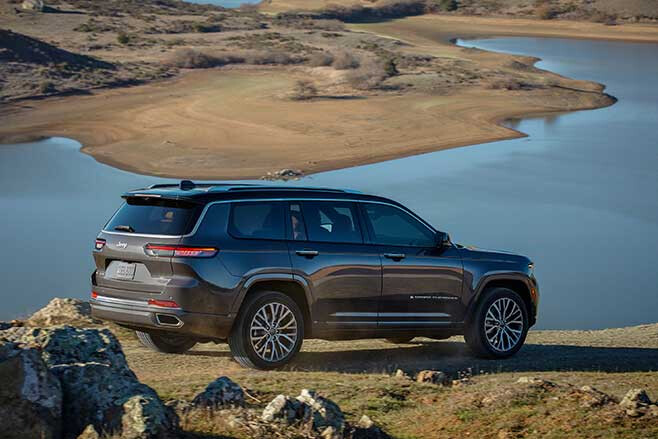
To make the Grand Cherokee a true seven-seat SUV it rides on a massive 3.1-metre wheelbase and the track is 36mm wider than that of the WK Grand.
The new body is instantly recognisable as a Grand Cherokee, with sharper lines and harder edges giving it a more modern look.
The WK2 Grand Cherokee was a sales hit when it launched in Australia back in 2011 as it regularly challenged the popular 4×4 wagons for top sales positions and was one of the best-selling Jeeps ever in Australia.
It was a good-sized, well-appointed wagon with modest off-road ability, a choice of petrol V6 and V8 and a diesel V6 engines, a class-leading 3500kg towing capacity, and it was reasonably priced.
But a series of highly publicised cases of so-called ‘lemon vehicles’ and owners disgruntled with the support they received from Jeep Australia soon saw the reputation tarnished and sales dropped dramatically.
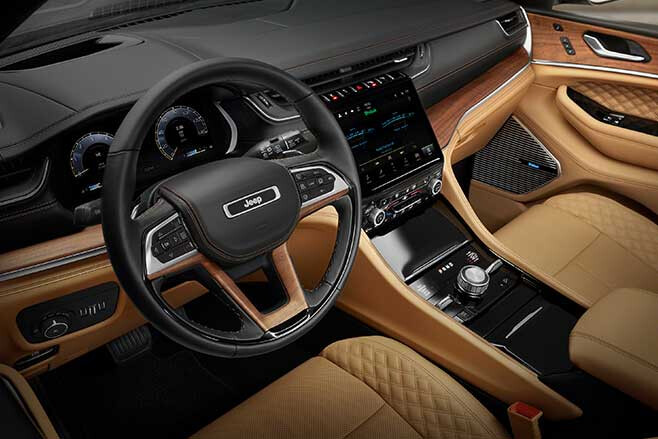
FCA/Jeep has worked hard to improve its customer relations and aftersales support since those days, and it will be hoping this new Grand Cherokee can replicate the strong sales of its predecessor when it lands here later this year.
So far there is no mention of what the line-up and pricing will be in Australia, with the company saying these will be revealed closer to the local launch.
THE Ford Ranger was the best-selling 4×4 in Australia in 2020.
In what was a tough year for the new car market – down 13.7 per cent on 2019 – the ageing Ranger ute bucked the trend, selling more units than it did the year before (37,889 units compared to 37,004 in 2019).
The total 4×4 PU/CC (pick-up/cab-chassis) market was down 9.5 per cent in 2020, but it was one of the strongest segments in new car sales.
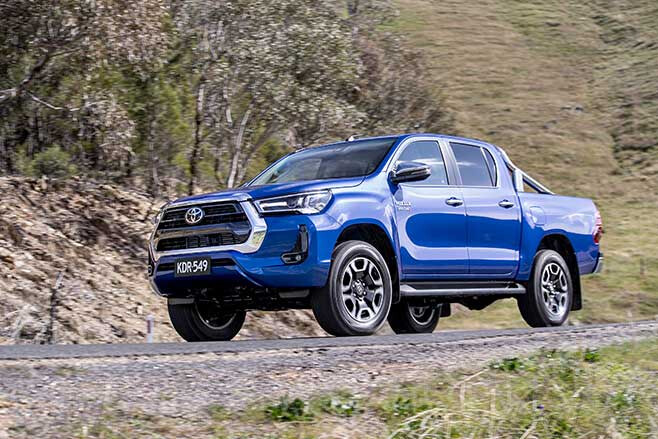
The Ranger’s biggest rival, the Toyota Hilux, might have been the best-selling vehicle overall in 2020 (45,176); but when you strip away the two-wheel drive models it fell short of the Ranger, selling 34,766 units (36,325 in 2019) for the year. This was despite a strong December, where it was the top-selling 4×4 with a stellar 4453 sales against its name. Hilux sales are up since the release of the updated model in September.
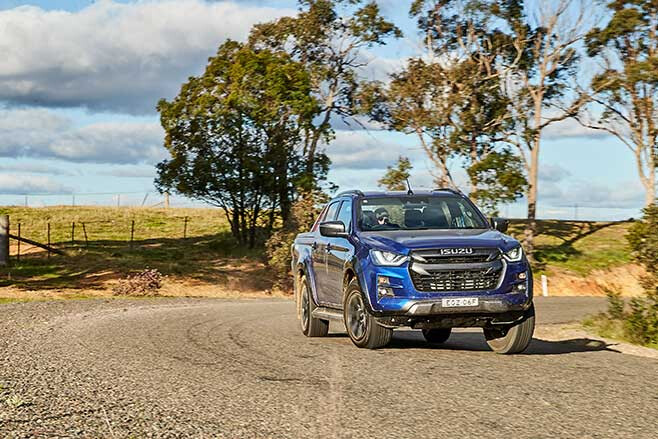
The other big mover in December was the Isuzu D-MAX which recorded 1775 sales for December, indicating that some of the early supply issues of the new model are freeing up. This also allowed the D-MAX to crack 10,000 sales for the year and finish as the sixth best-selling 4×4 for the year.
The D-MAX’s sister vehicle, Mazda’s BT-50, also had a reasonably strong December with 889 sales, allowing it to leapfrog the Holden Colorado in the yearly sales. For what it’s worth, the now defunct Holden sold just 27 Colorado 4x4s of its old stock in December, and this will be the last time we see the Australian nameplate on these lists.
The amazing performers are the only two wagons on the list: the Toyota Prado and LandCruiser 200. The only vehicles that aren’t utes pretty much have their respective classes to themselves, and they finished the year in third and fifth places on the 4×4 ladder. It leaves us wondering why other manufacturers can’t build a decent 4×4 wagon to challenge the Toyotas.
With four vehicles in the top 10 4×4 list and the only manufacturer with more than one entry, Toyota was again the top-selling manufacturer in the country, selling 204,801 of the 916,968 new cars sold overall. To put that in perspective, Mazda was the second best-seller (85,640) and Hyundai third (64,807).
DECEMBER 2020: 4X4 SALES
- Toyota Hilux: 4,453
- Ford Ranger: 3,875
- Toyota Prado: 2500
- Toyota LC200: 2235
- Isuzu D-MAX: 1775
- Mitsubishi Triton: 1388
- Toyota LC79: 1237
- Nissan Navara: 1058
- Mazda BT-50: 889
- Isuzu MU-X: 861
2020 OVERALL 4X4 SALES
- Ford Ranger: 37,889
- Toyota Hilux: 34,766
- Toyota Prado: 18,034
- Mitsubishi Triton: 15,649
- Toyota LC200: 15,078
- Isuzu D-MAX: 10,719
- Toyota LC79: 10,064
- Nissan Navara: 9777
- Mazda BT-50: 7193
- Holden Colorado: 6714
WAVE goodbye to 2020 and welcome in the New Year by picking up a copy of our latest issue of 4X4 Australia.
SUBSCRIBE TO 4X4 AUSTRALIA MAGAZINE
We’ve packed this issue tight with quality 4×4 content, including comprehensive coverage of that immaculate 79 Series set-up plastered on the cover. In fact, that very vehicle will feature regularly throughout 2021 as we follow it on its lap around Australia.
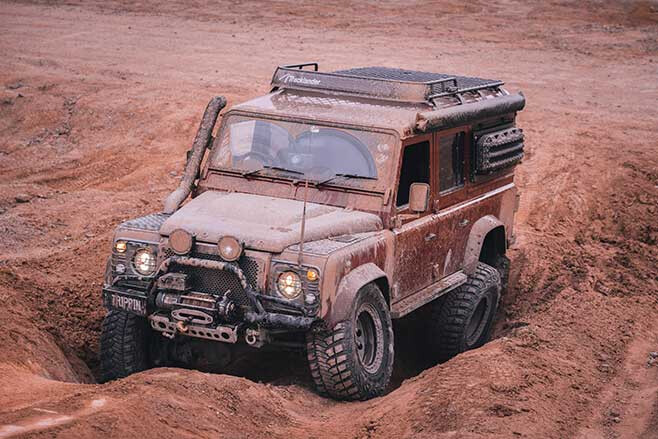
On the topic of custom metal, we examine a budget-built Hilux and a beautiful 2012 Defender that has been meticulously built with only the best quality accessories – not bad considering it’s the owner’s first 4×4 build.
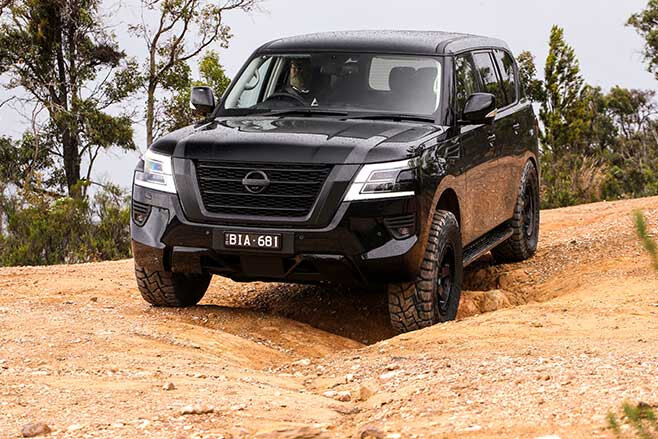
We also convinced Harrop to lend us the keys to its V8 Patrol fitted with a supercharger kit, which has been fettled to produce 360kW and 662Nm. Pick up a copy to read all about its mind-numbing acceleration.
Planning a 4×4 trip this year? To get you started, we’ve included three essential 4×4 destinations: Googs Track in SA, Burke Developmental Road in Queensland and Stradbroke Island in Queensland.
WHAT ELSE IS THERE?
– New Defender hits the Vic High Country. – A guide to dual-battery systems. – Kenda Klever MT tyres tested. – Product reviews, opinions and more!
The January 2021 issue of 4X4 Australia is available now.
VICTORIA’S Mallee region is a vast expanse of wheat-and-sheep country that travellers have typically passed through on their way to other places considered more enticing, like the thriving riverside cities of Mildura and Swan Hill.
You can’t blame tourists for overlooking the region. Until recently, it had a reputation for being a harsh place filled with dying towns and struggling farmers locked in a never-ending battle against droughts, dust storms and plagues of rabbits and mice. Indeed, if you look at the Visit Victoria website, the Mallee is barely mentioned at all, buried as it is in a section called ‘The Grampians’.
Yet the Mallee now finds itself in the midst of an unlikely tourism-led revival, sparked largely by the development of the Silo Art Trail and a growing appreciation for the natural beauty of Lake Tyrrell.
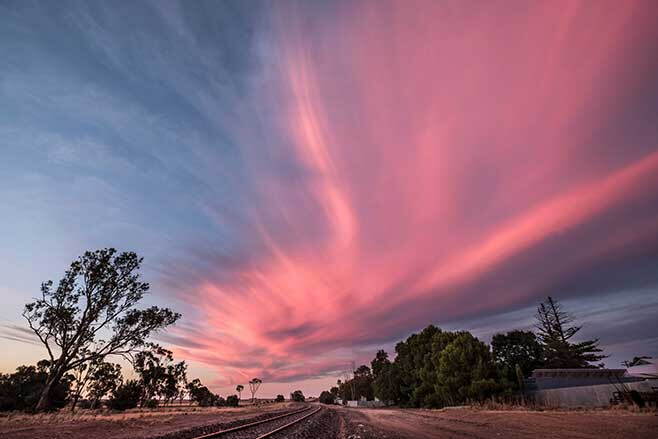
It is this moment in time, when a region best known for being in the middle of nowhere has found a new relevance as a destination for travellers keen to explore their backyard, that we have captured in our new documentary book The Mallee: A journey through north-west Victoria.
Having grown up in the tiny Mallee town of Manangatang, I had long dreamed about putting together a publication that celebrated the region and its great characters. Teaming up with five of Australia’s best documentary photographers – Andrew Chapman, Jaime Murcia, Melanie Faith Dove, Noel Butcher and Erin Jonasson – gave me the chance to make it happen. And I can’t forget our superstar book designer and part-time snapper, Phil Campbell. We think his graphic design prowess sets our book apart from many others.
Our snapshot of the Mallee follows the railway lines built through the region in the late 1800s and early 1900s. Using this as the narrative, we tell the story of the Mallee’s history as a whole and also focus on the stories of the little towns we find along the lines. Many are greatly diminished when compared to the bustling commercial centres they were 60, 70 or 80 years ago.
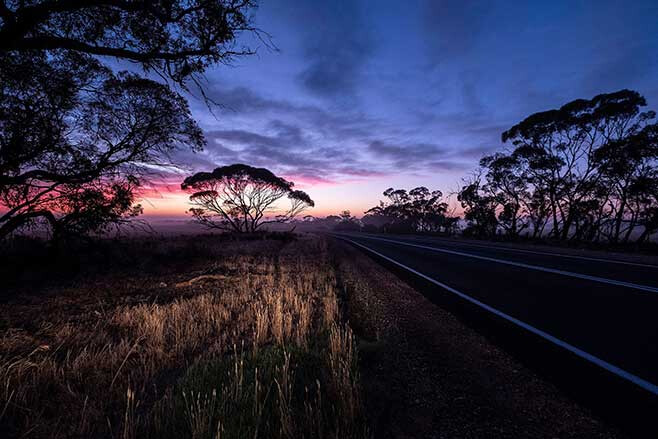
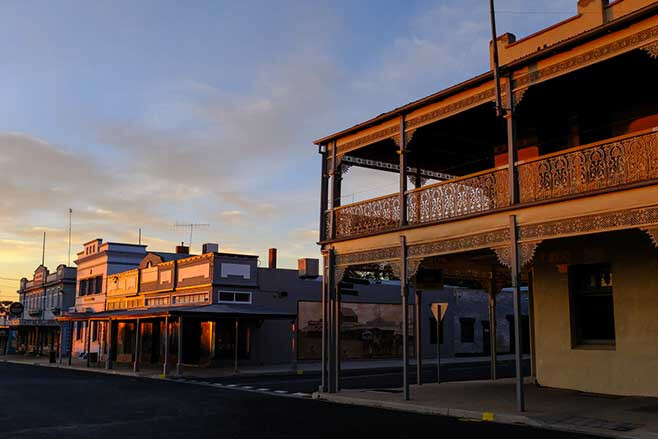
Rosebery, for example, once had a population of more than 300. It had numerous shops and sporting clubs. Today, just five people call the Rosebery district home. As photographer Andrew Chapman likes to say, “The Mallee has a clapped-out look about it.” Yet the sense of nostalgia you get from walking the streets of a Mallee town is a tourism drawcard in itself.
PATCHE PUB
AND tourism is already reviving a number of other towns that could have gone the same way as Rosebery. The outpost of Patchewollock, which is only 430km from Melbourne but has a real outback feel, has been swarming with caravanners since the opening of its painted silo. The silo is handily located over the road from the much-loved ‘Patche Pub’ where you can be assured of cold beer, hearty food and spotless rooms, has benefitted greatly from this influx of people.
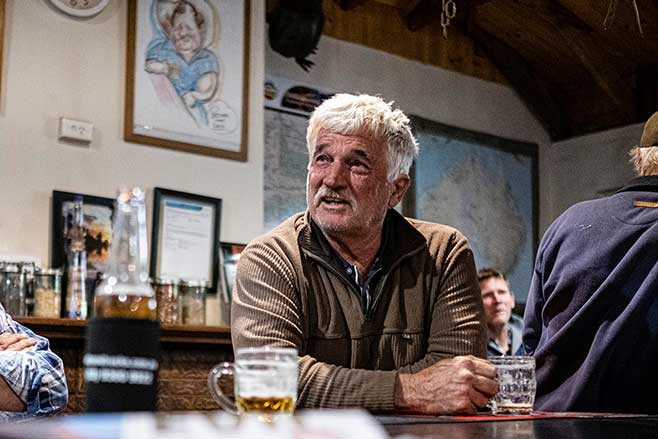
Be sure to have a cold one while leaning on the horseshoe-shaped front bar. You’ll no doubt end up chatting about the weather or wheat prices or even the annual Patchewollock Music Festival with one of the super-friendly locals. You might even get to say hi to Nick ‘Noodle’ Hulland, the farmer who is painted on the silo.
Patchewollock’s other great strength when it comes to tourism is its proximity to Wyperfeld National Park. The park has plenty of attractions for 4×4 lovers, although it’s a good idea to steer clear of the area in summer when temperatures can rise to near 50⁰C … in the shade.
One of the most popular things to do in Wyperfeld National Park, if you have entered the park from near Patchewollock, is visit the giant sand dune known as Snowdrift. Kids can have hours of fun rolling down the steep dune or riding down it on one of the rudimentary boards that are housed in a shelter at the bottom of the dune near the campsites.
The view from the top of Snowdrift is spectacular. You look across the vast Wirrengren Plain and see the trees that line Outlet Creek arranged snake-like across the landscape. The Wirrengren Plain was once an important indigenous trading route, with the area playing host to gatherings of people who had travelled north from the Wimmera River and south from the Murray River.
Another popular spot in the north of the park is the Casuarina Camping Area. If driving in from Patchewollock, you can access the area with a two-wheel drive. But a four-wheel drive is required if coming from the Mallee Highway town of Underbool via the Gunners Track.
There are no booking requirements or fees for camping at Snowdrift or Casuarina, but advance bookings and payment are required to camp at the Wonga Camping Area in the south of the park, which is accessed from the town of Rainbow.
To the north of Wyperfeld is the Murray-Sunset National Park and its Pink Lakes. Once home to a salt mine, the lakes are now celebrated for their natural beauty. This area, too, has some beautiful camping areas and some excellent tracks for 4×4 enthusiasts.
Away from the national parks, the Mallee has plenty of other attractions to offer. There are now painted silos in a host of towns, including Lascelles, Sea Lake and Nullawil. Sea Lake is also the perfect base for exploring Lake Tyrrell, a giant salt lake renowned for its shallow water that on most days provides a perfect mirror of the sky. You can’t beat a trip to the lake at sunrise or sunset with Julie Pringle, who runs Sea Lake Tyrrell Tours.
If events are your thing, there are iconic horseracing meetings at Wycheproof and Manangatang, the latter of which has achieved a degree of fame thanks to the popularity of the saying, “They’re racing at Manangatang.” Both events are sure to be bigger than ever in 2021 after being cancelled this year.
No matter which way you want to approach the region, now is the time to put the Mallee’s reputation for drought and disaster aside and take a look at the place for yourself.
MORE INFO
www.wimmeramalleetourism.com.au www.malleehighway.com.au
SOMETIMES, it takes a setback to take a step forward in life. And unfortunately for the owner of this 105 Series LandCruiser, Callum Mackellar, it took a serious accident for him to arrive at this dream setup.
Callum cut his teeth in the 4WDing world in a 2003 Holden Jackaroo, and a slow, yet trusty 105 Series LandCruiser with the naturally aspirated 1HZ diesel motor which he loved to pieces. Sadly, that vehicle is no longer with us.
“My first 105 was written off,” says Callum. “But that presented me with the opportunity to buy the holy grail, a stock-as-a-rock 2003 Kakadu Grey 105 LandCruiser. Well, stock apart from having a Sahara spec interior trim conversion, and (let’s be honest – the main attraction) a highly sought-after factory turbo diesel 1HD-FTE motor swapped in.”
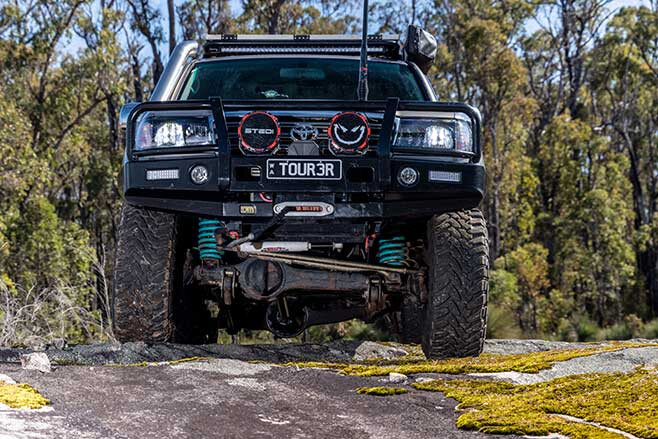
Now, the 4.2L 1HD-FTE factory turbo diesel motor needs no introduction, as it’s proven to be an absolute workhorse, yet it was only available in the 100 Series LandCruiser which features a torsion bar IFS setup that isn’t favoured by hard core 4WDers. When Callum saw this beast up for sale, with the factory turbo motor swapped into a 105 Series Cruiser with solid axles front-and-rear, he knew it was too special to pass up on.
While the bones of this vehicle were solid, it was a bit sad in the accessory and modification department, and we all know that’s not going to cut the mustard off road. “The vehicle was basically stock standard,” says Callum. “Which to be honest, suits me just fine as I’ve been able to build it up the way I like and create my version of the ultimate vehicle for extended trips all around Australia.” A job well done we say.
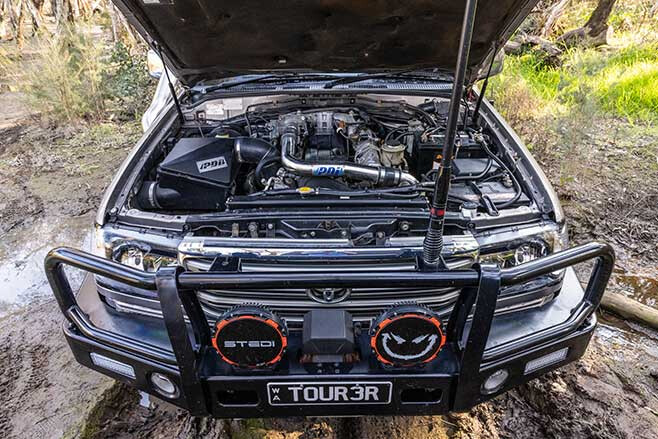
Callum mentioned that that side of things was actually rather smooth sailing, as he undertook most of the work himself. And while it was challenging, he found the experience extremely rewarding. The build took him a year to complete, and he tells us it cost $65,000 to put together, which in the scheme of things is money very well spent as he learned plenty along the way.
First cab off the rank, was extracting a little bit more power out of that lovely motor, by enlisting the help of Graham at GTurbo in Balcatta, Western Australia. With a few key modifications, Callum’s 105 is now making 233hp and 640Nm at the wheels, serious numbers indeed. These modifications include a GTurbo Red Wheel turbo upgrade, a front-mount intercooler conversion, PDI 4-inch airbox and a 4-inch stainless steel snorkel from Moonlight Custom Fabrication.
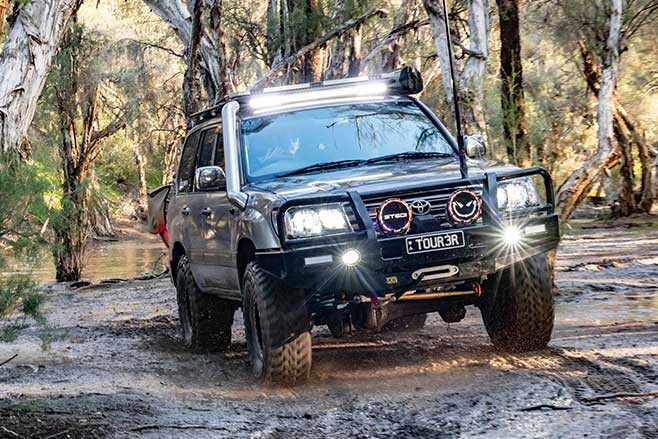
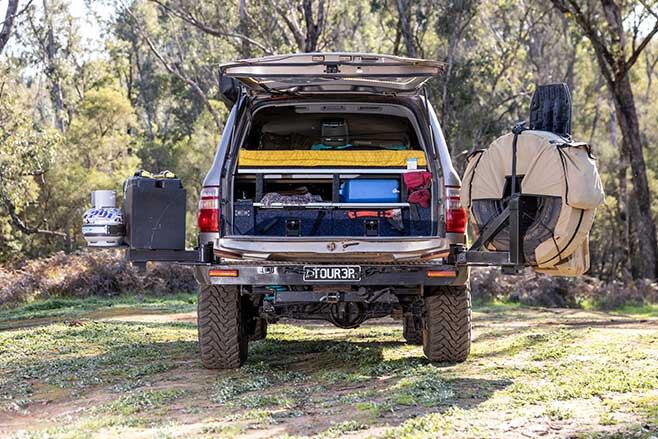
To allow the tuners to talk to the engine, a Unichip Q4 module was also installed, as well as a Manta 3-inch exhaust system meaning you can definitely hear Callum coming. To get power from the engine to the tyres, Callum wisely decided on a clutch upgrade, using a proven NPC unit. Around this time, Callum also decided it was important to have a solid touring range, and installed a 170L Brown Davis long-range fuel tank to extend his time between fuel stops dramatically. To further assist with fuel economy, a Marks 4WD 2WD conversion kit was also installed.
Touring mods include a winch compatible TJM steel front bar, with Stedi Type X spotlights, a Shoreline alloy roof rack with 50-inch LED light bar across the front and some aftermarket headlights to complete the lighting package. Callum has had a custom rear bar manufactured which incorporates twin jerrycan holders and a space for the spare tyre. A set of basic rear drawers house any camping gear and tools Callum needs to haul, and provides an area to put a bed on top as well as a hidden fridge. Solar screens on all windows help keep interior temps down too, as well as provide security while parking up for the night.
Suspension and tyres are two of the most important aspects for any touring 4WD, and Callum is wrapped with his setup. Starting with 3in Dobinson coil springs and 5in Superior Engineering remote res shocks. The coils are set up to carry 150kg constant load in the front, and 450kg in the rear. Superior Engineering again got the nod for its beefy upgraded suspension arms, such as tie rod and Panhard rods. A wise decision as the factory offerings are a little tame. Wheels are 16in Dynamic steelies with fake beadlocks, covered with 315x75R16 Toyo mud terrains, which Callum says are the best bang for buck mud tyres he’s driven on.
Regarding 12V, Callum is running a triple-battery setup (one start and two auxiliary) which is managed by a Redarc BCDC1225 and fed by a 180W solar panel when camping. A JVC head unit has been installed, as well as a 1000W amp to power a sub and 6 x 9 speakers when he is sick of hearing that FTE purr. So not often, in other words. With the Sahara interior fitted, Callum has such luxuries as woodgrain trim, leather seats in the front (the rears were turfed early in the game) and the coveted centre console icebox.
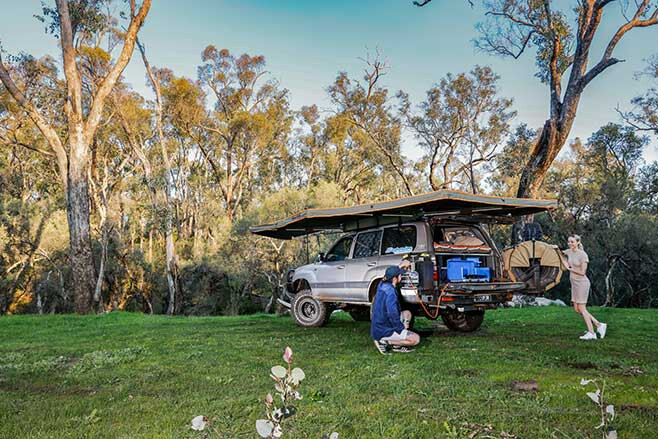
When asked why the 105 is so special to Callum, he summed it up nicely. “It’s an extremely capable and comfortable touring vehicle that I have 100 per cent confidence in.” And what’s in store for the future? Callum answered rather simply, by saying “many things.” His plans include improving the sleeping platform inside the Cruiser and installing some gullwing windows on both sides to allow for better access.
Interestingly, Callum is also planning on installing a sunroof directly above their heads so they can watch the stars of a night while sleeping in the vehicle. A capable, powerful and rugged vehicle for touring, and a comfortable place to sleep at the end of the day. What more could you ask for in a dream setup?
GEOGRAPHY quiz: What’s less than 1000km from Australia’s three biggest cities and dishes up a true taste of the Aussie outback? The answer: Bourke, NSW.
Yep, the tiny dot on the map that for many is a convenient place to restock before a broader adventure into the yonder is also surprisingly close (remember, we’re talking Australian outback close) to a fair chunk of Australia’s population, including Brisbane (924km), Sydney (758km) and Melbourne (982km).
Bourke is one of the bigger towns on the Darling River Run that meanders from Walgett in the north to Mildura on the Victorian border. It’s a fascinating insight into the former thriving port towns that played an integral role in transporting wool and establishing inland Australia as a source of income.
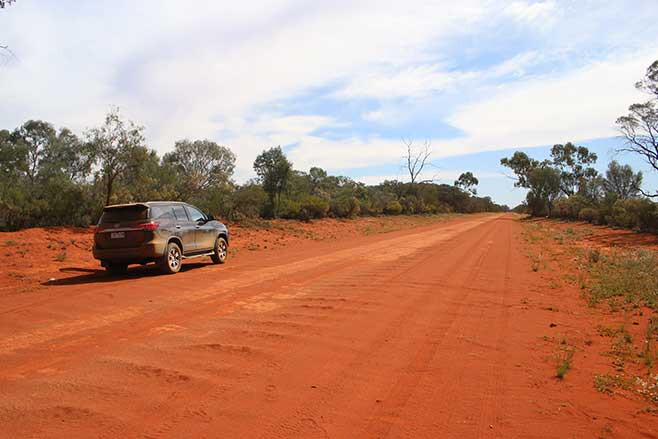
In all, there’s 730km to play with down The Run, but for this adventure we’re showing how you can change it up, crafting your own side trips delving into the best outback NSW has to offer. With national parks, Aboriginal culture and an insight into what makes the outback tick, the Darling River is the perfect spine to soak up the outback within a long day’s drive of big civilisation.
Much of the Darling River Run is on well-packed gravel roads. But like all outback adventures there’s always the risk of punctures. While 2H will suffice for much of the trip, it pays to have a proper 4×4 for variable road conditions –and so you’re not limited on any planned side trips.
BOURKE
WHICHEVER way you attack it from, Bourke is a decent drive. And the final run reinforces you’re in a less populated part of the country, wayward kangaroos and all.
Rolling into town is a welcome respite to the vast openness of the country that sprawls off in any direction. It’s impossible not to soak up at least some of the rich agricultural history of Bourke from the moment boots hit the pavement. Some regal two-storey buildings help the cause.
The modern Bourke doesn’t have the thriving industrial nature that defined the place in the late 1800s when dozens of wood-fired paddle steamers carried wool bales from surrounding farms down towards the Murray. Instead it’s a more relaxed outback town, albeit one oozing character from its working days.
If you want some respite from banging tent pegs into dusty earth there are some surprising finds, including the Riverside Motel with its beautifully restored high-ceiling rooms and main house that no doubt poured plenty of brews when it was the Telegraph Hotel.
The Bourke Bridge Inn is also a characteristic antidote to a motel. It’s outside the main town alongside the oldest moving-span bridge in Australia, constructed to allow passage for the boats that were the lifeblood of the river in its working heyday.
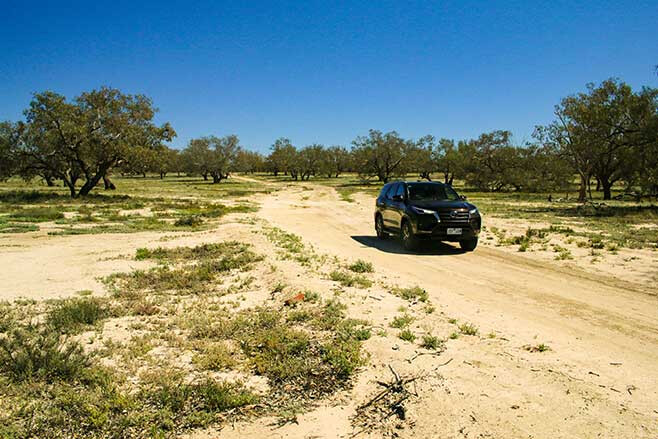
The Old Bourke Wharf is the former heart of the town, its spectacular multi-layered jetty the perfect place to soak up the tranquillity of the slow-running river. A ride on a paddle steamer is a reminder of Bourke’s formerly prosperous past, but during holiday times it pays to book to save missing out on the limited daily runs.
Even without the aquatic adventures, there are lots to explore in and around Bourke. Take the long road to the northern side of the Darling that forms a natural barrier on the edge of town, its steep banks overshadowed by ageing gums. The short but informative Maritime Trail even showcases the ruins of one of the original boats – and the Bourke Wharf is no less spectacular from the opposite bank, the lack of development reinforcing what the area was like prior to European settlement.
A tractor-sized 1923 Crossley engine is a stone’s throw from the banks of the Darling and is regularly fired up for tourists. While this particular engine did no work in Bourke’s early days – it was hundreds of kilometres away generating electricity in Sydney – it’s a reminder of the industrial past of the town on the unofficial edge of Outback NSW.
GUNDABOOKA
ANY Darling River Run will include plenty of kays travelling the main gravel road that heads south-west from Bourke. But it’s worth looking farther afield for some rewarding add-ons. Head south on the Kidman Way towards Gundabooka, which is one of those outback gems that throws up rocky surprises in an otherwise vast, flat and often featureless land (which, to be fair, has appeal of its own).
Road closures are common around here after rain, so ducking into the Bourke Visitor Centre before leaving town is worth the five minutes to ensure you’re properly prepared.
Delving deeper into the southern reaches of former grazing land takes you to Mulgowan, an easy drive with well-marked facilities. If you’re not up for one of the longer bushwalks in the park, the 1.4km track through Mulareenya Creek is less daunting and wonderfully picturesque.
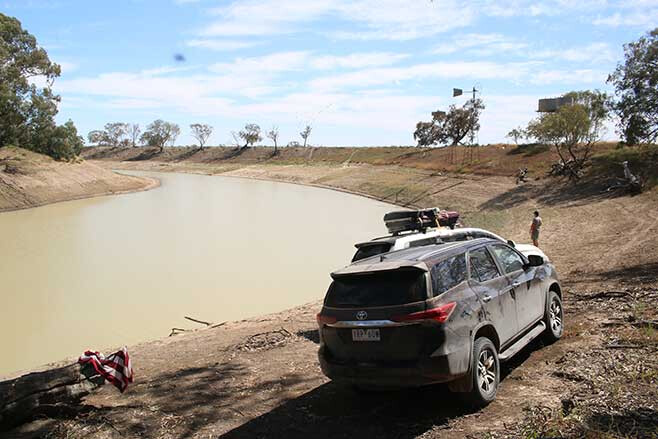
The short walk over a rocky pinch and into the mostly dry creek is a pleasant change from the vastness elsewhere. A rest on a rock is a chance to reflect on the serenity of a place that doesn’t look much changed from what it would have looked like thousands of years ago.
But it’s the Aboriginal rock art at Mulgowan – or Yappa – most come for, something that doesn’t disappoint. Walkways and fences make the main site obvious, images of emus and humans on overhanging ledges easy to make out. Follow the rocks farther around for another batch a few hundred metres along.
There are various campgrounds among the dense vegetation or an old shearers’ quarters and homestead providing self-contained accommodation for larger groups.
Well-posted roads direct you north back to the River Run or you can keep the National Park theme running with Toorale to the north. The former pastoral land was reclaimed from the government and designated a state area a decade ago, marking one of the newer places for visitors to explore.
STATION STAYS
SHEEP and sheering are still big business in north-western NSW, but a growing number of stations cater for 4×4 adventurers as well. Rose Isle station is one of the early contenders, providing well-manicured campgrounds or something closer to nature along the river.
Sure, the campsites are numbered, but you’ve got a patch to make you feel like you’re the only ones there. It’s a drive to the amenities, which include a newly established donkey shower complete with a blue-sky view. Be sure to stoke it up with wood to keep things toasty.
One thing that isn’t in short supply is firewood courtesy of the hardy trees surviving on often sporadic rain and whatever they can draw from the river. So it’s a short drag of some larger logs to keep the coals burning.
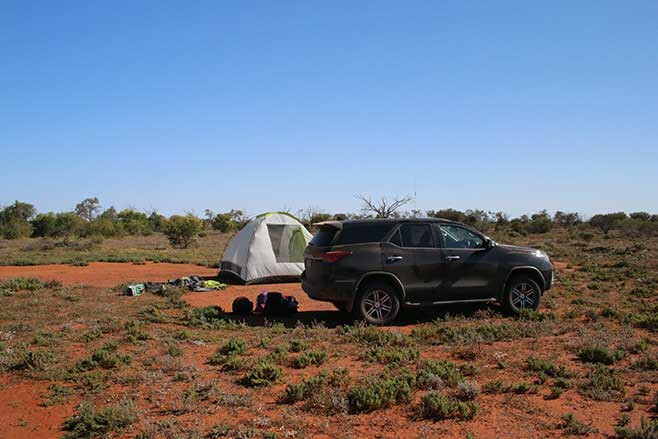
Oh, and don’t forget the morning tea, where Samantha shows off her baking skills (you really, really don’t want to miss it!) and will fill you in on a story or two.
Camping and accommodation choices ramp up as you continue the journey. Trilby and Kallara are two popular choices. Or there’s Dunlop Station that was once more than a million acres and has recently undergone a restoration having been abandoned for years. The 11am tour is a fascinating insight into life on a big sheep station many moons ago. It includes full access to the homestead and the old store that provided supplies to workers and neighbouring properties. No shortage of stories for a reminder of how tough farm life was way back when. Get ready for the one about the meat ants …
Dunlop camping is great, too. One of the picks is Wheelchair Camp – ask them about the name, there’s half a story to go with it – which is at the end of a line of camps giving the impression you’re there alone. If you’re not one to brave a swim (well worth it) an abandoned fish trap even provides the chance to catch dinner.
LOUTH, TILPA
THE road that vaguely follows the River may conjure images of a meandering track. But it’s mostly very well maintained gravel, albeit with all the outback caveats to be ready for anything. Dips or corrugations occasionally pop up and after rain there will be bog holes that should be avoided where possible, at the very least to stop churning up the road surface.
Tiny one-pub towns hugging the riverbank break the drive. A general store and a cemetery are the main appeal in Louth. That and the quaint bridge shrouded by gumtrees that allows a crossing to the north of the Darling.
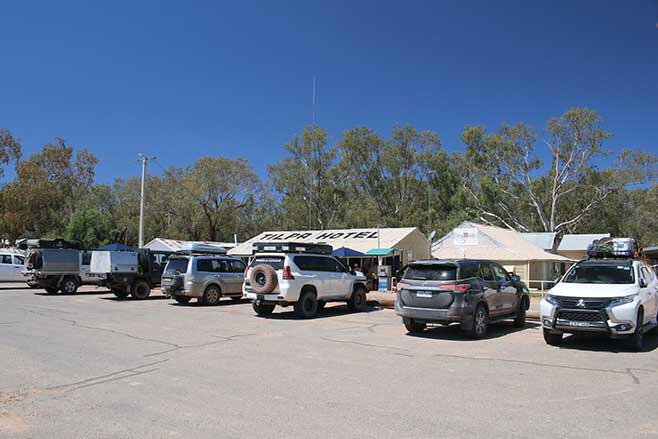
Louth is one of those towns that most would blaze through, unaware of its history. The cemetery is a good place to start. Rather than the crumbling headstones so common in burial grounds, there is one enormous ‘shining headstone’ that lives up to its name at sunset, reflecting the golden light from its 1.2m-high Celtic cross through town, albeit momentarily. The monument to local woman Mary Mathews was erected in 1886 and remains a beacon.
The Tilpa pub is a must-stop to bend an elbow on a cold brew. It’s a popular watering hole with good reason. How they get the hot chips better than most city pubs could be testament to the TLC metered out in the kitchen. All of which suggests it pays to allow time to refuel, with sprawling outdoor tables catering for overflow.
If you don’t have time for a feast, make a small donation and grab a pen to scrawl a message on the pub walls.
PAROO-DARLING
FROM Tilpa most adventurers stick to the river. But tracking north takes you into Paroo-Darling National Park. It’s vast, scrubby country that has far fewer tyre tracks than other roads around here. While the regular River Run has its fair share of cars during tourist season it’s refreshing and more reminiscent of the wider outback to see open roads virtually devoid of other vehicles.
The occasional shingleback or wedge-tailed eagle give an inkling to the wildlife on offer, and visiting after rain, the flies and mossies are also friendly.
Paroo-Darling has the sort of roads that are fine in 2WD most of the time, but having a 4×4 is a must in case things get sticky. Picking your way around mud holes and ridges can easily slow those higher speeds elsewhere.
It’s rocky country with hardy mulga and saltbush scrub, with the majestic Peery Lake at its heart. Fed partially from the Great Artesian Basin, the permanent water source is bursting with bird life, so don’t forget the binoculars. Braver folk can go for a dip or break out a canoe for some outback paddling.
WHITE CLIFFS
NEXT stop is opal country and the home of underground living, White Cliffs. Thousands of rock piles have transformed the barren rocky landscape, an eerie visual reminder of the town’s reason for being.
Whereas big mining companies dominate the collection of most minerals and gemstones, opal mining is mostly the domain of individuals and families hoping to strike it rich by picking away at rocks for the proverbial coloured needle in a haystack. White Cliffs is famous for the giant pineapple opals that collectors pay hundreds of thousands for, something that acts as a lure for strike-it-richers.
There’s the occasional grand, glassy residence on one of the low hills at the centre of town but for the most part, the underground ‘dugouts’ and basic houses are an indication most are yet to hit the big time.
A driving tour around town reinforces the sole reason most are here: opal mining. Trucks and mineshaft buckets litter the landscape. The occasional campervan and well-used truck break things up. Optimism runs high for many. But be careful not to wander too far from your car, because those rock piles are alongside often deep holes that could nicely ruin a holiday.
Book early if you want to stay in dark and 23-degree cool of the Underground Motel, too. Or take a tour underground to see just how hit-and-miss opal mining is. There’s no shortage of fascinating stories.
WILCANNIA
SURE, the Darling River Run continues far farther than Wilcannia, taking in the beauty of Menindee Lakes or to the culinary feasts of Mildura. Or you can head west to Broken Hill then on to the Flinders Ranges and beyond. Burke and Wills country is not far away, nor is Birdsville.
But Wilcannia is also an easy place to pull up stumps and head for an easy blacktop drive home, although not after some exploration. Whereas Bourke has begun to capitalise on its tourist appeal, Wilcannia has yet to catch up. Many buildings remain empty, businesses abandoned.
The lack of accommodation in town reinforces its current standing, although Warrawong on the Darling a few kilometres south has cabins and camping with basic facilities. Warrawong’s take on Bondi Beach is a bit different to the Sydney version, but it at least has red and yellow flags!
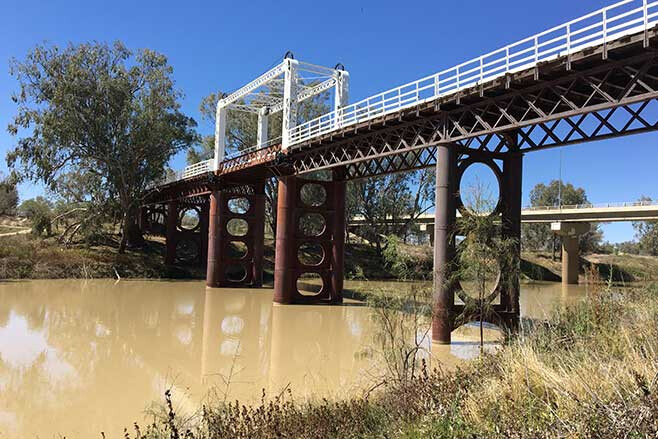
There are elements of Wilcannia that remind of its vibrant past, the grand buildings as graceful as ever. There’s some genuinely magnificent architecture. Dig deeper and there’s lots to explore, including details of the Wilcannia Rowing Club. Yep, it was a thing. Or the old Lion Brewery owned by Edmund Resch before he crafted Resch’s into a true Aussie bloke’s beer.
Beautifully maintained buildings are a grand reminder of the town’s wealthy past. The self-guided tour of town – make sure you check out the hospital – is the bare minimum to learn more about a place most don’t bother stopping for.
Wilcannia is a place with plenty more to offer than its lack of facilities would suggest. If we were cracking out the crystal ball, we reckon the history and architecture suggests that sometime in the future, Wilcannia will be more of a tourist stop than the shell it is today.
As it is, it’s a fitting full stop on an outback adventure that nicely melds Indigenous and European history into a relatively accessible part of the country.
ESSENTIAL INFO
Bourke is a relatively accessible entrée to the Australian outback with terrific Aboriginal and agricultural heritage, superb camping and other accommodation options.
There’s some bush camping along the Darling River Run, but utilising the facilities of a station is a more comfortable way to do it while still feeling like you’re alone.
Take the swimming gear and binoculars to make the most of river life.
If by the end of the truncated Darling River Run you’re up for more, there are no shortage of places to explore. Head a couple of hundred kilometres west to tag along with Burke and Wills country. Or a similar distance to Broken Hill then onto the Flinders Ranges. Or you can set the compass north for Birdsville and the Simpson.
Keep in touch with local tourist authorities to learn of any road closures; they’re common out this way after rain.
WE delve a bit deeper into a few campsite-friendly products that are new to market.
KEEN WILD SKY HIKING BOOTS
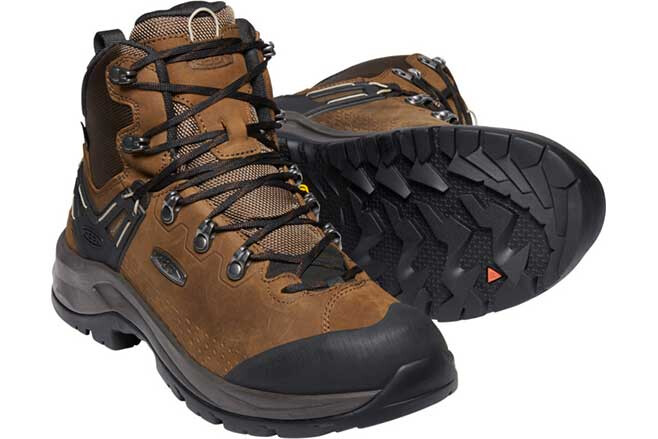
Outdoor footwear brand Keen has added a new top-of the-line hiking boot to its range, taking it to new territories in more ways than one. The Wild Sky boot is made for serious hiking, be it a local day trip or multiday trek with a fully loaded backpack onboard.
To achieve this, the Wild Sky features an upper made from leather and mesh to be both durable and comfortable. The leather features a waterproof liner to keep socks dry and there’s a removable PU foot-bed designed to best support your arch.
The Wild Sky employs Keen’s KonnectFit heel-capture system which fits snugly around your heel to almost clamp your foot in. The boot requires a bit of wearing in, but it feels very durable. The chunky all-terrain sole should provide grip in all conditions.
We’ll be giving the Keen Wild Sky more of a workout over summer and will let you know how they perform.
RRP: $329.99 Website: www.keenfootwear.com.au
ECO TOWEL
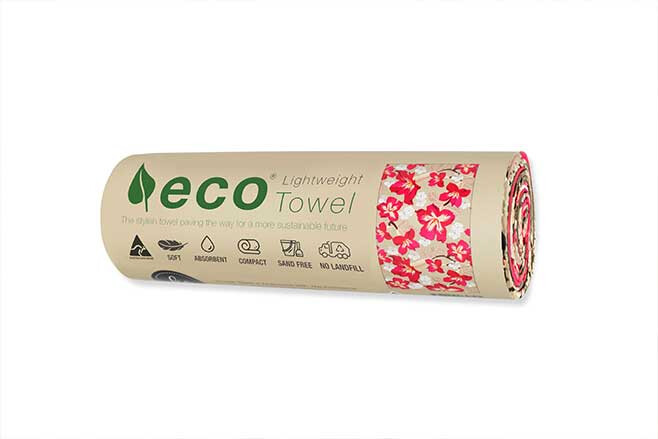
KE Design’s ECO Towel is an environmentally-friendly towel that is made in Melbourne, Victoria, and the first-ever Aussie-made towel to be made from RPET, a recycled yarn that uses post-consumer recycled plastic bottles and fabric cut-offs.
The RPET yarn has a 50 per cent lower carbon footprint than organic cotton, and the patterns are printed using water-based inks and compressed at high temperatures to bond their microparticles together and ensure our ocean remains protected. Not only does each ECO Towel keep 20 water bottles out of landfill and our oceans, they’re also said to be extremely comfy.
More than 20 designs are currently available.
RRP: $79 Website: www.kedesigns.com.au
OZTRAIL KINGSFORD SLEEPING BAG SERIES

These new oversized Kingsford Series sleeping bags from OzTrail are designed to provide maximum space and maximum comfort to suit every season.
The sleeping bags feature a snag-free zipper, hanging loops for airing and are easy to look after (cold machine washable). The bags are soft to touch and come with a low-noise outer shell, ensuring you get a quality sleep at your favourite campsite.
Prices and sizes vary.
Website: www.oztrail.com.au
ONE said “Land Rover ‘Offender’.” Another, “what a misguided path.” And others a lot more. The new Defender has certainly upset the Land Rover faithful and I understand their discontent.
The essential problem is this. The ‘old’ Defender, namely the one that stopped production on January 29, 2016, was a very basic and relatively simple 4×4 with a separate chassis and live axles at both ends being what it was, namely the direct descendant of the original 1948 Land Rover. That last of the old Defenders was about as low-tech as it could be, while still meeting mandatory safety and emissions regulations in play at the time.
The new Defender, however, is as complex and sophisticated as any current Land Rover model, Range Rovers included. In fact the new Defender is an evolution of the high-tech aluminium monocoque platform that underpins the current Range Rover.
Adding to the faithful’s angst is that there is no ute or cab-chassis of any description in the current line-up and little prospect of one outside of a recreational-focused integral-tub dual-cab.
Certainly with this new Defender any prospect of rural, mining, forestry, remote-area NGO, or military use is gone. It is purely focused at private use.
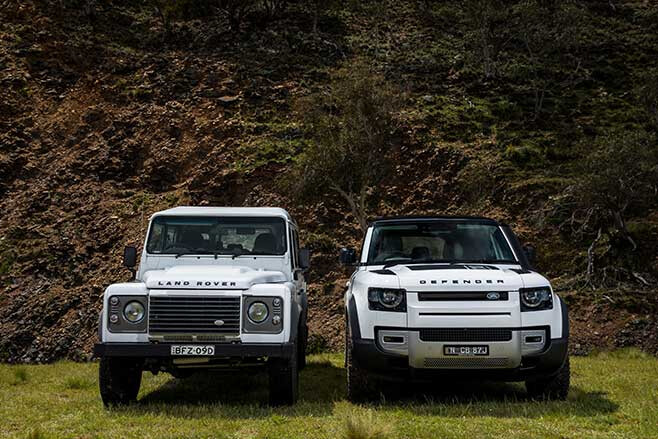
Further annoying the Land Rover purists is the fact that even the 90 and 110 names are misleading. In Land Rover-speak, the numbers 90, 110 (and 130) previously referred to the wheelbase in inches whereas the new ‘110’ is built on 119-inch wheelbase and the new ‘90’ is built on a 102-inch wheelbase. Heresy indeed!
Land Rover never set out to make the new Defender as a simple 4×4, it set out to make the Defender the most off-road capable model in the current Land Rover range, which it certainly is. There’s no question there. It may be an evolution of the current RR/RRS/Discovery platform but it’s been completely re-engineered from the ground up to make it both more off-road capable and more off-road durable.
Land Rover’s current owners, India’s Tata Motors, has seemingly the deepest pockets of Land Rover’s many owners, even if both Ford and BMW did invest heavily in the brand, and the new Defender comes across very much as a spare-no-expense exercise.
Land Rover could have gone the low-cost route for the new Defender by recycling one of its older and out-of-production designs, the Discovery 3/4 being the obvious candidate, but one can only speculate on whether this was ever considered.
Land Rover has history here as one of its most successful models of all time and one that saved the company from going broke, the original Discovery, was essentially the mechanicals of the last of the first-generation Range Rovers recycled under a new body.
The Discovery 3/4’s appeal in being the starting point of a new Defender include its box-shaped body, which is functional and has the look of a traditional 4×4, the image you wish to create for Defender. As for the mechanicals the theme should be ‘simple’, so coil springs rather than height-adjustable air springs, six-speed manual and automatic gearboxes, and the lowest-tech 3.0-litre V6 diesel you can get away with emissions wise.
Most of what could be used in a new Defender has in fact been in production before. The Discovery 3/4 is also a body-on-frame design, which opens up the possibility of single and double-cab utes even if the rear independent suspension would need some re-engineering for load carrying.
Things would have no doubt turned out differently had Tata said to Land Rover, “design a cheap, simple and robust Defender, in both ute and wagon models, that we can build and sell in India and export to ‘developing-world’ markets in Africa, the Middle East, SE Asia, and the like”. Ironically all the places the original Land Rovers made their name and reputation. Something like that would also come far closer to keeping the Land Rover faithful here happy as well.
ORIGINAL plans for Drive 4 Life’s (D4L) annual charity drive had multiple convoys travelling through western New South Wales, the Corner Country and into South Australia’s Flinders Ranges, but border closures and travel restrictions forced a rethink.
Many participants planning to attend from states other than NSW were forced to cancel and the D4L leaders restructured a route that stayed within NSW for a single convoy of eight 4×4 vehicles.
Drive 4 Life is a not-for-profit group that organises 4×4 trips to different locations each year. A $1000 donation to a registered charity gets your 4×4 on the trip and it’s always a lot of fun with a great bunch of people. So much so that many participants are repeat attendees, coming back year after year.
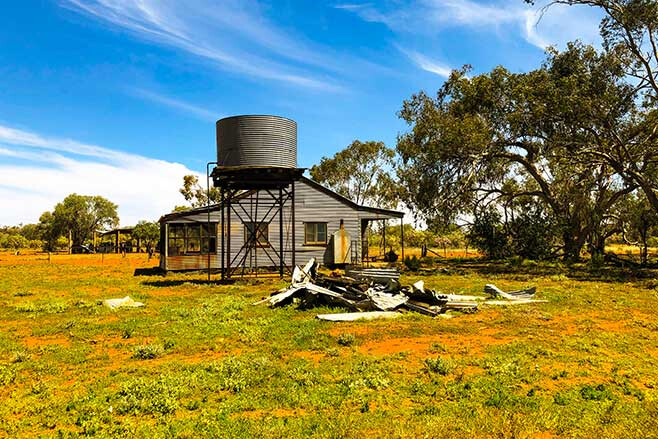
The 2020 crew met up at the IGA at Warren in the Central West of the state where there was some last-minute stocking up of essential supplies. IGA Supermarkets have been long-time supporters of D4L events and along with other sponsors – ARB 4×4 Accessories, Hema Maps and 4X4 Australia Magazine – make the trips possible.
After a briefing from the trip leaders Noel and David, the convoy headed off on its Western NSW Outback Road trip, and it wasn’t long before the group mascot, Sammy, an 18-month-old Cavoodle, made himself well-known with a swim at Billybingbone River.
It was a great drive to Brewarrina where we saw the Aboriginal fishing traps reported to be one of the oldest man-made structures in the world. We had a great camp, with a good social campfire on the Barwon River for the first night.
BACK O’ BOURKE
THE next day took us down the back roads to Bourke, where we did some sightseeing at the Back O’ Bourke visitor information centre and saw the old steam engine on the banks of the Darling River. From here we followed the road down the eastern side of the Darling, checking the irrigation dam, which we couldn’t believe how full and big it was at the time following recent rain. Camp that night was at a farm-stay at Rose Isle Station.
On day three we drove through Gunnabooka National Park, where we hiked along the gorge and took in some amazing Aboriginal rock art. Farther down the track we came to a recently abandoned homestead where we were able to walk through the old buildings, which had some old farm vehicles. A walk across to the other side of the road came to an old shearing shed with the old-style equipment still hanging on the walls.
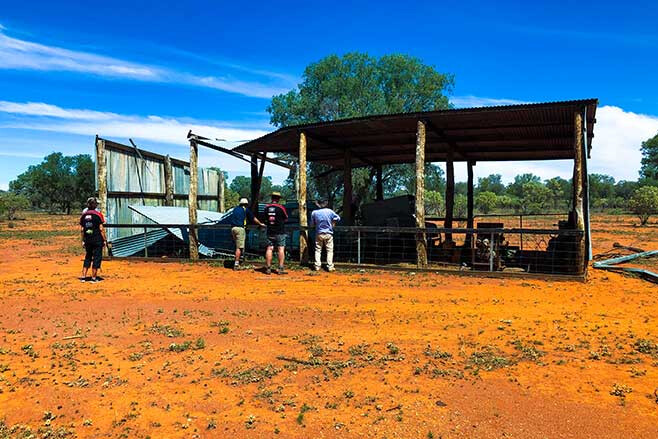
Lunch was enjoyed on the banks of the river behind the Louth Pub, and a drive west took us to Tilpa where we all quenched our thirst with a nice cold ale at the iconic pub and camped across the road in the paddock. To our surprise the Royal Flying Doctor Service opened up the amenities, to which we all chipped in a donation to this essential service.
Due to heavy rain the previous week closing the road, we had to take the western side of the Darling River down to Wilcannia to top up the fuel tanks and grab a coffee. Then we were on our way to Menindee, where we stayed at the Menindee Lakes Caravan Park and enjoyed the most beautiful sunset.
While we were in Menindee, D4L took a group on a day trip through the nearby Kinchega National Park to see the historic and beautifully restored woolshed and machinery, the boiler that flew out of the paddle steamer, and the colourful wild flowers. The park is a magical place to camp along the river if you’re ever up that way.
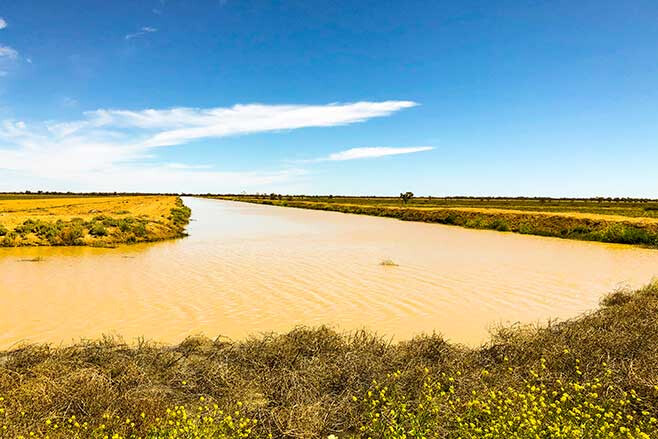
We headed to White Cliffs via Paroo National Park (Perry Lakes) and stopped in the middle of the desert for some lunch, before arriving in White Cliffs to spend half a day exploring this must-see opal mining town.
It was dinner at the pub for some and an outdoor barbecue at the caravan park for others, until we all joined up again. A special shout out to Brian and Cindy for their magical campfire.
MILPARINKA
ON DAY six we were in Milparinka, where we had a walk around this historical township, taking in the court house, Milparinka pub and campground. Then it was on our way to Tibooburra where we saw some abstract creations along the side of the road, which included a man on a toilet made out of metal parts, and a pink clothes line with spanners and shovels hanging off chains.
Cameron Corner, where NSW meets South Australia and Queensland, was the farthest west we could travel due to the restrictions. We were being monitored by the police on the Queensland side of the northern border, but were able to have our photo taken on the famous plaque that marks the junction.
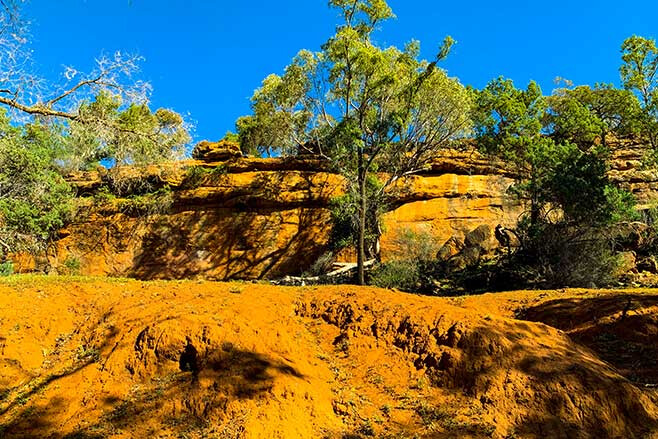
We thought we might camp near a dry creek bed until we pulled up and saw a snake, so we decided to head back to Tibooburra. From here, the group attempted the alternate gravel tracks south to Broken Hill, only to be turned around due to water over the road and a soft road base, so it was back to the recently sealed highway.
There was time for everyone to tour Broken Hill and explore Silverton with its art galleries, Mad Max history and great outback pub. Following a farewell dinner in town, everyone went their separate ways the next day.
Despite the planning hiccups due to travel restrictions, it was another fun and successful trip for the Drive 4 Life team which has raised $894,000 for charity since kicking off in 2006.
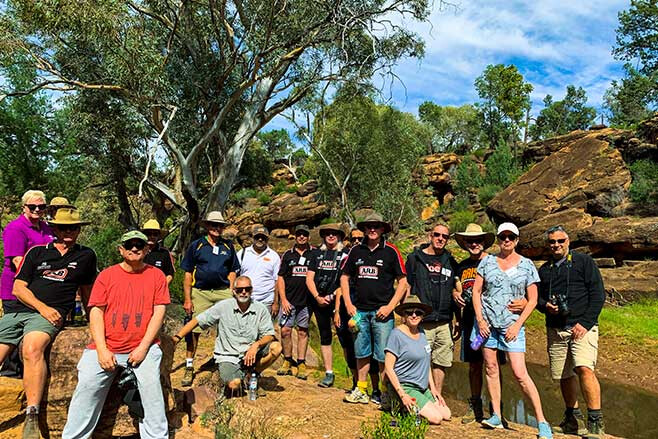
For 2021 D4L hopes to run a trip to the Victorian High Country early in the year for all the Victorians who couldn’t make it on this NSW adventure, before a bigger trip in September which will leave Alice Springs and venture to Cocklebiddy on the Nullarbor. Keep an eye on the website www.drive4life.com.au for all the details on the 2021 trips.
Drive 4 Life would like to pass on our heartfelt condolences to Chris Bates, director of D4L, on the passing of Raylene his wife, at home, in her sleep, while we were on this trip.
We’re looking back through some of our most-viewed content throughout the year, and it turns out you couldn’t get enough of this one! Kick back and relive one of the standouts from a tumultuous 2020.
A couple of Chevrolet Silverado 2500s that were on their way to American vehicle specialists Performax in Queensland were pulled from the ocean off the coast of Newcastle.
The pair of Silverado 2500s had been sitting on the sea floor, approximately 120 metres below the surface, for the last two years after the shipping containers they were in fell off the deck of the vessel YM Efficiency in June 2018. They were among 81 of the heavy containers to drop off the ship in rough seas.
“In 30 years of trading that was the first time we have ever lost a container,” Performax’s Kevin Thoroughgood told 4X4 Australia. “Ironically, the blue one was a special factory order in a colour called Deep Ocean Blue.
“They were fully insured, so they belong to the salvage company now.”
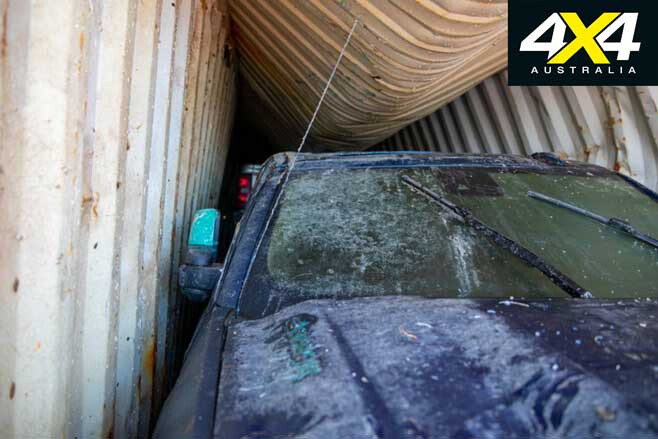
The shipping containers are currently being retrieved off the sea bed as part of a $15 million recovery and clean-up operation. Other containers retrieved to date have contained tyres, furniture and household items.
The 2018 Silverado pick-ups, each worth around $140,000 once converted and on sale, are total write-offs, having been filled with seawater during their adventures in the underwater garden.
Performax now has current model 2020 GMC heavy-duty and 1500 pick-ups already available, and Kevin says the related Silverados won’t be far behind.
“We were going to delay the Silverado, but our customers want it so we are full steam ahead.We also have the new RAM HD in customs.”
This comes on the back of news that HSV has ceased its steering conversions and sales of the heavy-duty Chevrolet Silverado 2500 model, as it is now focused on the half-tonne Silverado 1500 LTZ variant which officially went on sale this week. The only remaining HD Silverados from HSV are those already in dealers.
Queensland-based Performax International has 10 dealers around Australia selling a range of American pick-up trucks and performance vehicles.