
Talking Points
- Why it’s critical to check what your policy covers
- Don’t be left stranded with a massive bill
EMERGENCY Recovery Insurance is a good thing I reckon. And I should know – I’ve been on the receiving end of it on three different occasions in the last 12 years or so.
However, there are limits on what’s included and what was once covered by your insurance may not be covered nowadays.
A hell of a lot of travellers rely on their state auto association for emergency roadside assist and recovery and I’ll be talking about RACV Emergency Roadside Assist Total Care which I’m most familiar with. Other state automobile associations (NRMA, RACQ, etc) have very similar packages with similar benefits, although there may be minor differences – best to check.
Some years back the ol’ Patrol broke down on a remote Aboriginal road north of the Tanami Road some 700km northwest of Alice Springs.
While I won’t go into the details of the adventure – the recovery truck broke down on a flooded Tanami Road was just the start – the expensive recovery back to Alice and subsequent 11-day motel bill and hire car costs were all taken care off by RACV Total Care. The costs would have been in excess of six to seven grand as the recovery itself was near 4000 bucks.
Nowadays, the Total Care package isn’t quite so extravagant!
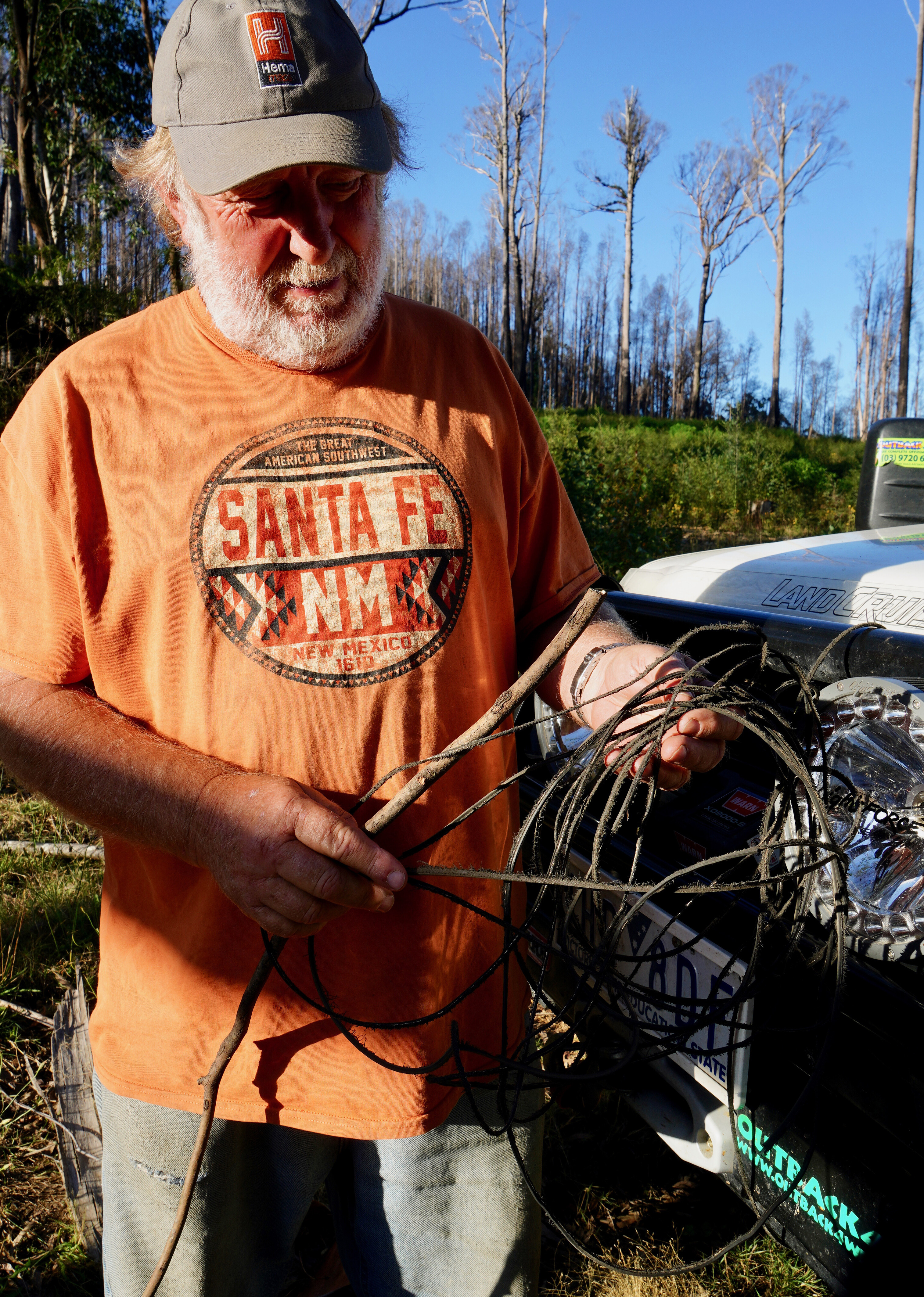
Just recently I shredded a serpentine belt on a bush track northeast of Orbost in some very remote forested country. With no spare (lesson learnt there) I limped back to a main dirt road taking particular care for the engine not to get overheated.
Without embarrassing myself too much with the nitty gritty of organising a recovery through the nearest RACV agent, later that evening the recovery truck pulled up, with Matt, the recovery mechanic jumping out of his vehicle exclaiming, “What the hell are you doing up here?”
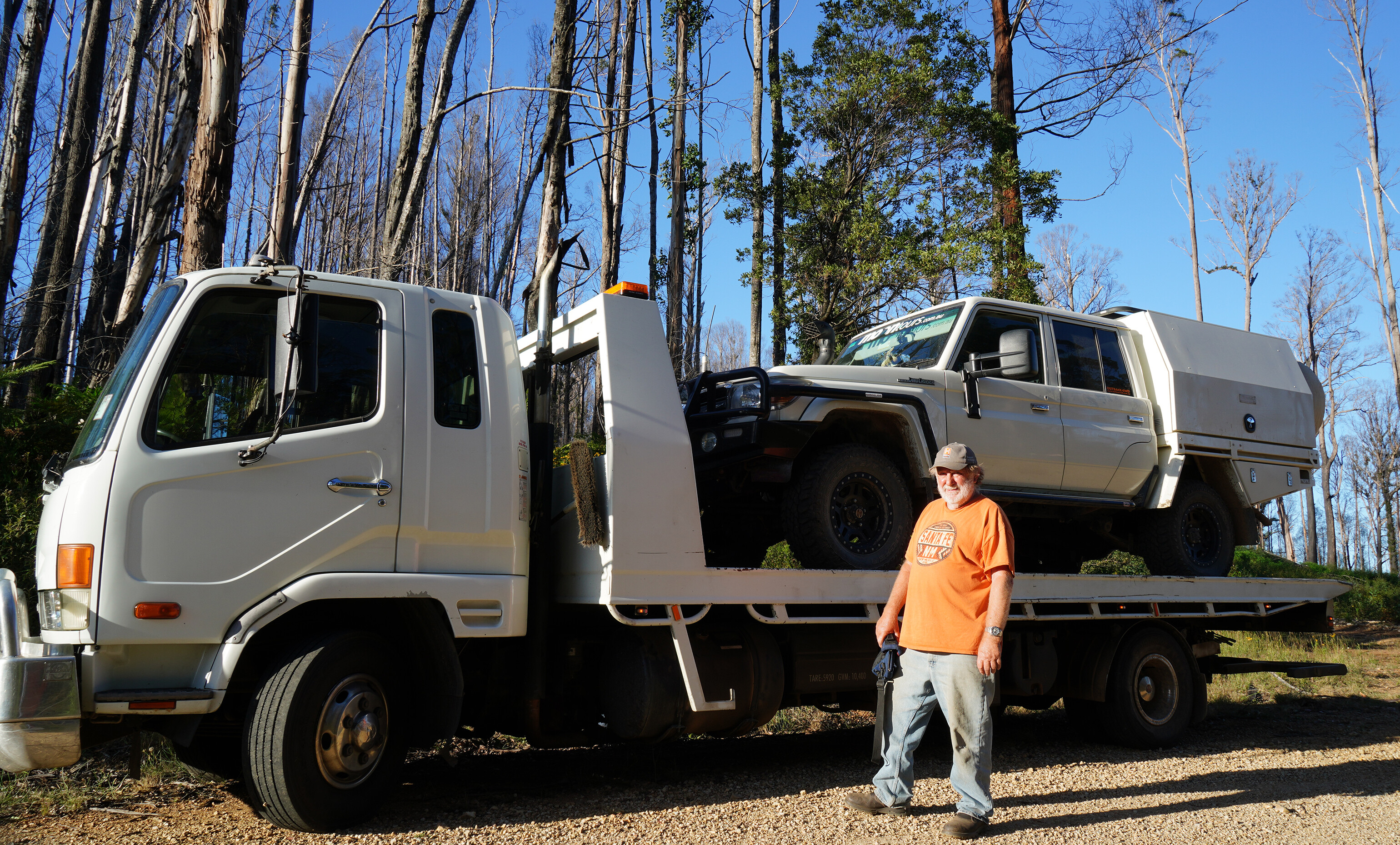
He then explained my recovery mightn’t be covered by RACV … not even by Total Care. I got a little bit agitated at that, which was further increased next day back at the agents-come-repairers who also said the same thing. I pleaded my case saying the road we were recovered from was a through road and a continuation of a country bitumen road, the blacktop only finishing less than 10km from where we were stuck. “We’ll see how we go!” was the not so reinsuring reply.
In the end the recovery was covered by Total Care as were a couple of nights in a motel while waiting for the Cruiser to be repaired, but it got me thinking about what we were actually covered for …
On checking, Total Care states that recovery/towing will be provided:
• In Country Areas, the first 100km in any direction, from the point of breakdown is free of charge, or back to the attending Service Centre. • Service will be provided on private property or on any public road, provided they are trafficable to normal two-wheel drive vehicles. This excludes areas such as open fields, beaches, creek beds, recreation ovals, bicycle paths, bicycle tracks, logging or forest service roads and roads which do not allow oncoming traffic to safely pass.
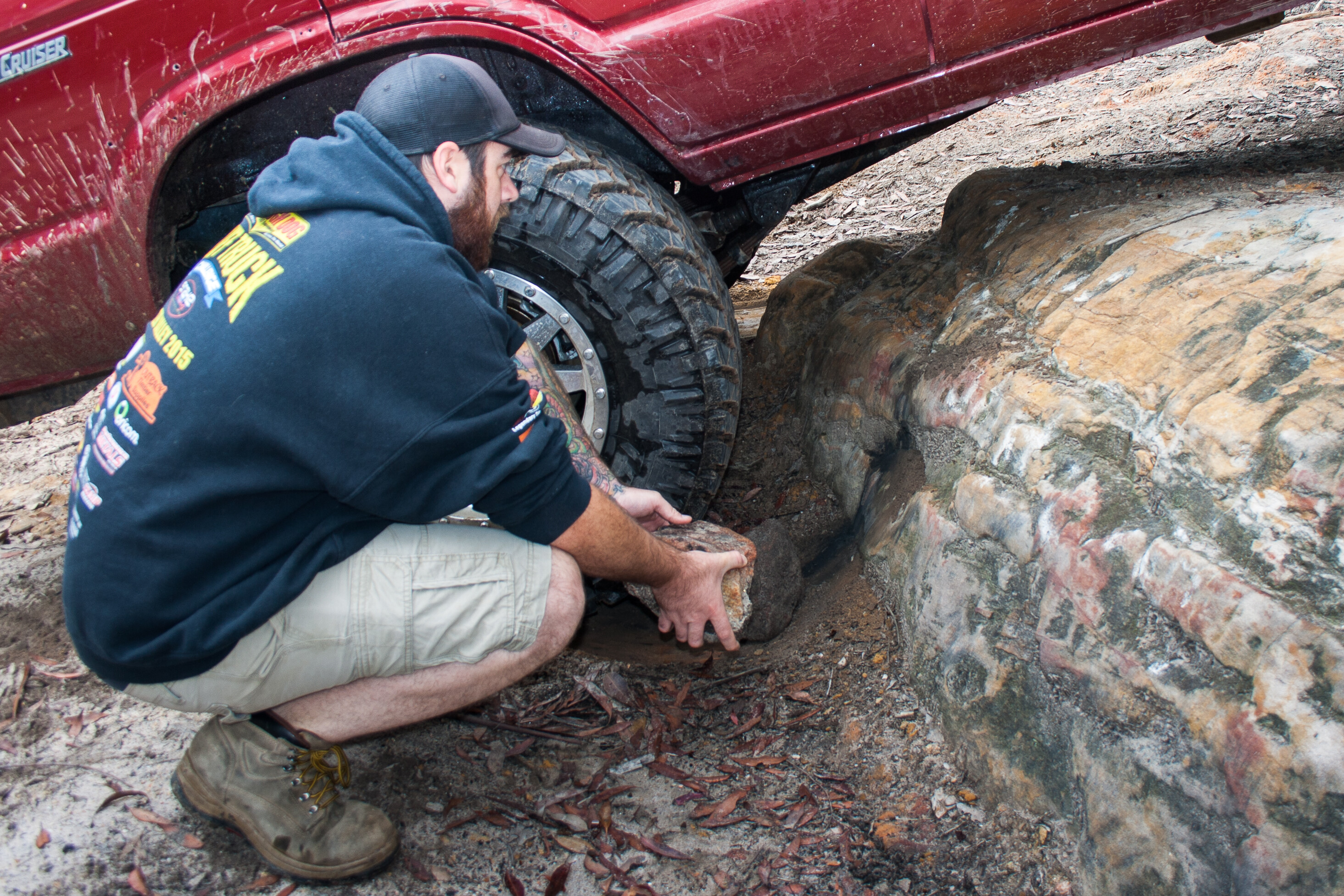
I rang the RACV to clarify what they meant by a ‘public road’ and after much toing and froing I accepted their definition as any ‘designated road’ but not a track. As an example, I mentioned the Tanami Road and the Great Central Road, both of which they were happy with, while the tracks across the Simpson or the Canning, they weren’t. In another major change from a few years ago Total Care now only covers approved benefits up to a total of $2400, stating: • You may claim a combination of the following benefits up to $2400 for you and your Travel Party (in total per incident) until the End of the Incident: • Accommodation ($170 nightly limit); and/or Rental vehicle ($88 daily limit); and/or alternative transportation; and/or taxi fares (maximum of 3 trips, at $100 each).
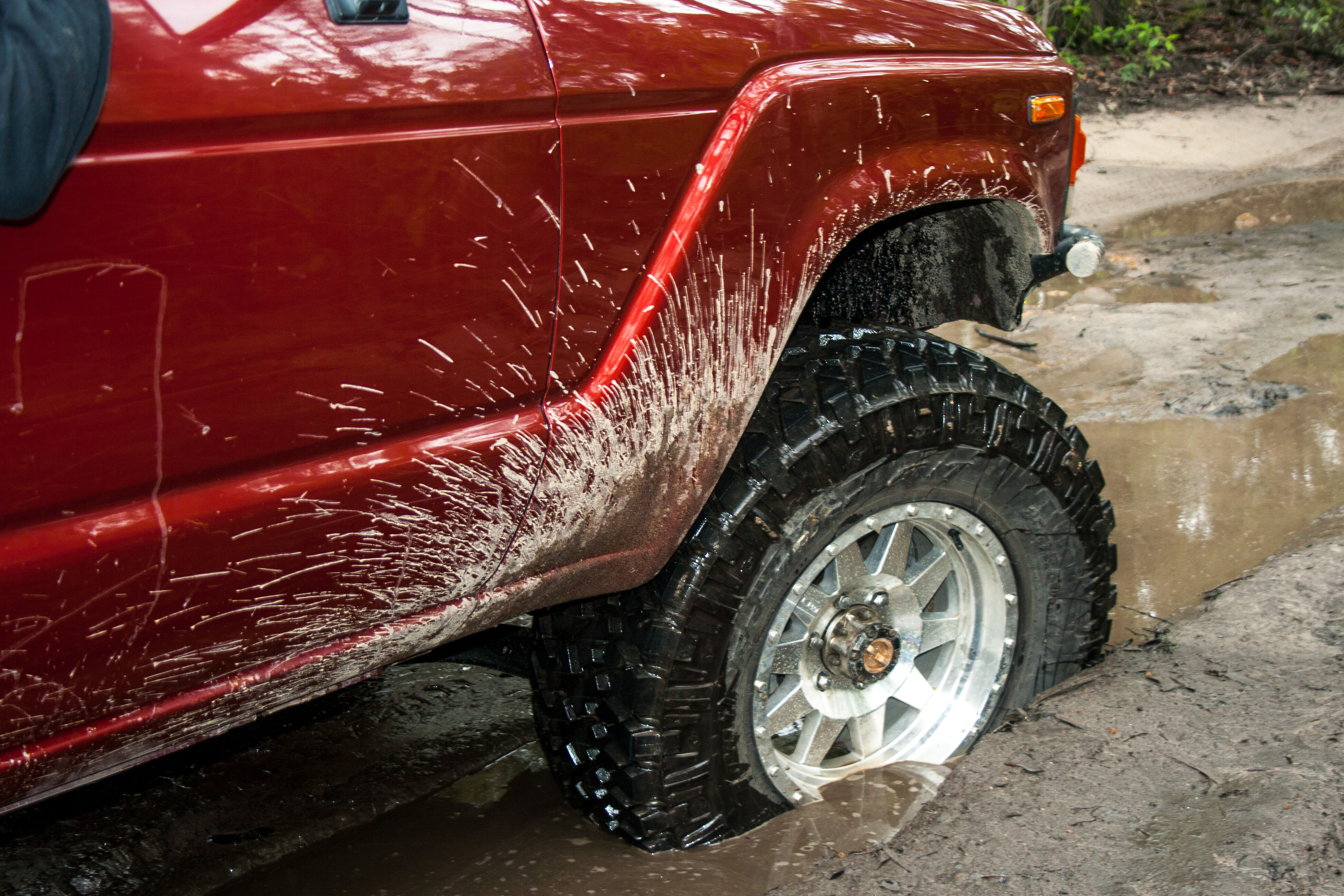
So, there you have it. I’ve got to say I’m pretty happy with the RACV Total Care package and won’t be dropping it anytime soon. If you are not, it may pay to have a look at Club 4X4 Insurance and opt for its extra premium cover which has up to $30,000 coverage for off-road recovery. That will surely cover your costs from being dragged out of the Simpson or some remote part of the Canning!
Talking Points
- Spy shots provide first look at next-gen 300
- Is this the model coming to Australia?
LEAKED images of the next-gen Toyota LandCruiser 300 Series continue to arrive thick and fast, with the latest spy shots providing the best view yet at the big new SUV.
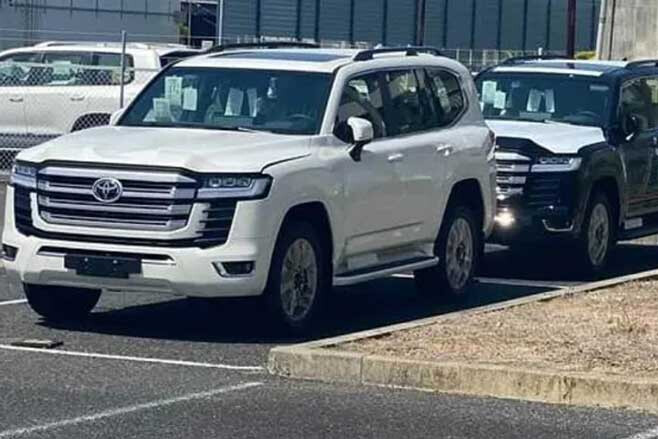
Whether this is the 300 Series we’ll eventually get in Australia remains to be seen, but these vehicles, in LHD configuration, provide a clear view of the off-roader’s busy front-end, chrome treatment and large alloy wheels – suggesting they could be premium Sahara examples.
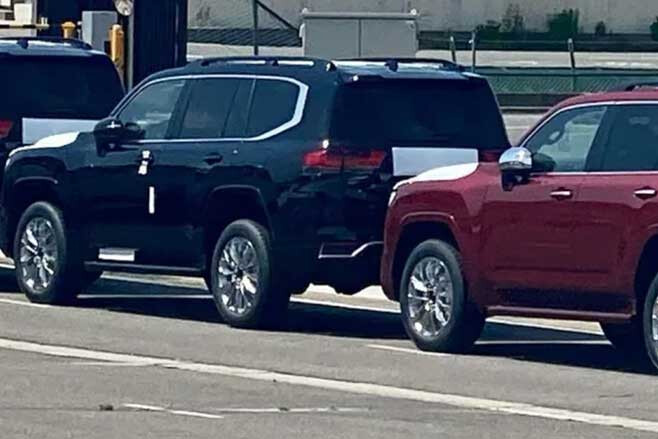
The images also indicate the 300 will be available in white, black and silver hues.
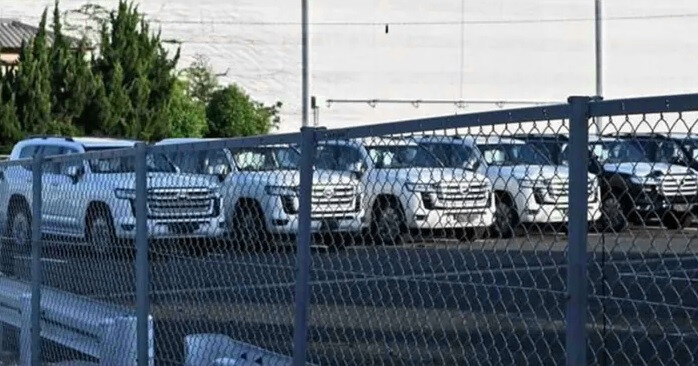
The vehicles were originally snapped in an undisclosed holding yard, adding to speculation that the full reveal is only weeks away.
Very little has been confirmed about the next LandCruiser except that the petrol V8 engine that was still used in the 200 Series in some markets will be shelved in favour of a V6 engine, and that a petrol/electric hybrid powertrain will be available sometime in the future.
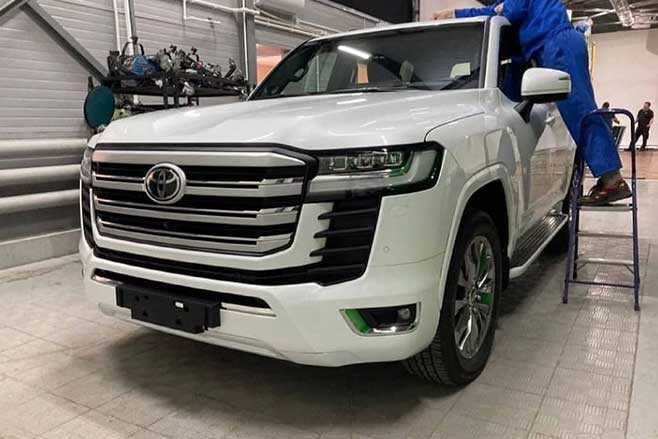
What this means for Australian LandCruisers, which are currently all V8 diesel-powered, is yet to be revealed.
There has been all sorts of rumours and speculation about what will power our LandCruisers – a diesel V6, inline six-cylinder engines, a continuation of the diesel V8, and even talk of a horizontally opposed engine that was being co-developed with Subaru.
Toyota’s ramping up of its hydrogen-fuelled vehicles, both in Australia and overseas, could also see the scalable system upsized to power the biggest Toyota passenger vehicle at some time.
A powerful diesel engine is essential for LandCruiser if it is to continue to sell in the numbers that it currently does here. It’s only real rival in the full-size 4×4 wagon segment is the petrol-only Nissan Patrol, and the Toyota outsells it by more than four to one.
The next LandCruiser is expected to be similar in size to the current LC200, with seating for seven or eight passengers and will retain its excellent off-road and all-road ability.
If the rumours are true, we’ll know a lot more about the actual specifications in the coming weeks.
BACK in the day, and we are talking about the 1960s, Detroit was churning out high-output big-displacement V8s like burgers from a McDonalds’ drive-through.
But the energy crisis of the 1970s gave pause, and the added burden of the 80s’ emissions requirements choked the life blood out of any dreams of hot-rodding around with a HEMI behind a seven-slot grille.
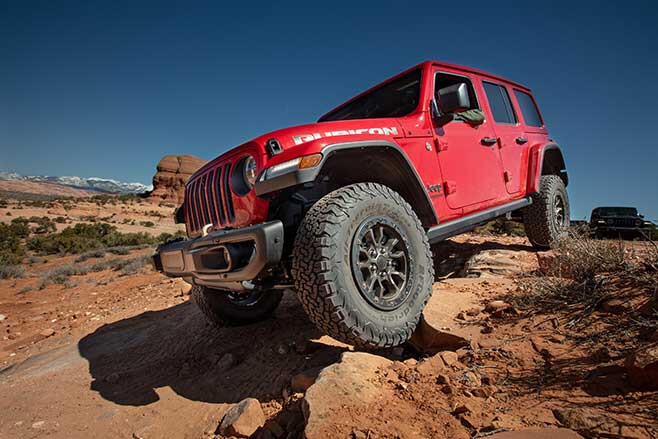
Yes, the Grand Cherokee made impressive strides with the SRT8, but it has been nearly four decades since a CJ-7 rolled out of Auburn Hills (Michigan) with the 5.0-litre (304cid) engine. But what about the Wrangler? It has led the brand for 35 years but has been relegated to V6 and I4 engines … until now.
ENTER THE RUBICON 392
We were near Moab, Utah, for the Easter Jeep Safari and I slowed down to 65km/h at the base of a long, paved, uphill grade. I pressed a funny little ‘goggles’ button on the dash and pinned the skinny pedal. Bam! My head whipped back against the headrest as I felt the Gs press my spine against the seat.
The throaty sweet notes of an uncorked exhaust echoed through the cockpit as the speedo spun north toward the century mark. We hit ‘V max’ in a heartbeat (the maximum tyre rating speed of 99mph or 159.3km/h) and I backed off the throttle to coast up to the crest.
Peeling off on a dirt track, my mind drifted back to high school days of HEMIs and Dodge Challengers and thought, “Damn, this is one badass Wrangler.”
GO V8 OR GO HOME
FOR years we’ve been asking Jeep to put a V8 in the Wrangler, and it is now evident they were listening. But they didn’t settle for a mere 5.7-litre, they went big, borrowing the proven 392cid (6.4-litre) HEMI from the SRT Grand Cherokee.
Retuning it for the dirt, this bad boy cranks out an adrenaline-inducing 470-470 … as in horsepower and torque respectively (350kW-637Nm). It is mated to a TorqueFlite eight-speed automatic transmission, with a Select-Trac transfer case distributing power fore and aft.
With all these cubes stuffed behind the grille, air flow and cooling are paramount. To accommodate this, the hood features a functional scoop that sends air into a ducting system called Hydro Guide. It directs flow to the air filter while vacating up to 60 litres of water per minute.
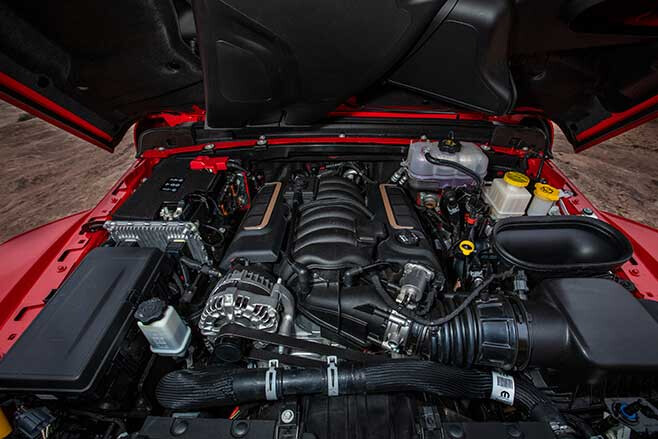
If you’ve ever dunked your bonnet in a billabong or crossed a flooded creek where the bow wave rolled up to the windscreen, you will understand Hydro Guide’s utility.
Down below are a pair of Gen III Dana 44 axles fitted with electronically controlled Tru-Loc differentials and 3.73:1 gears. They are capped with twin-piston disc brakes borrowed from the Gladiator Mojave (345mm rear, 330mm front) and steering is the electro-hydraulic system introduced with the JL.
WATCH: Off-road in Jeep’s SWB Wrangler Rubicon Recon
We’ve come to appreciate the Rubicon’s coil-linked suspension, but the 392’s has been revised to handle the increased power, torque and mass of the HEMI.
Front spring ratings were increased by 20 per cent while the rears were surprisingly reduced by 10 per cent, and specially tuned Fox aluminium shocks managing damping. Suspension links, track bars and cross members have been strengthened, and specific sections of the frame re-engineered.
EXTERIOR
WALKING around the 392, it looks like a basic four-door Rubicon, but the observant eye will notice subtle differences. It sits higher, two inches over the Sport and an inch over the Rubicon to accommodate the dimensions of the HEMI.
Grille slots are a bit wider to allow for increased air flow to the engine compartment, and an optional forward-facing camera rests in the middle.
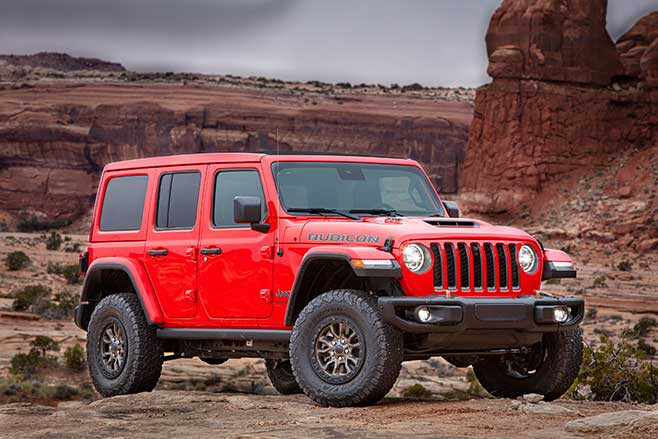
Armour includes Jeep Performance Parts (JPP) rock sliders and steel bumpers accented with bronze recovery points. Peeking under the rear bumper we find two tailpipes per side (more on this in a minute) and maintaining contact with the tractive surface are 33-inch BFGoodrich KO2 All-Terrains wrapped around Mopar’s new bead-lock-capable wheels. And, how could we miss the 392 badging on the hood.
INTERIOR
THE 392 might not have borrowed the interior directly from the Gladiator Mojave, but it sure took cues. Enhanced seat bolsters keep you securely tucked in place, lumbar support is prominent, and ergonomics have a sports-car feel … right down to the paddle shifters at a fingertip’s reach.
Bronze stitching, similar to the honeycomb on the grille, accents the leather-wrapped wheel and carries on throughout the interior. At arm’s reach is the 8.4-inch Uconnect screen, your portal to apps that monitor everything from HVAC and engine vitals, to drivetrain engagement and tilt angle. Scrolling through the options we find the forward-facing off-road camera, which provides a 180-degree view of upcoming terrain.
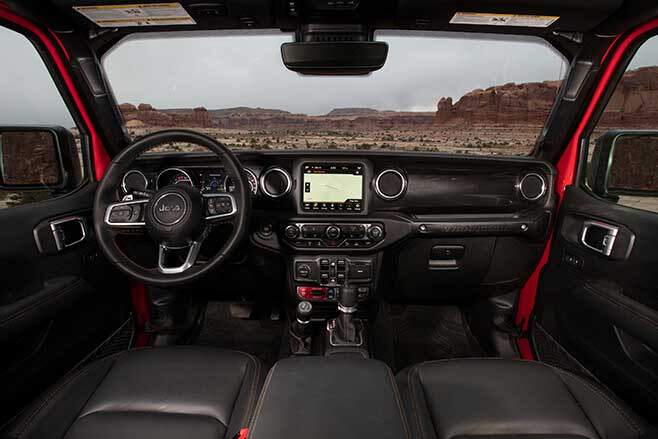
Locker controls are in the normal spot in front of the transmission shifter, and allow one-touch engagement and disengagement.
What’s new is the Off-Road+ feature … and the curious button with a pair of goggles? You might recall Off-Road+ from our review of the Gladiator Mojave, but read on about this goggle thing – it will put an ear-to-ear smile on your mug.
MASH AND BEANS
AS you might surmise from the 392’s stats, if you mash the skinny pedal it’s got the beans to slap your head back in the seat, I kid you not! Zero to 60mph (96.5km/h) in 4.5 seconds and a 13-second quarter mile, this bad boy gets up and moves – and would beat the tailpipes off my old ’71 Challenger.
However, heaps of power is of little use if you don’t have a suspension to control it. How does it manage G-outs? Are the shocks tuned for high-frequency, low-amplitude input (corrugations)? Does it porpoise during hard braking? How does it manage tight cornering? What is its return-to-centre ratio? Is the suspension balanced?
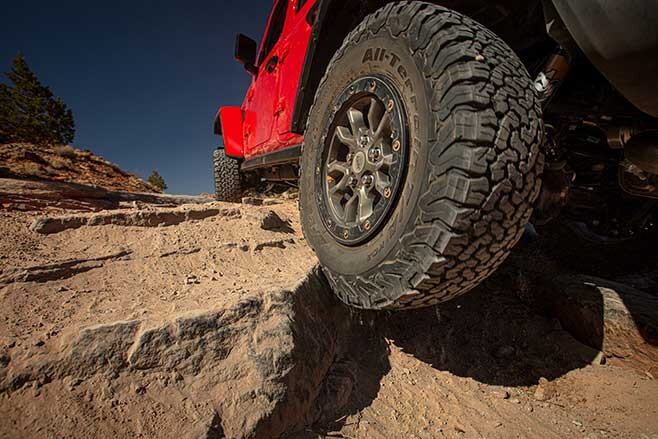
Before turning on to the dirt, I engaged Off-Road+. Pressing this lovely little button enhances throttle response, modifies transmission shift points, and detunes the Traction Control system. You can also permanently disengage electronic stability control (ESC), putting full control in the driver’s hands without an electronic nanny pulling the plug. It will also allow rear locker engagement in high range and at any speed.
After a day of blasting down two-tracks, through dune fields and crawling over technical terrain, I must say Jeep did an impressive job on the suspension. The combination of spring rates, damping and traction rendered predictable results during hard drifts.
Hitting a set of rollers carrying too much heat (one of those oh-crap moments) we cut through like a hot knife through butter, the shocks sucking up the bumps with impressive acumen. Damping, both compression and rebound, is critical in high-speed G-outs. Too little or too much and things can get messy.
The bottoms were firm, and rebound was controlled. Dropping in to a sand wash and pressing down on the happy pedal was pure joy. As for performance in the dunes, reread 470 ponies under the bonnet. Predictable, that is the operative word. A predictable suspension that builds confidence and trust.
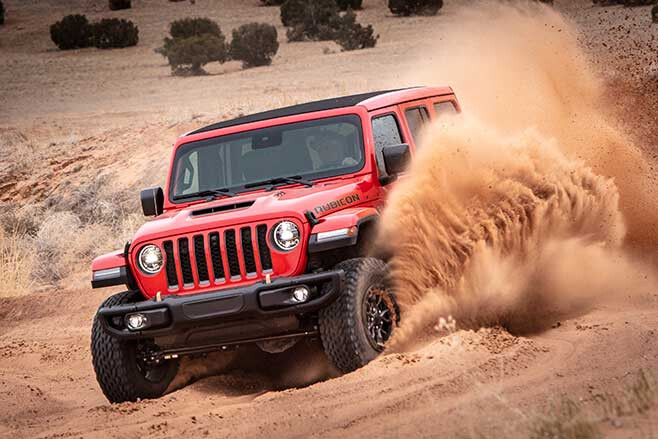
The 392 doesn’t have the Rubicon’s iconic 4:1 transfer case, and its low-speed crawl ratio of 48:1 doesn’t break any records. However, 637Nm makes up for a lot of gearing and we navigated some fairly technical terrain without issue – we were nowhere near the capability limits of this vehicle.
I will say I would have liked a bit more compression braking on steep declines – probably the only shortfall of the 2.72:1 transfer case gearing.
Now let’s get back to that curious pair of goggles on the dash. We’ll call this the ‘annoy your neighbour button’. One touch engages the Active Dual-Mode Exhaust, which has two settings: Normal is for when you don’t want to T-off the grandparents, the other is for those times that you want to relive your muscle car days.
The magic resides in a vacuum-operated solenoid that opens an internal gate in the muffler. This effectively uncorks the exhaust and releases the full fury of the 6.4-litre HEMI for the world to behold. Well, we enjoyed it.
THE WRAP
ALTHOUGH it has taken decades for Jeep to embrace our pleas for a V8 Wrangler, when they finally got around to it they did a bang-up job.
With the trail capability of a Rubicon, a high-output 6.4-litre mill under the bonnet and downright impressive handling, what is not to love about the Rubicon 392? Well maybe the fact that it is being built in left-hand drive only, so it’s another vehicle not for Australia … c’mon Jeep, bring the Wrangler 392 Down Under!
SPECS
ENGINE: 6.4-litre HEMI V8 MAX POWER: 470hp (350kW) at 6000rpm MAX TORQUE: 637Nm at 4300rpm GEARBOX: 8HP75 TorqueFlite 8-speed auto 4X4 SYSTEM: MP3022 Select-Trac CRAWL RATIO: 48:1 WHEEL/TYRE: 17×7.5in alloy/ LT285/70R17 BFGoodrich KO2 AT KERB WEIGHT: 2314kg TOWING CAPACITY: N/A FUEL TANK CAPACITY: 81.3lt PRICE: USD$73,500 DEPARTURE ANGLE 37.5⁰ RAMPOVER ANGLE 22.6⁰ APPROACH ANGLE 44.5⁰ WADING DEPTH 825.5mm GROUND CLEARANCE 261.6mm
WATCH: The Wrangler Rubicon 392 in action
SEND us a photo with a brief description of your 4×4 via our 4X4 Australia Facebook page and you could win a Wurth under-bonnet LED valued at $249!
FORD RANGER WILDTRAK
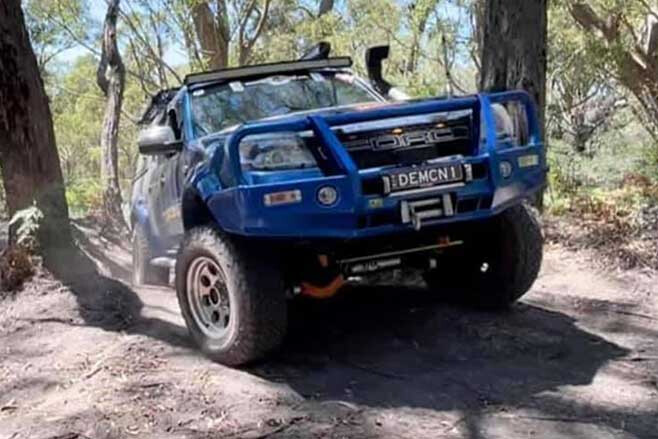
Gear includes twin ARB lockers; dual twin ARB compressors and dual air-tanks; GU diffs; Superior Engineering suspension; Dobinson coils; Fox shocks; custom sliders; an ARB rear bar with custom swing-aways; ARB reinforced canopy with 300W solar panel and lights/mozzie lights all around; auxiliary battery; 4000W inverter in a custom fan-cooled compartment; 12V and 240V power throughout; ARB LINX vehicle management system; TJM bullbar and winch; 90-litre fridge and slide; rear drawer, and more.
Under the bonnet is an HPD intercooler, three-inch exhaust, tune and catch can. I also have a long-range tank with custom belly pan, and custom front recovery points. There’s a lot, and I’ve probably left out half of it -Tim Dionys
FORD RANGER
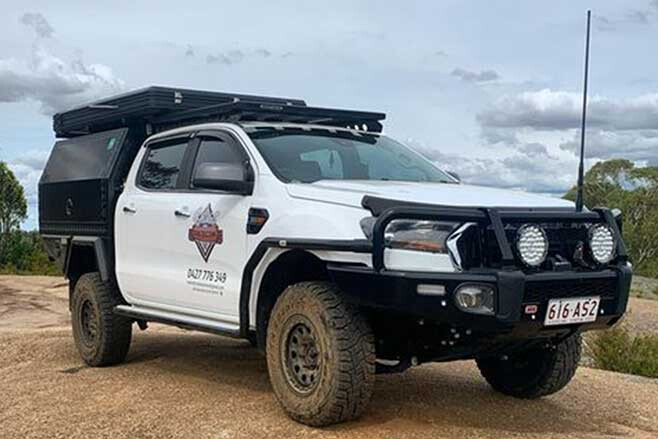
I bought the ute in January 2020. Since then I have fitted a three-inch Bilstein lift kit. The ute is sitting on 285/65/16 Toyo AT tyres with a Dunn & Watson touring tray and an MW toolbox canopy. On the front is an ARB Summit bullbar with matching scrub bars and side-steps, Stedi Type X Pro driving lights, GME XRS UHF, and a Bushranger 12,000lb winch. Up top there’s a Rhino-Rack Pioneer with the Backbone system and the Motop V3 135 rooftop tent -Mark Hewlett
1977 FJ40
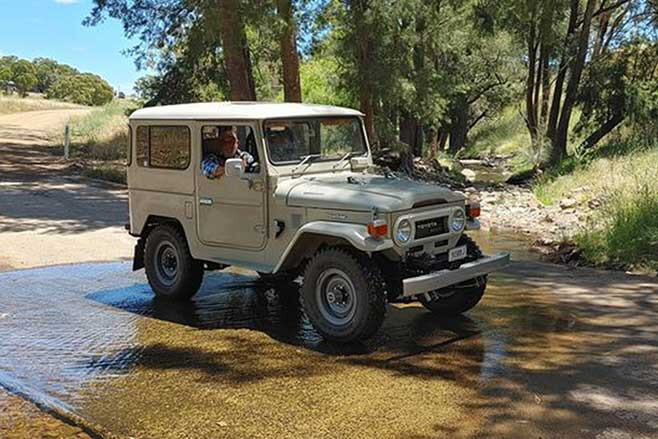
I wanted to share my 1977 FJ40, which I have just done a full chassis-off restoration. Every nut, bolt and rubber seal has been replaced. Plus a back-to-bare metal respray, all done by myself in my shed.
I shared the whole build on YouTube (40 Channel). This was family build with all my kids getting involved in the build. Super proud dad -Jayson Fox
2007 JEEP KJ CHEROKEE
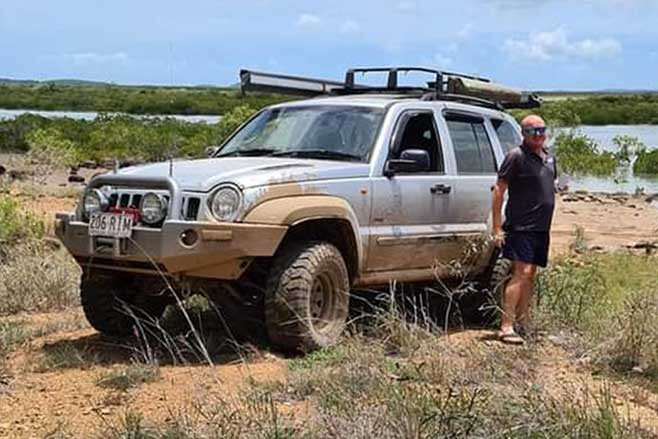
Additions include an ARB bullbar; Ironman 4×4 suspension (two-inch lift and some other mods); 31-inch MTs; Ironman 4×4 awnings and en suite; homemade rear drawers and rear table; custom aluminium radiator thermo fan and a TJ clutch fan; and custom bonnet vents.
Plus, there are other features I have done to it as there’s not much stuff for them in Australia -Mark E Spencer
2002 TOYOTA PRADO TX (3L TURBO DIESEL)
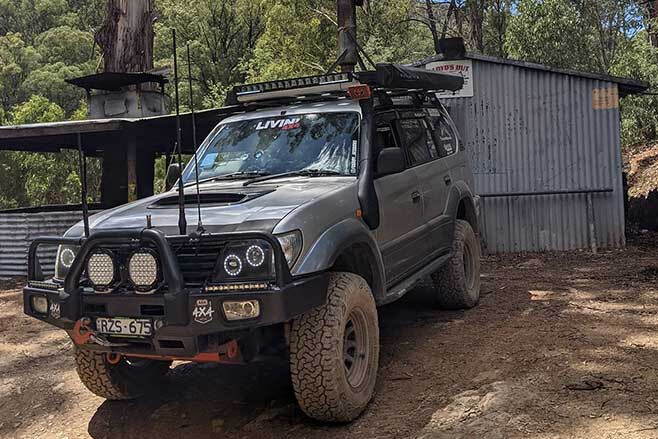
Kit includes a three-inch suspension lift; 33-inch AT tyres; adjustable upper control arms; and a rear ARB air locker. It’s fully kitted out for touring with drawers, two fridges, a travel buddy and extra water. Plus heaps more -Brodie Corbett
2004 TOYOTA HILUX
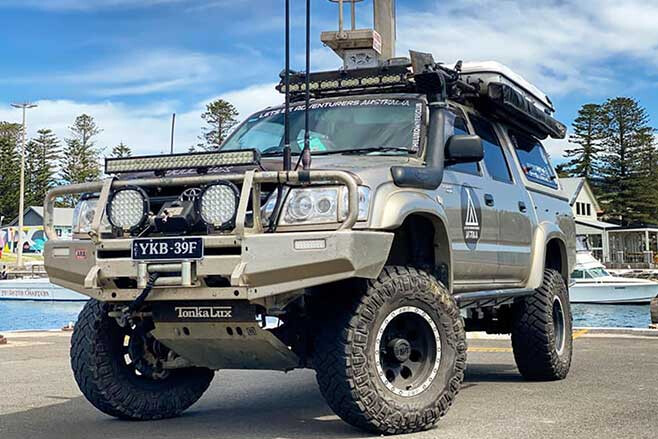
My Hilux is set up for remote touring as well as tough tracks. It has an SR5 factory turbo 1KZ, four-inch lift, lockers, and all the bells and whistles (so many things to list) -Tom Corra
The 2021 Ford Ranger lineup has been given a number of enhancements for the new model year, introducing a key new variant and a trio of upgraded options.
Headlining the news is confirmation that the Ranger XL 4×4 Heavy Duty Special Edition, with its mouthful of a name and a laundry list of enhancements, will continue into the new model year.
Released in August last year for different body styles in the XL grade, the pack is now specific to the XL Double Cab Chassis, with drive provided by Ford’s 147kW/470Nm 3.2-litre five-cylinder diesel and a six-speed auto.
Features include a factory-fitted, crash-tested and AEB-sensor equipped Genuine Ford Steel Bull Bar, which also gets integrated mounting points for driving lights and UHF antennas. An LED light bar is also fitted.
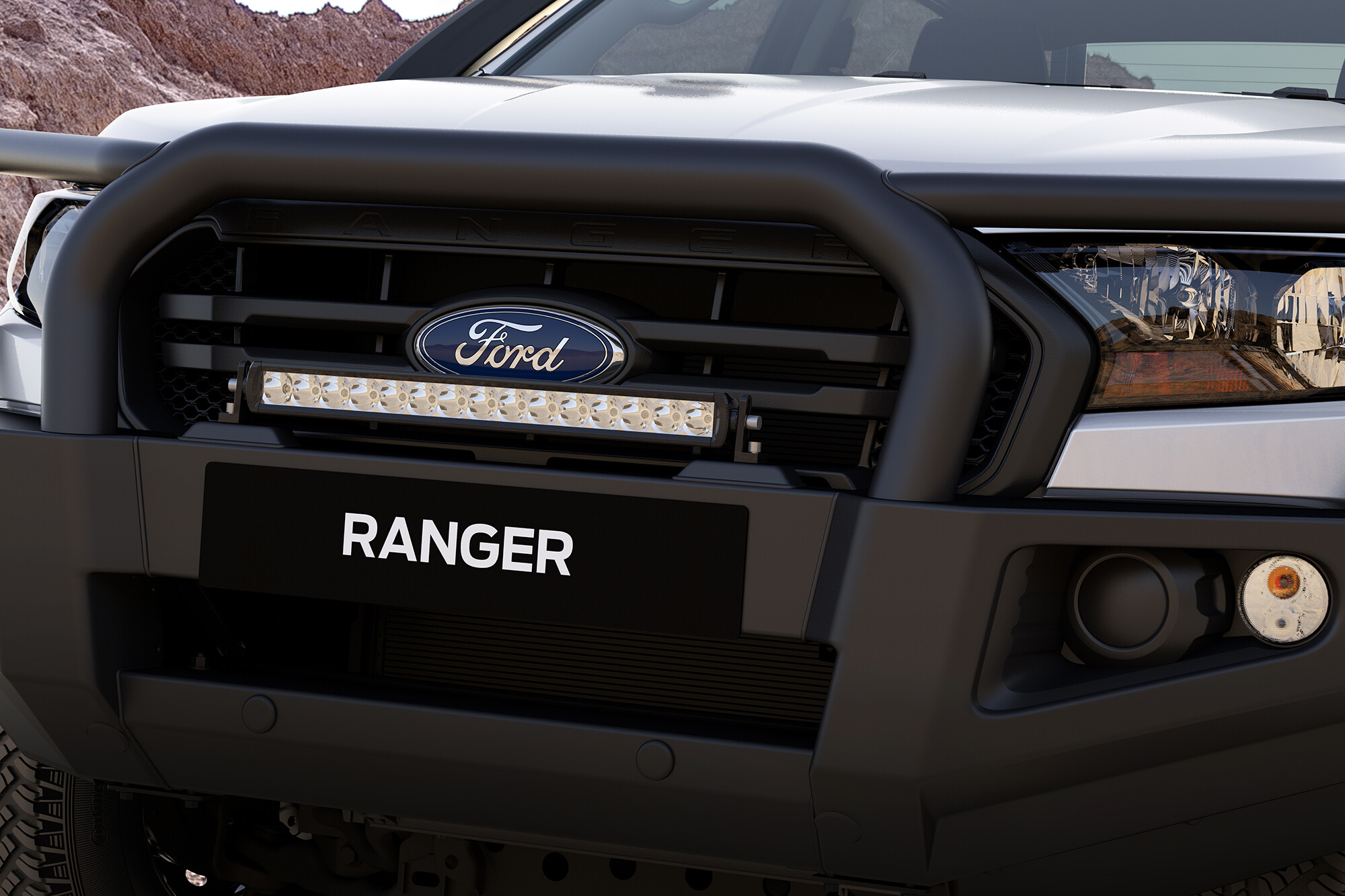
Enhancing its off-roading capability is a Ford Genuine fixed-head snorkel, along with black 17×7.5-inch steel wheels matched to Continental CrossContact All-Terrain tyres and solid wheel nuts.
For work days or well-stocked getaways, the XL Heavy Duty also gets upgraded suspension to live up to its name. This includes thicker springs with a revised spring rate, along with new front and rear dampers.
Final enhancement items include black side steps and a rear-view camera kit.
The Ranger 4×4 XL Heavy Duty Special Edition Double Cab Chassis is priced from $52,790 before on-road costs.
Ranger XL models get 2.0 Bi-Turbo diesel engine
For 2021, the XL range can now be had with Ford’s 157kW/500Nm Bi-Turbo four-cylinder diesel engine – the same mill powering the Raptor, among other high-spec variants.
As in its other applications, the Bi-Turbo engine joins the XL range paired with a 10-speed automatic transmission.
The new hero motor will be available in 4×4 XL Super Cab Chassis, 4×4 XL Double Cab Chassis, and 4×4 XL Double Pick-Up variants.
Ford Ranger XL 4×2 Sport joins range
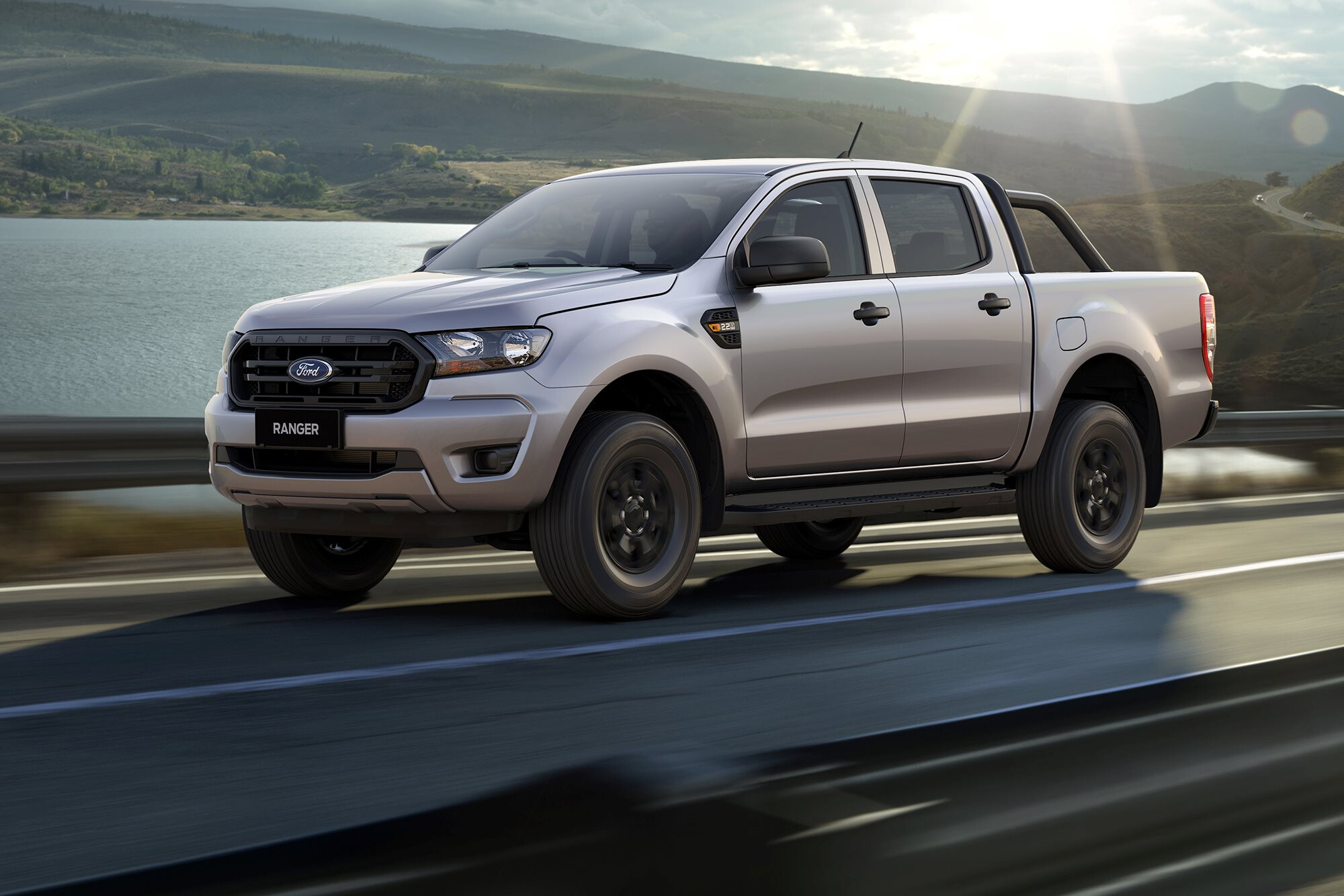
Also news is the arrival of a new 2021 Ford Ranger 4×2 XL Sport model, slotting in between the 4×2 XL and 4×2 XLT grades in the seemingly endless list of Ranger variants.
Priced from $43,790 before on-road costs, the new variant’s configuration is a Double Cab Pick-Up (a dual-cab ute with the standard tub on the back), driven by Ford’s 118kW/385Nm 2.2-litre turbo four-cylinder engine and a six-speed automatic transmission. No manual shifter is offered.
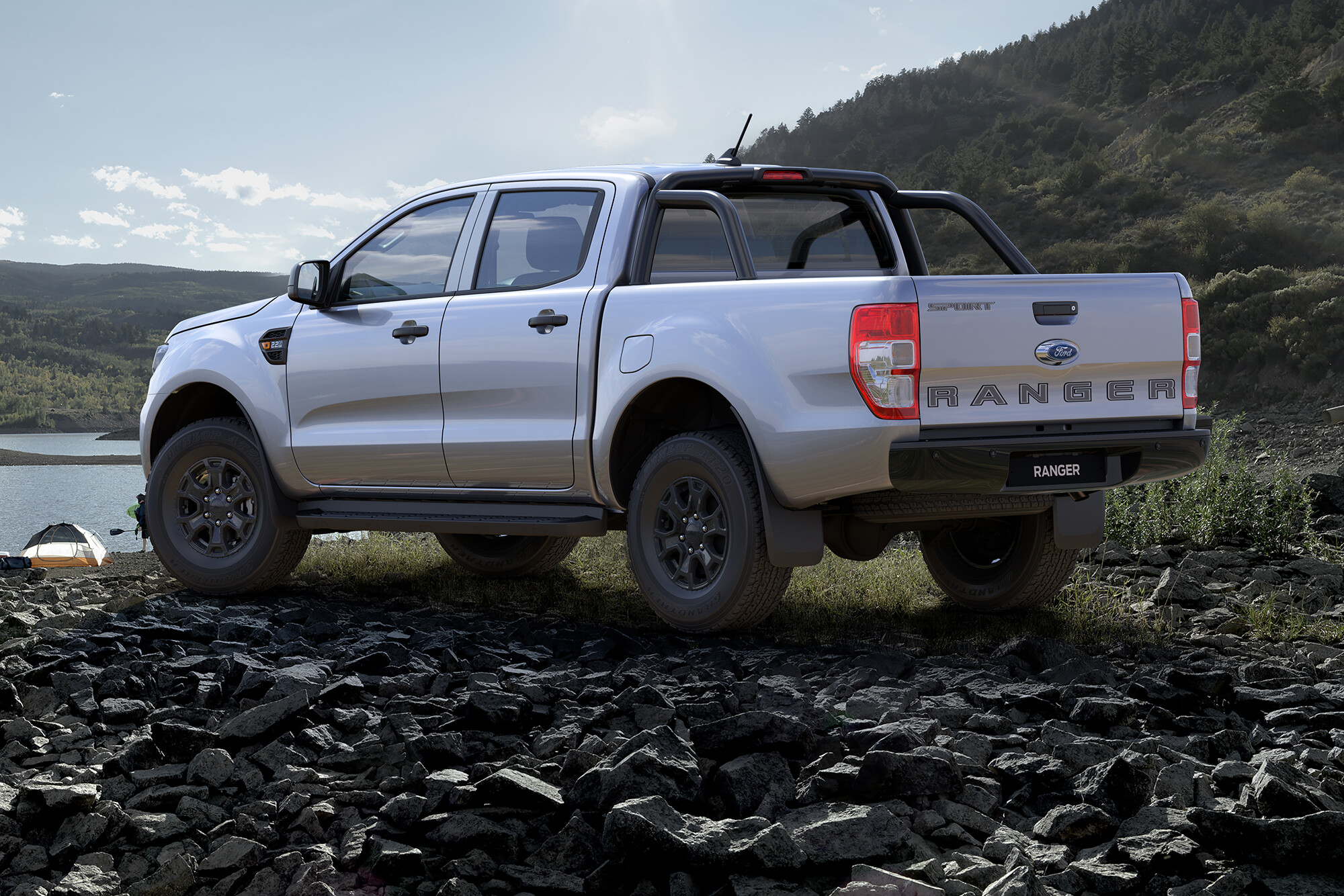
To earn its Sport badge, the new variant gets black 16-inch alloy wheels, and black all of these bits: grille, sports bar, bedliner, side steps, and rear bumper. There’s a SPORT graphic on the tailgate, too.
Colour options for the Ranger 4×2 XL Sport include Arctic White, True Red, Shadow Black, Meteor Grey, and Aluminium Metallic.
2021 Ford Ranger XLT gets adaptive cruise
No longer a mere inclusion in the optional Tech Pack, adaptive cruise control (ACC) is now standard in the XLT – better proving its right to the near-flagship position the XLT badge represents.
MORE: All you need to know about the 2022 Ford Ranger MORE: Ranger news and reviews MORE: Everything Ford
The vehicle many are calling the LandCruiser 300 Series has been snapped in an undisclosed holding yard, adding to speculation that the full reveal is only weeks away.
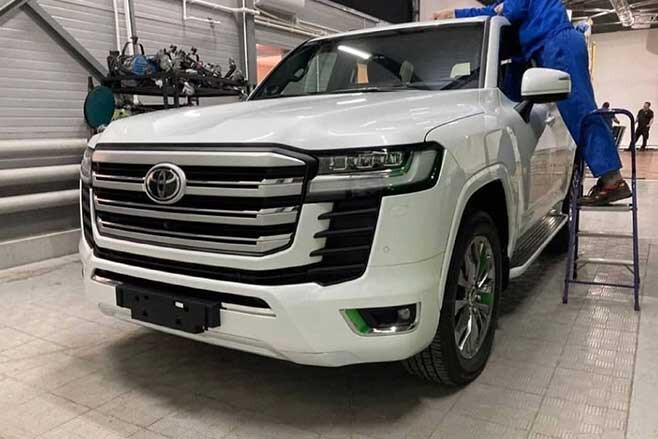
Very little has been confirmed about the next LandCruiser except that the petrol V8 engine that was still used in the 200 Series in some markets will be shelved in favour of a V6 engine, and that a petrol/electric hybrid powertrain will be available sometime in the future.
What this means for Australian LandCruisers, which are currently all V8 diesel-powered, is yet to be revealed.

There has been all sorts of rumours and speculation about what will power our LandCruisers – a diesel V6, inline six-cylinder engines, a continuation of the diesel V8, and even talk of a horizontally opposed engine that was being co-developed with Subaru.
LEAK: Sketches show next-gen 300 Series
Toyota’s ramping up of its hydrogen-fuelled vehicles, both in Australia and overseas, could also see the scalable system upsized to power the biggest Toyota passenger vehicle at some time.
A powerful diesel engine is essential for LandCruiser if it is to continue to sell in the numbers that it currently does here. It’s only real rival in the full-size 4×4 wagon segment is the petrol-only Nissan Patrol, and the Toyota outsells it by more than four to one.
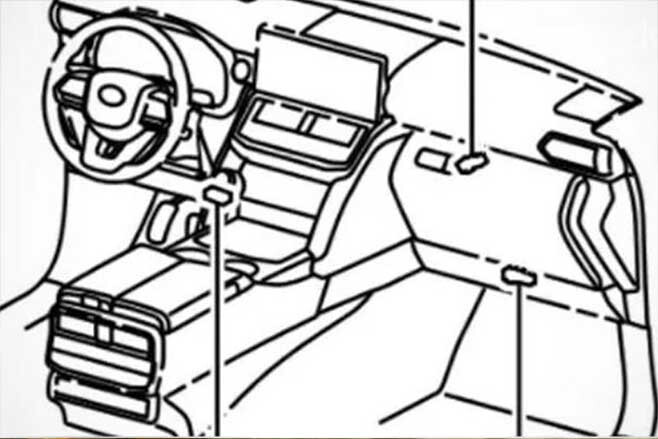
The next LandCruiser is expected to be similar in size to the current LC200, with seating for seven or eight passengers and will retain its excellent off-road and all-road ability.
If the rumours are true, we’ll know a lot more about the actual specifications in the coming weeks.
IF YOU think the replacement for the 200 Series LandCruiser is a long time coming, then you’re right. In round numbers, the 60 Series lasted 10 years, the 80 Series lasted seven years and the 100 Series nine years, while production of the 200 ran for 14 years, before halting recently.
The fact that Toyota has stopped making 200s indicates the ‘300 Series’, for want of a better name, is imminent. Given the size of the global market for the 200 and its offshoot the Lexus LX570, and the central part that the LandCruiser name plays in the Toyota brand, it couldn’t be any other way. One would think!
So why has Toyota been so slow in rolling out the 300 Series given as early as 2015 it was already testing 300 Series prototypes in Australia, amongst other things benchmarking them against a Range Rover and a Range Rover Sport?
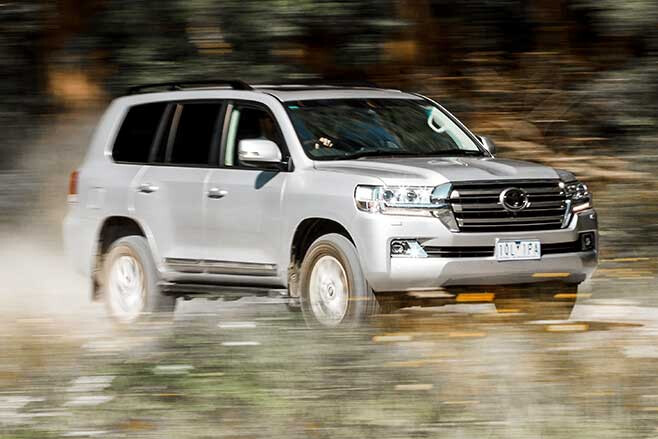
Well bottom line is in fact ‘the bottom line’ with the 200 selling well-enough – thank you – due in part to the lack of competition from the Nissan Patrol in those markets that favour diesel, Australia being at the forefront. From a moneymaking perspective (and car companies only exist to make money) keeping the 200 ticking along has been very much a ‘don’t fix what isn’t broke’ approach.
Toyota is obviously also well-aware of the unfavourable spotlight that the spectre of climate change has thrown on internal combustion engines and has no doubt been happy take the time to see where global sentiment and, more importantly, future exhaust emissions legislation is heading. Bigger and heavier passenger vehicles, such as the 200/LX570, are of course more sharply under climate-change focus than smaller and lighter cars.
Predictably, given Toyota’s history with petrol-electric hybrids, which now dates back near-on a quarter of a century to when the Prius first appeared, it appears that the new petrol powertrain in the 300 will in fact be a petrol-electric hybrid powertrain. To cover the LX570’s replacement as well, two petrol-electric hybrids, one naturally aspirated and one turbocharged seems likely.
So how will a petrol-electric hybrid powertrain work in a big 4×4 wagon and will it be any good off road?
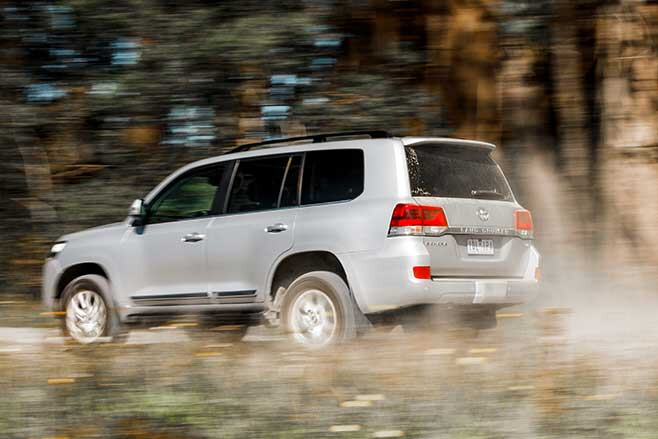
On the negative side, the obvious problem is that both the electric motor, and the battery that’s central to the hybrid system take up room. On current hybrid cars the batteries are in fact significant in size. Room for the battery will invariably compromise the petrol-tank size and/or the luggage space even if the electric motor can be accommodated more easily by being integrated into the transmission. Both the hybrid battery and electric motor will also add weight, which is never a good thing with a 4×4 (or any car for that matter).
On the positive side, and it could be major positive, the off-idle and low-rpm assistance provided by the electric motor should be just the ticket for low-range crawling on rocky and steep tracks and the like. Current petrol-electric hybrids all have the electric motor assisting the internal combustion engine in initial takeoff and at low speeds given electric motors produce full torque from zero revs.
On High Country tracks where you invariably climb a hill only to descend down the other side and then climb another, the hybrid’s ability to recapture when descending a hill some of the energy just spent on climbing the same hill will also be a major bonus. Don’t be surprised if a petrol-electric 300 comes close or even matches the fuel economy of a 200 diesel on High Country tracks. All will depend on the efficiency and of the hybrid system.
Speculation has it that the petrol-electric hybrid 300 Series won’t in fact be a plug-in hybrid, which will disappoint those rural folk who have plenty of roof area on their sheds for solar panels, as solar panels equate to free ‘fuel’ for a plug-in hybrid (or a full EV) once the installation costs are paid.
And what about a 300 Series diesel you ask? Don’t worry, there will be one of them too.
HEAD into any 4×4 workshop in the country and you’ll find some of the most-equipped toolboxes you can imagine. Huge breaker bars, deep impact sockets, rattle guns that’d break the earth in half before leaving a stuck harmonic balancer bolt in place.
Head down the road to the new housing estate and you’ll find some of the most expensive carpentry tools you can buy. High-end laser levels, lithium-powered circular saws and drill bits so expensive they should be included in the national budget.
It seems that no matter how many half-done projects lie around the house, when it comes time to deck out your toolbox for work only the best will do. It’s no surprise then that 4X4 Australia contributor and off-road show producer Dan Everett has one of the most-equipped off-road toolboxes you can buy.
You may remember his 60 Series LandCruiser on 80 diffs from about 100 years ago (best leave that alone) but as his work started needing longer trips in more isolated locations than the 60 was up for, Dan started looking towards new dual cabs to step up to the plate.
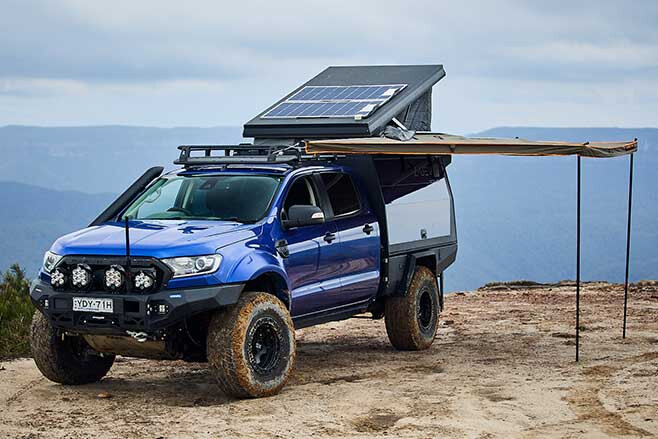
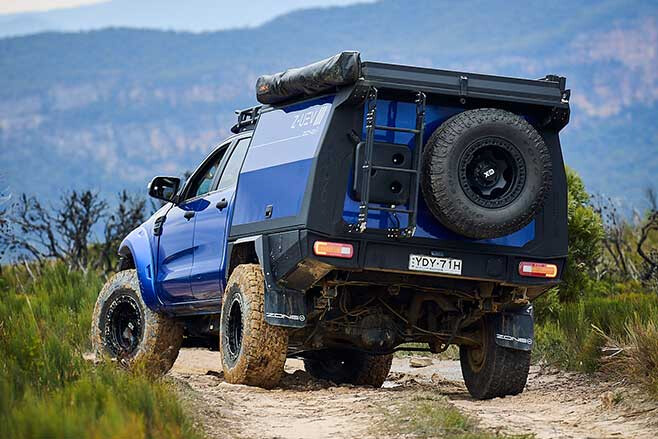
With the PX2 Ranger being one of the largest available utes at the time that met the budget, the path was set. It’s had a few forms since then, so we’ll just focus on how it sits now. Big.
Eagle-eyed readers will note there’s a whole lot more Ranger than you’d typically find parked out the front of your local jetski shop. The secret is a 300mm chassis extension by Sydney workshop Ultimate Stretches.
“I was doing a lot of towing and loaded-up travel,” Dan tells us. “I was getting concerned about how much the campers were throwing the rig around, and how much weight was behind the rear axle. Brad stretched the wheelbase out to suit a space cab tub giving me 300mm of cargo space in front of the rear axle for better weight balance, and a longer wheelbase which made the rig far less twitchy on and off road”With the Ranger now 300mm longer, Dan set about correcting the proportions in every other direction as well. First up was an altitude adjustment. All four corners now ride on Drivetech 4x4s Enduro Pro suspension.
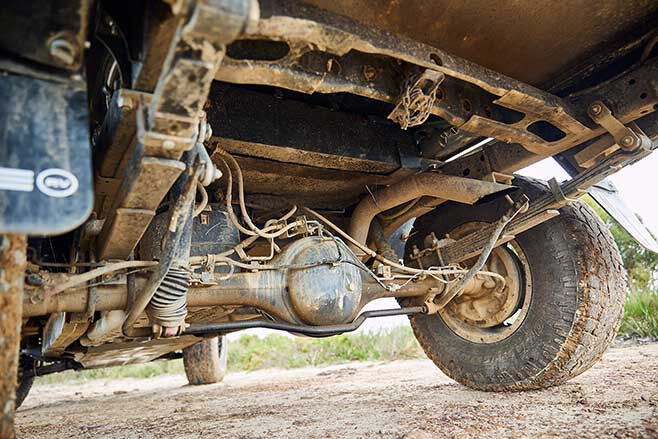
The remote reservoir shock’s extra oil capacity helps them cope with the added work of reining in such a big rig in harsh, corrugated country. Up front Dan’s dialled the adjustable struts in 50mm over standard and paired them with a set of matching Drivetech 4×4 upper control arms.
At the back, 300kg constant-load leaf springs slide between the shocks, while a Drivetech 4×4 sway bar kit helps reduce body roll without requiring excessive spring rates. Under the cab Dan’s installed a 50mm Superior Engineering body lift, allowing extra room for the wheel and tyre package at full bump, without running a huge suspension lift.
The combination, with a little bit of wheel-arch massaging from a grinder has let Dan punch the Ranger’s width out a little over 7in from stock. The 17x9in -38 KMC Robby Gordon Beadlock wheels replace the +55 factory offerings, while the tyres have jumped up to 35×12.5R17 Toyo Open Country AT2 Extremes on each corner. Up front 80mm wide Utemart flares have been fitted to cover the increase in track.With the Rangers build sheet starting to fill out and the ever-pressing GVM figure of 3.2t looming closer, Dan started looking for options to meet his gear requirements while keeping things under the weight limit. One of the biggest factors to keep weight down is the use of aluminium rather than steel on the bar work.
The Rival bar up front and dual-speed Drivetech 4×4 12,000lb winch are nearly half the weight of a typical steel setup. The bar also houses four laser beams of driving lights with a combination of Baja Designs LP9s and LP6s lighting the way.
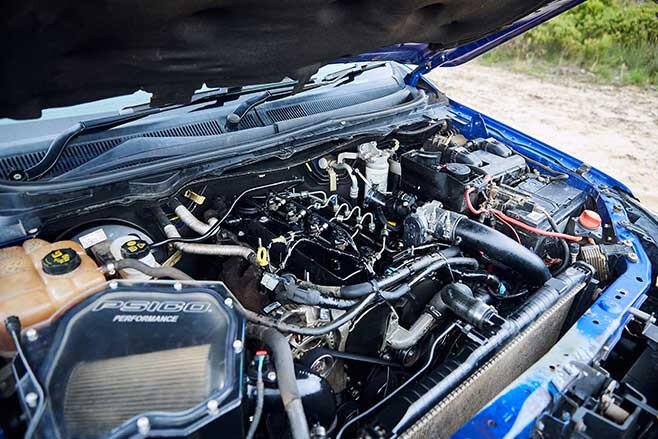
From here Dan took the rig down to AE-CO 4×4 in Sydney’s west to come up with a performance package that’d not only see the big rig motoring along the tracks, but doing it reliably too. First up is the Phat Bars 4in stainless-steel snorkel; it feeds down through the guard into a Psico Performance sheet-metal airbox and high-flow pod filter before a Harrop-sourced high-flow turbo compresses the intake air. From here, a hard pipe kit feeds the air through the Harrop front-mount intercooler before it’s finally forced into the built engine.
Inside is chock-full of Engine Australia components, with Billet rods holding on to ceramic-coated pistons. The whole rotating assembly is balanced and held in with massive billet main caps on the crank. AE-CO 4×4 also fitted a gear-driven oil pump to reduce the chance of oil supply failure (a common problem in the 3.2 Duratorq) while a brand-new head was also installed with ARP head studs keeping it in place, even with increased boost. Before the final tune was loaded in, +30 per cent fuel injector nozzles were also given the nod to keep AFRs happy.
Moving back the factory auto has been opened up, and inside the standard valve body has been replaced with a Wholesale Automatics heavy-duty offering. The factory thermostat has been bypassed and the OEM cooler binned. A dual-row PWR transmission cooler has been fitted up front. A deep sump with cooling fins was also added, giving nearly 30 per cent more oil capacity.On the inside there’s been no major modifications, but a series of small add-ons here and there make life a little easier on the road. An ECU=Shop Monster Gauge helps Dan keep an eye on engine vitals, while a GME XRS UHF has been installed under the centre console as a lifeline should help be required. With the stock rear mirror pointing at a window-full of stickers, a permanent rear-view camera feeds into a windscreen-mounted monitor.
Moving rearward Dan’s ditched the tub and optioned up a lightweight canopy from Qld-based Zone RV. The canopy is built like a high-end yacht with fibreglass composite panels making up the base of the construction; it not only insulates the entire canopy helping fridges work more efficiently but also keeps weight down, the empty canopy having a similar weight to the old tub.
Opening up the passenger side door and Dan’s optioned up a full-length kitchen making for quick meal prep on the side of the track. To the left, stacked Evakool fridge drawers make optimal use of the space without the added weight of fridge slides. To the right, a full pantry setup has storage for plates, cups, food, and even a coffee machine and toaster. Underneath, a small sink has hot and cold running water, with a full-width stainless-steel prep bench sliding out from the rearmost saddle box.
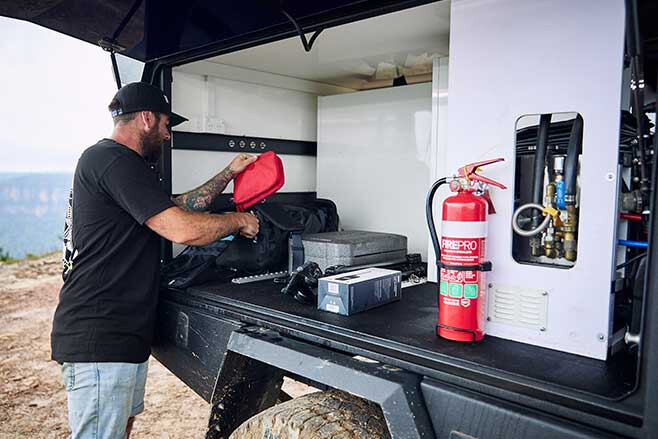
Tucked in next to the fridge is an Enerdrive system with a DC to DC charger, 2000W inverter, 200amp/h lithium battery, and Simarine digital gauge monitoring battery levels as well as the 100L water tank underneath.
Moving around to the driver’s side door, inside is a massive storage space designed to fit everything from his son’s mini bike, to space cases for camping or camera equipment. Tie-down rails spaced throughout allow things to be stored securely. There’s also an Eberspacher diesel heater unit plumbed to the kitchen sink, Quick Pitch shower, and an optional tent heater pumping up into the built-in rooftop tent for sub-zero camping trips.
While the debate between solid axle and IFS will no doubt rage on for years to come, there should be no doubt that no matter what vehicle you base your build off, the right combination of modifications and a clear direction with what you’re trying to achieve is a sure path to success.
Although Dan tells us if you’re trying to build a remote-area camera-car Ranger with billet internals and a kitchen sink you might want to set aside a casual $140,000 to get the job done.
EVER heard of Coorabakh National Park on the mid-north coast of NSW?
The entire area is scattered with stunning beaches and coastal getaways, but sometimes if you look a little inland you just might be surprised. Sitting quietly between Taree and Port Macquarie, Coorabakh NP has many surprises with volcanic plugs, stunning lookouts, and huge rock formations inhaling pristine rainforest and eucalyptus old-growth forests. Coorabakh is relatively small at 1830 hectares and was declared protected in 1999 to preserve its wide variety of wildlife and the park’s stunning scenery.
Entry to the park can be made from Moorlands, just south of Port Macquarie, where there are plenty of signs pointing you in the right direction. Traversing through dairy farms upon leaving the Pacific Highway, you get a sense of adventure as you look west towards the escarpment ridge lines that lie ahead.
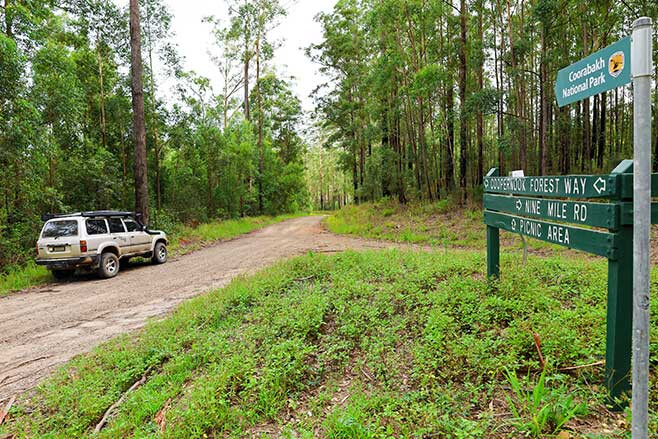
One of my favourite stops before heading in to the park is the little country store at Hannam Vale. Jam-packed with home-made goods, it has its own sit-in book exchange and library plus the best coffee and other sweet creations for miles. The cafe-cum-post office, store, local meeting place and once a servo dates back to 1914 and is still loaded with old-school charm.
Once heading out from Hannam Vale into the state forests, keep an eye out for the old logger trees, where you can still see the cut-outs from the planks the timber cutters stood on when these huge trees were cut by axe more than 100 years ago. The forests are full of eucalyptus, hardwood, coachwood and bloodwood trees.
BEST 4X4 TRACKS: Close to Sydney
The forest loop drive of around 100km isn’t a hard drive, but in some sections, where the road gets a little steep, it might be wise to select 4WD high-range for added traction. The road base out here changes from a granite material to black soil that can get pretty slippery in times of rain.
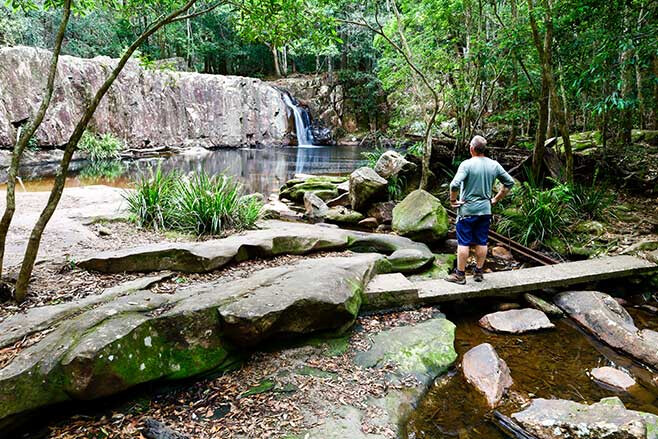
Along the way are many stops to explore such as Waitui Falls. In summer this is a great spot for a dip, with the water spilling over a massive rock face into a deep pool while surrounded by a pocket of rainforest and several overhanging rock faces. It’s popular with the locals, and has picnic tables and a barbecue to use.
Forest Way heads into Coorabakh NP and is significant to the local Biripi Aboriginal people, taking its name from Coorabakh, meaning bloodwood.
STARRS CREEK
HEADING deep down in to Starrs Creek picnic area you’ll find toilets, tables and a formed pathway which lets you wander through a thick pocket of stunning rainforest. Here you can get up close and personal to large red cedar stumps, and wander through a maze of spectacular palm trees where the grounds are often covered with a thick moss in the cooler times – but keep the bug spray handy as the mosquitoes can get pretty friendly.
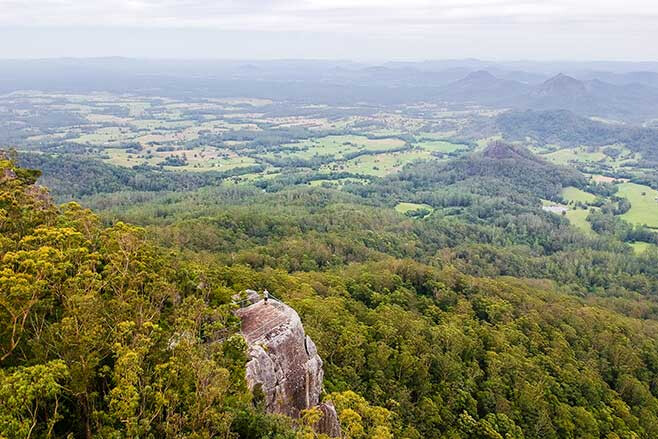
Farther along Forest Way you’ll climb higher on to the ridge lines, the forests thinning out and giving way to scattered views westward through the trees. There are several lookouts on the way including Flat Rock, where the road runs beside some seriously steep cliffs that drop down into the neighbouring valley.
Flat Rock viewing platform has been built right on the edge of the cliff line, where the views are nothing short of spectacular in all directions. It’s wheelchair friendly too. In the distance, remnants of volcanic plugs that blew their tops out millions of years ago can still be seen. These tall, jagged peaks stand several hundred metres high and are scattered in the valley farmlands.
BIG NELLIE
ON the forest loop there’s Big Nellie. Thirty-million years ago this volcanic plug exploded high and wide but, after it cooled, it left a tall, thick chunk of rock poking high above the surrounding forest. Keen hikers and rock climbers frequent the rock for the challenging and heart-thumping scramble to the top.
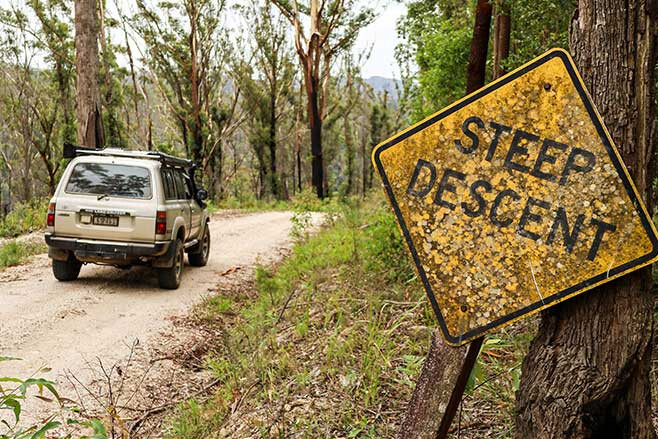
Other plugs in the area include Little Nellie and Flat Nellie, where, over time, the lower, softer areas have eroded away due to intense rain and constant winds. However, on the protected southern slopes the soil is deeper and more fertile; there are tall eucalyptus forests, yet the creek lines carry more sub-tropical species. The diversity of animal species come from the wide range of landscape and plant communities. Koalas, brushtail possums, Parma wallabies, stuttering frogs and a host of bush birds are just a few of the species found in the park.
NEWBYS
FOR those who may be a little scared of doing an extreme walk to the top of a volcanic plug, you can explore Newbys caves and Newbys lookout. It’s a short, easy stroll from the parking area up beside a stunning creek lined with palms and other cool-climate trees. The path leads to a number of overhanging rocks, where caves have formed from times when the creek was in full flood due to raging torrents of water.
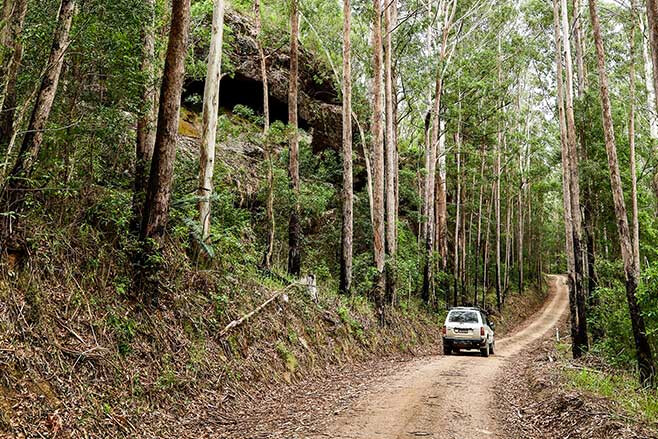
The lookout and caves were named after John Newby, who established the first dairy farm in the Manning. A pioneer of the district who lived between 1810 to 1880, he ran the first well-organised trading service in the valley using the river as the main form of transport.
Slowly, the densely forested land was opened up, with Newby at the forefront establishing his dairy farm and becoming the inventor of several farming creations. When he died his family owned most of the farming land that you can see from the lookout, though today it’s owned by private landholders and shared with State Forests and National Parks.
Moving along Forest Way the last stop is the very impressive Vincents Lookout. While it’s a short 2km detour off the main road up Tower Road, it’s worth another look at the stunning views covering the coastline, fertile valleys and parts of the Great Dividing Range. From the many lookouts around Coorabakh it’s evident the tall-timber NP is not only being preserved for the future, but it also allows full access to the public.
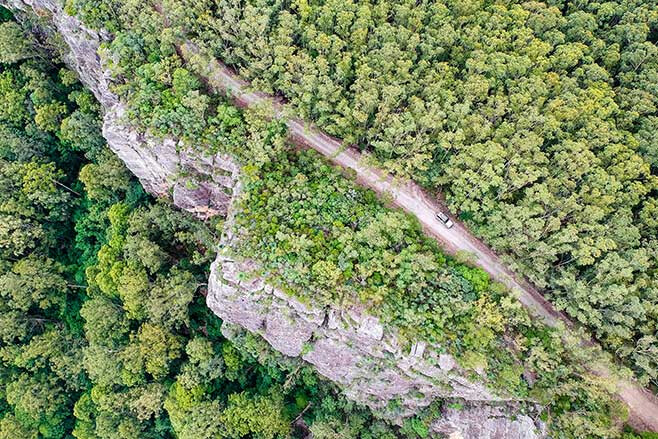
The Great Dividing Range that runs for thousands of kilometres along our east coast can often look the same, but Coorabakh has a different feel with its tranquil setting and the peaceful drive.
No camping is allowed in this National Park, but at the end of Forest Way at Coopernook is cheap camping near the pub or an hour away in Crowdy Bay NP.
Exploring Coorabakh National Park might only take a day, but where else can you view volcanic plugs, swim in cool mountain waterholes and remain so close to the eastern seaboard.
THE first dunes of the morning are always the easiest, tyres pressures are low in the cool desert air and the sand the firmest of the day. By lunch it’s a different story and the steep dunes keep on coming, temps reach the mid 30⁰Cs, the sand soft, tyre pressures down to 13/14psi and all the gear gets pushed to the limits, especially trailers, and this one was being put to the ultimate test.
It was day three on the WAA Line in the Simpson Desert and less than a week before we’d taken delivery of the first production Sierra ZR to roll off the production line.
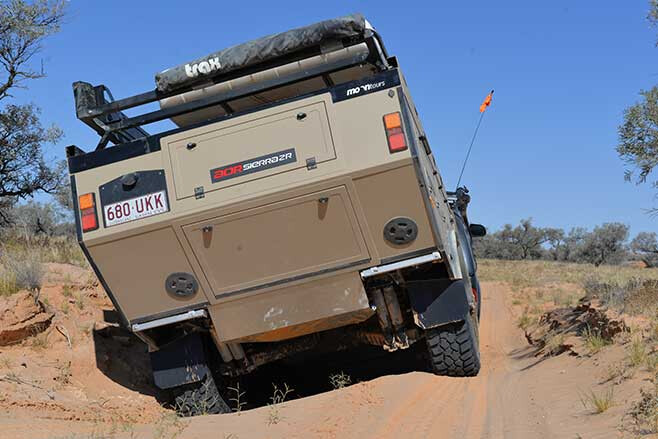
Towing trailers across the desert is frowned upon by many and we don’t recommend tackling the steeper eastern sides of the dunes if you intend to do a crossing, but it’s not illegal. Trent’s crossed the Simpson more times than he can remember and knows from experience it’s not vehicles or trailers chopping up the track, it’s people. With the right setup, the correct tyre pressures and the right approach, he wanted to make a point that in fact it can be done without buggering it up for everyone else.
In all, Trent and Steph have now done more than 12,500km with the camper, rolling into Melbourne none the worse for wear after its outback adventure that not only saw it head across the Simpson, but also to Uluru, Kakadu, the north coast of Arnhem Land and then the Gulf Country before heading to the east coast and a long bitumen run south.
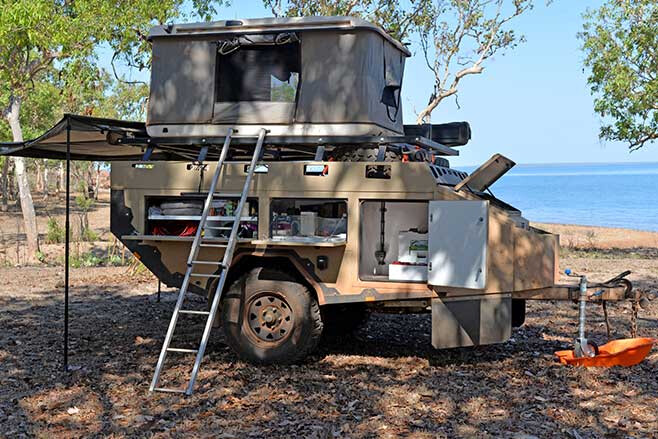
Established in 2000, the AOR brand has garnished a good reputation for high-quality and reliable campers. The Sierra ZR is the latest offering in the AOR camper range that now numbers 10 separate models from this relatively small rig to the company’s 19-foot Aurora off-road van.
The Sierra ZR is based on the well-spec’d Sierra camper which made its first appearance in 2019, but the more basic ZR has been designed and built for those amongst us who already have a long list of camping gear such as a rooftop tent, gas stove, a portable fridge, awnings and more. It also allows the budget conscious buyer to get into a quality Aussie-made product adding stuff as his or her wallet and inclination allows. It does come reasonably well-equipped however; read on to find out more.
CHASSIS & SUSPENSION
THE chassis is made from 100mm x 50mm SupaGal and powder coated high-tensile steel, and rides on AOR’s proven independent trailing arm and variable-rate coil-spring suspension, which is backed up with twin Outback Armour Offroad gas shockers on each wheel. Adjustable air-suspension is an option, but I’m not too sure why you want that.
The 17x8in steel rims are standard fare, fitted with Cooper Evolution 285/70R17 MT tyres and all this is backed up by 12-inch electric brakes along with 2500kg rated axles and bearings. The stud pattern of the hubs can be matched to suit any popular tow vehicle.
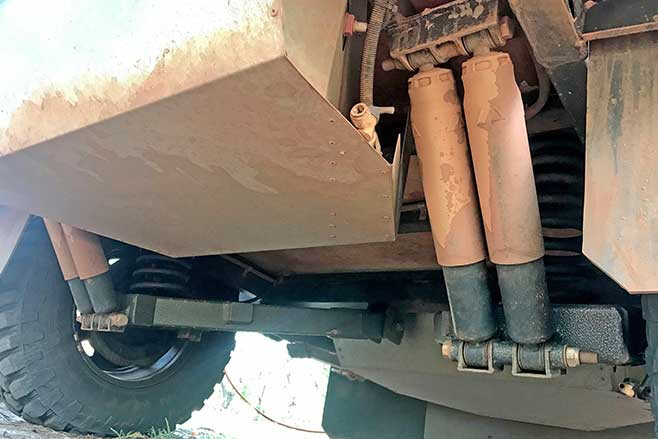
The A-frame is finished with an excellent DO35 coupling and a rather light-duty Ark jockey wheel. While it has done the job we’d like to see something a little bit sturdier; maybe the Ark Extreme Offroad jockey wheel.
One thing we liked was the electrical wiring which all runs through the chassis rails for excellent protection, while a couple of Anderson plugs allows for the connection of solar panels and the like.
BODY & STORAGE
THE camper body that includes the walls, floor and roof are made from a lightweight but strong alloy/fibreglass sandwich material that also helps insulate the interior. The nose-cone storage box sitting on the A-frame is made from aluminium, while the whole unit is covered in a tough, durable Raptor coating where you have the option of three colours; ‘platoon’ (olive green), ‘fighter jet’ (grey) or ‘desert storm’ (sandy brown). Ours wore the ‘desert storm’ colour.
BUYER’S GUIDE: 4×4 Camper Trailers
The body is 1950mm wide which is much the same width as a four-wheel drive vehicle, while the camper has a slanted and faceted design giving better aerodynamics than a straight-sided box.
Along with the suspension a cut-away rear end helps give the trailer a departure angle in excess of 40 degrees, which is pretty darn good (a Tvan for example sports a 30 degree departure angle and goes anywhere) which is more than apparent in steep-sided creek crossings and the like.
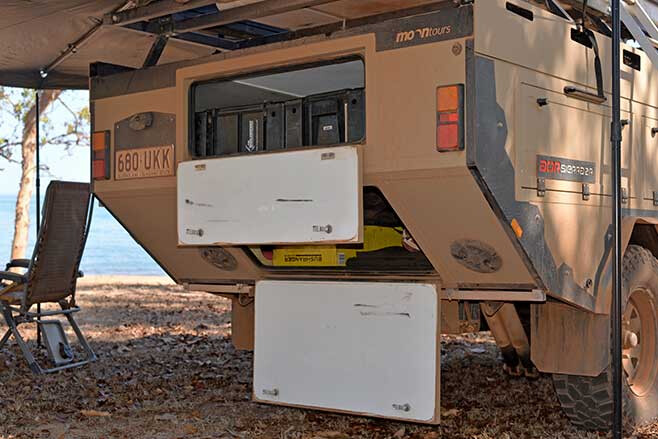
There’s a heap of storage to go with the impressive 900kg or so of payload capacity that the ZR is rated at. In addition to the cavernous nose cone, there is six large dustproof storage areas, a large tunnel-type storage ideal for carrying poles and the like, an optional fridge storage area with self-supporting slide and a couple of compartments at the front of the nose cone meant for gas bottles.
The tyre storage area at the rear of the trailer we converted to a more usable and valuable dustproof storage area by putting the two tyres we carry as spares on the top of the trailer thanks to some additional reinforcing and tie-down points fitted by AOR during the build. This shifting of the tyre’s weight forward threw a bit more weight on the towball, but that didn’t affect the towing ability or stability of the trailer at all. This area under the ultra-heavy-duty roof rack is an excellent place to store camping gear like additional tents or long items such as surfboards and the like, while also coming in handy for wood storage or throwing in the Maxtrax between recoveries.
The roof rack itself is big enough to fit a couple of rooftop tents if you so desire, but we took our roomy James Baroud rooftop tent from our Hilux and fitted it to the camper trailer. We also fitted our Rhino-Rack batwing awning to the edge of the rack and this covers the kitchen area and rear of the camper with plenty of shade and protection. At the rear of the rack we opted for the AOR supplied Bushranger Trax shower tent which has proven to be easy and quick to set up.
All the compartment doors come with good seals and high-quality compression locks to keep the dust and water out; something that AOR goes to extraordinary lengths to achieve.
EXTERNAL KITCHEN
THE external kitchen area offers a fridge slide, a drop-down preparation area with a stainless-steel bench as well as a pull-out slide for a stove fitted with drop-down sink and running water as standard. There’s also internal storage for all your kitchen requirements and the food and condiments you use each and every day. How you set the area up and where you position your stove is really up to you, while we opted to have our favourite Coleman stove sitting on the bench that also has the sink on it.
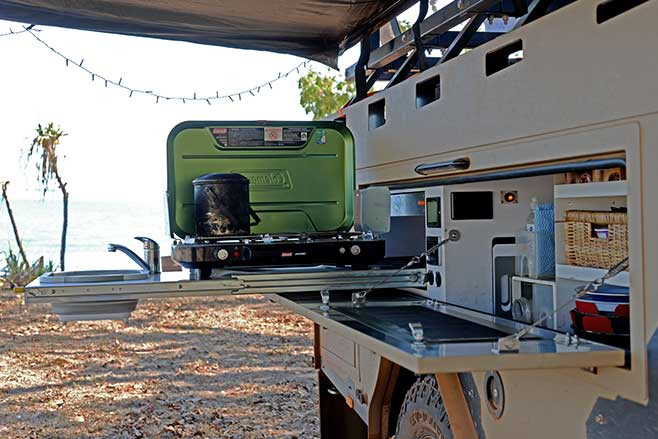
Quick connect low-pressure gas connections are fitted to the camper near the kitchen as well as down the back near the shower area. Our high-pressure Coleman stove demands a separate gas feed which is no great drama, although we’re considering a low-pressure Thetford unit, supplied as an option by AOR, in addition to our normal setup to cater for the large groups we often have with us.
The optional Bushranger hot-water system can supply water to the front kitchen or the rear shower area via a handy quick-connect connection, making for a no-hassle water supply. Talking of water supply, we added an extra 140-litre tank to the standard 60-litre setup giving us adequate water where we can fill one with not so great aqua, while leaving one as a drinking supply. Backing that up is a twin water filter – a paper one for getting rid of dirt and sediment and a carbon filter to improve the water taste and smell.
ELECTRONIC MASTERPIECE
WHILE standard fare is a single 150amp/h lithium battery we opted for two all backed up by a FinScan PowerCORE battery management and automation system. This unit incorporates a 12V 30amp charger, a MPPT solar regulator, 240V AC charging, and a 3.5-inch touchscreen display with mobile device connectivity.
The unit has the capacity to switch lights on and off, check water tank levels, while monitoring battery usage and remaining battery capacity. And it’s Aussie designed and made.
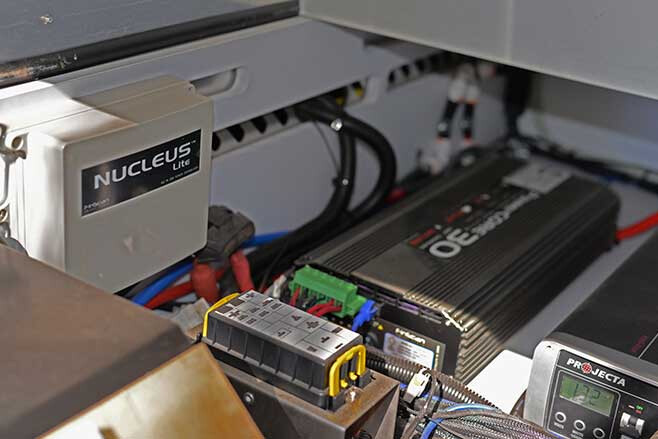
There’s plenty of LED lights throughout, while all the externals are dual-colour, anti-bug lights. We also opted to fit a Projecta 2000W Intelli-Wave inverter. In all, it’s a very impressive and handy electronic setup that has been well-laid-out and wired.
ON- AND OFF-ROAD
THIS unit has proved to be a well-made and reliable camper trailer which offers a heap of storage and the flexibility to suit a role of different camping and touring styles, or those with a variety of camping gear already at their fingertips. Likewise, you can opt to get a ZR fitted with the lot straight from the factory.
On the road and in the rough stuff the trailer tows like a dream and we rarely knew it was there – even behind the not-so-powerful Hilux. Its light weight means you don’t need a V8 Cruiser or similar to tow this rig.
A BUYER’S GUIDE TO: Roof-top tents
In all we can’t recommend the Sierra ZR highly enough. For us and Moon Tours, the trailer will be more than adequate for the many outback trips we have planned for 2021 and beyond. After our tough test we don’t expect any issues with it and its great build-quality ensures it has many years of tough service in front of it.
AOR SIERRA ZR SPECS
BODY: Alloy/fibreglass sandwich walls and roof; aluminium nose-cone CHASSIS: SupaGal and powder coated high-tensile 100mm x 50mm steel TARE WEIGHT: 850kg standard; 900kg as tested ATM: 1800kg PAYLOAD: 950kg standard; 900kg as tested TRAVEL LENGTH: 4300mm EXTERNAL BODY WIDTH: 1950mm TRAVEL HEIGHT: 1890mm (plus rooftop tent) SUSPENSION: AOR independent trailing arms and coil springs with twin gas shockers per wheel TOW COUPLING: DO35 rated to 3500kg DEPARTURE ANGLE: 40.7° BRAKES & AXLES: 12-inch electric brakes; 2500kg axles and bearings WHEELS & TYRES: 17x8in Black steel rims with LTZ 285/70-17; 33-inch tyres as standard; Cooper tyres as tested BATTERY: 150amp/h lithium battery (two batteries as tested) BATTERY MANAGEMENT: FinScan PowerCORE INVERTER 240V POWER: Two power points as standard; Optional Projecta 2000W full sine wave inverter as tested LIGHTING: LED lights throughout; inc. external dual-colour, anti-bug lights SOLAR: Anderson plug supplied for optional portable panels GAS: Single 4.5kg standard; two as tested. Fully protected, with front and rear bayonets (1 for shower area; 1 for kitchen area) WATER: 60 litres standard (200lt as tested) HOT WATER: Optional gas water heater COOKING: BYO FRIDGE: BYO SHOWER: Optional external rear hot/cold shower AWNINGS: BYO WARRANTY: 12 months parts and labour; 5 years on chassis PRICE: From $29,900